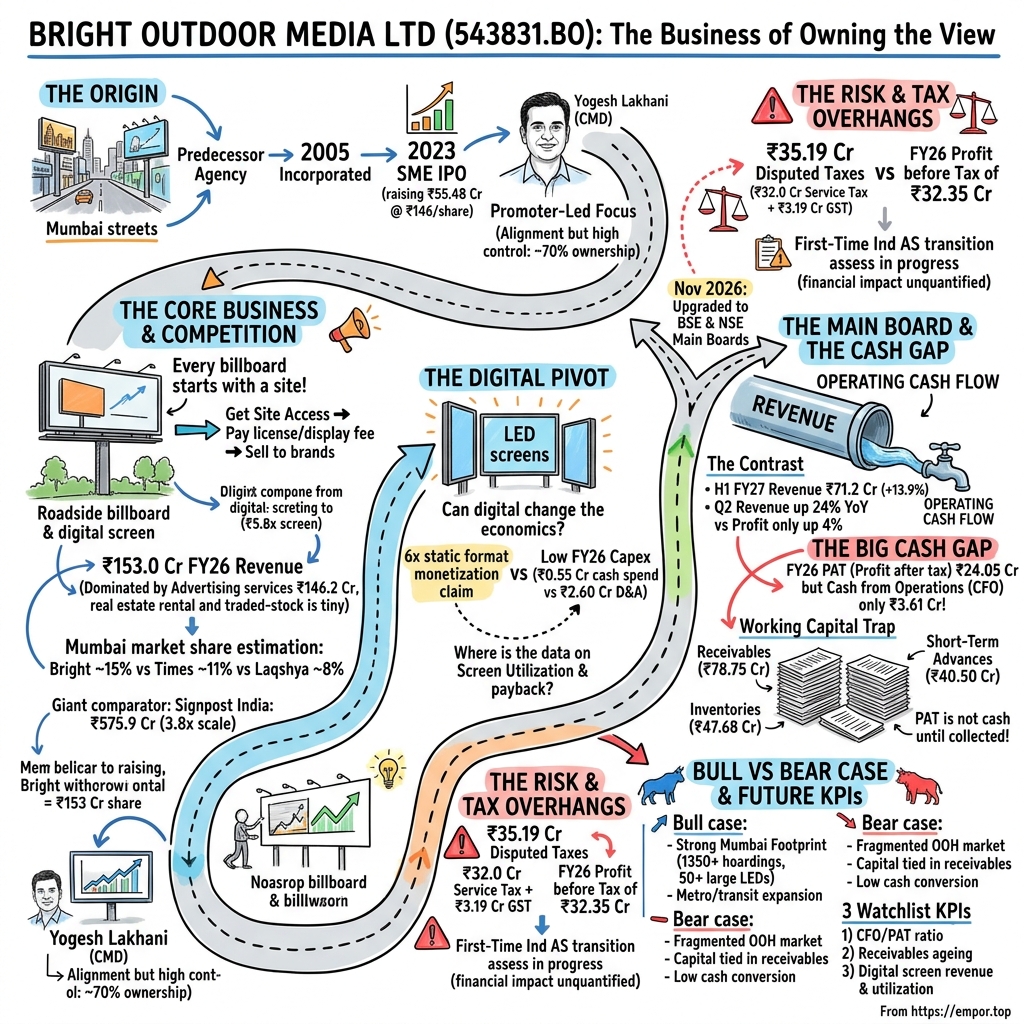
Bright Outdoor Media: The Business of Owning the View
I. The Main Board, and the Question Behind the Move
Stand at a junction on the Western Express Highway in Mumbai at eight in the morning and look up. Above the traffic there is a hoarding the size of a tennis court, lit and freshly pasted, selling a phone, a flat in a tower that does not yet exist, or a bank that wants your salary account. Several hundred thousand people will see it before lunch. Almost none of them will think about who owns the steel it hangs on, who negotiated the right to put it there, or who is waiting for the advertiser to pay for the month it ran.
Bright Outdoor Media is the company that thinks about little else. On 6 November 2026, after three and a half years on the BSE's platform for small and medium enterprises, its shares moved to the main boards of both the BSE and the National Stock Exchange.1 For a promoter-run Mumbai billboard business, that was a graduation. The SME platform is a deliberately narrow room: large minimum lots, thin trading, a shareholder register that can be counted in hundreds. The main boards open the door to any retail account in the country, to mutual funds that cannot or will not buy SME paper, and to the scrutiny of a much larger audience. The company announced the move with a description of a network of more than 1,350 hoardings and more than 50 large LED billboards, the kind of inventory list that reads well on a listing day.1
Eight days later the company did something far less ceremonial. It reported its September-quarter numbers, the first set published under the new listing, and they did not tell the same tidy story. Revenue from operations for the three months reached about ₹41.8 crore, up roughly 24% on the same quarter a year earlier.2 Profit after tax came in at about ₹7.05 crore, up only about 4%.23 The business had sold a quarter more advertising, and kept almost none of the increase as additional profit.
Stretch the lens to the whole half-year and the picture softens but does not change. Revenue for the six months to September 2026 was about ₹71.2 crore, up 13.9%, and profit after tax was about ₹11.0 crore, up 9.5%.2 Subtract the second quarter from the half and the first quarter emerges as nearly flat on revenue against the year before. So the half-year was one quiet quarter and one busy one, and in the busy one, profit lagged far behind sales. Some of that is the rhythm of the outdoor business, where festival-season campaigns, real-estate launches and election cycles can swing a single quarter. Some of it may be cost: location rentals, display charges and the price of filling inventory do not always move in step with what advertisers pay. The company's quarterly filing does not separate those effects, which is precisely why the quarter matters. It is a small, clean example of the question that runs through the entire story.
That question has three parts. The first is commercial: can Bright make scarce city locations pay, consistently, at prices that leave a margin after the cost of securing them? The second is financial: does the profit it reports become cash in the bank, or does it sit for months as money owed by advertisers, advances paid to partners and inventory held on the balance sheet? The third is about trust: does a promoter-led record, with its forecasts, disclosures and governance habits, support the price the market has been willing to pay?
Each part has a number that sharpens it. On the commercial side, the company sells something that looks scarce, a view of a city that can only hold so many billboards, but it does not publish the utilisation of its sites or the revenue each screen earns. On the financial side, the most striking figure in the company's recent history is a gap. Across the five years to March 2025, Bright reported roughly ₹46 crore of cumulative net profit, while its operations consumed about ₹11 crore of cash over the same span.45 In the year to March 2026 it reported about ₹24 crore of profit and only about ₹3.6 crore of cash from operations.4 On the trust side, the shares traded in September 2026 at nearly 40 times trailing earnings, a multiple that assumes the first two questions resolve in the company's favour.5
There is one more complication, and it is technical but consequential. Moving to the main boards brought Bright under India's converged accounting standards, Ind AS, which replace the older Indian GAAP rules most small companies use. The statutory auditor's limited review of the September 2026 results carried an emphasis-of-matter paragraph: the company's first-time adoption of Ind AS was still being assessed, and the financial effect had not been quantified.2 That is not a qualification of the accounts, and the auditor did not say anything was wrong. It does mean the numbers investors are reading at the moment of graduation are a bridge between two accounting regimes, and the far side of the bridge has not been fully described.
The listing day, then, is best read as a raised stake rather than a verdict. A bigger stage brings more liquidity, more analysts and more potential owners. It also brings more people asking why receivables grow faster than sales, why a growth target from 2025 was missed, and why a profitable company has so rarely produced free cash. To answer any of that, the story has to go back to where the business came from: a single Mumbai agency, and a promoter whose name was on the office deed long before it was on a share certificate.
 Subscribe on LinkedIn
II. A Mumbai Business Becomes a Listed Company
Every listed company has an origin story, and every prospectus has an incentive to tell it generously. Bright's prospectus reaches back beyond the company itself to Bright Advertising Agency, a proprietary concern run by Yogesh Lakhani, whose business was outdoor advertising and publicity in Mumbai.6 The listed company, Bright Outdoor Media Ltd, is a later creation. It was incorporated in 2005, and it is that entity, not the older agency, whose shares investors buy.64
The distinction sounds pedantic until one looks at what survived the handover. The proprietary concern did not simply vanish into the company. Two decades after incorporation, the title to Bright's office premises at Crescent Tower still stood in the name of Bright Advertising Agency through Yogesh Lakhani, a detail the statutory auditor flagged in the FY26 report.4 The office is not a large economic asset, and nobody has suggested the arrangement is improper. But it is a neat physical symbol of how the business grew: as an extension of one man's agency, with the formal boundaries between promoter and company drawn later, and not always completely.
Lakhani is the constant through all of it. He is chairman and managing director of the listed company, and Jagruti Lakhani serves alongside him as a whole-time director.4 The company's public materials say little about his early life, and the company's investor materials lead with hoardings rather than with the founder. What does show up in the record is a particular style. He kept control through the listing and after it. He pays himself modestly relative to the company's profits: ₹36 lakh in each of the last two fiscal years, against profit after tax that reached about ₹24 crore in FY26.4 And he has run the business as a Mumbai operator first, building its reputation on access to sites in a city where every square metre of road-facing wall is contested. In July 2025 the company appointed Mukesh Sharma as chief executive, a step toward separating day-to-day leadership from the promoter's chair.4
The year the city stopped commuting
The single most important event in Bright's pre-listing history was not a contract win. It was a pandemic. Outdoor advertising is a bet on people being outdoors. When Mumbai locked down in 2020, the commuters, the traffic jams and the railway crowds that make a hoarding valuable all disappeared at once. Bright's revenue, about ₹70.5 crore in the year to March 2020, fell to about ₹24.0 crore in the year to March 2021.6 Two-thirds of the business vanished in twelve months.
What that collapse revealed is worth holding on to, because it bears on every later debate about the moat. A billboard company's costs do not fall as fast as its sales. Site rentals, concession fees and display charges are often contracted in advance, staff must be retained, and structures must be maintained whether or not a brand rents them. That Bright survived the year without the business breaking says something about its relationships with landlords and partners. That revenue fell by two-thirds says something about how completely the company depends on the advertising budgets of others. It owns access to the view, not the audience in front of it.
The recovery was nearly as dramatic. Revenue roughly doubled to about ₹50.5 crore in FY22 as the city reopened, and kept climbing.6 By the time Bright filed its prospectus in March 2023, the story it could tell was one of a rebound becoming a growth trajectory: a Mumbai specialist with a long operating history, an expanding network and a promoter who had kept the company together through the worst year in the industry's modern history.
Going public on the SME platform
The prospectus was dated 3 March 2023. It offered 38 lakh fresh equity shares of ₹10 face value at ₹146 each, raising about ₹55.48 crore.6 The issue went to BSE's SME platform, a venue designed for younger and smaller companies, with simpler listing conditions and a narrower investor base. After the IPO, the promoter group held about 72.72% of the company.5
For the investors who bought in, the bargain was specific. They were not buying a media brand with its own audience, like a newspaper or a television channel. They were buying an intermediary: a company whose value depended on securing and selling advertising access, managing the gap between what it paid for sites and what it charged for them, and collecting from customers on time. The prospectus was candid about some of the risks. It warned that delayed collections, customer defaults or the loss of a major customer could hurt results.6 It also showed that customers were concentrated enough to matter. In FY21, the pandemic year, the five largest customers accounted for about 36.5% of revenue and the ten largest for about 54.4%; by the six months to September 2022, those shares had eased to about 27.5% and 40.5%.6 Concentration that high is common in outdoor advertising, where a handful of real-estate developers, consumer brands and political campaigns can dominate a city's spend in a given season, but it means a few relationships carry real weight.
The prospectus also described the company's billing in reassuring terms, saying it usually billed and collected on relatively short cycles.6 Keep that sentence in mind. It is the first claim in the record that the later cash-flow statements put to the test.
What the IPO did, above all, was convert a long-running local business into a public-market growth story with a price. The money gave Bright working capital and the ability to bid for more locations. The listing gave Lakhani a currency, a valuation and a reason to tell investors where the company was going. To judge whether it got there, the next step is to look closely at what, exactly, it sells.
III. Every Billboard Starts With a Right to the Site
Picture a brand manager at a consumer-electronics company in August, planning the festival season. The plan calls for a fortnight of outdoor presence in Mumbai: a few giant hoardings on the arterial roads, panels at suburban railway stations, perhaps time on a digital screen near a mall. The brand's media agency calls several outdoor vendors and asks what they have available, where, for how long and at what price. Bright is one of the calls.
Before that call ever happens, Bright has already done the hard part, or the expensive part. It has secured the right to put an advertisement at a particular location: by leasing a wall or a rooftop from a landlord, by winning a concession from a municipal body, a railway authority or a transit operator, or by partnering with whoever controls the site. It has paid, or committed to pay, display charges and related costs for that right. It has built or maintained the structure, which can mean steel frames, lighting and, increasingly, LED screens. Only then does it sell the space, and only after the campaign runs does it bill the customer and wait to be paid.
That sequence is the whole business, and it explains almost everything else in Bright's accounts. The company carries cost before revenue, it earns its margin on the spread between site cost and selling price, and its profitability depends on how much of each site's time it manages to sell. An unsold month on a hoarding is like an empty seat on a flight that has already taken off: the cost was incurred, the revenue is gone forever. The company recognises service revenue when the service is completed or substantially completed, which in practice means the campaign has run.4
What Bright actually sells
In the year to March 2026, Bright reported revenue from operations of about ₹153.0 crore.4 Almost all of it, about ₹146.2 crore, came from the sale of services, which is the advertising business: selling time and space on hoardings and other formats.4 The company lists an unusually broad menu of those formats, spanning roadside hoardings, railway placements, buses, cinemas, kiosks, toll plazas, gantries and digital screens.4 The remainder of revenue came from three small lines. About ₹5.0 crore came from the sale of rights or inventory of traded stock, about ₹1.4 crore from real-estate rentals and about ₹0.4 crore from printing.4
The mix settles one question quickly. Bright reports two operating segments, advertising and publicity on one side and real estate on the other, and it carries real-estate and hoarding-structure inventory on its balance sheet.4 A casual reader might conclude it is half a property company. It is not. Rentals were under 1% of revenue in FY26, and the traded-rights line, the more volatile of the minor streams, was around 3%. Real estate is a feature of the balance sheet, which matters for the cash story later, but it is too small to define the income statement. The company does not publish a useful split of profit between its two segments, so there is no way to tell whether the property side earns more or less than the advertising side on the capital it uses.
What the filings also do not specify is the commercial unit of the core product. Bright does not disclose a standard pricing basis, typical campaign duration, minimum commitments from customers or the share of revenue that recurs from year to year.4 An airline publishes load factors and yields; a hotel publishes occupancy and room rates. Bright publishes total revenue. That is the first gap in the record, and it is not a small one, because occupancy and price are the two levers that determine whether a location-based business is getting stronger or weaker.
The shape of the market
Outdoor advertising in India has two very different neighbourhoods. The roadside market, with its hoardings on private buildings and along highways, is fragmented. Hundreds of regional operators hold a few dozen or a few hundred sites each, and the landlords who own the walls can and do switch vendors when leases end. The premium end of the market looks different: concessions for airports, metro systems, railway stations and municipal street furniture are awarded through tenders, often for several years, and the winners can hold exclusive rights over large clusters of high-traffic inventory. That end of the market is more concentrated, and it is where the larger listed players have built their positions.
Bright's own claim to scale is local. A management-meet note published by the brokerage Share India in August 2025 estimated that Bright held roughly 15% of organised outdoor advertising in Mumbai, against about 11% for Times OOH and about 8% for Laqshya.7 Those are broker estimates, built on management conversations rather than audited market data, and nobody publishes an independent census of Mumbai's hoardings by owner. Even taken at face value, they describe a fragmented field, where the self-described leader holds about one-seventh of the organised market and the unorganised market sits outside the count entirely.
The listed comparison that investors most often reach for is Signpost India, another outdoor and transit-media company. Signpost reported FY26 revenue of about ₹575.9 crore, roughly 3.8 times Bright's.8 The comparison is useful for scale and almost useless for anything finer. Signpost's mix leans heavily toward transit and street-furniture concessions in several cities, while Bright's is concentrated on Mumbai roadside and related inventory. What the comparison does show is that Bright is a mid-sized regional operator in an industry where larger players exist and compete for the same national advertising budgets.
Testing the advantage
The bull case for Bright rests on a simple idea: good locations are scarce. A city can only hold so many hoardings, municipal rules limit where new ones can go, and the best junctions, the ones with long traffic signals and dense footfall, are already taken. If Bright controls a meaningful share of those junctions, advertisers who want Mumbai must come to it.
That idea is true as far as it goes, and it is the strongest part of the company's position. Location access is a form of distribution. A media agency assembling a Mumbai plan may find it easier to buy a bundle from one vendor with broad coverage than to stitch together a dozen small operators. Concession wins in transit, if they come, would add inventory that competitors cannot replicate for the life of the concession.
The idea also has limits, and the company's own record exposes them. The first is buyer power. Campaigns are short and budgets are mobile. A brand that runs a fortnight on Bright's hoardings this Diwali can run a fortnight on a competitor's next Diwali, or move the money to digital channels entirely, at no cost beyond a phone call. The second is customer retention. Bright's June 2026 investor presentation reported customer retention of about 60% for FY25.9 Read generously, that means a majority of customers came back. Read critically, it means roughly four in ten did not. For a business whose moat rests on advertisers needing its sites, a retention rate at that level does not demonstrate high switching costs; it suggests advertisers treat outdoor vendors as interchangeable more often than the scarcity argument implies.
The third limit is concentration, which cuts both ways. In the August 2025 note, management was reported to have described a top-five customer share of roughly 16% and a base of more than 5,000 brands.7 If accurate, that would be a striking diversification from the 27.5% to 36.5% top-five shares in the prospectus years, and it would reduce the risk that a single lost account dents results. But it is a broker-reported claim, not a filing, and the company has not published an updated customer-concentration table in its annual report, so the improvement cannot be checked against the same definition and period.64
Put together, the evidence narrows the moat claim rather than rejecting it. Bright has a real local footprint and likely a distribution advantage in Mumbai; that is enough to win a steady share of campaigns. What the record does not show is pricing power, high switching costs or durable customer lock-in. The company does not publish contract economics by format, utilisation by site or screen, the share of revenue that repeats, or consistent segment profitability. Those are the numbers that would turn a plausible advantage into a proven one, and until they appear, the honest description is a well-placed operator in a competitive market.
Which is exactly why management has spent the past two years pointing investors somewhere else: toward the glowing rectangles that were supposed to change the arithmetic of every site.
IV. The Digital Screens That Were Supposed to Change the Economics
At night, a static hoarding on a Mumbai flyover is a single advertisement, lit from below, saying the same thing to every car for a month. An LED screen in the same spot is a different animal. It can show a jeweller's ad for ten seconds, a telecom offer for the next ten, a film trailer after that, and repeat the loop all day. One structure, one site lease, many paying advertisers.
That is the promise of digital out-of-home advertising, usually shortened to DOOH, and it is the core of the growth story Bright's management told investors. In the August 2025 management meeting, the company was reported to have said that digital placements could monetise up to six times as much as static formats, and to have cited 235 LED displays in its network.7 In its November 2026 main-board announcement, Bright described more than 50 large LED billboards.1 Its January 2025 investor presentation had already put digital growth and utilisation at the centre of the pitch.10
How a screen changes the arithmetic
The logic is easy to follow. A static hoarding can carry one campaign at a time, so its revenue is capped by the rent one advertiser will pay for exclusive use. A digital screen divides time instead of space. If a site can sell six slots in a loop, and each slot commands even a fraction of the static rent, the site's total revenue can exceed what a single static advertiser would pay. Changes are instant, so a brand can buy a single day or a time band, which opens the format to advertisers who would never commit to a month of printed vinyl. Printing and mounting costs disappear. In principle, the same right to the site becomes more valuable.
Everything in that paragraph depends on one word: if. A digital screen earns more only when its loop is full. An empty slot in a digital loop is the same lost revenue as an empty static hoarding, except that the screen cost more to build and costs more to run, with electricity, maintenance and content management added to the site rent. The economics of DOOH are a bet on utilisation, and utilisation is precisely the figure Bright does not publish.
Counting screens, counting money
There are two puzzles in the screen numbers. The first is the count itself. The 235 LED displays cited in 2025 and the 50-plus large LED billboards described in 2026 are not obviously the same thing.71 The most plausible reconciliation is that they describe different categories: the larger number may include smaller screens in transit stations, malls and other formats, while the smaller number refers only to large roadside billboards. But the company has not set out a consistent definition, so an investor cannot tell whether the digital network has grown, shrunk or simply been counted differently. A business asking to be valued on digital transformation should be able to say how many screens it has, of what kind, and how much each one earns.
The second puzzle is spending. Building LED billboards costs money, and a company in the middle of a digital build-out would be expected to show it in capital expenditure. Bright's cash purchases of fixed assets fell from about ₹6.2 crore in FY24 to about ₹0.6 crore in FY26.4 Depreciation and amortisation in FY26 was about ₹2.6 crore.4 Depreciation is not the same thing as this year's capital spending, because it spreads the cost of past investment over time. But when a company spends roughly a fifth of its annual depreciation on new fixed assets, it is not, on the face of its cash-flow statement, aggressively building new structures. The likeliest explanations are that the screen base was largely built before FY26, or that some screens sit in arrangements with partners and venture partners who bear part of the capital cost.4 Either would make sense commercially, and either would change how investors should think about the returns. If partners own the screens, Bright's share of the upside is smaller. If the screens were built earlier, the question is no longer whether the company will invest, but whether past investment is paying off.
The company has not published the evidence that would answer that question. There is no consistent series for digital revenue, digital utilisation, realised rates per slot, payback periods on screens or customer retention by format. The six-times monetisation figure is a ceiling management described in a broker meeting, not a reported outcome.7 An investor can believe it is achievable at a fully booked screen on a premium junction and still have no way to know what Bright's average screen achieves.
Inventory is not yet a result
This is where the story's central caution applies most directly. A screen is inventory. It is the capability to sell. The record of conversion from capability to revenue is what investors should be valuing, and in Bright's case that record is visible only in the total: service revenue grew, overall, by about a fifth in FY26.4 Some of that growth may have come from digital, and some from static sites, transit inventory or pricing. Without a split, the digital thesis is neither proven nor disproven by the numbers. It is simply unmeasured.
The same applies to the company's adjacent ventures. Management has talked up broader marketing services, such as the Bright 360 offering, alongside the core outdoor business. Its filings do not identify material revenue from it, and until they do, it is an extension of the pitch rather than a part of the economics.
There is a reasonable bull version of this section. Digital is genuinely the direction the global outdoor industry has travelled, because it lets operators sell time instead of space and lets advertisers buy with more flexibility. Bright's footprint in Mumbai gives it sites where screens can work. If utilisation is high, the six-times arithmetic need not be fully realised to lift returns meaningfully. The bear version is just as reasonable: screens are expensive, the company's recent capital spending is modest, and the numbers that would demonstrate digital success are absent. Both versions point to the same next step: watch revenue per screen and utilisation, not screen counts.
Management did put a different kind of number on the table in 2025, one that could be checked. It set a growth target for the following year. That target is the cleanest test of how management's forecasts compare with what the business delivers.
V. The Growth Target That Did Not Arrive
In August 2025, Share India's analysts sat down with Bright's management and came away with a confident set of expectations. The note they published reported a FY26 revenue-growth target of 40%, and an anticipated contribution of ₹30 crore to ₹35 crore from new business verticals.7 Those were ambitious numbers for a company that had grown by about 19% the previous year. They implied that something new, whether digital inventory, transit concessions, new verticals or a step-change in pricing, would nearly double the growth rate in a single year.
The audited year closed in March 2026. Revenue from operations rose from about ₹126.7 crore to about ₹153.0 crore, an increase of about 20.7%.411 That is healthy growth by the standards of most businesses, and it is about half the reported target. The new verticals did not appear in the filings at anything like the anticipated scale; the revenue lines that might carry them, traded rights, rentals and printing, together came to under ₹7 crore.4
Two growth stories, one company
The miss matters partly because of how Bright's growth is usually presented. The headline figure is a three-year compound annual growth rate of about 36% for revenue between FY22 and FY25, and about 97% for net profit over the same period.645 Those numbers are arithmetically correct and economically misleading, because the starting point, FY22, was a city still climbing out of lockdown.
The full arc tells a more honest story. Revenue fell to about ₹24.0 crore in FY21, rebounded to about ₹50.5 crore in FY22, then grew by about 110% in FY23 as advertising returned to normal levels and the company recovered and expanded.65 After that, the pace settled. Revenue grew about 16.5% in FY24, about 18.9% in FY25 and about 20.7% in FY26.54 That three-year run, roughly 17% to 21% a year, is the operating rate the business has demonstrated since the recovery ended. It is a respectable rate. It is not 36%, and it is not 40%.
Profit followed a similar path. Net profit rose about 19% in FY25 and about 26% in FY26, to roughly ₹24 crore, after spectacular growth in the recovery years.54 Margins expanded sharply as revenue recovered, with net margin climbing from about 4% in FY21 to about 15% by FY24 and staying there in FY25.5 That margin expansion is a genuine achievement and explains why profit grew faster than revenue in the early years. It also explains why the profit growth rate had to slow: once margins stabilise, profit can only grow about as fast as revenue unless the business finds new efficiencies.
The latest quarter as a test
The first half of FY27 offers the most recent evidence, and it does not support a reacceleration. Revenue grew 13.9% for the half-year, below the FY24 to FY26 range, and profit after tax grew 9.5%.2 The second quarter showed strong revenue growth of about 24%, but profit after tax grew only about 4%.23 Whatever drove the revenue surge, it came at a cost. Either the new business carried lower margins, or costs rose faster than sales, or some combination. The quarterly filing does not decompose it.
None of this means management lied. Targets reported in a broker meeting are aspirations, often stated in a hopeful moment and rarely accompanied by the assumptions behind them. But the gap between the reported target and the result is itself a piece of evidence about how to weigh the company's forward-looking statements. When a company says it will grow 40% and grows 21%, and then grows 14% the following half-year, the reasonable inference is that its own forecasts should be discounted until the filings catch up with them. Management's own subsequent explanation of the gap matters here, and it has not been set out in the annual report or the main-board announcement with the specific, quantified reasons an investor would need.41
What would change the verdict
The case for faster growth is not dead. It is simply unproven. Three kinds of evidence would revive it. The first is several more years of growth from the post-recovery base, ideally at or above the 17% to 21% range, so that investors can trust it is the business's normal speed rather than a recovery tail. The second is a separation of the advertising-service revenue from the real-estate and traded-rights lines, so that investors can see the core business growing on its own terms. The third is disclosed revenue and margins for any new vertical management has described, so that the ₹30 crore to ₹35 crore forecast can be tested directly against what was delivered.
Until that evidence appears, the growth verdict is narrower than the headline: Bright is a business growing at roughly a fifth a year, with a recent tendency for profit to grow more slowly than revenue. That is still good. But growth that cannot be converted into cash is a very different thing from growth that can, and the place where Bright's story most needs scrutiny is not the income statement at all.
VI. The Profit That Went Looking for Cash
On 31 March 2026, Bright closed its books on its most profitable year. Profit after tax was about ₹24.05 crore.4 The same cash-flow statement that confirmed that profit also showed what happened to it. Cash generated from operations, after working capital and taxes, came to about ₹3.61 crore.4 For every ₹100 of profit the company reported, about ₹15 arrived in the bank as operating cash.
It was not a one-off. Across the five years from FY21 to FY25, Bright reported cumulative net profit of about ₹45.6 crore while its operations consumed a cumulative ₹10.7 crore of cash.645 Over that half-decade, the company's operating cash flow was not just smaller than its profit; it was negative. Once capital spending is deducted, free cash flow over those five years was about negative ₹29.8 crore.5 Whatever the company was building, it was paying for it with shareholders' money and with profits that never turned into cash.
Following the money
Where does profit go when it does not arrive as cash? In a business like Bright's there are three usual destinations, and the FY26 cash-flow statement shows money flowing into all of them.
The first is receivables, the money advertisers owe. Trade receivables rose from about ₹60.2 crore to about ₹78.75 crore during FY26, absorbing about ₹18.6 crore of cash.4 In other words, of the roughly ₹26 crore of additional revenue the company booked during the year, about seven rupees in every ten was matched by additional money owed rather than money collected. Receivables at year-end were equal to about half of the year's revenue, which implies customers were taking roughly six months on average to pay. Recall the prospectus's description of relatively short billing and collection cycles. The balance sheet tells a slower story.64
The second destination is advances. Short-term loans and advances absorbed another ₹12.5 crore or so during FY26, leaving them at about ₹40.50 crore at year-end.4 Advances in this business can be perfectly commercial: deposits to landlords, prepayments for site rights, money paid to partners ahead of a campaign. But the balance also includes inter-corporate deposits, which rose from about ₹2.72 crore to about ₹8.67 crore.4 Inter-corporate deposits are loans to other companies, and the company does not identify the counterparties in the relevant note. A billboard company that lends money to unnamed companies is making a treasury decision, not an advertising decision, and shareholders deserve to know who is on the other side.
The third destination is inventory. Inventories stood at about ₹47.68 crore at the end of FY26, a figure that includes real-estate and hoarding-structure inventory.4 Inventory absorbed a relatively modest ₹1.9 crore in FY26, but in FY25 it had absorbed about ₹9.7 crore.4 For a company where real estate is under 1% of revenue, carrying nearly ₹48 crore of inventory is a substantial commitment of capital, and its connection to future advertising revenue is not spelled out.
Payables and other liabilities offset part of the drain. Taxes, about ₹8.42 crore paid in FY26, took the rest.4 What did not explain the gap was non-cash accounting. Depreciation in FY26 was only about ₹2.60 crore.4 This is not a company whose profit is depressed by heavy depreciation and whose cash is therefore healthier than its earnings. It is the reverse: its earnings look healthier than its cash.
The encouraging signal, kept in proportion
There is a better piece of news inside the receivables note. The portion overdue by more than six months fell from about ₹16.34 crore at March 2025 to about ₹11.70 crore at March 2026, even as total receivables rose.4 The oldest debts, the ones most likely never to be collected, shrank. That suggests the company has been chasing its slowest payers, and it is the most concrete evidence that collections discipline is improving.
It does not settle the question. About ₹23.15 crore of the FY26 receivables, up from about ₹15.56 crore, were display charges accrued but not yet due.4 That means campaigns had run and revenue had been recognised, but the company had not yet billed, or the bill was not yet payable. Accrued revenue is a normal feature of businesses that recognise sales when services are delivered, but it grows the gap between profit and cash by definition, and its collection depends on contractual terms the company does not describe. The directors also said trade-receivable balances remained subject to confirmation and reconciliation.4 In plain English, the company had not yet confirmed every balance with every customer. And the annual report does not provide a full ageing schedule, customer-level overdue balances or a roll-forward of the provision for doubtful debts.4
What the company does disclose is small. It wrote off about ₹0.41 crore of bad debts in FY26 and recovered about ₹0.18 crore of previously written-off debts.4 Those figures are modest against a receivables balance near ₹79 crore, which is reassuring in one sense: the company has not been forced into large write-offs. But a small write-off figure is not proof of good credit quality when the ageing detail that would demonstrate it is missing.
There was a brief moment when the pattern seemed to be turning. In FY25, operating cash flow was positive at about ₹5.05 crore, as receivables actually released cash while inventory absorbed it.4 Then FY26 brought the receivables surge, and cash conversion fell back to about 15% of profit.
Why this is the central constraint
A company that turns little of its profit into cash cannot fund its own growth. It must borrow, issue shares, or slow down. Bright has, so far, chosen the second option: it raised equity at the IPO and again in a preferential issue, as the next chapter of the story describes, and has used that money in part to carry its working capital. Each rupee of capital tied up in receivables, advances and inventory is a rupee not available to build screens, bid for concessions or return to shareholders. It also leaves the company exposed if advertisers slow their payments in a downturn, because the cash cushion would be thinner than the profit figures suggest.
The forward test is simple to state and has not yet been passed. Over several periods, operating cash flow after tax should track reported profit, while receivables and advances grow more slowly than service revenue. If both happen, the cash gap will close and the profit figures can be trusted as a measure of value created. If they do not, the profit figures describe something real but not something shareholders can spend. That question leads directly to the people who make the capital decisions, and to a shareholder register dominated by a single family.
VII. A Promoter's Company After the Public Listing
In FY26, Bright's shareholders woke up to find they owned more shares than they had bought. The company had issued bonus shares in the ratio of one new share for every two held, adding about 72.74 lakh shares and lifting the total from about 1.45 crore to about 2.18 crore.4 To make room, it raised its authorised capital to ₹22 crore.4 Every shareholder's slice of the company stayed exactly the same size; it was simply cut into more pieces. The promoter group held about 69.76% of the company before the bonus and about 69.76% after it.4
Bonus issues are popular with Indian small-cap investors, partly because they lower the per-share price and partly because they signal a management's confidence. But they create nothing. No money came in, no asset was built, no customer was won. The bonus is a useful place to start this part of the story precisely because it is the clearest example of a capital event that changes how the company looks without changing what it is worth.
Three capital events, three different meanings
Bright's capital history since listing is short enough to hold in mind, and the three events in it mean very different things. The first was the IPO in March 2023, which raised about ₹55.48 crore of fresh money at ₹146 a share.6 The second was a preferential allotment in February 2024 of 6.2 lakh shares at ₹502 each, to a mix of promoter and non-promoter shareholders.[^12]4 That issue raised roughly ₹31 crore at a price more than three times the IPO price, which tells you how enthusiastically the market had re-rated the company in its first year as a listed business. The third was the FY26 bonus, which raised nothing.4
Put the first two together and Bright has raised roughly ₹86 crore of equity in its first year as a listed company. Set that beside the cash story and a pattern emerges. Over the five years to FY25, free cash flow was about negative ₹30 crore.5 The equity raised did not go into a large acquisition; Bright has not disclosed any acquisition-led growth. It went, broadly, into the balance sheet: into working capital, inventory, receivables, advances and some fixed assets. Capital spending on fixed assets has been modest, and in FY26 it was a fraction of depreciation.4 Most of the capital the business has tied up sits not in screens and steel but in money owed to it, money it has advanced to others, and inventory. That is the honest description of where shareholders' money went, and it frames every judgment about capital allocation. The company has not been reckless with acquisitions, but it has not yet shown that the capital it absorbs earns a cash return.
Dividends have been a token. The company paid its first dividend in FY25, about ₹0.7 crore, under 4% of that year's profit.5 There has been no buyback, rights issue or open offer.4
The family at the top
The promoter group's share of the company has barely moved. It was about 72.72% after the IPO in March 2023, about 69.76% from March 2024 through March 2026, and about 70.11% in September 2026.5 The dip coincided with the preferential issue in early 2024. Outside the promoters, the largest disclosed holder was Aegis Investment Fund PCC, at about 7.64% in March 2025 and about 7.03% in March 2026.4 Foreign institutional ownership peaked at about 9.78% in September 2025 and fell back to about 7.05% by March 2026; domestic institutions held about 1.07% by September 2026.5 The number of shareholders roughly doubled, from 535 in March 2026 to 1,024 in September 2026, as the company prepared for its main-board move.5
A promoter holding of 70% cuts in two directions. It means Lakhani's personal wealth rises and falls with the share price far more than with his salary, which is the classic alignment argument. It also means outside shareholders cannot block any ordinary resolution and can only influence special resolutions at the margin. At the 2024 annual general meeting, every vote cast on every reported resolution was in favour, including the item on Jagruti Lakhani's designation and remuneration, but only about 69.78% of outstanding shares voted, which is roughly the promoter group's own stake.12 In a company like this, the AGM records what the promoters decided, not what independent shareholders thought.
Pay, loans and a disclosure that does not add up
Director pay has been restrained. Yogesh Lakhani received ₹36 lakh and Jagruti Lakhani ₹12 lakh in each of FY25 and FY26, a combined ₹48 lakh a year against profits in the tens of crores.4 The FY26 report also showed combined managerial remuneration for directors and key managerial personnel rising about 79%, largely because the company added a chief executive in July 2025; median employee pay rose about 24%.4 For FY27, the company sought shareholder approval for directors' aggregate remuneration above the usual 11% of net profit and up to 15%.4 That is an approval ceiling, not a payment. At FY26 profit levels, 15% would be worth several crore, compared with the ₹48 lakh actually paid. There is no evidence the ceiling will be used, but shareholders granting it are trusting the promoters' restraint rather than relying on a cap.
The more pointed governance issue is a small one in rupees and a real one in principle. The annual report's related-party note records that Yogesh Lakhani lent money to the company and was repaid: about ₹2.05 lakh in FY26, and in FY25 about ₹1.78 crore taken and ₹1.88 crore repaid, alongside smaller transactions with Jagruti Lakhani and the family's Hindu undivided family.4 Elsewhere in the same report, the auditor's CARO annexure states that the company did not enter into related-party transactions.4 Both statements cannot be literally true. The likeliest explanation is technical: the CARO statement may refer to a narrower class of transactions, or to transactions requiring a particular form of approval. But the FY25 loan flows were equal to about 1.4% of revenue, large enough to warrant a clear explanation, and the company has not given one. In a promoter-controlled company, consistency between the related-party note and the auditor's statement is not a formality; it is how outside shareholders check that the family's dealings with the company are fully visible.
The capital record, then, is neither alarming nor reassuring. It shows a promoter who has kept control, paid himself modestly, raised capital when the market was generous and spent it mainly on working capital. What it does not show is a track record of turning that capital into cash returns. And it raises a question that becomes sharper when the audit report is read in full: if the disclosures are slightly inconsistent in a small matter, what does the rest of the audit say?
VIII. The Tax Disputes Behind the Clean Audit Opinion
An unmodified audit opinion is the sentence every listed company wants and most receive. Bright's statutory auditor gave one for FY26.4 The board reported no auditor qualifications, and the auditor's annexure under the Companies (Auditor's Report) Order, known as CARO, reported no default on borrowings and no material fraud.4 On the first page, the accounts are clean.
Turn a few pages into the CARO annexure, however, and two numbers appear that dwarf most of the others in this story. The company disputes a service-tax demand of about ₹32 crore covering April 2007 to June 2017, and a GST demand of about ₹3.2 crore covering July 2017 to March 2022.4 Together they come to about ₹35.2 crore. Bright's profit before tax for FY26 was about ₹32.4 crore.4 The disputed taxes, in other words, exceed a full year's pre-tax profit.
What the tax authorities say, and what Bright says
The service-tax dispute concerns how Bright's work was classified for a decade before GST replaced the old indirect-tax system. Outdoor advertising involves both a service, displaying an advertisement, and a physical good, the printed material. The company's position is that separately printed material was wrongly treated by the tax authorities as part of a bundled advertising service, which would have attracted service tax on the whole.4 That is a common type of dispute in India's pre-GST era, when the boundary between goods and services was frequently litigated. The GST demand is smaller and more mechanical: it relates to input tax credits the company claimed but which were not reflected on the GST portal.4 That is also a common dispute, often arising when suppliers fail to file their own returns correctly. Appeals in both matters were pending at the FY26 reporting date.4
The age of the demands matters. The service-tax period ends in 2017; the dispute has been running for years, and its outcome depends on appellate bodies whose timelines are slow. It is not a liability the company has recognised; it is a contingent claim the company is fighting. The company's stated grounds are plausible, and many such disputes in India are settled for far less than the original demand. But the amount is material relative to earnings, and an adverse outcome, even partial, would consume more than a year of profit in a company whose operating cash generation is already weak. Investors should treat it as a real risk to capital availability, not as background noise.
Two other numbers should not be confused with the tax demands. The company had performance guarantees outstanding of about ₹5.0 crore at March 2026, down from about ₹5.5 crore a year earlier.4 Those are commitments typically given to railway authorities and other concession grantors to guarantee performance under contracts; they become costs only if the company fails to perform. And the routine claims that any business faces are not in the same category as a disputed tax demand.
Is Bright debt-free?
Bright's balance sheet at March 2026 showed no separate line for borrowings.4 Its non-current liabilities were about ₹1.0 crore, identified as a gratuity provision.4 Finance costs were about ₹0.3 crore, mostly bank charges and processing fees, with borrowing interest of only about ₹0.1 lakh.4 On that evidence, the company looks almost entirely unlevered.
The cash and bank note complicates the picture. It lists a cash-credit account with Cosmos Bank of about ₹3.0 crore and a secured overdraft of about ₹0.6 crore.4 The cash-credit facility is secured by book debts, inventory and fixed deposits, carries a second charge over immovable properties and is backed by personal guarantees from the directors.4 Those amounts are small relative to cash and bank balances of about ₹25.5 crore.4 But a credit facility secured on receivables and guaranteed by the promoters is a borrowing arrangement by nature, and the note does not make clear whether the listed amounts were drawn, undrawn or in credit. A precise investor would not call the company debt-free without confirming how those accounts are classified and what was actually owed. The cash pile also needs a qualifier: about ₹17.8 crore was in demand deposits and about ₹3.6 crore was pledged for bank guarantees and railway tenders, so not all of it was freely available.4
Other income, meanwhile, contributed a growing slice of profit. It rose to about ₹2.4 crore in FY26, roughly 7% of pre-tax profit, mostly interest income of about ₹1.9 crore.4 That is not large enough to distort the earnings picture, but it is a reminder that some of the reported profit comes from the company's treasury rather than its billboards.
The office-title issue also appears in the CARO annexure.4 It is a governance and title detail, not the main operating risk, and it is the kind of loose end that a company moving to the main boards would be expected to tidy up.
What the main board should change
There is no credit rating rationale from ICRA, CRISIL, CARE or India Ratings in the company's annual report or prospectus to offer an independent view of its credit quality.46 So investors are left with the audit report and the company's own disclosures. The main-board move should improve those. A full Ind AS transition will produce restated comparatives, which may change some balances or reported earnings. A main-board company is subject to fuller corporate-governance reporting than an SME-listed one, an exemption Bright had explicitly relied on.4 And the scrutiny of a larger shareholder base should push the company to reconcile the small inconsistencies: the related-party note and CARO, the bank facilities and the absent borrowings line, the receivable balances still awaiting confirmation.
None of these issues, alone, undermines the accounts. Together, they describe a company whose disclosures were built for a small venue and now need to be rebuilt for a larger one. That rebuilding is part of what investors are paying for, which brings the story to the price, and to whether it leaves any room for what could go wrong.
IX. Analysis & Bear vs. Bull Case
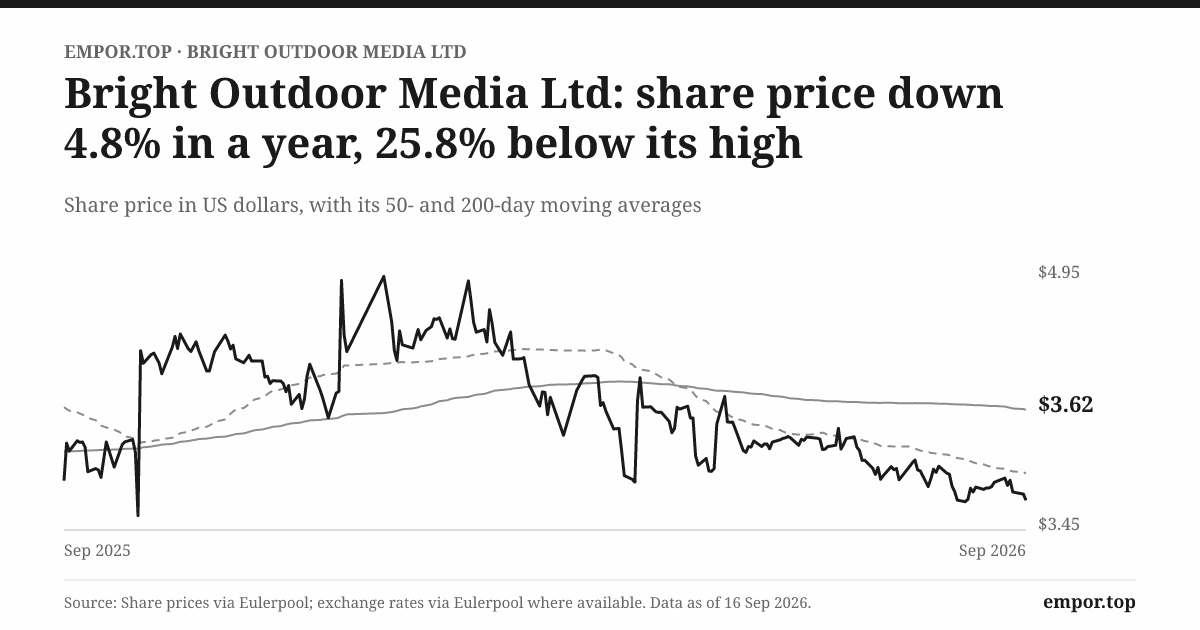
Put two outdoor-media companies side by side. On one side is Signpost India, with FY26 revenue of about ₹575.9 crore, spread across transit and street-furniture concessions in several cities.8 On the other is Bright, with about ₹153.0 crore of revenue, most of it from Mumbai.4 In November 2026, Signpost was trading at roughly 16 times earnings.13 In mid-September, two months before its main-board move, Bright was trading at about 40 times trailing earnings and six times trailing sales, with a slightly negative free-cash-flow yield.5 The smaller, less diversified company with weaker cash conversion commanded the richer multiple.
Those snapshots are not perfectly comparable. They were taken on different dates, Signpost's business mix is different, and Bright's trailing figures at the September snapshot rested on FY25 earnings. Measured against the FY26 profit the company had already reported by then, the multiple at the ₹347 share price was closer to 31 times earnings and about five times sales.54 Even on that friendlier arithmetic, the market was paying for growth and conversion that the record does not yet show. The company has no five-year median valuation to compare against, because it has only been listed since 2023.
Why Bright could win
The bull case begins with geography. Mumbai is India's largest advertising market, and Bright has spent decades inside it. Its network of more than 1,350 hoardings and more than 50 large LED billboards, as described in its main-board announcement, gives it inventory that a new entrant could not assemble quickly.1 Management has pointed to transit and metro opportunities, where multi-year concessions could add inventory that is exclusive by contract.17 If Bright wins those concessions and fills the screens, the digital arithmetic could lift revenue per site without a proportional rise in site costs. A business growing at roughly a fifth a year, with stable net margins around 15% and a promoter whose wealth is tied to the shares, has the basic ingredients of a compounding story.
Why the case could break
The bear case begins with the same geography. A single-city operator is exposed to a single city's advertising budgets, municipal policies and real-estate cycles. Outdoor advertising is fragmented, and roadside inventory in particular is contested by many regional operators. Retention of about 60% shows advertisers do not feel locked in.9 The company has not shown that digital screens improve returns. And the cash record is the hardest fact in the story: profits that consistently fail to become cash, receivables growing faster than sales, advances rising, and inter-corporate deposits to unnamed counterparties.4
The moat, tested once
Michael Porter's five forces offer a useful way to see where Bright's margin comes from and what could take it away. The threat of new entrants is moderate. Anyone can lease a wall, but the best sites and transit concessions are scarce and tendered, so scale and relationships are a real barrier at the premium end, though not on ordinary roadsides. Supplier power is meaningful: landlords, municipalities and transit authorities control the sites, and concession renewals can reset economics. Buyer power is high, because advertisers and their media agencies buy campaigns in short bursts and can move budgets between vendors at little cost, which the 60% retention figure reflects. The threat of substitutes is significant, since every rupee spent on outdoor competes with digital, television and print. Rivalry is intense among regional operators and, at the premium end, among larger players such as Signpost, Times OOH and Laqshya.87
Hamilton Helmer's seven powers framework asks a sharper question: which durable advantages allow a company to earn more than its cost of capital? For Bright, only one power has a plausible claim. A cornered resource, in Helmer's language, is preferential access to a valuable asset. Exclusive concessions and well-placed sites could qualify, but only for the life of each lease or concession, and only if renewals come at attractive economics. Scale economies are weak at Bright's size. Network effects do not apply; an advertiser does not benefit from other advertisers using the same billboards. Switching costs are low, as retention shows. Brand matters at the margin with media agencies, but advertisers buy reach, not the vendor's name. Counter-positioning and process power are not evident. The honest conclusion is that Bright's moat is local, contractual and renewable rather than structural. It is enough to support a profitable business; it is not, on present evidence, enough to guarantee one.
Stress-testing management's case
A skeptical long-short investor would focus on three questions. Do concessions renew on good terms, and does the company disclose renewal economics? Do advertisers repeat, and does utilisation hold outside the festival and election seasons? Can Bright pass through rising display charges, or do rising site costs compress margins, as the September-quarter profit growth might suggest? Each is a mechanism, not a mood, and the company could answer each by publishing figures it already tracks internally.
The same investor would hold management's forecasts against the record. The 2025 targets, 40% growth and ₹30 crore to ₹35 crore from new verticals, met a 21% audited result and new verticals too small to see separately in the revenue lines.74 Until management explains that gap with quantified evidence, every new target deserves the same discount.
The risks that actually work through the business
The risks worth tracking are tied to specific mechanisms. A slowdown in advertising budgets, or seasonal underutilisation, reduces sales while site costs remain fixed, which squeezes margins quickly. Site permissions and concession terms constrain supply, so a change in municipal policy or a lost tender could remove inventory at a stroke. The tax disputes and weak cash conversion affect the capital available to bid for new sites. Artificial intelligence is not a demonstrated standalone risk to a billboard company, but better digital measurement and programmatic media buying could shift advertising money toward inventory that can prove its reach and returns, which would reward operators that publish audience and utilisation data and penalise those that do not.
Three numbers to watch
Three measures will tell investors more about Bright's trajectory than any screen count or growth target. The first is operating cash flow divided by profit after tax, which stood at about 15% in FY26, down from FY25's positive reading and far below the 100% that would indicate profits becoming cash.4 The second is the growth and ageing of receivables relative to service revenue; receivables grew about 31% in FY26 while revenue grew about 21%, though the oldest overdue balances shrank.4 The third is utilisation and revenue per digital screen and key concession, which the company does not yet publish. That last absence is itself the point: a business whose central growth claim rests on screen economics will earn the market's trust only when it reports them.
X. Business & Investing Lessons
Return to the junction on the Western Express Highway. The advertisement is up, the traffic crawls past, the brand gets its impressions. For the commuter, the transaction is complete the moment they look up. For Bright, it has barely begun. Somewhere in the company's books, a receivable has been created, an invoice is waiting to be confirmed, and months may pass before the cash arrives. Bright's story yields four lessons that belong to this company more than to any other.
The first is that a location is an option until someone buys the campaign. Bright's investor materials count its hoardings and screens.17 Those counts describe the right to sell, not the act of selling. A billboard on a premium junction that sits half-empty for a quarter is a cost centre with a good view. The lesson for founders building inventory businesses is to report what the inventory earns before reporting how much of it exists, because investors will eventually ask, and the business that has the answer ready controls its own story.
The second is that a profit is not a cash return until the customer pays. Bright's cash conversion remained weak in FY26, following five years in which operations consumed cash despite reported profits.45 The gap reflects cash tied up in working capital. For investors, the lesson is that in an intermediary business the balance sheet is the income statement's conscience: if receivables and advances grow faster than sales for long enough, the profit figure is describing a promise, not a return.
The third is that a forecast earns trust when the next filing can reconcile it. Management's reported 2025 growth target was missed, and new verticals did not appear in the filings at the anticipated scale.74 The miss is not a scandal. Small companies miss targets constantly. The lesson is about what comes after the miss: a management that explains the gap with numbers builds credibility faster than one that hits targets by luck, and a management that moves on to the next target without explanation teaches investors to discount every target that follows.
The fourth is that a bonus makes the share count bigger; it does not make the business richer. Bright's capital story includes two equity raises and a bonus that brought in no money.64 The bonus changed the price of a share, not the value of the company. For investors in Indian small caps, where bonus announcements can move a stock on the day, the discipline is to ask one question of every capital event: did cash come in, go out, or stay exactly where it was?
XI. Epilogue
Tonight, Bright Outdoor Media is a main-board company still facing open questions the listing did not answer.2 Its next audited accounts will arrive after the Ind AS transition work flagged in the September review has been completed, and those accounts will be the first full test of the company in its new venue.2
Four moments will decide whether the main board marks a new phase or merely a new address. The first is completion of the Ind AS transition. If restated comparatives leave balances and earnings largely intact, the accounting bridge will have been crossed without incident, and investors can compare the company's numbers with those of larger peers on a common basis. If the transition moves revenue recognition, receivables or inventory materially, the market will have to reprice a story built on the old numbers.
The second is cash. Receivables stood at about ₹78.75 crore at the end of FY26.4 If the next year shows operating cash flow catching up with profit, receivables growing more slowly than service revenue and the overdue balances continuing to shrink, the central weakness of the story will begin to close. If receivables keep growing faster than sales, the company will need more capital to grow, and the valuation will rest on profits that never quite arrive as cash.
The third is disclosure. A company asking to be valued on digital screens and transit concessions can publish segment profitability, utilisation, revenue per screen and campaign economics. If it does, investors will be able to test the moat directly. If it continues to publish asset counts alone, the thesis will remain a matter of faith.
The fourth is the legal and governance clean-up. The about ₹35 crore of disputed tax demands sit in appellate forums, and their outcome could consume more than a year of pre-tax profit or vanish into a settlement.4 Alongside them, the company has small but visible loose ends to tie: the related-party disclosures that do not match the auditor's annexure, the bank facilities alongside an absent borrowings line, and an office title that still sits with the predecessor agency.4
Each of these outcomes is binary enough to matter and slow enough to watch. Together they will tell investors whether Bright's growth has been the visible part of a durable business or the visible part of a business still waiting for its customers to pay.
XII. Outro
A commuter looks up at a hoarding on a Mumbai flyover, sees the ad for three seconds, and drives on. The view has done its work. Somewhere else in the city, Bright's accounts team is still waiting for the invoice to be paid.
That is the whole company in a single frame. Bright sells public attention by the location, and it has built a real business doing it, one Mumbai junction at a time. Its long-term story comes down to whether it can turn owning the view into owning the cash.
References
-
Main-Board Listing Announcement — Bright Outdoor Media, 2026-11-06 ↩↩↩↩↩↩↩↩
-
Q2 and H1 FY27 Results and Limited Review — Bright Outdoor Media, 2026-11-14 ↩↩↩↩↩↩↩↩
-
Bright Outdoor Media Q2 profit rises 4 per cent to Rs 7 crore — Indian Television Dot Com, 2026-11-15 ↩↩
-
Annual Report FY26 — Bright Outdoor Media ↩↩↩↩↩↩↩↩↩↩↩↩↩↩↩↩↩↩↩↩↩↩↩↩↩↩↩↩↩↩↩↩↩↩↩↩↩↩↩↩↩↩↩↩↩↩↩↩↩↩↩↩↩↩↩↩↩↩↩↩↩↩↩↩↩↩↩↩↩↩↩↩↩↩↩↩↩↩↩↩↩↩↩↩↩↩
-
Shareholding Pattern and Historical Financials — Screener ↩↩↩↩↩↩↩↩↩↩↩↩↩↩↩↩↩↩
-
IPO Prospectus — Bright Outdoor Media, BSE, 2023-03-03 ↩↩↩↩↩↩↩↩↩↩↩↩↩↩↩↩
-
Bright Outdoor Media Management-Meet Note — Share India Securities, 2025-08-01 ↩↩↩↩↩↩↩↩↩↩↩
-
FY26 Audited Financial Results and Auditor's Report — Bright Outdoor Media, 2026-05-11 ↩
-
AGM Voting Results and Scrutinizer's Report — Bright Outdoor Media, 2024-09-26 ↩
 LinkedIn
 WhatsApp
 Reddit
 Hacker News
 Email
 Kindle
 RSS Feed
 Spotify
 Apple Podcasts
 Amazon Music
 Audible
 YouTube