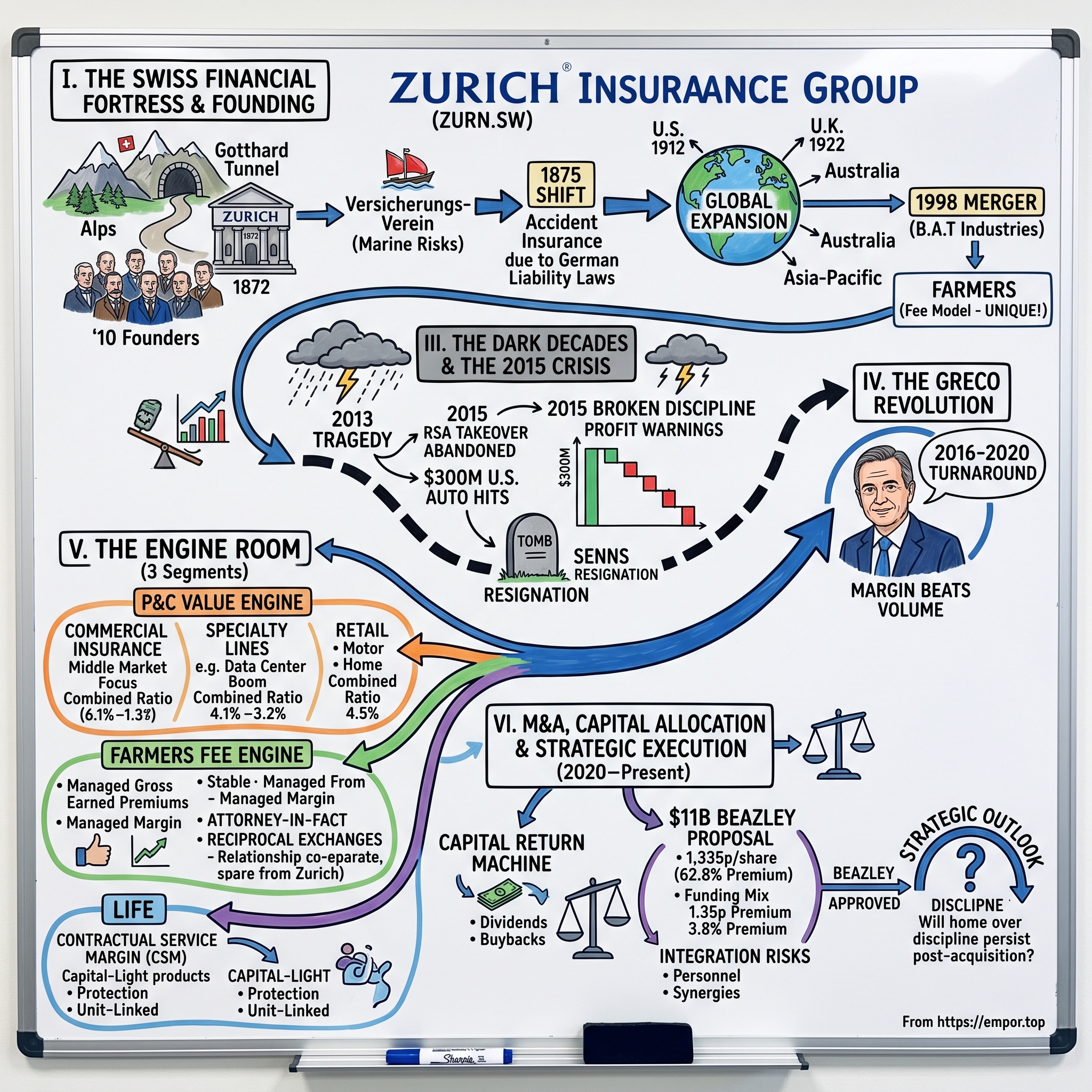
Zurich Insurance Group: The Swiss Underwriting Machine & The Art of Quiet Execution
I. Introduction & The Swiss Financial Fortress
On the morning of February 19, 2026, Zurich Insurance Group reported results that marked a sharp contrast with its performance a decade earlier. The company announced the highest operating profit in its 154-year history—USD 8.9 billion, up 14%—alongside a core return on equity of 26.9% and a proposed dividend increase to CHF 30 per share.1 In the same news cycle, Chief Executive Mario Greco confirmed he was pursuing an £8 billion takeover of London-listed specialty insurer Beazley, telling reporters he had "complete support" from his board and that shareholder feedback had been "super positive."2
Placing those two developments side by side highlights the central tension in Zurich's modern strategy. For ten years, the group built a reputation as one of the most disciplined capital allocators in European insurance—walking away from a major transaction in 2015 to focus on underwriting quality and balance sheet strength. Yet at a point of peak operational performance, management proposed its largest acquisition in a decade.
Consider the baseline scale. Zurich is one of Europe's largest multi-line insurers, operating in more than 200 countries and territories with over 65,000 employees, and serving more than 82 million retail customers at the end of 2025.1 In early August 2026, its shares traded around CHF 615, giving the group a market capitalization of roughly CHF 92 billion.3 Its Swiss Solvency Test ratio—a regulatory measure of capital held against underlying risk exposure—stood at 259% at the end of 2025,1 compared with an internal target floor of 160%.4 In an industry where products represent promises of future claim payouts, maintaining capital reserves significantly above regulatory requirements provides a strong balance sheet buffer.
However, the metric that best explains Zurich's recent trajectory is its return on equity. Core ROE—defined as business operating profit after tax divided by average shareholders' equity—reached 23.0% in 2023, 24.6% in 2024, and 26.9% in 2025.15 A decade earlier, the group struggled to clear low-double-digit returns. That sustained improvement reflects a structural shift in profitability rather than a temporary cyclical fluctuation.
The central thesis, and why it deserves scrutiny. Primary insurance remains largely a commoditized market. Given sufficient capital and a license, any firm can issue a policy. Because coverage terms are standardized, differentiation relies heavily on pricing discipline, service efficiency, and long-term solvency when claims arrive. Scale alone is insufficient; expanded volume combined with weak risk selection accelerates underwriting losses. Financial history features many insurers that expanded premiums rapidly only to discover years later that claim liabilities exceeded premium income.
Zurich's management asserts that it mitigated these structural risks through operational refinement: reducing exposure to volatile commercial lines, expanding fee-based revenues that carry no balance sheet underwriting risk, focusing on commercial middle-market accounts where pricing pressure is less severe than in mega-corporations, and holding every business unit to strict return-on-capital targets rather than top-line volume goals. The operational data supports part of this thesis—the group completed three strategic cycles meeting or exceeding financial targets, improved its combined ratio alongside premium growth, and generated fee income that cushioned overall results during severe catastrophe years.
The counter-argument is that much of the company's recent performance coincided with the hardest commercial insurance pricing cycle in two decades. As premium rates rose industry-wide, underwriting margins expanded accordingly. Disentangling management execution from broader market tailwinds is a primary analytical challenge, particularly as commercial rate increases slowed across key insurance lines by 2026.
The roadmap. This analysis traces five main arcs: Zurich's founding and 19th-century Swiss trade roots that established an early international footprint; the turbulent decade marked by a failed acquisition, leadership turnover, and diminished credibility; the operational turnaround under Mario Greco; the segment economics driving current returns, including the fee-generating structure at Farmers; and a competitive evaluation, risk radar, and investment case centered on whether capital discipline remains intact following the $11 billion Beazley proposal.
To understand why that acquisition offer represents such a significant strategic marker, it is necessary to examine where Zurich's financial strength originated.
 Subscribe on LinkedIn
II. 150 Years of History: From Transport Risks to Global Conglomerate (1872–1998)
In October 1872, as the Gotthard Tunnel was under construction and Swiss engineering was expanding across Europe, ten founders met in Zurich to establish Versicherungs-Verein (the Insurance Association) as a subsidiary of a marine insurer founded three years earlier.6
Operating initially as a reinsurance vehicle, the entity was built to absorb risks that primary insurers preferred not to hold alone. Marine and transport risks formed the natural starting point for landlocked Switzerland, whose export-driven economy relied heavily on foreign shipping and rail networks.
A strategic shift occurred in 1875 when Germany enacted new industrial liability laws holding factory owners responsible for workplace accidents. Recognizing the immediate demand for employer liability coverage, Zurich expanded into accident insurance and renamed itself Zurich Transport and Accident Insurance Limited, opening offices across Europe.6 In 1894, after exiting the marine business, the company rebranded as Zurich General Accident & Liability Insurance.6
This sequence—identifying regulatory shifts that create new liabilities, designing products to cover them, and scaling across borders—became an operational hallmark. That same pattern re-emerged in 2026 as Zurich's construction underwriters positioned the firm ahead of the global data center building boom, continuing a long tradition of underwriting emerging economic activities.
Going global before globalisation was a word. Zurich entered the United States in 1912. By 1920, the U.S. had become its largest single market, generating roughly half of gross written premiums.6 The company made its first full corporate acquisition in 1915 by purchasing Spain's Hispania Compañía General de Seguros, and in 1922 became the first foreign insurer permitted to write direct accident business in the United Kingdom.6 Geographic expansion accelerated with the purchase of Australia's Commonwealth General Assurance in 1961, the consolidation of Germany's Agrippina in 1969, and the establishment of a substantial Asia-Pacific presence by 1980.6
By the time the firm adopted the name Zurich Insurance Company in 1955 to reflect its multi-line reality, it had built an international infrastructure of licenses, claims networks, and local underwriting teams across dozens of jurisdictions.6 For a Swiss manufacturer opening a plant in Brazil or a German industrial group with sites across four continents, this global footprint was the core product, enabling Zurich to issue unified coverage across diverse regulatory environments.
The 1998 merger that changed the earnings mix. The defining corporate event of Zurich's modern era occurred in 1998 through a merger with the financial services arm of the UK's B.A.T Industries. The tobacco group had accumulated an extensive insurance portfolio that included Eagle Star, Allied Dunbar, Threadneedle Asset Management, and U.S.-based Farmers. The combination created Zurich Financial Services and roughly doubled the group's workforce to about 60,000 people.6
The addition of Farmers introduced a unique operational and financial structure to the group.
The Farmers Exchanges—comprising Farmers Insurance Exchange, Fire Insurance Exchange, and Truck Insurance Exchange—are California-domiciled reciprocal inter-insurance exchanges owned by their policyholders and governed by independent Boards of Governors; Zurich holds no ownership interest in them whatsoever.1 What Zurich owns is Farmers Group, Inc. (FGI), a management company that serves as attorney-in-fact for the Exchanges, providing policy administration, marketing, agency management, and technology services in return for a fee.1
Conceptually, this arrangement resembles managing a large mutual fund rather than owning its underlying assets. Policyholders absorb the underwriting risk, while FGI earns fee income for operating the enterprise. When major catastrophes strike, claim payouts draw on the Exchanges' surplus, leaving FGI's fee stream largely protected from underwriting losses.
This fee-based model provided Zurich with a high-margin, capital-light earnings stream—acquired as a byproduct of a tobacco conglomerate's diversification strategy—though its full operational potential would not be fully realized for another two decades.
The structural flaw hiding inside the success. Rapid international expansion through decentralized acquisitions ultimately created an unwieldy organizational structure. By the early 2000s, Zurich operated as a federation of regional units with duplicated functions, highly autonomous local underwriting authority, and minimal central cost oversight. In benign market conditions, this decentralization passed for local expertise; during downturns, it obscured group-wide balance sheet exposure.
That structural vulnerability culminated in 2015.
III. The Dark Decades & The 2015 Crisis: Broken Discipline, Tragedy, and the RSA Collapse (2008–2015)
For a time, Zurich appeared to be one of the few winners of the global financial crisis. While AIG required a U.S. government rescue and several European peers were forced into emergency capital raises, Zurich's conservative asset-liability management carried it through 2008 with its balance sheet and reputation intact. Swiss prudence appeared fully vindicated.
However, surviving a systemic panic is distinct from running an efficient operational business, and balance sheet resilience can mask operational decay for years.
Underneath the high-level solvency figures, Zurich's general insurance division was quietly underperforming. Its combined ratio—the proportion of every premium dollar spent on claims and administrative expenses, where any figure below 100% indicates an underwriting profit—persistently lagged top-performing U.S. competitors. Risk selection across U.S. commercial auto and segments of the global corporate book was lax, pricing discipline was inconsistent, and because underwriting authority was decentralized across regional units, group management lacked the mechanisms to force a contraction when underwriting margins collapsed.
August 2013: the first tragedy. On August 26, 2013, Zurich's chief financial officer, Pierre Wauthier, was found dead at his home. He was 53 and had been with the group since 1996, serving as CFO since September 2011. Zug canton police stated that an autopsy "clearly pointed to a suicide."7 A typed note reportedly assigned blame to the company's chairman, Josef Ackermann, the former Deutsche Bank chief executive. Ackermann resigned within days, stating that he felt partially responsible and should step down; he was succeeded as chairman by Tom de Swaan.8 A subsequent review overseen by Swiss regulator FINMA examined company records, correspondence, and staff interviews, finding no financial irregularities and concluding that Wauthier had not been subjected to undue workplace pressure.8
The regulatory findings cleared the institution legally, but they could not clear the internal atmosphere. What the crisis exposed publicly was a corporate culture where the pressure to deliver financial targets had become paramount precisely as those targets were becoming increasingly unattainable.
2015: the deal that was supposed to fix everything. Under Chief Executive Martin Senn, Zurich attempted to address a structural underwriting problem through major transaction scale. In mid-2015, the group proposed a £5.6 billion (roughly $8.7 billion) takeover of UK insurer RSA Insurance Group—a transaction intended to create a dominant European property and casualty platform.9
Strategic logic suggests why this was the wrong remedy. An acquisition of RSA would have added top-line premium volume, geographic coverage, and administrative cost synergies, but it could not address the mispricing and inadequate loss reserves in Zurich's U.S. commercial portfolio. Those deficiencies stemmed not from a lack of operational scale, but from writing policies at inadequate rates. Acquiring a larger peer merely expands the scale of the underlying underwriting liabilities.
The market never tested the proposed combination. On September 21, 2015, Zurich abandoned the RSA bid and simultaneously issued a series of severe profit warnings: an expected operating loss of approximately $200 million in its general insurance division for the third quarter, aggregate claims of roughly $275 million stemming from explosions at the port of Tianjin in China the previous month, and a comprehensive reserve review resulting in a $300 million negative hit focused on U.S. auto liability and related casualty lines.9 The group announced that General Insurance Chief Executive Kristof Terryn would lead a deep operational review, with management redirecting focus toward "taking the necessary actions to deliver on the required performance."9
In effect, the underlying reality was stark: Zurich could not acquire another major carrier when it had just discovered it did not fully understand its own underwriting liabilities.
The winter of write-offs. The third-quarter disclosures marked the beginning of a broader reckoning. Zurich's general insurance division recorded a $183 million loss for the third quarter of 2015, and on January 20, 2016, management warned of an additional fourth-quarter operating loss of approximately $100 million—marking two consecutive quarterly losses.10 Severe December storms across northern England, Scotland, and Ireland generated an estimated $275 million in claims, while the company absorbed $475 million in restructuring charges tied to accelerated cost cutting across general insurance, including workforce reductions in the UK and Germany.10 Management also indicated it would exceed its 2016 cost-reduction target of $300 million.10
Senn resigned in December 2015 by mutual agreement.11 Five months later, in late May 2016, Senn took his own life at his family home in Klosters at the age of 59. Zurich issued a stark statement: "We are stunned and deeply shaken."11 His death marked the second suicide of a senior Zurich executive in less than three years, with former colleagues describing him as withdrawn following his departure and deeply impacted by Wauthier's death.11
This human toll underscores the consequences when institutional performance expectations become detached from underlying operational performance.
Why nobody saw it coming. Understanding the mechanism behind this collapse is critical, as the same dynamics recur in insurance cycles. Commercial casualty insurance is a "long-tail" business: a policy written in 2011 covering a commercial trucking fleet may not result in a finalized claim payout until 2017 or later. Consequently, an insurer must estimate ultimate claim liabilities at the time of policy issuance and set aside loss reserves accordingly. If those initial estimates prove insufficient, the business appears highly profitable for years because premium revenues are recognized immediately, while reserve shortfalls surface only when claims are settled in court. This multi-year reporting lag allows an insurer to report acceptable accounting margins while silently eroding capital—and explains why a routine reserve review can abruptly transform past reported profits into an immediate operational crisis. Zurich's 2015 reserve additions did not represent a sudden drop in current underwriting quality, but rather the delayed recognition of inadequate pricing years earlier.
What investors should take from it. Two key structural principles emerge from this period. First, corporate acquisitions cannot fix fundamental underwriting deficiencies; M&A merely enlarges and defers the eventual accounting adjustment by combining mispriced portfolios. Second, premium volume growth without rate adequacy is not real expansion, but rather the deferred recognition of future losses—a deferral that can persist for years in long-tail casualty lines before loss reserves reflect operational reality.
By the end of 2015, Zurich had lost its chief executive, abandoned its strategic acquisition, erased a year of earnings, and severely damaged its standing with capital markets. Restoring stability required leadership with deep familiarity with the group's underlying operational weaknesses.
IV. The Greco Revolution: Mario Greco & The Turnaround of a Titan (2016–2020)
Mario Greco was a returning insider with direct knowledge of Zurich's structural challenges.
Zurich announced his appointment in January 2016, and he assumed the role of Group Chief Executive in March.1213 His career path combined management consulting with executive insurance management. Beginning at McKinsey’s Milan office in 1986, he became partner in 1992 and led the firm’s insurance practice.13 He moved to the operational side in 1995 at RAS, Allianz’s Italian subsidiary, starting as head of claims and becoming chief executive in 2000 before joining Allianz's executive board to oversee Southern Europe and Turkey.13 After running Eurizon’s insurance and financial services businesses, he joined Zurich in 2007, heading first global life and later general insurance.13 In 2012, he departed to become Group Chief Executive of Generali, where he executed a turnaround by cutting costs, reducing debt, and divesting non-strategic assets at a company whose net income had hit a nine-year low upon his arrival.12
When Zurich Chairman Tom de Swaan highlighted Greco’s "intimate understanding of our company and our industry," the comment pointed to relevant operational experience, as Greco had previously led the general insurance division where reserve shortfalls later emerged.12 Market analysts viewed the appointment favorably; Zuercher Kantonalbank analyst Georg Marti described the selection as "clearly positive for the stock," characterizing Greco as "a doer" expected to execute a swift operational restructuring.12
The cultural surgery.
The initial operational shift focused on financial discipline over top-line expansion. Management removed volume growth as a primary metric, holding business units strictly to return-on-capital targets. Under this approach, a division expanding revenue could still be judged deficient if capital returns fell short, while a unit contracting its portfolio could satisfy targets by shedding unprofitable risk.
Realigning sales incentives across a decentralized global insurer presents a significant execution challenge. Underwriters and distribution networks traditionally prioritize premium volume. Reconfiguring incentive structures to reward capital efficiency and selective underwriting—even if it results in reduced premium volume—served as a core driver of Zurich’s subsequent margin expansion.
Structural changes followed in 2016 as Greco streamlined organizational layers, consolidated regional management, centralized technology, and standardized global operations. Management backed this initiative with a formal financial target to reduce the expense base by $1.5 billion between 2015 and 2019.
Simultaneously, Zurich reshaped its risk portfolio by exiting unprofitable sub-segments of U.S. commercial auto, curtailing legacy construction exposures, and lowering capacity in volatile property lines. This portfolio de-risking intentionally surrendered lower-margin premium volume to competitors willing to accept narrower pricing margins.
Rebuilding property and casualty around the middle.
Another key strategic decision involved reorganizing Property & Casualty into two segments with distinct economic profiles: Commercial Insurance, covering large global corporations and mid-sized businesses, and Retail, covering personal auto and home lines.
Within Commercial Insurance, Zurich focused on middle-market accounts—companies large enough to require customized risk engineering and multi-jurisdictional coverage, yet small enough to avoid the intense pricing competition typical of mega-corporate accounts. Large corporate accounts feature corporate risk managers and global brokers who routinely renegotiate coverage terms during renewals. By contrast, middle-market accounts demonstrate higher policy retention, are priced on local market conditions, and yield stronger underwriting margins for insurers with global servicing capabilities. By 2025, Zurich's middle-market segment generated an underlying combined ratio of 88.3%—four percentage points better than the average across the remainder of its commercial portfolio.1
Did the targets actually get hit?
Zurich's execution against its announced multi-year strategic targets provided empirical evidence of the operational turnaround.
The 2017–2019 strategic cycle set a target for business operating profit after tax (BOPAT) return on equity above 12%, alongside the $1.5 billion expense reduction program. The strategy was immediately tested in 2017 by a severe Atlantic hurricane season. Zurich’s business operating profit fell 15% to $3.8 billion, and its P&C combined ratio reached 100.9% including catastrophe losses. Despite these headwinds, BOPAT ROE reached 12.1%, cumulative cost savings reached $700 million, the board increased the dividend by 6% to CHF 18 per share, and management announced a share buyback of approximately $1 billion.14 Meeting the return threshold during a peak catastrophe year validated the structural resilience of the revised underwriting model.
For the 2020–2022 cycle, management raised the BOPAT ROE target to above 14%, a benchmark the group achieved despite severe COVID-19 business interruption claims and elevated natural catastrophe losses. At its November 2022 investor day, Zurich set even higher targets for the 2023–2025 cycle: a BOPAT ROE above 20% by 2025, compound organic earnings-per-share growth of 8% annually, cumulative cash remittances exceeding $13.5 billion, and a Swiss Solvency Test ratio of at least 160%.15
Evaluating this performance requires accounting context. The transition to the IFRS 17 accounting framework for insurance contracts automatically added approximately 2.5 percentage points to reported return on equity by altering how insurance liabilities and shareholder equity are calculated.15 Consequently, comparing pre-2023 return metrics directly with post-2023 figures overstates the purely operational gains.
Even after adjusting for accounting rule changes, underlying profitability expanded significantly. Zurich generated a core ROE of 23.0% in 2023 and 24.6% in 2024, exceeding its elevated targets.5 Addressing the unpredictable operating environment at the 2022 investor day, Greco told investors: "We know in the next three years things will not be as we planned… we know how to change gear."15
By the end of the decade, Zurich had transformed from a restructuring case into a consistently profitable underwriting operation. The analytical question turned to the underlying segment mechanics and fee structures sustaining those returns.
V. The Engine Room: Dissecting Zurich's Core Business Segments & Economics
Zurich's profit comes from three engines that fail in completely different weather, which is the whole point of owning all three. In 2025 the group's $8.9 billion of business operating profit was assembled from $5.1 billion in property and casualty, $2.4 billion at Farmers and $2.3 billion in Life, with group functions and non-core businesses absorbing the difference.1 Understanding how each of these actually makes money — and what could stop it — is the core of the investment question.
Property & Casualty: the main value engine
This is the business people picture when they think of Zurich: factories, fleets, construction sites, cargo, homes and cars. In 2025 it wrote $50.4 billion of gross premiums, crossing $50 billion for the first time, generating insurance revenue of $48.2 billion and a combined ratio of 92.6% — an improvement of 1.6 percentage points.1
The combined ratio is the number to internalise. At 92.6%, roughly seven and a half cents of every premium dollar survives claims and expenses as underwriting profit — before the investment income earned on holding the money in the meantime. Push that number above 100 and the underwriting is loss-making, leaving the insurer dependent on investment returns to stay whole. That was Zurich's general insurance position in 2015. The gap between then and now is the entire turnaround expressed as a single statistic.
Within P&C, Commercial Insurance did the heavy lifting: $31 billion of premiums, up 4%, producing $3.8 billion of operating profit, up 12%, at a combined ratio of 91.0%.1 The composition of that improvement is instructive. Commercial motor — the line that helped detonate 2015 — reached a combined ratio of 98.4%, an improvement of more than 16 percentage points, achieved through deliberate portfolio actions including exits from mono-line motor programmes and rate increases.1 Property ran in the mid-80s. Crop insurance, previously a problem, was restored to satisfactory profitability through cost reduction and portfolio management.1
Notice what that list describes: not a rising market lifting everything, but a series of specific, unglamorous fixes to specific broken books. That is the strongest available evidence that the margin improvement contains genuine operational content rather than pure cycle.
Specialty lines tell the forward-looking story. Zurich underwrote more than 200 data centre construction projects in 2025, with its construction book growing 4% at a combined ratio in the low 80s — helping offset deliberate reductions in large-account property excess and surplus business as that market softened.1 By the first quarter of 2026, US construction volume was up 21%, and management explicitly framed the growth as artificial-intelligence-driven data centre and infrastructure demand.16 This is the 1875 instinct again: find the thing the economy has just started building at scale, and be the carrier that already knows how to price it.
Retail, meanwhile, delivered the most dramatic single-year swing. Premiums rose 7% on a like-for-like basis with average rate increases of 5% — and 8% in motor — while operating profit jumped 50%, or $491 million, to $1.5 billion, at a combined ratio of 94.4%.1 Retail motor is a business of rapid feedback loops: repair costs and used-car prices move, and the carrier that refiles rates fastest and segments risk most precisely captures the margin before competitors adjust. Zurich attributed the improvement to pricing sophistication and disciplined risk selection.1 The more sceptical reading is that every personal-lines insurer in the world enjoyed a margin recovery in 2024–25 as the post-pandemic claims inflation shock was finally priced in, and Zurich rode that wave alongside everyone else.
How Zurich competes. Its rivals are Chubb, Travelers, Allianz, AXA and AIG — all of them well capitalised, all of them capable of writing the same risks. The differentiators Zurich points to are its multinational programme capability, its claims network, and risk engineering. On the last of these, Zurich Resilience Solutions operates a global network of about 1,000 risk engineers and consultants, drawing on 75 years of claims data and performing roughly 60,000 risk assessments a year.17
Is that a genuine advantage or a marketing wrapper? The honest answer is: partially genuine, and hard to verify from outside. A risk engineer who walks a client's warehouse and specifies sprinkler upgrades reduces the loss the insurer will eventually pay, and creates a relationship the client is reluctant to unwind at renewal. But Chubb, Allianz and FM operate comparable capabilities, and no insurer discloses the loss-ratio differential attributable to engineering. Treat it as a real but non-unique capability rather than a moat.
Farmers: the fee engine most investors get wrong
Now the unusual one. Because Zurich owns the manager rather than the insurer, its Farmers segment earns a fee that is calculated against the volume of business the Exchanges write, not against whether that business is profitable.
The economics are visible in the disclosure. In 2025 the Farmers Exchanges wrote $29.6 billion of gross premiums and earned $28.9 billion, and Zurich's Farmers Management Services reported a managed gross earned premium margin of 7.0% — identical to 2024.1 That margin stability, held flat across a year in which the Exchanges' own combined ratio swung by nearly seven points, is the entire pitch for the structure. FMS delivered a record $2.2 billion of operating profit within a total Farmers segment result of $2.4 billion.1
The Exchanges themselves had an exceptional year: a combined ratio of 84.6%, an improvement of 6.8 points, and a surplus ratio strengthening to 52.9% from 42.4% — even after absorbing the California wildfires.1 Critically, policy count grew by more than 150,000 for the first time in over a decade, having turned positive after a first-quarter decline and built through the year.1 That mattered because the preceding years of aggressive rate increases had driven customers away; the Exchanges were repairing margins at the cost of shrinking, which is sustainable for a while and then is not.
Zurich does retain some underwriting exposure through Farmers Re, which takes a quota share of the Exchanges' business. That participation was reduced to 8.0% in 2025 from 10.0% the year before.1 It is a modest, adjustable dial rather than a structural risk. There is also a small and growing Agency Brokerages business, where fee revenue rose 21% and operating profit reached $49 million.1
The structural boundary is worth stating clearly because it cuts both ways. On the fourth-quarter 2025 call, Greco was blunt about the separation: "There is no way to connect the capital of the exchanges to Zurich."18 Zurich cannot reach into the Exchanges' surplus to fund a dividend or a buyback — but equally, the Exchanges' losses cannot reach Zurich's balance sheet. The fee is the whole relationship.
The vulnerability, then, is not underwriting. It is volume. If the Exchanges stop growing premiums — because rates fall, or because agents defect, or because policyholders leave — the fee shrinks mechanically, and Zurich has limited direct control over the outcome. This is a high-quality annuity with one moving part, and investors should watch that part.
Life: smaller than it looks, better than it was
The Life business is frequently under-appreciated because the industry's history in life insurance is largely a history of pain — decades of policies sold with guaranteed interest rates that became ruinous when yields collapsed.
Zurich's version has been deliberately rebuilt around three capital-light categories: protection products such as term life and disability, unit-linked savings where the customer bears the investment risk, and corporate pension and employee benefit solutions. In 2025 the segment produced $2.3 billion of operating profit, up 2% as reported but around 10% on an underlying basis once $154 million of prior-year one-off items are stripped out.1 Protection alone drove almost 60% of the segment's profit, with premiums up 5% to $9.7 billion.1
The metric that matters most in a life business is the contractual service margin, or CSM. Under IFRS 17, when an insurer writes a profitable policy it cannot book the profit immediately; it parks the expected profit in the CSM and releases it into earnings over the life of the contract. The CSM is therefore something close to a stock of pre-committed future profit. Zurich's reached an all-time high of $13.8 billion at the end of 2025, with $1.2 billion of new business CSM added during the year, up 11% like-for-like.1 Present value of new business premiums rose 14% to $19.5 billion, helped substantially by a capital-efficient retail savings product launched in Spain through the joint venture with Banco Sabadell.1
The uncomfortable footnote is that the largest single driver of Life's premium growth — savings and annuities up 77% — came from that one Spanish product launch, while unit-linked and investment contract volumes actually fell 3%, mainly on lower Brazilian sales.1 A single-product, single-market growth spike is a legitimate result but not yet a durable trend.
The fourth engine nobody talks about
There is a fourth profit source that rarely features in the strategic narrative, and it is not small. An insurer collects premiums today and pays claims later, which means it permanently holds a large pool of other people's money. Zurich's average group investments stood at roughly $163 billion in 2025, producing a net investment result of $7.6 billion at a 4.6% return.1 To put that in perspective, the investment result was comparable in size to the entire group's operating profit — the difference being that most of it is owed to policyholders rather than shareholders.
What matters for investors is the direction of travel. Insurers hold bonds to maturity and reinvest maturing paper at whatever rates prevail, so a portfolio of this size responds to interest rates with a lag measured in years. The rise in yields since 2022 is still working its way through, which provides a slow, mechanical tailwind to earnings that requires no management skill whatsoever — and would reverse just as mechanically if rates fell back. Any assessment of whether Zurich's returns are "structural" has to separate this from the underwriting improvement.
Taken together, the engines give Zurich something genuinely valuable: a profit pool where a catastrophic hurricane season damages one leg, a soft commercial market damages another, and a fee stream and a CSM release keep paying regardless. The diversification is real. What that diversification has not historically produced is much appetite for large acquisitions — which is what makes the last two years so interesting.
VI. M&A, Capital Allocation, and Strategic Execution (2020–Present)
For nearly a decade following the 2015 crisis, Zurich's stated capital allocation doctrine remained straightforward: avoid empire building. Acquisitions were expected to be bolt-on transactions—strategically logical, quickly accretive, and modest enough that an integration error would not threaten the group's financial standing. Capital outside those parameters was returned to shareholders.
The historical record reflected that posture across four primary transactions.
Farmers goes national. In December 2020, Zurich agreed to acquire MetLife's U.S. property and casualty business, completing the transaction on April 7, 2021, for $3.94 billion—funded with $2.43 billion from Farmers Group, Inc. and $1.51 billion from the Farmers Exchanges.19 The financing structure aligned capital outlay with economic benefit: Zurich provided roughly 62% of the funds while the policyholder-owned Exchanges supplied the remainder.
The underlying rationale centered on distribution. Historically concentrated in the U.S. West and Midwest, the Exchanges gained nationwide distribution reach through the transaction. The deal also established a ten-year exclusive agreement to market personal lines products through MetLife's group benefits platform, reaching approximately 3,800 enterprise clients and 37 million employees.19 Management targeted a return on investment of roughly 10% starting in 2023, alongside immediate fee generation.19
For a fee-based management company, purchasing premium volume provides direct earnings accretion: higher premium volume at the Exchanges expands managed gross earned premiums, generating increased fee revenue at stable profit margins.
Travel: an ecosystem assembled in pieces. In April 2017, Zurich acquired Australia's Cover-More for approximately A$741 million gross (roughly $565 million), establishing a top-three position in global travel insurance.20 In December 2024, the group expanded the unit by acquiring AIG's global personal travel insurance and assistance business, including the Travel Guard brand, for $600 million plus an additional performance-based earn-out, consuming about five percentage points of the group's Swiss Solvency Test ratio.21 The combined Zurich Cover-More platform serves over 20 million customers annually through more than 200 distribution partners.21
Travel insurance represents a capital-light niche with low earnings volatility, as Zurich's Asia-Pacific chief executive noted in 2017.20 Claims are small, frequent, and settled quickly without long-tail liability risks. However, establishing a durable competitive moat in the segment beyond operating a profitable fee business remains an open question.
India. In June 2024, Zurich completed the acquisition of a 70% stake in Kotak Mahindra General Insurance for $670 million—marking the largest foreign investment in India's general insurance sector and the first following the country's 2021 decision to raise the foreign ownership limit from 49% to 74%.22 The transaction represents a measured capital deployment aimed at long-term demographic expansion in an emerging market.
The capital return machine. Concurrently, Zurich maintained a consistent dividend and share buyback framework. The annual dividend increased from CHF 18 per share for 2017 to CHF 28 for 2024, alongside a proposed CHF 30 per share for 2025.1451 Cumulative distributions through dividends and share repurchases exceeded CHF 28 billion over the eight years ending in 2024.5 Buybacks functioned as a flexible capital management tool: a CHF 1.1 billion repurchase program conducted between June 17 and October 30, 2024, retired 2,221,529 shares at an average price of CHF 495.15, with the board slating the shares for cancellation.23 Cash remittances from operating units to the holding company reached $7.1 billion in 2024 and $7.4 billion in 2025.51
Myth vs. reality: the discipline narrative meets an $11 billion cheque
The market consensus surrounding Zurich held that the group had permanently eschewed large-scale acquisitions following the 2015 RSA experience. In November 2024, management presented its 2025–2027 strategic targets without incorporating M&A contributions—projecting a core return on equity above 23%, cumulative cash remittances exceeding $19 billion, compound annual core EPS growth above 9%, commercial operating profit above $4.2 billion, and middle-market premiums exceeding $10 billion by 2027.4 That framework aligned with earlier guidance from former CFO George Quinn, who characterized M&A as an opportunistic option rather than a strategic imperative.15
Zurich subsequently initiated an extended pursuit of London-listed specialty insurer Beazley.
Chief Executive Mario Greco confirmed that Zurich submitted five distinct acquisition proposals over more than a year.24 An initial approach in late June 2025 valued Beazley at 1,315 pence per share, or approximately £8.4 billion.24 On January 4, 2026, Zurich submitted a proposal of 1,230 pence per share, which Beazley's board rejected on January 16 as significantly undervaluing the business.25 Zurich made its pursuit public on January 19 with a revised proposal of 1,280 pence per share—representing a 56% premium over Beazley's closing price of 820 pence three days earlier—reaffirming its commitment to disciplined returns.25 Beazley's board unanimously rejected that offer, with Chief Executive Adrian Cox indicating that a transaction required a "Premier League price."24
On March 2, 2026, Zurich announced a recommended all-cash offer of 1,335 pence per share—comprising 1,310 pence in cash and a 25 pence permitted dividend—valuing Beazley at approximately $10.9 billion, a 62.8% premium over its mid-January undisturbed share price.26 The $10.9 billion acquisition was funded through $3.0 billion of existing cash, $2.9 billion of new debt, and $5.0 billion of new equity.26 The following day, Zurich placed 7,090,909 new shares at CHF 550 per share via an accelerated bookbuild, raising CHF 3.9 billion and diluting existing share capital by approximately 4.6%.27
Management outlined the transaction's financial parameters: anticipated annual pre-tax run-rate cost synergies of approximately $150 million by 2029, a one-time capital optimization of roughly $1 billion within two years, over $1 billion in identified annual medium-term revenue synergies, mid-single-digit core EPS accretion in year one, and a double-digit return on investment over the medium term. On the balance sheet, the transaction reduced Zurich's Swiss Solvency Test ratio by approximately 30 percentage points and added roughly 3 percentage points to its Moody's leverage ratio, creating a combined specialty insurance franchise writing approximately $15 billion in gross premiums with access to Beazley's Lloyd's syndicate platform.26
Beazley specializes in non-standard commercial liabilities—including cyber, marine, aviation, space, and fine art risks—written largely through Lloyd's of London, which provides established underwriting syndicates and global licensing access.28 In these specialized lines, profitability depends heavily on individual underwriter risk selection rather than standard actuarial modeling.
Beazley shareholders approved the transaction on April 22, 2026, with 99.9% voting in favor at both the court and general meetings.28 Competition authorities in Australia cleared the deal in June, followed by European Commission clearance under the simplified procedure on July 7, 2026.29 As of early August 2026, completion remained subject to regulatory approvals from the UK Prudential Regulation Authority, the Financial Conduct Authority, Lloyd's of London, and Switzerland's FINMA, alongside High Court sanction, with final closing anticipated in the second half of 2026.29
The acquisition highlights a shift in capital deployment execution. While management framed the transaction as meeting strict return thresholds, three factors warrant analytical scrutiny: Zurich raised its final offer above a level its board had previously walked away from six months earlier; it funded nearly half the purchase price via an equity placement at CHF 550; and the transaction committed capital equivalent to multiple years of share buybacks.
While specialty insurance offers scale benefits, underwriting expertise, and syndicate licensing advantages, the transaction shifts Zurich's capital allocation framework from pure capital return toward large-scale strategic integration, with financial performance demonstrable over a multi-year horizon.
VII. The Playbook: Business, Underwriting, & Investing Lessons
Stripping away segment details reveals five transferable lessons from Zurich's turnaround over the past decade—each accompanied by a strategic caveat, as uncritical playbooks quickly lose utility.
One: margin beats volume, and the proof is in what is declined. Any insurer can expand premium volume by lowering rates. True discipline shows only in the business intentionally turned away—a reality Zurich's disclosures demonstrate clearly. In 2025, middle-market premiums grew just 1% on a headline basis, but 7% excluding management actions taken to cut US motor liability exposure in the programmes portfolio.1 The gap between those two numbers represents the immediate price of underwriting discipline, paid in foregone top-line growth. Investors who reward top-line expansion without scrutinizing declined risk reward the wrong incentives. The caveat: executives can also use "portfolio actions" as a perpetual shield for sluggish growth, rendering the discipline narrative unfalsifiable unless accompanied by an eventual expansion in high-quality business.
Two: fee engines insulate against underwriting volatility—if volume holds. Owning the manager rather than bearing the underwriting risk converts a cyclical, catastrophe-exposed business into a predictable, fee-based revenue stream. As detailed earlier, this structure was inherited through the 1998 B.A.T Industries merger rather than designed internally. No rival major insurer has replicated it, as constructing a policyholder-owned reciprocal exchange from scratch is virtually impossible in modern regulatory environments. That history explains both its competitive value and why Zurich cannot replicate the asset elsewhere. The caveat: because fee income scales directly with total premium volume at the Farmers Exchanges, any sustained decline in policy count directly erodes the fee stream, regardless of how profitably those policies are underwritten.
Three: local underwriting with central capital control. The decentralized model that failed Zurich before 2015 granted regional units autonomy over both underwriting authority and capital allocation. The refined framework leaves local underwriters with the pen to price regional risks while holding capital centrally against strict return hurdles. A motor underwriter in São Paulo possesses detailed insight into local Brazilian claims; a Zurich-based capital committee possesses the objective view required to enforce cost-of-equity hurdles. Separating local risk selection from central capital allocation represents a core organizational lesson of Mario Greco's tenure. The caveat: central capital rationing can degenerate into bureaucratic friction if local underwriters feel overridden by formulaic metrics that ignore local market nuances.
Four: exiting legacy products early beats slow optimization. European life insurers spent fifteen years struggling to manage guaranteed-rate legacy books in a persistent low-yield environment. Zurich's decisive pivot toward protection, unit-linked, and corporate pension products freed tied-up capital for deployment into higher-returning commercial property and casualty lines. The broader lesson applies well beyond insurance: holding capital in a structurally impaired product line imposes a heavy opportunity cost that rarely surfaces in routine financial reporting. The caveat: executing a product pivot often requires absorbing upfront restructuring charges and surrendering reliable, if modest, recurring earnings before replacement growth fully materializes.
Five: guidance is a credibility instrument that compounds. Meeting or exceeding financial targets across three consecutive strategic cycles creates a tangible asset: a willingness among institutional investors to give management the benefit of the doubt on future plans. That credibility premium is valuable, but fragile—it is threatened less by missing an operational metric than by abruptly shifting the strategic narrative. The central test facing Zurich following its $10.9 billion acquisition proposal for Beazley in 2026 is whether a transaction funded in part through discounted equity remains consistent with the disciplined capital allocation strategy management articulated to investors in late 2024.
The playbook itself is structurally coherent. Whether it confers a durable competitive advantage requires testing against broader industry dynamics and competitive forces.
VIII. Hamilton Helmer's 7 Powers & Porter's 5 Forces Analysis
Applying Hamilton Helmer's 7 Powers framework to Zurich reveals a company reliant on several moderate competitive advantages rather than a single dominant moat. That profile is typical in primary insurance, which is why underwriting discipline—a behavioral choice rather than an unassailable structural advantage—becomes the defining strategic variable.
Scale economies: real, but bounded. Zurich's global licensing footprint, claims network, and multinational program capability lower the unit cost of serving corporate clients operating across dozens of countries, as the alternative requires assembling dozens of separate local policies. Yet scale in insurance has a distinct ceiling. Beyond a certain threshold, the marginal cost of writing an additional policy equals the underlying risk itself, and capital remains widely available. Competitors like Chubb, Allianz, and AXA operate at comparable scale. Consequently, scale serves as a barrier against smaller market entrants rather than a decisive weapon against global peers.
Counter-positioning: strongest at Farmers. The attorney-in-fact structure sitting inside Farmers Group, Inc. represents a distinct structural arrangement. A conventional joint-stock insurer cannot replicate this model without disrupting its relationship with policyholders, while a mutual insurer cannot extract a separate management company from its member-ownership base. This matches the classic definition of counter-positioning—an advantage competitors cannot copy without impairing their existing operations. The caveat is that this fee-based model protects profit margins rather than policy volume.
Switching costs: moderate to high in commercial, low in retail. A mid-market commercial client with an international Zurich program, embedded risk-engineering protocols, and local policies across multiple jurisdictions faces meaningful friction when changing carriers. Conversely, personal auto policyholders face minimal switching friction, which explains why the Farmers Exchanges lost policy volume for a decade and why retail personal lines compete heavily on price. Zurich's 82% property and casualty customer retention rate in 2025 represents a respectable metric, but it blends these two distinct business dynamics.1
Process power: plausible, hard to verify. Decades of proprietary claims data across industrial lines, a global network of risk engineers, and refined pricing models in personal lines suggest accumulated operational capabilities that are difficult for rivals to replicate quickly. However, the evidence remains circumstantial—reflected in improving loss ratios following specific underwriting interventions—rather than directly measurable.
Brand: matters more than outsiders assume. In commercial risk management, brand strength functions as a signal of long-term solvency. A corporate risk manager purchasing coverage for long-tail liabilities is evaluating the counterparty's financial durability over decades. A Swiss domicile, a 259% Swiss Solvency Test ratio, and a 150-year operating history function as essential product features rather than mere marketing messages.1
Zurich possesses virtually no network effects or cornered resources, as primary insurance market dynamics do not generate those structural moats.
An evaluation through Porter's five forces reveals a similar dynamic: a structurally viable industry defined by intense internal competition.
Threat of new entrants is low. Stringent capital requirements, regulatory oversight under the Swiss Solvency Test and Solvency II frameworks, and the complex process of securing insurance licenses across multiple jurisdictions restrict new competition. While insurtech companies disrupted distribution and user experience in personal lines, they have had minimal impact on multinational commercial underwriting, where balance sheet capacity and global licensing represent the primary entry barriers.
Buyer power is moderate and rising. Corporate buyers rely on major insurance brokers, including Aon, Marsh, and Willis Towers Watson, to drive price competition among carriers and capture a significant share of industry economics. For complex, global commercial programs, however, the pool of qualified tier-one underwriters remains limited, placing a floor on price erosion.
Supplier power rests primarily with reinsurers, who determine the pricing of catastrophe risk capacity and can compress primary insurers' underwriting margins during hard reinsurance cycles. Zurich mitigates this exposure through global geographic diversification and maintaining a measured risk appetite, though it cannot eliminate reinsurance market dependencies entirely.
Threat of substitutes remains low. Commercial auto coverage is legally mandated, property insurance is required by mortgage lenders, and general liability coverage is enforced by commercial contracts. The primary long-term alternative is self-insurance through corporate captive insurers, which large enterprises increasingly use for predictable, low-severity risk layers—representing a gradual structural erosion of profitable baseline coverage rather than an immediate disruption.
Competitive rivalry represents the primary industry threat. Major global carriers—including Chubb, Travelers, Allianz, AXA, and AIG—compete for similar commercial accounts. During soft pricing cycles, the temptation to expand market share by discounting rates remains persistent. This dynamic explains why Zurich's strategic thesis depends on behavioral discipline: because structural advantages are modest, performance ultimately depends on management's willingness to forfeit top-line volume rather than underwrite mispriced risk. That reliance on operational restraint makes management credibility the central analytical question.
IX. Management Credibility, Activist Stress Test & The Risk Radar
Mario Greco has run Zurich for a decade, a tenure long enough that recent results reflect his operational choices rather than inherited conditions. His record against management targets remains solid: Zurich completed three strategic cycles, executed its cost-reduction program, and generated returns on equity that consistently exceeded stated guidance, while maintaining steady public messaging across operating cycles.
Management commentary during analyst disclosures provides insight into executive risk assessment. On the February 2026 earnings call, Greco offered a restrained view on commercial casualty, stating that excess casualty "still has to recover, and double-digit price increases are probably not yet fully sufficient to rebalance the market."18 On property underwriting, despite strong underwriting margins, he cautioned that property "is in a good space until catastrophes will happen, and then when they will happen, let's see what's the impact."18 Explicitly highlighting vulnerability in top-performing business lines provides a counterweight to cyclical optimism.
Consistency in financial reporting throughout 2025 further supports management credibility. At the half-year mark in August 2025, Zurich reported a core return on equity of 26.3%, a property and casualty combined ratio of 92.4%—comprising 90.5% in commercial lines and 94.1% in retail—a Swiss Solvency Test ratio of 255%, and a return to policy growth at the Farmers Exchanges in the second quarter for the first time in over ten years.30 The nine-month update in November reinforced these trends, reporting 103,000 policies added over six months, a surplus ratio strengthening to 50.9%, and solvency standing at 257%.31 By the full-year release, operational metrics tracked predictably across all three divisions without shifting reporting benchmarks.
However, market context requires separating operational gains from cyclical tailwinds. Analysts at Jefferies characterized Zurich's 2025 non-life gains as "relatively low quality," noting significant benefits from reduced catastrophe losses and favorable weather in crop insurance.2 A mild catastrophe season depresses claims across the industry, and Zurich's disclosures acknowledged that commercial profit growth benefited directly from lower natural catastrophe activity.1 While structural improvements remain evident, reported underwriting margins exceeded underlying operational gains.
Claudia Cordioli took over as Group Chief Financial Officer on March 1, 2024, succeeding George Quinn following his ten-year tenure. Cordioli joined from Swiss Re, where she spent two decades, serving most recently as Group Finance Director overseeing the IFRS 17 transition, and previously as CFO of the reinsurance business unit from 2020 to 2022 and head of Western and Southern Europe.32 A reinsurance background brings actuarial and reserving focus to an insurer whose past balance sheet strain stemmed from inadequate long-tail casualty reserves. Her public statements have emphasized operational execution, noting on the first-quarter 2026 results that "all our businesses started the year strongly, with growth accelerating across targeted business lines and customer segments."16
Raul Vargas has served as Chief Executive of Farmers Group, Inc. since January 1, 2023, following Jeff Dailey. A longtime Zurich executive, Vargas previously ran Zurich Santander Insurance America for eight years and led distribution and life operations at Farmers.33 His strategic mandate prioritized margin restoration before pursuing volume growth. The operational sequence—improving the combined ratio before expanding policy count in 2025—aligned with those initial restructuring priorities.1
Board renewal has accompanied these executive shifts. Christoph Franz stepped down at the April 8, 2026 annual general meeting upon reaching the 12-year tenure limit, while Jasmin Staiblin was designated as Vice-Chair and former Munich Re executive Mary Forrest was nominated to the board.1 Adding reinsurance expertise to the board provides additional oversight for primary underwriting exposures in long-tail casualty.
The activist stress test
A skeptical investor evaluating Zurich's position would highlight four core operational challenges.
The cycle question. Whether a 26.9% core return on equity reflects structural earnings power or peak-cycle pricing remains a primary debate. Commercial insurance rates expanded for nearly five years, but Zurich's 2025 disclosures indicated overall rate increases slowed to 2%, with excess and surplus lines and large property accounts softening.1 By the first quarter of 2026, rate trends diverged: commercial motor increases approached 20% and casualty rates rose in double digits, whereas excess and surplus lines remained weak and large-account property pricing continued to decline.34 Proponents argue that Zurich's strategic shift toward middle-market and specialty accounts insulates earnings from severe pricing volatility. Critics contend that multi-line insurers rarely sustain peak-cycle returns as pricing cycles soften across major property and casualty lines.
The Farmers churn question. Rate increases restored underwriting profitability at the Exchanges, but resulted in a decade of policyholder attrition. Policy growth resumed in 2025 and continued into 2026, with the Exchanges adding 84,000 policies in the first quarter and an additional 49,000 in April.16 Sceptics note that 4% premium growth alongside accelerating policy counts suggests rate concessions were used to stabilize customer retention—a dynamic Greco acknowledged during the first-quarter earnings call, describing the posture as protecting the portfolio while building policy volume for future rate adjustments.34 While strategically coherent, this approach exchanges short-term margin expansion for volume growth.
The reserve question. U.S. casualty reserves represent an ongoing industry concern as social inflation—driven by expanding litigation financing, higher jury verdicts, and broader legal liability theories—forces industry-wide reserve additions. Zurich retains meaningful commercial casualty exposure, and management acknowledged that rate increases in excess casualty have not fully compensated for underlying claims inflation.18 Although Zurich reported no material adverse prior-year reserve development in its 2025 results, evaluating long-tail loss reserves relies heavily on actuarial assumptions, offering limited external visibility.
The capital allocation question. The proposed Beazley acquisition introduces strategic tension by departing from Zurich's long-standing preference for bolt-on transactions. Funding an $10.9 billion acquisition partly through discounted equity—at a valuation above an offer management previously walked away from—diverts capital from share repurchases. The transaction absorbs approximately 30 percentage points of Swiss Solvency Test capital headroom and adds 3 percentage points to financial leverage, committing balance sheet capacity toward medium-term integration returns.26
The current risk radar
Four primary risks shape Zurich's operational outlook, each driven by distinct structural mechanisms.
Social inflation and U.S. casualty reserves. Long-tail liability claims are settled years after policies are written. If legal settlement costs outpace initial actuarial projections, prior-year loss reserves require upward adjustments funded directly from current operating earnings. Inadequate casualty reserving served as the primary catalyst for Zurich's 2015 earnings crisis, and legal inflation pressure across the U.S. commercial casualty market remains elevated.
Natural catastrophe frequency. Climate and weather volatility affects property and casualty earnings through direct property claim payouts and higher reinsurance costs, as reinsurers adjust pricing following major loss events. Lower catastrophe losses materially supported 2025 underwriting profits, meaning severe weather events could rapidly alter reported margins.1
Commercial rate softening. Commercial insurance operates in cyclical pricing phases as capital inflows into profitable lines gradually erode premium rates. Initial pricing weakness in excess and surplus lines and large corporate property accounts signals the potential start of a broader competitive softening.
Farmers volume. Fee income at Farmers Management Services depends directly on managed gross earned premiums at the Exchanges. Any sustained contraction in policy volume directly reduces fee revenue, with no underlying underwriting margin buffer to absorb the decline.
Conversely, technological disruption presents a nuanced long-term factor rather than an immediate earnings threat. Artificial intelligence currently serves as both a growth driver—fueling global data center construction—and an operational cost control mechanism. Cordioli noted on the fourth-quarter 2025 earnings call that Farmers agents reduced operating costs by roughly 20% over the year, with technology-proficient agents achieving reductions of up to 40%.18 The strategic question is whether advanced predictive modeling eventually diminishes the competitive advantage established insurers derive from proprietary historical claims data.
All of which sets up the central investment debate.
X. The Bull vs. Bear Case & Key KPIs to Watch
The bull case
The core argument for the bull case rests on raising the structural floor rather than celebrating a cyclical peak. Zurich's operational restructuring appears to have permanently lifted its baseline profitability. A business that generated low-double-digit returns a decade ago has delivered a core return on equity above 23% in each of the past three years—an improvement driven by targeted underwriting fixes, portfolio exits, and permanent cost reductions rather than a single favorable variable.15 Even after adjusting for the roughly 2.5 percentage points added by accounting rule changes under IFRS 17, the structural profitability gain remains substantial.15
A second argument centers on the structure of group earnings. Few global insurers maintain a balanced three-legged profit foundation where each segment reacts to distinct economic drivers. Severe catastrophe years weigh on property and casualty underwriting, but leave Farmers management fees and Life contractual service margin releases intact. Conversely, a softening commercial pricing environment compresses commercial margins while retail auto margins expand. This operational diversification dampens earnings volatility compared to pure-play commercial underwriters.
The third pillar is cash generation. Operating units remitted $7.4 billion to the holding company in 2025, keeping the group on track toward its three-year cumulative target of more than $19 billion and providing direct support for shareholder distributions.14 With a proposed dividend of CHF 30 per share on a share price near CHF 615, the stock offers a dividend yield in the mid-to-high 4% range.13
Finally, Zurich benefits from a sustained reinvestment tailwind. As its $163 billion investment portfolio gradually matures, funds are reinvested at higher prevailing market yields, generating predictable net investment income that supports group earnings independently of underwriting cycles.
The bear case
The bear case presents the mirror image, rooted in classic insurance cycle dynamics.
First, if commercial insurance rates turn negative across broader lines, underwriting margins will compress. Zurich cannot entirely isolate itself from industry-wide price erosion, and the pricing softness observed in excess and surplus lines and large property accounts in 2025 reflects how commercial softening historically begins.1
Second, if U.S. commercial casualty reserves prove inadequate—the precise vulnerability that triggered Zurich's 2015 crisis—the financial impact arrives as current earnings charges for policies underwritten years earlier. In long-tail casualty lines, reserve shortfalls typically surface in successive additions rather than a single adjustment.
Third, if personal lines claims inflation accelerates faster than carriers can refile rates, the retail margin recovery that drove a 50% operating profit increase in 2025 could reverse.1 Because regulatory rate approvals in personal lines are inherently delayed, the carrier absorbs inflation spikes before pricing adjustments take effect.
Fourth, the $10.9 billion acquisition proposal for Beazley introduces integration and capital execution risks. In specialty insurance, underwriting talent represents the core asset, and key personnel are vulnerable to competitor poaching during ownership transitions. The financial rationale relies on annual cost synergies expected by 2029 and medium-term revenue synergies.26 Until those benefits materialize, Zurich absorbs equity dilution, added debt, and reduced solvency capital buffers.
Finally, valuation leaves less room for execution errors. The stock re-rated significantly as return on equity expanded, meaning a valuation well above book value during peak-cycle conditions reflects market expectations that underwriting discipline will persist.
The three KPIs that actually matter
Beyond headline figures, three key performance indicators determine whether Zurich's strategic trajectory remains intact:
One: the Property & Casualty combined ratio, evaluated separately by Commercial and Retail. Group-level combined ratios can obscure underlying trends, as strong retail results can mask commercial margin erosion or vice versa. Evaluating the two segments separately—and monitoring underlying combined ratios excluding catastrophe losses and prior-year reserve development—reveals whether current-year policy pricing remains adequate.
Two: core return on equity measured against the >23% target for 2025–2027. Core ROE serves as the central metric of capital efficiency and management accountability.4 The key analytical question is not whether returns clear this hurdle during favorable pricing cycles, but where ROE stabilizes when commercial rates soften, as that baseline determines long-term compounding.
Three: cash remittances and the Swiss Solvency Test ratio evaluated in tandem. Operating cash remittances fund dividends, while the Swiss Solvency Test ratio governs available capital distribution capacity. This paired metric is especially critical following the proposed Beazley acquisition, which is projected to absorb approximately 30 percentage points of Swiss Solvency capital headroom.26 The pace at which solvency rebuilds—and whether share buybacks resume—will signal whether the acquisition strained capital flexibility or utilized excess balance sheet capacity.
For investors monitoring Farmers, the Exchanges' policy count serves as a leading indicator. Policy count trends shift before managed gross earned premiums change, dictating the future trajectory of Farmers Management Services fee revenue.
XI. Epilogue & Strategic Outlook
Viewed across its 154-year history, Zurich's evolution follows a clear arc. A marine reinsurance vehicle established by ten founders in a Swiss trading hub expanded into global accident coverage driven by German industrial liability laws, grew into a multinational carrier following clients across borders, and acquired a unique fee-generating structure through the diversification of a tobacco conglomerate. It subsequently expanded into an unwieldy federation that obscured its own risk exposures, suffered a severe operational and public crisis in 2015, and spent the following decade restructuring into an insurer generating returns that appeared unachievable a decade earlier.
What drove that turnaround was less about novel product design or technological innovation and more about capital discipline: evaluating business units by the capital they consumed rather than the volume of premiums they wrote, and enforcing return targets even when doing so meant forfeiting top-line revenue. It is an unglamorous mechanism, but it represents the central driver of the group's margin expansion.
The strategic question now facing Zurich is whether an institution built on the discipline of rejecting unprofitable growth can successfully integrate the largest acquisition in its modern history without reintroducing the operational risks it spent a decade eliminating. Management set out its 2025–2027 strategic plan in November 2024 without incorporating M&A contributions, and reaffirmed at its November 18, 2025 investor update that it remained on track against those targets through focused execution across specialty, middle market, retail, and Farmers.435 As of early August 2026, with the proposed Beazley acquisition awaiting UK and Swiss regulatory approvals and court sanction, management has yet to reconcile those multi-year targets with the acquisition in a single set of reported financial results.29
That reconciliation will be critical to monitor. Over the next three years, Zurich's performance will clarify whether its peak returns reflected cyclical industry tailwinds or permanent operational execution—and whether its pursuit of Beazley represented a calculated strategic expansion or a departure from the capital discipline that defined its recovery.
References
-
Zurich delivers USD 8.9bn operating profit, raises dividend to CHF 30, strong progress toward 2027 targets — Zurich Insurance Group, 2026-02-19 ↩↩↩↩↩↩↩↩↩↩↩↩↩↩↩↩↩↩↩↩↩↩↩↩↩↩↩↩↩↩↩↩↩↩↩↩↩↩↩↩↩↩
-
Zurich Insurance Profit Beats Estimates as CEO Eyes Beazley — Insurance Journal, 2026-02-19 ↩↩
-
Zurich Insurance Group (ZURN) Stock Quote and Key Data — Stock Analysis, 2026-08-03 ↩↩
-
Zurich raises the bar with highest targets ever — Zurich Insurance Group, 2024-11-21 ↩↩↩↩↩
-
Zurich posts record earnings, strong delivery sets the pace for new plan, raises dividend — Zurich Insurance Group, 2025-02-20 ↩↩↩↩↩↩
-
Zurich Insurance CFO Wauthier Committed Suicide, Zug Police Say — Carrier Management, 2013-08-27 ↩
-
Review clears Zurich Insurance in CFO's suicide — SWI swissinfo.ch, 2013-11-01 ↩↩
-
Zurich Abandons $8.7B Takeover of RSA After Forecasting Losses in P/C Business — Insurance Journal, 2015-09-21 ↩↩↩
-
Update: Zurich Insurance Group Expects Q4 2015 Loss in General Insurance — Insurance Journal, 2016-01-20 ↩↩↩
-
Former Zurich Insurance CEO Martin Senn Kills Himself — Fortune, 2016-05-30 ↩↩↩
-
Zurich Snags Generali CEO Greco to Helm Turnaround Attempt — Carrier Management, 2016-01-27 ↩↩↩↩
-
Mario Greco — Zurich Insurance Group corporate governance ↩↩↩↩
-
Zurich reports strong performance for 2017 and proposes dividend of CHF 18 per share — Zurich Insurance Group, 2018-02-08 ↩↩
-
Zurich Insurance sets more ambitious financial targets — Reuters via KFGO, 2022-11-16 ↩↩↩↩↩
-
P&C revenues accelerate as AI drives data center construction demand and Middle Market growth broadens — Zurich Insurance Group, 2026-05-13 ↩↩↩
-
Earnings call transcript: Zurich Insurance full-year 2025 results — Investing.com, 2026-02-19 ↩↩↩↩↩
-
Zurich and Farmers Exchanges complete acquisition of MetLife property and casualty business in U.S. — Zurich Insurance Group, 2021-04-07 ↩↩↩
-
Zurich completes acquisition of Cover-More to become top three global travel insurance provider — Zurich Insurance Group, 2017-04-13 ↩↩
-
Zurich acquires AIG's global personal travel business, becoming a leading travel insurer — Zurich Insurance Group, 2024-12-03 ↩↩
-
Zurich Completes Acquisition of 70% Stake in India's Kotak General Insurance — Insurance Journal, 2024-06-19 ↩
-
Zurich completes public share buyback program — Zurich Insurance Group, 2024-10-31 ↩
-
Beazley Rejects Zurich Insurance's £7.7 Billion Takeover Bid — Insurance Journal, 2026-01-22 ↩↩↩
-
Zurich Insurance Group ("Zurich") Possible Offer for Beazley plc ("Beazley") — Zurich Insurance Group, 2026-01-19 ↩↩
-
Zurich Insurance Group Ltd ("Zurich") Recommended Cash Offer for Beazley plc ("Beazley") — Zurich Insurance Group, 2026-03-02 ↩↩↩↩↩↩
-
Zurich Insurance Group Ltd raises CHF 3.9 billion / USD 5.0 billion to partly finance the acquisition of Beazley plc — Zurich Insurance Group, 2026-03-03 ↩
-
Beazley Shareholders Approve Zurich's $10.9B Cash Takeover — Global Banking and Finance Review, 2026-04-22 ↩↩
-
European Commission clears Zurich's £8.1 billion acquisition of Beazley — Insurance Business, 2026-07-07 ↩↩↩
-
Zurich reports record operating profit and industry-leading return on equity — Zurich Insurance Group, 2025-08-07 ↩
-
Zurich continues strong execution with positive top line momentum and excellent profitability — Zurich Insurance Group, 2025-11-06 ↩
-
Zurich appoints Swiss Re's Claudia Cordioli as Group CFO — Reinsurance News, 2023-12-15 ↩
-
Zurich appoints Raul Vargas CEO of Farmers Group, Inc. — Zurich Insurance Group, 2022-10-05 ↩
-
Earnings call transcript: Zurich Insurance Q1 2026 growth — Investing.com, 2026-05-13 ↩↩
-
Zurich holds Investor Update — Zurich Insurance Group, 2025-11-18 ↩
 LinkedIn
 WhatsApp
 Reddit
 Hacker News
 Email
Email Kindle
 RSS Feed
 Spotify
 Apple Podcasts
 Amazon Music
 Audible
 YouTube