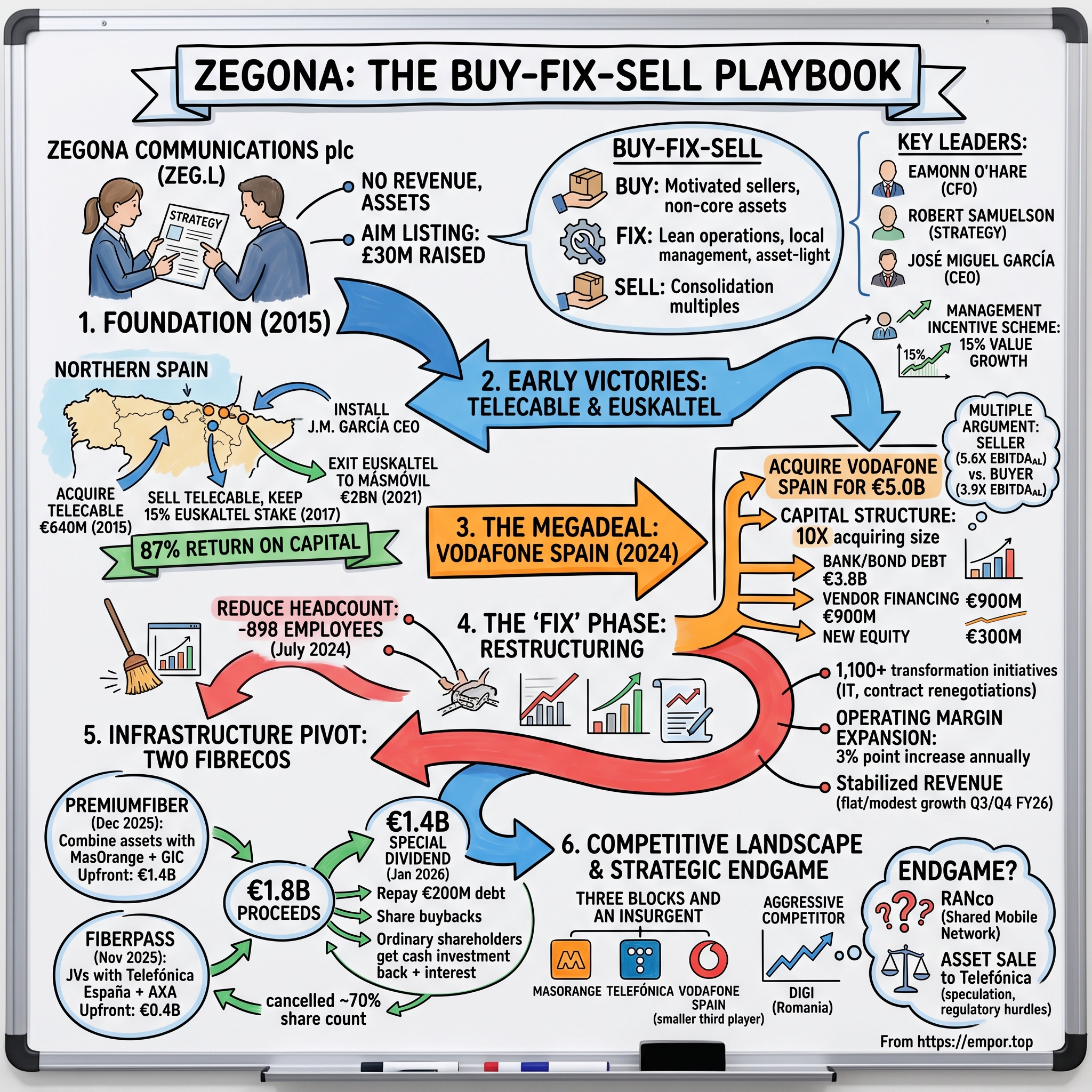
Zegona Communications plc: The Ultimate "Buy-Fix-Sell" Telecom Playbook
I. Introduction & Episode Roadmap (0:00 – 0:10)
On 19 March 2015, a company with no revenue, no customers, no network, and no assets listed on London's AIM market and raised up to £30 million.2 It had two executives, a strategy document, and a name—Zegona—unfamiliar to the market. Eleven years later, that same vehicle owns the third-largest telecommunications operator in Spain, generates €3.6 billion in annual revenue, and paid its shareholders a special dividend of €1.4 billion in a single January afternoon.1
The central question is whether this performance reflects a repeatable operational strategy or well-timed financial leverage.
Zegona's management frames its approach around three steps: Buy, Fix, and Sell. The playbook calls for acquiring European telecommunications assets that large incumbents seek to offload, pricing them based on seller impatience rather than underlying cash generation. Zegona then installs experienced local operators to trim overhead, streamline products, and separate passive infrastructure from core operations to fund fiber expansion through third-party balance sheets. Finally, management seeks to sell the restructured business into a consolidating market at an expanded valuation multiple.
The strategy functions like a private equity model executed in public markets, using public leverage and structured incentives. Management has deployed this approach twice before in the same target market.
Spain represents Europe's most competitive major telecommunications market—a country defined by a decade-long price war among four national operators, rapid market-share gains by low-cost challenger Digi in broadband, and eroding domestic pricing power for incumbent Telefónica. These dynamics have depressed asset valuations while creating opportunities for consolidation, leading Zegona to target Spain three consecutive times.
The narrative proceeds as follows:
Chapter 1 traces Zegona's origins at Virgin Media, examining how founders Eamonn O'Hare and Robert Samuelson applied their experience in leveraged cable management to construct an investment vehicle with explicit incentive structures.
Chapter 2 covers Zegona's initial Spanish transactions—Telecable in Asturias and a strategic stake in Euskaltel—alongside the appointment of chief executive José Miguel García to execute operational restructuring.
Chapter 3 analyzes the €5.0 billion reverse takeover of Vodafone Spain, detailing the capital structure engineering that allowed a small-cap entity to acquire an operating business ten times its size.
Chapter 4 examines the operational restructuring, including over 1,100 efficiency initiatives, a collective redundancy agreement affecting 898 employees, two fiber joint ventures, and annual operating margin expansion of roughly three percentage points.
Chapter 5 evaluates the competitive landscape in Spain, focusing on market dynamics involving MasOrange, Telefónica, and persistent pricing pressure from Digi.
Chapter 6 stress-tests the investment thesis, weighing bear-case risks against bull-case assumptions and highlighting key operational metrics to watch.
Zegona has demonstrated proficiency in complex financial engineering. The key question for investors is whether management can build durable operating value at Vodafone Spain beyond short-term cost reduction and one-off infrastructure monetization. The story begins with two executives, a spreadsheet, and a cable operator in Northern England.
 Subscribe on LinkedIn
II. Founders, DNA, & The "Buy-Fix-Sell" Philosophy (0:10 – 0:25)
The Virgin Media crucible
In 2009, Virgin Media presented an uncertain outlook for investors. The company had built a hybrid fiber-coaxial network across roughly half of the United Kingdom, carried heavy debt, and competed against BT, an incumbent with substantially larger resources. Its shares had stagnated for much of the decade. That year, Eamonn O'Hare joined as chief financial officer. An aerospace engineer from Queen's University Belfast with an MBA from London Business School, O'Hare brought experience spanning Rolls-Royce, British Aerospace, ten years at PepsiCo, a turnaround at Energis Communications, and four years as finance chief of Tesco's UK division.1
This background was unconventional for a telecommunications executive, combining consumer-goods and retail disciplines with a network business. O'Hare focused on gross margin per customer, promotional discipline, and cost of goods sold—metrics often secondary in an industry historically centered on coverage, capital expenditure, and spectrum allocation. This operational philosophy formed the basis of Zegona's strategy: simplify product lines, reduce promotional noise, protect price points, and reduce corporate overhead.
O'Hare served as Virgin Media's chief financial officer and main board director from 2009 to 2013. In 2011, Robert Samuelson joined as executive director of group strategy. A natural scientist from Cambridge with a Cranfield MBA, Samuelson had previously served as a managing partner at Virgin Group overseeing telecommunications and media investments, following a tenure co-leading the European corporate finance practice at consultancy Arthur D. Little.1
When Liberty Global acquired Virgin Media for $24 billion in 2013, Zegona's founders evaluated the outcome through a specific financial lens, noting in company disclosures that the restructuring and sale "crystallis[ed] USD $14 billion of incremental shareholder value."1 Rather than focusing on long-term network expansion, management prioritized capital returns through a timed sale—an approach that defined their subsequent investment vehicle.
The structural inefficiency they went looking for
The core thesis O'Hare and Samuelson presented to investors in early 2015 targeted structural inefficiencies among major European telecommunications groups. Operators such as Vodafone, Orange, Telefónica, and Liberty Global held non-core regional subsidiaries burdened by legacy cost structures and high capital requirements. Facing investor pressure to improve return on capital, corporate parent companies often prioritized strategic focus over maximizing sale prices, creating opportunities to acquire cash-generative operations at attractive multiples.
Zegona listed on London's AIM market on 19 March 2015 to target these opportunities. Marwyn Value Investors, a London firm specializing in listed acquisition vehicles, cornerstoned the initial capital raise with £12 million.2 Marwyn Chairman Robert Ware described the investment as backing "Eamonn and Robert, who have an exceptional track record of delivering shareholder value through their work at Virgin Media."2 Zegona targeted European technology, media, and telecommunications businesses with enterprise values between £1 billion and £3 billion, utilizing a structured "buy-fix-sell approach."2
The three pillars, and what they actually mean
Buy. Acquire assets from motivated sellers through bilateral or quasi-bilateral negotiations rather than competitive auctions, securing favorable entry multiples.
Fix. Install experienced local managers unburdened by legacy internal politics. Restructuring focuses on cutting administrative overhead, simplifying product offerings to lower customer support and IT maintenance costs, and transitioning from an asset-heavy to an asset-light model by transferring passive infrastructure into joint ventures with financial investors.
Sell. Exit to strategic consolidators seeking regional scale, returning realized capital to shareholders rather than reinvesting it into corporate expansion.
In corporate filings, Zegona distinguishes its model from traditional private equity, asserting that it is "fundamentally different from private equity businesses, most of whom work within a short to medium-term timeframe," enabling "a focus on fundamental business improvements that are value-accretive rather than relying on high leverage and valuation multiple expansion."1 However, given that Zegona financed its €5.0 billion acquisition of Vodafone Spain with approximately €3.8 billion in debt, financial leverage and valuation multiple expansion remain central components of its realized returns alongside operational improvements.
Alignment, and the number that makes people uncomfortable
Zegona's management incentive scheme represents one of the structure's most distinctive features. Executives hold management shares in a subsidiary, Zegona Limited, entitling them to 15% of the growth in value of Zegona plus shareholder returns over a defined calculation period, provided ordinary shareholders receive a 5% preferred annual compound return. If performance falls below this threshold, management receives no payout. Participants can redeem their shares between the third and fifth anniversaries of a period's start, or earlier on a winding-up, takeover, or change of control.1
Governance safeguards require shareholders to ratify each new calculation period at the subsequent annual general meeting; a negative vote of 75% or more forces the redemption of management shares for nil. Shareholders ratified the third period in 2022 with 98.03% in favour and the fourth in 2025 with 95%.1
The scale of potential compensation has drawn significant scrutiny. For the fiscal year ended 31 March 2025, O'Hare's remuneration disclosure included £129,280,073 under the incentive scheme and Samuelson's included £64,640,037—reported as the largest payout ever recorded for a London-listed company, against a FTSE 100 CEO average of around £4.2 million.123 The fourth calculation period began on 15 October 2024 with a baseline deemed market capitalisation of £2,514,763,995. In an illustrative calculation for 31 March 2026—when the scheme was not yet exercisable—company disclosures showed total value created of £5.26 billion, yielding a £2.75 billion surplus and a management share of £412,312,293.1
This incentive structure supports two interpretations. Proponents view it as transparent carried interest, disclosed in annual filings, bound by a preferred return hurdle, subject to shareholder approval, and paid primarily in stock. Critics argue that calculating payouts on market capitalization growth rewards leverage and multiple expansion alongside operational gains, while change-of-control acceleration clauses align executive financial interests directly with transaction timing.
The viability of this operational and incentive model faced its first operational test in Northern Spain.
III. The Early Victories: Telecable & The Euskaltel Masterclass (0:25 – 0:45)
Act I: A cable company in Asturias
Asturias, a region of roughly one million people on Spain's northern Atlantic coast, featured mountainous terrain and industrial geography conducive to a defensible local cable position. Telecable served the area through hybrid fiber-coaxial infrastructure and a subscriber base in the low hundreds of thousands. The network was owned by private equity firm The Carlyle Group and Spanish savings bank Liberbank, both of whom sought an exit.
In 2015, Zegona agreed to acquire Telecable de Asturias for an enterprise value of €640 million.4 To finance the purchase, Zegona placed 167.3 million new shares at 150 pence, raising approximately £251 million, and moved to main market trading on 14 August 2015.3 Early backer Marwyn increased its commitment to £67 million, securing a 23.8% stake.3
Operational priorities centered on upgrading network capability, defending dominant local market share, and streamlining administrative overhead left unaddressed by private equity ownership. Public disclosures did not provide the entry EBITDA multiple, making distressed-valuation claims unverified. However, the operational groundwork positioned the asset for immediate strategic integration.
Act II: Selling the asset and keeping the option
In May 2017, Euskaltel—the listed regional incumbent in the Basque Country—agreed to acquire Telecable. The headline consideration reached up to €701 million, comprising an enterprise value of €686 million plus up to €15 million in deferred consideration.5 Rather than exiting entirely for cash, Zegona structured the deal to maintain exposure to Spanish regional consolidation, accepting €186.5 million in cash alongside 26.8 million Euskaltel shares, representing approximately 15% of the acquirer.5
This structure exchanged a single-region operating asset for a influential stake in northern Spain's primary cable consolidator. Zegona subsequently expanded its holding to 21.4% (38.3 million shares), becoming Euskaltel's largest shareholder.7
Holding a minority position presented strategic risk for an investment vehicle designed around operational control. Lacking board control, Zegona sought to direct strategy by engineering changes in executive management.
Act III: Enter José Miguel García
In 2019, Zegona orchestrated the appointment of José Miguel García as Euskaltel's chief executive. Born in Madrid in 1962, García had previously built his industry reputation leading challenger operator Jazztel for nearly a decade prior to its sale to Orange.11 His operational approach prioritized product simplification, rapid overhead reduction, and aggressive commercial expansion.
Under García, Euskaltel expanded beyond its regional footprint in northern Spain, which covered roughly 15% of the national market. On 20 May 2020, the company launched Virgin telco as a national brand targeting the remaining 85% of the country.6 The 2020–2025 business plan targeted 18.4 million homes, projecting that half of Euskaltel's subscriber base by 2025 would originate outside its legacy territories.6
Rather than investing capital to build a national fiber footprint, Euskaltel executed a wholesale agreement with Orange for access to its national fixed and mobile networks.6 This asset-light approach permitted rapid national scaling without infrastructure capex, exchanging network ownership margins for faster market access and lower balance-sheet risk.
Act IV: The exit
The asset-light growth strategy facilitated a strategic sale. On 28 March 2021, telecom operator MásMóvil—backed by private equity sponsors Cinven, KKR, and Providence—launched a friendly cash tender offer for Euskaltel at €11.17 per share, valuing the company's equity at approximately €2.0 billion. Zegona, alongside core shareholders Kutxabank (19.9%) and Corporación Financiera Alba (11.0%), signed an irrevocable undertaking to tender its shares.7 Spanish securities regulator CNMV approved the transaction in July 2021, and the acquisition completed that month.17
Zegona's 38.3 million shares generated approximately €428 million in cash proceeds. Management reported an 87% total return on invested capital across the Telecable-to-Euskaltel arc.1 Following completion, Zegona distributed the realized capital to shareholders and sought its next target.
This initial transaction cycle highlighted three core features of Zegona's approach. First, creative deal structuring enabled management to trade an operating asset for a strategic stake in a broader consolidator. Second, installing proven operational leadership allowed management to drive restructuring without holding majority equity. Third, the eventual exit depended on an external consolidator backed by private equity capital. While effective for a regional asset, this reliance on external acquirers introduced structural constraints when applied to larger national operators.
IV. The Megadeal: Acquiring Vodafone Spain for €5.0B (0:45 – 1:10)
A group CEO with a portfolio problem
By 2023, Vodafone Group faced severe strategic challenges. Its share price had stagnated for years, its return on capital sat below its cost of capital, and its European portfolio contained several markets where it was structurally subscale—operating as a number-three player in markets with three or four national networks while maintaining the capital expenditure profile of a market leader. Chief Executive Margherita Della Valle made portfolio rationalization her primary mandate.
Spain presented the clearest case of strategic pressure. Vodafone had operated in the country since acquiring Airtel in 2000 and had spent €7.2 billion on cable operator Ono in 2014 to build a converged platform. The subsequent decade brought relentless pricing pressure: low-cost operators such as MásMóvil expanded aggressively at the entry tier, Telefónica defended the premium segment, and Vodafone Spain was compressed from both ends. Revenue declined, subscriber churn remained high, and the capital expenditure required to maintain competitive mobile and fixed networks continued unabated.
On 31 October 2023, Vodafone announced the sale of Vodafone Spain to Zegona. Della Valle framed the transaction as "a key step in right-sizing our portfolio for growth and will enable us to focus our resources in markets with sustainable structures and sufficient local scale," in a market that had delivered "structurally low returns."8
The terms, and the multiple argument
The transaction agreed an enterprise value of €5.0 billion for 100% of Vodafone Holdings Europe, S.L.U., structured as a minimum of €4.1 billion in cash and up to €0.9 billion in Redeemable Preference Shares with a six-year redemption term.8 The acquisition completed on 31 May 2024.9
Evaluating the acquisition multiple requires examining the divergence between seller disclosures and buyer presentation.
Vodafone Group stated that the €5.0 billion enterprise value represented 5.3x Adjusted EBITDAaL and 12.7x operating free cash flow for the twelve months ended 31 March 2023—metrics restated at completion to 5.6x EBITDAaL and 13.0x operating free cash flow based on the twelve months ended 30 September 2023.89 In contrast, Zegona's investment case framed the entry valuation as under 3.9x EBITDAaL.
Both calculations rely on distinct accounting treatments, such as pro-forma cost reduction assumptions, the classification of vendor preference shares, and lease accounting conventions. However, the distinction is financially material: an entry multiple under 4.0x reflects distressed pricing, whereas 5.6x represents a fair market valuation for a declining business operating in a competitive environment. While Zegona secured a discount relative to historical European telecommunications transaction multiples of 6.0x to 8.0x, the seller's disclosed multiple of 5.6x serves as the more conservative baseline.
In European telecommunications, EBITDAaL (earnings before interest, tax, depreciation, and amortization, after lease payments) is a primary operating metric. Because telecommunications providers rent extensive physical infrastructure—including tower sites, fiber ducts, exchange facilities, and retail stores—standard EBITDA excludes lease liabilities and can overstate operating cash flows. Incorporating lease costs back into the operating metric provides a clearer picture of cash generation after facility obligations.
The capital structure: how a minnow swallowed a whale
The transaction functioned as a reverse takeover, with the target company dwarfing the acquiring entity. Zegona financed the acquisition through a multi-tiered capital structure:
Bank and bond debt of roughly €3.8 billion. An underwritten debt package secured at completion was subsequently refinanced into institutional bonds and term loans across euro and dollar tranches. At transaction closing, net leverage stood at 3.1x EBITDAaL.1
€900 million of vendor financing. Vodafone Group structured its exit by providing seller financing. An intermediary vehicle, EJLSHM Funding Ltd, subscribed for €900 million of new Zegona shares in October 2023, with the proceeds applied directly to the purchase price.1 These 523 million shares carried economic rights that would be cancelled upon redemption of the underlying preference shares. This structure effectively allowed Zegona to issue equity-classified paper that behaved like debt, while securing the right to retire nearly 70% of its expanded share count upon repayment.
Approximately €300 million of new cash equity. Zegona raised equity capital at £1.50 per share in September 2023.1 As a result, existing shareholders contributed roughly €300 million in cash equity to gain control of a €5.0 billion enterprise, funding the remainder through senior debt, vendor instruments, and target operating cash flows.
A ten-year brand licence. Zegona acquired rights to use the Vodafone brand in Spain for up to ten years post-completion, supported by transitional and long-term service agreements covering international procurement, Internet of Things (IoT) platforms, roaming, and carrier services at an annual cost of approximately €110 million.8 Vodafone retained an operational presence in Spain through its Málaga Innovation Hub.9
What the structure tells you
This capital structure highlights three fundamental operational and financial implications:
First, the financing provided substantial equity upside potential. Deploying roughly €300 million in cash equity to control €5.0 billion in enterprise value concentrated future enterprise value accretion into a small equity base.
Second, high financial leverage increases operational sensitivity. Committing 3.1x leverage against an operating asset with declining historical revenues left limited cushion for performance shortfalls; any deterioration in EBITDAaL would disproportionately erode equity value. The transaction relied on rapid execution of cost reductions to offset persistent top-line pricing pressure.
Third, the vendor financing structure maintained seller involvement. The €900 million preference share arrangement ensured Vodafone Group retained financial exposure to the business post-sale. Furthermore, retiring the vendor paper required significant future cash realization, effectively committing management to large-scale asset monetization initiatives.
V. The "Fix" Phase: Restructuring Vodafone Spain (1:10 – 1:30)
Day one
On 1 June 2024 — the day after completion — José Miguel García took over as CEO of Vodafone España, replacing Mario Vaz.11 There was no interregnum, no strategic review, no consultants' diagnostic phase. The operator who had run Jazztel and Euskaltel walked in with a mandate the previous management had never had: this business is no longer a line item in a London group's portfolio, and its costs are no longer someone else's problem.
The scale of the inheritance was blunt. In the twelve months to March 2024, before Zegona took control, Vodafone Spain converted about 10% of revenue into operational cash flow — defined as EBITDAaL less capex.1 For a telecoms operator with a national mobile network and millions of fixed-line customers, that is close to the floor. Zegona's own framing: the business generated around €400 million of operational cash flow at acquisition.1
Cutting the cost base
The headcount reduction came first and it came hard. Management opened negotiations proposing 1,198 redundancies. After nearly a month of talks with unions UGT, CC OO and USO, an agreement was reached in July 2024 covering 898 employees — 27.5% of a workforce of 3,268.12 The terms landed well above the company's opening offer: compensation of between 45 and 33 days per year worked with a cap of 24 months' salary, matching the indemnity for unfair dismissal, plus a €3,500 bonus for employees earning under €40,000. The workforce ratified it 1,821 votes to 486.12
That outcome is worth reading carefully, because it cuts against the caricature. Zegona did not steamroll Spanish labour law; it paid a premium — roughly double its opening terms — to get a negotiated settlement and a fast, clean exit from the process. In a country where collective redundancy disputes can run for years and generate political heat, buying certainty was the commercially rational choice. It also tells you something about the true cost of the "cheap" entry multiple: restructuring a Spanish workforce is not free.
Beyond headcount, the programme has been relentless and granular rather than dramatic. Over 400 transformation initiatives were implemented in the first year, and approximately 700 more in FY26 — network asset and lease rationalisation, IT systems consolidation, across-the-board contract renegotiations, insourcing of sales and customer care platforms, and process redesign.1 García has described eliminating 75% of the company's customer communications — the letters, SMS messages and emails that a legacy telco generates by default, each of which costs money and generates confused inbound calls.26
The results are visible in the margin line, and they are consistent rather than spiky. EBITDAaL margin has improved approximately three percentage points per year since acquisition: from a pre-acquisition level, to 34% in FY25, to 37% in FY26, with the fourth quarter of FY26 touching 40% for the first time.113 EBITDAaL itself reached €1,341 million in FY26, up 7%.1 Operational cash flow rose 22% to €763 million, lifting the cash flow margin from 17% to 21%.1
Management's summary — that they have "almost doubled the company's cash flow" in two years — is defensible on the numbers as presented.1 The caveat an analyst should attach is that a large portion of the improvement is cost, and cost reduction is finite. You can only cut a business once. The durability question is whether the revenue line holds while you do it.
The infrastructure pivot: two FibreCos
Here is the strategic heart of the Zegona fix, and it deserves a proper explanation.
A telecoms operator owns two very different things. There is the service business — brands, customers, tariffs, call centres, spectrum — which is a high-margin, low-capital, competitive activity. And there is the passive infrastructure — the ducts and fibre strands in the ground — which is a low-margin, enormously capital-hungry, quasi-utility activity. The market values these differently. Infrastructure funds, pension funds and sovereign wealth funds will pay high multiples for predictable, inflation-linked, contracted fibre cash flows. Equity investors will not pay those multiples for the same cash flows buried inside a telco.
The arbitrage is therefore obvious and Zegona executed it twice.
PremiumFiber, the joint venture with MasOrange and Singapore's sovereign fund GIC, completed in December 2025. It combined the fibre assets of Vodafone Spain and MasOrange into a 100% fibre-to-the-home network covering over 12 million premises, with ownership of 58% MasOrange, 25% GIC and 17% Vodafone Spain.1014 Upfront cash proceeds to Vodafone Spain: €1.4 billion.1
FiberPass, the joint venture with Telefónica España, began operations in March 2025 as a partial carve-out of Telefónica's Spanish FTTH network, covering 3.7 million premises serving 1.4 million Vodafone Spain and Telefónica customers. In November 2025, AXA IM Alts agreed to acquire 40%, leaving Telefónica with 55% (split between Telefónica España and Telefónica Infra), Vodafone Spain with 5%, and Telefónica in control.115 It completed in March 2026, delivering a further €0.4 billion.1
Together: €1.8 billion of upfront proceeds, and guaranteed long-term access to a nationwide all-fibre network covering roughly 16 million premises — with retained ownership stakes and governance rights in both vehicles.1
What this achieves operationally is real: Vodafone Spain's customers move onto a full-fibre network without Vodafone Spain funding the build, and the company's capital intensity falls structurally. What it achieves financially is the point. The €1.8 billion did not go into the business. €1.4 billion funded a special dividend paid on 7 January 2026, which simultaneously settled the Vodafone Group financing — €975 million to EJLSHM — and cancelled 523 million shares, a 69% reduction in the share count. Remaining shareholders received a €440 million cash distribution of £1.62 per share, described by the company as returning their original equity investment plus interest. A €200 million buyback was launched, and €200 million went to debt repayment.1
Read that sequence again. Within nineteen months of completion, ordinary shareholders had their entire cash investment returned with interest, and still owned the whole company. That is a genuinely remarkable capital-allocation outcome. It is also the moment the "Buy" phase was fully de-risked — and, for a sceptic, the moment the remaining upside became a call option that management holds 15% of.
Two brands, two wars
On the commercial side, Zegona runs a deliberate two-brand structure. Vodafone carries the premium, convergent and enterprise positioning — mobile plus fixed plus TV, bundled, with handset financing used to build loyalty. Lowi is the value brand, refreshed under Zegona with the addition of television and handsets, aimed squarely at the segment Digi has been raiding.113
Fighter brands are strategically awkward: they cannibalise the premium base if positioned too well, and lose the war if positioned too weakly. Zegona's disclosed customer numbers suggest the balance is currently holding. FY26 delivered a sixth consecutive quarter of positive net additions in both broadband and contract mobile — broadband lines reaching 2,591,000 (up 29,000 on the year) and contract mobile lines 10,185,000 (up 128,000, the strongest full-year contract growth in five years).1 Revenue, having declined 3.8% in FY25, was flat in FY26 at €3,628 million, with the third quarter growing 1.1% and the fourth 2.0%.1
That is stabilisation, achieved while cutting 27.5% of the workforce. It is the single most impressive operational fact in the file, and it is the strongest available evidence against the claim that Zegona is simply harvesting. Whether it converts into sustained growth depends on a market that Zegona does not control.
VI. Industry Structure, Economics, & Segment Analysis (1:30 – 1:50)
Three blocks and an insurgent
Spain's telecommunications sector underwent a rapid structural transformation leading into 2026.
In late March 2024—two months before Zegona completed its acquisition of Vodafone Spain—Orange and MásMóvil merged to form MasOrange, a consolidated operator valued at approximately €18.6 billion with over 37 million combined mobile and fixed subscriptions.18 The transaction reduced the number of national network operators from four to three, positioning Vodafone Spain as a smaller third-place competitor. To secure European Commission approval, MásMóvil divested spectrum in the 1800 MHz, 2100 MHz, and 3.5 GHz bands to Digi and granted an option for a national roaming agreement.18
This regulatory remedy effectively strengthened the market's most aggressive discount competitor.
In April 2026, the European Commission cleared Orange to acquire full ownership of MasOrange for €4.25 billion, consolidating control of Spain's market leader within a single European telecommunications group.19
Telefónica, operating under the Movistar brand, remains the revenue leader and premium incumbent, maintaining its strongest positions in enterprise services and high-ARPU convergent households. Under Executive Chairman Marc Murtra, who assumed leadership in 2025, the company's strategic focus has centered on European scale and cross-border consolidation.
Vodafone Spain occupies third place, reporting 12,864,000 mobile lines (including 10,222,000 contract customers) and 2,592,000 fixed broadband lines as of the first quarter of FY27.21
Alongside these three national groups sits Digi.
The Digi problem
Digi Spain, the domestic unit of a Romanian telecommunications group, has served as the market's primary disruptive competitor for five years. Its commercial strategy focuses on aggressive price competition: offering higher fiber speeds and larger mobile data allowances than incumbent operators at lower price points. This strategy enabled Digi to capture over half—and at times more than 75%—of all net new fixed broadband additions in Spain.20
Rather than operating strictly as a wholesale reseller, Digi constructed its own infrastructure. Its proprietary SMART fiber network reaches 14.2 million Spanish homes, with 95% built on multi-gigabit-capable XGS-PON technology. The company plans to extend coverage to 21 million premises over the medium term while continuing its mobile network deployment using acquired spectrum, RAN sharing, and national roaming with Telefónica.17 Digi expects to invest approximately €400 million in 2026 alone.17
On 16 July 2026, Digi Spain listed on the Spanish stock exchanges at €5.60 per share, establishing an initial market capitalization of approximately €1,662 million and raising roughly €287 million (€330 million including the over-allotment option) with a free float of about 20%. Net primary proceeds of approximately €134 million were allocated to accelerate its fiber and mobile buildout. For 2025, Digi reported revenues of approximately €929 million and adjusted EBITDA of roughly €175 million.16
This public listing carries two strategic implications. First, Digi secured permanent equity capital and public currency to support its network expansion, reducing the likelihood of financial distress or an early acquisition. Second, public equity ownership introduces investor expectations for margin expansion and capital returns, which may over time temper its price discounting.
Where the money comes from
Vodafone Spain's revenue splits broadly between a dominant mass-market consumer business and a smaller, higher-margin corporate division. Because Zegona does not break out segment-level revenues in its FY26 financial reporting, informal estimates of a 70/30 consumer-to-business split remain unverified.
The economic drivers of each division differ significantly. In the consumer segment, price sensitivity is high, switching costs are low, and customer acquisition requires handset financing and promotional discounting. The primary retention mechanism is convergence: households subscribing to bundled mobile, broadband, and television packages churn at lower rates because changing providers requires replacing multiple household services rather than porting a single mobile line. This dynamic explains Zegona's commercial emphasis on convergent subscribers and handset-backed customer loyalty.1
In the business segment, longer contract terms and slower procurement cycles yield higher margins. However, Zegona explicitly noted in its risk disclosures that aggressive private pricing from competitors could require tactical discounting that compresses enterprise margins.1 This disclosure highlights that B2B market share remains exposed to competitive pressure.
A third income stream derives from Zegona's retained infrastructure holdings: a 17% stake in PremiumFiber and a 5% stake in FiberPass, both accompanied by governance rights.110 Rather than generating consolidated top-line revenue, these entities yield equity-accounted earnings while creating an ongoing operational expense: wholesale network access fees paid to third-party operators for infrastructure Vodafone Spain previously owned. Because the exact commercial terms of these wholesale contracts are undisclosed, evaluating their net economic impact represents a key transparency gap in the company's financial disclosures.
The margin question
Vodafone Spain's operating margin has expanded by roughly three percentage points annually since acquisition, reaching 37% for FY26 and touching 40% in the fourth quarter.113 The central analytical question is whether further structural cost reduction is attainable.
Zegona's formal impairment model—scrutinized by its independent auditors—assumes a long-term projected EBITDAaL margin of 36–37% and capital expenditure of 13–14% of revenue over a five-year forecast horizon, utilizing a 1.0% terminal growth rate and a post-tax discount rate of 9.52%.1 This internal valuation baseline indicates that management's formal accounting assumptions plan for margins to stabilize near current levels rather than expand continuously.
In strategic communications, management asserts that further cost-reduction potential remains, particularly across third-party vendor contracts and network operations.1 The variance between the conservative impairment model and executive targets defines the core of Zegona's operational strategy—a trajectory that depends on negotiating joint mobile network sharing with its two primary domestic competitors.
VII. Competitive Dynamics & Strategic Frameworks (1:50 – 2:05)
The 7 Powers audit
Hamilton Helmer's framework asks a single unsentimental question of any business: what stops a competent, well-funded competitor from taking your customers by matching your price? Applied to Vodafone Spain, the answers are mixed and instructive.
Scale economies — the central weakness. Eamonn O'Hare outlined the issue directly in January 2026 when discussing potential mobile network sharing, noting that three operators "manage three national mobile networks with exactly the same fixed costs, but Orange and Telefónica have twice as many customers as us."25 That statement captures the core strategic challenge. A national mobile network functions as a high fixed-cost infrastructure. Spread over MasOrange's larger subscriber base, the cost per customer is roughly half of what Vodafone Spain bears. Operational efficiency alone cannot bridge a structural scale gap of that magnitude—explaining why management executed the fiber joint ventures and is evaluating a mobile equivalent.
Cornered resource — real but rented. Vodafone Spain holds high-quality nationwide spectrum and operates an active network-sharing arrangement with MasOrange.1 Spectrum represents a genuine barrier to entry—licensed, finite, and impossible to replicate. The Vodafone brand, however, is licensed for up to ten years from May 2024.8 Zegona pays for a brand it does not own on a license that expires in 2034. Rather than a permanent cornered resource, the arrangement is a long-term lease with unquantified terminal-value implications.
Switching costs — low in consumer, higher in enterprise. In Spanish consumer telecommunications, number portability is fast and free, contract durations are short, and price comparison is straightforward. Product convergence and handset financing increase customer friction, but they do not create lock-in comparable to enterprise software. In the business segment, switching costs are higher, though Zegona's risk disclosures acknowledge ongoing competitive pressure.1
Counter-positioning — partial. Lowi functions as a value brand managed by a premium incumbent—a standard defensive strategy rather than structural counter-positioning. Digi serves as the primary counter-positioned competitor in the Spanish market, having built a lower cost structure that allows it to operate profitably at price points that erode legacy margins. Zegona is reacting to counter-positioning rather than driving it.
Process power — demonstrable but finite. Over 1,100 transformation initiatives, internal insourcing, and contract renegotiations demonstrate genuine operational execution, evidenced by three consecutive years of three-percentage-point annual operating margin expansion.1 However, process-driven cost reduction has natural limits: once legacy systems are consolidated and supplier contracts renegotiated, margin gains from efficiency taper off.
Network economies and branding — negligible. Telecommunications networks lack demand-side network effects, and the consumer brand is operated under license.
Vodafone Spain's most durable advantages reside in its spectrum holdings and wholesale infrastructure agreements, while its primary short-term driver remains executive cost reduction—two factors with distinct operational lifespans.
Porter, applied
Threat of new entrants: low. Spectrum licensing requirements, network capital intensity, and regulatory frameworks render greenfield entry improbable. However, competitive pressure in Spain has stemmed from an existing player scaling—Digi—rather than a new market entrant. High barriers to entry do not insulate incumbents from established low-cost competitors expanding within the market.
Supplier power: moderate, influenced by regulation. Equipment vendors compete aggressively on price. However, regulatory constraints introduce complexity: Vodafone Spain remains subject to Spanish government rules regarding high-risk 5G vendors, with company risk filings warning that regulatory policy shifts "could force significant infrastructure modifications with material financial and operational consequences."1 Geopolitics can thus translate directly into unexpected capital expenditure.
Buyer power: high in consumer, moderate in enterprise. Retail customers experience minimal switching costs alongside readily available low-cost alternatives, defining a high buyer-power environment.
Substitutes: low. Broadband and mobile connectivity function as essential utilities. Over-the-top digital services rely on underlying network infrastructure rather than replacing it. While data demand driven by artificial intelligence increases network usage, financial returns accrue primarily to network owners—a category where Vodafone Spain's direct ownership has been reduced through infrastructure carve-outs.
Rivalry: intense, alongside consolidation thesis. Zegona's principal risk disclosures highlight "intense price-based rivalry across low-end, mid-tier and high-end segments," driven by "the expansion of low-cost operators, the use of targeted promotions by established players, and the entry of new regional providers," classifying the overall risk level as unchanged year over year.1 The positive investment thesis posits that a market consolidated into three major operators will eventually demonstrate pricing discipline. However, empirical evidence of sustained price recovery remains limited: Vodafone Spain's revenue growth of 2.0% in the fourth quarter of FY26 and 2% in the first quarter of FY27 reflects modest stabilization, but remains consistent with volume gains at flat price points.121
The RANco endgame
This environment underscores the central strategic initiative remaining in Spanish telecommunications. In late 2025, Vodafone Spain, MasOrange, and Telefónica initiated discussions regarding the combination of their mobile radio access networks into a shared infrastructure entity—a "RANco"—as an alternative to formal corporate mergers. O'Hare confirmed the negotiations publicly in January 2026, stating that regulatory hurdles limit full-scale mergers in Spain. He noted that a potential arrangement with MasOrange would target urban network synergies, whereas an agreement with Telefónica could unlock broader operational savings given the absence of existing mobile network sharing between the two companies.25 Management temporarily paused the initiative to execute the fiber transactions before resuming negotiations following the end of 2025.25
Strategically, the proposed mobile network vehicle mirrors the structural logic of the fiber joint ventures applied to mobile network assets. If executed, the arrangement would directly address Vodafone Spain's scale disadvantage without requiring a full corporate merger subject to European Commission opposition. Without a network-sharing agreement, Vodafone Spain remains a smaller operator maintaining full national network overhead against competitors with substantially larger subscriber bases. Consequently, these network negotiations represent a key unresolved operational factor in the company's medium-term outlook.
VIII. Bear vs. Bull Case & The Activist / Skeptic Stress Test (2:05 – 2:20)
What the sceptic attacks first
The value has already been harvested. Skeptics argue that the primary value-creation drivers were one-time gains. The €1.8 billion in fiber joint-venture proceeds, the redundancy program affecting 898 employees, and the 1,100 efficiency initiatives targeted a finite cost structure. Adjusting for these operational interventions leaves an operating unit with flat underlying revenue in a market where Digi, the fastest-growing discount competitor, prices below incumbent tariffs and recently raised primary equity capital to expand its proprietary network.1617 In this view, a negative thesis does not require operational failure—merely a plateau in earnings growth.
Leverage is lower, but the operating footprint is smaller. Net debt fell 13% to €3,214 million in fiscal year 2026, lowering net leverage from 3.1 times earnings at acquisition to 2.4 times, and further to 2.33 times with net debt of €3.2 billion by the first quarter of fiscal year 2027.121 However, this balance-sheet improvement stemmed primarily from asset monetization rather than organic cash generation; only €200 million of the €1.8 billion in transaction proceeds was allocated to debt retirement.1 The company reduced its leverage ratio largely by carving out underlying infrastructure assets while distributing capital to shareholders, rather than accumulating retained operational earnings.
Debt service costs have declined, carrying trade-offs. Through fiscal year 2026, Zegona repriced its Term Loan A and revolving facility, completed a €725 million refinancing in August 2025 that removed quarterly leverage maintenance covenants to establish a covenant-lite framework, repriced its Term Loan B twice, and secured credit rating upgrades from Moody's to Ba2, S&P to BB with a positive outlook, and Fitch to BB-plus.1 On 26 June 2026, management announced a €3.7 billion comprehensive refinancing that closed on 14 July 2026. The package comprised a €1.1 billion senior secured note at 4.25% due 2032, a €1.35 billion Term Loan A at Euribor plus 1.75% due 2031, an amended €1.283 billion Term Loan B at Euribor plus 2.00% due 2032, and an undrawn €500 million revolving credit facility—reducing annualized interest expense from €230 million to €170 million at a transaction cost of roughly €100 million in fees and call premiums.22 Overall, annual debt service has fallen from approximately €294 million at transaction closing.22
From a credit perspective, covenant-lite terms expand flexibility for equity holders while reducing creditor protections. Furthermore, because a substantial portion of the capital structure remains tied to floating rates, interest expenses will track benchmark rate movements, maintaining sensitivity to macroeconomic fluctuations in a business with modest top-line growth.
Governance structure and change-of-control provisions. Having previously evaluated the £129 million and £64.6 million Management Incentive Scheme awards alongside the £412 million notional accrual as of 31 March 2026—exercisable from 14 October 2027 or earlier upon a change of control—critical analysis highlights three primary governance considerations.123 First, compensating executives on market capitalization growth rewards valuation multiple expansion and financial leverage on equal terms with operational gains. Second, change-of-control acceleration clauses can align executive transaction timing with incentive realization. Third, independent auditor EY designated the risk of management override of controls over executive remuneration KPIs as a key audit matter, alongside revenue recognition and asset valuation, applying a group materiality threshold of €25 million.1 This designation formally identifies executive compensation metrics as an area of heightened audit focus.
Ongoing litigation over regional assets. Vodafone Spain and subsidiary Vodafone ONO previously sought acquisition of Wewi Mobile, the parent entity of Alicante-based regional operator FiNetwork, through a debt-for-equity restructuring plan initially approved by Commercial Court No. 1 of Alicante and authorized by competition regulator CNMC and foreign direct investment authorities. However, on 27 April 2026, the Provincial Court of Alicante overturned the restructuring plan and ordered the cancellation of the capital increase, ruling in favor of founding shareholders, including family office KAI Capital. Zegona is contesting the judgment and has not consolidated Wewi Mobile.127 Consequently, Zegona's fiscal year 2026 performance metrics explicitly exclude FiNetwork, while the company's financial disclosures do not quantify potential contingent liabilities.13
Impairment test valuation headroom. Company disclosures indicate that recoverable asset values exceeded carrying values by €2.7 billion in formal impairment testing, requiring no write-down and leaving a valuation buffer under sensitivity analysis.1 This headroom remains contingent on achieving the projections in management's five-year operating plan, evaluated against a 9.52% post-tax discount rate.
The bull case, stated properly
Asymmetric equity capital structure. Because Zegona returned approximately €300 million of original cash equity to shareholders alongside a special distribution, while reducing its total share count by 69%—and 70% including subsequent share repurchases—future enterprise value growth accrues to a condensed equity base.1 Company presentations estimate Vodafone Spain's implied enterprise value at €7.8 billion as of June 2026, compared to €5.0 billion at transaction closing, representing a 56% expansion alongside a 15% reduction in net debt over the same timeframe.13
Cash flow conversion and tax shielding. Operating cash flow reached €763 million in fiscal year 2026, up from approximately €400 million at acquisition, raising year-end cash balances to €519 million compared to €208 million twelve months prior.1 Furthermore, Zegona carries over €5 billion in historical net operating loss carryforwards, exempting the operating business from immediate corporate income tax liabilities.13 Combined with lower interest expenses, this tax shield accelerates levered free cash flow generation relative to operating earnings growth.
Comparative valuation multiples. Zegona's fiscal year 2026 investor presentation highlights the company trading at 10.2 times enterprise value to operating cash flow, compared to 13.1 times for Telefónica Spain, 13.9 times for MasOrange, and a peer sector average of 14.1 times.13 While management presents this discount as an expansion opportunity, market pricing reflects structural factors, including single-asset concentration risk, the finite term of the brand licensing agreement, and potential dilution from executive incentive provisions.
Strategic exit optionality. Management maintains that transaction exit options remain an operational objective, a dynamic examined further in the concluding analysis.
Management credibility, judged on behaviour
Evaluating management's operational execution requires weighing stated commitments against realized outcomes.
On execution: Management committed to stabilizing revenue and achieved flat growth in fiscal year 2026 following a 3.8% decline in fiscal year 2025, recording two consecutive quarters of top-line expansion.1 Executives pledged to monetize passive fiber infrastructure and executed two joint-venture transactions yielding €1.8 billion in total proceeds.1 They committed to capital returns, distributing €1.6 billion to shareholders within a single fiscal year.1 Finally, management targeted lower debt service expenses, reducing annualized interest from €294 million at transaction closing to a run rate of €170 million.22 Performance metrics across annual disclosures and investor presentations have maintained consistent definitions and reporting structures.
On transparency gaps: Corporate reporting omits several core operational metrics, including subscriber churn rates, average revenue per user (ARPU), and segment-level revenue splits. In addition, the wholesale rate schedules governing access to the carved-out fiber networks remain undisclosed, making it difficult to evaluate long-term access costs. Furthermore, while media coverage highlighted fiscal year 2026 revenue of €3,628 million against €3,015 million in fiscal year 2025 as 20% top-line growth, that comparison reflected twelve months of operational consolidation versus ten months in the prior period; Zegona's formal financial disclosures correctly report like-for-like revenue as flat.1
Regarding statutory accounting, Zegona emphasizes operating cash flow and EBITDAaL—industry-standard metrics in telecommunications—whereas the company reported a statutory net loss of €189.4 million for fiscal year 2026, driven by €972 million in depreciation and amortization, €337 million in financing expenses, and €173 million in non-recurring items.1 While acquisition-related amortization accounts for much of the variance, statutory results underscore the distinction between cash earnings and net accounting profits.
The three KPIs that will settle this
Evaluating Zegona's ongoing trajectory requires monitoring three key operational metrics on a quarterly basis:
1. Year-over-year revenue growth at Vodafone Spain. Operational efficiency programs have finite limits. The core investment question is whether a third-place operator can sustain top-line expansion amidst price competition from low-cost providers. Two consecutive quarters of positive revenue growth represent initial stabilization rather than an established long-term trend.
2. Operational cash flow (EBITDAaL minus capital expenditure) and cash margin. This cash generation metric supports debt service, capital distributions, and strategic flexibility. Zegona expanded operational cash flow margin from approximately 10% pre-acquisition to 21% in fiscal year 2026.1 Whether cash margins expand further or stabilize near management's 36–37% EBITDAaL impairment baseline will determine the company's long-term cash conversion profile.
3. Fixed broadband and contract mobile net subscriber additions. In the absence of disclosed churn and ARPU figures, subscriber net additions provide the primary indicator of commercial trajectory. Six consecutive quarters of positive net additions demonstrate commercial traction.1 Maintaining net subscriber additions alongside stable total revenue indicates that volume growth is being achieved without heavy tariff discounting.
IX. Strategic Playbook & Investing Lessons (2:20 – 2:30)
Beyond its specific Spanish transactions, Zegona provides a case study in four transferable strategic principles—each carrying trade-offs that standard corporate narratives often omit.
1. Public equity can serve as a private equity vehicle, but the trade-offs are substantial. Zegona acquired a €5.0 billion enterprise with approximately €300 million in new cash equity by combining underwritten bank debt, vendor paper structured as preference shares, and cash flows generated by the target asset.18 The advantages relative to an unlisted fund structure include permanent capital, the absence of a fixed fund lifespan, daily liquidity for investors, and—as Zegona argues—the flexibility to hold an asset through a complete operational restructuring.1 However, the public model introduces distinct burdens: full market disclosure of executive incentive payouts, continuous quarterly scrutiny of a highly leveraged single operating asset, and equity volatility driven by market speculation. This approach suits management teams specializing in complex financial structuring and hands-on operational turnaround, but it remains difficult to replicate broadly.
2. Pairing financial structuring expertise with a proven local operator creates a durable division of labor. This functional separation represents one of the most replicable components of Zegona's model. Co-founders Eamonn O'Hare and Robert Samuelson focus on capital structure engineering, negotiations, and asset disposition, while chief executive José Miguel García manages operational turnaround. Neither side crosses into the other's domain. Many corporate turnarounds flounder because financial sponsors lack operational expertise or local operators lack balance-sheet authority. Zegona's approach—acquiring an asset and immediately installing an executive who previously led a comparable competitor in the same national market—was demonstrated at Euskaltel and repeated at Vodafone Spain within twenty-four hours of transaction closing.11 This structure carries clear key-person exposure: Zegona's disclosures explicitly list "reliance on key management" as a corporate risk factor, though company filings rate the risk level as decreased.1
3. Infrastructure disaggregation unlocks latent balance-sheet value. The underlying thesis posits that integrated telecommunications providers combine assets with conflicting return profiles. Passive fiber infrastructure fits the low cost of capital required by pension funds and infrastructure investors, whereas retail brands and consumer services require dynamic equity returns. Retaining both within a single corporate entity often results in the entire enterprise trading at a blended, lower valuation multiple. Unbundling these assets through the PremiumFiber and FiberPass joint ventures generated €1.8 billion in upfront cash proceeds that were previously unrecognized on the consolidated balance sheet.1 This disaggregation model applies broadly across capital-intensive industries operating service platforms. However, infrastructure carve-outs are one-time transactions that permanently replace asset ownership with ongoing wholesale operating expenses. Management's initiation of discussions regarding a mobile network "RANco" reflects the application of this same unbundling framework to mobile radio access infrastructure.25
4. Prioritizing capital returns over asset accumulation dictates the investment horizon. Zegona sold Telecable eighteen months after acquisition, tendered its Euskaltel stake to a private-equity-backed bidder, and returned the realized capital to investors in both instances rather than reinvesting into larger corporate structures. Distributing €1.6 billion to shareholders in fiscal year 2026—effectively returning original equity capital alongside additional cash returns—demonstrates an operational focus centered on return on invested capital rather than expansion of assets under management.1 Despite management's distinction between Zegona's model and traditional private equity funds, the ultimate strategic objective remains an eventual exit. Historical execution indicates that management views operating assets as transitory holdings to be restructured and sold when an attractive market valuation materializes, rather than permanent corporate compounders.
That prospective exit strategy now forms the central focus of Zegona's outlook.
X. Epilogue & Outro (2:30 – 2:35)
In August 2025, when asked directly whether Vodafone Spain could be sold to Telefónica, chief executive José Miguel García stated that the company could "analyse everything that makes sense for our shareholders, clients and employees." He noted that Spanish telecommunications had undergone thirty years of consolidation, adding that Vodafone Spain could act as either a consolidator of smaller operators or an acquisition target, depending on stakeholder interests.26
By January 2026, speculation shifted toward formal negotiations. Spanish media reported that Telefónica had initiated preliminary acquisition talks with Zegona, which declined to comment publicly on the matter.24 For Telefónica, acquiring the market's third-largest operator aligns with Executive Chairman Marc Murtra's focus on European consolidation as a path toward domestic pricing power. However, reducing the market from three national network operators to two presents significant regulatory hurdles; European competition authorities have consistently resisted market concentration, favoring structural remedies that preserve challenger competition, as demonstrated in the MasOrange transaction.18
These antitrust barriers explain the strategic focus on a joint radio access network (RANco). If a full corporate merger faces regulatory opposition, a shared mobile network infrastructure allows operators to capture operational synergies without triggering a formal merger review.25 Alternatively, an infrastructure fund or private equity consortium could acquire the restructured operating business—a target that presents a lower capital-intensity profile than the entity acquired from Vodafone Group, backed by cash generation, an asset-light fiber network structure, and more than €5 billion in net operating loss carryforwards.13
Management has committed to publishing a long-term capital allocation framework later in 2026, covering operational investment, balance-sheet leverage, and shareholder distributions—marking its first formal guidance extending beyond the initial restructuring phase.1 This framework will offer investors clarity on strategic direction, distinguishing between a permanent operational model and preparation for an eventual transaction.
In two years, Zegona demonstrated that a public acquisition vehicle using a structured capital framework can acquire an underperforming subsidiary, stabilize operations, and monetize unbundled infrastructure assets. Operational execution yielded stabilized top-line revenue, nine percentage points of operating margin expansion, nearly doubled operational cash flow, €1.8 billion in proceeds from fiber joint ventures, and €1.6 billion in capital distributions, effectively returning original cash equity with interest while preserving equity ownership.1
However, short-term restructuring execution does not guarantee long-term operational expansion. Cost-reduction initiatives deliver finite gains, passive fiber monetization represents a one-time transaction, and low-cost competitor Digi remains capitalised following its public listing to expand its proprietary network. Furthermore, the Vodafone brand agreement expires in 2034, while the fundamental scale disadvantage highlighted by co-founder Eamonn O'Hare—maintaining full national mobile infrastructure against competitors with twice the subscriber volume—has been mitigated rather than permanently resolved.25
Looking ahead, Vodafone Spain could establish a durable, capital-light operating model if mobile network sharing materializes and domestic market discipline improves. Conversely, if operational efficiency gains peak, the primary remaining objective will be negotiating an asset sale. While executive incentive provisions vesting in October 2027—or earlier upon a change of control—do not dictate which outcome will prevail,1 they ensure that management's financial returns remain tied to transaction timing and realized equity value.
References
-
Zegona Communications plc — Annual Report 2026, for the year ended 31 March 2026 — Zegona Communications plc, 2026-06-16 ↩↩↩↩↩↩↩↩↩↩↩↩↩↩↩↩↩↩↩↩↩↩↩↩↩↩↩↩↩↩↩↩↩↩↩↩↩↩↩↩↩↩↩↩↩↩↩↩↩↩↩↩↩↩↩↩↩↩↩↩↩↩↩↩↩
-
Zegona Communications IPO: Peppa Pig backer Marwyn puts aside £12m for new Aim entry — City A.M., 2015-03-19 ↩↩↩↩
-
Zegona to acquire Telecable de Asturias for €640m — Zegona Communications plc RNS via Investegate, 2015 ↩
-
Euskaltel acquires Telecable for €701m — Advanced Television, 2017-05-16 ↩↩
-
Euskaltel starts its national expansion today with the launch of Virgin telco — Euskaltel, 2020-05-20 ↩↩↩
-
MasMovil offer to acquire Euskaltel — Zegona Communications plc RNS via Investegate, 2021-03-28 ↩↩↩
-
Sale of Vodafone Spain — Vodafone Group plc, 2023-10-31 ↩↩↩↩↩↩
-
Sale of Vodafone Spain completes — Vodafone Group plc, 2024-05-31 ↩↩↩
-
José Miguel García será el nuevo consejero delegado de Vodafone en España a partir del 1 de junio — Forbes España, 2024-05 ↩↩↩
-
La plantilla de Vodafone refrenda de forma mayoritaria el acuerdo del ERE entre sindicatos y empresa — El Economista, 2024-07 ↩↩
-
Vodafone Spain results — Full-year 2026 investor presentation — Zegona Communications plc, 2026-06-16 ↩↩↩↩↩↩↩↩
-
MasOrange, Vodafone Spain and GIC join forces to create Spain's largest fibre optic company — GIC Newsroom ↩
-
AXA IM Alts extends digital infrastructure portfolio with the acquisition of 40% FiberPass stake from Telefónica España and Vodafone Spain — AXA IM Alts, 2025-11 ↩
-
DIGI Spain confirms the pricing of its IPO at €5.60 per share and expects to commence trading on the Spanish Stock Exchanges on July 16, 2026 — DIGI Spain, 2026-07 ↩↩
-
Digi Spain expands proprietary fibre and mobile network rollout plans — Telecompaper ↩↩↩
-
Orange, Masmovil complete merger in Spain — Fierce Network, 2024-03 ↩↩↩
-
EU clears Orange's full acquisition of MasOrange — RCR Wireless News, 2026-04-13 ↩
-
Regulator says Digi Spain grabbed 75% of broadband adds — Mobile Europe ↩
-
Zegona Comms. — FY27 Quarter 1 results (RNS) — Reuters via TradingView, 2026-07-15 ↩↩↩
-
€3.7BN Refinancing Delivers €60m Savings — Zegona Communications plc RNS via Investegate, 2026-06-26 ↩↩↩
-
Telecoms boss lands record £131m payday — The Telegraph via Yahoo Finance ↩↩
-
Telefónica reportedly begins official talks to acquire Vodafone Spain — The Corner, 2026-01-15 ↩
-
Vodafone Spain (Zegona), MasOrange and Telefonica in possible RANco joint venture — IEEE ComSoc Technology Blog, 2026-01-26 ↩↩↩↩↩↩
-
El CEO de Vodafone responde en una entrevista a los rumores sobre la venta a Telefónica — ADSLZone, 2025-08-31 ↩↩
-
La Audiencia tumba el plan de Vodafone para tomar el control de Finetwork — El Economista, 2026-04 ↩
 LinkedIn
 WhatsApp
 Reddit
 Hacker News
 Email
Email Kindle
 RSS Feed
 Spotify
 Apple Podcasts
 Amazon Music
 Audible
 YouTube