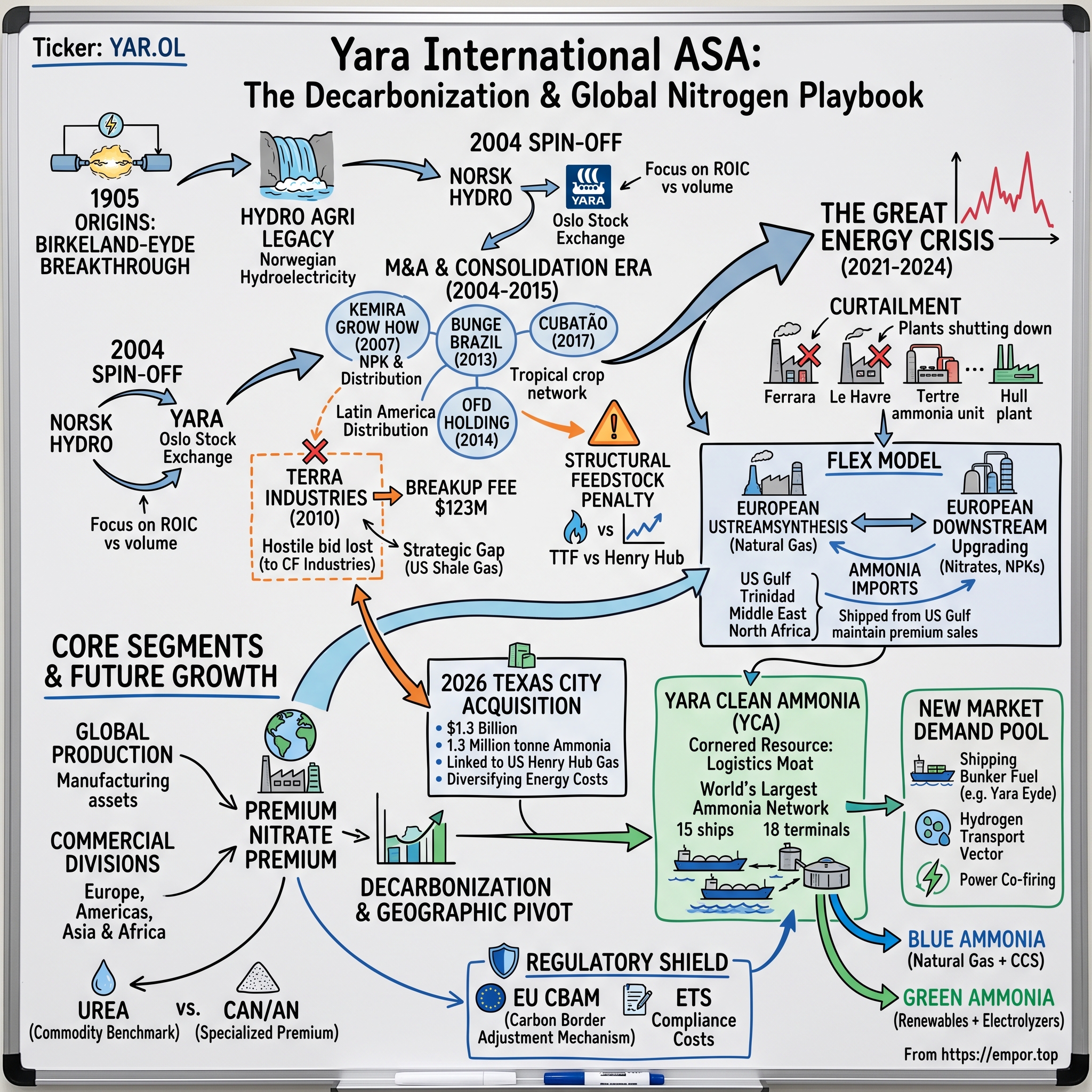
Yara International ASA: The Decarbonization & Global Nitrogen Playbook
I. Introduction & Episode Roadmap
On July 2, 2026, Yara International — a Norwegian fertilizer producer that traces its origins to an early twentieth-century hydroelectric experiment on a Telemark waterfall — executed a deal that underscored a dramatic shift in industrial strategy. The company announced the acquisition of a newly constructed ammonia plant in Texas City, Texas, for USD 1.3 billion, securing a 1.3 million tonne-per-year facility currently in commissioning and supplied with hydrogen under a long-term contract with Air Products.1
A European nitrogen champion built on Norwegian hydropower and European agronomy committed over a billion dollars to secure direct exposure to low-cost American natural gas.
In announcing the deal, President and CEO Svein Tore Holsether described the move as "diversifying our energy costs at a time when supply flexibility matters more than ever."1 Beyond the corporate phrasing lies a stark economic reality: high European production costs have become a structural handicap, prompting Yara to commit capital toward cheaper feedstock. On the second-quarter earnings call two weeks later, management quantified the pivot. Prior to the transaction, less than a third of Yara's natural gas exposure was tied to U.S. Henry Hub pricing; following completion, that share will rise to between 38% and 40%.23
That transaction offers a clear entry point into Yara's strategic evolution, distilling a 120-year history into a single capital allocation decision. Founded to address a physical challenge — capturing atmospheric nitrogen to enrich agricultural soil — Yara has spent the past five years tackling a financial one: maintaining profitability when its primary energy input costs roughly five times as much in Rotterdam as it does in Houston.
The scale. Yara is a major global industrial player, generating USD 15.7 billion in revenue in 2025.4 The company employs approximately 15,700 people, operates in more than 60 countries, and serves over 140 markets.5 It ranks as the world's largest producer of nitrate-based fertilizers and complex NPKs. Through its Clean Ammonia unit, Yara operates what management describes as the world's largest global ammonia shipping and trading network, comprising 15 vessels and access to 18 terminals.6 While synthetic nitrogen sustains a significant portion of global agricultural output, the core investor question remains financial: can supplying global food production consistently generate returns above the cost of capital?
The central paradox. Yara operates at the intersection of two structurally mismatched systems: agriculture and energy. Agricultural demand is seasonal, biologically constrained, and relatively inelastic. Natural gas markets, by contrast, have experienced extreme price volatility since 2021. Because the Haber-Bosch process relies on natural gas as both feedstock and fuel to synthesize ammonia, feedstock pricing directly dictates profitability. Low gas prices drive high margins; sudden price spikes convert chemical capacity into a high-fixed-cost burden.
In the second quarter of 2026, European natural gas averaged roughly USD 16.40 per million BTU, compared to USD 2.90 for U.S. Henry Hub — a price spread exceeding five to one.2 This disparity represents a structural shift in the global cost curve rather than a temporary cyclical variance, shaping every major strategic decision Yara has undertaken since 2022.
Key analytical themes. Five primary threads frame the analysis:
First, the Haber-Bosch trap and manufacturing flexibility. When European natural gas prices surged, Yara curtailed upstream European ammonia production while operating its downstream nitrate and NPK plants on imported ammonia shipped from the U.S. Gulf, Trinidad, and the Middle East. A central question is whether this import flexibility represents a durable competitive moat or merely a well-executed tactical response to an energy crisis.
Second, capital allocation and transaction discipline. Yara's history highlights a long-standing tension in capital deployment, illustrated by its failed 2010 acquisition of Terra Industries. That battle ended with CF Industries acquiring Terra, leaving Yara with a USD 123 million breakup fee rather than a U.S. production footprint.7 Purchasing the Texas City facility 16 years later at a different point in the energy cycle raises questions over whether that delayed entry reflects disciplined patience or missed strategic timing.
Third, the Clean Ammonia division. Yara Clean Ammonia functions as either a proprietary global logistics moat or a costly speculative option on a delayed energy transition. Management paused a planned minority IPO of the unit in June 2023, citing market valuation conditions.8 While deferring the listing demonstrated capital discipline, it leaves public markets without an independent valuation benchmark for the asset.
Fourth, leadership tenure and execution. Svein Tore Holsether has served as CEO since 2015, a notable duration for a cyclical commodity enterprise. His tenure reflects strong operational adaptability and a delivered cost-reduction program exceeding USD 200 million, balanced against a prolonged timeline for restructuring uncompetitive European assets.49
Fifth, the core commercial debate. A fundamental question is whether Yara can preserve its European nitrate price premiums against lower-cost, gas-based urea imports from the U.S., the Gulf, and Russia. Furthermore, it remains uncertain whether the European Union's Carbon Border Adjustment Mechanism — which entered its definitive implementation phase on January 1, 2026 — will serve as an effective competitive shield or a cumbersome administrative policy.10
Recent financial results illustrate this disconnect. In the second quarter of 2026, EBITDA excluding special items reached USD 906 million, up from USD 652 million a year earlier, while net income rose to USD 545 million. Return on invested capital expanded to 14.3% from 7.0%, marking Yara's strongest quarterly performance in a decade, excluding the exceptional market conditions of 2022.2923 Yet total delivery volumes fell 17% as farmers delayed purchases, causing the stock price to remain largely flat following the announcement.3 The divide between strong short-term earnings and muted investor sentiment underscores the broader strategic challenges facing the business.
Understanding why a Norwegian industrial giant committed over a billion dollars to secure American gas exposure requires examining why the enterprise was established in Scandinavia in the first place.
 Subscribe on LinkedIn
II. Origins: The Birkeland-Eyde Breakthrough & The Hydro Agri Legacy (1905–2003)
In a laboratory in Kristiania — the city now named Oslo — in the winter of 1903, Kristian Birkeland, a physicist known for studying the northern lights, demonstrated an electromagnetic cannon to prospective investors. The demonstration failed when a short circuit produced a violent electric arc that flashed across the room, scattering the audience. Birkeland, according to the account that hardened into Norwegian industrial legend, looked at the arc and saw not a failure but an industrial tool.
The problem he sought to solve was then among the most urgent in applied chemistry: the world's agricultural soils were depleting their nitrogen supply. Natural nitrogen deposits, such as Chilean saltpetre and guano, were finite and vulnerable to geopolitical disruption, prompting British chemist William Crookes to warn in 1898 that Europe faced eventual starvation without industrial nitrogen fixation. Although atmospheric air is roughly 78% nitrogen, plants cannot absorb it directly; breaking the strong triple chemical bond of elemental nitrogen requires immense energy.
An electric arc provided that energy. Birkeland's insight, developed alongside industrialist Sam Eyde, was that passing air through a widened electric arc at several thousand degrees caused atmospheric nitrogen and oxygen to combine into nitric oxide. That gas could then be oxidized and absorbed into water to yield nitric acid, which was subsequently neutralized with limestone to produce calcium nitrate fertilizer. The process effectively commercialized artificial lightning.
The fundamental constraint was power consumption. The Birkeland-Eyde process was energy-intensive, consuming massive quantities of electricity per tonne of fixed nitrogen, making it economically unviable across most of the world. Norway, however, possessed steep waterfalls with substantial elevation drops and minimal competing industrial demand for hydroelectric power. What constituted a fatal cost penalty in Germany served in Telemark as a distinct competitive advantage.
Norsk Hydro-Elektrisk Kvælstofaktieselskab — the Norwegian Hydro-Electric Nitrogen Company — was founded on December 2, 1905. The company constructed processing facilities at Notodden and Rjukan, where the Vemork power station briefly operated as the largest hydroelectric facility in the world. The founding rationale established a recurring strategic model: Yara has consistently operated as a business that converts cheap local energy into a globally tradeable nitrogen molecule. In 1905 that energy was Norwegian hydroelectricity; from the 1960s it shifted to North Sea and Russian pipeline natural gas; in 2026 it relies increasingly on American shale gas.
The arc technology soon proved obsolete. Fritz Haber and Carl Bosch's ammonia synthesis process, commercialized by BASF at Oppau starting in 1913, offered far greater energy efficiency and undermined the economics of the electric arc process within two decades. Norsk Hydro adapted by licensing and implementing the Haber-Bosch method, eventually retiring the last arc furnaces at Rjukan in 1971. The company expanded beyond nitrogen production into a broader industrial conglomerate encompassing fertilizer, hydroelectric power, light metals, and, following North Sea discoveries in the late 1960s, oil and gas.
During the post-war decades, Norsk Hydro's fertilizer division — later branded Hydro Agri — pursued European consolidation by acquiring regional competitors. Transactions including Nederlandse Stikstof Maatschappij in the Netherlands, Supra in Sweden, and Ruhr-Stickstoff in Germany built an integrated continental footprint of ammonia plants, nitric acid lines, and nitrate granulation units near major ports and natural gas pipelines. By 2000, Hydro Agri operated as the largest fertilizer enterprise in Europe and one of the largest globally.
Despite its scale, the division presented strategic challenges for Norsk Hydro's board. Nitrogen fertilizer manufacturing required substantial capital while exhibiting cyclical returns that lagged behind North Sea oil developments in the early 2000s. Seeking to allocate capital toward upstream energy and aluminium production, leadership faced investor pressure regarding a conglomerate discount on a business the parent company was reluctant to fund through commodity downturns.
The corporate board resolved the mismatch through a demerger rather than an asset sale. On March 24, 2004, Norsk Hydro completed the separation of its Agri operations into a new entity, and on March 25 shares in Yara International ASA began trading on the Oslo Stock Exchange.11 Norsk Hydro shareholders received Yara shares directly, while the parent company retained a temporary minority stake that it later divested. At listing, the newly independent entity employed roughly 7,500 people across more than 50 countries and recorded fertilizer sales exceeding 20 million tonnes in 2003.11
The corporate name "Yara" was selected for its cross-cultural pronunciation and its connection to an ancient Egyptian root associated with the annual flooding of the Nile, signaling a deliberate departure from the Norsk Hydro identity.
The spin-off established structural market discipline. As a division within a conglomerate, Hydro Agri had competed internally against higher-return oil projects without facing direct equity market scrutiny. As an independent listed entity managing its own balance sheet, credit rating, and cost of capital, Yara was forced to demonstrate return on invested capital across its asset base. That financial discipline — prioritizing returns over volume expansion — became the central framework governing subsequent strategy, influencing both its expansion decisions and its cautious capital deployment in the years that followed.
Freed from its corporate parent and supported by robust cash flow, Yara turned its focus toward global acquisitions.
III. The M&A & Consolidation Era: Building Scale and Capital Lessons (2004–2015)
The mid-2000s marked an extraordinary expansion phase for the global fertilizer sector. Rising Chinese demand, biofuel mandates diverting American corn into ethanol production, and a weakening U.S. dollar propelled grain and nutrient prices into a multi-year surge that peaked during the 2008 global food-price crisis. Generating unprecedented cash flows, producers across the sector deployed capital into rapid capacity expansion—often with mixed long-term results. Yara's initial expansion strategy, by contrast, focused on regional European consolidation rather than speculative volume growth.
Kemira GrowHow: buying the neighbour, cheaply
On May 24, 2007, Yara announced an agreement to acquire Finnish producer Kemira GrowHow, initiating the transaction by purchasing the State of Finland's 30.05% stake at EUR 12.12 per share, valuing the company's equity at EUR 671.8 million.12 The European Commission approved the acquisition on September 21, 2007, subject to regulatory remedies affecting less than 3% of Kemira GrowHow's total revenues, including the divestment of nitrogen chemical operations in Köping, Sweden, and Tertre, Belgium, the unwinding of a Danish distribution joint venture, and the sale of a UK carbon dioxide liquefaction plant.13
The transaction secured strategic assets rather than commodity volume. Yara acquired the Siilinjärvi phosphate mine, specialized NPK formulation capabilities, and established distribution networks across Finland, the Baltic region, and the UK, consolidating its market position in Northern European premium fertilizers. Management framed the acquisition around asset complementarity, uniting Yara's nitrogen expertise with Kemira GrowHow's phosphate base.12 The deal expanded Yara's total revenue base by approximately 20%.13
The acquisition illustrated a recurring core strategy: Yara's primary competitive advantage in Europe relied not on low-cost production—given Europe's historical energy cost disadvantage relative to the Persian Gulf—but on formulation expertise and market proximity. Serving agronomically sophisticated farmers who required customized nitrate formulations for cold, moist soils allowed Yara to command price premiums over standard commodity urea. The acquisition of Kemira GrowHow reinforced this high-value distribution footprint.
Terra Industries: the deal that defines the company
Yara's subsequent attempt to secure a North American production footprint proved to be a defining moment in its capital allocation history.
By early 2010, Yara lacked meaningful North American ammonia manufacturing capacity, leaving it unexposed to low-cost natural gas emerging from the U.S. shale revolution. Terra Industries, possessing nitrogen production facilities across the U.S. Midwest and in Trinidad, offered a clear strategic solution. In February 2010, Terra's board accepted Yara's acquisition offer of USD 41.10 per share in cash, valuing the transaction at approximately USD 4.1 billion.
However, rival producer CF Industries intervened with a hostile counter-offer. In March 2010, CF submitted a superior cash-and-stock bid that Terra's board accepted, leading Terra to terminate its agreement with Yara.7 Under the termination terms, Yara received a USD 123 million breakup fee, paid by CF on Terra's behalf.7
The outcome highlights a fundamental strategic trade-off in corporate development.
From a strict capital discipline perspective, Yara's management established a firm valuation ceiling based on hurdle rates and declined to engage in a bidding war. CF Industries incurred significant debt to complete the acquisition near a cyclical peak, whereas Yara protected its balance sheet and collected a substantial breakup fee.
Conversely, losing Terra carried significant long-term operational consequences. CF Industries leveraged Terra's assets to become the dominant North American nitrogen producer, capturing a massive structural cost advantage as U.S. shale gas prices plummeted over the following decade. Meanwhile, Yara remained heavily exposed to volatile European natural gas prices. Sixteen years later, Yara committed USD 1.3 billion for a single 1.3 million tonne facility in Texas to secure the North American gas integration that the Terra transaction would have provided in 2010.1
The episode underscores the tension between entry-multiple discipline and long-term strategic positioning. While maintaining price discipline preserved short-term balance sheet strength, it left Yara's core production footprint vulnerable to European energy cost inflation—a gap that would eventually require major capital reallocations in the U.S. Gulf Coast.
Latin America: the volume engine
Following its setback in North America, Yara redirected its acquisition capital toward Latin America, focusing on downstream distribution networks rather than primary chemical production.
In August 2013, Yara completed the USD 750 million cash acquisition of Bunge's Brazilian fertilizer business, acquiring 22 blending plants, brand assets, and warehousing infrastructure, alongside a long-term supply agreement with Bunge.14 Rather than expanding primary ammonia synthesis in a region reliant on imported nitrogen, the transaction secured direct distribution access into expanding agricultural markets driven by soybean, corn, coffee, and sugarcane production.
Yara expanded this model in 2014 by acquiring OFD Holding—a Latin American fertilizer enterprise operating as OFD Petroleum—for USD 425 million, extending its distribution network across Colombia, Central America, and tropical crop regions.15 In October 2017, Yara acquired Vale's nitrogen and phosphate manufacturing complex in Cubatão, Brazil, for USD 255 million, purchasing production assets from a mining conglomerate divesting non-core operations.16
The scorecard
Evaluating Yara's M&A record from 2004 through 2015 reveals a consistent operational pattern. While many global fertilizer producers impaired capital on top-of-cycle greenfield ammonia builds and overpriced corporate mergers, Yara focused on two specific asset types: premium distribution and formulation networks in high-margin markets, and selectively priced or distressed production assets in expanding agricultural regions. This approach avoided building high-cost greenfield capacity into market peaks or paying excessive premiums for undifferentiated volume.
However, downstream expansion did not resolve Yara's core structural vulnerability. Acquisitions such as Kemira GrowHow, Bunge Brazil, OFD, and Cubatão strengthened market access and product margins, but they did not alter the reality that Yara's primary production base remained subject to European natural gas pricing. Distribution networks and premium formulations enhance profit margins, but energy feedstock costs fundamentally dictate commodity nitrogen economics. So long as European natural gas remained affordable, this structural imbalance remained manageable; when European energy markets disrupted, the cost disparity became an operational challenge.
IV. The Great European Energy Crisis & Operational Turnaround (2021–2024)
The shock that disrupted the European chemical industry began on energy trading screens in Amsterdam. Dutch Title Transfer Facility (TTF) natural gas, the continental benchmark, had traded for most of the preceding decade between EUR 15 and EUR 25 per megawatt-hour. In late 2021, prices began climbing sharply. Following Russia's invasion of Ukraine in February 2022 and a subsequent supply panic that August, European natural gas spiked above EUR 300 per megawatt-hour.
For a primary nitrogen producer, this price movement went far beyond conventional inflation, presenting an existential economic calculation.
The underlying chemistry of the Haber-Bosch process requires combining atmospheric nitrogen with hydrogen derived from steam-reforming natural gas. Consequently, natural gas serves simultaneously as chemical feedstock and fuel, typically representing 70% to 80% of the cash cost to produce a tonne of ammonia. Manufacturing one tonne of ammonia consumes roughly 30 to 35 million BTU of natural gas. At a U.S. Henry Hub price of USD 3 per million BTU, feedstock costs equal approximately USD 100 per tonne. When European natural gas prices surged to equivalent levels of USD 60 to USD 70 per million BTU in 2022, input costs alone escalated to roughly USD 2,000 per tonne — far exceeding prevailing global market prices for finished ammonia.
Under those economics, primary European ammonia synthesis became directly value-destroying, as each tonne produced converted expensive energy inputs into lower-value finished product.
The curtailment
Yara responded rapidly to the shifting economics. On March 9, 2022 — less than two weeks after the invasion — the company announced production curtailments at its Ferrara plant in Italy and Le Havre facility in France. The decision removed roughly 1 million tonnes of annual capacity and lowered Yara's European ammonia output to approximately 45% of total capacity.17 By August 2022, as energy prices spiked again, management reduced European production further to a small fraction of nameplate capacity.18 Across the continent, competing industrial facilities curtailed operations, prompting widespread analysis regarding potential risks to European agricultural yields.19
While many regional competitors suspended operations entirely, Yara executed a distinct strategic pivot that highlighted its structural flexibility.
The flex model
Yara's European footprint consists of two distinct operational components: upstream ammonia synthesis, which relies directly on natural gas, and downstream upgrading units — including nitric acid lines, nitrate granulators, NPK compaction plants, and industrial urea solution facilities — which require ammonia rather than direct gas input.
This structural separation provided significant strategic flexibility. Because ammonia is an internationally traded commodity transported in specialized refrigerated vessels, an operator with deepwater import terminals and downstream processing assets can decouple primary synthesis from finished product manufacturing. Yara curtailed its high-cost European synthesis units while maintaining downstream operations using imported ammonia sourced from lower-cost regions, including the U.S. Gulf Coast, Trinidad, North Africa, and the Persian Gulf.
The financial mechanism proved highly effective. European prices for finished nitrates rose to reflect the marginal cost of the highest-cost domestic producers still operating. By importing lower-cost global ammonia while selling finished products at European marginal-cost price levels, Yara captured substantial operational spreads, transitioning temporarily from an integrated manufacturer into a high-margin conversion and logistics enterprise.
Management subsequently formalized this operational model as a permanent strategic capability. On the first-quarter 2026 earnings call, when asked how Yara manages natural gas price volatility, Holsether explained that the company deliberately avoids gas hedging. Because finished nitrogen prices and energy input costs share a strong historical correlation, hedging natural gas alone introduces basis risk rather than mitigating it; instead, Yara relies on its global import network to cover up to 75% of its European finished goods requirements.20 "We utilize the global network that we have on ammonia," Holsether noted, outlining an operational flexibility model that forms a central element of the company's investment case.20
Where the story gets less flattering
A more critical assessment of this period centers on the extended timeline required to execute structural adjustments following the initial crisis response.
While temporary capacity curtailments are reversible and relatively inexpensive, permanent plant closures require definitive capital decisions. Yara waited until late 2024 to begin restructuring its uncompetitive European footprint. In October 2024, the company announced a strategic asset review that acknowledged structural realities across parts of its European network: the permanent closure of the primary ammonia unit at Tertre in Belgium, resulting in approximately 115 job losses, alongside the shelving of full-scale renewable hydrogen projects at Porsgrunn in Norway and Sluiskil in the Netherlands.21 The Tertre facility had previously absorbed a USD 220 million impairment charge in 2023.21 In February 2025, alongside fourth-quarter results that reflected a net loss of USD 290 million and USD 430 million in pre-tax non-cash charges, Yara outlined plans to permanently remove roughly 1 million tonnes of European ammonia capacity, including mothballing its 300,000-tonne plant in Hull, UK.9
This prolonged restructuring timeline highlights two contrasting analytical perspectives.
From a critical viewpoint, if executive leadership viewed Europe's natural gas cost disadvantage as structural as early as 2022, permanent asset rationalization should have commenced in 2023 rather than through formal reviews in late 2024. The delay incurred ongoing maintenance capital expenditures, fixed overhead expenses, and deferred asset impairments. Furthermore, the decision to pause major green hydrogen developments underscored earlier capital deployment risks; Yara committed capital and executive focus to electrolyzer-based ammonia projects before regulatory frameworks and power economics fully matured, subsequently stepping back when projected financial returns failed to materialize.
Conversely, a more balanced perspective acknowledges that European industrial rationalization involves complex regulatory, labor, and political constraints. Industrial restructuring across Belgium, France, and the UK requires extensive consultation processes with works councils and national authorities. Accelerating those timelines presented significant practical challenges, and Yara ultimately initiated footprint adjustments ahead of several European chemical peers.
Ultimately, the European energy crisis demonstrated both clear strengths and defined limits within Yara's business model. It confirmed that the company can navigate severe energy price shocks while preserving downstream market share through its terminal infrastructure and global trading capabilities. However, it did not demonstrate a long-term economic case for unmitigated European primary nitrogen synthesis — a reality reflected in Yara's post-2024 capital allocation decisions.
V. Core Segment Deep-Dive: Economics, Competition, & Industry Structure
An investor describing Yara in 2015 would have noted a European fertilizer manufacturer expanding into emerging-market distribution. In 2026, evaluating the enterprise requires a more detailed perspective, reflected in a reporting structure reorganized around value creation.
The company operates through five core units alongside its Clean Ammonia division. Global Production manages upstream manufacturing assets, while Industrial Solutions supplies nitrogen chemicals to non-agricultural sectors. Three commercial divisions — Europe, Americas, and Asia & Africa — oversee customer relationships and product sales. Clean Ammonia functions alongside as a dedicated trading, shipping, and energy-transition business.
This organizational separation between production and sales enforces internal transfer pricing. Commercial units must purchase ammonia at market-equivalent rates and justify regional margins through downstream value-add — including formulation, agronomic expertise, logistics, and brand equity. The model also establishes transparent visibility into whether corporate earnings stem from upstream chemical manufacturing or downstream commercial execution.
What the second quarter of 2026 revealed
The second-quarter 2026 financial disclosures provided a clear illustration of this structure as manufacturing and commercial performance diverged sharply.
Global Production generated EBITDA of USD 385 million, up from USD 116 million a year earlier, while its return on invested capital rose to 19.0% from 3.1%.3 Industrial Solutions more than doubled EBITDA to USD 177 million. Europe reported an EBITDA increase to USD 189 million from USD 128 million, with ROIC climbing to 12.1% from 3.5%. The Americas generated USD 209 million compared to USD 239 million in the prior-year period, though ROIC improved to 16.1%. Asia & Africa recorded a decline, with EBITDA falling to USD 41 million from USD 73 million and ROIC contracting to 10.8% from 21.3%.3
Physical sales volumes presented a contrasting picture. External crop nutrition deliveries dropped 17% to 5.18 million tonnes, driven by 14% volume declines in both the Americas and Europe, and a 28% drop across Asia & Africa.3 Management attributed roughly USD 240 million in negative volume impact to deferred purchasing by farmers alongside operational interruptions, including reliability issues at the Pilbara plant in Australia and scheduled maintenance at Belle Plaine.2
These figures demonstrate that second-quarter earnings were driven primarily by unit margin expansion rather than volume growth. Nitrogen prices rose rapidly after conflict in the Middle East threatened transit through the Strait of Hormuz — a maritime corridor handling roughly one-third of globally traded urea, as Holsether noted on the first-quarter call — pushing urea prices up 47% from February and raising Egyptian FOB benchmarks by 77%.20 As Yara's manufacturing facilities maintained operations, higher realized product prices expanded operating margins even as physical delivery volumes shrank.
In response to elevated prices, agricultural buyers delayed purchases. On the second-quarter earnings call, CFO Magnus Krogh Ankarstrand distinguished between temporary demand deferral and permanent demand destruction, noting that "demand destructions end with the season. It's not like they're going to stop buying nitrogen forever."2 While biologically sound — given that crops consume nitrogen annually and soil nutrient levels deplete over time — this assessment depends on order book execution in subsequent quarters to confirm whether delayed buying reflects deferred volume rather than lost market demand.
Quarterly results were also supported by a non-operating benefit. Yara sold 1.7 million EU carbon emissions allowances during the quarter for USD 153 million, an action Ankarstrand framed as financial risk management rather than speculative trading.2 While a legitimate monetization of surplus allowances, the transaction generated a one-off cash gain rather than repeatable operating profit — a distinction reflected in the equity market's neutral reaction to the headline earnings release.
The economics underneath: why nitrates command a premium
Evaluating Yara's competitive positioning requires examining why two chemical products delivering the same primary nutrient trade at persistent price differentials.
Urea functions as the primary global commodity. Carrying 46% nitrogen by weight, it is easily transported and manufactured in regions with low-cost natural gas, including the U.S. Gulf Coast, Qatar, Saudi Arabia, Egypt, Russia, and China. As the primary swing product in international trade, urea sets the global benchmark price for nitrogen.
Calcium ammonium nitrate (CAN) and ammonium nitrate (AN) — Yara's primary European product offerings — contain lower nitrogen concentrations per tonne but deliver nutrient content in a distinct chemical form. Unlike urea, which requires enzymatic transformation in the soil and risks ammonia gas volatilization in warm, dry, or high-pH environments, nitrate nitrogen is immediately accessible to plant roots. In cool, wet European spring conditions, on intensively managed farmland, this efficiency advantage provides tangible agronomic value. European environmental regulations that restrict nitrogen losses further incentivize nitrate usage.
This efficiency differential provides the chemical foundation for Yara's product price premium over commodity urea. However, that premium remains bounded: when urea prices drop significantly, growers tend to substitute commodity product despite the efficiency loss. On the first-quarter 2026 call, when asked about potential erosion in NPK premiums, Ankarstrand acknowledged market pressure while noting that premiums were "still holding up quite well."20 Consequently, premium durability remains an operational variable that requires continuous monitoring.
The cost curve. Global nitrogen pricing operates on marginal cost dynamics, where the highest-cost producer required to meet demand determines the market price. For much of the past five years, European facilities burning high-cost natural gas have acted as the global marginal producer. When European gas prices elevate, low-cost manufacturers in North America and the Middle East capture substantial economic rents, while European facilities operate at narrow margins, protected mainly by regional freight costs, import tariffs, and product differentiation. Conversely, when European gas prices decline, production costs drop for European plants, but global nitrogen prices fall in tandem as the marginal cost ceiling lowers.
This dynamic creates a structural trap for European producers, who act as swing supply — earning modest returns when gas is cheap and facing operating losses when gas prices surge. Yara's acquisition of the Texas City facility represents a direct effort to establish production assets at the lower end of the global cost curve.
The competitive set
Yara operates alongside several global peers, each occupying a distinct position within the industry structure:
CF Industries serves as a direct operational comparison. Following its acquisition of Terra, CF established a large North American nitrogen platform anchored to low-cost Henry Hub natural gas, securing a production cost position that European facilities cannot replicate. However, CF remains concentrated in commodity products within North America, maintaining limited downstream formulation capacity and lacking an extensive global shipping network.
Nutrien operates an integrated business model led by potash production and anchored by Nutrien Ag Solutions, a massive agricultural retail network in North America. This retail layer secures direct customer access across North American farming regions at a scale Yara cannot match locally.
The Mosaic Company focuses primarily on phosphate and potash production, overlapping with Yara chiefly in blended plant nutrition markets.
OCI Global has actively restructured its asset portfolio by monetizing U.S. clean ammonia facilities and European nitrogen assets, establishing clear transaction valuation benchmarks for regional chemical capacity.
EuroChem represents a low-cost, vertically integrated producer with Russian raw material assets, whose access to European markets remains governed primarily by political and trade policy decisions.
OCP Group, the Moroccan state-owned phosphate producer, commands a dominant position in global phosphate exports and continues to expand downstream into finished compound fertilizers.
China acts as a major structural influence through state-directed trade policy. Government decisions to restrict or permit urea exports to safeguard domestic agricultural supply can alter seaborne trade balances by millions of tonnes. On the first-quarter 2026 call, Head of Market Intelligence Dag Tore Mo addressed reports of a 3-million-tonne Chinese export quota approval, stating he had "not seen anything concrete yet."20 That uncertainty illustrates how government policy decisions in major export origins limit earnings visibility for global fertilizer producers.
Where Yara wins, and where it doesn't
Yara maintains competitive strengths where products are agronomy-driven and customer relationships are established: European premium nitrates and NPKs, specialized crop formulations in Latin America, industrial nitrogen applications, and regions where digital farming tools and technical support create customer retention. The company also retains structural advantages in logistics, leveraging a specialized deepwater terminal and vessel network alongside scale in global ammonia freight management.
Conversely, Yara faces structural disadvantages in standardized commodity markets where competitors operate on lower-cost natural gas feedstocks. The company experiences margin pressure when European facilities run below design capacity, and it incurs compliance costs under the EU Emissions Trading System that non-European competitors do not bear on domestic production.
This compliance burden under European carbon policy represents a central factor in Yara's regional operational strategy — generating direct cash costs in the near term while creating potential competitive advantages if carbon equalization policies function as designed.
VI. "Hidden" & Future Businesses: Yara Clean Ammonia (YCA) & Digital AgTech
In September 2025, workers cut the first steel for a container vessel named Yara Eyde, honoring the industrialist who electrified Norwegian nitrogen fixation 120 years earlier.22 Designed to run on ammonia — the same molecule Yara has synthesized for fertilizer since the early arc furnace era — burned directly as maritime fuel rather than spread on agricultural fields, the ship was commissioned for a regional feeder route connecting Oslo, Porsgrunn, Bremerhaven, and Rotterdam.6
That vessel serves as a concrete manifestation of the central thesis behind Yara Clean Ammonia (YCA): that the core molecule Yara has spent over a century manufacturing, transporting, and storing is developing an entirely new end-market demand pool.
What YCA actually is today
Beyond future market projections, YCA operates as an established, profitable business anchored by physical infrastructure. Yara describes the division as operating the world's largest global ammonia network, encompassing 15 specialized vessels and access to 18 maritime terminals that connect global supply hubs with end-markets.6 Yara ranks as the world's second-largest ammonia producer and, by its own accounting, the largest exporter and trader.6
However, key operational disclosures remain limited. The frequently cited industry estimate that YCA handles roughly 30% of global merchant ammonia trade is not reported as a formal line item in Yara's segment reporting. Furthermore, Yara does not publish YCA's traded volumes or standalone financial performance in a format that allows public investors to value the division independently — a disclosure gap that complicates standalone valuation.
The physics of the transition case
The commercial rationale for treating ammonia as an energy commodity rests on overcoming the physical limitations of pure hydrogen.
While hydrogen offers high energy density without direct carbon emissions, it presents severe transport logistics challenges. Transporting elemental hydrogen requires compression to extreme pressures or cryogenic cooling to minus 253 degrees Celsius, alongside containment materials that prevent molecular leakage. Ammonia (NH₃), comprising three hydrogen atoms bound to one nitrogen atom, liquefies under far milder conditions at minus 33 degrees Celsius or under modest pressure. Crucially, global supply chains already maintain the dedicated ships, import terminals, storage infrastructure, and safety protocols developed over decades by the fertilizer sector.
Consequently, ammonia can function either as a hydrogen transport vector — shipped as ammonia and cracked back into hydrogen at destination — or consumed directly as a fuel. Direct combustion applications include co-firing in coal-fired power plants to reduce emission intensity or serving as marine bunker fuel, where maritime decarbonization mandates leave shipowners with few scalable zero-carbon alternatives.
The primary limitation remains production economics: ammonia generates low carbon emissions only if its constituent hydrogen is produced through low-emission pathways. "Blue" ammonia relies on natural gas coupled with carbon capture and storage, while "green" ammonia utilizes renewable electricity and water electrolysis. Because both pathways carry higher capital and operating costs than conventional fossil-based synthesis, commercial viability depends on regulatory carbon pricing mechanisms or customer willingness to absorb green premiums.
What Yara has actually built and committed
Yara's primary operational commitment to low-carbon ammonia is anchored at its Sluiskil facility in the Netherlands. The company executed a binding commercial agreement with Northern Lights — the joint venture formed by Equinor, Shell, and TotalEnergies — establishing the world's first cross-border commercial carbon capture and storage arrangement.23 The project is designed to liquefy up to 800,000 tonnes of captured carbon dioxide annually for transport to offshore storage 2.6 kilometers beneath the Norwegian continental shelf, totaling roughly 12 million tonnes committed over a 15-year period.24 A dedicated carbon dioxide transport vessel arrived at Sluiskil for operational testing ahead of planned 2026 start-up.24
This asset provides a clear test case for industrial carbon abatement, though its long-term financial returns remain tied to European carbon policy structures.
Alongside Sluiskil, Yara maintains a broader portfolio of joint developments and offtake agreements. These include partnerships with Enbridge for blue ammonia production, BASF on a U.S. Gulf Coast project, AM Green and ACME for renewable ammonia supply from India, and collaborative arrangements with Cepsa, JERA, VNG, and DNV. Infrastructure commitments include Scandinavian ammonia bunkering terminals with Azane Fuel Solutions and a long-term charter agreement with NYK Line for an ammonia-powered medium gas carrier.622 Additionally, Yara operates a 24-megawatt renewable hydrogen demonstration facility at Herøya in Norway.6
The enterprise's largest capital commitment remains a proposed USD 2 billion low-carbon ammonia development project in the U.S. in partnership with Air Products, presented at Yara's January 2026 Capital Markets Day and awaiting a final investment decision.25
The IPO that didn't happen — and what it tells you
In June 2023, Yara paused a planned minority initial public offering of Yara Clean Ammonia, with Chief Executive Svein Tore Holsether stating that public market valuations failed to reflect the portfolio's underlying value, delaying the listing by one to two years.8
One interpretation views the decision as capital discipline — declining to sell equity in a strategic asset during a sharp downturn in clean-tech valuations. Given the subsequent valuation compressions across hydrogen and clean-energy equities throughout 2023 and 2024, that deferral preserved balance sheet value.
An alternative perspective emphasizes ongoing valuation uncertainty. Three years after the announcement, the public listing has not materialized, and Yara has not published standalone financial disclosures to validate internal valuation estimates. Assertions that public markets undervalue unlisted corporate assets remain unverified without an arm's-length transaction, requiring investors to evaluate YCA as an unlisted asset with uncertain standalone realization.
Digital farming: keeping it in proportion
Yara's suite of digital agriculture tools — including agronomic advisory software, the N-Tester hand-held leaf sensor for crop nitrogen measurement, and variable-rate application tools — receives significant attention in corporate communications relative to its direct financial contribution. These tools generate a minor fraction of total group revenue and do not constitute an independent software revenue stream.
Their primary strategic value is defensive. When a grower optimizes seasonal fertilizer application using Yara's diagnostic tools, agronomic recommendations, and specific product formulations, switching to generic commodity urea introduces operational friction. While this switching barrier does not prevent substitution, it supports a modest price premium per tonne. However, framing these digital tools as an independent software-as-a-service business misinterprets their role in the overall business model.
A similar rationale applies to Agoro Carbon, Yara's soil carbon credit initiative. While strategically aligned with sustainable agriculture trends, the program remains financially immaterial to group earnings.
In summary, Yara Clean Ammonia represents a functional global logistics network bundled with a long-term growth option. The logistics network provides established operational value, whereas the growth option requires substantial future capital deployment subject to regulatory and market developments. This strategic balance highlights the capital allocation choices facing executive leadership.
VII. Current Management, Governance, & Capital Allocation Credibility
Svein Tore Holsether took the chief executive's chair at Yara in August 2015, and the first thing to understand about him is that he did not come from fertilizer. He came from Sapa, the aluminium profiles business, where he had been CEO — an industrial background in a commodity conversion business with thin margins and relentless cost pressure. He arrived at a company that had just endured a corporate governance trauma.
The inheritance
In January 2014, Yara agreed to pay a fine of NOK 295 million — at the time the largest corporate corruption penalty in Norwegian history — following an Økokrim investigation into payments connected to fertilizer ventures in Libya and India between roughly 2004 and 2009. Former senior executives were subsequently prosecuted; the litigation ran for years.26
That history matters for two reasons. It is the origin of the governance architecture Yara now runs — an unusually formalized compliance regime for a company of its size. And it is a reminder that a partly state-owned Norwegian company with a strong ESG narrative had, in living memory, a serious integrity failure in exactly the emerging markets where it was pursuing growth.
The style
Holsether has spent a decade doing something unusual for a commodity CEO: building a public profile around industrial decarbonization rather than around volumes and market share. He has chaired the World Business Council for Sustainable Development and become a fixture at Davos and food-security forums.
That posture is double-edged, and a neutral assessment has to say so. It bought Yara genuine influence in Brussels at exactly the moment EU carbon policy was being written — and Yara's European asset base is now heavily dependent on that policy. On the Q1 2026 call, when asked about proposals to suspend CBAM for fertilizers on farmer-affordability grounds, Holsether argued against suspension and instead proposed redirecting CBAM revenues toward farmers.20 That is a coherent position. It is also, transparently, the position that maximizes the value of Yara's European assets, and investors should read it as advocacy rather than analysis.
The cost of the posture was visible in the green hydrogen retreat. Yara advanced electrolyzer-based ammonia projects publicly, then shelved the full-scale Porsgrunn and Sluiskil developments in October 2024 when the economics did not materialize.21 Narrative got ahead of returns, and the company had to walk it back.
The finance chair changes hands
In March 2025 Yara announced that Magnus Krogh Ankarstrand would become EVP and CFO. Ankarstrand had joined the Group Executive Board in 2023 as EVP Corporate Development, and before that had been CEO of Yara Clean Ammonia, SVP of Yara North America, CFO of the Industrial segment, and head of strategy and business development. Thor Giæver, CFO since 2021, moved to acting EVP Corporate Strategy & Business Development and then to a strategic adviser role.27
The composition of that CV is a signal. Yara installed as CFO the person who had previously run the clean ammonia business and the North American organization — precisely the two areas where the company was about to deploy its largest capital. Whether that produces sharper judgment or reduced internal challenge on those specific investments is a fair question for a board to have asked.
Alignment: how the executives are paid
Yara's remuneration structure has a feature worth examining because it is genuinely stronger than the European norm. Group Executive Board members are expected to invest in Yara shares until their holding matches their gross remuneration package including pensions, and are expected not to sell any Yara shares for as long as they remain on the Group Executive Board.28 Share-based remuneration is granted at 30% of annual base salary.28
The "no selling while serving" expectation is the meaningful part. Most executive ownership guidelines set a threshold that, once met, permits sales. A standing expectation not to sell converts an executive's entire accumulated equity into a permanent long position for the duration of their tenure — which aligns incentives with the multi-decade asset lives Yara actually operates. The caveat, as always: these are expectations under guidelines approved at the AGM, not contractual lock-ups, and disclosure of individual compliance is what makes them enforceable in practice.
The capital allocation record
Here the evidence is more concrete than in most sections, because management set public targets and can be marked against them.
Cost reduction. Yara launched a fixed cost and capex reduction programme in July 2024 with a USD 150 million fixed-cost target. It raised the target to USD 180 million in 2025 and reported delivering more than USD 200 million of reductions since the second quarter of 2024.4 By the first quarter of 2026, twelve-month fixed costs had fallen to about USD 2.3 billion, roughly USD 230 million below the Q2 2024 baseline.20 In the second quarter of 2026, fixed costs rose only USD 8 million year on year — below inflation.2
That is a target set, raised, and beaten, with the run-rate visible in the cost line rather than only in a slide. It is the single most credible item on management's scorecard.
Returns. Yara targets ROIC above 10% through the cycle. For full-year 2025 it delivered 10.7%.4 That is a pass, but a narrow one, achieved in a year of recovering nitrogen margins — and it follows a 2024 in which returns were far below target. The 12.2% reported for the first quarter of 2026 — on EBITDA of USD 896 million against USD 638 million a year earlier — and 14.3% for the second quarter reflect a supply-shock margin environment, not a new baseline.30203 The honest statement is that Yara clears its return hurdle in good and great years and misses it in bad ones, which is what one should expect from a business with this cost structure.
Distributions. The capital allocation framework targets a BBB/Baa2 credit rating, net debt/EBITDA of 1.5–2.0x, and net debt/equity below 0.60.25 The board proposed a dividend of NOK 22 per share for 2025, against NOK 5 for 2024 — an increase that tracks the earnings recovery rather than smoothing through it.49 Yara has paid a dividend for 22 consecutive years.2 Notably, management reiterated capital discipline on the Q2 2026 call without announcing buybacks, even after a quarter of USD 583 million free cash flow.2 With the Gulf Coast acquisition lifting 2026 capex to about USD 2.5 billion and pro-forma net debt/EBITDA to 1.73x, that restraint is consistent rather than stingy.1
The 2030 framework. At the Capital Markets Day on January 9, 2026, Yara set out an improvement programme targeting USD 200 million of incremental EBITDA by end-2027 and USD 350 million by 2030, within a broader ambition of more than USD 600 million of free cash flow expansion from 2024 to 2030 — of which USD 250 million was described as already delivered — while holding average annual capex at roughly USD 1.2 billion in real terms through the cycle.254
The credibility verdict
Assessed on behaviour rather than rhetoric, the picture is mixed but reasonably favourable on the dimensions investors can verify.
Consistent: the return-hurdle language. Management has said for years that growth projects must clear strong double-digit returns and demonstrate concrete margin potential driven by firm regulatory change.21 It applied that test to kill its own green hydrogen projects, which is the hardest version of the test to pass. On the Q1 2026 call, pressed on whether the mid-2026 FID deadline for the US ammonia project was firm, Ankarstrand declined to commit: "What's important is to make the right decision... there's nothing forcing our hand."20 He also stated that the project's case does not rest on subsidies, resting instead on lower gas costs, scale, and carbon margins.20 Those are unusually specific answers for a question designed to elicit reassurance.
Less consistent: the timing of hard decisions. The European asset rationalization was slow. The clean-energy capital was committed before the policy framework was firm. And the YCA IPO pause, whatever its merits, has left a material business without an external valuation for three years running.
An activist would push hardest on one question: if European ammonia is structurally disadvantaged, and Yara can import 75% of its finished goods requirement, why keep any European ammonia at all? Management's answer — that CCS-equipped sites like Sluiskil and Porsgrunn become advantaged rather than disadvantaged under a functioning carbon price — is coherent, but it converts an operating decision into a policy bet. Whether that bet is a moat or a hostage is the question the frameworks help sharpen.
VIII. Strategic Frameworks: 7 Powers & Porter's 5 Forces
Stripping a business down to its structural advantages and core exposures reveals that quarterly financial noise often obscures a small set of fundamental drivers. For Yara, strategic analysis is clarifying: several competitive strengths often attributed to the company prove narrower upon inspection than corporate narratives suggest.
Hamilton Helmer's 7 Powers
Scale economies — real, but narrower than claimed. As the world's largest producer of nitrates and complex NPKs, Yara derives tangible scale advantages in two main areas: ammonia freight procurement—where chartering across a dedicated fleet reduces unit shipping costs—and agronomic research, where formulation development and advisory tools spread across a substantial tonnage base. However, scale does not lower the benchmark cost of natural gas, the company's primary expense. In an industry where key feedstock pricing is set on global commodity markets, scale provides only a modest competitive advantage.
Cornered resource — the strongest genuine power, rooted in logistics rather than chemistry. The combination of access to 18 maritime terminals, a specialized 15-vessel fleet, and the operational expertise required to safely transport hazardous, refrigerated ammonia globally represents an asset base that is exceptionally difficult to replicate.6 Deep-water ammonia terminals require extensive regulatory permitting, port access rights, rigorous safety clearances, and years of construction in jurisdictions increasingly resistant to new hazardous material infrastructure. This logistics network enabled Yara's operational flex model during the European energy crisis, creating a barrier that capital alone cannot duplicate—even as it remains the business unit with the fewest granular financial disclosures.
Counter-positioning — asserted more than demonstrated. Corporate positioning suggests that decarbonizing European manufacturing ahead of strict regulatory mandates forces higher-carbon competitors into a costly strategic dilemma. However, true counter-positioning requires that incumbents cannot adapt without undermining their core operations. In practice, North American Gulf Coast and Middle Eastern producers possess low-cost natural gas and access to capital to retrofit facilities with carbon capture and storage technology. Consequently, Yara holds a temporal head start and favorable regulatory proximity rather than an unassailable structural asymmetry.
Switching costs — modest and bounded. Agronomic advisory services and customized nutrient formulations create customer stickiness, particularly among high-yield European and Latin American growers. Yet fertilizer remains a recurring commodity purchase evaluated annually by price-sensitive agricultural buyers. Switching costs are measured in incremental margin premiums per tonne rather than structural lock-in, serving to defend product price premiums without ensuring customer exclusivity.
Branding — effective in targeted niches. Yara's brand identity commands recognition in European premium nitrates and Brazilian specialty formulations. This dynamic functions primarily as an established industrial reputation rather than a consumer-facing brand power.
Network economies and process power — largely absent. Fertilizer distribution exhibits no network effects. While process power is reflected in operational efficiency and safety management, primary synthesis relies on century-old Haber-Bosch chemical technology rather than proprietary manufacturing secrets.
Net assessment. Yara possesses one clear structural power—its global ammonia logistics network as a cornered resource—supported by moderate advantages in freight scale, brand reputation, and switching costs within premium segments. Beyond these assets, the core enterprise operates as a capital-intensive commodity business surrounded by a narrow economic moat.
Porter's Five Forces
Threat of new entrants — low and declining. Constructing a world-scale ammonia facility requires between USD 1.5 billion and USD 2 billion in capital alongside years of environmental permitting and engineering; Yara's proposed joint project in the U.S. carries an estimated USD 2 billion price tag.25 Stringent environmental regulations for hazardous chemical infrastructure create high barriers to entry across developed markets. New capacity expansion is primarily driven by state-backed entities in low-cost gas regions rather than private market entrants.
Bargaining power of suppliers — the dominant industry force. Natural gas suppliers command significant power because feedstock represents the majority of primary production cash costs and cannot be readily substituted in chemical synthesis. Management explicitly avoids natural gas hedging, maintaining that finished nitrogen prices correlate with energy input costs over time—a relationship that holds in multi-year averages but creates quarterly volatility.20 In this context, Yara's acquisition of the Texas City facility functions as a supplier-power mitigation strategy, diversifying its feedstock exposure toward lower-cost North American natural gas rather than altering European pipeline terms.
Bargaining power of buyers — moderate, with significant purchasing flexibility. While European buyers remain fragmented, large farming operations and agricultural cooperatives in North America and Brazil purchase in high volumes and exercise considerable price leverage. As demonstrated by the 17% drop in delivery volumes during the second quarter of 2026, buyers possess substantial timing power; while agricultural demand is biologically inevitable over a full growing cycle, purchasing delays can impact short-term financial performance by hundreds of millions of dollars.3
Threat of substitutes — minimal for base nutrients, material across product categories. Elemental nitrogen cannot be substituted in crop biology. While organic inputs, crop rotation, and precision farming tools gradually optimize application rates, primary substitution risks occur between fertilizer categories: price-sensitive growers replace premium nitrates with standard commodity urea whenever price differentials widen excessively.
Competitive rivalry — high and structurally persistent. Standardized commodity nitrogen products are largely undifferentiated, production capacity additions are large and lumpy, and facility exit costs are substantial. Furthermore, several major global producers are state-influenced entities operating under industrial policy mandates rather than strict return-on-capital targets. Supply decisions in the Middle East, Russia, and China frequently reflect national export strategies, constraining long-term industry return on capital across commodity cycles.
Synthesizing both frameworks outlines the core investment thesis. Yara operates a genuine, durable competitive advantage in its global ammonia logistics infrastructure, built atop a manufacturing core whose profitability remains constrained by feedstock supplier power. Strategic moves like geographical diversification mitigate that cost exposure, but the underlying commodity dynamics continue to dictate return volatility across the cycle.
IX. Bull vs. Bear Case & Investor Stress Test
Imagine a skeptical institutional investor sitting down with Holsether and Ankarstrand. The discussion would bypass routine volume updates and weather reports in South America, focusing instead on four fundamental questions that dictate whether the stock compounds value or merely fluctuates with the commodity cycle.
The stress test
"Is European nitrogen manufacturing permanently impaired?" The evidence indicates that the natural gas price spread between Europe and North America is structural rather than cyclical, driven by persistent U.S. shale supply and ongoing European import dependence. Management's capital allocation reveals an implicit strategy: primary merchant ammonia synthesis in Europe is indeed impaired, but downstream upgrading capability remains viable. Executive leadership has closed the Tertre primary ammonia unit, mothballed the Hull plant, and removed roughly one million tonnes of European ammonia capacity, while directing capital toward carbon capture and storage at Sluiskil and downstream upgrading assets.219 That choice reflects a pragmatic response to shifting energy economics, even if it formally acknowledges the end of unhedged European primary synthesis.
"So why not close all European primary ammonia synthesis and operate strictly as an import-and-blend terminal network?" This question highlights a fundamental debate over Yara's European operations. Management contends that total reliance on ammonia imports introduces freight volatility and supply chain exposure, while CCS-equipped European assets can capture carbon margins under the Carbon Border Adjustment Mechanism (CBAM) and the EU Emissions Trading System (ETS). Furthermore, executive leadership argues that total import dependence would surrender the flexibility that enables Yara to arbitrage global energy spreads. Conversely, critics argue that this framework justifies retaining capital-intensive European assets whose restructuring carries high political and organizational costs, while tying asset returns to regulatory policies that require ongoing corporate lobbying to maintain.
"Is decarbonization capital expenditure generating adequate returns today?" Presently, return metrics remain unproven. The Sluiskil CCS project is scheduled for a 2026 start-up, while the proposed U.S. low-carbon ammonia project has not yet reached a final investment decision.2420 Management demonstrated capital discipline by canceling electrolyzer-based hydrogen developments that failed to meet hurdle rates, providing evidence of hurdle-rate enforcement. Nevertheless, equity investors deploying capital into these low-carbon initiatives must absorb several years of upfront expenditure before clear return metrics can be demonstrated.
"Why has Yara Clean Ammonia not received an external market valuation?" Three years after deferring the planned minority listing, no independent price benchmark exists. Management maintains that public markets fail to reflect the unit's intrinsic value, but that assertion cannot be verified without an arm's-length transaction.8 Prolonging this unlisted status leaves investors without independent price discovery for a strategic asset.
The bear case
Structural gas cost disadvantage. The five-to-one cost spread between European TTF natural gas and U.S. Henry Hub observed in the second quarter of 2026 represents a durable economic divide.2 Even as the Texas City acquisition increases Henry Hub exposure to between 38% and 40% of total gas consumption, the majority of Yara's feedstock remains tied to higher-cost European or European-indexed pricing.32 Consequently, competitors operating low-cost North American assets continue to manufacture nitrogen molecules at a significant feedstock discount per tonne.
Risks around carbon border policy execution. The EU Carbon Border Adjustment Mechanism entered its definitive implementation phase on January 1, 2026, requiring authorized declarants to surrender compliance certificates for embedded emissions, with the initial surrender deadline set for September 30, 2027.10 While theoretically sound, practical implementation faces political and operational hurdles. Agricultural lobbies facing elevated nutrient costs continue to press for regulatory relief—a challenge Holsether addressed directly on the first-quarter call.20 Additional risks include complex carbon verification across non-EU supply chains, potential resource shuffling where low-emission production is selectively routed into Europe, and administrative delays. Should CBAM protection prove ineffective, the economic justification for Yara's European production base would be significantly weakened.
Policy volatility in Chinese exports. Administrative policy decisions by Chinese authorities can rapidly introduce or withhold millions of tonnes of urea from global trade channels. As Yara's internal market intelligence team acknowledged on the first-quarter call, government policy shifts in major export jurisdictions remain inherently difficult to predict.20 This regulatory uncertainty represents an unhedgeable variable that can abruptly alter international nitrogen pricing.
Decarbonization capital requirements. Unfavorable economics previously forced Yara to shelve full-scale green hydrogen projects at Porsgrunn and Sluiskil.21 Meanwhile, blue ammonia economics remain dependent on carbon capture costs, geological storage infrastructure, and sustained carbon credit prices. If the proposed USD 2 billion U.S. project advances to construction and fails to meet return hurdles, it would absorb nearly two years of Yara's through-cycle capital expenditure allocation.25
Sensitivity of agricultural demand. The 17% contraction in delivery volumes during the second quarter of 2026 demonstrated how rapidly elevated nutrient prices can lead farmers to delay purchases.3 If elevated fertilizer costs coincide with soft crop prices, temporary purchasing deferrals can transition into lower application rates or reduced planted acreage, resulting in true demand destruction rather than timing adjustments.
Operational execution risks. Operational interruptions, such as the reliability issues at the Pilbara facility that contributed to second-quarter volume declines, underscore the ongoing maintenance and execution risks inherent in managing an aging, multi-jurisdictional manufacturing footprint.2
The bull case
Proven operational flexibility. Yara's primary strategic strength is empirical: the company navigated the European energy crisis without ceding downstream market share by curtailing high-cost synthesis and operating processing units on imported ammonia. Maintaining infrastructure to source up to 75% of European finished-goods needs through imported ammonia provides a structural logistics hedge that purely regional manufacturers lack.20
Strategic expansion on the U.S. Gulf Coast. Acquiring a newly constructed 1.3 million tonne ammonia plant tied to Henry Hub gas positions Yara on both sides of the global cost curve.1 Elevated European gas prices allow North American assets to capture substantial margins, while lower European gas prices benefit continental operations. Management projects double-digit financial returns from the acquisition.3 However, operational risks persist as the facility remains in commissioning, and management declined to provide specific details regarding long-term offtake agreements during earnings calls.23
Stability from specialized product segments. Premium nitrate and NPK formulations, agronomic services, and industrial chemical applications establish a profitability buffer against commodity market downcycles. As demonstrated in the second quarter of 2026, when Industrial Solutions more than doubled its EBITDA, these non-commodity segments contribute meaningful earnings stability.3
Competitive protection from carbon equalization. If CBAM functions as intended, imported nitrogen will bear carbon costs equivalent to European production, neutralizing a portion of Europe's natural gas cost penalty and rewarding early capital deployment in carbon abatement. This regulatory framework represents a critical driver of long-term European asset profitability.
Upside option value in Clean Ammonia. Should global demand for ammonia expand into maritime bunkering and hydrogen transportation, Yara's established fleet and deepwater terminal infrastructure position it as a key logistics provider. This asset base offers asymmetrical upside potential, though long-term value creation depends entirely on the commercial adoption rate of clean energy transition markets.
Demonstrated cost management. Achieving over USD 200 million in structural fixed-cost reductions against an elevated target provides concrete evidence of operational discipline and execution capability.4
Second-layer diligence notes
Several nuanced operational and accounting factors warrant careful investor examination. First, while the USD 153 million sale of EU carbon emissions allowances in the second quarter of 2026 served as a risk-management measure, investors should evaluate carbon accounting practices to distinguish repeatable operational earnings from one-off allowance monetization.2 Second, asset impairments—including USD 430 million in pre-tax non-cash charges in the fourth quarter of 2024 and a USD 220 million write-down at Tertre in 2023—indicate that historical book values previously overstated European asset earnings potential, a factor relevant to evaluating current asset valuations.921 Third, Yara's target credit rating of BBB/Baa2 sits near the lower boundary of investment grade, making balance sheet leverage discipline during commodity troughs critical to maintaining favorable borrowing costs.25 Finally, the Norwegian state's continued status as a major shareholder provides financial stability but introduces broader social and policy considerations regarding domestic asset rationalization.
The three KPIs that matter
Ultimately, three core key performance indicators provide the clearest measure of whether Yara's strategic thesis is delivering results over time.
1. Through-cycle return on invested capital relative to the 10% target. Evaluating returns requires looking past short-term supply shocks to assess multi-year averages. While ROIC reached 10.7% in 2025, performance fell below target in 2024.4 Sustained through-cycle returns offer the only true measure of whether capital deployed into North American manufacturing, carbon capture projects, and global terminal infrastructure generates value above the cost of capital.
2. Realized nitrate and NPK price premiums over benchmark urea. The pricing differential between specialized products and commodity urea measures the strength of Yara's brand and agronomic value proposition. Persistent compression of this margin premium would signal eroding market differentiation, whereas stable premiums during periods of low urea prices validate product pricing power.
3. Fixed cost trajectory and energy-adjusted operating cash flow. Fixed costs represent the key financial driver within executive control. Assessing whether nominal fixed costs remain constrained—as demonstrated in the second quarter of 2026—during asset restructuring indicates whether cost reductions represent permanent operational discipline rather than temporary savings.2
X. Epilogue & Outro
There is a pleasing symmetry to where this story has arrived. In 1905, two Norwegians built a business on a simple insight: nitrogen fixation is fundamentally an energy conversion process, so build it where energy is cheapest and the physics will do the rest. In 2026, their corporate descendant paid USD 1.3 billion to act on precisely the same insight, having concluded that the cheapest energy is no longer in Telemark but in Texas.
Everything in between — the transition from arc furnaces to Haber-Bosch, the conglomerate decades inside Norsk Hydro, the demerger onto the Oslo exchange, the European consolidation, the loss of Terra, the Brazilian distribution build-out, the gas crisis and the flex model, the closures and the impairments — is a variation on that single theme. Yara has never really been a fertilizer company. It has been an energy arbitrage business that happens to deliver its output in granular form to farmers.
Three lessons stand out for anyone who allocates capital.
The first is about the cost of discipline. Yara's decision to walk away from Terra in 2010 was defensible on every metric a finance committee uses, and it collected a USD 123 million check for the trouble. It also ceded a North American cost advantage to a competitor for the following 15 years and required a billion-dollar corrective purchase to partially undo. Price discipline is a virtue; it is not a substitute for a view on where structural advantage will sit a decade out.
The second is about the difference between assets and optionality. Yara's most valuable competitive asset turned out not to be its plants — which the market punished — but the terminals and ships that connect them. Infrastructure that looks like a cost center in normal conditions becomes the entire business model in a crisis. That is worth remembering when evaluating any capital-intensive company: ask what the boring logistics layer would be worth if the primary business became temporarily uneconomic.
The third is about policy dependence. Yara has aligned a substantial portion of its European future with the European Union's carbon architecture, and it lobbies openly for that architecture's preservation. This is a rational strategy and potentially a very profitable one. It is also a form of concentration risk that does not appear in any operating metric. When a company's moat is written in regulation rather than in chemistry, that moat can be amended.
Watch this company, then, as more than a fertilizer producer. Yara is a live experiment in whether European heavy industry can survive a permanent energy cost disadvantage by becoming smarter, more flexible, and better connected than its cheaper rivals — and in whether decarbonization can be made to pay before the capital runs out. The answer will show up in three numbers over the next several years: returns through the cycle, the premium spread, and the cost base. Everything else is weather.
References
-
Yara acquires Gulf Coast Ammonia plant — Yara International, 2026-07-02 ↩↩↩↩↩
-
Earnings call transcript: Yara Q2 2026 profit jumps as margins offset weak volumes — Investing.com, 2026-07-17 ↩↩↩↩↩↩↩↩↩↩↩↩↩↩↩
-
Yara Q2 2026 slides: margins surge 39% despite volume headwinds — Investing.com, 2026-07-17 ↩↩↩↩↩↩↩↩↩↩↩↩↩
-
Yara reports strong fourth quarter and full year results — Yara International, 2026-02-11 ↩↩↩↩↩↩↩↩
-
Yara Clean Ammonia: Enabling the hydrogen economy — Yara International ↩↩↩↩↩↩↩
-
CF Industries Outbids Yara for Terra Industries — The Wall Street Journal, 2010-03-02 ↩↩↩
-
Fertilizer Giant Yara Delays Clean Ammonia IPO on Valuation Slump — Bloomberg, 2023-06-12 ↩↩↩
-
Yara reports strong operational performance and cost improvements — Yara International, 2025-02-07 ↩↩↩↩↩
-
Carbon Border Adjustment Mechanism — European Commission, Taxation and Customs Union ↩↩
-
Yara International ASA becomes a listed company on the Oslo Stock Exchange — GlobeNewswire, 2004-03-25 ↩↩
-
Yara will launch offer to acquire Kemira GrowHow — GlobeNewswire, 2007-05-24 ↩↩
-
Yara set to complete acquisition of Kemira GrowHow Oyj — GlobeNewswire, 2007-09-21 ↩↩
-
Bunge Limited Completes Sale of Brazilian Fertilizer Business to Yara — PR Newswire, 2013-08-09 ↩
-
Yara to buy OFD Petroleum for $425 mln to expand in Latin America — Reuters, 2014-07-24 ↩
-
Yara buys Vale fertilizer assets in Brazil for $255 mln — Reuters, 2017-10-18 ↩
-
Yara curtails production due to increased natural gas prices — Yara International, 2022-03-09 ↩
-
Fertiliser maker Yara cuts European ammonia capacity due to gas prices — Reuters, 2022-08-25 ↩
-
Europe's fertiliser crisis threatens food security — Financial Times, 2022-09-08 ↩
-
Earnings call transcript: Yara International's strong Q1 2026 performance — Investing.com, 2026-04-24 ↩↩↩↩↩↩↩↩↩↩↩↩↩↩↩
-
Yara shelves green hydrogen projects, eyes closure of ammonia unit in Belgium amid asset review — Borderless, 2024-10-27 ↩↩↩↩↩↩↩
-
Steel cut for Yara Eyde – world's first ammonia-powered container ship — Yara International, 2025 ↩↩
-
Yara invests in CCS in Sluiskil and signs binding CO2 transport and storage agreement with Northern Lights — Yara International ↩
-
Carbon Capture and Storage in action: Yara's project in Sluiskil — Yara International ↩↩↩
-
Yara Capital Markets Day 2026: Driving Resilient Earnings and Sustainable Growth towards 2030 — Yara International, 2026-01-09 ↩↩↩↩↩↩
-
Norway: American Executive Sentenced to Seven Years for Bribery — OCCRP ↩
-
Changes to Yara's Group Executive Board — Yara International, 2025-03-21 ↩
-
Yara Executive Remuneration Report 2025 — Yara International, 2026 ↩↩
-
Yara reports strong Q2 margins despite market volatility — Yara International, 2026-07-17 ↩
-
Yara reports increased margins and strong volumes in 1Q — Yara International, 2026-04-24 ↩
 LinkedIn
 WhatsApp
 Reddit
 Hacker News
 Email
Email Kindle
 RSS Feed
 Spotify
 Apple Podcasts
 Amazon Music
 Audible
 YouTube