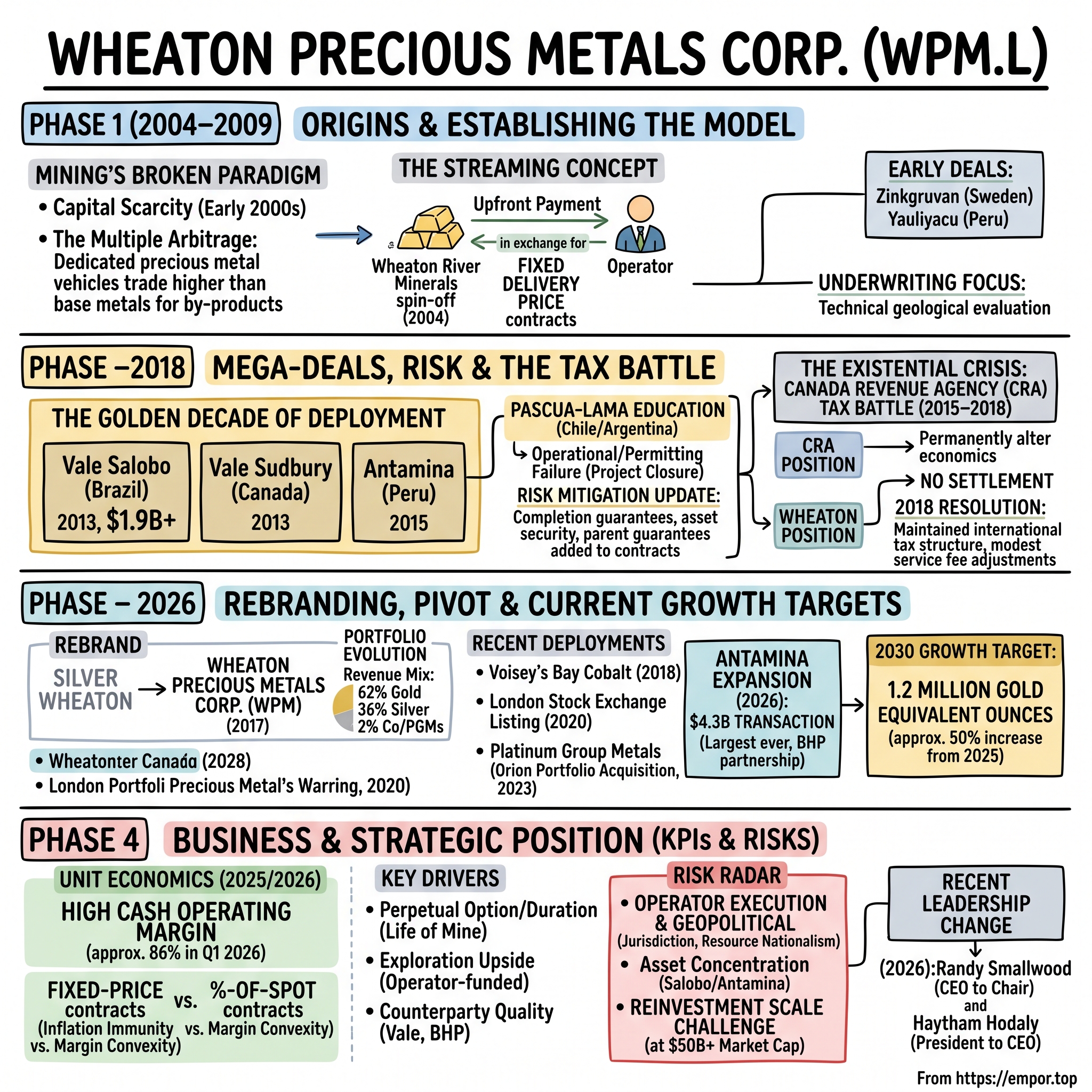
Wheaton Precious Metals Corp.: The Architecture of the Infinite Mining Margin
I. Introduction & Episode Roadmap
On a Friday morning in May 2026, mining engineer Haytham Hodaly sat down for the most closely watched hour of his professional life. It was his first quarterly conference call as chief executive of Wheaton Precious Metals, six weeks into a job his predecessor had held for fifteen years. The figures he presented set company records: revenue of $901 million, net earnings of $582 million, and operating cash flow of $766 million — each roughly double the prior year's performance.1
What makes those figures notable is not merely their magnitude, given the favorable metal prices of 2025 and 2026 across the mining industry, but the corporate structure behind them. Wheaton did not extract a single tonne of ore to generate that cash. The company owned no trucks, shovels, mills, or tailings dams, and employed fewer than fifty people in an office tower on West Hastings Street in Vancouver.2 Furthermore, its cost of goods sold — the cash paid to obtain the gold and silver sold at record spot prices — was fixed under contracts signed, in some cases, more than a decade earlier.
This structure highlights a central paradox in resource investing. Mining is historically a challenging business measured by return on invested capital. It is capital-intensive, cyclical, geologically uncertain, politically exposed, and structurally inflationary. A gold miner that discovers a deposit must spend years and billions of dollars permitting and constructing a mine, then continuously manage rising diesel prices, labor settlements, declining ore grades, and equipment wear. When metal prices rise, operating costs often climb in tandem, compressing potential gains. The industry's history is filled with top-of-cycle asset write-downs.
Wheaton insulated itself from most of those operational risks. In 2025, it reported an average cash cost of $514 per gold equivalent ounce against realized prices that produced a cash operating margin of $3,040 per ounce — an increase of more than 50% over the prior year, driven almost entirely by commodity price appreciation.3 In the first quarter of 2026, that margin expanded to $4,279 per ounce, representing a cash operating margin of roughly 86%.1 The business effectively generates software-like margins from physical commodities.
What streaming actually is
The core mechanism is metal streaming, a structure distinct from traditional mining investments.
A traditional royalty is straightforward: an investor holds a small percentage of a mine's revenue or production, typically retained from original land ownership or exploration claims. It requires no ongoing cash contributions from the holder, but grants no management input and rarely offers strategic scale.
A stream is a purchase agreement rather than a royalty. Wheaton provides a substantial upfront cash payment — historically hundreds of millions of dollars, and in one recent transaction, billions — to a mining operator, usually during mine construction or expansion. In exchange, Wheaton secures the contractual right to purchase a fixed percentage of the mine's future production for the life of the mine at a predetermined price. That delivery price is set as either a fixed dollar amount per ounce or a set percentage of the prevailing spot price. Wheaton then sells the delivered metal into global bullion markets at spot prices.
An illustrative analogy is a commercial coffee company that pays a farmer $2 million upfront to develop a plantation in exchange for the right to buy 20% of all future yield at $1 per pound. If market coffee prices rise to $10, the buyer's margin expands significantly. If the farmer's fertilizer costs triple, that operational inflation remains the producer's burden. If the farmer subsequently expands onto adjacent land and doubles production, the buyer's 20% purchase right automatically applies to the expanded output without requiring additional upfront capital.
That expansion right is a critical driver of long-term returns, and this analysis returns to it repeatedly.
The roadmap
The company's evolution spans several distinct phases, each testing key elements of its investment model.
It began in 2004, when Canadian financiers spun off silver by-product rights from Wheaton River Minerals, establishing the precious metals streaming model. It continued through a decade of rapid transaction growth in which the company deployed billions into cornerstone assets — including Salobo in Brazil, Peñasquito in Mexico, and Constancia in Peru — alongside a costly misjudgment at Pascua-Lama that led to fundamental revisions in contract structuring.
Between 2015 and 2018, the company faced a major challenge when the Canada Revenue Agency reassessed its international corporate structure, asserting tax liabilities exceeding $1 billion.
Following a corporate rebranding in 2017 reflecting its broader asset base, Wheaton entered a period of consolidation, listed on the London Stock Exchange in 2020, and expanded into cobalt and platinum group metals.
The business now stands at a major transition point marked by executive leadership changes, a $4.3 billion transaction with BHP representing the largest precious metals stream on record, and a strategic growth target to increase annual output from roughly 692,000 gold equivalent ounces in 2025 to 1.2 million ounces by 2030.45
Along the way, this analysis evaluates the core questions surrounding the business model: whether its competitive moat matches its operating margins, whether a company with a market capitalization approaching $51 billion can continue reinvesting capital at historical return levels, and whether an enterprise whose cash flows remain tied to underlying precious metal prices should be evaluated as an operating business or a structured commodity vehicle.
The story begins where the business model originated: in a capital-constrained mining sector.
 Subscribe on LinkedIn
II. Mining's Broken Paradigm & The Streaming Origin Story (2004)
At the turn of the millennium, the mining industry faced severe capital constraints. Gold had spent two decades declining, bottoming near $250 an ounce in 1999 — a price at which a substantial portion of global gold mines operated at a loss. Base metals such as copper, nickel, and zinc experienced similar weakness. Commercial banks had largely withdrawn from mine construction financing following a decade of project write-offs and the collapse of Bre-X, the Indonesian gold prospect that proved fictitious, wiping out billions of dollars in equity market capital and diminishing investor confidence across the sector.
By 2003, commodity prices had begun to recover, but capital remained scarce. A mid-tier producer seeking to construct a $600 million copper mine faced limited options: issue equity at depressed valuations and dilute existing shareholders, issue high-yield debt at elevated interest rates with restrictive operational covenants, or sell a direct asset stake and permanently surrender operational control.
This financing deficit created the opportunity for a valuation arbitrage between base and precious metal equities.
The multiple arbitrage
Geological deposits frequently contain multiple minerals. Copper deposits often yield gold and silver in economically meaningful quantities, while nickel deposits routinely produce cobalt and platinum group metals. In mining accounting, these secondary minerals are designated as "by-products" — metals recovered incidentally during primary extraction. Because mines are designed around primary ore bodies, standard accounting treats by-product revenues as a credit against primary production costs rather than as top-line revenue.
This accounting treatment created a persistent valuation gap. A copper producer generating 200,000 ounces of gold annually as a by-product received minimal market credit for that precious metal exposure. In the early 2000s, base metal producers traded at low single-digit cash flow multiples, reflecting investor perceptions of cyclicality and heavy capital requirements. Conversely, pure-play precious metal producers holding equivalent gold output traded at significantly higher multiples, driven by an investor base seeking hedges against inflation, currency debasement, and systemic risk.
Consequently, an ounce of gold commanded a higher equity valuation within a dedicated precious metals vehicle than on the balance sheet of a base metals producer. This differential presented a structural arbitrage opportunity for a corporate vehicle structured to isolate by-product streams.
The people
That vehicle was developed by a team of Canadian mining financiers at Wheaton River Minerals. Ian Telfer, Wheaton River's chairman, was a chartered accountant and dealmaker focused on corporate transactions and equity market pricing. In 2004, when a competing bidder targeted Wheaton River's silver assets — primarily by-product silver from its Luismin gold mines in Mexico — Telfer opted to separate the assets rather than sell them directly.
Telfer and his team spun off the silver stream rights into a separate entity and listed it on the Toronto Stock Exchange as Silver Wheaton, with Wheaton River retaining a controlling interest. The market pitch was distinct: investors purchased direct exposure to silver output produced by third-party mines at a fixed cash cost per ounce, insulated from direct capital expenditure and operating cost inflation.
The founding team included Randy Smallwood, a Wheaton River executive and exploration geologist who had evaluated mineral deposits in the field. This combination of transaction structuring and technical geology established the company's underwriting framework. Because a streaming transaction on an unviable mine results in unrecoverable capital loss, technical evaluation of underlying ore bodies became a core operational requirement.
The early deals and the credibility problem
Silver Wheaton's initial portfolio comprised modest agreements. The Luismin silver stream in Mexico was acquired through the spin-out, followed by transactions on Zinkgruvan, an underground zinc-lead mine in Sweden owned by Lundin Mining, and Yauliyacu in Peru. These mature operations provided predictable by-product volumes suitable for the streaming structure.
The initial commercial challenge involved establishing market credibility among mining executives cautious of novel financial instruments. To secure long-term streams, the structure had to demonstrate a clear capital advantage over conventional equity or debt financing.
For operators, streaming provided non-dilutive upfront project capital. Unlike debt, the streaming agreement carried no interest charges, financial covenants, fixed repayment schedules, or corporate default risks; if mine production ceased, the operator held no delivery obligation. Crucially, it monetized by-product ounces to which equity markets assigned limited value, allowing operators to fund primary mine construction while retaining core production upside.
This structural alignment facilitated adoption across the mining sector during the company's first decade. Operators acquired non-dilutive capital for project development, while the streaming company secured fixed-cost commodity exposure. As subsequent market cycles demonstrated, the primary trade-off for producers lay not in predatory terms, but in the long-term opportunity cost of capping upside on secondary metal output.
The following decade tested how large these capital deployments could become as-needed upfront capital commitments could become.
III. The Golden Decade of Mega-Deals & Capital Deployment (2005–2015)
The streaming business model shifted from a niche financing tool to a central mechanism for mine development on February 5, 2013. On that day, Silver Wheaton announced a $1.9 billion cash payment, alongside 10 million warrants, to acquire gold streams on two Vale operations: 25% of the life-of-mine gold output from the Salobo copper mine in Brazil, and 70% of the gold produced over twenty years from Vale's Sudbury nickel mines in Ontario.6
The transaction represented nearly $2 billion deployed for by-product gold that a major industrial miner had previously treated as secondary output.
Why Vale said yes
Why Vale — a global mining major with deep access to capital markets — chose to sell precious metals to a streaming company illustrates the structural appeal of the mechanism during sector downturns.
In 2013, Vale was executing a multi-billion-dollar capital expansion in iron ore just as iron ore prices entered a prolonged decline. Facing tight liquidity, Vale sought capital without issuing equity at depressed share prices or adding debt that credit rating agencies might penalize. Salobo's gold was a non-core by-product: a source of operational cash that received little valuation credit in equity markets focused primarily on iron ore.
Silver Wheaton monetized that secondary output, providing cash for an asset undervalued on Vale's balance sheet while securing high-margin bullion deliveries for itself. The ongoing delivery payment was set at the lesser of $400 per ounce, adjusted for 1% annual inflation starting in later years, or the prevailing spot price.6 At the time, gold traded near $1,600 per ounce.
This capital deployment expanded across three successive transactions at Salobo. In March 2015, Silver Wheaton paid an additional $900 million to double its gold stream entitlement to 50%.7 In August 2016, it committed another $800 million to increase its share to 75%.8 In total, the company deployed roughly $3 billion across three transactions on a single ore body.
This sequence highlights a fundamental feature of the streaming structure: reserve expansion and exploration upside accrue to the streamer without mandatory reinvestment. As Vale funded capital expenditures to expand mill capacity and delineate additional reserves, Salobo's output grew. Salobo became the single largest contributor to Wheaton's portfolio and remained so into 2026, when management noted that the asset outperformed expectations in the first quarter.1 The streamer's contractual right to 75% of gold production applied automatically to the expanded capacity without requiring additional upfront capital.
Antamina and the cornerstone strategy
The second major pillar of Wheaton's portfolio strategy emerged from Peru. Antamina, a large copper-zinc operation in the Andes owned by a joint venture including BHP, Glencore, Teck, and Mitsubishi Corporation, represents a long-life, low-cost asset. In 2015, Silver Wheaton acquired a silver stream on Glencore's interest in the mine. The agreement secured silver deliveries from a tier-one deposit without exposing Wheaton to the capital expenditures required for ongoing mine maintenance and expansion.
The commercial rationale across Salobo and Antamina reflected a focused underwriting approach: allocating capital to a limited number of long-life, lowest-cost-quartile operations rather than diluting portfolio quality across higher-cost assets. Operations in the lowest cost quartile typically maintain production during commodity downturns, whereas higher-cost mines risk suspension or closure. Because a streaming agreement generates cash flow only when physical metal is produced, long-term operational viability serves as a primary underwriting criterion.
While this strategy secured high-quality assets, development-stage investments presented significantly higher operational and political execution risks.
Pascua-Lama: the education
In September 2009, Silver Wheaton agreed to acquire 25% of the life-of-mine silver from Barrick Gold's Pascua-Lama project, located on the border between Chile and Argentina, alongside silver streams from several of Barrick's operating mines. The Pascua-Lama stream involved upfront consideration of $252 million, net of cash flows received from the operating mines, with an agreed delivery payment of $3.90 per ounce.9
Pascua-Lama contained extensive undeveloped precious metal reserves, but faced severe operational and technical challenges. Located at an elevation of 4,500 meters in a glacial ecosystem across an international boundary, the project encountered cost overruns, community opposition, and environmental permitting hurdles. Estimated capital costs rose from roughly $3 billion toward $8.5 billion, and Chilean environmental regulators sanctioned Barrick over water management compliance. Construction was suspended in late 2013, placing the project into care and maintenance in 2014. In September 2020, Barrick accepted an environmental court ruling upholding a closure order, transitioning the site from care and maintenance to formal closure.9
The project never delivered silver to Silver Wheaton.
The setback highlighted an underwriting gap: relying on counterparty balance sheet strength rather than independently assessing project-level technical, environmental, and regulatory risks on development-stage assets.
In response, Wheaton modified its contract underwriting standards. Subsequent streaming agreements incorporated structural risk-mitigation clauses, including completion tests with fixed outside dates that trigger refunds of upfront capital, asset-level security, corporate parent guarantees, and substitution rights permitting stream transfers if a primary asset fails to perform. During the company's first-quarter 2026 conference call, chief executive Haytham Hodaly affirmed that despite competitive market pressures, Wheaton maintained these requirements, emphasizing asset security and corporate parent guarantees.10
While these contractual protections established clearer recourse for capital recovery, their effectiveness remains partially unproven, as Wheaton has not experienced a counterparty default of comparable magnitude since Pascua-Lama.
How the field diverged
By the mid-2010s, the precious metal streaming and royalty sector had divided into distinct corporate strategies. Franco-Nevada, the historical pioneer and market leader during much of this era, accumulated a broadly diversified portfolio of precious metal royalties and oil and gas interests, prioritizing asset count to minimize single-mine operational risk. Royal Gold adopted an intermediate position, combining royalties and streams across mid-tier producers. Smaller competitors, including Osisko Gold Royalties and Sandstorm Gold, operated with narrower capital bases.
Silver Wheaton pursued a distinct strategy: concentrating capital in a smaller number of large, high-volume transactions on tier-one deposits. This asset concentration generated higher capital returns when cornerstone mines expanded output. Conversely, it exposed cash flows to greater single-asset risk, leaving financial performance vulnerable to operational interruptions at key mines like Salobo or Antamina — a dynamic evaluated later in this analysis.
By 2015, a decade of capital deployment had built a portfolio of core streaming assets. However, as the company consolidated its market position, Canadian tax authorities challenged its international corporate structure, raising questions about the tax treatment of its offshore streaming subsidiaries.
IV. The Existential Crisis: The Canada Revenue Agency (CRA) Tax Battle (2015–2018)
Every business model built on a structural insight eventually faces regulatory scrutiny. For Silver Wheaton, that challenge arrived in the summer of 2015, targeting the corporate structure underpinning its international earnings.
The structure was central to the company's economics. While Silver Wheaton Corp. was headquartered in Vancouver and listed in Toronto, its international streaming agreements—including those covering Salobo and Antamina—were held by wholly owned foreign subsidiaries, primarily based in the Cayman Islands. Those offshore entities negotiated the contracts, funded the upfront capital commitments, received the delivered metal, and sold it into global markets. Under Canadian tax law at the time, income earned by these foreign subsidiaries was not subject to Canadian corporate income tax. The Canadian parent company charged its offshore subsidiaries a service fee for head-office support, marked up by 20%, and paid Canadian tax solely on that fee income.
The Canada Revenue Agency (CRA) disputed that structure, asserting it did not reflect economic substance. The tax authority argued that substantially all foreign streaming income was generated by executives in Vancouver who evaluated, negotiated, and structured the transactions. Applying Canada's transfer pricing rules, the CRA proposed reassessing Silver Wheaton's 2005 through 2010 taxation years by reallocating virtually all offshore streaming income back to the Canadian parent entity, alongside interest and transfer pricing penalties.
The initial reassessments for those tax years totaled approximately 353 million Canadian dollars, requiring the company to post 213 million Canadian dollars in letters of guarantee as security while contesting the claim.11 However, the initial figure represented only a fraction of the total financial exposure. Had the CRA's legal principle prevailed, it would have applied to all subsequent tax years, creating a cumulative tax liability exceeding $1 billion and permanently impairing the after-tax economics of Silver Wheaton's international streaming portfolio.
Following the announcement, Silver Wheaton's stock price declined sharply, triggering shareholder class action lawsuits in the United States that added legal complexity for the management team.
The decision not to settle
Silver Wheaton elected to contest the reassessments rather than seek an early financial settlement.
The company prepared to litigate the dispute in the Tax Court of Canada, retaining the law firm Osler, Hoskin & Harcourt.12 Chief Executive Officer Randy Smallwood, who took the helm in 2011, alongside Chief Financial Officer Gary Brown, publicly maintained that the offshore subsidiaries operated as distinct operational entities responsible for key commercial decisions.
Accepting an early settlement would have eliminated near-term market uncertainty and resolved legal disputes. However, conceding the CRA's legal position would have permanently altered the company's economics. Taxing future offshore streaming income in Canada would have raised Silver Wheaton's international cost of capital relative to global peers. Consequently, defending the tax structure became essential to preserving the core business model.
The litigation spanned more than three years, during which prolonged legal proceedings and document discovery weighed on the company's valuation.
The settlement
On December 13, 2018, the company announced a settlement with the CRA that largely preserved its international tax structure.12
Under the agreement, the central principle held: earnings generated by Wheaton's foreign subsidiaries remained exempt from Canadian corporate tax, and the CRA reversed all previously assessed transfer pricing penalties. In exchange, Wheaton agreed to modest operational adjustments. The markup on service fees charged by the Canadian parent to its offshore subsidiaries increased from 20% to 30%, and the fee calculation base was expanded to include capital-raising expenses tied to international streaming deals.
The financial impact of the resolution was limited. Applying available non-capital tax losses resulted in no additional cash tax liabilities for the 2005 through 2010 taxation years, enabling the cancellation of the outstanding letters of guarantee.11 For the expanded 2005 through 2017 period, Wheaton estimated total additional cash taxes of approximately $4 million, alongside $4.3 million in interest and penalties—a modest outcome relative to the original multi-hundred-million-dollar reassessment.11
The settlement framework applied not only to the disputed 2005–2010 years but also resolved tax audits for 2011 through 2015 and established guidelines for future taxation, provided there were no material changes in factual circumstances or tax law.12 Smallwood noted that the agreement "removes uncertainty with the use of our business model going forward."12
Wheaton's shares increased by approximately 11% following the announcement.
What it actually proved
A common narrative attributes the resolution to executive resolve, but a rigorous analysis suggests a more structural explanation. Wheaton prevailed primarily because its offshore subsidiaries possessed genuine operational substance, making the CRA's position legally vulnerable. Management's key contribution was accurately evaluating the strength of its legal framework and maintaining sufficient balance sheet flexibility to absorb prolonged litigation rather than settling prematurely.
This decision demonstrated a willingness to accept a temporary equity valuation discount to protect long-term corporate economics. For institutional investors evaluating executive execution, this period provides a clear example of management holding to a core strategy under significant regulatory and market pressure.
However, a key ongoing risk remains. Because the 2018 settlement is explicitly contingent on unchanged facts and tax statutes, it does not permanently insulate Wheaton from global tax reforms. Since 2018, international tax standards have increasingly favored global minimum tax frameworks and heightened economic substance requirements for offshore subsidiaries. Future statutory changes in Canada or international jurisdictions could still alter the tax treatment of foreign streaming income.
With the tax overhang resolved, management focused on reshaping the company's corporate identity to reflect its evolving portfolio.
V. Rebranding, Portfolio Pivot, & Segment Economics
The company's corporate name lagged its underlying business model for several years.
By 2013, transaction activity had shifted heavily toward gold, anchored by streaming agreements on Salobo and Sudbury. The business retained the name Silver Wheaton even as its revenue mix moved away from silver. For three consecutive quarters leading up to the name change, revenue was split roughly evenly between silver and gold.13 On May 10, 2017, shareholders approved a special resolution renaming the enterprise Wheaton Precious Metals Corp., and its shares began trading under the ticker WPM on the Toronto and New York stock exchanges the following week.13
Chief Executive Officer Randy Smallwood described the rebrand as marking "our evolution from a pure silver streaming company to a diversified precious metals streaming company."13 While the transaction reflected no immediate change in the underlying asset base, it aligned the corporate identity with institutional investment mandate screens.
What the portfolio actually looks like now
The asset mix has continued to evolve. In 2025, revenue broke down as roughly 62% gold, 36% silver, and about 1% each from palladium and cobalt.3 Total production reached 691,670 gold equivalent ounces — comprising 416,286 ounces of gold, 22.4 million ounces of silver, and roughly 16,500 gold equivalent ounces of secondary metals — exceeding the upper bound of management's guidance of 670,000 ounces.4
Gold serves as the primary cash driver and remains concentrated in key assets. Salobo represents the largest single contributor, supported by Hudbay Minerals' Constancia mine in Peru and Vale's Sudbury nickel operations. Newer producing gold streams include Artemis Gold's Blackwater project in British Columbia and B2Gold's Goose project in Nunavut. The economic structure reflects the core streaming mechanism: streams like Salobo carry fixed ongoing delivery payments near $400 per ounce against realized gold prices that averaged $3,494 per ounce in 2025.3
Silver provides operational leverage. Operating anchors include Antamina in Peru and Newmont's Peñasquito mine in Zacatecas, Mexico, alongside contributions from Constancia and Zinkgruvan. Realized silver prices averaged $42.26 per ounce in 2025.3 Because roughly half of global silver demand stems from industrial applications, the metal exhibits higher volatility than gold, expanding margins during precious metals rallies while remaining exposed to broader industrial slowdowns.
Cobalt and PGMs represent small strategic allocations. The cobalt position originated from a June 2018 agreement with Vale covering the Voisey's Bay mine in Labrador: a $390 million upfront payment for 42.4% of cobalt output until 31 million pounds are delivered and 21.2% thereafter, with production delivery payments set at 18% of the spot price until the upfront capital is depleted and 22% thereafter, effective January 1, 2021.14 Management noted at the time that cobalt shared key streaming characteristics with silver as a primary mining by-product, with Voisey's Bay offering jurisdiction stability in Canada relative to primary supply concentrated in the Democratic Republic of Congo.14
The platinum group metals exposure was established through a portfolio acquisition. In November 2023, Wheaton acquired a package of existing streams from entities controlled by Orion Mine Finance for up to $530 million, securing palladium and platinum streams on Ivanhoe Mines' Platreef project in South Africa, gold and silver streams on BMC Minerals' Kudz Ze Kayah project in the Yukon, and a gold stream on Dalradian's Curraghinalt project in Northern Ireland.15
This modest positioning in secondary metals reflected capital discipline. Cobalt prices declined sharply after 2018 amid increased supply and shifting battery chemistries toward lower-cobalt formulations. Because Wheaton maintained cobalt at roughly 1% of revenue rather than executing a large-scale pivot into battery metals, the financial impact remained minimal. Restraint in non-precious metals distinguishes Wheaton from industry peers that committed larger capital allocations to battery materials during market peaks.
The development pipeline
Long-term production targets depend on an extensive pipeline of development projects. Management's February 2026 outlook highlighted Blackwater, Mineral Park, Fenix, Hemlo, Goose, Platreef, Kurmuk, Koné, El Domo, Spring Valley, Copper World, Santo Domingo, Cangrejos, Kudz ze Kayah, and Marathon as key growth drivers.4 As of the first quarter of 2026, the portfolio encompassed 22 operating mines and 26 development projects and other interests.1
This expanded project count addresses historical asset concentration risks, provided those mines reach commercial operation. Development-stage streams carry execution risk; the gap between a contractual right on a permitted project and commercial delivery from an operating mine remains significant, as demonstrated by historical project delays at assets like Pascua-Lama.
Geography and counterparty concentration
Geographically, portfolio cash flows are weighted toward the Americas, with primary production concentrated in Brazil and Peru through Salobo and Antamina, followed by secondary exposures in Mexico, Canada, the United States, Europe, Africa, and Australia.
Counterparty concentration represents a more structural consideration. Vale and the Antamina joint venture partners — BHP, Glencore, Teck, and Mitsubishi — generate a substantial share of total metal deliveries. Wheaton's cash flow stability depends on the operational execution, capital allocation, labor management, and regulatory compliance of a small group of major mining operations over which it exercises no direct operational control. This operational reliance is an inherent trade-off of the capital-light streaming model that metal diversification alone does not eliminate.
This structure raises the central question of how the market values the streaming model's risk-return profile relative to its returns.
VI. The Economics of Streaming: Mechanics, Margins, & 7 Powers Analysis
Examining the unit economics on a single ounce illustrates the core operating model. In 2025, Wheaton's average realized price per gold equivalent ounce sold, net of its cash cost of $514, produced a cash operating margin of $3,040 per ounce.3 In the first quarter of 2026, as metal prices climbed, the realized price per ounce reached $4,960 against a cash cost of $681, generating a margin of $4,279 per ounce.1 Approximately 86 cents of every revenue dollar converted directly into cash operating margin.
Between those periods, realized prices per ounce increased approximately 98% year over year in the first quarter.1 Wheaton's cash costs also rose, moving from $514 to $681 per ounce, though that increase was smaller in absolute terms and driven primarily by portfolio asset mix rather than direct operational inflation. This cost dynamic forms the foundation of the investment case.
Inflation immunity, correctly stated
When costs for diesel, explosives, tires, steel, and labor rise across the mining industry, an operating producer's all-in sustaining costs increase in tandem, absorbing much of the gain from higher commodity prices. Operating miners have historically provided inconsistent metal exposure because operational leverage is frequently offset by cost inflation and project capital overruns.
Wheaton's contractual delivery payments do not track those operating cost pressures. Under legacy fixed-price streams—such as Salobo's roughly $400 per ounce or Pascua-Lama's $3.90 per ounce of silver—purchase costs are contractually fixed and adjusted by a predetermined annual inflator of approximately 1%.69 Operational inflation at the mine site does not alter Wheaton's delivery price.
However, characterizing Wheaton's costs as permanently fixed oversimplifies the modern portfolio. Recent streaming agreements are increasingly structured as a percentage of prevailing spot prices rather than fixed dollar amounts. The Antamina agreement with BHP sets ongoing delivery payments equal to 20% of the spot silver price.16 The Platreef palladium and platinum streams pay 30% of spot until a delivery threshold is reached, increasing to 80% thereafter.15 The cobalt stream requires payments of 18% of spot, rising to 22%.14
Percentage-of-spot structures maintain complete protection against direct operating cost inflation, which remains entirely with the mine operator. However, they alter the margin expansion profile during commodity rallies. Under a fixed-price stream, a doubling in metal prices produces disproportionate margin expansion per ounce. Under a 20%-of-spot stream, a doubling in price doubles the absolute margin per ounce while holding the percentage margin constant at 80%. This mechanics explains why Wheaton's average cash cost per ounce increased from $514 to $681 as prices climbed: percentage-based streams incur higher delivery payments when metal is expensive.
This evolution alters portfolio leverage. While the legacy portfolio provides strong operating leverage to rising metal prices, the growing proportion of percentage-based streams yields high but structurally capped percentage margins. As the asset mix rotates toward newer agreements—highlighted by the $4.3 billion Antamina stream—blended operating margins become less convex. On the first-quarter 2026 conference call, management framed precious metals gross margins at 84% to 86%, reflecting high profitability but a distinct margin profile compared to fixed-cost leverage.10
The perpetual option nobody pays for
The structural feature distinguishing streaming from debt instruments or fixed-term royalty contracts is duration and operational optionality.
A life-of-mine stream attaches to the underlying geological deposit rather than a static reserve estimate. When a mine operator funds exploration to convert resources into reserves, deepens an open pit, or expands mill throughput, Wheaton's contractual percentage automatically applies to the incremental production without requiring additional capital contributions. During the first-quarter 2026 conference call, Chief Executive Haytham Hodaly highlighted this dynamic at Antamina, noting that operators had replaced over 95% of silver reserves through exploration and resource conversion since 2015.17
From an options perspective, Wheaton holds long-dated call options on both metal prices and operator-funded expansion capital. Because mine operating lives frequently exceed initial engineering projections, this unpriced reserve expansion represents a primary driver of long-term returns—a factor that standard discounted cash flow models based strictly on proven reserves tend to understate.
Hamilton Helmer's 7 Powers, tested honestly
Scale economies. Scale provides a clear barrier in mega-transactions. The Antamina transaction required $4.3 billion in upfront consideration, funded with $1.9 billion of cash, a $1.5 billion two-year term loan, and $0.9 billion drawn on the existing $2 billion revolving facility.5 Few streaming entities possess the balance sheet capacity to finance single transactions of this magnitude. Mid-tier competitors such as Osisko Gold Royalties or Sandstorm Gold are effectively excluded from competing for multi-billion-dollar tier-one assets, concentrating premier opportunities among a small group of market leaders.
Process power. Partially demonstrated. Two decades of technical, geological, and legal structuring experience provide an advantage, and contract modifications following Pascua-Lama reflect institutional learning. However, peers such as Franco-Nevada and Royal Gold possess comparable underwriting capabilities, narrowing any process-based differentiation among the primary market players.
Cornered resource. This represents the strongest structural power. A life-of-mine stream on a lowest-cost-quartile deposit grants an exclusive contractual right that cannot be contested, duplicated, or renegotiated by competitors once executed. The stream on Salobo, for example, permanently secures that output share for Wheaton.
Brand and counterparty preference. Present but secondary to financial terms. Major transactions validate the commercial model; during the first-quarter 2026 call, Hodaly noted that "BHP coming in... validating the streaming model" demonstrated institutional acceptance among major miners.10 However, when a global producer executes a multi-billion-dollar transaction, competitive pricing and capital availability remain the primary selection criteria rather than brand preference alone.
Switching costs and network effects. These powers do not apply to the streaming business model. Once a contract is executed, the agreement is legally binding, and the business generates no network-based feedback loops.
Porter's five forces
Threat of new entrants remains low for mega-transactions and high for smaller deals. While capital requirements are low for minor royalty vehicles, executing multi-billion-dollar transactions requires balance sheet scale that limits competition to a few established firms.
Supplier power—the leverage held by mining operators selling streams—has increased significantly. In 2013, capital-constrained operators like Vale had limited financing alternatives. By 2026, record metal prices and strengthened balance sheets provided miners with broader access to capital markets, increasing competition for streams and compressing returns on new transactions.
Buyer power is negligible, as refined bullion sells directly into liquid global spot markets.
Substitutes present growing competition. Mining companies can choose among high-yield debt, convertible notes, equity offerings, prepay structures, private credit, and sovereign wealth capital seeking direct resource exposure.
Rivalry among major streaming companies remains intense and focused on premier assets. In early August 2026, Wheaton's market capitalization stood at approximately $50.8 billion, compared with $41.4 billion for Franco-Nevada and $17.1 billion for Royal Gold.18 This valuation trajectory reflects the performance of Wheaton's precious-metals focus relative to Franco-Nevada's broader diversification during the recent commodity cycle.
This structural framework highlights a key distinction: while competitive moats effectively protect the cash flows of existing streaming agreements, they offer limited protection for returns on future capital deployment.
Evaluating how management navigates this competitive landscape provides the context for examining the leadership team tasked with allocating the company's capital.
VII. Current Management, Governance, & Capital Allocation Track Record
On March 31, 2026, Randy Smallwood stepped down as chief executive of the company he had helped establish twenty-two years earlier.
The transition was announced on February 5, 2026, and structured to ensure continuity.19 Smallwood, who co-founded the business in 2004 and became chief executive in 2011, transitioned to non-executive chair of the board. George Brack, board chair since 2022 and a director since 2009, moved into the role of lead independent director, while Haytham Hodaly, who had been elevated to president in 2025, assumed the chief executive role and joined the board.19
Reflecting on the transition, Smallwood stated that building and leading the organization "has been the privilege of my career."19
The new chief executive
Hodaly is a mining engineer who previously worked as a director and mining analyst at RBC Capital Markets. He joined Wheaton in 2012 as senior vice president of corporate development, leading business development efforts and playing a central role in executing more than $11 billion in streaming transactions.19
This background aligns directly with the company's current operational demands. While founding-era leadership focused on establishing the streaming model and building market credibility, the primary challenge today centers on competitive underwriting—evaluating stream valuations in auctions where multiple well-capitalized suitors compete for tier-one assets. A former mining analyst who spent fourteen years evaluating and pricing these instruments brings directly applicable experience to that environment.
However, executive succession from a long-tenured leader carries inherent operational and governance risks. Having assumed the chief executive role four months prior, Hodaly's track record in the top seat remains early-stage. While his prior role as architect of the transaction pipeline reduces the likelihood of strategic drift, pairing a new chief executive with a former long-serving chief executive as non-executive chair creates a governance structure that can either ensure steady continuity or obscure clear operational accountability.
The finance seat
The chief financial officer role underwent a similar internal transition a year earlier. Gary Brown, who served as chief financial officer for nearly seventeen years and navigated the company through the Canada Revenue Agency tax dispute, retired on March 31, 2025, following an announcement on January 9, 2025.20 Vincent Lau, previously vice president of finance for thirteen years, succeeded Brown. Lau holds CPA and CFA designations and brought prior finance experience from CHC Helicopter and KPMG's transaction services practice.20
Executing two internal promotions in the top executive roles within thirteen months represents a notable leadership transition for a lean corporate team. This transition can be interpreted as reflecting disciplined succession planning and cultural continuity. Conversely, it shifts institutional memory—specifically the operational lessons from the Pascua-Lama impairment and the CRA tax dispute—away from day-to-day executive decision-makers and toward the board level. The long-term impact of this shift will depend on how the new executive team navigates future underwriting and regulatory challenges.
Incentives and capital allocation
Executive compensation is tied to a mix of performance metrics, including operating cash flow per share growth, attributable metal production, relative total shareholder return, and site-level sustainability performance across partner operations.
Prioritizing operating cash flow per share aligns management incentives with shareholder protection. In a streaming model where growth can tempt executives to issue equity for large transactions, focusing on per-share cash metrics deters share dilution that might otherwise mask value-destructive deal structures.
Recent capital allocation decisions demonstrate this framework in practice. The $4.3 billion Antamina stream transaction was financed entirely through existing cash and debt facilities without equity dilution, resulting in expected net debt at closing of approximately $2.4 billion.5 During the fourth-quarter 2025 conference call, Hodaly noted that management remains comfortable funding future transactions between $1.5 billion and $3 billion while targeting net leverage of roughly 0.7 times at closing.17 Utilizing a $1.5 billion term loan alongside revolver draws marks a strategic shift from the company's historical unleveraged posture toward prudent balance sheet leverage for tier-one assets—a policy shift that warrants ongoing monitoring.
The dividend
The corporate dividend policy is structured as a progressive framework targeting approximately 30% of average operating cash flow over the preceding four quarters. However, rapid cash flow expansion has diverged from dividend growth. During the fourth-quarter 2025 earnings call, Lau noted that dividend payouts represented "just over 10% of our operating cash flows," maintaining dividend coverage even under lower commodity price scenarios.17 For 2026, the quarterly dividend was set at 19.5 cents per share—representing an 18% increase and the third consecutive annual expansion—compared to total dividend payouts of 66 cents per share in 2025.321
This distribution payout reflects a growth-oriented capital allocation policy rather than an income-focused return strategy. By retaining approximately 90% of operating cash flow to fund prospective streaming agreements, the company's capital strategy relies heavily on management's ability to reinvest retained capital at attractive returns on invested capital.
VIII. Recent Strategy Shifts, Earnings Call Analysis, & Analyst Q&A Audit
The executive Q&A on quarterly earnings calls offers a direct test of corporate messaging, forcing leadership to defend strategic claims against industry analysts.
Wheaton's fourth-quarter 2025 conference call on March 13, 2026, marked a transitional moment: Randy Smallwood remained chief executive for another eighteen days, alongside President Haytham Hodaly, Chief Financial Officer Vincent Lau, Vice President of Mining Operations Wes Carson, and Vice President of Corporate Development Neil Burns.17 The first-quarter 2026 call on May 8 featured the same leadership team following Smallwood's retirement.10 Comparing the two sessions provides a measure of operational and strategic continuity during an executive transition.
What management chose to emphasize
On both calls, management prioritized three main topics: record financial results, the $4.3 billion Antamina transaction, and production expansion targets through 2030. Hodaly maintained consistent framing across both appearances, projecting a growth trajectory to 1.2 million gold equivalent ounces by 2030 — approximately 50% above 2025 output.1710
For 2026, production guidance was set at 860,000 to 940,000 ounces, accompanied by specific detail on quarterly cadence: output was expected to be weighted roughly 45% in the first half of the year and 55% in the second.17 This weighting is critical because silver deliveries from the Antamina stream began on April 1, 2026, leaving first-quarter output devoid of contributions from that transaction.16 By outlining this trajectory early, management addressed why first-quarter production of 211,951 ounces annualized below full-year targets.1 Providing this structural context upfront established clear performance parameters for the remainder of the year.
Where analysts pushed
Analyst questioning focused heavily on the scale and repeatability of the Antamina deal. Analysts asked whether the $4.3 billion commitment represented a rare event, implying that if such transactions cannot be replicated, long-term growth beyond 2030 lacks a comparable catalyst. Management responded that while Antamina was exceptional in size, streaming agreements exceeding $1 billion remain possible over time.10
However, detail from the corporate development team presented a more measured outlook. On the same call, Burns noted that prospective transactions were concentrated in the $200 million to $500 million range, with billion-dollar deals requiring longer incubation periods.10 On the preceding quarterly call, he had characterized the pipeline as focused on opportunities between $200 million and $300 million.17
Reconciling these statements indicates that routine transaction flow consists of mid-sized commitments, while multi-billion-dollar transactions remain episodic. For an enterprise generating approximately $1.9 billion in annual operating cash flow and holding $2.4 billion in net debt following the Antamina transaction, a deal pipeline centered on $200 million to $500 million agreements suggests that capital allocation over the near term will emphasize balance sheet deleveraging and bolt-on acquisitions rather than immediate portfolio transformation.35 While this strategy maintains financial flexibility, it differs from the continuous mega-deal momentum implied by broader growth narratives.
Regarding the Salobo mine, analysts inquired about expansion permitting and incremental volume expectations. Management stated that capital studies by operator Vale remained ongoing, confirming that Wheaton faced no additional capital requirements and indicating that any output adjustments would be reflected in future annual guidance.10 This highlights a fundamental feature of the streaming structure: the operator funds facility expansions while the streamer receives contractual output without direct capital outlays. At the same time, it defers near-term volume estimates pending partner execution.
In discussing geographic expansion, Burns highlighted opportunities in Australia following Wheaton's $275 million upfront investment in the Jervois gold and silver stream, noting increased regional counterparty interest.110
Reading the credibility
Three key observations emerge from an evaluation of corporate disclosure and execution.
First, operational guidance has proven reliable. For 2025, Wheaton projected production with an upper bound of 670,000 ounces and delivered 691,670 ounces — approximately 3% above the top of the range and 9% above the midpoint.4 While exceeding projections can reflect conservative target-setting, setting attainable guidance in a streaming model—where delivery timing depends on third-party mine operators—helps insulate cash flow projections from unexpected operational downtime.
Second, corporate strategy remained consistent through the executive change. The 2030 production targets, capital allocation priorities, and underwriting risk criteria presented during Smallwood's tenure were reiterated by Hodaly and his team. This continuity suggests strategic stability rather than sudden operational reorientation following the leadership handoff.
Third, significant analytical questions regarding capital efficiency remain unaddressed. Disclosures do not specify the internal rate of return underwritten for the Antamina transaction, nor do they detail how projected returns on new capital have trended over recent years amid heightened competition. Additionally, the sensitivity of 2030 production targets to potential delays across development-stage projects remains unquantified. While Wheaton provides comprehensive operational and cost reporting, disclosure regarding return on invested capital for newly acquired streams remains limited across the industry. Consequently, public records do not currently allow independent verification of whether newly committed capital will achieve historical return thresholds.
The second-quarter 2026 financial results, scheduled for release on August 6, 2026, will reflect the initial full quarter of contributions from the Antamina stream, offering a concrete test of whether the company's largest capital commitment fulfills its financial expectations.
IX. Strategic Position, Risk Radar, & Skeptical Investor Stress Test
Imagine a skeptical fund manager sitting across from Chief Executive Haytham Hodaly. She is unimpressed by gross margin percentages, knowing that a high margin on a commodity price is fundamentally different from a high margin on an engineered product. Her questions outline the core investment thesis and its limits.
The risks that actually matter
Operator execution. Wheaton exercises no direct operational control over the assets generating its cash flow. A tailings restriction at Salobo, a pit wall failure at Antamina, a labor strike in Peru, or a mill outage in Mexico translates directly into fewer delivered ounces, with no operational levers available to Vancouver management. This risk is uninsurable within the streaming model — it is the structural trade-off of remaining capital-light. The primary mitigation is asset quality: the portfolio concentrates on low-cost, long-life mines that operators fight hardest to keep running.
Resource nationalism and jurisdiction. Governments across Peru, Brazil, and Mexico have periodically pursued higher mining taxes, revised royalty regimes, and stricter environmental permitting. Streams are contracts with mine operators rather than sovereign governments, providing partial insulation: a direct tax increase falls on the operator's margin rather than Wheaton's delivery price. However, if taxation or regulatory delays render a mine unviable or halt permitting, production stops, and stream deliveries cease. Mexico's limits on new concessions and Peru's local community disputes remain active operational considerations.
Development slippage. Achieving the 2030 target of 1.2 million gold equivalent ounces depends on a broad pipeline of development projects reaching commercial production on schedule. Vice President of Mining Operations Wes Carson noted on the fourth-quarter 2025 call that new growth projects were "fully funded, permitted, and either under construction or scheduled to begin shortly" — a key operational distinction, given that funding shortfalls and permitting hurdles previously halted Pascua-Lama.17 Nevertheless, across more than fifteen development assets managed by third-party operators in various jurisdictions, schedule slippage remains likely. The critical variable is whether aggregate delays are measured in months or years.
Counterparty financial distress. Several development agreements involve junior and mid-tier mining companies without the balance-sheet depth of Vale or BHP. If a junior operator fails to complete mine construction, Wheaton is left with a contractual completion-test claim and legal recourse rather than physical metal. While post-2015 contract standards incorporate completion guarantees and asset security specifically for this exposure, those protective clauses remain largely untested at scale during a severe downturn.
Cost of capital and leverage. Historically, Wheaton maintained a virtually debt-free balance sheet. Following the Antamina transaction, net debt stands at approximately $2.4 billion, anchored by a two-year term loan that will require refinancing or repayment.5 At current metal prices and cash flow generation, this debt burden is manageable. However, if commodity prices decline sharply, elevated debt service limits management's flexibility to deploy capital into distressed assets — historically the most advantageous environment for acquiring high-margin streams.
The activist's questions
On concentration. Salobo and Antamina continue to generate a substantial portion of total operating cash flow. Management contends that a portfolio encompassing 22 operating mines and 26 development projects and other interests will naturally dilute this concentration over time.1 While asset diversification is expanding, cash flow concentration declines much more slowly than asset count because new streams begin from a smaller base while cornerstone assets continue expanding. Significant single-asset exposure will persist through the decade.
On the reinvestment ceiling. The primary structural challenge facing the business model is capital redeployment scale. With a market capitalization exceeding $50 billion, Wheaton must deploy multi-billion-dollar sums at high returns to drive per-share growth.18 Management maintains a disciplined framework, asserting that if streaming returns compress below target hurdle rates, excess capital will be returned to shareholders rather than committed to lower-yielding transactions.
However, this capital discipline has not been tested through a prolonged drought of attractive deal flow. Rising competition from private credit, sovereign wealth funds, and financially sound mining operators has reduced the scarcity value of streaming capital. In this environment, preserving underwriting discipline requires declining overpriced transactions — a policy that investors can verify only through observed capital restraint over time.
On what Wheaton actually is. The central investment consideration is definitional. In 2025, attributable production expanded to 691,670 gold equivalent ounces from a lower base — reflecting real volume growth. However, record top-line revenue, earnings, and cash flow were driven primarily by market pricing, as gold averaged $3,494 per ounce and silver $42.26 per ounce.3 In the first quarter of 2026, realized prices per ounce rose 98% year over year, whereas production grew 21.5%.1 Commodity price expansion, rather than volume growth, generated the vast majority of financial upside.
This outcome reflects the intentional design of a streaming vehicle. Buying Wheaton provides a tax-efficient, operationally leveraged investment in underlying precious metals prices, structured to convert metal rallies into cash flow more predictably than an operating miner and with higher cash margins than physical bullion. However, this structure remains tied to commodity markets; it enhances, rather than replaces, a fundamental outlook on precious metals prices.
On disclosure. The primary reporting gap centers on return on new capital deployment. For an enterprise retaining approximately 90% of its operating cash flow for project reinvestment, clear disclosure regarding underwritten internal rates of return on new transactions remains essential for shareholders evaluating capital allocation performance.
X. Playbook: Business & Investing Lessons
Stripping away the mining specifics reveals several transferable business and investing principles.
1. Find the multiple arbitrage, then build the vehicle to harvest it. The founding insight was neither geological nor operational. It was that identical cash flows command different valuations depending on the corporate wrapper holding them, and that this gap can be captured by constructing a structure to transfer cash flows from a low-multiple entity to a high-multiple vehicle. Similar mispricings exist across industries wherever investor bases are segmented — such as a high-margin division buried within a lower-multiple conglomerate or a recurring revenue stream hidden inside a cyclical business. Identifying the valuation gap is common; building the vehicle to capture it is rare.
2. Design contracts with capped downside and uncapped duration. The most valuable provision in a streaming contract is not the purchase price, but the "life of mine" clause. Capping upfront capital commitments while leaving potential volume upside unbounded — including future reserves funded entirely by the operator's exploration spending — converts a financing arrangement into a long-dated call option. In long-term commercial agreements, duration and scope-of-application terms can prove far more valuable than initial pricing, yet they are frequently negotiated with less scrutiny.
3. Distinguish input-cost immunity from overall price exposure. Wheaton maintains structural protection against operating cost inflation because it incurs no direct mine site expenses. However, it is not immune to commodity price shifts under percentage-of-spot streaming contracts, where purchase payments increase alongside spot prices. When evaluating enterprises claiming inflation protection, investors must examine precisely which line items, contracts, and operating costs are sheltered. General claims of inflation immunity are almost always narrower than presented.
4. Identify which structural principles warrant prolonged defense. Contesting the Canada Revenue Agency reassessments exposed Wheaton to three years of legal costs and equity valuation pressure. However, conceding the core tax principle would have permanently impaired its international business model, whereas the eventual settlement required only minor operational adjustments. Distinguishing structural priorities from mechanical concessions — and accepting near-term market pressure to protect core economics — represents a key management capability that becomes evident only under regulatory scrutiny.
5. Size adjacent risks to ensure survivability. Wheaton's 2018 expansion into cobalt appeared prescient during initial supply tightness, but less compelling after global prices collapsed. Nevertheless, the financial impact remained minimal because the allocation was structured as a minor optional exposure representing roughly 1% of revenue rather than a major strategic pivot. Adjacent growth initiatives should be sized so that an adverse outcome never threatens the core enterprise.
6. Separate the competitive moat of existing assets from the economics of future growth. Wheaton's legacy streaming portfolio is protected by exclusive, long-term contracts that competitors cannot contest or renegotiate. Conversely, prospective streaming agreements are contested in competitive auctions against well-funded peers and increasingly solvent mine operators. Conflating the durable economics of an installed asset base with the returns achievable on future capital deployment leads to systematic overvaluation of growth prospects.
XI. Essential KPIs & Bull vs. Bear View
The metrics that matter
Three primary metrics capture the core performance of the business model.
1. Attributable gold equivalent ounce production against the path to 2030. This represents the volume engine and the primary operational variable management influences directly through capital deployment. The volume trajectory runs from 691,670 ounces in 2025 through 2026 guidance of 860,000 to 940,000 ounces, targeting 1.2 million ounces by 2030.4 The critical variable is whether key development projects—including Kurmuk, Koné, El Domo, Santo Domingo, and Cangrejos—reach commercial output on schedule, as the second half of that expansion relies on assets not yet producing.
2. Operating cash flow per share. Measuring cash flow on a per-share basis reflects capital discipline, showing whether production growth is generated organically or purchased through equity dilution. This metric distinguishes value creation from corporate expansion in a sector where issuing shares for major assets is a constant temptation.
3. Reserve and resource replacement at partner mines. This indicator determines whether life-of-mine streaming agreements maintain long-term value. Because metal delivery depletes active reserves, operator-funded exploration must add attributable ounces faster than extraction removes them to extend portfolio duration without requiring additional capital outlays. Management noted that operators replaced over 95% of silver reserves at Antamina since 2015—a reserve replacement rate that serves as a benchmark for the broader portfolio.17
The bull case
The investment thesis for the company rests on three distinct pillars.
The strongest pillar is structural: the portfolio consists of long-term contractual rights on tier-one mining operations, featuring fixed or percentage-based costs insulated from operating inflation, no ongoing capital calls, no direct site liabilities, and duration that extends whenever operating partners fund exploration. Competitors cannot alter these existing agreements, establishing a durable cornered resource.
The second pillar is volumetric: roughly 50% production growth through 2030 is already contracted under existing agreements rather than speculative, requiring no new acquisitions.4 Combined with precious metals operating margins of 84% to 86%, incremental delivery volumes convert directly into cash flow.10
The third pillar is macroeconomic: sustained central bank purchasing, currency debasement concerns, and tight global supply supporting elevated metal prices. Former Chief Executive Randy Smallwood highlighted this dynamic by noting that quality silver production is "becoming increasingly difficult to source while demand continues to rise"—a supply-side perspective reflecting the company's precious metals focus.5
The bear case
The bear case does not rest on operational weakness, but rather on whether current market valuations embed assumptions that may prove difficult to maintain.
First is reinvestment scale. At a $50 billion market capitalization, sustaining historical per-share cash flow growth requires deploying significant capital annually at high returns in a market where streaming capital is no longer scarce. The routine transaction pipeline centers on $200 million to $500 million deals, while multi-billion-dollar transactions remain episodic and competitive. Furthermore, public disclosures do not detail internal rates of return on newly committed capital, making independent verification of underwriting discipline difficult.
Second is asset concentration. Salobo and Antamina continue to generate a substantial portion of total operating cash flow. A multi-year operational, geotechnical, or regulatory interruption at either site would directly impair cash flows, with management holding no direct operational levers to intervene.
Third is commodity price sensitivity. Record financial performance in 2025 and 2026 resulted primarily from metal price appreciation rather than volume gains. Operating leverage functions in both directions: a sustained drop in spot prices would compress margins, while the balance sheet now carries net debt rather than a net cash buffer into such a downturn.
Fourth is portfolio contract mix. As percentage-of-spot streams expand as a proportion of total revenue, the margin expansion characteristic of legacy fixed-price streams diminishes. Investors expecting historical percentage margin expansion from a shifting contract mix risk overestimating future margin leverage during commodity rallies.
The synthesis
The enterprise prospers if precious metal prices remain elevated, contracted production growth through 2030 arrives on schedule, and management maintains capital discipline by declining lower-returning transactions. Commodity prices and mine execution depend on external market conditions and operator performance, leaving capital allocation as the primary variable under direct executive control.
The investment thesis weakens if a cornerstone asset suffers an extended operational disruption, if metal prices decline against a leveraged balance sheet, or if growth pressure at a $50 billion valuation leads to underpriced stream acquisitions whose lower returns become apparent only over time.
XII. Epilogue & Conclusion
There is an implicit image central to this story: an office floor in Vancouver housing fewer than fifty people, controlling contractual claims on gold beneath the Carajás rainforest, silver inside a mountain in the Peruvian Andes, cobalt under Labrador, and platinum group metals in the Bushveld — none of which anyone in that office has ever extracted, or ever will.
That image captures the core logic of the business. In 2004, a group of Canadian financiers recognized that the mining sector was systematically mispricing its by-product metals and established a dedicated company to capture the valuation gap. Twenty-two years later, in 2026, that enterprise was worth more than the pioneer royalty firm it once trailed, had survived a tax challenge that threatened its international corporate structure, had absorbed a costly lesson in the Chilean Andes, and had just written the largest check in the sector's history to a major producer that could have funded the asset on its own balance sheet.518
The broader lesson concerns where value accumulates in capital-intensive industries. Mining generates substantial economic value but retains relatively little of it, as returns are frequently eroded by high capital expenditures, operational cost inflation, and geological risk. Capital concentrates instead in the layer above the physical asset — in the legal agreements that govern who receives what the deposit produces, under what commercial terms, and over what duration.
Whether that dynamic persists depends on a question the past two decades have not fully tested: what happens to a contract writer's returns once the model becomes widely understood. Streaming yielded exceptional returns when mining companies faced acute liquidity constraints and the structure was novel. Today, streaming represents a mature, competitive form of corporate capital negotiated by well-funded counterparties who understand the full value of their secondary output. BHP did not monetize silver from Antamina out of financial distress.
The architecture Wheaton constructed remains structurally durable: existing agreements cannot be competed away, repriced, or eroded by mine-site inflation. What remains uncertain is whether future transactions can be executed on terms as favorable as those secured during the industry's formative years. That question will be answered not by corporate forecasts, but through the steady accumulation of quarterly results — ounce by ounce, deal by deal.
References
-
Wheaton Precious Metals Announces Record Revenue, Earnings and Cash Flow for the First Quarter of 2026 — Wheaton Precious Metals, 2026-05-07 ↩↩↩↩↩↩↩↩↩↩
-
Wheaton Precious Metals Corp. (WPM) Company Page — London Stock Exchange ↩
-
Wheaton Precious Metals Announces Record Annual Revenue, Earnings and Cash Flow for 2025 — Wheaton Precious Metals, 2026-03-12 ↩↩↩↩↩↩↩↩
-
Wheaton Precious Metals Exceeds 2025 Production Guidance and Provides 2026 and Long-Term Outlook — Wheaton Precious Metals, 2026-02-16 ↩↩↩↩↩↩
-
Wheaton Precious Metals Announces Acquisition of Additional Silver Stream on Antamina Through New Partnership with BHP — PR Newswire, 2026-02-16 ↩↩↩↩↩↩↩
-
Silver Wheaton Acquires Gold Streams from Vale's Salobo and Sudbury Mines — PR Newswire, 2013-02-05 ↩↩↩
-
Silver Wheaton Acquires Additional Gold Stream From Vale's Salobo Mine — PR Newswire, 2015-03-02 ↩
-
Silver Wheaton to pay Vale US$800M to increase gold stream at Salobo to 75% — Canadian Mining Journal, 2016-08-04 ↩
-
Earnings call transcript: Wheaton Precious Metals beats Q1 2026 estimates — Investing.com, 2026-05-08 ↩↩↩↩↩↩↩↩↩↩
-
Wheaton Precious Metals Corp. — Form 40-F, Management's Discussion and Analysis FY2018 — U.S. Securities and Exchange Commission ↩↩↩
-
Wheaton Precious Metals Reaches Settlement on Canadian Tax Dispute Regarding Foreign Income — PR Newswire, 2018-12-13 ↩↩↩↩
-
Silver Wheaton Changes Name to Wheaton Precious Metals — PR Newswire, 2017-05-10 ↩↩↩
-
Wheaton Precious Metals Acquires Cobalt Stream from Vale's Voisey's Bay Mine — PR Newswire, 2018-06-11 ↩↩↩
-
Wheaton Precious Metals Announces the Acquisition of Existing Streams from Orion Mine Finance Including the Platreef and Kudz Ze Kayah Projects — PR Newswire, 2023-11-15 ↩↩
-
Wheaton Precious Metals Announces Closing of Silver Stream with BHP on Antamina — Wheaton Precious Metals, 2026-04-01 ↩↩
-
Wheaton (WPM) Q4 2025 Earnings Call Transcript — The Motley Fool, 2026-03-13 ↩↩↩↩↩↩↩↩↩
-
Wheaton Precious Metals Corp. (WPM) Stock Analysis — London Stock Exchange ↩↩↩
-
Wheaton Precious Metals Announces Leadership Evolution: Haytham Hodaly Appointed President and CEO, Randy Smallwood to Become Chair of the Board — Wheaton Precious Metals, 2026-02-05 ↩↩↩↩
-
Wheaton Precious Metals Announces Chief Financial Officer Transition — PR Newswire, 2025-01-09 ↩↩
-
Wheaton Precious Metals Boosts 2026 Dividend And Clarifies Payout Path — Yahoo Finance ↩
 LinkedIn
 WhatsApp
 Reddit
 Hacker News
 Email
Email Kindle
 RSS Feed
 Spotify
 Apple Podcasts
 Amazon Music
 Audible
 YouTube