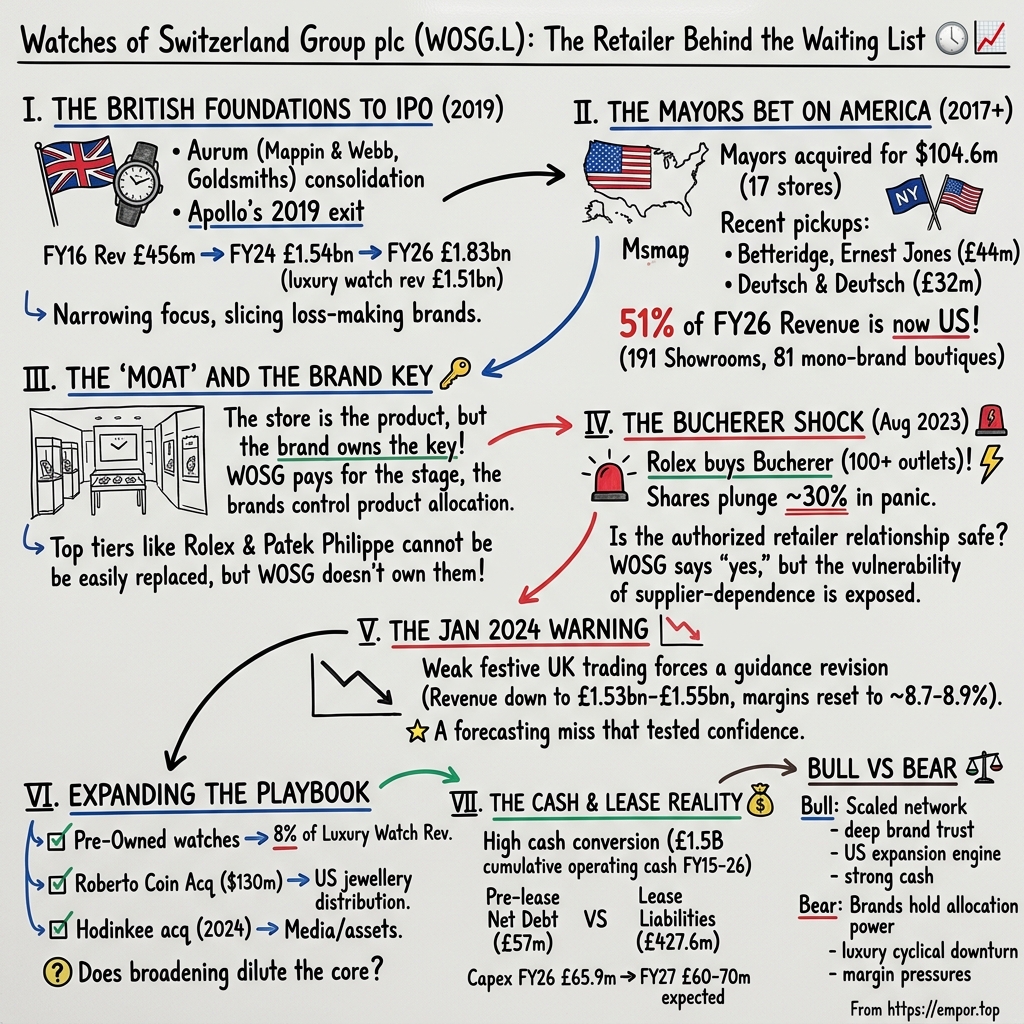
Watches of Switzerland Group plc: The Retailer Behind the Waiting List
I. The Waiting List, Then the Share-Price Cliff
On Thursday, 24 August 2023, a short statement came out of Geneva. Rolex, the most coveted name in mechanical watches, said it would buy Bucherer, the Lucerne retailer that had sold its watches since 1924.1 The reason it gave was personal: Jörg Bucherer, the 87-year-old third-generation chairman, had no direct descendants and had been thinking about selling.1 Rolex said Bucherer would keep its name, run independently and keep its management.1
The next morning in London, a different company paid for the news. Shares in Watches of Switzerland Group fell almost 30% at one point, on course for their biggest one-day drop on record and their lowest level since December 2020.2 The company had done nothing that week. It passed on Rolex's assurance that there would be no change to how it allocated or distributed watches, and that Rolex would take no operational role in Bucherer.2 Investors sold anyway.
That is the contradiction at the centre of this story. The world's most sought-after watchmaker bought a retailer, and the market decided that another retailer's most valuable asset, its relationship with Rolex, was suddenly worth less. The logic was brutal and simple. Watches of Switzerland does not own that relationship. It rents it, store by store, from the company that had just become a competitor.
Three years on, the business that suffered that sell-off is bigger than ever. In the 53 weeks to 3 May 2026, Watches of Switzerland Group sold £1.83bn of goods and services, up 11% on the year, or 13% at constant exchange rates.3 Luxury watches brought in about £1.51bn of that, around 82% of revenue.3 The rest came from jewellery sold in its own stores, from a North American jewellery distribution business it bought in 2024, and from servicing, repairs and insurance.3
It is a two-country company now. The United States produced 51% of revenue and 62% of adjusted operating profit in FY26, overtaking the UK for the first time.3 At year-end the group ran 191 showrooms across the two markets, 81 of them single-brand boutiques run in partnership with names such as Rolex, OMEGA, TUDOR, Breitling and Grand Seiko.3 It calls itself the UK's largest retailer for Rolex, OMEGA, Cartier, TAG Heuer and Breitling.3
Its footprint is a map of where wealthy people shop and wait. It has a leading presence at Heathrow, with showrooms in Terminals 3, 4 and 5, and it runs seven retail websites.3 In the UK it trades under Goldsmiths, Mappin & Webb and Watches of Switzerland; in the US under Mayors, Betteridge, Deutsch & Deutsch and Watches of Switzerland, alongside the pre-owned specialist Analog:Shift and the watch-media brand Hodinkee.3 Almost all of its customers are local: 95% of FY26 sales were domestic to the UK and US.4
The company says demand for its key brands, "particularly products on Registration of Interest lists", remains strong.3 A Registration of Interest list is a polite name for a waiting list. A customer walks in wanting a steel sports watch, the store does not have one to sell, and the customer's name goes on a list. The retailer manages scarcity. It does not create it.
That arrangement raises the four questions that run through this episode. First, is authorized-retailer access a moat, or a privilege the brands can withdraw? Second, can the American business keep outgrowing a mature, cyclical British one? Third, do the showrooms and acquisitions the company keeps paying for earn their cost? And fourth, is the FY26 recovery durable earnings power, or a good year inside a volatile decade?
The FY26 numbers already hint that the answer will not be clean. Statutory profit before tax jumped 76% to about £133m, yet the adjusted operating margin management itself prefers fell 60 basis points to 8.5%.3 Profit rose mostly because one-off charges shrank, not because each pound of sales became more profitable. And in July 2026, just as the results arrived, Reuters reported that the company had held talks with possible bidders about taking it private.5
To understand why Rolex's decision about a Swiss retailer mattered so much to a British one, and why buyers might still circle it, the story has to go back to how this network of stores was put together in the first place.
 Subscribe on LinkedIn
II. From a British Shopfront to a Listed Retailer
On 4 June 2019, the group's shares started trading in London.6 The offer price was £2.70 a share, giving the company an expected market value of about £647m.7 Before the listing, an Apollo-controlled holding company called Jewel Holdco owned almost 88% of the shares. Immediately afterwards it still held about 59%.7 The listing was as much an exit route for a private-equity owner as a fundraising for the business.
The names over the doors are much older than that listing. Mappin & Webb traces itself to Sheffield in 1775. Goldsmiths was founded in Newcastle in 1778, and in 1919 it became the first authorized retailer of Rolex watches in the United Kingdom. Watches of Switzerland itself began as a specialist watch retailer in 1924.7 The three brands came under one roof in 2005, when the owners of Goldsmiths bought the other two.7 For years the group traded as Aurum Holdings.8
That history is worth a moment, because it is the company's favourite credential and its most misunderstood one. A century of selling Rolex sounds like a deed of ownership. It is not. The prospectus that accompanied the listing described the reality plainly: the group's distribution agreements with watch brands are typically rolling contracts, and the most common termination clause lets the brand end an agency on six months' notice without cause.7
Some agreements, including those with Rolex and Patek Philippe, also give the brand a right to terminate on a change of control or management of the group.7 A hundred years of goodwill sits on contracts that can end in half a year.
The modern company really began in March 2013, when Apollo-affiliated funds bought the group.7 Brian Duffy, a Scottish chartered accountant who had sat on the boards of several Ralph Lauren subsidiaries, became chief executive in 2014. Anders Romberg, who had been finance chief and operating chief for Ralph Lauren in Europe, the Middle East and Africa, joined as finance director the same year.7 Two fashion-industry operators took over a British jeweller with a watch habit.
Their playbook was fewer, bigger, better stores. Between May 2015 and January 2019 the group spent about £63m in the UK opening 35 stores, closing 35 and refurbishing 66.7 The clearest example was London's "Golden Triangle" of Regent Street, Oxford Street and Knightsbridge, where the selling space of its Watches of Switzerland flagships went from 236 square metres to 2,091.7 Brands that ration their watches want them shown in grand rooms. The new owners built grand rooms.
It worked well enough to make the UK business dominant. By 2018 the group operated 39% of all Rolex agencies in the UK and accounted for half of Rolex's UK sales.7 It also exposed how dependent the business was on one supplier. In the nine months to January 2019, Rolex watches alone made up about half of the group's total revenue.7
Apollo's own economics are a separate story from the listed company's. The private-equity owner sold shares at the IPO and in later placings, and eventually exited the company entirely.9 Its return depended on what it paid in 2013. The return for public shareholders depends on what they paid from 2019 onwards, and on what the business did after Apollo's gradual departure, which is the part of the record that matters here.
That record is one of steep growth. Group revenue was about £456m in FY16.7 By FY24 it had reached about £1.54bn,10 and in FY26 £1.83bn.3 That is roughly 16% compound growth a year for a decade, a pace few retailers anywhere sustain.
But the growth came from two sources at once: same-store demand in a luxury-watch boom, and new space bought or built. By FY24 Duffy said around 41% of the group's US sales came from businesses it had acquired.11 The difference matters, because a pound of revenue bought with an acquisition costs capital in a way that a pound of revenue from a busier existing store does not.
The listing documents also set a public yardstick. The group said it was targeting about £1bn of revenue by FY21, with mid-single-digit like-for-like growth in both the UK and the US in each of the following three years.7 The pandemic closed stores within a year of the listing, and revenue did not pass £1bn until FY22, when the luxury boom more than made up the lost time.10 The like-for-like promise is harder to check for a simple reason: the company later stopped publishing the figure.
The older record also contains a course correction. In the years before the IPO the group had bought two smaller businesses: Watch Shop, an online seller of mid-market watches, and The Watch Lab, a servicing operation. On 3 December 2018 it disposed of both.7
In the nine months before that carve-out they produced about £25m of revenue and an operating loss of about £18m, most of it a £16.9m impairment of their brands, technology and goodwill.7 The group had also shut its Goldsmiths Boutique stores in 2017.7 Management had learned what its model was not: it was not an online discounter of affordable watches, and it was not a collection of small fashion jewellers.
That narrowing matters because it is the best evidence that this management team will cut a bet that is not working. It will matter again later, when the group exits Europe and when it buys a watch-media company. But the boldest choice of the Duffy era had already been made two years before the listing, and it took the focused model across the Atlantic.
III. The Mayors Bet on America
In August 2017, Aurum Holdings agreed to pay $104.6m to Canada's Birks Group for Mayors, a chain of 17 stores, 16 under the Mayors name plus one Rolex boutique.8 Duffy called it "the biggest deal we have ever done."8 Mayors, founded in 1910, was the largest luxury-watch retailer in the south-eastern United States, with stores in Florida and Georgia and 40% of all Rolex agencies in Florida.7
For a British jeweller, it was an unusual bet. American retail has humbled plenty of UK chains. Duffy's argument was that the US was "one of the biggest markets in the world" and that it had few multi-brand watch stores of the kind his company ran at home.8 Aurum announced at the same time that it would open its first American Watches of Switzerland store at Hudson Yards in Manhattan.8
The underlying opportunity was a structural one, and the IPO prospectus laid it out with unusual clarity. In the UK, the three largest retailers held 51% of Rolex agencies. In the US, as of February 2019, small independents owning between one and five Rolex stores held 79% of agencies, and the three largest chains together held only 13%.
Watches of Switzerland held 4% of US Rolex agencies, Ben Bridge 6% and Tourneau 3%.7 Patek Philippe's 85 American agencies had 60 different owners.7 The US looked like the UK before consolidation: thousands of family jewellers who might one day want to sell.
That is the strategic chess move. A retailer cannot manufacture Rolex watches, but it can buy the stores that are already licensed to sell them, upgrade the rooms and ask the brands for more. Each acquisition brings existing agencies, local clients and staff who know them. The prize is not only revenue. It is a bigger seat at the table when brands decide where their scarce watches go.
The build-out moved quickly. The group bought two stores in the Wynn resort in Las Vegas in December 2017, opened two more in Las Vegas and a SoHo flagship in November 2018, and opened Hudson Yards in March 2019.7 Later came Betteridge, whose Greenwich, Connecticut showroom the group expanded to give Patek Philippe more space,11 and Timeless Jewelers in Plano, Texas.11 By FY24 David Hurley, who ran North America, said US sales had grown from $120m in the first year to just under $900m.11
The openings were not modest. In May 2023 the group opened at the American Dream mall in New Jersey with Rolex as anchor and its largest Cartier space; in Orlando it more than doubled the size of its Rolex boutique and still found every seat in use; at the base of One Vanderbilt in Manhattan it opened a third New York multi-brand showroom.11 It also became the timepiece partner of American Express Centurion in the US.11 Each project followed the same template the London flagships had set: bigger rooms, more brand space, more hospitality.
The market helped. Duffy told investors in 2024 that the US luxury-watch market had grown about 14.6% a year since 2019, against about 6.3% in the UK.11 By FY23 the group's US revenue had compounded at about 40% a year since FY20 and made up 42% of group sales.12 The group was riding a fast-growing market and taking share of it at the same time, which is the best of both worlds and also the hardest combination to separate when judging management's contribution.
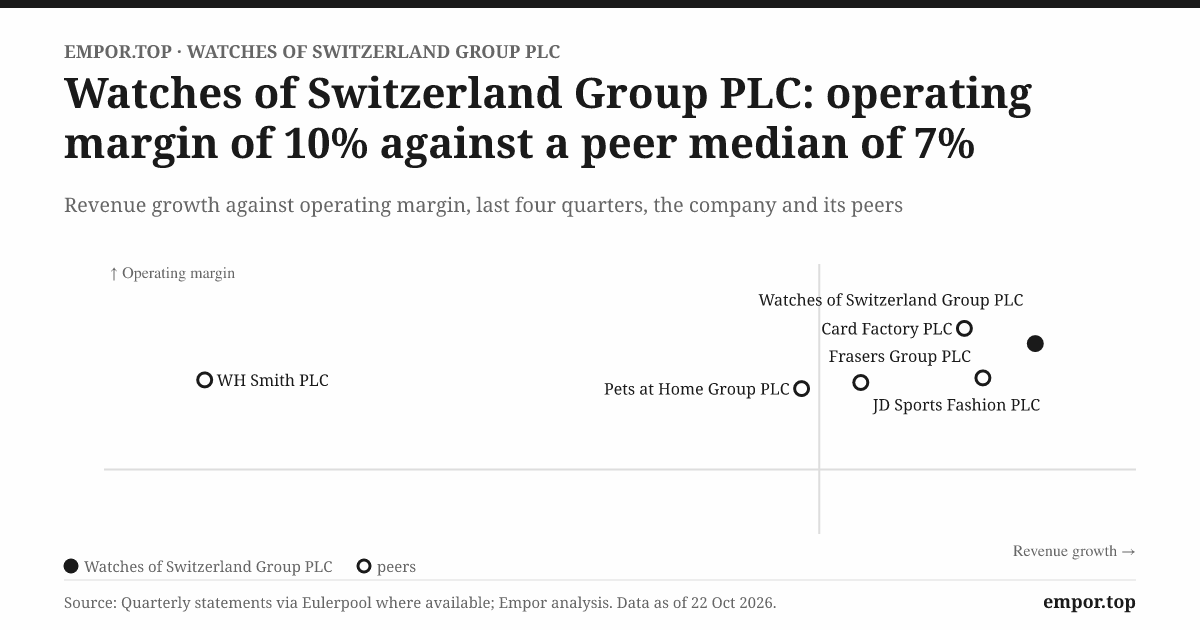
The FY26 numbers show how far the American business has come. US revenue reached £927m, up 24% at constant currency, against £901m in the UK, up 5%.3 More striking is the profit. US retail earned an adjusted operating margin of 8.8%, and the US as a whole, including the higher-margin jewellery wholesale business, earned 10.4%. The UK earned 7.3%.3
So the US is not only the bigger market now. Each pound of American sales currently keeps more profit than each pound of British sales, which is the strongest evidence that the 2017 bet created value rather than just size.
Management offers a demand explanation too. On the Q3 FY26 call, Duffy said collectors made up nearer half of the US business, against about a quarter in the UK, and that younger, knowledgeable buyers were active even at the top of the price range.13 He also described a "K-shaped" American consumer whose spending tracks the value of financial assets.13 That is a tailwind with a catch. Customers who buy because their portfolios are up can stop buying when their portfolios are down.
The cost of each step into the US has varied widely. Mayors cost $104.6m for 17 stores in 2017.8 At home, the group bought 15 luxury showrooms from Signet's Ernest Jones chain, completing the deal in November 2023,11 and spent about £44m on acquisitions in FY24.14
In January 2026 it bought a majority stake in Deutsch & Deutsch, four Rolex agencies in Texas,3 for about £32m.15 It is tempting to divide each price by the store count and compare. It would also be misleading. Store prices depend on leases, inventory, the brand agencies attached and the local market, and none of those deals reveals enough to make the comparison clean.
The Deutsch & Deutsch deal did introduce a new structure. The founding family kept a 12% stake and stayed in charge,4 and the group recognised a liability of about £9m for its commitment to buy out that minority later.3 Management argues that keeping owners invested suits family businesses in this category. When an analyst on the Q3 call asked how much revenue the stores might add after refurbishment and integration, Duffy answered: "honestly, we don't know at this point."13 That candour is welcome. It also means the returns from the newest deal remain unproven.
The verdict on America is mostly positive, with one important hole. The US has become the larger and more profitable half of the company, and the Mayors entry gave it the platform to get there. But the company does not publish like-for-like sales, so investors cannot cleanly separate growth at existing stores from growth bought through acquisitions and new space. Group revenue excluding the extra 53rd week grew 11% at constant currency in FY26, and that figure still includes Deutsch & Deutsch.3
And there is a deeper limit. The US market may be fragmented, but buying a store does not guarantee the right to keep selling the watches inside it. Agencies are granted store by store.7 That power belongs to the supplier, and to see what it means in practice, it helps to walk into a showroom.
IV. The Store Is the Product—and the Brand Owns the Key
On 14 March 2025, the group opened a Rolex boutique on Old Bond Street in London.14 It runs across four floors and about 8,000 square feet, with a floor dedicated to Rolex Certified Pre-Owned watches, three floors for sales and hospitality, and an aftersales lounge with six watchmakers.11 It replaced what had been four separate points of sale on Bond Street.11 Management says it is now one of the leading Rolex retail destinations in the world and reports a client satisfaction score of 93%.34
Getting there was not cheap or smooth. The project ran late, and the group booked £4.2m of exceptional costs in FY25 for a build it described as far outside a standard fit-out, with delays outside its control.14 That is the price of admission to the very top tier of a brand's network. The brand sets the standard for the room; the retailer pays for the overruns.
Picture a customer walking in. The room was designed and fitted out by Watches of Switzerland. The lease is in its name. The staff are its employees, trained partly by the brand. The stock on the shelves was bought with its money. The customer's name, purchase history and waiting-list place sit in its client systems. And yet almost everything the customer came for, the watch, the price, the decision about which model is available this month, belongs to Rolex.
That is the business model in one room. Revenue is earned the old-fashioned way: one watch or piece of jewellery at a time, recognised when control passes to the buyer.15 In FY26, sales of goods brought in about £1.66bn, wholesale about £127m before eliminations, and services about £51m.15 There are no subscriptions, no long contracts and no disclosed minimum purchase commitments. Every year starts with the shelves empty of the year's revenue.
The economics are those of a premium retailer, not a luxury brand. After the cost of the goods and some direct selling costs, the group kept a "net margin" of about 35.6% of sales in FY26.3 Showroom costs, mainly staff, rent and running costs on a pre-lease-accounting basis, took about £314m, and central overheads another £129m.3 What was left as adjusted operating profit was about 8.5 pence on each pound of sales.3 The brand that made the watch keeps a much larger share of the price than the retailer that sells it.
The retailer also carries the inventory. Stock was about £458m at year-end, roughly a quarter of a year's revenue.3 Romberg calls inventory "a very low risk asset in our category."4 For a waiting-listed steel Rolex, that is clearly true. For slower-moving brands and for jewellery whose cost tracks gold, it is less obviously so.
The competitive field is crowded and has become more concentrated. In the US, Bucherer had bought Tourneau, then the largest American luxury-watch retailer with 28 stores in ten states, in January 2018.16 In November 2023 WatchBox, Govberg Jewelers, Radcliffe Jewelers and Hyde Park Jewelers combined to form The 1916 Company, a group with multi-brand salons, mono-brand boutiques and collector lounges.17
Independents still hold many agencies. Brands run their own boutiques; Richemont, Duffy noted in 2024, had long concentrated its own mono-brand stores in London and New York.18 And online marketplaces sell pre-owned watches without asking anyone's permission.
Seen through Michael Porter's competitive forces, the picture tilts sharply in one direction. Customers are fragmented: no single customer accounted for more than 10% of revenue in FY25 or FY26.15 A buyer who wants a common model can shop around. But for the waiting-listed watches that carry the brand's prestige, the customer has limited leverage; the scarce item goes to whoever the retailer, within the brand's rules, decides to sell it to.
Suppliers are another matter. The prospectus described the watch brands as "highly concentrated" among a few owners who control distribution through selective agreements, grant agencies store by store, cap the number of agencies in each country and impose conditions on stock levels and store refurbishment.7 In FY24, the group's top eight brands produced 77% of its sales.11 The company no longer discloses Rolex's share of revenue, which was about half at the IPO.7
So what does the retailer actually own that is hard to copy? The strongest candidate is scale. A network of 191 showrooms lets the group find a watch for a customer in one store from stock in another; at the IPO, sales after such inter-branch transfers made up about a quarter of UK gross revenue, and the group could move a watch between its Heathrow stores in under 20 minutes.7
Scale also pays for larger rooms, servicing centres, pre-owned authentication, ecommerce and client systems that a family jeweller with three stores cannot match. And long relationships help win new agencies when brands consolidate distribution, which the company says they are doing "towards fewer, higher-quality points of distribution."3
The limits are just as clear. None of that scale creates ownership of Rolex, Patek Philippe or Cartier. The company publishes no customer-retention rate, no share of each client's spending and no brand-level supply figures. Without those, any claim of switching costs is an inference, not a measurement. The customer's loyalty may be to the waiting list, or to the brand, rather than to the shop.
The retailer's best argument comes, interestingly, from a regulator. When the European Commission reviewed Rolex's purchase of Bucherer, it asked whether Rolex might favour its own watches in its own shops. It concluded that Rolex lacked the incentive to do so without harming its broader distribution network.19 Translated: the brand still needs independent retailers to reach customers, and retailers like this one are not easily replaced.
How does the company win from here? By keeping its stores the best rooms in their cities, so brands grant it new agencies when they consolidate; by selling efficiently through clienteling and ecommerce; by offering pre-owned and jewellery so a customer who cannot get a new Rolex today still buys something; and by being the retailer brands trust with their scarce output.
How does it lose? Brands could cut allocations, shift more sales to their own boutiques, reduce retailer margins, or grant agencies to a rival who builds a better room. Demand could weaken, as it did in 2024.
The uncomfortable asymmetry is this. The retailer pays for the stage: the lease, the fit-out, the staff and the stock. The brand decides which products appear on it. That asymmetry had always existed. In August 2023, it became impossible to ignore.
V. When Rolex Bought Bucherer
Go back to that Friday in August 2023. Bucherer was not a boutique. It had more than 100 sales outlets worldwide, 53 of which sold Rolex and 48 TUDOR.2 One analyst at Vontobel estimated annual sales across its stores at about two billion Swiss francs, roughly 5% of Rolex's own sales.1 Bucherer had sold Rolex since Ernst Bucherer reached an agreement with Rolex founder Hans Wilsdorf in 1924.1 For Rolex, which had always relied on outside distributors, it was the first major consumer sales presence of its own.1
The announcement hit a nerve because it changed who was across the table. Analysts at Jefferies said the market was debating whether the deal signalled "a growing risk" to Watches of Switzerland's relevance as a key Rolex partner.2 The manufacturer that rationed supply to the group now owned one of its competitors. In the US, that competitor already owned Tourneau's network.16 In the UK, Bucherer had been one of the three largest holders of Rolex agencies when the group listed in 2019.7
The market's fear came in two versions. The mild version was that Rolex would steer its best pieces to its own shops. The severe version was that Rolex might, over time, want to own more of its distribution, and that Watches of Switzerland's stores would become either acquisition targets or redundant. Neither version needed Rolex to do anything immediately. It only needed investors to see a possibility that had always existed but had never been demonstrated.
The European Commission approved the deal without conditions in July 2024.19 Its report, published in January 2025, noted that Rolex already held 50 to 60% of the segment for watches priced between €10,000 and €49,999, and accepted Rolex's pledge to wall off Bucherer's commercial data on rival brands, including separate IT systems and limits on which staff could see detailed data.19
What happened afterwards is the real test. The company's account has been consistent. In January 2024, in the middle of a profit warning, Duffy said Rolex "deliver on their commitments in terms of units", and that in the UK and US they had been "really spot on the numbers."18 In February 2026, asked about the annual allocation talks, he called them "a normal process. Nothing's really changed."13
Since the Bucherer deal the group has opened the Old Bond Street flagship, agreed to double the size of its Rolex boutique in Glasgow,11 rolled Rolex Certified Pre-Owned into every US Rolex agency apart from the newly acquired Texas stores and into 30 UK agencies,3 and bought four Texas Rolex agencies.3 Luxury-watch revenue rose 10% in FY26 to about £1.51bn.3 None of that looks like a brand starving a partner.
But the evidence has a limit, and it is the company's own disclosure. Supply is only one lever. The other is the margin a brand allows its retailer. In FY26, US tariffs on Swiss watches and soaring gold prices pushed brands to raise prices and change retailer margin structures.3
Duffy said brands had included "an element of margin adjustment for us retailers."13 The company says higher retail prices meant its cash margin per watch was maintained or improved in the US even as its percentage margin fell.3 That may be true, and it is still a reminder that the terms of trade are set in Switzerland.
There is also a quieter constraint: Rolex's own production. Asked whether new Rolex factories might lift allocations, Duffy said the new facility at Bulle was not expected to come online until about 2028 or 2029, and that the company had built no expectation of extra supply into its plans.4 The waiting list is not only a sign of demand. It is a cap on how fast this retailer can grow in its most important brand.
So did Bucherer change the economics or reveal a risk? The record says it revealed one. The share-price collapse was not evidence that allocations had been cut, and three years of disclosures point the other way. But the episode narrowed the bull case. Watches of Switzerland is a valued partner of Rolex, not a part-owner of its scarcity. The test going forward is in figures the company only partly reports: brand margins, its luxury-watch growth against the market, and the brand mix it no longer quantifies.
The feared allocation crisis never arrived. What arrived instead, five months later, was something more ordinary and more damaging to management's credibility: its own forecast was wrong.
VI. The January 2024 Warning
At 9am on 18 January 2024, Brian Duffy opened a conference call with a sentence no chief executive wants to say: "We're obviously disappointed to be announcing a downwards revision to our guidance this morning."18 The group cut its revenue forecast for the year to April 2024 from £1.65–1.70bn to £1.53–1.55bn, and its adjusted operating margin forecast from about 10.7% to 8.7–8.9%.20 The shares fell by about a third.20
The timing made it worse. Only on 7 December 2023, at the half-year results, had the company confirmed its guidance, a point one analyst raised directly on the call.18 And it had presented a Long Range Plan on 7 November 2023 to more than double sales and profit by FY28, passing £3bn of revenue.12 Ten weeks separated the most ambitious plan in the company's history from its sharpest forecast cut.
Management's explanation had three parts. Christmas had been "very difficult to predict" and below projections, with shoppers buying late and spending shifting towards travel, hospitality and beauty rather than watches and jewellery.18 The UK watch market had shrunk year on year, Duffy said, by a mid-single-digit percentage, the first decline he had seen in ten years.18 And the average selling price had fallen.18
That third reason is the most revealing. Rolex had delivered exactly the number of watches it promised. But as the market cooled, brands made more steel watches and fewer in precious metal. Duffy called it "a surprise to us, and fairly late on in the period."18 The retailer had the units it expected and less revenue than it expected, because the brand had chosen a cheaper mix. Even when a supplier keeps every promise, it still decides what a retailer's sales will look like.
Romberg added a fourth reason on the call: the middle of the market took the brunt of the decline, and heavy discounting in commodity jewellery squeezed product margins, while falling sales left UK costs spread over less revenue.18 That is the operating leverage of a fixed-cost retailer working in reverse. Rent, staff and refurbished rooms cost the same whether customers buy or not.
There was an awkward admission about the brands, too. Melania Grippo of BNP Paribas asked whether the brands' own price rises had cooled demand. Duffy agreed that cumulative increases, driven by the strong Swiss franc and gold, had been "justified but, nevertheless, to the consumer it's a big increase" at a time of high living costs, and that "undeniably pricing" had affected consumer sentiment.18 The retailer had no say over those prices. It simply absorbed the consequences at the till.
The analyst questions sharpened the picture. Louise Singlehurst of Goldman Sachs asked what had changed since 7 December. Duffy answered: "I don't think a season's ever been more difficult to predict than this one," and then, more bluntly, "we got some projections wrong for this period, which is very, very evident."18 On the US, he was specific: like-for-like sales there were "definitely positive", while the UK was heading for a low-single-digit decline.18 On whether the steel-heavy mix would persist, he was not. It was, he said, "my personal assessment rather than any specific information."18
One exchange says a lot about the company's priorities. Jon Cox of Kepler asked whether the collapse in the share price changed management's view on buybacks or dividends. Duffy said no: the plan's investment in growth remained "the best usage of cash within the business."18 He closed the call with an apology: "We're sorry we didn't see it coming more than we have done," and a reaffirmation that the company was "on for the Long Range Plan."18
The revised forecast held. FY24 revenue came in at about £1.54bn, up 2% at constant currency, and adjusted operating profit at £135m, an 8.8% margin, inside the lowered range.11 Statutory profit fell much harder, roughly halving as exceptional costs and a higher tax rate bit.10 The effective tax rate rose to about 30%, partly because losses in the European business generated no tax relief.11
The bigger test was the Long Range Plan itself, and here the record is unflattering. The November 2023 plan said Europe would make up 4 to 6% of group sales by FY28.12 The group had entered Europe in 2022.12 By FY25 it was reallocating investment from Europe to the UK and US and had closed or transferred seven European showrooms.14 In FY26 it sold its last two European showrooms to brand partners and stopped trading in Europe altogether.3
Then, in June 2026, Bloomberg reported that the company would drop its target to more than double sales and profit by 2028, with the £3bn ambition "unlikely" in that timeframe; the shares fell as much as 9.5%.21 The FY26 results the following month described "mid-term priorities" instead and did not repeat the £3bn figure.3 The commitment Duffy reaffirmed on that January morning did not survive.
The recovery since then is real, though. In February 2026 management raised its FY26 revenue guidance to 9–11% constant-currency growth and guided to an adjusted margin decline of 70 to 90 basis points.13 It delivered 13% growth, or 11% without the extra week, and a 60-basis-point decline.3 The most recent forecasts were met or beaten. Yet the adjusted operating margin of 8.5% is still below the 9.1% of FY25 and far below the boom years.3
The January 2024 episode was a genuine forecasting miss, not a stock-market overreaction to a rounding error. It showed how much of the earlier growth had depended on an unusual luxury boom, and it showed that management's long-range targets were more aspiration than plan. The question that followed was whether new growth engines, a bigger US footprint, pre-owned watches and jewellery, could smooth the cycle, or simply add more moving parts to a retailer still led by watches.
VII. A Bigger US Platform, a Broader Offer
On 4 October 2024, the group announced it had bought Hodinkee, the New York watch website that Benjamin Clymer had started as a blog in 2008.22 Hodinkee claimed 22.2 million annual unique visitors and more than a million social-media followers.22 Clymer, who had stepped back as chief executive in 2020, returned to run it. The editorial team was promised independence, and Hodinkee's retail traffic would be sent to Watches of Switzerland's US ecommerce site.22 The company did not disclose the price, saying only that it was funded from existing facilities.22
There is an irony here. The group had exited Watch Shop after losses and a large write-down. Now it was buying an online audience again. The difference is the job each was meant to do. Watch Shop sold mid-market watches online in competition with everyone. Hodinkee is meant to feed enthusiasts towards the group's luxury stores and websites. That is a coherent idea. It is also, so far, an unproven one.
The FY26 disclosures keep Hodinkee in proportion. The annualised overheads of the Hodinkee business, together with spending on new US websites, pushed up US costs.3 Group overheads rose 22% to about £129m.3 Group ecommerce sales grew 21% at constant currency, and the group launched an updated Hodinkee app that lets readers shop through to Watches of Switzerland.34 The company does not report Hodinkee's revenue or profit separately. Audience reach is not earnings, and nothing published so far shows Hodinkee to be a material profit driver on its own.
The ecommerce rebuild around it was substantial. Management described a completely new US-based ecommerce team, new marketing investment and a migration of the Watches of Switzerland and Mayors websites onto the Shopify platform.13 It said in February 2026 that this infrastructure spending was largely complete and should lift ecommerce profitability from FY27.13 That gives investors a clear test. If overheads keep rising faster than sales next year, the digital investment will look less like a one-off build and more like a permanent cost.
Pre-owned watches are a more substantial story. Rolex launched its Certified Pre-Owned programme early in FY24, with this group as one of the founding partners.11 A Rolex sold second-hand through an authorized dealer carries a Rolex guarantee, usually at a premium price, and is available today rather than after years on a list. Duffy described the surprise: customers who came in asking about a new Rolex had previously been offered only a place on the waiting list, and now they could buy something that afternoon.11
The category has grown fast. Pre-owned sales rose 22% in FY26, and pre-owned watches made up more than 8% of luxury-watch revenue, against less than 2% when the group started in FY19.34 The US leads the mix.3 The original plan had aimed for certified pre-owned to reach 20% of new Rolex sales in the US and 10% in the UK by FY28.12 Pre-owned carries a lower product margin, though Romberg calls it cash-accretive.13 It is diversification of a particular kind: the programme that matters most is still Rolex's.
Pre-owned also needs machinery most retailers lack. Every second-hand watch has to be sourced, authenticated, serviced and guaranteed. The group expanded its watch service centres in Fort Lauderdale and Manchester and opened another in Leicester, partly to handle the extra volume.11 Duffy argues that scale and technology are real advantages in this business, because a large network can source stock, move it to where demand is and present it properly.11 This is one of the few places where the retailer's scale clearly does something a small independent cannot easily copy.
Jewellery is the other branch. Retail jewellery sales grew 17% to about £121m in FY26.3 The group opened its first jewellery-only Mappin & Webb boutique in Manchester in September 2025 and introduced lab-grown diamonds in the UK.3 But jewellery also carries the gold price straight into the margin. In the UK, the net margin fell a full percentage point in FY26, which the company attributed to product mix and lower brand margins after gold price increases.3
The showroom programme remains the main reinvestment engine. In FY26 the group spent about £66m of expansionary capital, opening four new showrooms and refurbishing 12.3 Its internal rule is that a showroom investment must pay back in cash within three years, measured as fixed assets and inventory divided by the showroom's earnings before interest, tax, depreciation and amortisation.3 Management said in 2024 that historical paybacks on such projects had been two to three years.11 For FY27 it guides to £60–70m of capex, falling as a share of revenue.3
That payback claim deserves a test, and the company's own accounts supply one. In FY25 the group booked a £43.6m non-cash impairment on showrooms, because high interest rates and inflation had worsened since the projects were approved.14 In FY26 it booked a further £8.8m of gross impairments, partly offset by £2.3m of reversals.3
It closed 14 UK showrooms in FY25 and 21 "non-core" UK showrooms in FY26.3 Some projects, in other words, did not earn what their appraisals assumed. The company does not say which ones, or whether they were acquired or built. The fair conclusion is that the best showrooms clearly work, while the payback rule is a hurdle, not a guarantee.
The workforce tells a similar story. Colleagues fell to 2,942 from 3,091 while revenue grew 11%.15 That is consistent with higher productivity per person. It is also consistent with closing two dozen small stores and opening a few large ones. The numbers alone cannot separate the two.
Taken together, the group says luxury jewellery, pre-owned and ecommerce made up 24% of revenue in FY26.3 Those categories overlap, so the figure is a broad indicator rather than a clean segment. The core is still watches, sold in rooms. The extensions are credible, but the right way to judge them is by profit and cash, not by strategic language or audience numbers. And the biggest extension of all had turned the retailer into something it had never been before: a supplier.
VIII. Roberto Coin: Retailer Becomes Distributor
On 8 May 2024, the group signed and completed the purchase of Roberto Coin Inc. for $130m, of which $10m was deferred for a year and contingent on profits.23 The sellers were Roberto Coin S.p.A., the Italian jewellery house founded in Vicenza, along with Pilar Coin and Peter Webster, the American business's co-founder and president.23 The group paid with a new $115m term loan.23
What it bought needs careful description. It did not buy the jewellery brand or the Italian factory that makes the pieces, each signed with a small ruby hidden against the wearer's skin. It bought the company holding exclusive, perpetual rights to import and distribute Roberto Coin jewellery across the US, Canada, the Caribbean and Central America.23
That business sold to department stores, jewellery chains and independent jewellers through more than 400 points of sale.23 The company says Roberto Coin is the sixth-largest jewellery brand in the US by retail sales value, a figure based on its own research.23
The strategic case leaned on a market shift. Citing McKinsey and Euromonitor, the company said branded jewellery had grown from 17% of the global luxury jewellery market in 2019 to 27% in 2024.23 Customers, in other words, were moving from unbranded gold chains towards names they recognised, the same shift that had made watch brands so powerful.
Peter Webster stayed on as president, the Coin family kept a seat on the subsidiary's board, and the business continued to run as a standalone company inside the group.23 The deal took the group's leverage to about 0.8 times pre-lease net debt to adjusted EBITDA.23
Overnight, Watches of Switzerland became a supplier to some of its competitors. That is a strategic chess move with a clear logic. In watches, the group sits downstream of brands that hold the power. In Roberto Coin it holds the distribution rights itself, earns a wholesale margin and can place the brand prominently in its own stores. It is a small attempt to stand on the other side of the table it usually sits at.
The price can be benchmarked. In 2023, Roberto Coin Inc. reported preliminary, unaudited revenue of $138.7m and profit before tax of $30.2m.23 So the $130m price was about 0.94 times revenue and about 4.3 times pre-tax profit. Those are simple historical ratios, not cash returns. They ignore tax, the cost of the loan, the inventory the business must carry and the possibility that the Italian parent changes its own strategy.
The 2022 audited figures show revenue of $146.2m and pre-tax profit of $30.1m, so sales had dipped in the year before the deal.23 Still, paying a little over four years of pre-tax profit for perpetual rights to a growing brand looks like a reasonable starting price, not an obviously rich one.
The early performance is good. In FY26, the wholesale business grew revenue 22% at constant currency to about £127m and earned adjusted operating profit of £25.0m.3 Set against a purchase price of about £100m at the time of the deal, that is a pre-tax operating return in the low-to-mid twenties per cent, before financing costs and before counting the extra jewellery sales in the group's own stores. Inside the Mayors network, Roberto Coin sales more than doubled after new shop-in-shop displays.4 The group opened three Roberto Coin boutiques, in New York, Las Vegas and Miami.3
Management had worried about channel conflict. Would rival jewellers stop buying a brand now owned by a competitor? On the FY26 call, Kate Calvert of Investec asked how much churn there had been among wholesale customers. Duffy replied: "There's literally been no churn in the customer base," adding that the company had expected to lose a couple of accounts "just because we were a competitor and now a supplier, but honestly there's been nothing."4 That is management's account; it is consistent with the reported growth.
Wholesale also brought a risk retail never had: lending to customers. In February 2026 management warned of a provision linked to a US department store's Chapter 11 filing but declined to say how large it was.13
At the FY26 results, an analyst assumed the debtor was Saks and the loss about £7m. Romberg corrected him: the write-off was £3.5m, the assumption about Saks was correct, and the charge sat inside adjusted profit rather than being excluded as exceptional.4 Wholesale margin fell from 21.8% to 19.7% as a result and because of a marketing campaign starring Dakota Johnson.3 The group discloses no ageing schedule for its receivables.15 The lesson is modest in size but real in kind: a single department store failure can dent a wholesale year.
How does Roberto Coin fit the wider acquisition record? In 2024 management claimed its acquisitions had paid back within four to four and a half years.11 Some of the record supports that. Mayors became the foundation of the larger, more profitable half of the company. Other parts do not.
The group's earlier record also includes the European exit,143 the sale of Watch Shop and The Watch Lab, and showroom impairments.14
The newest deal is too young to judge. Deutsch & Deutsch contributed £16.4m of revenue and £2.4m of pre-tax profit between its acquisition on 22 January 2026 and the year-end in early May.315 Annualising a little over three months of trading would be guesswork. Calling any of these deals overpaid would also be guesswork, because private store deals rarely disclose terms in a form that allows a like-for-like comparison.
The verdict is that the group's core acquisitions, Mayors in the US and now apparently Roberto Coin, have worked, while its peripheral bets have been reversed. That is a better record than the outright failures that sink many retailers. But it is not a licence to buy freely. The distribution deal broadened the profit pool. Whether it adds value for shareholders depends on how it was paid for, which brings the story to the cash.
IX. Cash in the Till, Leases on the Books
At the close of business on 3 May 2026, the group's headline debt looked almost trivial. Bank borrowings minus cash, before leases, came to £57m, less than a third of a year's adjusted operating profit.3 But a retailer that rents nearly 200 showrooms has another creditor: its landlords. Lease liabilities stood at £427.6m, which made net debt after leases about £483m.3
The long-run cash record looks spectacular at first glance. Over the twelve years from FY15 to FY26, the group reported about £459m of cumulative net profit and about £1.5bn of cash from operations, more than three times as much.15 In a retailer, some of that gap is ordinary: depreciation is a non-cash charge, and working capital moves around. But there is a quieter reason too, and it is an accounting one.
Since the IFRS 16 lease standard arrived in FY20, rent no longer appears as an operating expense in the cash-flow statement. Most of it is recorded as repayment of a lease liability, which sits under financing. In FY26 the group paid about £84m in lease payments.3 Every one of those pounds left the business, but none of them reduced reported operating cash flow. Read the twelve-year comparison with that in mind: a meaningful part of the apparent cash surplus is rent, paid below the line.
The company's own free cash flow measure is more conservative, because it is calculated as if the old rules still applied, with rent deducted. On that basis free cash flow was about £162m in FY26, an 80% conversion of adjusted EBITDA, up from 51% in FY25, when changes in key suppliers' payment terms had pulled cash into working capital.34
But even that figure is struck before growth spending. Subtract about £66m of expansionary capex, £39m of acquisitions, almost £14m of buybacks and £5m of exceptional cash costs, and the group was left with about £38m, which it used, along with cash on hand, to repay about £72m of borrowings.3
FY25 shows the other side. That year, acquisitions, mainly Roberto Coin and Hodinkee, cost about £107m and free cash flow was weaker. Cash flow after all uses was negative by about £101m, and the group borrowed about £86m.3 In an ordinary year, the business funds its own growth. In a big-deal year, it borrows.
The longest view says the same. Over FY15 to FY26, operating cash flow minus capital spending came to roughly £953m. The group paid no dividends at all. Yet its cash and short-term investments grew only about £59m across the period.15 The rest went into acquisitions, lease payments, debt repayment and, latterly, buybacks. The cash conversion is genuine. It is not, by itself, a verdict on how well the cash was spent.
The financing is comfortable for now. The group has a £275m revolving credit facility priced at the sterling SONIA rate plus 1.50 to 2.575 percentage points and a $125m term loan priced at the US SOFR rate plus 1.65 to 2.70 points.3 Of £367m available, about £122m was drawn, leaving liquidity headroom of about £290m.3 Net debt before leases was 0.28 times EBITDA.3 The interest margins rise with leverage, and the facilities are covenant-tested.15 Both mature in May 2028.3 Nothing in the current numbers suggests strain, but that date belongs on every investor's calendar.
One line in the income statement makes the landlord's importance vivid. Of £38.2m in finance costs in FY26, £25.5m was interest on leases.15 The group pays its landlords more interest than it pays its banks.
The return on capital shows the same effect from another angle. On the company's preferred basis, which treats rent as an operating cost and leaves leases off the balance sheet, return on capital employed was 18.0% in FY26, down from 19.0%.3 Once the leased showrooms are counted as capital, the figure falls to 15.4%.3
Both are respectable for a retailer. Neither is close to the 27.9% average the company reported for FY15 to FY23,12 or to the levels before FY24, when return on capital fell by more than eight percentage points in a single year.11 The boom-era returns were real, and they were also a product of the boom.
That reading also explains why "inventory is low risk" and "leases are low risk" are different claims. A waiting-listed watch can almost always be sold. A long lease on a large showroom in a market that turns, as several UK locations did in FY25 and FY26, cannot be handed back without cost.3
Then there is the buyback. In January 2024, with the shares down a third, Duffy rejected buying back stock because investing in growth was the better use of cash.18 A year later, the group announced a £25m programme anyway, completing it in June 2025, with £13.8m paid in FY26.3
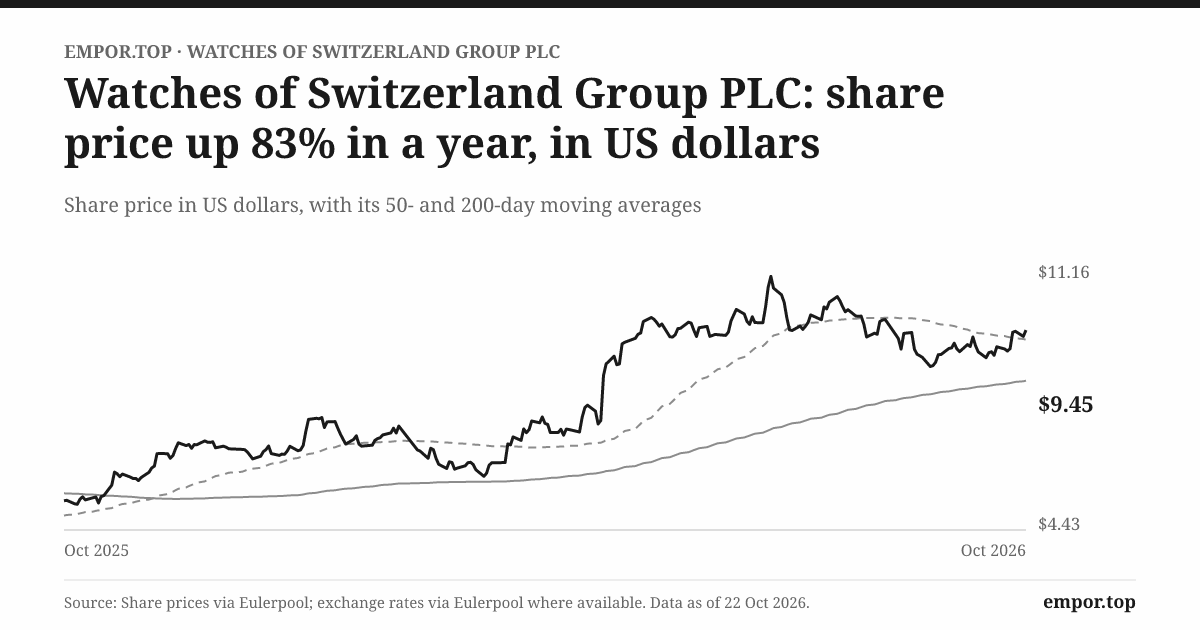
With hindsight the timing looks fine: within the past twelve months the shares have traded as low as about £3.81, against about £7.07 today. But at £25m against a market value of about £1.7bn, it was a gesture, not a capital-allocation shift. Management's stated order of priority remains showrooms first, acquisitions second and shareholder returns only from surplus capital.3
Currency adds one more moving part. Because more than half of profit now comes from dollar-earning US operations, Romberg said a five-cent move in the pound-dollar rate is worth about £30m of revenue and £4.5m of operating profit.4 Translation of the foreign operations cost £5.4m in FY26, after £15.2m the year before.15 The report's sensitivity analysis treats these exposures as unhedged.15
The conclusion is balanced. Cash generation is a genuine strength, and current bank headroom is wide. But investors should judge the business on cash after rent, after expansion capex and after acquisitions, not on reported free cash flow or on the £57m pre-lease debt figure. On that basis the business has funded itself in good years and borrowed in busy ones. Profit can pay for the strategy only if management's record on returns earns trust, which raises the question of what management is paid to do.
X. What Brian Duffy Is Paid to Deliver
On 3 September 2026, shareholders gathered for the annual meeting. Every resolution passed. The remuneration report received about 97.5% support, with about 2.5% voting against.24 Duffy was re-elected with about 100% of votes cast.24 The only meaningful dissent came elsewhere: about 10% of votes opposed the general authority to issue shares without first offering them to existing holders, and about 12% opposed the extra authority for acquisitions.24 Shareholders were relaxed about pay and a little more watchful about dilution.
The man at the centre of all this is a Glaswegian chartered accountant who built his career in fashion retail. Before taking over in 2014, Duffy served on the boards of several Ralph Lauren subsidiaries, of Celtic, the football club, and of Sara Lee.7 He describes the group's approach to luxury retail as "non-elitist and non-judgemental",25 a deliberate contrast with the hushed intimidation of old-fashioned jewellers.
On the FY26 call he mentioned the coming Rolex boutique in Glasgow, "my hometown", with evident pleasure.4 One detail of his pay says something about him too: since the 2019 IPO, the executive directors have chosen not to take salary increases or pension contributions.14
His pay tracks the cycle closely. In FY22 his total remuneration was about £4.5m and in FY23 about £3.3m, years in which long-term incentive awards vested in full.14 In FY24, the year of the warning, it fell to about £0.87m, and in FY25 to about £0.71m.14
In FY26 it rose to about £1.32m: the annual bonus paid out at 100% of the maximum, because adjusted operating profit reached £154.8m, but long-term incentive awards vested at zero.15 The long-term scheme, in other words, has paid nothing for the post-boom period. That is what a scheme linked to performance should do.
His link to the former owner was explicit at the listing. Shortly before admission, Apollo's holding company granted him a nil-cost option over about 2.2 million of its own shares, conditional on him staying for two years, which created no new shares and so did not dilute other investors.7 Apollo wanted its chief executive locked in through its sell-down. Public shareholders benefited from the same continuity.
Ownership matters more than salary here. Duffy held about 3.2% of the shares at the FY26 year-end, and executive and non-executive directors together held about 4.4%.15 With about 233 million shares in issue,24 his stake is roughly 7.5 million shares, worth about £53m at today's price of £7.07. He held 3.1% immediately after the 2019 listing.7 He has kept his exposure to the share price through the boom and the bust. The other notable holders are BlackRock at about 5.0%, Capital Group at about 5.0% and Alberta Investment Management Corporation at 3.0%.15
That ownership became newly relevant in July 2026. On 13 July, Reuters reported, citing three people familiar with the matter, that the company had held talks in recent months about possible offers to take it private, with private-equity funds and strategic bidders showing interest.5
Two sources said Duffy engaged because he believes the stock market undervalues the company; a third said the company wanted an offer significantly above £7.50 a share; no formal offer had been made.5 The shares jumped as much as 8.2%.5 The next morning, asked about it on the results call, Duffy said: "we don't comment on speculative media reports."4
Two facts frame that episode. A chief executive with a stake worth tens of millions of pounds has every reason to want a high price. And the brand agreements that some suppliers, including Rolex and Patek Philippe, have historically included allow termination on a change of control, a risk the company still flags in its annual report.714 Any buyer would need the brands' comfort as much as the shareholders' votes. Minority holders will want any process run by the board, with the brands' position understood, before they believe a headline price.
Related-party dealings are small and, on the disclosures, plain. The group owns 40% of an Audemars Piguet joint venture in Manchester, which had £12.3m of revenue in FY26; the group lent it £2.4m and earned £0.1m in interest.15 There are no parent royalties or management fees.15 Pay for key management rose to £4.3m for five people from £2.1m for four, a jump driven by the bonus outcome and a larger team.15
Management's credibility has to be judged across calls, not in a single quote. On supply, the answers have been concrete and consistent: units delivered as committed in 2024, allocations "normal" in 2026.1813 On pricing, Duffy has been honest about not knowing, telling analysts in July 2026 that "your guess is as good as ours" on brand price rises.4
On the Saks provision, management first declined to quantify it and then disclosed it.134 On the big promises, the record is weaker: the Long Range Plan that Duffy recommitted to in January 2024 was abandoned in 2026, and the European expansion was unwound.183 The near-term record is mixed but improving: the lowered FY24 range held; the FY25 range given in June 2024, £1.67–1.73bn of revenue, was missed at reported rates, with sales of about £1.65bn;113 and the FY26 range was raised and beaten. The longer-term ambition did not survive at all.
One more promise shows a better habit. In June 2024 Duffy called the return of VAT-free shopping for tourists in the UK "inevitable", but stressed that the company had not put it into any forecasts.11 Two years later it had still not returned, and the group's sales remained 95% domestic.4 Lobbying for a policy while refusing to bank it is exactly the discipline that was missing from the £3bn plan.
That leaves two questions that one good year cannot answer. How much of the group's growth comes from more customers buying more in the same stores, and how much from new space, acquisitions and brand price rises? The company does not publish like-for-like sales; an analyst noted as much on the January 2024 call.18 And how much of the business still depends on a single brand's supply? The company no longer says. Those two gaps sit at the centre of the investment case.
XI. Analysis & Bear vs. Bull Case
On 22 October 2026, Watches of Switzerland shares closed at about £7.07, valuing the company at about £1.7bn and its enterprise, including lease liabilities, at about £2.2bn. That is about 16.9 times trailing earnings and 7.7 times EBITDA, about 12% below the 52-week high of £8.02 and well above the 52-week low of £3.81.
A five-year median price-to-earnings ratio is not available, so there is no basis for saying the shares trade at a historic discount or premium. One third-party comparison puts the group at about 17.6 times earnings against a forward average of about 13 for a broad set of specialty retailers;26 that basket is too broad to be a true like-for-like comparison, and it serves only as context.
What does that price appear to assume? Roughly that this is a good retailer with some scarcity value, not a luxury brand and not a business in decline. Seventeen times earnings is more than the market pays for an ordinary shop chain and much less than it pays for the brands whose watches the company sells. The price seems to assume the business keeps growing at something like its guided pace, without a return to the margins of the boom.
The growth record frames that assumption. Revenue grew about 16% a year over ten years, but only about 6% a year over the three years from FY23 to FY26. The difference is the boom of 2021 and 2022 and the slowdown that followed. FY26's 11% growth, helped by the extra week and an acquisition, sits between the two.3
The bull case rests on the group's UK position, a larger and more profitable US platform, and continued Rolex supply through the Bucherer shock. It runs some of the best watch rooms in its markets, including a London flagship the company says is among Rolex's top retail destinations globally. Pre-owned, jewellery and Roberto Coin broaden growth, while the business has generated more than £1bn of operating cash across its long record and kept bank debt modest.
The bear case is equally specific. Suppliers set the allocation, the mix and increasingly the margin. The company does not disclose brand-level sales, supplier concentration, like-for-like growth or customer retention, so investors must take much of the moat on trust.
Watches are discretionary purchases whose demand moves with asset prices and confidence; the UK still lacks the tourist spending it lost when VAT-free shopping ended in 2021.4 Recent growth trails the decade-long rate, the adjusted margin is lower than it was three years ago, and some showroom investments have been written down. And Rolex now owns a direct competitor.
The same five forces apply here: supplier power is very high, while the agency system that creates it also limits new entrants.7 Buyer power is low for the scarcest pieces and real for everything else; Duffy himself described the "sticker shock" that hit aspirational UK buyers in the £4,000 to £8,000 bracket after repeated brand price rises.11 Rivalry is intense among authorized dealers, now including a Rolex-owned chain and the newly consolidated The 1916 Company. Substitutes include the grey and pre-owned markets and, as January 2024 showed, entirely different luxuries like travel.18
Hamilton Helmer's seven powers sharpen the verdict. The group has some scale and process advantages, particularly in pre-owned and stock transfers. Its retail brands have modest value beside the watch brands; there are no network effects or counter-positioning, and switching costs are unmeasured. Its most valuable resource, the agencies, is leased; the brands hold the deeds. The moat exists, but it is narrower than it looks and shared with the suppliers.
The FY26 margin puzzle shows why the distinction matters. Statutory operating profit jumped 49% to £170m, mainly because exceptional costs fell from £57.7m to £8.8m as showroom impairments shrank.3 Underneath, adjusted operating margin fell from 9.1% to 8.5%.3
The decomposition is visible in the company's figures. The net product margin fell about 70 basis points, because of product mix, tariffs and gold-driven reductions in brand margins.3 Overheads grew far faster than sales, as Hodinkee and ecommerce spending annualised.3 The £3.5m Saks write-off took roughly another 20 basis points.4 Leverage on showroom costs offset part of the damage.3
So FY26 was a statutory recovery and an underlying squeeze, not a return to boom-era earnings power. Management guides to a 40-to-80-basis-point margin improvement in FY27, mainly from the one-off write-off not recurring and from operating leverage.34
The material risks each have a mechanism. US tariffs and gold prices change brand pricing and the retailer's share of it. Currency moves translate dollar profit into fewer or more pounds. Leases fix a large part of the cost base, which magnifies both good and bad years. The May 2028 facility maturity is a refinancing checkpoint. And Rolex's own production, with new capacity not expected until about 2028 or 2029, caps growth in the most important brand.4
Three numbers will tell investors most. The first is organic constant-currency revenue growth, stripped of the 53rd week, new stores and acquisitions; in FY26 the closest available figure was 11% excluding the extra week but including Deutsch & Deutsch, and FY27 guidance is 5 to 10% on a 52-week organic basis.3
The second is the adjusted operating margin together with its bridge to statutory profit; it stood at 8.5% in FY26, down 60 basis points.3 The third is free cash flow after rent, expansionary capex and acquisitions; in FY26 that figure was positive at about £38m after a negative year in FY25.3
The tone of management's calls has changed in a useful way. In January 2024, the message was that the model was strong and the plan intact. In February 2026, it was that allocations were normal, some US brands had held back shipments while tariffs settled, and the inventory position was good.13
By July 2026, guidance was explicitly built on "visibility of supply of key brands for the calendar year of 2026", excluded acquisitions and uncommitted projects, and came with a reminder that an early lead in trading might reverse.4 The language was more conditional and more specific. That is a sign of a management team that has learned from a miss.
A sceptical activist would still find plenty to push on. The first target would be disclosure: a company whose value rests on brand access does not publish its brand mix, its like-for-like sales or its customer retention, and investors are asked to trust the relationship without seeing it. The second would be overheads, which grew 22% in FY26 against 11% revenue growth, largely because of Hodinkee and ecommerce.3
The third would be the sequence of deals: Ernest Jones, Roberto Coin, Hodinkee and Deutsch & Deutsch in under three years, alongside an exit from Europe that wrote off the money spent there. And the fourth would be the takeover talk. If the chief executive believes the market undervalues the company, shareholders will want the board to show why, either with a better offer or with buybacks large enough to matter.
What valuation cannot settle is the thing that matters most. A retailer like this can grow with luxury demand and earn a decent return on the stores it builds. Its enduring economics, though, depend on something it does not control: what the brands continue to let it sell, and on what terms.
XII. Business & Investing Lessons
When the product is scarce, the right to sell it is valuable, but the right can still belong to someone else. The August 2023 sell-off reminded investors that trust is not title. Investors who value distribution businesses should always ask who holds the lease on the scarcity. Here, it is Geneva.
A bigger shop is a growth strategy only when the next customer pays for it. The Old Bond Street flagship shows how well a great room can work. The showroom impairments a year earlier show what happens when the room is built for a market that changes before the payback arrives. Store count is a cost. Store returns are the strategy, and a three-year payback hurdle is a promise that only the next downturn can test.
Cash conversion is not a capital-allocation verdict. The long-run cash surplus can look like a money machine until rent, expansion and acquisitions are subtracted. The deals have to be judged on what they earn, not on how much cash passed through the till on its way out.
A reset is useful when the forecast changes; credibility is rebuilt when the next forecast survives. Duffy's apology in January 2024 was candid; his recommitment to the £3bn plan was not borne out. The credibility rebuilt since comes from forecasts that held or were beaten, not a new vision. For founders and managers, the lesson is that the market forgives a miss faster than a promise that quietly disappears.
And there is a fifth lesson, specific to this company: when you are a supplier's best customer, become someone else's supplier. Roberto Coin is small next to the watch business, but it gives the group a foothold as a supplier. The idea is right. Its scale is the question.
XIII. Epilogue
Tonight, Watches of Switzerland stands in a better position than it did in the dark winter of 2024.
At the annual meeting in September 2026 the company said trading in the 17 weeks to 30 August had continued the trends of the previous year, with the US strong and the UK improving, and it reiterated its FY27 guidance of 5 to 10% constant-currency growth and 40 to 80 basis points of margin expansion.27
The next moments that will decide the story are close. A first-half trading update is due on 10 November 2026, and full half-year results on 10 December.27 Before Christmas the group expects to open a new Rolex showroom in Glasgow, the refurbished Betteridge store in Greenwich and new Watches of Switzerland and Mayors spaces in Marlton, New Jersey.27 Each opening is a small test of whether new space still earns its keep.
The first thing to watch is organic growth. If constant-currency growth, stripped of acquisitions and the extra week FY26 enjoyed, stays within the 5 to 10% range, the recovery will look like a business rather than a boom. If it slips toward the bottom, the US may be carrying a UK that has not really recovered.
The second is margin. If tariffs settle and gold prices ease, brand price rises may restore the retailer's percentage margins as well as its cash margins. If brands keep a larger share of each sale, the 8.5% adjusted margin may prove closer to the new normal than to a trough.
The third is capital. Every new acquisition and showroom should be measured against the cash it absorbs, alongside lease liabilities of about £428m and bank facilities that mature in May 2028.3 And hanging over all of it is the question Reuters raised in July: whether someone will offer a price for the whole company, and whether the brands, with their change-of-control rights, would bless the buyer.514
The unresolved tension is the one this story began with. Scale may be compounding the group's value to the brands, making it the partner they cannot do without. Or scale may simply be compounding its exposure to brands it cannot control. Rolex's new factory, not expected until the end of the decade, will add watches to the world.4 Who gets to sell them will say a great deal about which of those two stories is true.
XIV. Outro
Go back to the customer in the Rolex boutique on Old Bond Street. Watches of Switzerland built the room; Rolex decides which watch arrives next.
That is the company's unusual achievement and continuing condition: it stands between powerful watchmakers and the customers who wait for them.3 It holds one key to the room. The brands hold the other.
References
-
Rolex to Buy Bucherer in Deal Resetting Luxury Watch Business — Bloomberg via Fortune, 2023-08-26 ↩↩↩↩↩↩
-
Watches of Switzerland Shares Slide After Rolex Buys Bucherer — Reuters via Investing.com, 2023-08-25 ↩↩↩↩
-
FY26 Results — Watches of Switzerland Group plc, 2026-07-14 ↩↩↩↩↩↩↩↩↩↩↩↩↩↩↩↩↩↩↩↩↩↩↩↩↩↩↩↩↩↩↩↩↩↩↩↩↩↩↩↩↩↩↩↩↩↩↩↩↩↩↩↩↩↩↩↩↩↩↩↩↩↩↩↩↩↩↩↩↩↩↩↩↩↩↩↩↩↩↩↩
-
FY26 Results Transcript — The Watches of Switzerland Group, 2026-07-14 ↩↩↩↩↩↩↩↩↩↩↩↩↩↩↩↩↩↩↩↩↩↩↩
-
Exclusive: Watches of Switzerland Held Talks Over Potential Offers — Reuters via Global Banking & Finance Review, 2026-07-13 ↩↩↩↩↩
-
Prospectus — The Watches of Switzerland Group, 2019-05-30 ↩↩↩↩↩↩↩↩↩↩↩↩↩↩↩↩↩↩↩↩↩↩↩↩↩↩↩↩↩↩↩
-
Why the UK's Leading Jeweler Bought Mayors — JCK, 2017-08-16 ↩↩↩↩↩↩
-
Annual Report and Accounts 2024 — Watches of Switzerland Group plc, 2024 ↩↩↩
-
FY24 Results Transcript — The Watches of Switzerland Group, 2024-06-27 ↩↩↩↩↩↩↩↩↩↩↩↩↩↩↩↩↩↩↩↩↩↩↩↩
-
Long Range Plan — Watches of Switzerland Group plc, 2023-11-07 ↩↩↩↩↩↩
-
Q3 FY26 Trading Update Transcript — The Watches of Switzerland Group, 2026-02-04 ↩↩↩↩↩↩↩↩↩↩↩↩↩
-
FY25 Annual Report — The Watches of Switzerland Group, 2025 ↩↩↩↩↩↩↩↩↩↩↩↩
-
Annual Report and Accounts 2026 — Watches of Switzerland Group plc, 2026-07-31 ↩↩↩↩↩↩↩↩↩↩↩↩↩↩↩↩↩↩↩
-
Bucherer Announces Acquisition of Tourneau, LLC — Leonard Green & Partners, 2018-01-31 ↩↩
-
WatchBox Merges with Independent Jewelers Under New Brand — National Jeweler, 2023-11-02 ↩
-
Trading Update Transcript — The Watches of Switzerland Group, 2024-01-18 ↩↩↩↩↩↩↩↩↩↩↩↩↩↩↩↩↩↩↩↩
-
EU Publishes Findings on Rolex-Bucherer Deal Approval — Coronet, 2025-01-17 ↩↩↩
-
Watches of Switzerland Shares Dive by a Third After Revenues Warning — The Guardian, 2024-01-18 ↩↩
-
Watches of Switzerland to Drop 2028 Growth Target — Bloomberg News via Global Banking & Finance Review, 2026-06-26 ↩
-
Acquisition of Hodinkee — The Watches of Switzerland Group, 2024-10-04 ↩↩↩↩
-
Acquisition of Roberto Coin Inc. — The Watches of Switzerland Group, 2024-05-09 ↩↩↩↩↩↩↩↩↩↩↩
-
FY26 AGM Voting Results — The Watches of Switzerland Group, 2026-09-03 ↩↩↩↩
-
British Luxury Summit: Meet the Speakers — Brian Duffy, Watches of Switzerland — Walpole ↩
-
Watches of Switzerland Reiterates Guidance Following Stable Trading — FashionUnited, 2026-09-03 ↩↩↩
 LinkedIn
 WhatsApp
 Reddit
 Hacker News
 Email
 Kindle
 RSS Feed
 Spotify
 Apple Podcasts
 Amazon Music
 Audible
 YouTube