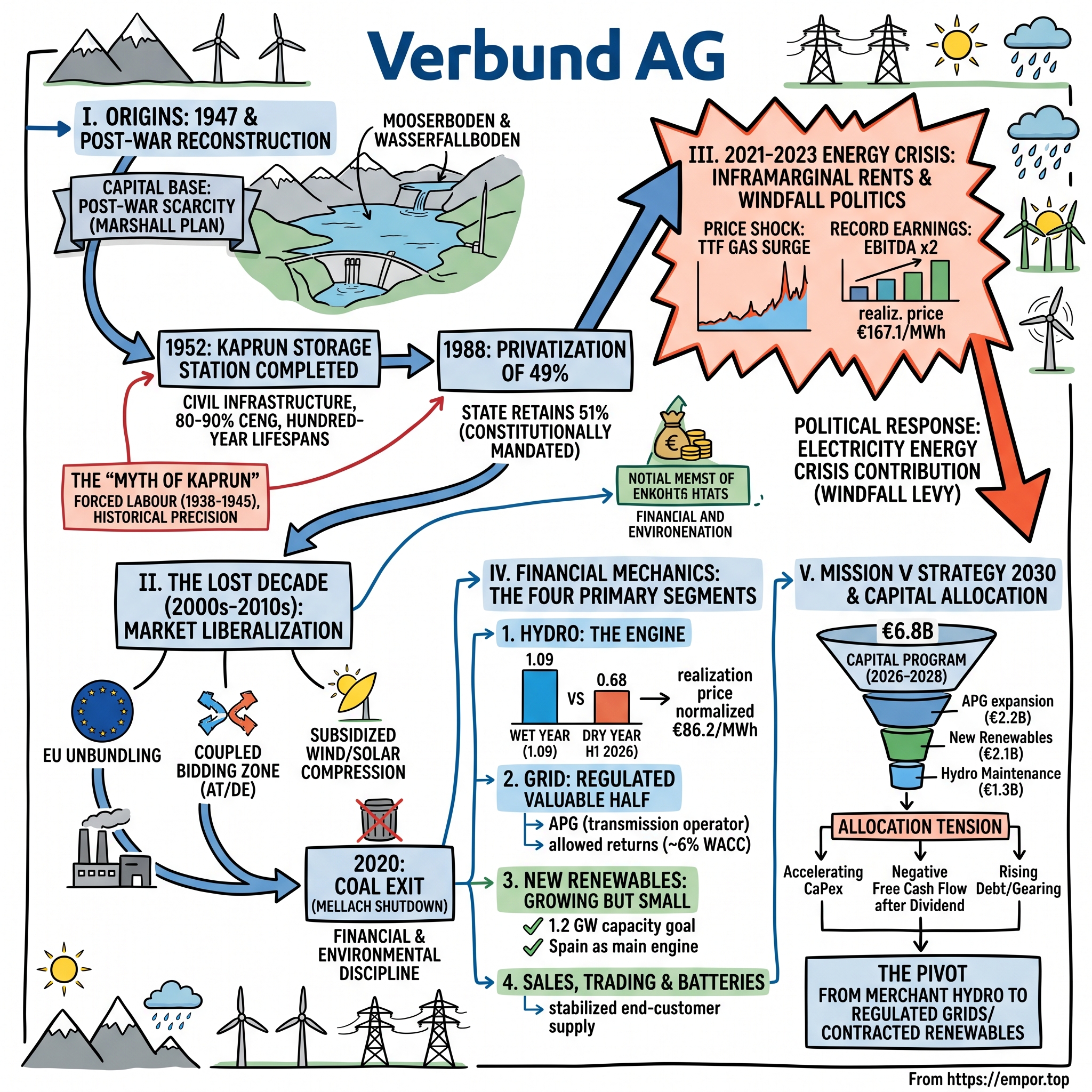
Verbund AG: The Alpine Battery and the Economics of Clean Power
I. Introduction & Episode Roadmap (10 min)
Roughly 2,000 metres above the Salzach valley, in a hanging valley of the Hohe Tauern range, sit two reservoirs called Mooserboden and Wasserfallboden. They were carved out of granite and glacier melt by workers using hand tools and dynamite in the years after the Second World War, and they hold water. That is all they do. Water arrives from snowmelt and rain, sits behind concrete arch dams, and is released down steel pressure shafts when someone in a control room decides that electricity is worth more now than it will be later. The dams were finished in 1952. They are still working, and they have no fuel bill.
That is the core business, stated plainly. Everything else — the Vienna listing, the windfall levies, the Spanish solar parks, the hydrogen memoranda — is commentary on a physical fact established seventy-four years ago by a bankrupt republic spending American reconstruction money.1
Verbund AG, listed in Vienna as VER.VI, is Austria's largest electricity company and one of Europe's largest producers of hydroelectric power. At the end of 2025, it operated 136 hydropower plants with roughly 9,100 megawatts of hydro capacity, employed about 4,400 people, and generated around €8.0 billion of revenue.2 Its shares traded around €59 in early August 2026, placing its equity value near €20 billion — well below the highs of the energy-crisis years, and closer to the bottom of its 52-week range than the top.3
The central paradox of the business is straightforward: Verbund produces electricity at close to zero marginal cost and sells it into a market where prices are set by whichever generator burns the most expensive natural gas. That mismatch is not a flaw in European power market design; it is the design. It made Verbund extraordinarily profitable in 2022 and 2023. Precisely because it generated those profits, the Republic of Austria — which owns 51% of the company by constitutional requirement — legislated to claw back a large share of the surplus, first through emergency measures and then, in 2025, through a framework that functions as a permanent feature.4
A second, quieter tension sits alongside the political one. Verbund's stock has behaved less like a defensive utility and more like a leveraged claim on European power prices. Its shares fell 11.4% during 2025 while the Austrian ATX index rose 45.4% and the STOXX Europe 600 Utilities index gained around 28% — a divergence of extraordinary width for a company in the same sector and index.13 That gap reflects a market repricing a specific, identifiable set of variables: water availability, forward power curves, and the Austrian tax code. An investor who buys Verbund expecting utility-like stability will be repeatedly surprised.
Verbund is therefore two things at once: a low-cost commodity producer, and a strategic national asset whose majority owner also writes the tax code, sets retail price expectations, and answers to voters paying electricity bills. Minority shareholders own a claim on cash flows that survives that tension. Understanding how much value survives, and under what conditions, is the central investment question.
The evidence available in mid-2026 is unusually clear because the company has just endured a severe operational test. In the first half of 2026, EBITDA fell 24.9% year on year to €1,061.5 million, while the group result dropped 35.4% to €518.1 million.5 Water availability was the primary driver: the hydro coefficient for run-of-river plants — the ratio of actual water flow to the long-term average — came in at 0.68, or 32 percentage points below normal.5 That followed a dry 2025, when the same coefficient averaged 0.79 and hydropower output fell 24.2%.6 Two consecutive dry years, arriving alongside an expanded windfall levy, have stripped the business down to its load-bearing elements.
The financial shape of the company today. Fixing the baseline proportions helps clarify the operating model. In 2025, Verbund generated 25,370 gigawatt-hours (GWh) from hydropower, 1,714 GWh from wind, 439 GWh from solar, and 2,054 GWh from thermal plants — with hydro alone representing roughly 86% of total output.2 Renewables in total accounted for 92.9% of generation, down 3.6 percentage points from the prior year as low water levels forced greater thermal operation.6 The company also owns Austria's electricity transmission grid outright and holds just over half of the national gas transmission network, which together contribute roughly a fifth of group earnings on a regulated basis. In addition, it operates approximately 1,256 megawatts of wind and solar capacity across five countries — a portfolio expanding rapidly in absolute terms, yet still small relative to its 9,100 megawatts of hydro capacity.10
What this piece covers. First, the origin: how a post-war reconstruction vehicle funded by the Marshall Plan built civil infrastructure with hundred-year lifespans, and why fully amortised concrete is an underappreciated asset class in European utilities. Second, two decades of market liberalisation, thermal retreat, and depressed power prices that made hydro appear routine — and how management navigated that era. Third, the 2021–2023 price shock, the mechanics of inframarginal rent, and the rapid political response that followed. Fourth, a segment-by-segment analysis of current cash generation, including the forward hedging strategy that determines realized power prices per megawatt-hour. Fifth, capital allocation: the Gas Connect Austria acquisition, the Spanish renewables expansion executed near the peak of sector valuations, and the €6.8 billion capital program running through 2028. Sixth, governance and sovereign ownership, including an impending CFO transition. Finally, the competitive landscape, the bull and bear arguments tested against empirical evidence, and the key operating metrics that drive long-term returns.
One framing device helps unify the analysis. Verbund operates across three distinct timelines moving at vastly different speeds. The asset clock runs in centuries — dams and tunnels built in the 1950s that will remain operational into the 2050s. The price clock runs in years — a forward hedging book that fixes revenue one to three years in advance, meaning current earnings stem largely from decisions made before the drought began. The political clock runs in electoral cycles — levies, price caps, and legal challenges that can reshape economics within twelve months. A long-term shareholder buys the asset clock, receives payouts governed by the price clock, and remains exposed to the political clock.
The narrative begins where the capital was first deployed — in the high Alps, seventy-nine years ago.
 Subscribe on LinkedIn
II. History: Post-War Reconstruction, Kaprun, & Alpine Infrastructure (1947–1990s) (15 min)
In 1947, Austria was a country under four-power occupation with a wrecked electricity system, a shortage of hard currency, and a specific fear: that Soviet occupation authorities would classify Austrian industrial assets as "German property" and seize them. The Second Nationalisation Act of March 1947 was passed with the consent of all political parties, creating Österreichische Elektrizitätswirtschafts-AG — the company that later traded under the name Verbund.1 Its statutory job was not to maximize returns, but to rebuild and expand the national electricity grid.
This origin matters for long-term investors. Verbund was not founded by entrepreneurs capitalizing on hydro opportunities. It was established as an instrument of state reconstruction and sovereignty at a moment when the alternative to nationalization was potential expropriation. That founding logic — the state as owner-of-last-resort and the company as core national infrastructure — never fully receded. It remains the reason a 51% majority state holding is enshrined in the Austrian constitution rather than in a standard shareholder agreement.
The foundational capital came from abroad. Financed substantially through the European Recovery Program, the storage power station at Kaprun was completed in 1952, followed by Ybbs-Persenbeug on the Danube between 1954 and 1959.1 Kaprun became the emblem of the entire enterprise: an immense high-altitude engineering effort undertaken amidst severe post-war scarcity and mythologized in Austrian public memory as proof of national recovery. By 1955, Austria could once again meet its electricity demand entirely from domestic sources.1
Myth versus reality: Kaprun did not begin in 1947. The traditional national narrative places Kaprun squarely in the post-war reconstruction era — the young Second Republic harnessing Alpine hydrology through collective effort. The historical record is less comfortable. Ground was broken in May 1938, weeks after the Anschluss, as a prestige project of the Nazi regime. Between 1939 and 1945, roughly 10,000 forced laborers worked on the site: prisoners of war and civilians abducted from occupied territories, housed in barracks behind barbed wire, with Soviet prisoners suffering the worst treatment. After the war, that history was largely suppressed, and the completed plant became emblematic of Austrian recovery — what historians now explicitly call the "Myth of Kaprun."30
Examining this history is essential for rigorous business analysis for two reasons. First, factual precision: describing Verbund's cornerstone asset purely as a product of the Marshall Plan gives only half the story. Second, it illustrates the unique nature of the company's capital base. The foundational equity embedded in these dams was not raised in capital markets or serviced through commercial cash flows. It was extracted first by a totalitarian regime through forced labor, then built out by a democratic state using American grant aid. No private company could assemble that asset base under modern legal, financial, or environmental standards. That non-replicability makes the asset base uniquely valuable, while explaining why the state's claim on its returns has never been purely a matter of ordinary shareholding.
The economics buried in that concrete. For modern investors, the essential operational takeaway lies in the physical structure of these assets. A high-head Alpine storage scheme is roughly 80% to 90% civil engineering: concrete dams, rock-bored tunnels, pressure shafts, access roads, and underground powerhouse caverns. Civil works require massive upfront capital expenditure, but their ongoing operating costs are exceptionally low. Concrete gravity and arch dams, rock tunnels, and headrace systems routinely operate for eighty to a hundred years or more with routine maintenance rather than structural replacement. While electromechanical components — turbines, generators, and transformers — require refurbishment every thirty to fifty years, the most capital-intensive and irreplaceable elements remain the mountain excavations and reservoir walls.
Consider an analogy to real estate where a previous generation paid off the land, foundation, and structural walls in cash, leaving the current owner responsible only for replacing basic mechanical systems. Depreciation on generation assets built in the 1950s and 1960s has long since run through the accounts. What remains is a cash cost of production that Verbund's disclosures show is a small fraction of prevailing wholesale power prices — explaining why group EBITDA margins routinely exceed 40% in normal hydrological years and still reached 34.2% during the severe drought of 2025.6
Fleet expansion continued through the 1960s and 1970s with run-of-river plants at Aschach and Wallsee-Mitterkirchen on the Danube, storage schemes in Tyrol, Altenwörth, and the Malta plant group in Carinthia, home to Austria's highest dam.1 Then, in 1978, Austrian voters altered the national energy trajectory by rejecting the commissioning of the completed Zwentendorf nuclear plant in a national referendum.1 The vote permanently closed the nuclear power option in Austria. For Verbund, this eliminated the primary technological rival capable of competing with hydro for baseload generation across the domestic grid.
1988: the state sells half and keeps control. In 1988, 49% of the company was privatized through an initial public offering, with the Republic retaining the majority.1 This transaction established public market disclosure, an independent share price, and a cohort of outside investors focused on financial returns. However, it did not transfer operational control, nor was it intended to. Because the 51% state ownership threshold is constitutionally mandated, there is no takeover premium embedded in Verbund stock, no activist mechanism to force corporate breakups, and no realistic scenario in which the company is sold. Minority holders are, structurally, aligned alongside a sovereign majority owner.
The context of that 1988 flotation explains the unusual shareholder register that persists today. Privatization in late-1980s Austria was selective rather than ideological, differing sharply from the full-scale privatizations undertaken in Great Britain during the same decade. The state sold minority stakes to raise capital and impose commercial discipline while retaining strategic control over critical infrastructure. The regional utilities and provincial governments that acquired large positions were not financial investors seeking an exit strategy; they were counterparties in the domestic energy system buying a seat at the table. Almost four decades later, that register remains essentially unchanged, keeping the effective free float at a minority of a minority.
During the 1990s, Verbund adjusted to emerging European Union market regulations, executing the corporate unbundling that created Austrian Power Grid AG as the transmission system operator, while constructing the Freudenau plant on the Danube between 1992 and 1998.1 Entering the twenty-first century, the organization operated on two distinct commercial engines: an amortized generation fleet exposed to market power prices, and a regulated wire business earning a regulator's allowed return. Managing the balance between those two engines has defined the company's strategy ever since.
Liberalisation was about to make that balance urgent.
III. Market Liberalization, Thermal Exit, & The Utility Slump (2000–2019) (25 min)
For most of Verbund's first fifty years, an Austrian power executive did not need to track the marginal cost of a German gas plant on a Tuesday afternoon. After European Union electricity directives unbundled generation, transmission, and supply, and after Austria and Germany operated for years as a single coupled bidding zone, that reality changed completely. Verbund's revenue stopped being a function of regulated Austrian tariffs and became tied to Central European wholesale prices set on commercial exchanges—meaning its financial results became dependent on German coal, German gas, German policy, and eventually German solar panels.
EU unbundling directives required vertically integrated utilities to separate competitive operations—generating electricity and selling it to customers—from monopoly grid infrastructure. A generator could no longer own the high-voltage network and quietly favor its own power plants. For Verbund, that meant Austrian Power Grid had to operate at arm's length from the generation division, even though both remained inside the same corporate group. The result is the dual structure visible in the accounts today: one half of the company competes in a liquid commodity market with zero pricing power, while the other operates as a regulated monopoly forbidden from exploiting its market position, earning a rate set by regulators. Few utility businesses combine both extremes under one roof.
For several years, this market design was highly lucrative. Rising fuel and carbon costs in the mid-2000s pushed clearing prices up, allowing a zero-fuel, zero-carbon producer to capture the entire spread. When the 2008 financial crisis arrived, that dynamic inverted sharply.
The lost decade. Post-2008 industrial electricity demand dropped and recovered sluggishly. At the same time, Germany's Energiewende introduced massive volumes of subsidized wind and solar power with near-zero marginal operating costs. This influx pushed conventional thermal plants down the merit order and compressed wholesale clearing prices. Carbon allowances traded at nominal levels, failing to penalize coal generation. Wholesale power prices that had reached high double digits per megawatt-hour spent years suppressed in the €25 to €40 range. For major European utilities, the impact was severe: RWE and E.ON took multi-billion-euro impairments on conventional and nuclear fleets and underwent structural breakups, spinning off Uniper and Innogy before swapping assets. These were structural admissions that conventional generation fleets no longer earned their cost of capital.
Verbund was not immune, but its low cost structure provided an operational floor. Because the hydro fleet's cash production cost sits far below any standard clearing price, depressed wholesale prices compressed margins without threatening solvency. Financial results from the trough demonstrate that resilience: for fiscal year 2017, EBITDA adjusted for non-recurring effects rose 0.6% to €899.7 million, while the adjusted group result increased 8.8% to €354.5 million.7 While €899.7 million in EBITDA was modest for a generator with 9,000 megawatts of hydro capacity, it generated positive net cash flow, covered debt service comfortably, and avoided equity dilution—at a time when peers were taking large write-downs and cutting dividends.
Management attributed the 2017 earnings improvement not to power prices, but to higher revenue from flexible grid products—specifically congestion management—alongside thermal restructuring and cost-reduction programmes.7 That shift revealed an important structural trend: even during the trough of wholesale power prices, Verbund's assets earned growing compensation for being dispatchable and controllable rather than for basic volume output. System operators were paying Verbund for grid reliability, creating a durable revenue stream that has expanded substantially in subsequent years.
The thermal exit. The defining strategic decision of this period was the planned exit from fossil fuel generation. Verbund progressively reduced its thermal portfolio throughout the 2010s, culminating on 17 April 2020 with the shutdown of its coal-fired unit at Mellach. That closure ended coal-fired power generation in Austria, making the country the second in Europe after Belgium to eliminate coal from its power mix.8 Over its 34 years of operation, the Mellach coal plant had produced more than 30 billion kilowatt-hours of electricity and 20 billion kilowatt-hours of district heating.9 Verbund retained the site for backup capacity and repurposed it as an innovation center, including a pilot high-temperature electrolysis and fuel cell facility.9
While corporate communications presented the coal exit as an environmental milestone, it was equally a disciplined financial decision. A coal plant operating under tightening EU emissions rules, rising carbon costs, and falling capacity factors represented a shrinking option value alongside an accumulating decommissioning liability. Exiting early avoided the severe write-downs suffered by European peers that delayed asset retirements.
Verbund retained selective gas capacity to maintain system flexibility. The combined-cycle gas turbine (CCGT) at Mellach remains in the portfolio and continues to generate income: in the first quarter of 2026, it was dispatched on a market basis, and both units were called by the transmission system operator to relieve grid congestion, with the district heating plant and one CCGT line contracted under grid reserve arrangements.10 A company whose generation profile is roughly 93% renewable still relies on—and profits from—controllable thermal capacity during grid stress.
The German extension. A significant aspect of Verbund's hydro fleet is its cross-border footprint. The group operates 22 hydropower plants in Germany generating approximately 4 terawatt-hours annually, primarily along the Inn river system along the Austrian-German border before flowing into Bavaria.2 This capacity places a meaningful share of generation directly within the German market, subjecting Verbund to German regulatory and energy policy developments. When Austria and Germany were separated into distinct electricity bidding zones with allocated cross-border transmission capacity, this geographic footprint became an operational consideration—supporting Verbund's strategic definition of Austria and Germany as a single integrated home market.25
Discipline in the slump. Throughout the 2010s price slump, management curbed capital expenditure, reduced net debt, and focused on operational efficiency across the hydro fleet. As a result, Verbund entered the 2020s with a balance sheet capable of absorbing significant market volatility.
That capital discipline came with trade-offs. Minimizing capital expenditure for a decade meant Verbund built very little new capacity. The company emerged from the utility slump financially sound but strategically thin—possessing an efficient legacy hydro fleet, a small non-hydro renewables portfolio, and a transmission grid requiring extensive investment to meet national decarbonization targets. Capital projects undertaken in recent years, including the 380-kilovolt grid expansion and pumped-storage additions at Limberg, represent necessary investments deferred during the austerity years. Conserving capital when returns were depressed was rational, but recent capital expenditure surges reflect structural catch-up rather than a sudden shift in strategic risk appetite.
That balance sheet optionality would prove critical within eighteen months.
What followed was an unprecedented energy crisis.
IV. The 2021–2023 European Energy Crisis: Inframarginal Rents & Windfall Politics (30 min)
Understanding what happened to Verbund's income statement during the energy crisis requires an appreciation of one key economic mechanism that drives the entire business: inframarginal rents.
European day-ahead power markets clear on merit order. Every generator offers its output, and the market operator stacks these offers from cheapest to most expensive until supply meets demand. The final facility required to satisfy demand—the marginal plant—sets a single clearing price paid to every generator whose offer cleared. In Central Europe, that marginal plant is frequently a natural gas-fired combined-cycle unit, meaning wholesale electricity prices closely track the marginal cost of natural gas plus carbon emissions allowances.
Consider an auction where a hundred farmers bring wheat to market, and whatever price the highest-cost farmer requires to break even becomes the uniform price paid to all hundred sellers. A farmer whose land produces wheat at zero marginal cost does not sell at cost; that farmer sells at the market-clearing price established by the highest-cost producer and retains the spread. Economists term that gap an inframarginal rent. Verbund's Alpine hydro fleet functions like the farmer with free land.
When Russian natural gas deliveries to Europe were curtailed throughout 2021 and collapsed following the February 2022 invasion of Ukraine, Title Transfer Facility (TTF) gas prices surged to levels previously unmodeled by European utilities. Power prices followed, with day-ahead clearing rates climbing to multiples of historical averages.
What that did to the accounts. In financial year 2022, Verbund's EBITDA doubled, rising 100.2% to €3,160.7 million, while the group result increased 96.6% to €1,717.0 million.11 In 2023, EBITDA climbed a further 42.1% to €4,490.5 million, and the reported group result rose 32.0% to €2,266.1 million—the highest full-year financial results in company history.12 The average price Verbund realized on its hydro generation in 2023 reached €167.1 per megawatt-hour.10 By comparison, the realized price in the first half of 2026 stood at €86.2 per megawatt-hour.5
This surge in cash flow left the business with capital beyond its immediate operational deployment needs. Management proposed a dividend of €4.15 per share for 2023, split into a regular dividend of €3.40 and a special dividend of €0.75, explicitly allowing shareholders to participate in the extraordinary year.12 For 2022, the combined payout ratio on reported earnings reached 72.8%.11 Rather than committing the windfall to unvetted, lower-return expansion projects, management distributed a substantial share to shareholders—a direct form of capital discipline that reflected the lack of immediately available high-return reinvestment opportunities.
And then the politics. The Austrian state occupied a dual position as majority shareholder collecting record dividends and sovereign government facing households burdened by surging energy bills. It resolved this internal conflict by legislating.
At the end of 2022, Austria enacted the Electricity Energy Crisis Contribution (Energiekrisenbeitrag-Strom), designed to skim off what were designated Zufallsgewinne, or windfall profits. The mechanism established a cap on retainable revenue per megawatt-hour and taxed the excess. In 2023, these intervention measures reduced Verbund's EBITDA by approximately €95 million.12 Set against €4.5 billion in annual EBITDA, that initial impact represented a manageable reduction.
The crucial regulatory shift occurred when the government extended and tightened the framework rather than allowing it to lapse as crisis prices moderated. As Verbund outlined in disclosures to investors, the Act was extended across annual tax periods running from 1 April 2025 through 31 March 2030. The revenue cap for existing generation assets was set above €90 per megawatt-hour, and above €100 per megawatt-hour for facilities commissioned after 1 April 2025, with 95% of surplus revenue subject to taxation. Exemptions apply to pumped storage, control energy, congestion management, and installations receiving the Austrian renewables market premium, while generators can offset up to 75% of eligible investments made during the period, capped at €25 per megawatt-hour.10
The financial impact expanded substantially: the levy cost Verbund €7.7 million in 2024 and rose to €135.9 million in 2025.613 This structure represents a permanent modification to upside capture above roughly €90 per megawatt-hour. In its reporting, management noted that the tightened levy "reduces our scope for investment"—a candid statement regarding the regulatory boundaries set by its majority owner.13
A major legal challenge to the framework is currently under judicial review. On 1 July 2026, the Austrian Constitutional Court initiated a review of key provisions of the levy for the 2024 assessment period, citing serious doubts as to whether the crisis conditions justifying the intervention persisted, while also questioning the assessment base, the restriction of liability strictly to electricity producers, and the absence of earmarked revenue allocation. A finding of unconstitutionality could compel refunds of contributions paid.4 Conversely, a ruling upholding the law would formalize the revenue cap as an enduring feature of Austrian generation economics through 2030.
The retail front. Political and regulatory pressure also emerged in consumer operations. In March 2022, Verbund announced price increases for household customers effective 1 May 2022, utilizing a price adjustment clause linked to the Austrian electricity price index. The consumer association VKI initiated legal proceedings on behalf of the Ministry of Social Affairs, challenging the clause and emphasizing the contradiction of a company marketing "100% Austrian hydropower" indexing customer tariffs to exchange-traded fossil fuel benchmarks.14 The Vienna Commercial Court ruled the clause impermissible, and the Vienna Court of Appeal subsequently confirmed the decision.15 Verbund and the VKI later reached an out-of-court settlement allowing affected household customers to apply for flat-rate refunds—roughly €90 for a household consuming 3,300 kilowatt-hours annually—with the application window closing on 11 November 2024.16
While the financial liability was modest for an enterprise of Verbund's scale, the reputational implications were substantial. Managing an enterprise backed by domestic renewable resources carries social and political obligations that merchant generators do not face, demonstrating that Austrian courts and regulatory bodies will strictly enforce consumer protection standards.
The sovereign's double claim. Analyzing the distribution of the crisis surplus reveals the core governance tension between shareholder classes. The Republic of Austria collected 51% of every dividend distributed while receiving 100% of the windfall levy. Dividend payments benefit all equity holders proportionally, whereas tax levies do not. Every euro extracted via the levy reduces the common equity base, whereas the state forfeits only its 51% dividend share of that euro. This mechanism effectively transfers value from minority investors to the sovereign owner before net income reaches the dividend line.
This structural dynamic explains the equity market's cautious response during the period of record earnings. Extending the levy through 2030 transformed an emergency tax into a structural cap on earnings above €90 per megawatt-hour, converting an open-ended claim on European power prices into a bounded return profile. Verbund's stock declined 20.5% in 2022—the most profitable year in its operational history—as market intervention debates introduced significant regulatory uncertainty.11 Capital markets did not doubt the hydro fleet's capacity to generate cash; they questioned how much of that cash would accrue to minority shareholders.
With crisis intervention mechanics established, the key analytical question shifts to how the business structures its revenue generation and hedging operations under standard market conditions.
V. Financial Mechanics, Segment Breakdown, & Economics of the Core Business (35 min)
Picture the control room rather than the dam. Somewhere in Austria, a dispatcher watches a wall of screens: reservoir levels, river flows, day-ahead prices for the next twenty-four hours, intraday spreads, grid frequency, and requests from the transmission system operator. Every operational decision boils down to the same underlying valuation: is a given cubic metre of water worth more released immediately or stored for later? A run-of-river facility on the Danube must generate when the river flows. A high-head storage station in the Tauern Alps holds substantial operational flexibility, and that flexibility is the commercial product.
Verbund reports its business across four primary operating segments, each representing a distinct asset class and risk profile.
Hydro: the engine, and the volatility. The hydro segment is the dominant earnings source and the primary driver of stock volatility. In the first quarter of 2026, it produced €300 million of EBITDA, down 38% from €481 million a year earlier, driven by lower generation, lower realized prices, and a €9.7 million decline in contributions from flexibility products.10 Hydropower output reached 5,095 gigawatt-hours, falling 6.8% year on year.10
The fundamental driver of volume is the hydro coefficient (Erzeugungskoeffizient), which measures actual water availability against the long-term average, where 1.00 represents normal conditions. It functions as the utility equivalent of same-store sales and remains entirely beyond management control. In 2024, the coefficient stood at a wet 1.09, before dropping to 0.79 in 2025.6 In the first half of 2026, it fell further to 0.68—thirty-two percentage points below normal.5 Verbund's sensitivity disclosures quantify the operational stakes clearly: a 1% change in hydro generation moves the 2026 group result by approximately €13.8 million, whereas a €1/MWh shift in wholesale power prices alters it by about €4.2 million, and a 1% change in wind and solar output affects it by only €1.8 million.10 Water availability remains the dominant variable. After all diversification efforts, Verbund remains primarily a financial play on Alpine rainfall and snowmelt.
The hydro fleet divides into two distinct operational models. Run-of-river plants along the Danube, Inn, and Enns rivers generate continuous baseload electricity dictated by river flow. High-head storage and pumped-storage complexes in the Alps—including Limberg, Reißeck, and the Kaprun group—provide dispatchable flexibility. Pumped-storage facilities operate essentially as water-and-gravity batteries: during periods of low or negative power prices, such as midday solar peaks, the plant consumes electricity to pump water from a lower reservoir to an upper basin. During peak evening demand, the water is released through turbines to sell power into higher-priced hours. Although round-trip energy losses run between 20% and 25%, the operation captures the price spread.
As solar and wind capacity grows, that price spread widens because midday generation depresses solar prices while evening demand sustains peak power rates. This structural shift provides a tangible earnings tailwind already reflected in the accounts. Revenues from flexibility products—encompassing control energy, congestion management, grid system services, intraday trading, capacity reserves, and pumping operations—contributed €348 million in 2023, €275 million in 2024, and €274 million in 2025, with management targeting approximately €270 million for 2026.10 These earnings represent recurring compensation for providing grid stability and dispatchable capacity rather than raw energy volume.
The segment also faces an operational setback. Limberg III, a 480-megawatt pumped-storage expansion in the Kaprun valley, suffered rotor damage to both generators during commissioning tests in late 2025. The equipment supplier carries repair liability; unit 2 is scheduled to return to service in summer 2026 and unit 1 in winter 2026, with an estimated earnings drag of €40 million to €60 million concentrated in 2026.13 In its first-quarter 2026 reporting, Verbund confirmed that repairs were proceeding on schedule and recommissioning targets remained unchanged.10 While manageable and largely covered by warranties, the delay highlights the execution risks inherent in commissioning complex, large-scale electromechanical equipment.
The hedging book: what Verbund actually gets paid. Wholesale market dynamics do not translate immediately into realized financial results because Verbund sells its generation forward over a multi-year horizon. This hedging strategy buffers cash flows against spot price spikes and collapses, ensuring current realized prices reflect commercial decisions made one to three years prior.
As of 31 March 2026, Verbund had hedged 18.3 terawatt-hours of its projected 2026 hydro output, leaving 6.0 terawatt-hours open, at an average achieved price of €86.6 per megawatt-hour—compared to a prevailing mark-to-market price of €92.1 on 30 April 2026. For 2027, hedging remained light, with only 5.5 terawatt-hours contracted at €92.1 per megawatt-hour against 20.3 terawatt-hours unhedged, where mark-to-market prices stood at €98.4. For 2028, forward sales had barely commenced at 0.4 terawatt-hours, with mark-to-market levels at €84.3 per megawatt-hour.10 Comparing these figures to historical achieved hydro prices—€167.1 per megawatt-hour in 2023, €118.0 in 2024, and €116.3 in 2025—clarifies the financial trajectory.10
Two strategic implications emerge. First, the primary earnings normalization from post-crisis peaks has largely run its course; realized prices have nearly halved from 2023 levels, moving close to the €90 per megawatt-hour windfall levy threshold and thereby dampening the tax's incremental impact. Second, because generation from 2027 onward remains largely unhedged, medium-term earnings will depend heavily on European forward power curves over the next two years rather than current hydrological conditions.
Grid: the boring, valuable half. Austrian Power Grid (APG), wholly owned by Verbund, operates roughly 3,300 kilometres of high-voltage transmission lines as the national transmission system operator.2 Gas Connect Austria (GCA), 51% owned, operates high-pressure gas transmission pipelines. Both network operators are regulated by E-Control, which sets allowed returns on their regulated asset bases.17
The segment's economics invert the hydro business model: revenue carries no commodity price risk, no weather dependency, and returns governed by regulatory formulas. In the first quarter of 2026, the grid segment generated €131 million of EBITDA compared to €145 million in the prior-year period, with APG contributing €101 million and GCA €30 million; full-year 2026 EBITDA guidance stands at approximately €290 million for APG and €60 million for GCA.10 APG's regulated asset base expanded from €3,229 million in 2025 toward an estimated €3,662 million in 2026—a 13% single-year increase that illustrates how capital expenditure expands future regulated earnings.10
Regulatory allowed returns establish the financial benchmark for grid investments. APG's nominal pre-tax weighted average cost of capital (WACC) for the 2026 regulatory period is set at 4.16% for legacy assets commissioned through 2022, rising to 4.88% for 2023 additions, 6.33% for 2024, 6.24% for 2025, and 6.11% for 2026, with annual updates applying to new assets through 2028.10 Newly constructed grid infrastructure earns roughly 6% pre-tax in nominal terms. While this offers attractive, low-risk returns backed by statutory demand, it remains lower than the returns generated by amortized hydro dams during periods of strong power prices. Allocating capital from merchant hydro into regulated networks elevates earnings stability while capping peak profitability—a clear strategic trade-off rather than an unmixed benefit.
An accounting distinction explains why reported grid earnings exhibit temporary volatility. Under local Austrian GAAP, timing differences between regulatory allowed revenues and actual collections are smoothed through a regulatory account—projected at €589 million for 2026—yielding stable local earnings. Under IFRS, which lacks regulatory account provisions, these timing shifts flow directly into reported income, creating quarterly fluctuations that reflect accounting conventions rather than shifts in underlying economic performance.10
New renewables: growing, small, and not yet proving itself. Wind and solar capacity stood at 1,256 megawatts at the end of the first quarter of 2026—comprising 910 megawatts of wind and 346 megawatt-peak of solar photovoltaics—spread across Austria, Germany, Spain, Romania, and Italy.10 Segment EBITDA reached €36 million in the quarter, down from €59 million a year earlier.10 Output expanded as wind generation grew 24.6% to 609 gigawatt-hours during the quarter, led by Spain with 330 gigawatt-hours and Germany with 88 gigawatt-hours.10 However, the resource availability coefficient for wind and solar ran at 0.82 in 2025—eighteen percentage points below baseline expectations.6 Multi-year resource deficits across both hydro and non-hydro renewables raise questions as to whether weather conditions reflect temporary fluctuations or overly optimistic underwriting assumptions.
Separately, transmission system metrics highlight a key operational divergence: grid throughput is decoupling from proprietary generation volumes. Transmitted grid volume rose 10.0% in the first half of 2026 even as Verbund's electricity sales volume fell 4.1% and hydro output dropped nearly 10%.5 Increased power flows across Austria's transmission system during periods of lower domestic generation illustrate the growing role of cross-border balancing in an electrifying grid—underlining why the regulated network remains shielded from primary generation volume risks.
Sales, trading and batteries. The sales segment encompasses energy trading, customer supply, and battery storage. It represented a rare area of growth in early 2026, as quarterly EBITDA rose to €49 million from €37 million in the prior-year period following stabilization in end-customer operations.10 The earnings composition highlights this recovery: commercial customer contributions increased modestly from €29.4 million to €31.3 million, while retail customer contributions rose from €7.2 million to €18.0 million.10 Retail supply had encountered severe friction during the energy crisis due to unhedged procurement costs and legal challenges over tariff adjustment clauses; its stabilization removes a recurring operational drag.
Battery storage development is expanding from a small base, with 15 operating facilities providing 110 megawatts of capacity, 108 megawatts under construction, and approximately 300 megawatts in pre-construction development, primarily across Germany and co-located sites in Spain.10 Compared to Verbund's 9,100 megawatts of hydro capacity, battery assets remain minor. Developing battery capacity protects against short-duration arbitrage competition from third-party storage developers, but Verbund possesses no proprietary technology or cost advantage in utility-scale batteries. Consequently, battery investments represent standard commercial deployments rather than structural additions to the core moat.
The thermal remainder. The remaining thermal assets, reported within the "all other segments" division, showed improved financial performance in the first quarter of 2026. Segment EBITDA reached €35 million, up from €16 million in the prior-year period, supported by reduced fuel costs and higher realized margins despite a 9.5% drop in thermal generation to 828 gigawatt-hours.10 While thermal output accounts for a minor fraction of total volume, these assets remain essential during low-water periods. In 2025, drought forced increased reliance on thermal generation, causing the carbon intensity of Verbund's power production to rise from 13.0 to 25.4 grams of CO2 equivalent per kilowatt-hour.6 This shift demonstrates that emissions metrics remain tied to Alpine hydrology as well as long-term decarbonization targets.
One line in the accounts that deserves more attention than it gets. Consolidated reporting figures reflect assets that are not fully owned by parent shareholders. In the first quarter of 2026, non-controlling interests accounted for €35.0 million of the €269.8 million group result—approximately 13%.10 These minority claims reside in partially owned generation subsidiaries and in Gas Connect Austria, where outside investors hold a 49% stake. Consequently, headline EBITDA overstates the cash flow directly attributable to Verbund's equity holders, with the variance differing significantly across operating divisions. Evaluating segment profitability requires analyzing net cash flows accruing to the parent company after minority distributions.
In aggregate, the core business generates roughly two-thirds of earnings from low-cost hydro assets subject to weather patterns and power price curves, while approximately one-fifth derives from regulated grid operations expanding at allowed pre-tax returns near 6%. How management allocates the capital generated across these two engines forms the focus of the following section.
VI. M&A, Capital Deployment, & "Mission V" Strategy 2030 (25 min)
Every utility management team in Europe faced the same structural choice in 2021: how to deploy unprecedented cash generation against a strict decarbonisation mandate without overpaying for growth. Verbund's capital allocation track record during this era presents a mixed picture, marked by a disciplined gas infrastructure acquisition on one hand and high-valuation renewable purchases on the other.
Gas Connect Austria: the good trade. On 23 September 2020, OMV accepted a binding offer from Verbund for its 51% stake in Gas Connect Austria at €271 million, plus the assumption of €165.9 million in debt, valuing the business at an enterprise value of roughly €980 million on a debt-free basis.18 The transaction closed on 31 May 2021.19
Three factors distinguish this transaction. First, Verbund executed the purchase before the energy crisis drove infrastructure valuations to record peaks. Second, it injected regulated, commodity-insensitive cash flow into a group heavily exposed to power price volatility—with Gas Connect Austria contributing €30 million of EBITDA in the first quarter of 2026 alone, up from €17 million a year earlier, toward full-year guidance of approximately €60 million.10 Third, it secured physical rights-of-way and pipeline corridors across Austria that Verbund could not otherwise build from scratch.
Benchmarking the purchase price requires some estimation because Verbund never published Gas Connect's regulated asset base at the closing date. However, comparing the €980 million enterprise value against a regulated asset base of €656 million in 2025 implies an asset multiple of roughly 1.5 times—aligning with or coming in below historical transaction multiples for European gas transmission peers like Snam, Enagás, and Fluxys. For an asset holding long-term regulated concessions, that valuation represents a defensible entry price that compares favourably with prices paid by infrastructure funds in 2021 and 2022. The long-term upside depends on how these pipeline corridors are repurposed.
Those pipeline corridors link directly to Verbund's long-term hydrogen strategy. Gas Connect is one of four transmission system operators—alongside Snam, TAG, and bayernets—developing the SoutH2 Corridor, a planned 3,300-kilometre hydrogen pipeline designed to connect North African supply to Italy, Austria, and Germany, featuring a target import capacity of 4 million tonnes annually and designation as a Project of Common Interest under the European Union's TEN-E framework.20 Gas Connect's specific initiative, the H2 Backbone WAG + Penta-West project, aims to construct parallel hydrogen lines alongside the existing West Austria Gas Pipeline, creating bidirectional capacity of approximately 150 gigawatt-hours per day across Austria, Slovakia, and Germany.21
Assessing these projects requires a rigorous materiality test: green hydrogen contributes virtually nothing to Verbund's current earnings. The SoutH2 Corridor relies on North African supply capacity that remains unbuilt, European commercial offtake that remains largely uncontracted, and regulatory and financing frameworks that are still under development. While the project represents a tangible option backed by physical assets and European Union political support, assigning it substantial net present value today remains speculative. Meanwhile, the underlying gas network faces structural contraction: Gas Connect's regulated asset base stood at €656 million in 2025 and was expected to decline to €605 million in 2026.10 A shrinking regulated asset base reflects the reality of gas infrastructure in a decarbonising economy unless full-scale hydrogen conversion materialises.
Spain: the expensive trade. In 2022, Verbund expanded rapidly into the Spanish market. On 9 March 2022, it agreed to acquire a 70% stake in four wind farms and one solar plant from Capital Energy totalling 171 megawatts, alongside 80 megawatts of solar hybridisation projects under development, without disclosing the purchase price.22 In May 2022, it acquired a platform from Q-Energy comprising 82 megawatts of operational solar, approximately 2,100 megawatts in advanced development, and roughly 2,400 megawatts of greenfield projects—a 4.6-gigawatt pipeline in total, also at an undisclosed price—following an earlier purchase of a large solar project in the same region from BayWa r.e.23
The timing of these transactions coincided with the peak of European renewable valuations in mid-2022, prior to the sharp rise in interest rates that expanded discount rates across the sector. Higher financing costs compress unlevered returns on renewable portfolios acquired at low discount rates, while Spanish solar assets have simultaneously encountered midday price cannibalisation as regional capacity expanded rapidly. In addition, Verbund confirmed ongoing exposure to market intervention in Spain, recording a €1.6 million EBITDA-level levy there in the first quarter of 2026 alongside €7.9 million in Austria.10
Despite these valuation headwinds, Spain has emerged as the primary earnings engine within the new renewables segment, with expected 2026 EBITDA of €88.2 million, compared to €34.9 million from Romania, €12.5 million from Germany, and negative contributions from Austria and Italy.10 Operational performance is materialising, but evaluating whether returns justify the initial capital outlay remains difficult because Verbund withheld the purchase prices—a notable disclosure gap that obliges public investors to take capital allocation quality on trust.
The forward capital commitment across international markets is substantial. Planned capital expenditure through 2030 totals approximately €1,075.6 million in Spain, €502.2 million in Romania, €485.6 million in Germany, €310.4 million in Italy, €201.5 million in Austria, and €91.0 million in Albania.10 To support this buildout, Verbund established a framework agreement with Nordex covering the supply of 700 megawatts of wind turbines.10 These commitments reflect a permanent geographical shift rather than a temporary trial.
Kelag. Verbund holds a 35% minority stake in KELAG, Carinthia's regional utility, alongside the provincial state holding company.24 The holding contributed €17 million to the group financial result in the first quarter of 2026, compared to €16 million in the prior-year period.10 This investment provides a stable, non-controlling income stream that adds predictable dividend income without altering the broader corporate strategy.
Mission V and the capital plan. Verbund's Strategy 2030, executed through the transformation programme branded Mission V, rests on three core pillars: strengthening its integrated position across the Austrian and German home markets, expanding European wind and solar capacity to account for up to 25% of total group generation by 2030, and establishing a position in green hydrogen via domestic electrolysis and import corridors.25
The financial plan underpinning Mission V involves significant capital deployment. According to mid-term planning disclosed in late 2025 (excluding future M&A), capital expenditure for 2026 through 2028 totals €6,789 million, comprising €3,993 million in growth capital and €2,796 million in maintenance.10 By division, Austrian Power Grid absorbs approximately €2.2 billion across growth and maintenance projects, new renewables accounts for roughly €2.1 billion in growth spending heavily front-loaded into 2026 and 2027, and hydro maintenance requires roughly €1.3 billion.10
This capital allocation strategy drives two structural shifts. First, it rebalances the asset mix away from merchant hydro toward regulated grid infrastructure and contracted renewables—enhancing earnings stability while capping returns closer to regulated thresholds. Second, this expansion coincides with a cyclical contraction in cash generation. Free cash flow before dividends dropped 74.2% in 2025 to €536.8 million, and fell an additional 71.6% in the first half of 2026 to €218.9 million, even as capital expenditure grew 34.3%.56 As a result, net debt expanded 54.7% year on year to €3,817.4 million by mid-2026, pushing gearing from 23.2% to 36.2%.5
This dynamic creates a clear tension in financial management: Verbund is accelerating capital deployment during an operational downcycle while maintaining high shareholder distributions. For 2025, the company distributed €3.15 per share, including a €1.15 special dividend representing roughly €400 million, which raised the payout ratio to 74.3% of adjusted net profit during a year when free cash flow after dividends registered negative €792.7 million.613 The decision to distribute optional special dividends while management publicly noted that windfall levies reduced investment capacity highlights the competing priorities facing the business—most notably the revenue requirements of its 51% sovereign owner, which forms the focus of the governance analysis that follows.
VII. Management, Governance, & Sovereign Ownership (20 min)
There is a specific profile of executive that Austrian state-linked infrastructure tends to produce, and Michael Strugl fits the archetype closely. Born in Steyr in 1963, he earned a law degree at Johannes Kepler University Linz, later completed the Stanford Executive Program, and spent the middle of his career in public office as an ÖVP politician in Upper Austria—rising to state councillor and deputy provincial governor before stepping down from regional government at the end of 2018.26 He joined Verbund's executive board in 2019 and has served as Chairman and CEO since January 2021.26
Evaluating that executive background on operational requirements rather than political optics offers key context for investors. A hydro and grid utility majority-owned by the Austrian state, operating under a tax regime drafted by that same state, securing rights-of-way for transmission lines through Alpine terrain, and negotiating European Union hydrogen corridor frameworks operates under a clear constraint: the primary boundary on value creation is rarely engineering capacity and almost always regulatory or political. A chief executive skilled in navigating public policy represents a deliberate choice for that environment. The corresponding vulnerability is equally apparent—an executive drawn from the political establishment is less inclined to publicly challenge the controlling sovereign shareholder when government priorities diverge from minority investor interests. During the windfall tax extension debates, management characterized the tightened levy as reducing investment scope, marking the outer boundary of its public criticism.13
The financial balance has been provided by Peter F. Kollmann. Born in Wels in 1962, holding a doctorate from the Vienna University of Economics and a research fellowship at the London School of Economics, he spent twenty-six years in investment banking—with Salomon Brothers, Lehman Brothers in London, and Bank of America Merrill Lynch in Frankfurt, where he served as Vice-Chairman of investment banking for Europe, the Middle East, and Africa—before joining Verbund's board in 2014.26 Over his tenure, the company maintained credit ratings of A/stable from S&P and A2/stable from Moody's, managing financial liabilities of €1,834.3 million (roughly €1.83 billion) as of March 2026 with an average duration of 5.9 years, an effective annual interest rate of 2.28%, 87.2% fixed-rate obligations, and 100% euro denomination.10 For an enterprise executing nearly €7 billion in capital expenditure over three years, a sub-2.5% average cost of debt with a long maturity profile represents a meaningful competitive advantage—providing cheap, stable funding that functions as an operational moat in capital-intensive infrastructure.
An imminent CFO transition. On 27 April 2026, Verbund announced that Kollmann would resign his board mandate effective 31 August 2026 to become Vice Chair EU and Country Executive for Germany and Austria at Bank of America. The supervisory board initiated an executive search immediately, noting that if no successor were appointed by 31 August, CEO Strugl would assume CFO responsibilities on an interim basis.27
As of early August 2026, no replacement has been publicly named. Consequently, Verbund is weeks away from temporarily combining its chief executive and chief financial officer roles while mid-way through its largest capital investment program, against a backdrop of rising gearing, falling near-term earnings, and an active constitutional challenge to its primary windfall tax. While utility finance operations do not depend on a single executive and the interim structure was disclosed in advance, consolidating executive authority remains a notable governance development. The duration of the interim period and the profile of the eventual appointee warrant close observation: selecting an external capital-markets specialist would signal continued balance-sheet discipline, whereas an internal or politically connected appointment would indicate a shift in governance priorities.
The remaining board members focus on operational execution. Achim Kaspar, born in Klagenfurt in 1965 with a doctorate from Graz, joined the board in 2019 following a career spanning the European Commission, Verbund operating subsidiaries, telecommunications, and eight years as chief executive of Cisco Systems Austria—a technology background that aligns with an operating model increasingly driven by dispatch optimisation and grid digitalisation.26 Susanna Zapreva, born in Vienna in 1973, holds a doctorate in electrical engineering from the Vienna University of Technology and led Germany's enercity AG from 2016 to 2023 before joining as Chief Renewables Officer in 2024.26 Appointing a former head of a major German municipal utility to lead renewable expansion reflects the strategic reality that growth capital expenditure is concentrated across Germany, Spain, and Romania.
Ownership: the structure that defines everything. The Republic of Austria holds a constitutionally mandated 51% majority stake. A syndicate comprising EVN AG and Wiener Stadtwerke holds approximately 25%, Tyrol's TIWAG holds slightly over 5%, and the free float remains under 20%, held predominantly by institutional index and active asset managers.28
That ownership distribution carries fundamental structural consequences. Less than one-fifth of total equity trades publicly, while more than three-quarters of the shareholder register is controlled by the Austrian state and state-linked regional utilities owned by provincial governments with distinct political priorities and retail customer bases. This ownership concentration creates clear capital market realities:
There is no takeover premium and no mechanism to trigger one. Activist investor strategies are constrained, as acquiring the entire free float yields less than 20% of voting rights. Trading liquidity is low relative to total market capitalization. Dividend policy is established in coordination with a majority shareholder that simultaneously operates as the national fiscal authority. Furthermore, that same sovereign owner has demonstrated its willingness to pass legislation capping generation revenues when wholesale power prices become politically sensitive.
These governance constraints are accompanied by tangible operational advantages. Sovereign backing supports a low cost of capital, while alignment with national decarbonisation targets facilitates environmental permitting for grid and hydro infrastructure that might encounter severe local opposition under private ownership—such as the 380-kilovolt Salzburg transmission line, commissioned in the second quarter of 2025 to complete Austria's high-voltage ring.29 Additionally, a controlling shareholder operating on multi-decade horizons provides structural stability for civil engineering assets built to operate for over a century.
The syndicate structure introduces an additional dynamic for public shareholders. EVN and Wien Energie are operational power companies with proprietary generation, retail customer bases, and provincial government owners. A shareholder register where a quarter of voting rights belongs to entities that simultaneously buy from, sell to, and compete with the company is unusual among listed European utilities. While this arrangement has not generated public related-party disputes—and Verbund's syndicate disclosures date back to 2010—it demonstrates that shareholder alignment is complex, with key decisions reflecting broader national energy interests inside the boardroom.
The core investment proposition reflects this balance: minority shareholders gain exposure to low-cost, well-permitted, century-scale infrastructure, while accepting capped upside during price spikes and limited voting influence. The attractiveness of that tradeoff depends heavily on entry valuation and the prevailing power price cycle.
Assessing credibility through behaviour. Evaluating executive performance against stated operational targets reveals a consistent record. On financial guidance, management demonstrated measured execution: initial 2026 EBITDA guidance was set at €2.0 billion to €2.5 billion alongside annual results in March,6 narrowed to €2.1 billion to €2.5 billion in the first quarter,10 and tightened further to €2.1 billion to €2.4 billion at the half-year mark as the hydro coefficient dropped from 0.78 to 0.68.5 Maintaining the guidance floor despite worsening hydrological conditions underscores management's reliance on forward power hedges and non-hydro contributions—a projection that the third-quarter financial report on 5 November 2026 will test directly.10
Disclosure quality presents a dual picture. Verbund provides detailed reporting on operational variables, publishing quarterly hydro coefficients against long-term baselines, three-year forward hedging ladders with volumes and achieved prices, explicit earnings sensitivities, segment-level regulated asset bases with allowed returns by vintage year, and precise euro-denominated tax impacts. This granular disclosure enables independent modeling of core earnings drivers. Conversely, management withheld purchase prices for its Spanish renewable acquisitions, creating a notable disclosure gap in capital allocation—establishing a contrast between high transparency on external operational factors and limited visibility on discretionary capital deployment.
Which leads to the competitive question: how defensible is this position against everyone else in European power?
VIII. Strategic Moats & Competitive Frameworks (20 min)
Consider a competitive stress test. If a rival attempted to attack Verbund's core Austrian hydro position with unlimited capital, what options would physically exist?
It cannot build a comparable high-head storage scheme in Austria. The finite sites with the required elevation drop, catchment area, valley geometry, and geology are already occupied—mostly inside or adjacent to protected Alpine areas where large new reservoir construction faces environmental opposition that has intensified since the 1970s. It cannot acquire Verbund, because the 51% state majority is constitutionally locked. It cannot build a parallel transmission network, as that is both economically unviable and legally prohibited. What a competitor can do is build wind and solar capacity—which depresses the average power price Verbund receives—and construct battery storage to compete for short-duration flexibility spreads.
That competitive landscape maps directly onto Hamilton Helmer's 7 Powers framework.
Cornered Resource is the dominant power, and it is structural rather than rhetorical. The Alpine sites are non-replicable, the water rights and concessions run for decades, and the physical assets were funded by prior generations of taxpayers. This is not a moat built on brand or contractual arrangements; it is built on topography. Very few enterprises across any industry possess an advantage this durable. The central investment question is not whether the resource is cornered—it demonstrably is—but whether Verbund controls the price that resource commands in the market. It does not, which represents its primary structural vulnerability.
Scale Economies and natural monopoly dynamics apply to Austrian Power Grid, which operates as a legally protected transmission monopoly. Duplicating high-voltage lines is neither economically viable nor regulatory permitted. However, a regulated utility does not earn monopoly rents; it earns a weighted average cost of capital set by E-Control, which stands around 6% pre-tax nominal on new assets.10 The moat protects that return, but it does not expand it.
Counter-Positioning is the weakest of the three claims. Verbund benefits from wholesale clearing prices set by carbon-emitting marginal plants without incurring carbon or fuel costs. Yet this is not counter-positioning in the classic sense, because incumbent fossil generators are prevented from adopting Verbund's model by geography and geology, not by business-model inertia. Nor is this advantage permanent. As natural gas plants gradually exit the marginal clearing position across Central Europe and are replaced by renewables and storage that set lower market-clearing prices, inframarginal rents will narrow structurally. Verbund's long-term advantage in that environment will derive from dispatch flexibility rather than merit-order positioning. Treating market-design gains as a permanent power risks mistaking a transitional windfall for a structural moat.
Porter's Five Forces, applied to the operating model:
Threat of new entrants in Austrian hydro and transmission is effectively zero for physical and regulatory reasons. In new renewables, however, entry barriers are low and competition is intense—explaining why that division generates modest returns.
Supplier power over core hydro generation is zero, as rainfall and snowmelt require no vendors. Elsewhere, supplier power is material: manufacturers of wind turbines, solar modules, and grid equipment retain pricing power in a European market where developers are expanding simultaneously. The 700-megawatt Nordex framework agreement represents an effort to secure equipment supply and lock in prices.10 Meanwhile, the generator rotor failures at Limberg III demonstrate that supplier quality risks remain significant even when financial liability rests with the equipment vendor.13
Buyer power is asymmetric. Wholesale buyers possess no leverage, as electricity is a fungible commodity traded on liquid exchanges. Conversely, retail customers and political stakeholders exercise substantial power—not through commercial switching, but through legislation and judicial challenges, as both the windfall levy and the VKI legal proceedings demonstrated.415
Substitutes represent a nuanced threat. Lithium-ion batteries compete directly with pumped storage within short-duration, one-to-four-hour arbitrage windows, with battery deployment costs continuing to decline. What battery technology cannot yet achieve at economic scale is seasonal storage—holding energy from spring snowmelt through a cold, windless winter week. Verbund's Alpine reservoirs perform seasonal shifting naturally. Consequently, substitution risk is active in short-duration balancing but negligible in seasonal balancing, which is where long-term scarcity value will concentrate as thermal capacity retires.
Rivalry is regional and moderate. Statkraft in Norway occupies a similar hydro-dominated position with a state majority owner. Fortum operates Nordic hydro and nuclear assets. Iberdrola, Enel, and RWE compete for European renewable pipelines and equipment supply. In Austria, EVN and Wiener Stadtwerke act as both regional competitors and key shareholders—a setup that dampens domestic rivalry. No competitor can contest Verbund's core hydro fleet because the underlying physical position cannot be duplicated.
The peer that matters most. Statkraft provides the most direct operational comparison for Verbund. Both are state-majority-owned, hydro-dominant, low-marginal-cost producers operating in a European market defined by rising renewable intermittency, and both control seasonal storage assets that cannot be replicated. The operational differences are nevertheless significant. Statkraft's Norwegian reservoirs are larger relative to domestic demand, and its home market is connected to Continental Europe through limited interconnectors rather than full market coupling, creating distinct pricing dynamics. Furthermore, Statkraft is unlisted, meaning its state owner faces no minority shareholders when political intervention occurs. Verbund's public listing provides market discipline and financial transparency, but it leaves minority investors exposed to regulatory interventions they cannot influence.
Fortum offers a cautionary precedent. The Nordic utility held an enviable low-carbon asset base but destroyed substantial equity value by expanding into European gas through Uniper, requiring a state bailout when energy markets collapsed in 2022. The key lesson for Verbund is that expanding outside its core cornered resource exposes capital to heightened risk—the precise framework through which to judge its international renewable buildout across Spain, Romania, and Italy.
The synthesis matters: Verbund's moat is nearly absolute on asset quality and virtually non-existent on power pricing. That dual nature ensures the enterprise cannot be competed out of its core business, even as its earnings fluctuate with commodity curves and weather patterns beyond management's control. Investors receive structural permanence without short-term earnings stability.
Now test the case properly.
IX. Investment-Story Spine: Bull vs. Bear Case & Stress Test (20 min)
Why Verbund wins from here.
The bull case rests first on cost position, an arithmetic reality rather than a speculative opinion. Sitting at the bottom of the European merit-order curve, Verbund's hydro fleet continues to operate profitably during price crashes while marginal gas plants shut down; during price spikes, it captures the full spread. That asymmetry explains how the company earned €899.7 million of adjusted EBITDA during the trough of the last utility cycle and €4,490.5 million at the peak—a fivefold expansion without an existential crisis along the way.712 Few commodity producers possess that fundamental resilience.
The second pillar is the volatility premium generated by grid decarbonisation. As European wind and solar capacity expands, intraday price spreads widen, creating negative midday power prices alongside expensive evening demand peaks. Pumped storage monetises this dispersion directly. Verbund's flexibility disclosures confirm that this is an active revenue engine rather than a pitchbook concept, contributing several hundred million euros annually across distinct price environments.10 The test for this thesis is straightforward: if renewable penetration continues to rise over the next several years without generating higher flexibility revenues, the underlying assumption is flawed.
The third pillar is the compounding regulated grid asset base. Austrian Power Grid's regulated asset base is scheduled to expand from €3,229 million to €3,662 million in a single year, expanding the allowed-return base through inflation-linked, commodity-insensitive cash flows.10 Regulated grid earnings will represent a substantially larger share of group profit by 2030, following directly from the disclosed capital expenditure program.
The fourth pillar is balance sheet strength. Credit ratings of A/stable from S&P and A2/stable from Moody's, paired with a 2.28% effective interest rate, 87.2% fixed-rate obligations, and a 5.9-year average maturity, mean the capital program remains fully financeable without equity dilution or refinancing pressure even if interest rates remain elevated.10 Relative to the leverage constraints facing peer European renewable developers, this balance sheet provides a tangible competitive advantage.
A fifth element is that the windfall levy acts as a stabilizing input for valuation models. Because the revenue cap applies per megawatt-hour rather than on net profits, it clips peak earnings without altering the operating floor. While this caps upside during extraordinary price spikes, it also narrows the range of potential outcomes. For investors seeking stable cash flows, a capped asset is simpler to underwrite, and the market's political risk discount may prove overly conservative once realized power prices sit near or below the cap threshold.
Why the case could break.
Price normalisation is already underway. Realized hydro prices dropped from €167.1 per megawatt-hour in 2023 to €116.3 in 2025, and fell further to €86.2 in the first half of 2026.105 Forward contract marks for 2028 sit near €84.3 per megawatt-hour.10 If Central European wholesale electricity prices settle between €70 and €90 per megawatt-hour, crisis-era peak earnings will not recur, positioning full-year 2026 EBITDA guidance of €2.1 billion to €2.4 billion—roughly half of 2023 levels—as a baseline reality rather than a cyclical trough.5
Hydrological availability is deteriorating. Hydro coefficients of 0.79 in 2025 and 0.68 in the first half of 2026, set against the long-term baseline of 1.00, represent severe operational deficits.65 While two dry years do not establish a permanent structural trend—given that 2024 ran above normal at 1.09—the physical mechanism of climate risk is well understood: reduced snowpack, accelerated spring melt, glacier retreat removing late-summer buffers, and winter precipitation falling as rain that runs off immediately rather than storing as snow. If long-term baseline water availability is shifting downward, valuations anchored to a 1.00 coefficient rest on an obsolete metric. This represents the single most under-discussed long-term risk to the core asset base because it degrades capacity gradually over time.
Sovereign intervention has established an enduring precedent. Rather than expiring alongside the energy crisis, the windfall levy was extended through 2030 with a lower cap and a higher rate, absorbing €135.9 million of EBITDA in 2025 compared to €7.7 million in 2024.613 While the Constitutional Court review presents a potential path to legal relief or tax refunds,4 investors must recognize that a state that intervened during a price surge retains the political mechanism to do so again during future market stress.
The capital program risks diluting returns. Deploying roughly €6.8 billion over three years into regulated grid infrastructure earning approximately 6% pre-tax nominal and into international wind and solar assets across competitive markets allocates capital into lower-returning segments than amortized Alpine dams.10 While trading peak profitability for regulated earnings stability may represent a rational strategic choice, group return on capital employed will naturally compress as this capital is absorbed.
The activist stress test.
An activist investor reviewing corporate capital allocation would first challenge the 2025 dividend distribution: paying a €1.15 special dividend totaling roughly €400 million raised the payout ratio to 74.3% of adjusted net profit in a year when free cash flow after dividends registered negative €792.7 million and gearing climbed from 23.2% to 36.2%.6135 Increasing debt to fund a special dividend while publicly stating that windfall levies constrained investment capacity reveals a clear contradiction—compounded by the fact that 51% of that dividend flowed directly to the sovereign authority that enacted the tax.
An activist would also target M&A transparency. Management withheld the acquisition prices for both the Capital Energy portfolio and the 4.6-gigawatt Q-Energy platform.2223 Without transaction figures, external shareholders cannot calculate capital returns on the Spanish expansion or assess whether management overpaid near the peak of renewable valuations.
On governance, an activist would challenge the executive concentration risk created by the CEO potentially assuming CFO responsibilities in September 2026 without an announced successor, precisely while executing a massive capital expansion.27
Finally, an activist would question why a company holding an unassailable cornered resource is deploying capital into highly competitive international renewable markets rather than concentrating investment on expanding its unique Alpine hydro and pumped-storage fleet. Management's rationale—that its 25% non-hydro target diversifies geography and technology while summer solar balances winter hydro—is strategically coherent, but whether it generates superior long-term returns remains unproven without disclosed asset returns.
The risk radar, restricted to what is actually material.
Refinancing and cost of capital. This represents a balance sheet strength rather than an immediate risk. Near-term debt maturities are modest—approximately €41 million in 2026, €180 million in 2027, and €146 million in 2028—with major maturities extended to 2031 and supported by €1,000 million in undrawn committed credit lines alongside a €1,000 million syndicated facility.10 Verbund will fund its capital program through operating cash flow and new debt issuance rather than facing a refinancing cliff. The primary financial risk is gradual: as new debt is issued at prevailing market rates, the 2.28% effective cost of debt will drift upward, narrowing the spread between APG's allowed regulatory WACC and actual borrowing costs.
Execution risk in the capital program. Growth capital expenditure of roughly €1.55 billion in 2026 alone—focused primarily on new renewables—represents a substantial operational step-up for an enterprise accustomed to capital restraint.10 Generator rotor failures during commissioning at Limberg III illustrate the operational and earnings friction inherent in major projects even when vendor warranties apply.13 Investors should monitor whether mid-term capital expenditure targets are met or quietly rebased.
Cybersecurity and physical grid security. Operating critical national transmission infrastructure creates exposure to physical and cyber disruption. While Verbund does not disclose specific security incident details, this exposure represents an unquantifiable tail risk to grid continuity rather than a routine financial variable.
Climate physical risk. As outlined above, hydrological changes represent the sole risk capable of permanently impairing the productive capacity of the core hydro asset base rather than temporarily compressing quarterly earnings.
Non-material factors can be excluded: AI technology creates no operational threat to hydro generation and instead provides a demand tailwind for generation and grid transmission via data center expansion. Similarly, supply chain geopolitics do not threaten a zero-fuel hydro fleet, though equipment costs affect wind turbines, solar modules, and grid components within the capital expenditure budget.
The counter to the bears.
Two factors offset the bear thesis. First, the windfall levy's impact diminishes as realized power prices approach the €90 per megawatt-hour revenue cap; with realized prices near €86 per megawatt-hour, the tax is largely inactive, making lower power prices and tax relief partially self-canceling.105 Second, pumped storage, control energy, and congestion management operations are explicitly exempt from the levy.10 Consequently, the state chose not to tax the most flexible, structurally advantaged division of the generation business.
The metrics that matter.
Three key performance indicators dictate long-term returns:
-
The hydro coefficient (Erzeugungskoeffizient), reported quarterly for run-of-river plants. This metric drives generation volume against the long-term average, with Verbund's sensitivity analysis indicating that every 1% change in hydro output impacts group result by approximately €13.8 million.10 Investors should track multi-year trends to determine whether baseline water availability is shifting.
-
The achieved and hedged forward contract price for hydro generation (€/MWh, covering one to three years ahead), disclosed quarterly with hedge ratios. This defines the revenue realization profile. With the 2027 and 2028 forward books still largely open, forward sales over the next two years will establish medium-term earnings.10
-
APG's regulated asset base growth alongside group ROCE. Regulated asset base growth confirms whether grid capital expenditure is expanding the earnings base, while return on capital employed indicates whether the asset mix shift is value-accretive or defensive. If grid assets compound while overall group returns decline faster than the mix shift explains, capital is being misallocated.10
All other initiatives—including green hydrogen, battery storage, and international development pipelines—remain either secondary earnings drivers or downstream of these three core metrics.
X. Playbook Lessons & Epilogue (10 min)
What this business teaches.
The first lesson concerns time horizons that exceed a single career. Verbund's competitive position was established by decisions made in 1947 by officials who never owned a share, funded by a reconstruction program designed for entirely different purposes, and built by workers using mid-century methods in the Alps. The current generation of shareholders benefits from civil engineering expenditure it did not fund and cannot replicate. Occasionally, an investor's job is simply to recognise that a previous generation already completed the hardest work—and then to evaluate what price is being asked today for that inheritance.
The second lesson is that being the lowest-cost producer is a survival strategy long before it becomes a profit driver. Verbund's most revealing operational result was not its €4.5 billion EBITDA in 2023, but the €900 million generated in 2017, when major European utility peers were recording multi-billion-euro write-downs and restructuring their balance sheets. Cost-curve position determines who survives to capture the subsequent cyclical expansion.
The third lesson is one frequently acquired through painful losses: political economy is a direct operating input, not an external variable. When an enterprise generates highly visible, easily explained surpluses from an essential public utility during a period of consumer hardship, a portion of those gains will be reclaimed. The mechanisms differ—windfall levies, price caps, mandated refunds, or elevated dividend expectations—but the directional pressure is constant. Verbund's equity value declined more than 20% during its most profitable operating year on record because capital markets anticipated that political reality ahead of the reported accounts.11 For investors in regulated or politically sensitive assets, the lesson is clear: model political risk with the same rigor applied to cash flows.
The fourth lesson highlights the distinction between a physical asset and an operating business. Verbund's Alpine dams represent premier physical infrastructure, but owning premier infrastructure does not automatically make an enterprise an unmixed commercial investment. An asset yields physical megawatt-hours; a business converts that output into retained cash for equity holders. Between those two points sit wholesale pricing, forward hedging, tax levies, regulatory frameworks, capital programs, and dividend policy—each of which can expand or compress investor returns. Equity holders who focus solely on physical assets often overlook how much cash actually reaches parent accounts. In Verbund's case, cash conversion remains strong but is explicitly capped, making the location of that revenue cap far more relevant than the scale of the concrete.
The fifth lesson centers on analytical discipline. The most valuable habit for an investor evaluating this business is inspecting the quarterly forward hedging ladder before examining headline earnings. The earnings headline reports water that has already flowed through turbines; the hedging ladder reveals forward prices already locked in for future years. In an enterprise where generation volume depends on weather patterns and pricing is contracted in advance, the forward order book provides the clearest leading indicator of medium-term earnings power—and it is fully disclosed every quarter.
Epilogue.
In mid-2026, Verbund looks markedly different from its crisis-era profile. Two consecutive low-water years, an extended windfall levy, and moderating forward power curves have reduced guided EBITDA to roughly half its 2023 peak, while gearing has expanded as capital expenditure accelerates against lower operating cash flow, a long-serving CFO departs in late August, and the constitutional validity of the windfall tax remains under judicial review.5274
Yet the core physical infrastructure in the Hohe Tauern remains unchanged. The reservoirs continue to collect spring melt, pressure shafts continue to harness gravity, and the generation fleet continues to yield electricity at a cash cost below any thermal or new-build renewable rival. Austria's transmission grid requires continued expansion, European power markets require storage capacity for midday solar generation, and the physical hydro asset base cannot be duplicated.
The near-term corporate calendar establishes clear operational milestones. Executive succession in the CFO role will be determined by the end of August 2026. Third-quarter financial results on 5 November 2026 will reveal whether narrowed full-year earnings guidance holds after a first half in which water flow ran thirty-two percentage points below normal.10 Outages at Limberg III's two pumped-storage units are scheduled for resolution through late 2026.13 Finally, the Constitutional Court's ruling on the windfall levy will eventually arrive, delivering either tax refunds or judicial confirmation that revenue caps are a permanent feature of the regulatory framework.4
Each milestone represents a dateable corporate event for an enterprise whose primary operational variable remains the weather. Collectively, these developments will determine performance over the coming five-year cycle: whether balance sheet discipline persists through executive transitions, whether the €6.8 billion capital program executes on schedule, and whether the Republic of Austria—acting simultaneously as majority owner, regulatory authority, tax collector, and customer representative—maintains a stable framework for minority equity holders.
The core investment question has never been the quality of the underlying assets. Verbund's hydro fleet represents exceptional physical infrastructure in European energy. The real analytical test is the price required for a minority equity claim, the share of surplus cash flow the majority owner allows minority investors to retain, and whether Alpine hydrology will continue delivering the water volumes embedded in financial models. The first variable is knowable today, the second requires a political assessment, and the third remains an active environmental question.
References
-
History of Austria's largest energy company VERBUND — VERBUND AG ↩↩↩↩↩↩↩↩
-
The power generation figures from the VERBUND Annual Report 2025 — VERBUND AG ↩↩↩↩
-
Vienna Stock Exchange Share Details for Verbund AG (ISIN AT0000746409) — Wiener Börse AG ↩
-
Breaking News: Constitutional Court reviews Energy Crisis Contribution — Deloitte Österreich, 2026 ↩↩↩↩↩↩
-
VERBUND AG: Results for quarters 1–2/2026 — EQS News via TradingView, 2026-07-30 ↩↩↩↩↩↩↩↩↩↩↩↩↩↩
-
VERBUND press release for the Annual Results 2025 — VERBUND AG, 2026-03-18 ↩↩↩↩↩↩↩↩↩↩↩↩↩
-
VERBUND annual results for 2017 — VERBUND AG, 2018-03-14 ↩↩↩
-
Austria's last coal plant closes, increasing European coal phase-out momentum — Beyond Fossil Fuels, 2020-04-17 ↩
-
VERBUND: Last coal-fired power plant has ceased operation — VERBUND AG, 2020-04-17 ↩↩
-
VERBUND AG Results quarter 1/2026 — conference call presentation, VERBUND AG, 2026-05-13 ↩↩↩↩↩↩↩↩↩↩↩↩↩↩↩↩↩↩↩↩↩↩↩↩↩↩↩↩↩↩↩↩↩↩↩↩↩↩↩↩↩↩↩↩↩↩↩↩↩↩↩
-
Corporate news: VERBUND 2022 annual results — VERBUND AG, 2023-03-16 ↩↩↩↩
-
Corporate news: VERBUND 2023 annual results — VERBUND AG, 2024-03-14 ↩↩↩↩
-
Verbund 2025 profit falls 21% as drought, windfall tax bite; 2026 prices lower — Investing.com, 2026-03-18 ↩↩↩↩↩↩↩↩↩↩↩
-
VKI: Klage gegen Verbund zur „Wertsicherungsklausel" für Strompreise — Verein für Konsumenteninformation, 2022-07-19 ↩
-
VKI: OLG Wien bestätigt Unzulässigkeit einer Preisklausel der Verbund AG — Verein für Konsumenteninformation ↩↩
-
VKI – VERBUND: Einigung im Streit um Preiserhöhung 2022 — Verbraucherrecht.at ↩
-
Regulatory framework for electricity grids — Energie-Control Austria ↩
-
VERBUND acquires OMV's 51% stake in Gas Connect Austria — OMV Aktiengesellschaft, 2020-09-23 ↩
-
Inside information: Acquisition of 51% stake in Gas Connect Austria GmbH completed — VERBUND AG, 2021-05-31 ↩
-
SoutH2 Corridor: Five States signed Declaration of Intent — Gas Connect Austria GmbH ↩
-
VERBUND and Capital Energy announce renewable transaction in wind and solar power in Spain — Capital Energy, 2022-03-09 ↩↩
-
Verbund Acquires 4.6 GW of Renewable Portfolio in Spain — Mercom Capital Group, 2022-05-10 ↩↩
-
Eigentümer & Beteiligungen — KELAG-Kärntner Elektrizitäts-Aktiengesellschaft ↩
-
The Executive Board and Supervisory Board of VERBUND — VERBUND AG ↩↩↩↩↩
-
VERBUND AG: Peter Kollmann legt sein Vorstandsmandat zurück und wechselt zur Bank of America — EQS News via OTS, 2026-04-27 ↩↩↩
-
ATX Insights: VERBUND AG stock — ownership and free float — CapTrader ↩
-
Forced Labour and the Kaprun Power Station: The Subjugation of Humans and Nature — Haus der Geschichte Österreich audio guide ↩
 LinkedIn
 WhatsApp
 Reddit
 Hacker News
 Email
Email Kindle
 RSS Feed
 Spotify
 Apple Podcasts
 Amazon Music
 Audible
 YouTube