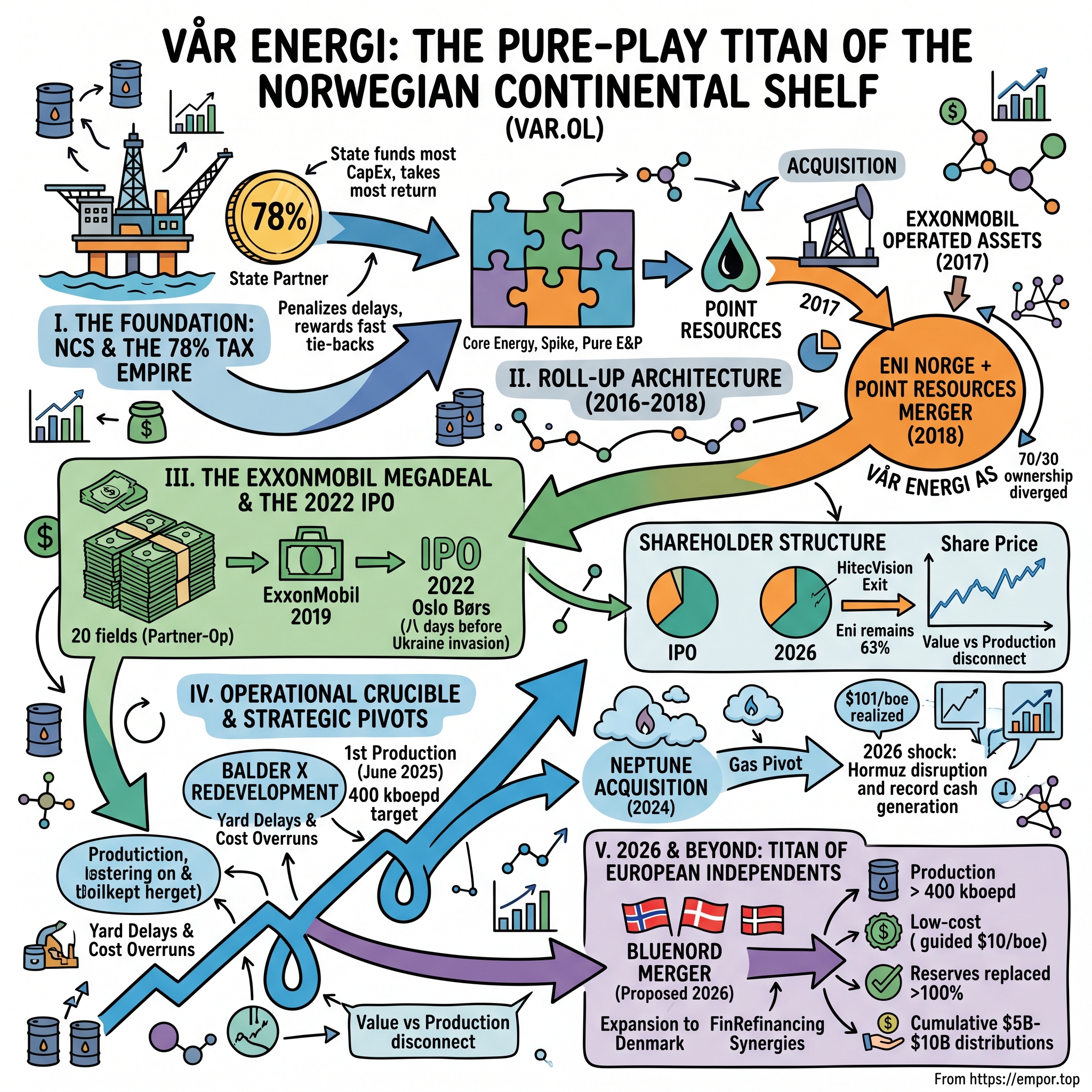
Vår Energi: The Pure-Play Titan of the Norwegian Continental Shelf
I. Introduction & Episode Roadmap
On the morning of July 21, 2026, Chief Executive Nick Walker opened Vår Energi's second-quarter results call with a line that was equal parts understatement and warning: "We've had a very active quarter with lots to report on this morning."1
He was not exaggerating. In a single presentation, the chief executive of Norway's largest independent oil and gas producer walked analysts through record quarterly cash generation, a raised dividend, two newly sanctioned development projects, and a proposed merger that, if completed, will take the company outside Norway for the first time in its eight-year history.32
The underlying figures highlighted the company's financial momentum. Vår Energi generated $2.1 billion in post-tax operating cash flow over the three-month period, enabling management to reduce net debt from $5.2 billion to $3.4 billion in a single quarter. That reduction brought its leverage ratio down to 0.4 times earnings—well within its self-imposed ceiling of 1.3 times—alongside available liquidity of $5.3 billion.1 The company also declared a $350 million quarterly distribution, marking its eighteenth consecutive quarter of holding or raising its dividend since listing.
The elevator pitch
Vår Energi ASA trades on Oslo Børs under the ticker VAR.2 Its strategy rests on a single geographic foundation: every producing barrel it owns sits on the Norwegian Continental Shelf, the expanse of the North Sea, Norwegian Sea, and Barents Sea that has established Norway as one of Western Europe's most critical energy suppliers.
That focus was not an accident of history; it was the central design.
The company was formed by combining two distinct predecessor entities—a private-equity roll-up of smaller Norwegian operators built by Stavanger-based HitecVision, and the Norwegian subsidiary of Italian energy major Eni SpA—and subsequently expanded through three counter-cyclical acquisitions over seven years. By the first quarter of 2026, Vår Energi delivered a record production rate of 406,000 barrels of oil equivalent per day, an increase of roughly 50% from a year earlier.3
The core hook
The central question for investors is whether Vår Energi's strategy has created a durable competitive advantage. The company built its asset base by acquiring properties that larger rivals sought to divest, buying during market downturns and funding asset development under a tax regime that levies a 78% marginal rate on petroleum profits.
Does that approach establish an enduring operational advantage, or does it represent a leveraged, well-timed bet on global commodity prices?
As of mid-2026, the evidence supports both interpretations, with the coming eighteen months set to test the sustainability of the model.
Major themes
Four primary threads run through this analysis.
The first is fiscal. Norway's petroleum tax framework serves as the primary variable guiding capital allocation on the shelf, operating in ways that can seem counterintuitive to investors accustomed to lower-tax jurisdictions.
The second is transactional. From Point Resources acquiring ExxonMobil's operated Norwegian assets in 2017, to Vår Energi purchasing ExxonMobil's non-operated portfolio for $4.5 billion in 2019, the acquisition of Neptune Energy Norge agreed in 2023, and the proposed deal for BlueNord, each transaction represented a counter-cyclical purchase from sellers exiting the basin.
The third is operational execution, an area where management's reputation suffered significant damage before showing signs of recovery. The Balder X redevelopment—centered on a legacy floating production vessel delayed for years in a Norwegian shipyard—exceeded its budget by more than $1 billion and missed multiple milestones before reaching completion.
The fourth is corporate governance: the transition from private-equity asset gathering to established field operations, and what a dominant majority shareholder in the executive suite means for minority investors.
The roadmap
The narrative spans a decade: from three boutique exploration firms consolidated in 2016, through a merger with Eni's Norwegian arm, a $4.5 billion portfolio purchase, an initial public offering completed eight days before Russian forces entered Ukraine, a major gas acquisition, and a troubled redevelopment project that severely tested executive credibility. It arrives in 2026 with Vår Energi generating record cash flow while preparing to expand beyond Norway into Denmark.
It begins, as every corporate history on the Norwegian Continental Shelf must, with tax.
 Subscribe on LinkedIn
II. The Norwegian Continental Shelf & The 78% Tax Empire
Consider a finance director evaluating an offshore development with a $1 billion price tag. In most petroleum jurisdictions, the operator funds the full construction bill upfront and retains the vast majority of the downstream profit.
In Norway, the state effectively funds most of the capital expense—and then takes most of the return. Whether that arrangement creates value depends entirely on mechanics that casual observers often overlook.
How the system actually works
Norwegian petroleum activity is taxed in two layers. Companies pay the standard 22% corporate income tax alongside a special petroleum tax that, following a 2022 reform, stands at 71.8%. Because corporate tax is deductible against the special tax, the combined marginal rate works out to 78%.4
The 2022 reform did more than alter headline rates; it transformed the special tax into a direct cash-flow mechanism. Capital investments are deducted immediately in the year incurred rather than depreciated over six years, the former "uplift" allowance was eliminated, and the tax value of losses—including exploration spending—is refunded in cash the following year.5
Stripped of accounting jargon, the core incentive is straightforward. When Vår Energi commits one krone of capital to a project on the Norwegian Continental Shelf, roughly 78 øre is offset through the tax framework almost immediately. The state acts as a silent partner paying the majority of the construction bill.
That structure explains why breakeven prices on the shelf often appear surprisingly low. When Vår Energi reports an average breakeven of around $30 per barrel for its development portfolio, that figure is calculated after accounting for the state's share of capital costs.3
Myth versus reality
An enduring industry myth holds that Norway's tax framework makes projects nearly free, rendering any shelf barrel profitable.
The commercial reality is far more disciplined. The same 78% regime that absorbs 78% of capital costs also claims 78% of operating revenues. Rather than offering free capital, the system narrows the distribution of financial outcomes: it absorbs a large share of the downside while capping the upside. In effect, it converts an upstream producer into a leveraged 22% equity owner in a project portfolio, with the state carrying the remaining exposure.
This dynamic yields two crucial implications for investors. First, it rewards operators capable of executing quick-payback tie-back developments around existing infrastructure, where the tax shield makes marginal discoveries economically attractive. Second, it penalizes schedule delays far more heavily than cost overruns. Tax refunds arrive on schedule regardless of production, whereas revenue depends entirely on first gas or oil.
The Balder X redevelopment provided a clear demonstration of that operational asymmetry.
Why Norwegian molecules got strategic
For decades, buyers viewed Norwegian gas as a standard commercial commodity. After 2022, those volumes became central to European energy security.
Norway's pipeline network delivers natural gas directly into Germany, the UK, Belgium, and France. When Russian pipeline supplies were withdrawn from Europe, Norwegian gas shifted from one regional option among many to Western Europe's indispensable marginal source. Consequently, gas pricing uncoupled from local supply-demand fundamentals and began tracking geopolitical anxiety.
That strategic repricing persisted into 2026, when new external supply shocks further tightened the market.
The 2026 shock
In the second quarter of 2026, shipping disruptions through the Strait of Hormuz unsettled global oil and gas markets. Brent crude swung between a high of $118 per barrel on April 29 and a low of $72 on June 26, with daily price volatility in April and May averaging $4 per barrel—quadruple the $1 daily swings recorded during the same period in 2025.6
Natural gas prices reacted even more sharply. European TTF futures jumped 73% in March 2026 to €55.6 per megawatt-hour as the Hormuz conflict halted liquefied natural gas shipments and shut in Qatari liquefaction capacity, forcing European buyers to seek alternative pipeline supplies.7
Against that backdrop, Vår Energi realized an average price of $101 per barrel of oil equivalent across its production in the second quarter. Crude fetched $110 per barrel—roughly $6 above dated Brent—while gas brought $91 per boe, about $1 above spot reference prices.8
These figures illustrate two contrasting realities for shareholders.
On one hand, the premium over Brent reflects structural advantages. North Sea crude grades and their direct pipeline logistics command persistent pricing differentials, yielding millions of dollars in added revenue across the roughly 34 million barrels of oil equivalent the company sells each quarter.
On the other hand, realizing $101 per boe during a volatile quarter driven by international conflict underscores the degree to which earnings remain tied to global geopolitical events. Management can optimize operating costs, field uptime, and project execution, but macro commodity swings lie beyond its control.
That vulnerability makes the strategy behind building Vår Energi—acquiring assets counter-cyclically during market downturns—all the more central to its long-term investment case.
III. Roll-Up Architecture: Point Resources, HitecVision, & Eni Norge (2016–2018)
In 2016, the Norwegian offshore industry was in the depths of a severe downturn. Brent crude had fallen below $30 per barrel in January, offshore rigs were being stacked, and Stavanger was laying off engineers.
For a private equity firm with local market knowledge and long-term capital, it was an ideal environment to acquire assets.
The HitecVision thesis
HitecVision was not a generalist buyout firm entering the sector. As a Stavanger-based investor focused on Northern European energy, its position in Vår Energi became one of the most consequential private equity transactions in Norwegian corporate history.9
Its 2016 strategy was structural rather than purely opportunistic. It combined three portfolio companies—Core Energy, Spike Exploration, and Pure E&P—into a single entity named Point Resources.9
The logic addressed a common weakness among smaller exploration firms on the Norwegian Continental Shelf: they possessed technical talent and licence acreage, but lacked production, infrastructure, and tax capacity to absorb exploration losses efficiently. Merging the three created critical mass, but Point Resources still lacked an operated production hub.
The 2017 breakthrough
That gap closed in 2017 when Point Resources acquired ExxonMobil's operated Norwegian business—inheriting not only field assets but also the majority of ExxonMobil's Norwegian upstream workforce and more than fifty years of operating history on the shelf.9
Point Resources acquired more than licence interests in Balder, Ringhorne, and Jotun. It acquired the operating organization that managed them, including the engineering teams familiar with legacy floating production units. For a company attempting to prove it could operate offshore facilities to major-company standards, that human capital was the core asset.
The Balder field itself carried historic significance: it sits in PL001, the first production licence awarded on the Norwegian Continental Shelf.10 Point Resources had purchased the shelf's founding acreage from the American major at the trough of a commodity cycle.
Enter Eni
Eni faced a different set of challenges on the shelf. The Italian major had invested heavily in Goliat, the first oil field developed in the Norwegian Barents Sea, but the project suffered from cost overruns, schedule delays, and heightened regulatory scrutiny over operational safety.
Eni Norge possessed scale and balance-sheet capacity, but lacked the lower-overhead, agile structure best suited for smaller tie-back developments.
In July 2018, Eni and HitecVision merged Point Resources AS into Eni Norge AS, renaming the combined entity Vår Energi AS. Eni retained 69.6% ownership, while HitecVision held 30.4% through Point Resources Holding.11
What the structure actually bought
The transaction combined complementary operational models. An oil major's subsidiary provided corporate governance, safety systems, and credit capacity. A private equity sponsor provided deal velocity, lean overhead, and transaction focus.
Together, the combined entity backed an operating team drawn from Norwegian offshore facilities with Eni's balance sheet, while maintaining private equity pressure to pursue further acquisitions.
The ownership structure also introduced an inevitable strategic divergence. A 70/30 ownership split between a major oil company and a financial sponsor created differing horizons: one investor required eventual liquidity, while the other held long-term strategic assets.
That tension ultimately pointed toward a public listing. Before Vår Energi could launch an initial public offering, however, it required further scale.
IV. The ExxonMobil Megadeal: Counter-Cyclical Masterstroke (2019–2021)
By 2019, ExxonMobil had made a decision that would have seemed unthinkable a generation earlier: after more than half a century on the Norwegian Continental Shelf, it was departing entirely.
Having already sold its operated business, the American major agreed in September 2019 to sell what remained—its non-operated Norwegian upstream portfolio, spanning more than twenty producing fields—to Vår Energi for $4.5 billion.12
What $4.5 billion bought
The portfolio was not a collection of operated assets offering direct control and strategic flexibility. Instead, it was a book of minority interests in fields managed by other operators, principally Equinor.
That distinction is central to understanding both the transaction's valuation and its initial criticism. Non-operated positions offer no authority to set drilling schedules, no control over maintenance turnarounds, and no scope to impose an independent cost culture. What they provide is immediate cash flow and substantial reserves across some of the shelf's most productive fields—including the Snorre, Statfjord, Åsgard, and Grane complexes that remain key components of Vår Energi's production portfolio.3
Market reaction was initially skeptical, with good reason. Brent crude hovered in the $60 range throughout much of 2019. Assuming billions of dollars in debt to acquire passive stakes in mature fields—at a time when institutional capital was increasingly migrating away from fossil fuels—appeared to carry significant financial risk.
When commodity prices collapsed in 2020, that risk briefly threatened the company's financial stability.
Why it worked anyway
Looking back over six years, the transaction proved highly accretive. However, an accurate evaluation requires distinguishing between market tailwinds and operational strategy.
Macroeconomic shifts provided significant momentum. Energy markets swung from the 2020 downturn to a European supply crisis in 2022, lifting every leveraged producer that survived the trough. That price recovery reflected broader market conditions rather than management execution.
The strategic rationale, however, lay in asset selection. The acquired barrels offered low decline rates and immediate production tied to established infrastructure maintained by third-party operators. Consequently, cash flow arrived quickly without requiring substantial incremental capital, allowing management to apply incoming revenue directly toward debt reduction. Had Vår Energi acquired a portfolio of early-stage development projects at the same moment, those assets would have consumed cash for years before generating returns.
The deal's structure—passive, producing, and low-capital—provided the resilience needed to survive the downturn. In effect, Vår Energi secured an option on energy price recovery through a low-capital entry point.
The strategic cost
That structure also established lasting operational trade-offs that continue to shape the business.
By expanding through non-operated interests, Vår Energi positioned the majority of its production under external operational control. In the first quarter of 2026, partner-operated fields accounted for 70% of total production, compared to 30% from operated assets.3
This reliance creates an ongoing structural challenge for an equity story centered on operational performance. When Equinor shuts down a compressor for maintenance at Åsgard, or an equity redetermination alters working interests at Snorre, Vår Energi's quarterly results fluctuate while its management team can only report the outcome.
Nevertheless, the deleveraging strategy succeeded. By the time energy prices surged, cash flow from the acquired fields had reinforced the balance sheet, enabling Vår Energi to launch its initial public offering with the financial flexibility required to sustain its dividend strategy.
V. Going Public: The 2022 Oslo IPO & Shareholder Structure
A retroactive narrative might frame the timing of Vår Energi's initial public offering as a stroke of market foresight. In practice, the company benefited from extraordinary fortune rather than prescient market timing.
The terms
On February 4, 2022, Eni International BV and HitecVision's Point Resources Holding announced terms for the offering: up to 220 million existing shares, divided equally between the two owners, within an indicative price range of NOK 28.00 to NOK 31.50 per share, implying an equity valuation between NOK 70 billion and NOK 79 billion.13
The shares priced at the bottom of the range, at NOK 28.00, and began trading on Oslo Børs on February 16, 2022.13 Eight days later, Russia invaded Ukraine, triggering an unprecedented European energy crisis.
What the pricing tells you
Pricing at the floor of the range signaled caution rather than triumph. In early 2022—before the invasion, even with Brent crude already trading near $90 per barrel—European institutional investors required a valuation discount to hold a pure-play hydrocarbon producer controlled by an industrial parent.
That discount reflected two distinct structural pressures that continued to weigh on the equity.
The first was sectoral. European capital markets had spent five years shifting capital away from upstream oil and gas. Lacking a renewable energy division, a green transition strategy, or geographic diversification, Vår Energi was valued primarily on immediate cash yields rather than growth multiples.
The second was governance. A company in which a single industrial shareholder holds a controlling majority inherently limits minority influence and eliminates any potential takeover premium. Both factors systematically cap the valuation multiple.
The sell-down
The offering served primarily as a liquidity event for HitecVision, whose eventual exit followed a disciplined private equity timeline.
In September 2023, HitecVision sold a 6.3% stake at NOK 29 per share—raising roughly $423 million—which reduced its holding to 14.4% and expanded the company's free float from 16.3% to 22.6%.14
Subsequent secondary sales followed in 2024. In June of that year, the firm sold its remaining 108.4 million shares—a 4.3% stake—at NOK 34.43 per share for NOK 3.7 billion, completing its divestment and lifting the free float from roughly 24% to approximately 33%.15
Eni, by contrast, retained its majority stake and continues to control approximately 63% of the company.15
Where that leaves the shares
By early August 2026, Vår Energi shares traded around NOK 47, against a 52-week range of roughly NOK 31 to NOK 51 and a market capitalization of about NOK 118 billion.2
Measured from the IPO price, that performance represents a strong capital return alongside four and a half years of steady dividend distributions. Measured against operational progress, however, the picture is more complex: while Vår Energi has roughly doubled its production since listing, its share price has appreciated at a more modest pace—meaning the market has assigned a lower multiple to each barrel of production even as total volumes expanded.
This dynamic highlights the central valuation tension facing the business. Production growth alone has not expanded the earnings multiple. Management has maintained that a sustained re-rating depends on expanding the free float, extending reserve life, and demonstrating dividend durability—priorities that guided its subsequent major acquisitions.
VI. The Neptune Energy Acquisition & Gas Pivot (2023–2024)
By 2023, Vår Energi faced an unexpected strategic challenge: its asset base was heavily concentrated in crude oil.
Over the preceding eighteen months, European energy buyers had demonstrated that natural gas delivered via pipeline from a politically stable neighbor commanded a structural premium. Vår Energi's production portfolio—assembled primarily from ExxonMobil's non-operated interests and Eni's Barents Sea developments—remained weighted toward liquids.
The opportunity to balance its production stream arrived through a corporate acquisition that had spent years being prepared for market.
The dual transaction
In June 2023, Eni and Vår Energi structured a coordinated transaction. Eni agreed to acquire Neptune Energy's global portfolio, while Vår Energi separately agreed to purchase Neptune Energy Norge AS, the Norwegian subsidiary outside Eni's target perimeter.
The Norwegian acquisition closed on January 31, 2024, transferring 100% of Neptune Norge's equity to Vår Energi. Funded through existing liquidity and credit facilities, the net cash consideration at closing totaled approximately $1.2 billion following standard locked-box and working capital adjustments.16
The deal brought non-operated and operated interests across twelve producing fields, adding roughly 66,000 barrels of oil equivalent per day in 2023 production and 265 million barrels of proved and probable (2P) reserves—with natural gas representing 58% of the acquired volume.16
Vår Energi integrated the operation rapidly, absorbing staff by May 1, 2024, and completing a statutory corporate merger in the second half of the year.16
Reading the deal honestly
The strategic alignment was clear. Increasing gas exposure rebalanced a liquids-heavy portfolio just as European pipeline gas prices established a higher floor. Acquiring operatorship of the Gjøa field provided a second operated hub in the North Sea featuring low operating costs and electrified infrastructure. Furthermore, the acquired assets sat adjacent to existing Vår Energi acreage, offering immediate opportunities for low-cost tie-back developments.
A more critical perspective highlights corporate governance. The acquisition was executed alongside a broader corporate transaction led by Vår Energi's majority owner, Eni. Minority shareholders had to rely on assurance that the Norwegian assets were carved out and priced on arm's-length terms.
While subsequent operating performance has validated the purchase, the transaction reinforced an enduring governance question: whether Vår Energi functions as an independent dealmaker or as a vehicle for executing Eni's broader corporate strategies.
The reserves engine
Beyond headline volume growth, the expanded asset base strengthened Vår Energi's capacity to convert existing infrastructure into new commercial reserves.
In 2025, Vår Energi replaced 185% of its annual production, maintaining a three-year average reserve replacement ratio of 174%. By year-end 2025, proved and probable reserves plus contingent resources reached approximately 2.2 billion barrels of oil equivalent—including 865 million barrels of contingent resources—extending total reserve and resource life to roughly 17 years.17
For a producer generating 400,000 barrels of oil equivalent per day, replacing nearly two barrels for every barrel extracted separates long-term viability from steady liquidation. Maintaining that replacement rate remains a persistent operational challenge for independent producers, relying on consistent discovery and execution across near-field exploration targets.
Subsequent developments in 2026 offer a more complex picture of that exploration engine.
And then, BlueNord
On July 21, 2026, Vår Energi announced a statutory merger with BlueNord ASA, a transaction management presented as creating the largest independent oil and gas producer in Europe.18
Under the agreed terms, BlueNord shareholders receive 9.7153 newly issued Vår Energi shares and 76.83 Norwegian kroner in cash—approximately $19—for each BlueNord share. The transaction requires issuing 248.4 million new shares, diluting existing Vår Energi equity holders by 9.95%, alongside a total cash payout of 1.964 billion kroner, or $204 million.18
Following completion, existing Vår Energi shareholders will hold roughly 90.95% of the combined entity, with BlueNord investors owning 9.05%. Eni's controlling stake will decrease from approximately 63% to 57.33%, while Vår Energi's public free float will expand to nearly 43%.18
What Denmark actually brings
BlueNord—formerly known as Norwegian Energy Company, or Noreco, prior to its 2023 rebranding—holds a 36.8% non-operated interest in the Danish Underground Consortium, alongside operator TotalEnergies at 43.2% and Danish state entity Nordsøfonden at 20%.19
The consortium's primary asset is Tyra, Denmark's largest gas field, originally discovered in 1968. Production was suspended in 2019 for a comprehensive redevelopment required after seabed subsidence lowered the original platforms. Following the installation of eight new topside structures—the largest redevelopment project in Danish offshore history—production resumed in 2024.20
The acquisition adds approximately 45,000 barrels of oil equivalent per day in net production from 2026 onward and roughly 195 million barrels of reserves and resources, extending field production life past 2040. The combined company targets long-term production of around 450,000 barrels per day, total reserves and resources of 2.4 billion barrels, unit operating costs between $10 and $11 per barrel, and an emissions intensity near 10 kilograms of CO₂ per barrel.18
The synergy question
Management has guided to $250 million to $300 million in post-tax synergies accumulated between 2027 and 2032. On the second-quarter earnings call, Chief Financial Officer Carlo Santopadre attributed 80% to 85% of those savings to refinancing BlueNord's higher-cost debt at a spread roughly 300 basis points lower, with the balance coming from reduced administrative overhead and gas portfolio optimization.1
This breakdown reveals that the vast majority of anticipated transaction value stems from capital structure arbitrage—applying Vår Energi's investment-grade credit standing to lower a target's borrowing costs. While debt refinancing offers more predictable savings than operational integration milestones, it reflects financial engineering rather than field-level efficiency gains. Because TotalEnergies operates the Danish assets, Vår Energi cannot directly alter field operations.
Industrially, the deal expands Vår Energi into a second sovereign jurisdiction, extends its reserve life, and adds contingent resources. Chief Executive Nick Walker noted that commercializing those contingent barrels falls outside the formal synergy target, stating that "there's an opportunity here for us to work with the operator to create value."1
Investors should treat that potential operational upside as ununderwritten in the base deal model. Crucially, the transaction signals a broader shift in strategic scope. As Walker observed during the call: "It's a natural evolution of our strategy to step outside Norway."1
For an operator that built its market positioning as a pure-play producer on the Norwegian Continental Shelf, expanding into Denmark represents a fundamental shift in geographic discipline.
The transaction is expected to close near the end of 2026, subject to BlueNord shareholder approval at an extraordinary general meeting, regulatory clearances, partner approvals, and the non-exercise of pre-emption rights.21
None of those strategic moves will matter, however, if the company cannot demonstrate consistent execution on its core offshore developments.
VII. Operational Crucible: Balder X, FPSO Dramas, & The Journey to 400 kboepd
Extending the operating life of the Jotun floating production, storage, and offloading (FPSO) vessel was meant to showcase Vår Energi's offshore execution. Instead, the project nearly undermined management's operational credibility.
The plan
On paper, the concept was straightforward and industrially sound. The plan called for taking the existing Jotun FPSO, subjecting it to a comprehensive lifetime-extension upgrade at Worley's Rosenberg yard in Stavanger, towing it back to the Balder field, connecting it to fourteen new subsea production wells, and extending production from the shelf's founding licence area toward 2045.
Vår Energi holds a 90% working interest in the project, with Kistos Energy Norway holding the remaining 10%.22
The strategy relied on the hub-and-spoke model central to North Sea economics: establish a central, high-capacity processing hub, and then tie back lower-cost subsea wells from surrounding reservoirs that could not economically justify standalone infrastructure.
The unravelling
The fundamental risk in refurbishing a legacy offshore vessel is that engineering teams cannot fully gauge structural decay or system complexity until teardown begins.
In September 2022, Vår Energi raised the gross cost estimate for the Balder X redevelopment by $1.2 billion and delayed expected first oil from late 2023 to the third quarter of 2024, attributing the escalation to expanded work scope and extensive engineering modifications during the Jotun FPSO upgrade.23
That revision—representing a 40% cost overrun on a flagship development—created an immediate credibility deficit for executive management.
It was not the final delay. In August 2024, management pushed the startup timeline to the second quarter of 2025 and added approximately $400 million in pre-tax gross costs. Chief Executive Nick Walker cited incomplete yard preparation, noting that "some onshore completion and commissioning work required prior to sail-away remains," and explaining that the remaining tasks had to be finalized onshore before the harsh winter weather window closed.22
What the delays actually cost
Evaluating the financial impact requires accounting for Norway's petroleum tax framework.
Under the shelf's cash-flow tax system, the state absorbed roughly 78% of the capital overrun, meaning the direct net-of-tax cost to Vår Energi shareholders was far smaller than headline figures suggested.
The true damage was temporal. Every quarter of delay deferred cash flows that could not be recovered, postponing the company's path toward 400,000 barrels of oil equivalent per day. Furthermore, repeated schedule revisions led equity analysts to apply an execution discount to management's long-term targets—a penalty that does not appear on balance sheets but compresses equity valuation multiples.
The delivery
The vessel finally departed the Rosenberg yard in March 2025, and Vår Energi confirmed first production through the Jotun FPSO on June 23, 2025, extending operations across a field active since the late 1990s.[^24] Following offshore installation, field execution improved rapidly. All fourteen subsea production wells were brought onstream by September 2025 ahead of schedule, helping Balder Area output reach 113,000 barrels of oil equivalent per day in the fourth quarter of 2025, a 16% sequential increase.24
Operational performance continued to strengthen into early 2026. By the first quarter of 2026, total Balder Area production expanded to 118,000 barrels per day, while Balder field production efficiency rose to more than 95%—up from 92% in the prior quarter and exceeding internal targets.3
The pipeline behind the hub
With the processing hub in place, Vår Energi is testing its tie-back strategy by filling available processing capacity.
Balder Phase V had three wells producing by the first quarter of 2026, with two additional wells scheduled for mid-year startup. Balder Phase VI remains in execution, with first oil expected in the fourth quarter of 2026; combined, the two phases target gross proved and probable (2P) reserves of roughly 50 million barrels of oil equivalent.3
Further development centers on the broader Balder Next program. Management sanctioned a debottlenecking project in the fourth quarter of 2025 to expand the Jotun vessel's fluid handling capacity. In the second quarter of 2026, the board sanctioned an initial seven-well project targeting 86 million barrels of gross 2P reserves, with estimated breakeven costs around $30 per barrel and projected internal rates of return above 35%, aiming for first production in the fourth quarter of 2027.1
The strategic value of this infrastructure expansion extends beyond incremental production volumes. Concentrating production on the modernized Jotun vessel permits the planned retirement of the legacy Balder Floating Production Unit in 2028, a move projected to reduce gross operating costs by approximately $130 million annually while lowering direct emissions by roughly 70,000 tonnes of carbon dioxide per year.3
This consolidation illustrates the core mechanics of shelf infrastructure optimization: aggregate production onto a unified processing platform, decommission legacy assets, and lower unit operating expenses.
Over the longer term, management projects the combined Balder area will sustain gross production between 70,000 and 80,000 barrels of oil equivalent per day toward 2030.3
The verdict on execution
Management eventually brought the Balder X development online, but the execution record remains mixed: a major shipyard redevelopment completed roughly eighteen months late and materially over budget, followed by post-startup operational performance that exceeded initial guidance.
Those outcomes highlight distinct operational skill sets. Vår Energi has demonstrated strong facility management and high operational uptime once assets are in place, but its record in budgeting and managing major greenfield or yard construction projects remains vulnerable to delay and cost growth.
Because the company's immediate organic project pipeline consists primarily of subsea tie-backs and infill drilling rather than complex floating facility conversions, management is leaning heavily on its proven operational strengths while limiting exposure to major shipyard redevelopments. Whether that focus reflects deliberate strategic risk management or temporary project scheduling, market confidence will be tested whenever the company next sanctions a major offshore platform build.
VIII. Core Business Economics, Hub Breakdown, & Competitor Benchmarking
Strip away the narrative, and Vår Energi operates as a machine that converts capital into barrels at a cost, selling those volumes into global commodity markets at prices it cannot set. Consequently, the key analytical questions center entirely on the cost side of the equation.
The shape of the production
In the first quarter of 2026, the company produced a record 406,000 barrels of oil equivalent per day, split 65% crude oil, 30% natural gas, and 5% natural gas liquids, achieving a production efficiency of 97% across its operated assets—ahead of internal targets.3
The second quarter brought 376,000 barrels per day, down 7% sequentially due to planned turnaround activity but up 31% year-on-year, lifting first-half production to 391,000 barrels per day against full-year guidance of 390,000 to 410,000 barrels per day.8
Myth versus reality: the "pure-play operator"
While Vår Energi positions itself as a leading independent operator on the Norwegian Continental Shelf, partner-operated assets accounted for 70% of its first-quarter 2026 production.3
This distinction is essential for proper business modeling. Vår Energi directly controls cost structures, project execution, and emissions performance across its operated hubs—Balder, Goliat, Gjøa, and Fenja. By contrast, the larger, partner-operated portfolio functions much like a royalty interest across the shelf's largest fields: high in quality and low in operational overhead, but completely outside executive control.
Two developments in early 2026 illustrated this operational passivity.
First, the Snorre field equity redetermination concluded in January 2026 with an effective date of February 1, reducing Vår Energi's working interest from 18.55% to 18.16%—a minor percentage shift that nonetheless imposes a production repayment obligation of roughly 7,000 barrels per day from the first quarter of 2026 through 2028.3
Second, the restoration of Sleipner B production following a 2024 fire remains underway, with full output not expected to resume until the first quarter of 2028, leaving approximately 4,000 net barrels per day shut in.3
Neither event resulted from Vår Energi's operational decisions, yet both directly altered its financial results.
The four hubs
The asset portfolio is organized into four geographic clusters, with first-quarter 2026 output demonstrating where the company's operational center of gravity resides.3
The Balder Area produced 118,000 barrels of oil equivalent per day—comprising 83,000 from Balder and Ringhorne, 25,000 from Breidablikk, and 10,000 from Grane and Svalin. This area represents the operated core of the business and houses the majority of its near-term project pipeline.
The Norwegian Sea generated 116,000 barrels per day across a broad network of gas-weighted tie-back positions: Åsgard contributed 38,000, Njord 17,000, Halten Øst 16,000, Tyrihans 11,000, Mikkel 10,000, Ormen Lange 9,000, and Fenja 7,000. Halten Øst reached plateau output during the quarter following the startup of two new wells, while Åsgard volumes were temporarily constrained by compressor maintenance on Åsgard B, completed in April 2026.
The Barents Sea delivered 88,000 barrels per day, transformed by the startup of Johan Castberg. The Equinor-operated field, in which Vår Energi holds a 30% interest, achieved first oil on March 31, 2025, and can produce up to 220,000 barrels per day at peak capacity.25 It contributed 58,000 net barrels per day in the first quarter of 2026, compared to zero a year earlier. Goliat added 14,000 barrels per day at 98% production efficiency, while Snøhvit—feeding the Hammerfest LNG complex—contributed 16,000.
The North Sea produced 84,000 barrels per day from a diversified portfolio of non-operated interests alongside the operated Gjøa area, which operated at 98% production efficiency supported by the Gjøa Low Pressure Project.
The transformation in the Barents Sea highlights a key feature of shelf dynamics. A single partner-operated field expanded a frontier region from a minor holding to nearly a quarter of group production within twelve months. In the first quarter of 2026, Johan Castberg's net contribution rose 13% after an offloading hose issue from late 2025 was resolved in January.3 The development demonstrates how rapid volume growth and partner operational dependence can arrive simultaneously.
The cost curve
Unit production costs represent an area of consistent management performance.
Operating expenses fell from $12.80 per barrel of oil equivalent in 2024 to $11.10 in 2025—a 13% reduction that landed at the bottom of management's $11.00 to $12.00 guidance range—with fourth-quarter costs reaching $10.00.24 Full-year guidance for 2026 targets approximately $10.00 per barrel.3
First-quarter 2026 costs came in at $10.40 per barrel, with the sequential increase driven primarily by a stronger Norwegian krone against the U.S. dollar. First-half costs averaged $10.80 per barrel, or $10.30 on a currency-adjusted basis.13
The primary driver of this cost reduction is fixed-cost dilution rather than discretionary expense cutting: production nearly doubled over two years while platform and vessel operating overhead remained relatively stable. Scale economies on offshore infrastructure provide the company's most reliable margin lever.
However, that dynamic cuts both ways. If production volumes decline, unit operating costs automatically rise, altering the cost trajectory without any operational failure.
Benchmarking the peers
Three corporate peer groups define the competitive landscape on the Norwegian shelf.
Equinor remains the dominant state-controlled operator, managing the majority of Norwegian production and establishing standards for infrastructure access. For Vår Energi, Equinor functions less as a direct commercial competitor than as the primary counterparty across its non-operated portfolio—the operator whose maintenance schedules and equity redeterminations directly affect Vår Energi's quarterly output.
Aker BP serves as the primary operational benchmark, particularly regarding production costs. Aker BP generated approximately 420,000 barrels of oil equivalent per day at a production cost of $7.30 per barrel, which it characterized as top-quartile performance globally for an offshore operator; its unit costs rose to $8.80 per barrel in the second quarter of 2026 from $7.70 in the prior quarter due to seasonal maintenance and lower output.2627
The cost differential—Aker BP operating in the $7.00 to $9.00 range compared to Vår Energi at $10.00 to $11.00—provides a clear baseline for comparing operational efficiency. While Vår Energi aims to narrow this margin, it remains a consolidating producer rather than the lowest-cost operator on the shelf.
TotalEnergies, Shell, and other international majors compete for exploration acreage and drilling rigs, but increasingly act as co-investors and operating partners alongside Vår Energi across mature basins and international transactions.
The emissions dimension
Environmental performance has become an increasingly critical metric for European institutional investors. Vår Energi recorded a carbon dioxide emissions intensity of 8.1 kilograms per barrel of oil equivalent in the first quarter of 2026, down from 9.9 kilograms a year earlier.3 Management cited third-party evaluations placing the company in the top 15% of the global oil and gas sector for emissions performance according to both Sustainalytics and S&P Global.1
The main driver behind these figures is the electrification of offshore platforms using onshore hydroelectric power rather than gas-fired turbines—a structural feature of Norwegian infrastructure that operators in most other basins cannot easily replicate.
While cost and emissions metrics have moved favorably, maintaining these trends will depend on execution across upcoming field developments and partner-operated facilities.
IX. Management & Governance: The Nick Walker Era, Incentives, & Capital Allocation
In August 2023, Vår Energi's board executed an executive change rarely managed gracefully: replacing a chief executive without forcing his exit.
The transition
Nick Walker assumed the role of chief executive officer on September 5, 2023. Torger Rød, who had led the company through the Neptune acquisition and initial Balder X turbulence, remained with the organization as chief operating officer, taking responsibility for continuous improvement, the integration of Neptune Energy Norge, and corporate transformation.2829
The board publicly framed the appointment by stating that acquiring Neptune would accelerate Vår Energi's position as a leading Norwegian independent, requiring an expanded executive team and additional operational leadership.29
While that explanation held true, it was incomplete. The management restructuring occurred between two negative announcements regarding Balder X, leading market observers to link the transition directly to project execution challenges.
Who Walker is
Walker's background illustrated the strategic intent behind his appointment.
He previously served as chief executive of Lundin Energy, the European independent that established itself as a benchmark operator on the Norwegian Continental Shelf before selling its upstream business to Aker BP in 2022—a transaction widely regarded as a model for creating and realizing value on the shelf. His earlier career included senior roles at BP, Talisman Energy, Africa Oil, and Vedanta's Cairn Oil & Gas.28
His background combined technical expertise, deep familiarity with the Norwegian shelf, major project management, and large-scale corporate integration. In hiring Walker, the board signaled a pivot in corporate priorities: moving from rapid asset accumulation toward operational delivery on the existing portfolio.
Walker's public style has remained focused on operations rather than promotion. On the second-quarter 2026 earnings call, when asked about European gas markets, he offered an operational perspective rather than a price forecast, noting, "we feel that we're going to see higher prices for longer because the world needs a lot of energy."1 Pressed on the potential for an extraordinary dividend, he declined to promise a payout, establishing a clear evaluation timeline by noting that the company remains open to a special distribution at year-end if elevated commodity prices persist.1
The Eni question in the executive suite
In October 2024, Vår Energi announced that Stefano Pujatti, chief financial officer since 2019, would depart to take up a new role within Eni. Carlo Santopadre succeeded him as chief financial officer on December 1, 2024, bringing more than fifteen years of industry experience spent predominantly at Eni.30
In plain terms, the senior finance role at a public company with a 63% controlling shareholder passed from one executive with a career at that parent major to another executive from the same organization.
This arrangement supports two distinct interpretations. The commercial view holds that Eni is a disciplined global operator whose financial talent brings rigorous capital controls well-suited to an upstream producer. The corporate governance view notes that the executive overseeing capital allocation, dividend policy, and related-party transactions built his career within the controlling entity that receives the majority of those cash distributions.
Neither perspective is conclusive, but both represent relevant considerations for minority investors.
Reading credibility through behaviour
Evaluating management performance requires measuring operational results against past commitments. Three metrics provide a clear test.
First, cost discipline. Operating costs landed at the low end of management's guidance range in 2025 and remained on track through 2026, with variance explicitly linked to foreign exchange shifts amounting to roughly 50 cents per barrel.124 This alignment reflects accountability to published targets.
Second, volume targets. Full-year 2025 production averaged 332,000 barrels of oil equivalent per day, falling slightly below the target range of 330,000 to 360,000 barrels per day due to startup delays and operational issues at Johan Castberg.24 While management explicitly identified the underlying asset rather than offering broad excuses, the result marked a second consecutive year in which major volume targets were delayed.
Third, shareholder returns. Management initially guided to a first-quarter 2026 dividend of $300 million and maintained that target for the second quarter.3 The company subsequently declared a $350 million distribution for the second quarter and raised its third-quarter guidance to $350 million.1 Increasing returns above near-term guidance demonstrated positive operational momentum.
The capital allocation framework
Management has outlined a three-tier capital allocation framework and applied it consistently.
First, balance sheet strength. Leverage is capped at 1.3 times net interest-bearing debt to EBITDAX across commodity cycles. Net debt stood at $3.4 billion at mid-year 2026, with leverage tracking at 0.7 times at the end of the first quarter and declining to 0.4 times by the end of the second quarter.13
Second, reinvestment in production. Capital expenditure plans for 2026 allocate $2.5 billion to $2.7 billion to field development, $250 million to $300 million to exploration, and approximately $200 million to platform decommissioning. This spending funds sixteen projects in execution targeting roughly 380 million net barrels of oil equivalent at average breakeven prices near $30 per barrel.13
Third, cash returns to shareholders. The distribution policy targets 25% to 30% of post-tax operating cash flow over the cycle, distributed quarterly. Total payouts reached $1.2 billion in 2025, and management raised its long-term production target above 400,000 barrels of oil equivalent per day at its February 2026 capital markets update, projecting cumulative distributions between $5 billion and $10 billion from 2026 through 2032.2431
Debt financing has supported this framework. In the second quarter of 2026, the company issued a €750 million hybrid bond, earning a BBB rating with a stable outlook from Fitch.1 Maintaining an investment-grade rating remains essential to capturing the borrowing cost reductions central to the BlueNord transaction.
A key structural condition governs this distribution framework. A dividend policy tied to a percentage of operating cash flow represents a flexible formula rather than a fixed commitment. If commodity prices drop and cash flows decline, dividend distributions automatically decrease. Treating a variable cash-flow target as a guaranteed dividend yield overlooks the fundamental commodity price exposure inherent in the business model.
X. Hamilton Helmer's 7 Powers & Porter's 5 Forces Analysis
Frameworks yield insight only when applied critically. Applied generously, almost any company can claim every competitive advantage. A rigorous assessment requires strict criteria.
Helmer's 7 Powers, honestly scored
Cornered Resource — present but shallow. Vår Energi holds operatorship and high equity in specific long-life licence areas, most notably a 90% interest in the Balder area, and owns the processing infrastructure at the centre of those clusters.22 A competitor cannot obtain those specific licences at any price. However, this is a resource cornered by allocation rather than inherent uniqueness: the Norwegian state awards acreage through licensing rounds in which multiple capable companies compete, and Vår Energi's positions stem from commercial transactions that other producers could have pursued.
Scale Economies — the strongest power in the portfolio. The core mechanism is the high fixed-cost base of floating production vessels and offshore platforms. Once a floating production facility is stationed offshore, the incremental cost of processing an additional barrel approaches zero, meaning the marginal economics of a subsea tie-back are driven almost entirely by drilling expenses. This dynamic explains why unit operating costs dropped from $12.80 to a guided $10.00 per barrel of oil equivalent as production nearly doubled, and why decommissioning the legacy Balder floating production unit eliminates $130 million in gross annual operating expenses without reducing production.324 It represents a tangible, measurable, and durable advantage—though one that reverses just as quickly if production volumes fall.
Counter-Positioning — historically real, currently decaying. For nearly a decade, the exit of international majors from mature basins created a persistent valuation disconnect: ExxonMobil sold its Norwegian assets in two tranches, Neptune's private equity owners exited, and each seller acted out of portfolio strategy rather than underlying asset quality. Vår Energi's willingness to acquire assets that larger peers were structurally constrained from holding served as a genuine counter-position. That window has largely closed. The primary exit-minded sellers have departed, and remaining consolidation occurs producer-to-producer at market-clearing valuations set by competing operators—a standard auction rather than an uncompeted counter-position.
Process Power — claimed, but not yet demonstrated at scale. Management's thesis relies on infrastructure-led, near-field exploration consistently converting into low-cost subsea tie-backs. Results from early 2026 show three commercial discoveries out of six wells drilled in the first quarter, and three commercial discoveries out of six wells across the first half.13 While a 50% commercial success rate on infrastructure-led drilling is respectable—and well above wildcat exploration averages—it falls short of the near-certainty implied by true process power, nor does it yet distinguish Vår Energi from other capable operators drilling similar near-hub prospects on the shelf.
Switching Costs, Network Economies, and Branding — absent. Vår Energi sells unrefined commodities into liquid global markets. There are no customer relationships to lock in, no network effects from density, and no brand premium attached to a barrel of Brent-linked crude. Any analysis claiming these dynamics exist in upstream oil and gas misinterprets the business model.
A strict evaluation yields one strong power, one decaying power, one shallow power, one unproven power, and three absent powers. That profile is typical for a major upstream producer, illustrating that the business relies on cost management and asset positioning rather than a true competitive moat.
Porter's Five Forces
Threat of new entrants — very low. Assembling a 400,000 barrel of oil equivalent per day producing position on the Norwegian shelf from scratch would demand billions of dollars in capital, strict operator qualification approval from Norwegian regulators, and access to licence acreage that is government-allocated rather than open-market. Furthermore, the 78% tax framework ensures that an entrant lacking existing Norwegian petroleum tax liabilities cannot utilize tax deductions as efficiently as an established incumbent—creating a substantial structural barrier that quietly favors active producers.
Bargaining power of buyers — low and largely irrelevant. Crude sales benchmark directly against Brent, while natural gas tracks European hub pricing. As a price taker, Vår Energi has no direct pricing power, but product offtake is effectively guaranteed through established market infrastructure. Realized pricing differentials—such as crude premiums of several dollars per barrel—reflect physical grade quality and regional delivery logistics rather than bilateral commercial negotiation.
Bargaining power of suppliers — high, representing a central operational risk. Offshore drilling rigs, subsea infrastructure hardware, specialized vessel capacity, and yard labor are supplied by a concentrated set of oilfield service providers whose capacity expands slowly. The Balder X redevelopment was fundamentally a supplier-power failure: a constrained shipyard, an expanding work scope, and an operator lacking immediate alternatives. With sixteen projects currently in execution and up to eight new sanction decisions planned for 2026, the company's exposure to supplier pricing power and scheduling bottlenecks is increasing.13
Threat of substitutes — high over the long term, muted in the medium term. European decarbonization mandates and renewable energy deployment represent a structural long-term threat to petroleum demand. However, the 2022 European gas crisis and 2026 supply disruptions in the Strait of Hormuz demonstrated that when regional supply is constrained, European markets will pay whatever price is required for secure Norwegian energy volumes. The substitution threat is real but gradual, whereas the security-of-supply premium is immediate and acute.
Competitive rivalry — moderate and highly collaborative. Operations on the Norwegian shelf rely on a co-licensing structure where commercial rivals frequently serve as operating partners. Vår Energi collaborates with Equinor across the majority of its non-operated production portfolio, and would partner with TotalEnergies in the Danish Underground Consortium if the BlueNord transaction completes. Competition is concentrated around scarce capital inputs—licensing rounds, rig availability, and targeted corporate acquisitions—rather than downstream market share.
This competitive structure raises a fundamental question for investors: if the company's position rests primarily on scale economies and asset location, what forces could dismantle it?
XI. Skeptical Investor Stress Test, Risk Radar, & Bull vs. Bear Case
Every equity story deserves an adversary. Here is the case a well-prepared short seller or activist would put to Vår Energi's board.
The governance challenge
You are not an independent company. You are Eni's Norwegian dividend pipe with a listing attached.
The facts an activist would marshal: a controlling shareholder holding roughly 63%, falling to 57.33% only if the BlueNord merger completes.1518 A chief financial officer recruited from that shareholder, replacing a chief financial officer who returned to it.30 A transformational 2023 acquisition executed as the Norwegian carve-out of a deal the parent was doing anyway.16 And a distribution policy that sends the majority of quarterly cash to that same parent.
The rebuttal is not trivial either. The dividend formula applies identically to every share, so Eni cannot extract value from minorities through it. The company has consistently reinvested $2.5 billion or more annually rather than starving the asset base to fund distributions.3 And the free float has risen from 16% at IPO toward a prospective 43%, which is the opposite of what a parent seeking to entrench control would engineer.1418
What remains unresolved is the counterfactual. A truly independent Vår Energi might have been acquired at a premium—as Lundin's upstream business was—or might have pursued a different portfolio. Minority shareholders will never be offered that option, and the market prices that permanent absence of a takeover bid into the multiple every single day.
The dividend under stress
Your distribution looks generous because oil averaged over $100 in a war quarter. Model it at $60.
The relevant mechanics are disclosed and can be worked through. The company guides free cash flow breakeven at approximately $40 per barrel.18 Development capital expenditure is $2.5 billion to $2.7 billion for 2026, with average annual capital expenditure of about $2.5 billion guided across 2027 to 2032.243 Cash tax payments are lumpy and large—around $800 million estimated for the second quarter of 2026 alone.3
At $60 Brent and softer European gas, the policy does not break, because it was never a fixed commitment. It flexes: 25% to 30% of a smaller operating cash flow produces a smaller dividend. Holders of this equity are underwriting a variable payout, and the discipline of the formula is precisely what makes it survivable.
The genuine vulnerability sits elsewhere—in the combination of a market downturn with a capital program that cannot easily be slowed. Sixteen projects in execution represent commitments, not options. A company that must keep spending $2.5 billion a year while cash flow halves would find its leverage ratio moving quickly from 0.4 times toward its 1.3 times ceiling, and the distribution would serve as the release valve.
The execution overhang
You told the market late 2023, then Q3 2024, then Q2 2025. Why should anyone believe your 2027 and 2028 dates?
This is a fair challenge, and the operational response is improved but incomplete. The post-startup operating record—97% production efficiency, wells delivered ahead of plan, and costs at the low end of guidance—demonstrates competence in routine field operations.324
However, no major greenfield facility project has been sanctioned and delivered under current executive leadership from a standing start. The Jotun debottlenecking, Balder Next new wells, and Gjøa subsea developments represent extensions of existing infrastructure. While these are economically logical projects, they present lower execution risk than standalone developments.
The current risk radar
Commodity volatility remains the dominant exposure, and it cannot be diversified away within this business model. A quarter in which Brent crude traded between $118 and $72 per barrel highlights an earnings stream that investors cannot reliably forecast.6
Supplier and cost inflation represents a second-order risk directly within management's sphere of influence. Offshore rig day rates, subsea hardware, and shipyard capacity remain tight, and an expanding project sanction pipeline heightens cost exposure.
Partner dependency carries structural weight. With 70% of production managed by third-party operators, a substantial share of quarterly volume depends on operational decisions made elsewhere—whether compressor maintenance at Åsgard, an offloading hose issue at Johan Castberg, a fire recovery at Sleipner B, or an equity redetermination at Snorre.3
Political and regulatory risk is modest by global standards but persistent. Domestic debates over Barents Sea exploration and platform electrification continue, directly touching acreage such as the Goliat Gas Export project sanctioned in early 2026 to develop 112 million barrels of oil equivalent gross and extend field life to 2050.3
Transaction risk remains active. The BlueNord merger requires shareholder approval, regulatory clearances, partner approvals, and the non-exercise of pre-emption rights.21 Pre-emption rights warrant close monitoring, as consortium partners in the Danish assets hold contractual rights that could alter the transaction perimeter.
The bull case
Production stabilizes durably above 400,000 barrels of oil equivalent per day as second-half 2026 startups—including the Eldfisk North Extension, King Development, Jotun debottlenecking, and Balder Phase VI—arrive on schedule.3 Unit operating costs drop to the target of $10 per barrel of oil equivalent and continue declining as the legacy Balder Floating Production Unit retires. The near-field tie-back program maintains a reserve replacement ratio above 100%, extending the 17-year reserve life rather than consuming it. The BlueNord transaction closes, refinancing synergies materialize as straightforward capital structure arithmetic, and an expanded free float of 43% attracts index and institutional capital that a 33% float excluded. European demand for secure pipeline gas persists, supporting a compounding cash distribution.
The bear case
European gas prices normalize as new global liquefied natural gas supplies arrive and the regional security premium recedes. Crude oil retreats toward $60 per barrel, automatically scaling back the variable dividend payout. Offshore cost inflation compresses margins across an expanding project pipeline, and one of the sixteen execution targets encounters delays reminiscent of Balder X. The Eni controlling stake maintains a structural valuation overhang, capping multiples regardless of operational delivery. Finally, the entry into Denmark—framed as a natural strategic evolution—marks the start of geographic dispersion, departing from the single-basin focus that defined the company's core investment thesis.
Both cases remain internally consistent, establishing Vår Energi as a complex risk-reward profile rather than an obvious consensus play.
XII. Business & Investing Playbook Lessons
Lesson 1: High tax rates are not the same as bad fiscal terms. A 78% marginal rate appears punitive until evaluated alongside a system where the state funds 78% of capital costs and refunds losses in cash. Investors should evaluate a fiscal regime's neutrality and stability rather than its headline rate alone. Norway's system compresses the distribution of outcomes—a structure that suits a disciplined operator running multiple tie-back developments while penalizing promoters chasing high-risk standalone projects.
Lesson 2: Buy from motivated sellers, and pay attention to asset structure. Vår Energi's formative acquisitions all originated from sellers driven by corporate portfolio strategy rather than asset quality. Yet the transaction that proved most effective was the one whose structure matched the moment: passive, producing, low-capital barrels capable of rapidly deleveraging a balance sheet. Counter-cyclical purchasing is only half the discipline; the other half is acquiring an asset structure resilient enough to withstand unfavorable commodity timing.
Lesson 3: The hub is the moat, and the moat is arithmetic. Owning the processing facility at the center of a field cluster converts high-risk exploration economics into efficient infill development. Every subsequent well drilled within tie-back range inherits pre-existing infrastructure without incurring standalone facility costs. This infrastructure advantage represents the most reliable value-creation mechanism in mature offshore basins—and remains accessible only to the operator controlling the hub.
Lesson 4: Match the leader to the phase. Assembling an upstream asset portfolio demands transaction-focused dealmakers; managing an established operating base requires operational discipline. Vår Energi's board executed that transition—appointing an executive with a proven track record on the shelf—at the precise point where the asset-assembly phase ended and operational delivery took precedence. Handling executive transitions smoothly avoids the corporate disruption that often accompanies strategic pivots.
Lesson 5: A percentage-of-cash-flow dividend is a policy, not a promise. The primary analytical error when evaluating flexible distribution frameworks is treating a variable cash-flow target as a fixed yield. The framework's virtue is structural durability across commodity cycles; its trade-off is that distributions automatically contract during market downturns precisely when shareholders seek income stability.
XIII. Outro
Eight years after Eni SpA and HitecVision merged their Norwegian holdings into a new combined producer, Vår Energi delivers more oil and gas than at any point in its history, at its lowest unit operating cost, from a portfolio assembled largely from assets divested by larger peers.
The company that emerged from the Balder X redevelopment is measurably different from the one that entered it: more disciplined in managing facilities, more cautious with project guidance, and—with the proposed BlueNord merger pending—no longer confined to a single continental shelf.
What has not changed is the fundamental character of the equity: a leveraged play on global commodity prices, operated by a capable technical team, controlled by a majority shareholder whose strategic priorities overlap with but are not identical to those of minority investors, within a fiscal regime that absorbs most of the capital risk while claiming most of the net profit.
Three quarterly metrics will determine whether that strategy delivers sustained value over the next two years.
Production sustained above 400,000 barrels of oil equivalent per day, alongside production efficiency. The core investment thesis requires that production plateaus rather than peaks. Key indicators include whether second-half 2026 project startups arrive on schedule and whether operated production efficiency holds in the mid-90% range, as high volume dilutes fixed platform overhead into a structural margin advantage.
Unit production cost per barrel of oil equivalent. This provides the clearest measure of whether scale economies are compounding. Management's guided path points toward $10 per barrel, with the planned retirement of the legacy Balder floating production unit in 2028 marking the next structural cost reduction. While currency fluctuations will create quarterly noise, the underlying cost trajectory reveals operational efficiency.
Post-tax operating cash flow and payout coverage. Rather than evaluating the dividend in isolation, investors should monitor cash flow coverage. Because the payout policy flexes directly with operating cash flow by design, coverage ratios will provide the earliest signal of whether distributions can withstand commodity price volatility.
Everything else—including the global price of Brent crude—remains beyond management's control, regardless of how persuasively the next earnings call frames the outlook.
References
-
Earnings call transcript: Vår Energi tops Q2 2026 EPS estimates, shares jump — Investing.com, 2026-07-21 ↩↩↩↩↩↩↩↩↩↩↩↩↩↩↩↩↩
-
Vår Energi ASA (VAR) listing overview — Oslo Børs / Euronext ↩↩
-
Vår Energi Interim Report First Quarter 2026 — Vår Energi ASA, 2026-04 ↩↩↩↩↩↩↩↩↩↩↩↩↩↩↩↩↩↩↩↩↩↩↩↩↩↩↩↩↩↩
-
Overview — Norwegian petroleum taxation — Vår Energi ASA, 2023 ↩
-
Petroleum markets responded to disruptions in the Middle East in the second quarter — U.S. Energy Information Administration, 2026 ↩↩
-
Vår Energi: Second quarter 2026 trading update — energy-pedia, 2026-07 ↩↩
-
Vår Energi confirms first production through Jotun FPSO — Euronext company news, 2025-06-23 ↩
-
Eni Norge and Point Resources merge into Vår Energi AS — Eni SpA, 2018-07-01 ↩
-
Vår Energi acquires ExxonMobil's upstream assets in Norway — Eni SpA, 2019-09 ↩
-
Shareholders of Vår Energi announce terms of the Initial Public Offering — Eni SpA, 2022-02-04 ↩↩
-
HitecVision sells 6.3% stake in Vår Energi for $423m — Offshore Technology, 2023-09 ↩↩
-
HitecVision divests Vår Energi completely — EnergyWatch, 2024-06 ↩↩↩
-
Vår Energi completes the acquisition of Neptune Energy's Norwegian oil and gas assets — Vår Energi ASA, 2024-01-31 ↩↩↩↩
-
Vår Energi continues to grow the reserves and resource base in 2025 — Inderes, 2026 ↩
-
Vår Energi to combine with BlueNord, building the largest independent producer of oil and gas in Europe — PR Newswire, 2026-07-21 ↩↩↩↩↩↩↩
-
Vår Energi to combine with BlueNord — BlueNord ASA stock exchange news, 2026-07-21 ↩
-
Tyra: a State-of-the-Art Offshore Gas Hub in the North Sea — TotalEnergies ↩
-
BlueNord: Notice of Extraordinary General Meeting — Approval of the Merger Plan with Vår Energi — PR Newswire, 2026 ↩↩
-
Vår Energi: North Sea Balder X startup delayed, two more development phases planned — Offshore Magazine, 2024-08-22 ↩↩↩
-
Vår Energi adds $1.2 billion to Balder X development cost, delays first oil — Oil & Gas Journal, 2022-09 ↩
-
Vår Energi delivering higher production and more value for longer — energy-pedia, 2026-02-10 ↩↩↩↩↩↩↩↩
-
Johan Castberg strengthens Norway as a long-term energy exporter — Equinor, 2025-03-31 ↩
-
Q4 and full-year 2025 & strategy update — Aker BP ASA, 2026-02-11 ↩
-
Aker BP Q2 2026 slides: record cash flow offsets higher project costs — Investing.com, 2026-07 ↩
-
Vår Energi welcomes Nick Walker as new CEO — Vår Energi ASA, 2023 ↩↩
-
Vår Energi names new CEO and COO — Offshore Magazine, 2023-08 ↩↩
-
Vår Energi announces change to the Executive Committee — Euronext company news, 2024-10-15 ↩↩
-
Vår Energi Capital Markets Update 2026 — Vår Energi ASA, 2026-02 ↩
-
Vår Energi reports record financial results in the second quarter 2026 — energy-pedia, 2026-07 ↩
 LinkedIn
 WhatsApp
 Reddit
 Hacker News
 Email
Email Kindle
 RSS Feed
 Spotify
 Apple Podcasts
 Amazon Music
 Audible
 YouTube