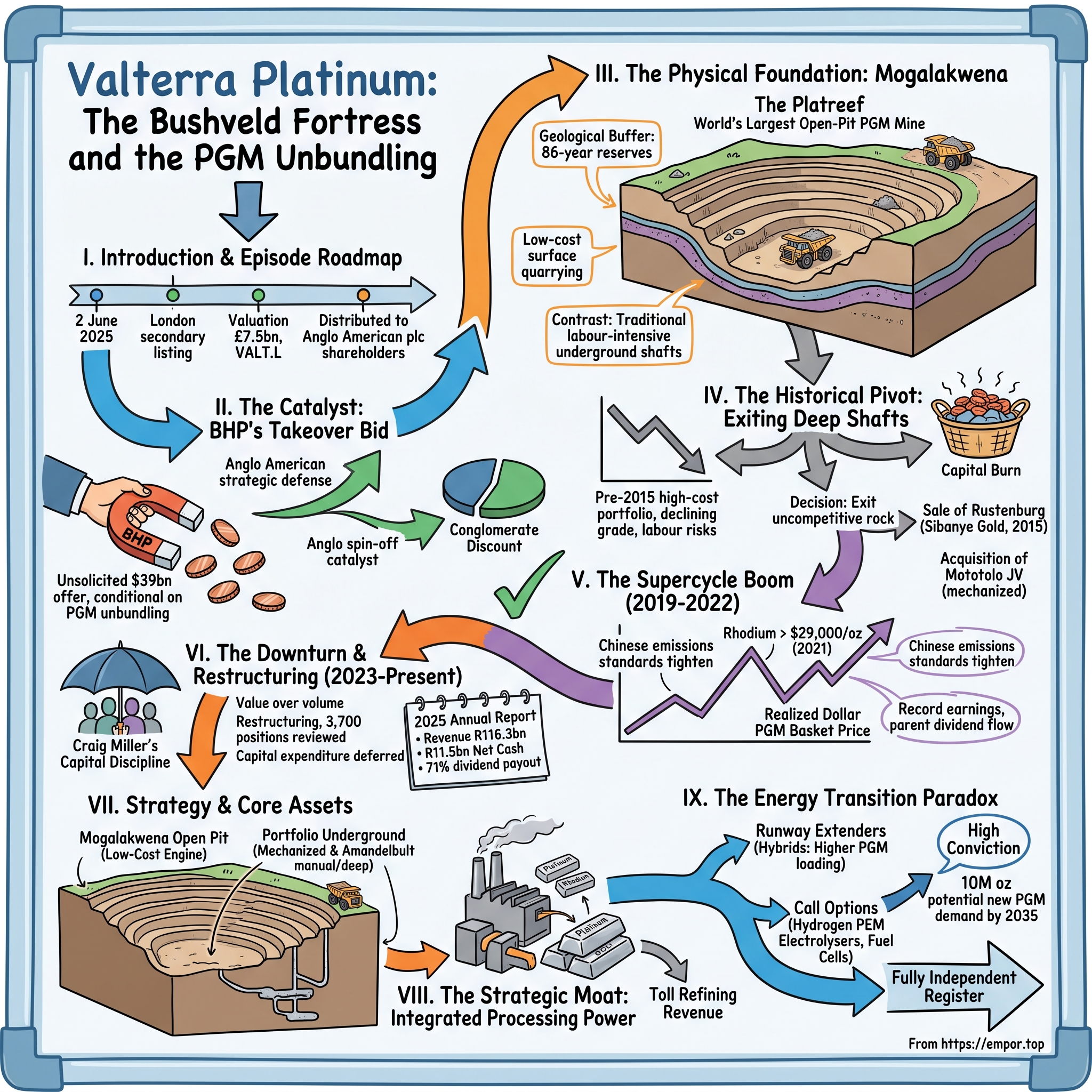
Valterra Platinum: The Bushveld Fortress and the PGM Unbundling
I. Introduction & Episode Roadmap
On the morning of 2 June 2025, a company that had operated for nearly a century inside a broader mining empire began trading as an independent entity. Valterra Platinum Limited — known until three days earlier as Anglo American Platinum, and long referred to simply as "Amplats" across Johannesburg financial markets — launched on the International Secondary Listing segment of the London Stock Exchange's Main Market under the ticker VALT, alongside its primary listing in Johannesburg.1 The London debut valued the business at approximately £7.5 billion.2 Unusually, the listing involved no conventional roadshow, no bookbuild, and no capital raise; shares were distributed directly to Anglo American plc shareholders at a ratio of 110 Valterra shares for every 1,075 Anglo shares held.3
This was not an initial public offering to raise new capital, but a corporate unbundling.
The catalyst for the separation originated outside Valterra. In April 2024, Australian mining giant BHP launched an unsolicited takeover approach for Anglo American that was structured to make the exit from platinum operations a prerequisite. What began as part of a corporate takeover defense ended as the largest unbundling in South African mining history, placing one of the sector's most distinctive physical assets under the control of an independent board.
That asset is Mogalakwena. Located on the Northern Limb of the Bushveld Complex in Limpopo province, Mogalakwena is the world's largest open-pit platinum group metals mine, with roughly 14% of its estimated 86-year reserve extracted across three decades of operation.4 While much of the South African platinum sector relies on labour-intensive underground shafts reaching two to four kilometres deep, Mogalakwena operates as a surface mine using heavy trucks and shovels. This geological baseline underpins Valterra's operational structure and cost advantages over underground peers.
This asset quality stands alongside significant structural shifts in the PGM market. Platinum group metals derive most of their commercial demand from automotive catalytic converters, which convert engine emissions into less harmful gases. Roughly 60% of global PGM supply is consumed by this single application.5 Because battery electric vehicles require no exhaust systems or catalytic converters, they contain no platinum, palladium, or rhodium, presenting a clear long-term demand headwind.
Despite those structural questions, the business generated a sharp financial turnaround by mid-2026. For the six months ended 30 June 2026, Valterra reported revenue of R81.8 billion, up from R42.3 billion in the prior-year period. Adjusted EBITDA rose to R33.4 billion from R6.6 billion, while headline earnings per share increased 1,633% to R82.02, up from R4.73.67 Performance was driven primarily by an 85% year-on-year rise in its realized dollar PGM basket price.8 Two years after widespread job cuts across the sector, Valterra declared an interim dividend of R15.1 billion.7
This contrast between near-term cash generation and long-term demand risk forms the core analytical tension for the company. Five central themes outline this story: first, how an uncompleted takeover attempt reshaped a FTSE 100 conglomerate and established an independent platinum producer; second, how the geology of a two-billion-year-old igneous complex dictates global cost positioning; third, the commercial dynamics of a multi-metal basket whose constituent prices frequently diverge; fourth, the structural shift away from deep, labour-intensive shaft mining toward mechanized open-pit extraction and processing infrastructure; and fifth, whether non-automotive demand drivers can provide a durable floor as vehicle fleets transition toward electrification.
The modern phase of this transition began with an unsolicited approach from Melbourne.
 Subscribe on LinkedIn
II. The Catalyst: How BHP's Megadeal Hostile Bid Unlocked Valterra
In the final week of April 2024, Anglo American received a takeover proposal that functioned less as a standard acquisition offer than as a structural directive. BHP Group proposed an all-share buyout of Anglo American valued at approximately $39 billion, but made the transaction strictly conditional on Anglo first demerging its entire shareholdings in Anglo American Platinum and Kumba Iron Ore directly to Anglo shareholders, with the takeover and demergers inter-conditional.9
That conditional structure reflected BHP's strategic focus. BHP was targeting Anglo's tier-one copper assets in Chile and Peru, which promised to make it a dominant global producer of the primary metal driving electrification. Conversely, BHP had no appetite for South African platinum or iron ore assets, where it lacked operational presence, local relationships, and exposure to the region's complex labor, energy, and regulatory environments. By requiring Anglo to execute the demergers beforehand, BHP sought to secure the prized copper assets while shifting the operational and regulatory risks of the South African spin-offs entirely onto the target.
Anglo's board rejected the initial approach on 26 April 2024, stating that the proposal significantly undervalued the company.9 Beyond price, Anglo's main objection centered on structural risk. Chairman Stuart Chambers characterized the proposed transaction as "highly unattractive, creating substantial uncertainty and execution risk borne almost entirely by Anglo American, its shareholders and its other stakeholders" — a complex process expected to take 18 months or more while leaving execution risk solely with Anglo.9 Anglo would bear the friction and political complexities of dismantling its South African operations while BHP retained the option to walk away if complications arose.
Two revised proposals followed, the last valuing Anglo at roughly £38.6 billion. Anglo rejected both offers and declined BHP's request to extend the UK Takeover Code deadline; on 29 May 2024, less than an hour before the cutoff, BHP confirmed it would not proceed.1011
Although BHP abandoned the bid, its intervention catalyzed immediate corporate action. On 14 May 2024 — while the takeover proposal was still active — Anglo American announced the most comprehensive restructuring in its modern history. Chief Executive Duncan Wanblad committed to demerge Anglo's 79%-owned platinum business, sell or demerge De Beers, sell its steelmaking coal assets, and divest or exit nickel, leaving a simplified portfolio focused on copper, premium iron ore, and crop nutrients.12 Having long defended its diversified conglomerate structure, Anglo management conceded under takeover pressure that the sum of its individual assets exceeded the market valuation of the combined group.
Execution proceeded rapidly by mining-industry standards. Anglo published the shareholder circular in April 2025,13 and shareholders approved the transaction at a general meeting on 30 April 2025.14 The demerger took effect on 31 May, followed by a share consolidation on 1 June and the secondary London listing on 2 June.31 Renaming the business Valterra Platinum formally severed its historic identity from the former parent.
Anglo initially retained a 19.9% stake in the newly independent company, creating a temporary equity overhang as investors anticipated a secondary placement. That overhang was resolved quickly. On 3 September 2025, Anglo launched an accelerated bookbuild for its remaining holding of roughly 52.2 million shares, pricing them at R845 per share to raise about R44.1 billion (roughly $2.5 billion), with settlement around 9 September.15 Valterra received none of the proceeds and was not a party to the placement.15 However, the complete exit eliminated the structural market overhang and established a fully independent register.
Beyond corporate mechanics, the spin-off carried political and regulatory dimensions. Separating one of South Africa's largest private employers and taxpayers from a London-headquartered parent involved sensitive national interests. The transaction's architecture directly addressed these priorities: Johannesburg remained the primary listing venue, while London took the secondary international slot, reassuring domestic stakeholders that corporate governance and operational focus remained anchored locally. Mining Charter obligations, community commitments surrounding Mogalakwena and Amandelbult, and local employment levels transferred intact, securing regulatory approvals without public conflict.
The separation also involved substantial administrative costs. Valterra incurred approximately R6 billion in standalone implementation expenses to establish independent treasury, information systems, insurance, corporate governance, and group administrative infrastructure.16 While corporate unbundlings aim to unlock shareholder value by removing conglomerate discounts, these upfront transaction costs represent a permanent expense. For Valterra, that R6 billion outlay established an independent board and capital allocation framework, shifting full accountability to its standalone performance.
Ultimately, those operational numbers depend less on administrative separation than on the extraordinary geology beneath the Limpopo bushveld.
III. Geology & The Bushveld Monopoly: The Physical Foundation of PGM Economics
Roughly two billion years ago, an immense volume of molten rock intruded into the Earth's crust beneath present-day northern South Africa, cooling slowly enough for minerals to settle into distinct layers. The resulting Bushveld Igneous Complex represents the largest layered igneous intrusion on Earth and holds the single greatest concentration of platinum group metals globally. The industry's cost curves, labor intensity, supply concentration, and geopolitical risks all trace back to this geological formation.
The Bushveld hosts three commercially significant orebodies. Understanding the distinctions among them is fundamental to analyzing PGM producers.
The Merensky Reef historically formed the foundation of South African platinum mining. A thin, tabular horizon—often under a meter thick—it is rich in platinum. However, its geometry presents severe operational challenges. A thin seam dipping deep underground cannot be economically mechanized. Extraction relies on manual labor, with workers drilling and blasting in confined stopes. Consequently, traditional South African platinum mining requires large workforces, making costs heavily dependent on labor and energy.
The UG2 Reef lies below the Merensky Reef and became the industry's primary source as Merensky reserves depleted. UG2 carries higher proportions of rhodium and ruthenium, metals that grew increasingly valuable under stricter global emissions regulations. However, UG2 also contains chromite, a metallurgical contaminant that complicates smelting and requires precise processing control. Like Merensky, UG2 is narrow, deep, and labor-intensive.
The Platreef, located on the Northern Limb, presents a sharp contrast. Rather than a narrow seam, it is a thick zone—tens of meters wide—of lower grade but massive volume that sits near the surface. This structure alters the economic profile of extraction. A shallow, thick orebody allows open-pit mining using heavy shovels and trucks, requiring a fraction of the workforce needed for deep underground operations. Mogalakwena represents the commercial execution of the Platreef, giving Valterra a cost structure distinct from its underground peers.
To visualize the operational contrast: mining the Merensky or UG2 reefs resembles extracting a thin sheet from between massive slabs of rock two to three kilometers underground by hand. In contrast, the Platreef allows surface quarrying. Although the ore grade is lower, bulk extraction lowers unit costs by moving vastly more rock per worker.
This geology creates extreme geographic supply concentration. South Africa produces the vast majority of global primary platinum and rhodium, while Russia—primarily through Nornickel—dominates primary palladium supply. For global automakers, essential catalyst metals originate almost entirely in two jurisdictions subject to political and geopolitical uncertainty. For example, when palladium reached a record intraday price of $3,420 per ounce in March 2022 following the invasion of Ukraine, the surge reflected market fears of potential supply disruptions rather than immediate physical shortages, as direct sanctions on Russian palladium did not materialize.17
A second structural feature of platinum group metals is their lack of ready substitutes in key applications. No alternative material matches their efficacy in converting nitrogen oxides and carbon monoxide into less harmful gases at high exhaust temperatures, making them essential for meeting global vehicle emissions regulations. Beyond automotive catalysts, PGMs serve critical roles in petroleum refining, glass fiber manufacturing, industrial crucibles, electronic contacts, and hard drive storage. Their specialized properties render them bottleneck materials across multiple supply chains.
Secondary supply through recycling acts as an ongoing constraint on market tightness. Scrapped catalytic converters yield platinum, palladium, and rhodium, feeding a global secondary recovery industry that provides a substantial portion of total supply. Recycling dynamics differ from primary mining in two important respects: secondary supply responds to price movements with a lag of months rather than the years required to develop a mine, capping price rallies, and its availability depends on vehicle scrappage rates driven by auto finance and used-car markets rather than mining economics. In 2023, a surge of secondary metal from vehicles built with high metal loadings contributed significantly to the sharp drop in PGM prices.
This combination of irreplaceable utility, concentrated primary mining, and elastic secondary supply underpins the fundamental investment narrative for PGM producers. Yet as market downturns have repeatedly demonstrated, these structural traits do not protect producers from severe margin erosion when demand weakens or capital allocation falters.
IV. The Historical Pivot: Exiting Deep Shafts & The Great Restructuring (2012–2018)
In August 2012, at Lonmin's Marikana operation in the North West province, a wildcat strike over wages ended with police opening fire on striking miners. Thirty-four people were killed. It was the deadliest use of force by South African security services since the end of apartheid, and it detonated the industrial relations settlement the platinum industry had operated under for decades.
What followed was not a single event but a two-year unraveling. The Association of Mineworkers and Construction Union displaced the older National Union of Mineworkers across much of the platinum belt, and in January 2014 it called a strike across the three largest producers — Anglo American Platinum, Impala Platinum, and Lonmin. It lasted 21 weeks. It cost the industry roughly R24 billion and removed about 1.3 million ounces of production, close to a third of global output. Amplats alone forewent approximately 440,000 ounces of equivalent refined production.18
Set that against the operating environment. Deep-level Merensky and UG2 mining was already in the highest-cost quartile of global PGM supply. Head grades were declining as the richest ore was worked out. Eskom, the state power utility, was raising tariffs far ahead of inflation while grid reliability deteriorated. Safety stoppages — a Section 54 notice from the mines inspectorate can halt an entire shaft after a single incident — were increasing. Meanwhile, the PGM basket price was falling. Amplats was burning capital at the bottom of the cycle, in the most difficult labor environment in its history, operating mines that were structurally uncompetitive.
The response, led by Anglo American Chief Executive Mark Cutifani and Amplats Chief Executive Chris Griffith, was a decisive strategic shift. It came down to a single principle applied repeatedly: exit uncompetitive rock rather than attempt to fix it.
The centerpiece was Rustenburg. These were the original mines, the historic heart of the company, employing tens of thousands of workers in the deep, manual, tabular mining the strategy was designed to escape. On 9 September 2015, Amplats announced their sale to Sibanye Gold — the gold producer Neal Froneman was transforming into a diversified precious metals group — for a nominal minimum of R4.5 billion.[^19] The deal structure reflected the market risk: R1.5 billion upfront in cash or Sibanye shares, plus deferred consideration equal to 35% of distributable free cash flow generated over a defined period, subject to a R3.0 billion minimum. The transaction was fully implemented in November 2016.19
Evaluating that divestment a decade later requires looking beyond raw proceeds.
Amplats sold near the trough of the market. Sibanye subsequently generated substantial cash from those shafts during the 2020–2022 PGM price boom — far exceeding the deferred consideration returned to the seller. On realized cash proceeds alone, the transaction favored the buyer.
However, that comparison overlooks what Amplats gained. By accepting a lower upfront price, Amplats permanently removed a labor-intensive, safety-exposed, high-cost operation from its balance sheet when capital was constrained and the political climate was uncertain. The sale converted a fixed operating liability into risk-managed optionality. Holding Rustenburg through 2016–2019 at depressed prices, with the required capital and headcount, would have carried far higher risk. While the valuation appeared low in hindsight, the decision was operationally defensible given the information available in 2015.
The second part of the strategy involved targeted acquisitions of lower-cost assets. On 23 July 2018, Amplats acquired Glencore's 39% interest in the Mototolo joint venture for approximately R1.5 billion, structured as roughly R800 million upfront with the balance paid monthly over six years linked to PGM prices, increasing its stake to 89% alongside Kagiso Tiso Holdings.20 Mototolo was shallow, fully mechanized, and low-cost — the operational antithesis of Rustenburg.
The key benefit was spatial synergy. Mototolo sits adjacent to Der Brochen, an orebody Amplats owned outright but could not economically develop alone. Combining the assets extended the mine life from roughly five years to more than thirty.21 The acquisition unlocked three decades of production from an asset already on the balance sheet. Around the same period, Amplats unwound its complex Kroondal pool-and-share agreement with Sibanye, simplifying operational governance and capital reporting.
This period is often framed as Amplats selling at the bottom while Sibanye profited. While accurate regarding transaction timing, that view misinterprets the underlying strategies. Sibanye acquired high-cost, high-leverage shafts specifically to capture sharp cash flows during price upswings, accepting the risk of mine closures during downturns. That strategy succeeded during the 2020–2022 rally, but led to large impairments and restructurings in 2023–2024. Amplats chose the opposite path: lower operational leverage and structurally lower unit costs. Both companies executed coherent strategies at different points on the risk curve, showing that a portfolio's cost position determines performance through a cycle far more than managerial intent.
By 2018, the contours of the modern company were established: a massive open pit at Mogalakwena, a select group of mechanized underground mines, a portfolio freed of its most labor-intensive operations, and a retained downstream processing network. Retaining the smelters and refineries appeared incremental at the time.
Then rhodium prices surged toward $20,000 an ounce.
V. The Supercycle Boom & PGM Basket Mechanics (2019–2022)
Understanding the industry's financial trajectory requires examining how a PGM producer generates revenue, a mechanism that differs fundamentally from single-metal gold or copper miners.
Valterra does not sell a single commodity called platinum; it sells a multi-metal basket. Every tonne of Bushveld ore contains platinum, palladium, rhodium, iridium, ruthenium, and small quantities of gold in fixed geological proportions that cannot be altered, alongside nickel, copper, and chrome by-products. Revenue per PGM ounce produced is the sum of each metal's volume multiplied by its market price, plus base metal and chrome credits, translated into South African rand—a second volatile variable outside management control. A reported "PGM basket price" is therefore a weighted average of several fluctuating metal prices and a currency exchange rate, where small shifts in basket composition or exchange rates yield substantial swings in realized revenue.
Comparing performance across the sector also requires accounting for reporting conventions. Producers disclose volumes on different bases—typically 3E, 4E, or 6E—making direct comparisons misleading without adjusting for the underlying denominator. In South African conventions, 3E comprises platinum, palladium, rhodium, and gold, while 6E adds iridium and ruthenium. Valterra reports its all-in sustaining cost per 3E ounce alongside total PGM production volumes. Minor metals carry disproportionate financial weight: iridium is essential for proton exchange membrane electrolyzers and specialized crucibles, while ruthenium is key to hard disk drive magnetic media and electrical contacts. Because both metals trade in illiquid, niche markets, modest shifts in industrial demand trigger sharp price movements. For example, ruthenium realizations rose 88% across 2025 and a further 167% in the first half of 2026, delivering an outsized contribution to revenue growth despite representing a small fraction of overall volume.326
This basket structure creates distinct revenue dynamics: a producer's earnings can contract during periods of flat platinum prices if rhodium declines, or expand sharply if rhodium rallies. Rhodium represents the most volatile component. Total global production is limited to a few hundred thousand ounces annually, and the metal has no functional substitute for reducing nitrogen oxide emissions in gasoline exhaust systems.
Between 2019 and 2021, three forces drove an unprecedented price surge. Emissions standards tightened simultaneously across major automotive markets—including China 6 and Europe's Euro 6d—increasing required metal loadings per vehicle, particularly for rhodium. At the same time, primary supply suffered from South African operational disruptions and pandemic-related shutdowns in 2020. In an illiquid physical market, speculative trading amplified the underlying tightness.
Rhodium peaked at nearly $29,800 per ounce in March 2021—roughly fifteen times the prevailing gold price.22 Palladium reached its own record high the following March.17 During this windfall, Amplats generated record earnings and distributed substantial dividends, the vast majority flowing to parent company Anglo American under its 79% holding. This capital flow underscored the corporate tension that later informed the demerger, as cash generated by South African operations primarily served the capital priorities of a controlling parent.
The supercycle also triggered a structural realignment in metal demand. For years, palladium commanded a premium over platinum despite performing similar catalytic functions in gasoline exhaust systems. Automakers and catalyst fabricators—notably Johnson Matthey and BASF—had standardized formulations around palladium. However, prolonged price disparities incentivized industrial re-engineering, leading to thrifting and substitution technologies that enabled platinum to replace palladium in gasoline catalysts by the early 2020s.
This substitution capability altered long-term market dynamics in two ways. First, it established a demand floor for platinum by re-opening access to the gasoline autocatalyst market. Second, it capped palladium's ability to maintain a wide premium, establishing a permanent structural limit on the price spread between the two metals.
Because primary miners extract metals in fixed geological ratios, this shift favored South African producers. Valterra's Bushveld ore is platinum-heavy, whereas Russian deposits mined by Nornickel are palladium-heavy. Consequently, the commercial shift toward platinum substitution structurally strengthened the relative market position of Bushveld assets.
However, these structural advantages did not shield producers when the broader commodity supercycle reached its inevitable conclusion.
VI. The Downturn, Restructuring, & Craig Miller's Capital Discipline (2023–Present)
On 19 February 2024, Anglo American Platinum reported a 71% drop in 2023 headline earnings to R14 billion. In the same announcement, the company initiated a restructuring under Section 189A of South Africa's Labour Relations Act, putting approximately 3,700 positions — roughly 17% of its workforce, including fixed-term employees — under review alongside contracts with 620 service providers.2324
Section 189A is not a routine corporate layoff. It is a legally mandated consultation process, facilitated by South Africa's Commission for Conciliation, Mediation and Arbitration, that requires employers to justify retrenchments and negotiate alternatives with trade unions. In a country with unemployment exceeding 30%, it is a slow, public, and politically sensitive process. Initiating it signals that operational cost reductions can no longer be achieved through minor adjustments.
The restructuring was forced by a sharp drop in metal prices. During 2023, rhodium lost roughly two-thirds of its value and palladium fell about one-third, dragging the six-element PGM basket down to around $1,250 per ounce — approximately two-thirds below its April 2021 peak.25 Multiple factors drove the decline: automakers destocking inventories accumulated during earlier supply shortages, slowing global vehicle production, expanding secondary supply from recycled catalytic converters, and widespread market assumptions of rapid battery electric vehicle adoption. Peer South African producers, including Impala Platinum, Sibanye-Stillwater, and Northam, faced similar margin compression and labor reductions.
Leading the company through this downturn was Craig Miller, who assumed the chief executive role on 1 October 2023 after his appointment was announced the previous July.26 A chartered accountant rather than a mining engineer, Miller trained at Deloitte in Johannesburg before joining Anglo American in 2000 as a finance manager. Over two decades, he held senior financial roles across the group, including group financial controller, chief financial officer of Brazilian iron ore, chief financial officer of South African coal, and head of the group chief executive's office. He joined the Amplats board as finance director in March 2019, serving as CFO through both the supercycle peak and its collapse before stepping into the chief executive role.27
This background shaped his managerial approach, prioritizing cost control, cash preservation, and capital discipline over volume growth. Since 2023, management has consistently deferred discretionary capital expenditure and adjusted production targets to emphasize capital efficiency — a strategy framed as "value over volume," which focuses on eliminating unmarginable production.
Operational challenges further tested this strategy in early 2025. Heavy rains and the collapse of the Bierspruit dam in February 2025 caused severe flooding at the Tumela mine, the core asset of the Amandelbult complex.28 Production at Amandelbult fell 45%, or 128,700 ounces, during the affected period, contributing to a 15% drop in total group second-quarter output.29 Valterra maintained its full-year group production guidance by lowering Amandelbult's output targets while relying on higher contributions from Mogalakwena, Mototolo, and Unki.29
Management responded with prompt operational disclosures and financial recovery measures. The company published details of the flooding within days,28 quantified the site-specific impact, and subsequently recovered R2.3 billion in net insurance proceeds.30 Operations at Amandelbult stabilized during the second half of 2025, returning the complex to the industry's leading cost quartile by mid-2026,6 accompanied by capital investments in upgraded flood defenses.31
Financial results for 2025, published on 25 February 2026 in Valterra's first annual report as an independent entity, reflected this operational recovery. Revenue rose 7% to R116.3 billion, while EBITDA increased 68% to R33.4 billion, supported by a 22% rise in the rand PGM basket price, R5 billion in operating cost savings, and insurance proceeds.30 Metal-in-concentrate production reached 3.2 million ounces and refined production reached 3.4 million ounces, both slightly exceeding full-year guidance.32 Balance sheet strength improved as the group moved from a net debt position of R4.9 billion at mid-year 2025 to a net cash balance of R11.5 billion by year-end.166
Capital return distributions followed the company's dividend framework, which targets a base payout of 40% of headline earnings. For 2025, the board declared a base final dividend of R23.00 per share and a special dividend of R20.00 per share, bringing total 2025 distributions to R45.00 per share, or 71% of headline earnings.30 The interim dividend for the first half of 2026 maintained this dual structure, combining a base payout of R32.50 per share with a supplementary dividend of R24.50 per share for a total of R57.00 per share, representing approximately 70% of interim headline earnings.6
This payout structure aligns with the cash flow realities of a cyclical commodity producer. The 40% base dividend provides a payout floor manageable during low-price environments without straining the balance sheet, while supplementary distributions return excess cash generated during price rallies without creating permanent fixed obligations. During the first-half 2026 investor presentation, Chief Financial Officer Sayurie Naidoo noted that the company retained R8.7 billion in earnings rather than distributing it, citing capital commitments toward full-year capital expenditure guidance of R17 billion to R18 billion, macroeconomic uncertainty, and balance sheet flexibility.5 Regarding share repurchases, Naidoo stated that buybacks remained an available capital allocation tool, though feedback indicated investor preference currently favored cash dividends amid market volatility.5
The decision to favor dividends over share buybacks highlights an ongoing debate over optimal capital allocation. With Valterra's Johannesburg-listed shares closing at 115,963 cents on results day — roughly 40% below their 52-week high of 193,072 cents — repurchasing equity at a discount presents an alternative method of compounding per-share value during periods of robust cash generation.5
The results that produced this debate came overwhelmingly from one mine.
VII. Segment Breakdown & Core Asset Deep Dive: Mogalakwena vs. The Portfolio
At the edge of the Mogalakwena pit, the operational contrast with traditional South African platinum mining is immediately stark. There are no headgears, underground cages, or shift changes disgorging thousands of workers into a lamp room. Instead, terraced benches cut into the earth, heavy haul trucks moving on ramps, and a distant processing plant give the site the appearance of a Chilean copper mine or an Australian open-pit iron ore operation.
Mogalakwena serves as Valterra's primary economic engine. While full-year 2026 group guidance targets 3.0 to 3.4 million refined PGM ounces, Mogalakwena alone is projected to generate 920,000 to 980,000 ounces.6 Because total refined output includes third-party concentrate and inventory drawdowns, Mogalakwena's share of total volume understates its true contribution to corporate profits. As an open-pit operation benefiting from substantial base metal by-product credits, it operates with a superior margin structure, placing it in the lower half of the global cost curve while much of the domestic underground industry sits in the upper half.32
The asset's geological scale provides a durable competitive buffer. Its reserve supports 86 years of production — with total resources extending far beyond — while roughly 14% of that reserve has been extracted across three decades of operation.4 In an industry where equity valuations frequently hinge on reserve depletion timelines, Mogalakwena presents no material depletion risk over any standard investment horizon.
Operational efficiency at Mogalakwena has also been enhanced through processing upgrades, particularly in flotation. In flotation, crushed ore mixes with water and chemical reagents while injected air floats metal-bearing particles to the surface as froth. Lowering "mass pull" — the proportion of total ore reporting to concentrate — produces a richer concentrate, reducing downstream transport, smelting volume, and power consumption. During the first half of 2026, Jameson cells installed at the North Concentrator improved mass pull by 15% year on year, reducing concentrate volume by 90,900 tonnes and lowering smelter electricity consumption by 70,500 megawatt-hours.6 Management reported that the technology achieved the complete operational savings projected in its initial business case,5 providing a rare instance of a mining company verifying modeled technology benefits against actual performance.
Mogalakwena's primary growth initiative is Sandsloot Underground, an extension beneath the existing open pit designed to extract Platreef ore beyond the economic depth limits of surface mining. Underground development advanced 1.5 kilometres during the first half of 2026 to reach a cumulative 10.7 kilometres, with trial mining scheduled for the fourth quarter of 2026 and a feasibility study and final investment decision expected in the first half of 2027, backed by phase-specific capital guidance of R1.5 billion to R2.5 billion.56 This phased sequence — advancing development and trial mining before completing the formal investment decision — limits upfront capital risk. While long-term targets envision underground production of 3.6 to 4.5 million tonnes annually by the end of the decade,33 formal project sanction remains contingent on the 2027 decision.
By contrast, Amandelbult represents the main strategic exception in Valterra's portfolio. Deep, tabular, labor-intensive, and weather-vulnerable, it resembles the assets the company systematically divested over the preceding decade. Yet its operational recovery from early-2025 flooding accounted for most of the 9% increase in group own-mined output in the first half of 2026, which reached 1,011,800 ounces.6 Management committed capital to the One Sub Shaft deepening project, guided at R500 million to R600 million annually, aimed at sustaining more than 4 million tonnes of annual ore throughput for 30 years and maintaining annual output between 600,000 and 630,000 ounces.5
Allocating capital to a deep-level operation appears at odds with Valterra's broader structural exit from manual shafts. Management defends the expenditure on metallurgical grounds: Amandelbult yields platinum-rich, chrome-bearing Merensky and UG2 ore that blends with Mogalakwena's Platreef concentrate to optimize furnace stability, energy consumption, and metal recovery in downstream smelters. Under this framing, Amandelbult functions as both an extraction site and an essential feed component for the processing division.
While such operational integration arguments can sometimes shield marginal assets from closure, Valterra's executive team has demonstrated a track record of rationalizing uncompetitive capacity, having eliminated 3,700 positions during the 2024 downturn and divested historic deep-level assets. Nevertheless, the ultimate test of this capital allocation logic will depend on whether investments at Amandelbult continue if PGM basket prices experience another severe decline.
The remainder of the mining portfolio consists of mechanized underground operations. Mototolo, integrated with the adjacent Der Brochen orebody, is shallow and mechanized; during the first half of 2026, mine development expanded 64% and immediately available ore reserves rose 29%.5 Modikwa operates as a joint venture contributing modest volumes. In Zimbabwe, Unki runs a fully mechanized mine that produced 219,700 ounces of concentrate in 2025 — representing roughly 7% of group output — and operates a dedicated $62 million smelter commissioned in 2019 to comply with local in-country beneficiation mandates.34[^36]
Unki's primary vulnerability is sovereign risk. Zimbabwe mandates that exporters surrender a portion of foreign currency earnings, and as of early 2026, the Zimbabwean government owed Valterra approximately $100 million in unpaid 2025 export proceeds that remain uncollected.3536 With 7% of total production linked to sovereign currency restrictions, these unrecovered funds represent an ongoing discount on operating cash flows.
Beyond extraction, Valterra maintains an extensive processing footprint comprising the Waterval, Mortimer, and Polokwane smelters, the Rustenburg Base Metals Refinery, and the Precious Metals Refinery. This complex refines raw concentrate into individually separated, commercial-grade metals. Chemically isolating six distinct platinum group metals requires specialized process engineering developed over decades, creating a significant technical barrier to entry.
This infrastructure allows Valterra to treat both internal production and third-party concentrate from smaller miners unable to justify the billion-dollar capital expenditure required for standalone processing assets. Toll treatment generates fee-based revenue with lower direct exposure to mining cost inflation. In the first half of 2026, purchased concentrate contributed 507,100 ounces, down 6% due to lower third-party volumes.6
This volume drop highlights emerging competition in toll refining. While third-party processing provides higher-margin revenue, domestic peers such as Impala Platinum and Sibanye-Stillwater also maintain excess smelting and refining capacity following their own mine rationalizations. As junior miners gain alternative processing options, fee structures face potential margin pressure. Because commercial tolling terms are omitted from financial disclosures, tracking per-ounce realization trends remains an open analytical question.
The multi-stage refining process introduces inventory swings that can obscure operational trends. Because metal requires months to pass through smelting, converting, and refining, drawdowns of work-in-progress inventory expand reported refined volumes without corresponding increases in mine output. In the first half of 2026, inventory optimization released approximately 200,000 ounces.5 Consequently, management reiterated full-year refined output guidance of 3.0 to 3.4 million ounces despite strong H1 results, citing planned third-quarter plant maintenance.5 Tracking mined metal-in-concentrate — which rose 4% to 1,519,000 ounces in H1 2026 — provides a clearer measure of underlying mine productivity.6 Separately, the ongoing repurposing of the Mortimer smelter, scheduled for completion in 2027, is projected to unlock roughly 200,000 additional PGM ounces over a five-to-six-year period.5
These asset distinctions frame the broader valuation debate for Valterra: whether its open-pit geology and processing scale establish a durable structural advantage, or whether corporate earnings remain primarily dependent on external PGM price cycles.
VIII. The Strategic Moat: Helmer's 7 Powers & Downstream Processing Power
Commodity producers are notoriously difficult candidates for economic moats because they sell fungible goods at market-clearing prices set on global exchanges. A platinum buyer has no reason to prefer Valterra's output over metal from Impala Platinum or Sibanye-Stillwater; platinum is chemically identical to four decimal places of purity. Any structural advantage must therefore originate from operating cost positioning, orebody geology, or downstream value-chain infrastructure that peers cannot duplicate.
Applying Hamilton Helmer’s 7 Powers framework, one strategic power applies to Valterra with exceptional clarity.
Cornered Resource. Mogalakwena is a categorically distinct asset rather than a better-operated underground shaft. Competitors like Impala, Sibanye, and Northam Platinum cannot replicate it by opening rival open pits, because the Platreef's shallow, thick expression is a unique geological formation on the Northern Limb whose prime economic acreage is already fully secured by Valterra. This represents the textbook definition of a cornered resource: preferential access to an asset that independently elevates profit margins on terms peers cannot match at any price. The practical evidence appears directly on the cost curve, where Mogalakwena operates in the lower half of global production costs while much of the domestic underground industry sits in the upper half.32 This advantage is durable across the mine's multi-decade reserve life and stems from geology rather than managerial skill.
Process Power. Valterra’s integrated smelting and refining network offers a secondary, though more qualified, claim. Decades of operational refinement in separation chemistry, recovery optimization, and managing variable chrome-bearing furnace feeds create meaningful technical barriers. However, because peers like Impala and Sibanye-Stillwater operate their own smelting and refining infrastructure, processing capacity is not uniquely scarce. The downstream complex functions less as a defensible proprietary moat and more as a high-barrier scale advantage with substantial replacement costs.
Counter-Positioning is frequently cited on Valterra's behalf, but represents the weakest moat argument. Proponents argue that Valterra’s "value over volume" strategy constitutes a business model that higher-cost peers cannot copy without damaging their economics. In practice, operational restraint is a tactical decision rather than a structural position; any producer can curtail unmarginable output, and during the 2023–2024 price downturn, Impala, Sibanye, and Northam all implemented production cuts. Framing routine capital discipline as a strategic power overstates its permanence.
A complementary analysis using Michael Porter’s Five Forces reveals why controlling a premier tier-one asset still leaves a commodity producer exposed to broader industry economics.
Bargaining power of buyers appears low under standard metrics, as automakers and industrial buyers purchase metal against standard benchmark prices. However, this dynamic is symmetric: Valterra possesses no pricing power either. As a price-taker whose revenue depends on benchmark fixes, the company's sole commercial levers are production volume and metal mix.
Bargaining power of suppliers represents the industry's primary structural vulnerability. State power utility Eskom supplies grid electricity to energy-intensive mines and continuous-operation smelters, with tariff increases consistently outpacing inflation alongside ongoing grid reliability risks. Simultaneously, organized labor—led by the Association of Mineworkers and Construction Union and the National Union of Mineworkers—negotiates multi-year wage agreements across a sector where labor dominates underground operating costs. Valterra’s operational countermeasure is concrete: through the Envusa renewable partnership, 520 megawatts of capacity has been commissioned, supplying 181 gigawatt-hours in the first half of 2026. This initiative generated 36 million rand in power cost savings while reducing emissions by 195,000 tonnes of carbon dioxide equivalent and improving energy intensity by 12%.56 While this provides a genuine structural defense against rising power costs, domestic peers are actively deploying similar renewable strategies.
Rivalry among existing competitors is often misinterpreted. While the Bushveld Complex features an oligopoly of major producers operating adjacent orebodies, direct commercial rivalry remains muted because companies do not compete for customers, undercut benchmark prices, or differentiate their metal. Instead, competition occurs over operational inputs: skilled labor, specialized contractors, grid power allocations, and the third-party concentrate required to fill spare downstream processing capacity. Consequently, rivalry manifests as input-cost inflation rather than price discounting. In fact, major producers occasionally cooperate when industry interests align, as demonstrated by Valterra's joint market-development initiative with Sibanye-Stillwater and Johnson Matthey to foster new demand applications for platinum group metals.
Threat of new entrants is minimal. Constructing a greenfield PGM mine with integrated smelting and refining capacity requires billions of dollars in capital and a decade of permitting and construction—an investment profile that no rational mining board would authorize given long-term demand uncertainties.
Threat of substitutes presents the most severe long-term risk, requiring a distinction between intra-basket substitution and end-use displacement. Within the PGM basket, substitution between platinum and palladium is established and bounds relative price spreads. Externally, however, the primary substitute for automotive catalysts is the battery electric vehicle, which eliminates PGM content entirely rather than reducing it. This dynamic represents potential demand elimination for the sector's largest market, against which no traditional competitive moat offers protection.
In sum, Valterra's strategic moat rests almost entirely on a single, extraordinary asset: the Mogalakwena orebody. Its downstream processing network provides valuable scale advantages, while claims of counter-positioning reflect management choices rather than structural barriers. Crucially, even a premier cornered resource operates within a broader market whose primary end-use faces a long-term technological transition beyond any producer's control.
Understanding the pace, scale, and trajectory of that technological transition is therefore the central question in the investment case.
IX. The Energy Transition Paradox: Catalysts, Hybrids, & Green Hydrogen Optionality
In 2021, the consensus view of platinum group metals was straightforward and grim: the internal combustion engine was dying on a known schedule, autocatalyst demand would follow it down, and PGM producers were melting ice cubes. Equity valuations across the sector reflected exactly that.
Five years later, that timeline has proven considerably messier than the models assumed, and the reasons are worth understanding because they determine how much runway the industry actually has.
The most important development is the hybrid. Pure battery electric adoption has grown, but more slowly in several major markets than the aggressive forecasts implied, while demand for conventional hybrids and plug-in hybrids has surged. Consumers who worry about charging infrastructure, cold-weather range or purchase price have found the hybrid a comfortable compromise, and manufacturers who over-committed to battery-only platforms have re-introduced hybrid options.
Here is the counterintuitive part, and it matters enormously. A hybrid does not use less PGM than an equivalent conventional car. It typically uses more.
The reason is chemistry, not marketing. A catalytic converter only works above a threshold temperature — roughly 250 to 300°C. Below that, the reactions do not proceed and the exhaust passes through essentially untreated. In a conventional car, the engine starts once and runs continuously, so the catalyst heats up and stays hot. In a hybrid, the engine shuts off whenever the battery can handle the load and restarts when it cannot. Each restart is potentially a cold start, and cold starts are when nearly all the harmful emissions escape. To pass the same regulatory test, engineers compensate by loading more precious metal into the catalyst, so that the smaller amount of active surface reaching temperature quickly can still do the job. More engine on-off cycles means more metal per vehicle.
The result is that the intermediate technology — the one gaining share while pure electric decelerates — is more PGM-intensive per unit than the technology it replaces. This is the single most important reason the sector's demand collapse has not arrived on schedule.
It is a reprieve, not a reversal. Hybrids remain internal combustion vehicles, and if battery costs and charging infrastructure improve sufficiently, the same substitution eventually occurs. The honest framing is that hybrids extend the runway by years, not that they eliminate the risk.
But hybrids are not what actually moved the platinum price in 2025 and 2026, and it is important to be precise about this, because the distinction separates a structural re-rating from a speculative one.
The platinum market recorded its third consecutive annual deficit in 2025, estimated at roughly 692,000 ounces, drawing down above-ground stocks by around 42%.41 That is the physical backdrop. The accelerant was investment and jewellery demand out of China, where buying is reported to have nearly quadrupled year on year in 2025, accounting for close to 70% of global bar and coin demand — up from roughly 15% three years earlier.41 Platinum futures set a record above $2,300 an ounce in late 2025, opened 2026 at $2,137 and reached an all-time high near $2,924 on 26 January 2026.4243
Here is the analytical point. Chinese physical investment demand is not industrial demand. It is discretionary, price-sensitive, and reversible in a way that a catalytic converter specification is not — a car maker that has engineered platinum into a catalyst formulation will buy the metal for years regardless of price, while a household buying bars because platinum looks cheap relative to gold can stop tomorrow. Some of the buying appears to have been a relative-value trade: with gold at elevated levels, platinum looked inexpensive against its own history versus gold, and capital rotated. Investment demand of this kind is genuinely capable of clearing a physical deficit and lifting prices sharply. It is not the same thing as a durable structural demand base, and a producer's earnings built on it are more fragile than the same earnings built on industrial offtake. Valterra's spectacular H1 2026 results are, in significant part, a function of this flow. That does not make them less real. It makes them less repeatable by default.
The industry's answer to what happens after the automotive runway ends is hydrogen, and it requires the discipline of proportionality.
Proton exchange membrane technology runs in two directions. A PEM electrolyser uses electricity to split water into hydrogen and oxygen, with platinum and iridium serving as the catalysts that make the reactions proceed efficiently — this is how "green hydrogen" is made. A PEM fuel cell runs the reaction backwards, combining hydrogen with oxygen to generate electricity and water, with platinum as the catalyst. Fuel cells are most compelling where batteries are weakest: heavy long-haul trucking, rail, maritime shipping, and stationary backup power, where weight and refuelling time matter more than efficiency.
Both applications consume platinum and iridium in meaningful quantities per unit. And here is the critical caveat: as of today, hydrogen accounts for a low single-digit percentage of PGM demand. It is not moving the basket price and it is not in current earnings. Any analysis that leans on hydrogen to justify a present valuation is substituting a 2035 story for 2026 arithmetic.
What it is, correctly understood, is a call option — worth something, potentially worth a great deal, but not yet worth including in a base case. Valterra has treated it as such, funding hydrogen ecosystem companies through the AP Ventures vehicle it co-founded with the express purpose of stimulating downstream demand for its own metal.
The more recent and more concrete demand initiative is broader. In February 2026, Valterra, Sibanye-Stillwater and Johnson Matthey launched a joint programme to develop PGM-enabled technologies and accelerate them from laboratory to commercialisation, spanning clean hydrogen, emissions detection and reduction, electronic materials and high-performance alloys.3738 Two further partnerships followed — with Umicore in Germany and Pujing Chemicals in China.38 The strategic intent is unambiguous: reduce dependence on the roughly 60% of demand tied to catalytic converters by manufacturing new demand.5
Management has quantified the ambition. On the H1 2026 call, the team identified approximately 10 million ounces of potential additional PGM demand by 2035 beyond consensus forecasts, of which roughly 2 million ounces sit in what they describe as a "high conviction" phase, and pointed to three near-term drivers: Chinese fuel cell truck deployment, artificial intelligence infrastructure — ruthenium in hard disk drive media, crucibles and connectors for data centre buildout — and industrial substitution of platinum and palladium for gold as gold prices have risen.5
That framing deserves both credit and scepticism. Credit, because producers attempting to expand their own end markets rather than passively awaiting demand is a rational and underused strategy in commodities, and because the numbers were disclosed with an explicit confidence split rather than presented as a single hopeful figure. Scepticism, because 10 million ounces against a market of roughly 12 million ounces of total annual PGM demand is an extraordinarily large claim, "high conviction" is a management adjective rather than a contracted order book, and management explicitly acknowledged that its deficit projections diverge from Johnson Matthey's forecasts — assuming stronger auto sales, higher metal loadings, lower primary supply and stronger industrial demand than the sector's most widely followed analyst.5
When a producer's demand forecast is systematically more bullish than the independent forecaster's on every single variable, that is worth noting. It may be right. It is not neutral.
X. Strategic & Investing Playbook: Lessons from Mining Cycles & Conglomerate Demergers
Strip away the narrative, and five transferable lessons emerge from this history, each generalising well beyond platinum.
Geology rules capital allocation. The most consistent finding in mining as an asset class is that asset quality dominates management performance over extended horizons. Operational teams can refine safety protocols, procurement, maintenance scheduling, and mine planning, but they cannot convert a one-metre reef three kilometres underground into a fifty-metre surface orebody. Valterra's cost advantage over its deep-level peers was determined two billion years ago. For investors, the practical implication is clear: in extractive industries, the majority of diligence belongs on the physical resource rather than the strategy deck. A first-quartile asset with mediocre management routinely outperforms a third-quartile asset with capable leadership across a complete commodity cycle.
Conglomerate structures obscure price discovery, and only external pressure reliably breaks them. The latent value of separating platinum from copper was not discovered in May 2024; it had been discussed across Johannesburg and London for years. What was missing was a forcing mechanism. A controlling shareholder receiving 79% of the subsidiary's dividends had limited incentive to test whether public markets would value the business higher on a standalone basis, while minority shareholders lacked the governance levers to compel a split. It took an unsolicited takeover approach — one that ultimately dissolved — to alter the strategic calculus. The broader principle is clear: when a listed subsidiary sits within a conglomerate, any valuation discount is usually structural rather than analytical, and it typically persists until external forces intervene.
By-products are an underappreciated hedge. Nickel, copper, and chrome credits reduce the net cash cost of producing a primary PGM ounce. Because these metals respond to distinct industrial cycles — such as stainless steel production, electrical grid expansion, and construction — their prices frequently hold up when PGM markets weaken. In the first half of 2026, Valterra's all-in sustaining costs fell 21% to $996 per 3E ounce, with higher by-product revenues acting as a primary driver.6 Chrome yields at Amandelbult also improved 18%.6 For a price-taking miner, by-product credits represent one of the few available operational levers on the cost side, functioning as partial insurance against downturns in the primary metal cycle.
Counter-cyclical discipline is easy to describe and extremely difficult to execute. Divesting the Rustenburg shafts near a market trough and acquiring Mototolo during a depressed period appear, in hindsight, like opposing moves. In reality, both executed a single, consistent strategy: replacing high-cost, labour-intensive operations with low-cost, mechanized capacity regardless of prevailing spot prices. The company was not attempting to time market turns; it was lowering its cost baseline and accepting low exit valuations to achieve long-term structural positioning. A coherent structural objective, maintained through a downturn, yields superior long-term results compared to attempts at trading commodity cycles — even when individual transactions appear mistimed in isolation.
Vertical integration is worth most precisely during scale contraction. The decision that appears most prescient in hindsight attracted little praise at the time: when Amplats sold its Rustenburg mines, it retained the smelters and refineries that processed their ore. At the time, keeping fixed downstream processing assets while shedding captive upstream volume looked like an incomplete exit. In practice, it transformed the processing division into a commercial business with spare capacity that could refine third-party concentrate. A miner that contracts its extraction while retaining processing infrastructure converts excess capacity into a fee-for-service business with a distinct revenue profile. In vertically integrated sectors, the value of processing infrastructure is dynamic: it increases when internal mining throughput falls below plant capacity, and decreases when facilities operate at full internal utilization. Evaluating vertical integration strictly on whether it captures mining margin overlooks this operational flexibility.
There is also a lesson in what the historical record does not show. Valterra did not diversify into unrelated commodities, did not execute a large acquisition at the peak of the 2021 market when cash was abundant, and has announced no transformational transactions since gaining independence. In an industry with a long history of value destruction through top-of-cycle acquisitions, this operational restraint is itself instructive.
The remaining question is whether that discipline will endure as the company manages its expanded balance sheet.
XI. Bear vs. Bull Stress Test & Management Credibility Audit
Evaluating a cyclical commodity business requires testing the assumptions underpinning both bullish and bearish perspectives against empirical operational evidence.
The case for Valterra rests on four distinct pillars.
The first and strongest is cost positioning. A producer operating in the lower half of the global cost curve maintains positive cash flow at prices that force higher-cost competitors to shut capacity. Those closures tighten market supply, supporting price recovery and benefiting low-cost survivors—a classic operational flywheel that represents the most reliable source of long-term returns in extractive industries. The evidence is concrete: Valterra reported all-in sustaining costs of $996 per three-element ounce in the first half of 2026, against full-year cost guidance of $1,050 per ounce assuming an exchange rate of 17 rand to the U.S. dollar.6 These are audited figures rather than aspirational targets.
The second pillar is potential supply attrition. Chief Executive Craig Miller argued that global primary PGM supply could decline 15% to 20% by the end of the decade due to sustained sector-wide underinvestment.16 While capital deferrals during the 2023–2024 price downturn provide a plausible mechanism given the multi-year lead times required to construct new mines, supply reduction projections from producers remain structural assumptions rather than guaranteed outcomes.
The third pillar is the temporary demand buffer provided by hybrid vehicles, which require higher PGM catalytic loadings than conventional internal combustion engines due to frequent cold engine restarts. This extends the demand runway, though it represents a delay in automotive fleet electrification rather than a permanent expansion of end-use demand.
The fourth pillar is capital allocation independence supported by an unencumbered share register. With Anglo American's remaining equity overhang resolved, the board operates under a standalone governance framework with an explicit dividend policy.
The case against Valterra is anchored by three structural risks.
The dominant risk remains long-term demand displacement. If battery electric vehicle adoption re-accelerates through battery cost reductions, expanded charging infrastructure, or regulatory mandates, the primary market for catalytic converters faces substantial contraction regardless of producer actions. The demand resilience observed between 2024 and 2026 reflected a slower rate of EV adoption rather than a structural reversal. Ultimately, an investment in Valterra remains tied to the timeline of global fleet electrification.
The second risk involves South African operational exposure. Rather than a vague country discount, this risk manifests through specific operational constraints: state utility Eskom's tariff increases and grid reliability affecting continuous smelting operations; Transnet's rail and port bottlenecks impacting chrome and base metal by-product exports; and severe weather events, as demonstrated by the costly flooding following the Bierspruit dam collapse in February 2025.
The third risk is cyclical valuation risk following sharp price movements. Financial results for the first half of 2026 were driven by a near-doubling of the realized PGM basket price, with platinum realizations up 106%, rhodium up 94%, and ruthenium up 167% year on year.6 Because operating costs remained flat, nearly all incremental revenue converted to earnings, generating a 50% mining margin and an annualized return on capital employed of 69%.5 These metrics reflect favorable commodity pricing rather than structural operational shifts, and operating leverage functions equally in reverse. Industry forecasters remain divided on price sustainability: analysts at Heraeus noted that the 2025–2026 price surge moved too far too fast and anticipates market consolidation,39 whereas Metals Focus projected further price gains for platinum and rhodium through 2026.40
This divergence highlights the need to re-examine the widespread narrative that South African mining is structurally uninvestable. While infrastructure constraints, labor complexities, and policy uncertainty present genuine operational hurdles, the same jurisdiction enabled Valterra to generate a 50% mining margin and 25.5 billion rand in free cash flow during a single six-month period,6 deploy 520 megawatts of renewable power capacity, execute a complex cross-border unbundling without regulatory friction, and maintain multi-year labor stability. Applying a blanket jurisdiction discount overlooks the reality that a mechanized open-pit mine with a lean workforce carries a fundamentally lower risk profile than a deep, labor-intensive underground shaft.
An activist stress test highlights several critical operational questions:
On Amandelbult: If Mogalakwena generates the overwhelming majority of economic profits, allocating 500 million to 600 million rand annually toward deepening the One Sub Shaft requires strict economic justification. While management defends the capital expenditure on the grounds that Amandelbult provides essential chrome-bearing Merensky and UG2 ore to optimize furnace stability and recovery rates, the company does not disclose the specific financial margin generated by this blended feedstock.
On capital return strategy: With Valterra shares trading roughly 40% below their 52-week high, a net cash balance of 23.7 billion rand, and 54.8 billion rand in available liquidity headroom,6 distributing capital exclusively through dividends rather than share repurchases warrants scrutiny. Chief Financial Officer Sayurie Naidoo noted that investor feedback currently favored cash dividends amid market volatility,5 though repurchasing undervalued equity represents a compelling alternative for compounding long-term per-share value.
On demand forecasting: Management's projections of 10 million ounces of incremental PGM demand by 2035 rely on four favorable assumptions regarding vehicle sales, catalyst loadings, primary supply contraction, and industrial adoption that diverge from baseline estimates published by Johnson Matthey.5
On operational safety: The most serious operational challenge is safety performance. Valterra recorded three work-related fatalities during the first half of 2026—Michael Ramodike at Mototolo on 27 March, Thato Makuwa at Mogalakwena on 9 June, and Mongezi Mbusi at Amandelbult on 11 June—compared to one fatality in the prior-year period, with a fourth fatality under investigation around the results date.65 The total recordable injury frequency rate increased to 1.66 from 1.46.6 Miller stated that the company remained resolute in its commitment to workplace safety,7 noting that these losses reinforced management's resolve to eliminate workplace fatalities,5 while highlighting that Valterra's injury rate remained in the top quartile of its ICMM peer group.6 However, deterioration in safety metrics during a period of expanding output represents a key operational risk, as fatal incidents trigger mandatory Section 54 regulatory stoppages that disrupt production.
Evaluating management credibility overall reveals a disciplined operational track record with specific analytical caveats. Production for 2025 slightly exceeded guidance, while full-year 2026 output targets were reaffirmed at the mid-year mark rather than raised prematurely on strong H1 results.326 Annual capital expenditure guidance for 2026 was reduced by 1 billion to 2 billion rand,30 operational cost reductions reached 5 billion rand in 2025,30 and flood disruptions were disclosed promptly with detailed asset-level impacts. Against these operational achievements, management's long-term demand assumptions remain notably more optimistic than independent industry forecasts, and safety performance deteriorated during the latest operating period. On balance, the executive team has demonstrated stronger capital discipline than the broader sector average, establishing a credible operating foundation as an independent producer.
XII. Current Risk Radar & The 3 Critical KPIs to Watch
For Valterra, primary investment risks center on operational and structural variables rather than generic macroeconomic factors.
Power. Smelters cannot be powered down casually — an improperly cooled furnace risks months of catastrophic structural damage — while deep underground shafts require continuous ventilation and hoisting. Consequently, state utility Eskom's above-inflation tariff hikes directly compress operating margins, and load curtailment cuts output. The 520 megawatts of renewable capacity commissioned through the Envusa partnership mitigates these grid vulnerabilities but does not eliminate them.5
Water and weather. The February 2025 flooding at the Tumela mine illustrates the operational vulnerability to sudden, severe climate events that can abruptly halt production.28 While surface pits are susceptible to heavy rains, underground workings face even greater disruption. Valterra has invested in expanded flood defenses,31 and insurance payouts recovered a portion of the financial loss,30 yet the increasing frequency of extreme weather events remains a persistent operational variable.
Price. Operating leverage functions in both directions because production costs are predominantly denominated in South African rand while revenues depend on U.S. dollar-denominated global metal prices. The rand-dollar exchange rate acts as a second, independent driver: a weaker rand increases rand-denominated top-line revenue against a local cost structure, explaining why management routinely reports both dollar and rand PGM basket realizations.
Labor, regulation, and sovereign exposure. Operational stability relies on navigating multi-year wage agreements with trade unions, meeting local Mining Charter ownership and procurement obligations, and maintaining community relations surrounding Mogalakwena. Separately, sovereign exposure manifests through Zimbabwean currency-remittance restrictions, which have left approximately $100 million in export proceeds unrecovered.3536
Balance sheet and cost of capital. Valterra currently maintains a net cash position backed by substantial liquidity headroom. Establishing its independent credit identity away from its former parent, the company debuted in the domestic debt market with a R2 billion floating-rate note issue under a new medium-term note program, lowering its borrowing costs by approximately one percentage point below prior levels.56 The key financial test is not immediate leverage, but whether balance sheet conservatism can endure when the Sandsloot investment decision, a future commodity downcycle, and a dividend policy distributing 70% of earnings converge. Cyclical producers seldom falter during market troughs; they strain their capital structures by making peak-cycle commitments that prove unsustainable when prices normalize.
Against these operational and structural risks, three core metrics capture the fundamental financial and operating health of the business.
The realized rand PGM basket price per ounce. This composite metric represents top-line revenue performance by combining constituent metal prices, by-product credits, and foreign exchange rates into a single realization figure. In the first half of 2026, the realized rand basket reached R45,993 per ounce, up 66% year on year, compared with an 85% surge in the dollar basket to $2,801 per ounce.6 The gap between those growth rates reflects foreign exchange movements, indicating whether revenue expansion stems from underlying commodity strength or rand depreciation. No single reported figure exerts a greater influence on net earnings.
All-in sustaining cost per 3E ounce. As a low-cost producer whose competitive moat relies on operating efficiency, all-in sustaining cost serves as Valterra's primary metric of capital discipline. Because AISC incorporates sustaining capital expenditure, it distinguishes genuine cost control from temporary maintenance deferrals. Benchmarking performance against full-year 2026 guidance of $1,050 per 3E ounce—assumed at an exchange rate of 17 rand to the U.S. dollar—requires evaluating cost composition, as buoyant chrome or nickel by-product credits can mask underlying cost inflation in core mining operations.6
Mogalakwena's production volume and margin. Mogalakwena functions as the economic core of the company, generating the bulk of operating profits. Full-year 2026 output guidance of 920,000 to 980,000 ounces provides the primary benchmark for operational performance.6 The asset also anchors Valterra's long-term growth trajectory, with the Sandsloot final investment decision expected in the first half of 2027 representing the largest capital deployment of its independent era.5 Given its outsized contribution to corporate cash flow, operational underperformance at Mogalakwena would undermine the central investment thesis.
By contrast, refined production figures isolated from context offer an unreliable measure of mine-level productivity, as they combine own-mined ore, purchased third-party concentrate, and work-in-progress inventory adjustments—evidenced by the 200,000-ounce inventory drawdown during the first half of 2026.5 Evaluating operational trends requires distinguishing metal-in-concentrate to track physical mining performance from refined production to measure commercial sales.
XIII. Epilogue
For roughly a century, this business operated as an instrument of a broader corporate strategy—a South African subsidiary whose cash flows supported a London-listed parent's expansion across other commodities and regions. It survived Marikana, a 21-week strike, the divestment of its foundational deep-level mines, an unprecedented commodity boom, and the severe downturn that followed. Its path to independence was catalyzed not by internal conviction, but by an unsolicited Australian takeover attempt that ultimately dissolved, leaving the newly independent producer with roughly R6 billion in separation expenses alongside a premier open-pit PGM orebody.
In its initial period as a standalone entity, management executed a measured operational playbook: meeting production guidance, reducing operating costs, managing flood disruptions, adhering to its capital return framework, preserving balance sheet flexibility, and avoiding expensive acquisitions. A sharp recovery in PGM prices during its first full year of independence bolstered short-term earnings, though cyclical price moves flatter financial metrics without validating long-term strategic execution.
The fundamental reality is that Valterra represents a high-quality asset inside an industry facing an unresolved technological transition. Mogalakwena's low-cost positioning, its 86-year reserve life, and its 50% mining margin at 2026 prices are established operational baselines. By contrast, the long-term PGM demand outlook beyond the mid-2030s remains a forecast—and management's projections are systematically more optimistic than independent market benchmarks across key demand variables.
This corporate evolution illustrates how value is unlocked in cyclical resource businesses. Mogalakwena's physical fundamentals remained unchanged between 2023 and 2026: the same orebody, equipment, reserve life, and core operational leadership. The shifts that occurred were structural and macro-driven: changes in corporate ownership, share register composition, and commodity basket prices. Macro market cycles and external takeover pressure drove two of those variables, while parent-level restructuring compelled the third. Although strategic narrative receives significant focus, a substantial portion of recent shareholder returns stemmed from structural rearrangements management did not initiate and commodity price increases it did not cause. The underlying strategy—a decade spent replacing labor-intensive underground shafts with mechanized, low-cost assets—ensured the company remained solvent and cash-generative when those external catalysts aligned. In a cyclical commodity business, sound strategy rarely generates market upside directly; rather, it ensures operational survival so the business can capture upside when market conditions improve.
Evaluating the company requires balancing these contrasting dynamics: recognizing that holding a first-quartile cost producer provides the safest exposure to a commodity facing long-term demand uncertainty, while acknowledging that even superior cost positioning cannot protect a business if end-market demand undergoes permanent structural contraction. The orebody will endure well past the century mark; whether industrial markets continue to require its output remains the central question for the decade ahead.
References
-
Valterra Platinum lists on London Stock Exchange, signaling the completion of demerger from Anglo American — Valterra Platinum, 2025-06-03 ↩↩
-
Valterra Platinum's £7.5bn London listing and demerger — Macfarlanes ↩
-
Anglo American completes demerger of Valterra Platinum (formerly named Anglo American Platinum) and associated share consolidation — Anglo American, 2025-06-02 ↩↩
-
Valterra Platinum simplified, streamlined as a significant Southern African mining company — Mining Weekly, 2025-08-28 ↩↩
-
Earnings call transcript: Valterra Platinum H1 2026 profit surges on PGM boom — Investing.com, 2026-07-29 ↩↩↩↩↩↩↩↩↩↩↩↩↩↩↩↩↩↩↩↩↩↩↩↩
-
Interim results and board committee change — Valterra Platinum Limited RNS via Investegate, 2026-07-29 ↩↩↩↩↩↩↩↩↩↩↩↩↩↩↩↩↩↩↩↩↩↩↩↩↩↩
-
Valterra Platinum earnings surge 1 633%, R15bn interim dividend declared — Engineering News, 2026-07-29 ↩↩↩
-
2026 Interim Results presentation — Valterra Platinum, 2026-07-29 ↩
-
Anglo American rejects BHP's $39 billion takeover bid to form mining juggernaut — CNBC, 2024-04-26 ↩↩↩
-
Anglo American rejects further BHP proposal and extends PUSU deadline to 29 May 2024 — Anglo American, 2024-05-22 ↩
-
BHP walks away from proposed $49bn takeover of Anglo American — MINING.COM, 2024-05-29 ↩
-
Anglo American accelerates delivery of strategy to unlock significant value — Anglo American, 2024-05-14 ↩
-
Anglo American publishes shareholder circular for demerger of Anglo American Platinum — Anglo American, 2025-04-08 ↩
-
Anglo American Platinum Demerger – Anglo American General Meeting results — Valterra Platinum, 2025-04-30 ↩
-
Results of Anglo American's accelerated bookbuild offering of shares in Valterra Platinum Limited — Anglo American, 2025-09-04 ↩↩
-
One year on: How Valterra Platinum has reclaimed the PGM narrative — Mining Indaba ↩↩↩
-
The 2014 platinum strike: narratives and numbers — Review of African Political Economy, 2015 ↩
-
Sibanye takes control of Rustenburg Platinum Mines — Engineering News, 2016-11-01 ↩
-
Amplats buys Glencore's stake in SA platinum project — International Mining, 2018-07-23 ↩
-
Amplats adds Der Brochen to project roster after buying Glencore stake in Mototolo — Miningmx, 2018-07-23 ↩
-
ANGLO AMERICAN PLATINUM LIMITED — 2023 annual results and commencement of restructuring, including a Section 189A process — SENS via Sharenet, 2024-02-19 ↩
-
Amplats restructuring may impact 3 700 jobs after 71% y/y earnings decline — Mining Weekly, 2024-02-19 ↩
-
Plummeting platinum group prices could worsen shortage — MINING.COM ↩
-
Anglo American Platinum appoints Craig Miller as CEO — Valterra Platinum, 2023-07-27 ↩
-
Heavy rains affect the safe operation of Tumela mine at the Amandelbult Complex and surrounding areas — Valterra Platinum, 2025-02-24 ↩↩↩
-
Valterra Platinum Q2 output falls 15% due to Amandelbult flooding — Investing.com, 2025-07-18 ↩↩
-
Valterra Platinum surges on dividend beat, cost savings — Investing.com, 2026-02-25 ↩↩↩↩↩↩
-
Valterra Platinum upping flood defence, envisaging underground trucking, hailing IRMA — Mining Weekly, 2025-07-30 ↩↩
-
Annual results short form announcement 2025 — Valterra Platinum, 2026-02-25 ↩↩↩↩↩
-
Valterra Platinum already exploring Mogalakwena's underground potential — Mining Weekly, 2025-10-10 ↩
-
Valterra Platinum Limited Production Report for the second quarter ending 30 June 2025 — Valterra Platinum, 2025-07-18 ↩
-
Zimbabwe owes Valterra Platinum $100 million in unpaid export proceeds — CNBC Africa, 2026 ↩↩
-
Valterra hits brick wall on Zimbabwe's unpaid $100m — Miningmx ↩↩
-
Johnson Matthey, Sibanye-Stillwater, Valterra partner on high-impact PGM technologies — Mining Weekly, 2026-02-10 ↩↩
-
Precious Metals Forecast 2026: Heraeus Expects Prices to Reset — Heraeus Precious Metals ↩
-
Platinum, rhodium to outperform palladium in 2026, Metals Focus forecasts — MINING.COM, 2026-05-18 ↩
-
Platinum Price Breaks Out as Chinese Demand and Global Shortfalls Ignite Rally — Investing News Network ↩↩
-
Platinum surges to record highs, eclipsing gold and silver in 2025 — Kitco News, 2025-12-23 ↩
-
Platinum and Palladium Price Trends: H1 2026 Review and Forecast — Investing News Network ↩
 LinkedIn
 WhatsApp
 Reddit
 Hacker News
 Email
Email Kindle
 RSS Feed
 Spotify
 Apple Podcasts
 Amazon Music
 Audible
 YouTube