The Swatch Group AG: The Industrial Fortress of Swiss Horology
I. Introduction & Episode Roadmap
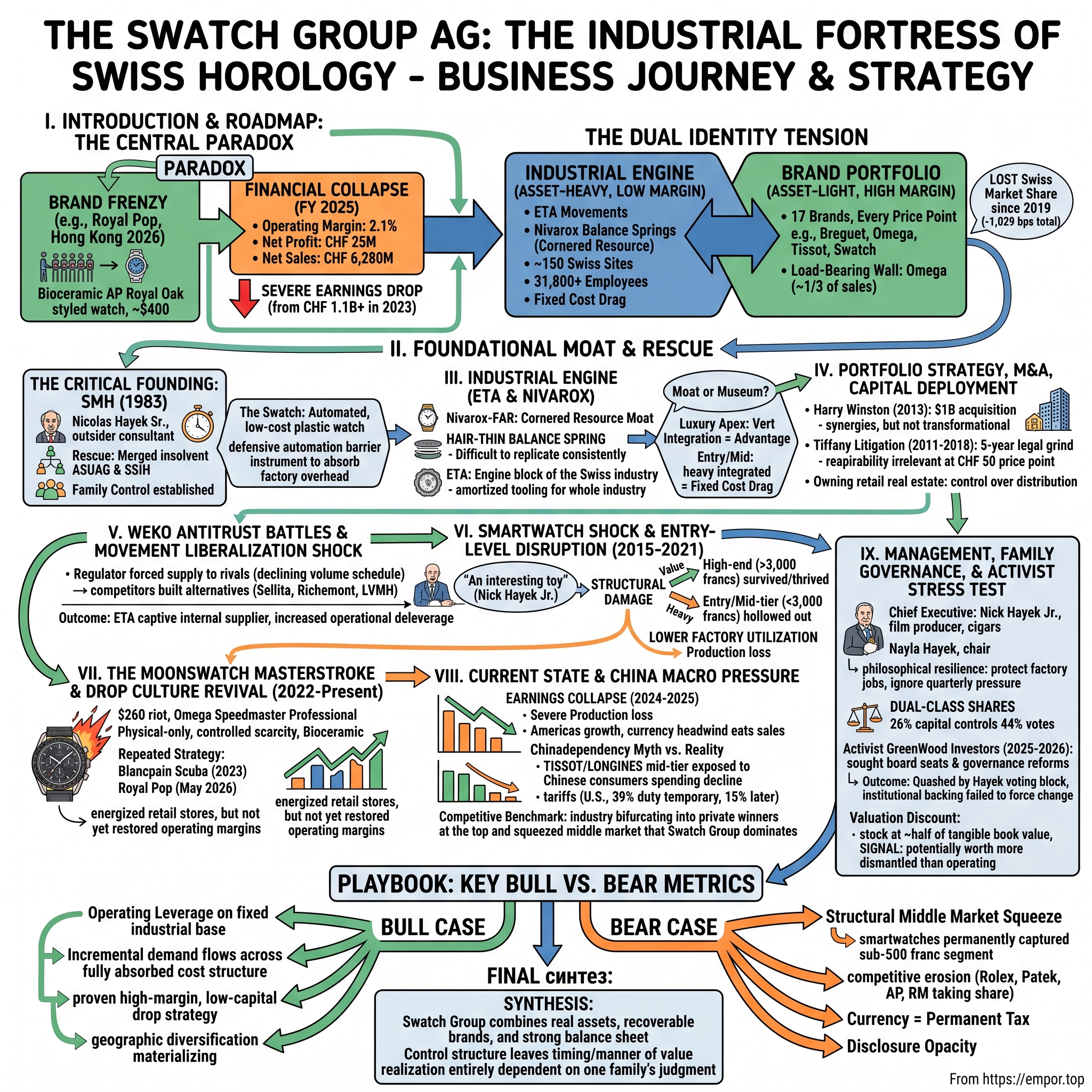
On a Saturday morning in May 2026, a queue snaked around a Swatch boutique in Hong Kong. The shoppers were not waiting for a mechanical tourbillon or a steel sports watch with a five-year waiting list. They were waiting for a plastic pocket watch — eight Bioceramic colorways styled like an Audemars Piguet Royal Oak, priced at roughly $400, limited to one per person per day, and sold exclusively in physical stores.1 Within hours, the collection had sold out worldwide. Swatch Group management later described the demand in unusually candid terms: "From day one, demand for Royal Pop far exceeded supply and this frenzy will continue for months to come."2
Here lies the central paradox. The same enterprise generating queues around the block on three continents — owner of Omega, Longines, Breguet, Blancpain, Harry Winston, Tissot, and eleven other brands, and manufacturer of the balance springs and escapements without which large parts of the Swiss watch industry would halt — reported an operating margin of just 2.1% for fiscal year 2025.3 Net profit stood at CHF 25 million on net sales of CHF 6,280 million.3 For a business whose operating profit exceeded CHF 1.1 billion as recently as 2023, that sharp drop represents a severe earnings collapse.4
The central tension at Swatch Group stems from its dual identity as two distinct businesses bound together, and the market has increasingly questioned whether that combination still holds. The first is an industrial engine comprising roughly 150 production sites in Switzerland, 31,800 employees across more than 50 countries, and a deeply embedded component supply chain — including ETA movements, Nivarox-FAR balance springs, Comadur ceramics, and EM Microelectronic chips — that remains exceptionally difficult to replicate.56 The second is a brand portfolio spanning every price point, from a CHF 60 Flik Flak children's watch to a high-jewelry Harry Winston diamond necklace. In theory, the industrial foundation subsidizes the brand house, while the brands monetize the manufacturing base. In practice, Swatch Group has lost more Swiss watch market share than any major rival since 2019 — ceding an estimated 216 basis points in 2025 alone to settle at roughly 16.1% of the market, down from about 26.4% in 2019, according to Morgan Stanley and LuxeConsult estimates.7[^8]
That divergence frames the primary question for long-term investors. Is Swatch Group a cyclical business navigating the trough of a steep downturn in China and unfavorable currency movements, anchored by CHF 11.7 billion in equity, an 87.1% equity ratio, and an inventory reserve that competitors would envy?8 Or is it a structurally disadvantaged asset in an industry bifurcating into a handful of private, supply-constrained luxury winners at the top and a squeezed middle market that Swatch Group dominates? While management argues the former, market pricing reflects the latter: the company's market capitalization fell from roughly CHF 20 billion a decade ago to under CHF 11 billion by early 2026, with one activist investor noting the shares traded at barely half of tangible book value — a signal that the stock market viewed the firm as potentially worth more dismantled than operating.910
The analysis that follows is organized around nine core questions. How did a management consultant rescue an entire national industry in 1983, and does that rescue still shape corporate strategy? What does Swatch Group control at the component level, and how much of that infrastructure forms a durable moat versus a legacy of Swiss industrial policy? How has the group deployed its capital across the Harry Winston acquisition, the Tiffany litigation, and its conservative stance on share buybacks? How did Swiss competition regulators spend two decades requiring Swatch to supply its own competitors, and what occurred when those mandates expired? How severely did the Apple Watch hollow out entry-level Swiss horology, and did management anticipate the shift? How did the MoonSwatch and its successors alter retail distribution? Where do the group's economics and geographic footprint stand after tariffs and shifting Chinese demand? Who controls the company, and what happened when an American fund manager attempted to force change? Finally, what conditions must hold for the bull case to succeed, what would break it, and which key metrics reveal the trajectory?
Start where the company started — in a country that had just watched its signature industry nearly die.
 Subscribe on LinkedIn
II. The Rescue of Swiss Watchmaking & Foundational Moat
The industry that nearly died
In the mid-1970s, a Swiss watchmaker could reasonably have believed the world would always need his craft. Precision timekeeping was simultaneously an art form, a national identity, and an export monopoly. Then a battery-powered quartz oscillator vibrating 32,768 times per second rendered two centuries of mechanical gear-train engineering obsolete virtually overnight. A cheap quartz movement kept better time than a hand-crafted mechanical caliber, cost a fraction as much, and could be assembled on automated production lines.
The companies that capitalized on this breakthrough were Japanese. Seiko launched the first commercial quartz wristwatch in 1969, and alongside Citizen Watch, flooded global markets with accurate, inexpensive timepieces. The Swiss industry responded with denial, followed by crisis. Employment collapsed, hundreds of watch firms folded, and by the early 1980s the two largest Swiss conglomerates — ASUAG, owner of Longines, Rado, and key component suppliers, and SSIH, owner of Omega and Tissot — were functionally insolvent, sustained only by emergency bank credit.
The consultant who refused to write the obituary
That collapse set the stage for Nicolas G. Hayek Sr., a Lebanese-born, Swiss-based management consultant who built a successful advisory firm and had precisely no romantic attachment to horology.46 Retained by creditor banks to study the wreckage and orchestrate a liquidation, Hayek recommended the opposite: merge the two failing giants and mount a competitive turnaround. In 1983, ASUAG and SSIH were combined into SMH, later renamed The Swatch Group AG.
Hayek Sr. brought an outsider’s perspective. He was an engineer and consultant rather than a watchmaker from the Jura valleys where industry families had intermarried for generations. Looking at a portfolio of distressed brands, he saw an uncompetitive cost structure rather than sacred heritage. He was also a formidable personality — combative, skeptical of industry orthodoxy, and prepared to risk his own capital. When banks hesitated to finance the merged group, Hayek led a syndicate of Swiss investors to acquire a controlling stake. That transaction established the family control structure that continues to shape corporate strategy four decades later.
Hayek diagnosed the Swiss crisis as an industrial problem rather than a cultural shift. Switzerland had lost market share at the low end not because quartz technology was inherently superior, but because Swiss factories could not produce a low-cost watch. His solution was the Swatch: a plastic watch containing 51 components instead of the traditional 91 or more, with the outer case serving directly as the movement baseplate. Assembled on automated lines with minimal manual labor, the watch was built primarily as an instrument to absorb factory overhead. The marketing elements — vibrant colors, artist editions, and encouraging buyers to collect multiple pieces — were commercial extensions of an engineering design.
That engineering architecture also established a defensive barrier. Traditional manufacturing required building a movement and placing it inside a separate case. The Swatch eliminated this intermediate structure, mounting components directly into the plastic case and ultrasonically sealing the unit. While this rendered the watch unrepairable — a controversial departure for traditional Swiss horology — repairability was irrelevant at a CHF 50 price point. More importantly, it enabled robotic assembly at speeds no low-cost overseas manufacturer relying on manual labor could match. Swatch competed not on labor rates, but on automation from within one of the world's highest-cost economies.
The dual-track bet, and what it cost
This operational design established a dual-track strategy: high-volume production at the entry level maintained factory utilization and sustained component manufacturing subsidiaries. High utilization enabled Swatch Group to maintain mechanical movement manufacturing at scale even during periods of depressed market demand. When global consumer preference swung back toward mechanical craftsmanship in the 1990s and 2000s, Swatch Group controlled both established prestige brands and the industrial infrastructure needed to supply them, whereas competitors held only brand names.
The high-end segment of the strategy was equally deliberate. In the early 1980s, when mechanical watchmaking was widely viewed as an obsolete craft, Hayek recognized that distressed assets could be acquired cheaply before scarcity restored their value. The group revitalized Omega following years of brand dilution from downmarket licensing, while retaining Longines, Rado, and Tissot. Through the 1990s, Swatch Group acquired premier high-horology houses, including Blancpain and Breguet, assembling a luxury portfolio at valuations impossible to replicate today. When the mechanical watch revival accelerated, driven by buyers seeking handcrafted mechanical objects, Swatch Group stood uniquely positioned across both manufacturing and retail distribution.
A secondary perspective on this corporate history is equally important for investors. The 1983 restructuring was an act of national industrial preservation as much as a private commercial venture, underwritten by Swiss banks and supported as critical national infrastructure. That founding mandate — acting as a custodian of Swiss manufacturing employment rather than purely optimizing capital allocation — remains embedded in group culture. Four decades later, Swatch Group still describes its refusal to cut production jobs during industry downturns as a core virtue, and still runs roughly 150 Swiss production sites.6 In 2025, that fixed cost structure operated as a major drag on group margins. Whether investors view this policy as prudent long-term stewardship or a structural tax on minority shareholders remains a key debate.
What the founding era established unequivocally was control over the physical chokepoints of Swiss watchmaking — the industrial foundation where the company's competitive moat resides.
III. The Industrial Engine: ETA, Nivarox, and the Cornered Resource Moat
The hair-thin spring that regulates an industry
A balance spring — the spiral — is a coiled hair of specialized alloy thinner than a human hair. Designed to expand and contract with temperature in a self-compensating rhythm, it flexes roughly 250 million times a year over the life of a timepiece. It is the single component that determines whether a mechanical watch keeps precise time or merely approximate time, and it remains notoriously difficult to manufacture consistently at industrial volume.
Swatch Group owns Nivarox-FAR, the subsidiary that manufactures the vast majority of these springs. While the group does not disclose precise market-share figures, industry estimates have long placed Nivarox at the overwhelming majority of Swiss balance spring and escapement assortment production — the closest thing the watch industry has to a cornered resource in strategist Hamilton Helmer's framework.5 The economics are counterintuitive: balance springs represent a tiny fraction of a watch's retail price, yet they are non-substitutable, technically demanding to qualify, and supplied at volume by essentially a single manufacturer. That industrial chokepoint explains why Swiss competition regulators have spent a quarter century scrutinizing Swatch Group.
ETA: the engine block of the Swiss industry
Sitting above Nivarox is ETA SA Manufacture Horlogère, the group's movement division and the most consequential industrial asset in Swiss watchmaking. For decades, ETA produced the standardized mechanical ébauches — the foundational movement architectures — on which the wider industry relied, including the 2824-2 automatic, the Valjoux 7750 chronograph, and their derivatives. A buyer purchasing a Swiss mechanical watch under CHF 5,000 in 1995 almost certainly relied on a Swatch Group caliber under the hood, regardless of the brand name printed on the dial.
In watchmaking, an ébauche functions much like an automobile engine block. It provides the complete mechanical architecture — the gear train, winding mechanism, and escapement mounting — supplied unfinished. A third-party brand purchases the movement, decorates it, regulates it to a chosen standard, attaches its own rotor and bridges, and markets the finished timepiece under its own moniker. This structure historically allowed hundreds of Swiss brands to claim mechanical credibility without building manufacturing infrastructure, while allowing ETA to amortize heavy tooling investments across the entire industry. For Swatch Group, the model proved doubly lucrative: the firm captured a baseline margin on competitors' watches, earned full retail margins on its own brands, and set the technical baseline for the mid-market.
Surrounding ETA and Nivarox is a cluster of specialized component manufacturers that explain much of Swatch Group's asset-heavy balance sheet. Comadur produces synthetic ruby bearings and technical ceramics; Universo manufactures watch hands; Rubattel & Weyermann crafts dials; Ruedin builds cases; and Micro Crystal supplies quartz resonators for battery-powered movements. Each represents a capital-intensive, high-precision manufacturing enterprise — precisely the type of low-margin operation that purely financial buyers might have outsourced decades ago.
The hidden semiconductor business
Parallel to its horological operations, the group operates its Electronic Systems segment. In 2024, the division generated CHF 330 million in sales and CHF 12 million in operating profit, representing roughly 5% of group revenue and a low-single-digit share of operating income.4 The segment encompasses EM Microelectronic, which designs ultra-low-power integrated circuits and RFID chips; Renata, which produces micro-batteries for timepieces, hearing aids, and medical devices; and a modest clean-energy research initiative. While financially minor, the unit provides strategic value, allowing Swatch Group to develop connected timepieces like the Tissot T-Touch Connect without depending on third-party silicon suppliers.
Moat or museum?
Whether this vast infrastructure constitutes a competitive moat or an industrial museum depends on the price segment. At the luxury apex, vertical integration remains a distinct advantage: Breguet, Blancpain, and Omega can engineer silicon escapements and proprietary anti-magnetic alloys because the group controls the underlying metallurgy. In the entry and mid-market segments, however, heavy integration acts as a fixed-cost drag. When retail demand falls, a vertically integrated manufacturer absorbs the full impact of operating deleverage, whereas asset-light rivals simply curtail third-party orders.
That structural vulnerability was fully evident in the group's 2025 financial results. The Watches & Jewelry segment excluding production generated CHF 549 million in operating profit at a 9.5% margin, but the Production segment reported a severe loss after management chose to maintain factory capacity and payroll rather than utilize Switzerland's short-time work compensation program.3 The resulting drag — eliminating roughly CHF 400 million in potential profit — illustrated the immediate cost of maintaining Swatch Group's industrial fortress.
Vertical integration accelerates profitability during industry expansions, but turns punitive during volume contractions. Because Swatch Group's manufacturing integration is heaviest in the entry and mid-tier price brackets — precisely where Swiss export volumes have contracted most severely — marketing alone cannot offset the underlying overhead burden.
That operational reality points to a critical strategic question: how effectively has management allocated the capital generated by its industrial fortress during peak market cycles?
IV. Portfolio Strategy, M&A, & Capital Deployment
Seventeen brands, one crowded ladder
Walk into the group's brand architecture and it resembles a well-planned city with an unusually crowded downtown. At the top sit Breguet, Blancpain, Glashütte Original, Jaquet Droz, Harry Winston, and Omega. Below them, the high range: Longines, Rado, and Union Glashütte. In the middle: Tissot, Certina, Mido, Hamilton, and Balmain. At the base: Swatch and Flik Flak. Seventeen brands, one shared component base, one shared retail network.
The theory behind this architecture is that a customer enters at Flik Flak or Swatch as a child, graduates to a Tissot at university, buys a Longines when the first real salary arrives, and eventually reaches Omega and beyond. It is the same ladder logic that Volkswagen Group applies to cars and that LVMH applies to leather goods. The theory has one demanding requirement: each rung has to be commercially healthy on its own terms, because a broken rung breaks the ladder. The strategic question hanging over Swatch Group for a decade has been whether the bottom two rungs — the ones the smartwatch attacked — still function as an entry ramp or merely as a legacy cost.
Omega is the load-bearing wall. Swatch Group does not disclose brand-level revenue — a disclosure gap that complicates outside analysis — but external estimates consistently place Omega at roughly a third of group sales and a considerably larger share of group profit.7 In the first half of 2026, Omega's own retail network grew 20% and accounted for 42% of the brand's turnover, a shift that tells as much about channel strategy as about demand.11 Longines has historically been the group's Greater China workhorse; Tissot is the global volume engine in entry mechanical watches; Swatch is the brand that generates cultural noise.
Harry Winston: the billion-dollar answer to Cartier
The single largest capital deployment in the group's modern history came on January 14, 2013, when Swatch Group announced the acquisition of the Harry Winston jewelry and timepiece business for $750 million in cash plus the assumption of up to $250 million of net debt — roughly a $1 billion enterprise value.12 The deal closed on March 26, 2013, and specifically excluded the seller's Canadian diamond mining operations, which continued separately.13
The strategic logic was sound and remains so. Watches are a cyclical, taste-driven, increasingly winner-take-most category. High jewelry is a different animal: it monetizes the same high-net-worth customer, carries structurally attractive gross margins, and — critically — is where the industry's most profitable competitor, Richemont's Cartier, actually makes its money. Swatch Group had no answer to Cartier and no meaningful jewelry franchise. Harry Winston gave it a genuinely blue-chip name, prime retail real estate on Fifth Avenue and Bond Street, and a customer file it could not have built organically.
The valuation was defensible at the time — roughly two times sales on the acquired business — and integration produced real synergies, most obviously the ability to put group-manufactured movements into Harry Winston timepieces rather than buying them. But thirteen years on, the honest assessment is that Harry Winston has been a decent asset rather than a transformational one. It has not scaled into a Cartier competitor, and it has not repositioned the group's revenue mix away from watches. Swatch Group remains an almost pure hard-luxury business, with essentially none of the leather goods, fragrance, or fashion diversification that lets LVMH and Richemont absorb a watch downturn. Harry Winston reduced the group's dependence on wristwatch cyclicality by less than the strategic rationale implied.
Tiffany: what a five-year lawsuit reveals about management
The other defining capital-allocation episode of the era was not an acquisition but a lawsuit — and it offers a better window into management's psychology than any strategy document. In December 2007, Swatch Group and Tiffany & Co. entered a joint venture to design, manufacture, and distribute Tiffany-branded watches from Switzerland. Sales disappointed. The venture was terminated in 2011 amid mutual accusations, and Swatch initiated arbitration under the rules of the Netherlands Arbitration Institute, alleging Tiffany had failed to develop the business as promised.
On December 21, 2013, the arbitral panel ruled for Swatch, ordering Tiffany to pay CHF 402.7 million — approximately $449.5 million — plus interest, an award that represented roughly 8.8% of what Swatch had claimed.14 Here the popular version of the story stops, and here is where investors should be careful, because the popular version is incomplete. Tiffany moved to annul the award in the District Court of Amsterdam in 2014, and in 2015 the Dutch trial court set the award aside, accepting the argument that the arbitrators had exceeded their mandate.15 Swatch appealed, the Court of Appeal reversed, and only in 2018 did the Dutch Supreme Court dismiss Tiffany's final appeal, making the original award enforceable.16 What looks in hindsight like a clean CHF 400 million win was in fact a five-year, multi-instance legal grind with a period during which the receivable had been judicially erased.
What both episodes reveal is a management team prepared to spend real money and real years defending what it regards as its property — a genuinely differentiated trait in an industry accustomed to quietly negotiated settlements. It also reveals a capital allocation style that is acquisitive only rarely, litigious when provoked, and otherwise almost entirely internally focused: build the factory, hold the inventory, keep the workforce. There have been no large buybacks, no portfolio pruning of underperforming brands, and no monetization of the group's substantial prime retail real estate.
This is where a second-layer look at the balance sheet becomes revealing. Swatch Group owns, outright, a portfolio of retail property in some of the most expensive commercial locations on earth — flagship boutiques on Zurich's Bahnhofstrasse, Fifth Avenue in New York, and comparable addresses in Tokyo and Hong Kong, much of it acquired decades ago at a fraction of current value and carried at historic cost. None of it is broken out separately in the accounts. The group has never conducted a sale-and-leaseback, never spun off a property vehicle, and never disclosed an independent valuation. For a business earning a low-single-digit return on its asset base, that is a substantial quantum of capital producing an accounting return close to zero and a strategic return that management describes as control over its own distribution. Analysts can debate whether owning shop windows represents a competitive advantage or a misallocation. What is not debatable is that shareholders have no visibility into how much capital remains tied up in those properties.
That inward orientation was, for two decades, tested most severely not by competitors but by regulators — who spent those decades trying to force Swatch Group to keep supplying the rivals it was competing against.
V. The WEKO Antitrust Battles & The Movement Liberalization Shock
The village with one well
Picture the Swiss watch industry in the year 2000 as a village with one well, owned entirely by Swatch Group. Every rival—from major luxury conglomerates like Richemont and LVMH to dozens of independent watchmakers—relied on Swatch Group to fill its buckets, paying a set price under an arrangement dating back to the industry's consolidation in the 1930s.
Nicolas Hayek Sr. decided Swatch Group would no longer operate as a public utility. Competitors, he argued, were treating ETA as an "easy supermarket"—purchasing movements at volume prices, bypassing research and development and capital expenditures, and using those savings to fund marketing campaigns against Swatch Group's own brands. In 2002, the group announced plans to phase out movement deliveries to third parties.
The Swiss Competition Commission, known as WEKO, intervened.[^18] The regulator ruled that ETA held a dominant market position and that an abrupt supply disruption would harm competition. That decision initiated one of the longest antitrust sagas in European industrial history, resulting in a sequence of negotiated settlements that obliged Swatch Group to supply third parties on a declining volume schedule. The most consequential agreement, reached in 2013, required ETA to continue deliveries through 2019 while stepping volumes down to roughly half their historical levels.
The regulator changes sides
By late 2019, when Swatch Group prepared to halt deliveries as agreed, the regulatory dynamics inverted. Having spent fifteen years fearing that ETA would cut competitors off, WEKO grew concerned that ETA—possessing an unbeatable cost scale—might price aggressively upon gaining commercial freedom, undermining the alternative movement suppliers created during the phase-out. In December 2019, the commission moved to restrict ETA from supplying third parties in 2020 pending a final decision.1718 Swatch Group issued a scathing public response, arguing that the regulator's "dictate harms the Swiss watch industry" and effectively punished the company for having invested where others had not.19 In 2020, the commission ultimately lifted the restrictions, leaving ETA commercially free while maintaining ongoing oversight.
What the industry built while Swatch was in court
The strategic consequences of this two-decade battle proved far more significant than the legal mechanics. The prolonged, predictable wind-down granted competitors what a sudden termination would have denied them: time to build alternatives. Sellita, which had spent years assembling movements from ETA components, reverse-engineered and industrialized its own calibers to become the default supplier for much of the mid-market. Independent producers like Soprod and Kenissi expanded capacity, while Richemont invested heavily in internal movement manufacturing for IWC, Jaeger-LeCoultre, and Panerai. LVMH built out capacity at TAG Heuer and Zenith, while Rolex—already fully vertically integrated—remained unexposed.
A notable strategic irony emerged from the saga. Swatch Group's central argument in 2002—that competitors were free-riding on its industrial capital and ought to develop their own capacity—was analytically correct over the long term. However, the regulator's extended timeline handed those competitors a fifteen-year transition window while ETA continued to supply them. Had supply ceased immediately in 2002, numerous mid-market Swiss brands likely would have folded or consolidated, allowing Swatch Group to capture their market share. Instead, the industry executed an orderly restructuring, effectively forcing Swatch Group to subsidize its rivals' path to independence. The result stands as a case study in how gradual antitrust remedies can leave a dominant supplier in a worse position than either immediate market liberalization or an unchecked monopoly.
The strategic outcome leaves Swatch Group in a vulnerable position. Having won the legal right to withhold supply, the group lost the broader commercial objective. Today, ETA operates primarily as a captive internal supplier, having exchanged a diversified external order book for complete reliance on its sister brands. When those brands see strong demand, ETA's facilities operate at high utilization. When sales contract—as occurred in 2024 and 2025—the absence of third-party order volume amplifies operational deleverage directly onto Swatch Group's income statement. In effect, the company traded revenue diversification for control just as its brand portfolio began ceding market share.
Regulators were not the only force reshaping the market during those years. While authorities in Bern and executives in Biel debated movement supplies, a technology giant in Cupertino was preparing to capture the wrist.
VI. The Smartwatch Counter-Shock & Entry-Level Disruption (2015–2021)
"An interesting toy"
In 2015, when asked repeatedly whether the newly launched Apple Watch threatened his business, Nick Hayek Jr. offered variations of the same response. It was, he suggested, an interesting toy rather than a revolution, and if anything, it was renewing consumer interest in wearing something on the wrist.20 Not everyone in the Swatch orbit shared his optimism. Elmar Mock, one of the engineers who co-invented the original Swatch, warned publicly that same year that the Swiss watch industry was heading for an "ice age."21
Both men proved partly right, making the decade that followed particularly complex to navigate. Hayek was correct that the Apple Watch would not destroy the Swiss mechanical watch. A 40,000-franc Breguet and a smartwatch are not functional substitutes; one is high jewelry with a mechanical engine inside, while the other is a wrist-borne digital peripheral. High-end mechanical watchmaking above 3,000 francs not only survived the smartwatch era, but thrived.
Mock, however, was right about everything below that threshold. The Apple Watch did not compete with Omega; it competed with the 150-franc quartz watch a teenager received for graduation, the 300-franc chronograph bought at an airport, and the entire entry-level tier through which the Swiss industry had historically recruited future customers. Those buyers were not weighing a Swiss watch against a smartwatch based on timekeeping accuracy. They were deciding how to allocate wrist real estate, and the digital alternative offered notifications, fitness tracking, and health monitoring.
Count the watches, not the francs
The structural damage shows most clearly in unit volume rather than revenue, explaining why value-based industry headlines consistently understated the problem. Swiss watch export volumes contracted for years while total export values remained roughly flat, buoyed by price increases at the top end. In 2025, total export value dipped 1.7% to 25.6 billion Swiss francs, but export volume dropped 4.8%—a loss of 740,000 watches—down to 14.6 million units.22 Timepieces with an export price below 500 francs fell 4.5% in value, marking the weakest performance across the three price categories.22 Measured over a decade, this hollowed out the entry tier and altered the industry's customer pipeline: selling fewer first Swiss watches meant cultivating a smaller pool of buyers who would eventually upgrade to a second.
For Swatch Group, this structural shift represented a worst-case scenario. No major competitor had more unit volume—and more manufacturing capacity—concentrated in the price bands directly exposed to smartwatch substitution. Tissot, Certina, Mido, Hamilton, and the core Swatch brand all sat squarely in the path of the disruption. Group operating margins, which had reached the mid-teens during peak demand cycles, entered a prolonged decline.4
The subtler operational consequence took a decade to fully manifest. Entry-level watches were never high-margin profit drivers, as margins on a 150-franc quartz watch are thin. Their primary function was providing unit volume to maintain high capacity utilization across the group's vertically integrated component factories. When millions of entry-level units disappeared from Swiss manufacturing lines, the immediate impact on profit was modest, but the compounding effect on factory utilization was severe. This dynamic connects a consumer electronics product launched in 2015 directly to a Production segment reporting deeply negative operating results a decade later. While asset-light competitors experienced the smartwatch as a revenue slowdown, Swatch Group absorbed it as an industrial burden.
Management's operational response was mixed. The group launched connected products, including the Tissot T-Touch Connect and Swatch Pay devices, drawing on proprietary chips from its EM Microelectronic subsidiary. None achieved meaningful market scale. The more effective response proved strategic rather than technological: shifting focus from competing on digital features to building emotional appeal, cultural relevance, and design-led scarcity—attributes standard computing devices cannot easily replicate.
The group also engaged in visible legal signaling. Swatch aggressively pursued trademark claims against Apple over marketing phrases with horological history, most notably contesting "one more thing" and "tick different." These disputes produced mixed court rulings across multiple jurisdictions and negligible economic impact, serving primarily as public signaling. A company entirely unconcerned by a competitor rarely litigates its marketing slogans.
As a matter of forecasting, Hayek's early dismissal of smartwatches aged poorly, underestimating a structural threat to the company's volume base. As a matter of strategy, however, the group's eventual pivot away from feature competition proved far more pragmatic than its initial public rhetoric suggested. In 2022, that strategic shift yielded the company's most commercially successful concept of the century.
VII. The MoonSwatch Masterstroke & Retail Drop Culture Revival (2022–Present)
A $260 riot
The Omega Speedmaster Professional is famous as the watch worn on the moon, retailing above $7,000—a price point well beyond most watch enthusiasts. In March 2022, Swatch Group executed a strategy unprecedented for a major luxury conglomerate: it adapted that iconic design into a ceramic-and-bioplastic composite called Bioceramic, placed both the Omega and Swatch logos on the dial, and offered the timepiece for $260.
The commercial response went far beyond a routine product launch. Overnight queues formed outside Swatch boutiques in major global cities, including Tokyo, London, Paris, Milan, and New York, forcing several locations to close temporarily. Units purchased hours earlier were resold on secondary marketplaces at steep markups.23 The company's stock price surged on the news of a plastic timepiece—a rare reaction for an enterprise with 6 billion Swiss francs in revenue.24
Three deliberate operational choices underpinned the MoonSwatch strategy:
- Physical-only distribution: Swatch declined to sell the MoonSwatch online. While competing luxury brands prioritized e-commerce expansion, Swatch Group turned the physical queue into a marketing event. This strategy drove foot traffic into a retail boutique network underutilized during the rise of smartwatches, converting a fixed-cost real estate burden into an interactive brand platform.
- Borrowed prestige and high margins: The collaboration transferred Omega's brand equity to a low-cost manufacturing platform. The gross margin profile of a $260 Bioceramic quartz watch substantially exceeded that of an entry-level mechanical timepiece, while requiring no incremental brand-building expenditure because the core equity was already owned on the group's balance sheet.
- Controlled scarcity without hard caps: The models were not structured as numbered limited editions. Instead, supply was constrained relative to immediate demand on a store-by-store, day-by-day basis, sustaining consumer interest far longer than a fixed production run would have allowed.
Did it dilute Omega? The evidence says no
The financial impact of the initiative was substantial. Swatch confirmed sales of more than one million MoonSwatches by the end of 2022. Industry estimates placed annual volumes near 1.5 million units by 2024, at which point the collaboration reportedly represented roughly two-thirds of total Swatch brand sales.25 That concentration underscores how dependent the flagship Swatch brand has become on high-profile collaborative drops.
Concerns that a budget product would dilute Omega's luxury prestige proved unfounded. Instead, Omega reported that sales of genuine mechanical Speedmasters rose materially in the months following the MoonSwatch launch, as the campaign introduced the Speedmaster heritage to a broader audience.23 Rather than cannibalizing higher-priced timepieces, the $260 model operated as a profitable marketing channel that generated gross margins while building brand awareness.
From one hit to a repeatable capability
Swatch Group subsequently expanded the drop strategy across its portfolio, introducing the Blancpain x Swatch Scuba Fifty Fathoms in 2023, followed in May 2026 by Royal Pop—a series of eight Bioceramic pocket watches designed in the silhouette of the Audemars Piguet Royal Oak, sold exclusively through select boutiques with a strict limit of one piece per customer daily.1 Unlike earlier efforts involving sister brands, this release partnered with Audemars Piguet—an independent, family-controlled manufacturer and key rival in the luxury market. Securing an external competitor's signature design asset for a $400 Swatch highlighted the commercial reach of the drop model, with management reporting that the campaign generated over 25 billion social media views.26
Despite these promotional milestones, the strategy carries structural risks. A collaboration relies on borrowing equity from higher-tier brands, a mechanism that yields diminishing novelty over successive iterations. The Blancpain edition drew smaller crowds than the initial MoonSwatch launch, and the long-term momentum of Royal Pop remains unproven. If the core Swatch brand relies primarily on third-party design drops for sales growth, its standalone brand equity risks being converted into a series of short-term retail events—a model that offers limited downside protection if consumer interest wanes.
Furthermore, engagement metrics have not translated into sustained group profitability. While collaborations generated foot traffic and top-line expansion, they failed to restore underlying operating margins. In the first half of 2026—a period covering the Royal Pop launch—group operating profit fell to CHF 52 million from CHF 68 million a year earlier, missing consensus analyst expectations of CHF 120 million by roughly CHF 68 million.2 Although constant-currency sales expanded 8.5%, operating profit contracted.27 The drop strategy has energized retail stores, but it has not yet overcome the structural margin pressure weighing on Swatch Group's broader manufacturing base.
VIII. Current State, Segment Economics, & The China Macro Pressure
Two years that erased nine-tenths of the earnings
The speed of the financial downturn was sharper than standard cyclical narratives suggest. In 2023, Swatch Group generated an operating profit of 1,191 million Swiss francs on an operating margin of 15.1%. In 2024, net sales fell to 6,735 million francs as operating profit dropped to 304 million francs, reducing the operating margin to 4.5%.4 In 2025, sales slid a further 1.3% at constant exchange rates—down 5.9% at reported rates—to 6,280 million francs, while operating profit fell to 135 million francs and net profit landed at 25 million francs, an 89% decline.328 Over two years, roughly nine-tenths of the group's operating earnings vanished.
Segment composition explains the underlying driver. The Watches & Jewellery division excluding Production still earned 549 million francs at a 9.5% operating margin in 2025.3 The entire gap between that divisional earnings figure and the group's consolidated operating profit of 135 million francs stemmed from the Production segment, where management chose to maintain capacity and jobs rather than furlough workers under Switzerland's short-time working scheme.3 This accounting distinction carries a clear governance implication: in 2025, roughly three-quarters of the group's brand-level operating profit was absorbed by a deliberate choice to preserve industrial capacity. Management has maintained this policy for years, telling reporters plainly that whatever happens, "we stick with our people."29
Underneath the earnings collapse lay several operational improvements. Operating cash flow rose 52.3% to 507 million francs in 2025, while inventories—a frequent target of bear-case arguments—declined 346 million francs, or 4.5%.38 The Americas delivered record performance, with U.S. sales rising roughly 20% in local currency alongside double-digit growth in India, the Middle East, Mexico, and Poland.30 Top-line momentum built throughout the year, with second-half sales rising 4.7% at constant exchange rates and fourth-quarter growth reaching 7.2%.30
The 2026 recovery, and the franc that keeps eating it
In the first half of 2026, net sales reached 3,121 million francs, up 8.5% at constant exchange rates, as second-quarter growth of 9.4% accelerated to 13.1% in May and June alone.2711 Regional gains were widespread: sales rose 27% in the United States, 41% in Saudi Arabia, 38% in India, 28% in Spain, 26% in Mexico, 20% in Japan, and 9% in Chinese retail.11 Directly operated retail sales grew 18%, e-commerce expanded 30%, and own-retail channels generated close to half of divisional revenue.11 Against a contracting broader Swiss watch export market, the group gained back market share over the six-month period.
And yet reported sales rose only 2%, as adverse currency movements erased nearly 200 million francs.27 This mismatch highlights the company's most persistent structural vulnerability: Swatch Group incurs manufacturing costs almost entirely in Swiss francs while generating revenue worldwide in dollars, euros, yen, and renminbi. Whenever the franc appreciates—as it routinely does during global market stress—operating margins compress mechanically regardless of local sales performance. A company with an 87.1% equity ratio and 1.125 billion francs of net liquidity possesses the financial strength to absorb this friction indefinitely, but management lacks a structural mechanism to halt the currency drag.811
China: the dependency that shrank rather than diversified
Myth versus reality on China. Conventional wisdom holds that Greater China accounts for 30% to 35% or more of Swatch Group's revenue. While historical reports placed the peak contribution at over 40% of sales, that figure no longer reflects current operations.9 Management commentary in 2025 placed China at roughly 24% of total group sales.31 That shift carries dual implications: Swatch Group is far less reliant on Chinese demand today than consensus believes, but that reduced exposure stems from market contraction rather than intentional geographic diversification. The luxury market downturn in China (中国) that began in 2023 combined real estate wealth contraction, subdued consumer sentiment, and a policy environment emphasizing common prosperity (共同富裕) that made conspicuous consumption socially awkward. Consequently, Swiss watch exports to mainland China fell 12.1% in 2025, while shipments to Hong Kong declined 6.5%.22 The downturn concentrated squarely in Swatch Group's core demographic—aspirational middle-class consumers—rather than among wealthy buyers, who continued purchasing ultra-high-end timepieces.9 Although the group's Chinese retail sales returned to growth in the first half of 2026, that recovery comes off a severely depressed baseline.
Understanding the distribution structure is critical for evaluating any potential rebound. Swatch Group built its Chinese footprint across three distinct channels that have diverged sharply. Department store and shopping mall concessions across tier-one and tier-two cities drove massive volume for Longines and Tissot throughout the 2010s, but absorbed the heaviest impact from the consumer spending decline. Onshore duty-free retail in Hainan (海南)—promoted by Beijing as an onshore substitute for overseas travel shopping—experienced an initial surge before normalizing. Meanwhile, outbound travel retail, where Chinese tourists purchased timepieces in Europe, collapsed during the pandemic and has recovered only partially as spending shifted domestically. Reaching former revenue levels in China would require simultaneous recoveries across all three channels, each operating under distinct margin economics. Because management does not disclose the breakdown among these channels, financial modeling of a Chinese recovery remains highly uncertain.
The tariff shock. External pressures escalated from another key market in mid-2025. A 39% U.S. tariff on Swiss goods took effect on August 7, 2025, penalizing Swatch Group's strongest regional market. The immediate impact on the industry was severe: Swiss watch exports to the United States plummeted 55.6% in September 2025, dropping from 355 million francs to 158 million francs.32 On November 14, 2025, the United States and Switzerland announced an agreement reducing the duty to 15%, which was later formalized retroactively to that date.3334 While far lower than the initial spike, 15% remains substantially above pre-2025 levels, imposing a permanent cost burden on the group's fastest-growing geographic market. Although the 27% U.S. sales growth recorded in the first half of 2026 indicates strong underlying consumer demand, the precise margin compression caused by the duty has not been disclosed.
The war game: four private brands taking the whole market
Competitive benchmarking. The broader industry data highlights a stark competitive divide. Morgan Stanley and LuxeConsult estimate that the four largest privately held Swiss brands—Rolex, Patek Philippe, Audemars Piguet, and Richard Mille—collectively controlled 49.1% of the market in 2025, capturing an additional 2.2 percentage points of share during a year when overall industry revenue contracted.7 Over the same period, Swatch Group suffered the largest market-share drop in the industry, losing roughly 216 basis points in 2025 for a cumulative decline of about 1,029 basis points since 2019.7 Growth was concentrated at the extreme high end: watches priced above 50,000 francs generated 89% of the industry's total growth in 2025 and represented 37.3% of export value, despite accounting for just 1.4% of unit volume.7
That concentration illustrates Swatch Group's central strategic dilemma: virtually all industry growth has gravitated toward a price category where the group holds minimal market presence. Rival conglomerate Richemont captures this high-margin demand through Cartier and Van Cleef & Arpels, generating operating margins far above Swatch Group's recent levels. LVMH continues scaling TAG Heuer, Hublot, Zenith, and Tiffany with aggressive marketing and distribution power, while Rolex maintains unmatched pricing power and supply discipline as a private entity. Swatch Group disputes the Morgan Stanley market-share estimates but declines to publish brand-level revenue figures that would settle the debate—a disclosure strategy that, in practice, leaves analysts to define the market narrative.9
The enterprise that emerges from these figures possesses improving operational momentum, a formidable balance sheet, a persistent currency handicap, and a portfolio heavily weighted toward a middle market that is losing ground. That reality leads directly to the leadership that controls the enterprise and determines its future path.
IX. Management, Family Governance, & Activist Stress Test
In March 2010, Swatch Group's board convened under difficult circumstances: founder Nicolas Hayek Sr. had died at his desk in the Biel headquarters at age 82, still working. He had spent 27 years as the most consequential figure in Swiss industry, and his succession had been arranged years earlier—his son as chief executive, his daughter as chair. That transition transferred far more than two leadership titles; it passed down an entire corporate philosophy, whose durability through subsequent industry shifts remains the central feature of Swatch Group's governance.
Chief Executive Nick Hayek Jr. is not a conventional luxury leader. Before joining the family business, he worked as a film producer and director. He routinely conducts interviews while smoking cigars, dismisses sell-side analysts and central bankers with equal vigor, refuses to hold quarterly earnings calls, and has run the company since 2003 on an operating model that would be unrecognizable at LVMH: manufacture in Switzerland, protect factory jobs, ignore quarterly earnings pressure, and let product design speak for itself. His sister, Nayla Hayek, chairs the board and personally manages the Harry Winston business.35 Both are children of the founder.
The absence of quarterly financial reporting shapes the entire information environment surrounding the stock. Swatch Group reports financial results only twice a year. It holds no quarterly earnings calls, provides no forward guidance, and hosts no analyst Q&A sessions where executives must address performance misses in real time. Management contends that quarterly reporting fosters destructive short-termism, an argument supported by the fact that the four privately held brands taking market share from Swatch Group report no public data at all.9 Unlike those private entities, however, Swatch Group relies on public shareholders for capital. For investors, the practical consequence is that standard tools for assessing management credibility—tracking consistency under pressure and evaluating operational explanations—are largely unavailable. Judgment must be formed through biannual press releases, annual reports, and media interviews, a far narrower evidentiary foundation.
How 26% of the capital controls 44% of the votes
The company's control mechanism relies on a dual-class share structure inherited from its founding. Swatch Group issued registered shares with a nominal value of 0.45 Swiss francs and bearer shares with a nominal value of 2.25 Swiss francs, with each share carrying one vote regardless of class. As a result, a registered share provides five times the voting power per franc of capital. The Hayek family pool and associated parties hold roughly 26% of total equity capital while controlling approximately 44% of the voting rights—a position that effectively functions as majority control given typical annual general meeting attendance.936 Three family members sit on an eight-person board, alongside three non-executive directors who have served over 15 years, well exceeding standard governance thresholds for independence.9
For decades, public shareholders accepted this control structure because it generated strong operational returns. A controlling family operating with a multi-generational time horizon, insulated from activist demands, could make long-term investments in industrial capacity that quarterly-driven management teams would have discarded. That tacit compromise fractured when capital returns collapsed.
The activist challenge. In May 2025, GreenWood Investors—a U.S. fund managed by Steven Wood—submitted a resolution to elect Wood to the board at the May 21 annual general meeting.37 The board recommended voting against his candidacy, citing his non-Swiss nationality and residency.38 The resulting vote highlighted the structural divide: among bearer shareholders voting within their class, Wood secured roughly 62% support, but in the combined vote, 79.2% of total shares voted against his election.39
Wood escalated his campaign in November 2025, issuing a public critique of board oversight and proposing a package of governance reforms.40 Ahead of the May 2026 annual meeting, GreenWood renominated Wood and submitted six governance proposals: guaranteeing bearer shareholders three dedicated board seats, requiring a majority of independent directors, separating the chair and CEO roles, increasing independence on board committees, establishing auditor term limits, and enabling hybrid meeting attendance. GreenWood argued that Swatch Group resembled an overwound mainspring constrained by governance rather than brand equity or craftsmanship, emphasizing that "minority shareholders, who represent a majority of the company's economic ownership, have little meaningful voice in the boardroom."41
The reform proposals gained substantial institutional backing. Proxy advisers Institutional Shareholder Services and Glass Lewis both recommended that shareholders vote for Wood's nomination and governance proposals ahead of the May 12, 2026 meeting, citing the value of adding independent capital-markets and operational expertise.42 Swiss proxy adviser Ethos had previously supported Wood's 2025 candidacy.
The institutional backing proved insufficient. At the May 2026 annual general meeting, 79.6% of votes were cast against Wood's election—a result virtually identical to the prior year despite the unanimous endorsement from proxy advisers.4344 The Hayek family's voting block, combined with its board seats, proved decisive.44
What a skeptical investor should actually take from this. The outcome offers three clear conclusions for investors:
First, the governance discount reflecting this control structure is a permanent structural feature rather than a temporary perception gap. Minority shareholders cannot compel share buybacks, mandate real estate monetization, force the sale of underperforming brands, or require brand-level financial disclosures. Two consecutive annual general meeting votes with near-identical outcomes demonstrate that public market pressure cannot override the family's voting power. Valuation models that anticipate a governance-driven re-rating rely on an assumption contradicted by empirical evidence.
Second, the activist critique regarding capital efficiency remains compelling. GreenWood's core observation—that Swatch Group shares traded at roughly half of tangible book value, signaling that the market viewed the company as worth more liquidated than operated—highlights a fundamental issue of capital productivity rather than board composition.10 The group's inventory position, still above 7 billion Swiss francs after the 2025 reduction, alongside its portfolio of prime retail real estate, represents substantial capital earning very little.8 Management counters that watch inventories consist largely of raw gold and precious stones that preserve value, and that maintaining component stocks allows the group to satisfy demand surges immediately. While both arguments contain merit, only one is supported by a decade of declining capital returns.
Third, regarding management credibility, executive narrative execution has remained remarkably consistent. Chief Executive Nick Hayek Jr. pledged not to cut Swiss production jobs during industry downturns and maintained payroll at an estimated cost of 400 million Swiss francs in 2025 operating profit. He promised to resist quarterly earnings pressure and maintained a biannual reporting schedule. He argued that collaborative product drops would reinvigorate physical retail stores, and direct retail sales expanded 18% in the first half of 2026. The primary concern is not narrative inconsistency or broken promises, but that faithful execution of this strategy has coincided with a decade of market-share loss. Furthermore, management attributes these market-share losses primarily to external factors—currency appreciation, Chinese demand weakness, and tariffs—while disputing third-party market-share data without disclosing internal brand performance to refute it.
The privatisation question
These dynamics regularly revive speculation regarding privatization: whether the controlling family might eventually partner with private capital to acquire minority shares and take the enterprise private. Although no transaction has been formally proposed, privatization represents the logical conclusion of a governance structure where controlling shareholders remain insulated from public equity market demands.
With governance control firmly established, the long-term investment case reduces to a fundamental evaluation of competitive positioning and capital efficiency.
X. Playbook, 7 Powers, & Bull vs. Bear Case
Seven Powers, honestly applied
Analyzing Swatch Group through Hamilton Helmer's 7 Powers framework yields a nuanced picture that sits between bullish defense and bearish pessimism. The enterprise holds two genuinely strong powers, two contested ones, and one notable absence.
Cornered Resource — strong, and narrowing in relevance. Nivarox's position in balance springs and assortments represents a genuine cornered resource: a physically scarce, hard-to-replicate capability with no high-volume substitute. Omega's association with the Apollo space program is a second cornered resource, unbuyable at any price. However, the strategic value of controlling component supplies has fallen as industry growth has migrated to a price tier where every major competitor is already vertically integrated. Owning the central well matters less when rivals have dug their own.
Scale Economies — strong within its tier, irrelevant above it. No competitor can match Swatch's unit cost in manufacturing Bioceramic cases and quartz movements. That cost advantage is decisive at $260, but offers zero benefit at $50,000, where scale is a liability and scarcity defines the product.
Process Power — strong and durable. Decades of accumulated tacit manufacturing knowledge underpin the group's capabilities in silicon balance springs, anti-magnetic architectures, ceramic formulations, and industrialized assembly. This operational capability cannot be quickly acquired or replicated, representing perhaps the group's most underappreciated asset and the one least reflected in its market valuation.
Brand Power — bifurcated and, in the middle, eroding. Omega, Breguet, Blancpain, and Harry Winston command genuine pricing power. Longines and Tissot carry broad brand recognition, but limited pricing power. In the middle tier — Certina, Mido, Balmain, and Union Glashütte — brand power is thinnest and the logic for portfolio consolidation is most compelling, though management has shown no inclination to prune.
Switching Costs — essentially absent. Consumers face no lock-in when choosing a wristwatch. Every purchase is contested from scratch, making brand desirability paramount and rendering any loss of cultural momentum particularly dangerous.
Five forces: why the industry structure explains the margin
Layering Michael Porter's five forces onto the business explains Swatch Group's margin profile better than any company-specific narrative:
- Rivalry is intense and asymmetric, with four privately held, supply-disciplined competitors controlling nearly half the market while facing no quarterly earnings pressure.
- Buyer power is rising as multi-brand retailers consolidate and consumers price-check globally, driving Swatch Group to expand direct-operated retail toward half of divisional sales.
- Supplier power is low for Swatch Group due to deep integration, but structurally high for unintegrated rivals — forming the traditional core of the group's moat.
- Substitutes are severe at the bottom of the market, where smartwatches have permanently taken the entry ramp, and negligible at the top.
- Barriers to entry in traditional Swiss mechanical watchmaking are formidable, whereas barriers to entry in wrist-worn consumer technology are far lower.
The Bull Case
The bull case does not depend on a Chinese market recovery, though a rebound would accelerate progress. Instead, it rests on three specific operational mechanisms with observable evidence behind them.
First is operating leverage on a fixed industrial base. The group has already absorbed the cost of maintaining full production capacity through the industry trough. Every incremental franc of demand now flows across a fully absorbed cost structure. The first half of 2026 demonstrated this dynamic: within the Watches & Jewelry division, operating margins expanded to roughly 15% in May and June, compared to 9.0% for the half as a whole.11 If sustained, this shift marks a return toward pre-collapse profitability.
Second is the collaboration playbook as a durable, repeatable capability rather than a one-off stunt. Four years and three major product launches after the MoonSwatch debut, the direct-to-consumer drop model has proven it can generate global queues, re-energize an underutilized boutique network, sell through inventory rapidly, and — as demonstrated by Royal Pop — attract an external rival as a partner. It is a high-margin, low-capital strategy that is difficult to copy because it requires simultaneous ownership of a mass-market brand, a luxury icon, and a physical retail footprint.
Third is geographic diversification that is actively materializing rather than merely promised. Sales growth in the United States, India, Saudi Arabia, Mexico, Japan, and Spain expanded at double or triple the group average in the first half of 2026.11 This performance reduces structural reliance on any single regional market, smoothing revenue volatility across cycles.
Underpinning these drivers is a balance sheet featuring CHF 11.7 billion in equity, an 87.1% equity ratio, and net liquidity above CHF 1.1 billion.811 This capital structure eliminates refinancing and covenant risks, granting management the flexibility to navigate extended downturns without distress.
The Bear Case
The bear case is not that Swatch Group fails, but that it persists — profitably enough to survive, yet unprofitably enough never to re-rate.
The governance discount is structural rather than cyclical. With two consecutive general meeting votes confirming the Hayek family's control, minority shareholders lack any mechanism to compel capital efficiency. Capital will remain tied up in low-return inventory and real estate holdings because the controlling shareholder considers that strategy appropriate.
Competitive erosion poses a deeper threat. A cumulative market-share loss of roughly ten percentage points since 2019 reflects positioning challenges rather than transient currency or regional headwinds.7 The group remains heavily exposed to shrinking mid-tier price bands while holding limited representation in the high-end tier driving nearly all industry growth. Simultaneously, flagship engine Omega has by some accounts slipped behind Audemars Piguet and Patek Philippe in the brand hierarchy.9 Rebuilding high-end prestige requires a decade of consistent scarcity discipline, which may prove difficult for an organization built around industrial volume.
The structural middle-market squeeze continues. Smartwatches have permanently captured the sub-500 franc segment, where export unit volumes continue to fall.22 The entry-level pipeline that historically introduced consumers to Swiss watchmaking no longer operates through traditional quartz models.
Currency acts as a permanent tax with no operational remedy short of moving production outside Switzerland — a step management will not take, and which would undermine the "Swiss Made" designation that justifies premium pricing. In the first half of 2026 alone, a CHF 200 million foreign exchange headwind exceeded the group's total operating profit for that half.272
Finally, disclosure opacity reinforces this discount. A company that eschews quarterly reporting, withholds brand-level revenues, and disputes external market-share estimates without offering alternatives asks investors for high trust. The resulting information asymmetry consistently attracts a valuation discount.
The synthesis: Swatch Group combines real industrial assets, recoverable brands, and balance sheet strength with a control structure that leaves the timing and manner of any value realization entirely dependent on one family's judgment. The bull case requires the operating recovery visible in mid-2026 to persist through a full cycle. The bear case requires only that the trajectory of the past decade continue.
Which means the investment case can be tested — with a small number of specific, observable measures.
XI. Key Investor KPIs, Risks, & Final Thesis
Three numbers that actually discriminate
Most Swatch Group analysis relies on metrics that fail to distinguish between the bull and bear cases. Reported sales growth is distorted by currency swings, net profit is skewed by deliberate manufacturing capacity decisions, and social media engagement is not a financial metric. Three specific operational measures determine how the investment thesis will resolve:
1. Watches & Jewellery operating margin excluding Production, versus historical performance and luxury peers. This metric provides the clearest measure of whether the brand portfolio is recovering pricing power, as it isolates brand performance from currency movements and the fixed costs of maintaining domestic manufacturing employment. The critical benchmarks are the 9.5% operating margin recorded for full-year 2025, the 9.0% recorded for the first half of 2026, and the roughly 15% margin achieved in May and June 2026.311 If that late-period run rate proves sustainable rather than a seasonal anomaly, the operating-leverage thesis is validated. If the division reverts to roughly 9%, the group remains a lower-margin enterprise than its prestige brand names suggest, and the performance gap relative to Richemont's jewelry houses will continue to widen.
2. Swiss watch export volume, rather than value, in the sub-500 franc and 500-to-3,000 franc price tiers. The Federation of the Swiss Watch Industry publishes monthly export figures, providing the most reliable external gauge of whether Swatch Group's core middle-market demographic is stabilizing.45 While the group does not disclose unit volume, industry-level export data reflects these shifts. Export value totals have historically been supported by mix shifts toward ultra-high-end timepieces where Swatch Group has limited exposure. Unit trends in the specific price brackets where the group competes signal whether entry-level and mid-tier demand has established a floor. Two consecutive years of stabilizing unit volume in these tiers would indicate a genuine operational inflection, whereas continued unit contraction of the scale seen in 2025 would confirm a permanent structural squeeze.
3. Inventory levels relative to sales across multiple reporting periods. The 346 million Swiss franc inventory reduction in 2025 provided the first tangible evidence in years of management converting working capital into cash rather than retaining it as strategic reserve.8 Sustained inventory discipline alongside top-line growth would fundamentally improve free cash flow generation and present a direct rebuttal to activist criticism. Conversely, a single year of inventory reduction driven by broader demand shifts rather than policy discipline would not alter the long-term capital efficiency thesis.
A secondary consideration is what investors should disregard. Reported sales growth offers limited insight during periods of significant currency volatility, as it conflates underlying consumer demand with fluctuations in the Swiss franc—two forces with opposing investment implications. Consolidated net profit is similarly unhelpful, given that it reflects an explicit management policy to absorb factory capacity costs rather than an unconstrained operating result. Finally, marketing engagement metrics carry no demonstrated correlation with sustained revenue generation in hard luxury.
Risk radar
Four primary risks require analytical modeling, while several commonly highlighted concerns are secondary:
First, portfolio-positioning risk: the ongoing shift of industry growth into price tiers where Swatch Group lacks meaningful scale. This is a structural trend rather than a cyclical macro risk. Addressing it requires direct strategic action—such as brand repositioning, portfolio rationalization, or expanding into high jewelry—none of which management has announced.
Second, currency risk: a structural liability that cannot be effectively hedged, given that manufacturing costs are denominated in Swiss francs while revenues are earned globally. Foreign exchange headwinds have repeatedly exceeded the group's total operating profit. Any renewed appreciation of the franc directly compresses reported earnings.
Third, trade and geopolitical risk: as demonstrated by the 2025 trade dispute, when a 39% duty was briefly imposed on the group's largest market. The subsequent 15% negotiated tariff rate represents a settlement rather than a permanent guarantee, remaining well above historical baseline costs.
Fourth, technology and demographic risk: the long-term question is no longer whether smartwatches displace entry-level Swiss quartz models—that shift has already occurred—but whether younger consumers accustomed to health-tracking wearables and ambient digital devices will develop an affinity for mechanical horology. This represents a multi-decade structural risk that governs whether demand at the higher end of the market remains durable.
Conversely, financing risk, liquidity risk, and going-concern risk are negligible. Supported by an 87% equity ratio and net liquidity exceeding 1.1 billion Swiss francs, Swatch Group maintains one of the most conservative balance sheets among European consumer goods enterprises.811 The investment risks pertain strictly to capital returns rather than corporate solvency.
Final thesis
Swatch Group was constructed by a founder hired to liquidate an industry who chose instead to rebuild it. That origin established a fixed hierarchy of corporate priorities—preserve industrial capacity, protect domestic employment, control component supply, and disregard short-term market expectations—that has remained unchanged through the smartwatch disruption, a Chinese market contraction, trade tariffs, and a decade of market-share erosion. The strategy is internally consistent for an enterprise optimizing for multi-generational industrial independence.
However, that corporate objective differs fundamentally from the returns required by public minority shareholders. The valuation discount directly reflects the gap between an industrial preservation strategy executed with conviction and the capital-productivity standards demanded by public markets. While the operational recovery observed in the first half of 2026 is tangible, the balance sheet exceptionally strong, and the collaborative product drop model a proven asset, these factors do not eliminate the governance discount. Whether that valuation gap ever closes depends not on external variables like currency or regional demand, but on whether the controlling family decides to align corporate strategy with public market expectations.
References
-
Swatch x AP: The $400 Royal Oak Exists. It Fits in Your Pocket. — WatchTime, 2026 ↩↩
-
Swatch posts better H1 sales but misses profit forecasts — RTÉ, 2026-07-21 ↩↩↩
-
The Swatch Group reports 2025 fiscal results and 2026 outlook — Time and Watches, 2026-01 ↩↩↩↩↩↩↩↩
-
Swatch Group Revenues and Profit Down in 2024 — Monochrome Watches, 2025 ↩↩↩↩
-
Morgan Stanley/LuxeConsult: Watch Report 2025 — Four manufacturers dominate the Swiss watch industry — Insight Luxury, 2026-03-13 ↩↩↩↩↩↩
-
Annual Report and Sustainability Report 2025 — The Swatch Group AG, 2026 ↩↩↩↩↩↩↩
-
First Half 2025 Letter: Durability & Balance — GreenWood Investors, 2025 ↩↩
-
Swatch Group Half-Year Report 2026: Sales Growth, Market Share — The Hour Markers, 2026-07 ↩↩↩↩↩↩↩↩↩↩
-
Swatch Group acquires the jewelry and watch brand Harry Winston Inc. — The Swatch Group AG, 2013-01-14 ↩
-
Swatch Group Completes $1 Billion Harry Winston Acquisition — Forbes, 2013-03-26 ↩
-
Award Issued in Arbitration Between The Swatch Group Ltd. and Tiffany & Co. — Tiffany & Co., 2013-12 ↩
-
Swatch Group: Tiffany Arbitration Award Set Aside — The Swatch Group AG, 2015 ↩
-
Dutch Supreme Court upholds CHF 402 million arbitral award in proceedings between Tiffany & Co. and Swatch — AMS Advocaten, 2018-12-12 ↩
-
COMCO Temporarily Extends Swatch Group/ETA Obligation to Deliver Movements to Third-Parties — Monochrome Watches, 2019 ↩
-
ETA Movement Sales Halted by Swiss Authorities — SJX Watches, 2019-12 ↩
-
Mechanical movements: COMCO's dictate harms the Swiss watch industry — The Swatch Group AG, 2019 ↩
-
Swiss watch industry headed for an 'ice age' thanks to Apple Watch, Swatch inventor says — AppleInsider, 2015-03-10 ↩
-
Swiss watch exports in 2025 — Federation of the Swiss Watch Industry FH, 2026-01-29 ↩↩↩↩
-
Omega Moonwatch Sales Surge After Cheap Swatch Version Goes Wild — Bloomberg, 2022-07-08 ↩↩
-
Budget Omega Watch Lures Mobs of Shoppers, Buoys Swatch Stock — Bloomberg, 2022-03-28 ↩
-
Is the Swatch x Omega MoonSwatch Hype Still Alive? — WatchGecko ↩
-
Swatch Group Reports Sales Up 8.5% in its Half-Year Report 2026 — Monochrome Watches, 2026-07 ↩
-
Half-Year Report 2026 — The Swatch Group AG, 2026-07-21 ↩↩↩↩
-
Swatch Group (UHR) 2025 Earnings: Net Profit Falls 89% — WWD, 2026-01 ↩
-
Swatch Group Profits Slump 89% in 2025 on Decision to Maintain Jobs — Yahoo Finance, 2026-01 ↩
-
Swatch Group 2025 Results: A Year of Transition, Not Decline — The Hour Markers, 2026-01 ↩↩
-
Swatch buyers in China hesitate over higher prices, CEO says — Investing.com, 2025 ↩
-
Swiss Watch Tariffs Set to Be Reduced Next Month — JCK Online, 2025-11 ↩
-
USA Agrees Lower 15% Tariff On Swiss Watch Imports — WatchPro, 2025-11 ↩
-
U.S. Tariffs On Swiss Goods Officially Rolled Back To 15%, Retroactive To November 14 — The Watches of Switzerland Group, 2025 ↩
-
Corporate Governance Report 2025 — The Swatch Group AG, 2026 ↩
-
GreenWood Seeks Board Seat at Swatch Group — MarketScreener, 2025-05 ↩
-
Swatch faces new US activist challenge, rejects changes — SWI swissinfo.ch, 2025 ↩
-
Activist targets Swatch board seat in challenge to Hayek family control — Hedgeweek, 2025 ↩
-
US investor Wood lambastes Swatch, proposes overhaul to company's board, FT reports — CNBC, 2025-11-29 ↩
-
Swatch's 2026 AGM: Releasing the Mainspring — GreenWood Investors, 2026 ↩
-
ISS Recommends The Swatch Group AG Shareholders Vote FOR GreenWood's Director Nominee and Governance Proposals — Business Wire, 2026-04-27 ↩
-
Swatch Quashes Activist Attempt to Shake Up Hayek Stronghold — SWI swissinfo.ch, 2026-05-12 ↩
-
Swatch Quashes US Activist Attempt to Shake Up Hayek Stronghold — Bloomberg, 2026-05-12 ↩↩
-
Swiss watch export statistics — Federation of the Swiss Watch Industry FH ↩
 LinkedIn
 WhatsApp
 Reddit
 Hacker News
 Email
Email Kindle
 RSS Feed
 Spotify
 Apple Podcasts
 Amazon Music
 Audible
 YouTube