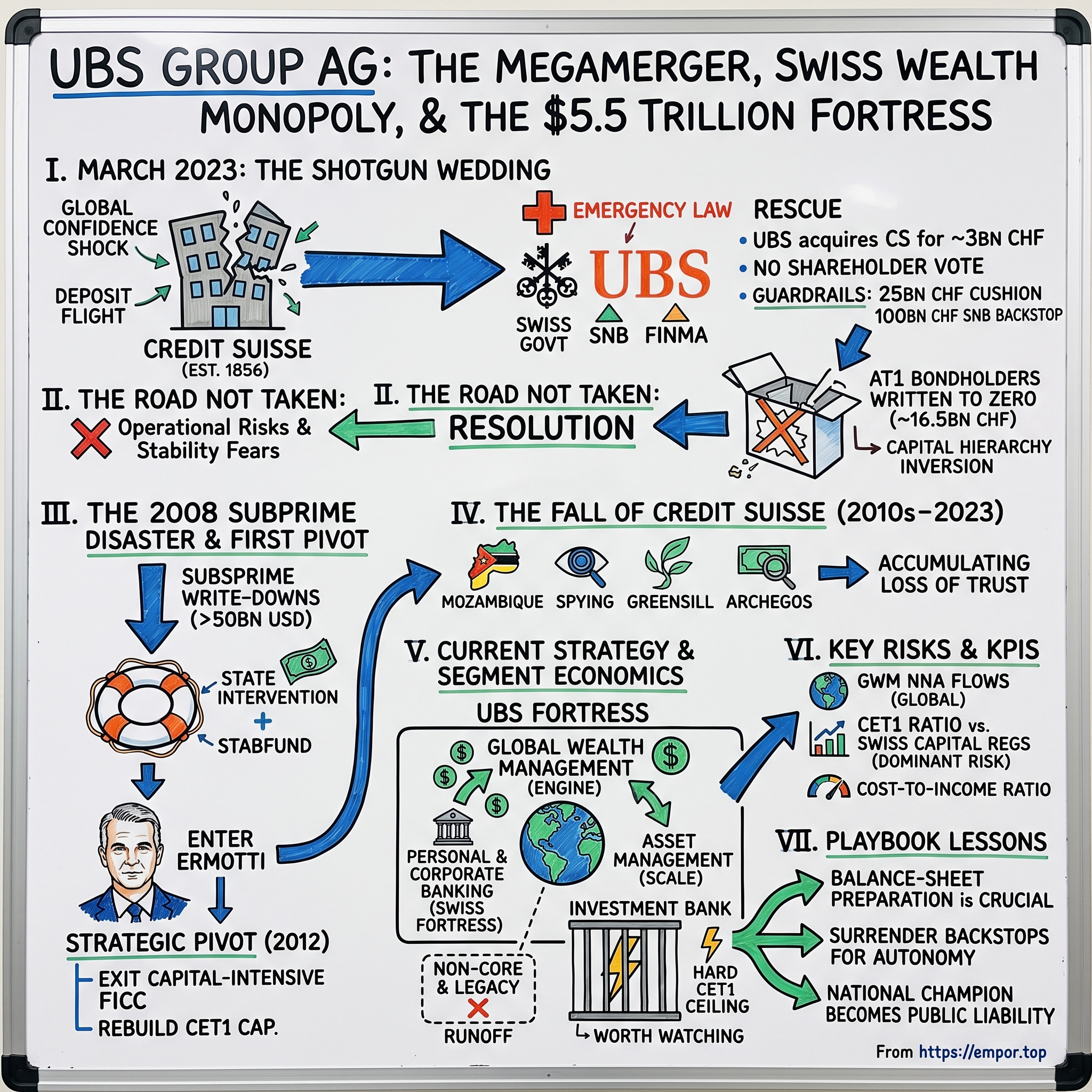
UBS Group AG: The Megamerger, Swiss Wealth Monopoly, and the $5.5 Trillion Fortress
I. Prologue & The March 2023 Shotgun Wedding
On the evening of Sunday, March 19, 2023, in a government building in Bern, Swiss officials used emergency law to dismantle a 167-year-old financial institution before Asian markets opened — an unprecedented intervention in modern Swiss banking history.
The setting was not a conventional corporate boardroom. Swiss Finance Minister Karin Keller-Sutter, the Swiss National Bank, and the Swiss Financial Market Supervisory Authority (FINMA) had spent the weekend running out of options. Credit Suisse Group AG — one of the two historic pillars of Swiss finance, having underwritten the country's nineteenth-century rail network — was suffering severe deposit flight. The failure of Silicon Valley Bank on March 10 and Signature Bank two days later detonated a global confidence shock, leaving Credit Suisse, long the most vulnerable major European lender, as the next domino to fall.
Across Paradeplatz, at the headquarters of archrival UBS Group AG, leadership faced a mandate effectively structured by the state. Colm Kelleher, the chairman who had joined UBS eleven months earlier, recognized the nature of the transaction. When the deal was announced, he avoided conventional strategic rhetoric, stating: "This acquisition is attractive for UBS shareholders but, let us be clear, as far as Credit Suisse is concerned, this is an emergency rescue."1
The terms of the rescue. UBS agreed to acquire Credit Suisse for roughly 3 billion Swiss francs in an all-share transaction, exchanging one UBS share for every 22.48 Credit Suisse shares — equivalent to 0.76 francs per Credit Suisse share.1 That valued Credit Suisse at less than half its closing price on the preceding Friday. Against a tangible book value in the low thirties of billions of francs, UBS paid roughly one-tenth of net asset value. The combined group inherited more than 5 trillion dollars in total invested assets, including 3.4 trillion dollars within wealth management.1 No shareholder vote was required on either side, as the Swiss Federal Council used emergency powers to suspend corporate voting rights.2
The protective guardrails were as significant as the purchase price. UBS negotiated 25 billion Swiss francs in downside cushion against asset markdowns, purchase-price adjustments, and restructuring costs, alongside a loss-sharing arrangement on non-core assets under which the Swiss Confederation guaranteed up to 9 billion francs in losses after UBS absorbed the first 5 billion francs.13 In addition, the Swiss National Bank provided a public liquidity backstop of up to 100 billion francs.3
The road not taken. Swiss authorities opted against placing Credit Suisse into resolution — the post-2008 regulatory framework designed to bail in creditors and restructure failing institutions. Although resolution works cleanly on paper, executing it across dozens of host jurisdictions carries operational and regulatory risks. Authorities concluded that applying an untested resolution process to a Global Systemically Important Bank during a market panic risked destabilizing the Swiss franc and the national financial center, choosing instead a private buyer with a capitalized balance sheet.
That choice directly influences the investment thesis. By selecting a merger over resolution, the state created an institution whose potential failure poses even greater systemic risk, prompting subsequent efforts in Bern to legislate stricter capital requirements.
The bondholders who paid for it. The rescue triggered widespread litigation when FINMA ordered Credit Suisse to write down the entire stock of its Additional Tier 1 (AT1) capital instruments — approximately 16.5 billion Swiss francs in nominal value — to zero. FINMA cited contractual terms permitting a full write-down upon a "viability event," triggered by extraordinary public liquidity support backed by a federal guarantee.4 Because equity holders received UBS shares while AT1 bondholders absorbed total losses, the conventional capital hierarchy was inverted, causing severe repricing across the global AT1 market. That regulatory decision has since faced challenges in Swiss courts.
Why this is the story. More than three years later, financial metrics present an initial picture of stability. In the second quarter of 2026, UBS reported net profit of 2.8 billion dollars on revenues of 13.3 billion dollars, a Common Equity Tier 1 (CET1) ratio of 14.4%, and record group invested assets of 7.3 trillion dollars.5 The bank that absorbed its rival is larger, more profitable, and further along in its integration than many anticipated in 2023.
Yet strong quarterly results do not resolve the broader investment case. UBS acquired an option on its own operational execution, financed largely through creditor loss absorption. Whether that option delivers long-term value depends on three unresolved issues as of mid-2026: whether the Swiss parliament mandates a capital regime that caps returns; whether the Federal Supreme Court overturns the AT1 write-down; and whether UBS retains the acquired wealth franchise, particularly in the United States, where client advisers continue to depart.
Management's thesis, led by Chief Executive Sergio Ermotti and Chairman Colm Kelleher, asserts that UBS can integrate two Global Systemically Important Banks, achieve roughly 13.5 billion dollars in gross cost savings, and generate an 18% return on CET1 capital by 2028.6 The counter-thesis holds that a bank whose balance sheet dwarfs its home economy remains vulnerable to political intervention, and that stricter capital rules could consume underlying wealth management profits before value reaches shareholders.
Evaluating these outcomes requires examining why UBS was the sole global institution capable of making that Sunday transaction — and how its own restructuring fifteen years earlier prepared it for the role.
 Subscribe on LinkedIn
II. Swiss Banking Heritage & The 1998 Merger of Equals
For most of the twentieth century, major Swiss banks operated less like ordinary corporations and more like national infrastructure — a shared utility for global capital, protected by law and geography.
The foundational legal architecture took shape in 1934, when the Swiss Banking Act codified bank secrecy under criminal law. Article 47 made the disclosure of client information a prosecutable offense rather than a civil breach. The commercial impact lasted three generations: Switzerland became a primary destination for international capital seeking anonymity, allowing Swiss banks to collect substantial fees for discretion — a service with virtually no marginal cost. That dynamic created the structural foundation for the wealth management economics examined in subsequent sections. The entire business model rested on a single premise: wealthy clients will pay a persistent premium for capital preservation and confidentiality.
Two banks, two temperaments. The modern enterprise emerged from the combination of two institutions with contrasting operational cultures.
Schweizerische Bankgesellschaft — Union Bank of Switzerland, founded in 1862 — operated with a conservative posture. Anchored in Zurich, it focused on commercial and retail banking, prioritizing risk aversion and serving Swiss industrialists and domestic savers.
Schweizerischer Bankverein — Swiss Bank Corporation, founded in 1872 in Basel — pursued an outward expansion strategy. In the mid-1990s, anticipating the deregulation of Anglo-American capital markets, Swiss Bank Corporation acquired London merchant bank S.G. Warburg in 1995 and New York investment firm Dillon, Read & Co. in 1997. Through those acquisitions, the institution established a direct footprint in major global financial centers.
When the two entities merged in 1998 to form UBS AG, the transaction was framed as a merger of equals, establishing a combined institution with approximately 1 trillion Swiss francs in assets. Culturally and operationally, however, power shifted to the Basel investment banking leadership. Led by Marcel Ospel, this faction assumed operational control and directed strategy toward expanding global fixed income, securitization, and proprietary trading, leveraging the parent bank's low Swiss funding costs and balance sheet strength.
The dual-track machine — and its hidden asymmetry. On paper, the combined model appeared balanced. Wealth management generated predictable, capital-light fee income from client assets, while investment banking offered higher-margin, cyclical returns from trading and underwriting, theoretically diversifying earnings.
In practice, this diversification proved fragile because both divisions shared a single balance sheet and brand equity. Wealth management relies fundamentally on client trust and capital preservation, whereas fixed income trading relies on risk-taking. Running both under one capitalized structure created a risk asymmetry: severe trading losses could undermine institutional reputation and trigger client asset outflows from the wealth management unit, neutralizing its fee stability.
A secondary structural asymmetry emerged in how scale affected each division. In wealth management, scale reduces unit costs and enhances client retention. In investment banking, expanded balance-sheet scale increases potential loss exposure during severe downturns. In the decade following the 1998 merger, UBS expanded its investment banking balance sheet under the assumption that it served as an effective counterweight to wealth management.
The 1998 transaction also established an integration precedent that re-emerged twenty-five years later during the Credit Suisse acquisition. Although presented publicly as a combination of equals, the 1998 deal functioned operationally as a takeover by the smaller, more aggressive investment banking culture, which directed corporate strategy for the subsequent decade.
When UBS acquired Credit Suisse in 2023, executive management explicitly rejected a merger-of-equals structure. Leadership stated that Credit Suisse's investment banking activities would be substantially curtailed rather than integrated, with UBS systems, risk controls, and management taking precedence. That approach reflected a deliberate strategy to avoid repeating the cultural and operational integration missteps of 1998.
Concurrently, the historical foundation of Swiss private banking was eroding. International regulatory pressure to end uncooperative bank secrecy accelerated during the 2000s, gradually eliminating the tax-anonymity premium that had supported high private banking margins for decades. The wealth management franchise faced a necessity to pivot toward investment advisory services, specialized lending, and global market access.
By the late 2000s, both structural pressures materialized simultaneously: the decline of offshore banking secrecy and an unprecedented accumulation of balance-sheet risk, anchored in American subprime mortgage securities.
III. The 2008 Subprime Disaster & The First Ermotti Strategic Pivot
In the autumn of 2007, senior UBS executives began receiving internal reports detailing a catastrophic accumulation of balance-sheet risk. The bank's fixed income desks across Zurich, London, and Stamford, Connecticut, had built a vast inventory of American subprime mortgage securities. This was not the result of a deliberate directional bet on the U.S. housing market; rather, because the securities carried AAA ratings, yielded a modest spread over funding costs, and required minimal regulatory capital under existing risk models, traders were incentivized to acquire them aggressively.
The mechanics reflected regulatory arbitrage rather than market insight. Under the capital rules of the era, assets deemed low-risk functioned on balance sheets much like government bonds, allowing institutions to borrow cheaply against them. Because individual trader incentives were aligned with yield generation under these capital metrics, desks accumulated instruments without pricing the risk of a nationwide collapse in U.S. residential real estate.
When housing values fell, UBS suffered the largest losses of any European lender, incurring cumulative write-downs exceeding 50 billion dollars. The Swiss state intervened. On October 16, 2008, the Federal Council announced a 6 billion Swiss franc injection via mandatory convertible notes, while the Swiss National Bank established a special purpose vehicle — the StabFund — authorized to remove up to 60 billion dollars in troubled assets from the balance sheet.7 Between December 2008 and April 2009, UBS transferred 38.7 billion dollars in assets and contingent liabilities into the vehicle across three tranches.7
The eventual outcome of the bailout left a lasting mark on Swiss political strategy: the state intervention generated a financial gain. The Confederation sold its UBS stake for approximately 7.2 billion Swiss francs, and in November 2013 UBS repurchased the StabFund's equity from the central bank for 3.8 billion dollars following full loan repayment, yielding 1.6 billion dollars in interest for the Swiss National Bank.8 This profitable resolution established a precedent that influenced policymakers during the 2023 crisis, reinforcing the view that emergency state liquidity could protect the financial system while yielding a return for taxpayers.
The rogue trader and the reckoning. Operational risk discipline remained unaddressed. In September 2011, UBS disclosed that Kweku Adoboli, a director on its Global Synthetic Equities desk in London, had generated 2.3 billion dollars in unauthorized trading losses, concealed over more than two years through fictitious counterparties and an unmonitored internal account.9 While the bank absorbed the direct financial loss, the incident demonstrated that internal risk controls remained ineffective three years after the state rescue. On September 24, 2011, Chief Executive Oswald Grübel resigned.9
Enter Ermotti. The board selected Sergio Ermotti as Chief Executive. A Ticinese executive from Switzerland's Italian-speaking region outside Zurich's traditional banking establishment, Ermotti had begun his career at sixteen as an apprentice before spending fifteen years in equity derivatives at Merrill Lynch and serving as deputy chief executive at UniCredit. Having joined UBS only months earlier in April 2011, the former trading executive was tasked with fundamentally restructuring the investment bank.
The strategic pivot launched in late 2011 represented a decisive capital reallocation in European banking. Ermotti concluded that if capital-intensive trading operations could not cover their cost of capital under post-crisis regulations — and posed catastrophic tail risk to the wealth management franchise — shrinking them incrementally was insufficient; the high-risk businesses had to be eliminated.
UBS systematically exited capital-intensive segments of fixed income, currencies, and commodities, withdrawing from macro trading and complex structured credit while eliminating thousands of positions.10 Risk-weighted assets in the investment bank were curtailed, and freed capital was redirected toward global wealth management and domestic Swiss banking. The bank's Common Equity Tier 1 (CET1) ratio — the core measure of loss-absorbing capital relative to risk-weighted assets — was rebuilt from single digits during the financial crisis to well above 13%.
Understanding the CET1 ratio is essential to evaluating the bank's long-term structure. Formed of common equity and retained earnings, CET1 capital represents the primary cushion absorbing losses before depositors or creditors suffer haircuts. Regulators weigh total assets by risk category, assigning higher weights to volatile instruments like leveraged loans and lower weights to sovereign debt.
This framework creates two distinct operational dynamics. First, balance sheet expansion does not dilute the ratio if added assets carry low risk weights — the mechanism that allowed subprime holdings to accumulate prior to 2008. Second, an institution can improve its capital ratio without raising equity simply by shedding high-risk-weighted assets. That asset reduction strategy formed the core of Ermotti's initial restructuring and provided the template for the Non-Core and Legacy unit created after acquiring Credit Suisse.
The retreat from investment banking drew criticism at the time. Divesting trading businesses reduced immediate revenues, incurred significant restructuring charges, and eroded market share in major capital markets products, leaving UBS a mid-tier performer in total shareholder return relative to expanding U.S. peers throughout the 2010s.
However, the primary dividend of Ermotti's strategic pivot was balance-sheet resilience. By March 2023, UBS possessed the excess capital, regulatory standing, and risk infrastructure required to absorb a failing global systemically important bank. That decade of capital discipline ultimately determined why UBS acted as the acquirer rather than the target in the emergency rescue of Credit Suisse.
IV. The Fall of Credit Suisse & M&A Benchmarking
The way institutions die is rarely a single event; it is an accumulating loss of the benefit of the doubt.
Credit Suisse spent the 2010s and early 2020s systematically spending down that benefit through a succession of governance and operational failures. The list was extensive: the Mozambique "tuna bonds" affair, in which bank employees participated in a corrupt sovereign-lending scheme; the 2019 spying scandal, in which the bank hired private investigators to track a departing executive through Zurich, ultimately costing the chief executive his job; and, in March 2021, two compounding disasters three weeks apart.11
The first was Greensill Capital, the supply-chain finance firm whose collapse forced Credit Suisse to freeze four funds holding around 10 billion dollars of client money — capital belonging, in many cases, to the wealthy private banking clients the bank depended on.11 The second was Archegos Capital Management, the family office of Bill Hwang, whose highly levered equity swap positions unwound violently. Credit Suisse lost roughly 5.5 billion dollars — several times what its prime brokerage division had earned over multiple years.11
Side by side, the two events revealed the same underlying failure: a prime brokerage that failed to monitor a counterparty's aggregate leverage, and an asset management arm that distributed illiquid credit risk to clients as cash-equivalent instruments. Both represented failures of internal risk control rather than adverse market conditions, occurring at an institution that maintained an elaborate formal risk framework on paper.
Strategic paralysis followed. Under a succession of chief executives — Tidjane Thiam, Thomas Gottstein, and finally Ulrich Körner — Credit Suisse introduced repeated restructuring plans, each promising to shrink the investment bank while deferring decisive cuts. Meanwhile, the bank's deposit base began to erode rapidly. By the time Credit Suisse reported its 2022 financial results in February 2023, customer outflows had exceeded 110 billion Swiss francs.11
The last week. On March 15, 2023, during a televised interview, the chairman of Saudi National Bank — Credit Suisse's largest shareholder — was asked whether the institution would inject additional capital. His response was "absolutely not," delivered for regulatory ownership reasons but interpreted by panic-stricken markets as an abandonment. Credit Suisse shares dropped more than 30% intraday before closing down roughly 24%.12 The deposit flight accelerated to billions of francs per day, leaving four days before Swiss authorities intervened.
Anatomy of the deal, benchmarked. Compared against crisis transactions from the 2008 financial shock, the terms obtained by UBS were unusually favorable.
JPMorgan Chase's acquisition of Bear Stearns in March 2008 represented the closest pricing analogue: an initial 2 dollars per share, later renegotiated to 10 dollars, representing a small fraction of book value alongside 29 billion dollars in Federal Reserve asset protection through the Maiden Lane vehicle. JPMorgan secured a discounted price and public loss protection, but inherited multi-year litigation liability.
Bank of America's acquisition of Merrill Lynch served as the period's primary caution: negotiated at nearly 0.6 times book value during market turmoil, the deal lacked loss protection and left an open-ended legal tail that absorbed management attention and capital for a decade. Wells Fargo's acquisition of Wachovia provided deposit scale but carried a similar legacy risk overhang.
UBS secured a structurally distinct arrangement: an acquisition price near one-tenth of tangible book value, a contractual first-loss cushion, a federal loss-sharing guarantee, a central bank liquidity line, and the 16.5 billion Swiss franc write-down of Additional Tier 1 capital, which recapitalized the target before UBS assumed control.14 AT1 bondholders, rather than UBS shareholders, absorbed the initial tranche of losses.
This structure triggered a significant accounting event. Because UBS paid approximately 3 billion Swiss francs for net assets valued far higher, the transaction generated provisional negative goodwill — or "badwill" — of 28.9 billion dollars. This was recognized as an accounting gain, driving a reported second-quarter 2023 net profit of approximately 29 billion dollars.13
The negative goodwill figure reflected an accounting adjustment rather than a cash gain. It represented the difference between the purchase price and the fair-value appraisal of acquired assets, functioning primarily as a provision buffer to absorb future asset markdowns, restructuring charges, and litigation costs without eroding capital. Excluding the negative goodwill gain, underlying pre-tax profit for that quarter stood at approximately 1.1 billion dollars.13 While retail interpretation viewed the 29 billion dollars as immediate earnings, institutional analysis evaluated it as a loss-absorption reservoir.
Myth versus reality: "UBS got Credit Suisse for free." This common shorthand misrepresents the transaction and distorts institutional valuation.
The narrative suggests that UBS paid 3 billion Swiss francs for 32 billion Swiss francs in tangible book value, recorded a 29 billion dollar gain, and acquired a global banking franchise at a negative net cost.
That view overlooks three operational realities.
First, the 3 billion Swiss francs represented the initial equity consideration rather than the total acquisition cost. The true cost comprised multi-year restructuring expenses absorbed through the badwill buffer and ongoing earnings. As of mid-2026, UBS continued to project an additional 750 million dollars in integration costs for the second half of the year, more than three years after closing.17
Second, UBS did not acquire Credit Suisse's historical book value intact. It acquired assets marked to fair value, with negative goodwill absorbing the gap between reported values and realized asset quality.
Third, client relationships did not transfer seamlessly. Wealth management assets are mobile, and a substantial portion had exited prior to the acquisition: the 110 billion Swiss francs in customer outflows Credit Suisse disclosed for 2022 departed before UBS assumed operational control.11 UBS acquired the remaining client franchise, the domestic Swiss banking unit, a scaled-back Asian operation, and a non-core asset portfolio designated for liquidation.
In practice, UBS acquired a franchise at a favorable price with downside protection, but incurred a multi-year operational requirement to restructure and stabilize the enterprise.
Handing back the state's umbrella. On August 11, 2023 — less than five months after the announcement and two months after closing on June 12 — UBS announced a decisive strategic move.14 Following a review of the covered portfolio and fair-value adjustments, UBS voluntarily terminated both the 9 billion Swiss franc federal loss protection agreement and the 100 billion Swiss franc public liquidity backstop, while Credit Suisse fully repaid its emergency liquidity support.3 UBS paid the Swiss Confederation 40 million Swiss francs in fees to settle the agreement, causing all federal guarantees to lapse.315
While the official rationale cited sufficient capital reserves, the primary strategic driver was autonomy. Public guarantees carry political conditions regarding executive compensation, branch network closures, domestic credit allocation, and workforce reductions. By relinquishing state protection early, UBS preserved its operational independence.
That autonomy faced immediate examination as the Swiss political system evaluated the implications of a consolidated institution whose balance sheet dwarfed the domestic economy.
V. Business Architecture & Segment Economics
Walk into a UBS booking centre in Singapore and then into a UBS branch in Winterthur, and you would struggle to believe they belong to the same institution. One is a discreet suite where a relationship manager coordinates a family's trust structures across four jurisdictions, a Lombard credit line against a concentrated equity position, and an allocation to a private markets fund. The other is a retail bank with mortgage brochures.
Both are essential, and the relationship between them is the actual business model.
Global Wealth Management: the engine. GWM is where the value sits. In the second quarter of 2026 it produced USD 2.0 billion of pre-tax profit on USD 7.0 billion of revenues, holding USD 4.9 trillion of invested assets and taking in USD 36 billion of net new assets in the quarter, USD 73 billion in the first half.516
The revenue mix is what makes this business interesting rather than merely large. Recurring fee income — the annual charge on assets under mandate — was USD 3.7 billion, up 11% year over year. Net interest income on client deposits and Lombard lending was USD 1.75 billion, up 12%. Transaction-based income, the most cyclical line, was USD 1.5 billion, up 23%.16
That composition tells you three things. First, roughly half of wealth revenues are recurring and asset-linked, which means they compound with markets and inflows and fall with drawdowns — this is a business geared to asset prices, not to credit cycles. Second, the interest income line means UBS is not a pure asset manager; it monetises client cash and lends against client portfolios, which is high-quality, heavily collateralised credit but is nonetheless rate-sensitive. Management guided on the second-quarter call that GWM net interest income should grow around 10% in 2026 versus 2025, helped by dollar rates, lending growth and deposit mix.17 Third, the transaction line's 23% jump flatters the quarter; a comparable market lull would reverse it.
The competitive position is genuinely strong outside the United States and genuinely contested inside it. Against Morgan Stanley, JPMorgan's private bank, Merrill, and boutiques such as Julius Bär, UBS's differentiator is not performance — nobody wins wealth management on returns — but the ability to serve a client whose life spans jurisdictions: booking centres in multiple time zones, cross-border regulatory permissions, structured lending against illiquid assets, and access to private markets deal flow. A family with assets in Hong Kong, a business in Germany, children studying in the US and a trust in the Channel Islands has a genuinely short list of institutions that can serve all of it under one relationship.
Personal & Corporate Banking: the Swiss fortress and the political liability. P&C delivered CHF 676 million of pre-tax profit in the second quarter of 2026, up 21%, on CHF 1.74 billion of revenues, and granted or renewed roughly CHF 40 billion of Swiss loans in the quarter.516 Ermotti has publicly framed the domestic franchise around the CHF 350 billion of lending UBS extends to Swiss households and companies.18
Economically this is the cheapest funding in the group: Swiss franc retail deposits, sticky and low-cost, supporting mortgages and corporate credit. It is also the feeder system — the domestic entrepreneur whose company UBS banks becomes, on exit, a wealth management client. That funnel is the strongest argument for keeping a retail bank inside a wealth manager.
It is simultaneously the source of UBS's greatest political exposure. Following the Credit Suisse merger, one institution holds a commanding share of Swiss domestic banking. Every branch closure, every job cut, every mortgage repricing is now a national political event, which is precisely why the capital debate in Bern has the emotional charge it does.
Asset Management: scale without pricing power. AM earned USD 237 million of pre-tax profit in the quarter, up 9%, on invested assets of USD 2.2 trillion, with USD 6.3 billion of net new money.16 Note the ratio: roughly a third of group invested assets producing well under a tenth of divisional profit. That is not a UBS failing; it is the industry. Traditional asset management is in a long fee compression, and scale is a defensive necessity rather than an offensive weapon. Its strategic value to UBS is as a manufacturing arm feeding GWM distribution, and management confirmed its integration was substantially complete by the end of 2025.6
The Investment Bank: rehabilitated, and worth watching. Here is the segment that requires the most analytical discipline, because it just had a spectacular quarter. IB pre-tax profit exceeded USD 1.2 billion in the second quarter of 2026, more than doubling year over year, on revenues of USD 3.7 billion, up 31%. Global Markets revenues rose 31% to USD 3.0 billion, with equities up 53%; capital markets revenues rose 55% to USD 509 million.16
The mandate since 2023 has been a capital-light, wealth-led investment bank operating under a hard ceiling on its share of group risk-weighted assets, focused on advisory, equities, foreign exchange and capital markets in service of GWM's entrepreneurs and family offices. The strategic logic is sound: UHNW clients are corporate clients, and the ability to execute a block trade or an IPO for a founder is part of what keeps the family's assets in-house.
The discipline required of investors is to remember what a 53% jump in equities revenues actually signals. It signals a very good trading environment, not a step-change in franchise quality. This is the same organisational muscle that produced Adoboli and, at the other bank, Archegos. The relevant question for the next several years is not whether the IB can earn outsized returns in a strong tape — it can — but whether the RWA ceiling holds when it does. Capital ceilings are easy to respect in bad years.
Non-Core and Legacy: the runoff, nearly done. NCL was purpose-built as the disposal unit for Credit Suisse's unwanted positions. By the end of 2025 its risk-weighted assets were down to USD 28.8 billion, and by the second quarter of 2026 to about USD 28 billion — a 68% reduction from the second quarter of 2023 — with operating expenses excluding litigation down 72% year over year to roughly USD 100 million.616
This is arguably the single most impressive execution in the whole integration, and it deserves to be stated plainly because it is the piece that was most likely to go wrong. Unwinding complex derivatives books and illiquid structured positions in a market that knows you are a forced seller is where acquirers historically bleed. UBS ran off the bulk of it faster than guided and without a headline loss event. That is evidence of competence, not merely of favourable markets.
Put the segments together and the shape of the group is clear: a wealth manager with a Swiss deposit franchise attached, a distribution-driven asset manager, and a deliberately caged investment bank. Whether that structure earns a premium multiple, however, is not decided in Zurich. It is decided by the people who set the capital rules — and by the people running the place.
VI. Current Management, Incentives, & The Activist Stress Test
In March 2023, Sergio Ermotti was chairman of Swiss Re, having departed as UBS chief executive two and a half years earlier. Within days of the Credit Suisse acquisition announcement, the UBS board replaced Ralph Hamers — the Dutch executive hired to digitize the firm — and reappointed Ermotti. The strategic signal was clear: the priority had shifted from digital transformation to complex balance-sheet restructuring, requiring an executive with prior turnaround experience.
Ermotti's direct operational style differs markedly from traditional Swiss banking norms. Unusually willing to engage publicly with regulators and politicians, he has shown little patience for the consensus-building typical of Swiss corporate governance. In an integration requiring rapid decision-making and aggressive expense reduction before Credit Suisse's institutional culture could reassert itself, that posture accelerated execution.
Chairman Colm Kelleher provides a complementary perspective. A former president of Morgan Stanley, Kelleher experienced that firm's transformation from a volatile trading house into a wealth-and-asset-management franchise trading at a premium valuation multiple — the precise structural re-rating UBS seeks to achieve. His expertise in U.S. wealth management and American regulatory oversight addresses a central strategic challenge for the combined firm.
The execution record: mostly delivered, with an honest exception. Management's performance shows clear operational delivery alongside a key delay in workforce reduction.
On expenses, progress has outpaced initial expectations. Cumulative gross savings reached USD 10.7 billion by the end of 2025 and USD 12.6 billion by the second quarter of 2026, against a target of roughly USD 13.5 billion by year-end 2026, supported by USD 1.1 billion saved in the second quarter alone.65 Remaining integration expenses were guided at USD 750 million for the second half of 2026.17
On technology integration — often the primary source of disruption in bank mergers — execution has proceeded smoothly. Roughly 85% of Swiss-booked accounts moved to UBS systems by the end of 2025, and by the first quarter of 2026 all Swiss-booked clients had been migrated, completing the transition of approximately 1.2 million former Credit Suisse clients globally.619 By mid-2026, about 70% of legacy applications were fully decommissioned and more than 90% were out of service.5 A client migration of this scale routinely risks operational outages and client attrition, but was completed without major systemic disruption.
On headcount, however, reductions have lagged corporate targets. UBS remains behind its plan to reach approximately 85,000 full-time employees by the end of the integration. Total workforce stood at 103,177 at the end of 2025 and 101,594 at the end of March 2026 — down 9,263 year over year and roughly 17,500 since the acquisition, but short of the trajectory needed to hit the final target.19 Up to 3,000 additional Swiss roles are expected to be eliminated, concentrated in the second half of 2026 and early 2027.20
This divergence provides meaningful insight into the cost structure. Expenses are falling on schedule while headcounts decline more slowly, indicating that savings are originating primarily from technology decommissioning, vendor consolidation, and real estate rationalization rather than headcount cuts. While this preserves revenue-generating capacity, it also demonstrates that personnel costs remain stickier than anticipated, making the 2028 cost-to-income target of roughly 67% increasingly reliant on top-line revenue growth rather than further expense reduction.6
Incentives and the pay problem. Executive compensation has become an active political issue. Ermotti's total compensation for 2025 was CHF 14.9 million, unchanged from 2024, comprising CHF 2.8 million in base salary and CHF 12.1 million in variable pay, while the group bonus pool rose roughly 10% to approximately USD 5.1 billion.21 While aligned with international peer benchmarks for global institutions, these payout levels have drawn sharp criticism within Switzerland amid ongoing debate over state backstops, with the Swiss finance minister publicly contrasting the payout against public-sector compensation.21
The analytical relevance extends beyond governance ethics: executive pay directly influences regulatory risk. High variable compensation amplifies political backing in Bern for stricter capital regimes and tighter oversight, creating a scenario where short-term compensation decisions could influence long-term regulatory costs for shareholders.
The succession question. In 2026, reporting indicated that Ermotti plans to step down around the time of the 2027 annual general meeting, though final timing remains open, while Kelleher oversees an internal succession process featuring several divisional leaders — including Asset Management head Aleksandar Ivanovic, Wealth Management co-heads Iqbal Khan and Robert Karofsky, and Chief Operating Officer Bea Martin.22 Khan's candidacy carries notable history: he joined UBS from Credit Suisse in 2019 following an executive departure that triggered a high-profile corporate surveillance scandal.
An executive transition immediately following integration completion presents structural risks. The incoming chief executive will inherit a firm where major cost reductions and non-core asset runoffs have largely been realized, requiring organic growth to drive further performance — while managing the risk of strategic disruption or defensive acquisitions.
The activist stress test. Cevian Capital disclosed a stake of approximately USD 1.3 billion — roughly 1.3% of UBS — in December 2023, contending that the institution could double its equity valuation over a two-to-three-year period.23 Co-founder Lars Förberg explicitly argued that UBS should achieve a valuation multiple comparable to Morgan Stanley.24
Market repricing has already realized a substantial portion of that thesis. In late 2023, UBS traded near or below tangible book value. By May 2026, UBS's price-to-tangible-book ratio reached approximately 1.6x, compared with a ten-year median of roughly 1.2x,25 while Morgan Stanley traded near 3.9x against a ten-year median near 1.9x.26 UBS shares recently traded around CHF 42.55 on SIX, near a fifty-two-week high of CHF 44.44 and substantially above the fifty-two-week low of CHF 28.25, establishing a market capitalization of approximately USD 139 billion.27
The initial valuation gap driven by transaction uncertainty has largely closed. The remaining discount to U.S. peers reflects a structural debate: whether the valuation gap represents an unwarranted discount on European banking assets or an accurate market pricing of Swiss regulatory capital demands, a smaller U.S. wealth management footprint, and lower structural return on equity.
Cevian's focus has accordingly shifted from pure valuation advocacy to regulatory engagement. Förberg has publicly stated that proposed Swiss capital requirements could render operating a global bank from Switzerland unviable, while simultaneously affirming to domestic media that Switzerland and UBS remain mutually dependent.28
And the counter-wind from Bern. The core political challenge stems from balance-sheet scale: the combined institution's balance sheet significantly exceeds Swiss gross domestic product.29 Federal policy reviews following the Credit Suisse collapse highlighted a key structural vulnerability: parent bank equity holdings in foreign subsidiaries were only partially backed by common equity, with roughly half funded through debt instruments, thereby limiting the parent's loss-absorbing capacity for international losses.30
UBS management has strongly resisted tighter capital rules. In an open letter dated March 19, 2025, Ermotti maintained that Swiss capital regulations were already among the most stringent globally and argued that the Credit Suisse crisis resulted from supervisory oversight failures rather than statutory gaps.18 He noted that UBS incurs approximately USD 3 billion annually in funding costs above Swiss sovereign borrowing rates, while emphasizing that UBS ranks only twentieth globally by total assets.18
Both perspectives address genuine systemic risks. Management defends operational efficiency and competitive standing, while regulators seek to insulate taxpayers from tail risk. For equity investors, the key determinant is how pending statutory capital changes will impact future return on equity and capital distribution capacity. Section VII examines the specific capital arithmetic and financial implications.
VII. Competitive Strategy Frameworks: Helmer's 7 Powers & Porter's 5 Forces
Evaluating UBS through formal strategy models clarifies its structural position. Hamilton Helmer’s 7 Powers framework provides a useful baseline because it defines a competitive power strictly as an advantage that delivers both a distinct benefit to the firm and a durable barrier to competitor imitation.
Scale economies: real, but narrower than claimed. A modern global wealth manager requires an extensive fixed cost base, covering multi-jurisdictional compliance, anti-money-laundering infrastructure, cybersecurity, client onboarding technology, product structuring, and regulatory booking permissions across dozens of countries. Spread across 7.3 trillion dollars of invested assets, those costs per client dollar are lower at UBS than at any European rival.5
However, scale economies in wealth management are strongest in back-office compliance and technology, and weakest in the primary revenue driver: the adviser relationship. A boutique with 200 bankers can serve a wealthy client effectively in a single market. What it cannot do is serve that client across six jurisdictions while satisfying six distinct regulatory bodies. UBS's scale advantage is genuine, but it is concentrated in operational complexity rather than client-facing service.
Switching costs: the strongest power in the portfolio. Switching costs represent the institution's primary competitive moat. While a mass-affluent investor can transfer a brokerage account within days, an ultra-high-net-worth family faces far greater friction. Such accounts typically involve complex structural webs: Lombard credit facilities secured against concentrated equity stakes, family trusts with designated custodians, active capital commitments to private equity funds, multi-year structured products, and cross-border tax arrangements designed around specific custodial banks. Transferring these assets requires unwinding legal structures, potentially triggering tax liabilities, refinancing credit lines, and re-executing documentation across multiple legal jurisdictions.
Market flows reflect this structural friction. UBS generated 73 billion dollars in net new assets during the first half of 2026 while simultaneously losing adviser teams in the United States.5 Outside the U.S. market, client inertia largely resides with the institution rather than individual advisers.
The American market, however, illustrates the boundary of this power.
Counter-positioning: overstated. Arguments framing UBS's capital-light wealth focus as counter-positioned against balance-sheet-heavy universal banks do not withstand scrutiny. Counter-positioning requires that incumbent competitors cannot adopt a strategy without undermining their core business model. In practice, Morgan Stanley executed a similar pivot toward wealth management years earlier, while JPMorgan Chase operates a private bank alongside a full-scale investment bank without operational contradiction. UBS's strategy reflects a deliberate choice rather than a position competitors are structurally prevented from occupying.
Brand and cornered resource: moderate, and eroding at the edges. The historic "Swiss safe haven" brand remains monetizable, but its core driver has evolved. Following the end of statutory bank secrecy, the brand relies on Switzerland's reputation for legal predictability and financial stability. However, the emergency rescue of Credit Suisse — executed via emergency decree, overriding shareholder rights, and inverting the conventional capital hierarchy — created legal uncertainty that weakened that proposition. The ongoing Additional Tier 1 litigation presents both a financial exposure and a broader reputational risk for the jurisdiction.
Industry structure: Porter's Five Forces. Examining the competitive environment through Michael Porter’s framework highlights additional structural pressures.
Rivalry: high and intensifying. Major global financial institutions have increasingly prioritized fee-based wealth management, expanding the competitive set. In the United States, Morgan Stanley, Bank of America's Merrill Lynch, and JPMorgan Chase compete aggressively for advisers using recruiting packages and balance-sheet capabilities that UBS has chosen not to match. In Asia, institutions including HSBC and DBS, alongside an expanding array of family offices and boutique firms, compete for regional wealth creation.
Buyer power: moderate to high, and rising. Family offices have increasingly professionalized, hiring former investment bankers, conducting competitive tenders, unbundling custody from advisory services, and negotiating fee schedules line by line. The historic pricing power once conferred by offshore secrecy no longer exists.
Supplier power: high, and structurally significant. In wealth management, the primary supplier is the client adviser, who often holds the direct client relationship. UBS's U.S. business illustrates this vulnerability. Its Americas adviser headcount fell to 5,644 in the second quarter of 2026, down from 5,773 a year earlier and 5,722 in the preceding quarter, while at least 27 teams managing roughly 28 billion dollars departed during the first half of 2026.3132 Chief Financial Officer Todd Tuckner has characterized the resulting asset headwinds as a "lag effect" from previously announced adviser departures, projecting that flows will normalize over 2026.1731
This dynamic reflects the structure of the U.S. wealth market, where adviser mobility is high and clients frequently follow individual advisers rather than corporate brands. Institutional switching costs do not apply uniformly across regions; the structural moat protecting client assets in Zurich or Singapore does not extend to the U.S. onshore network.
Threat of substitutes: low for target clients. Automated advisory platforms, direct indexing, and low-cost brokerages have compressed fees in the mass-affluent segment. However, these tools cannot manage cross-border estate planning, complex collateralized lending, or multi-generational wealth transfer. UBS's core ultra-high-net-worth clientele remains resistant to simple automation, though advancing technology continues to shift expectations in lower wealth tiers.
Threat of new entrants: very low. Entering global wealth management at scale requires a Global Systemically Important Bank license, international regulatory approvals, and substantial balance-sheet capacity. These capital and regulatory hurdles establish nearly insurmountable entry barriers.
Framework conclusion. The strategy frameworks yield a nuanced assessment. UBS possesses a powerful competitive advantage in institutional switching costs across international wealth management, supported by scale economies in regulatory and technical infrastructure. It operates with strong protection against new entrants, but faces persistent pressure from mobile advisers and increasingly sophisticated clients. While UBS maintains a resilient business model, its competitive moat remains most vulnerable in the United States, the world's largest wealth market.
VIII. Playbook: Business, Strategy, & Investing Lessons
Stripping the UBS story of its Swiss specificity reveals several transferable strategic lessons — some of which carry sharper trade-offs than they initially appear.
1. Capital-light fee income is superior, until market cycles turn. The central strategic insight of Ermotti's first tenure was that a franchise earning recurring fees on client assets consumes minimal regulatory capital, compounding return on equity in ways balance-sheet lending cannot match. Mid-2026 results illustrate the dynamic: Global Wealth Management generated 2 billion dollars of quarterly pre-tax profit on a fraction of group risk-weighted assets, while Non-Core and Legacy's remaining 28 billion dollars of risk-weighted assets produced only runoff.16
The necessary counterweight is that asset-based fee income carries a distinct risk profile rather than an absence of risk. Fee revenues are directly linked to asset prices, declining precisely when clients experience market anxiety. While credit-heavy lenders suffer during broader economic downturns, wealth managers experience revenue pressure during equity drawdowns, which occur with greater frequency.
2. Asymmetric crisis M&A requires years of prior balance-sheet preparation. Acquiring a distressed competitor at one-tenth of tangible book value offers extraordinary optionality, but that opportunity is available only to a buyer that enters a crisis overcapitalized, trusted by supervisors, and equipped with the operational scale to absorb a rival. UBS did not secure Credit Suisse because of tactical choices made in March 2023; it succeeded because of capital discipline maintained between 2012 and 2016. In systemic crises, transformational opportunities are secured during preceding expansions through returns voluntarily foregone.
3. Government backstops function as a loan against strategic autonomy. The August 2023 decision to surrender federal guarantees after five months, at a settlement cost of 40 million Swiss francs, stands out as a highly effective strategic transaction.3 Accepting state protection converts financial risk into political risk, which cannot be hedged, priced, or exited on a corporate timeline.
The corresponding reality is that relinquishing guarantees does not eliminate political scrutiny. Once a sovereign government concludes that an institution's failure presents unacceptable systemic risk, it will regulate the bank as though it still carries that exposure.
4. In high-friction integrations, rapid execution outweighs consensus. Following the transaction, UBS acted immediately to establish managerial control, isolate acquired investment banking assets inside a runoff division, and set strict decommissioning milestones. By mid-2026, the core technology migration is essentially complete and the cost reduction program remains on schedule.519
However, execution rigor on technology and cost targets has not translated smoothly to human capital. Missing headcount reduction targets while meeting savings goals suggests cuts landed where operational friction was lowest rather than where structural efficiency required.19 Meanwhile, persistent client adviser departures in the United States demonstrate the inherent tension between rapid organizational restructuring and preserving revenue-producing talent in relationship-driven markets.
5. A national champion becomes a public liability as much as a commercial power. Becoming indispensable to a domestic economy creates a complex strategic position. As Switzerland's sole remaining global universal bank, UBS commands significant domestic market share, direct access to corporate wealth, and a funding advantage reflected in borrowing costs.
Conversely, domestic indispensability means the state possesses no structural alternative if the institution encounters distress, prompting regulators to impose restrictive capital rules. Concentration that appears as commercial strength internally is viewed as systemic liability externally. Investors in dominant institutions within regulated sectors must recognize that returns derived from domestic market dominance remain subject to regulatory recapture.
6. Evaluate underlying operating metrics rather than accounting gains. The 28.9 billion dollar negative goodwill gain produced the largest quarterly profit in European banking history, yet provided limited insight into underlying operational health.13 Distressed purchase accounting creates substantial non-cash entries designed to absorb future integration expenses and asset markdowns. Analytical precision requires evaluating underlying operating income, capital ratios, and asset runoff schedules rather than reported top-line figures.
IX. Investment Case: Bull vs. Bear, Risk Radar, & Key KPIs
On July 29, 2026, Sergio Ermotti opened the second-quarter earnings call by noting that "the extraordinary patience and support of our shareholders is starting to be rewarded."17
Management supported that statement with improving quarterly metrics. Underlying pre-tax profit rose 45% year over year to 3.9 billion dollars, driving the cost-to-income ratio down to 70.0%. Underlying return on Common Equity Tier 1 capital reached 16.4% for the quarter and 16.7% for the first half of the year—exceeding the firm's exit-rate target of approximately 15% for 2026. Reflecting that capital generation, the board authorized a new 3 billion dollar share buyback program extending through the second quarter of 2027, with at least 1 billion dollars designated for execution over the subsequent three months.51617 That momentum followed a full-year 2025 net profit of 7.8 billion dollars and a dividend of 1.10 dollars per share—a 22% increase—with accruals set for a mid-teens percentage dividend increase in 2026.6
The key question for investors is whether those elevated capital returns are sustainable.
The three KPIs that matter. Amid the array of banking metrics, three indicators dictate the multi-year investment thesis.
First, net new assets in Global Wealth Management. Net new asset flows serve as the direct gauge of client expansion and institutional confidence. Unlike earnings, net new assets cannot be generated through expense reduction or market appreciation, and they directly expand the recurring fee base. The vital analytical distinction lies in geographic composition: headline inflows that mask persistent adviser departures and asset flight in the United States represent a structurally weaker signal than broad-based global growth.
Second, the CET1 ratio relative to evolving Swiss capital regulations. Regulatory capital represents the primary constraint on capital return capacity. At 14.4%, compared with management's target of approximately 14%, UBS retains immediate flexibility for share buybacks.5 However, under the Swiss government's proposed capital rules, that distribution capacity would contract sharply, forcing future earnings to be retained rather than distributed. Tangible book value per share remains the foundational metric tracking the underlying expansion of equity value beneath dividends and share repurchases.
Third, the underlying cost-to-income ratio. As the integration program nears completion, the cost-to-income ratio indicates whether efficiency gains reflect permanent structural synergies or transient market strength. Management has targeted a reported cost-to-income ratio of approximately 67% by 2028.6 Achieving that efficiency target after restructuring savings are fully realized will depend on organic revenue expansion rather than further expense reduction.
The risk radar.
Swiss capital legislation — the dominant risk. Under existing framework rules, UBS's parent entity can fund capital holdings in foreign operating subsidiaries partly through debt instruments. The Federal Council's dispatch of April 22, 2026 proposes requiring those subsidiary equity stakes to be backed entirely by common equity, phased in over seven years beginning with a 65% deduction and increasing by five percentage points annually to 100%.30 Government estimates indicate this mandate would require approximately 20 billion dollars in additional Common Equity Tier 1 capital for UBS, raising its capital ratio to roughly 15.5% to align with global peer averages.30
UBS calculates a substantially higher financial impact. Management stated that regulatory ordinance adjustments alone—including a three-year cap on software amortization for capital calculations starting in January 2029 and revised prudential valuation rules starting in January 2027—would reduce group CET1 capital by approximately 4 billion dollars, or 0.8 percentage points, generating an incremental requirement at UBS AG of roughly 22 billion dollars. Combined with approximately 15 billion dollars in regulatory capital previously required following the Credit Suisse transaction, the cumulative requirement reaches roughly 37 billion dollars in additional equity capital, carrying an estimated annual funding burden of 3 billion dollars.33 Rejecting the proposal, UBS stated that the regulatory package was "extreme, lacks international alignment," and that official descriptions of its impact were "misleading."33
The political process is entering a decisive phase. The upper house's Economic Affairs and Taxation Committee scheduled meetings for August 10, 11, and 31, 2026 to evaluate compromise options that would reduce foreign subsidiary equity backing from 100% to between 50% and 80%—potentially lowering the incremental capital buffer from 12 billion dollars to zero—with the full bill expected in the upper house by September and final rules anticipated by late 2026.34 Parliament is also considering permitting Additional Tier 1 instruments to meet a portion of the backing, alongside potential distribution restrictions if capital falls below defined triggers.34 Committee member Fabio Regazzi summarized the political compromise, stating: "We certainly don't want to put taxpayers' money at risk for a possible bank bailout, but we also mustn't weaken UBS unnecessarily."34
The legislative outcome presents a near-binary scenario for share buybacks. A scaled-down 50% requirement would preserve current share repurchases, whereas full implementation at 100% would absorb several years of distributable earnings. Chief Financial Officer Todd Tuckner explicitly linked capital return pacing to regulatory developments, noting that buyback execution remains subject to operating performance, the 14% CET1 target, and "ongoing Parliament deliberations on Swiss capital rules."17
The domicile question. Strategic tensions reached international prominence in 2025 following reports that UBS evaluated alternative corporate domiciles if Swiss capital mandates reached restrictive thresholds, with Chairman Colm Kelleher holding preliminary discussions with U.S. officials that prompted formal inquiries from the U.S. Senate Banking Committee.3536 Kelleher subsequently reaffirmed the firm's commitment, stating, "We will do everything in our power to stay in Switzerland — we want to be a Swiss icon that the country is proud of," while Chief Executive Sergio Ermotti noted that assessing contingency frameworks remains a fiduciary duty.37 While a formal corporate redomiciliation remains logistically complex and disruptive, market participants view the option as a negotiating anchor in legislative discussions in Bern.
The AT1 legal overhang. On October 15, 2025, the Federal Administrative Court ruled FINMA's cancellation decree unlawful, concluding that Credit Suisse satisfied statutory capital requirements on March 19, 2023, and that emergency liquidity support did not constitute a contractual viability event.38 Both FINMA and UBS appealed the ruling.3940 The Federal Supreme Court granted suspensive effect, leaving the write-down intact pending a definitive decision. The administrative court deferred ruling on remedy mechanics, leaving open whether the instruments must be restored, financial damages awarded, or liabilities assigned to the Swiss state, UBS, or both.41 Concurrently, international investor consortiums initiated treaty-based arbitration claims against the Swiss Confederation, with at least nine formal notices of dispute filed under international investment agreements.42 UBS has not established specific litigation provisions for potential adverse judgments.
Legacy litigation. Inherited legal liabilities continue to absorb capital buffer reserves. In May 2025, Credit Suisse Services AG pleaded guilty to federal conspiracy charges for assisting U.S. taxpayers in concealing more than 4 billion dollars across at least 475 offshore accounts in violation of a 2014 plea agreement, agreeing to pay approximately 511 million dollars in penalties while UBS noted it was not involved in the underlying misconduct and had proactively disclosed the accounts.43 Although negative goodwill provisions absorb legacy settlements, unquantified legal exposures remain across legacy portfolios.
An accounting judgment worth watching. The negative goodwill recognized following the 2023 acquisition was designated as provisional during the initial purchase price allocation period.13 That non-cash accounting reserve created a substantial buffer to absorb asset revaluations, restructuring expenses, and legal costs, causing persistent divergence between reported and underlying earnings performance. For full-year 2025, reported return on CET1 capital reached 10.8% compared with 13.7% on an underlying basis, while fourth-quarter reported return stood at 6.6% against 11.9% underlying.6 As integration operations finalize during 2026, that accounting gap is expected to narrow, aligning reported metrics with underlying financial performance as management targets a reported return on CET1 capital of approximately 18% by 2028.6
Market beta. Because approximately half of Global Wealth Management revenues are asset-linked, a prolonged decline in global equity or credit markets would simultaneously depress recurring fee income, transaction velocity, and collateralized lending volumes.
Execution tail. With more than 90% of legacy applications taken out of service, primary technology migration risks have receded, though final application decommissioning through 2026 retains operational complexity.5
The bull case. UBS completes its core integration by year-end 2026, securing approximately 13.5 billion dollars in gross savings while fully liquidating the Non-Core and Legacy portfolio. Swiss parliamentary negotiations yield a compromised capital deduction between 50% and 70%, releasing capital reserves for expanded share repurchases. Underlying returns on equity stabilize in the mid-to-high teens toward the 2028 target of roughly 18% on CET1 capital, while Americas profitability builds on quarterly operating profit of 534 million dollars on revenues of 3.4 billion dollars as U.S. adviser attrition stabilizes.631 Wealth accumulation across Asian and Middle Eastern booking centers continues driving net new asset growth, prompting a market re-rating that narrows the valuation discount relative to U.S. wealth management peers.
The bear case. Swiss parliament enacts strict 100% foreign subsidiary capital requirements, compelling UBS to accumulate retention capital through the decade and structurally depressing return on equity. The U.S. wealth franchise experiences sustained adviser departures, restricting access to the world's largest wealth pool. Judicial rulings from the Federal Supreme Court impose substantial financial restitution for AT1 bondholders, while broad market corrections reduce fee income as expense reductions reach completion. Under these conditions, the firm's valuation multiple—currently elevated relative to its historical median—reflects full valuation for an enterprise subject to firm regulatory limits.25
The enterprise trajectory lies between these outcomes, bounded by a broad range of regulatory and operational variables. Operational delivery—evidenced by non-core portfolio runoff, client account migrations, and expense reductions—has validated management's initial execution roadmap. Furthermore, the franchise's cross-border wealth capabilities continue to attract asset flows globally. However, long-term shareholder returns remain uniquely sensitive to two factors outside immediate operational control: the final legislative capital architecture established in Bern and the stabilization of the U.S. wealth adviser network.
X. Epilogue
There is a clear historical symmetry to this corporate trajectory.
In 2008, UBS stood among the most damaged major banks in Europe, rescued by a 6 billion Swiss franc state injection and a central bank vehicle that removed 38.7 billion dollars of distressed assets from its balance sheet.7 Fifteen years later, UBS served as the state's sole option to absorb a failing rival — and within five months voluntarily relinquished its federal loss protections and liquidity backstops.3
That reversal reflected the compounding effect of a strategic pivot initiated in 2012: systematically shrinking investment banking operations that generated trading revenue without earning their cost of risk-adjusted capital. The equity preserved through that decade of balance-sheet discipline provided the foundation for the 2023 acquisition, producing the 7.3 trillion dollars in group invested assets UBS manages today.5
Yet that same rescue created the structural challenge that defines the multi-year investment thesis. By consolidating the domestic financial sector, Swiss authorities resolved a systemic crisis by creating a significantly larger institution. The combined bank's balance sheet exceeds the national economic output of its home sovereign, prompting a multi-year political effort to construct a stricter legislative framework.29 That regulatory debate is entering a critical phase in Bern, where parliamentary decisions on statutory capital requirements will exert greater influence over long-term shareholder returns than near-term quarterly earnings performance.
A second structural uncertainty involves executive leadership. Chief Executive Sergio Ermotti, who directed the 2012 restructuring and led the 2023 integration, has indicated plans to step down around the 2027 annual general meeting.22 Core pillars of the current thesis — expense discipline, capital restraint in investment banking, and assertive regulatory engagement — remain closely associated with his operating posture. While UBS maintains an established internal succession pipeline, executive transitions often mark a shift from balance-sheet rationalization to growth initiatives, leaving his successor to manage a post-integration capital structure shaped by the pending legislative vote.
The core investment thesis presents a distinct paradox. The primary rationale for allocating capital to a global wealth manager lies in its recurring, capital-light fee income and relative insulation from credit downturns. Outside the United States, UBS operates the largest cross-border wealth franchise in global banking. Yet the principal threat to its long-term return on equity stems not from client attrition, market volatility, or credit losses, but from statutory decisions in Bern governing foreign subsidiary capital backing.
For an enterprise established on the institutional reputation of Swiss stability, the fundamental investment variable remains the regulatory policy of its home sovereign.
References
-
UBS to acquire Credit Suisse — UBS Group AG, 2023-03-19 ↩↩↩↩↩
-
FINMA approves merger of UBS and Credit Suisse — Swiss Financial Market Supervisory Authority, 2023-03-19 ↩
-
UBS Group AG voluntarily terminates Loss Protection Agreement and Public Liquidity Backstop guaranteed by Swiss government — UBS Group AG, 2023-08-11 ↩↩↩↩↩↩
-
FINMA provides information about the basis for writing down AT1 capital instruments — Swiss Financial Market Supervisory Authority, 2023-03-23 ↩↩
-
UBS's second-quarter 2026 results — UBS Group AG, 2026-07-29 ↩↩↩↩↩↩↩↩↩↩↩↩
-
UBS's fourth-quarter and full-year 2025 results — UBS Group AG, 2026-02-04 ↩↩↩↩↩↩↩↩↩↩↩
-
Switzerland: UBS Capital Injection, 2008 — Yale Program on Financial Stability / The New Bagehot Project ↩↩↩
-
Switzerland: UBS Restructuring, 2008 — Journal of Financial Crises, Yale School of Management ↩
-
Credit Suisse's Demise: A Timeline of Scandal and Failures — Morningstar ↩↩↩↩↩
-
Why a TV interview led to a day of chaos for Credit Suisse — Fortune, 2023-03-16 ↩
-
UBS posts $29 billion second-quarter profit in first results since Credit Suisse takeover — CNBC, 2023-08-31 ↩↩↩↩
-
UBS completes acquisition of Credit Suisse — UBS Group AG, 2023-06-12 ↩
-
Credit Suisse/UBS: all federal guarantees terminated — Swiss Confederation, 2023-08-11 ↩
-
UBS Q2 2026 slides: profit surges 45% as integration nears completion — Investing.com, 2026-07-29 ↩↩↩↩↩↩↩↩
-
UBS (UBS) Q2 2026 Earnings Call Transcript — The Motley Fool, 2026-07-29 ↩↩↩↩↩↩↩
-
UBS and Switzerland can both emerge as champions — open letter by Sergio P. Ermotti, UBS Group AG, 2025-03-19 ↩↩↩
-
UBS Group to Miss Workforce Reduction Goal Post CS Takeover — Yahoo Finance ↩↩↩↩
-
UBS Plans January Job Cuts to Start Final Integration Year — SWI swissinfo.ch ↩
-
UBS CEO Sergio Ermotti earned CHF14.9 million in 2025 — SWI swissinfo.ch, 2026-03-09 ↩↩
-
UBS CEO Ermotti plans to step down in April 2027, according to press report — SWI swissinfo.ch ↩↩
-
Cevian Takes $1.3 Billion UBS Stake Saying Bank Undervalued — SWI swissinfo.ch, 2023-12-19 ↩
-
Cevian Capital takes a stake in UBS. How the activist's track record with banks could help it build value — CNBC, 2023-12-23 ↩
-
UBS Group AG (UBSG.S) company profile and market data — Reuters ↩
-
UBS Shouldn't Leave Switzerland, Cevian's Foerberg Tells NZZ — Bloomberg Law ↩
-
Too-big-to-fail regulations: Federal Council adopts dispatch and Capital Adequacy Ordinance — Swiss Federal Department of Finance, 2026-04-22 ↩↩↩
-
UBS Wealth Profit Jumps 46%, Execs Forecast Easing Advisor Attrition — AdvisorHub ↩↩↩
-
UBS Q2 2026 Earnings and $28B in Advisor Departures: Reading Both Ledgers — Winthrop & Co. ↩
-
UBS statement on regulatory capital announcements made by the Swiss government — UBS Group AG, 2026-04-22 ↩↩
-
Analysis: Swiss lawmakers eye UBS rules balancing stability and competition concerns — Reuters via Euronext Live, 2026 ↩↩↩
-
UBS Leaving Switzerland is Edging Closer to Reality — Advisor Perspectives, 2025-10-28 ↩
-
Letter to UBS regarding relocation conversations — United States Senate Committee on Banking, Housing, and Urban Affairs ↩
-
UBS Chairman Kelleher reaffirms loyalty to Switzerland — Bluewin ↩
-
Unlawful write-off of AT1 capital instruments — Swiss Federal Administrative Court, 2025-10-15 ↩
-
FINMA to appeal partial decision of the Federal Administrative Court concerning AT1 — Swiss Financial Market Supervisory Authority, 2025-10-15 ↩
-
Credit Suisse AT1 Bonds: Federal Supreme Court to Review FINMA Write-Off — Lindemann Law ↩
-
Switzerland faces ISDS claims over Credit Suisse AT1 bond write-off — Investment Treaty News, IISD, 2026-01-19 ↩
-
Credit Suisse Services AG Resolves Tax Matter with DOJ, Will Pay USD 511m — UBS Group AG, 2025-05-05 ↩
 LinkedIn
 WhatsApp
 Reddit
 Hacker News
 Email
Email Kindle
 RSS Feed
 Spotify
 Apple Podcasts
 Amazon Music
 Audible
 YouTube