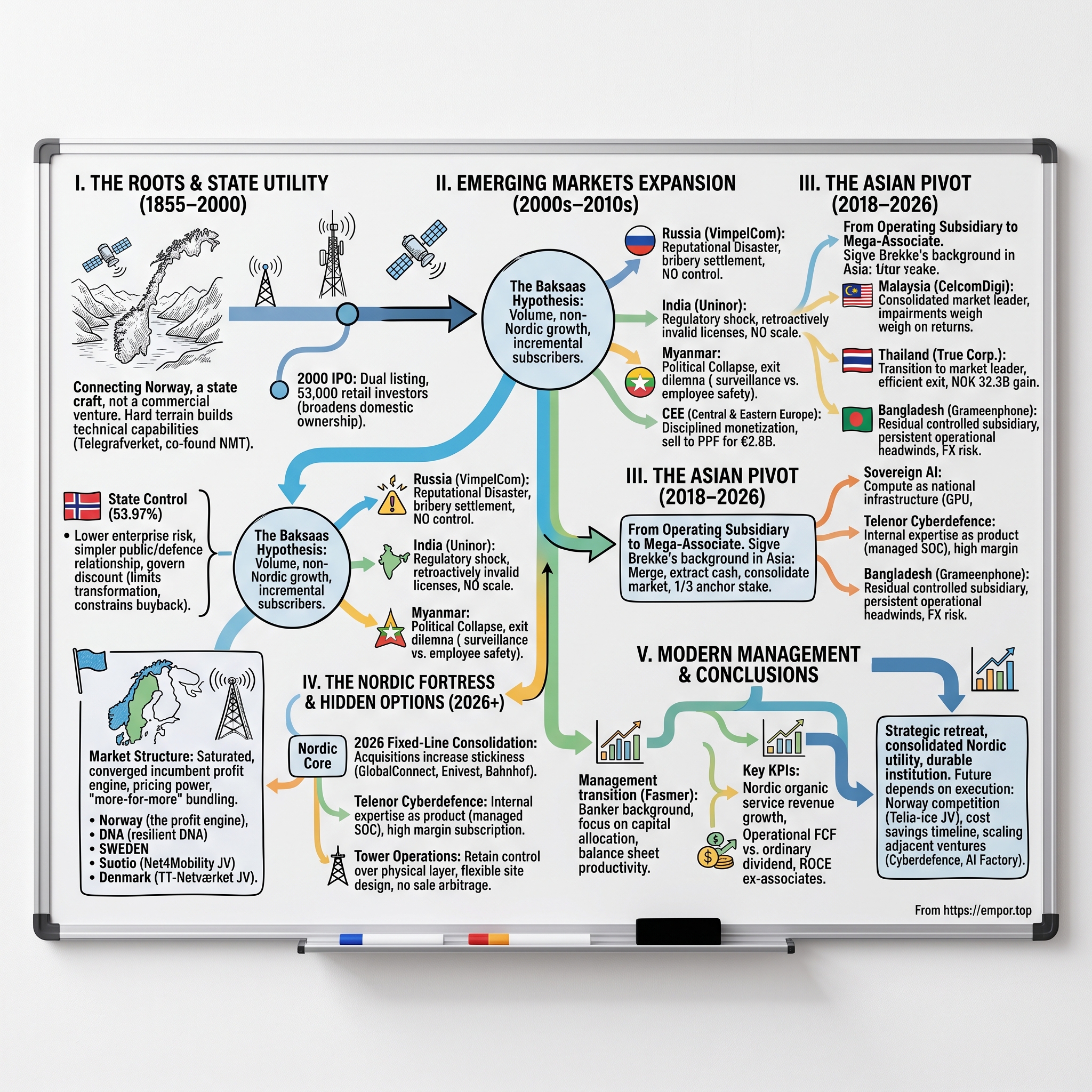
Telenor ASA: From Vikings of Emerging Markets to Nordic Sovereign Fortress
I. Introduction & Episode Roadmap
On the morning of July 16, 2026, Telenor's investor relations team hosted a webcast-only results presentation from Fornebu, the low-slung glass campus west of Oslo built on the site of Norway's former international airport. Without an auditorium of analysts or handshakes on the floor, executive management presented numbers via livestream that knocked roughly an eighth off the company's share price before the European lunch hour was over.5
The headline figures were not catastrophic: quarterly group service revenues fell 0.7% organically to NOK 14.7 billion, while adjusted EBITDA declined 4.8% to NOK 8.0 billion.1 However, it marked the second consecutive quarter that management downgraded its 2026 financial guidance. Capital markets tend to view an initial target cut as an isolated weather event; a second consecutive reduction prompts deeper questions about the underlying map.
That question is central to understanding Telenor in 2026. The 171-year-old institution originated as a state telegraph administration that laid a single line between Christiania and Drammen in 1855.18 Today, the Kingdom of Norway retains a 53.97% controlling stake through the Ministry of Trade, Industry and Fisheries.28 In 2025, the group generated NOK 76.5 billion in revenue and NOK 34.5 billion in adjusted EBITDA.13 Over the preceding eight years, it systematically dismantled an emerging-markets footprint spanning from Budapest to Yangon, converting distressed assets and operating holdings into cash to redeploy across four saturated Nordic markets.
The Telenor paradox
This strategic pivot highlights a core structural tension: Telenor functions simultaneously as a sovereign utility and a publicly traded, growth-seeking corporation—two identities that pull in opposing directions.
As a sovereign utility, the company carries national obligations: it serves as the critical connectivity backbone for the Norwegian state during crises, and in April 2026 secured a mobile contract with the Norwegian Armed Forces valued at approximately NOK 750 million over its term, adding roughly 25,000 subscriptions.15 As a listed enterprise, it remains committed to demanding capital-return targets, including a 2025 dividend of NOK 9.70 per share paid in two tranches in June and October 2026, alongside a three-year, NOK 15 billion share buyback program announced with its 2025 full-year results.93
Beneath its core telecom operations, the group maintains a portfolio of specialized growth assets: a managed cybersecurity business, a sovereign AI compute infrastructure unit powered by Norwegian hydroelectricity, a Nordic tower operator, an IoT platform valued at 18 times EBITDA, and a defence communications manufacturer supplying NATO procurement frameworks.1214161
The great restructuring, and where it landed
Between 2018 and 2026, Telenor executed one of the most comprehensive strategic retreats in European telecommunications. It sold its Central and Eastern European operations to PPF Group in July 2018,[^8] transferred its Indian business to Bharti Airtel, and exited Myanmar following the 2021 military coup.6 In Southeast Asia, it merged Digi into Celcom in Malaysia and dtac into True Corporation in Thailand, converting direct operating control into equity stakes.[^9][^10] In December 2023, it agreed to sell its Pakistan operations to PTCL.[^11] On January 22, 2026, Telenor agreed to sell its primary stake in Thailand—24.95% of True Corporation at THB 11.70 per share, or roughly NOK 32.3 billion—with a mutual put/call option on the residual 5.35% stake bringing potential total proceeds to about NOK 39.2 billion.4
Concurrently, Telenor consolidated its home markets, acquiring Finnish operator DNA in 2019 and executing a rapid sequence of fixed-broadband acquisitions across Norway and Sweden in 2026.[^7]11
Leadership also transitioned during this restructuring. Sigve Brekke, appointed in 2015, stepped down after nine years as chief executive officer. Benedicte Schilbred Fasmer, a career banker rather than a traditional telecom operator, was named his successor in May 2024 and assumed executive leadership on December 1, 2024.[^6]
What this article tests
The bullish thesis on Telenor centers on a de-risked, cash-generative Nordic infrastructure business backed by sovereign protection, optionality in security and AI, and declining capital intensity. The bearish view highlights a low-growth utility operating in four saturated markets, competing against a newly consolidated network rival in Norway, constrained by state ownership, and exposed to residual Asian holdings that continue to generate operational headwinds.
This analysis examines Telenor's historical origins, its global expansion and subsequent retreat, the performance of its core Nordic operations, its adjacent technology assets, management execution, and the underlying durability of its corporate model.
The story begins where Telenor started—with a national infrastructure built around connectivity and state resilience.
 Subscribe on LinkedIn
II. Roots & State Identity: Telegrafverket to the 2000 IPO
Wiring Norway was an exercise in extreme physical geography. The country is long, narrow, mountainous, and deeply indented by fjords, its population historically clustered in scattered settlements along a vast coastline. When Norway's first telegraph line opened in 1855 between Christiania—modern Oslo—and Drammen, a distance of about 40 kilometres, it was not a commercial venture.18 It was statecraft, built where private capital would not go.
That founding logic established a precedent that endured. Telegrafverket became Televerket in 1969, before renaming itself Telenor in 1995 as Europe prepared to deregulate telecommunications.18 Driven by demanding terrain, the state operator developed deep technical capabilities, establishing what the company's heritage records describe as the world's second radio telegraph connection in 1903,18 testing Norway's first mobile telephone in 1966,18 and co-founding Nordic Mobile Telephone (NMT) in 1981. NMT represented the first automatic mobile telephone system of its kind—a regional standard built because state operators concluded that a single technical platform across sparse populations was far more economic than four incompatible national networks.
The NMT experience left two lasting strategic lessons. First, technical standards served as commercial strategy: that collaborative framework fed directly into the development of GSM in the late 1980s, an effort in which Telenor's heritage materials place the company as an active participant.18 Second, sharing passive infrastructure was an economic tool rather than a competitive defeat—a principle Telenor later applied in Sweden and Denmark, and one that its domestic rivals would eventually leverage against the incumbent in Norway.
Corporatisation and the December 2000 listing
Telenor's commercial chapter began on December 4, 2000, when the company completed a dual listing on the Oslo Stock Exchange and Nasdaq, selling more than 372 million shares at an opening price of NOK 42.2 The offering created roughly 55,000 new shareholders, including about 53,000 Norwegian retail investors—a deliberate effort to broaden domestic equity ownership similar to the flotation of Statoil a year later.2
Telenor delisted from Nasdaq in 2007, shifting its American depositary receipts to over-the-counter trading.2 The move reflected a pragmatic re-evaluation of compliance costs: the overhead of a US listing was never justified by the marginal international demand it generated. The decision reinforced Telenor's position as a Norwegian equity with international holders rather than a global equity domiciled in Norway.
What 53.97% actually buys, and what it costs
As of February 27, 2026, the Kingdom of Norway held a 53.97% majority stake in Telenor, managed through the Ministry of Trade, Industry and Fisheries.28 The company operates under a single share class with one vote per share, with no golden share or dual-class structure.2 State control is strictly arithmetic.
This ownership structure creates distinct balance-sheet advantages and strategic trade-offs. On the positive side, majority ownership by a AAA-rated sovereign backed by a sovereign wealth fund lowers perceived enterprise risk. Unlike leveraged European alternative network operators, Telenor faces minimal refinancing risk, which lowers its cost of debt and allows management to operate comfortably at the bottom of its target leverage band. State control also simplifies key public-sector relationships; when the Norwegian defence establishment procures secure mobile communications, the majority-state-owned incumbent is a natural counterparty.
On the negative side, majority state control imposes a real governance discount. It constrains transformational corporate actions, as a majority-state-owned operator cannot easily be acquired, merge as a junior partner, or re-lever aggressively. It also dictates capital return mechanics. When Telenor launched the first tranche of its NOK 15 billion share buyback program in June 2026, the execution was split: of the NOK 6 billion first-year allocation, up to 24.9 million shares were to be bought on the open exchange, while up to 29.1 million were redeemed directly from the State on a pro rata basis to keep the government's 53.97% holding unchanged.23 Consequently, half of every repurchased krona functions as a cash transfer to the national treasury.
While the pro rata structure ensures fair treatment for minority shareholders and yields an identical earnings-per-share benefit, it prevents the public free float from expanding. As a result, capital allocation decisions remain permanently bound to a controlling shareholder whose objectives balance national strategic resilience against pure equity returns.
Telenor's early capabilities were forged by engineers overcoming difficult geography. By the late 1990s, with its home market wired and deregulation approaching, management applied those operational instincts outward, setting the stage for international expansion.
III. The Emerging Markets Spree: Conquests, Oligarchs, & Disasters
By 2006, Telenor announced that it had passed 100 million mobile subscriptions worldwide.18 For an enterprise serving a home market of under five million people, it was a staggering figure. In retrospect, however, the milestone read less like a triumph than a warning label.
The Baksaas hypothesis
Jon Fredrik Baksaas, who served as chief executive officer from 2002 to 2015, built his strategy on a hypothesis that appeared analytically sound and, for several years, highly profitable. With Nordic mobile penetration approaching saturation, volume growth had to come from regions where mobile ownership remained nascent. Telenor possessed the technical expertise to construct infrastructure in challenging environments, supported by a balance sheet anchored by a wealthy sovereign state. The core trade was straightforward: export Nordic engineering into high-growth markets where incremental subscribers were cheap to acquire.
For nearly a decade, the formula delivered. Then it collided with the operational realities that engineering prowess cannot hedge: property rights, regulatory stability, partner alignment, and the rule of law.
Russia and the VimpelCom war
The Russian chapter proved to be both the longest and the most instructive. Telenor built a substantial minority stake in VimpelCom alongside Mikhail Fridman's Alfa Group—a partnership pairing a Norwegian state-backed listed operator governed by strict compliance standards with a Russian conglomerate holding a starkly different approach to corporate governance.
Nearly a decade of boardroom gridlock and multi-jurisdictional litigation followed. Telenor could neither control the asset nor exit on reasonable terms, nor protect its brand from actions taken by its partner. The ultimate reckoning arrived on February 18, 2016, when VimpelCom and its Uzbek subsidiary, Unitel, settled bribery charges with US and Dutch authorities concerning operations in Uzbekistan. VimpelCom paid approximately $795 million in total penalties—including $397.5 million to Dutch regulators—and agreed to a three-year external compliance monitor. Prosecutors documented roughly $114.5 million in illicit payments to a government official between 2006 and 2012, alongside more than $30 million in sponsorships and charitable donations linked to obtaining telecom licenses and permits.7
Though Telenor was a minority shareholder rather than a named defendant, that distinction provided little political cover. For an enterprise majority-owned by a sovereign state renowned for advocating global governance standards through its wealth fund, maintaining a stake in a high-profile corruption scandal proved intolerable. The subsequent multi-year selloff of its stake in Veon (formerly VimpelCom) was driven less by portfolio optimization than by reputational survival.
The broader strategic lesson extended beyond country risk: minority stakes in co-controlled entities can transfer total reputational liability while yielding zero operational control—an asymmetry that would resurface in subsequent ventures.
India: the cautionary tale that cost the most
Telenor entered India in 2008 by partnering with Unitech Wireless to establish Uninor. The core investment rationale rested entirely on volume: a market of over one billion people, low mobile adoption, and newly acquired operating licenses.
In February 2012, India's Supreme Court annulled 122 telecom licenses granted during the contentious 2008 spectrum allocation, sweeping away Uninor's permits. Telenor found itself with network infrastructure built on a legal foundation that had been retroactively invalidated—a regulatory shock that no degree of operational discipline could mitigate.
Telenor restructured its entity, repurchased spectrum at auction, and resumed operations, yet it struggled to secure market share. When Reliance Jio entered the market offering free voice service and heavily subsidized data, mobile pricing across India collapsed, eroding profitability for sub-scale operators. Impairments mounted quickly: Telenor recognized a NOK 2.3 billion write-down in the first quarter of 2016 alone, comprising roughly NOK 1.4 billion in network equipment and NOK 0.9 billion in spectrum values.18 By the time Telenor agreed in February 2017 to transfer its Indian business to Bharti Airtel, the net book value of its tangible and intangible assets in India had fallen to approximately NOK 0.3 billion; the deal was structured as a cash-free transfer with Airtel assuming Telenor's remaining spectrum liabilities.18
The capital allocation outcome was stark: nearly a decade of capital expenditure and multiple spectrum auctions resulted in an exit value of essentially zero. Uninor operated with reasonable efficiency, but the strategic setup was flawed from the outset. Telenor had entered a market where it lacked scale, could not influence regulatory decisions, and could not match the financial firepower of a well-capitalized domestic conglomerate using telecommunications as a loss leader for a wider ecosystem.
Central and Eastern Europe: the one that was sold well
Telenor's Central and Eastern European portfolio—comprising mobile units in Hungary, Serbia, Montenegro, and Bulgaria—presented a sharp contrast. These were profitable, cash-generative businesses operating in European Union or EU-adjacent jurisdictions.
On July 31, 2018, Telenor completed the sale of its Central and Eastern European assets to PPF Group for an enterprise value of €2.8 billion.[^8] Divesting performing assets often poses a greater psychological hurdle than shedding distressed ones, making the transaction a notable exercise in disciplined capital management. Telenor recognized that maintaining four sub-scale operators in a consolidating European landscape—each facing heavy 5G capital expenditure and competition from converged fixed-mobile rivals—would yield lower returns on capital than reinvesting the cash into markets where Telenor already held dominant market positions. The capital generated from the sale laid the financial groundwork for the Nordic consolidation that followed.
Myanmar: where the ethics and the economics both broke
Myanmar initially represented Telenor's most successful greenfield venture in a generation, before turning into its most complex exit. Entering the market in 2014, the operator built a mobile network from the ground up, attracting tens of millions of subscribers and achieving rapid profitability in a manner that appeared to validate its emerging-markets growth model.
The situation changed dramatically in February 2021, when Myanmar's military seized power in a coup. The new regime demanded active network surveillance capabilities, including wiretapping and real-time subscriber monitoring. Telenor was left with an impossible dilemma: comply with the junta's mandates and compromise user privacy, or refuse and expose its local employees to potential detention, asset seizure, and physical harm.
Telenor chose to write off the asset and exit the country. The sale of Telenor Myanmar to Lebanon-based M1 Group closed on March 25, 2022, in a transaction reported by Reuters at a headline enterprise value of $749 million.6 The divestment triggered intense criticism from human rights groups over the buyer's track record and the ongoing protection of subscriber data.
The episode underscored a fundamental risk in frontier markets: Telenor's risk assessment models had failed to anticipate a full political collapse. A corporate identity built on Nordic governance and trust becomes uniquely vulnerable when operating under authoritarian regimes that demand compliance at odds with basic human rights principles.
By 2018, management faced a strategic choice regarding its remaining Asian footprint. Rather than expanding further or executing immediate fire sales, Telenor adopted a middle path.
IV. The Asian Pivot: From Operating Subsidiary to Mega-Associate
Sigve Brekke assumed the chief executive role in 2015 with a background rare among European telecom leaders: he had spent much of his career in Asia, helping build Telenor's regional operations from the ground up. Recognizing the operational headwinds of running a fourth-place mobile operator competing against politically connected incumbents, Brekke concluded that Telenor needed to alter its approach.
The strategic pivot was simple in design. Rather than holding full ownership of sub-scale operators with total political exposure, Telenor would merge its assets with strong local partners, retain an equal anchor stake of roughly one-third, and convert operating challenges into an equity-accounted dividend stream. Value creation was expected to stem from market consolidation: combining second- and third-tier operators into a leading entity while rationalizing network overlap and spectrum holdings.
Malaysia: CelcomDigi
The initial test of this approach occurred in Malaysia. Telenor's Digi merged with Axiata Group's Celcom on November 30, 2022, forming the nation's largest mobile operator, with Telenor and Axiata each holding equal anchor stakes.[^9] Telenor's holding stands at 33.1%.1
Operationally, the model delivered results. CelcomDigi generated service revenue growth of 1.6% in the first quarter of 2026, alongside margin expansion driven by cost discipline, and declared its first interim dividend for 2026, paid to Telenor in June.1 Cash flow to Oslo resumed as planned.
Valuation trends, however, presented a different picture. In the first quarter of 2026, Telenor recognized an impairment of approximately NOK 8.0 billion on its CelcomDigi investment after the stake's market value fell materially below its carrying amount. The write-down impacted group returns: Telenor's twelve-month rolling return on capital employed dropped to 3.6% by June 2026, compared to 11.9% excluding associates and joint ventures.1
This discrepancy highlights a key tension in Telenor's accounts. While the controlled Nordic operations generate roughly 12% on capital, the associate portfolio weighs on consolidated returns. Investors evaluating the joint-venture strategy against management's stated goals—de-risking, synergy capture, and cash extraction—must balance those objectives against market pricing, which assigned the Malaysian asset a valuation well below its book value.
Thailand: the merger that became an exit
The Thai transaction adopted the same framework. dtac merged with CP Group's telecom arm, True Corporation, completing on March 1, 2023, with Telenor and CP retaining equal anchor stakes in a combined operator serving tens of millions of subscribers.[^10]
Three years later, Telenor initiated a complete exit. On January 22, 2026, the company agreed to sell 24.95% of True to Arise Digital Technology Company Limited, owned by Khun Suphachai Chearavanont, at THB 11.70 per share—valuing the stake at THB 100.9 billion, or roughly NOK 32.3 billion. A mutual put/call option covers the remaining 5.35% holding two years post-closing at the higher of THB 11.70 or prevailing market prices, bringing potential total proceeds to approximately NOK 39.2 billion. Telenor recorded an accounting gain of about NOK 14.7 billion on the transaction, including NOK 1.6 billion in recycled currency translation differences.4 The initial tranche closed in March 2026, generating around NOK 30 billion in cash and lifting first-half 2026 free cash flow to NOK 33.9 billion, compared with NOK 4.0 billion in the comparable period a year earlier.1
As a transaction, the Thai exit was executed efficiently: Telenor transitioned a secondary operator into a co-controlling stake in the market leader, allowed integration synergies to materialize, and sold the holding to its partner at a gain. From a broader strategic standpoint, however, the divestment raises structural questions. If the ultimate destination for equal-stake Asian associates is divestment, the long-term rationale for the CelcomDigi stake remains unconfirmed by management, a point made more prominent by the Malaysian impairment.
The transaction also carried minor operational trade-offs. Telenor's 2026 outlook noted a NOK 0.2 billion revenue reduction within its Procurement Company following a contract cancellation by True.1 Exiting associate holdings removes equity income while incrementally reducing group-scale purchasing advantages.
Bangladesh: the asset that cannot be de-risked
Grameenphone remains Telenor's sole controlled Asian subsidiary, held at 55.8%, with Grameen Telecom—founded alongside Nobel laureate Muhammad Yunus—serving as the primary local shareholder and the remaining float publicly listed in Dhaka.1 It remains Bangladesh's largest mobile operator, a position it has held for years.19
The unit currently presents persistent operational headwinds. In the second quarter of 2026, Grameenphone's service revenues fell 3.2% organically while adjusted EBITDA dropped 6.1%, affected by declining voice usage, modest data growth, and price competition, partially offset by cost savings in network energy and vendor contracts.1 Telenor's risk disclosures note that Bangladesh's macroeconomic environment remains under pressure despite moderating inflation, leaving consumer spending vulnerable to broader economic volatility.1 On the second-quarter earnings call, Chief Financial Officer Torbjørn Wist declined to project a timeline for financial recovery, citing regional uncertainty and the country's dependence on energy imports.5
Grameenphone's performance remains tightly bound to Bangladeshi consumer purchasing power, foreign exchange rates, and regulatory decisions—factors outside Telenor's operational control. As real incomes fall, subscribers adjust usage by purchasing smaller data packages and recharging less frequently, compressing average revenue per user while topline subscription counts remain static.
Pakistan: the clean line
Pakistan marked the most straightforward exit in the region. In December 2023, Telenor agreed to sell its Pakistani business to PTCL, bringing an end to its direct South Asian operating footprint outside Bangladesh.[^11] Its remaining regional footprint consists of a 55% stake in the Easypaisa digital banking platform, alongside corporate offices in Bangkok and Singapore.1
Telenor's remaining Asian presence is now tightly focused: one controlled operating subsidiary exposed to local macroeconomic conditions, one major minority stake carrying an impaired carrying value, and a digital financial service provider. The core of Telenor's cash generation and operational asset base is now concentrated in the Nordic region.
V. The Nordic Core: Market Structure, Pricing Power, & DNA Finland
In Telenor’s home region, telecommunications market dynamics are defined by saturation. Smartphone penetration is near universal, fibre and high-speed cable connect most households, and data consumption per user ranks among the highest in Europe. Prices are similarly elevated. Market growth no longer comes from connecting first-time subscribers; it depends entirely on average revenue per user (ARPU) expansion and operational efficiency.
In 2025, the Nordic business area—comprising Telenor Norway, Telenor Sweden, Telenor Denmark, and DNA in Finland—generated service revenues of NOK 46.7 billion and adjusted EBITDA of NOK 26.7 billion, on total revenues of NOK 59.3 billion.1 Against group adjusted EBITDA of NOK 34.5 billion, the Nordics account for roughly three-quarters of operating earnings, a proportion set to rise as the Thai and Pakistani divestments fully settle. Telenor is, functionally, a Nordic telecom group with a Bangladeshi operating subsidiary and a Malaysian equity stake.
Norway: the profit engine, and where the pressure is
Telenor Norway produced NOK 21.0 billion of service revenue and NOK 14.2 billion of adjusted EBITDA in 2025—an EBITDA margin against service revenue of roughly two-thirds, close to the theoretical ceiling for a converged incumbent.1 That profitability reflects two decades of structural cost removal. The copper network—the legacy twisted-pair infrastructure that once carried Norway's fixed communications—was decommissioned at the end of 2022, eliminating the maintenance crews, spare parts inventory, and power consumption of a nationwide parallel network. The 3G network has likewise been retired, while the 2G shutdown is scheduled for late 2027 to allow legacy healthcare alarms and industrial devices to migrate.
The structural impact resembles closing duplicate network infrastructure: because traffic had already moved to modern standards, decommissioning legacy networks yields permanent cost reductions with negligible revenue impact.
The top line faced headwinds in 2026. Management's commercial strategy relies on a "more-for-more" approach: rather than raising headline tariffs, the company bundles additional features—such as security services, entertainment, and higher data allowances—and charges higher prices for the enriched package. In the second quarter of 2026, that mechanism supported a 2% increase in mobile ARPU. However, the subscription base fell by 19,000 in the quarter, and mobile service revenues declined 0.7%.1 Higher realized pricing per subscriber was offset by volume losses.
Fixed-line performance reflected accounting noise alongside steady underlying trends. Fibre subscriptions grew by 5,000 and fibre revenues expanded, but a NOK 135 million provision booked in the second quarter for a VAT dispute on TV news channels covering 2020 to 2022—totaling roughly NOK 0.2 billion for the full year and explicitly excluded from guidance—reduced reported fixed service revenues by 7 percentage points. Excluding the provision, fixed service revenues grew 0.6%.1 Adjusted EBITDA in Norway fell 7.7% as reported, or 2.1% excluding the VAT provision and business transfers.1
On the second-quarter earnings webcast, analysts questioned whether Telenor's value-added services strategy in Norway had encountered limits. Management defended the commercial model while acknowledging that newer security and entertainment add-ons had underperformed and were being adjusted.5 The "more-for-more" structure depends on customer demand for bundled features; if users perceive limited utility in the add-ons, the offering risks being treated as a price increase, increasing customer sensitivity during promotional periods.
The competitive shift that changes Norway's structure
A significant structural development in Telenor's domestic market emerged from competitor consolidation. On February 2, 2026, Telia Norway and ice—the challenger operator owned by energy and fibre group Lyse—agreed to combine their radio access networks into a 50/50 joint venture. The entity will own all radio equipment and base stations, supplying RAN capacity back to both parent companies while they maintain separate core networks, spectrum holdings, and commercial operations. The partnership targets substantial coverage gains by 2027, with operational launch set for the second quarter of 2026.13
This arrangement directly challenges Telenor's long-standing competitive moat in Norway, which historically rested on superior national network coverage while its two primary rivals faced individual coverage or capital expenditure constraints. A shared Telia-ice RAN provides the challenger with expansive coverage without standalone infrastructure economics, while giving the second-largest operator greater investment scale. The move also impacts Telenor's wholesale earnings: the group noted in its second-quarter outlook that full-year 2026 revenues from the Lyse Tele roaming agreement are expected to remain broadly flat compared to 2025, signaling that wholesale roaming revenue from the challenger will no longer drive growth and faces eventual contraction.1
DNA Finland: the acquisition that worked, until it didn't
Telenor agreed in April 2019 to acquire a majority stake in Finnish operator DNA Oyj at EUR 20.90 per share.[^7] DNA subsequently operated as Telenor's most resilient Nordic expansion, providing immediate scale in a market characterized by high data consumption and rational market structure, contributing NOK 10.3 billion of service revenue and NOK 5.3 billion of adjusted EBITDA in 2025.1
Market conditions tightened in 2026. Intense price competition in the Finnish mobile market during the fourth quarter of 2025 left a multi-quarter impact, as Finnish consumers predominantly use 12-month contracts, locking in discounted campaign tariffs across the customer base. By the second quarter of 2026, market activity and churn rates had normalized, but mobile ARPU remained down 1% year on year and new-customer ARPU lagged prior-year levels.1 DNA continued to add volume—gaining 23,000 mobile subscriptions (including 17,000 postpaid) and 6,000 fibre connections—meaning financial recovery depends on repricing subscribers as annual contracts expire.1
The Finnish trajectory illustrates how fixed-term contracts turn short-term promotional cycles into delayed earnings headwinds that resolve only as contract cycles roll over.
Sweden and Denmark: the improving half
Performance across the broader Nordic footprint showed positive momentum in 2026, particularly in Sweden and Denmark.
Telenor Sweden added 36,000 mobile subscriptions in the second quarter, up 4% year on year, driving a 3.1% increase in mobile service revenues on stable ARPU, while adjusted EBITDA rose 5.2% due to reductions in customer-service and network-operations costs.1 The fixed-line portfolio underwent deliberate restructuring toward higher-margin products: fixed subscriptions declined by 10,000 as lower-margin offerings were phased out and users migrated to 5G mobile broadband, leading to a 7.5% drop in fixed service revenues alongside improved profitability.1 In April 2026, Telenor Sweden became the first Swedish operator to launch a commercial 5G Standalone enterprise service, with Ericsson as its anchor client.1
Telenor Denmark, historically the group's lowest-margin Nordic unit, grew service revenues 3.5% in the quarter, supported by a 2% increase in mobile ARPU and 4.2% mobile service revenue growth despite elevated promotional intensity and subscriber rotation.1 Adjusted EBITDA fell 1.5%, impacted by higher third-party commissions and a product mix shifting toward lower-margin lines.1
The economic viability of Telenor's position as a secondary operator in Sweden and Denmark relies heavily on network sharing. In Sweden, Telenor and Tele2 have jointly operated Net4Mobility since 2009, a 50/50 joint venture that builds and maintains the shared radio access network. In September 2025, Net4Mobility activated 5G across the network, expanding 5G landmass coverage from 25% to 90% and reaching 99.9% of the Swedish population, largely through the deployment of 700 MHz low-band spectrum.23 In Denmark, TT-Netværket has operated as a 50/50 joint venture with Telia Denmark since 2012, managing over 4,300 sites as the country's largest mobile network.24
Because capital expenditure in mobile telecommunications is heavily concentrated in radio equipment and physical sites while commercial differentiation depends on pricing, branding, and core network capabilities, sharing passive and active radio infrastructure effectively halves capital intensity. This enables Telenor to maintain competitive national networks in Sweden and Denmark without holding incumbent-level market share.
The same structural logic underlines why the Telia-ice RAN agreement in Norway represents a key strategic development: Telenor now faces a shared-infrastructure model in the market where it historically held a standalone network advantage.
The 2026 Nordic fixed-line land grab
During 2026, management accelerated fixed-broadband consolidation across Norway and Sweden.
In Norway, the Competition Authority approved Telenor's acquisition of GlobalConnect's consumer broadband portfolio of approximately 140,000 customers in June 2026, subject to divesting roughly 15,000 subscribers and providing open wholesale network access.1 Telenor subsequently agreed to acquire Enivest, a fibre operator in Western Norway, for NOK 2.5 billion, adding approximately 28,000 fibre subscribers and a 34% stake in Årdalsnett representing roughly 3,000 additional connections.1 Combined, the acquisitions increase Telenor's Norwegian fibre market share from 22% to 30%.1
In Sweden, Telenor agreed on July 8, 2026, to acquire a controlling stake in independent broadband provider Bahnhof at an enterprise value of SEK 6.1 billion. Founders Jon Karlung and Andreas Norman sold 50.8% of equity carrying 86% of voting power at SEK 60 per share, while Öresund Investment sold its 6.7% holding at SEK 62, triggering a mandatory cash offer for the remaining shares at SEK 62. Bahnhof brings over 500,000 consumer subscribers, 15,000 enterprise accounts, and five colocation data centres, raising Telenor's Swedish consumer fixed market share from roughly 15% to 27%. Expected annual EBITDA synergies average approximately SEK 0.7 billion over four years, with transaction closing anticipated within four to eight months subject to regulatory approvals.11
Management presented the three transactions as adding roughly NOK 3.5 billion in annualized revenue and generating approximately NOK 0.75 billion in annual synergies from 2030 onward, establishing Telenor as the number-two broadband provider in both Norway and Sweden.5
The strategic rationale centers on convergence: fixed broadband serves as an anchor product, as households bundling mobile, broadband, and television demonstrate significantly lower churn rates than mobile-only customers. However, the financial timing presents a clear trade-off. Annual synergies targeted for 2030 do not offset short-term earnings pressure, requiring upfront capital deployment for assets whose full financial return matures late in the decade.20
Where the durable advantages actually are
Evaluating Telenor's Nordic core through a competitive moat framework identifies three primary structural factors:
Scale economies are evident but bounded nationally. Telenor leverages purchasing scale across network hardware, handsets, and IT platforms, while routing central functions through Telenor Shared Services.1 The 2026 corporate restructuring flattens the four business units into a country-centric model expected to deliver approximately NOK 375 million in annual cost savings from 2027 and support group operational expenditure changes of 0% to −2% between 2026 and 2028.110 However, telecommunications scale economies remain predominantly national rather than regional, limiting cross-border cost advantages. Telenor's scale lead over Telia is modest, and its network advantage over the combined Telia-ice RAN in Norway is narrowing.
Switching costs represent the strongest advantage, which the fixed-line acquisitions aim to reinforce. Households subscribing to integrated packages comprising fibre, multi-line mobile, television, and security services face operational friction when switching providers. This is reflected in Telenor's Norwegian metrics, where higher ARPU offset subscriber volume declines in core segments.
Cornered resources include scarce low-band spectrum holdings across mountainous terrain and Telenor's institutional status as Norway's critical connectivity provider. Major public-sector and defence awards, such as the Norwegian Armed Forces contract, involve stringent security and reliability requirements that limit non-incumbent competition.5
Conversely, brand equity offers limited defense in price-sensitive consumer segments, standardized network hardware from vendors like Ericsson and Nokia provides little proprietary technological differentiation, and raw network quality advantages diminish as competitors pool radio infrastructure.
The Nordic core remains a high-margin, cash-generative foundation operating under mature growth conditions and facing heightened domestic network competition. The broader investment case depends on whether adjacent technology assets can generate higher growth rates.
VI. Hidden Options & Sovereign AI: Defense, Towers, & Telenor Amp
In June 2024, about fifty security specialists walked out of Telenor Norway's payroll and into a new company. They took roughly seventy existing corporate customers with them.14 It was a small internal reorganisation with an unusually clear strategic intent: Telenor had decided that the security expertise it built to defend its own network was a product.
Telenor Cyberdefence
Telenor Cyberdefence launched on June 14, 2024 as a cloud-native managed security service provider, offering a 24/7 security operations centre for monitoring, detection and response, plus advisory work, penetration testing and infrastructure assessment. Its stated addressable market is the Norwegian SOC market of roughly NOK 3 billion a year, with ambitions across all Nordic markets. CEO Thomas Kronen framed the opportunity around unmet demand, citing survey work indicating that one in five Norwegian business leaders had experienced a cyberattack in the preceding year.14
Explaining what a managed SOC actually is helps size the opportunity. Most mid-sized companies cannot staff a 24-hour team of security analysts — the talent is scarce and expensive, and attacks arrive at three in the morning. A managed SOC is that team, rented. The customer forwards its network and endpoint telemetry to the provider, whose analysts and tooling watch for intrusion patterns and respond. It is a high-gross-margin subscription business whose costs scale sublinearly with customers, because the same detection engineering serves everyone.
The strategic fit with a telco is real: Telenor already carries the customer's traffic, already sells them connectivity, and already has an enterprise sales relationship. But investors should be disciplined about materiality. Cyberdefence sits inside Telenor Amp, whose entire adjusted EBITDA in 2025 was NOK 445 million on total revenues of NOK 3.5 billion.1 Against group EBITDA of NOK 34.5 billion, the security business is currently a rounding error with an interesting slope. It is optionality, not a pillar.
Sovereign AI: compute as national infrastructure
The more capital-intensive bet is Telenor's AI Factory, launched in November 2024 as Norway's first sovereign AI cloud service — GPU compute hosted entirely on Norwegian soil, powered by renewable energy, with excess heat routed to district heating for nearby residential buildings.1516
The idea behind "sovereign AI" is straightforward once translated out of vendor language. When a Norwegian hospital, energy utility or government department wants to run AI models on sensitive data, sending that data to a hyperscaler's servers in Ireland or Virginia raises legal and political problems: EU and Norwegian data rules, national security review, and simple institutional discomfort. A domestically owned, domestically located, domestically operated compute cluster removes those objections. Telenor is selling jurisdiction as much as it is selling GPUs.
By the second quarter of 2026, the AI Factory was scaling across enterprise and public sector customers, with commercial use cases including multilingual AI translation, public-sector digitalisation projects and industrial AI applications, all hosted in Norway.1 The physical layer comes through Skygard, a Norwegian data centre company in which Telenor holds 31.7%, building a high-security co-location cluster in Oslo — an initial 20 MW facility at Haraldrud with an ambition of 40 MW across the Oslo cluster.116
The skeptical read matters here. Twenty megawatts is a small facility by global AI standards; hyperscalers commission gigawatt campuses. Telenor is not competing for frontier model training. It is competing for the subset of Nordic workloads where sovereignty is a binding constraint and where scale is not the deciding factor. That is a real market with a real moat — regulation, not technology, is the barrier — but it is a niche, and the capex is visible now while the revenue is not. Infrastructure capex rose to NOK 265 million in the second quarter of 2026, up 56% year on year, mainly driven by AI Factory investments.1 Investors are funding a build whose commercial payoff has not yet been demonstrated in the accounts.
The towers: the asset Telenor chose not to sell
Telenor Infrastructure comprises the fully owned tower operations in Norway, Sweden and Finland, plus the AI Factory and the Skygard stake.1 Telenor Towers describes itself as the largest provider of passive cellular infrastructure in the Nordics.16
The economics are steady rather than exciting. Tower revenues were NOK 3.3 billion in 2025 with adjusted EBITDA of NOK 2.1 billion, or NOK 1.7 billion after lease depreciation — the more honest figure, since ground leases are a genuine cash cost.1 The mobile tenancy ratio, meaning the average number of operator tenants per site, was stable at 1.7 in the second quarter of 2026.1 That number is the single best measure of a tower business's health: a site with one tenant is a cost centre, a site with three is an annuity. At 1.7, Telenor's towers are moderately utilised with room to improve, though the Swedish 3G sunset removed some tenancy even as Norwegian co-location grew.1
Telenor's choice to retain majority ownership rather than sell to infrastructure funds is a deliberate trade. A sale would have crystallised a valuation multiple well above where the market values Telenor's own equity, and telecom investors have spent a decade cheering exactly that arbitrage. Retaining the towers instead keeps control of the physical layer, avoids locking the group into decades of escalating lease payments to a third-party landlord, and preserves flexibility on site design as networks densify. Given that Telenor's leverage sat at 1.4x at the end of June 2026 — comfortably below its own 1.8x to 2.3x target band — the company did not need the money.120 Whether shareholders would have preferred the arbitrage is a legitimate disagreement, and it is exactly the kind of point an activist would press.
Telenor Amp: venture returns and the discipline to sell
Telenor Amp is the group's portfolio of adjacent businesses: Telenor Connexion in IoT, KNL in defence communications, Telenor Maritime, Telenor Linx, Telenor Cyberdefence, and minority positions including a 29% stake in Carousell.1 The portfolio was described at Cyberdefence's launch as comprising 15 companies valued at NOK 10–12 billion.14
Amp's defining virtue has been willingness to exit. The template was Working Group Two, a cloud-native mobile core software company that began as an internal Telenor development project and was spun out in 2017 with Telenor and Digital Alpha as founding investors. On August 10, 2023, Cisco agreed to acquire it at an enterprise value of $150 million, with Telenor selling its 44.6% stake. The business had grown from about five employees to more than ninety with customers across Europe, North America and Asia.17
The 2026 repeat was larger. On May 26, 2026, Telenor agreed with Verdane to establish 50/50 joint ownership of Telenor Connexion at an enterprise value of SEK 7.5 billion — 18 times 2025 EBITDA. Telenor receives approximately SEK 3.8 billion in cash plus a SEK 0.8 billion seller credit and books a gain of roughly SEK 7.2 billion, while each party commits SEK 2 billion of additional growth capital. Former Nokia CEO Pekka Lundmark chairs the new board. Connexion will be deconsolidated and reported as an associate from September 2026.121
Eighteen times EBITDA is a software multiple, not a telecom multiple, and that is the entire point of Amp: incubate businesses inside a utility, then sell them to buyers who value them as growth assets. Connexion earned it — excluding the transferred IoT business from Telenor Nordics, its service revenues grew 32% in the second quarter on higher traffic, SIM shipments and Asia-Pacific momentum, with the IoT SIM base up 2.5 million to 33.6 million.1
The defence business is the newest thread. KNL, Amp's defence communications unit, had a muted second quarter on order timing, but in June 2026 was appointed an approved supplier on the United Kingdom's Tactical Communication Systems Framework, giving it standing to bid for British Armed Forces contracts.1 Combined with the Norwegian Armed Forces mobile award and a EUR 6.5 million Finnish Defence Forces contract, a pattern is visible: Telenor is monetising Nordic rearmament.5
The pattern is real. The scale is not yet. Which brings the analysis to the people deciding how much capital to point at each of these.
VII. Modern Management, Capital Allocation, & Earnings Call Evidence
The appointment of Benedicte Schilbred Fasmer as president and group chief executive officer from December 1, 2024, signaled a clear diagnosis by Telenor's board.[^6] Fasmer brought a background in commercial and corporate banking—having served as chief executive of SpareBank 1 SR-Bank and head of corporate banking at DNB—rather than network engineering. Her selection pointed to a leadership transition focused primarily on capital allocation and balance-sheet productivity.
The board's composition reinforces that orientation. Chair Jens Petter Olsen, elected in May 2023 and re-elected in May 2025, spent over a decade at Norges Bank and its investment management arm—including leading its New York office—followed by a decade managing capital markets at Danske Bank and serving on DNB Bank's board as risk committee chair. He holds degrees from the Norwegian School of Economics (NHH) and London Business School.21 Together, the appointments reflect an executive leadership structure designed around financial governance and return on capital.
The framework they set, and the framework they are being judged against
At its Capital Markets Day on November 11, 2025, management presented the financial scorecard by which its strategy is evaluated: generating free cash flow before acquisitions of NOK 12 billion to NOK 13 billion in 2028, rising to NOK 14 billion to NOK 15 billion by 2030; lifting return on capital employed from 8.6% to above 11% by 2028 and above 12% by 2030; reducing Nordic capital intensity below 13% of sales by 2028 and to 11%–12% by 2030; maintaining leverage between 1.8 and 2.3 times EBITDA; and sustaining annual dividend growth funded strictly from operational cash flows.20
While those multi-year targets were reaffirmed in the second-quarter 2026 financial report, near-term operational guidance was revised downward.1
The guidance record: two cuts in two quarters
The divergence between long-term targets and near-term execution emerged across the first half of 2026.
When Telenor reported its 2025 full-year results on February 6, 2026, performance appeared solid. Full-year adjusted EBITDA reached NOK 34.5 billion, free cash flow before M&A stood at NOK 12.9 billion, and Nordic operations delivered 2.8% organic service revenue growth alongside an 8.7% increase in adjusted EBITDA. Management proposed a dividend of NOK 9.70 per share and announced a three-year, NOK 15 billion share buyback program contingent on closing the True divestment. The accompanying 2026 outlook called for low single-digit Nordic organic service revenue growth, mid single-digit Nordic adjusted EBITDA growth, capital expenditures around 14% of sales, and free cash flow before M&A of NOK 10 billion to NOK 11 billion.3
Management lowered that outlook in the first quarter of 2026, adjusting group organic EBITDA growth to flat-to-slightly-negative and capping free cash flow expectations at roughly NOK 10 billion, citing persistent weakness in Bangladesh and a delayed recovery in Finland.
By the second quarter, management downgraded the core Nordic operational guidance as well: both service revenue growth and adjusted EBITDA growth were reduced to flat-to-low single digits, stepping back from the mid-single-digit EBITDA growth projected at the Capital Markets Day eight months earlier.120
Management attributed the reduction to a combination of operational headwinds and structural adjustments: slower top-line growth in Norway and Finland, higher Nordic operating expenses, a NOK 0.2 billion revenue reduction within the Procurement Company following True's contract cancellation, NOK 0.1 billion in group-level project expenses, and a 0.2 percentage point EBITDA margin drag from deconsolidating Telenor Connexion starting in September.1
Financial disclosures itemize these drivers clearly, separating organic operational performance from accounting effects and explicitly excluding the Norwegian VAT provision from guidance.1 Nevertheless, the operational reality remains that initial 2026 targets were lowered twice within six months, driven substantially by softness in Telenor's primary domestic market. While management framed 2026 as a transition year, the consecutive revisions highlight the challenge of expanding operational margins in mature markets.
What analysts pressed on, and how concrete the answers were
The second-quarter earnings call on July 16, 2026, provided a clear view of market scrutiny as analysts questioned management on strategy, capital deployment, and regional performance.5
On whether the growth strategy is exhausted. Goldman Sachs questioned whether Telenor's "more-for-more" value-added service strategy in Norway had reached its limit, requesting specifics on total transformation costs and quantified EBITDA benefits. Management defended the commercial model and stressed the necessity of IT modernization. Chief Financial Officer Torbjørn Wist explained that duplicate operating costs from running legacy and modern IT systems simultaneously would "start rolling off from 2027," with financial benefits becoming "more visible from late Q4 and especially into 2027 and 2028."5 The second-quarter report provided additional structural detail, targeting approximately NOK 375 million in annual savings from 2027 and an opex trajectory of 0% to −2% across 2026–2028, though total transformation expenditure remains unquantified.1
On capital allocation. DNB Carnegie and Nordea probed dividend sustainability, the stability of the buyback program following guidance cuts, and potential headroom for mobile consolidation. Wist affirmed a "strong fundamental commitment" to dividend growth and emphasized discipline regarding acquisitions.5 Leverage of 1.4x sits comfortably below the target range of 1.8x to 2.3x, supported by cash proceeds from the True transaction received in March.1 However, capital deployment accelerated during the same period: between May and July 2026, Telenor committed to acquiring Enivest, finalized the GlobalConnect consumer subscriber acquisition, and agreed to purchase Bahnhof—a rapid series of fixed-line transactions whose major synergies are projected for 2030 while near-term guidance was being reduced.
On competition as a permanent condition. Asked whether heightened Nordic price competition represented a structural shift, management characterized second-quarter promotional activity as temporary, pointing to stabilization late in the period.5 CEO Fasmer cited "encouraging market developments towards the end of June" in written comments.1 The sustainability of Nordic ARPU depends on whether market conditions normalize in subsequent quarters or reflect broader competitive pressure.
On Bangladesh. BNP Paribas questioned the timeline for operational recovery at Grameenphone. Wist noted an assumption of second-half stabilization while acknowledging macroeconomic sensitivity, observing that if regional conditions deteriorate, "it's difficult to be optimistic."5 The second-quarter report echoed that stance, citing modest near-term improvement alongside ongoing recovery risks.1
Consistency of narrative over time
Comparing current execution with the strategic roadmap presented at the Capital Markets Day shows consistency in overarching objectives: portfolio simplification, reduced capital intensity, higher returns on capital, and dividend growth funded by organic free cash flow.201 Portfolio transactions—including the True exit, the Connexion joint venture, fixed-broadband acquisitions, and organizational restructuring—align with this framework.
The primary divergence lies in execution timing and operational trajectory. While the strategic direction remains intact, near-term financial delivery has lagged initial forecasts, making subsequent quarterly results critical in establishing whether margin targets remain achievable.
Incentives and the state shareholder
Executive remuneration at Telenor combines short-term incentives with long-term performance shares tied to financial and operational metrics, governed by an annual compensation report submitted for shareholder approval.22 Norwegian state-ownership policy exerts a direct influence, mandating moderation in executive pay.8 This framework results in lower variable compensation relative to international peers, aligning management incentives toward risk mitigation rather than aggressive expansion.
The execution of share repurchases illustrates the impact of state ownership. Open-market buybacks are paired with pro rata share redemptions from the Kingdom of Norway to maintain the state's 53.97% holding.23 Consequently, capital distribution decisions remain tied to a majority owner balancing state fiscal requirements alongside commercial equity returns.
VIII. Playbook: Business & Investing Lessons
Telenor's multi-decade arc from a state monopoly to an ambitious global expansion and, ultimately, a consolidated Nordic utility offers an unusually clear set of strategic takeaways. By running the full experiment across emerging and mature markets, the company has provided a live case study in capital allocation and operational focus.
1. The frontier trap: scale without property rights is not scale. The Indian and Myanmar expansions shared a common structural flaw. In both markets, Telenor executed competently by building networks, acquiring subscribers, and managing costs. Yet in both cases, exogenous state action destroyed the underlying asset—a court nullifying spectrum licenses in India, and a military junta demanding network surveillance in Myanmar. The broader lesson is that operational metrics in frontier markets are entirely subordinate to legal and political risks that investors cannot hedge. A telecom license is only as valuable as the government granting it. Any investment thesis built on subscriber penetration and ARPU expansion is inherently a bet on institutional stability. By contrast, Telenor's Central and Eastern European portfolio—located in stable European Union jurisdictions—was the single international region the company successfully monetised at an attractive valuation rather than losing to political disruption.[^8]
2. The joint-venture exit reduces risk, but carries hidden accounting costs. Converting full ownership of a sub-scale operator into a minority holding in a market leader lowers political exposure, captures consolidation synergies, and caps downside risk. However, equity-accounted associates introduce two distinct liabilities. First, reputational liability remains entire while operational control falls to zero, as demonstrated in the VimpelCom dispute. Second, carrying values become tied to market prices the parent operator cannot direct. Telenor's NOK 8.0 billion impairment on CelcomDigi—which drove group return on capital employed down to 3.6%, compared with 11.9% when excluding associates—provides arithmetic proof of this friction.1 Investors evaluating companies with significant associate stakes must analyze returns on both a consolidated and equity-accounted basis.
3. Decommissioning legacy networks offers unmatched returns. Decommissioning copper infrastructure, 3G, and eventually 2G eliminates permanent operational costs with negligible top-line impact, as customers have already migrated to modern standards. The process requires no market share gains or pricing power—only systematic project execution and regulatory patience. Telenor's Norwegian adjusted EBITDA margin of roughly two-thirds against service revenue is largely a dividend of network decommissioning.1 For legacy infrastructure operators, identifying obsolete systems to shut down often yields higher returns than funding new buildouts.
4. Sovereign requirements create regulatory moats. Following NATO's northern expansion, national security requirements across the Nordics serve as an effective entry barrier. Foreign capital cannot easily overcome sovereign mandates: a Norwegian defence agency will not source critical communications from a foreign-controlled provider, nor will a Norwegian health trust store sensitive patient data on overseas compute platforms if a domestic sovereign alternative exists. Telenor's defence contracts, the AI Factory's sovereign cloud positioning, and Cyberdefence's public-sector focus all commercialise this structural reality.51514 However, regulatory moats defend profitability only where addressable markets are large enough to be material; at present, these adjacent ventures remain small components of a much larger parent enterprise.
5. Incubate specialized capabilities, then divest. Telenor's transactions involving Working Group Two and Telenor Connexion demonstrate a repeatable model: incubate specialized technology units within a utility where they trade at low multiples, then sell or partner at software valuations.1712 The critical discipline lies in executing the exit; while many corporations attempt internal venture incubation, few successfully monetize assets at 18 times EBITDA.
These lessons frame the forward question: can Telenor sustain its Nordic utility model while delivering capital returns, and what operational signals would challenge that thesis?
IX. Stress Test: Bull vs. Bear Case & Key KPIs
Stripping away the history leaves Telenor in mid-2026 as a relatively straightforward enterprise to evaluate: a Nordic converged operator earning about 12% on capital in its controlled business, generating roughly NOK 10 billion of free cash flow before M&A for the year, paying a rising dividend while repurchasing stock, maintaining leverage at 1.4 times EBITDA, and holding two Asian investments of starkly different quality.120
Industry structure: Porter's five forces applied to the Nordic core
Threat of new entrants: low, but the definition of "entrant" has changed. Building a fourth national mobile network in Norway remains economically unfeasible due to spectrum costs, tower capital expenditure, and a population of 5.5 million. However, the joint radio access network between Telia and ice demonstrates that the primary threat is not a brand-new entrant, but an existing sub-scale operator gaining incumbent-grade network reach without incurring incumbent-level capital costs.13 Structurally, this represents the most significant competitive shift in Telenor's domestic market in a decade.
Bargaining power of suppliers: moderate and rising. Radio access equipment is effectively a duopoly between Ericsson and Nokia following the exclusion of Chinese vendors from Nordic infrastructure. Telenor's second-quarter risk disclosures highlight an evolving European regulatory environment where vendor restrictions, digital sovereignty rules, and security standards increasingly dictate long-term technology choices, alongside semiconductor availability and energy price volatility.1 Having fewer approved vendors reduces negotiating leverage. In AI compute, supplier concentration is even tighter, as sovereign AI initiatives rely on GPUs from a single dominant hardware provider.15
Bargaining power of buyers: moderate, and concentrated at the margin. Nordic retail consumers face low nominal switching costs—number portability is immediate and contracts are short outside Finland—but experience considerable operational friction when switching bundled household services. Telenor Norway's second-quarter performance illustrates this split: mobile average revenue per user rose 2% even as the subscriber base shrank by 19,000.1 Multi-product bundled customers absorbed higher prices, while price-sensitive single-service users departed. Buyer power is real but concentrated at the price-sensitive margin, making Telenor's 2026 fixed-broadband acquisitions an explicit strategy to migrate more households into sticky multi-service bundles.11
Threat of substitutes: low, with one watch item. Mobile data and fibre form the essential infrastructure for digital services, leaving connectivity itself with no direct substitute. Telenor considers low-Earth-orbit satellites to be largely complementary, with competitive friction restricted to niche locations.1 Direct-to-device satellite connections currently function as a coverage extension rather than a high-capacity replacement, though the technology warrants monitoring as constellations expand. Within fixed communications, product substitution is internal: 5G fixed wireless access is actively replacing legacy fixed connections in Sweden.1
Rivalry: the force that is actively worsening. Telenor's risk disclosures identify intensified Nordic mobile competition as the primary market risk, citing aggressive promotional campaigns, discounted plan offerings, the expansion of mobile virtual network operators, and evolving market structures.1 Second-quarter results reflected heightened promotional activity in Norway, while the late-2025 price war in Finland continued to weigh on DNA's mobile ARPU eight months later.1 While concentrated market structures typically foster rational pricing, two of Telenor's four Nordic markets experienced price competition within a single year.
Myth versus reality
Myth: Telenor is now a clean Nordic pure-play. Reality: The portfolio is streamlined, but far from single-region. The group continues to fully consolidate a Bangladeshi operator whose earnings depend on consumer purchasing power in a volatile macroeconomic environment, equity-accounts an impaired Malaysian associate, holds a residual Thai stake bound by a two-year option, and maintains ownership in a Pakistani digital bank, a Singapore-based classifieds platform, and a data center developer.14 An investor buying Nordic infrastructure inherits these assets as well, and the recent Malaysian impairment demonstrates that non-Nordic holdings can affect group returns far more than domestic operational swings in Oslo.
Myth: The Nordic markets operate as a disciplined oligopoly immune to price wars. Reality: Half of Telenor's Nordic markets experienced competitive disruption within twelve months. Finland underwent a late-2025 promotional campaign whose ARPU erosion persisted two quarters later due to 12-month fixed contracts, while Norway saw elevated promotional activity through the second quarter of 2026 amid subscriber losses.1 Management similarly characterized Denmark as exhibiting heightened promotional intensity and elevated customer churn.1 High market concentration moderates the severity of price competition, but does not eliminate it.
Myth: The share buyback reflects management's confidence in operational earnings. Reality: The three-year, NOK 15 billion buyback program was explicitly contingent on completing the True divestment in Thailand, funding capital return through asset sales rather than organic cash generation.34 Reallocating capital from non-core divestments to shareholders avoids overpaying for growth, but it represents a balance-sheet optimization rather than an operational earnings signal—a distinction underscored by consecutive guidance reductions.
The activist's brief against Telenor
A skeptical investor evaluating Telenor would construct the following argument against the current setup:
Portfolio complexity persists despite years of simplification. Telenor continues to consolidate a Bangladeshi operator exposed to macroeconomic volatility, equity-accounts an impaired Malaysian associate, holds a residual 5.35% stake in True subject to a two-year option, owns 55% of a Pakistani digital bank, retains a 29% stake in Carousell, holds 31.7% of a data center developer, and operates a defense communications business.14 While each holding has individual logic, collectively they require a Nordic telecom investor to hold a multi-industry corporate conglomerate.
Returns are presented on two tracks because the consolidated figure is weak. The gap between group return on capital employed of 3.6% and the 11.9% figure excluding associates is described by management as a temporary accounting effect of the CelcomDigi impairment.1 An activist case would argue that the impairment reflects market valuation of the associate strategy, and that emphasizing the ex-associate metric implicitly acknowledges the underperformance of non-controlled holdings.
Capital deployment timing appears reactive. Executing three fixed-broadband transactions in three months—with the primary synergies projected for 2030—during the same period as consecutive guidance reductions raises capital allocation questions.1115 While management frames the moves as balance-sheet-enabled opportunism, a skeptical view suggests purchasing inorganic scale to offset slowing organic momentum.
The share buyback functions partly as a cash distribution to the state. Of the NOK 6 billion allocated to the first-year buyback tranche, NOK 3.24 billion represents direct share redemptions from the Kingdom of Norway to maintain its 53.97% stake.23 While minority shareholders benefit from earnings-per-share accretion, the public free float remains static and state control stays entrenched.
Passive infrastructure was retained rather than monetized at peak valuations. European tower assets commanded historically high valuation multiples relative to integrated operators through the early 2020s. Telenor chose to retain majority ownership, generating NOK 1.7 billion in adjusted EBITDA after lease depreciation on a 1.7 tenancy ratio.1 While retaining operational control offers strategic flexibility, it left significant valuation arbitrage unrealized.
The bull case, tested against evidence
The constructive investment thesis rests on four distinct claims:
Nordic operating costs decrease structurally starting in 2027. Evidence for: Organizational restructuring is projected to yield approximately NOK 375 million in annual savings from 2027, group operating expenses are guided to change by 0% to −2% between 2026 and 2028, and dual IT system running costs are temporary.15 Evidence against: Cost reductions are not yet reflected in current accounts, and Nordic operating expenses are guided higher for full-year 2026, with peak expenditure expected in the third quarter.1 The cost-reduction thesis remains credible but entirely forward-looking.
Capital intensity declines over the medium term. Evidence for: Management targets lowering capital intensity from roughly 14% of sales in 2026 to below 13% by 2028 and 11%–12% by 2030, enabled by maturing 5G deployment and legacy network retirements.201 Evidence against: Capital expenditure for the AI Factory and data centers is expanding, and recently acquired fibre networks will require integration spending. While mobile capital intensity is falling, the group-level trajectory depends on disciplined allocation of saved capital.
Free cash flow covers capital returns. Evidence for: Free cash flow before M&A reached NOK 12.9 billion in 2025 and is projected at approximately NOK 10 billion for 2026, while the NOK 15 billion buyback program is backed by roughly NOK 30 billion in realized proceeds from the True divestment.31 Evidence against: At NOK 9.70 per share, the ordinary dividend absorbs most of 2026 projected free cash flow before any share repurchases. The buyback is funded by asset sales rather than operational earnings, limiting its multi-year repeatability.
Adjacent technology assets provide monetization upside. Evidence for: The sale of Working Group Two for $150 million and the Telenor Connexion transaction at 18 times EBITDA validate management's strategy of incubating and monetizing specialized technology units.1712 Evidence against: Telenor Cyberdefence and the AI Factory remain early-stage ventures, and Telenor Amp's total 2025 adjusted EBITDA of NOK 445 million underscores that these units represent a small fraction of group earnings.1
The bear case, tested the same way
The downside thesis focuses on structural risks across domestic and international holdings:
Norway's market structure undergoes lasting competitive pressure. The shared radio access network between Telia and ice launches operations in 2026, targeting broad national coverage gains by 2027.13 If the joint venture establishes a nationwide network matching Telenor's reach, Telenor's pricing premium will be harder to sustain, wholesale roaming revenues from ice will decline, and the "more-for-more" bundling strategy will face structural pressure. This argument represents a key long-term risk because the competitive mechanism is already active.
Operational headwinds in Bangladesh persist. Grameenphone reported declines in second-quarter service revenues and adjusted EBITDA, with management declining to offer a timeline for financial recovery given macroeconomic uncertainty and energy price pressure.15 Following divestments in Thailand and Pakistan, Grameenphone represents a larger proportion of Telenor's remaining Asian portfolio, increasing concentration risk within a volatile market.
Transformation costs escalate or delayed savings push out financial targets. Telenor is maintaining dual IT systems at peak implementation expense, recognized NOK 337 million in second-quarter workforce restructuring charges, and projects financial benefits to materialize primarily in 2027 and 2028.15 Major telecom IT modernizations carry execution risk; any timeline slippage would delay margin expansion and expose additional financial periods to guidance revisions.
Dividend commitments restrict capital flexibility. Management maintains a policy of annual dividend per share growth funded through operational free cash flow.920 In a year marked by reduced cash flow guidance and flat-to-low-single-digit Nordic EBITDA growth, sustaining dividend growth absorbs capital that could otherwise fund AI compute buildouts, fibre integration, or cybersecurity initiatives, creating trade-offs between shareholder distributions and growth investments.
The three KPIs that matter
Evaluating Telenor's execution comes down to three primary operational metrics:
1. Nordic organic service revenue growth by country. This metric provides the direct test of whether Telenor's pricing power endures under evolving competitive dynamics. The focus centers on Norway relative to management's low-single-digit target, specifically testing whether Norwegian mobile service revenue resumes growth as market promotional intensity stabilizes. Telenor provides country-level disclosures quarterly.1
2. Operational free cash flow relative to ordinary dividend payouts. Operational free cash flow before M&A serves as the binding constraint for Telenor's capital structure, as share buybacks are funded by asset divestments. If operational free cash flow fails to cover ordinary dividend payments across a full year, dividend policy commitments and internal growth investments come into direct friction.13
3. Return on capital employed excluding associates. Management's strategic roadmap prioritizes return expansion. The ex-associate metric—11.9% on a twelve-month rolling basis as of June 2026—reflects the performance of businesses under Telenor's direct operational control.1 Tracking this figure relative to management's 11% medium-term target, as newly acquired fibre assets enter the capital base, provides the clearest measure of whether Nordic consolidation generates true economic value or merely adds top-line scale.
X. Epilogue & Conclusion
There is an unmistakable symmetry to Telenor's trajectory. The company began in 1855 as an instrument of Norwegian state capacity, laying a single telegraph line because physical geography made connectivity a national necessity.18 For two decades following its 2000 public listing, the operator attempted a global expansion—constructing networks from Budapest to Yangon to Mumbai—only to learn that engineering capability offers little protection against a court that can invalidate operating permits or a military junta that can demand subscriber data.6
The group has now returned to its core role as an instrument of Nordic state capacity, operating with a public listing, a dividend policy, and defined financial return targets. The divestment in Thailand generated a NOK 14.7 billion gain, while the Malaysian associate required an NOK 8.0 billion write-down. Capital extracted from Asia was redirected into Norwegian and Swedish fibre assets, domestic data centers, and pro-rata share redemptions from the Norwegian state.4111
Whether this strategic consolidation creates a resilient sovereign fortress or represents a retreat into low-growth utility status remains an open question. Chief Executive Officer Benedicte Schilbred Fasmer has led the group for nearly twenty months, compiling a mixed record: swift portfolio rationalization alongside two consecutive downward guidance revisions driven primarily by domestic headwinds.
Three operational factors will determine the group's trajectory. First, whether the heightened promotional competition in Norway during mid-2026 was a temporary event, as management contended, or the beginning of a lower-margin environment reinforced by the Telia-ice shared network.135 Second, whether the IT transformation costs currently weighing on Nordic earnings fade starting in 2027 to deliver promised operational savings, or follow the familiar trajectory of delayed, over-budget telecom modernizations.1 Third, whether adjacent ventures in cybersecurity and sovereign AI compute expand into material contributors, or remain modest line items within a division whose total annual earnings fall short of a single quarter's EBITDA from Telenor Norway.1
An institution that has navigated state telegraph monopolies, political coups, corruption scandals, cancelled spectrum licenses, and a multi-year geographic retreat possesses evident institutional durability. Yet durability and equity value creation are distinct outcomes. For Telenor, sustained returns now depend almost entirely on execution across four mature, highly competitive Nordic markets—where geographic expansion has ended, and operational performance alone dictates results.
References
-
Telenor interim report — Second quarter and first half 2026 — Telenor Group, 2026-07-15 ↩↩↩↩↩↩↩↩↩↩↩↩↩↩↩↩↩↩↩↩↩↩↩↩↩↩↩↩↩↩↩↩↩↩↩↩↩↩↩↩↩↩↩↩↩↩↩↩↩↩↩↩↩↩↩↩↩↩↩↩↩↩↩↩↩↩↩↩↩↩↩↩↩↩↩↩↩↩↩↩↩↩↩
-
Telenor's Share and Shareholders — Telenor Group, 2026-02-27 ↩↩↩↩↩↩↩↩↩
-
Telenor reports strong results and announces NOK 15 billion share buyback programme — Telenor Group, 2026-02-06 ↩↩↩↩↩↩↩↩↩
-
Telenor sells ownership in True Corporation — Telenor Group, 2026-01-22 ↩↩↩↩↩↩
-
Earnings call transcript: Telenor Q2 2026 profit miss sparks sharp stock drop — Investing.com, 2026-07-16 ↩↩↩↩↩↩↩↩↩↩↩↩↩↩↩↩↩↩
-
Telenor Completes $749 Million Sale of Myanmar Operations — Reuters, 2022-03-25 ↩↩↩
-
VimpelCom pays close to 400 million dollars to the Netherlands for bribery in Uzbekistan — Netherlands Public Prosecution Service, 2016-02-18 ↩
-
Norwegian Ministry of Trade, Industry and Fisheries — Government of Norway ↩↩↩
-
A new organisation for stronger customer focus and value creation — Telenor ASA via GlobeNewswire, 2026-05-27 ↩
-
Telenor acquires Bahnhof to strengthen position in Sweden — Telenor Group, 2026-07-08 ↩↩↩↩↩
-
Telenor partners with Verdane to build a global IoT leader — Telenor ASA via GlobeNewswire, 2026-05-26 ↩↩↩↩
-
Telia Norway and ice to combine mobile radio access networks — Nasdaq Nordic company news, 2026-02-02 ↩↩↩↩
-
Telenor Establishes New Cyber Security Company with Nordic Ambitions — Telenor Cyberdefence, 2024-06-14 ↩↩↩↩↩
-
Telenor Builds Norway's First AI Factory, Offering Sustainable and Sovereign Data Processing — NVIDIA, 2024-11 ↩↩↩
-
Working Group Two to be acquired by Cisco — Telenor Group, 2023-08-10 ↩↩↩
-
Capital Markets Day 2025 — Telenor Group, 2025-11-11 ↩↩↩↩↩↩↩↩
-
Tele2 and Telenor now activate 5G across the entire mobile network — covering 90% of Sweden's landmass and 99.9% of the population — Tele2, 2025-09-03 ↩
-
Nokia accelerates Telenor and Telia joint 5G network rollout in Denmark — Nokia via GlobeNewswire, 2021-06-17 ↩
 LinkedIn
 WhatsApp
 Reddit
 Hacker News
 Email
Email Kindle
 RSS Feed
 Spotify
 Apple Podcasts
 Amazon Music
 Audible
 YouTube