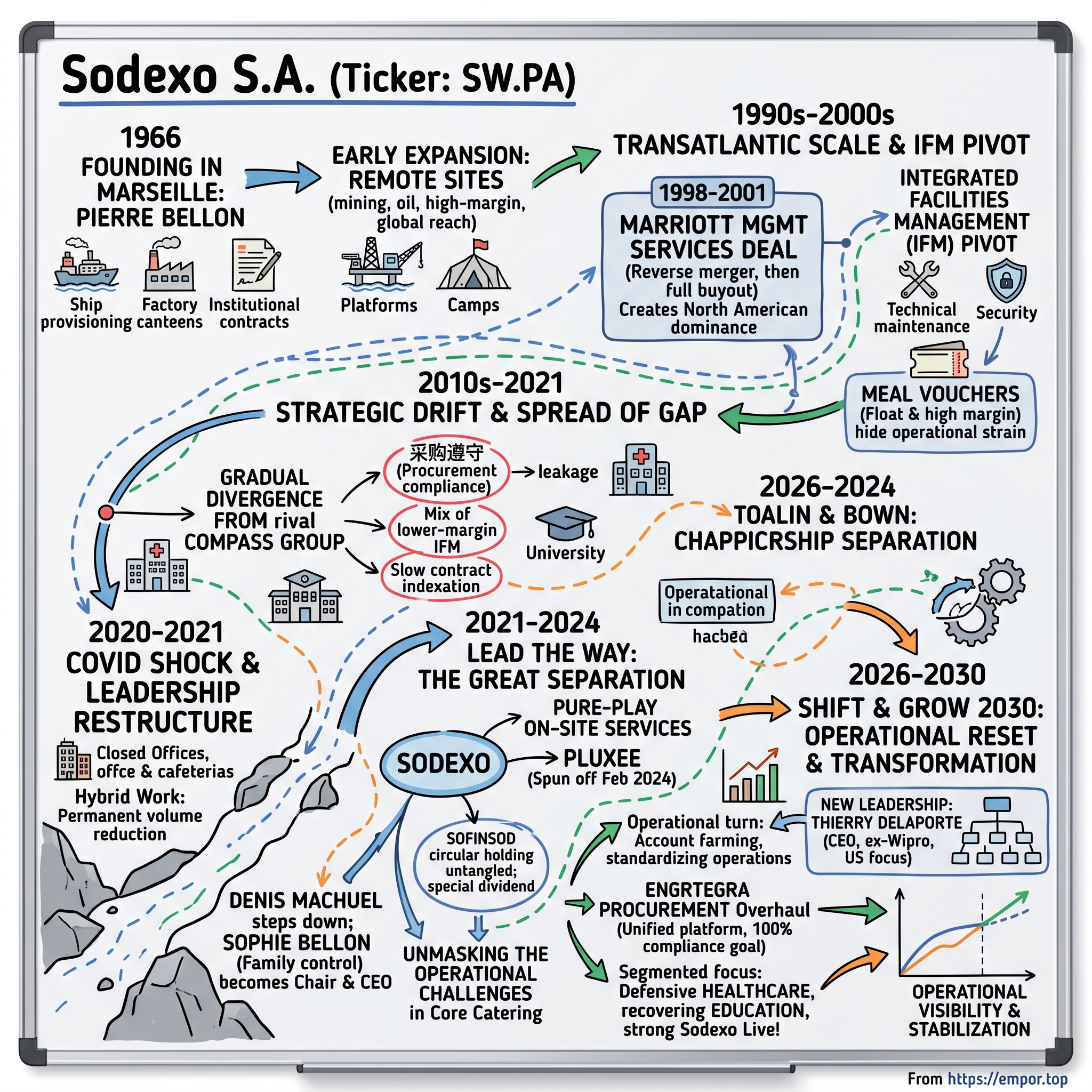
Sodexo S.A.: The Architecture of Institutional Nourishment & Workplace Transformation
I. Prologue & Episode Roadmap
On the morning of April 10, 2026, five months into his tenure as chief executive of Sodexo, Thierry Delaporte dialled into a conference call with covering analysts and delivered a strikingly candid assessment, aligning himself with the market's fiercest critics.
"We have undeniably underperformed the market and our main competitors," Delaporte told them. Avoided were typical executive euphemisms about challenging environments or underlying business resilience. The root causes, he stated, "have been building over time and relate primarily to under-investment and execution."[^1]
Delaporte then lowered the company's financial guidance. Organic revenue growth for the fiscal year ending August 2026 was cut to between 0.5% and 1%. The underlying operating margin — the central benchmark of Sodexo's investment thesis for a decade — was reduced to between 3.2% and 3.4%, down from 4.7% the prior year.1 In contract catering, such a reduction is profound: on roughly €24 billion in revenue, a 130-basis-point margin drop equates to approximately €300 million in lost operating profit in a single announcement.
This reflects the challenging economics of contract catering. Sodexo feeds around 80 million people daily across roughly 27,000 client sites in more than 40 countries, employing over 426,000 people.2 It ranks among the world's largest private employers, yet operates on an underlying margin that, even in strong years, hovers under five cents on the euro.
This narrow margin leaves virtually no operational buffer. A minor uptick in food inflation, hourly wage growth exceeding contracted price escalators, poor execution during account mobilisations, or declining university enrolments can reduce margins by 20 to 30 basis points—eroding 5% or more of total operating profit. Consequently, Sodexo functions as an operational leverage play on execution discipline. When execution is tight, leverage drives profitability upward; when discipline falters, margin compression occurs rapidly. Fiscal 2026 represents that downside risk unfolding in real time.
The current chapter of Sodexo's trajectory began with a major structural separation. On February 1, 2024, Pluxee—the employee-benefits and meal-voucher business developed inside Sodexo over decades—was listed independently on Euronext Paris, with one Pluxee share distributed for every Sodexo share held.3 The strategic rationale was straightforward: Pluxee was a high-margin, float-generating fintech asset attached to a low-margin, labor-intensive services business. Operationally distinct, the two entities required separation to allow proper market valuation.
However, structural separation also removed a key buffer. For two decades, Pluxee's superior profitability elevated Sodexo's consolidated margins, cushioning operational missteps in the core business. Without Pluxee, the remaining On-Site Services division stands fully exposed—stripped of financial float and high-margin earnings, leaving only the core enterprise of operating facilities and food service accounts at scale. The spin-off did not create Sodexo's operational challenges; it exposed them.
Rather than delivering the pure-play valuation re-rating promised in 2024, the spin-off was followed by operational headwinds: a profit warning in March 2025, full-year results that met expectations only after guidance had been reduced, the transition of leadership away from a second-generation family CEO, the appointment of an external chief executive, a comprehensive contract review that trimmed margins by an additional 140 basis points, and, on July 16, 2026, a five-year strategic plan acknowledging that historical profitability would not be restored until the end of the decade.4
The roadmap. Sodexo's history spans from a Marseille shipping dynasty to North American corporate and institutional campuses. Key chapters include the 1998 transaction that established Sodexo as the largest food service provider in North America; the multi-year performance divergence from UK rival Compass Group; the severe operational shock of the COVID-19 pandemic; the 2021 leadership restructuring that reasserted family control; the 2024 corporate simplification that spun off Pluxee and returned nearly €1 billion to shareholders; and the 2026 operational review, in which a new leadership team challenged a decade of strategic assumptions.
Central to this analysis is a core question: does Sodexo possess a durable competitive advantage, or simply scale without the operational discipline needed to convert volume into margin? Sodexo's procurement arm, Entegra, claims to be the world's largest food group purchasing organization, backed by $50 billion in annual purchasing volume across more than 360,000 sites.5 Yet despite that purchasing scale, Sodexo's operating margin remains roughly half that of its chief UK competitor, establishing the central investment debate surrounding the company.
 Subscribe on LinkedIn
II. Founding Origins: Pierre Bellon & The Marseilles Marine Catering Playbook (1966–1980s)
The Old Port of Marseille in the 1950s smelled of diesel, salt, and cooking oil. Ships arrived from Algiers, Beirut, Dakar, and West Africa, each requiring provisioning: flour, tinned goods, cured meat, wine, and water. Loading required operational discipline and reliable pricing; running short mid-voyage in the Mediterranean posed severe operational risk.
Pierre Bellon, born in 1930, grew up within that trade. His father operated a maritime supply company in the city.6 The business focused on core logistics, provisioning, margin management, and reliability—the discipline of ensuring physical goods arrived at a specified location on schedule and in exact quantities.
Bellon graduated from HEC Paris before adapting the maritime provisioning model to land-based facilities. In 1962, he launched Repas Service, delivering prepared meals to businesses around Marseille.6 His central insight was that factory canteens and merchant vessels shared the same operational constraint: a captive workforce needing on-site meals at predictable costs from a specialist in food logistics.
The venture achieved a major breakthrough in 1964 by securing a contract to operate a 2,000-seat self-service restaurant for the Commissariat à l'Énergie Atomique, France's atomic energy commission.6 Serving 2,000 daily covers provided proof of concept with a major institutional client—a permanent organization that determined paying a specialist was preferable to managing its own kitchens.
In 1966, Bellon formalised the enterprise as Sodexho, an acronym for Société d'Exploitation Hôtelière, Aérienne, Maritime et Terrestre.6 The name signaled a strategy spanning hotel, aviation, maritime, and terrestrial food and facility services.
The outsourcing wave, and why it worked
Sodexho's expansion into a multinational enterprise reflected a fundamental shift in corporate cost structures. The company was selling operational efficiency rather than simple food service.
Consider a French manufacturing plant in 1970 with 800 employees operating an internal cafeteria. Management faced kitchen maintenance, food purchasing at near-retail rates, health inspections, staffing absences, and administrative distractions unrelated to manufacturing. In-house catering represented a fixed overhead cost and a persistent operational burden.
Outsourcing converted unpredictable operational friction into a defined contractual line item with fixed per-meal or management-fee structures, clear service standards, and single-point accountability.
Sodexho's internal economics relied on geographic density. A single client site purchased food at near-retail prices. Operating 50 client sites within a single region unlocked bulk purchasing, shared distribution routes, unified management, and flexible staffing across accounts. Every additional site within a geographic cluster lowered unit costs across the local network.
However, density creates localized rather than global economies of scale. Scale in Lyon yields operational efficiency in Lyon, but provides no structural advantage in Ohio. A global contract caterer functions effectively as an aggregate of regional density networks under a single brand—leaving the business exposed to geographic performance dispersion when individual regions encounter operational strain.
Remote sites: the high-risk, high-margin cash engine
Sodexho's most strategically consequential early expansion extended beyond urban centers into remote-site services, managing housing and catering for mining camps, construction projects, and offshore oil platforms in Africa and the Middle East. Within eight years of its founding, the company operated across 35 countries, generating 55% of its revenue outside France.6 International expansion continued through the early 1990s, with 25 new country entries between 1990 and 1994.6
Remote sites operated under distinct economic dynamics. Isolated industrial camps required comprehensive infrastructure management, including accommodation, catering, water supply, laundry, and waste disposal. With no local retail alternatives, clients entered into long-term, broad-scope contracts priced to reflect logistical complexity.
This segment delivered structurally higher operating margins than European corporate canteens, generating cash flow that funded expansion into other markets while introducing exposure to geopolitical instability, commodity cycles, and foreign exchange volatility.
That remote-site capability remains a major financial driver. In the third quarter of fiscal 2026, Sodexo's Rest of the World region grew organically by 10.6%, driven largely by project ramp-ups in Energy & Resources.7 On the quarterly earnings call, Chief Financial Officer Sebastien De Tramasure noted that the capabilities built running large remote worker camps closely parallel the requirements for serving data center construction sites—a fast-growing sector where the company is building a project pipeline.7
Six decades after its founding, the original Marseille provisioning model—delivering reliable food and site services to captive populations in challenging environments—remains Sodexo's most durable operational strength, contrasting with the persistent margin pressures in its high-volume corporate food service accounts.
III. Transatlantic Scale: The Marriott Management Services Mega-Deal & Global Expansion (1990s–2000s)
By the mid-1990s, Sodexho faced a common challenge for expanding European multinationals. The company had listed on the Paris Stock Exchange in 1983 and joined the CAC 40 index in 1998.6 While it maintained a global presence, it remained subscale in North America—the world's largest contract catering market.
North America generated the bulk of industry profits, dominated by two major players: Aramark and Marriott's food service division. Building scale organically in the region against established incumbents would have required substantial capital and time.
Rather than attempting organic growth, Sodexho opted for a strategic transaction. The structure of that deal reflected founder Pierre Bellon's calculated approach to balance sheet discipline and corporate control.
What actually happened in 1998
On October 1, 1997, Marriott International announced a corporate restructuring, spinning off its lodging, senior living, and distribution businesses into a new entity. The remaining company—Marriott Management Services, its food service and facilities management unit—was combined with Sodexho Alliance's North American operations.8
The combined entity, named Sodexho Marriott Services, Inc., was 51% owned by Marriott International shareholders and 49% owned by Sodexho Alliance. To secure its stake, Sodexho contributed approximately $305 million in cash to its North American arm prior to the merger and received roughly 124 million shares. The transaction valued Marriott's food and facilities business at over $2 billion, including debt.8
The transaction was structured not as an outright acquisition, but as a reverse-merger-style combination. By taking a 49% minority stake in a publicly traded entity, Sodexho created the largest contract services provider in the United States, operating over 4,800 accounts with more than $4 billion in annual sales and roughly 100,000 employees.8
The structure was capital-efficient: for roughly $305 million in cash, Sodexho acquired nearly half of an entity several times larger than its existing US footprint, while public equity markets shared the capital burden. The deal also strengthened executive leadership: Michel Landel, who served as executive vice president of the combined entity after leading Sodexho's North American operations, eventually rose to become group chief executive officer.8
However, the initial minority structure meant Sodexho lacked full operational control—a situation temporary for a founder intent on consolidated governance.
Full control was secured three years later. In January 2001, Sodexho Alliance offered $27 per share, or approximately $900 million, for the 51% stake it did not own. After the board rejected that offer as inadequate, the parties agreed on May 2, 2001, to a price of $32 per share—representing a total cash outlay of roughly $1.08 billion and an 8.5% premium over the previous day's closing price.9 By that point, the North American unit had expanded to $4.7 billion in annual sales across 5,000 locations with 111,000 employees. The buyout established Sodexho as the world's largest food service and facilities management provider, surpassing Compass Group.9
In total, the two-step transaction required approximately $1.4 billion in cash over four years, establishing North America as Sodexo's primary regional market. The region remains the company's operational center of gravity, generating €11.2 billion in revenue in fiscal 2025, or 46% of total group sales.2
This expansion highlighted a long-term strategic tradeoff. While Sodexho successfully purchased market volume, acquiring a major US footprint did not automatically generate operational differentiation. For two decades, industry growth masked structural parity with competitors. However, as UK rival Compass Group subsequently built superior local operational efficiencies and site discipline within North America, Sodexo's reliance on acquired scale rather than organic capability began to pressure relative margins.
The pivot into facilities management
Sodexho's second major strategic shift during this era was expanding beyond food service into Integrated Facilities Management (IFM), incorporating technical maintenance, cleaning, security, groundskeeping, energy management, and reception services. The commercial premise was cross-selling: leveraging existing food service relationships to manage a client's broader physical infrastructure.
IFM agreements offered larger contract sizes, longer tenure, and higher client switching costs. Replacing a food service caterer involves localized operational disruption, whereas re-tendering a multi-service contract covering physical infrastructure requires extensive administrative realignment. Consequently, IFM promised increased revenue per client site and stronger contract retention.
However, technical facilities management introduced distinct operational risks, labor requirements, and contract complexities. Margin profiles in technical FM were often narrower, and performance-penalty clauses on subcontracted maintenance created potential downside exposure. As IFM grew as a proportion of total revenue, group operating margins experienced downward pressure.
The concentration risk inherent in large IFM contracts became evident in subsequent years. In fiscal 2024, Sodexo's client retention rate declined from 97.1% to 94.2%, with approximately 60 basis points of that reduction driven by the termination of a single global facilities management account.10 Similarly, the demobilization of a major European IFM contract continued to weigh on European organic growth into the third quarter of fiscal 2026.7
In response, executive leadership subsequently refocused strategy toward core food services. By fiscal 2025, food service generated more than two-thirds of portfolio revenue, up from 62% in fiscal 2022, marking a deliberate shift back toward higher-margin catering operations.11
The voucher business that hid the problem
The third key leg of Sodexho's strategy emerged from the French Chèque Restaurant model, building an employee benefits and meal-voucher business. Under this structure, employers purchased vouchers for employees, merchants redeemed them upon receipt, and Sodexho collected transaction fees from both employers and merchants while holding the funds during the redemption cycle.
This model generated significant financial float—prefunded cash held on the balance sheet between issuance and redemption that earned interest income—alongside high-margin transaction fees. Unlike labor-intensive food operations, the voucher unit scaled efficiently without linear staffing increases, functioning effectively as a financial technology and payments network.
For two decades, the voucher division provided a substantial boost to consolidated performance. High profit margins and float income elevated Sodexo's aggregate operating margin above the underlying return of On-Site Services. However, this blended reporting obscured operational underperformance in core contract catering, masking margin headwinds and delaying operational reforms in food service.
This earnings buffer sustained group financial metrics through the 2000s and 2010s, maintaining consolidated margins until the structural spin-off and rising competitive pressure from UK rivals forced a re-evaluation of On-Site Services' standalone economics.
IV. The Lost Decade & Strategic Drift: COVID Crisis, Remote Work, & Leadership Friction (2010s–2021)
Sodexo's competitive divergence from Compass Group occurred gradually rather than through a single sudden disruption, compounding over more than a decade in an industry where margin improvements are measured in fractions of a percentage point.
By fiscal 2025, that performance gap had widened significantly. Compass delivered organic revenue growth of nearly 9%, with underlying operating profit up almost 12% to over $3.3 billion and a second-half operating margin of 7.3%. Its client retention rate stood above 96%, with net new business running at 4.5%—marking its fourth consecutive year within its target range of 4% to 5%.12
Over the same twelve-month period, Sodexo grew organically at 3.3%, generating €1.1 billion in underlying operating profit at a 4.7% margin, retaining 94% of its clients, and securing €1.7 billion in new business.11 The contrast was stark: on broadly comparable revenue bases, Compass generated nearly three times as much operating profit, converting significantly more of every dollar in sales into bottom-line returns.
Why the gap exists
Three primary structural mechanisms explain the divergence between the two competitors.
Procurement compliance. Both companies operate massive group purchasing organizations. Compass relies on Foodbuy, which handles over $30 billion in annual spend in the United States alone.12 Sodexo operates Entegra. Although their paper scale is comparable, the operational difference lies in purchasing compliance—the percentage of site-level orders that actually flow through negotiated vendor contracts.
In contract catering, a group purchasing organization secures volume discounts with suppliers, but those savings materialize only if local managers adhere strictly to approved supply catalogs. When a hospital kitchen manager orders unapproved items from a local distributor rather than contracted items from approved suppliers, margin leaks in two ways: the local site pays higher unit prices, and the parent company loses purchasing volume that supports future rebate negotiations. In an industry operating on sub-5% margins, minor food-cost compliance leakages directly erode operating profit. Compass built a competitive advantage not merely by negotiating bulk terms, but by enforcing site-level purchasing adherence.
Sodexo's executive leadership subsequently acknowledged this structural gap. On the October 2025 earnings call, Chairwoman and CEO Sophie Bellon conceded that site-level purchasing compliance in the United States "is not sufficient," disclosing that starting in September 2025, every manager from the site level upward would be newly incentivized on purchasing compliance.11 The policy change highlighted how long local operational decisions had remained unaligned with corporate procurement contracts.
Business mix. Compass focused primarily on core food service, whereas Sodexo expanded further into integrated facilities management—a sector characterized by structurally lower margins, greater labor complexity, and higher execution risks. While portfolio mix does not account for the entirety of the 250-basis-point margin gap, it accounts for a significant portion.
Contract indexation. During inflationary periods, profitability depends on how quickly contract terms allow pricing to adjust to rising food and labor costs. Cost-plus contracts automatically pass cost increases to clients. Fixed-price and profit-and-loss contracts require explicit renegotiation, which in European public-sector education and healthcare accounts is often slow, political, and restricted to annual cycles. Consequently, a contract portfolio that indexes slowly exposes the operator to persistent margin compression.
The family, the governance, and the CEO who didn't last
Founder Pierre Bellon stepped down from the chairmanship in 2016, passing the role to his daughter Sophie Bellon, before his death in 2022. The Bellon family's governance control remained structurally decisive: as of August 31, 2025, family holding company Bellon SA held 43.8% of Sodexo's equity capital and 58.8% of exercisable voting rights.13 Utilizing the double-voting-rights structure standard in French corporate governance, the family maintained absolute voting control while holding less than half of the economic equity.
This control was further reinforced by a long-term family lock-up agreement. In June 2015, Pierre Bellon, his spouse, and their children signed a binding agreement prohibiting direct descendants from freely disposing of Bellon SA shares for fifty years.13 While the agreement ensures stability, it also presents a central governance question for public shareholders: whether multi-generational family control fosters patient long-term investment or insulates management from the market pressures that compel faster operational reforms.
The tenure of Denis Machuel, who was appointed chief executive officer in 2018, illustrated these governance dynamics. Machuel inherited an operation already trailing competitors in organic growth and profitability. During his leadership, growth lagged, North American execution—especially across healthcare accounts—stagnated, and contractual adjustments to rising food and labor inflation lagged behind market movements.
Then, in early 2020, the COVID-19 pandemic disrupted the core operating model of contract catering.
The shock that emptied every building
Contract catering carries a fundamental structural vulnerability: revenue depends directly on physical site attendance. Sodexo's business model relies on foot traffic in workplaces, universities, and venues. When global lockdowns took effect in March 2020, site attendance halted.
Corporate cafeterias closed, universities transitioned to remote learning, and sports stadiums and convention centers—managed under the Sodexo Live! brand—suspended operations entirely. The Business & Administrations segment suffered immediate revenue contraction. While healthcare facilities and remote energy sites remained operational and cushioned the downturn, corporate dining and live events experienced sharp revenue declines while maintaining substantial fixed costs until contracts were restructured and labor costs adjusted.
Beyond the initial demand shock, the pandemic accelerated a permanent structural shift in workplace attendance. The widespread adoption of hybrid work reduced baseline meal counts in corporate dining. Cafeterias built for five days of full capacity operating with peak attendance concentrated between Tuesday and Thursday faced permanently altered site economics, altering baseline revenue potential across corporate accounts.
The crisis also prompted cost-cutting decisions that disrupted specialized capabilities. During the pandemic, Sodexo disbanded its US university meal-plan team—the specialized unit responsible for structuring and pricing higher-education dining contracts. In October 2025, management disclosed that it was rebuilding the team from scratch while renegotiating 75 higher-education meal plans scheduled for implementation in autumn 2026.11 Reconstituting that capability required five years, during which Sodexo lost higher-education market share to competitors.
July 2021: the family takes the wheel
On July 27, 2021, Sodexo announced a major governance restructuring. Denis Machuel stepped down as chief executive on September 30, 2021, and Chairwoman Sophie Bellon assumed the additional role of interim chief executive starting October 1, receiving a monthly fee of €18,750 for the combined executive responsibilities.14 The board confirmed the dual leadership structure on October 7, 2021, and formally appointed her Chairwoman and CEO on February 15, 2022.
Under the terms of Machuel's departure, he declined severance compensation, while retaining a non-compete indemnity of approximately €1.8 million tied to a three-year covenant and keeping 41,514 performance shares subject to achievement of performance targets.14 The structured separation reflected mutual agreement between the board and executive leadership that the company's operating trajectory required a strategic shift.
By combining the roles, the controlling family asserted direct operational control over the enterprise. Combining the roles of chairwoman and chief executive concentrated governance and operational authority within the founding family, temporarily reducing independent board oversight.
Four years later, the board reversed that dual governance structure—a shift that defined the starting point of Sodexo's current operational turnaround strategy.
V. The "Lead the Way" Transformation & The Great Separation: Spun-Off Pure Play (2021–2024)
When Sophie Bellon assumed full executive leadership, she inherited a corporate structure divided between an On-Site Services division burdened by operational margin pressure and an employee benefits business operating with high profit margins. The balance sheet also retained a complex circular ownership structure dating to 1991.
Under the strategy branded "Lead the Way," Bellon sought to reposition Sodexo as a pure-play food and facility services enterprise while streamlining non-core corporate holdings. On her final results call as chief executive in October 2025, she framed the mandate established in 2022 in precisely those terms.11
Judged purely on structural simplification, the initiative succeeded. Judged on the operational performance that simplification was intended to unlock, the initial results proved far more challenging.
Untangling the 1991 knot
A key structural anomaly on Sodexo's balance sheet was Sofinsod, a subsidiary whose sole asset was a 19.6% stake in Bellon SA—the family holding company that controlled Sodexo. Sodexo effectively held an equity stake in its own controlling entity. This circular structure originated in 1991, stemming from the unwinding of cross-holdings with Carlson Wagonlit.
Circular shareholdings complicate corporate governance by entrenching control without requiring incremental capital deployment. Because the operating company owned a fifth of its controlling entity, public capital effectively supported a portion of the family's voting power while locking up capital in an illiquid asset.
Sodexo resolved the structure by selling Sofinsod to Bellon SA for €918 million, completing the transaction on August 23, 2024. The full proceeds were returned to shareholders through a special interim dividend of €6.24 per share, paid on August 29, 2024.15 Because the asset was carried at €751 million in first-half fiscal 2024 accounts, the purchase price represented a premium over book value.
As a related-party transaction, the sale required minority shareholder approval. The transaction eliminated the circular holding, allowing the controlling family to consolidate full ownership of its holding vehicle while returning €918 million in cash directly to Sodexo shareholders.
The separation
The core transaction of the restructuring was the spin-off of Pluxee. At an extraordinary general meeting on January 30, 2024, shareholders approved the distribution of one Pluxee share for every Sodexo share held, with an 85.89% quorum and what the company described as a very large majority.3 Pluxee listed on Euronext Paris on February 1, 2024, with shares delivered to holders on February 5.3
Management framed the separation as enabling two pure-play entities in large, expanding markets to pursue independent growth strategies.3 Historically, Pluxee's high profit margins and interest income on float had elevated Sodexo's consolidated metrics. The spin-off stripped away that earnings cushion, requiring On-Site Services to be evaluated strictly on its independent operating performance.
While the separation achieved structural clarity, it also fully exposed the underlying operational challenges within core contract catering. Subsequent operational results immediately drew market focus back to those standalone catering economics.
The year the numbers looked good
Initial financial performance following the separation appeared strong. In fiscal 2024, Sodexo reported revenue of €23.8 billion, organic revenue growth of 7.9% split evenly between pricing and volume, a 13.7% increase in underlying operating profit, and a 40-basis-point margin expansion to 4.7%. Net profit from continuing operations rose 31.8% to €738 million, supporting a 17.8% increase in the ordinary dividend to €2.65 per share.10
However, the composition of that top-line growth revealed temporary tailwinds. Approximately four percentage points of the 7.9% organic growth stemmed from inflation pass-through pricing, while volume gains were bolstered by major one-off sporting events, including the Paris Olympic Games and the Rugby World Cup.
Concurrently, underlying commercial retention deteriorated. Client retention declined from 97.1% to 94.2% in fiscal 2024, driven principally by the loss of a single large global facilities management contract.10 The drop indicated that headline revenue growth, elevated by pricing adjustments and event volumes, masked underlying account attrition in core operations.
Management incentives and the credibility question
Post-separation financial targets established the benchmark for evaluating standalone execution.
For fiscal 2025, initial guidance targeted organic revenue growth between 5.5% and 6.5%, along with underlying operating margin expansion of 30 to 40 basis points.10
Full-year performance fell substantially short of these targets, delivering organic growth of 3.3% and 10 basis points of margin expansion at constant currency.11
The shortfall was formally acknowledged on March 20, 2025, when Sodexo reduced full-year guidance to 3–4% organic growth and 10–20 basis points of margin expansion, attributing the revision to persistent soft volumes in Education, delayed Healthcare contract start dates, and softer commercial performance in North America.16
Addressing the guidance cut, Sophie Bellon stated that "while our industry fundamentals remain strong," execution issues were concentrated in North American Education volumes and Healthcare contract ramp-up timing.16 While the statement distinguished broader market demand from internal execution, the adjustment arrived midway through the first full fiscal year following the spin-off.
Three underlying financial factors further illustrated operational strain:
First, capital allocation lagged internal targets. Capital expenditure reached approximately 2% of revenue in fiscal 2024 and 2025, below the stated 2.5% objective. Bellon linked the underspend directly to a low win rate on major contracts, as large deals require client-side capital investment.11
Second, cash generation faced non-operational tax headwinds. Fiscal 2025 free cash flow of €459 million reflected an exceptional outflow of roughly €160 million related to the finalisation of a French tax reassessment on Sodexo S.A.11 Excluding that settlement, underlying cash conversion reached 91%, demonstrating strong baseline cash conversion from operating profit.
Third, rising borrowing costs created financial drag. In May 2025, Sodexo issued a $1.1 billion bond ahead of 2026 debt maturities. With average bond coupons expected to rise from roughly 2.7% toward 4% to 4.5% over three to four years, annual interest expense is projected to increase from approximately €140 million toward €170–190 million.[^1] This shift represents €30 million to €50 million in annual pre-tax earnings absorbed by refinancing costs during a period requiring reinvestment in operational capability.
By late 2025, persistent execution gaps prompted the controlling family to initiate a broader leadership transition.
VI. Core Business Deep Dive: Segment Economics & How Sodexo Wins
Inside a major American hospital at four in the morning, a Sodexo operational team is already at work. This is not a standard corporate cafeteria; it is a clinical production kitchen preparing specialized therapeutic diets for patients. Renal menus, diabetic protocols, texture-modified meals for dysphagia patients, and strict allergen isolation mean an operational error carries clinical risk.
Two floors above, another Sodexo team manages patient room turnover. In the basement, a third crew operates the loading dock. For hospital executives, a single contract consolidates all three functions.
By contrast, inside a corporate headquarters in central London on a Friday afternoon, a Sodexo café remains open with a full barista staff, serving a third of its usual seats while most office workers work remotely. The same service provider operates under entirely different site economics.
That operational variance defines Sodexo's segment performance.
Where the money is
Geographically, Sodexo combines a North American revenue base with a European corporate legacy. Fiscal 2025 revenue of €24.1 billion was divided into €11.2 billion in North America (46%), €8.6 billion in Europe (36%), and €4.3 billion in the Rest of the World (18%).2 Workforce distribution reflects varying labor intensity across regions, with 179,952 employees in the Rest of the World compared to 124,886 in North America.2
Across client categories, Sodexo operates through four distinct commercial divisions:
Business & Administrations handles corporate dining and facility services, representing the segment most exposed to post-pandemic hybrid work. Close to 86% of Rest of the World revenue sits within B&A, incorporating Energy & Resources remote-site operations.11 Consequently, the division spans both underutilized European corporate dining rooms and high-margin mining camps in Western Australia operating under opposite demand trends.
Healthcare & Seniors provides Sodexo's most defensive revenue base, characterized by high client switching costs tied to clinical workflows and regulatory compliance. Demand remains decoupled from office attendance patterns. In the third quarter of fiscal 2026, organic revenue grew 7.8% in North America, while US Healthcare client retention exceeded 97% in fiscal 2025 — three percentage points above the group average.711
Education has presented persistent operational challenges. US Higher Education suffered sustained market-share losses, which management attributed in an October 2025 review to a footprint over-indexed to small and mid-sized institutions, inadequate mid-plan renegotiations, and misaligned sales resources.11 Enrolment across Sodexo's comparable higher-education accounts fell roughly 0.7% year-over-year in autumn 2025, compounded by visa delays, denials, and revocations impacting international student numbers.11
Sodexo Live! — managing venues, stadiums, convention centers, and airport lounges — proved to be a bright spot in fiscal 2026. Third-quarter organic growth in North America exceeded 15%, driven by robust venue attendance and higher spend per guest from expanded merchandising and brand partnerships.7
How the contracts actually work
Contract catering relies on two primary pricing structures that determine which party absorbs input inflation:
Under cost-plus contracts, the client reimburses operating expenses and pays a fixed management fee. The caterer's operating margin remains protected, while the client absorbs food and wage inflation.
Under fixed-price or profit-and-loss contracts, the caterer collects revenue directly and retains full cost exposure. Margin expansion depends on operational efficiency, while unhedged food or wage inflation compresses profitability.
Contract profitability turns on indexation mechanics—how rapidly pricing terms adjust to published food and labor indices. Fast, automatic indexation passes cost increases through with minimal lag. Slow or negotiated indexation forces the caterer to absorb cost increases until annual adjustments occur. A significant portion of Sodexo's European public-sector education and healthcare book operates under slow indexation terms.
The impact of contract structure was evident in first-half fiscal 2026 results: pricing adjustments contributed 2.4 percentage points to organic growth, while like-for-like volume added just 0.2 points.[^1] Top-line growth reflected inflation pass-through rather than unit expansion.
Retention: the KPI that governs everything
In contract catering, client retention functions as the primary determinant of organic growth momentum. On a €24 billion revenue base, retaining 96% of accounts requires replacing under €1 billion annually to maintain flat revenue. At a 93.4% retention rate, required replacement revenue rises to €1.6 billion before generating net growth.
Retention remains structurally high across the industry because changing providers introduces operational risk. Switching hospital caterers requires re-credentialing staff, revising dietary software protocols, and risking service disruptions. Replacing a corporate caterer directly impacts employee amenities.
Sodexo's client retention trajectory highlights a key vulnerability. Group retention slipped from 97.1% in fiscal 2023 to 94.2% in fiscal 2024, 94.0% in fiscal 2025, and 93.4% for the twelve months ending February 2026.1011[^1] Chief Executive Thierry Delaporte addressed the decline directly on his April 2026 conference call, calling every contract loss "dramatic" and insisting the company "stop accepting the fact that we are losing contracts," targeting near-term retention of 95% and higher over time.[^1]
Entegra, and the compliance gap
Entegra represents Sodexo's group purchasing organization and the world's largest food buyer by volume, managing $50 billion in annual purchasing power across more than 360,000 purchasing sites and 2,700 suppliers.5
The model leverages aggregate volume to negotiate supplier discounts, extending those price terms to third-party members such as hotel chains, restaurant groups, and senior living operators. Entegra earns administrative fees and supplier volume rebates without operational cooking overhead. Sodexo more than doubled Entegra's scale in the three years through fiscal 2025 and acquired French GPO Agap'pro to expand its European footprint.11
However, purchasing scale translates into margin expansion only when local unit managers adhere to contracted supplier catalogs. To capture this margin potential, management initiated an operational overhaul in fiscal 2026: migrating client sites onto a unified purchasing platform, standardizing recipes to link directly with order guides, establishing real-time spend visibility, and pooling procurement volumes across on-site operations and Entegra.11
The necessity of building basic spend-tracking infrastructure in fiscal 2026 demonstrates how site-level compliance lagged historical scale expansion—and indicates potential margin recovery if digital compliance tools are successfully deployed.
Bolt-ons
Sodexo has focused M&A on targeted bolt-on transactions targeting convenience, food-technology formats for hybrid workplaces, and procurement expansion. Examples include CRH Catering in the US and Agap'pro in France during fiscal 2025, followed by Grupo Mediterránea in Spain at the end of February 2026, which doubled Sodexo's Spanish footprint.11[^1] The company maintains explicit investment criteria for bolt-ons: a capital payback period under 10 years, a return on capital employed above 15%, and an annual capital allocation of approximately €300 million.11
However, small acquisitions cannot bridge a 250-basis-point margin gap against peer benchmarks. Addressing that gap requires site-level execution discipline—the central objective of the July 2026 strategic plan, and the benchmark against which Sodexo's operational turnaround must be evaluated.
VII. Competitive Dynamics, Porter's 5 Forces, & Hamilton Helmer's 7 Powers
In any competitive assessment of the global contract catering industry, the largest competitor is not a corporate rival at all.
Roughly half of the global institutional food service market remains self-operated—organizations that continue to run their own kitchens.11 This represents the industry's primary structural growth driver, as well as a recurring strategic justification. When top-line growth slows or market share slips, industry executives often point to the untapped outsourcing market rather than account churn between contract caterers. However, that structural opportunity is available to all major players equally, and Compass Group has converted self-operated accounts at a consistently faster pace.
The three-player oligopoly
Compass Group serves as the industry operational benchmark. For fiscal 2026, Compass guided to approximately 7% organic revenue growth and roughly 10% underlying operating profit growth, including a two-percentage-point profit contribution from acquisitions such as Vermaat.12 Guiding operating profit growth ahead of revenue expansion signals continued margin improvement from an operating base that already significantly exceeds Sodexo's profitability.
Aramark, the US-focused third major player, has also demonstrated solid operational momentum. In fiscal 2025, Aramark generated $18.5 billion in revenue—up 6% on a reported basis and 7% organically, aided by two percentage points from an extra trading week. Adjusted operating income reached $981 million, up 12% at constant currency, expanding its adjusted operating margin to 5.3%. Commercial execution remained strong, with client retention reaching 96.3% and net new business expanding 5.6% on $1.6 billion in gross new contract wins—a 12% increase.17
Evaluating the three operators across the core commercial drivers of contract catering reveals a clear performance gap. On client retention, Compass surpassed 96% and Aramark achieved 96.3%, while Sodexo stood at 93.4%. On net new business growth, Compass generated 4.5% and Aramark reached 5.6%, whereas Sodexo contracted by 0.6% in the first half of fiscal 2026.1217[^1]
These metrics indicate that Sodexo's commercial challenge extends beyond minor execution slippage; on the key drivers of account retention and net expansion, the company has lagged both primary peers simultaneously.
Applying the 7 Powers
Applying Hamilton Helmer's 7 Powers framework—which identifies specific strategic mechanisms that enable a company to sustain returns above its cost of capital—yields a mixed profile for Sodexo.
Scale economies represent Sodexo's primary theoretical advantage, anchored by Entegra's substantial purchasing volume. However, scale economies in contract catering translate into superior margins only when paired with strict site-level purchasing compliance. Historical results show Sodexo possessed aggregate scale without full operational conversion. Because Compass converts comparable purchasing scale into substantially higher operating margins, the operational constraint stems from execution discipline rather than structural scale.
Switching costs provide Sodexo's most durable economic protection, particularly where services integrate directly into client operations—such as clinical dietary workflows in healthcare facilities, where client retention exceeds 97%. However, switching costs vary significantly across segments. In corporate dining and higher education, where offerings are more standardized, client switching occurs more frequently, limiting this advantage to specialized institutional accounts.
Process power—proprietary operational capabilities developed over time that competitors cannot easily replicate—is evident in Sodexo's remote-site and complex clinical operations, as reflected in its Rest of the World performance. At the group level, however, Chief Executive Thierry Delaporte explicitly identified operational friction, noting that decision rights had become "diluted across layers," organizational complexity had slowed execution, and fragmented initiatives had scattered managerial resources.[^1] In core geographies, organizational friction has hindered enterprise-wide process efficiency.
Branding, network economies, cornered resources, and counter-positioning play minimal roles in Sodexo's competitive profile. Institutional clients evaluate contracts on price and service metrics rather than brand equity. Network effects do not apply, as adding client sites improves local density and purchasing scale rather than direct service utility. Furthermore, Sodexo holds no exclusive physical assets and operates under the same fundamental business model as its chief rivals.
In summary, Sodexo possesses one effective power in high-complexity niches (switching costs), one structural advantage that requires higher site compliance to fully capture (scale economies), and specialized capabilities in remote sites that have been offset by administrative complexity in its core markets (process power).
Porter's five forces
Buyer power: high, and rising. Corporate and public-sector clients utilize formal procurement processes and third-party advisors to benchmark contract pricing. Delaporte disclosed that approximately 50% of Sodexo's fiscal 2026 contract-review margin adjustments were concentrated in Europe and one-third in North America, highlighting where client pricing power had squeezed contract profitability.[^1] Concurrently, Chairwoman Sophie Bellon noted that financially constrained universities have adopted increasingly commercial approaches to vendor selection—a shift that increases pricing pressure while expanding prospective outsourcing opportunities.11
Supplier power: moderate, and partially mitigated. Aggregate purchasing scale helps buffer raw material cost pressures. On the July 2026 conference call, CFO Sebastien De Tramasure noted that food inflation had stabilized, despite ongoing pressure in transportation and energy, pointing to operational mitigants including product substitution, menu engineering, client contract adjustments, and supplier negotiations.7 On the labor front, management reported a moderating trend in wage inflation, easing a major source of cost pressure.7
Threat of substitutes: high in corporate dining, low in captive environments. Office workers can choose commercial food options, delivery services, or home-prepared meals, creating high substitution risk in corporate facilities. Conversely, hospital patients and remote mining camp personnel have no external alternatives. The threat of substitution aligns closely with segment performance, presenting headwinds in corporate dining while remaining minimal in captive institutional facilities.
Threat of new entrants: low for enterprise-scale contracts. Establishing a global contract catering operation requires capital, procurement scale, and site infrastructure that create high barriers to entry. While local caterers compete effectively for individual sites, they lack the global footprint required by multinational corporations seeking unified service agreements across multiple countries—a capability Delaporte highlighted when reaffirming Sodexo's commitment to maintaining its international presence.[^1]
Rivalry: intense and asymmetric. Three major global operators compete for large institutional accounts in a mature industry. This rivalry is structurally disadvantageous for Sodexo because its primary competitors operate with higher underlying profit margins, allowing them to price contracts aggressively while maintaining superior returns. Bidding against a competitor operating at a 7% margin places an operator with a 3.2% to 3.4% margin at a structural disadvantage during contract renewals and tenders.
This margin gap represents Sodexo's central strategic challenge, underscoring why the success of the five-year plan announced in July 2026 depends on improving site-level execution and unit economics rather than relying solely on top-line expansion.
VIII. Transcript Evidence, Earnings Calls, & Skeptical Investor Stress Test
The most revealing document in Sodexo's recent record is not a press release, but the transcript of its October 23, 2025 earnings call—Sophie Bellon's last as chief executive—centered on a single exchange.
Jaafar Mestari of BNP Paribas Exane reviewed the qualitative targets management had set for itself and noted that most had been achieved: branded offers exceeded 50% of revenue, up from under 20% three years earlier; Entegra's purchasing volume had more than doubled; and carbon emissions were down 34%. Yet underlying financial performance remained weak. Mestari asked whether management had chosen the wrong metrics or merely fulfilled them cosmetically, noting that a site could achieve branded status simply by changing a logo.11
The exchange exposed the gap between operational activity and financial outcomes.
Bellon defended the substance of the program—explaining that a branded concept requires a standardized menu, a defined product list, and strict purchasing compliance—before acknowledging that the initiative was not yet driving sufficient gross profit, hampered by weak site-level compliance in the United States.11 Management had hit its internal process milestones without converting them into bottom-line returns.
Pressed further during the call, Chief Financial Officer Sebastien De Tramasure confirmed that advanced food models generated roughly 8% of group revenue, falling short of the 10% target.11 When Jamie Rollo of Morgan Stanley asked whether fiscal 2027 would become a second consecutive transition year, Bellon insisted, "we are not standing still."11
Six months later, management guided fiscal 2027 operating margins to between 3.2% and 3.4%—flat compared to fiscal 2026 and well below the 4.7% achieved in fiscal 2025.4 By management's own forecasts, fiscal 2027 represents another transition year.
The new CEO's diagnosis
On October 8, 2025, Sodexo announced that Thierry Delaporte would become chief executive effective November 10, separating the roles of chair and CEO. Bellon transitioned to non-executive Chairwoman, while Gilles Pélisson replaced Luc Messier as Lead Independent Director.18
Delaporte brought a background outside food service. After starting at Arthur Andersen, he joined Capgemini in 1995, holding global finance roles, heading its Global Outsourcing division, and serving as Deputy CEO before leading Wipro Limited as chief executive for four years. The board cited his experience managing large international workforces and his familiarity with the US market.18
That background aligned with a specific operational hypothesis. While IT services and contract catering differ in service delivery, their financial mechanics are similar: large workforces, thin margins, contract-by-contract revenue, utilization controls, and account farming as core profitability levers. Appointing an IT services executive reflected a calculation that Sodexo's primary constraint was operational discipline rather than culinary strategy.
Delaporte took direct responsibility for North America rather than delegating the underperforming division, spending roughly half his time in the United States. He replaced approximately two-thirds of the regional leadership team and eliminated the zone management layer, bringing regional heads into direct reporting lines under a structure established on February 19, 2026.[^1]1
Delaporte also revealed a major administrative flaw: prior to his arrival, Sodexo ran only one forecasting cycle per quarter and did not review commercial performance on a monthly basis.[^1] Managing a €24 billion enterprise with thousands of accounts on a quarterly cadence meant operational problems were systematically discovered late.
The reset, and how to read it
The contract and asset review that compressed fiscal 2026 margins reflected both operational realities and strategic kitchen-sinking.
Of the roughly 150-basis-point margin decline in the first half, management attributed about 50 basis points to operational performance, client mix, and negative volume leverage; 20 basis points to accelerated investments in technology, supply chains, and commercial capabilities; and 70 basis points to the formal review of contracts and assets.[^1] Within that review, about a quarter involved reassessed credit risk, another quarter related to contract and litigation claims, and the remainder covered onerous-contract provisions. Asset write-offs—including the consolidation of central production facilities—resulted in roughly €300 million in non-operating expenses, about half of which represented direct restructuring costs.[^1]
Addressing whether the charges represented a clean-slate exercise by a new CEO, Delaporte argued the objective was to improve earnings visibility and reduce volatility, stating that the provisions established "a more solid earnings floor."[^1] He acknowledged introducing his own risk criteria, representing a shift in accounting judgment rather than a sudden change in site conditions.
In response to questions from Kate Xiao of Bank of America regarding potential provision reversals if contracts outperformed, Delaporte confirmed that management intended to mitigate identified risks rather than rely on optimistic operational assumptions.[^1]
The review reflected both recognized contract deterioration and a lowered baseline for future comparison. Investors should view the fiscal 2026 margin as artificially depressed, making fiscal 2027 guidance—which forecasts no margin recovery—the clearer indicator of underlying profitability. Had the reset been purely an accounting write-down, fiscal 2027 margins would be expected to rebound.
Regarding executive compensation, Delaporte declined to discuss personal pay details, noting that compensation remains a board decision while confirming that his incentive structure includes growth and profitability targets.[^1] He also confirmed that the long-term incentive plan was transitioned from presence-based vesting to performance-contingent metrics.[^1]
The turn, and what it does and doesn't prove
On July 2, 2026, Sodexo reported third-quarter revenue of €6.2 billion, representing 2.0% organic growth and exceeding consensus expectations. Management raised full-year organic growth guidance to between 1.2% and 1.5%, while leaving operating margin guidance unchanged.7
Regional performance highlighted persistent divergence. North American organic growth stood at -0.1%—or +2.2% adjusting for contract reclassifications—while Europe grew 0.6% and the Rest of the World expanded 10.6%.7 The top-line beat was driven by venue attendance at Sodexo Live!, energy and resources remote-site projects, and conservative baseline guidance, rather than account wins in corporate dining or education.
Commercial indicators showed modest stabilization. The 12-month net new business metric improved sequentially from the second quarter, supported by stronger sales conversion.7 Account retention was projected to land around 94%, matching prior-year levels.7
Addressing the US higher education selling season, CFO De Tramasure characterized expected results as slightly better than the prior year "but still disappointing."7 The candid framing reflected a shift toward more direct disclosure with public markets.
Shift & Grow 2030
On July 16, 2026, Delaporte presented the company's "Shift & Grow 2030" strategic plan in Paris. The targets for fiscal 2030 include organic revenue growth above 5%, net new business expansion above 3%, and underlying operating margins exceeding 5%. For fiscal 2027, the bridge targets forecast 2% to 3% organic growth with operating margins between 3.2% and 3.4%.4
Financing the plan requires roughly €100 million in incremental annual operating costs to strengthen commercial capabilities, alongside approximately €1 billion in non-recurring investments across technology, procurement, and organizational restructuring from fiscal 2026 through 2030. Capital expenditure is projected to rise to between 2.5% and 3.0% of revenue, while the dividend payout ratio remains at 50% under an investment-grade balance sheet policy.4
The plan centers on three operational priorities: rebuilding commercial growth through account management and pricing discipline; standardizing site operations; and reshaping organizational execution.4 Delaporte summarized the objective: "By 2030, we want Sodexo to be fully back in the game: competing with the best, delivering consistent growth, improving profitability and becoming the partner of choice for clients."4
The strategic sequence acknowledges near-term constraints, focusing fiscal 2026 and 2027 on operational stabilization before attempting growth acceleration from fiscal 2028 onward.4
However, the financial targets highlight the limited scope of the planned recovery. Achieving an operating margin above 5% by 2030 merely returns Sodexo to its pre-separation profitability levels of 4.7% achieved in fiscal 2024 and 2025, while Compass Group operates above a 7% margin. Rather than closing the performance gap with its primary peer, the plan aims to stabilize Sodexo's relative position.
Following the presentation, Sodexo shares traded near €57.10 in early August 2026—against a 52-week range of €35.50 to €58.40—giving the company a market capitalization of approximately €8.3 billion.19 The stock recovery reflected reset expectations rather than completed operational execution.
The stress test
The bull case rests on four pillars. Fiscal 2026 operating margins reflect temporary accounting provisions, creating potential earnings recovery. Entegra's procurement compliance effort provides a clear mechanism for margin capture. Free cash flow conversion remains near 90%, supporting capital requirements without dilutive financing. Finally, management has instituted operational changes, including monthly pipeline reviews, performance-linked compensation, and leadership turnover in North America.
The bear case highlights structural headwinds. Client retention has declined for three consecutive years, remaining below peer benchmarks of 96%, while net new business contracted in the first half of fiscal 2026. Leverage reached 2.7 times net debt to EBITDA at mid-year, exceeding the target range of 1 to 2 times, as refinancing costs rise toward 4.0% to 4.5%.[^1] Structural shifts toward hybrid work in corporate dining and demographic declines in European education represent permanent volume constraints.[^1] Furthermore, the €1 billion transformation program requires upfront capital expenditure before delivering verified margin expansion.
Governance dynamics present ongoing considerations. Controlling shareholder Bellon SA holds 58.8% of voting rights on a 43.8% equity stake, bound by a 50-year family lock-up. While this control structure enabled the Pluxee spin-off and Sofinsod simplification, it also permitted a four-year period of dual leadership, repeated earnings revisions, and delayed executive changes. The board's decision to separate the chair and CEO roles in 2025 represented an implicit acknowledgment of those governance limitations.
Operational risk factors remain concentrated. Hybrid work permanently lowers baseline corporate dining volume. Contract indexation lags behind inflation in European public-sector accounts, even as labor cost increases moderate. North American higher education remains an operational vulnerability, while debt refinancing adds financial drag. Ultimately, execution risk on the transformation plan remains high, given Sodexo's history of achieving process milestones without capturing corresponding margin expansion.
The central question facing investors is whether new leadership can translate organizational restructuring into sustained operating profitability—a transition the company has struggled to execute over the past decade.
IX. Essential Investor Playbook & Key KPIs
Stripping away the strategy presentations, Sodexo's investment thesis reduces to a small set of core metrics that can be tracked externally.
Two KPIs, and one that confirms them
Client retention rate. This is the master variable. It determines how much of the existing revenue base must be replaced before growth begins, and it serves as the clearest available signal of client satisfaction. Management's stated near-term ambition is closer to 95%, with an eventual objective above that.[^1] Sodexo spent three years moving in the wrong direction while Compass and Aramark both held above 96%. Nothing in the investment thesis works until this metric recovers, and retention should turn before top-line revenue because it serves as a leading indicator of the revenue base a year ahead.
Net new business. Retention measures defensive strength; net new business — gross contract wins minus losses, contributing directly to organic growth — measures offensive performance. It ran at negative 0.6% in the first half of fiscal 2026, against Compass at 4.5% and Aramark at 5.6%.[^1]1217 The Shift & Grow 2030 plan targets above 3% by fiscal 2030.4 That target requires a swing of nearly four percentage points, making it the largest single operational assumption in the turnaround plan. Investors should monitor the forward-looking 12-month net new business metric disclosed quarterly, which improved modestly through fiscal 2026 without reaching positive territory.
Underlying operating profit margin serves as a confirming metric rather than a leading indicator. It is where procurement compliance, labor productivity, and operating leverage ultimately materialize. Because margins remain distorted by the fiscal 2026 contract review, the relevant baseline for the next two years is not fiscal 2026, but the guided range of 3.2% to 3.4% for fiscal 2027 and the strategic target of above 5% by fiscal 2030.4 A margin recovery faster than guided would indicate that the operational reset was conservative; a failure to recover from a deliberately lowered baseline would signal persistent operational friction.
Everything else — regional revenue mix, event volume at Sodexo Live!, and currency translation — remains secondary to these three core indicators.
What the story teaches
Portfolio simplification reveals; it does not repair. The Pluxee separation was strategically sound and functioned as intended by exposing the standalone economics of core operations. For investors underwriting spin-offs, the lesson is clear: removing a high-margin subsidiary does not improve the remaining business; it merely prevents that subsidiary from masking operational underperformance. Sodexo's operational challenges predated the February 2024 transaction. The separation simply made them visible, leaving the core catering business fully exposed to market scrutiny.
In thin-margin services, the constraint is compliance, not scale. Sodexo and Compass Group both command immense purchasing volume. Yet Compass converts that purchasing scale into an operating margin of roughly 7%, while Sodexo operates under 5%. The divergence occurs at the site level: whether local unit managers systematically order from contracted suppliers at negotiated prices. Negotiated vendor discounts represent potential value; compliance systems convert that potential into realized margin. Any decentralized network relying on aggregated volume must be evaluated on the operational mechanisms enforcing compliance, rather than on headline purchasing power alone.
Family control is a variable, not a verdict. The Bellon family's governance structure enabled two major value-unlocking decisions — returning €918 million in Sofinsod proceeds to shareholders and spinning off Pluxee — that management under short-term market pressure might have delayed. Conversely, that same concentrated control permitted extended operational drift under a combined chair and CEO structure before governance changes were enacted. Concentrated voting control amplifies executive decision-making. For investors, the crucial test is not family ownership itself, but whether controlling shareholders identify operational issues and execute corrections with sufficient speed. Sodexo's controlling family ultimately took decisive action by separating governance roles and recruiting an external chief executive, though only after two consecutive years of missed financial targets.
Watch how management diagnoses performance. The clearest signal in Sodexo's recent record came from executive candidness: a chief executive, five months into his tenure, telling analysts that underperformance stemmed directly from under-investment and execution gaps, alongside a chief financial officer framing an improving education season as disappointing. Accurate problem identification is a prerequisite for operational recovery. Having previously attributed performance lags to temporary timing, mix, and phasing issues, management now frames its priorities around commercial intensity, decision-rights clarity, and core system investments.
Whether this revised diagnosis yields superior operational execution remains unproven. Fiscal 2027 guidance forecasts flat operating margins, pushing anticipated financial recovery into fiscal 2028 and beyond. Given two consecutive years of missed guidance, market skepticism is understandable. Consequently, client retention and net new business — metrics that shift well ahead of operating margin — serve as the primary indicators that will determine whether Sodexo's operational turn is succeeding.
References
-
Sodexo First half Fiscal 2026 results — Sodexo, 2026-04-10 ↩↩
-
Fiscal 2025 performance — Sodexo Integrated Report Fiscal 2025, 2025 ↩↩↩↩
-
Sodexo confirms the Pluxee spin-off following its Shareholders Meeting of January 30, 2024 — Sodexo, 2024-01-30 ↩↩↩↩
-
Sodexo launches its 2030 growth acceleration plan — Sodexo, 2026-07-16 ↩↩↩↩↩↩↩↩↩
-
Q3 Fiscal 2026 revenues above expectations; focus on execution — Sodexo, 2026-07-02 ↩↩↩↩↩↩↩↩↩↩↩↩
-
Marriott International to Merge Its Food Service and Facilities Management Business with Sodexho Alliance's North American Operations — Hospitality Net, 1997-10-01 ↩↩↩↩
-
French firm is buying all of Sodexho — Baltimore Sun, 2001-05-03 ↩↩
-
Sodexo: strong financial delivery in Fiscal 2024 — Sodexo, 2024-10-24 ↩↩↩↩↩
-
Sodexo Fiscal 2025 results in line with revised guidance; Fiscal 2026 as a transition year laying foundation for the future — Sodexo, 2025-10-23 ↩↩↩↩↩↩↩↩↩↩↩↩↩↩↩↩↩↩↩↩↩↩↩
-
Compass Group PLC (CMPGF) Full Year 2025 Earnings Call Highlights — Yahoo Finance, 2025-11 ↩↩↩↩↩
-
Information on the compensation and financial terms of the departure of Denis Machuel, Chief Executive Officer, and the compensation of Sophie Bellon, Chairwoman and Interim Chief Executive Officer — Sodexo, 2021-10-08 ↩↩
-
Sodexo announces the completion of the sale of Sofinsod for €918 million and the payment of a special interim dividend — Sodexo, 2024-08-23 ↩
-
Sodexo First half Fiscal 2025 estimates and full year guidance update — Sodexo, 2025-03-20 ↩↩
-
Aramark (ARMK) Q4 2025 Earnings Call Transcript — The Motley Fool, 2025-11-17 ↩↩↩
-
Sodexo appoints Thierry Delaporte as Chief Executive Officer and adopts dissociated governance — Sodexo, 2025-10-08 ↩↩
 LinkedIn
 WhatsApp
 Reddit
 Hacker News
 Email
Email Kindle
 RSS Feed
 Spotify
 Apple Podcasts
 Amazon Music
 Audible
 YouTube