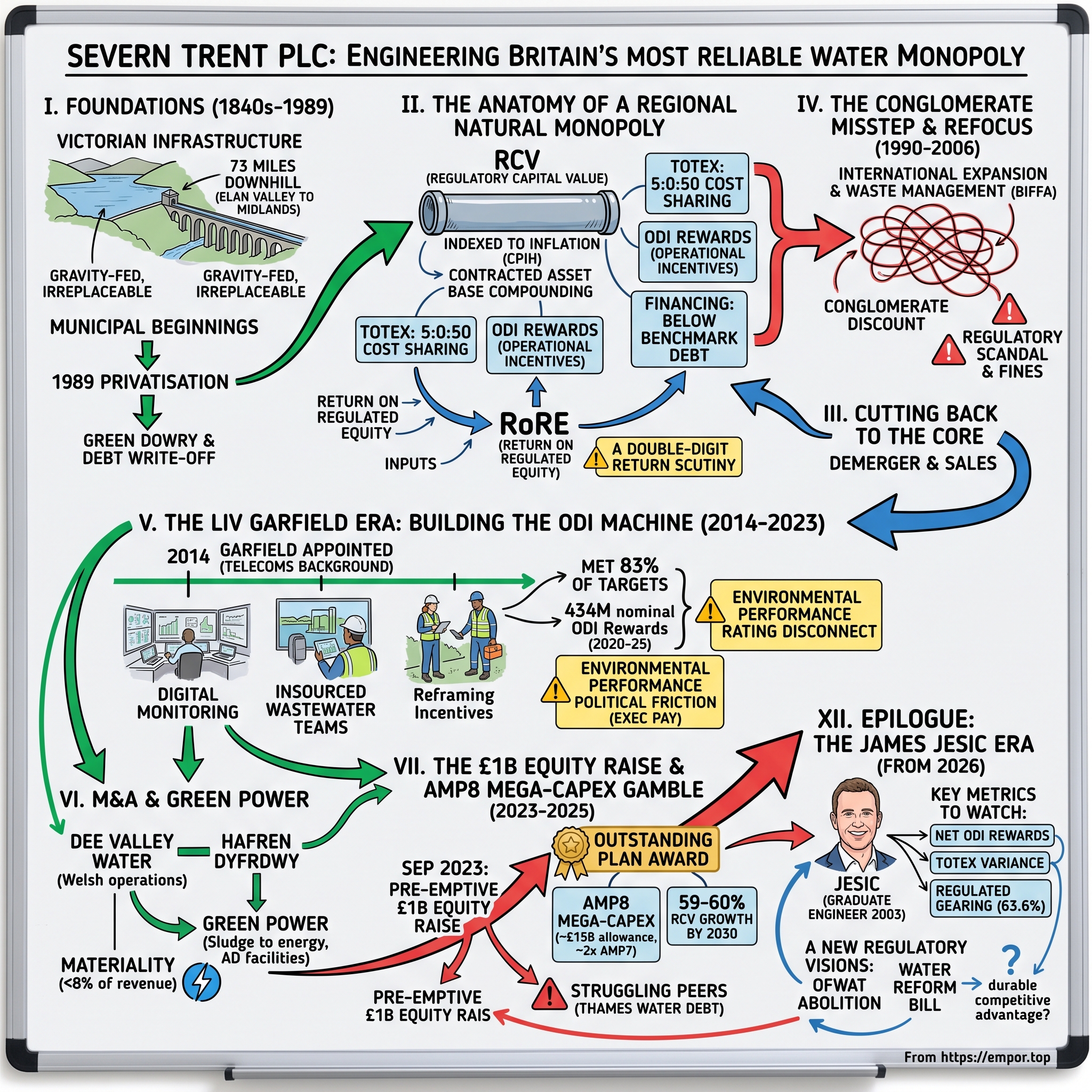
Severn Trent Plc: The Engineering of Britain's Most Reliable Water Monopoly
I. Introduction & Episode Roadmap
On the morning of 20 May 2026, James Jesic, who had joined Severn Trent as a graduate engineer in 2003, sat down before City utilities analysts to present his first annual results as chief executive. After opening with a remark on the webcast's raise-hand feature, Jesic faced his first question within ninety seconds: a query about reopeners—the regulatory mechanism through which a British water utility requests permission from its regulator to spend an additional £600 million in capital expenditure. Notably, no analyst questioned whether Severn Trent would survive. In the UK water sector of 2026, that distinction alone was remarkable.
Consider the broader industry backdrop. Thames Water, the nation's largest water company, spent the year negotiating a debt restructuring to write off roughly a quarter of its £16 billion in senior debt, all £1 billion of its Class B debt, and £2.5 billion in subordinated debt, with the process extending into the second half of 2026 and special administration remaining a live possibility.1 The Environment Agency's sector assessment, published in October 2025, awarded the nine major water and sewerage companies a combined score of 19 stars out of a possible 36—the lowest collective result since ratings began in 2011, alongside a 60% year-on-year increase in serious pollution incidents.2 Meanwhile, the government accepted the recommendation of Sir Jon Cunliffe's Independent Water Commission that Ofwat itself be abolished and replaced.3
Amid this sector distress sits a company supplying water to roughly eight million people across 21,000 square kilometres of the English Midlands and mid-Wales, delivering about two billion litres of drinking water daily while maintaining among the lowest combined household bills in the country at approximately one pound per day.4 Severn Trent Plc trades on the London Stock Exchange under SVT.L. In the financial year ended 31 March 2026, the company increased revenue 16.6% to £2,831 million, lifted profit before interest and tax 45.9% to £861 million, and raised adjusted earnings per share 64.5% to 184.4p.5
These figures depart significantly from standard utility performance and warrant close examination.
In a regulated monopoly framework, the regulator establishes prices, allowed financial returns, and five-year capital spending envelopes. A utility cannot expand by acquiring market share, as customers have no alternative suppliers. Growth depends on expanding the regulatory asset base on which allowed returns are calculated and on beating regulatory performance targets. Over the past decade, Severn Trent systematised performance target outperformance to a degree unmatched by its English peers, leveraging that execution record to secure a large capital allocation for asset base expansion.
However, that perspective represents the company's own positioning, and rigorous analysis requires testing it. The same fiscal year that produced 64.5% earnings growth also brought a July 2026 finding from Ofwat that Severn Trent Water had breached its statutory duty to effectually drain its area—a failure serious enough that the regulator conducted a two-year investigation before accepting formal undertakings in lieu of a fine.6 Furthermore, despite holding the Environment Agency's top four-star rating longer than any peer, Severn Trent was fined £2 million in February 2024 for recklessly discharging hundreds of millions of litres of raw sewage during 2019 and 2020—years in which it held four stars.7 Finally, the regulatory regime that supported a 17.2% regulatory return in FY26 faces restructuring by the government following the commission's recommendation to abolish Ofwat.53
This context points to several core questions: Is Severn Trent fundamentally a better-managed company or simply better positioned? Is its financial outperformance driven by operational skill, or by inflation and debt financing structures? And how will a business model structured around regulatory contract optimization perform as that regulatory framework is dismantled?
To address these questions, this analysis traces the financial mechanics of UK water utilities; the Victorian and municipal origins of Severn Trent's physical infrastructure; the 1990s conglomerate expansion that was subsequently unwound; the decade under former CEO Liv Garfield that established its performance framework; its bolt-on acquisitions and embedded renewable energy operations; the £1 billion equity raise that funded its capital program; its financial architecture and management incentives; key risk factors and stress-test scenarios for investors; and analytical frameworks—including Helmer's 7 Powers and Porter's Five Forces—to evaluate long-term outlooks.
Understanding this operational model begins with the financial mechanics that govern regulated water monopolies.
 Subscribe on LinkedIn
II. The Anatomy of a Regional Natural Monopoly: How UK Water Works
A regional water utility operates a massive, fixed asset base buried underground that cannot be moved, duplicated, or subjected to direct market competition. Because captive customers cannot switch suppliers, an independent regulator determines how much revenue the utility can collect.
In this regulated structure, shareholder returns do not stem from traditional market-share expansion. Instead, they depend on how effectively a company navigates the specific financial levers embedded in the regulatory framework.
The RCV: a rate base you can see
The foundational metric in UK water finance is the Regulatory Capital Value. The RCV serves as the regulator's official ledger of the capital a water company has invested in its network that has not yet been recovered through depreciation. Every pound of approved capital expenditure adds to the RCV. The utility then earns an allowed rate of return on that balance while recovering asset depreciation through customer bills.
This mechanism makes RCV growth and return spreads the primary drivers of equity value, rather than conventional sales margins. Expanding the RCV directly enlarges the regulated earnings base. By 31 March 2026, Severn Trent's RCV reached £15.4 billion, representing a 13% annual increase, while management projected the asset base would grow to £17.4 billion by March 2027.5 This expansion reflects contractual asset-base compounding rather than commercial revenue growth.
Two structural features reinforce this asset model. First, the RCV is indexed to inflation—historically RPI and now transitioning to CPIH—allowing both the capital base and derived revenues to adjust automatically with price levels. Second, allowed returns are established in real terms. For the 2025–2030 regulatory period, Ofwat's final determination established an allowed weighted average cost of capital of 4.03% on a CPIH-real basis, consisting of a 5.10% cost of equity and a 3.15% cost of debt.8
Totex and the incentive to think long
The second structural mechanism is total expenditure, or Totex. Rather than regulating capital investments and operational costs separately, Ofwat evaluates them within a single five-year spending envelope. Regulating the two categories independently created a structural incentive for utilities to favor capital replacements—which enter the RCV and earn a permanent return—over operational repairs, which are treated as immediate costs.
Totex eliminates that distortion by treating capital and operational spending equally within the regulatory allowance. Variances against the allowance are shared between the utility and its customers according to a fixed ratio. Severn Trent's determination for the 2025–2030 period includes a 50:50 cost-sharing rate, allowing shareholders to retain half of any delivered efficiency gains while passing the remainder to customers.9
ODIs: the part that separates the companies
Operational differences between utilities manifest primarily through Outcome Delivery Incentives. Under this system, Ofwat establishes annual performance targets across key operational commitments, including pipe leakage, supply interruptions, pollution incidents, sewer flooding, biodiversity, and customer service metrics such as C-MeX and D-MeX.
Beating these operational targets generates financial rewards that increase future regulated revenue, whereas missing targets results in cash penalties. Because regulatory targets ratchet higher each year, static operational performance leads to compounding penalties over time. While the mechanism rewards operational skill, it creates significant financial downside for struggling utilities.
Severn Trent has consistently captured net rewards under this framework. Over the 2020–2025 regulatory cycle, Severn Trent accumulated £434 million in nominal ODI rewards, surpassing its guidance of at least £420 million and generating what the company described as significantly more than any peer.10 In the financial year ended 31 March 2026, the company recorded £73 million in combined ODI and performance-commitment-deliverable rewards, meeting or exceeding 78% of its operational targets.5
Financing: where the quiet money is made
The final financial driver is balance sheet management. Ofwat sets an allowed cost of debt based on industry benchmarks. When a utility secures debt financing below this benchmark, the resulting interest rate spread accrues directly to equity holders. During the 2026 fiscal year, Severn Trent raised £1.8 billion in debt at spreads it reported as 66 basis points below the regulatory benchmark.5
Debt structure is particularly critical during inflationary periods. Index-linked debt—bonds with principal balances that adjust for inflation—provides an economic match for an inflation-indexed asset base. However, sharp inflation increases cause immediate principal accretion on the income statement, while the offsetting revenue increases from RCV adjustments flow into customer bills with a time lag. Severn Trent maintained index-linked debt at approximately a quarter of its total borrowings—a proportion Chief Financial Officer Helen Miles described as among the lowest in the sector and the result of a long-standing risk-management strategy.1011
For investors, a UK water utility represents three distinct operational elements: a contracted regulatory asset base, an operating business evaluated through incentive targets, and a treasury execution function. Evaluating Severn Trent's outperformance across these areas requires examining the physical network and corporate origins of the company—a development that began with its Victorian municipal infrastructure.
III. From Victorian Infrastructure to Thatcher's Privatization (1840s–1989)
In the 1870s, Birmingham was among the fastest-growing and least healthy industrial cities in the world. Typhoid, cholera, and dysentery moved through its courtyards with grim regularity, driven by a water supply that was privately owned, inadequate, and frequently contaminated.
Joseph Chamberlain, mayor of Birmingham in the mid-1870s, addressed the crisis through a three-year program of municipalising the gas and water works, clearing slums, and building parks—a model contemporaries termed "gas and water socialism."12 Chamberlain's insight was commercial as well as civic: profits from gas supply could subsidise water infrastructure, and water provision was too vital to remain in fragmented private hands.
Seventy-three miles downhill
Chamberlain's successors extended that logic. Because local catchments could not support Birmingham's growth, the municipal corporation sought water sources in Wales. Working with civil engineer James Mansergh, the corporation flooded a community in the Elan and Claerwen valleys in Powys to construct reservoirs, then built a 73-mile aqueduct to transport water from mid-Wales to the Midlands entirely by gravity. Construction began in 1893, and King Edward VII and Queen Alexandra formally opened the reservoirs in 1904.13
That gravity-fed aqueduct remains operational in 2026. For equity investors, it illustrates why the sector's physical assets are virtually irreplaceable: capital is sunk, rights-of-way are historically established, and geography prevents duplicate infrastructure across the Welsh border. This physical reality underpins the industry's economic moat. However, it also highlights the sector's central long-term liability: assets built in the late 19th century require eventual capital replacement, exposing utilities to reinvestment requirements that modern regulatory models have yet to fully fund.
From river authorities to a single regional monopoly
The corporate entity took shape in 1974, when the Severn Trent Water Authority was formed by amalgamating the Severn River Authority, the Trent River Authority, and council sewage disposal functions across the region.14 The organising principle was hydrological rather than political, combining the catchments of two major river systems into a single operational unit.
Under state ownership during the 1970s and 1980s, regional water authorities faced chronic capital constraints. As public bodies, their capital expenditure competed against national priorities such as healthcare and defence within Treasury budgets, resulting in decades of deferred infrastructure maintenance. By the late 1980s, incoming European Union environmental directives on drinking water and urban wastewater treatment required extensive capital investments that the government resisted placing on the national balance sheet.
The 1989 flotation and the dowry
Privatisation provided the solution. In 1989, the government floated the ten regional water authorities of England and Wales on the London Stock Exchange.14 To attract private capital for the required environmental upgrades, the government engineered a clean financial starting position: it wrote off roughly £5 billion in accumulated state debt and provided a "green dowry" consisting of £1.5 billion to £2.3 billion in direct cash injections alongside substantial tax allowances.1516
This structure allowed privatised water utilities to begin commercial operations debt-free, backed by inflation-protected asset bases and captive regional customer bases. However, public opposition was immediate, with contemporary polling indicating approximately 79% voter disapproval.15 That political friction became an enduring feature of the UK water sector, ensuring that regulatory risk and political scrutiny remain as vital to corporate performance as physical engineering.
Equipped with debt-free balance sheets, regional natural monopolies, inflation-indexed revenue structures, and regulated returns, UK water management teams faced a uniquely low-risk foundation. In the decade that followed, sector executives chose to deploy that balance sheet capacity toward non-core conglomerate expansion.
IV. The Conglomerate Misstep & The Great Refocus (1990–2006)
Monopoly utilities face a distinct corporate temptation: when a business enjoys captive demand and regulated cash flows, management teams seeking faster growth often look beyond their core operations. In the 1990s, the UK water sector sought that growth through international expansion and environmental services diversification.
Severn Trent embraced this path early. In 1991, it acquired the waste management business Biffa.14 Over the following decade, the company expanded into water and wastewater operating services across the United States and Italy, established an analytical laboratories business on both sides of the Atlantic, and built a water purification products operation.
The strategic rationale presented to markets was straightforward: Severn Trent aimed to leverage its technical expertise in water treatment, lab analysis, and waste management to build an international platform. In theory, the regulated UK monopoly would provide stable cash flow, while unregulated international operations would deliver growth, earning the combined group a higher valuation multiple.
What actually happened
Public markets rejected the hybrid model. Investors seeking defensive, regulated UK utility yield objected to underwriting speculative international services contracts, while growth-oriented environmental services investors resisted holding a heavily regulated British water and sewage network. Consequently, Severn Trent traded at a persistent conglomerate discount, while financial returns on non-regulated capital failed to justify the capital diversion.
Diversification also exacted a heavy operational cost in management focus. Operating complex international service businesses diverted leadership attention from an aging, leaking, and politically sensitive domestic network. The operational consequences culminated in 2008 when Ofwat imposed a £35.8 million penalty on Severn Trent Water—then the largest fine in the regulator's history—for deliberately submitting false operational data and delivering poor customer service that led to inflated customer bills.17 Just one day earlier, the company was fined an additional £2 million after pleading guilty to Serious Fraud Office charges involving the deliberate under-reporting of leakage data in 2001 and 2002.17
This episode remains a critical benchmark in Severn Trent's corporate history. It demonstrates that the company's long-standing positioning as an operational leader was preceded by a severe regulatory scandal—one rooted in falsifying the core operational data that underpinned its performance record.
Cutting back to the core
The company's return to a pure-play utility focus unfolded in stages. On 9 October 2006, Severn Trent demerged Biffa, distributing Biffa shares to its shareholders alongside a three-for-two share consolidation. Biffa was valued at approximately £1.2 billion upon separation, following a strategic review that concluded the regulatory and growth dynamics of the two businesses were fundamentally distinct and yielded few operational synergies.1819 Severn Trent subsequently sold its US water purification business to Industrie De Nora in 2015, followed by the sale of its Italian and US operating services businesses in 2017, concluding its international experiment.14
By the mid-2010s, Severn Trent had reshaped itself back into a focused UK regulated water and wastewater utility supported by a small set of complementary domestic activities. The restructuring underscored a primary principle of regulated infrastructure finance: when a utility's core asset base compounds predictably through inflation-indexed returns, non-core investments carry a high hurdle rate because they must overcome the market discount applied to corporate complexity. Severn Trent spent fifteen years absorbing that lesson.
This corporate restructuring left a simplified business facing an essential strategic question: if a regional utility cannot expand through major acquisitions or arbitrarily raise customer prices, how does it generate superior shareholder value? In 2014, the board appointed an executive from outside the water industry to execute the answer.
V. The Liv Garfield Era: Building the ODI Machine (2014–2023)
When Severn Trent appointed Liv Garfield as chief executive in 2014, she had no prior experience running a water utility. Garfield, then 38 and the youngest female chief executive in the FTSE 100, had previously led BT Openreach, the infrastructure division managing the UK's telecommunications network.
Despite the industry shift, telecommunications and water networks share fundamental operational characteristics: both are vast, aging, buried, capital-intensive physical assets operated by large field workforces and overseen by economic regulators setting explicit compliance targets. The management disciplines required at Openreach—telemetry, predictive fault detection, workforce scheduling, and continuous operational tracking—translated directly to water utility management.
Turning a regulatory formula into an operating system
Under Garfield, Severn Trent reframed Ofwat's incentive schedule from a regulatory compliance obligation into its primary operational scoreboard. Rather than treating performance targets as passive benchmarks, the company structured engineering programs around specific outcome metrics. Reduced leakage became an income-generating engineering project, while pollution incidents were managed as quantified financial losses assigned to specific operational owners.
Execution required building a digital monitoring layer across the physical network. Severn Trent invested in sub-surface sensors, centralized control facilities, and predictive analytics across both its clean water and wastewater divisions. Crucially, management also reversed previous outsourcing trends. The company brought its wastewater networks team back in-house approximately two and a half years prior to its FY26 results, operating on the premise that real-time predictive management required direct operational control.11
These operational changes delivered measurable regulatory outcomes. Across the 2020–2025 regulatory cycle, Severn Trent met or exceeded 83% of its performance commitment targets, achieving its best recorded metrics on pipe leakage, supply interruptions, and internal sewer flooding. This operational performance generated a 9.1% real return on regulated equity over the period, significantly outperforming the base allowed return.10 Furthermore, in 2021 Ofwat awarded Severn Trent £566 million under its Green Recovery program—representing over 70% of the total funding allocated across the entire sector—allowing the utility to scale its capital delivery framework ahead of peer companies.10
This early capital allocation served as an operational trial, enabling Severn Trent to test its supply chain capacity and project management systems well before the broader sector-wide capital expansion required in the 2025–2030 regulatory period.
The environmental scoreboard, and its limits
In the Environment Agency's annual environmental performance assessment, Severn Trent held the top four-star "industry-leading" rating for six consecutive years through the 2024 assessment published in October 2025—a period during which overall sector ratings declined sharply.220 On the FY26 earnings webcast, Chief Executive James Jesic expressed high confidence that the company would secure a seventh consecutive four-star rating, noting that the next best peer performance in sector history was three consecutive years, achieved a decade earlier.11
However, the four-star rating represents a composite index that can obscure specific environmental failures. For example, Severn Trent recorded two serious pollution incidents in 2025, an issue raised by utility analysts during the FY26 results call.11 Moreover, as highlighted previously, the company maintained four-star ratings during 2019 and 2020 despite underlying operational practices that ultimately resulted in a £2 million criminal fine in February 2024—a disconnect that drew public criticism regarding the rating system's ability to accurately reflect environmental performance.7
Consequently, while Severn Trent demonstrated clear operational superiority against established regulatory benchmarks relative to English peers, those regulatory metrics offer an incomplete measure of overall environmental health. Evaluating the company requires distinguishing between outperformance on regulatory incentive formulas and broader environmental impact.
The pay problem
This financial and operational performance generated substantial political friction around executive compensation. Garfield's total remuneration reached approximately £3.3 million in a single year, comprising a base salary of roughly £830,000 alongside performance-linked bonuses and long-term incentive payouts. These compensation levels drew public criticism from campaign groups and prompted a formal protest letter from a parliamentary group of Labour MPs.[^21]21
Crucially, when Ofwat's enhanced regulatory powers took effect in June 2025, Severn Trent was excluded from the group of six water companies—Anglian, Southern, Thames, United Utilities, Wessex, and Yorkshire—whose executive bonuses were formally blocked by the regulator.2223 Its executive compensation structure reflected direct alignment with Ofwat's financial incentive framework: payouts escalated as the company met or exceeded operational performance targets. Nevertheless, high compensation at a regulated utility providing essential public services creates ongoing political exposure, introducing legislative and regulatory risks that extend beyond operational performance.
Garfield's tenure concluded after eleven years, handing leadership to Jesic. However, alongside the core utility's operational development, Severn Trent established a distinct secondary growth vector that remains central to its overall corporate architecture.
VI. M&A, Non-Regulated Engines, & Green Power (Dee Valley to AD)
In late 2016, a revealing corporate takeover battle emerged over Dee Valley Water, a small utility supplying approximately 250,000 customers in Wrexham and Chester. Despite its modest scale, the company carried distinct strategic value under regulated asset economics.
Infrastructure fund Ancala Partners had initially agreed to acquire Dee Valley for approximately £71.3 million. Severn Trent intervened with a superior proposal. On 16 November 2016, Severn Trent agreed to acquire Dee Valley's voting ordinary shares at 1,705 pence in cash and its non-voting shares at 1,601 pence, valuing the business at roughly £78.5 million and prompting Dee Valley's board to withdraw its recommendation for the Ancala offer.24 The Competition and Markets Authority cleared the transaction unconditionally, and the acquisition closed in February 2017.2514
Why Severn Trent could pay more
This bidding dynamic illustrates a broader principle of regulated utility mergers and acquisitions. A financial investor evaluates a small water company as a standalone regulated entity, factoring in its Regulatory Capital Value, allowed returns, and modest operational efficiencies. By contrast, an adjacent regional incumbent treats the acquisition as a low-overhead addition to its existing asset base, eliminating duplicate control centers, billing platforms, administrative structures, and executive management. Because these operational synergies are structural rather than speculative, an incumbent utility can outbid financial buyers while still generating attractive risk-adjusted returns.
The transaction also carried a key jurisdictional advantage. Legislative devolution created diverging regulatory frameworks between England and Wales, leaving Severn Trent serving a small customer base in Powys under Welsh policy oversight. Integrating Dee Valley's Welsh operations with Severn Trent's Powys footprint established Hafren Dyfrdwy—Welsh for "Severn Dee"—a dedicated Welsh regulated entity operating alongside the core group.1426 This structural realignment insulated Severn Trent's primary English operations from regulatory divergence in Wales while establishing a tailored operational structure for its Welsh customer base.
The renewable energy business inside the sewage company
A less conventional component of the group's portfolio is Severn Trent Green Power, a commercial venture derived from the physical mechanics of wastewater processing.
Wastewater treatment generates substantial volumes of organic solids—termed sludge or bioresources within regulatory frameworks. While historically treated purely as a waste disposal expense, organic sludge contains bioenergy potential. Processing sludge through oxygen-free anaerobic digestion tanks allows bacteria to decompose the organic matter, producing methane gas for fuel alongside a stabilized solid byproduct suitable for agricultural fertilizer.
Because a wastewater utility receives a continuous, captive supply of organic feedstock, it maintains the raw inputs necessary to operate an embedded renewable energy provider. Severn Trent systematically developed anaerobic digestion infrastructure across its operational footprint, later expanding these facilities to process municipal and commercial food waste. Commercial food waste yields similar biogas output while generating gate-fee revenue from waste producers, enhancing plant economics.
On 30 November 2018, Severn Trent Green Power completed the £120 million acquisition of Agrivert Holdings, adding five food waste anaerobic digestion facilities and five composting sites. The transaction added 13 megawatts electrical equivalent of generating capacity to an existing platform of roughly 45 megawatts.2728 The company expanded the division further in 2023 through the acquisition of Andigestion.14
Materiality: important, but keep it in proportion
To evaluate this commercial expansion accurately, the business must be viewed in proportion to the broader corporate group. In the 2025 financial year, Business Services—the reporting segment encompassing Green Power, Operating Services, and Property—generated £183.5 million in turnover, representing approximately 7.6% of total group revenue, and recorded £47.5 million in EBITDA. Green Power contributed £83.3 million of that turnover, though its earnings declined during the period due to lower wholesale energy prices.10 Relative to a regulatory asset base then approaching £14 billion, commercial energy operations remain a modest portion of total enterprise value.
However, the strategic value of Green Power extends beyond immediate segment earnings. First, energy self-generation provides a structural hedge: Severn Trent generated a record 912 gigawatt-hours of energy in FY25, up 11% year-on-year, mitigating power costs across a pumping-intensive water network.10 Second, the division converts an operational waste liability into a commercial revenue stream within Ofwat's bioresources regulatory framework. Third, the business represents a key growth target: management projected that the expanded Infrastructure Services division—combining Green Power, Network Services, Operating Services, and Property—will deliver approximately £100 million in EBITDA by FY30.5
Doubling segment EBITDA within five years represents an ambitious growth trajectory. While management has historically delivered on operational targets, commercial energy returns remain exposed to merchant wholesale power price volatility—a market variable outside regulatory cost-recovery mechanisms. Consequently, Infrastructure Services represents the group's smallest yet fastest-growing operating unit, carrying higher market risk than the core regulated monopoly.
With its non-regulated operations expanded and its regulatory performance engine established, Severn Trent faced the broader sector financial instability that emerged in 2023. As balance sheets across the industry deteriorated publicly, the company prepared a capital decision that separated it from its listed peers.
VII. The £1B Equity Raise & The AMP8 Mega-CapEx Gamble (2023–2025)
By the autumn of 2023, UK water utilities faced mounting market skepticism regarding their overall financial solvency. The immediate stress point was Thames Water, where complex holding-company debt structures were collapsing under high leverage. However, the broader systemic pressure was arithmetic: Ofwat was preparing to require the largest capital investment programme in the industry's privatised history, leaving doubt over whether company balance sheets could support the funding burden.
Every English water utility confronted the same predicament. The incoming five-year regulatory period required roughly double the capital expenditure of the previous cycle. Funding the entire expansion through debt would push leverage beyond acceptable rating-agency thresholds, whereas issuing new equity threatened substantial share dilution at valuations depressed by industry distress.
While most sector boards hesitated, Severn Trent moved early.
The pre-emptive strike
On 29 September 2023, alongside the submission of its five-year business plan, Severn Trent announced a £1 billion equity raise. The offering comprised approximately £500 million placed with institutional investors, roughly £500 million subscribed directly by the Qatar Investment Authority through 23,255,814 new ordinary shares, and approximately £8 million raised through a UK retail offer.2930 The placing price of 2,150 pence represented a modest 5.1% discount to the preceding closing price of 2,265 pence — an unusually tight spread for a capital raise of that magnitude during sector distress.29 Share admission became effective in early October 2023.3031
The transaction structure highlighted three strategic advantages. First, securing a narrow 5.1% discount indicated that institutional demand remained solid even as broader capital markets withdrew from the water sector. Second, anchoring half the issuance with a single sovereign wealth fund eliminated execution risk for the institutional tranche and secured long-term capital, even as foreign ownership of critical national infrastructure attracted recurring political scrutiny. Third, the timing proved decisive: by raising equity well before Ofwat published its draft determination and before macro conditions deteriorated further, Severn Trent fortified its balance sheet while peers faced far harder financing environments.
What the money bought
In December 2024, Ofwat released its final determination, approving a total expenditure allowance of approximately £15 billion for Severn Trent over the 2025–2030 period — roughly double its prior five-year allocation and the second-largest allowance in the sector.1032 The regulator classified Severn Trent's business plan as "Outstanding," awarding a 30-basis-point financial return bonus across the entire £15 billion allowance, worth roughly £93 million, alongside a 50:50 cost-sharing framework.9 Company projections indicated the determination would drive 59% to 60% expansion in its Regulatory Capital Value by 2030, compared to a sector average closer to 50%.1011
Management positioned the early equity raise as a direct catalyst for this outcome, arguing that upfront balance sheet fortification proved financial viability, secured the "Outstanding" rating, and unlocked the expanded capital allowance. While causality cannot be established definitively, early capital execution clearly removed balance-sheet constraints that might otherwise have prompted regulatory limits. Crucially, securing equity early enabled Severn Trent to lock in supply-chain capacity and contractor commitments before industry-wide demand created severe labor and equipment bottlenecks.
Delivering it
Severn Trent's recent capital deployment provides empirical testing for its strategy. In the financial year ended 31 March 2025, capital investment reached a record £1.67 billion — up 39.5% year-on-year and triple the spending level from the start of the prior regulatory cycle — supported by accelerating more than £450 million of capital projects ahead of the official AMP8 start.10 Capital expenditure expanded further in FY26 to £1.95 billion, with management issuing guidance of £2.2 billion to £2.5 billion for FY27.5
While front-loading capital expenditure increases near-term cash requirements, it allowed Severn Trent to advance environmental compliance projects and operationalise supply-chain capacity prior to sector-wide peak activity. Nevertheless, executing a £2.5 billion annual capital program presents ongoing delivery risks, as scaling operational capacity requires managing contractor availability and cost inflation.
The sector's divergent trajectories were underscored by Thames Water, which spent 2026 negotiating a creditor-led restructuring to write off roughly a quarter of its £16 billion in Class A debt, all £1 billion of its Class B debt, and £2.5 billion in subordinated debt, while drawing emergency liquidity facilities in March 2026 and securing an additional £205 million in April.133 That contrast demonstrates that in an industry requiring continuous capital reinvestment, balance sheet strength operates not merely as a financial cushion, but as a binding operational prerequisite.
VIII. Financial Architecture, Segment Economics, & Management Incentives
Stripping away narrative embellishments reveals a straightforward financial architecture. Roughly 92% to 93% of revenue stems from the core regulated water and wastewater business—Severn Trent Water alongside Hafren Dyfrdwy—generating an even higher share of total profit. The remainder comes from Infrastructure Services, the non-regulated operations detailed earlier. The business operates without meaningful international exposure, customer concentration risk, or product lifecycle volatility.
Decomposing the return
The primary metric used by management and industry analysts to measure profitability is Return on Regulated Equity, or RoRE. This composite metric builds in distinct layers: the base allowed equity return established by Ofwat, supplemented by financing outperformance, total expenditure efficiency, net outcome delivery incentive rewards, and the temporary effects of inflation and tax adjustments.
Severn Trent reported a regulatory return on equity of 17.2% for the 2026 fiscal year, compared with a base allowed cost of equity of 5.10%.58 By comparison, the company delivered a 9.7% real regulatory return in FY25 and averaged 9.1% over the preceding five-year regulatory period.10
A double-digit return for a regulated monopoly naturally invites scrutiny, and City analysts pressed management on the issue during the annual webcast. Dominic Nash of Barclays asked whether elevated returns driven by inflation risked triggering a regulatory backlash similar to past intervention by the energy regulator Ofgem. Chief Financial Officer Helen Miles responded that while inflation contributed to the figure, outperformance was also driven by maintaining gearing below Ofwat's notional benchmark and holding a low proportion of index-linked debt, adding that an Ofgem-style regulatory intervention "is not something that concerns us."11
Deutsche Bank analyst James Brand raised a second technical point, noting that a substantial portion of the reported return stemmed from a deferred tax accounting rule prescribed by Ofwat rather than operational efficiency. Because Ofwat sets tax allowances to reflect expected cash tax, the deferred tax boost did not represent structural economic outperformance. Miles acknowledged the distinction—noting "we've had that debate ourselves internally"—while explaining that Severn Trent reports strictly in accordance with Ofwat's prescribed methodology.11
This disclosure confirms that the headline 17.2% figure overstates the durable, operationally driven component of Severn Trent's financial return. While management's transparency provided clarity for investors, the accounting nuance highlights why assessing the company's long-term profitability requires evaluating incentive rewards, financing spreads, and expenditure efficiencies separately rather than relying on the aggregate figure.
Where the durable outperformance actually sits
Three components of financial outperformance demonstrate operational repeatability.
The primary driver is operational incentive rewards. Chief Executive James Jesic informed analysts that Severn Trent had generated approximately £500 million in cumulative outcome delivery incentive rewards since 2021, while reaffirming guidance of more than £300 million in incentive rewards for the 2025–2030 regulatory period, with at least £50 million expected in FY27.511 Despite the strong initial year, management maintained its existing five-year target without upward revision, signaling a cautious approach to long-term incentive projections.
The second driver is financing execution. Outperforming Ofwat's allowed cost of debt by 66 basis points on £1.8 billion of new debt issuances during FY26 represents a structural financial advantage rooted in corporate credit ratings and treasury execution capability.5
The third component is expenditure efficiency. During the FY26 presentation, management committed to delivering £150 million in operational cost savings over the five-year regulatory period—including £36 million achieved in FY26—alongside a £500 million capital efficiency program.11 Management identified specific operational levers supporting these targets: implementing a Kraken-based customer management and billing platform, insourcing wastewater operations to lower repeat service visits, deploying machine learning algorithms to optimize pumping station usage, using artificial intelligence weather forecasting to favor gravity-fed water supplies over power-intensive pumping, and applying automated route selection for cross-country pipelines to compress engineering design work from months into hours.11
Unlike generic overhead cuts, these initiatives represent concrete operational modifications. However, delivering the remaining £114 million in cumulative operating savings will require maintaining the initial FY26 implementation pace across subsequent years.
The reopener: a growth lever most investors do not model
A major focal point of the FY26 results presentation was the regulatory reopener mechanism. Under Ofwat rules, a utility can request mid-period capital funding adjustments for specific investment categories, including asset health, cybersecurity, PFAS chemical remediation, and regional growth. Severn Trent submitted a £600 million reopener application.11
As outlined by Regulation Director Shane Anderson, the application requested £221 million to upgrade 2% of distribution service reservoirs, £175 million to renew 172 kilometers of sewer lines out of a 93,000-kilometer network, £25 million to rehabilitate 11% of clean water boreholes, and slightly more than £50 million to expand wastewater treatment facilities in eight catchments experiencing rapid housing growth. Concurrently, the company is deploying artificial-intelligence inspection systems across nearly 10,000 kilometers of sewers to gather asset-condition data for the subsequent 2030 price review.11
This reopener request illustrates two strategic dynamics. First, replacing 2% of reservoirs and 0.2% of sewer networks represents an incremental start, establishing a regulatory precedent for expanded capital spending in future cycles. Second, securing mid-period approval requires demonstrating both project execution readiness and customer support. Severn Trent surveyed 2,150 customers regarding the proposal, presenting the combined bill impact of inflation, incentive rewards, and the reopener. The company reported that approximately 75% of respondents rated the proposed £8 increase in annual household bills by 2030 as affordable or neutral.11 While company-sponsored surveys warrant scrutiny regarding question design, the underlying regulatory requirement favors utilities with established track records of operational delivery.
Incentives and capital allocation
Executive remuneration is structured around operational incentive targets, return on regulated equity, asset-base growth, safety metrics, and carbon reduction goals—aligning executive compensation with Ofwat's regulatory performance metrics. However, since June 2025, executive payouts have been subject to statutory regulatory rules that automatically prohibit performance-related bonuses if a utility fails to meet mandatory standards regarding environmental compliance, customer service, financial resilience, or criminal liability.22
Dividend policy targets annual payout growth aligned with or exceeding CPIH inflation. For FY26, Severn Trent declared a full-year dividend of 126.02 pence per share, representing a 3.5% increase.5 Evaluating whether dividend payments are supported by operational cash flows or debt financing requires examining balance sheet leverage. Gearing increased modestly from 62.7% to 63.6% during the fiscal year, even as capital expenditure expanded 16.7%.105 While a one-percentage-point leverage increase during a year of record capital deployment demonstrates balance sheet capacity, it reduces financial flexibility relative to management's target gearing range of 60% to 65% through 2030.11
Regarding future equity requirements, Jesic stated explicitly during the FY26 presentation that the company would not raise additional equity during the 2025–2030 regulatory period.11 This commitment establishes a clear benchmark against which management's capital allocation execution can be evaluated.
This financial structure and capital program frame the core risk factors facing the business.
IX. Skeptical Investor Stress Test, Sewage Crisis, & Regulatory Risk Radar
On 8 July 2026, Ofwat published its final decision in the enforcement case opened against Severn Trent Water two years earlier, concluding that the utility had breached its statutory duty to effectually provide drainage and manage the contents of its sewer network.6
Yet the regulator imposed no financial penalty.
Ofwat justified the decision on the grounds that Severn Trent had self-identified the operational failures and initiated remediation before the investigation concluded. Shareholders directly funded £98 million in remediation, comprising £38.5 million for additional capacity across 65 wastewater sites, £34 million for flow-to-full-treatment and storm tank enhancements, and £26 million for nature-based solutions in the Mansfield area—contributing to a 41% year-on-year drop in average storm overflow spills in 2025.634 Ofwat Senior Enforcement Director Lynn Parker highlighted the company's response as an industry benchmark: "their response to those failures sets a standard we expect from all companies: identifying the problem, proactively investing to fix it, and cooperating openly with the regulator."34 Consequently, the regulator accepted formal undertakings under Section 19 of the Water Industry Act 1991 in lieu of an enforcement order.6
An objective evaluation requires examining both interpretations of this outcome. The supportive view sees a utility that identified internal failures, deployed shareholder equity rather than customer funds to fix them, and cooperated fully with regulators. The critical view notes that the operational breaches were severe, the statutory violation was formally established, the remediation absorbed £98 million in equity, and a parallel Environment Agency criminal investigation into permit compliance remains open without a definitive timeline—a reality Chief Executive James Jesic confirmed on the FY26 call, noting that discussions continue and stating, "we haven't got any time scales."116
Evaluating Severn Trent's long-term investment case requires stress-testing three core operational and regulatory questions.
Question one: can they physically spend the money?
Severn Trent must execute approximately £15 billion in capital spending over five years, alongside any additions approved through the reopener process. This deployment takes place across a sector where every peer utility is simultaneously attempting to double its capital program, creating intense competition for civil engineers, specialized tunneling contractors, and treatment equipment.
In support of execution capability, the company expanded annual capital investment from roughly £1.2 billion in FY24 to £1.67 billion in FY25 and £1.95 billion in FY26 without missing price control deliverables. It achieved all year-one AMP8 commitments on mains replacement and metering while running ahead of schedule on phosphorus removal and storm overflow projects.10535 Its earlier Green Recovery program provided operational testing at elevated expenditure levels, and management insourced key engineering functions rather than relying exclusively on third-party contractors.
Conversely, the guided FY27 capital investment range of £2.2 billion to £2.5 billion requires another substantial step-up. Civil engineering inflation represents an input cost that Totex allowances may not fully cover. Under the 50:50 cost-sharing mechanism, shareholders absorb half of any Totex overspend, making capital deployment execution a central risk for equity investors.
Question two: what does politics do to the returns?
Political and legislative scrutiny has moved beyond rhetoric into formal statutory mechanisms. The Water (Special Measures) Act 2025 introduced a criminal offense of environmental mismanagement causing harm, exposing senior managers who fail to exercise due diligence to potential prosecution, penalties of up to five years' imprisonment, and unlimited fines. This framework operates alongside regulator powers that took effect on 6 June 2025 and blocked roughly £4 million in executive bonus payouts across the sector in their first year.362223
A broader structural shift is also underway. Following the July 2025 recommendation of Sir Jon Cunliffe's Independent Water Commission that Ofwat be abolished, Environment Secretary Emma Reynolds published the government white paper A New Vision for Water in January 2026. The policy sets out plans to consolidate four regulatory bodies into a single water regulator, to be implemented through an upcoming transition plan and Water Reform Bill.337
On the FY26 results call, Jesic maintained a measured stance, stating that the King's Speech had "cemented the direction of travel," that the objective was "a sector that is a strong performing sector that is investable," and that the company would "wait and see" the details of the transition plan.11 Addressing Greater Manchester Mayor Andy Burnham's calls for increased public control, Jesic remarked that Burnham's emphasis on "well-run companies for public good" aligned with Severn Trent's corporate objectives.11
While Severn Trent's relative operational track record provides a strong defense in any regulatory restructuring, a new regulatory body will introduce updated methodologies, revised performance commitments, and recalibrated allowed returns. Because regulatory reform responds to sector-wide public dissatisfaction, relative operational outperformance does not fully insulate a utility if baseline allowed returns across the industry are reduced.
Question three: is the inflation benefit a trap?
With approximately a quarter of its debt index-linked, sustained high inflation increases Severn Trent's debt principal and near-term interest charges before the offsetting growth in Regulatory Capital Value and customer bill revenues fully registers.10 Management maintains that its index-linked debt share is among the lowest in the sector and that its upgraded FY28 guidance of at least 250p in adjusted earnings per share—up from 224p—was stress-tested across multiple inflation scenarios. Chief Financial Officer Helen Miles noted on the call that she "wouldn't put something into the market that wasn't confident of delivering in any scenario."511
This explicit, time-bound financial commitment provides a concrete benchmark against which management's treasury strategy and operational delivery will be evaluated through 2028.
The rest of the radar
Two additional operational exposures warrant attention. Climate volatility presents dual challenges for water infrastructure: prolonged dry periods stress supply and increase tankering costs, while intense rainfall events overwhelm combined sewer systems and trigger storm overflow discharges that lead to penalties. During FY26, Severn Trent commissioned a new water treatment works at Derby that added 89 million liters per day of peak capacity. The company is also progressing strategic water resource projects through the RAPID framework—including joint schemes with the Canal & River Trust and the Mining Remediation Authority—as it prepares to replace approximately 20% of its water sources in response to reduced groundwater abstraction limits.11
Finally, customer service performance remains an operational challenge. Performance under C-MeX, Ofwat's customer satisfaction incentive, generated an estimated £28 million penalty in FY26. On the results call, Jesic acknowledged the deficit directly, conceding that "C-Mex has been a measure that we haven't performed well enough on" and citing 70 internal roadshows designed to improve customer service execution.11 While modest relative to the £73 million in net performance rewards earned across the business, persistent C-MeX penalties highlight an area where operational improvements have yet to yield net regulatory rewards.
X. Playbook: Business & Investing Lessons
Four transferable lessons emerge from Severn Trent's operational trajectory, led by a principle frequently misapplied in regulated markets.
One: In a regulated monopoly, the primary route to structural outperformance is out-engineering the regulator's formula. A utility cannot raise prices, win market share from competitors, or expand into new territories at will. Instead, outperformance requires understanding in forensic detail exactly what the regulator rewards, then building an operating system optimised for those specific metrics. Severn Trent's Outcome Delivery Incentive gains stem directly from treating a regulatory compliance schedule as an operational profit-and-loss statement. However, this strategy carries a clear metric-optimisation risk: an organization becomes highly proficient at hitting measured benchmarks, which do not always reflect broader operational health. The disconnect between six consecutive years of four-star environmental ratings and a £2 million criminal fine highlights that structural gap.
Two: Financial engineering works on essential assets only until those assets require physical reinvestment. For two decades, highly leveraged private equity ownership models across English water appeared more lucrative than public listings, extracting higher cash returns per pound of Regulatory Capital Value. But when environmental requirements escalated and required capital expenditure doubled, balance sheets built purely for cash extraction lacked the capacity to fund physical renewal. The fundamental distinction was not merely leverage ratios, but whether a balance sheet preserved the flexibility to invest. Severn Trent retained that capital capacity, whereas highly indebted peers like Thames Water did not.
Three: Raise capital when it is optional, not when it is mandatory. Severn Trent launched its £1 billion equity raise in September 2023, well before Ofwat's final determination, before sector distress fully deepened, and at a tight 5.1% discount that proved unobtainable for peers a year later. Securing equity when optional yields superior pricing terms while delivering strategic benefits beyond immediate cash: balance-sheet credibility, priority access to contractor supply chains, and the elimination of financeability concerns during regulatory reviews.
Four: Industrial waste streams can become valuable commercial feedstocks. For decades, sewage sludge was treated strictly as a disposal expense. Deploying anaerobic digestion transformed that waste into electricity, biomethane, and agricultural fertiliser, while the resulting infrastructure enabled Severn Trent Green Power to process third-party food waste and collect gate fees. While small relative to the core regulated monopoly—contributing less than 8% of group revenue—it illustrates an important infrastructure principle: high-return incremental capital often comes from monetising operational by-products using pre-existing asset networks.
Together, these lessons describe a utility that has systematically aligned its corporate strategy with its underlying regulatory economics. The remaining question for investors is whether this operational alignment constitutes a durable competitive advantage as the UK regulatory framework undergoes structural reform.
XI. Analysis, 7 Powers, & Bull vs. Bear Thesis
Hamilton Helmer's 7 Powers
Cornered Resource is the dominant power here, and it is close to absolute. Severn Trent holds perpetual statutory licences to supply water and wastewater services across roughly 21,000 square kilometres.4 No competitor can duplicate the pipe network—not merely because of the prohibitive cost, but because the legal framework does not permit it. The Elan Valley aqueduct represents a rights-of-way asset assembled through Victorian municipal authority that could not be replicated today at any price.
Scale Economies are real but partial. Spreading fixed treatment, control-room, billing, and regulatory-compliance costs across approximately eight million customers gives Severn Trent a lower unit cost base than a smaller operator like Dee Valley—explaining why it could outbid a financial buyer for that asset. Against peers like United Utilities or Anglian Water, however, the scale advantage largely disappears, as these companies operate at comparable scale.
Process Power is the central point of debate in the investment case. Severn Trent contends that it has built an organizational capability—combining dense telemetry, predictive analytics, insourced field operations, and an outcome-driven culture—that competitors cannot easily copy. The supporting operational record is tangible: six consecutive years holding the regulator's top environmental rating when the next-best sector streak was three years a decade earlier; £434 million in net outcome delivery rewards over a five-year period when several peers incurred penalties; and 83% of performance commitments met or exceeded.21011
The counter-argument warrants equal consideration. Process power in an industry where the regulator publicly benchmarks every utility's performance data on every metric is inherently permeable. Ofwat's regulatory methodology is designed to identify the operational frontier and systematically impose those standards across the sector. Severn Trent's advantage may therefore reflect a persistent execution lead rather than an unassailable moat—valuable and compounding while maintained, but continuously targeted by regulatory benchmarking. While nothing in the empirical record indicates the lead is closing, nothing in the industry structure guarantees it will endure.
The remaining four powers—network economies, counter-positioning, switching costs, and branding—are essentially absent or structurally irrelevant.
Porter's Five Forces
Threat of new entrants: effectively zero. High barriers stem from a statutory monopoly framework combined with unrepeatable sunk physical infrastructure.
Threat of substitutes: effectively zero. There is no scalable alternative to piped water supply and centralized sewerage at the household level.
Competitive rivalry: geographically non-existent, but benchmark rivalry is intense. This represents the most distinctive force in the sector. While Severn Trent never competes directly for retail customers, it competes continuously for regulatory positioning—because Ofwat sets baseline efficiency targets by reference to sector leaders, and securing an "Outstanding" classification delivered a 30-basis-point return bonus across a £15 billion allowance.9 Operational leadership functions not as a marketing tool, but as a direct driver of financial returns.
Bargaining power of buyers: non-existent individually, but absolute by proxy. Individual households cannot negotiate rates or switch suppliers. Ofwat negotiates on their behalf as a monopsony price-setter, holding ultimate authority over prices, allowed financial returns, and approved capital expenditure. This force governs the utility's commercial framework, and it is currently undergoing statutory restructuring.
Bargaining power of suppliers: moderate and rising. With every English water utility simultaneously doubling its capital investment program, civil engineering contractors, tunneling specialists, and equipment suppliers hold greater pricing power than at any point since privatization. This market dynamic represents the primary channel through which capital expenditure overrun risks materialize.
Myth versus reality
Three widespread assumptions regarding the company require objective examination.
Myth: Severn Trent is a clean operator in a troubled industry. Reality: While the company performs demonstrably better than peers on measured regulatory metrics, it was found in statutory breach of its sewerage duties in 2026, fined £2 million for reckless sewage discharges in 2024, and fined £35.8 million by Ofwat in 2008 for submitting false data.6717 Superior relative execution does not equate to an absence of operational failures.
Myth: The £1 billion equity raise rendered the balance sheet bulletproof. Reality: Gearing increased to 63.6% in FY26, placing leverage near the upper end of management's 60% to 65% target range just as its largest capital deployment years commence.511 The equity raise provided vital financial headroom, but not permanent immunity from leverage constraints.
Myth: The 17.2% regulatory return demonstrates underlying operational efficiency. Reality: Management acknowledged during the FY26 results presentation that a material portion of this return resulted from a deferred tax accounting presentation rule rather than operational efficiency, alongside temporary inflation benefits.11 The durable, operationally driven components of return are smaller and should be evaluated independently.
The bull case
The foundation of the positive investment thesis rests on contracted asset-base expansion. Severn Trent's Regulatory Capital Value is expanding from £13.7 billion in March 2025 to a guided £17.4 billion by March 2027, on a path toward approximately 59% to 60% growth over the regulatory period—providing a compounding earnings base that requires neither volume growth nor market-share gains.10511 Supporting this asset growth is an outcome delivery incentive track record that management reports has generated over £900 million in cumulative gross rewards across two regulatory cycles, a proven capability to secure debt below regulatory benchmarks, an explicit pledge to avoid further equity dilution through 2030, and upgraded management guidance for FY28 adjusted earnings per share from 224p to at least 250p.511 Provided future regulatory frameworks preserve financial incentive structures, the company enters the transition as the operator best positioned to capitalize on them.
The bear case
The primary risk to the investment thesis is that the utility's economic model rests on a regulatory contract with an institution currently slated for abolition. A replacement unified regulator will establish updated methodologies within a political environment marked by heightened public scrutiny and legislation introducing criminal liability for water executives. Allowed financial returns remain a policy variable determined by regulators rather than market forces, creating downside exposure if base returns are reset lower.
Beneath this structural regulatory shift lie three operational risks. First, capital execution: delivering a capital program that requires £2.2 billion to £2.5 billion in annual spending during FY27 within a supply chain facing industry-wide demand constraints, where shareholders absorb 50% of any cost overruns.59 Second, inflation and debt servicing: index-linked debt accretion creating immediate income-statement expense if inflation remains elevated, before long-term RCV growth fully translates into customer revenue. Third, enforcement overhang: an ongoing Environment Agency criminal investigation into permit compliance with no established timeline, operating under a statutory framework that allows individual prosecution of corporate officers.1136
A final, subtle risk involves metric dependency. Severn Trent's operational outperformance relies heavily on optimizing against a specific regulatory incentive architecture. Should the incoming regulatory framework alter those performance benchmarks, management will need to demonstrate that its operational capabilities translate effectively to new measurement criteria.
XII. Epilogue & What to Watch (The James Jesic Era)
On 20 November 2025, Severn Trent announced that Liv Garfield would step down as chief executive on 31 December 2025 after eleven years, remaining through 31 March 2026 to assist with the transition, and that James Jesic would succeed her as chief executive on 1 January 2026 with a starting salary of £775,000.38
The appointment reflected an internal succession strategy. Jesic is a chartered engineer who joined Severn Trent as a graduate in 2003 and worked across the business before serving as Capital and Commercial Services Director and managing director of Hafren Dyfrdwy.38 While Garfield was hired to import an external operating philosophy, Jesic was appointed to execute the largest capital program in the company's history—a role directly aligned with his background in capital delivery and Welsh regulatory management. He leads the executive team alongside Chief Financial Officer Helen Miles.
His initial results presentation in May 2026 signaled operational continuity: maintaining focus on performance incentive rewards, detailing operational efficiency mechanisms, and adhering to existing five-year targets. The primary strategic shift involves the capital reopener approach—combining mid-period funding requests with artificial-intelligence asset inspections to establish the empirical foundation for broader asset-health claims at the 2030 price review. This strategy shifts emphasis toward long-term asset-base growth alongside incentive optimization.
What to actually track
Evaluating the company's performance during this transition requires tracking three published operational and financial metrics.
Net annual ODI and performance incentive rewards, in pounds. This figure serves as the direct measure of whether Severn Trent retains its operational lead. The company generated £73 million in net rewards in FY26 and issued guidance of at least £50 million for FY27 toward its five-year target of more than £300 million. Because annual performance benchmarks ratchet higher over time, management noted that maintaining static performance would reduce rewards by approximately £20 million.511 A sustained decline in net rewards would signal that peer performance is catching up or regulatory benchmarks are tightening.
Totex variance against the allowance, and the annual capital investment figure. Under the 50:50 cost-sharing framework, capital efficiency directly dictates shareholder returns across the £15 billion program. Investors must monitor whether FY27 capital deployment remains within the guided £2.2 billion to £2.5 billion range while meeting scheduled price control deliverables.5
Regulated gearing. With leverage reaching 63.6% during a year of record capital spending, balance sheet capacity represents the primary constraint on management's commitment to avoid issuing additional equity through 2030.511
A closing thought
Severn Trent's relative performance stands in contrast to a sector facing structural regulatory overhaul. Holding the Environment Agency's top four-star rating for six consecutive years represents a notable operational record, yet it occurred during a period when the industry's combined score dropped to its lowest recorded level.2 While outperformance under Ofwat's incentive framework secured a 30-basis-point return bonus and an expanded capital allowance, the regulatory institution itself is slated for replacement.
Over the past decade, Severn Trent demonstrated that in a regulated regional monopoly, combining a conservative balance sheet, an operating culture structured around regulatory performance benchmarks, and pre-emptive equity financing generates superior operational outcomes compared with sector peers. Whether that operational model continues to deliver equity value through upcoming regulatory reforms depends primarily on policy decisions in government rather than corporate execution in Coventry.
That regulatory policy shift represents the central variable in evaluating Severn Trent's long-term investment case.
References
-
EMEA Special Situations: Thames Water creditors seek in-principle takeover agreement in coming weeks; RP2 could slide into H2 2026 — CreditSights, 2026 ↩↩
-
Environment Agency continues to call for urgent action as water company performance declines — GOV.UK / Environment Agency, 2025-10-23 ↩↩↩↩
-
Water reform: "A new vision for water" — House of Commons Library, 2026 ↩↩↩
-
Annual Results for the year ended 31 March 2026 — Severn Trent Plc RNS via Investegate, 2026-05-20 ↩↩↩↩↩↩↩↩↩↩↩↩↩↩↩↩↩↩↩↩↩
-
Ofwat finds Severn Trent Water in breach of wastewater obligations — Ofwat, 2026-07-08 ↩↩↩↩↩↩
-
Severn Trent given top environmental rating by regulator that just fined it £2m — City A.M., 2024 ↩↩↩
-
PR24 Price Review Overview & Final Determinations — Ofwat, 2024-12-19 ↩↩
-
Overview of Severn Trent Water's PR24 final determination — Ofwat, 2024-12 ↩↩↩↩
-
Preliminary Announcement of Annual Results, year to 31 March 2025 — Severn Trent Plc, 2025-05-21 ↩↩↩↩↩↩↩↩↩↩↩↩↩↩↩
-
Full Year Results 2025/26 presentation, webcast and analyst Q&A — Severn Trent Plc, 2026-05-20 ↩↩↩↩↩↩↩↩↩↩↩↩↩↩↩↩↩↩↩↩↩↩↩↩↩↩↩↩↩
-
Joseph Chamberlain and Municipal Liberalism — Journal of Liberal History ↩
-
Elan Valley: a community lost to promote progress — Royal Commission on the Ancient and Historical Monuments of Wales ↩
-
Thirty years on, what has water privatisation achieved? — CIWEM ↩↩
-
Drowning in debt: the 'over-privatisation' of England's water — University of Birmingham, 2023 ↩
-
Severn Trent £35m fine confirmed — Express & Star, 2008-07-02 ↩↩↩
-
Biffa to split from parent company Severn Trent — letsrecycle.com ↩
-
Further re demerger and share consolidation — Severn Trent Plc via Investegate, 2006 ↩
-
Environment Agency's latest EPA report reveals lowest ratings since 2011 — Water Magazine, 2025-10-24 ↩
-
Severn Trent doubles CEO reward plan to £3.1m despite anger over water pay — PA via AOL ↩
-
Government grants Ofwat new powers to force polluting water companies to ban exec bonuses — Ofwat, 2025-06-06 ↩↩↩
-
New bonus rule blocks £4m in first year of operation — Ofwat, 2025-11-05 ↩↩
-
Severn Trent Water buys rival Dee Valley Water in £78.5 million deal — Shropshire Star, 2016-11-17 ↩
-
CMA unconditionally approves Severn Trent's acquisition of Dee Valley Water — WaterBriefing ↩
-
Severn Trent swoops for Agrivert in £120m deal — letsrecycle.com, 2018 ↩
-
Severn Trent Green Power acquires Agrivert Group Ltd — Severn Trent Green Power, 2018-11-30 ↩
-
Results of the Equity Issue — Severn Trent Plc RNS via Investegate, 2023-09-29 ↩↩
-
Severn Trent Proposed £1 Billion Equity Raise Regulatory Announcement — London Stock Exchange RNS, 2023-09-29 ↩↩
-
UK utility Severn Trent raises £1 billion to fund 5-year investment plan — Reuters, 2023-09-29 ↩
-
Severn Trent Water PR24 Final Determination — Severn Trent Plc RNS via Investegate, 2024-12-19 ↩
-
Thames Water seeks further creditor approval to unlock £205m funding — Water Magazine, 2026-04-10 ↩
-
UK Water Regulator Finds Severn Trent Breached Wastewater Duties — Insurance Journal, 2026-07-09 ↩↩
-
Severn Trent Plc releases Annual Report and Accounts for financial year ending 31 March 2026 — WaterBriefing, 2026 ↩
-
Water (Special Measures) Act 2025 — Explanatory Notes, legislation.gov.uk, 2025 ↩↩
-
Water reform: From Ofwat to what? — Institute for Government, 2026 ↩
-
Severn Trent Plc announces James Jesic as next CEO, as Liv Garfield steps down — Severn Trent Plc, 2025-11-20 ↩↩
 LinkedIn
 WhatsApp
 Reddit
 Hacker News
 Email
Email Kindle
 RSS Feed
 Spotify
 Apple Podcasts
 Amazon Music
 Audible
 YouTube