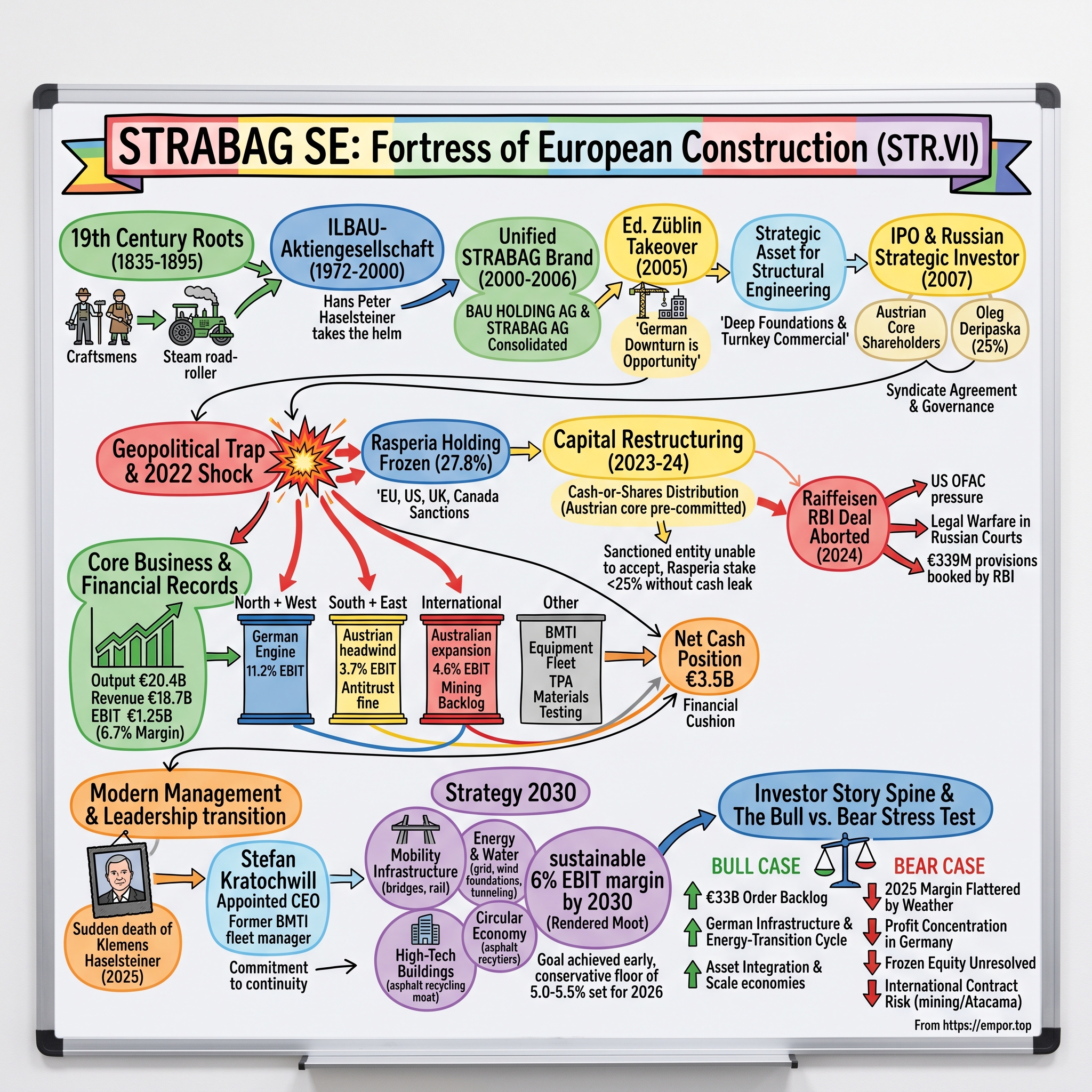
Strabag SE: The Fortress of European Construction
I. Introduction & Episode Roadmap (00:00 – 06:00)
On 21 March 2024, a clerk at the Regional Court of Klagenfurt — a provincial courthouse in Carinthia, on the mountainous southern edge of Austria, closer to Slovenia than to Vienna — entered a routine line into the commercial register. STRABAG SE's share capital had increased from €102,600,000 to €118,221,982.1
Nothing about that entry appeared dramatic: no press conference, no bell-ringing, no billion-euro cheque. Yet that single registration was the final step in a nine-month legal and financial restructuring designed to resolve a complex dilemma: what does a €20 billion European construction company do when roughly 28% of its equity is owned, through a Cyprus-then-Russia holding vehicle, by an individual subject to sanctions by the European Union, the United States, the United Kingdom, and Canada?
A company cannot buy out a sanctioned investor — paying a sanctioned party is explicitly prohibited by sanctions regulations. It cannot ignore him — a shareholder above 25% holds a blocking minority under Austrian corporate law, and public-procurement authorities across the EU strictly screen bidders with sanctioned owners above that threshold. Nor can it wait him out — infrastructure contracts are awarded on multi-year cycles, and procurement authorities wary of compliance risks will simply award projects to competitors.
Strabag pursued an alternative structure. It offered all shareholders a choice: accept a cash distribution from reserves or receive newly issued shares instead. The Austrian core shareholders — the Haselsteiner family, Raiffeisen, and UNIQA — pre-committed to accept shares, while the sanctioned shareholder was legally barred from receiving any. Equity mechanics achieved the rest. When the register entry cleared, Rasperia's holding had fallen from 27.8% to 24.1%,1 below the blocking threshold, without a single euro of liquid capital leaving the company for a sanctioned entity.
The elevator pitch. Strabag traces its origins to a 19th-century Alpine masonry business that expanded over nearly two centuries into one of Europe's largest construction groups. In the 2025 financial year, the group produced roughly €20.4 billion of output volume, generated €18.7 billion of IFRS revenue, and earned €1.25 billion of EBIT — a 6.7% operating margin, its highest ever.23 It closed that year with a net cash position of €3.5 billion,4 a rare balance-sheet posture in an industry where high leverage and thin margins are common.
The core thesis, and the reason to be sceptical of it. Construction is fundamentally a business where contractors submit fixed-price bids today for costs incurred over several years, leaving the winning bidder disproportionately exposed to estimation errors. Strabag's strategy relies on vertical integration — owning quarries, asphalt plants, and equipment rather than leasing them — alongside an emphasis on complex civil engineering projects where few competitors can bid. While this structural model offers genuine advantages, several factors temper the thesis: the 2025 margin was helped by a mild German winter and by favourable closeouts on a handful of large projects,5 management itself guides 2026 back down to 5.0–5.5%,4 and in March 2026 Strabag agreed to a fine increase of €100.63 million after an Austrian court found it had breached its obligations as a cartel-leniency applicant — bringing the total penalty for bid-rigging in Austria between 2002 and 2017 to €145.99 million.6 What was presented as regional pricing power was, according to the case record, partly the result of market coordination.
The roadmap. This analysis works through seven arcs: the 19th-century craft roots and the rise of Hans Peter Haselsteiner; the acquisition of Ed. Züblin AG during the German construction downturn and whether it delivered long-term value; the entry of Oleg Deripaska into the shareholder register and the governance challenge that arose in 2022; the subsequent capital measures and the failed Raiffeisen transaction; the segment economics that determine where profit is generated; the leadership transition to CEO Stefan Kratochwill following a sudden death in the founding family; Strategy 2030 and what it commits management to deliver; and a stress test of the investment case using Porter and Helmer frameworks alongside the key operational metrics that signal ongoing business performance.
It starts in a valley town in Carinthia, with a family that laid stone.
 Subscribe on LinkedIn
II. The Haselsteiner Legacy: From Spittal an der Drau to European Dominance (06:00 – 16:00)
Spittal an der Drau sits where the Lieser river meets the Drau, a mountain-ringed market town in southern Austria. In 1835, a craftsman named Anton Lerchbaumer registered a family building business there.7 For most of the next century and a half, the firm operated as a typical regional Alpine contractor: building houses, masonry walls, small bridges, and performing road repairs while accumulating local market knowledge that outside competitors could rarely match.
Roughly six hundred kilometres to the northwest, an entirely separate enterprise was taking shape. In 1895, engineer Heinrich Reifenrath and twelve partners founded Straßenwalzenbetrieb vormals H. Reifenrath GmbH in Niederlahnstein, on the Rhine — literally a "road-roller operation."7 As Germany expanded its modern road network, Reifenrath's firm supplied the essential heavy machinery. By 1923, the business had been renamed Straßenbau-Actiengesellschaft, and by 1927, it took an unusual step for a contractor of that era by establishing a central laboratory to research construction materials.7 That underlying principle — treating raw materials testing and supply as a strategic advantage rather than an off-the-shelf commodity — became a defining thread for the group.
The two companies, founded ninety years apart in different countries, eventually merged into a single entity. The executive who brought them together was an accountant.
Enter Haselsteiner. Hans Peter Haselsteiner, born in 1944, trained in commerce rather than civil engineering. He joined the Lerchbaumer business in 1972 — the same year it was reorganized as ILBAU-Aktiengesellschaft.7 Having married into the founding family, he assumed executive control two years later following the death of Anton Lerchbaumer Jr. At age thirty, he was running the firm.
Haselsteiner brought a financial controller's perspective to the construction industry. In his assessment, construction companies rarely fail from a lack of orders; they fail because they win fixed-price contracts based on cost assumptions that prove unrealistic over multi-year project lifecycles as steel, fuel, asphalt binder, subcontracted labor, and equipment hire prices fluctuate. His strategic response over the following four decades was twofold: own as much of the supply chain and cost stack as possible, and centralize risk pricing while allowing local units to chase local tenders.
This approach produced a distinct corporate structure that continues to govern Strabag. Operating decisions — such as which tenders to pursue, which crews to deploy, and which subcontractors to hire — are delegated to hundreds of regional units that operate like local contractors. However, capital allocation, equipment management, and risk underwriting are controlled strictly from the top. Heavy machinery is managed by a centralized fleet company, materials testing is handled by a group laboratory division, and administrative functions including treasury and IT operate through shared services. A regional unit in Slovakia does not purchase its own excavators; it leases them internally at group rates from a central balance sheet that buys equipment at scale.
Building the holding. In 1987, Haselsteiner created BAU HOLDING AG as ILBAU's parent company, listing it on the Vienna Stock Exchange in 1990.7 Access to public capital provided acquisition currency just as Central European markets opened up. German reunification and the dissolution of the Eastern Bloc created a decade of massive infrastructure redevelopment, during which state-owned construction enterprises were privatized at distressed valuations.
Through the 1990s, BAU HOLDING and Germany's STRABAG AG operated as affiliated companies.7 In 2000, Haselsteiner consolidated the corporate identity by retiring historic local brand names. ILBAU and STUAG were folded into a newly structured STRABAG AG in Austria, and the group adopted STRABAG as its unified brand across Europe.7 For an organization composed of hundreds of local units, a single brand provided scale and commercial weight: a municipality in the Czech Republic could be confident that a local team bidding on a bypass was backed by a major international balance sheet.
What this history means for an investor today. This operational legacy highlights three structural factors relevant to investors today.
First, Strabag built its market position during economic downturns and regional disruptions rather than broad industry booms. This history fostered a conservative balance-sheet philosophy in which a net cash position is viewed not as idle capital, but as liquidity reserved to acquire assets when competitors face financial pressure.
Second, vertical integration is a longstanding operational habit rather than a recent strategic initiative. The materials laboratory established in 1927 evolved into TPA, which the group describes as one of Europe's largest private testing organizations specializing in asphalt, concrete, earthworks, and geotechnics.8
Third, a highly decentralized network competing for public tenders across numerous small geographic markets carries inherent compliance risks. Austria's competition authority alleged, and the Cartel Court affirmed, that group entities engaged in price fixing, market sharing, and information exchange on Austrian tenders over a fifteen-year period, resulting in substantial fines.6 While decentralization provides deep regional market knowledge, it also makes oversight from headquarters significantly more challenging.
By the mid-2000s, Haselsteiner had established a unified brand, a publicly listed holding company, and a dominant position across Austria and Central Europe. What the group still lacked was a major footprint in Germany — Europe's largest construction market, which was then undergoing a severe structural downturn.
III. The Mega-Acquisition Playbook: The Ed. Züblin Takeover & M&A Benchmarking (16:00 – 28:00)
Understanding what Strabag acquired in 2005 requires examining the severe downturn in the German construction sector at the time.
The reunification boom of the early 1990s was an extraordinary demand shock: an entire country required new roads, housing, rail, and utilities, financed by public transfers from the west. German contractors expanded aggressively to meet it. When that demand receded, capacity built for a boom met a market that contracted for nearly a decade, plunging the industry into price deflation where contractors bid below cost simply to keep crews employed. Major firms collapsed. Philipp Holzmann, historically one of Germany's leading construction companies, failed. In 2005, Walter Bau — formed from parts of DYWIDAG and HEILIT+WOERNER, which had built German motorways and prestressed-concrete bridges for generations — entered insolvency.
Strabag stepped into the distressed market. It acquired major assets of the Walter Bau group and secured a controlling majority in Ed. Züblin AG, a Stuttgart-based engineering contractor founded in 1898 by Eduard Züblin.7
Why Züblin was the prize. Züblin was not a standard road paver. It was a structural engineering specialist focused on deep foundations, complex ground engineering, reinforced concrete structures, and turnkey commercial projects — work where technical expertise, rather than lowest price, represents the primary barrier to entry. This distinction is critical to pricing power. While road paving allows clients to compare competing bids line by line, complex deep foundations under urban high-rises require clients to pay for risk mitigation, leaving only a small group of qualified contractors capable of bidding.
Incorporating Züblin into a group whose heritage lay in materials and civil works shifted Strabag's earnings profile, adding a business segment where margins stem from engineering specialization rather than raw cost efficiency.
The 2016 endgame, and what it reveals about the valuation. Strabag did not acquire 100% of Züblin immediately, operating the firm with minority partners for a decade. On 7 April 2016, Strabag concluded a share purchase agreement for the remaining 42.74% stake for a fixed price of €210.3 million, plus a variable component of up to €114 million tied to Züblin's net income after minorities from 2015 through 2019.9 Following the transaction, Strabag's wholly owned subsidiary Ilbau Liegenschaftsverwaltung GmbH held 94.9% of Züblin, with the remainder acquired by a Strabag core shareholder.9
Standard M&A metrics require careful examination here. Strabag did not disclose an enterprise value to EBITDA multiple for its initial 2005 investment, making any retrospective transaction multiple an estimate. However, the disclosed 2016 minority buyout price offers a clearer metric, serving as an arm's-length valuation of Züblin eleven years into Strabag's operational control.
Evaluating those numbers provides useful context. A fixed purchase price of €210.3 million for 42.74% implied a total equity value for Ed. Züblin AG of approximately €492 million. Including the full potential earn-out raised the implied valuation to roughly €760 million. Comparing that figure to present-day performance highlights the transformation: the North + West segment, anchored by Züblin's German operations, generated €840.96 million of EBIT in the 2025 financial year on €7.51 billion of revenue — an 11.2% segment EBIT margin.5
This indicates that the segment built around Züblin now generates more operating profit in a single year than the implied 2016 valuation for the entire company. While Züblin represents a subset of the broader North + West reporting segment and 2025 benefited from exceptionally favorable conditions, the valuation gap underscores the long-term impact. Acquiring a structural engineering franchise during a decade-long construction slump and consolidating ownership before a market recovery secured an asset that would be cost-prohibitive to build organically. The financial return was primarily driven by the timing of the entry and buyout rather than post-acquisition engineering restructuring alone.
Restructuring the wrapper. In parallel with operational integration, Haselsteiner restructured the corporate holding. The group reorganized as a European Company (Societas Europaea) in 2004, and began operating as STRABAG SE in 2006.7 The SE corporate form provided a unified legal framework and a standardized co-determination model across multiple European jurisdictions, replacing a fragmented network of national entities.
On 19 October 2007, Strabag SE completed an initial public offering on the Prime Market of the Vienna Stock Exchange. As one of Austria's largest IPOs at the time, it raised growth capital for Central and Eastern European expansion near the peak of the pre-financial crisis cycle.
The IPO also established an equity governance structure — pairing a syndicate of Austrian core shareholders with a major Russian strategic investor — that would become a defining corporate factor fifteen years later.
That strategic investor was Oleg Deripaska.
IV. The Oligarch in the Boardroom: Oleg Deripaska, Rasperia, & Geopolitical Trap (28:00 – 40:00)
In 2007, the partnership appeared to be a strategic financial move.
Russia was experiencing a commodity supercycle, characterized by public capital reserves and a multi-decade construction deficit. Central and Eastern Europe was simultaneously absorbing European Union cohesion funds for infrastructure development. Meanwhile, Oleg Deripaska — an aluminium industrialist and head of the Basic Element group — sought access to European engineering and construction capabilities.
Deripaska acquired his Strabag stake in 2007 through Rasperia Trading Limited, securing a holding of roughly 25% alongside the initial public offering. Crucially, this was not a passive investment. In 2007, the Austrian core shareholders and Rasperia concluded a syndicate agreement governing, among other things, the nomination of Supervisory Board members and the coordination of voting at the Annual General Meeting.10 Rasperia was a contractual partner in the governance of the group.
The underlying strategic rationale was clear: Strabag gained a strategic sponsor with access to the Russian market and an anchor shareholder at listing, while Deripaska secured an interest in a prominent European industrial asset. The syndicate arrangement — linking the Haselsteiner family, Raiffeisen, UNIQA, and Rasperia — also insulated Strabag from hostile takeover attempts.
The structure operated stably for fifteen years. However, Russia's invasion of Ukraine on 24 February 2022 fundamentally altered that arrangement.
How a blocking stake becomes a liability. Within weeks, the 2007 governance architecture became untenable. Deripaska was sanctioned by the EU, the US, the UK, and Canada. In March 2022, the Haselsteiner family foundation terminated the syndicate agreement with Rasperia, UNIQA, and Raiffeisen, dismantling the coordinating structure that had governed Strabag since its IPO.10 Effective 8 April 2022, the shares held by Rasperia were frozen under EU sanctions regulations, suspending all associated voting rights.3
Operationally, a frozen 27.8% equity stake presented severe structural complications. Under Austrian corporate law, a shareholder holding more than 25% commands a blocking minority — the authority to veto major corporate resolutions, including capital measures and structural modifications. Although the sanctioned shareholder could no longer vote, the stake retained a potential veto that could not be legally exercised, leaving governance in an indeterminate state.
The commercial impact on public procurement proved equally pressing. Strabag's principal clients are public entities, including national highway authorities, rail operators, municipalities, and public utilities. These institutions operate under EU procurement frameworks and sanctions regulations that mandate strict checks on ownership and control. Because a 25% threshold serves as a definitive benchmark across these frameworks, procurement officers evaluating bids from a firm with a sanctioned 27.8% shareholder faced substantial regulatory compliance risks. Consequently, public bodies were incentivized to award tenders to competing contractors.
For a group generating the vast majority of its output in Germany, Austria, and Central Europe, this dynamic threatened a gradual erosion of order volume as procurement bodies bypassed the firm to avoid compliance scrutiny.
Financial management faced additional constraints regarding capital distributions. Dividends attributable to the frozen stake could not be disbursed. By the end of the 2024 financial year, the cumulative amount of withheld dividend claims stood at roughly €128.1 million, with a further €257.9 million from the capital-reduction distribution also withheld.10 These funds remained legally restricted, unable to be retained by Strabag or transferred to the shareholder.
Governance implications. The scenario highlights broader governance considerations regarding concentrated international ownership. In 2007, the investment was structured as a strategic alliance with fully disclosed syndicate agreements. However, investors implicitly assumed that a major shareholder subject to a non-Western legal jurisdiction would remain an unproblematic counterparty. That assumption dissolved within weeks due to geopolitical developments beyond the company's operational control.
While concentrated equity is typically evaluated through the lens of shareholder alignment, the Strabag case demonstrates that jurisdictional alignment is equally critical: corporate governance vulnerabilities arise when the legal frameworks governing major shareholders conflict with those of the operating entity.
By spring 2022, Strabag's management faced the task of neutralizing a legally binding ownership structure without disbursing cash or violating international sanctions. Resolving that position required two years of complex financial and legal engineering.
V. The Sanctions Chessboard: Capital Measures & The Aborted Raiffeisen Deal (40:00 – 52:00)
The 19th Annual General Meeting of STRABAG SE convened on 16 June 2023. On the agenda was a package of capital measures with a single, explicitly stated purpose: to reduce Rasperia's holding from 27.8% to below 25%.1 Shareholders approved it unanimously.1
The mechanics of the restructuring. Strip away the Austrian corporate law procedures and the structure operated in four steps.
First, the company resolved to distribute capital from reserves at €9.05 per entitled share.1 Ordinarily, that would have required a cash payout to all shareholders, including the frozen holding — an outcome both legally prohibited and strategically ineffective.
Second, instead of receiving cash, shareholders were offered an election: take the distribution in cash or subscribe to newly issued shares from a non-cash capital increase, reinvesting their entitlement back into the company at a fixed ratio.
Third, the Austrian core shareholders committed to take shares.
Fourth — the hinge of the entire design — the sanctioned shareholder could accept neither. It was legally barred from receiving cash and prohibited from taking new shares, as both represented a transfer of economic value to a sanctioned entity. Its entitlement was withheld and frozen.
The result was purely arithmetic. The share counts of all participating shareholders increased while the sanctioned holder's count remained static. On 5 October 2023, the subscription results showed that 87.6% of eligible shareholders, representing 60.9% of the share capital, chose the share option over cash.1 The non-cash capital increase was registered with the Regional Court of Klagenfurt on 21 March 2024, issuing 15,621,982 new shares — a 15.2% increase in share capital.1 Rasperia's stake fell to 24.1%.1
Why the structure proved effective. The restructuring achieved several objectives simultaneously. It removed the blocking minority and lowered the equity holding below the public procurement threshold. It did so without transferring liquid capital to a sanctioned party, leaving regulators in Washington, Brussels, and London with no grounds to object. Furthermore, because most shareholders selected shares over cash, the company retained the vast majority of the capital that would otherwise have been distributed. The dilution was borne almost entirely by the sanctioned shareholder.
However, the measure did not eliminate the shareholder entirely. A 24.1% stake remains the largest single position on the register, and it remains frozen. The corporate governance problem was neutralized, not fully resolved.
The Raiffeisen transaction, and why it collapsed. Operating in parallel was an attempt at a definitive solution — one of the most complex corporate finance transactions in recent European banking history.
Raiffeisen Bank International (RBI) faced a dilemma that mirrored Strabag's. RBI's Russian subsidiary, AO Raiffeisenbank, generated substantial cash profits, but its capital was trapped inside Russia due to local capital controls and Western regulatory restrictions. RBI proposed using those trapped Russian funds to acquire Rasperia's Strabag stake, effectively repatriating the value to Austria as equity in a major domestic industrial enterprise.
While the structure addressed RBI's capital constraint, US authorities viewed it as converting value linked to a sanctioned Russian entity into a clean Western asset. Regulatory pressure from the US Treasury's Office of Foreign Assets Control (OFAC) intensified through the spring of 2024.
On 8 May 2024, RBI cancelled the transaction, stating that it was unable to obtain the required comfort from the relevant authorities.11 Rasperia remained a shareholder of Strabag with a 24.1% stake.11 Shortly thereafter, OFAC added Rasperia and Iliadis JSC to the US sanctions list, and the EU followed in June 2024 under Council Implementing Regulation (EU) 2024/1842.10
Rasperia's ownership structure had also undergone changes. Iliadis JSC concluded a purchase agreement for 100% of Rasperia's shares on 14 December 2023; the transaction closed on 26 March 2024, transferring control from Deripaska to Iliadis; and on 16 December 2024, Rasperia was transferred again to Valtoura, Iliadis's former parent.10 Sanctions authorities subsequently determined these transfers did not alter the sanctioned status, extending restrictions to the successor entities.
Legal warfare in Russian courts. Following the regulatory blockage, the dispute shifted to Russian courts, turning a corporate finance impasse into active legal warfare.
Rasperia initiated legal proceedings in the Arbitration Court of the Kaliningrad Region — a Russian regional commercial tribunal — claiming that sanctions-related measures had impaired the value of its Strabag holdings. In January 2025, the court ruled in Rasperia's favor, ordering RBI's Russian subsidiary to pay approximately €2 billion in exchange for the disputed shares. The decision was upheld on appeal and enforced through funds withdrawn from AO Raiffeisenbank's accounts.
In a parallel move in October 2024, Strabag's Austrian core shareholders filed an arbitration claim against Rasperia in Amsterdam to enforce rights of first refusal under the former syndicate agreement, seeking an outright buyout of the stake. In June 2025, Rasperia responded by securing an anti-suit injunction from the Kaliningrad court prohibiting proceedings outside Russia, backed by a penalty of €1.09 billion.12 Because the core shareholders held no assets in Russia, the penalty was structured to be enforced against RBI's Russian subsidiary.12
Faced with cross-border liability that would penalize an Austrian banking institution that was also a fellow core shareholder, the Austrian core shareholders withdrew the Amsterdam arbitration on 30 September 2025.12 Strabag stated that the shares remained frozen and all options regarding the Russian shareholder stayed under review.12
On 18 December 2025, the Kaliningrad court issued a second judgment, holding Strabag SE and its Austrian core shareholders liable for €339 million in damages to Rasperia to cover withheld distributions, unpaid 2024 dividends, and interest. This judgment was again enforceable against AO Raiffeisenbank's assets, leading the bank to book a €339 million provision in the fourth quarter of 2025.13
The failed EU carve-out. In October 2025, Austria sought a political resolution by proposing a specific carve-out in the EU's 19th sanctions package. The provision would have permitted authorities to unfreeze the Rasperia stake so it could be transferred to Raiffeisen as compensation for its losses in Russia. Although actively considered, the proposal encountered resistance from Czechia, Poland, the Baltic states, and Nordic member states, who argued it effectively validated the enforcement of Russian court judgments against frozen assets. Austria subsequently withdrew its objection, and the sanctions package was enacted without the exemption.
Key takeaways for investors. Three principal conclusions emerge from these developments.
First, the capital restructuring achieved its primary goal. The operational threat to public procurement eligibility was neutralized, and order book performance indicates no exclusion from European public tenders. The €31.4 billion order backlog at year-end 2025, up 24%,4 provides clear evidence that commercial operations remain unimpaired.
Second, the direct financial exposure arising from Russian court judgments rests primarily with Raiffeisen Bank International rather than Strabag. The initial €2 billion judgment targeted AO Raiffeisenbank directly, while the subsequent €339 million ruling names Strabag and the core shareholders but is enforceable against Raiffeisen's Russian assets.13 Strabag's direct exposure remains limited to frozen distributions and ongoing administrative and reputational overhead, rather than an immediate cash judgment against its balance sheet.
Third, the 24.1% stake in an Austrian benchmark index constituent remains frozen without a clear path to resolution. Regulatory prohibitions prevent a buyout by Western entities, jurisdictional conflicts preclude cross-border legal resolution, and diplomatic carve-outs have failed. The frozen equity position represents a persistent feature of Strabag's shareholder register until broader geopolitical conditions change.
VI. Core Business Anatomy & Segment Economics (52:00 – 1:07:00)
When Strabag explained in January 2026 why its full-year earnings would far exceed prior guidance, one of the primary reasons management cited was the weather.14
Favourable conditions in Germany enabled higher capacity utilisation late in the year, alongside solid performance across major German projects and international infrastructure.14 This detail highlights the fixed-cost operating leverage inherent in heavy construction: field crews, heavy machinery, and asphalt plants represent fixed overhead that incurs costs regardless of freezing ground. A mild German winter translates directly into high-margin incremental output.
Across the 2025 financial year, Strabag produced €20.42 billion in output volume—a 6% increase that marked its first time crossing the €20 billion threshold. IFRS revenue expanded 7% to €18.71 billion, while earnings before interest, taxes, depreciation, and amortisation (EBITDA) reached €1.88 billion. That delivered a 10.1% EBITDA margin, the group's first double-digit result on that measure. Operating profit (EBIT) rose 17% to €1.25 billion, widening the EBIT margin from 6.1% in 2024 to a record 6.7%.24 Net income after minority interests rose to €916.28 million, bringing earnings per share to €7.94 compared to €7.35 a year earlier.24 Return on capital employed remained steady at 14.5%,2 while workforce headcount stood at 80,211 full-time equivalent employees.4
North + West: the engine. Encompassing Germany, Switzerland, the Benelux region, Scandinavia, and ground engineering, the division generated €8.53 billion in output volume, €7.51 billion in revenue, and €840.96 million in EBIT—delivering a segment EBIT margin of 11.2%, up 21% year-on-year.5 Infrastructure and industrial projects in Germany spearheaded this growth, buoyed by large-scale contract execution and late-season weather that boosted equipment utilisation.5 The division's order backlog expanded 11% to €13.41 billion.5
This segment produced roughly two-thirds of group EBIT on roughly 40% of group revenue. That structural concentration underpins Strabag's overall profitability, but it also creates key vulnerabilities. On one hand, it reinforces the strategic value of the Ed. Züblin acquisition, demonstrating that complex engineering work in Germany generates margins nearly double the corporate average. On the other, it leaves group earnings heavily dependent on German public and industrial capital spending—and acutely sensitive to execution risk on major lump-sum contracts.
South + East: the regional challenge. Covering Austria, Poland, Czechia, Slovakia, Hungary, Romania, South-East Europe, and the construction materials business, output reached €7.69 billion and revenue rose to €7.24 billion—a modest 2% to 3% top-line gain driven by strong activity in Poland and Czechia. Operating profit, however, dropped 31% to €266.72 million, shrinking the segment margin from 5.4% in 2024 to 3.7%.5
This margin contraction stemmed from three distinct factors highlighted in corporate disclosures: fiscal austerity among Austrian municipalities that curtailed regional civil works, frozen European Union cohesion funds that stalled infrastructure tenders in Hungary, and the financial impact of antitrust modification proceedings, which management noted have been brought to a binding conclusion.5 That final element reflects a €100.63 million penalty increase agreed on 11 March 2026, raising total fines for Austrian bid-rigging between 2002 and 2017 to €145.99 million after the Cartel Court ruled that Strabag had breached its cooperation duties under leniency rules.6
While municipal budget constraints and frozen EU transfers represent external macro headwinds, the antitrust penalty highlights a governance vulnerability. South + East is precisely the market where vertical integration and regional density are claimed to confer organic pricing power. Yet official antitrust findings established fifteen years of illegal price-fixing, market division, and tender coordination in Austria.6 Consequently, attributing Strabag's historic regional profitability solely to supply-chain integration overlooks a documented history of market coordination.
International + Special Divisions: the swing factor turns. Comprising non-European operations, global tunnelling, real estate development, and infrastructure concessions, this division has historically represented Strabag's most volatile business unit, suffering a €132.1 million EBIT loss in 2023 before breaking even in 2024. In 2025, the segment rebounded sharply: output volume expanded 23% to €4.03 billion, revenue grew 29% to €3.94 billion, and EBIT reached €181.69 million, delivering a 4.6% operating margin.5
Two primary drivers underpinned this turnaround. First was expansion in Australia: on 27 November 2024, Strabag agreed to acquire Georgiou Group Pty Ltd, a Perth-based contractor generating approximately €790 million in annual output, effective retroactively from 30 June 2024 with existing leadership retained;15 the acquisition formally settled in 2025. Second, management cited reduced earnings provisions across international projects,5 reflecting an absence of major cost overruns that had burdened prior periods.
The division's order pipeline points to an even sharper operational reorientation, expanding 81% to €9.98 billion by year-end 2025.5 By the first quarter of 2026, the segment backlog rose 70% year-on-year to €10.87 billion, driven by approximately €800 million in Chilean mining infrastructure contracts alongside European mobility projects.16
This growth represents a notable strategic choice. Strabag is expanding its footprint in remote, complex, fixed-price international projects—the precise contract category responsible for its steepest historical losses. While management contends that enhanced central risk oversight mitigates these exposures, a single operational setback on a remote mining contract in the Atacama Desert could quickly erode segment profitability.
Other, and the internal service architecture. The "Other" reporting segment houses group shared services: BMTI for heavy equipment fleet management, BRVZ for finance, IT, and administration, and TPA for materials testing. The segment reported €19.08 million in external revenue and an EBIT loss of €8.93 million in 2025.5 While its direct P&L contribution is minor, its operational role is pivotal. BMTI oversees a fleet of construction and logistics equipment valued at over €7 billion, including more than 700 cranes, 2,200 wheel loaders, and 2,700 excavators.8 Strabag does not separately disclose the total count of its proprietary quarries, gravel pits, and asphalt mixing plants.
Cash flows and balance sheet reality. Operating cash flow increased to €1.80 billion from €1.39 billion in 2024, supported by higher operating earnings and an unexpected release of working capital, while customer advance payments remained stable.4 Net liquidity closed the year at €3.52 billion, up from €2.91 billion at year-end 2024.417
This cash position warrants careful analytical interpretation. In heavy construction, a substantial portion of reported liquidity consists of unearned customer advance payments and project retentions—cash collected prior to contract completion. Consequently, an expanding order backlog mechanically expands liquid reserves, whereas a contracting pipeline absorbs cash. While Strabag maintains a solid debt-free balance sheet, its €3.52 billion net cash reserve does not represent purely unencumbered surplus available for distribution. Instead, it reflects client pre-funding for active project execution, making the stability of advance payments a critical gauge of underlying cash flow health.
This financial cushion leads directly to the leadership transition and capital allocation choices facing executive management.
VII. Modern Management, Governance & Capital Allocation (1:07:00 – 1:17:00)
On 17 January 2025, Strabag issued a brief press release: Klemens Haselsteiner, Chairman of the Management Board, had passed away suddenly and unexpectedly at age 44.18 Other board members temporarily assumed his responsibilities.18
Haselsteiner had become CEO in 2023, representing the third generation of the founding family to lead the group. He had served as the public face of Strategy 2030—the sustainability-anchored strategic framework presented at the same 2023 Annual General Meeting that approved the capital restructuring. His death removed the executive family continuity that had defined the business since the 1970s.
The successor nobody outside the company had heard of. On 19 February 2025, the Supervisory Board appointed Stefan Kratochwill as Chairman of the Management Board with immediate effect.19 Aged 48, Kratochwill had joined Strabag as a trainee in 2003, most recently serving as central division head and managing director of STRABAG BMTI GmbH—the construction machinery subsidiary—overseeing roughly 3,000 employees internationally.19
That appointment was telling. Rather than selecting a financial deal-maker or the head of its highest-margin operating unit, Strabag promoted the executive running its equipment fleet. BMTI is the operational embodiment of the group's central thesis: that owning and managing heavy machinery internally generates a durable structural cost advantage over competitors reliant on third-party equipment hire. Promoting BMTI's leader underscored management's intent to reinforce its vertically integrated model.
On 22 April 2026, the Supervisory Board reappointed all five Management Board members—Kratochwill as CEO, Christian Harder as CFO, Jörg Rösler for North + West, Péter Glöckler for South + East, and Siegfried Wanker for International + Special Divisions—for a term running from 1 January 2027 through 31 December 2030.20 Supervisory Board Chairwoman Kerstin Gelbmann framed the decision as "a deliberate commitment to continuity," noting that the executive team had guided the group through challenging operating conditions.20 Reappointing the entire board four years in advance, eighteen months before existing contracts expired, established deliberate leadership stability while the Rasperia shareholding situation remained unresolved.
Reading management's credibility through its guidance. Examining corporate forecasting over time reveals a distinct pattern. In April 2025, management guided to a 2025 EBIT margin of at least 4.5% on output of roughly €21 billion.17 On 27 January 2026, an ad-hoc disclosure raised the 2025 margin expectation to at least 6.5%.14 The final audited margin reached 6.7%.2 For 2026, management guided to an EBIT margin of 5.0% to 5.5% on output of approximately €22 billion.4
This sequence illustrates a conservative signaling pattern: initial guidance of 4.5% yielded a final result of 6.7%—a beat of more than 200 basis points, mirroring 2024 when a 6.1% margin comfortably exceeded initial targets. In heavy construction, where late-stage project closeouts, claims settlements, weather variations, and loss-provision timing heavily influence second-half earnings, establishing a conservative floor protects against downside volatility. However, persistent under-promising limits the utility of initial guidance as an analytical forecast.
Consequently, the 5.0% to 5.5% guidance for 2026 functions as an operational floor rather than a midpoint target. Management attributed the projected margin step-down to investments under Strategy 2030 and the group's expanded asset base;4 while fleet depreciation and the integration of Australian operations create genuine cost drag, those factors do not fully explain a potential 120 to 170 basis point margin decline during a period of expanding order backlogs. A 2026 margin landing squarely within the guided range would indicate actual margin compression, whereas another substantial beat would confirm structural under-guidance.
How the board pays for performance. Strabag's remuneration policy for the Management Board relies entirely on quantitative financial metrics, with the group stating explicitly that non-financial criteria are excluded because defining, measuring, and auditing appropriate key performance indicators for them still poses a significant challenge.21 The variable compensation component evaluates performance against two alternative targets—cost-accounted net income and operating margin—with executive payouts calculated using whichever metric yields the higher entitlement, resulting in a bonus ranging from a minimum threshold up to a maximum of twice base salary.22
This compensation structure presents dual governance considerations. Indexing executive bonuses to operating margins rather than gross output volume aligns management incentives with contract profitability, curbing the industry-wide temptation to acquire volume through underpriced bids. Conversely, a structure that defaults to the higher of two metrics provides an asymmetrical payout mechanism. Furthermore, excluding non-financial parameters from executive compensation creates an obvious disconnect for a group marketing its corporate vision under "People. Planet. Progress." while committing to group-wide climate neutrality by 2040.
What they do with the money. Capital allocation decisions reflect this conservative balance-sheet posture. For the 2025 financial year, the Management Board proposed a dividend of €2.90 per share—a 16% increase from €2.50—representing a 37% payout ratio and a 4.1% yield based on the average share price for the year.3 Net investments for 2026 are guided at no more than €1.4 billion, directed at construction machinery and acquisitions.4
The 37% payout ratio remains conservative for an unleveraged contractor holding €3.52 billion in net cash. Retaining earnings supports equipment fleet modernization, funds targeted acquisitions such as Georgiou, and provides liquidity protection while equity restrictions on the Russian holding persist. Whether this cash accumulation represents prudent risk management or capital inefficiency depends on reinvestment returns: thus far, the group's 14.5% return on capital employed indicates disciplined deployment.
The register is slowly opening. A notable corporate development during 2025 was the expansion of Strabag's public float. Private placements by core shareholders increased free float from 10.9% to 16.2% over 2025, reaching 18.0% by February 2026.3 At year-end 2025, the shareholder register comprised Raiffeisen/UNIQA at 30.4%, the Haselsteiner family foundation at 26.9%, Rasperia at 24.1%, free float at 16.2%, and treasury shares at 2.4%.3 Strabag was admitted to Austria's benchmark ATX index on 22 September 2025, closing the year at €81.00 per share following a 105% annual gain within a 52-week trading range of €40.40 to €91.30.3 Six investment banks maintain equity research coverage on the stock: Erste Group, Kepler Cheuvreux, LBBW, Metzler, ODDO BHF, and Raiffeisen Research.3
A 105% share price rally in a single year reflects a fundamental valuation re-rating rather than organic operational growth alone. That re-rating resulted from the simultaneous convergence of index inclusion, expanded free float, record earnings, and the operational neutralization of the sanctions risk. Sustaining those valuation levels depends on ongoing operational execution and the ultimate resolution of the frozen equity block—where the group's strategic framework comes into focus.
VIII. Hidden Drivers & Future Optionality: Strategy 2030 (1:17:00 – 1:24:00)
At the Annual General Meeting on 12 June 2026, CEO Stefan Kratochwill outlined what the business was working to become, presenting an operational focus notably more concrete than its overarching corporate branding implied. Strabag is organizing around four key target markets: mobility infrastructure, energy and water infrastructure, high-tech buildings, and the decarbonization of existing buildings. "These markets have one thing in common," he told shareholders. "They're built on our strengths."23
That operational taxonomy contrasts with the formal framework of Strategy 2030, presented at the 2023 AGM under the title "People. Planet. Progress." That program outlined six strategic priorities: employee development; a "global-local" model combining international reach with regional decision-making; circular economy capabilities across procurement, deconstruction, and recycling; energy-sector expertise; technology leadership in data and Building Information Modeling (BIM); and integrated value creation spanning the entire building lifecycle from design to demolition.24 Its headline financial target was achieving a sustainable 6% EBIT margin by 2030,24 paired with a commitment to deliver climate-neutral projects by 2040.
Start with the awkward part. Strabag had already surpassed that 2030 profitability target—twice. The group achieved a 6.1% EBIT margin in 2024 and 6.7% in 2025.172 Setting a decade-end target that was cleared five years early reduces the metric from an ambitious goal to a record of past performance. As of mid-2026, management had not revised the target upward.
That gap matters because the 6% margin figure represents the only quantified, externally verifiable commitment in the Strategy 2030 framework. The remaining goals—expanding circular economy capabilities, establishing tech leadership, and deepening lifecycle presence—function as general directions of travel without measurable benchmarks. An investor cannot audit progress toward "expanding expertise in deconstruction and recycling," whereas "6% by 2030" is easily evaluated—and has already been rendered moot. The appropriate response is not cynicism toward the strategy itself, which remains logically sound, but skepticism toward using Strategy 2030 as a primary benchmark.
Now the substance, because there is real substance. Examining the four growth markets reveals what Strabag's operational model actually contributes to each.
Mobility infrastructure represents the core incumbent business: roads, rail networks, bridges, and tunnels. The primary catalyst is that Europe's post-war infrastructure is approaching the end of its design life just as governments expand capital spending budgets. Germany's bridge network, in particular, requires widespread replacement rather than routine maintenance. For Strabag, this is not an unfamiliar market, but an existing core business operating against an expanding public budget.
Energy and water infrastructure represents an adjacent growth area closely aligned with core civil capabilities. Wind farms require heavy concrete foundations, high-voltage grid expansion demands substations and underground conduit routes, pumped-storage hydropower relies on deep tunneling, and municipal water networks across Central Europe require extensive overhaul. Rather than developing unfamiliar technical capabilities, Strabag can redirect its existing civil and ground engineering resources toward utilities and grid operators instead of highway agencies. The central margin question is whether utility clients procure via lowest-compliant-bid tender structures or capability-constrained contractor selection. Order intake patterns in 2025 suggest the latter, pointing toward potential margin support.
High-tech buildings—such as data centers, semiconductor fabrication facilities, and pharmaceutical plants—present the highest-margin potential, while standing furthest from the group's historic civil engineering focus. These turnkey industrial facilities operate under strict delivery timelines where the client's financial cost of delay far exceeds total construction expense, allowing qualified contractors to price for execution reliability rather than lowest cost. Züblin's complex structural engineering unit provides the technical platform for these projects. However, the same attributes that make high-tech construction lucrative—technical complexity, compressed schedules, and bespoke engineering—also make it a frequent source of severe fixed-price contract overruns if execution falters.
Decarbonization of existing buildings represents the largest total addressable market, but the least proven operational model. While retrofitting Europe's building stock to satisfy regulatory climate targets involves massive aggregate expenditure, individual project values remain small. Whether an organization built to manage €100 million infrastructure contracts can efficiently execute thousands of €200,000 building retrofits remains an open question, and Strabag has not disclosed unit economics or segment metrics to demonstrate profitability in this market.
The circular economy angle is the one with a real moat. In materials recycling, the competitive moat is tangible rather than aspirational. Asphalt consists of roughly 95% aggregate and 5% bitumen binder by weight and is fully recyclable through milling, reheating, and relaying. The primary operational constraint is not recycling technology, but transportation logistics and environmental permitting. Reclaimed asphalt must be transported to a regional mixing plant, and its high weight-to-value ratio makes long-distance haulage economically unviable. Consequently, the contractor controlling the asphalt mixing plant closest to a project site holds a structural cost advantage in recycled materials that competitors cannot easily replicate without building a nearby facility—a prospect severely constrained by Central Europe's strict environmental and planning regulations.
This dynamic provides one of the group's few genuine competitive moats: a location-based cost advantage on key raw inputs, reinforced by regulatory barriers to entry. As rising carbon prices elevate the cost of virgin bitumen and primary aggregate extraction, the economic value of these localized recycling assets increases automatically.
Technology. Strabag has implemented 5D Building Information Modeling—a digital design framework integrating geometric parameters with time scheduling (the fourth dimension) and cost estimation (the fifth dimension), enabling automatic cost adjustments whenever project schedules change prior to breaking ground. The commercial rationale is straightforward: on fixed-price contracts, resolving design conflicts in a digital model avoids costly field re-work. The group has also conducted trials of autonomous asphalt paving equipment. While both initiatives reflect genuine operational progress, management has not yet disclosed quantified margin contributions from either technology, leaving their financial impact unverified.
The overall assessment of Strategy 2030 is that its market positioning aligns well with group capabilities, its environmental goals reflect genuine operational shifts, but its single quantified financial target is outdated and uninformative. The strategy clarifies where Strabag intends to allocate resources, but fails to define expected financial returns—an area where market participants have yet to press management for clarity.
Evaluating whether those returns are defensible requires a structured analytical framework.
IX. Strategic Frameworks: 7 Powers & Porter's 5 Forces (1:24:00 – 1:33:00)
Construction is fundamentally a challenging industry, characterized by low entry barriers for small projects, commoditized output, price-sensitive buyers, cyclical demand, and a fixed cost structure that severely penalizes unutilized capacity. Any assertion that a contractor possesses a durable competitive advantage requires rigorous scrutiny. Testing Strabag's business model against Hamilton Helmer's 7 Powers framework and Michael Porter's Five Forces model helps distinguish genuine structural edges from temporary cyclical tailwinds.
Hamilton Helmer's 7 Powers
Scale economies — real, and the strongest of the set. The primary operational mechanism is BMTI. When a group centralizes over €7 billion of construction and logistics equipment — including more than 700 cranes, 2,200 wheel loaders, and 2,700 excavators8 — and leases it internally across hundreds of operating units in a dozen countries, it achieves two distinct advantages that a regional contractor cannot match. First, bulk purchasing power reduces capital expenditure on new machinery. Second, equipment utilization improves significantly: an idle excavator in Slovakia can be redeployed to a project in Poland, whereas a regional firm's idle machine sits unutilized on a yard. Because depreciation represents the dominant cost of heavy machinery and accrues regardless of active deployment, higher utilization operates as a direct margin lever. This represents a tangible structural advantage, explaining why the group's former fleet manager was appointed chief executive.
Cornered resources — real, and geographically specific. The network of permitted quarries and asphalt mixing plants represents the strongest explanation for why Strabag earns above-average margins in Central European road construction. However, its strategic value is inherently local. Owning a quarry near Graz confers no operational cost advantage for a project in Perth, meaning this resource power does not automatically transfer to international expansion.
Process power — partially real, and hard to verify from outside. TPA's testing laboratories and group-wide Building Information Modeling standards represent genuine operational capabilities. In Helmer's framework, process power requires an embedded, slow-to-build, and difficult-to-replicate operational edge. From an external perspective, assessing whether Strabag's risk underwriting and bidding discipline is structurally superior to peers like Vinci, Bouygues, or Skanska remains difficult to verify independently. The primary empirical evidence is the absence of major project write-downs in the International division since 2023, though two clean financial years indicate operational improvement rather than definitive proof of embedded process power.
Counter-positioning — real historically, weaker now. Operating with a net cash balance sheet while leveraged competitors chased volume served as an effective counter-positioning strategy during prior industry slumps. That liquidity permitted Strabag to acquire assets from Walter Bau and Ed. Züblin during market downturns and continuously issue the substantial bank guarantees required for major infrastructure tenders. However, balance-sheet conservatism reflects management discipline rather than an insurmountable structural barrier, and peers across the European construction sector generally enter current cycles with healthier balance sheets than in 2005.
Branding, network economies and switching costs — largely absent. Public procurement regulations generally prohibit government infrastructure agencies from paying price premiums for corporate brand equity. Laying asphalt creates no network effects, and client switching costs apply only after an active contract has been awarded. Consequently, branding, network economies, and switching costs contribute negligibly to a contractor's economic moat.
The power that the record complicates. An objective evaluation must account for historical market distortion: for fifteen years, a portion of the Austrian construction market was not competitively priced. Cartel Court findings established price fixing, market sharing, and bid coordination across public and private tenders from 2002 to 2017, culminating in total fines of €145.99 million after Strabag's leniency status was set aside.6 Consequently, historical regional margins must be evaluated with caution. The key forward-looking question is quantitative: how much of the South + East segment's historic profitability was structural versus coordinated? The segment's 2025 EBIT margin of 3.7%, down from 5.4% in 2024,5 reflects cyclical headwinds and municipal budget constraints, but it also highlights that the post-cartel competitive baseline in Austria may prove less lucrative than pre-2017 performance suggested.
Porter's Five Forces
Threat of new entrants: very low at the top, very high at the bottom. Entry barriers for basic municipal civil works are minimal, but competing for a 20-kilometer Alpine base tunnel requires massive scale. The primary entry barriers at the high end are bonding capacity — the extensive bank guarantee lines required to bid on mega-projects, backed by a strong balance sheet — and verified project references, which cannot be acquired quickly. Strabag's strategic shift toward complex civil works and specialized industrial construction represents a deliberate migration up the entry-barrier curve.
Bargaining power of buyers: medium, and bifurcated. Public highway and rail agencies operate as professional, price-sensitive monopsonists enforcing formal procurement rules — establishing high buyer power. For complex engineering projects, however, the qualified bidder list narrows to two or three contractors, significantly reducing buyer leverage. An order backlog of €31.4 billion at year-end 2025, providing revenue visibility into 2028,23 serves as an operational buffer against buyer pressure, allowing a contractor with three years of execution capacity to reject underpriced tenders. Management noted at the 2026 AGM that the backlog "allows us to be even more flexible in our project selection."23 The key test for investors is whether this selective bidding discipline is maintained if overall market volumes soften.
Bargaining power of suppliers: low for materials, higher for labour. Backward integration into aggregate quarries and asphalt plants insulates the group from raw material supplier power. However, skilled construction labor across Germany and Austria remains scarce and aging, making wage inflation a persistent cost pressure that supply-chain integration cannot offset.
Threat of substitutes: very low. Physical transportation infrastructure lacks direct technological substitutes. The primary substitution risks are demand-driven — structural shifts toward remote work reducing commercial construction, or political reallocations of capital away from road networks — which alter project mix rather than eliminating the underlying market.
Rivalry: intense in commodity work, muted in specialised work. Basic building construction remains highly fragmented, with intense price competition driving margins toward zero. In complex sectors like Alpine tunneling, deep foundation engineering, and specialized structural work, a limited cohort of European groups — including Vinci, Bouygues, Ferrovial, Skanska, Hochtief, Implenia, and Strabag — compete primarily on technical capability rather than price alone. Strabag's 6.7% group EBIT margin sits at the upper end of large European contractors, though peer comparisons require adjustments for varying revenue contributions from concessions and facility services.
The synthesis. Construction remains inherently challenging, and Strabag does not possess an impenetrable economic moat. Instead, it operates as a structurally advantaged contractor within a difficult industry — supported by scale economies in equipment management and localized raw material ownership, alongside an established position among the select group of contractors qualified to bid on complex European infrastructure projects. That provides a genuine competitive edge, though one that is narrower than corporate presentations suggest and less transferable to remote international markets.
X. Investor Story Spine: The Bull vs. Bear Stress Test (1:33:00 – 1:41:00)
Setting structural frameworks aside allows a direct comparison between the bullish thesis and its counterarguments.
The bull case, stated in its strongest form.
Europe has entered a multi-year infrastructure replacement and energy-transition capital cycle, and Strabag sits directly in its flow with three years of work already secured. The order backlog reached €31.4 billion at year-end 2025, a 24% increase, before expanding further to €33.06 billion by the end of the first quarter of 2026, up 18% year-on-year.416 These figures represent signed, legally binding commitments rather than speculative demand projections.
The earnings mix has shifted structurally toward higher-margin operations. North + West, operating at an 11.2% segment margin,5 is a fundamentally different business from the road-paving contractor Strabag was two decades ago, supported by a strong German infrastructure and industrial pipeline.
The balance sheet remains among the strongest in the sector. Net cash of €3.5 billion4 ensures the group is never forced to accept underpriced contracts to finance working capital, provides the bank guarantee capacity required for mega-projects, enables opportunistic asset purchases during downturns, and easily funds dividend payouts from a 37% distribution ratio.3
Management has consistently outperformed its initial guidance, the Management Board was reappointed en bloc through 2030,20 and the blocking stake held by a sanctioned shareholder was structurally neutralized without cash leaking from the group.
The bear case, stated in its strongest form.
The record 2025 margin was flattered by temporary tailwinds. Management itself attributed the beat partly to mild winter weather in Germany and favorable closeouts on specific major projects.14 Neither factor represents a repeatable operational advantage. Group guidance for 2026 projects an EBIT margin of 5.0% to 5.5%,4 conceding that if those projections prove accurate rather than conservative, 2025 will represent a cyclical peak.
Operating profits remain heavily concentrated. A single segment in a single country generates the vast majority of group EBIT. A €200 million cost overrun on a major German contract—a vulnerability that has periodically hit large European contractors—would significantly impair group earnings, with limited earnings diversification elsewhere to absorb the impact.
The equity situation surrounding the sanctioned holding remains unresolved. Roughly a quarter of the share capital is frozen without a visible commercial or regulatory path to resolution. Strabag abandoned its Amsterdam arbitration after Rasperia obtained an anti-suit injunction backed by a €1.09 billion court penalty enforceable against Raiffeisen's Russian subsidiary,12 Kaliningrad tribunals have issued judgments against Strabag and its core shareholders,13 and an Austrian initiative for an EU diplomatic carve-out failed. Any future unfreezing could place a 24.1% equity block on the open market or hand it to a new owner, creating control uncertainties.
Governance concerns extend beyond equity restrictions. The Austrian antitrust case was not merely a fine for historic conduct; the Cartel Court determined that Strabag had breached its cooperation obligations as a leniency applicant, leading to a tripling of the penalty.6 Executive compensation raises further questions: variable pay calculates bonuses using a "higher of two metrics" structure, excludes non-financial parameters entirely despite the group's sustainability branding,2122 and maintains a conservative payout ratio even as cash reserves build.
Cyclical vulnerabilities persist across secondary markets. Residential construction across Central Europe remains subdued, while strained Austrian municipal budgets and frozen EU cohesion funds for Hungary weakened performance in the South + East division in 2025.5 Input-cost inflation on long-term fixed-price contracts poses a constant risk; although Strabag incorporates price escalation clauses and long-term local procurement contracts where feasible,16 these mechanisms do not fully eliminate margin exposure.
International expansion introduces operational risk. After a decade of concentrating on European core markets, the group acquired Perth-based contractor Georgiou Group in Australia15 and secured approximately €800 million in Chilean mining infrastructure contracts.16 Both operations fall within International + Special Divisions—the segment with the steepest historical losses. The localized material ownership and equipment density that protect European margins offer no operational advantage in remote mining locations like the Atacama Desert.
Why win, and what would break it. Evaluating the investment case requires identifying the conditions for ongoing success and the triggers that would break it. Strabag succeeds if European infrastructure replacement spending remains robust, the elevated margin in North + West proves structural rather than temporary, and international expansion proceeds without major project overruns. That trajectory is supported by tangible operational mechanisms: localized raw material ownership, centralized equipment management, competitive advantages in complex engineering tenders, and a debt-free balance sheet that permits selective bidding.
The investment case breaks under three specific conditions: a major fixed-price contract overrun in North + West or International that invalidates management's risk-control narrative; a sharp contraction in German public capital expenditure that undermines order volume; or a resolution of the frozen equity stake that transfers a 24.1% voting block to an unaligned shareholder.
Significantly, the bear case contains no balance-sheet, refinancing, or liquidity risks. With €3.5 billion in net cash, structural insolvency risks are absent—a rare attribute in a highly cyclical industry.
XI. Playbook & Key Performance Indicators (1:41:00 – 1:47:00)
Three lessons that generalize.
In a commoditized market, own the bottleneck. Laying asphalt is a low-margin service that virtually any contractor can provide. Owning a permitted quarry and asphalt mixing plant ten kilometers from a project site creates a locally protected franchise, because heavy bulk materials cannot be transported far economically and environmental permits are exceptionally difficult to replicate. The generalized principle: when the final output is undifferentiated, identify the essential input that cannot be transported, substituted, or newly permitted—and acquire that asset instead.
Acquire when an industry is being liquidated, not when it is being celebrated. Strabag established its dominant German footprint by purchasing distressed assets out of a decade-long industry slump, and secured full ownership by buying out minority partners before the market cycle turned upward. The financial logic is unglamorous but decisive: purchasing the same operating asset at a distressed valuation rather than a peak multiple produces fundamentally different long-term returns. Doing so requires a balance sheet structured to deploy capital when market sentiment is weakest—the primary strategic function of Strabag's net cash position.
Financial engineering can serve as a potent defensive weapon. The 2023–24 capital restructuring resolved a governance impasse that had no direct operational solution. It offers a template for complex shareholder conflicts: when a restricted entity cannot legally receive financial distributions, an election structure that requires accepting economic value to maintain a proportional ownership stake will automatically dilute that holder. The broader implication for executive boards is that shareholding constraints are not permanent barriers, but legal and financial problems that can be re-engineered given sufficient time and execution discipline.
And one counter-lesson. The Austrian antitrust judgment provides a stark reminder that a decentralized, locally embedded operating model carries inherent governance costs. The same organizational structure that allows hundreds of regional units to evaluate local tender opportunities better than distant competitors also enables those local managers to coordinate illegal pricing with regional rivals—an exposure headquarters identified late and at substantial cost. Investors who favor the operational flexibility of a decentralized network must simultaneously account for the heightened oversight risks attached to it.
The metrics that actually matter. Strabag discloses extensive operational data, much of which offers limited analytical value. Evaluating the group's ongoing performance requires monitoring three primary indicators.
1. Segment EBIT margin, monitored specifically in North + West rather than at the group level. The group margin is an aggregated average that obscures the central operational question: whether the German engineering-led business can sustain a double-digit segment margin. That margin reached 11.2% in 2025.5 If it remains above 10% through a standard winter without requiring exceptionally favorable project closeouts, the structural thesis is validated. Conversely, if it reverts toward the high single digits, 2025 will have represented a cyclical peak, indicating that underlying earnings power is lower than headline figures suggest. Most operational variables in the investment case remain downstream of this single metric.
2. Order backlog, evaluated for project composition rather than overall volume. The headline backlog—standing at €33.06 billion at the end of the first quarter of 2026, an 18% year-on-year increase16—provides only a partial picture. The critical analytical test is identifying where expansion originates and what contract types it comprises. Backlog expansion in mobility infrastructure, energy grid projects, and complex high-tech buildings is margin-accretive. By contrast, volume growth in commoditized building construction or remote fixed-price international tenders risks sacrificing margins for scale, creating contract overruns that emerge years later. The International segment's order pipeline expanded 70% year-on-year in the first quarter of 2026;16 this specific line item warrants close scrutiny given the division's historical project write-downs.
3. Net cash, evaluated alongside customer advance payments and operating cash conversion. Net cash of €3.5 billion and full-year operating cash flow of €1.80 billion4 reflect current balance-sheet strength, but their analytical value lies in their dynamic relationship with order volume. If net cash expands while the backlog grows, client advance payments are pre-funding contract execution, indicating healthy working capital dynamics. If net cash rises while order backlogs contract, the company is liquidating working capital—a temporary cash influx that mimics structural strength. Finally, if net cash declines while the order backlog expands, the firm is funding its own growth, reducing its liquidity buffer. In contractor accounting, working capital and cash conversion serve as the earliest indicators of project performance, as margin erosion impacts cash flow long before appearing in reported operating income.
All remaining indicators—including output volume, headcount totals, revenue growth, and reported earnings per share—either serve as inputs to these three metrics or represent lagging indicators of them. The next scheduled operational update arrives with the half-year financial results on 27 August 2026.25
XII. Epilogue & Outro (1:47:00 – 1:50:00)
A distinct symmetry runs through the Strabag story.
It began in a valley town in Carinthia with a business whose competitive advantage rested on knowing local ground better than outside rivals. Nearly two centuries later, generating over €20 billion in annual output volume across Europe, the underlying advantage remains recognisably the same—just industrialised. Strabag's core assets are not merely its brand, balance sheet, or engineering reputation, impressive as those are. They consist of permitted quarries and asphalt plants in strategic locations, machinery deployed more days per year than competitors' equipment, and accumulated technical knowledge of local geology. All of it remains intensely physical.
What the four years following 2022 added was a second form of durability. A group that spent a century navigating construction and commodity cycles suddenly had to survive a geopolitical shock—a war far beyond its control that converted a quarter of its shareholder register into a regulatory hazard. The response was not dramatic; it was procedural, patient, and clinical: two years of legal engineering, a shareholder vote, an equity election structure, and a registration entry in a provincial courthouse. And then a return to core execution.
The company that emerged maintains the strongest financial posture in its history and operates in its most favourable demand environment in a generation. Yet it is also a business whose record 2025 margin was aided by mild winter weather, whose earnings depend heavily on a single national market, whose largest shareholder cannot vote or be bought out, and which incurred €146 million in antitrust penalties for market coordination in its home territory. Both descriptions are accurate, and neither invalidates the other.
In an industry defined by a long history of high-profile collapses—Philipp Holzmann, Walter Bau, Carillion—the enduring lesson from Spittal an der Drau is not that heavy construction is inherently an attractive business. It is that a construction group can be engineered for survivability, which over long cycles proves to be the rarer and more valuable achievement. Whether that survivability compounds into something more depends on execution across the next three winters in Germany and the ultimate resolution of that frozen 24.1% stake.
References
-
Financial performance — STRABAG SE Annual and Sustainability Report 2025 ↩↩↩↩↩↩
-
Investor Relations — STRABAG SE Annual and Sustainability Report 2025 ↩↩↩↩↩↩↩↩
-
Best result to date: STRABAG with strong performance in the 2025 financial year — STRABAG SE Newsroom, 2026-04-28 ↩↩↩↩↩↩↩↩↩↩↩↩↩↩↩
-
Segment report — STRABAG SE Annual and Sustainability Report 2025 ↩↩↩↩↩↩↩↩↩↩↩↩↩↩↩
-
STRABAG takes another important step to finally close the entire construction cartel complex: Settlement in amendment proceedings — STRABAG SE Newsroom, 2026-03-11 ↩↩↩↩↩↩
-
Share purchase agreement concluded with minority shareholders of Ed. Züblin AG — STRABAG SE Newsroom, 2016-04-07 ↩↩
-
Notes on shareholder structure — STRABAG SE Annual and Sustainability Report 2024 ↩↩↩↩↩
-
RBI cancels transaction over STRABAG shares, MKAO "Rasperia Trading Limited" remains shareholder of STRABAG SE — STRABAG SE Newsroom, 2024-05-08 ↩↩
-
Core shareholders withdraw arbitration claim in Amsterdam — STRABAG SE Newsroom, 2025-09-30 ↩↩↩↩↩
-
AO Raiffeisenbank (Russia) to book EUR 339 million provisions in Q4/2025 related to Rasperia's second Russian lawsuit — Raiffeisen Bank International AG, 2025-12-18 ↩↩↩
-
STRABAG SE expects EBIT margin of at least 6.5% in the 2025 financial year — STRABAG SE Newsroom, 2026-01-27 ↩↩↩↩
-
STRABAG SE pursues market entry in Australia through acquisition of Georgiou Group Pty Ltd — STRABAG SE Newsroom, 2024-11-27 ↩↩
-
STRABAG SE Trading Statement 3M/2026: Solid increase in performance despite unfavourable weather conditions — STRABAG SE Newsroom, 2026-05 ↩↩↩↩↩↩
-
STRABAG SE shows resilience and achieves best result to date — STRABAG SE Newsroom, 2025-04 ↩↩↩
-
STRABAG SE CEO Klemens Haselsteiner passed away completely unexpectedly — STRABAG SE Newsroom, 2025-01-17 ↩↩
-
STRABAG SE Supervisory Board appoints Stefan Kratochwill as Chairman of the Management Board — STRABAG SE Newsroom, 2025-02-19 ↩↩
-
STRABAG Management Board team reappointed for further term of office — STRABAG SE Newsroom, 2026-04-22 ↩↩↩
-
Remuneration report for the Management Board and Supervisory Board — STRABAG SE ↩↩
-
Strabag SE Annual General Meeting call transcript — 2026-06-12 ↩↩↩
-
Strategy — STRABAG SE Annual and Sustainability Report 2025 ↩↩
-
Strabag SE earnings call transcripts and reporting calendar — StockAnalysis ↩
 LinkedIn
 WhatsApp
 Reddit
 Hacker News
 Email
Email Kindle
 RSS Feed
 Spotify
 Apple Podcasts
 Amazon Music
 Audible
 YouTube