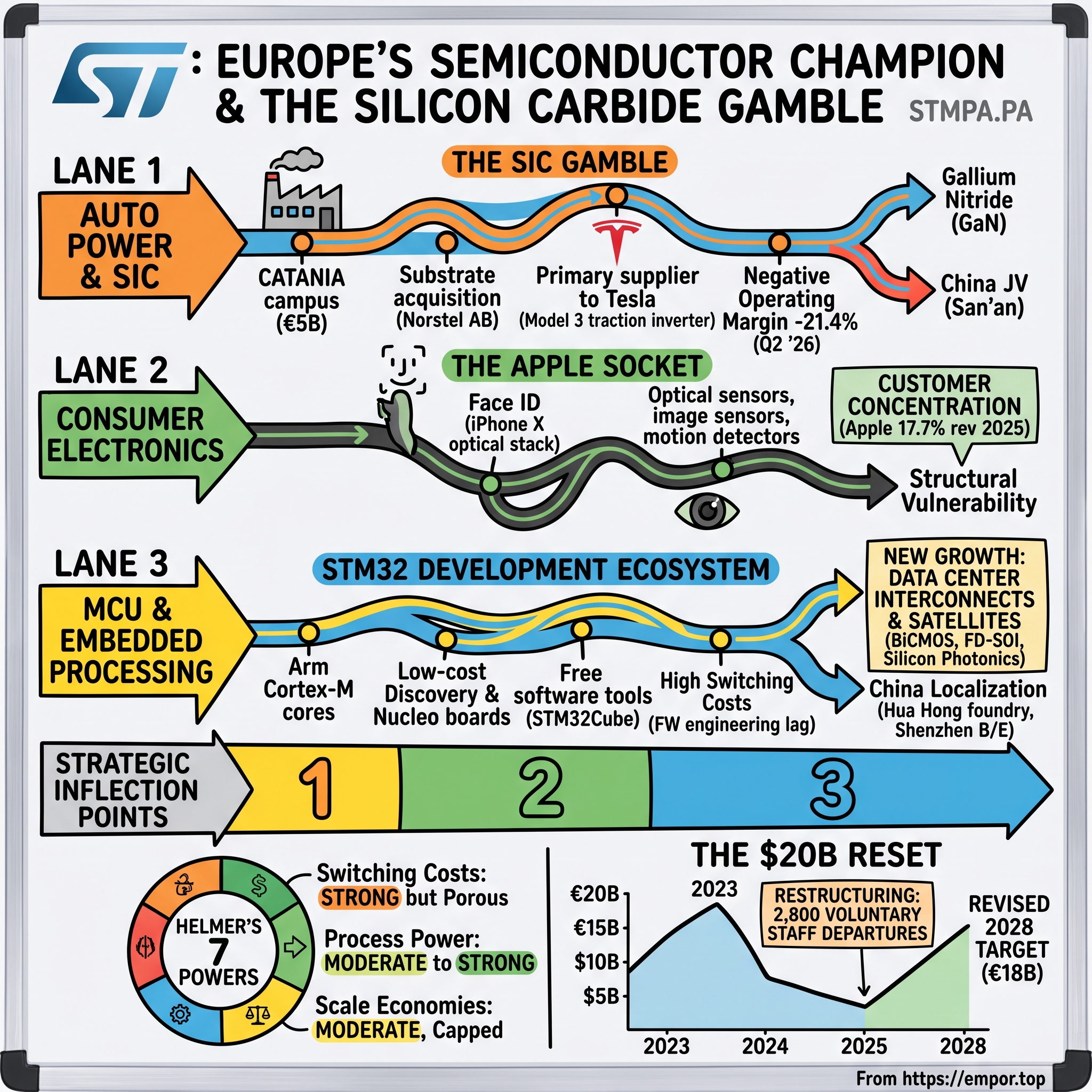
STMicroelectronics: Europe's Semiconductor Champion and the Silicon Carbide Gamble
I. Introduction & Episode Roadmap
On Thursday morning, July 23, 2026, STMicroelectronics reported quarterly results that contrasted sharply with its performance eighteen months earlier. Revenue rose 26% year over year to $3.49 billion, powered by bookings that pushed the book-to-bill ratio close to 2—meaning the chipmaker received nearly two dollars in new orders for every dollar shipped.[^1]1 Distributor inventory dropped below the company's internal target, unwinding the severe overhang that had weighed on sales for the prior two years. Free cash flow turned positive, while the unit supplying microcontrollers and radio-frequency chips to AI data centers and low-Earth-orbit satellites posted 30% to 35% revenue growth alongside operating margins exceeding 19%.
Yet the stock dropped about 16% following the announcement.2
That single trading session captures the central contradiction surrounding STMicroelectronics. While operational recovery was evident, third-quarter revenue guidance of $3.70 billion fell short of the consensus forecast of roughly $3.80 billion. For investors who had driven the stock up nearly threefold from its 2025 lows on enthusiasm for AI data centers, the outlook disappointed. Furthermore, financial statements revealed a sharp divergence within its product portfolio: the Power & Discrete segment, home to the silicon carbide business long touted as ST's primary growth driver, recorded an operating margin of negative 21.4%.[^1]
The business unit intended to propel ST toward its $20 billion revenue ambition is instead posting quarterly losses. Conversely, the driver currently stabilizing performance—optical connectivity silicon for hyperscaler data centers—was barely highlighted in strategic planning three years prior.
That strategic inversion frames the company's current position.
Company profile. STMicroelectronics N.V. trades under the ticker STMPA.PA on Euronext Paris, and as STM on both Borsa Italiana and the New York Stock Exchange. Incorporated under Dutch law and operationally headquartered in Plan-les-Ouates near Geneva, the company operates manufacturing facilities in Crolles (France), Agrate and Catania (Italy), Singapore, Morocco, Malaysia, the Philippines, and China. As an Integrated Device Manufacturer (IDM), ST designs its chips and owns the fabrication facilities that manufacture them—a capital-intensive model most semiconductor peers abandoned over the past two decades. In full-year 2025, revenue declined 11.1% to $11.80 billion, while net income fell to $166 million.[^4] Two years earlier, in 2023, the company generated $4.21 billion in net income on $17.29 billion in revenue.3 The vast majority of its profit pool evaporated during the industry downturn before reconstituting around an entirely different set of end markets.
Four central themes define this trajectory.
First, the IDM paradox in Europe. Owning fabrication plants grants ST control over specialized manufacturing processes—such as silicon carbide, silicon photonics, and fully-depleted silicon-on-insulator—that fabless chip designers cannot easily purchase from commercial foundries. However, when end-market demand drops, fixed factory overhead remains constant, compressing margins far more severely than fabless competitors experience.
Second, customer and socket concentration. Apple accounted for 17.7% of ST's 2025 revenue.4 Similarly, early adoption by Tesla established ST's silicon carbide business. Neither relationship provides an immutable moat; both rely on periodic contract renewals with major customers that maintain strong incentives to cultivate alternative suppliers.
Third, the dual-state governance trap. The French and Italian governments jointly hold 27.5% of ST through a holding vehicle named STHolding.5 In April 2025, this ownership structure triggered severe friction when an Italian cabinet minister publicly accused ST's managing board of insider trading and stated that Rome did not support the company's French chief executive officer.6 Governance risk remains a persistent structural factor.
A related structural dynamic influences how the equity trades. ST is listed on three exchanges across two currency zones, presents financial reports in U.S. dollars, bills most sales in dollars, but incurs a substantial share of operating expenses in euros—reflecting its primary front-end manufacturing plants and engineering centers in France and Italy. Foreign exchange is consequently a direct operational swing factor for gross margins rather than a cosmetic accounting adjustment, alongside fab utilization and product mix. A stronger euro against the U.S. dollar compresses operating margins regardless of underlying manufacturing performance.
Fourth, the bullwhip effect and the operational reset. After riding post-pandemic semiconductor shortages to record profitability and establishing a $20 billion revenue target, ST faced a sharp contraction in automotive and industrial demand. Management subsequently delayed the target timeline by three years and initiated a restructuring plan calling for up to 2,800 voluntary staff departures.[^9] A key question for investors is whether the 2026 operational rebound validates management's strategy or primarily reflects broader cyclical recovery alongside unexpected demand from artificial intelligence infrastructure.
The analysis begins where ST's history originates: with two unprofitable state-owned entities and an engineer who sought to unify them into a viable enterprise.
 Subscribe on LinkedIn
II. Origins, European Chip Sovereignty, & Early Battles (1987–2013)
In 1980, Pasquale Pistorio left his position heading Motorola's international semiconductor division to return to Italy and assume control of SGS Microelettronica, a state-owned chipmaker that was, by any commercial measure, dying.7 Industry peers viewed the move as an extraordinary personal risk. In retrospect, it served as the foundational moment for the modern European semiconductor industry.
Understanding why the decision appeared reckless requires recalling European electronics in the mid-1980s. American firms dominated the microprocessor market, while Japanese manufacturers had captured dynamic random-access memory (DRAM) through manufacturing efficiency and seemed poised to expand into adjacent categories. Europe relied on subscale national champions—one per country, each protected, unprofitable, and lacking the production volume to justify a modern fabrication facility. Policymakers in Brussels and national capitals feared the continent would lose a strategic industry, while observers in Silicon Valley believed the loss had already occurred.
In 1987, the French and Italian governments brokered a merger between their respective state-backed chipmakers, combining SGS with Thomson Semiconducteurs, the semiconductor arm of France's Thomson-CSF. Pistorio was appointed to lead the unified enterprise. Initial industry reaction was skeptical. The merged group posted combined losses of more than $200 million on roughly $850 million of revenue and operated some twenty-two manufacturing plants, most of them obsolete.8 Analysts doubted that a state-engineered Franco-Italian entity could compete against established giants like Texas Instruments, Motorola, or the expanding Japanese memory producers.
Pistorio's response was pragmatic. He closed seven obsolete plants, built a modern fabrication facility in Grenoble, France, and systematically avoided markets where raw scale dictated success. Memory chips—DRAM and NAND flash—represented a capital-intensive treadmill where high-volume producers set prices and competitors suffered recurring losses. Instead, he directed the company toward analog chips, power devices, and application-specific integrated circuits: specialized components defined by close engineering collaboration with customers rather than sheer wafer volume. Longer design cycles and sticky customer relationships allowed a mid-sized European manufacturer to build a sustainable business.
That strategic positioning formed the structural foundation for the modern enterprise. By the time Pistorio retired in 2005, the company was profitable, operating globally, and positioned in core markets—automotive, industrial, and sensors—that would expand over the subsequent two decades.7
Two enduring organizational traits originated during Pistorio's tenure. The first was an engineering-focused leadership pipeline: ST's senior executives were overwhelmingly drawn from process development and factory management rather than finance or sales. For instance, the chief executive officer who managed the company through the mid-2020s joined in 1986 and led technology and manufacturing operations prior to assuming the top role. That background produced an executive suite deeply grounded in manufacturing mechanics and cautious about strategic commitments that lacked clear process implementation paths.
The second inheritance was its governance structure: STHolding, the joint vehicle through which the French and Italian governments retained influence, hovering above a cross-border corporate architecture. The arrangement provided long-term capital stability but also introduced political friction during periods of operational restructuring—a recurring dynamic throughout the company's history.
Then came two major portfolio decisions, executed within a year of each other, that produced starkly divergent outcomes.
The first involved memory. ST had spent decades competing in NOR and NAND flash memory—capital-intensive, price-sensitive markets dominated by high-volume producers. On March 31, 2008, ST completed a deal with Intel and the private equity firm Francisco Partners, contributing its NOR and NAND flash operations, along with its phase-change memory research, into a joint venture named Numonyx. In exchange, ST received a 48.6% equity stake and $155.6 million in subordinated notes.23 On February 9, 2010, less than two years later, the partners agreed to sell Numonyx to Micron Technology in an all-stock transaction. ST's share of the net consideration was valued at approximately $527 million, yielding a net gain of about $280 million.24
The transaction demonstrated effective portfolio management: ST identified a business where it lacked scale, removed the associated operating losses from its financial statements, and converted the holding into cash and a realized gain within two years. It stood as a disciplined capital-allocation decision, though its success was soon overshadowed by a subsequent venture.
In February 2009, ST partnered with Ericsson to establish ST-Ericsson, a 50/50 joint venture aimed at designing and manufacturing mobile chipsets.9 The strategic rationale appeared compelling. Nokia was then the world's largest mobile phone manufacturer and a key customer, Ericsson provided wireless modem technology, and ST contributed manufacturing infrastructure and application processors. The combined entity was intended to match Qualcomm's scale across third-generation (3G) networks and the emerging fourth-generation (4G) transition.
The venture's underlying market assumptions quickly unravelled. The rapid adoption of Apple's iPhone and Google's Android operating systems transformed the mobile phone industry, undermining the feature-phone architecture around which the venture was built. Nokia's market share eroded rapidly, weakening the joint venture's primary customer base. Meanwhile, fabless competitors like Qualcomm iterated technology faster and maintained lower cost structures unencumbered by factory depreciation. Burdened by an integrated device manufacturer cost base in a market driven by rapid design cycles and sheer scale, ST-Ericsson accumulated approximately $2.7 billion in net losses over four years.10
On March 18, 2013, ST and Ericsson announced the termination of the joint venture. Approximately 1,600 positions were eliminated, and the venture was formally dissolved on August 2, 2013, with Ericsson acquiring the thin-modem assets while ST absorbed the remaining operations.1011
The contrasting outcomes of Numonyx and ST-Ericsson highlighted a key strategic lesson. In memory, ST recognized its structural disadvantage early and exited profitably. In mobile chipsets, the company reacted slowly to similar structural headwinds, resulting in four years of operating losses and extensive restructuring. The delay stemmed less from analytical oversight than from the perceived strategic importance of mobile devices, strong customer ties, and the commitment of a major industry partner, all of which prolonged management's willingness to fund the venture.
The experience reshaped ST's capital allocation philosophy. Management concluded that an integrated device manufacturer could not compete effectively in commodity platform markets where demand was concentrated among a few buyers with internal design capabilities and where competition hinged solely on transistor density. ST subsequently exited mobile application processors permanently, redirecting capital toward automotive power semiconductors, industrial embedded processing, and proprietary sensor and analog technologies—markets where proprietary manufacturing processes provided a competitive advantage rather than a fixed overhead burden.
This strategic pivot laid the groundwork for the modern enterprise, fostering key customer partnerships that shaped the subsequent decade and establishing a widely adopted microcontroller platform. However, evaluating why those investments yielded uneven results requires examining ST's business model—and how rapidly profitability contracts when factory utilization declines.
III. The Core Engines: Segment Economics, Materiality, & Fabs
A modern 300mm wafer fab operates with minimal human presence inside the cleanroom. Robotic overhead transport systems move wafer carriers between processing tools inside facilities that require billions of dollars in upfront capital before producing their first commercial chip. This capital intensity dictates the central economic reality of ST's business model: fixed facility overhead represents the vast majority of manufacturing costs, while incremental wafer production costs remain relatively low.
How ST is organised. Following a 2024 organizational restructuring, ST reports financial results across two product groups comprising four operating segments. The Analog, Power & Discrete, MEMS and Sensors (APMS) group consists of Analog Products, MEMS and Sensors (AM&S) and Power & Discrete (P&D). The Microcontrollers, Digital ICs and RF Products (MDRF) group comprises Embedded Processing (EMP) and RF & Optical Communications (RF&OC).
Second-quarter 2026 results illustrate a pronounced divergence in profitability across these units. AM&S generated $1.43 billion in revenue with a 10.1% operating margin. P&D generated $464 million while posting an operating margin of negative 21.4%. Embedded Processing produced $1.15 billion at a 19.7% margin, while RF & Optical Communications generated $445 million at a 21.2% margin.[^1] The underlying dynamic is straightforward: the microcontroller and communications businesses—accounting for roughly 45% of total revenue—generated virtually all of ST's operating profit, offsetting sustained losses in power semiconductors.
The weakness in Power & Discrete reflects an extended trend rather than a single quarterly outlier. In the fourth quarter of 2025, the segment recorded an operating margin of negative 30.2%.12 Silicon carbide, long positioned by executive leadership as ST's primary long-term growth driver, has operated as a loss-making division for eight consecutive quarters.
Where the revenue comes from. In full-year 2025, automotive applications represented approximately 39% of total revenue, personal electronics 25%, industrial markets 21%, and communications equipment and computer peripherals 15%. By customer location, the Americas generated 43% of sales, Asia-Pacific 31%, and Europe, the Middle East, and Africa (EMEA) 26%. By distribution channel, ST sold 72% of its output directly to original equipment manufacturers (OEMs) and 28% through third-party distributors.12 The distribution split is analytically crucial: distributors order heavily during supply constraints and halt orders when inventories accumulate, amplifying cyclical swings through the bullwhip effect.
R&D spending underlines management's capital allocation priorities during cyclical contractions. ST invested $2.05 billion in research and development in 2025—roughly 17% of total revenue—representing a minor adjustment from $2.08 billion in 2024 despite a 12% drop in total sales.4 Maintaining R&D funding through a severe industry downturn compressed operating margins in the short term, but preserved technical development across embedded processing and optical connectivity—yielding product availability that supported the 2026 revenue recovery.
The manufacturing footprint. Crolles, located in the French Alps, represents ST's primary advanced manufacturing site. The 300mm facility runs fully-depleted silicon-on-insulator (FD-SOI) processes alongside BiCMOS and silicon photonics technologies that support data-center components. On the July 2026 earnings call, executive management stated that Crolles would reach and exceed 15,000 wafers per week, identifying the site as "the key success factor" for AI data-center expansion.1 Agrate, near Milan, serves as the 300mm front-end counterpart for analog and smart-power devices. Catania, in Sicily, houses ST's silicon carbide initiative—a €5 billion integrated campus, supported by €2 billion in Italian government funding under the EU Chips Act, designed to combine substrate synthesis and device fabrication on one site. Initial output begins in 2026, though reaching the full planned capacity of 15,000 wafers per week is scheduled for 2033.13
Back-end assembly and testing—where completed wafers are diced, packaged, and electrically verified—is distributed across facilities in Morocco, Malaysia, the Philippines, Singapore, and Shenzhen. This back-end network creates operational bottlenecks during demand surges. During the AI data-center expansion, ST faced capacity constraints in packaging and testing rather than front-end wafer fabrication. Asked on the July 2026 call why ST raised its data-center growth targets, Chief Executive Officer Jean-Marc Chery cited expanding customer demand alongside "our capability to grow in the various assembly and test manufacturing."1 Although back-end capacity requires less capital and time to construct than a front-end fab, reliance on internal sites and external assembly partners creates periodic operational friction, which management described as a recurring "pocket of capacity limitation."1
Fully-depleted silicon-on-insulator (FD-SOI) technology provides the technical foundation for several of ST's highest-margin product categories. Unlike conventional planar transistors built directly on bulk silicon substrates where electrical current leaks through the underlying material, FD-SOI places an ultra-thin silicon layer over a buried insulating oxide layer. Placing the transistor channel over an insulator dramatically reduces current leakage, allowing the chip to operate at very low power levels or undergo dynamic body-biasing for higher processing speed. While FD-SOI does not offer a pathway to the ultra-dense transistor geometries pursued by TSMC using extreme-ultraviolet lithography, it provides a cost-effective architecture for low-power, radio-frequency, and mixed-signal applications. That combination fits the operational requirements of satellite communications and optical transceivers for data centers, transforming an alternative technology choice made fifteen years prior into an engine for two of ST's fastest-growing product lines.
Fab utilization and operating leverage. Because semiconductor fabrication facilities represent substantial fixed capital investments, ST's gross margin fluctuates directly with factory utilization rates. High utilization spreads fixed facility depreciation across a larger volume of wafers, generating high incremental gross margins. Conversely, when factory output drops, accounting standards require the company to expense idle facility overhead directly on the income statement under the line item "unused capacity charges."
The financial impact of this operational structure is substantial. ST's gross margin declined from 39.3% in 2024 to 33.9% in 2025—a 540 basis point compression caused by reduced factory efficiency, unfavorable product pricing and mix, and elevated unused capacity charges.[^4] By the first quarter of 2026, unused capacity charges reduced gross margin by approximately 220 basis points. Third-quarter 2026 guidance implies that unused capacity charges will decline to roughly 70 basis points.112 This 150 basis point reduction represents a 1.5 percentage point improvement in gross margin, yielding more than $50 million in quarterly operating profit on a $3.70 billion revenue base simply through higher facility utilization.
The economic structure of a semiconductor fab resembles an airline route network. Fixed operating costs remain largely constant regardless of passenger count, meaning seat load factor—or factory utilization—determines profitability. Because multi-billion-dollar fabs cannot be easily idled, running facilities at reduced capacity severely impairs gross margins, as ST experienced during eight quarters of inventory destocking throughout 2024 and 2025.
However, operating leverage functions symmetrically. The same fixed-cost mechanics that compressed gross margin by 540 basis points during the cyclical trough generate automatic margin expansion as wafer volumes recover. A key task for financial analysis over upcoming quarters is separating cyclical volume recovery from structural operational improvements.
This operational dynamic explains why direct comparisons between ST and Texas Instruments require qualification. Texas Instruments operates large-scale 300mm analog facilities with intentional excess capacity, maintaining gross margins above 60% across industry cycles. ST operates with a lower structural gross margin ceiling and wider cyclical volatility. Long-term financial targets outlined by management envision gross margins of approximately 45% at $18 billion in annual revenue and 50% at $20 billion. On the July 2026 earnings call, Chief Financial Officer Lorenzo Grandi emphasized that revenue expansion alone would not achieve those targets. Structural margin improvement requires completing a broader manufacturing reorganization—transitioning silicon devices from 200mm to 300mm wafers, upgrading silicon carbide production from 150mm to 200mm, and closing two legacy fabs—a process Grandi stated will not be completed before the end of 2027.1
Consequently, ST's margin recovery depends on two distinct mechanisms: a cyclical rebound driven by factory loading, and a structural restructuring that requires another eighteen months of execution. Evaluating ST's path back to peak profitability requires assessing both a multi-year manufacturing migration across politically sensitive European regions and the permanence of end-market demand when that replacement capacity matures.
This operational reality sets up the three strategic bets that defined the company's modern portfolio—and their starkly divergent outcomes.
IV. The Strategic Inflection Points: Tesla, Apple, & STM32
Inflection Point 1: The silicon carbide gamble
Around 2017, Tesla transitioned the traction inverter in the Model 3 from conventional silicon insulated-gate bipolar transistors (IGBTs) to silicon carbide MOSFETs—a decision that reshaped power electronics in automotive manufacturing. The traction inverter converts direct current from the battery into alternating current to drive the electric motor.
The physics of wide-bandgap materials underpins this commercial transition. Silicon carbide operates at significantly higher voltages and temperatures than standard silicon while reducing energy lost as heat during switching. In an electric vehicle, lower switching losses yield a few percentage points in drivetrain efficiency, translating directly into extended driving range or allowing automakers to reduce battery pack size. Because the battery remains the single most expensive component in an electric vehicle, efficiency gains offset the higher unit cost of silicon carbide semiconductors.
ST co-developed the power modules and became the primary supplier for the Model 3 program, securing a pivotal design win for the European semiconductor industry. To secure substrate supply and crystal-growth technology, ST acquired Swedish silicon carbide wafer specialist Norstel AB—a 2005 spinoff from Linköping University—purchasing a 55% stake in February 2019 and the remaining 45% on December 2, 2019, for a total consideration of $137.5 million.[^17][^18] Relative to the €5 billion ST subsequently committed to its Catania silicon carbide campus, the Norstel acquisition represented a modest initial investment to secure underlying substrate capability.
However, market conditions shifted rapidly.
Electric vehicle adoption in Europe and North America decelerated, while Chinese automakers—who account for the majority of global battery-electric vehicle production—established domestic silicon carbide supply chains faster than Western incumbents anticipated. Average selling prices fell across the industry. Wolfspeed, the American pure-play manufacturer and primary merchant substrate supplier, filed for bankruptcy protection in 2025—underscoring the risks of debt-financed capacity expansion during a demand slowdown.14 Reflecting these headwinds, ST's silicon carbide revenue contracted significantly in 2025.12
Myth versus reality. The common market perception of ST as primarily a "Tesla silicon carbide play" misrepresents its operational reality in three key respects. First, the silicon carbide division has operated as a drag on group profitability for eighteen months rather than a growth driver. Second, rather than directly contesting market share against Chinese competitors like San'an Optoelectronics 三安光电, ST chose to form a joint venture to operate a local facility, which Chief Executive Officer Jean-Marc Chery described in January 2026 as "a key success factor in our capability to compete on the Chinese market."12 Third, while a revenue recovery began in mid-2026, its slope remains gradual: on the July 2026 earnings call, APMS President Marco Cassis reported that silicon carbide revenue grew in the low teens year over year in the second quarter, with a book-to-bill ratio comfortably above 1, and guided to double-digit growth for full-year 2026—though noting that segment revenue will not return to 2024 levels until 2027.112
Ultimately, silicon carbide represents a defensible, vertically integrated technology franchise where capital commitments were made based on aggressive growth projections at the peak of the electric vehicle adoption cycle. As a result, capital deployment at the €5 billion Catania campus outpaced near-term market demand.
Inflection Point 2: The Apple socket
In 2017, Apple introduced Face ID on the iPhone X, introducing an optical sensing stack that utilized a vertical-cavity surface-emitting laser alongside a time-of-flight sensor to calculate depth. ST secured key socket wins within that module and subsequently expanded its footprint across Apple's product ecosystem to include imaging sensors, motion detectors, secure elements, and analog power management ICs.
While the financial return on high-volume consumer electronics is substantial, customer concentration introduces structural vulnerability. Apple represented 17.7% of ST's 2025 revenues, and ST's annual report explicitly notes that "losing key customers or key sockets, or seeing strategy shifts at such customers, could adversely affect future results."4 Apple maintains rigorous annual contract negotiations, regularly pursues internal silicon development, and seeks alternative component suppliers whenever feasible.
However, recent financial results illustrate that customer concentration can also provide counter-cyclical stability. During the automotive downturn in late 2025, personal electronics revenue grew—rising approximately 17% year over year in the fourth quarter of 2025 while automotive revenue fell about 15%.12 High-volume shipments to Apple stabilized group cash flow during the automotive contraction. Conversely, in the second half of 2026, management guided personal electronics revenue to a mid-single-digit year-over-year decline, citing smartphone production constraints driven by rising memory component prices.1 Socket concentration thus functions as a source of revenue volatility rather than a one-sided risk.
Inflection Point 3: STM32 and the compounding power of free tools
The third strategic initiative required minimal upfront capital but generated widespread architectural adoption.
Beginning in the late 2000s, ST launched its STM32 family of 32-bit microcontrollers based on Arm Cortex-M processor cores, accompanied by an open software distribution strategy. Low-cost Discovery and Nucleo development boards were broadly distributed to universities, engineering labs, and commercial design teams. The company made its STM32Cube software development environment—including configuration tools, hardware abstraction layers, and middleware—available at no cost, while publishing application notes without non-disclosure restrictions.
This developer-centric strategy established switching costs at the engineering level. When an industrial designer builds a control system around STM32 peripherals, register maps, and pin configurations, substituting a competitor's microcontroller requires rewriting firmware, re-validating timing characteristics, re-certifying safety compliance, and retraining engineering teams. For mid-volume industrial machinery, software requalification represents a substantial engineering expense with no visible enhancement to product performance, discouraging routine supplier changes.
However, competitive advantages rooted in developer familiarity differ structurally from those based on proprietary manufacturing processes. Chinese semiconductor designers, led by GigaDevice 兆易创新, introduced GD32 microcontrollers engineered to be pin-compatible with widely used STM32 devices. These alternatives operate using ST's software abstraction libraries with minimal modification while offering lower unit prices.15 Pin-compatible designs directly challenge the hardware switching costs ST cultivated over two decades.
This competitive pressure impacted market share. On the January 2026 earnings call, Jean-Marc Chery stated that ST was "on track to return to our historical market share of about 23% by 2027" in general-purpose microcontrollers, reflecting prior market share erosion.12 In response, ST advanced its manufacturing roadmap—announcing an 18nm STM32 architecture at its November 2025 STM32 Summit—and addressed Chinese localization mandates directly. On March 23, 2026, ST began volume shipments of STM32 microcontrollers manufactured entirely within China by foundry partner Hua Hong 华虹 using a 40nm embedded non-volatile memory process, with back-end packaging and testing handled at ST's Shenzhen facility and local partners.12[^21] This marked the first instance of a global semiconductor manufacturer running identical microcontroller designs and manufacturing processes concurrently inside and outside China.
By mid-2026, the microcontroller business had emerged as ST's primary earnings generator, with management noting that general-purpose microcontroller supply had become tight due to accelerating demand.1
The broad distribution of the STM32 ecosystem also created an unexpected advantage in data-center infrastructure. Optical transceivers handling 800-gigabit data rates frequently rely on high-performance general-purpose STM32 microcontrollers rather than custom-designed application-specific ICs. When hyperscale optics manufacturers required control processors featuring specific peripheral interfaces, real-time performance, and mature software support, ST possessed an established product line supported by a developer base familiar with its toolchain. Long-term seeding of developer tools generated design wins in artificial intelligence hardware markets that did not exist when the architecture was first introduced.
These three strategic initiatives yielded divergent outcomes across automotive power electronics, consumer devices, and embedded processing. Evaluating whether any of these positions provides a lasting competitive advantage requires examining ST's competitive landscape.
V. Industry Structure, Competition, & Helmer's 7 Powers
Viewing the competitive landscape as a set of overlapping siege lines rather than a single battlefield highlights ST's strategic position. The company is not contesting a single market; it is competing across four distinct fronts, against four separate sets of rivals, with varying odds of success.
In automotive power, the primary competitor is Infineon Technologies—a larger German firm holding the leading global position in automotive power semiconductors, supported by an aggressive 200mm silicon carbide program. Alongside Infineon sits onsemi, which established a vertically integrated silicon carbide position and secured major platform commitments from Korean and European original equipment manufacturers. Silicon carbide remains a concentrated market: Infineon, ST, Wolfspeed, onsemi, and ROHM together accounted for more than 90% of global revenue as of 2024.16 While high market concentration typically fosters pricing discipline, price competition intensified because all five producers expanded manufacturing capacity based on aggressive demand projections that failed to materialize. When five capital-intensive manufacturers with high fixed costs chase a market expanding slower than total capacity, pricing becomes the primary mechanism to maintain factory loading.
In automotive microcontrollers and digital, the main competitors are NXP Semiconductors—dominant in radar, body networking, and infotainment—and Renesas Electronics, effectively the house supplier to Japanese automotive manufacturers. In this segment, executive leadership has acknowledged lagging behind rivals. Chief Executive Officer Jean-Marc Chery acknowledged in January 2026 that ST's automotive microcontrollers were "optically offsetting the real good health" of general-purpose microcontroller growth, noting that the product roadmap had been substantially reworked during 2025 and that financial returns would not arrive until late 2027 and 2028.12 That represents a multi-year execution lag in an industry transitioning toward software-defined vehicle architectures—making automotive microcontrollers the clearest self-identified weakness in ST's portfolio.
In general-purpose analog and industrial, the primary opponent is Texas Instruments, where competition is structural rather than tactical. Texas Instruments' manufacturing scale in 300mm analog production sets a cost floor that ST cannot match on commodity components. ST's response—evident across recent earnings calls—is to focus on application-specific analog chips, proprietary BCD (Bipolar-CMOS-DMOS) smart-power processes, and integrated sensing rather than high-volume catalog parts. Microchip Technology pursues a similar specialized strategy in industrial microcontrollers.
In the emerging artificial intelligence data center and satellite markets, the competitive structure remains unsettled, creating a significant growth opportunity. ST's position rests on three simultaneous strengths in optical connectivity: a substantial share of the microcontrollers that manage the control plane inside 800-gigabit and 1.6-terabit pluggable transceivers; an expanding share of the electronic integrated circuits built on its BiCMOS process; and a silicon photonics platform in Crolles that is ramping rapidly.1 Few semiconductor manufacturers can supply all three technology elements from a single 300mm manufacturing facility.
A closer look at optical transceivers clarifies why this market represents a major growth vector. As artificial intelligence computing clusters expand to tens of thousands of accelerators, traditional copper interconnects reach physical limitations in distance and bandwidth. Data center operators replace copper with pluggable optical modules—compact units that convert electrical signals into laser light, transmit data over optical fiber, and convert the signals back. Each module requires three core components: a photonic integrated circuit to route light signals, driver and receiver chips to handle analog processing, and a microcontroller to govern calibration, thermal regulation, and diagnostic functions. ST manufactures all three components. Because each accelerator in a computing cluster requires multiple optical links, demand for optical modules scales super-linearly with cluster size. That structural tailwind drove a roughly 50% year-over-year revenue increase in ST's Communication Equipment & Computer Peripherals segment in the second quarter of 2026, with management projecting year-over-year growth to reach approximately 90% by the fourth quarter.1
The principal competitive risk in optical connectivity stems not from European peers, but from potential industry shifts: hyperscale cloud providers and module makers consolidating vendor relationships, architectural transitions toward co-packaged optics, or heavily capitalized entrants expanding into merchant silicon photonics. In a rapidly evolving market, long-term competitive moats remain unproven.
Helmer's 7 Powers, applied honestly
Switching Costs—strong, but narrower than advertised. Switching costs are substantial in industrial microcontrollers due to firmware and software toolchain integration, and in automotive applications where customer qualification cycles span three to five years. However, switching barriers prove weaker where pin-compatible alternative chips are available, as demonstrated by Chinese microcontroller competitors.
Process Power—moderate to strong, and improving. Fully-depleted silicon-on-insulator (FD-SOI) and silicon photonics in Crolles, BCD smart-power in Agrate, and vertically integrated silicon carbide in Catania represent differentiated manufacturing capabilities. Commercial adoption provides the clearest evidence: ST is securing silicon photonics design wins with hyperscale cloud operators against larger chipmakers, while executive management noted that output on the platform is not currently capacity-constrained.1
Scale Economies—moderate, and structurally capped. ST ranks as a leading semiconductor manufacturer within Europe but holds a mid-tier position globally. The company cannot match Texas Instruments' manufacturing scale in analog or TSMC's scale in advanced digital logic. Its ongoing manufacturing reorganization reflects an implicit acknowledgment that its historic footprint was sub-scale across multiple wafer dimensions.
Cornered Resource—moderate. Norstel-derived crystal-growth technology and the fully integrated Catania manufacturing campus represent proprietary operational assets. However, an asset operating at a negative operating margin currently provides limited economic power.
Network Effects—weak to moderate. The STM32 developer ecosystem represents ST's closest approximation of a network effect, functioning primarily as a demand-side scale economy: an expanding user base encourages third-party library development and increases the pool of trained engineers, reducing adoption friction. While valuable, these ecosystem advantages can be partially exploited by imitators offering compatible hardware.
Counter-Positioning—weak. ST operates no business model that established competitors cannot emulate. Rather than disrupting incumbents through business-model innovation, ST carries fixed fabrication costs that its fabless competitors avoid.
Branding—weak. Brand reputation functions primarily as a quality and reliability signal in automotive safety applications and as a factor in European semiconductor supply-chain strategy. It does not provide significant pricing power.
Porter's Five Forces, briefly
Supplier power is high among semiconductor equipment manufacturers—such as ASML and Applied Materials—which dictate pricing and delivery schedules, but low among suppliers of raw wafer materials and industrial chemicals.
Buyer power is highly concentrated among major accounts like Apple and key electric vehicle platforms, but fragmented across tens of thousands of industrial customers served through distributor networks. This structural asymmetry explains why industrial sales historically yield higher operating margins.
Threat of new entrants remains low for manufacturing categories requiring capital-intensive fabrication facilities, though state-backed Chinese producers demonstrate that capital barriers diminish when investments are not evaluated strictly on commercial returns.
Threat of substitutes represents an active risk: gallium nitride technology is displacing silicon carbide in lower-voltage applications, while open-source RISC-V architectures pose a long-term alternative to Arm-based microcontroller families.
Competitive rivalry is intense and turns destructive during industry downturns. For integrated device manufacturers with high fixed overhead, reducing unit prices to preserve factory utilization represents a rational short-term decision—a dynamic that directly drove margin compression in silicon carbide.
In summary, ST maintains defensible positions across embedded processing, application-specific analog, sensor technologies, and optical connectivity, alongside a contested, capital-intensive position in power semiconductors. Translating those technical capabilities into sustained profitability depends on executive execution—a requirement brought into sharp focus by the operational volatility of recent years.
VI. The Great Bullwhip & The $20B Reset: Transcripts & Management Analysis
Jean-Marc Chery joined ST in 1986, a year before the merger that created it. He has been a fab manager, chief technology officer and chief operating officer, and became President and CEO in May 2018. He is a manufacturing person by formation, and it shows in how he talks: dense, specific, willing to name a fab and a wafer size and a nanometre node in answer to a strategic question. Alongside him sits Lorenzo Grandi, President and CFO, whose calls are exercises in careful qualification — the man who, when asked whether a bigger revenue jump means a bigger margin jump, will spend two minutes listing the headwinds first.
The story of their credibility runs through four moments.
Moment one: the peak, and the target. The chip shortage of 2021–2023 produced conditions that had never existed in ST's history. Customers double-ordered out of panic. Revenue rose to $17.29 billion in 2023 and the company earned $4.21 billion.3 Management set a public ambition of $20 billion-plus in revenue. In hindsight, a substantial portion of that 2023 revenue was not consumption — it was inventory accumulating on customers' shelves and in distributors' warehouses.
Moment two: the reset. By November 2024 the illusion had broken. At its Capital Markets Day on November 20, 2024, ST formally pushed the $20 billion-plus ambition out to 2030 and set an intermediate model of roughly $18 billion of revenue with a 22–24% operating margin in 2027–2028, to be delivered partly through a manufacturing reshaping and cost-resizing programme generating "high triple-digit million-dollar savings" against the then-current cost base by exit-2027.[^23]17
Moment three: the reshaping made real. On April 10, 2025, ST detailed the programme. Up to 2,800 employees would leave voluntarily over three years, on top of normal attrition, concentrated in 2026 and 2027; the footprint would consolidate onto 300mm silicon and 200mm silicon carbide, closing two fabs.[^9] Two things about the timing deserve attention. First, ST moved to structural cost action rather than waiting for a macro rebound — a genuinely creditable decision, and one several peers deferred. Second, the same week, ST's supervisory board was forced to publicly deny an allegation of insider trading levelled by Italy's Economy Minister, Giancarlo Giorgetti, concerning share sales by two managing board members ahead of negative results. ST said the sales were executed by its stock plan administrator "through an automatic procedure." Giorgetti also stated that the Italian government did not support Chery.6 Announcing European job cuts in that atmosphere is not a normal corporate restructuring.
Moment four: the trough, and the surprise. Full-year 2025 was the bottom. Revenue fell 11.1% to $11.80 billion. Automotive fell hard. Gross margin dropped to 33.9%. Operating income was $175 million — an operating margin of 1.5% on a business that had earned 26.7% two years earlier — after $376 million of impairment, restructuring and phase-out charges. Net income was $166 million. The fourth quarter produced an outright net loss of $30 million, including $163 million of one-time non-cash tax expense. Net capex was cut to $1.79 billion from $2.53 billion, and free cash flow still came in positive at $265 million.[^4]12 That last fact matters more than it reads: ST absorbed a 32% peak-to-trough revenue decline and never stopped generating cash, never cut the dividend, and continued buying back stock.
Then came the part nobody modelled.
On the January 29, 2026 call, Chery listed the company's growth drivers for the year and, on data centers, said: "with the current market dynamic, we believe we can deliver $1 billion revenue before 2030 with already USD 500 million in 2026."12
On the July 23, 2026 call — less than six months later — the same business was guided to "above $1 billion in 2026" and "well above $2 billion in 2027."1 The 2026 number doubled. The target that was supposed to take four years was being cleared in one.
How should an investor read that? Two ways, and both are correct.
Positively: ST has genuine content in the fastest-growing hardware market on earth, and the demand is verified by orders rather than by ambition. Chery was asked directly whether the raise was demand-driven or supply-driven and answered "It's both," noting that 2026 backlog coverage was 100% and that more than half of all bookings taken in the second quarter were for delivery in 2027.1 Total backlog reached roughly 4.5 to 5 quarters of the quarter's average revenue. Those are order-book facts, not forecasts.
Sceptically: a company that misjudges the size of its single fastest-growing business by 2x in six months does not have good visibility. The same forecasting apparatus produced the $20 billion target in 2023 and missed the industrial correction in 2024. A doubling in the right direction is more pleasant than a halving, but it is the same underlying imprecision.
The analyst pressure tells its own story. Read the two calls back to back and the tenor of the Q&A inverts completely. In January 2026, the questions were defensive and forensic: is the inventory correction actually over, why is embedded processing growing only 1–2% when peers are doing better, are unloading charges at the bottom, will gross margin recover from 33.7%. Chery answered the microcontroller question with unusual candour, separating the general-purpose business — which he said would grow above 30% year over year in the following quarter — from the automotive microcontrollers that were dragging the segment down, and conceding that the automotive roadmap rework would not pay back until 2028.12
By July 2026, the questions had flipped to capacity and upside: can you supply the demand, is data center accretive to margin, why can't you pull revenue forward into the third quarter, will first-quarter seasonality be better than normal. Chery's answer to that last one — that ST's total backlog had reached roughly 4.5 to 5 quarters of average revenue, and that customers had "understood that they have to provide us visibility" — is the kind of remark that reveals how bad the visibility had been. During the correction, customers ordered inside lead times and cancelled freely. The return of long-dated ordering is a genuine change in operating conditions, not a management talking point.
Management's narrative consistency is, on the whole, better than its forecast accuracy. Grandi has been unusually disciplined about not letting good news get ahead of the factory. Asked in July whether the $4 billion-plus fourth quarter would deliver the 40%-plus gross margin implied by ST's own model, he refused the framing: the model requires the reshaping to be complete, the 200mm-to-300mm and 150mm-to-200mm transfers are mid-flight, mask redesigns and requalification costs are running through cost of sales, and "we are not yet there."1 He also flagged that unused capacity charges would not improve much in the fourth quarter because of fab start-up costs in China. That is a CFO managing expectations downward while the top line surprises upward — the opposite of the pattern that destroys credibility.
Chery, for his part, confirmed the $18 billion 2028 target on the July call but visibly declined to re-litigate $20 billion: "let's reach together the $18 billion target, then we speak about the $20 billion."1 After the 2024 experience, that reticence reads as learned discipline.
A note on the incentive structure. ST's executive variable compensation is tied to operating income, free cash flow and return on invested capital measured against semiconductor peers. In a business this cyclical, peer-relative metrics are the right design — they punish underperformance without rewarding a management team simply for standing in front of an up-cycle. What the last three years tested was whether that structure would produce the right behaviour at the bottom. The evidence is mixed but leans positive: R&D was protected, the dividend was maintained, buybacks continued, capex was cut hard in the trough and is now being raised into visible demand, and the restructuring was launched before the market forced it. What the structure did not prevent was the original over-extrapolation that produced the $20 billion target.
The unresolved question is not whether ST can grow. It is whether a company whose growth has migrated to markets it did not plan for can execute a factory reorganisation designed for the markets it did plan for. And whether its two government shareholders will let it.
VII. Skeptical Investor Stress Test & Current Risk Radar
An activist short thesis on STMicroelectronics would not begin with the quarterly financial reports. It would begin with the shareholder register.
The dual-state problem at full strength. France and Italy jointly hold 27.5% of ST through STHolding, backed by a supervisory board structured to maintain national parity.5 Proponents argue that patient state capital enables long-term planning. The operational reality in 2025 presented a starker dynamic: an Italian cabinet minister accusing the managing board of insider trading during a press conference; the Italian government publicly withholding support from the French chief executive officer; Rome alleging that corporate governance leaned toward Paris; Industry Minister Adolfo Urso declaring planned job cuts at the Agrate facility "unacceptable" while demanding expanded capital deployment; and Lombardy labor unions warning that an entire unit at a 2,500-employee site faced liquidation.618 ST ultimately confirmed that involuntary redundancies at Agrate were ruled out in favor of a negotiated voluntary-departure framework.18
The operational implications are direct. ST's chief financial officer identified the manufacturing reorganization as the primary prerequisite for margin recovery—a plan requiring fab closures in sovereign nations that hold a combined quarter of the company's equity and retain political influence over local employment. In May 2026, the supervisory board named Armando Varricchio as Chairman and Bpifrance's Nicolas Dufourcq as Vice-Chairman for three-year terms, a structural realignment that resolved immediate governance friction without removing its underlying causes.[^26]
The market discounts this governance model accordingly. ST cannot execute rapid operational restructurings at the speed of unencumbered peers like Texas Instruments or onsemi. This lag reflects a structural constraint on capital reallocation rather than an executive failing, and it remains an active factor in equity valuation.
The capital intensity burden. ST plans net capital expenditures at the upper end of a $2.0 billion to $2.2 billion range for 2026, following capital outlays of $2.53 billion in 2024 and $1.79 billion in 2025.1[^4] Measured against 2025 revenue of $11.80 billion, this represents a capital footprint that fabless competitors avoid entirely. During cyclical contractions, these fixed burdens compress free cash flow to nominal levels. Conversely, this capital commitments strategy preserves proprietary manufacturing assets—such as the Crolles silicon photonics platform—that fabless designers cannot source from commercial foundries. The central financial question is whether the option value of operating custom process technologies compensates for the elevated cost of maintaining them through industry downturns.
The Crolles joint venture. In July 2022, ST and GlobalFoundries announced plans for a jointly operated 300mm manufacturing facility at Crolles, later estimated at €7.5 billion, with the European Commission approving €2.9 billion in French state aid in April 2023.1920 By late 2025, industry reports indicated that construction on the joint project was paused due to weakening automotive demand.21 The pause underscores two realities: state-subsidized project announcements do not guarantee operational capacity, and European industrial policy operates on timelines detached from the semiconductor cycle.
The current risk radar
Chinese market substitution. In general-purpose microcontrollers, domestic Chinese designers using pin-compatible architectures captured market share that ST is now working to reclaim. In silicon carbide, Chinese electric vehicle manufacturers led by BYD 比亚迪, alongside an expanding domestic substrate supply chain, pushed down unit prices in the world's largest automotive market. ST responded by establishing local microcontroller production in China with Hua Hong and forming a silicon carbide joint venture with San'an Optoelectronics. While pragmatically necessary to maintain market access, this strategy caps long-term pricing power and transfers manufacturing knowledge into an increasingly competitive domestic ecosystem.
Silicon carbide concentration and demand timing. The recovery in silicon carbide remains back-loaded into late 2026 and 2027, tied to electric vehicle adoption rates, 800-volt architecture transitions, and socket retention across a small group of major automotive accounts. A design-win loss or platform re-sourcing at a top-tier customer would directly impact financial results.
AI infrastructure concentration. ST's primary short-term growth vector relies on hyperscale data-center capital spending and low-Earth-orbit satellite deployments. Management reported that its data-center customer profile matches broader market-share distribution across cloud operators rather than depending on a single account.1 While this mitigates single-customer risk, it leaves ST exposed to broader infrastructure spending cycles. A slowdown in artificial intelligence capital expenditure would replace automotive cyclical exposure with data-center cyclical exposure just as manufacturing capacity ramps up. Additionally, management noted that satellite component shipments remain subject to launch schedules, pointing out that certain constellation programs faced operational delays.1
Trade policy and tariffs. ST excludes potential changes to global trade tariffs from its forward financial guidance—an approach that reflects current policy fluidity while leaving tariff exposure unquantified.[^1][^4] With 43% of 2025 sales derived from Americas-based customers and front-end fabrication concentrated in Europe and Asia, trade barriers present a direct risk to operating margins.
Pricing power dynamics. Following three years of price declines driven by industry-wide capacity underutilization, management noted on the July 2026 earnings call that ST instituted selective price increases to offset rising raw material and subcontractor costs.1 While this demonstrates an ability to pass through cost inflation, it reflects a volume-led recovery rather than structural pricing power. Gross margin expansion will require sustained pricing leverage rather than cost-pass-through adjustments.
Facility ramp execution. Upgrading silicon carbide lines from 150mm to 200mm wafers while transitioning silicon production from 200mm to 300mm introduces operational risks during a demand recovery. On the July 2026 call, management acknowledged minor delays in restarting legacy analog capacity following heavy underutilization in the first quarter, which temporarily constrained third-quarter shipment capabilities.1 Re-engaging idle fabrication tools presents execution challenges that static capacity models can overlook.
Capital requirements for sustainability targets. ST maintains a commitment to achieve carbon neutrality across Scope 1 and Scope 2 emissions alongside 100% renewable energy sourcing by 2027, citing progress in late 2025 following the commissioning of a large-scale industrial district cooling system at its Ang Mo Kio facility in Singapore.12 Given the energy and water demands of advanced semiconductor fabrication, meeting these benchmarks requires sustained capital and operating expenditures during an active manufacturing reorganization. While aligned with European regulatory standards and long-term utility cost management, these outlays represent a fixed cost that competitors operating in lower-cost energy jurisdictions do not share equally.
Organizational structure and key-person alignment. ST's top-line expansion relies heavily on its Microcontrollers, Digital ICs and RF Products group, shifting operational focus toward previously secondary business lines. Reflecting this transition, the July 2026 earnings call featured expanded participation from product-group presidents, with the microcontrollers and RF executive handling questions on optical connectivity and satellite programs.1 While this structure improves operational oversight, it concentrates execution risk within a single leadership group. Simultaneously, executive management continues to operate under public oversight from key state shareholders.
Financial disclosure transparency. A notable counterweight to the bear thesis is ST's reporting transparency. The company details unused capacity charges in basis points, breaks down segment operating margins quarterly, reports inventory days alongside sales channel distribution, and itemizes non-recurring restructuring expenses. This level of granular reporting provides clear visibility into factory utilization drags that less transparent peers conceal within aggregated segment results.
Balance sheet structure and debt issuance. ST's net cash position decreased from $2.79 billion at year-end 2025 to $2.01 billion by June 2026, while total financial debt reached $4.02 billion following a $1.5 billion dual-tranche convertible bond offering issued alongside the early redemption of its 2027 convertibles.[^1][^4] While the balance sheet remains in a net cash position, issuing potentially dilutive convertible debt while stock valuations recovered and capital expenditures peaked indicates a capital strategy focused on funding growth rather than harvesting cash flow.
VIII. Playbook: Business & Capital Allocation Lessons
Lesson 1: A great socket is a great revenue stream and a terrible moat.
Winning designed-in content at Tesla or Apple accomplishes what no distributor relationship can: it fills a fab. Volume absorbs depreciation, depreciation absorption drives gross margin, and gross margin funds the next process node. That operational flywheel explains why ST chased those high-volume wins. However, extreme customer concentration means a client's engineering roadmap effectively becomes the supplier's capacity plan. Tesla's adoption of silicon carbide created a major business line for ST; the subsequent electric vehicle market deceleration turned that division into a loss-making operation posting negative operating margins two years later. The transferable lesson is that socket wins must be underwritten at the customer's specific risk profile rather than broader market forecasts—and capital committed against a single client's projections should accommodate the possibility that demand falls short by half.
Lesson 2: State shareholders change the shape of what is possible, not the direction.
Operating with government shareholders is frequently treated as purely detrimental—slowing restructurings, introducing political vetoes, and imposing employment mandates. ST's experience demonstrates that state involvement is a structural trade-off rather than a pure tax. The operational constraints are clear: reliance on voluntary departures rather than direct layoffs, ministerial interventions, and an inability to close manufacturing sites strictly on spreadsheet timelines. Yet the capital benefits are equally concrete, including €2 billion in Italian state support for the Catania campus and €2.9 billion in approved French aid for the Crolles project.1320 In this environment, executive plans relying on aggressive, uncoordinated restructurings will stall. The viable strategy is converting political constraints into joint capital investment—while maintaining clear expectations with investors that operational recoveries will unfold over longer horizons than those of U.S. peers.
Lesson 3: In a fixed-cost business, the balance sheet is the strategy.
ST's most consequential decision during the industry downturn was made years earlier: refraining from adding heavy debt at the market peak. Maintaining a substantial net cash position through 2023 ensured that when revenue contracted by nearly a third and operating margin shrank to 1.5%, the company could still invest $1.79 billion in capital equipment, sustain dividend payouts, continue share repurchases, and fund a structural reorganization without resorting to emergency equity financing. Wolfspeed, pursuing similar wide-bandgap technology with a debt-heavy capital structure, failed to navigate the same demand environment intact. In capital-intensive cyclical industries, cash reserves accumulated at the cycle's peak are not passive conservatism; they represent the essential flexibility to keep investing when competitors cannot.
Lesson 4: Give the tools away.
The STM32 ecosystem required minimal upfront capital in development boards and free software, yet it cultivated a generation of hardware engineers who specified STM32 microcontrollers by default. While chip specifications age within eighteen months, familiarity with a toolchain persists throughout a career. However, an ecosystem built on standard Arm architectures contains a structural vulnerability: it can be attacked at the socket level by pin-compatible competitors. A developer moat protects effectively against differentiated rivals, but proves porous against identical functional substitutes.
Lesson 4a: Know which kind of competitor you are facing.
The contrast between ST's two ecosystem outcomes is instructive. Against Microchip, NXP, and Renesas—competitors operating proprietary architectures, distinct toolchains, and unique peripheral sets—the STM32 switching barriers held. Against GigaDevice, which engineered pinout and register-map compatibility, the moat dissolved because the financial and technical friction of switching was removed. Any enterprise relying on developer ecosystems must evaluate a central question: how easily can a determined competitor eliminate switching costs? If the barrier can be breached by a competent engineering team in two years, the moat represents a temporary lead time rather than a permanent structural advantage.
Lesson 5: The next growth market may not appear on the strategic roadmap.
In November 2024, ST presented an $18 billion revenue roadmap centered on automotive electrification, industrial automation, and personal electronics. Yet the primary driver of its mid-2026 top-line expansion—optical connectivity for artificial intelligence data centers, silicon photonics, and satellite communications—was only a minor line item in that strategic plan. ST captured this market less through deliberate forecasting than through process optionality: owning a 300mm fabrication facility capable of running BiCMOS, FD-SOI, and silicon photonics on a single site, alongside a high-performance microcontroller capable of governing a 1.6-terabit optical transceiver. For an integrated device manufacturer, optionality is the tangible value of process capabilities developed for earlier applications.
The corresponding investment takeaway is that strategic roadmaps function as statements of intent rather than precise forecasts. Underwriting an integrated device manufacturer based on its portfolio of proprietary manufacturing processes provides a more reliable foundation than relying on published end-market projections.
Lesson 6: The bullwhip effect is a supply-chain design problem, not a forecasting failure.
Attributing the 2024–2025 downturn solely to management forecasting errors overlooks the underlying mechanics of semiconductor distribution. With roughly a quarter of ST's sales flowing through third-party distributors, intermediaries order based on projected end-demand plus precautionary safety stock. When lead times stretched during pandemic shortages, buyers across the supply chain amplified orders to secure inventory. When lead times normalized, ordering halted abruptly, subjecting the chip manufacturer to a demand shock far larger than the actual contraction in end consumption.
Because incoming factory orders reflect both true demand and supply-chain panic, traditional forecasting models fail during sharp cyclical shifts. Mitigation requires structural adjustments: tracking point-of-sale data rather than point-of-purchase bookings, securing contractual capacity reservations, and rejecting order volumes driven by panic. ST now tracks distributor inventory levels against internal targets and reports point-of-sale growth during earnings calls—demonstrating how management improved supply-chain visibility after the downturn.112 For investors evaluating cyclical suppliers, the critical question remains whether management is steering the business by sell-in volume or sell-through demand.
IX. The Investment Story Spine: Bull vs Bear Case & Key KPIs
Why ST wins from here
The bull case has changed materially over the past twelve months, and honest bulls should acknowledge that transition.
The product mix is improving faster than overall volume. Embedded Processing and RF & Optical Communications—the company's two highest-margin segments—are also its two fastest-growing units. Management confirmed that the AI data-center business is accretive to gross margin, as is the low-Earth-orbit satellite business in aggregate.1 A chipmaker whose growth concentrates in its highest-margin products enjoys a far steeper recovery trajectory than one expanding evenly across legacy lines.
Self-help operational measures reinforce the cyclical rebound rather than substituting for it. Unused capacity charges are falling, the factory reshaping is scheduled for completion by year-end 2027, and management's cost program was already reducing operating expenses through 2025 despite adverse currency movements.12 If revenue reaches management's $18 billion 2028 model, the incremental margin on that new revenue arrives against a leaner, more efficient fixed-cost base than the one supporting 2023's peak performance.
Current demand is backed by firm commitments. A book-to-bill ratio near 2, distributor inventory below internal targets, more than half of second-quarter bookings placed for the following year, and 100% backlog coverage for the 2026 data-center revenue target represent verifiable operational facts rather than executive optimism.1
Headcount reductions remain ahead of the margin recovery. The voluntary-departure program lands primarily across 2026 and 2027, meaning structural labor savings have yet to fully hit the bottom line. Management guided full-year 2026 non-GAAP operating expenses to slightly above $3.8 billion, attributing the uptick to fab start-up costs, share-award expenses, and the integration of NXP's MEMS assets rather than core cost inflation.1 If revenue compounds toward the 2028 target while operating expenses grow only modestly, operating leverage will be substantial.
Vertical integration in specialized processes is yielding tangible returns. While silicon carbide remains unprofitable, silicon photonics is generating immediate financial benefits. ST is securing design wins with hyperscale cloud operators precisely because it owns a 300mm fabrication line capable of running the process—and management reports that capacity is not currently constrained.
Why it may not
Silicon carbide may fail to earn its cost of capital. ST committed €5 billion to its Catania campus in a market where five producers control 90% of global revenue, the largest merchant substrate supplier filed for bankruptcy, Chinese capacity is expanding rapidly, and ST's own power segment continues to post operating losses. Returning to 2024 revenue levels by 2027 represents a cyclical rebound rather than a secular growth trajectory. If Catania ramps into a market with permanently lower pricing, heavy depreciation costs will weigh directly on the income statement.
Artificial intelligence exposure represents a cyclical asset priced as a secular certainty. ST's shares roughly tripled from their 2025 lows before giving back a sixth of that gain following a single quarterly guidance shortfall.2 Equity markets are capitalizing the data-center expansion at a valuation multiple that assumes uninterrupted growth. Hyperscaler capital expenditure has expanded rapidly, but it remains untested by a broader technology spending contraction—even as ST expands dedicated manufacturing capacity.
Localization in China caps long-term gross margin potential. Manufacturing STM32 microcontrollers inside China and establishing a local silicon carbide joint venture are pragmatic competitive moves to preserve volume, but they sacrifice the pricing leverage needed to sustain a 45%-plus gross margin structure across the portfolio.
The margin expansion timeline is back-loaded and conditional. Management acknowledges that gross margins cannot reach target levels until the multi-year fab migration finishes near the end of 2027 at the earliest. That timeline leaves at least six additional quarters where reported gross margins must absorb line-transfer costs, mask redesigns, requalification expenses, and residual idle-capacity charges. Complex factory migrations slip more frequently than they accelerate.
Dual-state governance slows operational adjustments. Regardless of optimal manufacturing footprint decisions, ST inevitably executes restructuring programs more slowly than U.S. competitors and incurs higher political friction during execution.
Automotive microcontrollers suffer from a multi-year product gap. Executive leadership acknowledges a two-to-three-year competitive lag against NXP and Renesas in software-defined vehicle architectures—ST's largest end market.
The automotive market is undergoing a structural shift rather than a standard cyclical rebound. Chery described the automotive sector in January 2026 as "not yet stable"—experiencing simultaneous shifts across powertrain types, vehicle tiers, and geographic regions, with battery-electric vehicles accounting for over half of China's 30-million-unit market compared to under a third in Europe and a fraction in North America.12 The market's center of gravity is migrating to China, where ST faces the strongest local competition and the weakest pricing power. While automotive demand is recovering in 2026, a component supplier can capture market growth while still losing overall market share.
The KPIs that actually matter
Three core metrics provide clear operational signals and should be evaluated as disclosed directly in financial reporting:
1. Headline gross margin compared against disclosed unused capacity charges. ST discloses both headline gross margin and the basis-point drag from idle facility capacity—220 basis points in the first quarter of 2026, stepping down to roughly 70 basis points in third-quarter guidance.112 Evaluating gross margin alongside unused capacity charges isolates cyclical recovery from structural improvement. Gross margin expansion driven solely by falling idle-capacity charges reflects factory reloading; expansion that persists after charges normalize demonstrates structural cost-reduction success. With management targeting a 45% gross margin at $18 billion in annual revenue, the utilization-adjusted margin gap serves as the primary scorecard for execution.
2. Power & Discrete segment operating margin. Reporting quarterly, this segment reflects the operational performance of the silicon carbide business. Operating margin stood at negative 30.2% in the fourth quarter of 2025 and negative 21.4% in the second quarter of 2026.[^1]12 The validity of ST's silicon carbide strategy—from substrate acquisitions and the Catania campus buildout to the 200mm wafer migration—depends on returning this segment to sustained profitability. If operating losses persist as Catania's depreciation ramps up, capital allocation efficiency will face severe scrutiny.
3. Data-center and satellite revenue relative to management targets. Management has established explicit operational benchmarks: above $1 billion in data-center revenue in 2026, well above $2 billion in 2027, and well above $3 billion in cumulative satellite component revenue from 2026 through 2028.1 Achieving these targets validates management's forward visibility, whereas a shortfall would re-open questions regarding forecasting discipline following earlier target revisions.
Book-to-bill ratios and distributor inventory levels were essential metrics during the 2024–2025 inventory digestion. That correction has largely played out: channel inventory sits below target, and balance-sheet inventory days declined from 166 to 126 over the past year.[^1] While these figures remain useful early indicators for future cyclical turns, they no longer represent the primary metrics driving the investment narrative.
X. Epilogue & Future Outlook
The trajectory outlined by executive management in mid-2026 reveals a company whose strategic direction has diverged significantly from the roadmap presented in its 2024 strategic plan.
Edge artificial intelligence is increasingly moving directly into microcontrollers—replacing cloud-based processing with neural computing integrated onto low-cost, battery-powered chips. This architecture enables factory sensors to detect failing machinery or industrial robots to evaluate visual environments without transmitting data to remote servers. Demonstrating this focus, ST launched industrial MEMS sensors with embedded AI, a compact 3D LiDAR module producing AI-ready output for low-compute systems, and ultra-low-power global-shutter image sensors for always-on vision in wearables and appliances.1 The company also expanded its partnership with NVIDIA focused on functional safety for industrial and humanoid robotics—a market where ST estimates its potential component content at approximately $600 per system.112
In power management, gallium nitride and high-voltage silicon devices are expanding into power supplies for artificial intelligence servers—a segment management acknowledges entering late but is now actively targeting. In optical connectivity, silicon photonics production at the Crolles 300mm facility is scaling to support 800-gigabit and 1.6-terabit transceivers. In February 2026, ST completed the acquisition of NXP’s MEMS sensor business for up to $950 million—comprising $900 million upfront and $50 million contingent on technical milestones—against approximately $300 million in 2024 revenue. The transaction strengthens ST’s position in automotive safety and tire-pressure monitoring at profit margins management stated would be accretive.22 Additionally, in June 2026, ST participated in a €115 million Series A funding round for Quobly, a French silicon-based quantum computing venture whose chips ST plans to manufacture on its 300mm FD-SOI production line—a modest financial commitment that illustrates how management seeks to leverage the option value of its fabrication facilities.1
Several of these initiatives warrant analytical caution. Humanoid robotics remains a nascent market characterized by venture investment rather than commercial volume; an addressable content figure of $600 per system delivers meaningful revenue only when multiplied by large-scale production shipments. Highlighting humanoid robotics as a near-term growth catalyst resembles the demand extrapolation that previously generated ST's revised revenue targets. Similarly, quantum computing represents an early-stage research effort; participating in a €115 million Series A funding round functions primarily as a technology partnership rather than a near-term commercial investment. Neither initiative represents a strategic misstep, but both should be evaluated as long-term optionality rather than near-term revenue drivers.
A more immediate and consequential development is the expansion of gallium nitride (GaN) technology. While both silicon carbide and gallium nitride are wide-bandgap semiconductors that offer superior efficiency over standard silicon, they serve distinct voltage ranges. Silicon carbide handles high-voltage applications such as electric vehicle traction inverters, whereas gallium nitride excels at lower voltages and higher switching frequencies—the precise technical requirements for data-center power supplies stepping down grid electricity for high-performance AI accelerators. As power density becomes a primary constraint on data-center expansion, incremental efficiency gains across the power distribution chain carry substantial economic value. Gallium nitride represents ST's most viable pathway to restoring profitability within its struggling power division.
Equally revealing is what ST has chosen not to pursue. The company has avoided acquiring expensive digital compute assets, launching a pure-play foundry model, or expanding into finished systems. The acquisition of NXP's MEMS business represented a complementary addition to a segment where ST already possessed operational scale and familiar margin profiles. Following the costly dissolution of the ST-Ericsson joint venture, management has consistently restricted expansion to categories where internal fabrication capabilities and established customer relationships provide a clear competitive rationale. Whether this approach reflects disciplined capital allocation or strategic caution depends on how investors evaluate the timeline for achieving $18 billion in annual revenue, but it demonstrates operational consistency.
Taking a broader view, STMicroelectronics presents a clearer strategic profile than at any point in recent years. Formed through a state-sponsored cross-border merger, the company survived early skepticism, a $2.7 billion joint-venture dissolution, and a 32% peak-to-trough revenue contraction. Today, its fastest-growing business operates in data-center infrastructure markets that were not central to its prior strategic plans, supported by manufacturing facilities originally built for other applications, while its primary power electronics initiative continues to generate operating losses. Executive leadership has demonstrated transparency regarding operational setbacks while struggling with demand forecasting. Throughout this cycle, a net-cash balance sheet provided financial stability, while dual-state governance imposed structural operational constraints.
Ultimately, STMicroelectronics demonstrates that advanced semiconductor manufacturing remains viable in Western Europe. What remains unproven is whether those operations can consistently generate financial returns that justify the underlying capital requirements and political complexities. Over the next eighteen months, completing the manufacturing reorganization, absorbing initial depreciation from the Catania facility, and executing on data-center demand will determine whether ST can translate its manufacturing capabilities into sustained shareholder value.
References
-
STMicroelectronics (STM) Q2 2026 Earnings Call Transcript — The Motley Fool, 2026-07-23 ↩↩↩↩↩↩↩↩↩↩↩↩↩↩↩↩↩↩↩↩↩↩↩↩↩↩↩↩↩↩↩
-
STMicroelectronics (STM) Falls 15.9% on Dismal Q2, Weak Outlook — Finviz, 2026-07-23 ↩↩
-
STMicroelectronics Q4 & FY 2024 Financial Results Presentation — STMicroelectronics Investor Relations, 2025-01-30 ↩↩
-
STMicroelectronics N.V. Annual Report on Form 20-F for FY2025 — U.S. Securities and Exchange Commission, 2026-02-26 ↩↩↩
-
Italy govt vows to oppose job cuts at STMicro's Agrate plant — Reuters via MarketScreener, 2025 ↩↩
-
Chipmaker STMicro denies Italian minister's allegations of insider trading — Reuters via Yahoo Finance, 2025-04-10 ↩↩↩
-
Pasquale Pistorio — Engineering and Technology History Wiki ↩↩
-
Ericsson and STMicroelectronics complete transaction to split up ST-Ericsson — Ericsson, 2013-08-02 ↩
-
ST-Ericsson joint venture dies, with 1,600 layoffs possible after failing to find buyer — VentureBeat, 2013-03-18 ↩↩
-
Parent companies split up ST-Ericsson — Mobile World Live, 2013 ↩
-
Earnings call transcript: STMicroelectronics Q4 2025 misses EPS forecast, revenue up — Investing.com, 2026-01-29 ↩↩↩↩↩↩↩↩↩↩↩↩↩↩↩↩↩↩↩↩
-
STMicroelectronics to build €5 billion silicon carbide plant in Italy — Reuters, 2024-05-31 ↩↩
-
Wolfspeed bankruptcy signals turning point in global SiC market — Electronics360, 2025 ↩
-
STM32 Alternatives Guide: Top Replacements for 2026 — LCSC, 2026 ↩
-
Silicon Carbide Power Semiconductor Market Size & Share — Mordor Intelligence, 2026 ↩
-
STMicro Pushes $20 Billion Revenue Target Back Three Years — Bloomberg, 2024-11-20 ↩
-
Chipmaker STMicro tells Rome it will not slash jobs in Italy — Reuters via MarketScreener, 2025 ↩↩
-
STMicroelectronics, GlobalFoundries to build $5.7 billion microchip factory in France — Reuters, 2022-07-11 ↩
-
Commission approves €2.9 billion French State aid measure to support STMicroelectronics and GlobalFoundries — European Commission, 2023-04-28 ↩↩
-
ST, GloFo suspend plan for joint wafer fab, say reports — eeNews Europe, 2025 ↩
-
STMicroelectronics to strengthen position in sensors with acquisition of NXP's MEMS sensors business — STMicroelectronics, 2025-07-24 ↩
-
STMicroelectronics, Intel and Francisco Partners Close Transaction to Create Numonyx — Design & Reuse, 2008-03-31 ↩
-
STMicroelectronics Announces an Agreement for the Combination of Numonyx into Micron Technology, Inc. — PR Newswire, 2010-02-09 ↩
 LinkedIn
 WhatsApp
 Reddit
 Hacker News
 Email
Email Kindle
 RSS Feed
 Spotify
 Apple Podcasts
 Amazon Music
 Audible
 YouTube