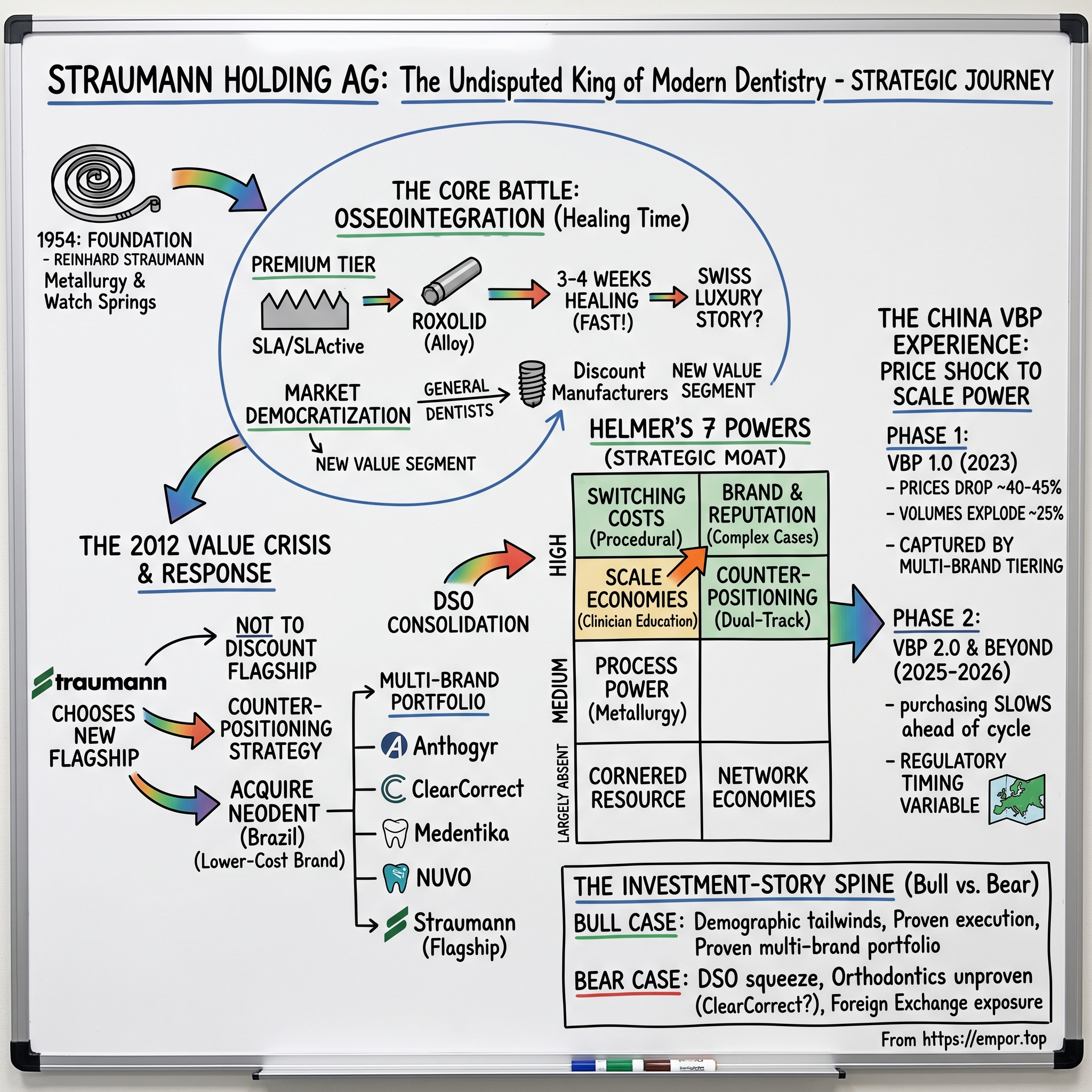
Straumann Holding AG: The Undisputed King of Modern Dentistry
I. Introduction & Episode Roadmap (~12 min)
Forty minutes southeast of Basel, in the folds of the Jura mountains, sits Waldenburg — a village of roughly a thousand residents with a single main street and a valley floor narrow enough that road, railway, and river run side by side. Nothing about the location suggests global industry. Yet in 1954, Swiss engineer Reinhard Straumann established a research institute here to study the metallurgy of watch springs. Seven decades later, the company that carries his name is the world's largest supplier of dental implants.
The company's financial scale is striking given its modest origins. At the end of 2025, Straumann Holding AG carried a market capitalization of CHF 14.9 billion.1 It employed 11,821 people, operated across more than 100 countries, and generated annual revenue of CHF 2.6 billion.2 According to management estimates presented at its Capital Markets Day in Basel in November 2025, the group holds roughly 35% of the global dental implant market — a level of concentration that attracts surprisingly little regulatory scrutiny outside the dental industry.3
What distinguishes Straumann is less its absolute size than its economic profile. In 2025, the group converted CHF 2.6 billion in revenue into a core gross margin of 70.1% and an as-reported core EBIT margin of 25.2%.2 These gross margins rival software-like profitability, despite belonging to a manufacturing enterprise that machines titanium alloys into precision medical components.
Unlike most medical technology segments with comparable margin profiles — such as cardiac stents, orthopedic implants, or surgical robotics — dental implantology operates largely outside single-payer reimbursement schemes that pressure prices elsewhere in medtech. In most markets, patients pay out of pocket for dental implants. This structure gives Straumann substantial pricing freedom while simultaneously creating exposure to broader consumer spending cycles — a dual dynamic that defines the business.
A central pillar of Straumann's strategic durability rests on a strategy few premium brands navigate successfully: deliberately building and scaling lower-cost competitors to its own primary brand. Facing an influx of discount implant manufacturers in the early 2010s alongside a customer shift from specialist surgeons to general dentists, Straumann chose not to discount its flagship product. Instead, it acquired Brazil's leading value manufacturer, Neodent, followed by France's Anthogyr, directing those brands toward price-sensitive segments the premium brand could not serve as profitably. Counter-positioning against its flagship before external rivals forced its hand proved to be a pivotal capital allocation decision.
Three common market assumptions about the company require qualification when examined against financial disclosures:
Myth: Straumann is a Swiss luxury-goods story wearing a lab coat. In reality, the majority of the group's unit growth over the past decade has originated from value-tier brands sold at price points well below the primary brand. While the premium franchise remains the profit anchor and reputational core, lower-cost brands have driven volume growth for years.
Myth: High gross margins automatically equate to pricing power. High gross margins partly reflect pricing strength, but they also stem from low direct unit manufacturing costs relative to product price. What gross margin omits is that roughly 45 centimes of every revenue franc must fund sales forces, clinician education, and regulatory infrastructure before operating profit is generated. Straumann's competitive moat is expensive to maintain, with its costs concentrated in operating expenses rather than cost of goods sold.
Myth: The business is inherently defensive because it operates in healthcare. Dental implants are among the most discretionary procedures in healthcare. Without reimbursement floors or insurance coverage in most markets, patients can defer treatment without acute health risks. Consequently, Straumann's top line tracks consumer sentiment much like a premium consumer-durables manufacturer — a dynamic illustrated by softer demand patterns in North America over recent years.
This multi-brand portfolio strategy faced a critical test in China. When Chinese authorities expanded centralized volume-based procurement (VBP) to dental implants, tender prices dropped sharply.4 While market consensus anticipated severe margin erosion, transaction volumes expanded rapidly. Straumann submitted bids across multiple price tiers using its distinct brands, leading management to estimate that its global implantology market share expanded from approximately 32% to 35% during 2024.5 In 2025, however, China became a temporary headwind as purchasing slowed ahead of the subsequent procurement cycle.2 Both phases underscore the cyclical and regulatory sensitivity of the market.
An additional framing helps evaluate the business. Straumann sits in a distinct analytical category: its product is clinical medical technology, its direct customer is a small-business dental practice or dental service organization (DSO), and its end payer is an individual consumer. Each perspective yields a different valuation view. Evaluated strictly as medical technology, its business durability appears exceptional while baseline volume growth looks modest. Viewed as a small-business supplier, the consolidation of dental practices into DSOs dominates the thesis. Viewed as a consumer-facing brand, recent demand softness in North America becomes the focal point. Assessing Straumann requires weighing all three factors and determining which force governs a given reporting period.
The following sections map this trajectory: the metallurgical origins and academic alliances that underpin the brand; the surface-science innovations that established Straumann's clinical reputation; the 2012–2015 value crisis and the Neodent acquisition; the strategic expansion into clear aligners and digital workflows; the dual-phase Chinese VBP experience; management incentives and governance; segment-by-segment financial performance; a competitive war-game applying strategic frameworks; and a stress test of potential risks. The narrative begins in the Waldenburg valley.
 Subscribe on LinkedIn
II. Origins: Watch Springs, Metallurgy, & The Osteosynthesis Pivot (1954–1979) (~15 min)
The mechanical foundation of Straumann began with a specific engineering problem: a mechanical watch relies on a coiled balance spring oscillating at a fixed rate, but metals expand and contract with temperature shifts. A watch calibrated in a cool climate runs fast in warm weather. Solving this required developing metal alloys whose stiffness remained stable across temperature variations, machined to tolerances measured in microns.
Reinhard Straumann addressed this challenge in the 1930s and 1940s by developing the Nivarox alloy family, which became the standard material for Swiss watch balance springs. When he founded his research institute in Waldenburg in 1954, the initial focus centered on alloy metallurgy and materials testing, including wire fatigue and corrosion resistance.6
That technical focus proved critical when applied to medical devices. The core competency was understanding metal performance under continuous mechanical stress inside demanding environments. A human jaw — characterized by repetitive chewing loads, moisture, salinity, acidity, and oral bacteria — presents a similarly harsh operational test for load-bearing materials.
The transition from horology to healthcare occurred through bone fixation. During the 1960s and early 1970s, the institute developed osteosynthesis products, manufacturing the metal plates, screws, and pins used by surgeons to stabilize fractured bones during healing. This application required corrosion-resistant alloys machined to precise specifications and tested for fatigue strength. Progress in non-corroding trauma alloys prompted the founder's son, Fritz Straumann, to direct research toward orthopedics and dental implantology. In 1974, the institute produced its first titanium hollow-cylinder dental implants.6
A fundamental challenge in dental implantology is long-term clinical credibility. Because dental implants are designed to function in a patient's jaw for decades, clinical adoption depends on independent long-term validation rather than manufacturer assertions.
In 1980, Fritz Straumann and Professor André Schroeder of the University of Bern founded the International Team for Implantology (ITI), an interdisciplinary alliance of clinicians and researchers dedicated to advancing implant dentistry.7 The ITI was structured as an independent academic network with its own governance, a General Assembly of Fellows, and dedicated research funding. Today, the organization comprises more than 25,000 members across 38 national and regional sections, with a research committee that deploys an annual budget of approximately USD 2.2 million to fund clinical studies. Straumann serves as the ITI's primary industry partner and holds single seats on the ITI board as well as its education, research, and leadership committees, preserving the network's operational independence.7
This academic partnership established an enduring customer retention mechanism. Clinicians trained through ITI curricula learn surgical protocols using Straumann's specific instrument geometry, drill sequences, torque thresholds, and prosthetic connections. Switching to a competing implant system requires relearning surgical steps on active patients, creating operational friction and medico-legal liability. Concurrently, the ITI's multi-decade clinical trial data provides practitioners with defensible evidence for treatment selection. Together, clinical education and long-term research generate substantial switching costs without requiring continuous promotional spending.
Unlike traditional medical device marketing models that rely on direct compensation for clinical key opinion leaders, the ITI operates with structural autonomy. Because Straumann holds advisory representation rather than veto power, the network's research findings maintain high academic credibility. While this arms-length relationship delivers slower commercial returns than direct product sponsorship, it builds durable institutional trust.
However, the ITI model has clear boundaries. It does not enforce product exclusivity, as ITI-trained practitioners remain free to use competing implant systems. Nor does it protect against price erosion from low-cost market entrants. The academic ecosystem insulates the premium product tier, but offers limited protection in price-sensitive market segments.
Geographic expansion was equally critical to Straumann's growth trajectory. Operating from a domestic Swiss market of fewer than nine million people, the company was required to export from its inception. Achieving scale meant building regulatory capabilities across multiple jurisdictions, producing multilingual clinical documentation, and establishing international distribution channels early in its corporate development. This imperative forced Straumann to establish a global commercial footprint far earlier than larger domestic competitors.
Straumann also maintained a preference for vertical integration, machining its own implants rather than outsourcing production to contract manufacturers. While this capital-intensive model increases fixed operating costs, it ensures direct control over machining tolerances, surface chemistry, and material traceability. In an industry where manufacturing defects can result in late surgical failures and regulators mandate complete audit trails from raw bar stock to patient records, vertical integration serves as a primary risk-management mechanism.
The group formalized its modern commercial structure in 1990 with the incorporation of Institut Straumann AG as an operating company, led by the founder's grandson, Thomas Straumann, who served as CEO until 1994 and chairman until 2002.1 In 1998, the company completed an initial public offering on the SIX Swiss Exchange, trading under the ticker STMN.1 Capital raised from the listing funded the transition from third-party distributors to a direct sales force, allowing dedicated representatives to manage practitioner training, clinical support, and customer relationships directly.
Straumann entered public markets as a specialized industrial business rather than a high-growth medical technology enterprise. Since its listing, the company has avoided significant secondary equity offerings. Total share capital stood at 159,455,239 registered shares at the end of 2025, following a ten-for-one share split and conditional share conversion in April 2022.1 Subsequent expansion across international markets, manufacturing plants on four continents, and a portfolio of six distinct brands has been funded almost entirely through organic operating cash flow and disciplined borrowing, including a CHF 250 million domestic bond issued in 2025 and maturing in October 2028.1 This capital structure has enabled long-term business growth without substantial equity dilution.
While establishing a direct sales network requires ongoing operational expenditure rather than balance-sheet asset capitalization, it secures direct ownership of practitioner relationships and real-time market feedback. This distribution infrastructure provided the foundation for Straumann's subsequent multi-brand strategy, enabling the company to leverage established sales channels when expanding into lower-cost market tiers.
III. Building the Clinical Gold Standard & The 2012 Value Crisis (~20 min)
At the core of Straumann's pricing power was a biological imperative: osseointegration. When a titanium screw is placed into the jaw, living bone grows directly onto its surface, locking it into place. Until bone integration occurs, the implant remains an unanchored foreign body. The patient cannot chew, the dentist cannot place a crown, and treatment remains incomplete.
Historically, bone integration required approximately three months — a waiting period that left patients with temporary gaps, delayed final billing for dental practices, and extended clinical risk. Straumann's central scientific focus for two decades was compressing that healing window, relying not on changes to the underlying metal, but on surface engineering.
Engineers treated the implant surface much like a climbing wall: a smooth, polished metal exterior offers bone cells little grip, whereas a textured surface multiplies microscopic surface area for cellular adhesion. Straumann's SLA surface — sand-blasted with large grit and then acid-etched — created a microscopic topography of peaks and pits that accelerated bone attachment. Its successor, SLActive, added a chemical dimension. Storing the implant in a sealed saline solution rather than air preserved a hydrophilic, chemically active surface. Upon placement, the surface immediately attracted blood into contact with the titanium, initiating faster tissue regeneration. This innovation reduced average healing times from three months to three to four weeks, transforming dental practice economics alongside clinical biology.
Materials science advanced in parallel. While standard titanium is strong, narrow-diameter implants risk structural fracture — a critical limitation in patients with bone loss from long-standing tooth loss. The traditional solution, bone grafting, required secondary surgeries, higher costs, and extended recovery. Straumann developed Roxolid, an alloy combining titanium and zirconium, which offered higher tensile strength than pure titanium. The material allowed clinicians to place smaller implants safely without pre-treatment bone grafts. Positioned clinically, Roxolid offered a less invasive, faster treatment protocol that justified its premium price point.
This combination of proprietary surface chemistry, proprietary metallurgy, an independent academic research base, and a direct sales force established Straumann's premium market position. Around 2010, however, structural shifts began reshaping the dental industry.
First, implant dentistry democratized. Procedures historically performed primarily by specialists, such as periodontists and oral surgeons, increasingly shifted to general dentists placing straightforward implants in routine practice. General dentists represented a distinct customer group: more price-sensitive and focused on practice overhead, treating implant selection as an operational cost item rather than an academic philosophy. Second, a new generation of value manufacturers across Brazil, South Korea, southern Europe, and Israel matured, producing implants that were clinically sufficient for routine cases at significantly lower prices.
This dynamic created a strategic dilemma for Straumann. Cutting prices to defend volume threatened its gross margin structure, which exceeded 70%, while signaling to academic partners that its premium pricing was promotional rather than scientific. Conversely, maintaining prices protected margins but risked surrendering the fastest-growing market segment to lower-cost competitors.
Straumann addressed this threat in May 2012 under then-Chief Executive Beat Spalinger by acquiring a 49% stake in Neodent for approximately CHF 260 million in cash. The transaction valued the Brazilian manufacturer at roughly 13 times historic EBITDA and included options to acquire full ownership over six years.8
Neodent was founded in Curitiba in 1993 by Dr. Geninho Thomé, a Brazilian clinician who aimed to develop domestic implants matching imported quality at lower costs through simplified surgical protocols.9 By 2011, Neodent generated revenue of BRL 167 million (roughly CHF 80 million), capping three years of approximately 20% annual growth, controlling nearly a third of the Brazilian market, and generating an EBITDA margin above 40%.8
Neodent's lower price point reflected lower direct manufacturing costs, a simplified product architecture, and the absence of a global research apparatus, rather than compressed profit margins. By acquiring the company, Straumann gained access to a highly profitable, low-cost operating structure.
Marco Gadola served as CEO from 2013 to 2019, a period during which Group revenue roughly doubled, profits more than doubled, and the workforce more than tripled.1 Gadola brought an operational background to the role, having served as Straumann's CFO and Executive Vice President of Operations from 2006 to 2008, followed by executive leadership roles at logistics provider Panalpina as CFO and Asia-Pacific regional CEO.1 His background in finance and supply chain management suited a strategy that treated brand architecture as a portfolio management challenge rather than an identity issue.
Under Gadola, Straumann accelerated its acquisition timeline, agreeing in April 2015 to acquire the remaining 51% of Neodent three years ahead of schedule for approximately CHF 210 million in cash.10 Across both transactions, Straumann secured full ownership of the Brazilian market leader for a total cash outlay of approximately CHF 470 million.
The strategic shift created internal and commercial tension. For decades, Straumann had positioned its premium pricing on scientific evidence, clinical research, and manufacturing precision. Acquiring a brand positioned as clinically sound at lower prices risked signaling that premium features were unnecessary for routine cases. This strategy created friction with sales representatives and academically aligned clinicians. Management accepted this operational friction to establish a multi-tier defense before external competitors eroded its market share.
Several structural factors contributed to the successful integration of Neodent where many dual-brand strategies fail. First, Straumann maintained strict operational separation between the brands, preserving distinct product architectures, brand identities, and commercial positioning to protect flagship pricing. Second, Straumann expanded Neodent globally through its established international distribution channels, scaling the brand without duplicating local sales infrastructure. Third, founder Dr. Thomé remained as scientific president following the transaction, maintaining brand credibility among practicing clinicians.9
The Neodent acquisition demonstrated management's willingness to execute a strategy that countered its primary brand narrative to protect overall market share. By counter-positioning against its flagship product, Straumann secured a dual-tier market structure. Whether current executive leadership maintains this disciplined portfolio approach remains a key test as the group expands into clear aligners and digital orthodontics.
IV. Portfolio Expansion: Challenger Implants, Clear Aligners, & Digital Ecosystem (2017–2022) (~18 min)
By 2016, Straumann's portfolio strategy was firmly established. Having demonstrated through Neodent that a secondary brand could leverage the company's existing commercial infrastructure, leadership sought to expand both the number of brands in its portfolio and its reach beyond core dental implants.
The expansion within implantology proceeded in deliberate phases. Straumann initiated its expansion into upper-value challenger implants in early 2016 by acquiring a 30% stake in French manufacturer Anthogyr and assuming control of Anthogyr's Chinese distribution business.11 When Straumann acquired full ownership in March 2019, Anthogyr added approximately CHF 57 million in annual revenue, 400 employees, production facilities in France and Luxembourg, and a position in the non-premium segment bridging flagship implants and value brands. Financial terms were not disclosed.11 Management framed the acquisition as providing timely footholds in non-premium segments across China and Russia.11
The Anthogyr transaction reflected Straumann's disciplined approach to mergers and acquisitions. Rather than completing outright purchases immediately, the group frequently takes initial minority positions, operating alongside target companies for two to four years to evaluate operational and cultural fit before committing full capital. While this phased approach means final purchase prices may reflect value created during the partnership, it significantly mitigates integration risks and preserves the flexibility to exit unsuitable investments.
Alongside Anthogyr, the group assembled targeted regional positions, including acquiring Medentika in Germany for third-party-compatible prosthetics, alongside equity stakes in regional providers such as Zinedent in Turkey and Nihon Implant in Japan. The underlying commercial logic remained consistent: run distinct brands at tailored price points with tailored clinical positioning, while sharing sales forces, regulatory compliance, and manufacturing scale. By structuring its corporate house into distinct brands—including Anthogyr, ClearCorrect, Medentika, Neodent, NUVO, and the flagship Straumann line—the group created a multi-tier commercial strategy.2
In August 2017, Straumann executed a broader strategic shift into orthodontics by agreeing to acquire ClearCorrect, a Texas-based clear aligner manufacturer, for approximately USD 150 million, closing the transaction the following month.12
Clear aligners—removable plastic trays that straighten teeth—represented a category pioneered and dominated by Align Technology's Invisalign system. For Straumann, clear aligners offered immediate commercial adjacencies: the general dentists purchasing its dental implants also treated orthodontic patients. Management later estimated the global clear aligner market at roughly CHF 4.7 billion, expanding at approximately 10% annually.3
While the strategic rationale was clear, execution proved challenging. Nine years after entering the category, clear aligners remain an operational turnaround rather than an established profit engine. In its 2025 disclosures, the group reported solid growth in orthodontics alongside progress transforming ClearCorrect, while first-quarter 2026 management commentary emphasized that the aligner business remained on track to reduce operating losses.213
The ongoing restructuring reflects a fundamental shift in manufacturing strategy. Moving away from direct aligner fabrication, Straumann closed its Markkleeberg manufacturing site in Germany and transferred production for Europe, the Middle East, Africa, and Asia-Pacific to the third-party Smartee platform, shifting all regional orders to the outsourced network.13 Concurrently, the company integrated DentalMonitoring, an artificial-intelligence remote monitoring tool that enables clinicians to track tooth movement between visits via patient smartphone photos.2 In effect, Straumann transitioned ClearCorrect from an in-house plastic manufacturer into a digitally managed clinical service with outsourced manufacturing.
The third pillar of portfolio expansion focused on digital dentistry. The group acquired intraoral scanning capabilities through AlliedStar, added GalvoSurge to treat peri-implantitis—the inflammatory bone loss that represents a primary long-term implant complication—and built planning software including Smilecloud. These digital assets were anchored around Straumann AXS, a cloud platform designed to unify the group's hardware, software, and clinical services into a single digital workflow.5
Intraoral scanners serve as the primary entry point for digital workflows. Replacing traditional physical impression materials, an intraoral scanner uses an optical wand to generate a three-dimensional digital model of a patient's mouth within minutes. Because treatment planning and custom fabrication flow directly from the initial scan, owning scanner hardware gives manufacturers strategic influence over software selection and component routing. The launch of the SIRIOS X3 scanner in late 2025 generated sales momentum, with registered AXS platform users increasing by over 50% in the six months through April 2026.213
In practice, a digital workflow streamlines treatment complexity. In a traditional analogue workflow for a single missing tooth, a dentist takes physical impressions, ships models to an external laboratory, reviews two-dimensional X-rays, drills freehand, and waits several weeks through multiple laboratory cycles before fitting a final crown.
In a fully digital workflow, the intraoral scan is merged with three-dimensional cone-beam imaging to construct a complete anatomical model. Software maps the precise implant placement relative to bone density and nerve structures, outputting a surgical guide that constrains the drill during surgery. The final crown can then be designed digitally and fabricated chairside using practice-based milling or 3D printing. For clinicians, this reduces chair time and procedure risk; for Straumann, it embeds the practice within a proprietary ecosystem selling software licenses, consumables, and hardware.
This integrated vision underpins products like the Straumann Signature MIDAS 3D printing system, developed with SprintRay, which combines with the SIRIOS X3 scanner to link scanning, treatment design, and fabrication directly within the dental practice.2 This strategy mirrors management's explicit effort to transition Straumann from a hardware vendor into a service-led provider, a core narrative presented throughout 2025 financial reporting and capital markets communications.23 For investors, service and consumable sales offer higher-quality recurring revenue compared to capital equipment sales.
However, platform strategies in dental technology carry inherent risks. The scanner market remains highly competitive, contested by established imaging specialists with extensive distribution networks. Furthermore, an open-architecture platform like AXS inherently lacks strict proprietary lock-in.13 User growth metrics measure platform adoption rather than direct monetization, meaning the long-term economic return of the digital ecosystem strategy remains to be fully demonstrated in reported financial segment results.
This multi-brand architecture and digital infrastructure would soon face a live stress test in the largest and most volatile dental market globally.
V. The China VBP Case Study: Converting Regulatory Price Shock into Scale Power (~18 min)
In late 2022, dental equipment executives across Europe and North America watched a policy file out of Beijing with deep apprehension.
China had spent five years applying centralized volume-based procurement (VBP) to healthcare. The regulatory mechanism aggregated demand across public hospitals into centralized state tenders, guaranteeing winning manufacturers defined supply volumes in exchange for steep price reductions. Applied to generic pharmaceuticals, VBP had slashed prices by over 90%; applied to coronary stents, it eliminated industry profit margins almost overnight. In 2022, the program expanded to dental implants — a market where Straumann had spent a decade building China into one of its fastest-growing international regions at premium Swiss price points.
When initial tender results landed in January 2023, they showed a dramatic reduction in implant prices under the bulk-buy program.4 Consensus financial models projected that lower prices with flat volume expectations would severely erode Asia-Pacific profitability.
Instead, market dynamics unfolded differently, illustrating how volume can expand when price barriers are removed in underpenetrated markets. China held a vast population requiring implant treatment who could not afford premium care, making implantology a luxury purchase in urban centers. Rather than destroying commercial demand, price reductions unlocked pent-up market volume.
Financial disclosures highlighted this volume sensitivity: in 2023, Straumann earned 40% to 45% less on each implant unit sold in China, yet total national implant volume expanded by roughly 25%, with volume growth more than offsetting unit price declines.14 Driven by this surge, the group raised its full-year organic revenue growth guidance in August 2023.15
Capturing this expansion required an established multi-tiered brand architecture. VBP tenders were structured in price tiers. Public hospitals treating complex cases required premium systems with extensive clinical trial backing, whereas high-volume urban clinics serving price-sensitive patients prioritized cost-effective, clinically proven options. Rather than choosing a single market segment, Straumann submitted its flagship brand into the premium tier while deploying Neodent and Anthogyr in value tiers. The Anthogyr Chinese commercial network, integrated in 2016, provided a key operational vehicle. In its 2024 annual report, management reported double-digit volume growth across both premium and challenger implant segments, attributing this combination to an expansion in global implantology market share from approximately 32% to 35%.5
This tiering strategy addressed regional competition directly. Straumann's primary rivals in China were not competing Western premium manufacturers, but domestic and South Korean producers operating with lower cost structures. Entering value tiers with brands backed by dedicated manufacturing bases — rather than discounting flagship Swiss inventory — allowed Straumann to compete on aligned cost fundamentals.
To support regional demand and optimize operations, Straumann constructed a manufacturing campus in Shanghai, finalizing construction in 2024 as initial production testing began.5 The facility provided localized cost management, shortened supply chains, and established natural currency hedging by matching renminbi revenues with renminbi operating expenses, as management detailed at its 2025 Capital Markets Day.3 However, scaling the Shanghai facility created near-term margin pressure, temporarily depressing group gross margin in 2025 as fixed overhead was absorbed ahead of full volume production.2
While the initial VBP implementation expanded transaction volumes, preparation for subsequent procurement cycles created operational headwinds. Through the second half of 2025, Chinese market conditions softened as patient volume slowed and distributors reduced inventory levels ahead of the next tender round.2 In tendered healthcare markets, anticipated price cuts prompt distributors to defer inventory purchasing. Consequently, Straumann's Asia-Pacific revenue declined 12.8% organically in the fourth quarter of 2025, despite the region excluding China achieving 10.2% full-year organic growth.2 Softness persisted into early 2026, with Asia-Pacific organic revenue growing 0.5% in the first quarter, compared to double-digit growth across regional markets outside China.13
During the first-quarter 2026 earnings call, Chief Executive Guillaume Daniellot informed analysts that official timing for VBP 2.0 remained unconfirmed, with potential implementation expected in the second half of the year, while noting stabilizing patient visits and gradual distributor restocking from low inventory levels.1316 This regulatory uncertainty leaves a portion of near-term group growth tied to public procurement timelines.
Beyond immediate pricing impacts, VBP produced broader structural changes. Heightened public visibility and price transparency increased national awareness of implant dentistry, while lower entry costs encouraged additional clinics to establish implant services. In its 2024 financial reporting, Straumann described Chinese patient demand as unlocked by the long-lasting structural impact of the procurement initiative rather than a temporary price adjustment.5 If sustained, this expansion creates a broader installed patient base requiring long-term prosthetic maintenance and consumable components.
Conversely, if the initial volume surge reflected finite pent-up demand, future revenue growth will depend on ongoing volume expansion under lower unit pricing. The upcoming procurement cycle will test whether market demand expands further or stabilizes at lower price tiers.
The Chinese market experience demonstrated the strategic utility of Straumann's multi-brand portfolio during regulatory price shifts, while highlighting how transition to tendered procurement shifts pricing dynamics toward state-defined parameters, introducing policy timing and distributor buying cycles into financial performance. Concurrently, regional competitors, including South Korean manufacturers Osstem Implant and Dentium, continue expanding capacity within high-volume value segments.
This structural evolution highlights how executive leadership navigates regulatory interventions and market shifts, turning attention to management incentives, governance, and capital allocation strategy.
VI. Current Management, Incentives, & Capital Allocation Discipline (~15 min)
On 17 April 2026, at the annual general meeting in Basel, Thomas Straumann did not stand for re-election to the board of directors he had joined in 1990.12 After more than 36 years of service, including twelve as chairman, he transitioned into the role of honorary chairman. To represent the founding family going forward, the board proposed his son-in-law, Sébastien Schatzmann.2
It was a quiet ending to a long presence, carrying far more strategic weight than a typical governance transition because Thomas Straumann was no ceremonial figurehead. At the end of 2025, he held 24,655,997 shares out of 159,455,239 in issue — a stake of roughly 15.5%.171 That anchor holding insulates the company from short-term market pressures, giving the founding family a structural voice institutional investors cannot easily override. For shareholders who value long-term stability, this concentration of ownership provides reassurance; for those who prioritize corporate contestability, it renders activist intervention virtually impossible.
The current leadership team reflects a distinct operational focus that contrasts with standard market overviews.
Petra Rumpf has chaired the board since 2024, having joined as a director in 2021. Her background aligns directly with Straumann's strategic priorities: from 2015 onward, she served on the executive management board, first leading the global expansion of value brands through Instradent and strategic alliances, and later, from 2017, heading the dental service organizations channel.1 Prior to joining Straumann, she spent eight years on the executive committee of Nobel Biocare — Straumann's primary premium rival — and has accumulated thirteen years of experience on dental industry executive boards in total.1 Appointing a chair who directly managed both the value-brand rollout and DSO channels signals explicit board oversight over these key growth engines.
Guillaume Daniellot has served as chief executive since 1 January 2020. French, born in 1970, and trained as a physicist at the University of Dijon before entering hospital product management at Coloplast and B. Braun, he entered dentistry in 2001 at Dentsply France and joined Straumann in 2007 as managing director of its French subsidiary.1 Two years later, he moved to Basel to oversee global sales for digital dentistry, subsequently leading the prosthetic laboratory business group, joining the executive board in 2013, and running Western Europe and then North America before becoming CEO.1 With nineteen years inside the organization, primarily across commercial functions, his background aligns with an executive focus centered on distribution networks, clinician education, and digital workflow adoption.
Isabelle Wege assumed the role of chief financial officer in mid-2025, succeeding Yang Xu, who left the Group in May.1 German, born in 1984, she previously served as CFO and executive board member at FUCHS Group from 2022, following earlier roles as CFO of Zeiss Greater China and senior finance roles at Schenck Process under Blackstone ownership.1 Her experience in China is directly relevant given Straumann's commercial exposure in the region. She also serves as chief risk officer, embedding audit and risk committee's risk oversight runs through that seat.1
Alongside them sits Marco Gadola, who chaired the human resources and compensation committee as vice-chair of the board until stepping down at the April 2026 AGM alongside Thomas Straumann, remaining available in an advisory capacity.2 The simultaneous departure of the board's two longest-serving figures marks a significant generational transition, removing the key leaders who guided the company through its multi-brand expansion in 2012.
What the pay plumbing actually rewards
Straumann's compensation design provides clear insight into executive priorities, outlining the specific performance drivers rewarded by the board.
The short-term incentive for the CEO and executive management board is determined entirely by economic profit — defined as net operating profit after tax minus a capital charge calculated at an 8% weighted average cost of capital.17 This structure directly penalizes capital deployment that fails to generate adequate returns, discouraging growth pursued purely through volume acquisition. In 2025, the Group generated an economic profit of CHF 317.8 million against a target of CHF 299.0 million.17
While operational performance exceeded target, the payout mechanics illustrate a steep sensitivity curve. A 6.3% beat above target yielded a short-term incentive payout of 177.4% of target for executive board members, near the 190% maximum cap.17 Because the band between threshold and maximum was narrow — with the upper threshold set at CHF 320.8 million, just 7.3% above target — the payout curve converted a single-digit operational beat into a near-maximum bonus, highlighting how closely variable compensation depends on initial budget forecasting precision.
By contrast, the long-term incentive plan operates under more demanding vesting criteria. Performance share units granted in 2025 vest over three years across three independent performance metrics: absolute total shareholder return weighted 25%, relative total shareholder return against the Swiss Market Index Mid weighted 25%, and absolute core EBIT growth weighted 50%.17 The absolute TSR component requires a 7% annualized return to initiate vesting, capping at 14%.17
The real-world alignment of this framework was demonstrated by the 2022 grant that vested in April 2025. Over the three-year cycle, absolute TSR was negative 8%, resulting in zero vesting for that tranche, while relative TSR lagged the index by 15 percentage points, yielding 20% performance achievement. The combined vesting factor equaled 0.20 shares per granted unit, and when combined with share price decline over the holding period, the four eligible executive board members received roughly 15% of the initial grant value.17
This divergence reflects two distinct outcomes: executive management earned high annual cash bonuses based on operating profit targets, while long-term equity compensation experienced substantial reduction alongside multi-year shareholder returns.
The board introduced two governance adjustments starting in 2026: executive board variable pay became subject to formal clawback provisions, and the 25% conversion discount previously applied when issuing performance share units was eliminated, both tightening the framework.17 At the same time, the board sought AGM approval in April 2026 for a one-time retention grant of restricted share units to select executive board members excluding the CEO and CFO, vesting in the third quarter of 2027.17 While framed by management as necessary to preserve leadership stability during strategic transitions, off-cycle retention grants outside standard performance criteria represent an exception to typical incentive alignment.
Shareholding requirements reinforce executive alignment: executive board members must hold Straumann equity equal to at least their annual base salary plus target short-term incentive, while the CEO requirement encompasses base salary, target STI, and target LTI, with new executives given five years to build up.17 As of year-end 2025, Daniellot held 43,421 registered shares alongside 30,950 unvested PSUs at end-2025.17
The DrSmile round trip
The primary test of recent capital allocation discipline occurred in direct-to-consumer orthodontics. Between 2020 and 2022, Straumann acquired DrSmile, a German direct-to-consumer aligner business, betting that orthodontic adoption could be scaled through digital consumer marketing rather than traditional clinical dental referrals.
The business model encountered structural headwinds as post-pandemic demand normalized, professional medical oversight standards tightened, and digital customer acquisition costs escalated. On 14 August 2024, Straumann announced the divestment of DrSmile to the Barcelona-based Impress group, retaining a 20% shareholding on a fully diluted basis and continuing to supply aligners to the acquirer; financial terms were not disclosed.18 Daniellot framed the decision as a refocusing on the B2B orthodontics business.18
The exit reflects a pragmatic course correction: divesting an underperforming consumer channel within four years, retaining residual equity upside, and converting the acquirer into a B2B supply customer mitigates initial capital loss. However, the original capital commitment occurred at the peak of direct-to-consumer market valuations into a distribution model that conflicted directly with Straumann's core network of independent dentists. While the unwind demonstrated capital discipline, the initial acquisition highlighted the operational risks of chasing direct-to-consumer channel expansion.
With leadership, incentive structures, and capital allocation track records established, the central analytical focus turns to group financial performance: how these strategic decisions translate into long-term reported economics.
VII. Core Business Economics & Segment Breakdown (~18 min)
Beneath its multi-brand architecture and digital platforms, Straumann's financial structure remains straightforward: the group manufactures precision dental components at a gross margin above 70%, allocates roughly 45 centimes of every revenue franc to commercial distribution and clinical education, and converts approximately one-quarter of revenue into operating profit.
Management estimates its total addressable oral care market at more than CHF 20 billion. Within this total, implantology serves as the primary profit driver, orthodontics represents a roughly CHF 4.7 billion category expanding at approximately 10% annually, and prosthetics—encompassing crowns, bridges, and restorations—constitutes a fragmented, largely manual market of roughly CHF 6 billion.3 Straumann's global implantology market share of approximately 35% positions it as the industry leader, with the remaining market divided primarily among Envista's Nobel Biocare, Dentsply Sirona, Osstem, ZimVie, and regional value producers.3
To illustrate long-term growth potential, management frequently highlights an addressable patient pool of roughly 220 million individuals globally who require and can afford implant treatment, compared to approximately 16 million treated annually.3 While this suggests substantial structural room for expansion, the penetration gap has narrowed slowly over two decades. Growth remains constrained less by product availability than by patient willingness, clinician treatment capacity, and out-of-pocket financial costs.
The geographic shape
In 2025, the group generated CHF 1,084.2 million in Europe, the Middle East, and Africa—representing 41.6% of total revenue and growing 11.2% organically. North America contributed CHF 687.7 million, or 26.4% of revenue, with 4.2% organic growth. Asia-Pacific delivered CHF 599.7 million, accounting for 23.0% of total revenue and growing 7.3% organically. Latin America produced CHF 233.7 million, representing 9.0% of revenue, while leading regional expansion with 18.3% organic growth.2
These regional dynamics reveal distinct underlying growth drivers. EMEA, the group's largest and most mature region, expanded faster than North America, indicating that market share gains rather than overall market expansion drove regional performance. Conversely, North America's mid-single-digit growth reflected persistent softness in elective, out-of-pocket dental procedures; during the first-quarter 2026 earnings call, management attributed improved regional momentum to commercial execution and product innovation rather than broader market recovery.16 In Latin America, sustained high-teens growth reflected continued market expansion by Neodent a decade following its acquisition.
Straumann reports financial results strictly along geographic lines rather than solution categories, leaving exact revenue contributions from implantology, orthodontics, and digital dentistry undisclosed. Nevertheless, qualitative disclosures underscore operational focus. Implantology remains the group's core revenue and profit driver: the flagship iEXCEL premium implant system surpassed one million units sold during 2025 and accounted for over 20% of premium implant volume by the first quarter of 2026.213 Meanwhile, the orthodontic business continues its operational restructuring aimed at reducing losses.
The margin anatomy
In 2025, the group reported a core gross margin of 70.1%, compared to 71.4% in 2024, while core EBIT reached CHF 655.5 million. This generated an as-reported core EBIT margin of 25.2%, or 26.5% at constant 2024 exchange rates.2 Core net profit reached CHF 477.8 million, free cash flow totaled CHF 290.2 million, and capital expenditure rose 33% year-on-year to CHF 223.5 million, funding manufacturing expansion at the Shanghai plant and a third Neodent facility in Curitiba.2
Three primary factors define the group's financial performance and operating trajectory:
Foreign exchange exposure. The gap between reported and constant-currency margins underscores structural currency sensitivity. Straumann's administrative, research, and principal manufacturing costs are heavily denominated in Swiss francs, whereas revenues are earned primarily in U.S. dollars, euros, Brazilian reais, and Chinese renminbi. As the Swiss franc appreciated in 2025, currency headwinds reduced revenue by more than CHF 100 million, lowering reported growth to 4.1% in Swiss francs despite 8.9% organic growth.2 Management disclosures at its Capital Markets Day illustrated the magnitude of this translation impact: evaluated at constant 2021 exchange rates, Straumann's core EBIT margin would have been 32.4% rather than the reported 26%, while its organic revenue compound annual growth rate since 2021 would have reached 16.2% instead of the reported 9%.3 Consequently, group financial results remain closely tied to Swiss franc exchange movements.
Adjustments between reported and core EBIT. The difference between IFRS EBIT of CHF 549.0 million and core EBIT of CHF 655.5 million represented approximately 4.1 percentage points of operating margin.2 Disclosed non-core items in 2025 included CHF 48 million in purchase price allocation amortization and contingent consideration adjustments, CHF 40 million in restructuring expenses spanning production and all four commercial regions, CHF 24 million in legal costs, and a CHF 7 million impairment associated with the planned headquarters relocation to Arlesheim.2 While purchase price adjustments reflect past acquisitions, simultaneous restructuring costs across all geographic units and elevated legal expenses highlight ongoing operational overhead that requires monitoring relative to reported core profitability.
Cash conversion efficiency. Free cash flow of CHF 290.2 million relative to core EBIT of CHF 655.5 million yielded a cash conversion rate below historical medtech benchmarks. This shortfall stemmed from disclosed working capital expansion—net working capital reached CHF 426.0 million due in part to tactical inventory accumulation ahead of potential tariff adjustments—alongside elevated capital expenditure for manufacturing facilities.2 To address cash generation, management's 2030 strategic plan targets higher free cash flow conversion through moderated capital expenditure, procurement efficiencies, expanded shared services, and tighter working capital controls.3
Operational reinvestment provides additional perspective on margin dynamics. Although Straumann does not disclose standalone quarterly research and development figures, product rollouts—including the iEXCEL implant system, SIRIOS X3 scanner, and Signature MIDAS printing platform within an eighteen-month window—demonstrate continued capital allocation toward product pipeline development.2 Maintaining active commercial launches alongside margin compression indicates a strategy focused on defending clinical differentiation rather than maximizing short-term earnings.
Similarly, expenditure on clinician education operates as a commercial investment that builds long-term switching costs. Providing continuous training to dental practitioners creates immediate operating expenses without generating direct upfront revenue. While reducing clinical training would yield immediate operating margin expansion, preserving education investments supports the long-term retention mechanism that underpins the group's premium market position.
Distribution and the DSO question
The final key economic driver involves customer channel consolidation. Dental service organizations (DSOs)—corporate groups operating consolidated chains of dental practices—have expanded rapidly across North America and Europe. Centralized purchasing by DSOs creates pricing leverage over equipment manufacturers. In response, Straumann elevated its DSO channel management to the executive level, appointing Sara Dalmasso as head of the DSO organization in 2024 following senior roles at Omnicell and GE Healthcare.1 By the fourth quarter of 2025, the DSO channel contributed directly to North American performance, with management attributing growth to strong adoption of integrated digital workflows and long-term enterprise partnerships.213
The central strategic question is whether DSO consolidation threatens long-term gross margins. Management maintains that bundling intraoral scanners, planning software, implants, prosthetics, and clinician training enables the group to secure enterprise contracts based on workflow efficiency rather than component price. While recent commercial adoption aligns with this strategy, Straumann does not separately disclose DSO contract pricing or channel gross margins. Consequently, gross margin trajectory remains the primary metric for evaluating whether integrated digital bundles effectively offset enterprise volume discounting.
These economic mechanics set the stage for evaluating the strategic moats and competitive forces that protect Straumann's market position.
VIII. Playbook: Strategy, Hamilton Helmer's 7 Powers, & Porter's 5 Forces (~12 min)
To evaluate Straumann's competitive moat, consider a hypothetical competitor backed by CHF 3 billion intent on capturing its premium implant business. Where would such a rival attack?
A competitor could not win on product specifications alone. A newcomer could hire metallurgists to replicate Roxolid's mechanical properties within a few years or reverse-engineer a hydrophilic surface topography. What capital cannot purchase is time. The evidence base that allows a surgeon to justify a clinical treatment choice rests on fifteen years of published survival data for a specific implant geometry—a validation timeline no investment can compress. This long-term clinical evidence forms the structural core of Straumann's moat.
Helmer's powers, tested
Switching costs — high, and the strongest of the set. The retention mechanism is procedural rather than contractual. A clinician's surgical protocol, instrument tray, prosthetic driver set, planning software, and CAD/CAM library are system-specific. Changing manufacturers requires retraining on active patients while assuming personal liability for surgical outcomes. Practitioners also manage an installed base of patients whose implants require compatible prosthetic components for long-term maintenance. However, these switching costs bind individual clinicians rather than corporate buyers. A dental service organization that centralizes procurement can transition new patient cases to a lower-cost system and absorb clinician retraining as a one-time expense, making DSO consolidation a primary structural risk to premium margins.
Brand and reputation — high, but narrower than it looks. Seven decades of clinical evidence and an independent academic research network support premium pricing in complex cases, such as severe bone loss, medically compromised patients, full-arch reconstructions, and aesthetic restorations where treatment failures carry high personal visibility. In routine single-tooth replacements with healthy bone structure, high price premiums are harder to maintain—precisely the segment Straumann's value brands were acquired to address. Brand power is substantial, but strictly segment-specific.
Scale economies — high, and central to commercial distribution. Straumann spreads fixed costs across a global manufacturing footprint spanning Villeret in Switzerland, Curitiba in Brazil, Andover in the United States, Calw in Germany, and Shanghai in China, alongside a regulatory team maintaining compliance across more than 100 jurisdictions.25 The group's primary scale advantage lies in clinician education: in 2025, Straumann conducted over 10,700 training programs for more than 370,000 dental professionals, with 42% of these activities occurring in low- and middle-income countries.2 Because product adoption requires clinician training, maintaining a global educational infrastructure creates a significant barrier to entry for smaller competitors.
Counter-positioning — high, and the most distinctive power in the portfolio. The multi-brand structure allows Straumann to capture price-sensitive market volume through lower-tier brands without discounting its flagship line. This model reflects true counter-positioning because a pure-premium competitor cannot introduce value brands without cannibalizing flagship sales, while a value-tier entrant cannot establish a premium brand without multi-decade clinical trial data. The strategic utility of this dual-track structure was demonstrated during China's volume-based procurement transition.
Process power — medium. Proprietary surface chemistry and alloy metallurgy reflect accumulated manufacturing expertise that is difficult to replicate quickly. However, core patents eventually expire, and surface-treatment techniques across the industry have largely converged, with major competitors offering active surfaces supported by clinical data. Consequently, process power functions as a decaying asset requiring ongoing research and development investment.
Cornered resource and network economies — largely absent. The academic relationship with the ITI represents an enduring clinical alliance, but the ITI remains an independent organization whose members retain full clinical independence. Similarly, the Straumann AXS cloud platform aims to build digital workflow integration, but an open-architecture platform with unquantified monetization does not yet constitute a demonstrated network effect.
Porter's forces, applied
Supplier power: low. Titanium and zirconium represent commodity raw materials, and Straumann manufactures its core implant components internally. The group's supplier dependencies sit outside traditional metallurgy, specifically in outsourced clear aligner manufacturing and electronic components for intraoral scanners.
Buyer power: moderate and rising. Individual dental practices exercise limited pricing leverage. Conversely, consolidating DSOs hold substantial bargaining power, while state procurement authorities, such as Chinese health officials, possess centralized purchasing leverage. The ongoing concentration of buyer purchasing power represents a consistent structural headwind for product pricing.
Threat of substitutes: low. Clinical alternatives to implants—such as fixed dental bridges requiring the reduction of adjacent natural teeth, or removable dentures—do not prevent jawbone resorption following tooth loss. The long-term clinical efficacy of implant therapy remains well established, while technological alternatives like biological tooth regeneration remain distant from commercial application.
Threat of new entrants: low to moderate. Regulatory approvals, clinical trial generation, and direct sales infrastructure require substantial capital and time. However, entry barriers are asymmetric: formidable in the premium segment, but lower in the value tier where numerous regional manufacturers compete. New entrants do not need to displace flagship products; they only need to offer clinically acceptable options for routine cases at lower prices.
Competitive rivalry: high in value implants and aligners, moderate in premium implantology. In premium implants, Straumann competes against a small group of established manufacturers in a market where clinical reputations change slowly. In value implants, the group faces Korean, Israeli, and regional manufacturers operating with lower cost structures. In clear aligners, Straumann competes as a loss-making challenger against Align Technology's established consumer brand and rapidly scaling international providers like Angelalign.
Comparing competitive advantages across industry peers clarifies these market dynamics. Align Technology relies on direct consumer brand recognition that generates patient demand pull—a consumer marketing model Straumann does not replicate, as dental patients rarely request implants by brand name. Envista's Nobel Biocare shares Straumann's clinical research heritage within a broader corporate structure, while Korean manufacturers focus on high-volume, low-cost production, and Dentsply Sirona offers broad equipment coverage across the dental practice.
Straumann's competitive differentiation rests on operating premium and value implant franchises simultaneously through a shared international distribution and educational network. Replicating this strategy is difficult: premium competitors risk brand dilution by moving downmarket, while value manufacturers face multi-decade clinical trial requirements to move upmarket. Whether this structural advantage can be successfully extended into clear aligners and digital scanners—categories where Straumann operates as a challenger rather than an incumbent—remains the central strategic question.
In summary, Straumann maintains strong competitive protection in core premium implantology, supported by clinical data and switching costs. In contrast, its position in newer digital and orthodontic adjacencies remains subject to higher competitive rivalry and ongoing operational investment.
IX. Investment-Story Spine: Bull vs. Bear Stress Test & Risk Radar (~12 min)
On 17 June 2026, Straumann took the unusual step of raising its full-year profitability guidance mid-year. The expected core EBIT margin expansion for 2026 was upgraded from 30 to 60 basis points at constant 2025 exchange rates to 140 to 170 basis points — nearly tripling its margin improvement target. Management attributed the upgrade to operational efficiencies across divisions, a favorable geographic sales mix, lower-than-expected tariffs, cost discipline, and accelerated supply chain optimization, while separately noting non-core tariff refunds of up to CHF 17 million that were excluded from guidance.19
That single announcement encapsulates the central tension between the bull and bear cases for the stock.
Why Straumann wins from here
A structural demographic tailwind. Aging populations across major developed and emerging markets face higher rates of tooth loss, while the treated portion of the addressable patient pool remains low. Dental implantology represents an expanding medical need with no equivalent clinical substitute.
A multi-brand portfolio proven under regulatory stress. Straumann expanded its implant market share during the most aggressive state-mandated price reduction in its primary Asian growth market. The operational mechanism — maintaining distinct brand tiers while sharing distribution networks and supply chains — remains intact and continues to scale globally through Neodent's international expansion.
Resilient operational execution across economic cycles. The group delivered organic revenue growth of 13.7% in 2024 and 8.9% in 2025 despite soft North American consumer spending, market shifts in China, and sustained foreign exchange headwinds.52 The mid-year 2026 guidance upgrade, following 7.1% organic growth in the first quarter, indicates that internal efficiency programs are yielding faster results than initially budgeted.1319 Management has consistently met or exceeded its public financial targets throughout this period.
Quantifiable margin recovery potential from currency normalization. The divergence between reported operating margins and constant-currency earnings represents a significant valuation swing factor outside management's direct control. Should the Swiss franc weaken against major operating currencies, a substantial portion of the historical margin drag would reverse without requiring operational changes.
Why it may not
The DSO squeeze is structural, not cyclical. As dental practices consolidate into corporate dental service organizations (DSOs), procurement shifts to enterprise buyers with substantial bargaining power. Straumann relies on bundled digital workflows and education to preserve pricing power, but bundling protects margins only as long as proprietary hardware and software remain differentiated. If intraoral scanners commoditize and planning software standardizes, software bundles risk becoming explicit discount tools. This pricing pressure was reflected in core gross margin, which contracted from 71.4% to 70.1% between 2024 and 2025 due to geographic mix, tariffs, and facility startup costs in Shanghai.2
Orthodontics remains unproven after nine years of capital deployment. Since entering the clear aligner segment, Straumann has dismantled initial manufacturing infrastructure, acquired and subsequently divested a direct-to-consumer business, and entered 2026 still working to bring the division to profitability.13 Competing against Align Technology's scale and lower-cost international providers makes capturing profitable market share challenging. Management's current strategy — outsourcing manufacturing, integrating remote monitoring software, and targeting general dental practitioners — represents a third distinct operational pivot. Sustainable orthodontic profitability remains an unverified assumption in reported segment results.
Macroeconomic sensitivity is genuine and asymmetric. Because dental implants are largely uncompensated by insurance or state healthcare systems, treatment starts are discretionary. Faced with consumer weakness, patients defer elective care. North America's mid-single-digit organic growth through 2025 reflected this sensitivity, demonstrating that the business lacks a floor when consumer sentiment softens.
Foreign exchange represents a permanent operational tax. Management has mitigated currency drag by expanding regional manufacturing in Shanghai and Curitiba, but headquarters, research and development, and primary manufacturing remain in Switzerland. Structural currency mismatch remains an ongoing operational constraint.
China policy risk is a recurring operational variable. Timing for the second cycle of volume-based procurement (VBP 2.0) remained unconfirmed through the first quarter of 2026, creating distributor buying lulls that reduced Asia-Pacific organic growth to near-zero.1316 Furthermore, state-mandated procurement models could be adopted by other international health authorities seeking to reduce elective procedure costs.
Trade policy introduces margin volatility. Tariffs compressed 2025 gross margins and prompted defensive inventory accumulation; by mid-2026, lower tariff costs contributed to the guidance upgrade alongside expected non-core tariff refunds of up to CHF 17 million.219 Operating production across Switzerland, Brazil, Germany, the United States, and China leaves cost of goods sold exposed to geopolitical shift, reinforcing the rationale for localized regional manufacturing.
Execution risks persist in digital workflow integration. Transitioning from precision hardware manufacturing to integrated scanner hardware, cloud software, and digital services requires distinct operational capabilities. Restructuring charges across all four operating regions in 2025, alongside CHF 24 million in legal costs, highlight the operational friction accompanying this digital transition.2
What an activist would attack
A critical analysis of management execution highlights four primary governance and operational concerns:
- Short-term incentive mechanics: An annual executive bonus paying 177.4% of target on a 6.3% operating profit beat suggests target baselines may be set conservatively.
- Off-cycle equity grants: The board's request for out-of-framework retention restricted share units for select executives departs from standard pay-for-performance structures.
- Portfolio complexity: Managing six distinct implant brands, an orthodontic business undergoing its third strategic restructuring, scanner hardware lines, and a software platform without solution-level revenue disclosures requires investors to rely heavily on management commentary.
- Cash conversion efficiency: Free cash flow generation remains below historic medtech peer benchmarks relative to operating margin, leaving room for working capital and capital expenditure optimization.
Conversely, management's operating record shows consistent target delivery, guidance upgrades, and long-term equity compensation payouts that directly reflected historical share price performance when multi-year shareholder returns lagged.
The three KPIs that actually matter
Investors evaluating ongoing operating performance should focus on three primary metrics:
- Regional organic revenue growth disaggregated by market: Headline numbers aggregate Chinese policy cycles with core commercial demand. Disaggregated performance reveals whether mature European market share gains continue, North American consumer demand stabilizes, and Asia-Pacific markets outside China maintain volume momentum.
- Core EBIT margin at constant exchange rates: Constant-currency EBIT margin provides an unadjusted view of underlying operating leverage, cost discipline, and product mix without foreign exchange distortion, serving as the primary metric for management's 2026 guidance commitment.
- Free cash flow conversion rate: Free cash flow relative to core EBIT measures whether working capital management and moderated capital expenditure deliver the cash flow targets outlined in the group's 2030 strategic plan.
While global implantology market share provides useful competitive context, it remains an internal management estimate published annually rather than an audited financial data.
X. Epilogue & Primary Transcripts Guide (~6 min)
One common reading of Straumann’s trajectory frames it as a simple Swiss engineering narrative: precise manufacturing in a Jura mountain valley yields high-grade titanium implants that command premium pricing. While factually grounded, that view overlooks the strategic pivot that enabled the company to navigate a structural market shift that frequently undermines premium brand franchises.
The more instructive narrative centers on deliberate self-disruption. In 2012, management recognized that as implant dentistry expanded to general practitioners and price-sensitive tiers, discounting the flagship brand would erode its gross margin and scientific positioning. Instead, Straumann acquired Neodent—a profitable Brazilian manufacturer with EBITDA margins exceeding 40% and a low-cost production model. By preserving Neodent’s distinct identity, retaining its founder, and scaling the brand through Straumann's established international distribution network, the group built a multi-tier commercial defense. A decade later, this portfolio architecture enabled Straumann to bid across multiple price tiers during China's centralized volume-based procurement transition, expanding global market share even as average selling prices in China dropped over 40%.
A second lesson highlights the limits of strategic transferability. Capabilities that drove success in dental implantology—academic partnerships, clinical evidence generation, and education-led selling—did not immediately yield leadership in clear aligners. Nine years after entering the category, the orthodontic division remains an operational turnaround, having transitioned from direct manufacturing and direct-to-consumer channels toward outsourced production and software-led digital monitoring. Commercial adjacencies that appear logical on paper often require distinct operational execution.
Straumann now faces a governance and operational transition. In April 2026, the board's two longest-serving directors stepped down, passing leadership to a chair with experience managing value-tier expansion and corporate dental chains, alongside a chief financial officer with operational expertise in China. The group's 2030 strategic plan targets compound annual organic revenue growth of approximately 10% and annual core EBIT margin expansion of 40 to 50 basis points at constant exchange rates, alongside improved free cash flow conversion.3 These specific operational targets offer clear benchmarks for evaluating management execution over the coming years.
Concurrently, the group is navigating a shift in business model identity. Historically a high-margin hardware manufacturer supported by clinical education, Straumann's strategic roadmap envisions an integrated digital ecosystem where hardware components connect directly into cloud software, scanning services, and automated clinical workflows. Transitioning from standalone manufacturing to an integrated platform involves distinct economics, software competitors, and operational execution risks. Future financial reporting—specifically whether disclosures evolve to provide visibility into recurring digital revenues, software attachment rates, and service margins alongside geographic segments—will clarify the extent to which this digital transition generates incremental economic value.
Primary corporate disclosures provide essential data points for evaluating this trajectory.
The full-year 2025 results and earnings call of 18 February 2026 offer a detailed picture of operating performance, illustrating strong organic growth in EMEA alongside headwinds in China, non-core adjustments covering restructuring and legal expenses, expanding capital expenditure, and board leadership succession.2 This disclosure pairs directly with the full-year 2024 release of 19 February 2025, which reflects the initial volume surge under Chinese procurement and details management's estimate of a 35% global implant market share.5
The Capital Markets Day presentation of 25 November 2025 outlines the group's medium-term operational benchmarks. It details the 2030 financial targets, quantifies foreign exchange drag by comparing reported margins against constant-currency performance, outlines addressable market penetration metrics, and sets the strategic framework across implantology, orthodontics, prosthetics, and digital workflows.3
The first-quarter 2026 trading update and call of 29 April 2026 address near-term operational variables, including regulatory timing around China's second procurement cycle, progress toward reducing orthodontic losses, the transfer of European aligner manufacturing to Smartee, and user adoption metrics for the Straumann AXS platform.1316 The subsequent guidance revision of 17 June 2026 should be evaluated alongside those first-quarter figures, as the mid-year profitability upgrade reflected rapid operational efficiency gains and favorable cost conditions relative to initial management forecasts.19
Finally, the corporate governance and compensation reports within the 2025 annual report detail executive alignment mechanisms. These disclosures document short-term economic profit targets, the vesting outcomes of long-term performance share units that realized roughly 15% of target value, minimum shareholding mandates, formal clawback provisions introduced for 2026, and proposed restricted share unit retention grants.117
Ultimately, Straumann's economic moat derives less from temporary patent protection or regulatory barriers than from structural switching costs and clinical network effects. Training hundreds of thousands of practitioners on proprietary surgical geometry, backed by multi-decade clinical trial data from an independent research network, builds customer retention that resists price competition. However, this competitive protection is category-specific; it does not automatically grant pricing power in adjacent markets like clear aligners. Evaluating the business requires recognizing where this moat provides durable protection and where competitive rivalry remains active.
The second-quarter 2026 financial results are scheduled for release on 19 August 2026.13 That report will provide the next benchmark for assessing whether the upgraded full-year margin targets remain on track and whether Chinese market demand has begun to stabilize ahead of upcoming procurement rounds.
References
-
Straumann Group Annual Report 2025 — Corporate Governance Report — Straumann Group, 2026-02-18 ↩↩↩↩↩↩↩↩↩↩↩↩↩↩↩↩↩↩
-
Straumann Group delivers strong 2025 performance with continued market share gains, innovation and strategic progress — Straumann Group, 2026-02-18 ↩↩↩↩↩↩↩↩↩↩↩↩↩↩↩↩↩↩↩↩↩↩↩↩↩↩↩↩↩↩↩↩
-
Straumann Group outlines its mid-term growth strategy to accelerate market shares, strengthen profitability and increase cash generation — Capital Markets Day 2025 media release — Straumann Group, 2025-11-25 ↩↩↩↩↩↩↩↩↩↩↩
-
China Dental Implant Prices Plunge in Bulk-Buy Program — Bloomberg, 2023-01-11 ↩↩
-
Strong 2024 performance reflects Straumann Group's strengths in innovation and execution — Straumann Group, 2025-02-19 ↩↩↩↩↩↩↩↩
-
Straumann to Acquire 49 Percent of Neodent, Brazil's Leading Dental Implant Company — Dentaltown, 2012-05-16 ↩↩
-
Neodent Global Brand & Product Portfolio — Neodent / Straumann Group ↩↩
-
Straumann increases ownership of Neodent to 100% — DentistryIQ, 2015-04-07 ↩
-
Anthogyr joins the Straumann Group — GlobeNewswire / Straumann Group, 2019-03-12 ↩↩↩
-
ClearCorrect Global Orthodontics — ClearCorrect / Straumann Group ↩
-
Straumann Group delivers strong start with 7.1% organic growth — Q1 2026 media release — Straumann Group, 2026-04-29 ↩↩↩↩↩↩↩↩↩↩↩↩↩
-
Straumann Group Annual Report 2023 — Straumann Group, 2024-02-27 ↩
-
Straumann Raises Full-Year Organic Growth Guidance on VBP Resilience — Reuters, 2023-08-15 ↩
-
Straumann Holding AG Q1 2026 Earnings Call Highlights — Yahoo Finance, 2026-04-29 ↩↩↩↩
-
Straumann Group Annual Report 2025 — Compensation Report — Straumann Group, 2026-02-18 ↩↩↩↩↩↩↩↩↩↩↩↩
-
Straumann divests DrSmile in return for minority stake — Dental Tribune, 2024-08-14 ↩↩
-
Straumann Group raises its profitability guidance for 2026 — EQS News, 2026-06-17 ↩↩↩↩
 LinkedIn
 WhatsApp
 Reddit
 Hacker News
 Email
Email Kindle
 RSS Feed
 Spotify
 Apple Podcasts
 Amazon Music
 Audible
 YouTube