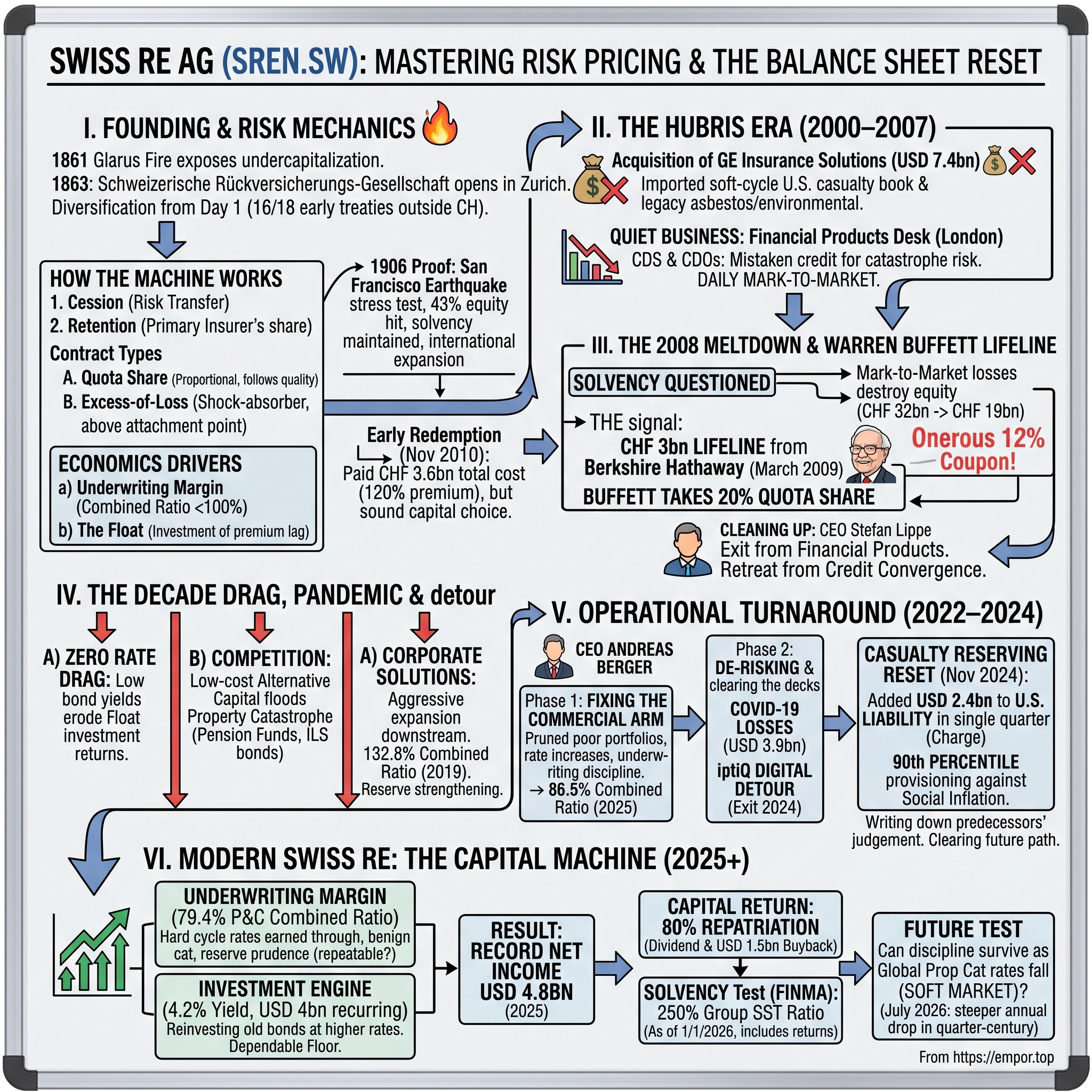
Swiss Re AG: The Master Risk-Pricer and the Battle for Balance Sheet Truth
I. Introduction & Episode Roadmap
There is a particular kind of quiet that settles over a reinsurance company in the days before it tells the market it got something badly wrong.
In the autumn of 2024, inside Swiss Re's headquarters at Mythenquai 50 on the western shore of Lake Zurich, a newly installed chief executive was working through the least glamorous document in finance: an actuarial reserve triangle. Not a growth deck, nor an AI roadmap, but a grid of numbers showing, accident year by accident year, how much money the company had set aside to pay American liability claims that had already occurred but had not yet been billed. These stemmed from trucking accidents, product failures, medical incidents, and corporate negligence suits filed years earlier and still grinding through the U.S. court system. The triangle revealed an uncomfortable truth: claims were arriving larger than the models had assumed, and the gap was not closing.
Andreas Berger had been Group CEO for roughly three months. He could have followed industry convention: trickle the shortfall into earnings over five or six quarters, a few hundred million at a time, and let the problem quietly dissolve into the noise of natural catastrophe seasons. Instead, on November 7, 2024, Swiss Re announced it was adding USD 2.4 billion to its U.S. liability reserves in a single quarter — a charge that took the year's total U.S. liability additions to USD 3.1 billion and cut full-year net income guidance from USD 3.6 billion to roughly USD 3 billion.12 It was, in effect, a new chief executive publicly writing down his predecessors' underwriting judgment in a single line.
That decision serves as the hinge of this narrative and makes Swiss Re AG (SREN.SW, listed on the SIX Swiss Exchange) a critical case study in institutional turnaround. Swiss Re is a 163-year-old institution that generated USD 43.1 billion of insurance revenue in 2025 and posted a record Group net income of USD 4.8 billion, up 47%, on a return on equity of 19.6%.1 It is also an institution that, within living memory of its current shareholder base, nearly destroyed itself with credit derivatives, overpaid for an American acquisition, endured a decade of soft pricing, absorbed USD 3.9 billion of pandemic losses, and expended capital and executive focus on a digital insurance venture it eventually shut down.1012
The central thesis is that reinsurance is one of the few industries where the product is a promise about the future, the cost of goods sold remains uncertain for up to a decade, and management retains wide discretion over what constitutes "profit" in any given year. Consequently, balance sheet honesty — rather than top-line growth or technological innovation — represents a reinsurer's most valuable asset. Swiss Re depleted that asset between 2005 and 2020 and spent the subsequent three years working to rebuild it. The central question in July 2026 is whether that balance sheet restoration is complete and whether it will suffice, as the pricing cycle has turned hostile: global property catastrophe rates fell roughly 16% at the June and July 2026 renewals, marking the steepest annual decline in a quarter-century.14
This creates a clear operational tension: a company that has restored underwriting discipline precisely as market conditions stop rewarding price discipline.
The investigation spans eight distinct sections. First, the origin — a Swiss town that burned down in 1861 and the financial machine built in response, alongside the core mechanics of reinsurance revenue. Second, the era of expansion: the 2006 acquisition of GE Insurance Solutions and the growth of the London derivatives desk. Third, the 2008 financial crisis and the CHF 3 billion lifeline from Warren Buffett that stabilized the balance sheet at significant cost. Fourth, the decade-long grind — a soft pricing cycle, underwriting losses in commercial insurance, pandemic claims, and the iptiQ venture. Fifth, the operational turnaround and reserving reset. Sixth, Swiss Re's current segment structure and accounting framework. Seventh, an evaluation of whether its competitive moat is structural or regulatory. Eighth, the bull and bear cases evaluated against a softening market, concluded by the key metrics that will signal whether the strategic pivot succeeded.
The story begins with a fire.
 Subscribe on LinkedIn
II. The Founding & The Mechanics of Risk Pooling (1863–1990s)
On the night of May 10, 1861, a föhn wind — the hot, dry downslope gale that funnels through Alpine valleys — swept through the canton of Glarus in eastern Switzerland. A fire started, and the wind did the rest. By the following day, roughly 600 buildings were destroyed, and the town, a textile manufacturing center and one of the most industrialized corners of Switzerland, was largely gone.5
The financial arithmetic of that night established the reason Swiss Re exists. Losses exceeded 8 million Swiss francs, while the canton's compulsory fire insurance fund held about 250,000 francs.5 In a single evening, the local insurance system was exposed as severely undercapitalized for the risk it purported to cover. Swiss primary insurers could write policies, but they lacked the capacity to pay catastrophic claims.
Moritz Ignaz Grossmann, an insurance practitioner based in St. Gallen, recognized that Switzerland needed a fundamentally different structural layer: an independent company designed specifically to absorb concentrated primary losses and spread them across multiple clients and geographies.5 On December 19, 1863, Schweizerische Rückversicherungs-Gesellschaft opened in Zurich, capitalized with 6 million Swiss francs and backed by Helvetia Assurances, Schweizerische Kreditanstalt (later Credit Suisse), and Basler Handelsbank.56
The founders embedded geographical diversification from inception: of the company's first 18 treaties, only two were with Swiss clients.5 A reinsurer that concentrates risk in a single country merely shifts regional vulnerability up one level. Geographic spread was not an afterthought; it was the core business model.
How the machine actually works
Stripped of actuarial jargon, reinsurance operates as a balance-sheet shock absorber with multi-decade cash-flow cycles.
A primary insurer collects small premiums from policyholders to cover everyday claims. That model functions until a major catastrophe strikes. A severe hurricane, earthquake, pandemic, or industrial loss can generate claims that eclipse an insurer's annual premium volume. To protect its capital, the primary insurer — known as the cedant — buys reinsurance, ceding a portion of its premium income to transfer peak risk.
Reinsurance contracts generally take two structural forms:
- Quota share: The reinsurer takes a fixed percentage of a primary insurer's entire portfolio — taking, for example, 30% of all premiums and paying 30% of all claims. As a proportional arrangement, the reinsurer's profitability directly tracks the cedant's underwriting quality.
- Excess-of-loss: The reinsurer pays nothing until claims surpass a pre-agreed threshold, known as the attachment point, and then covers losses above that level up to a defined limit. The attachment point determines how much risk the primary insurer retains versus how much transfers to the backstop, making it a critical variable across pricing cycles.
Contracts are further divided into treaty reinsurance — automatic, portfolio-wide arrangements covering an entire class of business annually — and facultative reinsurance, where individual high-value or unusual risks, such as a satellite launch or an oil refinery, are underwritten separately.
Reinsurance economics depend on two primary drivers:
- Underwriting margin: Premium revenue remaining after paying claims and operating expenses. The industry evaluates this through the combined ratio (total losses and expenses divided by earned premiums). A combined ratio below 100% indicates an underwriting profit, while a ratio above 100% indicates an underwriting loss before investment returns.
- The float: Premiums are collected upfront, while claims — particularly on long-tail casualty lines — may not be fully settled for years or decades. In the interim, the reinsurer invests this capital pool, generating investment income.
This extended lag creates structural reporting risk. A reinsurer can recognize underwriting profits today on contracts that ultimately prove underpriced years later, and external observers cannot easily verify reserve adequacy in real time. Reported earnings depend directly on management's reserving assumptions.
The 1906 proof
Swiss Re's solvency framework faced its first major stress test on April 18, 1906, when the San Francisco earthquake and subsequent firestorm devastated the U.S. West Coast insurance market. Swiss Re's share of the claims reached 4.3 million Swiss francs against total capital of 9.9 million — absorbing more than 43% of its equity from a single overseas event.6
By meeting its obligations in full, Swiss Re demonstrated that its reserve buffers could withstand extreme stress, establishing a market reputation for solvency. The company expanded internationally over the following decades: opening a U.S. branch in 1910, acquiring majority control of British reinsurer Mercantile & General in 1916, writing its first aviation hull policy in 1924, and becoming the world's largest reinsurer by 1938 with 297 million Swiss francs in premium.6 Post-war geographic expansion continued into South Africa in 1950, Hong Kong in 1956, and Toronto in 1959, adding non-correlated risks to the portfolio.6
This historical record highlights two foundational assets for a reinsurer: capital credibility and cumulative claims data. Each major catastrophe paid reinforced its standing with cedants while refining the historical loss dataset used to price future contracts.
That capital standing and historical dataset formed Swiss Re's inheritance heading into the 1990s — providing an AA-tier balance sheet, global scale, and actuarial depth.
III. The GEIS Acquisition & The Hubris Era (2000–2007)
By the early 2000s, a peculiar idea had taken hold across financial services: that risk was fungible. If an institution could price hurricanes, the logic went, it could price credit. If it could model mortality, it could model mortgage defaults. Insurance, banking, and capital markets were converging into a single business of transferring risk for a fee, and the market would reward the institutions that operated across all of it.
AIG had built AIG Financial Products on that exact premise. Reinsurers everywhere were pushing into direct commercial insurance, structured finance, and credit protection. Sitting atop the industry's most respected balance sheet, Swiss Re decided to lead that convergence rather than watch it.
Jacques Aigrain personified that ambition. A former JPMorgan investment banker who joined Swiss Re in 2001 and became CEO in 2006, Aigrain brought a capital markets sensibility to a business historically governed by actuaries. Under his tenure, the company pursued two initiatives simultaneously — one visible and massive, the other quiet and, ultimately, far more dangerous.
Buying the world's largest reinsurer
The visible initiative was the acquisition of GE Insurance Solutions (GEIS). In November 2005, Swiss Re agreed to acquire General Electric's reinsurance arm, closing the transaction on June 12, 2006. Swiss Re accounted for the purchase at USD 7.4 billion including closing adjustments; GE reported USD 7.8 billion in cash and securities alongside the assumption of USD 1.7 billion in debt.7 The deal structure carried long-term balance sheet consequences: roughly USD 2.4 billion was paid in newly issued Swiss Re shares, combined with USD 500 million in mandatory convertibles, leaving GE with an 8.9% stake in the acquirer.7 Swiss Re inherited 2,500 employees across 50 offices in 22 countries — including Employers Reinsurance Corporation and the GE Frankona entities — and projected at least USD 300 million in annual cost synergies by the end of 2007.7
Aigrain's framing was unambiguous: the deal "consolidates further Swiss Re's global leadership position," creating what the company described as the world's largest and most diversified global reinsurer.7 On paper, Swiss Re had surpassed Munich Re in gross written premium, capping off what appeared to be a defining strategic triumph.
The underlying asset told a different story. GE Insurance Solutions represented the accumulated insurance operations of a conglomerate whose defining management imperative had been meeting quarterly targets. At its core, the portfolio was a long-tail U.S. casualty book — spanning general liability, workers' compensation, professional lines, and commercial auto — written during the late 1990s and early 2000s. The industry now recognizes that period as one of the softest and least disciplined underwriting eras on record. Layered on top were legacy asbestos and environmental exposures dating back decades. GE had sought to exit the insurance market for years but had been unable to find a buyer willing to pay its asking price.
This critique does not rely on hindsight. The strategic flaw was what Swiss Re was actually buying. Premium volume was immediately recognizable on the top line, but the underlying liabilities were mere estimates — established by another institution — for claims that would not fully emerge for 15 years in a legal system notorious for volatile liability awards. Swiss Re effectively imported a decade of adverse reserve development while booking immediate premium growth.
A comparison with peers underscores the misstep. Hannover Re spent the same era expanding organically with an obsessive focus on maintaining the industry's lowest expense ratio, avoiding transformational acquisitions altogether. Munich Re, the rival Swiss Re had briefly eclipsed in scale, declined to chase a large legacy U.S. casualty book at the market peak. Both competitors ended the decade with smaller top lines but far healthier balance sheets. Scale in reinsurance is valuable only when the underlying risk is priced correctly; scale in underpriced risk merely deepens future losses.
The quiet business
The second initiative attracted far less public notice at the time but nearly proved fatal. Swiss Re established a financial products division, operated primarily out of London and Zurich, that wrote credit default swaps (CDS) and sold protection on structured credit products — including instruments tied to U.S. subprime residential mortgage-backed securities and collateralized debt obligations (CDOs).
The internal logic was superficially persuasive. A credit default swap functions much like an insurance contract on a bond: the seller collects periodic premiums and pays out if the underlying credit defaults. Because Swiss Re was renowned for pricing low-frequency, high-severity tail risk, management reasoned that credit risk was no different from catastrophe risk.
That logic ignored two fundamental distinctions: correlation and mark-to-market accounting. A hurricane in Chile has virtually no statistical correlation with a Japanese typhoon; natural catastrophe risks are largely independent, providing the mathematical foundation for risk pooling. Structured credit operates on the opposite principle. The individual mortgages bundled into a CDO share exposure to the same U.S. housing market and macroeconomic conditions, meaning that when defaults rise, they rise simultaneously. Furthermore, while conventional reinsurance liabilities are recorded via actuarial estimates, derivative contracts are marked to market daily. A reinsurer can hold an underpriced catastrophe treaty to maturity without immediate balance sheet distress, but an underwater CDS portfolio triggers immediate fair-value write-downs against equity.
Swiss Re had unwittingly traded a diversified, slow-moving liability portfolio governed by actuarial judgment for a concentrated, fast-moving portfolio exposed to immediate market pricing. Worse still, key segments of this credit exposure were left unhedged.
By late 2007, market marks were deteriorating. By 2008, they were collapsing.
IV. The 2008 Meltdown & The Warren Buffett Lifeline (2008–2010)
February 5, 2009, was a difficult day for Swiss Re shareholders, and an unusually revealing one regarding how a 145-year-old institution behaves when its solvency comes into question.
The company disclosed that it expected a net loss of roughly CHF 1 billion for 2008 — compared with a prior-year profit of CHF 4.16 billion — and that shareholders' equity, which had stood at CHF 31.9 billion at the end of 2007, would fall to between CHF 19 billion and CHF 20 billion. Underwriting had actually performed well. The damage stemmed from mark-to-market losses on the legacy portfolio of structured credit default swaps and trading positions written by the former financial products division. The stock had lost close to two-thirds of its value since the start of the year, a materially worse collapse than Munich Re suffered over the same stretch.8
What was at stake went far beyond the immediate share price. A reinsurer's core product is a promise to pay in the future. If counterparties doubt that promise, they stop buying — and unlike a bank, which fails when depositors run, a reinsurer fails when customers run. Cedants renewing on January 1 could simply place their treaties with competitors such as Munich Re or Hannover Re. A ratings downgrade would have made that flight rational and potentially irreversible. Swiss Re required less of a liquidity infusion than a convincing public signal that its balance sheet was beyond question.
The most expensive stamp of approval in insurance history
That signal arrived from Omaha. In the same announcement window, Berkshire Hathaway committed CHF 3 billion of fresh capital to Swiss Re, finalized in March 2009, structured as a convertible perpetual instrument paying a 12% coupon.89 Swiss Re retained the right to defer interest and pay it in shares rather than cash.9 Berkshire simultaneously took a 20% quota share of Swiss Re's property and casualty reinsurance book, relieving capital strain by handing a slice of the risk — and the required capital behind it — to an unassailably solvent counterparty.
The terms were onerous. A 12% perpetual coupon on CHF 3 billion required CHF 360 million annually in cash from a company that had just recorded a net loss. Redemption before March 2011 required paying 140% of face value.9 The arrangement was less a vote of confidence in Swiss Re's franchise than a heavily collateralized rescue loan priced by the sole buyer willing to provide capital at scale.
The trade unfolded as the terms dictated. In November 2010, Berkshire agreed to accept 120% of face value rather than 140% for early repayment — a CHF 600 million premium that brought the total redemption cost to roughly CHF 3.6 billion — while Swiss Re additionally paid interest through the first quarter of 2011.9 Because the Swiss franc appreciated from about USD 0.886 in March 2009 to roughly USD 1.035 by November 2010, Berkshire gained an additional 16.9% currency return on top of the coupon and redemption premium.9
For Swiss Re, early redemption represented sound capital allocation. Paying a CHF 600 million premium to eliminate a CHF 360 million annual drag broke even in under two years while removing a visible marker of distress from the balance sheet. Yet the episode offered an enduring lesson for the industry: emergency capital for a reinsurer is ruinously expensive because a reinsurer in distress has compromised the very security it sells. The only true buffer is maintaining robust capital reserves during profitable years — a principle that resurfaces when evaluating Swiss Re's current solvency ratio and capital return policy.
Cleaning up
Aigrain stepped down on February 12, 2009, stating that "the interests of Swiss Re are now best served by a change in executive leadership."8 He was succeeded by Stefan Lippe, the 53-year-old deputy CEO and a career underwriter rather than an investment banker. Lippe had built much of Swiss Re's underwriting discipline and quality framework, making his appointment a deliberate reversion to core principles.8
What followed was a systematic retreat from the financial convergence strategy. Management ring-fenced and ran off the legacy credit portfolio, dismantled the financial products unit, and de-risked the investment portfolio. Over the next several years, the company focused on re-establishing its core business: underwriting insurance risk rather than structuring credit exposure.
The strategy proved effective and restored balance sheet stability, but the timing presented new challenges. Swiss Re emerged from its self-inflicted crisis into a global reinsurance market that was about to endure a decade-long structural shift driven by external forces.
V. The Soft Market Drag, Pandemic Shock, & The iptiQ Experiment (2011–2022)
If the 2008 financial crisis was an acute shock, the decade that followed presented a chronic drag on shareholder returns.
Two macroeconomic forces converged. First, central banks pushed government bond yields toward—and in some cases below—zero after the financial crisis, directly eroding investment returns across the industry. The float—the capital pool held between premium collection and claims payment—generates minimal yield when high-grade bonds return 1%. Reinsurers accustomed to earning reliable spreads on invested premiums were forced to generate virtually all profits from underwriting margins.
Second, structural shifts introduced low-cost competition to the industry's highest-margin product. Pension funds and institutional asset managers, searching for yield in a zero-rate environment, expanded into catastrophe bonds and insurance-linked securities. These instruments allowed institutional investors to assume natural disaster risk directly in exchange for a coupon, offering low correlation with traditional equity and credit markets. Capital flooded into the asset class.
This influx disintermediated traditional reinsurers. Property catastrophe coverage—long Swiss Re's most profitable business line—could now be sourced from institutional investors operating with lower cost-of-capital requirements and no need for rating-agency capital charges. Property catastrophe rates declined steadily across most of the decade. While traditional rated balance sheets remained essential for complex, long-tail liability risks, standard catastrophe layers could be modeled, collateralized, and transferred directly to institutional investors.
Corporate Solutions loses the plot
Facing compressed margins in wholesale reinsurance, Swiss Re expanded downstream through Corporate Solutions. The business unit wrote property, casualty, marine, and specialty coverage directly for large commercial clients rather than primary insurers. The strategic rationale was to capture primary underwriting margins and diversify group revenue.
Execution, however, proved flawed. Direct commercial insurance requires underwriting individual accounts against entrenched local brokers who understand regional market dynamics. In a soft market, rapid top-line growth often requires undercutting incumbent rates. Corporate Solutions expanded by writing business that established commercial carriers deliberately avoided.
The financial consequences emerged in 2019. In the first half of that year, Corporate Solutions recorded a combined ratio of 132.8%—paying out roughly 1.33 Swiss francs in claims and expenses for every franc of premium earned—and posted a net loss of USD 403 million. The performance required a USD 328 million claims reserve strengthening in the second quarter, alongside an Adverse Development Cover underwritten by Swiss Re's own Property & Casualty Reinsurance unit to cap further downside.11 Management responded by active pruning of underwriting portfolios and implementing significant rate increases.11
The setback demonstrated that group-level actuarial capabilities do not automatically transfer to primary commercial lines. Underwriting discipline is an account-level practice that can rapidly degrade under aggressive top-line growth targets.
The pandemic
In 2020, the global insurance industry confronted a systemic event long modeled in theory but unprecedented in modern practice.
Swiss Re recorded USD 3.9 billion in COVID-19 losses for 2020, alongside USD 1.7 billion in natural catastrophe claims driven by U.S. hurricanes and severe secondary peril events, resulting in a Group net loss of USD 878 million.10 Excluding pandemic claims, the underlying business earned USD 2.2 billion in net income—up from USD 727 million in 2019—indicating that operational turnarounds were taking effect.10 Swiss Re projected an additional USD 500 million in pandemic-related claims for 2021.10
Pandemic losses affected business units unevenly. Life and health reinsurance absorbed significant mortality claims following spikes in excess deaths across the U.S., the UK, Latin America, and India. Property and casualty lines faced event cancellation claims, credit losses, and litigation over business interruption coverage, focusing on whether government lockdown orders constituted physical property damage. Amid these pressures, Corporate Solutions generated USD 393 million in net income at a 16.5% return on equity, providing early evidence of its operational recovery.10
iptiQ: the strategic detour
Concurrently, Swiss Re developed iptiQ, a white-label digital insurance platform launched in 2014. Operating on a B2B2C model, iptiQ provided the regulated risk carrier, product design, and technology infrastructure for third-party distributors—such as banks, retailers, brokers, and insurtechs—which sold life and non-life policies under their own consumer brands.
The venture struggled to achieve profitability. Customer acquisition costs remained high because distribution partners captured most of the economic margin. Continuous technology development required substantial capital, while business volume fell short of the scale required to cover fixed overhead. Within a group generating tens of billions in annual revenue, iptiQ remained a small operation that consumed significant executive attention.
Swiss Re initiated a complete exit from the venture in 2024. On November 5, 2024, the company agreed to sell iptiQ's European property and casualty business—including Luxembourg risk carrier iptiQ EMEA P&C SA, over 100 employees across five European markets, distribution agreements, and approximately 130,000 policyholders—to Allianz Direct, stating that the platform no longer fit the Group's long-term strategic goals.13 Hannover Re acquired the Australian direct life portfolio, completing the exit from Asia-Pacific. By the time the 2025 financial accounts closed, all iptiQ operations had been sold or placed into run-off.1
While iptiQ did not pose a material financial risk to Swiss Re, it absorbed management bandwidth during a period when long-tail U.S. casualty liabilities were quietly accumulating in the core Property & Casualty Reinsurance division. That allocation of attention established the context for the reserve restructuring that followed.
VI. The Turnaround: Corporate Solutions & The Casualty Reserving Reset (2022–2024)
Every corporate turnaround needs a proof of concept — a smaller, contained problem that a leader fixes visibly enough to earn the right to attempt the larger one. For Andreas Berger, that proof was Corporate Solutions.
Phase I: Fixing the commercial arm
Berger arrived at Swiss Re in March 2019 to run Corporate Solutions, joining the Group Executive Committee at the moment the unit's losses were becoming impossible to explain away.[^22] His background was unusual for Swiss Re: he began in insurance in 1995 as a leadership trainee at the Gerling Group, spent time at Boston Consulting Group, returned to Gerling as head of commercial and international programme business, and then spent thirteen years inside Allianz Global Corporate & Specialty — first as global head of market management when AGCS was created in 2006, then as CEO of its London-based regional unit covering the UK, Ireland, South Africa, the Middle East and Benelux from 2009, and from 2011 on the AGCS board as Chief Regions & Market Officer.[^22]
That executive background was directly relevant. Berger was not a reinsurance actuary handed a commercial insurance problem; he was a career corporate insurance executive from Swiss Re's primary competitor in that segment who understood from the inside how large-account underwriting is won and lost.
The playbook he ran was unglamorous and effective: exit underperforming portfolios entirely rather than reprice them, push rate increases through on what remained, rebuild risk selection discipline account by account, and accept the temporary revenue contraction. The Corporate Solutions combined ratio moved from 132.8% in 2019 to 86.5% in 2025, generating net income of USD 988 million against insurance revenue of USD 7.7 billion.1 The unit that had been the Group's most visible operational drag became an annual profit contributor of nearly one billion dollars.
The key insight from this turnaround extends beyond individual management talent. What the Corporate Solutions record demonstrates is a specific and disciplined willingness to shrink a business deliberately, absorb a top-line decline, and accept reported growth deterioration in exchange for underwriting quality that emerges years later. That behavioral pattern — verified over a five-year period with published financial results — represents a core operational asset for the company.
Phase II: The succession
In 2024, Christian Mumenthaler stepped down as Group CEO after eight years in the role and roughly a quarter-century at the company, and Berger was appointed Group Chief Executive Officer effective July 1, 2024.[^22]
The strategic signal in that appointment was clear. Swiss Re selected an executive whose tenure had been defined by cutting unprofitable business rather than expanding digital or diversification initiatives. Where Mumenthaler's era emphasized strategic breadth — including iptiQ, distribution partnerships, and the convergence of primary and reinsurance markets — Berger's mandate focused on technical execution: enforcing underwriting discipline, reducing operating costs, and maintaining balance sheet strength.
Phase III: Clearing the decks
This brings the narrative back to the actuarial reserve triangle.
The problem Berger confronted stemmed primarily from the U.S. casualty market. Over the preceding decade, U.S. liability claim costs had risen well above baseline inflation, driven by social inflation. Third-party litigation funding — where institutional investors finance plaintiff lawsuits in exchange for a portion of court awards — converted liability claims into an asset class, increasing trial frequency over early settlements. Plaintiff tactics shifted, with attorneys anchoring juries to higher settlement baselines, making nuclear verdicts exceeding USD 10 million increasingly common in commercial auto and product liability lines. Additionally, several U.S. state legislatures reopened statutes of limitations for historical claims, while legal liability theories expanded to capture broader classes of corporate defendants.
For a reinsurer, long-tail liability inflation creates a delayed accounting risk. Casualty claims underwritten in 2020 may not be settled until 2028. If court severity trends exceed reserving assumptions, annual reported underwriting profits are overstated, with the shortfall emerging only years later.
On November 7, 2024, Swiss Re addressed the shortfall in a single action, adding USD 2.4 billion to U.S. liability reserves in the third quarter and bringing year-to-date U.S. liability reserve additions to USD 3.1 billion, partially offset by reserve releases in other business lines.12 The reserve adjustment targeted recent underwriting years — pushing assumed ultimate loss ratios for accident years 2020 through 2022 from roughly 70% to roughly 90% — whereas older accident years from 2016 to 2019 were already reserved above a 100% loss ratio and required smaller adjustments.12 Management stated it had set overall property and casualty reserves at approximately the 90th percentile of its best-estimate range, with Berger noting that "the significant amounts we have added reflect the incorporation of an adverse future scenario into our reserving assumptions."12
Reserving at the 90th percentile establishes a conservative buffer above the actuarial midpoint. Rather than projecting baseline claims costs, Swiss Re provisioned for an adverse future claims environment, creating potential upside if legal inflation moderates. Then-CFO John Dacey confirmed that the company was "modeling continued deterioration of U.S. liability cost year-on-year," expecting that trend to persist for four to five years.12 Alongside the reserve adjustments, Swiss Re reduced its U.S. liability exposure by 21% at renewals, aligning portfolio size with its revised risk assumptions.12
The immediate financial impact was substantial: third-quarter 2024 net income fell to USD 102 million, and full-year guidance was lowered from USD 3.6 billion to approximately USD 3 billion.12 Berger described the restructuring as placing the company "into a new position."12
A rigorous financial assessment requires examining the structural implications of this choice. A substantial upfront reserve charge by an incoming CEO represents a classic balance sheet reset. By absorbing legacy losses immediately, management lowers the baseline for future earnings, transitions past underwriting liabilities into inherited charges, and builds reserve buffers that can be released into future income. Swiss Re's subsequent financial performance reflects both underlying operational strength and the structural support of conservative reserve positioning.
The long-term validation of this strategy depends on multi-year claims trends. If U.S. casualty reserves established in 2024 prove sufficient through 2027 and 2028 without further strengthening, the balance sheet reset will have achieved its objective. Conversely, if legal inflation requires additional reserve additions, the re-underwriting effort will remain incomplete.
VII. Modern Swiss Re: Segment Anatomy, Capital Mechanics, & Management (2025–Present)
On the morning of February 27, 2026, Swiss Re reported the best results in its history — and the market response was complicated, because everyone in the room already knew the pricing cycle had turned.
Group net income for 2025 reached USD 4.8 billion, up 47%, on insurance revenue of USD 43.1 billion and a return on equity of 19.6%.1 Book value per share rose to USD 85.15 from USD 74.44.1 The insurance service result — the IFRS 17 measure of underwriting profit — climbed 36% to USD 5.8 billion.1 The Group hit a target it had set of more than USD 4.4 billion, and it did so with room.4
Here is what sits underneath.
Property & Casualty Reinsurance: the earnings engine
P&C Re generated USD 2.8 billion of net income in 2025, up from USD 1.2 billion, on insurance revenue of USD 18.7 billion, at a combined ratio of 79.4% against a target of below 85%.1 A 79.4% combined ratio in a business of this scale is an exceptional outcome, and it is important to be precise about why it happened, because the drivers are not equally repeatable.
Three things contributed. Rate levels achieved during the 2023–2024 hard market — when reinsurers collectively raised attachment points and forced primary insurers to retain far more of their own frequency losses — were still earning through the book. Natural catastrophe experience was benign, with actual losses running below the roughly USD 2 billion annual catastrophe budget.17 And the reserving posture established in 2024 meant that reserves set conservatively were developing favourably.
Only the first of those is a durable competitive result. The second is weather. The third is the mechanical unwind of prior prudence. An investor should mentally normalise a mid-80s combined ratio for this business across a full cycle, not 79%.
Life & Health Reinsurance: the one that missed
L&H Re earned USD 1.3 billion in 2025 against roughly USD 1.5 billion in 2024, on insurance revenue of USD 16.5 billion, and it missed its own target of approximately USD 1.6 billion.117 The miss is instructive. The decline reflected roughly USD 0.65 billion of negative assumption updates concentrated on underperforming portfolios in Australia, Israel and South Korea — a review that management had flagged at the December 2025 Management Dialogue as materially complete, with an estimated fourth-quarter pre-tax IFRS earnings impact of about USD 250 million.4 The company also added uncertainty loads to new business as a resilience measure.17 Claims experience on the major portfolios, including US mortality, ran in line with expectations.1
This is the same behaviour pattern as the casualty reset, applied to a different book: identify a set of underperforming portfolios, take the hit in one window, miss the target, and say so. Management's willingness to miss a published target rather than manage to it is, in a business built on estimates, a meaningful data point.
The economics of L&H are worth explaining because they are the least understood part of Swiss Re. This business reinsures mortality (the risk people die sooner than expected), morbidity (that they get sick), and longevity (that pension liabilities run longer than funded). These are long-duration contracts, and under IFRS 17 the expected future profit on them sits on the balance sheet as the Contractual Service Margin — a stock of unearned profit that is released into income over the life of the contracts. Swiss Re's L&H CSM balance stood at USD 17.0 billion at the end of 2025, with USD 1.1 billion of new business CSM added during the year.1
Think of the CSM as a reservoir. New business fills it; each year's earnings drain a portion of it. It makes L&H earnings far more predictable than P&C — but it is not a bank account. If mortality or morbidity assumptions worsen, the CSM absorbs the revision first, silently, and only overflows into reported profit when the assumption change exceeds what the reservoir can absorb. That is precisely what the Australia, Israel and South Korea write-downs represented. A reader monitoring this business should watch new business CSM and assumption updates, not just reported net income.
Corporate Solutions and the credit and surety build
Beyond the 2025 numbers already cited, Corporate Solutions added USD 834 million of new business CSM and, in February 2026, agreed to acquire QBE's Global Trade Credit and Surety business — a portfolio generating roughly USD 200 million of annual revenue across Australia, New Zealand and the UK, excluding QBE's French bonds operation, on undisclosed terms and subject to regulatory approval.122 Corporate Solutions CEO Ivan Gonzalez framed it as strengthening a global credit and surety platform with a well-managed, profitable portfolio.22
The scale here is the point. A bolt-on adding USD 200 million of revenue to a USD 43 billion Group is a portfolio adjustment, not a strategic pivot — and after the GEIS experience, the modesty is arguably the feature. On the first quarter 2026 call, Berger was direct about the Group's M&A posture: "we don't need an M&A. We're not a distressed buyer. We have actually a very solid portfolio."3
The investment engine reawakens
The second profit engine, dormant for a decade, has come back. Recurring investment income exceeded USD 4.0 billion in 2025 at a recurring income yield of 4.2%, up from 4.0%, with the reinvestment yield reaching 4.4% by the fourth quarter.117 The overall return on investments was 4.0%, reflecting recurring income plus a positive equity contribution, partially offset by realised losses on targeted fixed income sales.1
The mechanism is simple and powerful. A bond portfolio bought during the zero-rate era matures gradually and gets reinvested at today's yields. Every maturity that rolls from a 1.5% coupon into a 4.4% one permanently lifts income with no additional risk-taking and no management skill required. This is the most reliable tailwind in the Swiss Re story — and, critically, it is a tailwind that continues even if underwriting margins compress, which is exactly what makes the current soft market survivable rather than existential. It reverses only if central banks cut rates hard and fast.
Capital, solvency, and what gets returned
Swiss Re's regulatory capital measure is the Swiss Solvency Test, administered by FINMA, the Swiss Financial Market Supervisory Authority.[^21] In plain terms, the SST ratio compares the economic value of assets minus liabilities against the capital required to survive a severe one-in-two-hundred-year stress. A ratio of 100% means you have exactly enough. Swiss Re reported an estimated Group SST ratio of 250% as of January 1, 2026 — already including the impact of proposed capital repatriation — and 252% as of April 1, 2026, against a target range of 200–250%.12
That surplus drove the 2025 capital return decision: a proposed dividend of USD 8.00 per share, up 9% from USD 7.35, plus a share buyback of up to USD 1.5 billion for 2026, comprising the USD 500 million sustainable annual programme announced at the December 2025 Management Dialogue plus a USD 1 billion extraordinary tranche — total repatriation of roughly 80% of 2025 earnings.1417 The dividend is denominated in US dollars, and management has committed to growth of 7% or more per year over the next two years, subject to board approval, alongside a multi-year IFRS return on equity target above 14%.4
Returning 80% of a record year's earnings while sitting slightly above the top of your own solvency target range is a defensible reading of surplus capital. It is also, viewed through the lens of Section IV, precisely the moment at which reinsurers historically feel most comfortable and are most wrong. The counterargument management would make — that the reserve position is at the 90th percentile and the retro programme is intact — is reasonable. The skeptical observation is that a company one year past a USD 2.6 billion reserving problem is now distributing four-fifths of its profit, and that capital returned cannot be un-returned when the cycle turns.
The first quarter of 2026
The most recent scorecard, reported May 7, 2026, showed Group net income of USD 1.5 billion, up 19%, on insurance revenue of USD 10.0 billion, with a return on equity of 23.6% and a return on investments of 4.6%.218 P&C Re delivered net income of USD 754 million against USD 527 million a year earlier at a combined ratio of 79.5%, versus 86.0% in the prior-year quarter.2 L&H Re contributed USD 491 million, Corporate Solutions USD 262 million at an 85.1% combined ratio, and new business CSM came in at USD 1.2 billion.218 Natural catastrophe losses in P&C Re were just USD 133 million, essentially Storm Kristin in Portugal.2
Management's own framing was careful. The 4.6% investment return, CFO Anders Malmström told analysts, was "obviously higher than what you would usually expect. This is a one-off. You should not expect that to come in the future quarters."3 A CFO volunteering that a strong number is not repeatable, unprompted, is worth noting.
The quarter also included a defensive move that has received less attention than it deserves: Swiss Re established USD 400 million of IBNR reserves — "incurred but not reported," the actuarial provision for claims that exist but have not yet been notified — against potential inflation impacts from Middle East conflict, while retaining USD 450 million of positive reserve releases elsewhere.3 The company is, in other words, still converting favourable development into new prudence rather than into reported profit.
Management and governance
The executive team is a substantially new one. Berger became Group CEO in July 2024.[^22] Anders Malmström succeeded John Dacey as Group CFO, Dacey having served as CFO through the 2024 reserve review before retiring; Malmström joined from Athora Holdings, having previously been CFO of Equitable Holdings in New York and of AXA US.1220 Jacques de Vaucleroy chairs the Board.20 Ivan Gonzalez runs Corporate Solutions.22 A Group Chief Transformation Officer, Henock Teklu, took up the role on April 1, 2026, and the Board nominated Jean-Jacques Henchoz — himself a former Swiss Re executive and, most recently, Hannover Re's chief executive — as a director, while Larry Zimpleman did not stand for re-election.1
On credibility, the record supports a qualified positive. Under this team Swiss Re took a reserve charge that cost it a target rather than deferring it, missed an L&H target and explained precisely why, set out a refreshed strategy with specific numbers at a December 2025 investor event, and then hit the Group target the following February.1412 The operating expense programme — USD 300 million of run-rate reduction targeted by 2027, with cost savings exceeding USD 100 million achieved in 2025 — is a specific, checkable commitment rather than an aspiration.417
The qualification is that this record is short. Two years of consistency after fifteen years of strategic wandering is a promising base rate, not a proven one, and the first genuinely hard test — a large catastrophe year or an adverse casualty development in a softening market — has not yet arrived.
VIII. Business Playbook & Strategic Powers
Stripping Swiss Re down to its structural core leaves one essential question for long-term investors: why do primary insurers pay the company a premium over pure risk costs, and how sustainable is that pricing power?
Helmer's 7 Powers, tested rather than asserted
Scale economies — real, but narrower than claimed. The genuine economic advantage stems from risk diversification rather than operating costs. Because losses across Japanese typhoons, Florida hurricanes, European windstorms, U.S. mortality, and Latin American earthquakes are largely uncorrelated, a portfolio containing all of them requires significantly less capital per unit of risk than five regional specialists would need independently. That capital-efficiency math is difficult for smaller entrants to replicate and explains why the top global reinsurers persist. On operating expenses, however, Swiss Re has historically lagged behind peers; Hannover Re has maintained a leaner cost structure for years, prompting Swiss Re to target a USD 300 million run-rate expense reduction.4 The scale advantage resides in balance-sheet efficiency, not administrative leverage.
Counterparty trust — real, and the most valuable asset. A cedant purchasing coverage against a one-in-two-hundred-year catastrophic event is betting that its reinsurer will remain solvent and capable of paying claims in that extreme scenario. Swiss Re's AA-tier balance sheet rating, an SST solvency ratio exceeding 250%, and a claims-paying record spanning from the 1906 San Francisco earthquake to the COVID-19 pandemic form an institutional asset that can only be accumulated over time.16 Commercial evidence indicates this standing remains intact: at the January 2026 contract renewals, Swiss Re successfully renewed USD 11.8 billion of the USD 12.5 billion in contracts up for renewal. Chief Executive Andreas Berger noted that even as primary insurers retained higher loss thresholds, "they need lead reinsurance partners, so our share of wallet in the market didn't reduce."16 Nevertheless, peers such as Munich Re, Hannover Re, and Berkshire Hathaway's National Indemnity command equivalent financial standing. Counterparty trust functions as a formidable barrier against outside entrants rather than a unique differentiator among top-tier peers.
Cornered resource — genuine, but increasingly contested. Swiss Re's proprietary loss database and catastrophe models, accumulated across more than 160 years, provide a genuine edge in pricing tail risks. Yet that moat is narrower than marketing materials imply. Commercial vendors such as Verisk, Moody's RMS, and CoreLogic sell sophisticated risk models broadly, enabling insurance-linked securities investors to price property catastrophe risks without operating a traditional reinsurance franchise. Swiss Re's proprietary advantage is strongest where external models are weakest and historical data is sparse: casualty severity trends, complex liability, cyber accumulation, and emerging risks. Crucially, those were the exact areas where industry-wide under-reserving occurred, raising legitimate questions regarding the standalone value of historical datasets. At its December 2025 Management Dialogue, Swiss Re pointed to its data and artificial intelligence platform as a driver to transform underwriting, claims processing, and data integration.4 That initiative represents a strategic aspiration that has yet to yield clear competitive differentiation.
Process power — the most defensible advantage. The expertise required to structure complex risk transfers — multi-year retrocession structures, bespoke casualty covers, longevity swaps, adverse development covers, and multinational corporate programs — relies on specialized institutional judgment and underwriting relationships built over decades. These complex structures cannot be easily packaged into standardized capital market securities, creating a persistent barrier against alternative capital providers.
Branding, network economies, and switching costs — largely absent. Reinsurance is a wholesale business with no consumer brand equity or network effects. Primary insurers frequently adjust or rotate their reinsurance panels during annual renewal cycles, meaning client retention is driven almost entirely by pricing, capacity, and counterparty trust.
Porter's Five Forces, as of mid-2026
Threat of new entrants: low for full-service franchises, high for dedicated capital. Replicating a rated, globally diversified, multi-line reinsurer from scratch remains virtually impossible. However, the competitive challenge comes from incoming capital rather than new corporate entities. Total global reinsurance capital reached a record USD 790 billion by March 31, 2026, propelled largely by expansion in alternative capital markets.21 Institutional capacity can now deploy into profitable property catastrophe layers in months rather than taking decades to establish an operating franchise.
Bargaining power of buyers: rising. Primary insurers possess viable alternatives, including raising retention levels, issuing catastrophe bonds, or reallocating business across competing reinsurers. Insurance broker Aon reported that reinsurance demand grew over 10% by mid-2026 against capital levels described as plentiful, enabling cedants to secure double-digit price reductions alongside expanded terms and conditions during the June and July renewals.21
Bargaining power of suppliers: moderate. Retrocession providers — reinsurers that cover other reinsurers — effectively establish the baseline cost of capital at the peak of the risk pyramid. Swiss Re selectively reduced its external retrocession purchases in early 2026, indicating that management viewed external retrocession pricing as unappealing relative to retaining risk on its own balance sheet.15
Threat of substitutes: high in property catastrophe, low in long-tail lines. A clear strategic divide separates business segments. Catastrophe bonds and insurance-linked securities can substitute for traditional property catastrophe capacity because property risks are short-tail, standardized, and easily collateralized. By contrast, capital markets cannot readily substitute for long-tail U.S. casualty, life and health reinsurance, or complex corporate risk programs, where claims require multi-year settlement horizons. Paradoxically, Swiss Re's most effective protection against capital market disintermediation relies on the complex casualty and life lines that previously generated its most severe underwriting losses.
Rivalry: oligopolistic, but facing price erosion. A small tier of global reinsurers — including Munich Re, Swiss Re, Hannover Re, SCOR, and Berkshire Hathaway's General Re and National Indemnity — dominates the market, alongside regional carriers such as China Re. Underwriting discipline remained firm during the 2023–2024 hard market cycle. However, market metrics from July 2026 indicate pricing discipline is softening across property lines, reflecting expanded capital supply and recent benign catastrophe losses.
The playbook lesson
Swiss Re's long-term operating history reveals a consistent pattern: the company generates attractive returns when concentrating on core wholesale risk pricing, and suffers capital erosion when expanding beyond it. Structured credit derivatives in the mid-2000s, the GE Insurance Solutions acquisition at the top of the casualty cycle, Corporate Solutions' early push for unpriced commercial volume, and the iptiQ digital retail platform each represented attempts to bypass wholesale reinsurance dynamics that ultimately resulted in financial setbacks. The current management strategy pursues the inverse: fortifying core underwriting, exiting non-core ventures, and prioritizing margin over premium volume. How effectively that discipline withstands an accelerating soft market cycle remains the primary operational test facing the firm.
IX. Investment Case: Bull vs. Bear Stress Test & Current Risk Radar
On July 1, 2026, the annual renewal outcome arrived that the reinsurance industry had anticipated and expanding market capacity had quietly enabled.
Guy Carpenter's Global Property Catastrophe Rate-on-Line index dropped roughly 16% year on year, as risk-adjusted price reductions accelerated following the January renewals.14 In North America, rate cuts reached 20% to 25% on the best-performing accounts.14 Dean Klisura, Guy Carpenter's president and CEO, attributed the decline to abundant reinsurer capacity driving an increasingly competitive pricing environment.14 It marked the steepest annual price drop in a quarter-century — eclipsing the soft market of the 2010s — while Gallagher Re projected sector return on equity to fall from nearly 19% in 2025 to between 14% and 15% in 2026.
That pricing shift forms the core backdrop for evaluating Swiss Re's current position.
The bull case
The optimistic thesis centers on balance sheet restoration and earnings resilience.
First, balance sheet cleaning has been rigorous and verifiable. Property and casualty reserves sit at approximately the 90th percentile of the best-estimate range, the Life & Health portfolio review is complete, the iptiQ retail platform has been exited, and management has continued building provisions — adding a USD 400 million Middle East incurred-but-not-reported provision in the first quarter of 2026 rather than maximizing reported earnings.312
Second, higher investment yields provide a structural earnings cushion. Recurring investment income exceeding USD 4.0 billion at a 4.2% yield, combined with reinvestment yields above that level, creates a dependable earnings floor that was absent during the previous soft market.117
Third, revenue remains diversified across non-correlated segments. Swiss Re targets USD 4.5 billion in Group net income for 2026, backed by USD 1.7 billion from Life & Health Re, a combined ratio below 85% in Property & Casualty Re, and a combined ratio under 91% in Corporate Solutions.4 First-quarter net income reached USD 1.5 billion, delivering one-third of the full-year target.3
Finally, capital return has been formalized alongside demonstrated underwriting discipline. Rather than chasing volume in a softening market, Swiss Re accepted an 11% year-to-date decline in natural catastrophe reinsurance volume in early 2026 — with property down 3%, specialty down 3%, and casualty up 4%.15 Group CEO Andreas Berger stated that maintaining portfolio quality over volume reflects essential cycle management.3
The bear case and the activist stress test
The counterargument highlights structural vulnerabilities beneath reported results.
Casualty reserve adequacy remains an open question. Setting reserves at the 90th percentile provisions for an adverse scenario, yet former CFO John Dacey guided in 2024 that U.S. liability cost inflation would persist for four to five years — extending through roughly 2029.12 If legal inflation outpaces conservative assumptions, reserve buffers will erode, requiring additional charges without the rationale of an incoming CEO reset. Meanwhile, the Group is releasing reserves in other lines and returning 80% of 2025 earnings while acknowledging multi-year inflation pressures in its largest liability class.
Underwriting margins face cyclical compression. The 79.5% first-quarter P&C Re combined ratio reflects benign weather and favorable reserve movements rather than a long-term baseline. Asked during the first-quarter call whether soft June and July renewals could push combined ratios beyond the guided three-point deterioration, Group CFO Anders Malmström indicated that renewal trends from January and April were likely to persist.3 Responding to analyst inquiries on reserve building, Malmström affirmed that reserving at the upper end of best estimates remains an explicit policy.3 Nevertheless, reported combined ratios contain discretionary reserving choices that external observers cannot independently measure.
Net pricing is eroding faster than headline rates. At the January 2026 renewals, Swiss Re recorded a 4.6% net price decline on flat volume.16 At the April renewals, nominal prices fell 2.5%, but a 3.6% increase in loss assumptions pushed the net price drop to 6.1%.15 Year-to-date net pricing fell 4.4% overall.3 This widening gap between nominal and net rates indicates that premiums are falling while underlying risk costs are assumed to rise — a trend that compresses margins over consecutive renewal cycles.
Top-line contraction requires close monitoring. First-quarter P&C gross revenue fell 8.5% compared with prior guidance, which Malmström attributed to renewal outcomes and ceding updates where cedant volumes fell short of expectations, particularly on quota share treaties.3 While voluntary shrinkage reflects underwriting discipline in a soft market, involuntary top-line contraction can look identical in early stages. Group insurance revenue declined from USD 45.6 billion in 2024 to USD 43.1 billion in 2025, and fell to USD 10.0 billion in the first quarter of 2026 from USD 10.4 billion a year earlier.12 Management must prove that margin expansion continues to offset lower volume.
Policy terms and conditions are under market pressure. Addressing whether primary insurers were securing broader coverage terms, Berger stated that contract structures remained stable and that Swiss Re saw no reason to support concessions.3 High attachment points prevented reinsurers from absorbing high-frequency losses between 2017 and 2022. If cedants successfully lower these thresholds alongside rate cuts, underwriting profitability will erode faster than headline pricing suggests.
Commercial lines show localized claims volatility. Questioned regarding a USD 77 million revenue drop in Corporate Solutions' accident and health line, Berger acknowledged unexpected large claims activity while maintaining it did not represent a broader trend.3 This claim remains an unverified management assertion that requires ongoing monitoring.
Equity valuation reflects market caution. Swiss Re traded at CHF 134.50 on July 29, 2026, against a 52-week range of CHF 114.05 to CHF 156.80, representing a market capitalization of approximately CHF 39.7 billion.19 Sitting roughly 14% below its 52-week high, the share price indicates that investors are weighing strong recent reported earnings against a softening pricing cycle.
The current risk radar
U.S. casualty social inflation represents the highest-materiality risk due to its delayed transmission mechanism: litigation funding and expanding legal liability inflate claim severity on policies underwritten years earlier, eroding historical reserves. Swiss Re's countermeasures include the 2024 reserve reset, a 21% reduction in U.S. liability exposure, and ongoing mid-single-digit casualty rate increases.312 These actions mitigate risk exposure but do not eliminate underlying legal inflation.
Climate and secondary perils present a chronic margin drag rather than a solvency threat. Extreme catastrophe events remain modeled and capitalized, but mid-sized events — severe convective storms, wildfires, and urban flooding — frequently fall below traditional model return periods. Higher attachment points keep these frequency losses on primary insurers' balance sheets. While Swiss Re's annual catastrophe budget of roughly USD 2 billion was not fully drawn in 2025,17 an elevated catastrophe year under current management will test whether current attachment levels protect margins.
Reinvestment yield reversal carries medium materiality. Present earnings forecasts rely on interest rates remaining near current levels. Rapid rate cuts by central banks would lower reinvestment yields and erode the investment earnings floor that offsets underwriting softness, though asset-liability duration matching partially mitigates this impact.
Systemic accumulation risk — encompassing global cyber incidents or geopolitical conflicts triggering concurrent claims across marine, aviation, trade credit, and property lines — represents an unquantified tail risk. Swiss Re relies on contract exclusions, strict limits, and war clauses, which are ultimately subject to judicial interpretation following an event. The USD 400 million Middle East IBNR provision acknowledges that geopolitical risk has moved from a theoretical possibility to an active reserve line.3
Efficiency program execution risk remains unverified. The target to achieve USD 300 million in run-rate cost reductions by 2027 — overseen by a Chief Transformation Officer appointed in April 2026 alongside an AI and data initiative — represents the least tested element of current strategy.14 Large operational transformations at Swiss Re have historically consumed executive attention without delivering proportional efficiency gains.
Why it wins from here, and what breaks it
The investment thesis for Swiss Re does not depend on top-line expansion, digital innovation, or market share gains. It rests on a narrower premise: that in an industry selling long-term financial promises, surviving full market cycles requires conservative risk pricing, rigorous reserving, and a willingness to shrink unviable books.
Over the past seven years, management has demonstrated this discipline across four distinct instances: the turnaround of Corporate Solutions, the 2024 casualty reserve reset, acknowledging the Life & Health target miss, and accepting double-digit catastrophe volume reductions in early 2026.
Conversely, the thesis breaks under specific operational failures. It breaks if the 2024 reserve reset proves insufficient and forces additional U.S. casualty reserve additions, demonstrating that even 90th-percentile provisioning failed to capture social inflation. It breaks if competitive pressure forces lower attachment points, exposing the Group to high-frequency losses at lower rates. It breaks if underwriting discipline dissolves during consecutive soft renewal cycles as shrinking volume becomes politically unpalatable. Finally, it breaks if central bank rate cuts eliminate the investment income floor while underwriting margins compress simultaneously.
Pricing softening and interest rate shifts are already underway, making underwriting discipline the decisive variable for Swiss Re's long-term returns.
X. Epilogue & What to Watch
Reinsurance accounting presents a core challenge for equity investors: an income statement is largely a set of management estimates for unpaid claims, compiled by the same executives evaluated on the resulting profit. What investors can reliably judge is corporate behaviour — whether loss reserves are established conservatively, whether the firm declines underpriced business, and whether management discloses miscalculations before the market uncovers them.
By that metric, Swiss Re in mid-2026 stands in its strongest operational posture since 2005. Credit default swaps have been eliminated, legacy GE Insurance Solutions liabilities are reserved near the top of the actuarial range, Corporate Solutions generates nearly one billion dollars in annual profit, the iptiQ digital venture has been exited, and the investment portfolio is capturing higher fixed-income yields. The Group achieved its 2025 net income target after deliberately accepting a lower result in 2024 to execute a comprehensive balance sheet reset.
Yet the defining operational test lies ahead. These achievements materialized during the most favourable property-catastrophe hard market in two decades — conditions that softened in the first half of 2026. Underwriting discipline during a hard market requires little more than basic arithmetic; true discipline is tested in year three of a soft market, when declined business expands a competitor's balance sheet while a disciplined reinsurer's top line contracts.
Three primary metrics will reveal whether Swiss Re maintains that discipline far better than any executive presentation.
First, prior-year reserve development in P&C Re. This disclosure reveals whether the 2024 reserve reset was definitive. Favourable or neutral development on the 2020–2022 U.S. casualty accident years through 2028 will validate the balance sheet reset; renewed reserve strengthening will undermine confidence in reported earnings. Investors should monitor both the net figure and its composition: favourable development driven by short-tail property releases while long-tail casualty continues to deteriorate would represent a temporary distortion rather than genuine balance sheet health.
Second, the P&C Re combined ratio, evaluated alongside net price changes at each renewal. The combined ratio alone is insufficient because it incorporates weather volatility and actuarial discretion. Examined alongside net price changes — which adjust nominal rate movements for updated internal loss assumptions — it indicates whether Swiss Re is earning organic underwriting margins or consuming prior-year reserve buffers. The spread between nominal and net pricing across January, April, and July renewals serves as the firm's clearest leading indicator.
Third, the Group Swiss Solvency Test (SST) ratio. The SST ratio governs capital allocation, dividend security, buyback capacity, and shock absorption. A ratio drifting toward the lower end of the 200% to 250% target range alongside elevated capital distributions would signal that payout policies are outstripping balance sheet strength.
On upcoming earnings calls, four specific operational signals warrant close attention: whether executive leadership continues to highlight one-off gains candidly, as CFO Anders Malmström did in the first quarter of 2026; whether management's stance on policy terms and conditions shifts from CEO Andreas Berger's firm assertion that structures remain stable; whether elevated accident and health claims in Corporate Solutions remain isolated; and whether the full-year 2026 net income target of USD 4.5 billion is reaffirmed without qualification.
The 1861 Glarus fire demonstrated to Swiss Re that concentrated risk destroys capital. The 2008 financial crisis showed that correlated risk destroys capital faster. The 2024 reserve review proved that unacknowledged risk destroys credibility — the essential asset of any reinsurer. The coming years will determine whether the institution can uphold all three lessons simultaneously as a softening market reduces the immediate financial reward for doing so.
References
-
Swiss Re delivers record Group net income of USD 4.8 billion in 2025 — EQS News / Swiss Re ad-hoc release, 2026-02-27 ↩↩↩↩↩↩↩↩↩↩↩↩↩↩↩↩↩↩↩↩↩
-
Swiss Re's Q1'26 net income rises 19% as P&C combined ratio strengthens — Reinsurance News, 2026-05-07 ↩↩↩↩↩↩
-
Earnings call transcript: Swiss Re's Q1 2026 results show strong start — Investing.com, 2026-05-07 ↩↩↩↩↩↩↩↩↩↩↩↩↩↩
-
Swiss Re targets a net income of USD 4.5 billion in 2026; refreshed strategy to strengthen core business — EQS News / Swiss Re ad-hoc release, 2025-12-05 ↩↩↩↩↩↩↩↩↩↩
-
Glarus Fire and Swiss Re — The Tontine Coffee-House, 2024-03-25 ↩↩↩↩↩
-
Swiss Re: history of the Swiss reinsurance company — Atlas Magazine ↩↩↩↩↩
-
Swiss Re Completes GEIS Acquisition — Insurance Journal, 2006-06-12 ↩↩↩↩
-
Aigrain steps down as Swiss Re CEO — SWI swissinfo.ch, 2009-02-12 ↩↩↩↩
-
Swiss Re Repays Berkshire's Investment After Buffett Eases Repayment Terms — The Rational Walk, 2010 ↩↩↩↩↩
-
Swiss Re reports $3.9bn of COVID, $1.7bn of catastrophe losses in 2020 — Artemis.bm, 2021 ↩↩↩↩↩
-
Swiss Re's reinsurance & investments offset Corporate Solutions loss — Reinsurance News, 2019 ↩↩
-
Swiss Re Execs Sleeping Well After $2.4 Billion Q3 Reserve Boost — Insurance Journal, 2024-11-15 ↩↩↩↩↩↩↩↩↩↩↩↩↩↩
-
Swiss Re sells iptiQ's European P&C unit to Allianz Direct in strategic exit — Insurance Business, 2024-11-05 ↩
-
July 1, 2026 reinsurance renewals: Property — Guy Carpenter, 2026-07 ↩↩↩↩
-
Swiss Re beats on net income, prioritises underwriting discipline and reduces nat cat volumes — Artemis.bm, 2026-05-07 ↩↩↩
-
Despite some taking more risk, Swiss Re's 'share of wallet didn't reduce' at Jan renewal: CEO Berger — Reinsurance News, 2026 ↩↩
-
Swiss Re FY 2025 slides: net income surges 47%, beats target — Investing.com, 2026-02-27 ↩↩↩↩↩↩↩↩
-
Swiss Re, Q1 2026: net income of USD 1.5 billion and ROE of 23.6% — XPRIMM, 2026-05-07 ↩↩
-
Swiss Re AG (SREN.SW) market data and company information — SIX Swiss Exchange ↩
-
Record Reinsurance Capital Supports Growth and Innovation for Insurers — Aon Midyear 2026 Renewal Report, 2026-07 ↩↩
-
Swiss Re Corporate Solutions to Buy QBE's Global Trade Credit and Surety Business — Insurance Journal, 2026-02-23 ↩↩↩
 LinkedIn
 WhatsApp
 Reddit
 Hacker News
 Email
Email Kindle
 RSS Feed
 Spotify
 Apple Podcasts
 Amazon Music
 Audible
 YouTube