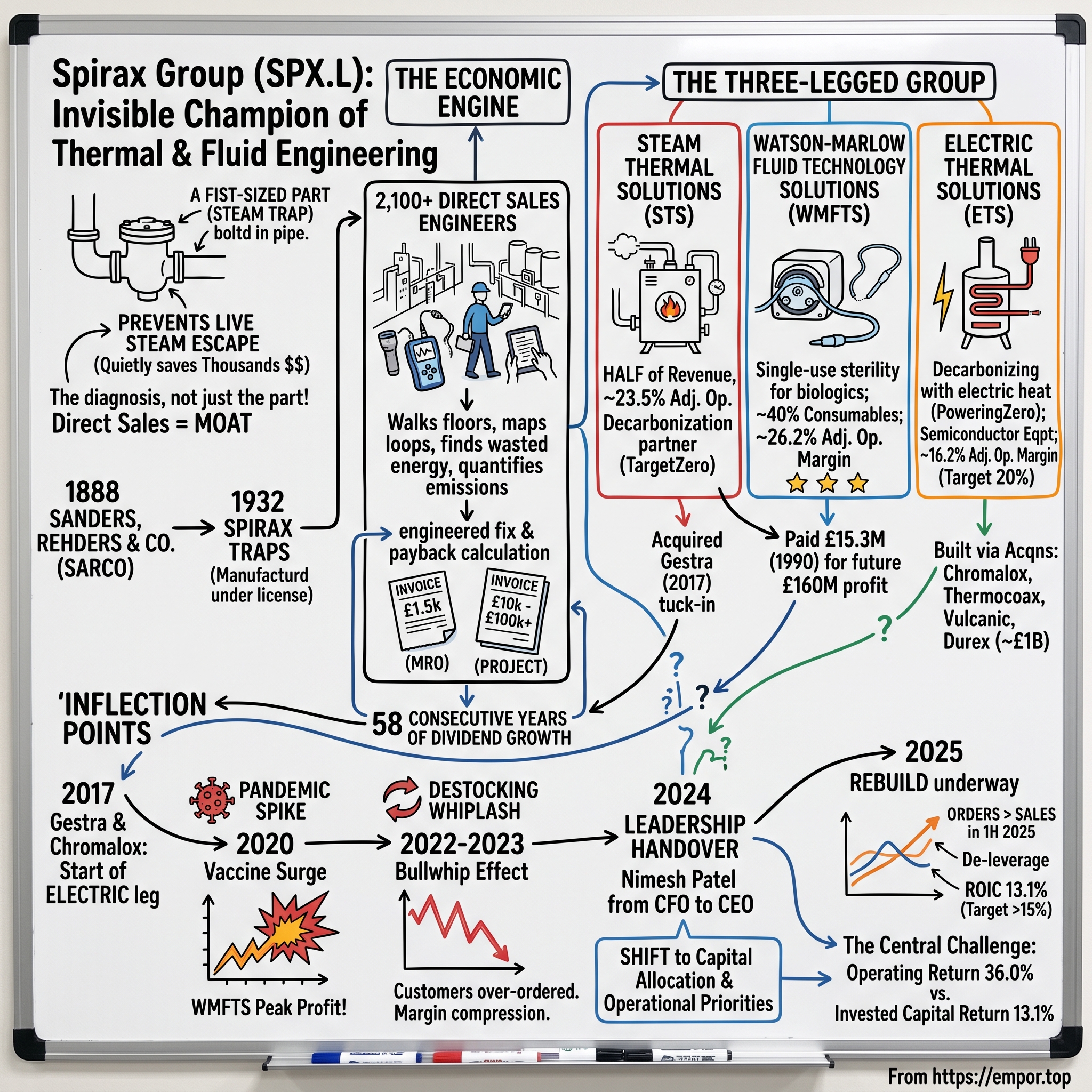
Spirax Group: The Invisible Champion of Thermal & Fluid Engineering
I. Introduction & Episode Roadmap
Somewhere in a food factory in Ohio, or a brewery outside Guadalajara, or a hospital boiler room in Kuala Lumpur, there is a piece of metal roughly the size of a fist bolted into a pipe. It has no screen, no software subscription, no brand recognition outside the plant-engineering profession. It is a steam trap. Its entire job is to let condensed water out of a steam line while keeping the steam itself in. When it works, nobody notices. When it fails — and they all fail eventually — the line either floods and hammers itself apart, or it vents live steam into the atmosphere, quietly burning money at a rate the plant manager can measure in thousands of dollars per week.
Multiply that fist-sized object by tens of thousands per site, across food, pharmaceuticals, chemicals, refining, hospitals, breweries, pulp and paper, and you arrive at a business that almost nobody outside industrial engineering can name, and that generated £1,702.9 million of revenue in 2025 at a 20.0% adjusted operating margin.1 That business is Spirax Group plc, listed in London under the ticker SPX and headquartered in Cheltenham, a Regency spa town in Gloucestershire better known for horse racing and GCHQ than for global industrial engineering.
The company was called Spirax-Sarco Engineering plc until 2024, when it renamed itself Spirax Group to reflect that steam is now only about half the story. Its shares have been continuously listed in London since 1959, and it sits in the FTSE 100.1 As of late July 2026 the shares changed hands around the 6,900–7,000 pence level, giving a market value of roughly £5 billion.3 That is a number worth pausing on, because five years earlier the market valued this same company at more than three times as much. The stock's closing peak came on 15 November 2021; 2022 delivered a roughly 41% decline, and 2024 another 34%.4 Very few FTSE 100 industrials have given back that much of a quality-compounder rating while continuing to grow revenue.
So the central puzzle of this story is not simply "how does a steam trap company earn software-like returns?" It is sharper than that: how did a business that still earns a return on capital employed of 36.0% — a genuinely exceptional operating return — end up with a return on invested capital of only 13.1%, and a share price that has spent five years going backwards?1 Those two numbers, sitting side by side in the same 2025 results, are the whole argument. The first describes the operating business Spirax built over a century. The second describes what happened when it went shopping.
The business model in one sentence
Spirax does not sell parts. It sells the diagnosis that tells a customer which part they need, and then supplies the part.
That distinction is the entire economic engine. Most industrial component makers push product through distributors — catalogue houses, regional wholesalers, the industrial equivalent of a supermarket shelf. Spirax employs roughly 2,100 direct sales and service engineers of its own, spread across 66 countries where it maintains a direct sales presence, serving more than 100,000 customers.2 These are not order-takers. They walk plant floors, map steam and condensate loops, find the traps that are blowing through, quantify the energy being wasted, and come back with an engineered fix and a payback calculation.
The economics of that are unusual, and the company's own disclosure makes them concrete. A typical maintenance-and-replacement invoice runs about £1,500. A small engineered project runs £10,000 to £70,000. A large project exceeds £100,000.2 Almost none of that comes out of a customer's capital budget for the £1,500 items — it comes out of the operating budget, which is precisely why the business holds up when capex freezes. Spirax has historically grown at roughly 1.8 times global industrial production over the cycle, at an average adjusted operating margin of 21.6%.2 Those are the two numbers that built the reputation.
The arc of this story
The narrative divides into five movements. First, a slow century in which a small London importer of German steam traps turned itself into the world's most complete industrial direct-sales network — a process measured in decades, not quarters. Second, the assembly of a three-legged group: Steam Thermal Solutions, the cash-generating bedrock; Watson-Marlow Fluid Technology Solutions, the high-margin niche pumping business bought almost by accident in 1990; and Electric Thermal Solutions, the newest and most contentious leg.
Third, the acquisition campaign that built that third leg — Chromalox, Thermocoax, Vulcanic, Durex — a roughly £1 billion bet that industrial heat would electrify, executed largely between 2017 and 2022, and the still-unresolved question of whether the later deals were priced for a world that did not arrive on schedule.
Fourth, the whiplash: a pandemic super-cycle that turned Watson-Marlow into one of the most profitable industrial businesses in Britain, followed by a destocking collapse that erased nine percentage points of that division's margin in a single year and cost management most of its credibility with the market.
And fifth, the rebuild now underway under Nimesh Patel, who moved from the CFO's chair to the CEO's in January 2024, inheriting a group with a magnificent operating business, a mediocre return on the capital it had deployed, and a shareholder base that had stopped taking guidance at face value.7 The question this story tests is whether the repair is real, or whether the market's five-year re-rating was simply the correct answer arriving late.
 Subscribe on LinkedIn
II. Older History & Founding Context (1888–2000s): From Steam Traps to Global Direct Sales
Victorian London ran on steam, and steam had a dirty secret: it kept turning back into water. Every heating coil, pipe run, and process vessel accumulated condensate. Condensate in a steam line is not merely inefficient — it is dangerous. Slugs of water travelling at steam velocity hit pipe elbows like a hammer. The device that solved this, the steam trap, was one of those unglamorous nineteenth-century inventions that quietly made industrial heat practical.
In 1888, a London firm called Sanders, Rehders & Co. — universally shortened to Sarco — set itself up to sell steam traps.5 The early business was essentially import and distribution: German-engineered thermostatic traps sold into a British industrial base that was building boiler houses faster than it was learning to run them efficiently. There was no Silicon Valley-style founding myth, no garage, and no visionary manifesto. There was simply a market failure — enormous quantities of heat energy being thrown away by plant operators who could not measure the loss — and a company that positioned itself to solve it.
The pivot from trading to manufacturing came in 1932, when a group including H.A. Smith and Lionel Northcroft, later the company's chairman, established a business in London to manufacture Sarco's steam traps under a new brand name: Spirax.5 For two decades the two names circled each other. Then in 1952, Spirax bought out Sarco's remaining UK interests and consolidated under a single identity, Spirax-Sarco.5 The North American half of the puzzle took another three decades to resolve; the company finally acquired the remaining Sarco interests from White Consolidated in 1983 for $29.9 million, at last owning its own brand worldwide.5
The choice that made the company
The public listing came in 1959.1 But the decision that actually determined the next sixty years was strategic rather than financial, taken in the post-war decades as Spirax-Sarco pushed into Argentina, Sweden, Mexico, Italy, India, Brazil, Australia and Japan.5
The choice was fundamental: sell through distributors, or build a dedicated sales force in every country?
Distribution was the conventional choice. It was cheaper, faster, and standard practice across component manufacturing. Selling steam traps through a wholesaler placed products on a shelf next to gaskets and fittings, competing on catalogue price against Crane, local fabricators, and commodity valve makers. That path led directly to price erosion in an undifferentiated commodity market.
Spirax-Sarco chose the alternative. It built local operating companies — complete with legal entities, engineers, and service vehicles — country by country, accepting substantial upfront costs and a multi-decade payback period. The underlying logic was that a steam trap is not merely a component, but the physical output of a technical diagnosis. By owning the diagnosis, the company owned the customer relationship, making unit price a secondary consideration. A third-party distributor could not audit a steam loop or demonstrate to a plant manager that a malfunctioning trap was wasting tens of thousands of pounds annually in escaped live steam.
That direct approach was slow and capital-absorbing, but it created an enduring competitive moat. Competitors could not replicate decades of local customer relationships and application expertise without spending equal time and capital accumulating them. Everything that followed in the company's evolution stems from this decision.
The accidental crown jewel
In 1990, Spirax-Sarco paid £15.3 million to Smith & Nephew for a small Buckinghamshire company called Watson-Marlow, founded in 1956, that made peristaltic pumps.5 In hindsight, the transaction was extraordinary: a business that at its 2022 peak generated £160.0 million of adjusted operating profit in a single year was acquired for the price of a mid-sized office building.9
Peristaltic pumping explains why the business proved so valuable. A conventional pump uses an impeller or piston that directly contacts the fluid. A peristaltic pump has neither. Operating similarly to biological peristalsis, a flexible tube runs through the pump head while rollers squeeze along the tube to advance a captive fluid. The mechanical components never touch the fluid; contact occurs solely inside the tubing.
While a minor detail for standard industrial applications, this design proved transformative for biologics manufacturing. A monoclonal antibody batch worth millions of dollars cannot risk exposure to metal impellers or mechanical seals that might shed particulates or harbour contamination. A disposable tubing path eliminates the need for complex cleaning and validation between batches. This intrinsic sterility turned a niche laboratory pump into critical infrastructure for biotechnology manufacturing, making the single-use tubing a high-margin recurring consumable. Consumables now run at roughly 40% of Watson-Marlow's sales.2
Spirax did not acquire Watson-Marlow anticipating mRNA vaccine demand. It purchased a well-run pump manufacturer at a reasonable valuation and applied its proven direct-sales model to the business — a pragmatic expansion rather than a prescient strategic masterstroke.
What the first century established
By the turn of the millennium, Spirax-Sarco had established a distinct operational model: growth funded through organic cash flow rather than debt, disciplined commitment to the direct sales channel, and long-term customer relationships anchored by continuous replacement demand from the installed base. The group's financial discipline was reflected in its dividend history, recording 58 consecutive years of dividend progress.1
For investors, this heritage established a crucial baseline: an operating business capable of delivering exceptional returns on capital employed, paired with a historical aversion to large-scale acquisitions. What changed in the 2010s was the company's approach to capital allocation.
III. The Masterclass Moat: Engineer-Led Direct Selling & Industrial Thermodynamics
Picture the actual encounter. A Spirax sales engineer arrives at a dairy processing plant. Nobody sent a purchase requisition. There is no tender. The engineer has an appointment with a maintenance manager who is chronically short-staffed and whose primary operational concern is that line three keeps tripping.
They walk the plant floor. The engineer carries an ultrasonic tester and a tablet connected to the company's monitoring platform. Over three or four hours, they survey the steam distribution system: identifying traps blowing live steam straight to the atmosphere, traps blocked and backing up condensate, valves throttling pressure wastefully, fouled heat exchangers, and hot, treated condensate dumped to the drain instead of returning to the boiler.
Then comes the commercial calculation. The engineer produces a concrete figure: the annual cost of the steam system's wasted energy and excess carbon emissions, accompanied by an engineered fix and a calculated payback period. In 2025, the company reported that it increased by more than 50% the number of steam-system quotes explicitly highlighting sustainability benefits, which generated additional site-audit opportunities and follow-on product revenue.1 In one instance disclosed in the 2025 results, Spirax was appointed preferred supplier for steam system audits across 20 sites of a global food and beverage customer, with management estimating pull-through revenue potential of roughly ten times the value of the audits themselves.1
That ratio — audit as loss-leader, hardware as monetisation — is the core mechanism. It is worth examining why competitors struggle to replicate it, as well as where the commercial argument reaches its limits.
Why the channel is hard to copy
The barrier is not proprietary technology. Steam traps are not patent-protected fortresses; the underlying thermodynamics have been understood for a century. The true barrier is operational: diagnosis requires a specialized engineer who has surveyed hundreds of plants, understands the specific process chemistry of dairy versus brewing or fine chemicals, speaks the local language, and can arrive on site on short notice. Building that capability in one country takes years. Establishing it across 66 countries takes generations, and the return on investment for the final 20 countries is genuinely marginal for any new entrant starting from scratch.
A competitor relying on third-party catalogue distributors cannot offer this level of diagnostic service. The economics of distribution do not support employing dedicated process engineers, and the manufacturer behind the distributor lacks a direct relationship with the plant floor. Consequently, the competitive dynamic is asymmetric: Spirax competes on total cost of ownership over the life of the system, whereas catalogue distributors compete on unit price. These represent two distinct sales pitches, usually targeted at different decision-makers within a customer's organization.
Where the commercial argument requires nuance is on the size of the price premium. Spirax does not disclose the specific markup it charges over commodity alternatives, and external market figures remain estimates rather than verified facts. What is disclosed is the operational output: the steam business generated a 23.5% adjusted operating margin in 2025, and management targets holding roughly that level over the medium term.12 In a mature market for mechanical components, an operating margin of that scale provides clear evidence of pricing power. The underlying mechanism is inferred, but the financial outcome is measured.
The MRO bedrock — and its limits
The second pillar of operational resilience is the balance between routine maintenance spending and capital project spending. Steam systems operate continuously. Over time, traps fail, valves erode, gaskets deteriorate, and sensors drift. When failures occur, plant operations cannot wait for a formal capital budget approval cycle; replacement parts are purchased immediately out of the operating budget.
Management classifies roughly 60% of 2023 group sales as serving defensive end markets.2 While this provides a substantial buffer, it does not offer total immunity, as performance in 2025 demonstrated. In China and Korea, where the steam business is more heavily weighted toward large capital projects, demand slowed as industrial customers deferred capacity expansions. Those two markets combined accounted for 22% of steam-division sales in 2024.6 Consequently, steam revenue grew by just 1% organically in 2025, though growth reached 3% when excluding large capital projects in China and Korea.1
That spread between 1% overall organic growth and 3% underlying growth illustrates the two-speed nature of the business model. The maintenance base performed as intended, expanding steadily ahead of a global industrial production backdrop that grew 2.1%, or 1.7% excluding China.1 Meanwhile, the overlay of large capital projects behaved like a standard cyclical capital-goods business. Portraying Spirax as entirely recession-proof accurately describes its maintenance base, but overlooks the cyclicality of its project exposure.
Unit economics: small ticket, enormous consequence
Pricing power persists primarily because of a fundamental asymmetry in risk. A single steam trap represents a minor expense relative to the total operating budget of a processing facility. However, a malfunctioning trap that allows water hammers into a line, or a control valve that drifts out of specification during a sterilization cycle, can contaminate an entire batch, trigger safety shutdowns, or halt production lines where downtime costs quickly dwarf the price of the replacement component.
Faced with catastrophic failure risks from low-cost components, procurement departments rarely negotiate aggressively on price. This represents a classic high-criticality, low-cost position — one of the most reliable drivers of durable pricing power in industrial markets. Spirax's margin defense in 2025 aligned with this dynamic: management reported that the business offset cost inflation and tariff impacts through pricing discipline and operational efficiency savings.1 That distinction is key: price increases did not drive top-line expansion, but pricing power protected profitability. In a year when foreign exchange movements reduced reported profit by 4% and global industrial production stagnated, keeping reported margins flat while delivering a 30-basis-point organic margin improvement highlighted the resilience of the core business.1
This competitive moat is genuine and clearly reflected in the division's operating margins. What it cannot do — and what sets up the central challenge of Spirax's recent history — is insulate the group from capital allocation decisions. Applying an exceptional operating model to overpaid acquisitions will still depress overall returns on invested capital. That tension forms the backdrop for the three distinct divisions the group operates today.
IV. Segment Breakdown & Economic Engine: STS, WMFTS, and ETS
An industrial group designed from first principles would rarely take the shape of Spirax Group. The company operates three divisions that share a core commercial philosophy—deploying direct sales engineers to solve thermal and fluid problems—but differ in almost every other respect. They serve distinct customer bases, operate on separate capital cycles, and in 2025 recorded adjusted operating margins that differed by ten percentage points.1 Understanding those divergence patterns is central to evaluating the group's earnings quality.
Steam Thermal Solutions: the bedrock
Steam Thermal Solutions remains the primary anchor, generating £853.4 million of revenue in 2025—representing half of total group sales—at an adjusted operating margin of 23.5%, up 40 basis points organically year-over-year.1 Its product portfolio spans steam traps, pressure-reducing valves, control valves, condensate recovery systems, heat exchangers, boiler controls, and digital monitoring systems.
The competitive landscape in steam specialties is frequently mischaracterized. Spirax's primary independent rivals include Japan's TLV and the United States' Armstrong International, alongside broader process-control suppliers such as Emerson and Danfoss that overlap in valves and instrumentation without matching Spirax's dedicated field-engineering reach. Gestra, the Bremen-based boiler control and steam valve specialist, is often cited as a competitor, but Spirax acquired Gestra from Flowserve in April 2017 for €186 million, and Gestra has been part of the group ever since.12 That transaction offers a helpful reference point for later dealmaking: at €16.6 million of 2016 EBITDA, the price represented roughly 11.2 times trailing earnings before interest, tax, depreciation and amortization for a business that slotted directly into the core steam franchise.12
While often viewed as a mature cash generator, the steam division is evolving along two main tracks. The first is digital enablement: Spirax more than doubled its digital customer connections in 2025, passing 2,000 connected sites, and reported high-double-digit growth in digital product and subscription revenues.1 The strategic value lies less in direct software subscription fees than in predictive maintenance: wireless monitoring flags failing traps before plant operators notice, converting reactive sales calls into scheduled, higher-margin replacements.
The second track is industrial decarbonization, which presents a dual outlook for the segment. Optimizing steam infrastructure is often a prerequisite for meeting plant emissions targets, supporting site-audit demand and driving a 50% increase in sustainability-linked product quoting in 2025.1 Over the longer term, however, full decarbonization can involve replacing fossil-fired boilers with electric process heating—a transition that prompted the group to build its third division.
Watson-Marlow: the high-margin engine
Watson-Marlow generated £408.2 million in 2025, accounting for 24% of group revenue, while delivering a 26.2% adjusted operating margin—a 160-basis-point organic improvement and the strongest margin progress among the three divisions.1 It remains Spirax's highest-return and most cyclical business.
Roughly half of Watson-Marlow's sales go to the pharmaceutical and biotechnology sector, which works out to about 12% of total group revenue.1 The remainder—classified internally as process industries—spans water treatment, food and beverage, mining, and medical devices. The division employs approximately 300 direct sales engineers serving more than 4,000 end-user customers in biopharma alone.2
Competitors in this space differ substantially from those in steam, including life-sciences tool suppliers such as Avantor's Masterflex unit, Danaher's Cytiva, Sartorius, Merck KGaA's process solutions business, Thermo Fisher Scientific, and Cole-Parmer. Competition centres less on general pump mechanics and more on securing specified inclusion in validated biopharmaceutical production processes.
When a drug manufacturer registers a production process with regulatory authorities, the fluid path and tubing specifications are fixed within the regulatory filing. Replacing a component vendor requires formal change-control procedures, re-validation testing, and the risk of production delays. Consequently, plant managers routinely reject minor price discounts from alternative suppliers to avoid regulatory risks. This regulatory lock-in secures high recurring demand for single-use tubing consumables, though it also amplifies inventory swings when biopharma customers over-order during supply-chain disruptions.
Management's medium-term ambition for the division, set out at its October 2024 Capital Markets Day, targets high-single-digit organic growth with margins above 30%.2 Given that the division previously operated above that margin threshold, achieving the target depends primarily on volume recovery and manufacturing capacity utilization.
Electric Thermal Solutions: the problem child
Electric Thermal Solutions generated £441.3 million in 2025—representing 26% of group sales and surpassing Watson-Marlow in total revenue for the first time—but delivered a 16.2% adjusted operating margin, roughly seven percentage points below the steam business.1 The division was assembled through four acquisitions: Chromalox, Thermocoax, Vulcanic, and Durex Industries.
Operations are organized into three primary units. Process Heating, which accounted for 64% of 2024 divisional revenue, manufactures custom industrial electric heaters. Equipment Heating, representing 24%, provides specialized thermal management components for semiconductor equipment, nuclear, aerospace, and defense applications, with semiconductor capital equipment alone driving about 11% of divisional sales. Heat Trace, accounting for 12%, supplies freeze-protection and temperature-maintenance systems; it was carved out as a separate unit with its own sales team during 2025.1
Primary competitors include Watlow in the United States, Thermon Group, and Sweden's NIBE Industrier. This peer group reflects how Electric Thermal Solutions relies on Spirax's direct-selling methodology rather than shared technology or overlapping customer bases with the rest of the group.
The strategic rationale for establishing the division rests on capturing the electrification of industrial process heat. Spirax sizes the decarbonisation opportunity at roughly £7 billion of additional annual addressable market, split between about £2 billion for decarbonising steam generation—its TargetZero programme, including SteamVolt electric boiler technology now being incorporated by several global boiler OEMs—and about £5 billion for electrifying other process heating under the PoweringZero banner.1
These market estimates reflect long-term potential rather than current commercial scale. The observable evidence remains modest: initial pilot SteamVolt installations at a food and beverage facility and a chemical plant; six high-temperature heat pump units under validation at customer sites through a commercial partnership; and medium-voltage heater contracts won with a UK renewables energy storage facility, a European paper OEM for tissue drying, and a chemical customer.1 Decarbonization offerings currently represent a pipeline of development projects rather than a primary revenue contributor.
Recent performance improvements in Electric Thermal Solutions have stemmed largely from operational turnarounds at existing facilities. Engineering design lead times for large North American heaters were reduced from sixty weeks to six, output from those plants rose over 20% over two years, and a new dedicated medium-voltage facility in Ogden, Utah was completed on time and on budget.1 Sales grew 11% organically in 2025.1 The sharp reduction in lead times reflects how severely operational bottlenecks had constrained the business following its acquisition, indicating that recent growth was driven substantially by operational catch-up rather than market share expansion.
This three-part structure gives the group genuine diversification: steam demand is late-cycle and tied to routine maintenance; Watson-Marlow responds to biopharma production volumes and inventory cycles; and electric thermal depends on industrial electrification capex and semiconductor equipment cycles. However, expanding into the third division required significant capital investment, placing the returns on those acquisitions at the center of Spirax's recent financial performance.
V. The M&A Expansion Era & Inflection Points (2014–2022)
When Nicholas Anderson became chief executive in 2014, he inherited a group with enviable operating performance. The steam business generated substantial cash, delivered exceptional operating returns, and grew reliably at several percentage points above global industrial production. Yet it also faced a structural ceiling. A direct sales force operating across sixty-plus countries in a mature product category could not compound capital indefinitely at a rate that justified a high growth multiple.
Anderson set out to acquire a second and third growth engine. His initial move in 2017 proved to be the most aligned with the core franchise.
The 2017 double
On 3 April 2017, Spirax announced the acquisition of Gestra from Flowserve — a direct tuck-in to the steam franchise, financed through cash and existing credit facilities, which Anderson framed as bringing complementary product and market strength to scale globally.12
Seven weeks later, management executed a far more strategically consequential transaction. On 26 May 2017, Spirax announced it would acquire Chromalox from private equity firm Irving Place Capital for $415 million, or £319 million.11 Based in Pittsburgh, Chromalox manufactured electric process heating equipment, and Spirax disclosed that it had been tracking the company since 2008.11
The rationale outlined in the announcement provided the clearest blueprint for the electric thermal strategy. Chromalox generated roughly 70% of its sales through a direct sales force rather than third-party distributors, mirroring Spirax’s own go-to-market structure. Approximately two-thirds of its revenue was recurring MRO business. Crucially, the strategic logic posited that the choice between steam and electricity was dictated by customer application rather than vendor preference. By offering both heating mediums, Spirax aimed to expand its total addressable market by £2.1 billion to £7.9 billion.11
The announcement was equally candid regarding valuation and cyclical exposure. Chromalox reported $201 million in revenue and $43 million in EBITDA for the year ending September 2016, representing roughly 9.7 times trailing EBITDA. However, with 18% of its sales linked to the oil and gas sector during a severe downturn, Spirax estimated near-term forward performance at $190 million in revenue and $38 million in EBITDA, implying a forward valuation closer to 11 times earnings.11 Management explicitly acknowledged that the purchase price reflected an anticipated recovery in end-market demand.
Thermocoax and the semiconductor pivot
In June 2019, Spirax acquired Thermocoax, a French specialist in mineral-insulated heating elements, thermocouples, and sterilization components for nuclear, aerospace, defense, energy, and semiconductor applications.13 The transaction consideration was not disclosed in the company's official announcement.
Strategically, Thermocoax shifted the electric thermal portfolio from general industrial heating toward high-barrier, customized applications. Heating elements designed to maintain precise, uniform temperature profiles within semiconductor wafer fabrication chambers carry high switching costs. This specialization established semiconductor capital equipment as an important demand driver for the group, allowing Spirax in 2025 to capture double-digit growth in semiconductor demand after implementing a new ERP system at Thermocoax to expand production capacity.1
The 2022 double, and the price question
By 2022, cheap capital, structural demand expectations for semiconductors, and industrial decarbonization trends accelerated M&A activity across the sector.
Spirax completed the acquisition of Vulcanic on 30 September 2022 for €261.7 million on a cash and debt-free basis. Vulcanic had generated €99.9 million in revenue and €19.9 million in EBITDA for the twelve months ending 31 August 2022, representing an acquisition multiple of roughly 13 times EBITDA.14
Two months later, on 1 December 2022, the group acquired Durex Industries for $342.2 million on a cash and debt-free basis. Durex reported $74.5 million in revenue and $25.3 million in EBITDA over the same twelve-month period, representing approximately 13.5 times EBITDA.15 As a specialist in custom electric thermal solutions for mission-critical equipment, Durex brought the combined Electric Thermal Solutions footprint to roughly 2,700 employees across eighteen manufacturing sites.15
Whether Spirax overpaid for these assets depends on three operational factors rather than the headline purchase multiples alone. An EBITDA multiple of 13 times for high-margin, custom engineering businesses with semiconductor exposure was consistent with market valuations in 2022, particularly given Durex's impressive EBITDA margin of over 30%. However, the underlying return profile was distorted by several key issues:
First, purchase prices were calculated on peak-cycle earnings. Both Vulcanic and Durex were valued on trailing results through August 2022, matching the cyclical high for industrial demand and semiconductor capital equipment spending. As cyclical demand subsequently normalized, paying 13 times peak earnings proved far more expensive than paying 13 times mid-cycle earnings.
Second, integration complexities weighed on operational execution. Spirax acquired four separate businesses across five years in an industrial segment where it lacked previous operating history. Sourced from private equity sellers and sponsors, each business arrived with legacy IT systems, separate sales organizations, and distinct manufacturing cultures. The sixty-week engineering lead times experienced in North America reflected integration bottlenecks in an assembled portfolio. By 2026, Spirax was still working to standardize a single group-wide ERP architecture, having replaced three separate division-level projects with a unified rollout scheduled to pilot at Watson-Marlow in the second half of 2026.1
Third, divisional operating margins remained below original targets. Electric Thermal Solutions reported an adjusted operating margin of 15.6% in 2022 and 2023,9 rising slightly to 16.0% in 20246 and 16.2% in 2025.1 Compared to management's medium-term divisional target of 20%,2 nine years of expansion and roughly £1 billion in total capital expenditure yielded a margin expansion of just 60 basis points. While a second-half 2025 margin of 17.2% and the completion of low-margin orders at the Ogden facility indicated operational improvement,1 reaching the 20% target remains an ongoing execution challenge.
What it did to the balance sheet and to returns
The 2022 acquisitions increased net debt to £690.4 million by year-end, representing a leverage ratio of 1.7 times EBITDA.9 While manageable for a business with high cash generation, this debt load exceeded the group's historical target range and restricted financial flexibility as market valuations re-rated downward.
The impact on capital efficiency was evident in group return on invested capital (ROIC), which incorporates goodwill and acquired intangibles. ROIC declined from 18.3% in 2022 to 13.5% in 2023, reaching 12.8% in 2024 before stabilizing at 13.1% in 2025.961 Contrasting this 13.1% ROIC with the core operating business's 36.0% return on capital employed highlights the core financial tension: operational profitability remained outstanding, but total returns were diluted by the purchase prices paid for acquired assets.1
While part of the ROIC contraction reflected a cyclical downturn at Watson-Marlow, management has since signaled a clear shift in capital allocation, confirming that major acquisitions are paused. On the 2025 earnings call, when asked by a Citi analyst whether the electric thermal business was ready for further bolt-on acquisitions, Chief Executive Nimesh Patel stated directly that the division was not ready, as ongoing operational improvements required continued management focus.8
VI. The Pandemic Spike, Biopharm Destocking & The Post-COVID Bull/Bear Realities (2020–2024)
In the spring of 2020, global pharmaceutical manufacturers began building vaccine production capacity at unprecedented speed. Every new production line required sterile fluid paths—tubing, single-use assemblies, and peristaltic pumps that move delicate biologics without direct contact or contamination. Watson-Marlow, the fluid technology specialist Spirax had acquired three decades earlier for £15.3 million, suddenly occupied a critical position in global vaccine supply chains.
What followed was an extraordinary short-term demand surge for industrial equipment—and ultimately, a severe supply-chain bullwhip effect.
The peak
By 2022, Watson-Marlow produced £488.5 million in revenue at a 32.8% adjusted operating margin, delivering £160.0 million in adjusted operating profit from a division that represented less than a third of group sales.9 That single segment generated a margin well above typical life-science equipment peers, lifting the broader group's overall margin to 23.6% that year.9
End-user demand was genuine, but a substantial portion of customer ordering reflected inventory buffering rather than immediate consumption. Biopharmaceutical clients, alarmed by 2020 supply chain disruptions, over-ordered to build precautionary inventory reserves against shortages that ultimately passed.
Management failed to anticipate the eventual demand collapse. In a trading update on 11 May 2022, four months into the fiscal year, Spirax continued to guide toward approximately 20% growth in Watson-Marlow's biopharmaceutical and biotechnology sales for the full year, pointing to strong order books and historical resilience across economic cycles.17 Customer destocking began in the second half of that year.9
The unwind
The subsequent contraction was sharp. Watson-Marlow's revenue fell 19% organically to £394.0 million in 2023, while its adjusted operating margin dropped nine percentage points to 23.8%.9 Group adjusted operating profit fell from £380.2 million to £349.1 million, and adjusted earnings per share declined despite top-line growth across the wider business.9
This margin compression demonstrated the stark operational leverage inherent in Watson-Marlow's manufacturing base. Fixed overhead that generates exceptional profitability during volume expansion creates severe margin pressure when volume contracts. The episode highlighted that a high-margin consumables model can carry cyclical volatility that remains concealed during expansionary periods.
The company's guidance record through 2023 weakened market confidence. Having signaled double-digit group sales growth in May 2023, management reduced full-year guidance in August to between zero and 4%, lowered margin expectations by 100 to 200 basis points, and warned that bioprocess destocking would persist into 2024. With first-half pre-tax profit down 18% to £114.0 million and Watson-Marlow's sales falling 21% organically, Spirax shares declined 5.9% to 10,200 pence on the day of the announcement.16
Three consecutive guidance reductions in a single year eroded the valuation premium long granted to Spirax's predictable earnings profile. Concurrently, broader industrial weakness in Europe and North America, lower project spending in China, and a cyclical downturn in semiconductor equipment weighed on the group's other operating units.
The handover
In August 2023, the board announced that Chief Financial Officer Nimesh Patel would succeed Nicholas Anderson as Chief Executive Officer, effective 16 January 2024.7 The executive transition took place during an operational reset, placing leadership in the hands of an executive who had overseen the 2022 acquisitions and financial disclosures.
Following the transition, executive communications adopted a noticeably more cautious tone. While the May 2022 update had projected strong expansion just prior to a market downturn, the 2025 half-year report opened by stating trading was "in line with expectations." It acknowledged downward revisions to global industrial production forecasts while maintaining guidance grounded strictly in committed order books.10 The full-year 2025 results subsequently framed operational progress against targets outlined at the 2024 Capital Markets Day amid a volatile macroeconomic background.1
This tighter framework for setting market expectations helped stabilize executive credibility as operational metrics met revised projections.
Was the destocking structural or cyclical?
The duration and nature of the bioprocess slowdown remained a central debate for investors through 2025, but subsequent operating data clarified the trend.
Operational recovery emerged in 2024 as Watson-Marlow returned to 3% organic revenue growth and biopharmaceutical order intake stabilized.6 During the first half of 2025, organic order growth exceeded 10%, with order intake surpassing sales for the first time since 2021—marking the technical end of the customer inventory correction.10 Double-digit order growth continued through the full year, second-half sales accelerated as projected, and divisional operating margin recovered by 160 basis points.1
On the 2025 results call, management addressed analyst inquiries regarding recovery sustainability by highlighting renewed ordering from both end-users and original equipment manufacturers (OEMs), noting that OEM orders signal new capacity additions rather than inventory replenishment.8 Growth was supported by demand in monoclonal antibodies, recombinant DNA, and cell and gene therapy manufacturing.1
The empirical evidence confirms that the 2022–2023 downturn represented a cyclical inventory adjustment rather than a loss of competitive positioning. However, the cycle demonstrated that Watson-Marlow's high-margin bioprocess business carries greater operational cyclicality than its recurring consumables profile suggests.
VII. Management Credibility, Capital Allocation & Compensation under Nimesh Patel
There is a particular kind of executive that boards reach for when a company has grown complicated: not the visionary, but the leader who can inspect a P&L by segment and pinpoint which facility is destroying value.
Nimesh Patel fits that description. Before joining Spirax as chief financial officer in 2020, he served as CFO of De Beers and previously as Group Head of Corporate Finance at Anglo American plc, following fourteen years in investment banking at JP Morgan and as a managing director at UBS.7 He was appointed chief executive in August 2023 and assumed the role on 16 January 2024, after nearly four years as finance director.7
That background emphasizes capital allocation and portfolio discipline rather than steam thermodynamics, shaping his operational approach. A recurring theme in his commentary is "the operational priorities within our control"—a phrase appearing almost verbatim in the 2024 results, the 2025 half-year statement, and the 2025 full-year release.6101 On the 2025 results call, management summarized this strategy as "controlling the controllables."8 Maintaining consistent messaging across three consecutive reporting periods represents a meaningful shift toward executive discipline following the guidance revisions of 2023.
Louisa Burdett joined as group CFO in July 2024. She previously served as CFO of Croda International, following senior finance roles at UK-listed engineering group Meggitt and polymer specialist Victrex.7 That background in specialty chemicals and precision engineering—sectors driven primarily by product mix and operating margins—aligns directly with Spirax's core priority of lifting Electric Thermal Solutions' operating margin from 16% toward 20%.
Leadership across the executive bench has also undergone significant turnover. Andrew Mines, previously managing director of Watson-Marlow, was appointed to head Electric Thermal Solutions in September 2024, reassigning the executive who led the group's highest-margin division to oversee its lowest-margin unit.7 Stuart Roby joined from The Vita Group to lead Watson-Marlow in January 2025.17 At the board level, Maria Antoniou joined in June 2025 and succeeded Jane Kingston as Remuneration Committee chair, while Andrew Kemp joined in November 2025 and assumed the Audit Committee chair from Kevin Thompson following the May 2026 AGM.1 This transition represents a near-complete renewal of the executive team that oversaw the previous acquisition cycle.
Testing the track record
Assessing management requires comparing stated commitments against operational delivery.
In January 2025, Spirax launched a restructuring program, guiding investors toward approximately £35 million in annualized savings—with 40% realized in 2025—at an estimated cost of £35 million in cash and £5 million in non-cash charges.6 By year-end, the company delivered £40 million in annualized savings, realizing roughly half during 2025. Restructuring charges totaled £39.9 million—comprising £33 million in cash and £7 million non-cash—with £22 million of cash spent in 2025 and approximately £11 million scheduled for 2026.1 Annualized savings moderately exceeded guidance, restructuring costs matched expectations, and realization progressed faster than originally planned.
Operational performance against 2025 segment guidance also showed improved predictability. Steam Thermal Solutions was guided to low-single-digit organic growth and delivered 1%, landing at the bottom of the range amid weaker industrial production. Electric Thermal Solutions was guided to mid-to-high single-digit growth and delivered 11%, exceeding expectations. Watson-Marlow was guided to mid-single digits and delivered 6%. Group organic revenue growth was guided to match 2024's 4% and reached 5%, while the adjusted operating margin landed at 20.0%, ahead of the currency-adjusted 19.6% baseline.61 Delivering three targets above guidance and one at the lower bound represented a marked improvement over 2023, particularly given that global industrial production underperformed the forecasts management planned against.1
The structural impact of the restructuring is evident in divisional operations. Within the steam business, the EMEA region consolidated nineteen individually managed operating companies into ten, while continuing to serve twenty-three countries.1 Maintaining nineteen separate corporate entities across one region reflected the administrative overhead accumulated during the historical country-by-country expansion. Following simplification, second-half organic revenue growth in EMEA accelerated to 3% against regional industrial production growth of 1.1%, supporting management's assertion that organizational streamlining improved field sales effectiveness.1
Alignment and incentives
Executive compensation at Spirax is structured around a Performance Share Plan, with awards vesting over three years subject to performance criteria. A grant equal to 250% of base salary was awarded to the chief executive in March 2026 under the existing policy, and shareholders approved an updated Directors' Remuneration Policy and revised share plan rules at the 13 May 2026 AGM.18 Specific performance metrics and weightings are disclosed within the remuneration report of the annual report.
Beyond incentive structures, management has explicitly committed to a group return-on-invested-capital benchmark. The 2025 results state that achieving medium-term organic growth and margin targets, alongside sustained cash conversion, is projected to lift ROIC above 15% from its 2025 level of 13.1%.1 Establishing a public capital efficiency target following a period of margin dilution provides a clear benchmark for evaluating ongoing capital allocation.
The capital allocation hierarchy
Spirax maintains a clearly defined framework for capital allocation.1 First, organic investment in sales personnel, digital platforms, product development, and decarbonization technologies is prioritized, backed by the core operating business's 36.0% return on capital employed. Second, the dividend remains a core commitment, supported by 58 consecutive years of dividend growth and a target payout cover range of 2.0 to 2.5 times; the 2025 total dividend increased 3% to 170.0 pence, representing £122.8 million. Third, balance sheet target leverage is set at 1.0 to 1.5 times net debt to EBITDA, with net debt reduced to £564.7 million by the end of 2025, placing leverage at 1.5 times. Fourth, capital deployment to bolt-on acquisitions or equity returns remains subject to strict return comparisons against alternative uses.
Under this hierarchy, share buybacks are treated as a residual allocation option rather than a firm capital commitment. On the 2025 earnings call, when asked about triggers for share buybacks if leverage fell below 1.0 times EBITDA, Patel noted that evaluation frameworks exist but emphasized disciplined M&A as the preferred path, stating that capital returns would be evaluated only after other allocation options were exhausted.8 Coupled with management's assessment that Electric Thermal Solutions is not yet prepared for bolt-on acquisitions, the group generated £199.0 million in free cash flow while deleveraging, without declaring specific deployment plans for surplus cash beyond the dividend.1
This capital position can be interpreted in two ways: either as commendable capital discipline following an expensive acquisition cycle, or as capital allocation inertia that risks depressing overall equity returns. How management deploys surplus cash flow over the coming financial cycles will serve as the primary test of its long-term strategy.
VIII. Strategic Frameworks: Hamilton Helmer's 7 Powers & Porter's 5 Forces Analysis
Strategic frameworks are useful only when applied rigorously, which requires evaluating where a company lacks structural advantages as clearly as where it excels. Spirax possesses strong competitive insulation in specific operational niches, but remains unremarkable across several other dimensions. Disentangling these distinct dynamics reveals where the company's economic moat truly sits.
Hamilton Helmer's 7 Powers, applied
Process Power represents Spirax's most compelling advantage. Hamilton Helmer defines process power as an embedded organizational capability that rivals cannot easily replicate, even if they understand its design. The group's network of roughly 2,100 direct sales and service engineers—trained across years of application-specific process knowledge and deployed through local operating companies in 66 countries—fits this definition closely.2 Competitors can study the direct-sales methodology, yet establishing equal delivery scale requires decades of operational investment. In 2025, management introduced a digital accelerant: MiM, a proprietary artificial intelligence tool built on accumulated internal process data. Piloted with 200 sales personnel, the tool reportedly saved roughly four hours per user each week before rolling out to more than 1,000 employees.1 If sustained, this technology partially converts tacit domain knowledge into a scalable asset, reinforcing rather than diluting process power.
Switching Costs are substantial but unevenly distributed across the business. Within Watson-Marlow's biopharmaceuticals business, switching costs are exceptionally high due to regulatory re-validation requirements for approved fluid paths. In steam maintenance, switching barriers are behavioral and relational rather than contractual: facilities that standardize on Spirax components, maintain spare parts inventory, and rely on specific field engineers rarely defect for minor price savings, though no legal barrier prevents them from doing so. In Electric Thermal Solutions, switching costs are robust in specialized semiconductor and nuclear niches, but negligible in standard process heating.
Cornered Resource—often identified as the global field-engineering network—overlaps directly with Process Power rather than operating as an independent asset. In practice, Spirax possesses a single primary operational advantage manifested through two complementary dimensions.
Scale Economies remain modest, presenting a clearer limitation than external perception often suggests. Spirax operates more than 30 manufacturing plants globally.1 This decentralized footprint prioritizes customer proximity and rapid service over centralized production efficiency—the structural opposite of a scale-driven strategy. Recent restructuring initiatives—closing a Mexican steam facility, shifting Alitea pump manufacturing from Sweden to the United Kingdom, and pausing an expansion in Germany—represent targeted efforts to eliminate redundant operational overhead.1 For an industrial group generating £1.7 billion in revenue, operating over 30 plants delivers service responsiveness rather than unit-cost manufacturing advantages.
Branding provides genuine commercial value within specialized engineering channels. Both Spirax-Sarco and Watson-Marlow are specified directly in engineering documentation across food, beverage, and pharmaceutical facilities. This represents specification-driven brand equity: its commercial value lies in mitigating operational risk for plant managers whose financial downside from a process failure far exceeds any cost savings from choosing cheaper components.
Counter-Positioning is the least convincing advantage attributed to the company. Counter-positioning requires that established incumbents cannot match a challenger's business model without damaging their own core revenues. Competitors face no structural barrier preventing them from deploying direct sales engineers; doing so is capital-intensive and time-consuming, but not self-destructive. Spirax benefits from an extended operational head start rather than structural counter-positioning.
Network Effects are functionally absent in physical equipment. A customer's installation of a steam trap creates no direct utility for other users. While the group's digital monitoring platform could eventually build predictive data advantages as more traps report operational data, reaching just over 2,000 connected sites leaves this capability as an emerging initiative rather than an established competitive moat.1
Porter's Five Forces, applied
Buyer Power: Low and structurally limited. The group's customer base spans more than 100,000 accounts across food and beverage, pharmaceuticals, chemicals, oil and gas, healthcare, mining, and water treatment.2 No single account represents a material share of group revenue. Furthermore, purchasing decisions for routine £1,500 maintenance items are made by plant maintenance managers addressing immediate operational needs rather than procurement officers conducting formal tenders. Buyer power increases primarily during large capital project tenders, where competitive bidding is active—explaining the cyclical volume slowdown experienced in China and Korea.
Supplier Power: Low to moderate. Raw inputs consist primarily of stainless steel, bronze, specialized elastomers for fluid tubing, and electronic components—all sourced from competitive commercial markets. The group's principal input risk stems from trade tariffs and cross-border supply friction rather than supplier concentration. Management mitigates trade barriers by maintaining local manufacturing in the United States alongside targeted price surcharges, reporting in 2025 that these measures successfully protected operating margins.1 While consistent with reported financial results, this pricing strategy faces ongoing testing under heightened global trade restrictions.
Threat of New Entrants: Very low. Replicating Spirax's position requires building a global field-engineering network, securing regional regulatory certifications, accumulating decades of process application data, and committing substantial long-term capital. Financial resources alone cannot quickly bridge these operational hurdles.
Threat of Substitutes: Moderately high over long horizons. Steam remains thermodynamically superior for transferring large heat loads at moderate temperatures, limiting near-term substitution risks. Over longer timeframes, industrial electrification poses a structural threat to fossil-fired steam systems. Spirax responded by acquiring electric thermal assets—a logical strategic defense, though an expensive one. The strategic challenge is that electric process heating currently operates at a lower margin profile than steam specialties—16.2% compared to 23.5% in 2025—meaning adaptation could dilute group-level profit margins even if market share is preserved.1
Competitive Rivalry: Moderate and fragmented. Spirax encounters distinct competitors within each product category and faces no single global rival across its combined portfolio. Market fragmentation shields the group from broad price wars, though it also prevents the pricing discipline typical of consolidated duopolies.
The strategic assessment reveals three distinct divisions: an exceptionally defended core business in steam specialties, a highly differentiated position in biopharmaceutical fluid handling, and an electric thermal division whose competitive moat remains a work in progress. Spirax possesses two high-return franchises alongside a third unit that absorbed significant capital without yet matching the group's historical return standards.
IX. Activist & Skeptical Investor Stress Test
Imagine an activist fund building a position in Spirax in 2026. The pitch practically writes itself, and it starts with a single slide: a business earning 36% on the capital employed in its operations that returns 13.1% on the capital its shareholders have invested.1 Everything the bear case needs flows from that gap.
The bear case
One: the electric thermal business has not earned its cost of capital, and the clock is running. Spirax has spent roughly £1 billion assembling four companies since 2017. Nine years in, the division earns 16.2% against a 20% target and a group average of 20.0%.12 Every year the target slips, the discounted value of achieving it falls. An activist would press hard on a specific question: if the 20% margin is achievable, why does it require a decade? And if the answer is that the acquired assets were operationally weaker than diligence suggested — the sixty-week lead times argue they were — then the price paid was wrong even if the multiple looked market-standard.
Two: portfolio complexity without portfolio logic. Three businesses, three separate competitor sets, three different end-market cycles, thirty-plus factories, nineteen operating companies in one region before simplification. The stated glue is the direct selling model. An activist would counter that a shared philosophy is not a shared customer, and that the integrated thermal energy assessment — combining steam and electric expertise in a single customer audit — is currently evidenced by multi-site pilots in food and beverage producing an identified pull-through opportunity of over £1 million.1 That is a promising pilot. It is not yet proof that the combination creates value that separate ownership would not.
Three: the returns math may not work even on management's own targets. Take management's medium-term goals at face value: 22–23% group margin and ROIC above 15%.21 Even full delivery leaves invested-capital returns less than half of what the operating business generates, because the goodwill from the acquisition era does not amortise away quickly. The pre-acquisition Spirax was a higher-returning enterprise than the post-acquisition Spirax will be even if everything goes right.
Four: valuation was never going to survive a growth slowdown. The market previously awarded Spirax a multiple appropriate to a reliable double-digit compounder. When organic growth settled into low-to-mid single digits and guidance became unreliable, the re-rating followed with the violence such re-ratings usually have — a peak in November 2021, then declines of roughly 41% in 2022 and 34% in 2024.4 The bear observation is that mid-single-digit organic growth with 20% margins is a good industrial business, and good industrial businesses trade at industrial multiples.
Five: geographic sprawl is expensive. Direct presence in sixty-six countries is the moat. It is also a permanent fixed-cost base that must be carried through downturns and that gets more expensive as trade fragments and local content requirements proliferate. The 2025 decision to shift certain UK-manufactured components to a US facility to comply with Build America, Buy America requirements is a small, concrete example of deglobalisation adding cost and complexity.1
Six: the currency drag is chronic. Spirax reports in sterling and earns almost everywhere else. In 2025, currency reduced revenue by 3% and adjusted operating profit by 4%, and the company disclosed that at February 2026 exchange rates the 2025 base would restate roughly 2% lower on sales and 3% lower on profit.1 This is not a one-off; it is a structural feature that makes reported results systematically noisier than underlying performance.
The bull case
One: the destocking question has largely been answered. Orders exceeding sales in the first half of 2025, order growth above 10% sustained for the full year, second-half sales acceleration exactly as forecast, and 160 basis points of margin recovery constitute a specific, falsifiable claim that was made and then met.101 The underlying biopharma market — antibodies, cell and gene therapy, recombinant products — is a genuine secular grower, and management's stated medium-term ambition of high-single-digit growth with margins above 30% is a return to a level previously achieved, not an untested aspiration.2
Two: the electric thermal operational turnaround has physical evidence behind it. Not synergy slides — throughput. Output up more than 20% over two years, engineering lead times cut by an order of magnitude, the Ogden medium-voltage facility delivered on time and on budget, and a second-half 2025 margin of 17.2% against a full-year 16.2%.1 The 2026 guidance of high-single-digit organic growth with strong margin progress, now that legacy low-margin orders have cleared, is the specific commitment against which this can be judged.1 On the 2025 call, a Barclays analyst pushed exactly this point and Louisa Burdett acknowledged that operational improvements and pricing come later in the cycle — a candid framing rather than a claim of imminent delivery.8
Three: the decarbonisation position is genuinely hard to replicate. Whatever one thinks of the £7 billion addressable market estimate, the underlying observation is sound: very few companies employ engineers who understand both steam systems and industrial electric heating and sit inside customers' plants already. When an industrial company has to decide whether to optimise its steam loop, install a high-temperature heat pump, or electrify outright, Spirax is one of the few suppliers indifferent to the answer.1 That is a real structural position — the open question is timing and whether the eventual economics match steam's.
Four: cash generation and dividend durability are not in doubt. Cash conversion of 89% in 2025, free cash flow of £199.0 million, net debt reduced to 1.5 times EBITDA, capital expenditure at 4% of sales, and a 58-year dividend record.1 This is a business that funds its own growth and its distribution through cycles. The debt profile carries no visible stress — £400 million of committed, fully undrawn revolving credit facilities alongside a net cash balance of £239.7 million at year end.1 The accounting is comparatively clean: the main adjusting items in 2025 were £34.6 million of acquired intangible amortisation and the £39.9 million restructuring charge, both clearly disclosed and reconciled, though the persistent gap between a 20.0% adjusted margin and a 15.6% statutory margin is exactly the kind of divergence a sceptical investor should keep watching.1
Five: the near-term operating picture has stabilised. The trading update on 13 May 2026 reported organic growth in line with expectations across all three businesses for the first four months of the year, with steam in low single digits, electric thermal in double digits including strong semiconductor demand, and Watson-Marlow robust in both process industries and pharmaceuticals — and full-year guidance reiterated despite a weak industrial backdrop.19 Reiterating guidance is unremarkable when conditions are good. Doing it in a soft macro environment, from a management team that lost credibility on exactly this in 2023, is the point.
Where this nets out
The bull and bear cases are not really in dispute about facts; they disagree about which fact dominates. The operating business is excellent and the evidence for that is unambiguous. The capital deployed on top of it has, so far, earned a return well below what the operating business generates. Everything hinges on whether the second statement is a permanent feature of the group or a phase that closes as electric thermal margins converge on the rest.
That question resolves through a small number of observable numbers.
X. Material Risk Radar & Critical KPIs to Watch
Material risk radar
Electric thermal margin execution — the highest-stakes risk. The group cannot reach its 22% to 23% medium-term margin target without the electric business reaching 20%, because the arithmetic is straightforward: the division accounts for a quarter of total revenue while operating nearly four percentage points below the group average.21 The risk of shortfall is not a sudden collapse, but rather a plateau in operational gains as the expense of a new medium-voltage facility, ongoing sales investments, and semiconductor cyclicality absorb progress. While a 17.2% margin in the second half of 2025 offered an encouraging signal, sustaining that performance across subsequent periods remains the critical test.
Industrial production weakness — high probability, moderate impact. Spirax anchors its internal planning on CHR Economics forecasts that projected 2026 global industrial production growth of 2.1%, weighted toward the second half, though management adopted more conservative assumptions following repeated downward forecast revisions in recent years.1 That caution proved justified: global industrial production grew by just 1.4% in the first quarter of 2026—or 1.5% excluding China—with softness concentrated across key European economies.19 Because roughly half of group revenue originates in the United States, Germany, France, Italy, and the United Kingdom, macroeconomic headwinds directly pressure top-line expansion.1 While the routine maintenance base cushions this weakness, larger capital projects remain vulnerable.
China and Korea normalisation. Large project delays in China and Korea remain the clearest headwind for Steam Thermal Solutions. On the 2025 results call, management projected that performance in China would stabilize to neutral levels in either the second half of 2026 or during 2027, depending on when large project demand recovers.8 Operational data suggests progress toward that baseline: China's revenue decline narrowed to 3% in 2025 from 13% in 2024, as double-digit growth in routine maintenance orders partially offset project weakness.1
Semiconductor cycle volatility. Semiconductor equipment manufacturers accounted for approximately 11% of Electric Thermal Solutions sales in 2024, representing the division's highest-margin end market.1 While double-digit demand growth across 2025 and early 2026 provided strong tailwinds, this exposure creates dual margin and volume risks when capital equipment spending inevitably cools.119
Trade policy and supply chains. The 2025 financial disclosures highlighted two operational friction points: tariff-driven customer hesitancy on major capital commitments, which management cited as the most significant commercial impact, and potential supply-chain bottlenecks in the Middle East. Although the Middle East accounts for just 1% of group revenue, management anticipated localized supply disruptions during the first half of 2026.1
Currency translation. Foreign exchange fluctuations remain a structural and recurring drag on reported sterling results, as previously detailed.
ERP implementation risk. Spirax is designing and testing a unified global ERP architecture, scheduling an initial pilot at Watson-Marlow for the second half of 2026 to manage cost and operational exposure.1 Enterprise software rollouts across complex manufacturing operations carry substantial execution risks, as evidenced by a £13.9 million ERP impairment recorded by the group in 2023.6 A phased deployment mitigates operational shock, but full group integration remains a multi-year risk.
The three KPIs that matter
These operational risks and strategic priorities filter down to three key metrics. Tracking these figures provides a clear measure of whether the group's turnaround strategy is succeeding.
First: Watson-Marlow organic growth and order book momentum. Operational leverage makes Watson-Marlow the primary driver of group earnings volatility. The critical indicator is whether order intake continues to outpace revenue—the relationship that signaled the end of biopharma destocking and preceded revenue acceleration.10 For 2026, management guided to high-single-digit organic revenue growth accompanied by margin expansion comparable to 2025.1 Orders consistently exceeding sales confirm that customer demand is compounding, whereas a reversal would indicate that the recovery has topped out.
Second: Electric Thermal Solutions adjusted operating margin. This metric tests whether the group's acquisition strategy can generate acceptable returns. Divisional margins progressed from 15.6% across 2022 and 20239 to 16.0% in 2024,6 reaching 16.2% for full-year 2025 behind a 17.2% second-half performance,1 against management's 20% medium-term target.2 Given business seasonality, sequential half-year results offer the clearest signal. With legacy low-margin contracts cleared, 2026 provides the first unclouded test of structural profitability.
Third: group return on invested capital. Group ROIC summarizes capital allocation efficiency in a single figure. Return on invested capital reached 13.1% in 2025, up from 12.8% in 2024, compared with 18.3% in 2022 and management's medium-term target of above 15%.19 ROIC expands through earnings growth on a stabilized asset base and the gradual amortization of intangibles, whereas premature large acquisitions would dilute returns. Ultimately, this metric determines whether disciplined capital management is replacing acquisition-driven growth.
The next operational readout arrives shortly: Spirax scheduled its half-year results for 11 August 2026, followed by a trading update on 11 November.20
XI. Epilogue & Durable Business Lessons
Return to the fist-sized lump of metal in the pipe.
What distinguishes Spirax is not simply whether its hardware is superior to competing steam traps. It is that a century ago the company recognized that the trap itself was not the primary product. The true product was the diagnostic capability: identifying which trap had failed, why it failed, what energy was being wasted, and which engineered solution should replace it. Everything valuable about the business flows from placing a field engineer inside the customer's facility rather than placing a product catalog on a distributor's shelf.
That strategic choice required decades of capital investment before becoming a permanent competitive advantage. By the time competitors understood the operational model, replicating it required time rather than money — building a direct presence across 66 countries with decades of accumulated application expertise and customer trust. The result is an enterprise that converts commodity mechanical components into high-value engineered solutions, earning a 36.0% return on capital employed in its operations.1
Yet the second half of the story offers a more instructive lesson for investors, precisely because it is less flattering. Between 2017 and 2022, a business built on patient organic compounding spent roughly £1 billion acquiring four electric heating businesses. The strategic rationale was defensible: as industrial process heat electrifies, a steam specialist without electric capabilities risks losing addressable market share. However, execution demonstrated that operational excellence in core steam engineering does not automatically translate to acquired units, that assembling disparate businesses creates integration overhead rarely captured in pre-deal diligence, and that paying a 13-times EBITDA multiple on peak-cycle earnings represents a steep price once demand normalizes.
Four broader lessons emerge from this trajectory:
The power of low cost and high criticality. Components that represent a minor fraction of a facility's operating budget but can halt production if they fail command durable pricing power across economic cycles, procurement reviews, and competitive pressures. The customer's economic incentive is asymmetric: switching offers minimal cost savings, whereas component failure carries substantial financial risk. This asymmetry creates one of the most reliable moats in industrial markets.
Distribution networks are harder to replicate than hardware, and therefore command higher strategic value. Spirax's underlying mechanical technology is not fundamentally proprietary, but its direct sales and service network is nearly irreproducible. Investors and founders often overvalue product novelty while undervaluing the compounding equity of owning direct customer relationships, largely because product features are immediately visible while channel advantages accumulate quietly over decades.
Do not confuse a cyclical inventory adjustment with structural decay — nor mistake operational leverage for low volatility. The biopharmaceutical slowdown at Watson-Marlow appeared, for two years, to signal a broken franchise. In reality, it was a classic supply-chain bullwhip effect that eventually normalized. However, the episode also demonstrated that a business generating 33% operating margins on consumables remains vulnerable to volume swings; the fixed overhead that generates exceptional profit expansion during upturns compresses earnings during downturns.
Exceptional operators can still be mediocre capital allocators, and the market eventually prices the difference. This represents the central takeaway of the Spirax narrative. The group's core operational capabilities — running plants, training field engineers, and serving site managers — remained intact. What shifted was that substantial shareholder capital was deployed at valuations that have not yet generated adequate returns, prompting the market to re-rate the stock accordingly. The spread between a 36.0% return on capital employed and a 13.1% return on invested capital highlights this gap.
Whether management can close that gap remains the central question for the business. Operating performance through 2025 and early 2026 shows clear signs of stabilization: margin expansion across all three operating divisions, restructuring savings that slightly exceeded targets, earnings guidance delivered as promised, and an executive team offering realistic operational forecasts.119 What remains to be proven is whether the electric thermal division can ultimately deliver returns that justify the capital invested in its assembly.
Management has set clear expectations and timelines for the market. The operational test is now underway.
References
-
2025 Full Year Results — Spirax Group plc, 2026-03-10 ↩↩↩↩↩↩↩↩↩↩↩↩↩↩↩↩↩↩↩↩↩↩↩↩↩↩↩↩↩↩↩↩↩↩↩↩↩↩↩↩↩↩↩↩↩↩↩↩↩↩↩↩↩↩↩↩↩↩↩↩↩↩↩↩↩↩↩↩↩↩↩↩↩↩↩↩
-
Evolving for tomorrow's world — Capital Markets Day Presentation, Spirax Group plc, 2024-10 ↩↩↩↩↩↩↩↩↩↩↩↩↩↩↩↩
-
Stock price history for Spirax-Sarco Engineering (SPX.L) — CompaniesMarketCap ↩↩
-
History of Spirax-Sarco Engineering plc — FundingUniverse ↩↩↩↩↩↩
-
2024 Full Year Results — Spirax Group plc, 2025-03-11 ↩↩↩↩↩↩↩↩↩
-
Earnings call transcript: Spirax-Sarco Engineering reports robust growth in H2 2025 — Investing.com, 2026-03-10 ↩↩↩↩↩↩
-
2023 Full Year Results — Spirax-Sarco Engineering plc via Investegate, 2024-03-07 ↩↩↩↩↩↩↩↩↩↩↩
-
Acquisition of Chromalox for US$415 million (£319 million) — Spirax-Sarco Engineering plc, 2017-05-26 ↩↩↩↩
-
Acquisition of Gestra for €186 million (£160 million) — Spirax-Sarco Engineering plc, 2017-04-03 ↩↩↩
-
THERMOCOAX is now part of the SPIRAX-SARCO ENGINEERING PLC GROUP — Thermocoax, 2019-06-14 ↩
-
Completion of the acquisition of Vulcanic — Spirax-Sarco Engineering plc RNS, 2022-09-30 ↩
-
Completion of the Acquisition of Durex Industries — Spirax-Sarco Engineering plc RNS via Stockopedia, 2022-12-01 ↩↩
-
Spirax-Sarco warns Biopharm destocking to continue into 2024 — AJ Bell / Alliance News, 2023-08-10 ↩
-
AGM Trading Update — Spirax-Sarco Engineering plc via Investegate, 2022-05-11 ↩
-
Spirax Group Publishes 2025 Annual Report and Sets May Date for AGM — TipRanks, 2026 ↩
-
Morning note: market news and an update from Spirax Group — Patronus Partners, 2026-05-13 ↩↩↩↩
 LinkedIn
 WhatsApp
 Reddit
 Hacker News
 Email
Email Kindle
 RSS Feed
 Spotify
 Apple Podcasts
 Amazon Music
 Audible
 YouTube