Swiss Prime Site AG: The Architect of Swiss Real Estate
I. Introduction & Episode Roadmap (10 Minutes)
On the 34th floor of the Prime Tower in Zurich, on the morning of 5 February 2026, thick fog obscured the city from the assembled analysts. Marcel Kucher, six weeks into his role as Chief Executive Officer, opened the full-year presentation by apologizing for the weather and offering a dry promise that visibility would improve before refreshments were served. It did. By the end of the session, the fog had lifted to reveal Zurich West below—including the Maag site, the JED campus in Schlieren, and key rail corridors—representing land that Swiss Prime Site owns, manages, or has redeveloped.[^2]
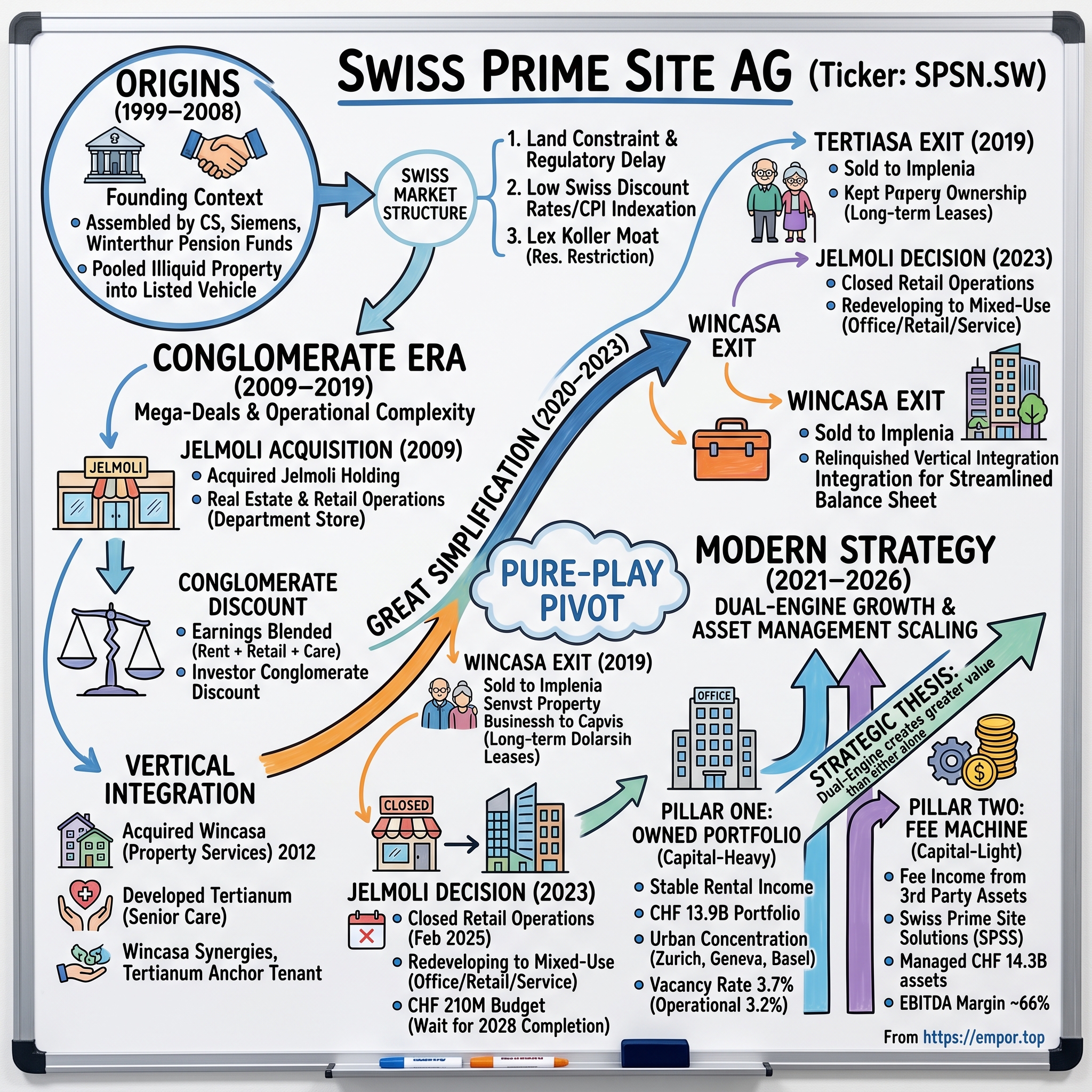
That scene serves as a fitting metaphor for the business. For much of its history, Swiss Prime Site lacked a clear strategic focus. The real estate firm simultaneously operated a department store, a senior-care network, and a property services division. Earnings blended rent, retail markups, and care-home fees, prompting investors to apply a conglomerate discount.
By mid-2026, the corporate structure is considerably more focused. Swiss Prime Site holds a property portfolio valued at CHF 13.9 billion as of late 2025—the largest among listed Swiss real estate firms—alongside its asset management division, Swiss Prime Site Solutions, which manages CHF 14.3 billion in third-party assets. Combined, group-managed real estate totaled CHF 28.2 billion.1 This model relies on two distinct drivers: a capital-intensive balance-sheet portfolio providing steady rental income, and a capital-light asset management arm generating fee income. Management's strategic thesis rests on the premise that operating both creates greater value than operating either in isolation.
That thesis requires rigorous examination. The core operational and financial questions facing the business include:
How do you recycle capital in a tight market without eroding value? Switzerland features approximately nine million residents, a structural shortage of developable urban land, and substantial institutional capital seeking domestic placement. While selling properties into this market is straightforward, acquiring replacement assets without overpaying remains a persistent challenge.
Why shut down Jelmoli? In February 2023, management announced the permanent closure and structural renovation of one of Switzerland's major department stores near Zurich's Bahnhofstrasse.5 The decision represents the company's most prominent operational shift in recent years, illustrating a preference for real estate underlying value over direct retail operations.
What drives Swiss commercial property returns? Low discount rates, modest inflation, Lex Koller restrictions on foreign ownership, and inflation-indexed leases produce cash flows that differ substantially from American or British REITs. Evaluating these structural mechanics is critical to understanding portfolio performance.
What does the 2026 leadership transition signal? Kucher, who served four and a half years as Chief Financial Officer, succeeded René Zahnd as CEO on 1 January 2026.4 Promoting the executive who structured the balance sheet signals a strategy focused on execution and capital discipline rather than further structural realignment.
Underlying these operational questions is a key financial dynamic. Swiss Prime Site raised CHF 300 million in equity in February 2025 and issued CHF 350 million in convertible bonds in February 2026, expanding its share count. While absolute funds from operations (FFO I) grew 3.2% in 2025, FFO per share remained unchanged at CHF 4.22 due to equity dilution.1 Generating per-share growth amid an expanding share count presents an ongoing operational hurdle. Understanding how the company reached this position requires examining its origins in 1999, when Swiss Prime Site operated primarily as a real estate portfolio within a corporate wrapper.
 Subscribe on LinkedIn
II. Origins, Swiss Property Market Structure & The Founding Context (1999–2008) (20 Minutes)
Swiss Prime Site was not founded by an entrepreneur with a sketch on a napkin. It was assembled on 11 May 1999 by institutions facing a balance-sheet challenge: the Credit Suisse Pension Fund, the Siemens Pension Fund, and Winterthur Leben—the life insurer later absorbed into AXA—held large quantities of Swiss commercial property that were illiquid, opaque, and difficult to value.2 Their solution was to pool the assets into a single vehicle, list it publicly, and let the open market establish pricing.
The listing occurred in 2000 on the SWX Swiss Exchange. The portfolio at inception was valued at roughly CHF 500 million—a fraction of the company's current scale, but sufficient to establish its core architecture: an externally sourced portfolio, institutional sponsorship, and a public share price measured against net asset value.
What made the vehicle work was not complex financial engineering, but the structure of the market in which it operated.
Why Swiss Property Is a Different Asset Class
The first structural factor is land constraint. Bounded by lakes, topography, agricultural zones, and a strict local planning framework, buildable urban land in cities like Zurich is structurally scarce. A single formal objection can delay a development for years—such as when Swiss Prime Site later withdrew a Federal Supreme Court appeal after a project spent years in legal impasse. In the Swiss commercial market, regulatory delay is a baseline operating condition.
Supply scarcity supports rental rates in prime locations and renders existing assets difficult to replicate. While an office developer in the United States must contend with competitors building adjacent towers, an owner in Zurich's central business district primarily manages tenant retention risk, given the severe barriers to construct nearby alternatives.
Discount rates provide a second structural driver. Swiss property values rely on discounted expected cash flows, and Swiss discount rates rank among the lowest globally due to domestic interest rate policy. The Swiss National Bank has held its policy rate at 0% through 2026, with average annual inflation forecast at 0.6% for both 2026 and 2027.18 Low interest rates and minimal inflation elevate the value of stable rental income streams. In 2025, Swiss Prime Site's external valuer reduced discount rates by approximately two basis points in real terms—a modest adjustment that generated roughly half of the company's CHF 220 million portfolio value gain.[^2] In a low-yield environment, incremental discount rate shifts drive substantial balance-sheet revaluations.
Lex Koller: The Moat Written Into Law
Regulation provides a third structural mechanic. The Federal Act on the Acquisition of Real Estate by Persons Abroad—commonly known as Lex Koller—has restricted foreign purchases of Swiss residential property since 1983, while commercial property acquired for genuine business use has remained exempt.3 The practical impact on Swiss Prime Site requires careful distinction.
Lex Koller restricts foreign capital competing for Swiss residential assets, which historically capped bidding intensity across the domestic property sector. However, the commercial exemption means Swiss Prime Site's core asset classes—offices, retail, and logistics—have always faced international competition. The statutory protection protects the residential sector rather than commercial real estate. Furthermore, the regulatory regime remains dynamic: the Federal Council has proposed tightening rules, including requiring authorization for shares in listed real estate companies and ending investment-motivated commercial acquisitions by foreign buyers.3 Restricting foreign capital would support Swiss Prime Site when bidding on acquisitions, while simultaneously reducing the pool of prospective buyers when it seeks to sell assets.
The Indexation Engine
A fourth mechanic shaping cash flow is lease indexation. Swiss commercial leases are typically tied to the Swiss Consumer Price Index, automatically adjusting contractual rents for inflation. While often characterized as an inflation hedge, this mechanism generates meaningful top-line growth only during inflationary periods.
In 2025, with Swiss inflation near zero, indexation added just 0.4 percentage points to like-for-like rental growth out of a 2.0% total.1 The remaining 1.6 percentage points came from re-letting space at higher market rates and filling vacancies. Chief Executive Officer Marcel Kucher informed analysts that the indexation contribution is expected to remain around that level or decline further.[^2] In a low-inflation environment, CPI-linked leases provide downside protection rather than active growth, requiring leasing teams to drive operational performance.
Assembling the Portfolio
Against this backdrop, Swiss Prime Site spent its first decade expanding its portfolio. The company acquired a large property package from Swisscom and completed its first ground-up development, Cityport in Zurich Oerlikon. In 2003, it inaugurated the Messeturm in Basel, then Switzerland's tallest building at 105 meters. In 2004, it acquired Maag Holding, securing the Maag site in Zurich West—the industrial location where Prime Tower would later rise and which continues to shape strategic decisions.2
By 2008, Swiss Prime Site had fulfilled its initial objective: converting scattered institutional property holdings into a scaled, liquid, publicly traded vehicle capable of outbidding fragmented private landlords. However, the firm had not yet navigated operational complexity—a phase that arrived next with the acquisition of a department store.
III. The Conglomerate Era: Mega-Deals & Operational Complexity (2009–2019) (25 Minutes)
The Jelmoli building on Seidengasse 1 is not a single structure, but a complex assembled over more than a century from four principal buildings and eleven distinct structural components off Zurich's Bahnhofstrasse. Marcel Kucher later noted to analysts that this physical complexity explained why subsequent renovation projects incurred unexpected costs.[^2] In 2009, however, the strategic focus was real estate scale: acquiring Jelmoli Holding AG brought roughly 120 properties into the portfolio, expanding Swiss Prime Site's holdings from CHF 3.8 billion to CHF 8.1 billion in a single transaction.2
The transaction established Swiss Prime Site as the largest listed real estate firm in Switzerland—a position it has maintained ever since. Crucially, it also introduced a new dimension to the company's business model: direct management of an operating business.
What Came With the Real Estate
Jelmoli was not merely a real estate lease; it was an operating department store—branded "The House of Brands"—complete with retail buyers, inventory, staff, seasonal working capital, and inherent margin volatility. In acquiring the property, Swiss Prime Site simultaneously absorbed a prime real estate asset and an operational retail enterprise, managing both for the subsequent fourteen years.
Management subsequently pursued further expansion into real estate-adjacent services. In October 2012, Swiss Prime Site acquired Wincasa, Switzerland's leading property services provider, aiming to capture revenue across the entire real estate value chain.2 Integrating property management allowed the firm to retain service fees that would otherwise go to external providers while acquiring broad market data across the Swiss real estate sector.
A similar logic underpinned the firm's expansion into senior living. During the 2010s, Swiss Prime Site developed Tertianum Group into Switzerland's market leader in assisted living and elder care. Tertianum served as an anchor tenant in Swiss Prime Site's purpose-built properties while generating operational income alongside rental payments. The strategy leveraged favorable demographic trends in Switzerland, where an aging population supported stable, long-term occupancy rates.
In December 2011, the company completed the Prime Tower in Zurich West—a 126-meter, 36-floor skyscraper that stood as Switzerland's tallest building for several years.2 The tower served as a flagship asset for the firm and ultimately provided the location for its executive presentations.
Why the Market Stopped Paying
By the mid-2010s, despite steady operational performance across the portfolio, the company's valuation lagged. The discount stemmed from structural factors rather than underlying asset quality.
Pure rental income is predictable, long-term, and valued at a low discount rate, commanding higher valuation multiples. Conversely, department store earnings are cyclical, labor-intensive, and exposed to retail trends and e-commerce, earning lower multiples. Senior care occupies an intermediate position, carrying specific regulatory and staffing risks. When these distinct cash flows were combined into a single consolidated financial statement, equity markets applied a conglomerate discount, valuing the group closer to its lower-multiple operating units to compensate for bundled operational risk.
The market valuation stood in contrast to peers such as PSP Swiss Property, a focused commercial landlord without operating subsidiaries. PSP commanded a valuation premium due to its transparent, pure-play earnings structure. Despite holding a larger asset base and greater overall scale, Swiss Prime Site traded at a persistent valuation discount.
Operating these divisions also introduced organizational friction. Operating businesses require executive oversight out of proportion to their capital allocation, diverting leadership attention toward retail merchandising, vendor negotiations, and healthcare staffing rather than core real estate activities such as lease negotiations, asset management, and property acquisitions.
The Man Hired to Fix It
René Zahnd assumed the role of Chief Executive Officer on 1 January 2016, bringing a background in civil engineering, legal practice, and construction management. He trained as a civil engineer at Delft University of Technology, earned an MBA from IMD Lausanne, and practiced law at Bratschi Emch & Partner in Bern and Zurich. Between 1998 and 2009, Zahnd directed legal services and project development at general contractor Losinger Marazzi, before serving six years at Implenia as head of real estate and development, joining its group executive board in 2013.[^22]
Zahnd's combination of legal and construction expertise suited the operational demands of Swiss real estate, providing a practical perspective on development budgets, building logistics, and regulatory delay risk.
In February 2017, Swiss Prime Site established Swiss Prime Site Solutions AG as a dedicated third-party asset management arm.2 While initially modest in scale, the unit established the architecture for a dual-pillar strategy: creating a capital-light asset management platform to generate fee income alongside the capital-intensive balance-sheet portfolio.
The second element of the restructuring strategy focused on portfolio simplification and divestments.
IV. The Great Simplification: Pruning, Capital Recycling & Pure-Play Pivot (2020–2023) (25 Minutes)
On 13 December 2019, Swiss Prime Site announced the sale of Tertianum Group to Swiss private equity firm Capvis, executing a capital recycling strategy that separated operating activities from real estate ownership.
Swiss Prime Site retained ownership of the nursing home properties on its balance sheet while selling the operating business, keeping Tertianum as a primary tenant.8 This structure allowed the real estate firm to maintain stable rental cash flows while transferring staffing, regulatory compliance, wage inflation, and operational execution risk to the buyer. The parties agreed not to disclose the purchase price.8 The transaction closed in the first half of 2020.
In the corporate accounts, Tertianum remains Swiss Prime Site's single largest tenant, accounting for slightly over 5% of rental income as of the end of 2025.[^2] Selling the operating business did not end the relationship; it converted an operational exposure into a long-term lease.
The Wincasa Exit and the Question of Vertical Integration
The rationale for divesting Wincasa differed from Tertianum, marking a direct departure from vertical integration.
On 30 March 2023, Swiss Prime Site agreed to sell property manager Wincasa to construction and real estate group Implenia at an enterprise value of CHF 235 million. The deal generated roughly CHF 181.6 million in cash proceeds, including an intra-group dividend for 2022. The transaction closed in the second quarter of 2023, backdated for economic effect to 1 January 2023. Management projected the sale would lower the group's loan-to-value ratio from 38.9% to roughly 37.5% while generating a non-operating pre-tax accounting gain of approximately CHF 140 million.9
The CHF 140 million pre-tax gain reflected a carrying value significantly below transaction value after eleven years of ownership. While boosting reported earnings for 2023, the one-off gain required investors to strip out disposal proceeds to gauge underlying operational performance during the transition.
CEO René Zahnd framed the transaction as achieving "maximum streamlining of our company."9 The strategic trade-off was explicit: Swiss Prime Site relinquished its in-house property manager and internal fee margins in exchange for a streamlined balance sheet, lower leverage, and arm's-length service contracting.
The divestment reflected the diminishing strategic value of full vertical integration. Wincasa's primary synergy—market intelligence—had become redundant as Swiss Prime Site developed its dedicated asset management platform, which offered comparable market insights alongside higher profit margins. Ultimately, property management operated as a lower-multiple service business attached to a higher-multiple real estate portfolio.
The Jelmoli Decision
The company's most prominent operational shift occurred in retail.
On 6 February 2023, Swiss Prime Site announced the permanent closure of the Jelmoli department store's retail operations and a full redevelopment of the property, citing an inability to secure an independent operator or buyer. The initial project outline specified closing the department store at year-end 2024, investing over CHF 100 million, initiating a two-year construction phase in early 2025, and reopening in early 2027 under new tenants. The redevelopment plan earmarked roughly 10,000 square metres for refurbished retail on lower levels, while converting upper floors into office space, sports facilities, and dining options. The 2022 financial accounts absorbed CHF 34 million in non-recurring charges, including impairments and accelerated depreciation.5
The decision signaled that direct retail operations at the Bahnhofstrasse location were no longer commercially viable without an external operator. With no third-party operator emerging, Jelmoli served its final customers in February 2025.1
The redevelopment shifts the property from a single-tenant retail site to a multi-tenant mixed-use asset. The completed design at Seidengasse 1 encompasses roughly 34,000 square metres, comprising approximately 13,000 square metres of retail and 20,000 square metres of office and service space, alongside a publicly accessible rooftop terrace and restaurant, with phased completion set to begin in summer 2028.6 Transitioning to a mixed-use model diversifies tenant risk by placing retail on high-footfall lower levels while allocating upper floors to office and service tenants.
The financial rationale relied as much on eliminating retail losses as on real estate redevelopment yields. Marcel Kucher explained to analysts that while the physical redevelopment yields approximately 4% on cost, eliminating the ongoing operating losses from Jelmoli's final years raises the effective return of the decision to between 7% and 8%.[^2] Roughly half of the financial return stems from eliminating operating losses rather than incremental rental growth.
This decision completed the firm's broader capital recycling principle: separating real estate assets from underlying business operations and evaluating each independently. Tertianum proved viable as an independent tenant, Wincasa suited a service-focused owner, and Jelmoli's retail operations were discontinued to unlock the underlying real estate value.
The Honest Version of the Track Record
Executing three major disposals in four years removed distinct operational risks from the balance sheet, contrasting with several European real estate peers that struggled to complete announced restructuring programs.
However, execution challenges emerged in project cost control, particularly regarding Jelmoli's redevelopment budget. In February 2023, management initially projected investment costs of over CHF 100 million.5 That estimate rose to CHF 130 million at the 2023 Capital Markets Day, before reaching CHF 210 million by the full-year 2025 results presentation. Zürcher Kantonalbank analyst Ken Kagerer questioned Kucher on the escalation, noting that former CEO René Zahnd had previously assured investors the earlier budget would be maintained.[^2]
Kucher attributed the budget expansion to structural requirements discovered after stripping the building, design modifications to expand floor space and atrium lighting, additional structural reinforcement, and the inclusion of the rooftop restaurant and terrace, noting that a general contractor agreement signed in September 2025 capped further cost increases.[^2] While structural modifications and expanded scope provide operational justification, the final figure represents a roughly 60% increase over mid-stage estimates, presenting a key test of capital discipline for leadership.
Concurrently, the company's third-party asset management division expanded its role within the group's dual-pillar model.
V. Modern Strategy: Dual-Engine Growth & Asset Management Scaling (2021–2026) (25 Minutes)
At the full-year presentation in February 2026, Anastasius Tschopp, Deputy Chief Executive Officer of the group and CEO of Swiss Prime Site Solutions, outlined the structural demand driving the company's asset management business. Swiss pension funds allocate roughly CHF 17 billion annually to investments, with approximately 23%—or CHF 4 billion to CHF 5 billion—directed into real estate. Swiss Prime Site Solutions captures a 12% to 15% share of these annual capital flows.[^2]
This asset management model relies on Switzerland's mandatory occupational pension system, which generates continuous institutional capital inflows seeking domestic yield. In addition, net annual immigration of approximately 100,000 people maintains structural demand for Swiss real estate relative to constrained urban supply.[^2] Within this market structure, scale and institutional reach allow Swiss Prime Site Solutions to position itself as a primary recipient of domestic pension capital.
Pillar One: The Owned Portfolio
The balance-sheet portfolio stood at CHF 13.9 billion at the end of 2025, reflecting a 6.6% annual increase. Expansion was driven by CHF 550 million in acquisitions, CHF 222 million in development investments, and a 1.8% revaluation gain, partially offset by CHF 130 million in property disposals.1[^2]
Geographic holdings remain highly concentrated in major urban centers: approximately 60% of portfolio value is in central Zurich, roughly 20% around Lake Geneva, and about 12% in the Basel region.[^2] By sector, office properties account for nearly 50% of asset value, retail represents roughly 20%, and the remaining portion encompasses infrastructure, logistics—including specialized laboratory space—hotels, gastronomy, and healthcare assets retained from the former Tertianum portfolio.
Two structural operational shifts define the portfolio's trajectory. First, management has consolidated holdings into fewer, larger assets. The portfolio comprises roughly 130 properties averaging approximately CHF 100 million each. Consolidating asset scale has lowered administrative overhead per Swiss franc of rental income: in 2025, property operating costs fell 5.4% while rental income declined by a modest 1.4%.[^2]
Second, portfolio quality has systematically improved. Ratings from external valuer Wüest Partner indicate that over 99% of the portfolio occupies prime location categories, while nearly 90% meets top building-quality standards—a marked upgrade from four years earlier.[^2] This structural quality supports like-for-like rental growth, as high-grade properties in core urban locations command higher rents upon lease renewals.
Operational metrics reflect this positioning. Total vacancy dropped to 3.7% by late 2025—the lowest level in corporate history—comprising 3.2 percentage points of active operational vacancy and 0.5 percentage points held vacant for planned redevelopments. The weighted average unexpired lease term (WAULT) expanded by nearly six months to 5.3 years, supported by lease renewals with EY at the Prime Tower site and staggered multi-year extensions with department store operator Globus, spanning seven years in Lucerne, eight years in Lausanne, and ten years in Geneva.1[^2]
However, long-term lease commitments involve operational trade-offs. The ten-year extension in Geneva deferred a planned property conversion project by a decade, illustrating the ongoing tension between securing immediate lease duration and preserving near-term redevelopment flexibility.
Pillar Two: The Fee Machine
Since its inception in 2017, Swiss Prime Site Solutions has expanded into Switzerland's largest independent real estate asset manager, operating without an underlying parent bank or insurance balance sheet.[^2]
Strategic acquisitions accelerated this growth. In December 2021, the firm agreed to acquire Zug-based Akara Group, adding approximately CHF 2.3 billion in assets under management, three regulated entities, a dedicated pension fund real estate vehicle, a private equity development entity, a project pipeline exceeding CHF 240 million, and a team of roughly 50 real estate specialists.10
A larger expansion followed on 14 March 2024, when Swiss Prime Site acquired the real estate division of Fundamenta Group, adding CHF 4.2 billion in assets under management. Funded via 75% cash from existing liquidity and 25% newly issued authorized equity, the transaction brought approximately 60 employees across Zug and Munich, a listed real estate company, an investment foundation, an investment fund, a Luxembourg SICAV, direct asset mandates, and CHF 0.9 billion in core German residential properties managed out of Munich.11 Former CEO René Zahnd characterized the acquisition as "a perfect fit."11
Integration achieved its target financial objectives. Management projected CHF 8 million in operational synergies and confirmed during the full-year 2025 results presentation that these savings were fully realized, maintaining flat personnel expenses alongside rising revenues.[^2]
Financial results for 2025 demonstrated operational leverage across the division. Asset management operating income rose 18.1% to CHF 83.6 million, while segment EBITDA grew 30.7% to CHF 54.9 million.1 Earnings expanding at nearly twice the rate of revenue highlights the division's low marginal cost per additional franc of managed assets, yielding an EBITDA margin of approximately 66%.[^2]
Capital inflows expanded significantly in 2025, generating CHF 1.0 billion in net new capital—exceeding total inflows from 2023 and 2024 combined. Inflows comprised CHF 430 million in new fund equity, CHF 590 million into investment foundations, and roughly CHF 400 million in advisory mandates. Total transaction volume reached CHF 1.75 billion across approximately 120 deals, 30% of which were executed off-market.1[^2]
The Discipline Question Inside the Fee Engine
Sustaining earnings quality across the asset management division requires balancing fee structures and deployment pacing.
Fee income comprises recurring asset management fees and variable, transaction- or construction-linked fees. Recurring fees command higher valuation multiples due to their consistency. Management targets maintaining recurring fees at two-thirds or more of total fee revenue, achieving a 66% share in 2025 despite record transaction volumes.[^2] Pressed by ABN AMRO ODDO BHF analyst Steven Boumans regarding whether this proportion can hold through 2026 and 2027, CEO Marcel Kucher reaffirmed the two-thirds threshold as an operational benchmark rather than a fixed forecast.[^2] Maintaining this ratio remains critical, as heavy transaction years naturally weigh on recurring revenue shares.
A broader strategic challenge concerns capital deployment discipline. Analyst Ken Kagerer highlighted that more than CHF 9 billion was raised across the Swiss real estate fund market in 2025. With Swiss Prime Site Solutions targeting an additional CHF 1 billion in capital inflows amid active institutional competition, Kagerer questioned how incoming funds can be deployed at attractive yields without diluting fund returns or asset quality.[^2]
In response, Tschopp indicated that the transaction pipeline remained filled for four to five months and expressed confidence in maintaining target returns.[^2] Nevertheless, managing institutional capital inflows in a tight market presents structural risks. Given that asset management fees are tied to total assets under management, maintaining strict acquisition standards during periods of heavy capital inflows remains an ongoing test of capital discipline.
The People Now Running It
Dr. Marcel Kucher assumed the CEO role on 1 January 2026, following four and a half years as Chief Financial Officer starting in July 2021. Kucher, 54 at his appointment, holds a doctorate in economics from the University of Zurich and previously served ten years as CFO and COO of Peach Property Group, with prior consulting experience at McKinsey and a-connect.4 During his CFO tenure, Kucher structured the financing framework supporting the group's capital recycling strategy and secured an A3 credit rating from Moody's.4
In public presentations, Kucher has maintained a detailed, operational focus. Addressing the cost adjustments on the Jelmoli redevelopment, he cited specific structural requirements, while addressing potential capital increases by stating that any equity issuance must be "accretive, and it should be accretive quickly, not in 5 years' time and with a lot of hope."[^2] When asked if immediate accretive opportunities were available, he noted: "That we'll answer once we see them."[^2]
René Zahnd stepped down as CEO after a ten-year tenure under a planned succession process announced on 16 September 2025. Chairman Ton Büchner praised Zahnd's real estate expertise and strategic direction, while Zahnd called leading the firm's transformation "a true privilege."4
Martina Moosmann was appointed Chief Financial Officer on 31 March 2026, taking office on 15 April.14 Moosmann brings over 25 years of corporate finance, capital management, and asset management experience, having previously served as CFO of Swiss Re Asset Management, where she oversaw a portfolio exceeding USD 100 billion. Her background also includes capital management roles at Swiss Re, investor relations leadership at Barry Callebaut, a master's degree in economics from the University of Vienna, and an IMD board director diploma.14 Appointing a CFO with extensive institutional asset management credentials reflects the strategic weight assigned to expanding the asset management pillar.
Kucher managed the CFO succession process within his stated timeline. Addressing analysts during the full-year 2025 presentation regarding interim responsibilities, Kucher stated, "I will not do a double job," committing to a structured four-to-six-month search that concluded with Moosmann's appointment in late March.[^2]
At the Annual General Meeting in Zug on 12 March 2026, shareholders re-elected Ton Büchner as Chairman, alongside board members Reto Conrad, Barbara A. Knoflach, Gabrielle Nater-Bass, Thomas Studhalter, Detlef Trefzger, and Brigitte Walter, for terms extending to the 2027 AGM. Shareholders approved all board proposals, including a total dividend of CHF 3.50 per share—split equally between a CHF 1.75 ordinary dividend and a CHF 1.75 tax-free capital reserve distribution—paid on 31 March 2026.16
VI. Segment Economics & Financial Deep-Dive (15 Minutes)
In September 2025, Swiss Prime Site took an unprecedented step in its 26-year history by issuing debt in euros. The company placed a €500 million Eurobond that drew €4.3 billion in demand—roughly eight times oversubscribed—at a credit spread that broadly matched its domestic borrowing costs.[^2]
For a company whose properties, rental streams, and investor base are overwhelmingly Swiss, tapping European debt markets represented a strategic structural expansion rather than a temporary tactic. On the earnings call, CEO Marcel Kucher framed the move around operational optionality, noting that the primary purpose of the Eurobond was to ensure that "in any position, we are always able to refinance ourselves."[^2] Relying exclusively on the domestic Swiss franc market leaves a borrower vulnerable to local liquidity conditions when debt matures. Accessing a deeper, broader European capital pool provides a structural hedge against domestic market disruptions.
How the Two Engines Contribute
The real estate segment continues to generate the overwhelming majority of group earnings, underscoring the structural imbalance between the two divisions despite asset management's rapid expansion. In 2025, rental income fell 1.4% in absolute terms to CHF 456.8 million, while asset management generated CHF 83.6 million in operating income.1 Real estate remains the primary driver of earnings before interest, taxes, depreciation, and amortization (EBITDA): asset management contributed CHF 54.9 million to a group comparable EBITDA of CHF 408 million, representing roughly one franc in every seven.1[^2]
Evaluating the business requires looking past the absolute levels to the underlying growth trajectories. Asset management EBITDA surged 30.7% while requiring virtually no balance-sheet capital. By contrast, real estate EBITDA grew 3.4% on a comparable basis, supported by CHF 13.9 billion in property assets.1[^2] This stark divergence in return on equity provides the core rationale for scaling the capital-light asset management pillar.
The headline decline in rental income warrants closer examination, as it reflects intentional restructuring rather than operational weakness. Approximately CHF 14 million in annual rent temporarily lapsed as the Jelmoli department store and the Fraumünsterpost property were removed from service for major redevelopments, while asset sales completed in 2024 removed an additional CHF 15.7 million. Offsetting these reductions, organic like-for-like rental growth generated roughly CHF 8 million, newly completed developments—led by Alto Pont-Rouge in Geneva, JED in Schlieren, and BERN 131 in Bern—added nearly CHF 9 million, and 2025 property acquisitions contributed about CHF 5 million, with most closing late in the financial year.[^2] Adjusting for planned disposals and temporary redevelopment vacancies, underlying portfolio income expanded, confirming that the top-line reduction stemmed from deliberate capital recycling rather than tenant attrition.
The Balance Sheet
The real estate segment's loan-to-value ratio closed 2025 at 38.1%, a decrease of 20 basis points, maintaining compliance with management's target ceiling of 39%.1[^2] The portfolio's average interest rate declined from approximately 1.1% to 0.94%, with 86% of outstanding debt fixed against rate volatility.[^2] Capital sources remain diversified: unsecured bonds represent roughly half of total borrowing—split into 40% domestic Swiss franc bonds and 10% euro-denominated debt—supplemented by convertible bonds, unsecured credit facilities across 13 Swiss banking institutions, and insurance-backed secured loans accounting for approximately 11%. Committed liquidity reserves stood at roughly CHF 1.1 billion.[^2] Moody's maintains an A3 credit rating on the group with a stable outlook.4
One debt metric moved adversely during the period: the average maturity of financial liabilities contracted to 3.9 years, marking a decade low. When questioned by Zürcher Kantonalbank analyst Holger Frisch, Kucher attributed the shortening primarily to an unsecured bank facility with four to five years remaining that was too early to refinance, cautioning that the maturity profile could temporarily contract further before lengthening.[^2] In the current low-rate environment backed by CHF 1.1 billion in committed liquidity, a 3.9-year average maturity poses no immediate solvency threat. However, in a rising-rate environment, a shorter debt ladder escalates refinancing risk, making debt duration an important metric to monitor.
In February 2026, Swiss Prime Site issued CHF 350 million in green convertible bonds maturing on 5 March 2032. The notes carry a zero coupon and a 24.0% conversion premium, establishing an initial conversion price of CHF 179.56 per share. Net proceeds were earmarked to partially refinance CHF 275 million in maturing convertible notes and finance sustainable developments under the company's Green Financing Framework,15 which guided approximately CHF 800 million in refinancings throughout 2025.[^2]
Zero-coupon convertible structures provide immediate cash flow advantages by eliminating ongoing interest expense, with equity dilution deferred unless the stock appreciates 24%. However, convertibles represent embedded equity options. With the share price trading around CHF 132 as of late July 2026, the conversion option remains substantially out of the money.[^5] Because convertible debt transforms into equity during periods of share price appreciation, tracking potential conversion remains essential when evaluating diluted per-share earnings.
Dividend and Yield
The approved CHF 3.50 per share dividend relative to funds from operations (FFO I) of CHF 4.22 represents a payout ratio of approximately 83%, sitting comfortably within management's target band of 80% to 90%.1 Based on the late-July 2026 stock price of around CHF 132, the distribution translates to a dividend yield of approximately 2.7%.[^5] This yield reflects a significant valuation re-rating compared to historical Swiss property yields, as share price appreciation has reduced the headline distribution yield.
The M&A Scorecard
On balance, recent divestments demonstrate effective capital discipline. The group monetized Tertianum's operations while retaining the underlying care home real estate, sold Wincasa at a substantial accounting gain, and completed 2025 property disposals at average prices roughly 5% above carrying values—a premium that Kucher noted confirms conservative balance-sheet valuations.[^2]
Evaluating acquisition performance proves more complex due to limited disclosure. Because the transaction price for Fundamenta was not disclosed, evaluating valuation multiples against European asset management benchmarks is not possible. Empirical data confirms that the acquisition added CHF 4.2 billion in assets under management, delivered the guided CHF 8 million in operational synergies, and rendered the German business profitable at all operating levels, according to Kucher, though at undisclosed margins below Swiss levels.[^2]11 When analyst Ken Kagerer pressed management on the specific German EBITDA margin, Kucher deferred the detailed breakdown to a future Capital Markets Day.[^2] The absence of margin transparency leaves an information gap regarding a unit managing approximately CHF 1 billion in assets within a challenging German property market.
Acquisitions for the balance-sheet portfolio present a clearer operational track record. In 2025, Swiss Prime Site deployed approximately CHF 550 million across four prime properties: Place des Alpes in Geneva, acquired from SGS following its headquarters relocation to Baar; a newly constructed property in Prilly near Lausanne anchored by SAP and RUAG on nearly 20-year leases; the Swiss stock exchange headquarters in Zurich West; and, through an asset swap, full ownership of a Bahnhofstrasse building where the group previously held a half stake. The transaction package generated a blended net initial yield of roughly 3.7%—exceeding the existing portfolio average—though the Bahnhofstrasse acquisition yielded approximately 2.7%.[^2]
The 2.7% yield on Bahnhofstrasse highlights a long-term strategic priority: consolidating ownership across key urban blocks rather than maximizing immediate rental yield. Whether acquiring full site control generates superior long-term returns remains dependent on redevelopment execution over the coming years.
That imperative leads directly to the broader competitive landscape.
VII. Competitive Landscape, Porter's 5 Forces & Hamilton Helmer's 7 Powers (15 Minutes)
A walk along Zurich's Bahnhofstrasse is effectively a tour of an institutional shareholder register. Swiss institutional landlords—Swiss Prime Site, Swiss Life, UBS's funds, and cantonal pension schemes—own the majority of prime commercial properties. Competition in this market is not a land grab; it is a strategic war of position among a small group of well-capitalized institutions bidding on the same prime assets and competing for capital from the same pension funds.
The Named Field
PSP Swiss Property represents the closest operational peer and primary benchmark. At the end of 2025, PSP held a portfolio valued at CHF 10.1 billion across 150 investment properties and 10 development properties, maintaining a vacancy rate of 3.5%, compared with 3.2% a year earlier. Revaluation gains drove net income up 8.9% to CHF 408.5 million, supporting a five-centime dividend increase to CHF 3.95 per share.19
The peer comparison reveals distinct portfolio strategies. PSP operates as a pure-play commercial landlord with no asset management division. Its vacancy rate of 3.5% slightly exceeds Swiss Prime Site's total vacancy of 3.7%, though Swiss Prime Site's figure includes 0.5 percentage points of intentional vacancy reserved for redevelopment, placing its operational vacancy lower at 3.2%.[^2] PSP distributes its capital across smaller holdings, averaging under CHF 70 million per property, compared to Swiss Prime Site's average of roughly CHF 100 million. These structures reflect different strategic choices regarding asset concentration, operational risk, and overhead management.
Swiss Prime Site's primary structural differentiator is its fee-generating platform. PSP lacks an equivalent to Swiss Prime Site Solutions, leaving it without a capital-light growth driver or a mechanism to generate fee returns on third-party assets. This dual-engine structure provides a distinct operational vector, though its resilience across a complete real estate market cycle remains to be proven.
Allreal Holding combines direct property ownership with in-house general contracting—a structure that captures development margins but introduces construction volatility similar to what Swiss Prime Site systematically eliminated. Mobimo Holding operates as a mid-tier developer balancing commercial and residential properties.
For Swiss Prime Site's asset management division, the primary competition comes from institutional managers rather than listed real estate peers. Swiss Life Asset Managers and bank-backed vehicles like UBS's SIMA fund target the same institutional pension allocations. Deputy CEO Anastasius Tschopp emphasizes that these competitors manage proprietary balance-sheet capital alongside client funds, creating potential allocation conflicts. A manager operating without a balance sheet avoids incentives to direct secondary assets to clients, though whether pension trustees prioritize this distinction in manager selection remains an open question.
Seven Powers, Honestly Applied
Cornered Resource — genuinely strong. This represents the most defensible strategic advantage in the portfolio. Flagship properties along Zurich's Bahnhofstrasse and the Prime Tower campus cannot be duplicated, as regulatory constraints and spatial limits render equivalent urban developments functionally unobtainable. Valuation metrics reflect this scarcity: accepting a 2.7% net initial yield on a Bahnhofstrasse asset is rational only because the property represents an irreplicable asset.[^2]
Scale Economies — real but modest. Efficiency metrics confirm tangible operating benefits: property operating costs declined 5.4% while rental income fell 1.4%, and asset management EBITDA expanded at nearly double the rate of revenue growth.1[^2] Managing fewer, larger assets reduces administrative overhead per franc of rent. However, scale economies in physical real estate have natural limits; owning a Zurich office tower does not lower the operational cost of managing a property in Basel. The scale advantage is more pronounced in asset management, where compliance, distribution, and administration costs are spread across a larger asset base.
Switching Costs — moderate, and often overstated. Swiss pension funds investing through investment foundations incur administrative and tax friction when changing asset managers, and the three-year extension of the Fundamenta Investment Foundation mandate to 2029 reflects client retention.[^2] However, foundation units remain redeemable and mandates are subject to re-tendering. Switching costs delay capital reallocations rather than preventing them if performance lags.
Counter-Positioning — plausible but limited. Management contends that operating an independent asset manager alongside a balance-sheet portfolio creates a model that bank and insurer incumbents cannot replicate without structural conflicts. While logical, the business model is technically replicable by listed peers like PSP or Allreal. Swiss Prime Site's advantage stems from an eight-year head start, established regulatory approvals, and acquired platforms rather than an uncopyable structural barrier.
Process Power, Network Economies, Branding — not evident. Proprietary operational processes that competitors cannot replicate are not evident, and commercial property does not generate network effects. Tenant amenities at the Prime Tower campus—including shared transportation and digital services—were described by Kucher as making tenants "more sticky."[^2] These represent effective property management practice rather than a defensible moat.
Porter's Five Forces
Threat of new entrants: very low. Urban land scarcity, strict planning frameworks, and significant capital requirements make organic entry into prime Swiss commercial real estate impractical. Entry is effectively restricted to acquiring existing platforms at substantial premiums.
Bargaining power of tenants: low in prime, rising elsewhere. Demand continues to polarize across property grades. Kucher highlighted "huge demand" for core inner-city locations alongside "more challenging" conditions for secondary assets.[^2] Central Zurich tenants face minimal alternative supply, whereas suburban office tenants hold greater negotiating leverage. Swiss Prime Site's migration toward top-tier assets—with over 99% of its portfolio in prime location categories—is a direct hedge against this structural divergence.[^2]
Bargaining power of suppliers: moderate and underappreciated. Finite construction capacity and high labor costs give general contractors real pricing power. The Jelmoli redevelopment budget increase from CHF 100 million to CHF 210 million reflects expanded project scope alongside contractor cost pressures in a tight market.[^2]5
Threat of substitutes: bifurcated. Flexible working models substitute for office space, while e-commerce competes with traditional retail. While remote work adoption in Switzerland remains lower than in the US or UK, substitution pressures are pronounced in secondary suburban retail and office assets—prompting Swiss Prime Site's targeted disposals in locations such as Aarau, Biel, Augst, Buchs, and Brugg.[^2]
Rivalry among competitors: intense but disciplined. With institutional capital inflows driving over CHF 9 billion raised across the Swiss real estate fund market in 2025, competition centers on asset acquisition rather than tenant acquisition. Rivalry manifests as yield compression rather than price competition, elevating existing portfolio valuations while lowering returns on new acquisitions.[^2]
This competitive dynamic underscores the operational challenge facing management in deploying capital effectively.
VIII. Stress Tests, Risk Radar & Primary Transcript Guidance (15 Minutes)
Suppose an activist investor built a position in Swiss Prime Site tomorrow. What would the letter say?
The Dilution Case
The critique would open with the share count. Funds from operations (FFO I) grew 3.2% in absolute terms during 2025, yet FFO I per share remained flat at CHF 4.22.1 The culprit is equity dilution: the company issued 2,926,829 new shares at CHF 102.50 in its February 2025 capital raise and issued a further tranche to fund a quarter of the Fundamenta consideration.1112 Layered on top sits CHF 350 million in convertible bonds that transform into equity if the stock price rises above CHF 179.56.15
Management's rebuttal is specific and largely holds. The February 2025 placement was priced at a premium of nearly 19% to net asset value, making it immediately NAV-accretive; the proceeds were fully deployed within the year at yields above the existing portfolio; and the transactions are expected to generate around CHF 17 million of additional annual rent.12 Because most of those acquisitions closed late in 2025, only about CHF 5 million of that rent appeared in the 2025 accounts.[^2] Chief Executive Officer Marcel Kucher's claim that the raise was "adding value to our capital increase already in day 1" is therefore testable rather than rhetorical, and the real test arrives in the 2026 financial results, where guidance of CHF 4.25–4.30 per share embeds the full-year effect.1[^2]
An activist would counter that this strategy operates on a treadmill. Raising equity at a premium to NAV and acquiring assets at 3.7% yields works only while the share price supports the premium and while such assets remain available. Kucher's own response regarding future capital increases—stating they will occur only when accretive and quickly so—suggests he understands the constraint.[^2] Nevertheless, the broader pattern remains clear: Swiss Prime Site grows by issuing paper, and per-share progress has been modest enough that the burden of proof rests with management.
The Office Demand Case
The second line of attack targets asset composition. Roughly half the portfolio consists of office space, at a time when hybrid work models have weakened office demand across much of the developed world.[^2]
The Swiss counter-evidence presents a stronger operational picture. Portfolio vacancy stood at a record low of 3.7%, supported by lease extensions with EY and the Canton of Zurich alongside new leases signed with SGS and Banque Cantonale de Genève, while management deliberately increased the office share to reflect demand that is holding.1[^2] Reversionary potential across the portfolio runs at about 10%, which, spread across a weighted average lease duration of roughly six years, supports the 1.4% annual real rental growth the firm has been consistently delivering.[^2] These metrics indicate that in-place rents sit below market rates, signaling operational strength rather than structural decline.
An activist would respond that this positioning represents a geographic concentration risk disguised as asset quality. Allocating nearly 60% of the portfolio to central Zurich creates a single-city exposure that would be considered reckless in larger, more diversified markets. The strategy succeeds because Zurich's economy remains strong, but offers no diversification if local demand slows.
The Risk Radar
Interest rate and yield spread volatility. This represents the primary bidirectional risk facing the balance sheet. Roughly half of 2025's revaluation gain resulted from a two-basis-point reduction in real discount rates.[^2] That valuation engine functions equally in reverse. With the Swiss National Bank policy rate at 0% and expected to remain there across the forecast horizon, near-term risk remains low—yet valuations built on the lowest discount rates in modern history have limited room to improve and considerable room to fall.18 Furthermore, lease indexation provides asymmetric protection: if interest rates rise because inflation returns, CPI-linked leases partially offset the valuation hit; if rates rise without inflation, no such offset exists.
Development execution. Three projects are live. The Jelmoli redevelopment requires CHF 210 million, featuring staggered completion from summer 2028 and roughly 50% pre-letting alongside signed letters of intent on two additional office floors. The YOND Campus represents a CHF 150 million investment generating about CHF 8 million of additional annual rent, also completing from 2028—with underground parking finished and construction under way on YOND 3, which comprises roughly 85% of the new development. The Fraumünsterpost project involves a CHF 30 million commitment completing in summer 2027, with advanced discussions covering about two-thirds of the floor space.[^2] Total committed capital expenditure stands at roughly CHF 380–390 million, of which CHF 70–80 million was spent by early 2026.[^2] The Jelmoli budget history warrants close monitoring: a project that expanded from CHF 100 million to CHF 210 million while its completion timeline slipped from early 2027 to summer 2028 demonstrates ongoing execution risk, even with a fixed-price contract signed.[^2]5
Planning and legal risk, illustrated. On 25 June 2026, Swiss Prime Site abandoned its "Maaglive" development project in Zurich West and withdrew its appeal before the Swiss Federal Supreme Court, opting instead to renovate the historic Maag halls as a cultural venue at an estimated cost of CHF 60 million. The formal planning application is not due until late 2027 and construction will not start before mid-2029; management signed a letter of intent with the University of Zurich for a potential long-term lease housing the Natural History Museum and extended the existing lease with Maag Music & Arts to May 2029.17 Kucher was direct about the rationale, noting that ongoing legal uncertainty prevented concrete plans for Maaglive.17 The decision highlights the dual nature of Swiss planning law: while strict zoning rules protect incumbent asset values from new competitive supply, they symmetrically hinder an owner's own redevelopment ambitions, converting years of commercial development option value into a modest cultural heritage project.
German exposure. Roughly CHF 1 billion of managed assets sit in German residential property. Kucher described the market as showing "a little bit of a light on the horizon" and confirmed the business is profitable but operates below Swiss margins, declining to quantify.[^2] For a company whose competitive advantage rests on Swiss market dynamics, foreign residential assets represent a division where its core moat does not apply.
Concentration in the tenant base. Swiss Prime Site serves approximately 2,000 tenants, yet the top 30 account for 50% of rental income, with three tenants—Tertianum at slightly over 5%, Swisscom at roughly 5%, and Globus at close to 5%—each individually material.[^2] Two of those three operate in retail or senior care, sectors facing broader operational headwinds. While multi-year lease extensions with Globus protect near-term cash flows, tenant credit quality across evolving retail formats remains an ongoing factor.
A single asset worth watching. The Müllerstrasse building leased to Google features regularly on analyst calls. In his February 2026 update, Kucher noted that Google publicly committed to Zurich and designated Müllerstrasse as a core strategic site—moving artificial intelligence development teams there—while simultaneously reducing headcount.[^2] The asset illustrates the balance between securing major technology tenants and managing broader corporate space rationalization.
Reading the Primary Sources
For investors analyzing group strategy, the full-year 2025 call on 5 February 2026 provides the most comprehensive primary source available. Kucher presented the operational results with granular detail, while Deputy CEO Anastasius Tschopp set out the pension-flow arithmetic supporting the second-pillar thesis.[^2]
The accompanying question-and-answer session revealed underlying strategic tensions. Analyst Ken Kagerer's line-by-line reconstruction of the Jelmoli cost escalation across three separate presentations offered a clear test of guidance discipline, while his repeated attempts to extract a German EBITDA margin illustrated disclosure boundaries. Similarly, Morgan Stanley analyst Ana Escalante questioned potential expansion of the asset management business outside Switzerland, drawing a cautious response from management that left international growth an open strategic question.[^2]
Comparing corporate guidance with financial execution reveals a pattern of conservative target-setting. At the half-year 2025 stage, management guided to FFO I per share at the upper end of CHF 4.10–4.15 and vacancy below 3.8% by year-end.13 The company delivered CHF 4.22 and 3.7%.1 Outperforming both metrics in the same period indicates disciplined guidance practices, balancing the cost escalation observed in major redevelopment projects.
IX. Playbook: Durable Business & Investing Lessons (10 Minutes)
Strip away the Swiss specifics, and four transferable strategic lessons emerge.
1. Separate the asset from the enterprise sitting on it. This is the foundational insight of the Swiss Prime Site story, with applications far beyond real estate. A department store is not a building, a senior-care operator is not a nursing home, and a property manager is not a property asset. When a company owns both the underlying property and the operating enterprise, public markets struggle to price either accurately, and executive focus naturally drifts toward operational friction rather than core asset value.
The Tertianum divestment demonstrates how clean that separation can be: sell the operating company, retain the real estate, convert operational exposure into a long-term lease, and remain landlord to the former subsidiary.8 The Jelmoli closure illustrates the harder variation: when an operating enterprise lacks a viable third-party buyer at any price, the disciplined response is to close the business and reclaim the physical asset—accepting a CHF 34 million charge and temporary rental loss to unlock long-term redevelopment value.5
The decision framework is straightforward: for any operating business housed within an asset-heavy corporate structure, evaluate what an arm's-length third party would pay to operate it. If an outside operator values the business higher than internal management can justify, divest the operation. If no buyer exists, shut down the enterprise to liberate the real estate.
2. Capital-light and capital-heavy divisions compound at different speeds, and pairing them requires strict governance. The dual-engine architecture offers a compelling financial profile: generating CHF 54.9 million in segment EBITDA from a platform requiring minimal balance-sheet capital—growing at 30.7% annually—alongside a CHF 13.9 billion property portfolio delivering low single-digit earnings growth.1
However, combining these two business models creates distinct organizational tensions. First, the asset management platform must maintain independence; using a captive manager to offload secondary balance-sheet assets destroys client trust and institutional standing. Second, asset managers must resist expanding assets under management purely to harvest fee income at the expense of investor returns. Third, holding a fee-generating engine must not lead leadership to tolerate lower returns on balance-sheet capital.
Swiss Prime Site's corporate structure satisfies the independence requirement by design, but its capital deployment discipline remains to be tested across a full real estate cycle. The dual-engine framework is promising, yet unproven through an economic downturn.
3. In low-yield regimes, per-share growth is the ultimate operational test. Expanding a real estate portfolio by issuing equity to acquire properties is straightforward in a liquid market. Increasing earnings and asset value on a per-share basis is far more demanding, as illustrated by 2025's flat FFO per share alongside a 3.2% increase in absolute funds from operations.1
Navigating this environment requires unglamorous balance-sheet protections: extended lease terms that lock in duration, indexation clauses that offer upside if inflation rises, a leverage ceiling that is strictly enforced, and a diversified funding structure that prevents refinancing bottlenecks. Swiss Prime Site maintains all four safeguards. The remaining open question is whether its acquisition strategy can consistently generate per-share accretion faster than equity issuances dilute it.
4. Portfolio quality and geographic concentration are distinct risks. Concentrating 99% of holdings in top building and location categories appears to minimize operational risk.[^2] However, allocating nearly 60% of portfolio value to central Zurich creates a single-market exposure.[^2] Asset quality provides operational stability during favorable economic conditions, but offers limited protection if regional demand shifts. Every investment thesis in this story ultimately rests on a long-term commitment to the economic trajectory of central Zurich.
X. Bear vs. Bull Investment Case & Key KPIs (10 Minutes)
Why This Company Wins From Here
The bull case rests on four distinct mechanisms backed by operational data.
First, the portfolio holds prime assets in a market where regulatory and physical constraints restrict new supply. Operating metrics reflect this scarcity: a record-low vacancy rate of 3.7%, 2.0% like-for-like rental growth in a year with near-zero inflation, and approximately 10% reversionary potential indicating in-place rents sit below market rates.1[^2] High occupancy paired with under-rented leases suggests rental income can expand through lease renewals independent of broader macroeconomic growth.
Second, the asset management division benefits from mandatory institutional capital flows. Swiss pension funds allocate roughly 23% of new capital to real estate, with Swiss Prime Site Solutions capturing 12% to 15% of those inflows.[^2] A 66% EBITDA margin alongside 30.7% segment profit growth indicates that expanding assets under management generates high operational leverage at low incremental cost.1[^2]
Third, redeveloping the Jelmoli site replaces operating losses with rental income. While the physical project yields roughly 4% on cost, eliminating retail losses elevates the effective return on the decision to between 7% and 8%. Approximately half the office space is already pre-let or under letters of intent, and retail operator Manor has committed to 13,000 square metres across three floors starting in 2027.[^2]7
Fourth, the company's financial structure provides operational flexibility. An A3 credit rating, an average cost of debt below 1%, CHF 1.1 billion in committed liquidity, and access to both Swiss franc and euro capital markets allow the firm to pursue acquisitions and developments when tighter liquidity constrains competitors.[^2]4
What Would Break the Case
The bear case highlights structural vulnerabilities across valuation, per-share earnings, and capital deployment.
Valuations rely on historically low discount rates. Approximately half of the portfolio's 2025 revaluation gain resulted from a two-basis-point compression in real discount rates.[^2] With discount rates near historic lows, future compression is constrained, leaving valuations exposed to upward rate adjustments. An interest rate increase without corresponding inflation would depress asset values without triggering lease indexation adjustments.
Capital expansion risks diluting per-share growth. Equity issuances in 2024 and 2025 alongside a green convertible bond issue in early 2026 have expanded absolute earnings faster than per-share metrics.11115 Full-year 2026 FFO I guidance of CHF 4.25 to CHF 4.30 per share represents modest midpoint growth of under 2% over 2025 levels.1 Sustaining per-share accretion requires deploying capital at attractive yields in a competitive market where rivals raised over CHF 9 billion in fund capital during 2025 alone.[^2]
Asset management growth creates deployment discipline risks. Absorbing roughly CHF 1 billion in annual capital inflows requires placing funds without lowering underwriting standards. When questioned on maintaining asset quality during heavy capital inflows, management pointed to pipeline depth rather than strict acquisition yield criteria.[^2] If compressed acquisition yields reduce fund returns, institutional capital inflows could slow or reverse, weighing on fee income and valuation multiples.
Development cost and timeline overruns remain an operational risk. The Jelmoli redevelopment budget expanded from over CHF 100 million to CHF 210 million while its completion timeline moved from early 2027 to summer 2028.[^2]5 Managing concurrent major developments at YOND Campus and Fraumünsterpost presents ongoing execution tests.
German residential holdings lack the domestic competitive moat. Managing roughly CHF 1 billion in German residential assets exposes the division to a market where the firm lacks structural advantages. Operating margins for the German unit remain undisclosed, with management deferring detailed segment breakdowns to a future Capital Markets Day.[^2]
The Three KPIs That Matter
Three key performance indicators provide the primary benchmarks for evaluating execution.
1. FFO I per share. This metric reflects the net financial impact of capital recycling, equity issuances, convertible debt, and development spending. It serves as management's primary operational benchmark and the foundation for dividend distributions. Management guided to CHF 4.25 to CHF 4.30 per share for 2026, compared to CHF 4.22 delivered in 2025.1 Tracking per-share performance indicates whether capital deployment generates net accretion across an expanding share base.
2. Net capital inflows and the recurring fee ratio. Assessing asset management quality requires evaluating capital inflows alongside fee stability. Capital inflows without fee discipline reflect volume growth, while stable margins without inflows indicate stagnant scale. Management targeted approximately CHF 1 billion in net new assets under management for 2026 while maintaining recurring fees at two-thirds or more of total fee income.1[^2]
3. Vacancy rate split between operational and strategic space. The headline vacancy rate of 3.7% comprises 3.2 percentage points of active operational vacancy and 0.5 percentage points held vacant for planned redevelopments.[^2] Management projected operational vacancy to decline below 3.0% in 2026.[^2] Shifts in operational vacancy serve as an early indicator of demand across core commercial holdings.
These three metrics provide the baseline for measuring whether strategy translates into per-share value creation.
References
-
FY2025: Resilient rental income and record new money in Asset Management ensure stable FFO I of CHF 4.22 per share; higher dividend of CHF 3.50 per share proposed — Swiss Prime Site, 2026-02-05 ↩↩↩↩↩↩↩↩↩↩↩↩↩↩↩↩↩↩↩↩↩↩↩↩↩↩
-
Looking back: 25 years of Swiss Prime Site — Swiss Prime Site ↩↩↩↩↩↩
-
Lex Koller: Tightening ahead for real estate acquisitions by persons abroad — PwC Switzerland ↩↩
-
Swiss Prime Site: Marcel Kucher to become CEO as per January 2026 — Swiss Prime Site, 2025-09-16 ↩↩↩↩↩↩
-
Modernisation and repositioning of the Jelmoli building — Swiss Prime Site, 2023-02-06 ↩↩↩↩↩↩↩
-
Zürich: Manor zieht ins Jelmoli-Haus ein — IMMOBILIEN Business, 2024-07-09 ↩
-
Swiss Prime Site sells the Tertianum Group to Capvis — Capvis AG, 2019-12-13 ↩↩↩
-
Swiss Prime Site to sell Wincasa to Implenia — Swiss Prime Site, 2023-03-30 ↩↩
-
Homburger advised Swiss Prime Site AG on the acquisition of Akara Group — Homburger AG, 2021-12-16 ↩
-
Swiss Prime Site: acquisition of the real estate division of Fundamenta Group — Swiss Prime Site, 2024-03-14 ↩↩↩↩↩
-
Swiss Prime Site raises CHF 300 million to further expand its high-quality property portfolio — Swiss Prime Site, 2025-02-25 ↩↩
-
Swiss Prime Site reports strong results in the first half of 2025 – focus on two pillars is paying off — EQS News, 2025-08 ↩
-
Swiss Prime Site appoints Martina Moosmann as its new Chief Financial Officer — Swiss Prime Site, 2026-03-31 ↩↩
-
Swiss Prime Site announces the conversion price of its CHF 350 million green convertible bonds due 2032 and the outcome of the incentivized conversion invitation — EQS News, 2026-03-05 ↩↩↩
-
Swiss Prime Site: Annual General Meeting approves all proposals of the Board of Directors with a large majority — Swiss Prime Site, 2026-03-12 ↩
-
Swiss Prime Site to breathe new life into the Maag halls — Swiss Prime Site, 2026-06-25 ↩↩
-
Monetary policy assessment of 19 March 2026 — Swiss National Bank, 2026-03-19 ↩↩
-
PSP Swiss Property records another solid business year with a strong operating result — EQS News, 2026 ↩
 LinkedIn
 WhatsApp
 Reddit
 Hacker News
 Email
Email Kindle
 RSS Feed
 Spotify
 Apple Podcasts
 Amazon Music
 Audible
 YouTube