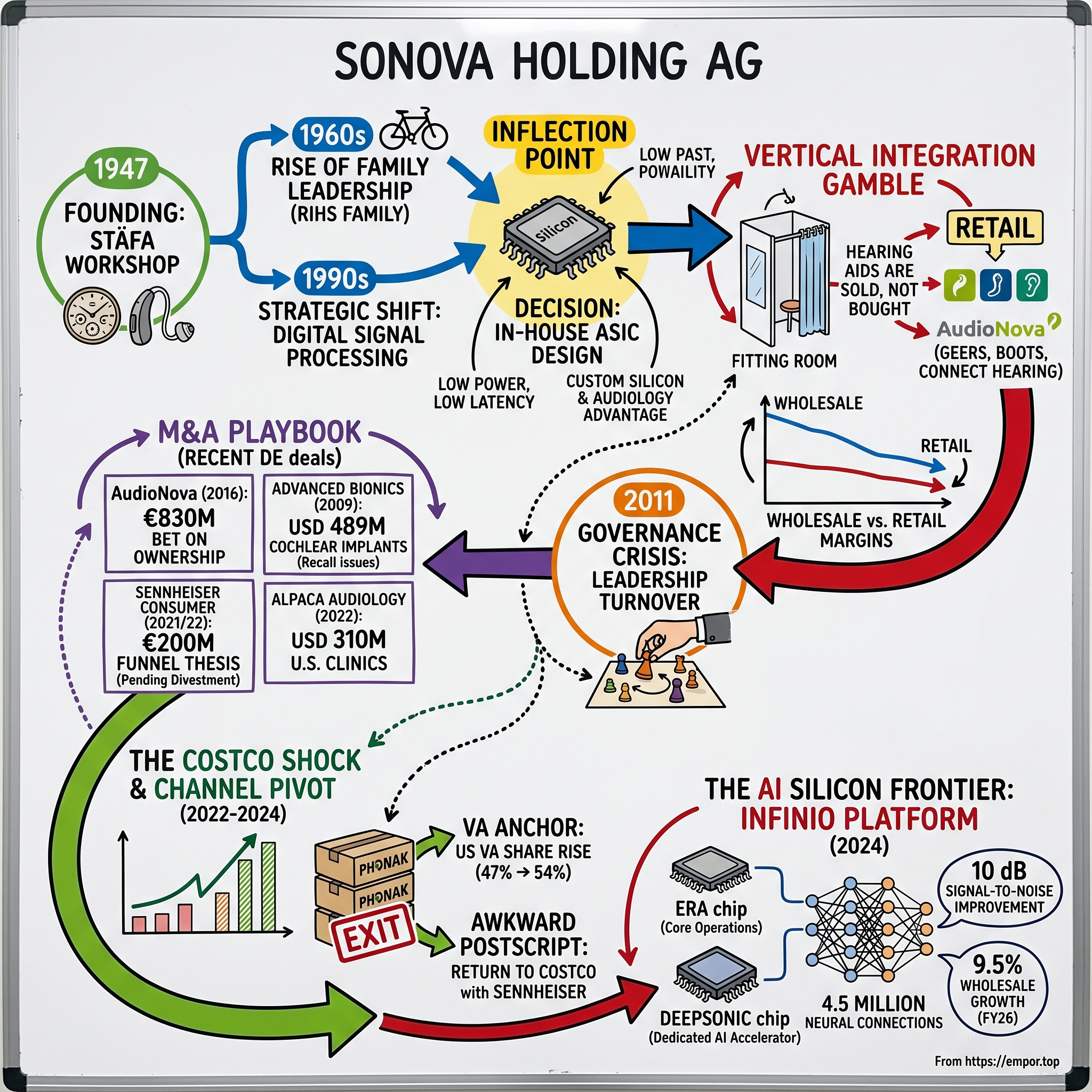
Sonova Holding AG: The Silicon & Care Monopoly in Hearing
I. Introduction & The Sound of Silicon
There is a moment that happens thousands of times a day in a fitting room in Düsseldorf, Melbourne, or Springfield, Missouri. A patient in their seventies sits across from an audiologist. A device smaller than a coffee bean is placed behind their ear. The audiologist opens a laptop, adjusts a few software sliders, and conducts a standard acoustic test: speaking at a normal conversational volume while a recording of a crowded restaurant plays through background speakers.
When the device engages, the patient frequently begins to cry.
That reaction — shared across roughly 17 million active users of Sonova devices worldwide — forms the foundation of the business.1 It also explains why hearing care deviates from typical consumer electronics markets. The product is prescribed rather than routinely bought as retail tech. Final pricing is dictated less by the manufacturer than by the owner of the clinical practice dispensing it. Meanwhile, the core technology remains invisible: a few square millimeters of custom silicon executing processing algorithms that would have required a desktop computer a generation ago, consuming fractions of a milliwatt.
Sonova Holding AG trades on the SIX Swiss Exchange under the ticker SOON, where it has been listed since 1994.[^2] In the fiscal year ended March 31, 2026, the group generated CHF 3,605.9 million in sales from continuing operations and CHF 811.2 million in normalized EBITA — a 22.5% normalized margin.2 The company employs roughly 18,000 people, operates about 3,600 retail hearing-care locations, and invested CHF 218 million in research and development in fiscal 2026.1
A central tension defines Sonova's current valuation. The company possesses key characteristics of a defensible medical technology franchise — an established market share alongside proprietary silicon, a global distribution footprint, and gross margins in the low 70% range. Yet the equity market has sharply revalued the company. At the end of July 2026, Sonova's market capitalization stood at approximately CHF 13 billion, down from nearly CHF 24.6 billion in November 2021, even as normalized EBITA increased over the same timeframe. This divergence reflects four primary market concerns: the threat of consumer technology giants commoditizing entry-level devices, the fixed-cost exposure of maintaining 3,600 physical stores, potential inconsistencies in channel strategy, and operational friction following senior management turnover that replaced the chief executive officer, chief financial officer, chairman, and operating model within an 18-month window.
This analysis evaluates Sonova's multi-decade structural transition: evolving from an original equipment manufacturer selling hardware to third-party distributors into an integrated platform that designs custom ultra-low-power silicon, manufactures prescription devices under the Phonak, Unitron, and Hansaton brands, and sells a significant portion through owned retail clinics including AudioNova, Geers, Boots Hearingcare, Connect Hearing, and regional banners.3 Between 2022 and 2026, Sonova also operated a consumer audio division under a perpetual Sennheiser brand license, an initiative management decided to exit in 2026.
Sonova's trajectory spans from a Swiss electro-acoustics workshop founded in 1947, the year Chuck Yeager broke the sound barrier,4 through family ownership, a 1994 public listing, a major governance restructuring, a multi-billion-franc expansion into European retail, the loss of a major North American retail account, and the 2024 launch of the industry's first hearing aid equipped with a dedicated real-time neural-network processor. As of July 2026, a new chief executive oversees a target to reach CHF 6 billion in revenue alongside the divestment of the consumer division.
Assessing the viability of that financial target requires examining the origin and development of Sonova's proprietary hardware and clinical model.
 Subscribe on LinkedIn
II. From Stäfa Workshop to Global Pioneer: The Phonak Foundation (1947–2006)
Post-war Switzerland possessed a unique industrial inheritance: a workforce trained in assembling mechanical watch movements—craftsmanship accustomed to working at micro-scales. When AG für Elektroakustik was founded in 1947 to help people with hearing loss overcome what the company later termed a "barrier to sound," it drew directly on that tradition of Swiss precision, applying it to electro-acoustics rather than watch escapements.4
Early devices were functional rather than discreet. The Phonak Alpina, launched in 1950, was the company's first portable hearing aid—a designation that, in the era's terminology, meant a device a user carried rather than something worn unobtrusively behind or inside the ear.4 Vacuum tubes gradually yielded to transistors, and transistors to integrated circuits, shrinking physical dimensions while extending battery performance. Nevertheless, for its first two decades, the business remained a modest Swiss engineering firm.
A strategic inflection point arrived in 1965 when entrepreneur Ernst Rihs acquired a majority stake and renamed the business Phonak AG. He was soon joined by Beda Diethelm and Rihs's sons, Andy and Hans-Ueli Rihs, with all four taking equal shareholdings.4 This concentrated ownership structure proved pivotal. Phonak operated not as a conventional, professionally managed corporation throughout its formative era, but as a closely held family enterprise with a few owners holding large, illiquid stakes. This setup fostered exceptional patience for long research-and-development cycles, while also embedding a governance culture that would later face friction when transitioning into a widely held public company.
Andy Rihs emerged as the public face of the enterprise. Unconventional among Swiss industrial leaders, he was a passionate cyclist who later founded and funded the BMC professional cycling team, displaying a demeanor far more comfortable alongside laboratory engineers than quarterly sell-side analysts. The enterprise established Phonak Holding AG as its overarching holding structure in 1985 and moved its headquarters from Zurich to the lakeside town of Stäfa in 1987.4
The decision that still matters: designing the chips
The most consequential technical choice in Sonova's history occurred in the 1990s during the industry's transition from analog amplification to digital signal processing (DSP). Hearing aid manufacturers faced a strategic choice: buy off-the-shelf DSP cores from semiconductor vendors or design custom chips in-house. Sourcing generic chips was cheaper, faster, and carried lower initial risk. In contrast, designing custom application-specific integrated circuits (ASICs) required absorbing substantial fixed engineering overhead and multi-year development schedules for hardware selling only in the low millions of units.
Phonak chose in-house design. The Phonak Claro, the group's first digital hearing aid, was launched as the direct result of that proprietary silicon commitment.4
The strategic value of custom silicon stems from physics and audiology. A hearing aid is essentially a miniaturized computer operating continuously for an entire waking day on a battery the size of a lentil. It must execute complex digital signal processing fast enough that amplified audio reaches the eardrum virtually simultaneously with ambient sound entering the ear naturally. A delay exceeding a few milliseconds creates an uncomfortable echo of the wearer's own voice. Consequently, the primary engineering constraint is not raw computing capacity, but processing power per milliwatt constrained by a near-zero latency budget.
Commercial off-the-shelf processors prioritize flexibility, carrying unneeded transistors that consume power and generate latency. Conversely, a custom ASIC eliminates unnecessary circuitry to execute a single targeted workload at maximum efficiency. Compounded over three decades of architecture iteration, this efficiency gap explains why specialized hearing care manufacturers maintain performance advantages over consumer technology firms—not due to a lack of engineering talent among tech giants, but because consumer electronics optimize for different power budgets, physical forms, and usage profiles.
Controlling silicon architecture also gave Phonak direct command over its product roadmap. Manufacturers relying on third-party processors remain constrained by vendor feature sets and release cycles, sharing identical hardware capabilities with direct rivals. In contrast, an in-house silicon developer can align chip design years in advance with targeted audiological functions, introducing features competitors cannot replicate until commercial suppliers offer equivalent components. This architectural independence enabled a recurring series of product milestones: early wireless communication systems for classrooms, the Lyric extended-wear device implanted deep in the ear canal by a clinician for continuous multi-month use, and the 2016 Audéo B-R—the group's first mainstream lithium-ion rechargeable hearing aid—launched alongside Unitron's Moxi Now, which was then the smallest receiver-in-canal device in its class.4
Each milestone depended on custom silicon executing tasks beyond generic processor limits. Rechargeability, for example, is less an energy-density challenge than a rigorous power-budget constraint—an equation solved only by minimizing the exact energy cost per processing operation.
Going public, and the shape of the industry
Phonak Holding listed on the SWX Swiss Exchange in November 1994, generating capital to expand international distribution networks and scale research operations.[^2] Over the following decade, global hearing aid manufacturing consolidated into a durable oligopoly known as the "Big Five": Sonova, Demant (Oticon), WS Audiology (created through the merger of Widex and Sivantos), GN Store Nord (ReSound), and US-based Starkey. Industry studies estimate that these five manufacturers collectively control approximately 92% of the global hearing aid market.5
This five-player structure proved remarkably resilient. With five primary competitors, explicit collusion remains impracticable and technological competition stays intense, yet price wars remain self-defeating because each manufacturer understands the industry's cost structures. Crucially, all five operate under the realization that end-user selection is driven by audiologist recommendations rather than consumer shelf-price comparisons.
That clinical dynamic became the central axis of Sonova's long-term strategy. The company had secured technological leadership in custom silicon, but securing end-user demand required controlling the clinical point of sale—the fitting room where prescribing decisions were made.
III. Rebranding to Sonova & The Great Vertical Integration Gamble (2007–2017)
On August 2, 2007, shares in Sonova Holding AG began trading on the SWX Swiss Exchange under the ticker SOON, replacing the shares that had traded the prior day as Phonak Holding AG under the ticker PHBN.6
Corporate renamings are usually cosmetic, but this move was structural. Management explicitly stated that Sonova was not a commercial brand and would never sell a product directly; rather, it served as a holding structure designed to sit above multiple distinct brands and operating units.6 Phonak, previously both the corporate identity and the flagship product line, became one brand asset among several. Unitron, Hansaton, and eventually a broad portfolio of retail banners were placed alongside it.
This structural shift mattered because of a fundamental industry reality: hearing aids are sold, not bought.
The bottleneck problem
From the consumer's perspective, the industry's economics are distinct. A pair of premium prescription hearing aids in the United States typically carries a retail price in the low thousands of dollars. Most of that cost reflects professional services rather than hardware: the diagnostic audiogram, custom fitting, real-ear measurement, follow-up consultations, and routine maintenance over a five-year lifecycle. When a manufacturer sells wholesale to an independent audiologist, it captures only the hardware margin while bypassing the service margin. Crucially, the audiologist — rather than the manufacturer or patient — determines which brand leaves the clinic. Few patients enter a practice asking for a specific manufacturer, but nearly all leave with a prescribed brand.
That clinical gatekeeper represents a distribution bottleneck. Recognizing that controlling the point of sale grants control over channel margins, Sonova initiated a systematic expansion into retail clinic ownership under Chief Executive Lukas Braunschweiler.
Over the following decade, the group built an extensive international footprint, acquiring major retail banners across key markets: Geers in Germany, Hungary, and Poland; Boots Hearingcare in the United Kingdom and Ireland; Connect Hearing in Australia and Canada; AudioNova across Brazil, Denmark, Italy, Sweden, and the United States; alongside Audium, AuditionSanté, Lapperre, Schoonenberg, and Triton.3
The obvious problem with buying your customers
This expansion created a major strategic trade-off rather than a simple margin expansion.
Prior to acquisition, each target clinic had purchased inventory from competing manufacturers like Demant, GN, WS Audiology, and Starkey alongside Phonak. Post-acquisition, that store became a direct competitor to every neighboring independent audiologist — the very wholesale customers Sonova depended on to distribute its devices. Sonova was establishing corporate retail locations alongside its existing wholesale client base.
Independent practitioners across Europe and North America pushed back, accusing equipment makers of aggressive vertical integration. Their concern had merit: when an independent audiologist dispensed a Phonak device, the transaction helped capitalize the retail network competing directly for their patients.
To mitigate channel friction, Sonova relied on a multi-brand strategy. Phonak remained positioned as the flagship clinical brand, while Unitron and Hansaton served as alternative labels that independent practices could dispense without directly supporting a competing retail chain. While logical, this compromise only partially addressed practitioner resistance. Nearly two decades later, Sonova's March 2026 strategy update explicitly listed "minimize channel conflict" as a core distribution objective — underscoring that channel friction remained a permanent structural reality rather than a short-term transition phase.7
The mechanics explain why multi-brand positioning offers only a partial remedy. Multi-brand distribution succeeds when brands are distinct in the consumer's mind and easily interchangeable in the clinician's office. In hearing care, clinicians can readily fit a Unitron device using familiar software. However, practitioners are aware that Sonova deploys its newest silicon innovations exclusively to Phonak first, making the technology differential between flagship and secondary brands an intentional element of product tiering. Consequently, independent practitioners offered mid-tier lines often view the proposition as accepting secondary technology while the manufacturer expands competing corporate stores nearby. As a result, maintaining wholesale volume requires continuous reinvestment in flagship product performance, making research and development spending a mandatory operational requirement.
This dynamic created a self-reinforcing ratchet in retail roll-ups. When vertical integration alienated independent practices, replacing lost wholesale volume often required purchasing additional clinics, further compounding independent channel resistance. Competitors including Demant and WS Audiology adopted identical vertical integration strategies, transforming the sector into a consolidated market where integrated manufacturer-retailers compete over a diminishing pool of independent practices.
The week Sonova lost its leadership
In March 2011, this vertical expansion was disrupted by a severe corporate governance crisis.
On March 8, 2011, then-Chairman Andy Rihs sold 300,000 Sonova shares worth approximately CHF 37.5 million. Eight days later, on March 16, Sonova issued a profit warning. The company's share price plummeted 23% in a single trading session, erasing roughly CHF 1.6 billion in market capitalization.8
Swiss regulatory authorities initiated an insider trading investigation. While Sonova's internal review concluded there was no evidence Rihs possessed advance knowledge of the profit warning — and Rihs offered to repurchase the equity at the original transaction price — the inquiry exposed significant internal control failures.9 Specifically, management had failed to enforce a standard blackout period ahead of the earnings revision, permitting executive share transactions during a sensitive reporting window.9
Chief Executive Valentin Chapero and Chief Financial Officer Oliver Walker both resigned, while Rihs stepped down as chairman.89 Within a single week, Sonova lost its top executive, its chief financial officer, and the long-serving family leader who had guided the business for four decades.
For institutional investors, the 2011 crisis remains an important case study in board oversight and control environments under stress. It highlights why corporate governance demands careful analysis alongside financial metrics like normalized operating margins.
The governance disruption did not alter Sonova's strategic trajectory. Following the leadership transition, the enterprise emerged with external professional management and accelerated its retail acquisition strategy.
IV. The M&A Playbook: Benchmarking Key Acquisitions
Every acquisitive company claims a disciplined playbook. The only way to test the claim is to go back to the deals, look at what was paid, and ask whether the thesis survived contact with reality. Sonova has made four transactions large enough to judge, and they grade very differently.
Case Study 1: AudioNova (2016) — the €830 million bet on owning the high street
In the spring of 2016, the Dutch investment house HAL Investments put AudioNova International up for sale. AudioNova was the largest independent hearing-retail network in Europe: more than 1,300 stores across eight countries. Sonova won a competitive auction, announcing on May 4, 2016 that it would pay €830 million — approximately CHF 913 million — on a cash and debt-free basis, financed with cash and debt arranged through UBS, taking pro-forma net debt to roughly 1.2x EBITA.10 The deal closed on September 15, 2016.11
Overnight, Sonova's global store count went from roughly 2,000 to more than 3,300, including over 2,580 stores across 12 European countries.10 Management guided that AudioNova would contribute CHF 210–220 million of sales and CHF 25–30 million of EBITA before one-time costs in its first partial year, and promised double-digit EPS accretion once synergies were realized.10
Was it expensive? At the announced terms, yes — this was a full price paid at the top of a competitive process, and it loaded the balance sheet with goodwill. But the strategic logic was not really about the multiple. Retail networks of that scale in hearing care exist in a fixed supply; there was one AudioNova, and had a rival bought it, Sonova would have been permanently locked out of a fifth of European fitting capacity. What Sonova bought was not an EBITDA stream. It was the option to never be disintermediated in Europe.
The evidence that it worked is in the durability of the asset: a decade later, Retail generated CHF 1,491.9 million of sales in FY2025/26, growing 5.1% in local currencies.2 The evidence that it was not free is in the operating leverage discussion later in this article. A store network is a wonderful thing to own when volumes are growing and a very expensive thing to own when they are not.
Case Study 2: Advanced Bionics (2009) — the acquisition that took a decade to work
In 2009, Sonova moved into surgical medicine, agreeing to acquire the California-based cochlear implant maker Advanced Bionics for USD 489 million in cash plus roughly CHF 10 million in transaction costs, for a total of about CHF 510 million.1213
Cochlear implants are a fundamentally different product from hearing aids. A hearing aid amplifies sound for an ear that still works imperfectly. A cochlear implant bypasses the damaged parts of the ear entirely: a surgeon threads an electrode array into the cochlea, and an external sound processor sends signals that stimulate the auditory nerve directly. It serves patients with severe-to-profound loss for whom amplification does nothing, and it is implanted for life. The economics are correspondingly different — high average selling prices, surgical channel, a recurring upgrade stream as patients replace external processors, and a device that must survive decades inside a human body without leaking.
That last requirement is where it went wrong. In November 2010, Advanced Bionics issued a voluntary recall of its HiRes 90K implant.14 The root cause traced to moisture ingress through the hermetic seal assembly, sourced from an outside vendor. Litigation followed. In one case, a jury found that the company had not adequately tested the device and had failed to notify the FDA that it had switched the supplier of the component in question, returning a multi-million-dollar judgment against Advanced Bionics, which the company appealed.1516 FDA clearance for US market re-entry of the HiRes 90K came in September 2011.14
The commercial damage lasted far longer than the regulatory pause. Cochlear implants are chosen by surgeons who implant a device once and live with the consequences for twenty years; a reliability event in that market is close to unforgivable. Advanced Bionics lost ground to the Australian market leader Cochlear Ltd and to Austria's privately held MED-EL, and it has never fully recovered it.
The turnaround thesis — and it took more than a decade to prove out — was to stop treating Advanced Bionics as a standalone implant company and start treating it as a distribution channel for Phonak's sound processing. The Marvel CI processor, which brought Phonak's hearing-aid algorithms and connectivity into a cochlear implant, was the clearest expression of that. By FY2024/25, Cochlear Implants generated CHF 303.9 million of sales, growing 9.5% in local currencies with system sales up 16.3%, at an adjusted EBITA margin of 14.1%.17
Then it reversed. In FY2025/26, the segment's sales fell 11.1% in local currencies to CHF 252.1 million and normalized EBITA margin collapsed to 6.8%.2 More on why in Section VI — but the honest summary of seventeen years is this: Sonova paid roughly half a billion francs for a business that has never earned a return commensurate with the group, has consumed enormous R&D and management attention, and remains a distant number two or three in its market. Judged as capital allocation rather than as strategic optionality, Advanced Bionics is the weakest link in the portfolio.
Case Study 3: Sennheiser Consumer (2021/22) — the €200 million bridge that management has now decided to burn
In May 2021, Sonova agreed to acquire the Consumer Division of Sennheiser electronic GmbH & Co. KG — headphones, soundbars, TV listening devices — for €200 million, financed from the existing cash balance, together with a perpetual licence to use the Sennheiser brand on consumer hearing devices. The transaction closed on March 1, 2022, forming a fourth business unit.1819
The strategic story was genuinely interesting. Most people with mild hearing loss wait years — often a decade — before walking into a clinic. If Sonova could meet them earlier, at the consumer-electronics shelf, with a trusted audio brand, it might build a funnel: from headphones, to over-the-counter amplification, to prescription devices, all inside one ecosystem.
Four years later, management concluded it did not work. On March 23, 2026, Sonova announced it intended to divest the Consumer Hearing business, treating it as discontinued operations from the FY2025/26 results.7 The stated reason was portfolio focus: consumer audio "has distinct channels, consumer dynamics, and R&D cycles," and Sonova would concentrate investment on hearing instruments and cochlear implants.7
The unstated reason is visible in the numbers. In the first half of FY2025/26, Consumer Hearing sales fell 11.6% in local currencies to CHF 96.8 million, which management attributed to weak consumer-electronics demand, tariff effects, and the absence of a major product launch.20 A business generating roughly CHF 250 million of revenue with declining sales, competing against Apple, Sony, and Bose on their home turf, was never going to earn its cost of capital inside a medical device group.
Investors should file this one plainly: an acquisition made on a funnel thesis, held for four years, and exited without the funnel ever being demonstrated. Whether Sonova recovers the €200 million depends entirely on the sale price, which has not been disclosed and for which no timetable has been given.
Case Study 4: Alpaca Audiology (2022) — buying the US chair
The smallest of the four is the cleanest. On January 13, 2022, Sonova agreed to acquire Alpaca Audiology, one of the largest independent networks of audiological care clinics in the United States, for USD 310 million (about CHF 285 million) on a cash and debt-free basis, funded from existing cash. Alpaca operated around 220 clinics with over 500 employees, and was expected to contribute roughly USD 120 million of annual revenue at a high-teens adjusted EBITDA margin. The deal completed on March 1, 2022.21
At roughly 2.6x revenue and mid-teens EBITDA, this was not cheap either. But it bought something Sonova conspicuously lacked: owned distribution in the world's largest and most profitable hearing-aid market, at a moment when the US channel was about to become considerably less friendly. Which is exactly what happened, nine months later.
V. The Costco Shock, Channel Conflict, & The Retail Pivot (2022–2024)
In November 2022, employees at Costco hearing aid centers across the United States received instructions to halt orders for Phonak and Unitron products immediately and pull all promotional displays.22
What initially appeared to be a routine distribution adjustment marked one of the largest voluntary channel exits in modern medical device history.
Why Costco mattered so much
Evaluating the scale of Sonova's withdrawal requires understanding Costco's position in American hearing care. The warehouse retailer accounted for roughly 12% to 14% of U.S. hearing aid unit volume, making it the nation's second-largest dispenser behind only the Department of Veterans Affairs.22 Costco achieved that volume by applying its high-velocity retail model to audiology: bundling professional fitting services into a membership format and pricing premium-adjacent technology at a fraction of traditional clinical rates.
Sonova was the manufacturing partner behind the Kirkland Signature 10.0, Costco's private-label device launched in April 2021 and built on Phonak's Paradise platform. The product provided consumers with a high-end technological feature set at an entry-level discount price point.
How it unravelled
The immediate operational catalyst was hardware reliability. Costco discontinued the Kirkland Signature 10.0 in October 2022 following customer complaints regarding its rechargeable power system. Sources close to Sonova acknowledged the rechargeability issues but disputed that failure rates exceeded standard industry benchmarks for lithium-ion devices.22
Sonova subsequently made a broader strategic choice. Rather than negotiating a replacement private-label contract, it exited the warehouse channel entirely, withdrawing Phonak-branded devices alongside the private-label line. The company's U.S. wholesale president framed the decision as a deliberate realigning of brand equity, stating, "Based on our recent assessments, we have made the decision to focus the distribution of our Phonak brand with strategic channels and eliminate our offering in certain large retail chains."22
The commercial logic behind the exit was clear. A premium brand's pricing power relies on independent audiologists bundling hardware with high-margin clinical services. Selling technologically comparable devices through a warehouse club at a third of the cost undermined independent practice margins, equipping patients with leverage to negotiate clinical pricing.
Sonova never disclosed the precise revenue loss resulting from the Costco exit. However, the group's U.S. wholesale business experienced notable headwinds in fiscal year 2023, prompting management to redirect manufacturing capacity toward independent audiologists and Sonova's owned retail network.
The VA anchor
The commercial impact of the warehouse exit was cushioned by Sonova's strong position in the other primary U.S. channel. The U.S. Department of Veterans Affairs represents the world's largest institutional buyer of hearing aids, selecting products based on clinical performance metrics rather than retail price negotiations.
Sonova expanded its share in this channel following product refreshes. On the fiscal year 2026 earnings call, management disclosed that Sonova's market share within the Veterans Affairs channel rose from approximately 47% to 54%. This expansion was driven primarily by the Virto R rechargeable in-the-ear device, which generated roughly CHF 120 million in annualized revenue despite being available for only part of the fiscal year.23 Supported by share gains across both commercial channels and the VA, overall U.S. sales grew 9.1% in fiscal 2026.2
These results offer concrete evidence supporting Sonova's technology thesis: in a channel where purchasing decisions depend on audiological efficacy rather than retail discounting, the company captured volume following hardware upgrades. This performance reinforces the core argument supporting the durability of Sonova's research and development moat.
The awkward postscript
Subsequent distribution moves, however, complicated the narrative of strict channel discipline.
Sonova eventually returned to Costco, substituting its flagship Phonak brand with Sennheiser. The Sennheiser Sonite R, a rechargeable receiver-in-canal hearing aid manufactured by Sonova, was introduced exclusively through Costco Hearing Aid Centers at approximately $1,600 per pair, displacing a competing WS Audiology offering. Explaining the strategy, a Sonova spokesperson noted, "For this specific mainstream retail chain, we offer bespoke hearing instrument solutions under our Sennheiser consumer brand, as a significant percentage of consumers visit mainstream retail chains to get their hearing treated."24
Juxtaposed against the 2022 exit statement, this move clarifies Sonova's channel strategy. The company did not abandon high-volume retail discounting; rather, it protected its flagship Phonak brand by shifting discount retail distribution to a secondary consumer label. While this represents a conventional multi-brand segmentation strategy, it refutes the notion that Sonova permanently walked away from big-box retail channels.
This dual-track approach also creates additional questions regarding Sonova's planned divestment of its consumer audio division. If the Sennheiser brand served as Sonova's primary vehicle for big-box retail distribution, the pending sale of that business leaves the company's long-term access to high-volume retail channels unresolved.
VI. Segment Economics & The Hardware/Retail Cash Engine Today
On May 18, 2026, Sonova published results for the financial year ended March 31, 2026 — its first full year under a new chief executive and the first presentation that reclassified the Consumer Hearing business as discontinued operations.2 The underlying figures present two contrasting narratives about the company's financial health.
The currency illusion
Group sales from continuing operations reached CHF 3,605.9 million. Measured in local currencies, revenue grew 5.9%, but foreign-exchange headwinds converted that expansion into a 0.2% top-line decline when reported in Swiss francs.2
The currency impact was even more pronounced in operating profits. Normalized EBITA rose 17.3% in local currencies to CHF 811.2 million, yet grew just 3.7% in Swiss francs, as currency fluctuations erased CHF 103 million from normalized EBITA.23
This divergence reflects a structural reality of Swiss manufacturing. Sonova generates the vast majority of its revenue in U.S. dollars, euros, and other foreign currencies, while maintaining headquarters, research operations, and a notable portion of production in Switzerland — exposed to a currency that has steadily appreciated for two decades. To mitigate this mismatch, management targeted reducing Swiss franc cost exposure from approximately 15% of total expenses to below 10% over the medium term through supply-chain adjustments and geographic expansion.23
For investors, these FX mechanics mean reported franc earnings tend to mask underlying operational momentum during periods of Swiss franc strength, making earnings-per-share growth in francs a measure of currency movements as much as core performance.
Where the money is actually made
Following the restructuring, Sonova's performance depends primarily on two core divisions.
Wholesale — comprising Phonak, Unitron, and Hansaton devices sold to independent audiologists, medical networks, buying groups, and institutional buyers such as the U.S. Department of Veterans Affairs — generated CHF 1,861.8 million, up 9.5% in local currencies.2 Serving as the group's chief profit generator, Wholesale captures the highest gross margins by leveraging proprietary silicon design into pricing power. Top-line expansion accelerated to double-digit rates in the second half of the fiscal year following new product introductions, which management described as achieving the largest year-over-year market share gains since the Marvel platform's 2018 launch.23
Retail — the owned store network previously reported as Audiological Care — generated CHF 1,491.9 million, representing 5.1% local-currency growth through a combination of organic expansion, patient acquisition initiatives, and targeted store acquisitions in Germany, Australia, and Canada.220
Combined, these divisions form the Hearing Instruments segment, which generated CHF 3,353.8 million in revenue and CHF 793.7 million in normalized EBITA, representing a 23.7% operating margin.2
While retail operations capture end-consumer prices, they yield lower operating margins than wholesale operations due to facility leases, clinical staffing costs, and local marketing expenses. Instead of margin expansion, corporate ownership of clinics provides three structural advantages: guaranteed distribution channels independent of practitioner preferences, direct consumer data to inform hardware development, and defensive ownership of high-volume retail locations. Sonova's March 2026 strategy update outlined this integration, noting that clinic feedback accelerates research cycles, enables synchronized multi-channel product rollouts, and powers centralized marketing that generates patient leads for independent wholesale accounts in regions lacking corporate stores.7
The trade-off remains fixed-cost exposure. Operating approximately 3,600 physical clinics creates substantial operational leverage.1 During periods of stagnant sales volume — whether driven by macroeconomic pressure, changes in healthcare reimbursement, or competitive product launches — those fixed store overheads compress operating margins rapidly.
The problem child
In contrast, the Cochlear Implants segment experienced significant operational contraction. Division revenue fell 11.1% in local currencies to CHF 252.1 million, while normalized EBITA declined to CHF 17.2 million — compressing the segment's operating margin from 14.1% to 6.8%.217
Two factors drove the decline. First, volume-based procurement (VBP) policies in China aggregated public hospital demand to negotiate substantial price reductions. For high-average-selling-price medical implants, VBP tenders sharply reduce unit revenue while causing temporary purchasing freezes during procurement transitions. Management noted that excluding Chinese operations, segment revenue contracted 3.8%.23 Second, the division faced adverse product-cycle dynamics: replacement processor sales to existing implant recipients dropped 13%, while rival product launches captured market share across developed economies.2325
Management's response relies on launching a next-generation sound processor, pending regulatory clearances.23 However, this strategy addresses execution rather than structural risk. The segment's performance underscores that cochlear implants have provided limited diversification benefits, remaining exposed to both sovereign pricing mandates and competitive hardware cycles.
What the balance sheet and cash say
Operating free cash flow totaled CHF 519.1 million, a 10.8% decrease from the previous year, yielding free cash flow of CHF 473.7 million. Net debt ended the period at CHF 994.3 million, equivalent to 1.1 times EBITDA, alongside a 46.8% equity ratio and a 19.0% return on capital employed. Reflecting these cash flows, the board proposed a dividend of CHF 4.70 per share — a 7% increase to a record high, representing a payout ratio of approximately 45%.2
These figures illustrate a conservatively leveraged balance sheet generating steady free cash flow while returning roughly half of earnings to shareholders. Financial leverage decreased as dividend distributions rose, and management explicitly characterized retail clinic acquisitions as a modest supplement contributing 1% to 2% to top-line growth rather than the primary driver of expansion.23
However, sustaining market share gains across wholesale channels depends fundamentally on hardware performance. Evaluating those commercial prospects requires examining the underlying processor architecture.
VII. The AI Silicon Frontier: Infinio, DEEPSONIC, & The Technology Moat
In a crowded restaurant, a person with normal hearing performs a complex acoustic task without conscious effort: the brain isolates a single conversation while filtering out background noise. Known in psychoacoustics as the cocktail party effect, this selective attention capability is what hearing loss impairs most severely.
Conventional hearing aids long struggled with speech isolation. Traditional devices attenuated ambient noise by deploying directional microphones to favor sounds from directly ahead and applying statistical algorithms to reduce steady background hum. However, noise reduction is fundamentally distinct from speech separation. Because conventional noise-filtering algorithms cannot distinguish one human voice from another, they struggle in dynamic environments with overlapping conversations.
Separating overlapping human speech in real time requires deep neural networks. Integrating these computational architectures into wearable hearing care hardware presents extreme power and latency challenges.
Why this is harder than designing a phone chip
While a smartphone processor can draw several watts, operate off a large battery, and offload processing tasks to cloud servers, a hearing aid enjoys none of these options. The device must operate continuously throughout the day on a micro-battery while executing all digital signal processing locally within a latency budget measured in single-digit milliseconds. Delays exceeding a few milliseconds create audible echo and phase cancellation between amplified audio and natural sound entering the ear canal.
This severe processing constraint aligned directly with Sonova's decades-long investment in custom silicon design. Thirty years of developing application-specific integrated circuits (ASICs) optimized for minimal energy consumption per calculation provided the engineering foundation for embedding neural network inference directly into an earpiece.
The launch
On August 6, 2024, Phonak introduced the Infinio platform, headlined by the Audéo Sphere Infinio.26 The hardware split processing workloads across two distinct silicon dies to balance compute capacity against energy consumption.
The ERA chip managed core operational workloads, including standard digital signal processing, power management, and wireless connectivity, delivering double the Bluetooth range of the previous generation.26
The DEEPSONIC chip functioned exclusively as a dedicated real-time AI accelerator. Designed to run a deep neural network with 4.5 million neural connections trained on more than 22 million sound samples, the chip executes 7.7 billion operations per second. Phonak reported that DEEPSONIC provided 21 times more memory, 4 times the power efficiency of prior-generation hardware, and 53 times the processing capacity of existing industry chips.26
Decoupling the silicon architecture resolved a fundamental engineering trade-off. Running a neural network on a general-purpose audio processor imposes a severe energy penalty on every operation. Assigning inference to a dedicated die optimized solely for neural workloads delivers high-throughput compute without draining battery reserves.
Does it actually work?
Evaluating these technical capabilities requires distinguishing vendor-provided performance metrics from independent market adoption.
Phonak's internal research for its Spheric Speech Clarity feature reported a 10 dB signal-to-noise ratio improvement — up to 3.7 dB better than named competitors — alongside a 93% preference at first fitting, a 45% reduction in listening effort, a 21% reduction in fatigue, and users being two to three times more likely to understand speech from any direction.26 These benchmarks originate from company-sponsored studies and reflect controlled lab conditions.
More objective validation appeared in channel distribution metrics. Following the Infinio rollout, Wholesale sales accelerated to 9.5% growth — Sonova's largest market share gain in six years — while the U.S. Department of Veterans Affairs shifted seven percentage points of its purchasing allocation toward Sonova.23 Allocation shifts by institutional buyers relying on standardized clinical testing provide concrete evidence of real-world performance gains.
Sonova expanded the platform on October 21, 2025, with Infinio Ultra, introducing Spheric Speech Clarity 2.0 with up to 30% greater processing efficiency, an expanded environment classifier covering 18 times more real-world listening scenarios, 24% more precise environmental detection, and the EasyGuard wax management system.27 Management reported that EasyGuard reduced device service time by 38% — an operational improvement that holds substantial commercial value in high-volume institutional channels where repair appointments represent direct operational costs.23
How durable is the moat?
Sonova's technological position proved more defensible than equity markets assumed in late 2024, yet remains bound by traditional medical technology product cycles.
The primary structural moat stems from specialized hardware requirements. Consumer electronics manufacturers design devices for short-duration wear, daily charging routines, and larger physical forms, without the requirement to deliver 60-plus decibels of gain to severely impaired ears without acoustic feedback. In September 2024, the FDA authorized Apple's AirPods Pro 2 hearing aid feature as the first over-the-counter hearing aid software, targeting an estimated 30 million Americans with mild to moderate hearing loss at a $249 price point.[^29] Announcement of the feature prompted a 2% to 4% decline in shares of Sonova, Demant, and GN Store Nord, though Jefferies analysts noted that over-the-counter devices address a distinct patient population.28
The broader long-term risk involves functional convergence rather than direct substitution. As consumer silicon efficiency advances, over-the-counter earbuds will progressively encroach on functional capabilities once reserved for prescription hardware. Sonova's current protection relies less on insurmountable technical barriers than on Apple's lack of commercial incentive to build customized devices for severe hearing loss requiring physical ear molds and clinical fitting.
Competitive dynamics within the hearing care oligopoly also temper long-term moat claims. Demant conducted research on neural-network audio algorithms more than a decade ago, leading an industry analyst to characterize Sonova's advantage as being "the first one among hearing-aid makers to massively market it" rather than holding an exclusive technological breakthrough.29 In the months following the Infinio launch, Sonova shares rose over 20%, outperforming Demant, and by early 2025 traded at approximately 27 times forward earnings — over 40% above Demant and roughly 15% above Sonova's historical ten-year average — with UBS noting that the outperformance was "entirely due to the excitement around the new product."29 The subsequent valuation compression indicates that equity markets eventually reassessed the duration of a two-year product lead.
Management's product roadmap implicitly acknowledges these cycle dynamics, scheduling its next-generation hearing aid platform for the second half of fiscal 2027.23 In hearing care, architectural leads typically endure for a single product cycle; Sonova's long-term defense depends on whether it can execute platform refreshes faster than its four global rivals.
VIII. Playbook: Business & Investing Lessons
Strip away the Swiss specifics, and Sonova offers five transferable lessons — each accompanied by a caveat from the company's own history.
1. When a professional gatekeeper stands between you and the customer, buy the gate
The defining insight of the last twenty years at Sonova was that in a market where a licensed professional chooses the product, brand equity accrues to whoever controls the appointment, not whoever builds the device. Owning clinics converts a wholesale relationship — renegotiable annually and switchable in an afternoon — into a captive channel.
The caveat is that gates are expensive to maintain. Sonova pays for that control through lower group operating margins than a pure wholesaler would earn, capital tied up in store leases and goodwill, and the ongoing friction of competing against its own independent wholesale customers. Vertical integration into clinical care trades margin percentage for volume certainty. Investors should evaluate it as a structural trade-off rather than a free margin upgrade.
2. Counter-positioning against consumer tech is real, but it is a narrowing corridor
The strongest defense against consumer technology is physical rather than commercial. A hearing aid for moderate-to-severe hearing loss requires a custom-molded acoustic coupling to the ear canal, gain levels that would cause immediate acoustic feedback in an open-fit earbud, an all-day battery in a tiny form factor, and a clinician performing real-ear measurement to verify acoustic delivery. None of those requirements can be solved by software alone.
The commercial counter-argument — that over-the-counter devices expand the market by attracting younger patients earlier — remains unproven in Sonova's numbers. If over-the-counter adoption were expanding the broader patient funnel, industry unit growth would be accelerating. Yet management's market outlook for fiscal year 2027 projects unit growth of just 2% to 4%, edging toward 3% to 5% over the medium term.23 That reflects demographic baseline demand rather than a consumer-tech expansion.
3. Silicon design is a moat, but only if you can keep amortizing it
Group R&D spending reached CHF 218 million in fiscal year 2026 and CHF 232 million in fiscal year 2025 — around 6% of sales.117 Spread across millions of units, that investment represents a manageable cost per device. For a new entrant selling only a fraction of that volume, the fixed engineering overhead is prohibitive. This scale economy forms the most durable element of Sonova's hardware moat.
The caveat is that scale economies protect against smaller rivals, not against competitors with vastly greater scale. Custom silicon creates a formidable barrier against startups and smaller medtech peers, but offers less protection against global consumer electronics giants that ship hundreds of millions of audio devices annually.
4. Channel discipline is a claim to be verified, not assumed
The Costco episode is often cited as a case study in brand protection. The complete sequence — exiting warehouse clubs under the flagship Phonak brand, then returning under the licensed Sennheiser label — demonstrates a more conventional corporate tactic: optimizing price segmentation across channels while framing the pivot around strategic principles.
This is a pragmatic commercial response, but it serves as a reminder for investors reading management narratives. When an executive team frames a distribution shift as an act of brand discipline, the test is whether that behavior holds when commercial incentives change. Here, distribution adapted to channel economics. Investors should evaluate channel strategy by observing multi-year behavior across full product cycles rather than relying on initial management framing.
5. Adjacency is about economic structure, not subject matter
The final lesson stems from two acquisitions that underperformed. Although Advanced Bionics and Sennheiser Consumer appeared entirely different, both faced setbacks for the same structural reason.
Each business was acquired on the premise of market adjacency — surgical implants for profound hearing loss beyond amplification, and consumer headphones for listeners not yet seeking prescription care. While both adjacencies were real, neither shared the core economic engine that drives Sonova's profitability.
Wholesale hearing instruments generate high returns through a distinct combination: professional gatekeepers who prescribe based on clinical performance, two-to-three-year product refresh cycles powered by proprietary silicon, and a fragmented customer base with limited pricing power. Cochlear implants share the clinical requirement but substitute fragmented buyers for institutional procurement systems and sovereign tenders — which explains how centralized Chinese purchasing policies severely curtailed segment growth. Meanwhile, consumer audio leverages signal processing talent but replaces clinical gatekeepers with retail store shelves, forcing Sonova to compete against consumer electronics firms operating with vastly larger scale, shorter product cycles, and no commitment to audiological care.
Two businesses can center on sound yet share few operational similarities. Sonova required seventeen years to recognize those structural limits in cochlear implants, compared to four years in consumer audio. That swifter exit from consumer audio indicates a management team and board becoming more decisive in addressing portfolio misalignments.
IX. Strategic Frameworks, Management Credibility, & Bull vs. Bear Stress Test
On March 23, 2026, a new chief executive delivered a virtual investor presentation outlining Sonova's target to reach CHF 6 billion in revenue by fiscal 2031 — approximately two-thirds higher than the CHF 3.6 billion reported for fiscal 2026.7 It marked Eric Bernard's first major public commitment, providing a clear opportunity to stress-test the group's overarching investment thesis.
Hamilton Helmer's 7 Powers, applied honestly
Process Power represents Sonova's strongest competitive claim. Three decades of accumulated expertise in ultra-low-power ASIC design, combined with the proprietary Phonak Target fitting software used across audiology practices, constitute an advantage embedded in organizational routines that cannot simply be bought. Market share gains within the Department of Veterans Affairs offer concrete evidence of this operational moat.
Switching Costs function across two levels and remain moderate rather than formidable. Audiologists trained on a specific fitting software interface face workflow friction when switching brands, while patients accustomed to a specific sound processing profile often resist changing manufacturers. However, clinical practices routinely stock three competing brands, and switching barriers that dispensaries can readily arbitrage provide limited long-term pricing power.
Scale Economies are genuine in research and development as well as manufacturing, as established across prior product iterations.
Counter-Positioning is frequently cited but poorly supported. True counter-positioning requires that an incumbent cannot replicate a challenger's model without inflicting self-harm on its core business. Sonova's competitive posture against Demant, GN Store Nord, WS Audiology, and Starkey does not constitute counter-positioning; each rival possesses the technical capacity to develop equivalent platform capabilities over time. Relative to consumer technology firms, the dynamic reflects market segmentation rather than structural counter-positioning. Apple refrains from entering severe hearing loss care not out of cannibalization concerns, but because the clinical niche remains small relative to its broader ecosystem.
Branding is weak, as few end-consumers enter clinics requesting a specific manufacturer. Cornered Resource and Network Economies are virtually non-existent.
In aggregate, Sonova commands two strong powers, two moderate powers, and lacks three entirely. This profile describes an enterprise capable of earning returns above its cost of capital rather than an enterprise equipped to compound market share indefinitely.
Porter's Five Forces
Threat of new entrants: Very low. Complex FDA and CE regulatory frameworks, decades of custom silicon engineering, and the necessity of managing relationships with tens of thousands of dispensing professionals worldwide create formidable entry barriers. No independent player has built a global prescription hearing aid business from scratch in a generation.
Bargaining power of buyers: Higher than the industry's oligopoly structure implies, and steadily expanding. Individual patients hold minimal bargaining leverage. However, institutional buyers — including the Department of Veterans Affairs, European national healthcare systems, big-box retailers, and U.S. managed-care organizations — command substantial purchasing power. Volume-based procurement initiatives in China for cochlear implants illustrate how determined institutional purchasers can reprice high-ASP medical technology.
Bargaining power of suppliers: Low for core components due to proprietary silicon design. However, component sourcing risks persist: the historical Advanced Bionics recall demonstrated that low supplier power does not eliminate supplier execution risk, as a single failed outsourced component threatened a major acquisition.
Threat of substitutes: Low to moderate, depending on market segmentation. For severe-to-profound hearing loss, substitution risk remains near zero. For mild hearing loss, over-the-counter devices already serve as functional substitutes, making the key question whether Sonova ever meaningfully captured that entry-level segment.
Competitive rivalry: High but rational. Five established manufacturers, each supported by robust research budgets, compete primarily through technology refresh cycles rather than price discounting. This dynamic protects industry gross margins and enables temporary technical leads to translate into volume share gains rather than price wars.
Management credibility: a lot of new people making a big promise
Sonova's executive leadership team has turned over almost completely within an eighteen-month window.
Arnd Kaldowski, who introduced lean operating discipline from Danaher during his tenure as chief executive from April 2018, stepped down effective September 30, 2025 due to family health matters while continuing as an advisor through June 2026.30 His successor, Eric Bernard, joined on July 1, 2025 and assumed the chief executive role on September 15, 2025.31 Bernard previously served from 2019 to 2024 as chief executive of WS Audiology, bringing direct experience from a primary competitor to lead the market incumbent.
The leadership transition began in the finance department. Birgit Conix, chief financial officer since 2021, departed at the end of January 2025 to pursue non-executive board roles; Matthias Düllmann served as interim chief financial officer before Elodie Carr-Cingari, former group chief financial officer of Landis+Gyr, assumed the role in 2025.32 In June 2025, Gilbert Achermann — former chairman of Straumann Group — succeeded Robert Spoerry as chairman upon Spoerry reaching the board's age limit.33
Effective April 1, 2026, the group restructured its functional operating model into a regional framework, with regional heads managing both wholesale and retail operations while reporting directly to the chief executive.34
Evaluated alongside prior governance challenges, this rapid succession presents notable execution risks: a board overseeing multiple executive changes, a new chief executive outlining ambitious targets within six months of appointment, a simultaneous organizational restructuring, a strategic divestment of a four-year-old acquisition, and guided non-core restructuring charges of CHF 35 million to CHF 40 million for fiscal 2027.23 Executing structural transformations across multiple operational vectors concurrently increases near-term operational risk.
Conversely, historical guidance execution supports management credibility. The fiscal 2026 outlook targeting 5% to 9% sales growth and 14% to 18% normalized EBITA growth at constant currencies was established in May 2025,17 refined toward the lower end in March 2026,7 and delivered with local-currency sales rising 5.9% and normalized EBITA increasing 17.3%.2 Management pre-announced performance adjustments transparently, provided precise foreign-exchange impact metrics, and paired them with concrete operational countermeasures. Furthermore, fiscal 2027 guidance targeting 5% to 8% sales expansion and 7% to 10% core EBIT growth aligns with the group's medium-term trajectory rather than deferring performance to outer years.2
The headline revenue target of CHF 6 billion requires careful arithmetic. Expanding revenue from CHF 3.6 billion to CHF 6 billion by fiscal 2031 requires approximately 11% compound annual growth. However, formal medium-term targets specify 5% to 10% local-currency sales growth and 7% to 12% core EBIT growth.7 These parameters do not reconcile at the midpoint. Achieving CHF 6 billion requires performance at the upper bound of guided ranges in local currencies alongside steady acquisitions, with management expecting retail store acquisitions to contribute 1% to 2% annually against a baseline market growth rate of 2% to 4%.23 Consequently, the CHF 6 billion target represents an optimistic scenario requiring optimal execution across all variables rather than a baseline forecast. Investors should evaluate testable annual guidance ranges while treating long-term aspirational targets with appropriate caution.
The bull case
The demographic demand drivers are well-supported. Hearing loss incidence correlates strongly with age, populations are aging across developed economies, and market penetration remains low, with a substantial majority of individuals who could benefit from amplification remaining untreated. Sonova frames this addressable market opportunity as expanding care to 30 million people, up from approximately 17 million active users.134
The hardware performance thesis is corroborated by financial results: wholesale sales expanded 9.5% in local currencies — Sonova's largest market share gain in six years — while Department of Veterans Affairs share rose from 47% to 54%, U.S. sales grew 9.1%, and a single newly introduced product line reached CHF 120 million in annualized revenue during a partial launch year.223
Operating margin performance demonstrates structural leverage. Normalized EBITA margin reached 22.5% — a 2.3 percentage point increase in local currencies — as wholesale volume expansion leveraged a largely fixed operating cost base.2 This expansion highlights the operational leverage inherent in Sonova's business model, amplified by its vertical retail store footprint.
Additionally, portfolio discipline has improved. Exiting the underperforming, sub-scale consumer audio segment allows management to reallocate capital and operational focus toward core medical technology operations.
The bear case
Operating leverage creates downside sensitivity. The fixed overhead supporting 3,600 physical stores amplifies earnings contraction during periods of volume weakness just as effectively as it expands margins during growth periods. Fiscal 2026 results reflect positive volume growth; potential headwinds, such as changes in European reimbursement frameworks or broader consumer spending contractions, remain untested under the current cost structure.
Channel conflict requires ongoing management. Corporate strategy documents explicitly identify minimizing distribution friction as a continuing operational objective.7 Acquiring retail practices risks alienating independent audiologists, while multi-brand distribution relies on independent clinics accepting Unitron and Hansaton as viable substitutes for Phonak — a positioning strategy that becomes more challenging as Sonova concentrates its latest silicon innovations in its flagship brand.
Institutional buyers are exercising purchasing power. Centralized procurement mandates in China demonstrate how sovereign buyers can alter medical device pricing dynamics. U.S. Medicare Advantage plans and European health authorities maintain similar incentives to pursue bundled, lower-cost hearing benefits.
Technological leads are transitory. Competitors have a multi-year window to respond to the DEEPSONIC platform prior to Sonova's planned next-generation platform launch in the second half of fiscal 2027.23
Execution risks are concentrated. Management must navigate executive transitions, a new regional operating structure, an ongoing business unit divestment with unconfirmed timing and proceeds, and upcoming restructuring expenses simultaneously.
Financial disclosures remain limited. Sonova does not publish separate profitability metrics for its wholesale and retail operations, detail the exact revenue impact of its Costco channel exits and re-entries, or disclose expected financial terms for the Consumer Hearing divestment. Independent verification of how much of the group's 22.5% normalized margin originates from silicon manufacturing versus retail dispensing requires more granular segment reporting.
X. Epilogue & Key KPIs to Watch
Returning to the fitting room described at the outset, that emotional reaction represents the commercial core of an enterprise that has spent nearly eight decades scaling audiologically precise care. Sonova evolved from a Lake Zurich workshop into a global market leader by committing early to custom silicon, acquiring European store networks to secure retail distribution, and embedding real-time neural-network processing into wearable hardware to capture market share from direct rivals.
Yet structural vulnerabilities remain. Sonova operates a fixed-cost retail footprint that relies on sustained volume expansion, a cochlear implant division that has struggled to deliver group-level returns, an ongoing currency mismatch between Swiss franc costs and foreign revenues, a technological lead bounded by multi-year product cycles, and an executive leadership team executing an organizational restructuring, a business unit divestment, and an ambitious growth target concurrently.
Three key metrics separate the underlying business reality from corporate ambitions:
1. Wholesale organic growth versus stated market growth. This metric provides the clearest measure of Sonova's hardware moat. Management projects baseline market growth of 2% to 4%, whereas wholesale sales expanded 9.5% in local currencies in fiscal 2026.232 The spread between wholesale expansion and underlying market growth measures product differentiation. If that growth premium compresses toward market rates as competitors launch alternative neural-network processors, the hardware outperformance thesis weakens regardless of reported sales figures.
2. Normalized EBITA margin, tracked against retail's share of the mix. The 22.5% normalized EBITA margin achieved in fiscal 2026 was supported by wholesale revenue expanding nearly twice as fast as retail sales.2 Operating margin is therefore partly an asset-mix outcome rather than purely a reflection of hardware pricing power. Evaluating profitability during periods when retail growth outpaces wholesale—or when overall sales volume decelerates—will test the true cost structure of the retail network.
3. U.S. Department of Veterans Affairs channel share. The VA selects hearing aids based on standardized clinical performance evaluations across a large institutional patient volume. Expanding market share within the VA channel from approximately 47% to 54% provided concrete external validation for the Infinio platform.23 Because the VA publishes procurement data regularly, channel share shifts serve as an early indicator of competitive positioning ahead of broader financial reporting.
Everything else—the CHF 6 billion revenue target, the Sennheiser consumer unit divestment proceeds, the next hardware platform launch, and the regional reorganization—remains secondary to performance across these three core metrics.
References
-
Key figures, Annual Report 2025/26 — Sonova Holding AG, 2026-05-18 ↩↩↩↩↩
-
Sonova delivers strong FY 2025/26 results with continued market outperformance and increased profitability — Sonova Holding AG, 2026-05-18 ↩↩↩↩↩↩↩↩↩↩↩↩↩↩↩↩↩
-
Phonak celebrates 70 years of hearing innovation and technological leadership — Sonova Holding AG ↩↩↩↩↩↩↩
-
Hearing Aids Market Size & Share, Forecasts Report 2025-2034 — Global Market Insights ↩
-
Phonak Holding AG is renamed to Sonova Holding AG — Sonova Holding AG, 2007 ↩↩
-
Sonova presents renewed strategy to expand market leadership with ambition to reach CHF 6 billion in revenue by FY 2030/31 — Sonova Holding AG, 2026-03-23 ↩↩↩↩↩↩↩↩
-
Heads roll at Sonova after share sale debacle — SWI swissinfo.ch, 2011-03-30 ↩↩
-
Changes to the Management and the Board of Directors of Sonova — Sonova Holding AG, 2011-03-30 ↩↩↩
-
Sonova announces agreement to acquire AudioNova — Sonova Holding AG, 2016-05-04 ↩↩↩
-
Sonova completes acquisition of AudioNova — Sonova Holding AG, 2016-09-15 ↩
-
Sonova Acquires Advanced Bionics For $489 Million — The Hearing Review, 2009 ↩
-
Advanced Bionics Corporation Announces FDA Approval for U.S. Market Re-Entry of the HiRes 90K Cochlear Implant — BioSpace, 2011-09 ↩↩
-
Jury hits Advanced Bionics with $7M judgment over recalled HiRes 90k cochlear implant — MassDevice ↩
-
Advanced Bionics will appeal the cochlear implant verdict — Sonova Holding AG ↩
-
Financial year 2024/25: Sonova achieves market share gains across all businesses and announces upcoming CEO transition — Sonova Holding AG, 2025-05-09 ↩↩↩↩
-
Expanding our offering and entering new growth markets – Sonova to acquire Sennheiser Consumer Division — Sonova Holding AG, 2021-05 ↩
-
Sonova completes acquisition of the Sennheiser Consumer Division and forms a new business — Sonova Holding AG, 2022-03-01 ↩
-
Sonova HY 2025/26 Results: Strong sales and earnings growth in local currencies, outperforming the market — Sonova Holding AG, 2025-11-14 ↩↩
-
Sonova completes acquisition of Alpaca Audiology — Sonova Holding AG, 2022-03-01 ↩
-
Sonova Halts Hearing Aid Sales to Costco; Pulls Products and Brochures — HearingTracker, 2022-11 ↩↩↩↩
-
Earnings call transcript: Sonova's H2 2026 earnings show robust growth — Investing.com, 2026-05-18 ↩↩↩↩↩↩↩↩↩↩↩↩↩↩↩↩↩↩
-
Sonova Returns to Costco with Sennheiser Sonite R Hearing Aid — HearingTracker ↩
-
Sonova Reports Strong FY 2025/26 Growth, Led by Infinio Platform — HearingTracker, 2026-05 ↩
-
Phonak elevates sound quality with new Infinio portfolio, introducing a paradigm shift with real-time AI for speech clarity in noise in Audéo Sphere Infinio — Sonova Holding AG, 2024-08-06 ↩↩↩↩
-
Phonak's AI revolution continues: new Infinio Ultra hearing aids with clearer sound and easier maintenance — Sonova Holding AG, 2025-10-21 ↩
-
Hearing aid makers slip after Apple rolls out hearing aid features, analysts shrug off threat — Reuters via Investing.com, 2024-09 ↩
-
Hearing-Aid Maker Transforms Into Unlikely AI Stock Winner — SWI swissinfo.ch, 2025-01-30 ↩↩
-
Eric Bernard takes over as Sonova CEO effective September 15, 2025 — Sonova Holding AG, 2025 ↩
-
Former WSA leader Eric Bernard to succeed Arnd Kaldowski as Sonova CEO — Audiology Worldnews, 2025-05 ↩
-
Sonova Announces New Chief Financial Officer — Sonova Holding AG ↩
-
Annual General Shareholders' Meeting 2025: Sonova shareholders approve all Board of Directors motions — Sonova Holding AG, 2025-06 ↩
-
Letter to Shareholders, Annual Report 2025/26 — Sonova Holding AG, 2026-05-18 ↩↩
 LinkedIn
 WhatsApp
 Reddit
 Hacker News
 Email
Email Kindle
 RSS Feed
 Spotify
 Apple Podcasts
 Amazon Music
 Audible
 YouTube