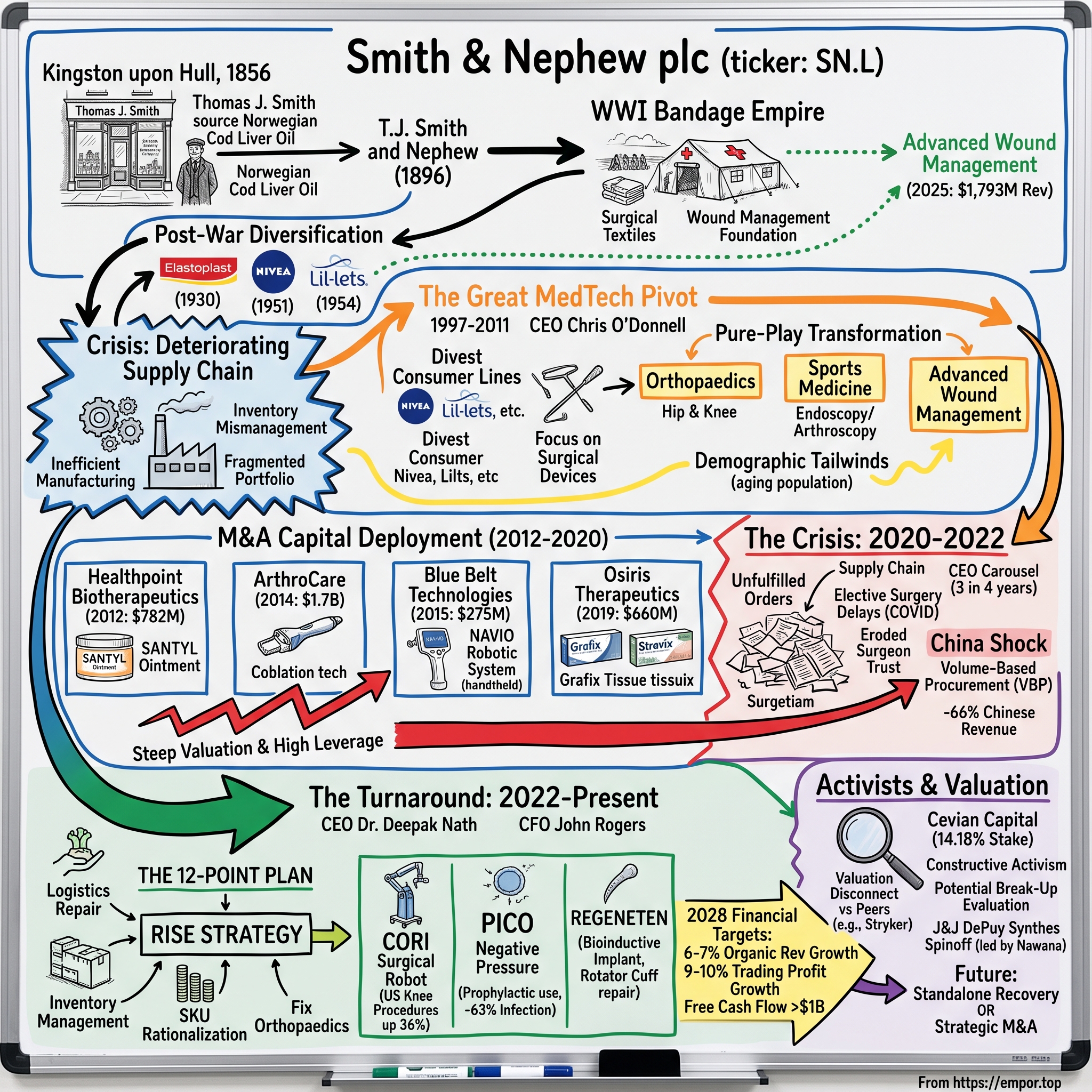
Smith & Nephew plc: The MedTech Veteran's Turnaround & The Battle for Margin
I. Introduction & Episode Roadmap
There is a particular kind of frustration that afflicts solid businesses run poorly. It is not the frustration of a dying industry or an obsolete product, but of watching a company with high-quality assets—patented technologies, entrenched surgeon relationships, and gross margins above 75%—persistently fail to convert those advantages into financial performance.
For roughly a decade, Smith & Nephew plc served as a case study in that gap.
Consider the figures greeting investors in the summer of 2026. Smith & Nephew closed 2025 with revenue of $6,164 million, up 5.3% on an underlying basis, and a trading profit margin of 19.7%—a 160 basis point expansion in a single year, representing its best margin since the pre-pandemic era.1 By conventional operational metrics, it was a strong performance: free cash flow rose 52.5% to $840 million, while trading cash conversion reached 102%.1 Yet on 2 March 2026, the morning management presented those results, the company's shares fell nearly 6%.2
That gap between operational progress and market skepticism defines the modern Smith & Nephew story. It explains why a Swedish activist fund spent two years building a position, crossing 14.18% of the share register by late July 2026 to become the company's largest shareholder.3 It also explains why analysts now routinely evaluate a potential break-up of a 170-year-old FTSE 100 enterprise that has historically operated as a single corporate entity.
Smith & Nephew, listed in London as SN.L and in New York as an ADR under SNN, is one of four key global competitors in orthopaedic reconstruction—hips and knees—alongside established positions in two adjacent markets: sports medicine (arthroscopic repair of shoulders, knees, and small joints) and advanced wound management (dressings, devices, and biologics for chronic wounds). It remains the smallest of the orthopaedic "Big Four" by a wide margin. In 2025, Stryker reported revenue of $25.1 billion, Zimmer Biomet generated $8.2 billion, and Johnson & Johnson's DePuy Synthes produced roughly $9.2 billion.456 Smith & Nephew's entire corporate revenue remains smaller than any single rival's orthopaedic division.
The core question: When CEO Dr. Deepak Nath took charge in April 2022, Smith & Nephew faced eroded trust among surgeons, financial analysts, and its own board. Four years later, operational turnaround efforts show clear progress, and management has established 2028 targets calling for 6–7% organic revenue growth, 9–10% trading profit growth, and post-tax returns on invested capital of 12–13%.7 The central strategic question is whether operational recovery renders Smith & Nephew a compelling standalone investment—or whether its structural scale deficit, positioned between a U.S. giant with three times its sales-force density and a specialized competitor driving sports medicine innovation, means long-term value creation will ultimately accrue to an acquirer or activist rather than public shareholders.
The analysis follows a five-part progression: 1856–1990s: a Hull chemist selling Norwegian cod liver oil evolves into a wartime dressings supplier and later a consumer conglomerate selling tampons and skin cream. 1997–2011: CEO Chris O'Donnell divests consumer lines to construct a pure-play surgical device maker. 2012–2020: an M&A expansion under Olivier Bohuon acquires high-quality assets while underlying manufacturing infrastructure deteriorates. 2018–2022: three CEOs in four years contend with supply chain bottlenecks and Chinese volume-based procurement reforms that erase two-thirds of a key unit's pricing. 2022–present: the implementation of the 12-Point Plan, deployment of the CORI surgical robot, introduction of the RISE strategy, and the arrival of an activist holding a 14% stake.
The trajectory begins at its origins—with a young pharmacist in an English fishing port and a barrel of cod liver oil.
 Subscribe on LinkedIn
II. Hull Origins & The WWI Bandage Empire (1856–1990s)
Kingston upon Hull in 1856 was a bustling port on England's east coast—defined by trawlers, whale oil, Baltic timber, and the pervasive smell of fish. It was an unlikely birthplace for a medical technology enterprise that would eventually operate in more than 100 countries, but it provided an ideal location to source cod liver oil.
Thomas James Smith trained as a pharmacist in Grantham and at University College London—where Joseph Lister was simultaneously developing the antiseptic principles that transformed modern surgery—before opening a dispensing chemist shop on Whitefriargate in Hull in 1856.8 Retail sales proved modest, but within two years Smith recognized a larger opportunity: utilizing Hull's docks and Norwegian trade routes, he acquired a superior grade of cod liver oil and began selling it wholesale to hospitals and dispensaries rather than by the spoonful to retail customers.9
The strategic importance of cod liver oil rested on a logic that remains strikingly modern. Although vitamins had not yet been identified, physicians observed that cod liver oil produced tangible clinical improvements in rickets, tuberculosis, and rheumatism—diseases widespread among industrializing Britain's urban poor. Smith branded his oil "Paragon" and competed strictly on purity and consistency in a market fraught with adulteration.9 The founding insight of Smith & Nephew was not merely a specific product, but a quality standard sold through a professional channel: clinicians willing to pay a premium to avoid unverified batches. Structurally, that institutional focus defines the company's business model today.
Smith never married or had children. Months before his death in 1896, he brought his 22-year-old nephew, Horatio Nelson Smith, into the business. The firm was renamed T.J. Smith and Nephew, and Horatio rapidly pivoted its strategy.9 He shifted focus from oils toward surgical textiles—bandages, dressings, and lint. The move was a direct bet on the industrialization of surgery: as Listerian antiseptic techniques spread across healthcare systems, hospital demand for sterile dressings expanded rapidly.
Then came the outbreak of the First World War in August 1914.
The war transformed Smith & Nephew from a regional supplier into an industrial enterprise. With demand for field dressings virtually unlimited, Horatio secured contracts with several Allied governments and the American Red Cross, expanding the workforce to roughly 1,200 employees.9 The company's corporate history explicitly cites the supply of field dressings during the World Wars as its core foundation, and the Hull facility on Hessle Road remained a wound-management manufacturing center more than a century later.8 The firm's core advantage during the Great War was operational rather than scientific—specifically, the ability to run a large-scale textile production line to precise specifications and tight deadlines. That early manufacturing strength stands in sharp contrast to the supply-chain bottlenecks that would challenge the company a century later.
The interwar and post-war periods marked a phase of corporate diversification. In 1930, the company acquired British rights to a German adhesive-coated bandage from Lohmann AG and launched it as Elastoplast, which became a household name.9 Subsequent expansion moved further from core clinical supplies: the 1951 acquisition of Herts Pharmaceuticals secured British rights to the Nivea skincare brand, and Lil-lets feminine hygiene products followed in 1954.9 By the 1980s, Smith & Nephew had evolved into a diversified consumer and healthcare conglomerate spanning surgical dressings, adhesive plasters, skincare, feminine hygiene, generic pharmaceuticals, and an emerging orthopaedics division.
While conglomerate diversification functioned in a protected domestic market with captive distribution, it proved unsustainable as markets globalized. Nivea remained a licensed Beiersdorf brand restricted to the United Kingdom, Lil-lets faced intense pressure from Procter & Gamble, and Elastoplast competed directly against Johnson & Johnson's Band-Aid. In virtually every consumer category, Smith & Nephew operated as a sub-scale regional player competing against global giants with far greater marketing capital. Consequently, the company's most defensible assets—surgical and wound-care products sold to clinicians who prioritized quality over price—were starved of capital and executive focus.
The connection to the modern business remains direct. Advanced Wound Management, which generated $1,793 million in revenue in 2025, represents the direct evolution of Horatio's textile operations.1 The core engineering capability—developing materials that interface with damaged human tissue to promote healing—moved steadily up the value chain from basic cotton lint to moisture-retentive foams, enzymatic debriding ointments, and advanced cellular tissue products. From an investment perspective, Smith & Nephew's foundational wound-care division has consistently represented its highest-quality unit, even during periods when executive leadership prioritized consumer conglomerate diversification.
By the late 1990s, new leadership recognized that reality and began restructuring the firm.
III. The Great MedTech Pivot: Chris O'Donnell's Pure-Play Transformation (1997–2011)
When Chris O'Donnell became Chief Executive in 1997, he inherited a company organised into nine separate divisions—each operating with its own management, factories, and strategy, and several facing a dominant competitor ten times its size. O'Donnell had joined Smith & Nephew in 1988 following roles at Vickers Medical and C.R. Bard.10
O'Donnell's strategy relied on subtraction. He streamlined the company from nine divisions down to four, focusing on artificial joints, endoscopy instruments, and advanced dressings. During the second half of his tenure, he invested heavily in R&D and doubled the sales force, bringing total revenue to roughly $3 billion.10 The consumer operations were systematically divested over the same period. In 2001, the traditional casting and bandaging business was folded into BSN Medical, a joint venture with Beiersdorf AG designed to extract value from a low-growth franchise without an outright fire sale.9
Intentionally shrinking the top line of a FTSE 100 enterprise ran counter to prevailing corporate orthodoxy, as shedding revenue is inherently harder for executives than acquiring it. Yet O'Donnell's strategic rationale was clear, representing the single most decisive piece of capital allocation in the company's modern history.
The underlying economic logic was straightforward. While skincare products and titanium knee implants might superficially share a healthcare label, their financial characteristics are entirely distinct. Consumer items compete on brand recognition and shelf space against rivals with vastly superior marketing budgets; margins are thin, and buyers switch readily over minor discounts. Surgical implants, by contrast, compete on clinical evidence and surgeon habit. The surgeon—rather than the patient or the hospital finance department—selects the implant, choosing a familiar system whose instrumentation feels precise in hand and whose long-term track record reduces clinical risk. With gross margins in surgical devices exceeding 70%, O'Donnell was systematically trading low-margin volume for high-margin revenue.
The three pillars resulting from this restructuring remain the core segments Smith & Nephew operates today. Orthopaedics—hip and knee reconstruction, alongside trauma plates and screws—served as the primary growth engine, riding a demographic wave as the Western baby-boom cohort reached the age of joint degeneration. Endoscopy, later renamed Sports Medicine, comprised the minimally invasive franchise: visualization cameras, mechanical shavers, suture anchors, and arthroscopic instruments designed to repair meniscus or rotator cuff tears through narrow incisions. Advanced Wound Management represented the transformation of the legacy dressings business from basic cotton into advanced, science-driven tissue care.
These demographic tailwinds provided sustained momentum. Joint replacement volumes across developed markets compounded steadily throughout the 2000s, reinforced by powerful economic moats. Once a surgeon trains on a specific knee system, the primary switching cost is not the price of the device, but the time required for retraining, familiarity with instrument trays, and the clinical risk accompanying early cases on an unfamiliar platform. High switching friction explains why market share in orthopaedics shifts incrementally in basis points rather than through rapid swings.
However, those same switching costs created a structural vulnerability that would challenge the company two decades later. High switching friction cuts both ways: it protects an incumbent until an operational or supply breakdown forces a surgeon to switch to a rival. Once lost, that surgeon remains locked out by the very friction that previously ensured their loyalty.
By the time O'Donnell retired in 2011, he had executed a transformation rare among British industrial leaders: reshaping Smith & Nephew from a diversified conglomerate with a medical arm into a focused medical technology company. What he left incomplete was the underlying operational infrastructure—the manufacturing and supply-chain network required to support a global implant enterprise. The strategic portfolio was sound, but the operational backbone remained fragile.
His successor would spend the next decade adding to that portfolio.
IV. M&A Capital Deployment: Expansion, Valuation, & M&A Benchmarking (2012–2020)
When Olivier Bohuon arrived in 2011 from the pharmaceutical sector, he brought a pharma executive's playbook: if organic growth slows, acquire it. Over the next seven years, Smith & Nephew deployed roughly $3.5 billion across four major acquisitions. Judged individually, most of these transactions were commercially defensible. Judged as an overarching capital allocation programme, however, they revealed a company addressing a deep structural issue with a superficial portfolio strategy.
Healthpoint Biotherapeutics, 2012 — $782 million. The first deal offered the clearest strategic logic. In November 2012, Smith & Nephew agreed to acquire substantially all the assets of Healthpoint, a Texas-based bioactive wound care business, for $782 million in cash.11 The primary asset was Collagenase SANTYL Ointment, an enzymatic debriding agent that dissolves dead tissue in chronic wounds without surgical intervention. At the time of the deal, Healthpoint was generating roughly $190 million in annual revenue and expanding at a double-digit rate.11
Strategically, SANTYL occupied an unusual regulatory niche: an approved prescription drug housed within a medical device portfolio, protected from direct generic competition. That structure provided Smith & Nephew with pricing power rare in wound care—a category otherwise characterized by commoditized foam dressings. The acquisition also included HP802-247, a living-cell therapy then in Phase 3 clinical trials.11 That pipeline candidate ultimately failed to commercialize, underscoring the risk of valuing unproven development assets during deal negotiations.
ArthroCare, 2014 — $1.7 billion. In February 2014, Smith & Nephew agreed to acquire ArthroCare Corporation for $48.25 per share in cash, representing an equity value of roughly $1.7 billion and an enterprise value of about $1.5 billion.12 ArthroCare held the patents to Coblation, a radiofrequency technology utilizing a low-temperature plasma field to dissolve soft tissue precisely without thermal damage to adjacent cartilage—a critical feature in delicate shoulder and knee arthroscopy.
The strategic fit was strong, offering an immediate financial benefit: Smith & Nephew was already licensing an earlier iteration of Coblation from ArthroCare, meaning the acquisition eliminated an existing royalty burden.12 However, the valuation was steep. At an enterprise value of $1.5 billion and equity value of $1.7 billion, Smith & Nephew paid a mid-to-high-teens multiple of trailing EBITDA at a time when mid-teens multiples represented the upper band for medtech transactions. Funded largely through debt and balance-sheet goodwill, the deal yielded a solid product integration—Coblation remains central to the Arthroscopic Enabling Technologies franchise within Sports Medicine—but delivered a mixed return on capital due to the high purchase price and subsequent execution challenges elsewhere in the business.
Blue Belt Technologies, 2015 — $275 million. In October 2015, Smith & Nephew acquired Blue Belt Technologies, the Pittsburgh-based developer of the NAVIO handheld robotic surgery system, for $275 million.13 The acquisition served as a direct response to Stryker's $1.65 billion purchase of Mako Surgical two years earlier, which had ignited an industry-wide race to integrate robotics into joint replacement procedures.
The strategic thesis behind Blue Belt rested on a distinct architectural approach. Smith & Nephew paid approximately one-sixth of Stryker's outlay for a system that eliminated the need for pre-operative CT scans. While Stryker's Mako relied on a large robotic arm planned from CT images, NAVIO—later evolved into the CORI platform—used a handheld smart instrument that mapped patient anatomy in real time during surgery via optical tracking. For hospital administrators and ambulatory surgery centers, this difference removed substantial capital expenditure, pre-operative radiation exposure, and imaging lead times. Smith & Nephew correctly anticipated the shift toward lower-cost surgical settings, though its ability to commercialize the platform was ultimately constrained by its smaller sales force.
Osiris Therapeutics, 2019 — $660 million. The final transaction of this era closed in April 2019, when Smith & Nephew acquired Osiris Therapeutics for $19.00 per share—an equity value of approximately $660 million—adding regenerative medicine products, including skin, bone graft, and articular cartilage substitutes, to Advanced Wound Management.14 Osiris's Grafix and Stravix placental-tissue products expanded the company's footprint in the fast-growing skin substitutes market, a segment that would face significant regulatory and reimbursement shifts in the U.S. several years later.
The capital allocation verdict. Evaluated collectively, these four transactions reveal a clear pattern: each added high-margin technology to the two divisions already performing well—Sports Medicine and Advanced Wound Management. None addressed the company's weakest segment, core Orthopaedics, where the primary handicap was not implant design, but operational logistics—specifically, the complex task of manufacturing, sterilizing, kitting, and delivering tens of thousands of specialized instrument trays to surgical suites on demand.
This pattern reflected a classic corporate governance challenge: managing a company at the portfolio level rather than the operational level. While acquisitions offer immediate visibility and strategic narrative, restructuring supply chains requires tedious, capital-intensive operational overhauls. Throughout the 2010s, Smith & Nephew expanded its strongest franchises through M&A while allowing its foundational orthopaedic supply chain to degrade quietly.
In 2020, that operational neglect produced a major crisis.
V. The CEO Carousel, Supply-Chain Paralysis, & China Shock (2018–2022)
The operational vulnerabilities that accumulated during the 2010s culminated in a severe financial contraction. In 2019, Smith & Nephew generated revenue of $5,138 million and a trading profit of $1,169 million, delivering a trading profit margin of 22.8%. In 2020, revenue fell to $4,560 million and trading profit collapsed to $683 million, reducing the trading profit margin to 15.0%.15 That 780 basis point margin contraction in a single year was exacerbated by the pandemic, but COVID-19 accounted for only part of the deterioration.
The revolving door
The executive instability preceded the pandemic. In 2018, the board appointed Namal Nawana, an executive who had built and sold the diagnostics firm Alere to Abbott and spent over 15 years in senior roles at Johnson & Johnson, including running the DePuy Synthes spine business.16 Nawana arrived promising an aggressive cost-discipline culture, but his tenure lasted just 18 months.
On 21 October 2019, Smith & Nephew announced Nawana's departure by mutual agreement. The proximate cause was executive compensation: Nawana had accepted a pay reduction to join the British company—his annual compensation at Alere had reached $8.6 million, compared to roughly $2.8 million during his first seven months at Smith & Nephew—and the board could not bridge the gap within UK governance norms and shareholder pay expectations.16 The company's shares fell 8% on the announcement, closing at 1,683 pence.16
This departure highlighted a fundamental structural tension for Smith & Nephew: the company generates the majority of its revenue and faces its primary competitors in the United States, yet it remains listed, domiciled, and governed in the United Kingdom under pay structures calibrated to British norms. Executive talent in medtech is priced in the U.S. market, while governance constraints reflect UK institutional benchmarks.
To replace Nawana, the board appointed Roland Diggelmann, a Smith & Nephew non-executive director since March 2018 and former head of Roche Diagnostics, a business generating approximately $11.5 billion in annual revenue.16 Diggelmann assumed the CEO role in November 2019, inheriting a global pandemic within four months.
The mechanism of failure
Understanding the operational breakdown requires examining how orthopaedic implants are commercialized—less as standalone hardware products than as highly synchronized service events.
When a surgeon schedules a joint replacement, the manufacturer delivers multiple specialized instrument trays containing implants in various sizes alongside cutting guides, broaches, rasps, trial components, and alignment jigs. Because precise sizing can only be confirmed during surgery, every tray set must be complete, sterile, and physically present in the operating room prior to anesthesia. If a single size or component is missing, the procedure cannot proceed. Managing these capital-intensive field trays requires continuous recovery, cleaning, re-sterilization, and rotation across hospitals.
At its core, joint replacement relies heavily on field logistics—a capability Smith & Nephew had allowed to degrade despite its historical manufacturing capabilities.
COVID-19's elective-surgery suspensions initially masked the underlying problem. As the company acknowledged in its 2020 results, healthcare systems suspended elective procedures—with the second quarter of 2020 particularly severely affected—and Orthopaedics, with its heavy exposure to postponed hip and knee procedures, suffered the greatest drop.15 Factory underutilization and increased inventory provisions compounded the margin damage.15 When surgical volumes recovered in 2021 and 2022, Smith & Nephew could not fulfill demand. Orders went overdue, and surgeons unable to obtain complete instrument trays shifted cases to competitors such as Stryker and Zimmer Biomet.
In this environment, high switching costs worked against the company. Retraining a surgeon involves significant friction, but once supply disruptions forced a clinician to adopt a competitor's system and instrumentation, that same friction prevented them from returning. Market share lost in orthopaedics is rarely regained quickly.
The scale of the supply backlog became public with the rollout of the company's turnaround plan. When the 12-Point Plan was announced in July 2022, one of its initial reported milestones was reducing overdue orders by 35% from peak levels.17 Elevating overdue order reduction to a headline operational metric reflected the depth of the logistics breakdown. While Smith & Nephew did not disclose specific instrument-set fill rates during the crisis, management adopted overdue order reductions as its primary proxy for logistics recovery.
带量采购 — the China shock
Simultaneously, regulatory reforms in Asia created a second major financial headwind.
China's volume-based procurement (VBP) program—a centralized tendering framework run by national healthcare authorities—aggregated hospital demand across product categories into single national volume commitments awarded through competitive price bidding. Winning manufacturers secured guaranteed national volume, while unselected suppliers were effectively excluded from public hospitals. When VBP expanded from orthopaedic implants to sports medicine consumables, steep price reductions compressed margins across Western medtech providers.
For Smith & Nephew's Chinese business, the impact was severe. China had represented roughly 7% of group revenue prior to VBP, but by the end of 2025 that share had contracted to around 2%.18 In Sports Medicine Joint Repair alone, VBP headwinds reduced group underlying revenue growth by approximately 280 basis points in the fourth quarter of 2024.19 The drag persisted across eight consecutive quarters before China revenue stabilized at approximately $160 million in 2025, down from $210 million to $220 million in 2024.2
This contraction stemmed from centralized sovereign purchasing policy rather than competitive market share loss. The VBP experience demonstrated how centralized state purchasing frameworks in major healthcare markets can rapidly alter segment economics regardless of operational execution.
The credibility damage
By 2022, the combination of supply chain bottlenecks, input cost inflation, and Chinese procurement reform had severely degraded financial performance. Smith & Nephew's trading profit margin, which stood at 22.8% in 2019, dropped to 18.0% in 2021 and contracted further to 17.3% in 2022.17 Repeated guidance revisions and the turnover of three chief executives in four years damaged market credibility, transforming Smith & Nephew from a reliable demographic compounder into an operational turnaround story.
In April 2022, the board responded by appointing a new chief executive with an engineering background to address the company's operational execution.
VI. The Turnaround: Deepak Nath, The 12-Point Plan, & RISE Strategy (2022–Present)
Deepak Nath does not present like a typical FTSE 100 chief executive. He holds a PhD in aerospace engineering. He came from Siemens Healthineers, where he ran the diagnostics business, and before that from Abbott's vascular division. When he describes his own management style, he describes a cadence rather than a philosophy: biweekly meetings with his executive team, running four hours each, in which progress against specific commitments is tracked personally.18 Asked about the pressure of an activist on the register, his framing was characteristically unadorned: "My approach was not to run away from that pressure, but rather to lean into it."18
He was named CEO in February 2022 and took the role in April.20 He was the fourth chief executive in five years.18
The second half of the leadership pairing arrived eighteen months later. John Rogers was announced as Chief Financial Officer on 2 November 2023, joining as CFO-designate that December and taking the board seat in the first quarter of 2024, succeeding Anne-Françoise Nesmes.31 His CV is conspicuously non-medical: CFO of WPP through its global restructuring, before that CFO of J Sainsbury and chief executive of Argos, Habitat and Sainsbury's general merchandise arm during that group's digitisation.31 Nath's own framing at the time was unusually plain for a hiring announcement — he looked forward to working with Rogers "as we continue to turn around performance."31
Hiring a retail-and-advertising CFO into a surgical implant company looks eccentric until you consider what was actually broken. Smith & Nephew's problem in 2023 was not clinical science. It was inventory sitting in the wrong places, working capital trapped in instrument trays, a cost base that had never been zero-based, and a set of numbers institutional investors had stopped believing. Those are retail problems. Rogers had spent a career on exactly that kind of plumbing, and his conduct on subsequent calls — granular, willing to name a charge and its size, comfortable disaggregating half-year phasing to the decimal — has been consistent with the brief.
The 12-Point Plan: what it actually was
Announced in July 2022, the 12-Point Plan was not a strategy in the conventional sense. It was a repair manual, organised around three priorities: fix Orthopaedics, improve productivity, and accelerate the businesses that were already winning.17
Fixing Orthopaedics meant, in the first instance, logistics: rebuilding the ability to deliver complete sets on time, reducing overdue orders, and right-sizing manufacturing capacity. It also meant an unglamorous and painful exercise in SKU rationalisation — retiring legacy implant lines that a sales representative somewhere still loved but that consumed disproportionate inventory, tooling and tray capital. That programme has run for years and was still running in 2025, when the company flagged a further approximately $500 million reduction in gross inventory through SKU elimination, taken via a non-cash provision of roughly $200 million.7 On the FY2025 call, CFO John Rogers isolated the charge at $159 million and stated plainly that no additional charges were hidden behind it.2
Improving productivity meant a target of $200 million in annual savings by 2025, pursued through zero-based budgeting, procurement and manufacturing network consolidation.17 By the end of 2024 the company reported roughly 410 basis points of incremental cost savings and a net workforce reduction of close to 9% across 2023–2024.19 Those are not cosmetic numbers. A 9% headcount reduction in a business with a direct surgical sales force is a genuinely difficult thing to execute without damaging revenue.
Accelerating growth meant reallocating R&D and commercial investment towards Sports Medicine and Wound.
Did it work? The evidence, and its limits
The honest answer is: substantially, yes, on the metrics management set for itself — and the company has been unusually specific in letting itself be measured.
Orthopaedics underlying growth accelerated from 1.9% in 2022 to 5.1% in 2025.117 Group trading margin climbed from 17.3% (2022) to 17.5% (2023) to 18.1% (2024) to 19.7% (2025) — a four-year, uninterrupted ascent that landed inside the 19.0–20.0% band management had guided to a year earlier.11719 Free cash flow went from $129 million in 2023 to $551 million in 2024 to $840 million in 2025, with trading cash conversion improving from 65% to 95% to 102%.119 That cash conversion progression is the single cleanest evidence that the working-capital disaster inside Orthopaedics was genuinely addressed, because trays and implants sitting unsold in the field are precisely what destroys conversion.
Management credibility, assessed by behaviour over time, comes out reasonably well here. The 2025 target of "at least 20% margin by 2025," set in 2022, was not quite met — 19.7% is a near-miss, and the company should be held to that. But the pattern across 2023, 2024 and 2025 is of guidance set, largely delivered, and explained in consistent language across successive calls. Nath's own summary of 2025 was carefully hedged rather than triumphal: "I am pleased that a strong fourth quarter helped us meet or exceed our 2025 targets for revenue growth, profitability and cash generation."1
The three products the story rests on
CORI. The descendant of the NAVIO platform, CORI is a handheld, image-free robotic system for knee — and now shoulder — arthroplasty. The layman's version: instead of a room-sized robotic arm working from a pre-loaded CT map, CORI is a smart burr the surgeon holds, guided by an optical camera that builds a model of the joint live in theatre. The machine will not let the surgeon cut outside the plan. By the end of 2025, more than 1,100 CORI systems had been deployed globally, 36% of US knee implant procedures ran on CORI, and overall utilisation reached 63% — the company's highest levels to date, with US knee growth in CORI accounts meaningfully ahead of non-CORI accounts.1
That last data point is the one that matters, because it is the only evidence that the robot is doing commercial work rather than sitting in a cupboard. Utilisation, not installed base, is the honest metric — a placed robot is a cost until it is used. Notably, when pressed by Deutsche Bank on how CORI would fare against Stryker's own new handheld device, Nath declined to accept the ASC-only framing, describing CORI as "a robotic system that happens to be handheld," deployed across teaching hospitals, ambulatory surgical centres and general hospitals alike.2 That is a fair rebuttal, but it is also a slight retreat from the original Blue Belt thesis that low-capital robotics would win by owning the ASC channel.
PICO. Negative pressure wound therapy works on a simple principle: seal a wound under an airtight dressing, apply gentle suction, and you pull out fluid, draw the wound edges together and stimulate blood flow. Traditionally this required a pump the size of a lunchbox, a canister, tubing, and a patient tethered to it. PICO shrank the whole apparatus into a pocket-sized, canister-free single-use device — which changed the addressable market entirely, because it made the therapy usable prophylactically on a closed surgical incision rather than only therapeutically on an open chronic wound.
The clinical evidence is unusually strong for a device claim. A systematic review and meta-analysis covering 29 studies and 5,614 patients across orthopaedic, obstetric, cardiothoracic, colorectal, vascular and breast surgery found PICO reduced the odds of surgical site infection by 63%, seroma by 77% and dehiscence by 30%, with close to a two-day reduction in length of stay.21 For a hospital administrator, an SSI is a catastrophic cost event. That is a rare instance of a medical device with a genuine, quantified, payer-aligned economic argument.
REGENETEN. A bioinductive collagen implant for rotator cuff repair, REGENETEN does not mechanically hold the tendon — it induces the body to lay down new tendon-like tissue over it. On the FY2025 call, Nath disclosed only that REGENETEN generates "multiple $100 million" in revenue, declining to be more specific for competitive reasons — a defensible but notable disclosure gap for a product the equity story leans on heavily.2 Management sizes the combined rotator cuff opportunity at approximately $1.2 billion, comprising roughly $875 million of biomechanical repair (sutures and anchors) plus about $325 million of biologics, within which Smith & Nephew holds roughly 25% share.2
RISE, and what changed in December 2025
On 8 December 2025, Nath retired the 12-Point Plan and launched RISE — Reach, Innovate, Scale, Execute — with hard 2028 targets: 6–7% organic revenue CAGR, 9–10% trading profit CAGR, free cash flow above $1 billion, and post-tax ROIC of 12–13%.7
The substantive shift is in the "S." The 12-Point Plan was internally focused and made no promises about deals. RISE explicitly contemplates strategic capital allocation into high-return growth opportunities.7 Six weeks later, on 12 January 2026, the company announced the acquisition of Integrity Orthopaedics — $225 million upfront with up to a further $225 million contingent over five years — completing on 21 January.2223 Integrity's Tendon Seam system, FDA-cleared in 2023, uses patented microanchors and a continuous locked suture to address a genuinely poor clinical outcome: rotator cuff repairs suffer 20–40% structural failure rates.23
Nath's defence of the deal on the results call was specific and, to his credit, framed around a track record rather than a strategy slide: the Integrity team is "the group that gave us REGENETEN," and capital allocation is directed to "areas where we have strength."2 His stated discipline: "It's not chasing growth at all costs, but rather driving the right kind of balance."2
An activist-minded sceptic would note that a management team which spent three years promising capital discipline announced a deal worth up to $450 million within six weeks of setting new growth targets, and that the deal is dilutive to margin until 2028.22 That is a fair challenge. The counter-evidence is that leverage remained below the 2x EBITDA target, the deal was funded from existing facilities, and management simultaneously committed $500 million to a buyback.2224
The 2026 test
Then came a wobble. First-quarter 2026 revenue was $1,501 million, up only 3.1% underlying (4.7% adjusting for trading days), with Orthopaedics up just 0.8% and US knee implants down 10.3%.24
Management's explanation was that this was deliberate: the company was withholding instrument-set capital from accounts ahead of the LANDMARK knee launch in late Q3/Q4 2026, rather than deploying trays for a system about to be superseded. Nath: "We're making deliberate trade-off decisions on capital deployment in accounts."25 And: "We will strike a better balance in terms of growth, capital deployment, and margin. It's not just growth for the sake of growth."2
This is exactly the kind of explanation that deserves scepticism, because it is unfalsifiable in the moment — a company losing share and a company deliberately pausing look identical for two quarters. The falsification test is specific and near: management has committed to closing the gap to market growth in US knees by the end of 2026, with LANDMARK cementless launching in the second half and the cemented version in the first half of 2027.2 If US knees are still declining in early 2027, the "deliberate trade-off" framing will have been a euphemism.
Full-year 2026 guidance was reaffirmed at roughly 6% underlying revenue growth and around 8% organic trading profit growth, with the year explicitly back-end loaded: 4.5–5% growth in the first half against 7.5–8% in the second.224 Against headwinds of roughly $60 million from tariffs and $20–40 million from US skin-substitute reimbursement changes, management pointed to about $150 million of planned cost savings, split roughly evenly between zero-based budgeting and procurement/manufacturing.12 The good news buried in the guidance: 2026 was expected to be the first year since 2021 in which China would not be a material drag on group revenue.24
The operational repair, then, is largely real. Whether it is enough is a question about the shape of the business itself.
VII. Segment Economics & Financial Anatomy
Beneath its corporate branding, Smith & Nephew operates three distinct businesses with little in common beyond a shared sales network across hospital operating rooms. Understanding the group's valuation requires recognizing that these units possess fundamentally different economics—and that its largest division generates its weakest returns.
Orthopaedics: $2,437 million, roughly 40% of revenue
The Orthopaedics division encompasses hip and knee implants, trauma and extremity devices, and the CORI robotic surgery platform. Underlying revenue grew 5.1% in 2025.1
The division carries the group's weakest financial profile due to high capital intensity. Servicing surgeon accounts requires maintaining extensive inventory and instrument trays in hospital sterile processing departments. These trays represent capitalised assets that generate no return while idling in field facilities. Because a knee replacement system requires a larger tray footprint than a hip system, management emphasized during the full-year 2025 earnings call that the LANDMARK platform was specifically engineered for tray efficiency to support the ambulatory surgery center channel.2 Combined with substantial fixed manufacturing overheads—machining titanium and cobalt-chrome to micron tolerances—Orthopaedics operates with the group's lowest profit margins and significant operational leverage in both directions.
On the upside, operational recovery in Orthopaedics translates rapidly into operating profit, as incremental volume flows directly onto an existing fixed-cost foundation. On the downside, it is also the division where centralized pricing shocks or market share losses inflict the most structural damage.
In early 2026, performance within Orthopaedics remained distinctly uneven. U.S. hip sales outpaced market growth for three consecutive quarters, and trauma and extremities outperformed the broader market for several quarters, even as knee implant revenue contracted.2 This divergence highlights where operational fixes have succeeded. Supply chain enhancements have restored competitiveness in hips and trauma, whereas the knee business continues to struggle with an aging platform against Stryker's established Triathlon and Mako ecosystem. The turnaround is an operational reality, but it remains incomplete in orthopaedics' largest product category.
Sports Medicine & ENT: $1,934 million, roughly 31% of revenue
Sports Medicine & ENT represents the company's premier growth franchise. Underlying revenue increased 5.2% in 2025 despite China volume-based procurement headwinds, and accelerated to 6.7% in the first quarter of 2026.124 The division spans Joint Repair—including the REGENETEN bioinductive implant, suture anchors, and shoulder and knee repair systems—Arthroscopic Enabling Technologies, which incorporates Coblation wands, visualization systems, and fluid management from the ArthroCare transaction, and an ear, nose, and throat franchise.
The unit's economics are inherently superior to Orthopaedics due to its procedure-based consumable model. A soft-tissue shoulder repair consumes anchors, sutures, Coblation wands, and disposable accessories that are replenished for every surgical procedure. Without the burden of multi-million-dollar instrument tray floats sitting idle in hospital basements, revenue recurs predictably by case volume, gross margins remain high, and capital intensity stays low.
Yet the competitive landscape presents distinct challenges. Smith & Nephew's chief rival in sports medicine is Arthrex—a closely held, family-controlled firm focused heavily on surgeon education and unencumbered by quarterly public reporting. Competing against a private player willing to invest aggressively in surgical training centers through market cycles creates a persistent strategic headwind. Smith & Nephew holds a solid second-place position, but operates against a market leader that faces no public shareholder demands for short-term margin expansion.
Advanced Wound Management: $1,793 million, roughly 29% of revenue
Advanced Wound Management, the company's legacy division, operates as its highest-margin business. Underlying revenue expanded 5.6% in 2025—the fastest across the group—before moderating to 2.2% growth in the first quarter of 2026.124 The division is organized into three segments: Advanced Wound Care dressings, Wound Bioactives containing SANTYL ointment alongside Grafix and Stravix tissue products, and Advanced Wound Devices centered on the PICO negative-pressure system.
The division's commercial strength stems from gross margins above 75%, minimal capital expenditure requirements, and durable demand driven by rising diabetes prevalence and aging demographics. In addition, proprietary offerings like SANTYL command pharmaceutical-grade pricing power.
However, regulatory exposure emerged as a key vulnerability in 2026. Following changes to U.S. Medicare reimbursement rules for skin substitutes, prices across the category were reset. Management modeled a 20% to 25% price reduction across its roughly $200 million skin substitutes base, while anticipating volume to remain "broadly neutral, maybe even a little bit positive as we grab a little bit more share," reasoning that Smith & Nephew was less exposed than rivals to high-priced physician-office and mobile channels that drew regulatory scrutiny.2 While this relative positioning argument holds merit, it underscores that a meaningful portion of value from the Osiris acquisition depended on U.S. reimbursement codes subject to administrative revision. Regulatory pricing pressure is not unique to Chinese procurement reforms.
The group picture
Taken together, the group's structural profile becomes clear. Approximately 60% of Smith & Nephew's revenue is generated by high-margin, low-capital-intensity divisions supported by proprietary technologies. The remaining 40% resides in a capital-intensive reconstruction business where the company lacks scale as the smallest of four global competitors.
For the consolidated business, management's 2028 targets call for 6% to 7% organic revenue compound annual growth, 9% to 10% trading profit compound annual growth, annual free cash flow exceeding $1 billion, and post-tax return on invested capital between 12% and 13%.7 Among these metrics, post-tax ROIC offers the clearest gauge of historical capital allocation. Guided at above 10% for 2026 excluding the Integrity transaction and reaching 12% to 13% by 2028, achieving these return levels would mark a sustained spread over the company's cost of capital for the first time in years.724 Ultimately, ROIC expansion—rather than headline profit margins—will determine whether the multi-billion-dollar acquisition strategy of the past decade successfully created shareholder value.
An activist investor reached that exact conclusion, systematically accumulating a 14% stake to force the issue.
VIII. Activist Stress-Test: Cevian Capital & Governance
On 10 July 2024, the Financial Times reported that Cevian Capital—Europe's largest activist investor, known for long-duration, board-level engagement rather than public proxy battles—had accumulated a 5% stake in Smith & Nephew.26 Cevian's initial critique was straightforward: the company had persistently failed to convert high-quality assets into shareholder returns.
What followed was not a public battle, but a steady accumulation.
Through a series of regulatory filings, the progression became clear. Cevian's holding crossed 10% in March 2026 and passed 12% on 8 June. On 22 June, the fund acquired an additional 9,757,713 shares at $29.39 each, lifting its stake to 13.21% three days later. By 22 July, the holding reached 14.01%, and a filing accepted on 27 July 2026 confirmed beneficial ownership of 119,179,419 ordinary shares—a 14.18% position funded through general working capital.3
Crucially, Cevian was building its position alongside operational progress. Between the initial 5% disclosure and the 14.18% filing, Smith & Nephew delivered its strongest margin expansion in years, record cash conversion, and a revised long-term strategy. Had Cevian believed the turnaround was complete, it would have taken profits. Instead, the activist continued buying—signaling a belief that while operational execution was improving, the public equity market was not yet pricing in the recovery.
The valuation argument
The valuation disconnect driving Cevian's investment is readily visible across peer multiples. In 2025, Stryker reported 10.3% organic revenue growth on $25.1 billion in sales alongside an adjusted operating margin of 26.3%.4 Zimmer Biomet generated $8.2 billion with 3.9% organic growth, while guiding 2026 organic expansion down to 1–3% amid a sales reorganization.5 Smith & Nephew sat between them on growth at 5.3% organic and reported a 19.7% trading profit margin.1 Yet in late July 2026, Smith & Nephew's market capitalization stood at approximately $13.5 billion—roughly 2.2 times sales—compared with Stryker's valuation of roughly $134 billion, or 5.3 times sales.27
Some valuation discount is warranted: Stryker expands at twice the speed and yields substantially higher operating margins. However, a sales multiple less than half that of its peer for a company delivering two-thirds of Stryker's margin and half its growth rate represents a wide valuation gap—the precise spread Cevian's campaign aims to capture.
The break-up question
The sharper version of the activist thesis suggests that the fastest route to unlocking shareholder value is not rehabilitating Orthopaedics, but separating it.
Corporate leadership has gradually acknowledged that possibility. In March 2025, Chief Financial Officer John Rogers signaled a shift to analysts, noting that while management remained committed to turning around Orthopaedics, it would evaluate alternative structural options if revenue growth failed to sustainably improve or if the equity valuation remained depressed.28
Industry dynamics soon reinforced that logic. On 14 October 2025, Johnson & Johnson announced plans to spin off its orthopaedics division into a standalone enterprise under the DePuy Synthes name within 18 to 24 months, appointing a new Worldwide President effective immediately: Namal Nawana.6
Nawana—who departed Smith & Nephew in 2019 following a compensation dispute—now leads the orthopaedic enterprise slated to become Smith & Nephew's chief pure-play competitor. For Smith & Nephew's board, J&J's executive choice provided a stark illustration of the long-term consequences of UK corporate governance constraints.
Johnson & Johnson's rationale—that removing orthopaedics would immediately elevate the parent company's top-line growth rate and operating margin—mirrors the core argument for restructuring Smith & Nephew, where Orthopaedics accounts for a far greater share of consolidated revenue than it ever did at J&J.6
Chief Executive Deepak Nath has explicitly rejected a breakup, arguing that modern medical technology requires integrated capabilities across biologics, robotics, software, and artificial intelligence that a sub-scale standalone business cannot easily assemble.18 That argument has technical merit: the CORI robotic system, REGENETEN biologic implants, and sports medicine instruments share R&D resources and surgical relationships. However, it is also the standard defense of multi-division conglomerates. The true test of Nath's thesis is whether Orthopaedics can restore market-level organic growth on its own; if it succeeds, integrated scale is validated, but if growth falters, multi-division integration risks being seen as a rationale for maintaining the status quo.
The governance overhang nobody discusses enough
Rupert Soames assumed the chair on 15 September 2023, having joined the board earlier that year in April to succeed Roberto Quarta.29 Soames brought a reputation built on complex turnarounds, having served as CEO of Serco from 2014 to 2022 following a major contracting scandal, and as CEO of Aggreko from 2003 to 2014.29 His appointment reflected a deliberate effort to restore institutional credibility among UK and international shareholders.
Soames's first major governance challenge addressed the issue that precipitated Nawana's departure. At the annual general meeting on 1 May 2024, the board presented a revised Directors' Remuneration Policy structured to offer executive compensation competitive with U.S. medtech peers. The policy passed with 56.78% of votes in favor and 43.22% opposed, while an accompanying Restricted Stock Plan received 55.95% support.30 Under the UK Corporate Governance Code, approval below 80% mandates formal shareholder consultation; Smith & Nephew completed the required six-month review and ultimately implemented the approved terms.30
This vote highlighted two contrasting realities. On one hand, the board correctly recognized that retaining top executive talent for a U.S.-focused business requires U.S.-style compensation packages. On the other, the fact that more than 40% of voting shares opposed the measure underscores the ongoing friction of managing a global medical technology business listed in London under UK governance norms.
That structural disconnect—operating primarily in the United States while constrained by UK listing standards, UK pay expectations, and a British shareholder base—remains a fundamental vulnerability that operational improvements alone cannot eliminate.
IX. Strategic Frameworks: Helmer's 7 Powers & Porter's 5 Forces
Evaluating strategic frameworks requires examining whether competitive advantages deliver structural outperformance or merely defend existing market share. Applying Hamilton Helmer's 7 Powers and Michael Porter's Five Forces tests the durability of Smith & Nephew's position across its core divisions.
Hamilton Helmer's 7 Powers
Switching Costs — strong, but conditional. High switching costs represent Smith & Nephew's most durable moat, driven by surgeon habit rather than institutional purchasing decisions. A surgeon switching knee platforms accepts temporary procedural inefficiency, unfamiliar instrument ergonomics, and heightened clinical risk. Consequently, market share in orthopaedics shifts incrementally over years. However, the operational breakdowns between 2020 and 2022 exposed a critical boundary condition: switching costs protect an incumbent only while product supply remains reliable. When supply shortages forced clinicians to adopt rival systems, high switching friction began working in favor of competitors. Re-engaging those lost accounts has required four years of sustained operational effort and substantial capital investment.
Process Power — genuinely rebuilding, not yet proven. Process power reflects embedded organizational capabilities that competitors cannot quickly replicate. In orthopaedics, this power resides in the global logistics network that manufactures, sterilizes, kits, delivers, and recovers instrument sets. After this infrastructure faltered, operational recovery became evident in financial execution, with trading cash conversion climbing from 65% in 2023 to 95% in 2024 and 102% in 2025, while underlying Orthopaedics revenue growth accelerated from 1.9% in 2022 to 5.1% in 2025.119 However, process power requires relative advantage; Smith & Nephew has restored basic operational competence rather than establishing an industry-leading standard that peers seek to emulate.
Cornered Resource — moderate and genuine. Proprietary intellectual property provides distinct advantages in specialized categories. The Coblation radiofrequency platform, the REGENETEN bioinductive implant, the SANTYL enzymatic debriding ointment, and the newly acquired Tendon Seam system represent assets with few direct substitutes. SANTYL illustrates this power clearly, operating with near-monopoly pricing in bioactive wound care. Nevertheless, this power remains bounded, protecting specific high-margin products rather than the broader franchise while remaining subject to patent expiration.
Scale Economies — weak versus peers, and this is the crux. The commercial model for orthopaedics relies heavily on dedicated sales representatives who cover territories, manage hospital inventory, and assist in surgical suites. Commercial returns scale directly with sales-force density: more surgeons per representative yield lower fixed costs per procedure and broader territory coverage. Competitors possess a structural scale advantage; Stryker generates roughly four times Smith & Nephew's corporate revenue, with an orthopaedics division larger than Smith & Nephew's entire enterprise. That density deficit cannot be eliminated through operational discipline alone, presenting the primary structural constraint on long-term margin expansion.
Branding, Network Economies, Counter-Positioning — largely absent. Consumer brand equity carries negligible weight in surgical selection, network effects do not apply to joint implants, and core product designs can generally be replicated over time. The CORI platform's handheld, image-free architecture initially resembled counter-positioning by offering an alternative to capital-intensive robotic arms that incumbents might hesitate to emulate. However, as Deutsche Bank highlighted to Chief Executive Deepak Nath on the full-year 2025 earnings call, Stryker subsequently introduced its own handheld robotic device.2 When a larger competitor adopts a similar architecture, counter-positioning converts into a temporary product lead rather than a permanent structural defense.
Porter's Five Forces
Rivalry — very high, and asymmetric. Four major manufacturers control the orthopaedic reconstruction market, with Smith & Nephew occupying the smallest position. Competition centers on clinical registry data, surgeon training, robotics ecosystems, and sales-force density rather than wholesale price discounting. The planned separation of DePuy Synthes into an independent enterprise will create a pure-play competitor generating roughly four times Smith & Nephew's orthopaedic revenue, led by a Chief Executive with direct knowledge of Smith & Nephew's internal operations.6 In Sports Medicine, rivalry presents a different challenge, facing a dominant private competitor unencumbered by quarterly public market reporting.
Buyer power — high and rising, on two fronts. Institutional purchasing continues to consolidate under group purchasing organizations that leverage volume across healthcare systems. Simultaneously, surgical volume is shifting toward physician-owned ambulatory surgery centers that prioritize cost per case. While this environment favors lower-capital platforms like CORI, it also limits pricing flexibility for premium implants. Sovereign buyers exert even greater pressure; China's volume-based procurement program demonstrated how centralized tendering can drastically compress device margins, while the 2026 U.S. Medicare reimbursement adjustments for skin substitutes showed similar administrative pricing leverage in Western markets.
Threat of new entrants — very low. High entry barriers protect incumbent medtech manufacturers. Regulatory requirements—including U.S. Food and Drug Administration clearance pathways and the European Union Medical Device Regulation—demand substantial compliance capital. Furthermore, establishing long-term clinical registry data, financing global instrument tray inventories, and developing surgeon relationships require years of investment. High structural barriers represent the most favorable force for Smith & Nephew, explaining how the enterprise maintained its market footprint despite severe operational supply-chain disruptions.
Threat of substitutes — low to moderate, with one live question. Direct substitutes for end-stage joint reconstruction do not exist; conservative therapies such as physical therapy, viscosupplementation, and analgesics merely delay surgical intervention. The primary long-term variable involves GLP-1 receptor agonists for weight loss. Because obesity represents a key contributor to knee osteoarthritis, broad adoption of weight-loss pharmaceuticals could reduce joint degeneration over time. Conversely, healthier, lighter patients may live longer and remain candidates for joint replacement who previously posed excessive surgical risk. Neither Smith & Nephew nor its industry peers have disclosed conclusive data on patient volume impact, leaving the long-term effect of weight-loss therapies on reconstruction demand an unquantified structural variable.
Supplier power — low, with a policy wrinkle. Key raw materials—including titanium, cobalt-chrome, and medical-grade polyethylene—are widely sourced commodities, limiting direct supplier pricing power. Cost pressures entering 2026 stemmed primarily from international trade tariffs, which imposed an estimated $60 million headwind.1 During the first-quarter 2026 earnings call, management characterized input exposure to petrochemical derivatives as relatively modest with cost hedges established through 2026, while declining to issue cost guidance for 2027.25
The synthesis. Smith & Nephew operates within a medical technology sector defined by high entry barriers, limited direct substitutes, and sticky customer relationships. However, its competitive standing remains asymmetrical: holding a sub-scale position in its largest, most capital-intensive segment alongside solid market shares in its higher-margin sports medicine and wound-management franchises. That structural duality explains why the business survived years of self-inflicted operational failures while simultaneously struggling to command an equity valuation on par with its larger industry peers.
X. Analysis: Bull vs. Bear Investment Case & KPIs
Why Smith & Nephew wins from here
The bull case does not require dramatic operational shifts; it requires that four trends already underway continue.
First, the recovery in Orthopaedics must prove durable rather than cyclical. The evidence for durability is stronger than sceptics acknowledge: trading cash conversion above 100%, underlying segment growth accelerating from 1.9% to 5.1%, and above-market performance sustained in hips for three consecutive quarters alongside similar outperformance in trauma and extremities.12 These represent multi-year trends moving in a single direction rather than isolated quarterly spikes. If U.S. knee sales recover following the LANDMARK launch as management guided, the segment will cease dragging on group performance and begin generating operating leverage from a cost base that has already absorbed a 9% workforce reduction.19
Second, product mix works in the company's favour. Sports Medicine and Advanced Wound Management together account for roughly 60% of group revenue, expanding at or above the corporate rate with structurally superior margins and significantly lower capital intensity.1 Simple arithmetic expands consolidated margins as these higher-margin divisions compound faster than Orthopaedics. Combined with $150 million in identified 2026 cost savings, management's target of a 9% to 10% trading profit compound annual growth rate through 2028 appears achievable without aggressive operational assumptions.27
Third, R&D productivity remains strong. More than 60% of 2025 revenue growth came from products introduced within the preceding five years, with 16 new product launches planned for 2026 following 15 in 2025.2 This cadence provides compelling evidence for the bull case, demonstrating that commercial innovation continued throughout the operational crisis—confirming that historical failures stemmed from supply-chain execution rather than product development.
Fourth, the valuation and shareholder structure offer multiple catalysts. A business projected to generate over $1 billion in annual free cash flow by 2028 against a market capitalisation near $13.5 billion—backed by a 14.18% activist position and a chairman experienced in corporate restructurings—presents several paths to valuation re-rating, whether through operational execution, portfolio separation, or outright acquisition.3727 Meanwhile, management has accelerated direct capital returns, completing a $500 million share buyback and initiating a second alongside dividends that together were projected to return more than $835 million to shareholders over a twelve-month period.124
Why it might not
The bear case does not contend that the turnaround has failed, but rather that operational recovery is necessary yet insufficient to overcome structural disadvantages.
The foremost challenge is scale. Stryker expanded organically by 10.3% in 2025—roughly twice Smith & Nephew's growth rate—from a revenue base four times larger, allowing it to fund broader sales coverage, extensive surgeon education, and higher robotics R&D from a far larger profit pool.4 This creates a compounding competitive disadvantage in which Smith & Nephew must invest heavily merely to maintain its position. Furthermore, Johnson & Johnson's planned spinoff of DePuy Synthes will establish a third focused orthopaedic rival with its own turnaround strategy, led by a chief executive intimately familiar with Smith & Nephew's operational vulnerabilities.6
In addition, the U.S. knee business remains a vulnerability. A 10.3% revenue contraction in the company's largest product category within its primary geographical market represents a major headwind, and management's "deliberate trade-off" explanation—withholding inventory ahead of a product transition—mirrors the rhetoric of a business losing market share.2425 Consequently, the upcoming LANDMARK platform launch functions less as a discretionary growth catalyst than as a critical structural test; any delay or commercial disappointment would undermine the central recovery thesis.
Pricing power represents a third area of risk. Within two years, the company absorbed both China's volume-based procurement reforms—which reduced its Chinese business by roughly two-thirds of its group revenue weighting—and a U.S. Medicare reimbursement adjustment that repriced a $200 million skin-substitutes portfolio down by 20% to 25%.218 These parallel policy shifts illustrate that in markets dominated by single-payer systems or government regulators, manufacturers possess limited pricing leverage. Management's 2028 margin targets implicitly assume no further adverse regulatory pricing actions occur across major product categories—an assumption subject to sovereign policy risk.
Capital allocation policy also introduces uncertainty. The RISE strategy explicitly incorporates growth acquisitions, and six weeks after its launch, management announced the acquisition of Integrity Orthopaedics—a deal that remains dilutive to trading margins until 2028.722 Smith & Nephew's historical M&A track record is mixed: ArthroCare secured valuable soft-tissue technology but at a steep valuation, while Osiris added tissue products whose economics depended on regulatory reimbursement rules that were subsequently revised down. Resuming acquisition activity while asserting capital discipline warrants ongoing scrutiny.
Finally, the UK listing venue creates a valuation discount. UK-listed companies generating the majority of their revenue in the United States have consistently traded at lower valuation multiples than U.S.-domiciled peers, a disparity that operational execution alone cannot resolve. If improved financial performance fails to narrow this valuation gap, pressure will intensify for structural remedies, including spinning off divisions, re-domiciling the listing, or pursuing a sale. While the potential for an acquisition by a larger medical device competitor or private equity consortium provides a floor for the share price, it also reflects market skepticism regarding the standalone company's ability to command a peer-level valuation.
Myth versus reality
Four common assertions about Smith & Nephew circulate among market participants, yet each requires qualification.
"Smith & Nephew is a perpetual turnaround that fails to deliver." Recent financial results challenge this broad characterisation. Trading profit margins expanded across three consecutive reported years, cash conversion improved from depressed levels to over 100%, and management met or exceeded its 2025 revenue, margin, and cash flow guidance.119 A more precise critique is that while operational targets were met, the company fell just short of its original 2022 ambition of a 20% trading profit margin by 2025—reaching 19.7%—and has yet to prove it can match broader U.S. orthopaedic market growth rates.117
"Smith & Nephew is losing market share across its entire orthopaedics division." Market share losses are not uniform across the franchise. U.S. hip implant sales outpaced broader market growth for three consecutive quarters entering early 2026, while trauma and extremities outperformed for an even longer duration.2 The market share deficit is concentrated in U.S. knees—the largest and most competitively contested sub-segment—representing a specific platform challenge rather than a broad divisional collapse.
"The CORI platform succeeds primarily as a low-cost robot for ambulatory surgery centers." While low capital cost remains an advantage in outpatient settings, management has broadened its commercial positioning. On the full-year 2025 earnings call, Chief Executive Deepak Nath characterised CORI as a general-purpose robotic platform "that happens to be handheld," active across academic medical centers and general hospitals alongside surgery centers—a strategic positioning adjustment that coincided with Stryker launching its own handheld robotic instrument.2 Handheld, image-free technology offers operational advantages in ambulatory settings, but it no longer represents an exclusive architectural niche.
"Chinese procurement reforms represent an ongoing drag on earnings." Following eight quarters of severe revenue contraction, Chinese operations have largely stabilised. Annual revenue from China levelled off at approximately $160 million, volume-based procurement price cuts fully amortised and annualised in sports medicine, and management guided 2026 as the first year since 2021 in which China would not exert a material drag on group revenue growth.224 The primary ongoing risk is not unique to China, but rather the general vulnerability of medtech lines to single-payer administrative price reductions, as seen in U.S. Medicare skin-substitute reimbursement adjustments.
The stress-test question
From an activist perspective, the central strategic challenge is not merely margin expansion, but capital allocation across divisions: Smith & Nephew has spent four years and substantial management bandwidth restoring its weakest division to market-level growth. What is the return on that investment compared with reallocating capital and executive focus toward Sports Medicine and Advanced Wound Management, where the company already possesses leading positions and higher margins? Chief Executive Deepak Nath's response—that long-term competitive advantage requires integrated capabilities across biologics, surgical robotics, and software—presents a coherent strategic thesis.18 However, its financial return relative to a corporate separation remains to be proven.
The three KPIs that matter
1. Relative underlying revenue growth in Orthopaedics. The critical metric is not absolute growth, but the growth gap relative to primary peers. For example, Smith & Nephew achieving 5% growth while Stryker's orthopaedics division expands at 9.5% indicates ongoing market share loss despite headline growth.4 This relative measure simultaneously evaluates supply-chain delivery, the commercial reception of the LANDMARK knee platform, and CORI robotic adoption, with U.S. knee sales serving as the primary benchmark.
2. Group trading profit margin. Consolidated trading margin provides the clearest measure of whether operational efficiency, favourable product mix, and operating leverage are compounding, or whether input inflation and pricing pressure are eroding gains. Margins expanded from 17.3% in 2022 to 17.5% in 2023, 18.1% in 2024, and 19.7% in 2025; performance over subsequent quarters against the target of a 9% to 10% trading profit compound annual growth rate through 2028 will confirm whether margin expansion remains on track.171719
3. Trading cash conversion. Trading cash conversion serves as the definitive test of operational quality. Medical device manufacturers can temporarily inflate reported growth by deploying excess inventory and instrument trays into field channels, but working-capital buildup immediately depresses cash conversion. The improvement in cash conversion from 65% in 2023 to 102% in 2025 provided concrete proof of operational recovery; any sustained decline back below the mid-80s percentage range would indicate that revenue growth is once again tying up working capital.119
XI. Primary Evidence & Call Transcript Guidance for Writers
Primary company disclosures reward close analysis when evaluated in a deliberate sequence.
Start with the FY2025 results and the 2 March 2026 call. The full-year 2025 results release provides the audited baseline: revenue, segment performance, trading profit margin, cash conversion, 2026 guidance, and anticipated tariff and reimbursement headwinds.1 The accompanying earnings call reveals where market pressures concentrate. Six analysts pressed management along distinct fault lines: RBC questioned the composition of the 6% revenue growth guidance; Citi asked whether joint repair would cease being a drag from China and whether the dilution from the Integrity Orthopaedics acquisition was justified; JPMorgan probed why guidance on skin substitutes was less severe than peer warnings; Goldman Sachs questioned REGENETEN's actual revenue scale and the credibility of the $1.2 billion total addressable market; Deutsche Bank raised CORI's positioning against Stryker's handheld system and Johnson & Johnson's orthopaedic spin-off; and UBS challenged first-half growth phasing alongside inventory build for the LANDMARK platform.2
The texture of management's responses is equally revealing. Chief Financial Officer John Rogers was consistently specific and numerate—detailing first-half growth guidance of 4.5% to 5% against second-half expectations of 7.5% to 8%, noting that Chinese revenue had stabilized at approximately $160 million, and isolating the portfolio inventory rationalization charge at $159 million. By contrast, Chief Executive Deepak Nath provided strategic detail while maintaining deliberate opacity on REGENETEN's exact sales figure, disclosing it only as "multiple $100 million."2 Selective opacity often signals either a sensitive competitive boundary or a metric that might invite scrutiny regarding underlying market penetration.
Then compare the December 2025 RISE strategy presentation with the July 2022 12-Point Plan. Comparing these documents tests narrative consistency over three and a half years. The 2022 turnaround plan targeted a trading profit margin of at least 20% by 2025, against an actual outcome of 19.7%.117 Across that span, corporate messaging transitioned from operational repair to market expansion, while capital allocation shifted from strict internal cost discipline toward targeted strategic investment.7 While both strategic evolutions reflect operational progress, they also mark a transition from restructuring to growth-oriented execution that requires ongoing verification.
Next, examine the first-quarter 2026 trading update and transcript from 6 May 2026. This update represents a real-time stress test of management's guidance. Underlying revenue growth slowed to 3.1% against a full-year target of roughly 6%, driven by a 10.3% contraction in U.S. knee replacement sales, requiring leadership to defend its heavily back-end-loaded outlook.2425 The Q&A exchange on capital deployment is particularly critical, as whether holding back instrument trays represents a "deliberate trade-off" ahead of platform launches or an ongoing loss of market share remains a central open question for investors.
Then review the disclosures surrounding Cevian Capital's stake arrival in July 2024. Reading materials from this period in sequence highlights a subtle shift in executive communications regarding corporate structure, culminating in Chief Financial Officer John Rogers's March 2025 statement that management would evaluate alternative structural options if orthopaedic revenue growth failed to sustainably improve.2628
A critical analytical practice. Across Smith & Nephew's earnings calls, prepared management remarks consistently emphasize product highlights: CORI robotic installations, REGENETEN adoption, PICO clinical expansion, and upcoming launch counts. While standard corporate practice, these scripted statements offer less analytical value than the executive Q&A sessions, where analysts press leadership to quantify qualitative assertions—and where management's decisions to withhold specific metrics reveal underlying operational or competitive boundaries.
XII. Epilogue & Core Business Lessons
There is a photograph somewhere in Hull of a Victorian shopfront on Whitefriargate. A young pharmacist decided he could sell better fish oil than anyone else on the Humber, building a business on the principle that a clinician would pay a premium for a product they could trust.
A hundred and seventy years later, the company that grew out of that shop nearly lost its most important franchise because a surgeon in Ohio could not rely on a tray of instruments arriving on a Tuesday morning.
Operations trump innovation, and it is not close. Smith & Nephew never stopped inventing. Through the worst of its operational crisis, its R&D engine kept producing—more than 60% of 2025's growth came from products launched in the previous five years.2 Yet it nearly lost the business anyway, because in orthopaedics the product is not merely the implant; it is the reliable delivery of a complete surgical event. Companies whose customers bear direct clinical risk from a supply failure operate under a standard far stricter than those whose customers merely suffer inconvenience. Smith & Nephew forgot that distinction, and spent four years paying for the mistake.
Executive turnover in capital-intensive businesses compounds. Having four CEOs in five years is not just a leadership issue; it is a strategy-persistence failure.18 Rebuilding a global logistics network for surgical instrument sets takes longer than the average tenure of the executives hired to carry it out. For investors, the decisive question is rarely just whether a chief executive is capable, but whether they will remain long enough to finish the execution. In 2026, Smith & Nephew's most valuable asset may simply be stability: Deepak Nath has led the company for four years, and Rupert Soames has served as chairman for nearly three.
Structural constraints are not solved by operational execution alone. The Namal Nawana episode initially appeared to be a standard compensation dispute, but it was actually an early signal of a deeper structural friction. A medical technology business generating most of its revenue in the United States, competing for American executive talent, and benchmarked by global investors was still governed under British institutional norms—and 43.22% of votes cast at the 2024 annual general meeting opposed the board's proposed remuneration policy fix.30 Margin expansion alone cannot eliminate that governance tension.
Constructive activism operates as a governance technology rather than a threat. Cevian Capital did not wage a public proxy fight. Instead, it systematically built a 14.18% stake, engaged privately, and allowed the presence of an informed, long-term shareholder to focus management's priorities.3 Deepak Nath's decision to lean into activist pressure rather than resist it illustrates how the mechanism can work constructively.18 For legacy listed companies where boards have grown comfortable with persistent underperformance, focused external ownership is often the only mechanism that reliably enforces discipline.
What remains unresolved is the fundamental strategic question that will be answered over the next two years. Smith & Nephew has spent four years proving it can run its operations competently. Whether operational competence is sufficient—against a rival four times its size, in a market where healthcare buyers continue to consolidate and governments periodically reprice device categories—is a question of corporate structure rather than execution. The commercial rollout of the LANDMARK knee platform, the achievement of 2028 return targets, and the long-term intent of an activist holding one in every seven shares will ultimately decide the outcome.
References
-
Smith+Nephew Fourth Quarter and Full Year 2025 Results — Smith & Nephew plc, 2026-03-02 ↩↩↩↩↩↩↩↩↩↩↩↩↩↩↩↩↩↩↩↩↩↩↩↩
-
Earnings call transcript: Smith & Nephew Q4 2025 beats revenue forecasts — Investing.com, 2026-03-02 ↩↩↩↩↩↩↩↩↩↩↩↩↩↩↩↩↩↩↩↩↩↩↩↩↩↩
-
Schedule 13D/A — Smith & Nephew plc, Amended Major Shareholder Report (Cevian Capital, 14.18%) — U.S. Securities and Exchange Commission, 2026-07-27 ↩↩↩↩
-
Stryker reports 2025 operating results and 2026 outlook — BioSpace, 2026-01-29 ↩↩↩↩
-
Zimmer Biomet Announces Fourth Quarter and Full-Year 2025 Financial Results — PR Newswire, 2026-02-10 ↩↩
-
Johnson & Johnson Announces Intent to Separate Its Orthopaedics Business — Johnson & Johnson, 2025-10-14 ↩↩↩↩↩
-
Smith+Nephew Announces New Strategy and 2028 Financial Targets — Smith & Nephew plc, 2025-12-08 ↩↩↩↩↩↩↩↩↩↩↩
-
Smith+Nephew founders commemorated with plaques on Hull site — Smith & Nephew plc, 2016-12-01 ↩↩
-
Sir Christopher O'Donnell to become Chair of Council — University of York, 2007-06-20 ↩↩
-
Smith & Nephew to acquire US bioactive wound care business for $782 million — Smith & Nephew plc, 2012-11-28 ↩↩↩
-
Agreement to acquire ArthroCare Corp — Smith & Nephew plc, 2014-02-03 ↩↩
-
Acquisition of Blue Belt Technologies — Smith & Nephew plc, 2015-10-29 ↩
-
Smith & Nephew Completes Acquisition of Osiris Therapeutics Inc — Smith & Nephew plc, 2019-04-17 ↩
-
Smith+Nephew Fourth Quarter and Full Year 2020 Results — Smith & Nephew plc, 2021-02-18 ↩↩↩
-
Smith & Nephew share price dips as Namal Nawana quits over pay row — City A.M., 2019-10-21 ↩↩↩↩
-
Smith+Nephew Fourth Quarter and Full Year 2022 Results — Smith & Nephew plc, 2023-02-21 ↩↩↩↩↩↩↩↩↩
-
Deepak Nath applies pressure at Smith and Nephew — Semafor, 2026-06-05 ↩↩↩↩↩↩↩↩↩
-
Smith+Nephew Fourth Quarter and Full Year 2024 Results — Smith & Nephew plc, 2025-02-25 ↩↩↩↩↩↩↩↩↩
-
Smith & Nephew names Deepak Nath as new CEO — Reuters, 2022-02-22 ↩
-
Smith+Nephew's PICO Single Use Negative Pressure Wound Therapy System again shown to significantly reduce surgical site complications — PR Newswire, 2021-01-27 ↩
-
Smith+Nephew strengthens shoulder repair portfolio with acquisition — Smith & Nephew plc, 2026-01-12 ↩↩↩↩
-
Smith+Nephew completes acquisition of Integrity Orthopaedics — Smith & Nephew plc, 2026-01-21 ↩↩
-
Smith+Nephew First Quarter 2026 Trading Update — Smith & Nephew plc, 2026-05-06 ↩↩↩↩↩↩↩↩↩↩↩
-
Earnings call transcript: Smith+Nephew Q1 2026 shows strong growth in emerging markets — Investing.com, 2026-05-06 ↩↩↩↩
-
Activist investor Cevian takes stake in Smith & Nephew — Financial Times, 2024-07-10 ↩↩
-
Smith & Nephew plc (SN.L) stock quote, market data and company overview — Reuters ↩↩
-
Smith & Nephew opens door to break-up in response to activist, The Times says — Yahoo Finance, 2025-03-05 ↩↩
-
Smith+Nephew announces Rupert Soames as Chair Designate — Smith & Nephew plc, 2023-02-17 ↩↩
-
Result of AGM — Smith & Nephew plc via Investegate, 2024-05-01 ↩↩↩
-
Smith+Nephew to appoint John Rogers as Chief Financial Officer — Smith & Nephew plc, 2023-11-02 ↩↩↩
 LinkedIn
 WhatsApp
 Reddit
 Hacker News
 Email
Email Kindle
 RSS Feed
 Spotify
 Apple Podcasts
 Amazon Music
 Audible
 YouTube