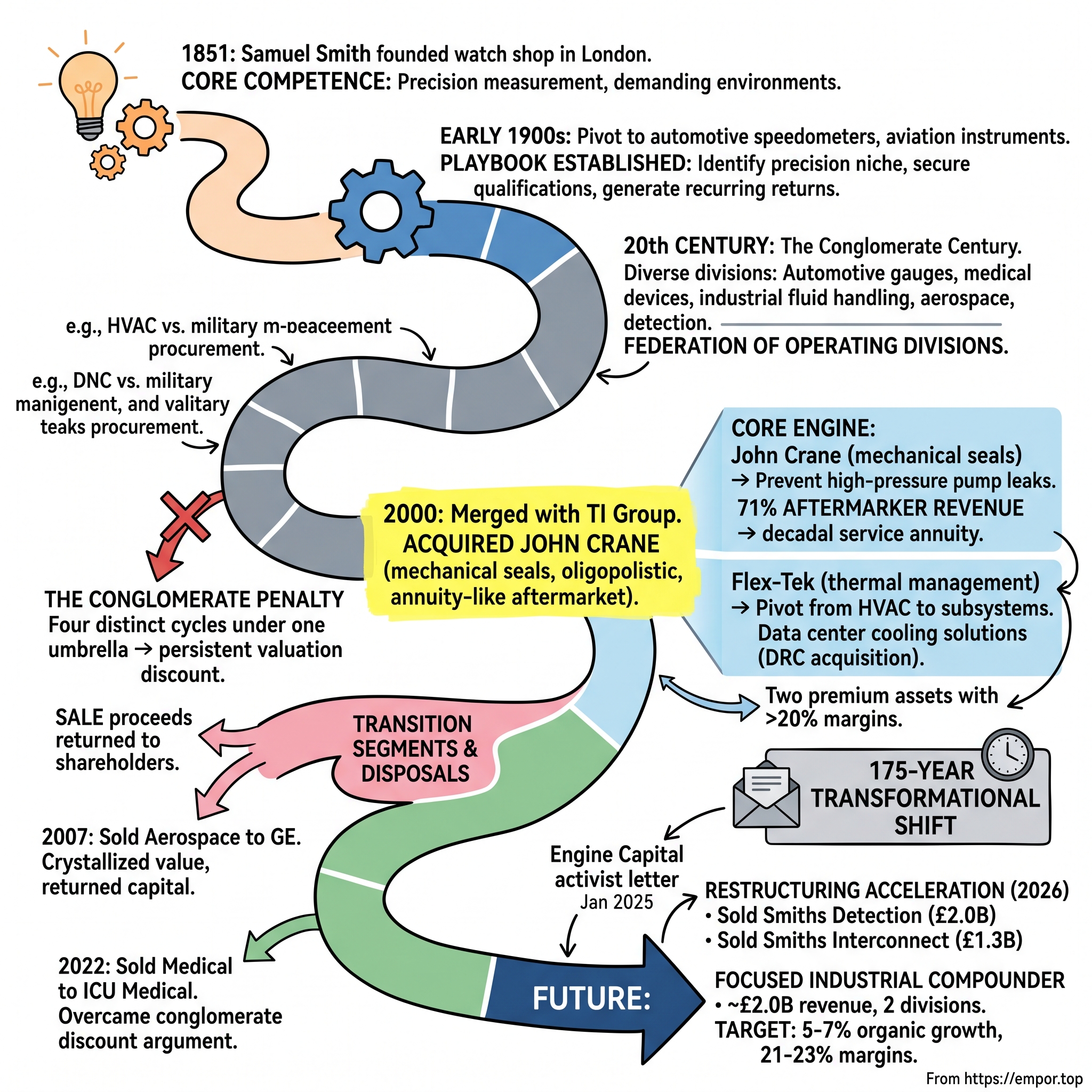
Smiths Group plc: The 175-Year Industrial Transformation
I. Introduction & Episode Roadmap
On 30 June 2026, Smiths Group plc completed the sale of Smiths Detection to funds advised by CVC Capital Partners for an enterprise value of £2.0 billion, banking net cash proceeds of more than £1.9 billion.1 The transaction marked a definitive shift for a company founded in 1851, the year of the Great Exhibition. Three months earlier, on 1 April 2026, Smiths Interconnect went to Molex, a Koch company, for £1.3 billion.2 Together, the two disposals crystallised £3.3 billion of enterprise value in roughly fourteen months.1
What remains is the focus of this story. Stripping away airport scanners and microwave connectors leaves two core businesses: John Crane, which manufactures mechanical seals that prevent high-pressure pumps and compressors from leaking in refineries, and Flex-Tek, which produces flexible hoses, rigid tubing, and heating elements for aerospace, housing, and increasingly, data centres. In the financial year ended 31 July 2025, those two businesses generated roughly £1.95 billion of revenue at a pro-forma operating margin of 19.6% and a return on capital employed of 22.8%.3 The remaining divisions that gave Smiths its conglomerate structure have all been divested.
This is not a story about a company built on a single breakthrough technology. It is an examination of a 175-year-old institution that spent two decades selling healthy businesses, and an assessment of whether the final act of that program produces a higher-quality enterprise or merely a smaller one.
The economic weight, as it stood before the disposals. In FY2025, John Crane produced £1,115 million of revenue at a 23.8% headline operating margin.45 Flex-Tek contributed a little over £830 million at 19.5%.35 Smiths Detection turned roughly £960 million of revenue into £122 million of headline operating profit — a 12.7% margin, barely half of John Crane's.56 Smiths Interconnect, the smallest segment, ran at 17.8%.5 The structural logic that drove the breakup is visible in those figures: two businesses earned premium returns while two did not, leading the market to price the consolidated average.
The core thesis, and its weak points. Management contends that a focused Smiths warrants a premium valuation rating, projecting that its two remaining businesses can deliver 5–7% organic revenue growth with operating margins of 21–23% and returns on capital above 20% from FY2027 onwards.5 Trailing performance, however, presents a more mixed picture. In the nine months to April 2026, organic revenue growth across the retained businesses was +0.2%, and in May 2026 management lowered full-year FY2026 organic growth guidance to around 2%, down from 3–4%, after conflict in the Middle East disrupted John Crane's largest regional market.7 A company targeting 5–7% through-cycle growth has delivered a year at roughly 2%. The gap between management's targets and the trailing record forms the central analytical question.
What follows. This analysis traces the arc from a South London watch shop to a FTSE 100 industrial; examines the three major disposals of 2007, 2022, and 2026 and what they reveal about the board's capital allocation framework; takes apart John Crane's aftermarket economics in detail, where the investment case lives or dies; assesses Flex-Tek's pivot from HVAC components into thermal management; tests management's credibility against historical statements on earnings calls; evaluates the business through Hamilton Helmer's 7 Powers and Porter's Five Forces; and stress-tests the bull case against the bear case, including the activist argument that prompted this transformation. Throughout, the central task remains evaluating what evidence supports each claim and what would falsify it.
The transformation did not begin in a boardroom. It began, as most breakups do, with a letter.
 Subscribe on LinkedIn
II. History: From Victorian Watchmaker to Industrial Conglomerate
In 1851, Samuel Smith opened a jewellery and watch shop at 12 Newington Causeway in South London, as the city was absorbing the rapid expansion of the railway age. He died in 1875 at age 49, having built a business selling precision timepieces to a rising middle class that had learned to value punctuality. That origins story established a core competence that defined the firm's entire subsequent history: measuring physical properties accurately in demanding environments and charging a premium for that precision.
The pivot from pocket watches to motor cars was opportunistic rather than visionary. Early British motorists required speedometers, and a company capable of manufacturing watch escapements could readily manufacture speedometers. By 1914, the business was listed on the London Stock Exchange, and during the First World War it expanded into supplying instruments to the Admiralty and the nascent aviation industry. The operating pattern established itself early: identify a precision-engineering niche adjacent to existing capabilities, secure regulatory and customer qualifications, and generate recurring returns from the installed base.
The conglomerate century. Across the twentieth century, Smiths repeated this playbook across multiple sectors. It supplied cockpit instruments and military avionics through the Second World War. It manufactured automotive gauges for the British motor industry during its post-war peak, a period when a Smiths speedometer sat behind the steering wheel of most cars built in Britain. As domestic car manufacturing faltered under international competition in the 1970s and 1980s, Smiths diversified into medical devices — such as tracheostomy tubes and infusion pumps — and industrial fluid handling. Reorganised under the Smiths Industries banner as a decentralised federation of operating divisions, the group fit the corporate model of an era defined by expensive capital and limited market information, when a central head office could allocate capital more efficiently than public markets.
This underlying technical competence explains why Smiths survived the decline of British volume manufacturing when many industrial peers failed. Smiths did not compete on price; it competed on reliability in mission-critical applications where failure carried heavy financial or safety risks. Each market position was secured through strict qualification processes rather than cost leadership, creating durable customer relationships. When British car manufacturing contracted, that core competence survived and found new industrial applications — the same engineering capability that now sits inside John Crane's dry gas seals.
That conglomerate rationale eventually lost its force. By the 1990s, capital was abundant, information was cheap, and institutional investors preferred targeted exposure to specific end markets. A multi-industry structure no longer solved a capital allocation problem for shareholders; instead, it created a valuation penalty by combining four distinct business cycles under a single corporate umbrella.
The 2000 inflection. In November 2000, the company rebranded as Smiths Group plc, and in December it merged with TI Group, a British engineering conglomerate whose principal asset was John Crane — a mechanical seals business founded in 1917.4 The transaction also expanded Smiths' aerospace operations and brought in an automotive parts division that was spun off as TI Automotive the following year. In a single deal, Smiths acquired both the high-return asset that would come to define its core identity and the portfolio complexity that would weigh on its market valuation for the next quarter-century.
The 2000 merger established a four-pillar conglomerate spanning aerospace, medical, detection, and industrial engineering — a structure that management would spend the next 25 years dismantling. Crucially, it brought John Crane, an oligopolistic business supported by an annuity-like aftermarket model, into a corporate structure that took two decades to fully prioritize it. Subsequent strategic decisions at Smiths reflected a gradual recognition that one of the four divisions possessed fundamentally superior economics to the rest.
What the conglomerate legacy actually bought, and what it cost. The technical inheritance was substantial. Deep engineering expertise, metallurgical capabilities, and long-standing customer relationships in safety-critical industries accrete over decades. Each division occupied defensible market positions. However, the corporate overlay created structural friction. Detection relied on volatile government procurement cycles; Medical depended on hospital capital budgets; John Crane tracked oil and gas capital expenditure and industrial aftermarket demand; and Flex-Tek was tied to US residential construction. Operating four distinct cyclical businesses under one equity listing generated a persistent gap between the company's trading multiple and the underlying value of its individual units.
For years, executive management argued that operational execution would eliminate this discount. At the 2021 analyst day, then-Chief Executive Paul Keel argued that underperforming multi-segment companies and underperforming pure-plays both traded at low multiples, contending that performance rather than corporate structure was the primary driver — and that improving operational execution at Smiths would eliminate the conglomerate discount.8 That premise formed the central defense of the group's structure, but subsequent events demonstrated its limitations.
III. The Two Decades of Strategic Pruning (2007–2022)
On 15 January 2007, Smiths announced the sale of its aerospace division to General Electric for $4.8 billion in cash.9 The division had generated $2.4 billion in revenue in 2006 and employed more than 11,000 people producing flight management systems, electrical power management, mechanical actuation, and airborne computing.10 It held strong tier-one positions on major aircraft platforms that would dominate commercial and military aviation for the next two decades.
Smiths sold the division nonetheless, offering a candid rationale. The board noted that rising capital requirements and increasing supplier scale were reshaping the aerospace sector.9 Smiths Aerospace was subscale for the coming wave of industry consolidation; the company faced a choice between committing substantial capital to compete or selling while a strategic buyer offered a premium valuation. Chief Executive Keith Butler-Wheelhouse framed the transaction as crystallizing value while placing the business with a well-capitalized owner.9
The capital return that followed was substantial. From estimated net proceeds of £2.25 billion, the board proposed returning £2.1 billion to shareholders through a B share scheme and share consolidation—representing roughly 37% of the group's market capitalization in January 2007.9 GE completed the acquisition on 4 May 2007.10
What the 2007 sale established, and what it failed to fix. The transaction established two key precedents: first, that Smiths would divest healthy businesses rather than underfund them; second, that sale proceeds would be returned to shareholders rather than spent on empire-building. Both precedents remain vital context for evaluating the group's structure in 2026. What the sale failed to accomplish, however, was closing the conglomerate discount. Removing one business from a four-part structure simply created a three-part portfolio, and the valuation penalty persisted.
The middle years. The period from 2008 to 2020, spanning the tenures of Chief Executives Philip Bowman and Andy Reynolds Smith, was characterized by setting organic growth targets that the portfolio could not consistently achieve. Segment data highlighted the structural mismatch. John Crane generated strong cash flow and high returns on capital, whereas Smiths Medical and Smiths Detection were tied to volatile hospital and government procurement cycles. Combining these distinct business models produced modest overall growth and diluted cash conversion, which public markets discounted accordingly.
The common critique that management simply failed to execute is contradicted by the financial record. Engine Capital, an activist shareholder critical of the group's structure, noted in its 2025 letter that management had accelerated organic growth for over three years, implemented the Smiths Excellence operating system to expand margins, divested Smiths Medical, and completed accretive acquisitions—delivering performance largely in line with targets set at the November 2022 capital markets event.8 Organic revenue growth and earnings per share exceeded targets in FY2023 and FY2024, while return on capital employed met expectations.8
This period demonstrated that Smiths was not an operational turnaround story with failing divisions, but a corporate structure issue where solid operations were penalized by a conglomerate wrapper. Investors observed improving underlying fundamentals alongside a flat valuation multiple. The market's refusal to re-rate the stock reflected a rational response to a multi-industry structure that prevented each division from being valued independently.
A secondary burden of this era lay in legacy liabilities. Decades of industrial manufacturing left Smiths with pension and asbestos-related obligations typical of long-established British engineering firms. These liabilities increased the discount rate applied by prospective buyers and investors without altering operational results, adding another layer of complexity to the corporate valuation.
The Medical disposal and a competitive auction. After years of aborted spin-off attempts and stalled trade sales, Smiths agreed on 2 August 2021 to sell Smiths Medical to TA Associates through an acquisition vehicle named Trulli Bidco.11
On 8 September 2021, Smiths announced superior terms from ICU Medical, prompting the board to withdraw its recommendation for the TA Associates transaction.11 The ICU deal valued Smiths Medical at an enterprise value of $2.7 billion ($2.4 billion in equity value)—approximately $400 million above the private equity offer—and included an equity stake in ICU plus a $100 million earnout.11 Shareholders approved the transaction on 17 November 2021 with 99.97% support, and the sale completed on 7 January 2022. The final consideration comprised $1.85 billion in cash, roughly $500 million in newly issued ICU Medical stock, and up to $350 million in performance-contingent earnouts.12 Smiths allocated $1.0 billion, or about 55% of initial cash proceeds, to share buybacks.12
An analytical post-mortem of the Medical sale. Although securing an additional $400 million by switching buyers demonstrated negotiating leverage, the deal structure retained indirect exposure to the medical devices sector. Accepting 2.5 million ICU Medical shares meant Smiths maintained exposure to the US infusion-pump market it sought to exit, converting a clean cash sale into a partially deferred holding dependent on another management team's performance. Smiths gradually monetized this residual position, realizing £53 million in net proceeds during FY2025 from its remaining ICU shares.5 The company did not disclose the total realized cash compared with the $500 million paper valuation initially attributed to the stock component.
The broader lesson centers on portfolio structure rather than deal timing or execution. Smiths sold its aerospace business into a strong strategic market and its medical division into an active private equity market. Yet despite well-timed disposals and operational progress, the company failed to achieve a market re-rating. By late 2024, Smiths traded at an enterprise value of approximately 9.5 times forward EBITDA—well below pure-play peers and private transaction multiples.8 Operational improvements alone had not eliminated the conglomerate discount.
That persistent valuation gap set the stage for an activist intervention that accelerated the company's full restructuring.
IV. The Core Engine: John Crane & Industrial Moats
Imagine a refinery in the Gulf. Inside it, a compressor spins at fifteen thousand revolutions per minute, containing hydrocarbons at pressures that would flatten a car. Somewhere on that shaft, where the rotating part meets the stationary part, there is a gap. Something has to close that gap without touching — because contact at those speeds means heat, and heat means failure — while preventing a single molecule of what is inside from reaching the outside.
That something is a dry gas seal, and John Crane makes them. Two ultra-flat faces, one rotating and one fixed, separated by a film of gas a few microns thick — thinner than a human hair by an order of magnitude. The physics is genuinely hard. The commercial consequence is simpler: on the HY2026 earnings call, CEO Roland Carter reached for the clearest possible analogy, telling analysts that in many of these plants the seal is essentially the fuse — if something in the system has to be sacrificed, it is designed to be the seal rather than the compressor or the pump, because of the relative costs.13
That is the whole moat in one sentence. The seal is the cheap component whose job is to fail before the expensive components do. Nobody optimises the purchase price of a fuse.
The scale of the franchise. John Crane generated £1,115 million of revenue in FY2025, operates more than 200 facilities worldwide including manufacturing, sales and service sites, runs 13 global turbo service centres, manufactures in ten countries, and employs over 6,000 people across more than 50 countries.4 Its revenue splits roughly 63% energy and 37% industrial, and — the number that matters most — 71% of it is aftermarket rather than original equipment.4
A short detour into why this is hard. It is worth dwelling on the engineering, because the moat is downstream of it. A conventional seal works by contact — two surfaces pressed together, like a rubber gasket. Contact generates friction, friction generates heat, and heat destroys the seal. At the speeds and pressures of a modern gas compressor, contact sealing is simply not survivable.
A dry gas seal solves this by not touching at all. Shallow grooves are etched into one of the two seal faces — patterns measured in microns — and as the shaft spins, those grooves pump gas inward and generate a pressurised film that physically lifts the faces apart. The seal floats. The gap it maintains is roughly three microns, which is to say it must hold a tolerance far finer than a human hair while spinning at thousands of revolutions per minute, absorbing vibration, thermal expansion and pressure swings, and never letting the faces touch.
Get it slightly wrong in either direction and you have a failure: too much gap and the seal leaks hydrocarbons; too little and the faces contact, overheat and destroy themselves. This is why seal selection is an engineering exercise rather than a procurement one, why the specification of pressure, temperature and speed capability is the competitive battleground Carter describes, and why the supporting systems — the gas conditioning skids and monitoring instrumentation that keep the seal within its operating envelope — are part of what John Crane sells. Fagge's observation that the support system failing is what damages the seal is not a caveat; it is the reason the systems business exists.13
Why the aftermarket ratio is the business. In the original-equipment sale, John Crane competes. A pump manufacturer or an EPC contractor is specifying components, alternatives exist, and price is negotiated. But the OE sale is not really the transaction; it is the acquisition of a decades-long service annuity. Once a seal is installed in an operating plant, it must be inspected, refurbished and replaced on a maintenance cycle for as long as that plant runs — and process plants run for thirty or forty years.
The switching economics are brutal for challengers. Replacing an incumbent seal design in a live plant means re-engineering, re-qualification, and — most damningly — accepting unquantified risk on a component whose failure mode is an unplanned shutdown. Against that, a discount on a component representing a fraction of a percent of plant capex is close to irrelevant. This is not brand loyalty. It is rational risk aversion by a plant manager whose career depends on uptime.
Carter made the counter-cyclical version of this argument explicitly during the Middle East disruption, telling analysts that with aftermarket over 70% of John Crane, it is the most resilient part of the market — because it is difficult not to look after your equipment even when it is not being fully utilised, or when you are going through shutdown and bringing it back up.13 He then went further, in a passage worth reading carefully: things do not generally break as they run, he argued; they break when they are switched on and switched off.13
That is an important and slightly uncomfortable claim. It says that operational chaos — shutdowns, restarts, damaged infrastructure — is, over a full cycle, good for a seal business, because thermal cycling and improper shutdown are what damage seals. Carter conceded the point commercially, noting that much as one would never like to describe such a situation as positive, it is relatively positive for the business.13 CFO Julian Fagge added that facilities elsewhere in the world running at higher capacity to fill the demand gap also support the aftermarket.13
Testing the claim against the numbers. Here the evidence is more equivocal than the narrative. Despite that resilience argument, John Crane's organic revenue grew only +3.0% in FY2025 and +2.0% in the first half of FY2026 — well below the 5–7% the group now targets.514 And in Q3 FY2026 the Middle East disruption cost roughly £10 million of revenue, with management indicating a similar impact in Q4 for around £20 million across the year.715 So the theoretical resilience is real, but it operates on a lag: disruption hurts first and helps later, and "later" has not yet shown up in reported growth.
The self-inflicted wound. John Crane's recent record also carries an execution story that management has been unusually direct about. Through FY2025 the business installed 72 new CNC machines and began adding nine dry gas seal test rigs — a substantial capacity and automation upgrade.3 Upgrades of that scale disrupt throughput, and this one was compounded by a cyber security incident disclosed on 28 January 2025, when Smiths confirmed unauthorised access to its systems and isolated affected infrastructure.16
The interaction was ugly. On the FY2025 call, Carter explained that the cyber incident hit engineering across John Crane, the most integrated of the businesses, and that the company had locked down its drawings to protect them before releasing them back — surging engineering hours to cope.3 Fagge added that the aftermarket saw slippage in Q3 around the cyber event.3 BNP Paribas analyst Stephan Klepp pushed hard on the obvious follow-up: had John Crane lost share while its peers outgrew it? Carter's answer combined an assertion — that this is a very sticky business — with an admission that opportunities to gain share exist and that the company had worked to reassure customers.3
For investors, the honest reading is that FY2025 and HY2026 growth at John Crane is not a clean read on underlying demand. It is demand minus a cyber disruption minus a capacity upgrade minus, latterly, a geopolitical shock. Management's argument that the underlying business is healthier than the reported number is plausible and partially evidenced — sequential quarterly improvement through H2 FY2025, a positive book-to-bill, and mid-single-digit growth in Q2 FY2026.314 It is not yet proven, and the proof point is a clean year without an excuse attached.
The competitive set. Mechanical seals is a concentrated global industry. John Crane competes principally with Flowserve in the United States and EagleBurgmann — a joint venture between Germany's Freudenberg and Japan's NOK株式会社 NOK Corporation — with A.W. Chesterton and AESSEAL as significant secondary players.17 Independent market research puts the mechanical seals market at roughly $8.0 billion in 2026, growing at a mid-single-digit compound rate, with John Crane holding the leading share position at around 15%.17 Note what that implies: a leading position of 15% in a market where the top handful of players do not collectively dominate means this is an oligopoly at the top of a long tail, not a duopoly. Pricing discipline exists at the high-specification end; it thins out considerably in commodity applications.
Rivals also anchor the valuation debate. Engine Capital's analysis put John Crane's listed peer group — Rotork, Flowserve, ITT and Dover — at a median of approximately 13.7x next-twelve-months EBITDA, versus a Smiths group multiple of roughly 9.5x, and noted the April 2022 sale of SPX Flow to Lone Star at about 16.8x EBITDA as evidence that private buyers paid up for these assets.8 That gap is the entire financial logic of the breakup.
The energy transition option. John Crane's growth optionality rests on the argument that decarbonisation infrastructure — carbon capture, hydrogen, methane abatement — expands the addressable market rather than cannibalising it. There is early, concrete evidence. In February 2026 the business disclosed a set of energy transition contract wins including dry gas seals and integrated heating for an Australian carbon capture and utilisation project, filtration for a methanol-powered vessel, and Type 93AX seals for an offshore carbon storage project in Thailand that cut nitrogen consumption by up to 80% versus conventional seals.18 The company characterised these collectively as worth tens of millions of pounds over their lifecycle, typically structured as multi-year agreements including aftermarket.18
That is real but small. "Tens of millions over a lifecycle" against a £1.1 billion revenue base is optionality, not yet a growth engine. Carter's own framing on the FY2025 call was more technically interesting than the marketing version: he argued the seals are not fundamentally end-market specific, because higher pressures, higher temperatures and higher speeds are the common requirements — and a platform that delivers those serves traditional energy, hydrogen and LNG alike.3 That is a better argument, because it means the R&D is not a bet on decarbonisation timing. It is a bet on physics that pays either way.
The commercial proof points are more persuasive than the green ones. In February 2026 John Crane disclosed a multi-year global framework agreement with an international energy company covering seal management across its global operations, and a multi-year managed reliability programme in Central America involving on-site engineers and digital diagnostics — plus a US pulp and paper installation that lifted mean time between repairs from three weeks to over twelve months.19 Moving from selling components to selling contracted reliability is the mechanism by which an aftermarket franchise deepens rather than merely persists. Watch whether it scales.
If John Crane is the annuity, the other half of the new Smiths is supposed to be the growth story. It is having a harder year.
V. Thermal Management & Fast-Growing Segments: Flex-Tek
Flex-Tek manufactures flexible ducting, rigid tubing, and heating elements—from heat kits to industrial process systems—supplying US residential construction, aerospace, and industrial plants. In FY2025, it generated a little over £830 million of revenue at a 19.5% headline operating margin.35 While flexible ducting rarely attracts media coverage, a near-20% operating margin indicates that this is not commodity manufacturing. These returns reflect products engineered directly into customer designs, qualified into distribution channels, or specified onto aircraft platforms, alongside market consolidation rather than price competition inside fragmented trades.
Three businesses wearing one name. In HY2026, Smiths began disclosing Flex-Tek's breakdown explicitly, revealing three distinct segments: construction representing 19% of group revenue, aerospace at 12%, and thermal solutions at 9%.14 These units have distinct operational drivers. Construction is a US distribution business where Flex-Tek spent five years acquiring its way to national scale in a predominantly regional market.14 Aerospace is a certification-heavy business supplying fluid and gas conveyance to airframe and engine manufacturers, where wins lock in content for a programme's entire lifespan. Thermal solutions is an industrial heating business being repositioned toward higher-value systems.
The current problem is construction. In HY2026, Flex-Tek's organic revenue declined 2.0%, and in Q3 FY2026 it fell 3.9%.147 Management attributed the decline to weak US residential housing activity without forecasting a near-term recovery. On the HY2026 earnings call, CEO Roland Carter told analysts that the company had not factored a second-half construction rebound into its outlook.13 Carter was equally explicit on pricing, acknowledging that pricing power is thinnest in construction and would remain constrained while market conditions persist, even as thermal solutions and aerospace achieved positive pricing, with aerospace demonstrating significant pricing power.13
While this candour offers realistic guidance, it highlights an underlying vulnerability: roughly a fifth of the retained Smiths portfolio remains exposed to US housing starts and interest rates with minimal pricing power and limited visibility on a turnaround.
Aerospace is the offset, and it is working. Flex-Tek's aerospace unit has expanded alongside commercial aircraft production ramps, with management renegotiating long-term agreements with airframe and engine manufacturers specifically to secure higher pricing.13 On the Q3 call, aerospace growth was attributed to contract renewals with positive pricing benefits.15 This provides concrete evidence of pricing power: when a supplier can reprice long-term contracts mid-programme, it indicates that customers lack readily available alternatives. Flex-Tek also extended its nearly 30-year partnership with the Indian Space Research Organisation, supplying specialized components for high-altitude ground test rigs.14
The pivot: thermal solutions and the data centre. In March 2026, Smiths agreed to acquire DRC Heat Transfer for £164 million, representing approximately 10x adjusted EBITDA for calendar year 2025.14 DRC designs and manufactures custom heat transfer and cooling solutions in the US, primarily for backup and prime power generators used alongside data centres.14
This position is specific: DRC does not supply direct liquid cooling for server racks, but rather heat management for the power generation infrastructure supporting data centres. While this aligns with structural growth in data centre power requirements, it represents exposure to power generation and electrification infrastructure rather than direct chip-level cooling.
Management's commentary on the HY2026 call reflected this distinction. Carter expressed enthusiasm for data centre exposure while emphasizing that Flex-Tek had successfully transitioned from selling individual heating elements to integrated subsystems and complete systems, building on its TUTCO foundation through acquisitions including SureHeat, Farnam, Wattco, and DRC.13 Asked by Citigroup analyst Martin Wilkie whether separate disclosure for thermal solutions signaled increased capital allocation to the segment, Carter confirmed the strategic direction without giving specific targets, while CFO Julian Fagge noted that the division would continue pursuing small bolt-on acquisitions within balance sheet flexibility.13
The acquisition record, and its limits. Flex-Tek's M&A track record provides empirical support for management's capital allocation strategy. Since 2018, acquisitions have driven a compound annual growth rate exceeding 13% in both revenue and operating profit, alongside a 60 basis point margin expansion.3 In FY2025, the division added Modular Metal, Wattco, and Duc-Pac for net acquisition spend of £121 million, contributing £41 million in revenue and £10 million in operating profit during the year while expanding margins.5
Two caveats temper this record. First, acquisition roll-ups depend on sustained integration and market demand; acquiring construction suppliers into a stagnant US housing market relies on a cyclical recovery that has not yet materialized. Second, Flex-Tek disclosed an internal control issue in FY2025: a non-material balance sheet misstatement at an isolated US industrial site discovered in Q4 resulted in an £8 million charge to headline profit and a £15 million prior-period adjustment charged below the line.5 Fagge informed analysts that the issue spanned multiple years, was fully investigated and resolved, and that the £8 million was routed through headline profit to reflect organic performance accurately.3 In response to Kepler Cheuvreux analyst Dylan Jones regarding whether the £8 million charge would reverse, Fagge indicated that a portion would recur as benefit but declined to quantify the amount.3
While the financial impact is modest relative to the group, multi-year accounting misstatements within an active roll-up platform highlight internal control risks that warrant continued monitoring.
Who Flex-Tek actually competes against, and why that matters. Flex-Tek's competitive dynamics vary significantly across its three sub-businesses, making division-wide averages less informative.
In aerospace fluid conveyance and ducting, Smiths competes against major suppliers including Parker Hannifin, Eaton, Senior plc, and Hutchinson's PFW Aerospace.26 Parker Hannifin, in particular, maintains a vertically integrated hose and fitting portfolio backed by deep OEM and aftermarket presence.26 Flex-Tek competes not on overall scale, but through custom engineering, rapid prototyping, and securing design-in positions on specific aircraft and engine platforms. Once qualified, those positions endure for the life of the aircraft programme, enabling mid-programme price renegotiations.
In US construction products, the competitive landscape consists of fragmented regional ducting and HVAC manufacturers. Here, Flex-Tek acts as a market consolidator rather than a niche challenger, driving its acquisition pace but limiting pricing power in fragmented distribution channels.
Consequently, Flex-Tek's 19.5% FY2025 operating margin represents a composite across distinct competitive profiles.5 The aerospace and thermal segments possess stronger structural moats than residential construction. Disclosing these three sub-businesses separately starting in HY2026 provides clearer visibility, prompting analysts like Citigroup's Martin Wilkie to track capital deployment across the portfolio.1413
High-grading, or shrinking to fit. In conjunction with the DRC acquisition, Smiths announced plans to exit selected non-core general industrial lines within Flex-Tek. These dilutive units generated £25 million in revenue and a £2 million operating loss in HY2026, following £54 million in revenue and a £5 million loss in FY2025.14 Fagge informed Panmure Liberum analyst Alex O'Hanlon that one sale was advanced, with two additional divestments targeted over six to twelve months.13
Pruning unprofitable operations improves reported margins and organic growth mechanically. While this represents rational portfolio management, investors should recognize that achieving management's 21–23% operating margin target relies in part on divesting lower-margin revenue rather than solely driving underlying operational gains across the core base.
VI. Transition Segments & Portfolio Streamlining
For a company that spent nineteen months evaluating a dual-track strategy, the conclusion was decisive. On 3 December 2025, Smiths announced the sale of Smiths Detection to funds advised by CVC Capital Partners for an enterprise value of £2.0 billion. The price represented 16.3 times fiscal year 2025 headline operating profit of £122 million and 12.5 times headline EBITDA of £160 million.6 With that agreement, the board abandoned the parallel option of a public demerger.
What Detection was. Smiths Detection manufactured the X-ray, computed tomography, and trace detection systems that screen passengers, baggage, and cargo at airports, ports, and borders. It competed with OSI Systems' Rapiscan, Leidos, and China's 同方威视 Nuctech, among others, in a market where the top five suppliers account for roughly 62% of global revenue.20 In fiscal year 2025, Detection was the group's fastest-growing segment, delivering 15.2% organic revenue growth driven by an aviation checkpoint upgrade cycle.5 Organic revenue expanded a further 11.7% in the first half of fiscal year 2026, with operating margin rising to 13.8%.14
So why sell the fastest grower? The decision requires separating management's explanation from market mechanics.
Management pointed to margin structure and capital intensity. Detection's 12.7% fiscal year 2025 operating margin was roughly half that of John Crane, driven by structural market dynamics rather than operational execution. Detection sold large equipment into government and airport procurement cycles that arrive in concentrated waves. Regulatory type-certification with the TSA and ECAC establishes high barriers to entry, but while certification protects incumbents, it does not smooth cyclical demand. The checkpoint CT upgrade represented one such multi-year wave. Chief Executive Roland Carter told analysts in September 2025 that the company had shipped about 1,800 units, up from roughly 1,600 previously, with the deployment extending through 2026 and into 2027.3 Capital equipment waves, however, eventually crest.
The broader market explanation is that Detection commanded a higher valuation outside the conglomerate structure. CVC paid 12.5 times EBITDA for a business that Smiths' equity was valued at roughly 9.5 times on a consolidated basis before the breakup was announced.86 The transaction effectively harvested the conglomerate discount in cash. Whether Detection's growth rate remains sustainable is now CVC's concern; Smiths captured the valuation gap.
A key analytical trade-off warrants attention: Smiths exited near the peak of an equipment deployment cycle, before the high-margin aftermarket service revenue from those 1,800 installed CT units fully materialized. Carter acknowledged on the fiscal year 2025 earnings call that service streams would expand across both the new CTiX line and the broader installed base.3 A buyer paying 16.3 times operating profit was presumably underwriting that recurring aftermarket cash flow. Smiths chose upfront cash certainty, leaving CVC to capture the long-term service income.
The geopolitical dimension. Beyond margin profiles, security screening presents distinct ownership challenges related to customer composition. Threat detection equipment is procured by state entities and airport authorities, with a competitive field that includes China's 同方威视 Nuctech, a firm subject to security scrutiny across Western markets.20 Consequently, market access depends as much on international relations as technical specifications, leaving regional market share vulnerable to political factors beyond executive control.
For a private equity sponsor operating within a fixed investment horizon, geopolitical entry barriers can offer a defensible market position. For a public company evaluated on steady earnings growth, political uncertainty adds unmodellable volatility. Exiting Detection removed a business whose addressable demand was heavily influenced by government policy, streamlining the equity narrative alongside the financial profile.
Interconnect: the cleaner decision. The sale of Smiths Interconnect—which manufactures specialized connectors, microwave components, and semiconductor test products—presented a simpler strategic rationale. Announced on 16 October 2025 and completed on 1 April 2026, the division went to Molex, a Koch company, for £1.3 billion, representing 15.1 times fiscal year 2025 headline EBITDA of £86.1 million.214 The unit had performed strongly prior to the sale, generating 22.5% organic revenue growth in fiscal year 2025 driven by a recovery in semiconductor testing alongside aerospace and defence demand, with an operating margin of 17.8%.5
Interconnect represented the most straightforward divestment because it shared little operational synergy with the rest of the group. Its technology, customer base, and market cycles were rooted in electronics, whereas the remainder of Smiths focused on mechanical engineering. Carter noted on the fiscal year 2025 earnings call that selling Interconnect was an obvious decision, whereas Detection required managing parallel demerger and sale tracks to maximize value and transaction certainty.3 That distinction between immediate transaction clarity and complex value execution defined the contrast between the two disposals.
What the new Smiths actually is. Following the completion of the disposals, Smiths operates as a focused industrial entity generating approximately £1.95 billion in revenue across three primary end markets: energy at 36%, industrial at 38%, and construction at 26%.3 Management projects that these underlying markets will grow at an annual rate of 4% to 5% over the next decade, and targets 5% to 7% organic revenue growth by outperforming its core markets.14 That ambition forms the central investment test. Consistent premium growth of 100 to 200 basis points above market rates across economic cycles presents a rigorous operational challenge—and establishes the benchmark against which management's execution will be judged.
VII. Current Management, Execution & Capital Allocation
On 26 March 2024, Smiths announced that Paul Keel had decided to step down as CEO with immediate effect to return to the United States and lead a US public company, with Roland Carter—a 30-year Smiths veteran who had led Smiths Detection since 2018—taking over immediately.21 An abrupt executive departure with immediate effect rarely signals an orderly succession plan.
Ten months later, on 14 January 2025, Smiths announced the retirement of CFO Clare Scherrer, who stepped down on 31 January 2025 while supporting a transition through April, with Julian Fagge appointed CFO effective 1 February.22 Within less than a year, the FTSE 100 industrial group had replaced both of its top executive leaders.
Writing three days after the CFO announcement, activist investor Engine Capital drew the conclusion that both executives had departed after driving operational improvements without achieving the desired market re-rating, suggesting their exits reflected an implicit admission that the multi-industry corporate structure was no longer viable.8 While that represents an activist's perspective, the rapid sequence of senior leadership changes is indisputable.
Roland Carter. Carter represents an operational insider rather than a corporate dealmaker. A three-decade company veteran, he previously ran Smiths Detection, Smiths Interconnect, and the Asia-Pacific division before assuming the chief executive role, bringing a background centered on innovation and R&D.321 On earnings calls, his communication style is technical and detailed—often spending time explaining the engineering mechanics of high-pressure, high-temperature, and high-speed seals before addressing commercial metrics.3 He has also directly addressed operational setbacks, using the HY2026 earnings call to express dissatisfaction with the half-year safety record and detail targeted remedies, including site safety stand-downs.13
The central strategic question is whether an executive who built his career in divisions that were ultimately divested is best suited to lead the retained businesses. In response, Carter has focused on institutionalizing lean operating systems rather than corporate restructuring, expanding the group's continuous improvement initiative through the Smiths Excellence Academy, where 1,500 employees had completed Yellow Belt training by HY2026.313
Julian Fagge. Fagge brings direct operational management experience to the CFO role. He joined Smiths in 2013 as Group Financial Controller, advanced to Group Strategy and M&A Director in 2017, and subsequently served as President of Flex-Tek in 2019 and President of Smiths Interconnect in 2021.22 On investor calls, his direct style contrasts with Carter's technical detail, handling complex financial queries regarding balance sheet adjustments, share buyback mechanics, and capital deployment choices.
How incentives are structured. Under the company's remuneration policy, executive directors can earn a maximum annual bonus of up to 250% of base salary, with financial metrics accounting for at least 70% of the weighting—typically tied to profit, organic revenue growth, and cash generation. Up to 67% of any earned bonus is paid in cash, with the remainder deferred into company shares for three years.23 Long-Term Incentive Plan (LTIP) awards are capped at 500% of salary and granted as a fixed number of shares—190,000 for the CEO and 110,000 for the CFO in FY2025—vesting after three years with a mandatory two-year post-vesting holding period, subject to performance metrics including earnings per share (EPS), cash measures, organic revenue growth, return on capital employed (ROCE), and ESG goals.23 Threshold performance results in a 25% payout on relevant components.23
This incentive structure contains two key mechanics. First, fixed-share LTIP grants directly link executive compensation to stock price movements, with a cap preventing total award values from exceeding 500% of base salary if the share price appreciates substantially.23 Second, evaluating ROCE alongside EPS and revenue growth provides a safeguard during major capital return programs. Because share buybacks reduce the share count and artificially inflate EPS without altering operating efficiency, incorporating ROCE helps ensure financial engineering alone does not trigger full incentive vesting.
The capital allocation record, in sequence. Capital deployment decisions over the past eighteen months highlight management's strategy under public and activist scrutiny.
The initial expansion of capital returns occurred under market pressure. While Smiths already had a £150 million share buyback underway, the board expanded the program to £500 million on 31 January 2025—two weeks after Engine Capital issued its public letter—alongside announcing the Interconnect sale process, the Detection separation, and an Acceleration Plan, overseen by a dedicated board committee chaired by Chairman Steve Williams.24 That £500 million program completed in December 2025, with £398 million repurchased by 10 September 2025.514
A second £1.0 billion buyback program launched in calendar 2026, funded by proceeds from the Interconnect sale. Under this authorization, £180 million was executed during HY2026, reaching £127 million more by the March results and targeting £600 million total repurchases by the end of the fiscal year.14 By 19 May 2026, repurchases under this tranche totaled £506 million.7
Following the completion of the Detection sale, Smiths announced an additional £1.5 billion capital return on 20 March 2026, structured through a tender offer or special dividend alongside further share buybacks extending through calendar year 2027.14
Addressing analyst queries regarding why the £1.5 billion return was slightly below initial market expectations, Fagge clarified that the figure represented roughly 75% of Detection's £2.0 billion enterprise value. He explained that net cash proceeds were lower than headline value due to transaction costs, capital allocated to the DRC Heat Transfer acquisition, and the need to preserve balance sheet strength, fund ongoing bolt-on acquisitions, and cover operating cash flows and dividend commitments over an eighteen-month horizon.13 Leverage stood at 1.2 times net debt to EBITDA at the half-year mark prior to receiving full disposal proceeds, supported by a €650 million bond issuance in the first half.14
The dividend. Smiths reported a total dividend of 46.0p per share for FY2025, an increase of 5.1%, marking the company's 74th consecutive year of dividend payments under a policy targeting minimum earnings cover of approximately two times.5 The interim dividend for HY2026 was subsequently raised by 5.4% to 15.00p per share.14
Assessing credibility honestly. Management's execution record displays clear strengths alongside persistent operational gaps. On the positive side, FY2025 organic revenue growth reached 8.9%—exceeding twice-upgraded guidance of 6–8%—while operating margin expansion met the top end of the guided 40–60 basis point range, and cash conversion reached 99% against a 90% target.5 Furthermore, the disposals of Detection and Interconnect were completed at transaction multiples above initial market consensus and ahead of schedule.1 On earnings calls, management has routinely disclosed operational challenges, including accounting adjustments, safety metrics, and cybersecurity impacts, without shifting blame.
Conversely, growth targets have undergone multiple downward revisions. Management initially guided FY2026 organic revenue growth at 4–6% in September 2025, lowered the target to 3–4% in March 2026 following Detection's reclassification as a discontinued operation, and reduced it further to approximately 2% in May 2026.5147 This represented two growth downgrades in eight months. Management attributed the final reduction primarily to Middle East conflict disruptions impacting John Crane, backed by a £10 million Q3 revenue hit and a matching projected Q4 impact, while slightly raising operating margin guidance to just above 20%.715
The central analytical issue is that while management targets 5–7% medium-term organic growth, trailing performance across the retained operations remains subdued: John Crane delivered 3.0% organic growth in FY2025, 2.0% in HY2026, and group growth is projected at roughly 2% for full-year FY2026.5147 External factors—cybersecurity recoveries, manufacturing upgrades, weakness in US residential construction, and geopolitical conflict—provide context for each shortfall. Collectively, however, they mean the retained core business has yet to demonstrate its 5–7% growth profile over a full operating year.
Narrative consistency across calls — the test that actually discriminates. Evaluating management commentary over consecutive financial quarters reveals how core messaging evolves under changing operational conditions.
Smiths' public narrative has remained consistent in its core framing, adjusting primarily as factual developments occurred. Regarding John Crane's operational performance, management cited internal factors in September 2025—specifically recovery from a cyber security incident and capacity integration of new CNC machining centers—pointing to leading operational metrics such as engineering hours, machine utilization, on-time delivery, and backlog lead times.3 By March 2026, management pointed to those same indicators as evidence of operational recovery, highlighting mid-single-digit growth in Q2.13 When revenue dipped in May 2026, the shortfall was attributed to new geopolitical disruptions in the Middle East rather than recurring internal operational issues.7
Regarding US residential construction, management's messaging has remained conservative. In September 2025, Carter stated that the company was not forecasting a housing market recovery and was operating based on current demand.3 He reiterated in March 2026 that no market rebound had been factored into financial projections.13 Refusing to bake an unearned cyclical recovery into forward guidance demonstrates realistic planning.
The most notable strategic shift occurred regarding Smiths Detection. Throughout 2025, management insisted on pursuing parallel tracks for a public demerger or trade sale, with Carter stating in September that the dual-track process preserved transaction certainty and value.3 Management subsequently dropped the demerger option in favor of the £2.0 billion sale to CVC.6 While this represented a change in execution path, the dual-track structure was framed from the outset as an open choice rather than a fixed commitment.
The primary area of weakness lies in initial guidance calibration rather than disclosure transparency. Setting FY2026 organic growth guidance at 4–6% in September 2025 required an immediate demand acceleration that order books supported but trailing results did not.5 On that call, management indicated that John Crane would likely land at the top end of the 4–6% range.3 John Crane subsequently generated 2.0% organic growth in the following half-year.14 While the explanations for the shortfall were detailed and logical, the initial baseline targets proved overly optimistic.
Finally, working capital dynamics warrant tracking. Headline operating cash conversion fell from 94% to 78% in HY2026, driving free cash flow down to £74 million—representing 26% of headline operating profit, compared to 53% in the prior period.14 This drop reflected temporary inventory accumulation to support order delivery, alongside separation and restructuring costs, with full-year conversion guided in the low-to-mid 90% range.14 While inventory builds frequently accompany production recoveries, cash conversion represents a core medium-term performance benchmark targeted at roughly 100%, and the metric declined during a crucial transitional period.5
VIII. Strategic Moats & Frameworks
Analytical frameworks are useful primarily when they discriminate—revealing insights beyond initial assumptions. Evaluating the retained Smiths Group through Hamilton Helmer's 7 Powers and Porter's Five Forces highlights a clear divergence: John Crane scores strongly across almost every dimension, whereas Flex-Tek demonstrates structural power primarily within its aerospace unit. That asymmetry, rather than any group-level average, represents the central analytical finding.
Hamilton Helmer's 7 Powers
Switching costs—the primary power, and it is genuine. The underlying mechanism is straightforward: mechanical seals represent a minor purchase price relative to the massive cost of plant failure. Embedded in running facilities, replacing an incumbent seal requires re-engineering and accepting unquantified operational downtime risk. This moat is supported by John Crane's 71% aftermarket revenue mix and the fact that recent operational disruptions—specifically a cyber incident and machining upgrades—resulted in temporary growth delays rather than identifiable market share losses.43 CEO Roland Carter reiterated on investor calls that customer retention remained durable under analyst questioning.3
That protection has clear limits. High switching costs safeguard an existing installed base, but they do not automatically generate expansion. An incumbent with a 71% aftermarket ratio in an industry expanding at 4% to 5% annually will naturally grow near market rates unless it captures a higher share of new equipment installations or increases spend per customer. This dynamic explains why management's growth initiatives center on expanding aftermarket coverage and shifting toward multi-year, contracted reliability agreements.1319
Process power—real but difficult to verify externally. Decades of metallurgical formulation, seal face design, and fluid dynamics are difficult for rivals to copy. The deployment of the Type 93AX coaxial separation seal—positioned as a category benchmark with strong initial customer adoption—provides a practical example.1318 Across the group, new product introductions contributed about 165 basis points to FY2025 growth.5 Because process power is difficult for external observers to isolate from operational execution, research and development spending serves as the primary indicator: total group research, development, and engineering reached 4.3% of sales in FY2025 and 4.5% in HY2026—or 3.5% on a continuing, Smiths-only basis—supported by £46 million in FY2025 customer-specific engineering, concentrated mainly at John Crane.514
Scale economies—partial and localized. John Crane's global footprint of more than 200 facilities across over 50 countries, including 13 turbo service centers, enables rapid technician deployment to remote refineries and offshore platforms.4 Operational density forms the competitive barrier: while a competitor can replicate a physical component, matching local service response times within hours is far more difficult. Nevertheless, with roughly 15% global market share, scale advantages operate regionally rather than globally, as major peers such as EagleBurgmann and Flowserve maintain competing service footprints.17
Where structural powers are absent. The business lacks network effects, consumer brand power, cornered resources, and counter-positioning. Smiths does not employ a business model that incumbents are structurally prevented from copying; it operates within the established industry framework, relying on technical precision and service execution. Investors should distinguish a defensible market niche from an unassailable monopoly.
Porter's Five Forces
Buyer power: low to moderate, and asymmetric. Because an individual mechanical seal costs a fraction of total plant capital expenditure, price sensitivity on spot purchases is low. However, international energy majors purchase components through global framework agreements—such as the multi-year deal John Crane secured in HY2026—which aggregates buyer leverage.1914 This creates a trade-off: John Crane accepts sharper pricing terms in exchange for long-term volume and customer lock-in. As a result, buyer leverage remains weak on single transactions but stronger during corporate framework negotiations.
Supplier power: low. Specialized alloys, carbon, and silicon carbide are accessible from multiple global suppliers, preventing reliance on any single vendor. The primary supply-side challenge stems from broader input cost inflation and tariffs, which management cited as ongoing margin headwinds that must be counteracted through commercial pricing.514
Threat of new entrants: low for John Crane, moderate for Flex-Tek. In high-pressure mechanical seals, the main entry barrier is an established track record rather than capital intensity, as plant operators rarely approve unproven components on critical rotating machinery. In Flex-Tek's construction segment, entry barriers depend on distribution access and regional scale rather than proprietary technology, reinforcing management's focus on market consolidation over product differentiation.
Threat of substitutes: very low for mechanical seals. High-speed rotating shafts under pressure require dynamic sealing, as alternative technologies like magnetic drives remain limited to specialized, low-power applications. The long-term substitution risk stems not from competing sealing designs, but from potential declines in the overall installed base of refineries and hydrocarbon compressors as global energy systems evolve.
Rivalry: disciplined among tier-one peers, intense in lower-tier markets. Competition between John Crane, Flowserve, and EagleBurgmann centers on technical reliability, engineering support, and global service coverage rather than aggressive price discounting, while secondary suppliers such as AESSEAL and Chesterton cap pricing power in lower-specification applications.17 By contrast, Flex-Tek's construction unit faces heightened price competition, matching management's acknowledgement of constrained pricing power in that market.13
Dynamic moat evaluation. Static frameworks like Helmer's and Porter's evaluate current market positioning, but the core analytical question for Smiths is dynamic: is its competitive moat widening, holding steady, or narrowing?
Evidence of a widening moat remains modest but tangible—reflected in new product introductions contributing to organic growth, the transition from component sales to long-term reliability contracts, and automation investments that reduce lead times to secure quick-turn aftermarket orders.51913 Conversely, evidence of a narrowing moat is absent: there is no apparent technological substitution, no newly qualified entrant, and no erosion of pricing discipline in high-specification applications.
The analytical conclusion is that the moat is holding steady, with potential for incremental widening at the margin. While this confirms the durability of a mature industrial franchise, high moat quality alone does not guarantee accelerated top-line growth.
Synthesis. Evaluating Smiths through structural frameworks yields a clear conclusion: the group's competitive advantages are concentrated primarily within a single division. John Crane represents a highly defensible industrial franchise operating at margins above 23%. Flex-Tek combines strong market positions in aerospace with a construction roll-up strategy that remains unproven through an economic recovery. Ultimately, the retained Smiths Group pairs one premium asset with a secondary division still in transition.
IX. Investment-Story Spine & Bear vs. Bull Stress Test
On 17 January 2025, Engine Capital LP sent a letter to Chairman Steve Williams and the Smiths board. The communication began constructively, commending the scale of John Crane's service network, the annuity-like cash flow generated by its installed base, Flex-Tek's market positioning, and the group's capital-light cash generation.8 It then delivered standard activist critiques.
Engine argued that Smiths' market undervaluation was structural rather than operational. It acknowledged that management had strengthened performance by accelerating organic growth over three consecutive years, embedding the Smiths Excellence operating system, divesting Smiths Medical, and executing accretive tuck-in acquisitions—delivering organic sales and earnings-per-share growth that exceeded targets in 2023 and 2024.8 Nevertheless, the valuation discount persisted, with Smiths trading at roughly 9.5 times forward EBITDA compared to divisional peers valued between 12 and 14 times, and private transaction multiples even higher.8
The activist's most compelling evidence focused on total shareholder return. As of 15 January 2025, Engine noted that Smiths had delivered trailing returns of 6% over one year, 18% over three years, and 14% over five years, underperforming both its peer median and the STOXX Europe 600 Industrial Goods & Services index across every timeframe—lagging the index by 43 percentage points over five years.8 The letter also cautioned against medium or large acquisitions, warning that a company trading below 10 times EBITDA would destroy value by purchasing targets at 12 to 14 times.8
Fourteen days later, Smiths announced its breakup plan.24 While the company never explicitly linked the decision to Engine Capital's letter, the timing speaks for itself.
Myth vs Reality: Four Consensus Narratives, Checked
Before stress-testing the bull and bear cases, four prevailing market assumptions require objective evaluation.
Myth: "Smiths is now an AI data centre play." Reality: Data centre exposure stems primarily from a £164 million acquisition of a business manufacturing custom heat transfer and cooling equipment for power generators, housed within a thermal solutions unit that accounted for 9% of group revenue in HY2026.14 Even under aggressive growth assumptions, this unit remains a single-digit share of group revenue. While the growth exposure is real, market framing has been exaggerated. Management has offered a more measured perspective, with Carter emphasizing a deliberate strategic shift from component heating elements to integrated subsystems and complete systems rather than promoting an artificial-intelligence narrative.13
Myth: "The breakup unlocked the discount." Reality: The separation realized a portion of the valuation gap in cash by selling two divisions to buyers paying 12.5 and 15.1 times EBITDA.62 Whether the retained core re-rates remains an open question that depends on delivering growth and margin targets that trailing results have not yet demonstrated. Monetizing assets at market value is not equivalent to public markets repricing the remaining portfolio.
Myth: "John Crane's aftermarket makes it recession-proof." Reality: A 71% aftermarket revenue mix makes the division recession-resilient, which is a narrower claim than immunity.4 Operational data supports this resilience: the business maintained headline operating margins of 23.8% in FY2025 and 23.2% in HY2026 despite cybersecurity disruptions and geopolitical shocks.514 However, results do not demonstrate complete immunity: organic revenue grew just 2.0% in HY2026, and a £10 million quarterly regional disruption reduced full-year group growth guidance by more than a percentage point.147
Myth: "Management was forced into this by an activist." Reality: While the timeline suggests impact—with Engine's letter landing on 17 January 2025 and the breakup announced on 31 January—the broader context is more complex.824 Smiths had previously divested its aerospace division in 2007 and its medical unit in 2022 without activist intervention, while maintaining a public portfolio evaluation since at least its 2021 capital markets presentation.9118 Engine Capital accelerated and formalized a strategic shift the board was already evaluating, altering execution pace and capital return commitments rather than initiating the underlying direction.
The Bull Case: Why This Wins From Here
1. The re-rating is partly proven, not merely hoped for. The primary bull thesis rests on executed transactions rather than forward projections. The sales of Detection at 12.5 times EBITDA and Interconnect at 15.1 times validated sum-of-the-parts valuations in cash against a group multiple of roughly 9.5 times when the process began.628 Independent strategic and financial buyers confirmed the valuation logic. The retained businesses represent the two units Engine Capital highlighted as highest quality, having generated operating margins above 20% and return on capital employed above 25% in FY2024.24 Equity markets have partially reflected this shift: Smiths traded at around 2,642p in late July 2026, giving it a market capitalization of approximately £7.8 billion near the upper end of its 52-week range.25
2. Share count reduction is large, mechanical and already underway. Capital returns are substantial relative to group market value: a completed £500 million buyback, a £1.0 billion program with £506 million executed by May 2026, and an additional £1.5 billion committed through calendar year 2027.147 This represents £3.0 billion in total announced returns against a £7.8 billion market capitalization. Even accounting for execution phasing and structured returns involving special dividends, the mechanical impact on earnings per share is significant, with HY2026 EPS growth of 11.7% already reflecting share repurchases.1425
3. Margin has genuine, identified levers. Reaching the targeted 21% to 23% operating margin from HY2026's continuing-operations baseline of 19.8% relies on four distinct drivers, three of which are currently operational.14 The group's Acceleration Plan is projected to yield £30 million to £35 million in annualized savings from FY2027 for £40 million to £45 million in implementation costs, with £8.6 million realized in HY2026 and roughly half expected during FY2026.14 Post-separation central overhead is capped at 1.5% to 1.7% of revenue.3 Furthermore, exiting dilutive general industrial lines within Flex-Tek provides a structural margin lift.14 Only top-line operating leverage remains dependent on volume growth that has yet to materialize.
4. Two independent structural demand vectors. John Crane's exposure to energy security and process efficiency operates independently from Flex-Tek's position in industrial electrification and data center power infrastructure. This structural independence offers better portfolio diversification than a four-division conglomerate, enabling the group to share engineering, aftermarket, and distribution capabilities across un-correlated demand cycles.
The Bear Case: What Breaks It
1. The growth target is unproven, and the excuses are accumulating. The primary bear argument centers on trailing operational performance. In FY2025, John Crane generated 3.0% organic growth due to cybersecurity and machining upgrades.5 In HY2026, John Crane grew 2.0%, Flex-Tek declined 2.0%, and continuing group revenue rose 0.4%.14 Organic growth across the retained operations stood at 0.2% through the first nine months of FY2026,7 with full-year guidance lowered to approximately 2%.7 Against a medium-term target of 5% to 7% organic growth,5 each quarterly shortfall carries a logical explanation, yet the retained core has delivered below 3% organic growth for two consecutive years, requiring investors to underwrite an operational step-change based primarily on order backlog and management guidance.
2. Execution risk has largely resolved — which removes the catalyst, not the risk. Completing major disposals eliminates transaction execution risks, but it also means initial sum-of-the-parts value creation has been realized. Going forward, investment performance depends entirely on operational execution across two remaining divisions. Furthermore, Engine Capital's warning regarding capital deployment applies in reverse: a re-rated Smiths holding £1.9 billion in net proceeds possesses the balance sheet capacity for expensive acquisitions. While CFO Julian Fagge has reiterated a commitment to disciplined, small bolt-on deals—such as DRC at 10 times EBITDA—that fit capital allocation parameters,13 maintaining deployment discipline as cash balances accumulate remains a critical test.
3. Geopolitical concentration is larger than it looks. Middle Eastern operations accounted for roughly 7% of group revenue in HY2026 and 12% of John Crane's sales.13 That regional exposure generated approximately £20 million in lost revenue across two quarters, reducing full-year group growth guidance by over a percentage point.715 While management contends that plant shutdowns and restarts ultimately drive long-term seal replacement, near-term operational disruptions have produced immediate financial headwinds, with recovery timing remaining outside executive control.13
4. Energy transition may cut both ways, and the timing is uncertain. John Crane's wins in carbon capture, utilization, and storage (CCUS) and hydrogen projects remain modest relative to its £1.1 billion revenue base.18 The primary risk is that emerging energy transition demand scales more slowly than traditional refining and hydrocarbon processing activity contracts in developed markets. Carter's argument that high-pressure, high-temperature seal platforms serve both traditional and renewable energy applications protects research and development investments,3 but reported revenue remains tied to installed base capacity and capital project timing.
5. The construction bet needs a housing recovery it cannot cause. Approximately 20% of the retained business remains exposed to US residential construction products, where management acknowledges constrained pricing power, declines to forecast a near-term recovery, and continues acquiring into market weakness.13 While consolidating a fragmented regional market to capture an eventual structural housing recovery is a coherent strategy that Carter has articulated clearly,3 it remains a macro-economic bet on interest rates and housing starts outside company control.
6. The activist question, restated for today. Following the portfolio transformation, long-term governance discipline requires scrutiny. The breakup was announced two weeks after receiving an activist letter and executed rapidly under a dedicated board committee.248 With that committee's mandate largely fulfilled, key questions persist: whether central costs will settle at 1.5% to 1.7% of revenue for a smaller corporate footprint, whether HY2026 cash conversion declines reflect temporary working capital shifts, whether Flex-Tek accounting misstatements remain isolated, and whether fixed-share executive incentive grants align with aggressive share count reductions.314523
The Three KPIs That Matter
Evaluating the group's ongoing transformation requires tracking three core metrics.
1. Organic revenue growth for the retained businesses. This metric represents the central investment test. Management targets 5% to 7% medium-term organic growth from FY2027, compared to 0.2% achieved over the first nine months of FY2026.57 Segmental performance provides critical clarity: John Crane's growth validates operational recovery and aftermarket resilience, while Flex-Tek's performance demonstrates whether aerospace and thermal growth can offset residential construction weakness.
2. Headline operating margin. Management targets operating margins between 21% and 23%, against 19.8% achieved in HY2026 continuing operations and full-year FY2026 guidance slightly above 20%.147 Margin progression reflects whether cost savings under the Acceleration Plan, central overhead reductions, and portfolio pruning generate structural expansion independent of top-line volume growth.
3. Return on capital employed. Continuing operations ROCE reached 23.5% in HY2026 against a group target above 20%.145 As a key indicator of capital discipline, ROCE highlights whether capital deployment—including £1.5 billion in net disposal proceeds and ongoing bolt-on acquisitions—enhances long-term shareholder value or dilutes operating returns.
X. Epilogue & Playbook Lessons
There is a triumphant framing for this story: a 175-year-old enterprise reads the market correctly, sheds two non-core divisions at premium valuations, returns £3.0 billion to shareholders, and emerges as a focused compounder. There is also a more sobering interpretation: a company that has divested aerospace, medical, detection, and interconnect over a nineteen-year period has repeatedly discovered that its individual assets were worth more to third parties than inside its own corporate umbrella. Both conclusions rest on the same underlying facts.
Lesson one: installed bases are the closest thing heavy industry has to an annuity — but they establish a ceiling on growth as well as a floor. John Crane's 71% aftermarket revenue mix explains why it generates margins above 23% and why Smiths navigates industrial downturns with resilient cash flow.4 Facility operators service critical equipment regardless of capacity utilization, and a component representing a fraction of a percent of total plant expenditure that safeguards the entire facility is rarely subject to cost-cutting. Yet an installed base expands primarily at the rate of its underlying industry. Razor-and-blade economics provide stability and strong returns, but seldom produce rapid top-line acceleration. Expecting an aftermarket business to compound revenue at 6% in an end market expanding at 4% to 5% requires underwriting market share gains rather than relying on installed-base mechanics — and demands clear evidence of that market-share mechanism.
Lesson two: portfolio pruning succeeds only when capital markets reward structural focus over pure operational execution. Smiths conducted that experiment for fifteen years. The group accelerated organic growth, expanded margins, met return targets, and divested two major divisions, yet continued to trade near ten-year valuation lows on an enterprise value-to-earnings basis.8 The takeaway is not that operational improvements are ineffective, but that operational excellence within a conglomerate structure that markets penalize fails to yield a valuation re-rating. Paul Keel's 2021 assertion that operational performance alone would eliminate the conglomerate discount was tested over three years and ultimately disproved.8 The broader implication for corporate boards is clear: when public markets persistently discount a multi-industry structure, the market's assessment of the corporate framework may be correct even if its valuation of the underlying assets is too low.
Lesson three: returning capital while trading at a discount is simple arithmetic, not a standalone strategy. Engine Capital's most persuasive critique did not focus on breaking up the group, but rather on capital discipline: a company valued below 10 times EBITDA cannot acquire targets at 12 to 14 times without destroying shareholder value, and should instead prioritize share repurchases over large-scale M&A.8 Smiths has adhered closely to that principle, committing £3.0 billion in capital returns alongside disciplined bolt-on acquisitions, exemplified by acquiring DRC Heat Transfer at approximately 10 times EBITDA.1413 The true test of whether this capital deployment represents long-term institutional discipline or temporary activist compliance will arrive if the valuation discount closes and acquisition opportunities re-emerge.
What to watch from here. The portfolio restructuring is complete, but the operational proof remains outstanding. Smiths enters fiscal year 2027 as a focused two-division industrial group generating approximately £2.0 billion in revenue, targeting 5% to 7% organic growth alongside 21% to 23% operating margins, supported by a reducing share count and free of major portfolio divestments. FY2027 marks the initial period where management's medium-term targets apply in full, without demergers, cybersecurity recoveries, manufacturing transition costs, or regional geopolitical disruptions to account for operational performance gaps.
For 175 years, the company's defining capability has been measuring physical properties with high precision under demanding conditions. It is now subject to the same precise measurement by public markets.
References
-
Completion of Smiths Detection sale — Smiths Group, 2026-06-30 ↩↩↩
-
Smiths Group plc sale of Smiths Interconnect — Smiths Group, 2025-10-16 ↩↩↩↩
-
Smiths FY2025 Financial Results transcript — Smiths Group, 2025-09-23 ↩↩↩↩↩↩↩↩↩↩↩↩↩↩↩↩↩↩↩↩↩↩↩↩↩↩↩↩↩
-
Smiths Group plc Full Year Results 2025 press release — Smiths Group, 2025-09-23 ↩↩↩↩↩↩↩↩↩↩↩↩↩↩↩↩↩↩↩↩↩↩↩↩↩↩↩↩↩↩
-
Smiths Group plc sale of Smiths Detection — Smiths Group, 2025-12-03 ↩↩↩↩↩↩
-
Smiths Group announces 2026 Q3 trading update — Smiths Group, 2026-05-21 ↩↩↩↩↩↩↩↩↩↩↩↩↩↩↩
-
Engine Capital LP letter to the Board of Smiths Group plc — Engine Capital, 2025-01-17 ↩↩↩↩↩↩↩↩↩↩↩↩↩↩↩↩↩↩↩
-
Sale of Smiths Aerospace division — Smiths Group, 2007-01-15 ↩↩↩↩↩
-
GE Aviation Completes Acquisition of Smiths Aerospace — GE Aerospace, 2007-05-04 ↩↩
-
Superior transaction for sale of Smiths Medical — Smiths Group, 2021-09-08 ↩↩↩↩
-
Completion of Smiths Medical sale — Smiths Group, 2022-01-07 ↩↩
-
Smiths Group plc HY2026 Financial Results presentation transcript — Smiths Group, 2026-03-20 ↩↩↩↩↩↩↩↩↩↩↩↩↩↩↩↩↩↩↩↩↩↩↩↩↩↩↩↩
-
Smiths Group plc Half Year Results 2026 press release — Smiths Group, 2026-03-20 ↩↩↩↩↩↩↩↩↩↩↩↩↩↩↩↩↩↩↩↩↩↩↩↩↩↩↩↩↩↩↩↩↩↩↩↩↩↩↩
-
Earnings call transcript: Smiths Group Q3 2026 — Investing.com, 2026-05-21 ↩↩↩↩
-
Mechanical Seals Market — Size, Share & Manufacturers — Mordor Intelligence ↩↩↩↩
-
Smiths Group's John Crane business awarded key, global energy transition contracts — Smiths Group, 2026-02-25 ↩↩↩↩
-
Smiths Group's John Crane business announces key H1 2026 customer wins — Smiths Group, 2026-02-11 ↩↩↩↩
-
Security Screening Market Size & Share Analysis — Mordor Intelligence ↩↩
-
Smiths Group plc announces the appointment of new Chief Executive Officer — Smiths Group, 2024-03-26 ↩↩
-
Appointment of Chief Financial Officer and upgraded FY2025 guidance — Smiths Group, 2025-01-14 ↩↩
-
Remuneration Policy Report — Smiths Group plc Annual Report FY2024 ↩↩↩↩↩
-
Strategic actions to unlock significant value and enhance returns to shareholders — Smiths Group, 2025-01-31 ↩↩↩↩↩
-
Smiths Group plc (SMIN) company page — London Stock Exchange ↩↩
-
Aerospace & Defense Fluid Conveyance Systems Market — Stratview Research ↩↩
 LinkedIn
 WhatsApp
 Reddit
 Hacker News
 Email
Email Kindle
 RSS Feed
 Spotify
 Apple Podcasts
 Amazon Music
 Audible
 YouTube