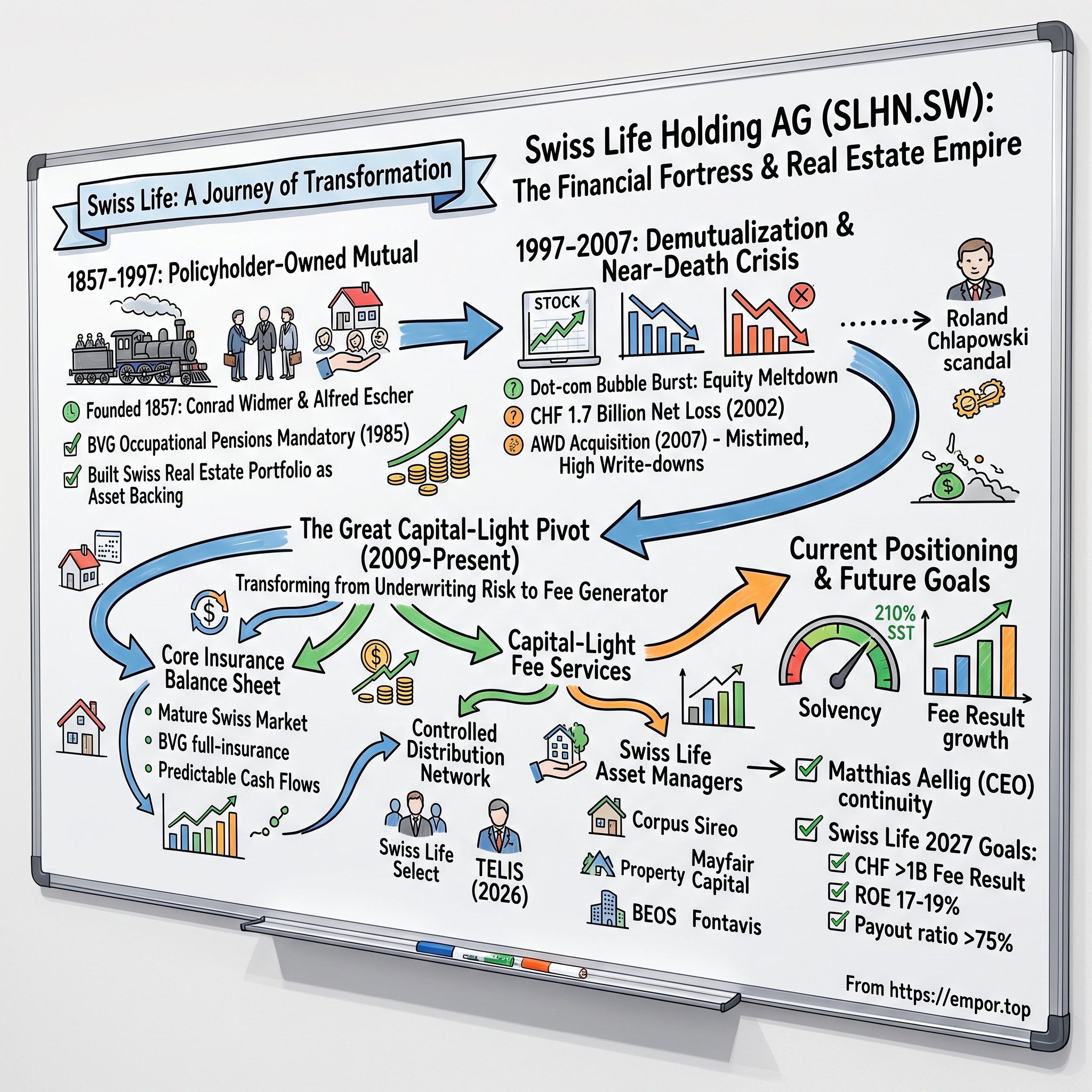
Swiss Life Holding AG: The Financial Fortress & Real Estate Empire
I. Introduction & Episode Roadmap
Walk down Zurich's Bahnhofstrasse on a grey January morning and a pedestrian will pass, without noticing, an unusual ownership structure in European finance. The luxury watch boutiques, discreet private-bank entrances, and apartment blocks a few streets back with scrubbed limestone facades share a common landlord. It is neither a sovereign wealth fund nor a property tycoon, but a life insurance company founded in 1857 to sell annuities to Swiss families. Over 140 years, it quietly converted policyholders' retirement savings into bricks and land, building what is today the largest private real estate portfolio in Switzerland: roughly 37,400 apartments and about 2.1 million square metres of commercial space.1
That company is Swiss Life Holding AG, listed as SLHN on the SIX Swiss Exchange. The primary reason it commands investor attention is not merely its real estate holdings, but what Swiss Life built upon that property portfolio—and how close the firm came to collapse before realizing that potential.
In mid-2026, Swiss Life trades around CHF 951 per share, giving it a market capitalisation of roughly CHF 27 billion—near the top of a 52-week range of CHF 793 to CHF 960.[^2] For the 2025 financial year, it reported a net profit of CHF 1.256 billion, flat compared to the prior year, alongside an operating profit of CHF 1.827 billion (up 3% in local currency) and a return on equity of 17.2%.2 Its Swiss Solvency Test ratio—the regulator's measure of capital backing outstanding obligations—was estimated at approximately 210% at year-end 2025, comfortably above management's strategic target band of 140% to 190%.2
Swiss Life Asset Managers oversaw CHF 288.3 billion in total assets, with CHF 145.7 billion managed for third-party institutional clients rather than Swiss Life's own balance sheet.3
While those headline figures reflect balance-sheet strength, a different metric frames the core investment question. In 2025, Swiss Life's fee result—the profit earned from advising clients, distributing financial products, and managing third-party assets rather than underwriting insurance risk—came in at CHF 858 million, down 1% in local currency.2 That slight contraction followed a 33% surge to CHF 875 million the prior year.4 At its December 2024 Investor Day, management had committed to lifting the annual fee result above CHF 1 billion by 2027.5
This highlights the central tension in modern Swiss Life: the strategic core rests on transforming the company into a capital-light fee generator anchored by a resilient insurance balance sheet. Yet in the first full year under the program designed to deliver that outcome, the fee result contracted slightly.
Evaluating whether this setback represents a temporary stumble or a structural signal requires examining Swiss Life's history. The company previously survived a near-death crisis, and its recovery explains both its operational strengths and its specific vulnerabilities.
The narrative features a distinct dual character. Over two decades, Swiss Life successfully recapitalised under duress without forfeiting its core franchise, insulated its balance sheet from investment risk, and converted an internal asset-management cost center into a European fee platform. Conversely, it destroyed significant shareholder value through a poorly timed acquisition, spent a decade recovering from the fallout, and is now navigating the second year of a strategic plan whose signature growth metric has paused.
Why this story matters to long-term investors. Two core mechanisms warrant close examination. The first is the capital-light pivot: moving away from guaranteed-return life products—where the insurer bears investment risk and holds substantial regulatory capital—toward fee-based advice and asset management, where capital requirements are minimal and earnings are recurring. While many European insurers pursue this strategy, few have executed it at scale. The second is the density advantage: the thesis that managing a massive Swiss real estate portfolio over a century generated operational capabilities that can be commercialized for institutional clients across Europe. This represents a distinct competitive claim, though it faced headwinds in 2025.
A note on how to read a life insurer. To navigate life insurance accounting, one key distinction is essential before proceeding further. An insurer generates earnings through two primary channels. The first is underwriting and spread: collecting premiums, promising future payouts, investing the float, and retaining the margin after paying claims. This model is capital-intensive, requiring regulatory reserves, and earnings fluctuate with interest rates, market swings, and mortality trends.
The second is fees: providing financial advice or managing external assets in exchange for service fees. This business requires minimal capital, and revenues track assets under management and transaction activity rather than direct market spreads. Since 2009, Swiss Life's strategy has focused on expanding fee earnings without forfeiting the scale of its traditional insurance base. Understanding this distinction keeps the company's strategic evolution clear.
The roadmap. The analysis begins with a founding myth and 140 years as a policyholder-owned mutual, Rentenanstalt. It then examines the 1997 demutualisation and the 2002 crisis that nearly brought down the firm, including an executive self-dealing scandal that led to the CEO's departure immediately prior to an emergency capital raise. It investigates the AWD acquisition—a poorly timed European deal that nevertheless laid the groundwork for today's distribution channel.
The roadmap continues through the capital-light transition during the era of negative interest rates and the acquisitions that built Swiss Life Asset Managers. It then evaluates segment earnings, the leadership transition from Patrick Frost to Matthias Aellig, competitive moats, a stress test derived from recent analyst inquiries, and the key tracking metrics that determine whether the strategic thesis remains intact.
The story begins with a railway.
 Subscribe on LinkedIn
II. Founding Context & The Alfred Escher Era (1857–1997)
Zurich in the 1850s was short of domestic investment capital. Switzerland had been a federal state for less than a decade and possessed limited financial infrastructure to fund large-scale industrial projects. Railways—the defining infrastructure investment of the nineteenth century—were expanding across France and the German states while Swiss valleys lagged behind. The foreign capital available to Swiss project builders was expensive and carried restrictive conditions.
Addressing this shortage required institutional innovation. A leading figure in this effort was Alfred Escher: politician, railway promoter, founder of the Eidgenössische Polytechnikum (now ETH Zurich), and founder in 1856 of Schweizerische Kreditanstalt, the bank that eventually became Credit Suisse. Escher recognized that Switzerland did not lack aggregate savings, but rather institutions capable of pooling small, long-dated household deposits into large, long-term capital. While banks intermediated short-term credit, financing thirty-year infrastructure required dedicated long-term vehicles.
Popular accounts often credit Escher with founding the insurer itself. In reality, Swiss Life was founded in 1857 by Conrad Widmer, a former schoolmate of Escher, under the name Schweizerische Rentenanstalt (Swiss Annuity Institution). Escher's newly created Kreditanstalt served as the credit sponsor, guaranteeing the venture with its entire equity capital.1 This distinction was significant: Kreditanstalt provided financial backing rather than direct corporate ownership.
Rentenanstalt was established as a policyholder-owned cooperative with no outside shareholders. For an institution asking Swiss families to commit savings over several decades, a mutual structure aligned customer incentives directly with asset security by eliminating intermediary equity owners.
In 1857, commercial life insurance functioned as much as a social mechanism as a financial product. Prior to its emergence, families losing a primary earner relied on private savings, guilds, church charity, or relatives. Actuarial science—calculating mortality probabilities to price long-term guarantees—was still maturing, requiring both mathematical precision and institutional credibility. The guarantee from Escher's bank provided the initial trust required to sell promises spanning several decades.
Rentenanstalt was Switzerland's first life insurer.1 Within a decade, the firm expanded into Prussia, Bremen, and Hamburg, establishing an international footprint that eventually extended to France, Germany, and Luxembourg—regions that would play complex roles in its modern operations.
The insurer's domestic positioning shifted significantly in the twentieth century through legislative mandates. Switzerland built a three-pillar retirement system encompassing state pensions, occupational pensions, and private savings. In 1985, the second pillar—occupational pensions, governed by the BVG (LPP in French)—became compulsory for employees. For small and medium-sized enterprises (SMEs) lacking the scale to manage independent pension funds, life insurers offered full insurance solutions, assuming all investment, longevity, and capital guarantee risks in exchange for predictable minimum return obligations.
As the largest market participant, Rentenanstalt absorbed a substantial share of this mandatory demand. Converting occupational pensions into a legal requirement embedded the insurer deeply into the Swiss corporate landscape. For Swiss SMEs, switching pension providers involved complex legal restructuring, actuarial revaluations, and regulatory filings. This created high switching costs that continue to support Swiss Life's core domestic retention today.
The economics of the Swiss second pillar are governed by statutory mandates. Mandatory occupational pension savings are subject to two politically determined metrics: the minimum interest rate credited to active accounts (Mindestzinssatz) and the minimum conversion rate applied to accumulate retirement annuities (Umwandlungssatz). Because parliament and public referendums periodically adjust these parameters, full-insurance providers write guarantees against political and legislative risk, constraining underwriting margins and tying business performance to Swiss legislative policy.
To back these long-dated pension liabilities, Rentenanstalt accumulated prime real estate. While Swiss government bonds offered long maturities without inflation protection and equities carried market volatility, Swiss residential and commercial property provided stable, long-term real yields. Purchased across Zurich, Geneva, Basel, and Lausanne throughout the twentieth century and held over decades, this property portfolio created a competitive advantage anchored in a historical cost basis that subsequent market entrants could not replicate at modern valuation levels.
The mutual structure also shaped Rentenanstalt's operating culture over its first 140 years. Without public shares, quarterly reporting pressures, or public market valuation models, the organization prioritized long-term solvency, actuarial conservatism, and property management over aggressive commercial expansion. This heritage fostered operational durability alongside a conservative corporate culture—traits that later created friction when the company transitioned into a publicly listed entity pursuing growth and corporate acquisitions.
This cultural and structural framework served as the foundation for its eventual transformation. A mutual insurer holding illiquid property against long-term liabilities operated as a stable institution—until demutualisation introduced public equity investors, growth targets, and capital market scrutiny.
III. Demutualization, Equity Meltdown, & The 2002 Emergency (1997–2007)
In 1997, after 140 years as a policyholder-owned cooperative, Rentenanstalt demutualised and listed on the Swiss stock exchange.1 The transition reflected broader trends in European financial services, where industry consolidation and single-market deregulation encouraged cross-border expansion supported by public equity. Over the next five years, the firm acquired operations across Europe—including France, Germany, the Netherlands, Belgium, the United Kingdom, and Spain, alongside the private bank Banca del Gottardo—transforming the Swiss annuity provider into an international financial conglomerate.
This structural shift altered the firm's strategic incentives. While a mutual cooperative prioritises long-term solvency to safeguard policyholder obligations, a publicly listed company focuses on delivering competitive returns on equity to shareholders. In a bull market, life insurers can boost returns by reducing surplus capital reserves and increasing exposure to higher-yielding equities. During market downturns, however, this approach exposes the balance sheet to severe downside risk.
The vulnerability stemmed from traditional life insurance economics. When an insurer issues savings products with fixed return guarantees—such as the 4% annual yields common in the 1990s—it creates long-term fixed liabilities. If the underlying assets generate returns above the guaranteed threshold, the insurer retains the spread. If returns fall short, the shortfall must be absorbed by shareholder equity. Allocating a significant share of assets to equities creates substantial financial leverage. By December 2000, public equities represented 21.9% of Swiss Life's total investments.6
When the dot-com bubble burst, the impact was immediate. Swiss Life's equity portfolio lost nearly one-third of its value, triggering a CHF 781 million write-down. The firm swung from a net profit of CHF 924 million in 2000 to a record net loss of CHF 1.7 billion in 2002, while total equity capital dropped by CHF 1.1 billion to CHF 3.9 billion.6 For an institution whose core business depended on long-term policyholder trust, this capital erosion threatened its commercial standing.
The financial strain was exacerbated by a governance scandal. In late 2002, disclosures revealed that senior executives, including Chief Executive Officer Roland Chlapowski, had used low-interest company loans to invest in an internal vehicle, Swiss Life Hedge Fund Partners. The arrangement generated approximately CHF 12 million in gains on an initial investment of CHF 3.8 million.6 Following an investigation, the Federal Office of Private Insurance ordered the recovery of about CHF 9.9 million.6 The board dismissed Chlapowski shortly before the company approached capital markets for emergency funding.
In November 2002, the board appointed Rolf Dörig, a senior Credit Suisse executive, as chief executive officer.6 To restore balance-sheet stability, Dörig initiated a comprehensive recapitalisation program. Over the following eighteen months, Swiss Life executed three capital raises at substantial discounts: a CHF 1.1 billion rights issue in December 2002 priced at a 52% discount, a CHF 341 million mandatory convertible bond issue in December 2003, and a combined equity and debt offering of CHF 1.15 billion in May 2004.6 While dilutive to existing shareholders, the capital injections secured regulatory compliance and stabilized the group's financial foundation.
Concurrently, management systematically de-risked the investment portfolio. Equity exposure was reduced from 21.9% of total investments at year-end 2000 to 2.1% by the end of 2003.6 Swiss Life also divested non-core assets, selling its Spanish operations, its stake in Crédit Agricole Belgium, the asset manager STG, and several private equity holdings, though an attempted sale of Banca del Gottardo to UniCredito was unsuccessful.6 Rebranded as Swiss Life Holding AG, the group refocused its portfolio on high-quality fixed income, Swiss property, and strict asset-liability duration matching.
A third critical element involved statutory adjustments. Dörig engaged with Swiss lawmakers to lower the mandated minimum interest rate on occupational pension assets (Mindestzinssatz) from 4.0% to 3.25% in 2003, and further to 2.25% in 2004, aligning guarantees with declining market yields. In return, regulations introduced a legal quota requiring at least 90% of gross operating returns from group life business to be distributed to policyholders.6 This regulatory framework established thin, regulated underwriting margins for Swiss group life, shifting future profit growth toward operational scale, administrative efficiency, and fee-generating services.
With its balance sheet stabilized, management turned toward selective growth, expanding in markets undergoing pension reforms. This strategy yielded early results, including a 30% increase in new business in Germany and 68% premium growth in the Netherlands.6
By 2003, Swiss Life returned to profitability, reporting net income of CHF 233 million.6 The crisis reshaped the firm's strategic philosophy: rather than operating as a leveraged risk-taker reliant on investment spreads, a sustainable life insurer needed to emphasize capital-light fee services and asset management. Implementing that model, however, would require two decades and a subsequent expansion strategy.
IV. The AWD Acquisition: M&A Benchmarking & The Road to Redemption (2007–2013)
By 2007, Swiss Life had repaired its balance sheet, de-risked its investment portfolio, and narrowed its international footprint, but it faced a fundamental growth bottleneck. Its domestic Swiss core was mature and heavily regulated, while its European units relied on independent brokers and bank networks that marketed competing products alongside Swiss Life's own. Distribution was the primary constraint, and external parties controlled it.
Management's response, announced on 3 December 2007, was to acquire distribution directly.7 The target, AWD Holding AG, was a Hanover-based financial advisory network founded by Carsten Maschmeyer. It operated thousands of self-employed advisors who sold insurance, mutual funds, and closed-end investment products to retail customers across Germany, Austria, and Switzerland. Swiss Life agreed to a purchase price of approximately 1.2 billion euros, securing an 86.2% controlling stake by 13 March 2008.8
The strategic appeal of AWD rested on its structure. It was not a traditional brokerage, but a franchise-like network of independent advisors who cultivated personal client books across German towns and earned commissions on product sales. Maschmeyer had built AWD into one of Germany's most recognizable retail financial brands, driven by an energetic sales force that, as later events revealed, exercised inconsistent product oversight.
For a product provider like Swiss Life, whose German life insurance products struggled for shelf space in a crowded brokerage market, acquiring the distribution channel appeared highly logical. Selling products through an owned advisory network allowed the insurer to capture both the manufacturing underwriting margin and the distribution commission that previously flowed to third parties.
However, the timing proved treacherous. Swiss Life agreed to acquire a consumer-facing, commission-driven distributor in December 2007—at peak-cycle valuations reflecting years of strong retail markets—and closed the transaction in March 2008. Within months, the Global Financial Crisis struck, causing retail demand for structured products and closed-end funds, a core component of AWD's sales volume, to collapse. Soon after, legacy liabilities emerged from products AWD advisors had sold before Swiss Life took ownership.
The fallout persisted for years. In August 2013, Swiss Life Select—the renamed AWD network—paid 11 million euros to settle a 40 million euro claim with Austrian consumer association VKI regarding allegations of misleading advice by advisors. Swiss Life noted that claims of systematic mis-selling were not substantiated, though parallel disputes remained pending in Germany.9 Regardless of the legal resolution, the commercial impact was clear: Swiss Life had acquired a brand built on consumer trust, only to inherit a legacy of customer dissatisfaction created prior to the acquisition.
The financial reckoning arrived in 2012. Swiss Life recorded a CHF 578 million write-down on AWD's goodwill, brand, and customer relationship assets. Coupled with restructuring costs and litigation provisions, the AWD segment reduced group results by CHF 591 million, driving group net profit down to CHF 93 million from CHF 606 million in 2011.10 Five years after signing the deal, Swiss Life had erased approximately half the original purchase price in a single impairment.
This impairment highlights a structural risk inherent in distribution acquisitions. Accounting rules require buyers to allocate purchase prices across goodwill, brand value, and customer relationship assets—which represent estimated future revenue from advisor-managed client books. Because all three line items depend on sustained customer activity, they tend to impair simultaneously during downturns. A market drop that depresses product sales also damages brand value and increases client churn, revealing an asset category with highly correlated risk factors.
Evaluated on price and timing, Swiss Life overpaid for AWD. The company paid peak-cycle valuation multiples for a cyclical, commission-dependent distributor at the top of a credit cycle, without securing adequate price concessions for legacy mis-selling risks embedded in the acquired client books. It remains the clearest example in Swiss Life's modern history of management attempting to buy growth rather than build it organically.
Yet the long-term operational outcome presents a more complex picture.
Rather than divesting the troubled unit, Swiss Life undertook an extensive operational overhaul. In 2012, management retired the AWD brand and renamed the network Swiss Life Select, integrating it into a multi-brand advisory architecture alongside tecis, HORBACH, Proventus, and UK-based Chase de Vere.10 By maintaining separate brand identities tailored to specific customer segments, Swiss Life allowed advisors to retain local commercial positioning while routing transactions through a unified product and fee management platform. Crucially, advisors maintained open-architecture status, offering third-party financial products alongside Swiss Life's portfolio while generating steady fee income for the group.
This restructuring turned what appeared to be an M&A failure into an operational foundation. Proprietary financial advisory channels became a key pillar of Swiss Life's broader transition toward fee-based revenue, a distribution asset the company has continued to expand.
On 21 May 2026, Swiss Life Germany announced the acquisition of TELIS Group, a Regensburg-based advisory firm employing approximately 1,800 certified advisors that generated over 200 million euros in 2025 revenue, and completed the transaction on 1 July 2026.1112 The deal expanded Swiss Life's German network to roughly 8,000 certified advisors and pushed pro-forma 2025 annual German fee income above 1 billion euros.12 Although the purchase price was not disclosed,12 Swiss Life maintained TELIS's brand identity and open-architecture distribution model, applying the same multi-brand framework developed over the previous decade.
The turnaround demonstrated a distinct operational capability in managing independent advisory networks. Self-employed advisors are not direct employees; retaining top producers requires competitive product access, efficient technology platforms, ongoing compliance support, and attractive commission structures. Mishandling an advisory network risks alienating high performers who can migrate to competitors with their client portfolios. By stabilizing and expanding a network that faced severe reputational strain in 2012, Swiss Life built an operational capability that went unreflected in both the initial acquisition price and the subsequent impairment charges.
For investors, the strategic lesson presents two sides. Controlling distribution offers clear benefits: it converts variable broker commissions into captive earnings, captures both product and advisory margins, and protects the insurer against losing market access. However, human-capital distribution assets are costly to acquire and slow to repair. Swiss Life's acquisition of TELIS in 2026 underscores management's commitment to this strategy. Whether the firm maintained valuation discipline this time remains unknown to public markets, as the undisclosed transaction price leaves investors unable to evaluate the purchase multiple ahead of future reporting cycles.
V. The Great Capital-Light Pivot & Building Asset Managers (2009–2024)
A major turning point for the traditional European life insurance model occurred on 15 January 2015, when the Swiss National Bank cut its policy rate to –0.75%.13 For Swiss Life, negative interest rates presented a fundamental structural challenge to its traditional business model.
The spread mechanism that created pressure during the 2002 downturn operated in reverse under negative interest rates. An insurer holding a book of long-dated return guarantees must reinvest maturing bonds at yields above its guaranteed payout obligations. When ten-year Swiss government bonds yield less than zero, reinvesting maturing assets depresses overall portfolio yields toward—and eventually below—the guaranteed rate. Under such conditions, an insurer does not face immediate insolvency, but experiences a prolonged erosion of investment margins. The SNB did not exit negative interest rates until September 2022, and subsequently lowered its policy rate back to zero in June 2025.1314 This low- and negative-yield environment defined the macroeconomic backdrop for Swiss Life throughout the decade.
While all European life insurers confronted this yield environment, their strategic responses diverged.
Bruno Pfister, chief executive from 2008 to 2014, initiated structural de-risking by cutting costs and shifting new business from traditional return guarantees to unit-linked products, where policyholders bear the investment risk. Patrick Frost, who succeeded Pfister as chief executive in 2014, institutionalized this approach through successive three-year strategic programs—"Swiss Life 2015," "2018," "2021," and "2024"—each tied to explicit, published financial targets. By publishing three-year fee result targets, management established a formal framework for annual accountability.
Execution across these strategy cycles proved consistent. When announcing its 2024 results, management reported achieving its fee result target of CHF 875 million alongside an adjusted operating profit of CHF 1.78 billion (a 20% increase) and a return on equity of 16.6%, up from 13.7% in the prior year. Over the three-year program, the group remitted cumulative cash of CHF 3.5 billion to the holding company.4 While management disclosures warrant objective scrutiny, the underlying financial metrics demonstrate a sustained record of target delivery.
Turning a cost centre into a business. The central strategic initiative of modern Swiss Life involved commercializing its internal asset management capabilities. Having spent 150 years acquiring, developing, leasing, and managing property for its own balance sheet, the company operated a substantial internal real estate infrastructure. Management recognized that these same teams, property management capabilities, and deal-sourcing networks could manage capital for external institutional clients—such as Swiss and European pension funds seeking long-dated, inflation-linked assets—in exchange for recurring management fees.
The economics of this transition reflect a shift in capital intensity. When Swiss Life acquires real estate for its own balance sheet, it collects rental income but must hold regulatory capital against property risk. Conversely, when managing real estate for third-party institutional investors, the firm earns recurring asset-based fees while requiring minimal regulatory capital. For an insurer whose equity valuation had historically been constrained by capital-intensive underwriting risks, expanding capital-light fee streams represented a high-return strategic pivot.
Co-investing internal balance-sheet capital alongside third-party institutional client funds created an operational advantage over independent asset managers. Swiss Life could use its balance sheet as seed capital to acquire initial assets and establish track records for new strategies—such as specialized European logistics funds—before syndicating those funds to external clients hesitant to commit to blind pools. This seed-capital capability provided execution certainty in slower market environments, enabling insurer-backed real estate platforms to gain market share from independent fund managers.
Expanding this platform outside Switzerland required acquiring targeted capabilities across European markets:
- Corpus Sireo (2014, EUR 210 million). Acquired from three German savings banks for 210 million euros, the Cologne-based firm was Germany's leading independent real estate asset manager, managing roughly 16 billion euros in real estate assets with 550 employees and approximately 160 million euros in annual revenues. Patrick Frost described the acquisition as extending Swiss Life's real estate asset management footprint "from Switzerland and France to Germany."15
- Mayfair Capital (2016). A London-based property fund manager overseeing approximately 1 billion pounds for charities, pension funds, and high-net-worth individuals, providing entry into the UK institutional market. The acquisition price was undisclosed. At the time, Swiss Life's total real estate assets stood at roughly 55 billion pounds.16 The firm was later rebranded Swiss Life Asset Managers UK.16
- BEOS (2018). Germany's leading corporate real estate investment manager, specializing in light-industrial, logistics, and mixed-use corporate properties (Unternehmensimmobilien). Announced on 25 June 2018 and completed effective 30 August 2018, BEOS managed 2.6 billion euros in real estate assets at year-end 2017 and generated roughly 30 million euros in annual revenues.17
- Fontavis (2019). A Swiss clean-energy infrastructure manager overseeing approximately 1 billion Swiss francs across three funds focused on hydropower, wind, solar, power grids, and recycling. Fontavis was merged into Swiss Life's infrastructure platform in December 2021.18
Examining this acquisition sequence reveals a disciplined, bolt-on strategy rather than large-scale corporate mergers. The largest transaction was 210 million euros, compared with Swiss Life's market capitalization of roughly CHF 27 billion in 2026. Each purchase added specific asset-class expertise or geographical distribution to an institutional platform capable of deploying fresh third-party capital during a period of strong demand for real assets.
Equally notable were the strategic paths Swiss Life chose not to pursue. Management avoided large-scale consolidations with European insurance peers, deferred expansion into the United States, declined to build high-volume equities or fixed-income asset management businesses vulnerable to passive fee compression, and avoided exclusive bancassurance agreements that would reinstate third-party distribution dependencies. This focus on small, adjacent acquisitions within real assets reflected a deliberate emphasis on capital discipline, contrasting with the firm's earlier acquisition approach in 2007.
The cumulative impact on client assets was substantial. Third-party assets under management reached CHF 125 billion at the end of 2024, supported by CHF 9.5 billion in net new assets that year.4 By year-end 2025, third-party assets under management expanded 17% to CHF 145.7 billion, driven by CHF 17.7 billion in net new assets—an 88% increase in annual net capital inflows.2 Total assets managed by Swiss Life Asset Managers, including internal balance-sheet assets, reached CHF 288.3 billion,3 with total real estate under management and administration standing at CHF 114.0 billion.1
The expansion in net new assets demonstrated strong institutional demand for Swiss Life's real estate and infrastructure strategies, even during a period of broader real estate market revaluation in Europe. However, asset growth did not translate directly into segment profitability. In 2025, Swiss Life Asset Managers' third-party segment result declined 10% to CHF 229 million despite the 17% growth in client assets,2 pointing to margin compression and underlying cost pressures. Section IX examines this divergence in unit economics.
VI. Segment Breakdown & Financial Architecture
Understanding where Swiss Life generates its resources requires tracing the capital that arrives at the holding company. In 2025, total cash remittances to the holding company reached CHF 1.220 billion.2 That capital funds dividends and share buybacks, making cash remittance the primary measure of distributable value for equity investors.
Five operating units generate these cash flows, each functioning under distinct financial dynamics.
Switzerland — the engine room. The domestic business generated premiums of CHF 10.214 billion (up 3%), an operating segment result of CHF 891 million (up 4%), and cash remittances of CHF 651 million—accounting for more than half the group total.2 This unit encompasses the core occupational pension franchise, individual life insurance, and the domestic branch of Swiss Life Select. While it remains the company's primary source of profit and cash, its contribution to the fee strategy is modest: Switzerland delivered only CHF 55 million of the group's total fee result.2
The mechanics of the Swiss group life market explain this dynamic. Under the statutory full-insurance regime, regulations cap profit margins through a 90% legal quota requiring investment gains to be distributed to policyholders, while the insurer absorbs tail risks. Although this structure constrains underwriting margins, it creates strong customer retention. Small and medium-sized enterprises seeking to avoid managing investment and longevity risks internally remain tied to full-insurance contracts, providing Swiss Life with highly predictable earnings and stable cash flows.
France — the high-margin growth engine. In 2025, the French segment generated premiums of EUR 8.094 billion (up 4%), a segment result of EUR 361 million (up 8%), a fee result of EUR 195 million (up 7%), and remitted EUR 191 million to the holding company.2 Swiss Life France focuses on high-net-worth clients and health insurance distributed through private agent networks, with new production weighted heavily toward unit-linked policies that transfer investment risk to policyholders. This performance followed a strong 2024, when the segment result grew 64% to EUR 335 million.4 Consecutive years of growth in a market where foreign insurers often encounter structural hurdles indicate that its wealth-management positioning delivers consistent results.
Germany — the fee laboratory. The German unit reported premiums of EUR 1.541 billion (up 2%), a segment result of EUR 205 million (up 6%), and a fee result of EUR 127 million (up 6%).2 While Germany generates roughly one-tenth of Swiss Life's total premiums, it contributes approximately one-seventh of the group's fee result. This fee density stems from the advisory networks established through AWD—and expanded in 2026 via TELIS—alongside an established position in occupational disability insurance (Berufsunfähigkeit), where actuarial pricing and underwriting expertise drive product margins.
In Germany, where large domestic incumbents dominate traditional life insurance underwriting, Swiss Life's strategy emphasizes controlling customer distribution rather than expanding balance-sheet scale. By operating open-architecture advisory networks, the German business functions primarily as a distribution platform that collects advisory and distribution fees rather than relying solely on underwriting spreads. Consequently, Germany serves as the primary testing ground for the group's broader fee-expansion strategy.
International — cross-border wealth solutions. The International segment posted premiums of EUR 1.829 billion (up 6%), a segment result of EUR 130 million (up 10%), and a fee result of EUR 91 million.2 Operating out of Luxembourg, Liechtenstein, and Singapore, the division provides cross-border life insurance and wealth structuring for high-net-worth individuals. Although small relative to the domestic units, it achieved the group's highest segment growth rate in 2025 while maintaining an elevated fee-to-premium ratio. The business acts primarily as a cross-border estate planning platform, earning fee income with minimal exposure to interest-rate or market-spread risks.
Swiss Life Asset Managers — third-party growth versus fee pressure. The division generated total income of CHF 1.148 billion, remitted CHF 250 million in cash to the holding company (up 3%), and recorded a third-party asset management (TPAM) segment result of CHF 229 million (down 10%).2 The asset management operation functions through two distinct activities: managing proprietary balance-sheet assets for the group's insurance units, and managing external institutional capital. Expanding external mandates represents the primary driver of the group's capital-light valuation strategy.
Fee growth versus margin compression. The divergence between revenue growth and profitability highlights the key operational challenge facing the firm. Group fee income reached CHF 2.588 billion in 2025, up 5% in local currency, driven by 5% growth from owned advisor networks, 5% from proprietary and third-party products, and 2% from Asset Managers.2 However, the overall group fee result contracted 1% to CHF 858 million.2
This margin squeeze resulted from higher operating costs within asset management and a shift in revenue composition. The proportion of third-party asset management income derived from non-recurring sources—such as real estate transaction, performance, and development fees—dropped from 32% to 27%.19 Because non-recurring fees depend on commercial real estate transaction activity, slowing European property markets reduced high-margin transactional revenue.
While recurring asset management fees provided downside protection—supported by CHF 148 billion in third-party assets under management by the first quarter of 202611—the 2025 results demonstrated that variable transaction fees remain a significant swing factor in total fee profitability.
Investment yield and underlying profit reserves. On its investment portfolio, Swiss Life generated CHF 4.13 billion in direct investment income at a 2.9% direct yield, alongside CHF 3.79 billion in net investment income at a 2.7% net yield.2 Beyond reported annual earnings, the balance sheet was supported by growth in its contractual service margin (CSM)—the accounting measure under IFRS 17 representing unearned future profits embedded in existing insurance policies—which expanded by CHF 900 million to reach CHF 15.3 billion.2
Under IFRS 17 accounting rules implemented in 2023, insurers defer expected profits from long-term contracts into the CSM liability reserve, releasing them into operating income over the life of the policies. The CHF 900 million expansion in 2025 indicates that new insurance underwriting added more long-term value than was released into current-year earnings. While reported annual net profit remained flat, the growing CSM reserve builds future earnings capacity, though its ultimate realization remains subject to actuarial assumptions regarding policy longevity, lapse rates, and discount rates.
Holding company capital flow mechanics. A critical structural consideration governs Swiss Life's capital distribution: Swiss Life Holding AG functions as a legal entity owning regulated operating subsidiaries across Switzerland, France, Germany, and Luxembourg. Each subsidiary must maintain local statutory solvency capital and secure supervisory approval before transferring cash upstream to the parent company. Consequently, local regulatory capital requirements make cash remittances—rather than consolidated net profit—the primary determinant of distributable capital for shareholder dividends and buybacks.
VII. Leadership, Governance, & "Swiss Life 2027"
On 16 May 2024, Patrick Frost stepped down as chief executive after a decade leading the firm.20 The transition was notable for its operational continuity: it involved no external search, strategic pivot, restructuring charge, or fresh management mandate. Instead, Matthias Aellig—who served as Group Chief Risk Officer from 2010 and Group Chief Financial Officer from 2019—assumed the chief executive role, having spent fourteen years evaluating the insurer's risks and reporting its financial figures before taking operational command.20 Marco Gerussi, another internal executive, succeeded Aellig as CFO.
This succession signals that the board viewed the strategic framework as established, prioritizing execution and capital discipline over structural reform. Selecting a risk manager turned finance head represents a low-variance choice focused on operational stability. However, it also alters governance dynamics: an executive who designed the capital architecture as CFO is unlikely to question its underlying assumptions as chief executive.
Board governance and chairman succession. Rolf Dörig—who stepped in as chief executive during the November 2002 crisis—continues as chairman, a post he has held since 2009. Re-elected at the annual general meeting on 7 May 2026, Dörig is serving a final term through the 2027 AGM, when he will retire after 25 years at the firm, including seven years as chief executive and eighteen as chairman.2122 A quarter-century tenure by a former chief executive turned board chair presents a distinct governance structure that contrasts with standard international corporate governance practices, making board succession an active consideration for institutional investors.
At the 2026 AGM, shareholders approved a gross dividend of CHF 36.50 per share for the 2025 financial year, paid on 13 May 2026, and elected former chief executive Patrick Frost to the board alongside Luisa Deplazes Delgado, as Henry Peter and Adrienne Corboud Fumagalli retired from their positions.21 The meeting drew approximately 1,280 shareholders representing 41.50% of voting rights.21 Appointing a former chief executive to the board after a two-year hiatus aligns with Swiss corporate tradition and preserves institutional knowledge, though it also creates a structure where the architects of the strategic plan oversee its execution.
Alignment of executive compensation. Evaluating executive incentives against public commitments requires examining Swiss Life's disclosed pay disclosures. On-target variable compensation for Corporate Executive Board members ranges from 80% to 100% of base salary, capped at 150% for executive board members and 165% for the Group CEO, divided equally between short-term and long-term incentive plans.25
Long-term equity awards are assessed over a three-year cumulative period using three performance metrics: IFRS net profit weighted at 50%, the combined risk and fee result at 25%, and cash remittances to Swiss Life Holding at 25%.25 Additional medium-term planning metrics track distribution capacity, cost reduction targets, underwriting and fee results, new business profitability, return on equity, and the Swiss Solvency Test ratio.25
This structure demonstrates alignment with the group's declared strategy. Two of the long-term criteria—the fee result and cash remittances—directly target capital-light growth and holding-company liquidity. Allocating 25% of long-term equity incentives to cash arriving at the holding company enforces discipline rarely seen among European insurers, which typically emphasize accounting earnings.
However, two structural caveats remain. Accounting profit retains a 50% weighting, yet life insurance IFRS earnings are strongly affected by market movements and actuarial assumptions. Furthermore, combining the risk result and fee result into a single 25% performance metric allows strong underwriting margins to mask a contraction in fee income—a relevant consideration given the slight fee result decline in 2025.
The "Swiss Life 2027" strategic program. On 3 December 2024, Aellig unveiled the group's latest three-year strategic targets, raising performance expectations across key operating metrics.5 Management increased its annual fee result target from a previous range of CHF 850 million to CHF 900 million up to more than CHF 1 billion by 2027. It raised the return on equity target range from 10–12% to 17–19%, and elevated cumulative cash remittance expectations for the 2025–2027 period to between CHF 3.6 billion and CHF 3.8 billion, up from CHF 2.8 billion to CHF 3.0 billion under the prior plan. Additionally, management raised its dividend payout ratio target from 60% to over 75% beginning in 2025, while launching a CHF 750 million share buyback running from December 2024 to May 2026, smaller than the CHF 1 billion program that preceded it.5
Two of these target revisions warrant detailed analysis.
The increase in the return on equity target to 17–19% reflects accounting mechanics rather than a doubling of underlying profitability. Following the adoption of IFRS 17, changes in insurance revenue recognition and equity measurement shifted baseline profitability ratios across the industry. For 2025, Swiss Life reported a return on equity of 17.2%, achieving the new target band in its first year.2
The elevated payout ratio provides a clearer test of capital intensity. For 2025, Swiss Life distributed 82% of net profit as dividends, surpassing its target threshold of more than 75%.2 Maintaining dividend payouts above four-fifths of earnings alongside share repurchases and advisory network acquisitions depends entirely on low capital requirements across core operations. While this capital return policy signals management's confidence in the capital-light model, high distribution ratios reduce internal capital retention during potential market downturns.
Evaluating management execution and disclosure culture. Assessing leadership performance requires tracking execution against historical commitments. Across four consecutive strategic programs, management published explicit targets and reported against them annually, concluding the 2024 plan by meeting its fee result objective and exceeding other financial targets.4 Guidance across financial reports has remained consistent; in its first-quarter 2026 update, management reaffirmed its share buyback timeline and capital solvency position without adjusting definitions or timelines.11
This transparency extends to how management handled the 2025 fee result contraction. Rather than introducing adjusted earnings definitions or reclassifying fee streams to mask the 1% decline, the firm reported the figure under established metrics and addressed cost and product-mix drivers directly during analyst briefings. Maintaining consistent reporting standards during periods of underperformance reflects a disciplined disclosure policy.
However, execution challenges remain. The flagship fee result target contracted in the first year of the "Swiss Life 2027" program, while management reiterated its medium-term targets without adjustment. Reaffirming targets during a temporary slowdown sets up a clear operational test: whether subsequent reporting periods demonstrate fee results reconnecting with asset management growth. Evaluating this trajectory requires examining the structural sources of Swiss Life's competitive moat—and whether those advantages defend profit margins or merely top-line revenues.
VIII. Moats & Strategic Frameworks (7 Powers & 5 Forces)
Stripping the strategic narrative down to competitive dynamics raises a fundamental question: if a well-capitalized competitor—whether a traditional European peer like Allianz, AXA, or Zurich, or a private-markets firm like Blackstone or Brookfield—sought to capture Swiss Life's market share, what structural barriers would prevent it?
Scale economies in real estate asset management. Swiss Life's real estate platform manages and administers CHF 114.0 billion of property across Switzerland, Germany, France, and the UK.1 In real assets, scale is less about driving down per-square-metre operating costs than about securing off-market deal flow. At this volume, property vendors and brokers approach managers capable of executing large transactions rapidly with execution certainty.
Scale also provides product breadth: institutional clients can allocate capital across Swiss residential properties, German logistics facilities, French office buildings, and renewable infrastructure through a single relationship. However, asset scale does not guarantee fee pricing power. Institutional asset management fees remain under persistent competitive pressure, explaining why a 17% expansion in third-party assets in 2025 coincided with a 10% decline in third-party asset management segment profit.
Cornered resource in distribution. A distribution network of roughly 17,000 advisors group-wide5—including around 8,000 in Germany following the TELIS acquisition12—represents an asset competitors cannot replicate quickly. Because these advisors operate as self-employed professionals with established client books, building a comparable network requires either recruiting advisors individually or acquiring established advisory firms. Such networks rarely come to market and carry high acquisition costs, as Swiss Life experienced during its 2007 acquisition of AWD. While this network constitutes Swiss Life's most durable commercial advantage, it also carries exposure to potential regulatory changes regarding distribution commissions and financial advice.
Switching costs in Swiss group life. Significant administrative, actuarial, and legal friction binds small and medium-sized enterprises to their occupational pension providers over long horizons. However, high switching costs work in both directions: while they shield Swiss Life's existing client portfolio from competitor poaching, they also create barriers to capturing market share from rival incumbents. In a mature market governed by strict statutory return quotas, this moat primarily functions to preserve the legacy franchise rather than drive new expansion.
Counter-positioning. Swiss Life gained an early advantage during the 2010s by expanding third-party real estate asset management while peer European insurers remained focused on restructuring legacy guaranteed-return portfolios. Transforming an internal investment division into a commercial fee generator required allowing external institutional clients to compete directly with the insurer's balance sheet for real estate acquisitions. Although this early pivot built market presence, counter-positioning advantages naturally erode over time. By 2026, major European insurers operate dedicated third-party asset management divisions, while global private-markets firms compete aggressively for the same institutional real estate mandates.
Limitations of the strategic position. Beyond scale, distribution, switching costs, and early positioning, Swiss Life lacks other traditional competitive moats. Outside Switzerland, the firm possesses limited consumer brand equity, as its German advisory networks deliberately operate under independent brand identities. The model exhibits no network effects, since adding an individual financial advisor does not increase the platform's intrinsic value to existing clients. Nor does it possess unique process advantages that generate structural cost superiority. Owning an uneven selection of competitive advantages provides solid market defense, but not complete insulation from industry pressures.
Industry forces and competitive intensity. Barriers to entry in Swiss group life insurance remain formidable: stringent Swiss Solvency Test capital requirements, FINMA regulatory oversight, and the substantial balance-sheet capacity needed to underwrite full-insurance guarantees make new market entry highly improbable.23 Buyer power varies significantly across segments: while corporate pension clients face high switching costs, institutional asset management clients possess considerable bargaining power, frequently running competitive tenders and negotiating fee structures on large mandates.
Industry rivalry is multi-tiered. While traditional European insurers such as Allianz, AXA, Zurich, Helvetia, and Baloise compete across core insurance markets, the primary competitive pressure on Swiss Life's growth strategy occurs in third-party asset management. There, the group competes not only against peer insurance asset managers, but also against specialized real estate managers like PATRIZIA and Union Investment, traditional asset managers such as Amundi, and major global private-markets platforms.
Myth versus reality. Four common market assumptions regarding Swiss Life require re-examination:
Myth: Alfred Escher founded Swiss Life to finance Swiss railway expansion. Reality: Conrad Widmer founded the company, while Escher's bank provided equity guarantees, establishing a business designed to sell life insurance and annuities to families rather than directly fund railway construction.1 Escher created the institutional framework for Swiss capital formation, of which the insurer was a key element. This historical distinction highlights that the firm's core operational DNA rests on actuarial conservatism rather than aggressive infrastructure development, explaining its risk-averse behavior during market downturns.
Myth: Swiss Life functions primarily as a real estate firm operating under an insurance umbrella. Reality: The Swiss insurance segment remains the largest single contributor to group operating earnings and holding-company cash flow, not third-party asset management.2 While real estate serves as the primary asset backing insurance liabilities and a key product managed for external clients, financial results indicate that Swiss Life remains an insurer expanding an asset management arm, rather than a real estate company with an insurance subsidiary. Evaluating the firm solely on real estate valuation multiples misconstrues the primary source of group cash flows.
Myth: The elevated return-on-equity target reflects a structural doubling of underlying corporate profitability. Reality: Raising the strategic return-on-equity target from 10–12% to 17–19% primarily reflects accounting adjustments under IFRS 17 and changes in equity measurement, rather than a doubling of operational earnings.5 Comparing new target ranges against historic accounting baselines distorts underlying performance trends.
Myth: The capital-light strategic transformation is complete. Reality: In 2025, the fee result represented approximately 47% of operating profit and experienced a slight contraction, while core insurance earnings expanded.2 The strategic pivot remains partially realized, and recent results indicate a temporary pause in fee expansion. While this does not alter the long-term strategic direction, it underscores the execution requirements needed to meet 2027 fee income targets.
Ultimately, Swiss Life occupies two distinct competitive positions: it holds an almost unassailable posture in a slow-growing, capital-intensive, highly regulated domestic market, while remaining a well-positioned challenger in a faster-growing, capital-light, highly competitive European fee landscape. The investment safety case rests on the domestic insurance anchor; the valuation expansion thesis relies on the European fee strategy. Long-term investors must evaluate which dynamic drives their investment thesis.
IX. Analyst Q&A Deep-Dive, Skeptical Stress Test, & Risk Radar
Examining Swiss Life's operational reality requires reviewing the full-year 2025 earnings call. While prepared remarks presented a narrative of steady execution, the Q&A session revealed specific analyst concerns, and on 12 March 2026, institutional analysts raised a coordinated series of doubts.19
The real estate valuation question. Matteo Lindauer of Vontobel and René Locher of Oddo BHF both questioned the group's property markdowns: Swiss Life reported fair value gains of 1.3% on its real estate, lagging gains reported by Swiss listed property peers, prompting analysts to request clarity on non-Swiss valuations.19 Aellig responded that valuations are conducted by external appraisers and that positive property trends in Switzerland were offset by stable valuations across other European markets.19
While defensible, that explanation addresses the appraisal process rather than the valuation outcome. The core issue is whether Swiss Life's balance sheet contains unrecognized gains, unrealized losses, or a more conservative valuation cadence than listed real estate peers. Investors should view property valuations as a key accounting estimate on Swiss Life's balance sheet, where any persistent valuation divergence from peer portfolios warrants ongoing scrutiny.
The fee result question. Farooq Hanif of JP Morgan addressed the central strategic contradiction: why did the fee result contract while overall fee income expanded?19 Management cited higher asset management operating expenses alongside a decline in third-party asset management (TPAM) non-recurring income—from 32% of total revenues down to 27%—while Gerussi highlighted that the TPAM cost-income ratio had improved to 81%.19 Aellig reaffirmed management's confidence in reaching an annual fee result above CHF 1 billion through growth initiatives across owned advisor networks alongside proprietary and third-party product channels.19
A cost-income ratio of 81% indicates that the asset management division retains 19 cents of operating profit per fee franc—a standard margin for real asset managers, but well below the 40% to 50% margins generated by large traditional asset managers. Expanding operating margins while revenue shifts toward recurring fees presents an operational hurdle. Furthermore, relying on advisory networks and product distribution to reach the CHF 1 billion fee target—reflected in the TELIS acquisition two months later—repositions fee expansion as a distribution-led strategy rather than purely an asset-management growth narrative.
The buyback question. Thomas Bateman of Mediobanca raised capital allocation concerns: with shares trading near all-time highs, why execute share buybacks rather than deploy capital into M&A?19 Aellig stated that the group's capital allocation framework remained unchanged.19 Two months later, Swiss Life acquired TELIS. While the capital framework accommodates both share repurchases and targeted acquisitions, the timing illustrates how management maintains strategic flexibility without signaling pending transactions during earnings updates.
The France tax question. Hanif also inquired about a new 2.05% health social security levy in France, to which Gerussi responded that mitigation measures were "too early to tell in all the details."19 Regulatory levies on health policies represent a recurring feature of French fiscal policy and an ongoing margin risk in a segment that has otherwise driven international expansion.
The activist stress test. A critical investment analysis highlights five key vulnerabilities:
First, conglomerate discount. An activist could argue that the asset management division—managing CHF 145.7 billion in third-party client capital—would command a higher valuation multiple as a standalone entity than inside an insurance holding company. However, the insurance balance sheet and the asset manager are operationally interdependent: the third-party business relies on the insurer's balance sheet for seed capital, property sourcing, and anchor investment allocations.
Second, capital return pace. Returning capital through an 82% dividend payout ratio alongside share buybacks and acquisitions during a year of flat net profit and contracting fee results raises sustainability questions. Countering this view, the group's 210% Swiss Solvency Test ratio and CHF 1.220 billion in holding-company cash remittances demonstrate substantial underlying capital generation.
Third, governance concentration. A chairman serving his eighteenth year as board chair and twenty-fifth year at the firm, a chief executive promoted internally from the chief financial officer role, and a former chief executive joining the board provide deep institutional continuity. However, this structure offers limited independent oversight at a time when the capital-light strategy faces execution challenges.
Fourth, commercial real estate exposure. The sector risk facing European property managers involves remote work reducing office demand, secondary office assets facing refinancing pressures, and real estate funds absorbing valuation write-downs and client redemptions. Swiss Life's property portfolio exhibits structural differentiation: its domestic portfolio is dominated by roughly 37,400 residential apartments in Switzerland—where low home-ownership rates and supply constraints drive non-discretionary rental demand1—while its German real estate arm, BEOS, specializes in Unternehmensimmobilien (light-industrial and logistics corporate properties) that benefited from supply-chain restructuring.17
However, property quality alone does not fully insulate the fee business. Institutional client inflows depend on broader real estate sector allocations; when institutional investors reduce property exposure, asset gathering slows regardless of underlying portfolio resilience. Asset quality and net client capital inflows remain distinct operational variables, and capital inflow deceleration directly impacts fee income.
Fifth, transaction price disclosure. Swiss Life did not disclose acquisition prices for TELIS, BEOS, Mayfair Capital, or Fontavis—explicitly noting in the Fontavis transaction that the parties had mutually agreed not to disclose financial terms.18 While standard practice for non-material transactions, serial acquisitions of fee businesses without public valuation metrics require investors to rely entirely on management's internal pricing discipline across an expanding series of transactions.
The risk radar — primary structural exposures.
Real estate transaction volatility. European commercial property slowdowns compress non-recurring transaction and development fees, impacting overall fee results due to their high profit margins. Results from the first quarter of 2026 illustrated this dynamic: while third-party asset management income expanded 16% to CHF 171 million and overall Asset Managers' income rose 12% to CHF 261 million, net new client capital inflows slowed to CHF 4.2 billion, down from CHF 9.3 billion in the prior-year quarter.11 This quarterly deceleration highlights how institutional sentiment directly affects client capital flows.
Swiss pension regulatory policy. On 22 September 2024, Swiss voters rejected the BVG occupational pension reform, maintaining the statutory minimum conversion rate applied to mandatory pension assets.24 Preserving this conversion rate requires full-insurance providers to maintain generous payout guarantees relative to prevailing market yields and population longevity. Although pension funds apply lower conversion rates to non-mandatory assets, unresolved political reform maintains persistent margin pressure on Swiss Life's primary cash-generating division.24
Interest rate and solvency sensitivity. Following the Swiss National Bank's rate cut to zero in June 2025,14 lower interest rates supported real estate asset valuations while reducing bond reinvestment yields on insurance portfolios and trimming regulatory solvency ratios. Swiss Life's Swiss Solvency Test ratio stood at approximately 210% at year-end 2025, comfortably above its 140% to 190% target range.2 While solvency remains secure, regulatory capital buffers—rather than flat annual earnings—underpin high capital payout ratios during periods of market weakness.
Distribution commission regulation. Potential European Union restrictions or bans on commission-based financial advice represent a structural regulatory risk to owned advisor networks. While Swiss Life has expanded hybrid and fee-based advisory services, and Switzerland operates outside EU regulatory jurisdiction, its advisors in Germany and Austria remain subject to European distribution frameworks, making regulatory policy a key determinant of distribution profitability.
X. Playbook: Business & Investing Lessons
Crisis as curriculum. The 2002 near-collapse forced Swiss Life to internalize, roughly two decades before it became industry consensus, that a life insurer earning a spread on guaranteed liabilities is a leveraged asset owner in disguise. Peers that avoided crisis in 2002 were not forced to confront that reality until negative interest rates made it unavoidable in the mid-2010s. The broader business lesson is uncomfortable: institutions rarely reform themselves absent existential pressure. Consequently, the firm that was nearly destroyed sometimes ends up structurally ahead of peers that merely endured a bad decade.
For investors, the corollary is to look for tangible evidence that the lesson was truly institutionalized—in Swiss Life's case, reducing its equity allocation from 21.9% to 2.1% and maintaining that conservative posture over two decades.
Owning distribution is expensive—and often worth it. The AWD transaction was mistimed, overpriced, and reputationally costly, resulting in a write-down of half the purchase price within five years. Yet owned distribution eventually became a central pillar of Swiss Life's fee strategy, and the company continues to expand it. The nuanced lesson is not simply to buy distribution networks, but to recognize that distribution assets carry long payback periods and extended integration hurdles. Acquiring them requires cycle-adjusted valuations and a decade-long horizon—neither of which Swiss Life applied in 2007. Evaluating management's 2026 acquisition of TELIS depends on whether those principles were applied this time, though withholding the purchase price prevents public markets from verifying that discipline.
Rent out your internal competence. The most repeatable strategic insight in Swiss Life's transformation is converting an internal cost center into an external fee generator. Having developed property management capabilities over a century to service its own balance sheet, the company commercialized that operational scale as a service for third-party institutional investors facing similar asset-allocation challenges. This pattern recurs across corporate history—from retailers selling cloud infrastructure to manufacturers offering third-party logistics—where capabilities built out of internal necessity reach a scale that competitors cannot easily replicate from scratch.
The operational trade-off lies in managing resource allocation: external clients inevitably compete with the insurer's own balance sheet for prime asset acquisitions, creating structural conflicts of interest that require ongoing governance.
Publish the number before you hit it. The most transferable governance practice in Swiss Life's modern history is a management habit: publishing explicit, quantified three-year financial targets and reporting transparently against them. Across four consecutive strategic programs, management set concrete numerical benchmarks rather than relying on vague qualitative guidance.
This practice serves two functions. Internally, it enforces capital discipline by requiring projects to demonstrate a direct contribution toward published targets. Externally, it provides public markets with a multi-year performance scorecard independent of narrative framing. However, explicit targets can also create operational rigidity. When external market conditions shift—as seen during the fee result contraction in 2025—management teams may become reluctant to adjust published targets, risking a situation where target reaffirmation substitutes for operational adjustment. While setting explicit targets reflects governance discipline, maintaining them during market slowdowns warrants close investor observation.
Beware the asset that is measured by an outside expert. A central feature of Swiss Life's balance sheet is that its largest asset category—real estate—is valued using external appraisal models rather than daily transaction prices. While standard across institutional real estate portfolios, this approach means carrying values represent valuation estimates rather than realized market transactions. When an insurer's property valuations diverge from trends reported by listed peers or direct market transactions, that divergence provides meaningful analytical insight. For investors, identifying which balance-sheet line items reflect model-based appraisals rather than market clearing prices remains essential to evaluating valuation trends across credit and property cycles.
Continuity has a price as well as a value. The chief executive transition from Patrick Frost to Matthias Aellig delivered seamless operational continuity: no strategic pivots, restructuring charges, or organizational friction, allowing three-year planning cycles to proceed without interruption. For a long-term business model, leadership stability carries clear value.
However, internal succession can also limit strategic debate. A leadership team composed entirely of long-serving internal executives is less inclined to challenge foundational assumptions when core growth metrics stall. While operational stability provides organizational resilience, investors must ensure that continuity does not foster complacency when strategic execution faces headwinds.
XI. Epilogue & What to Watch
The building at the corner of Bahnhofstrasse has not changed, but the company that owns it has transformed almost completely—from a policyholder cooperative underwriting Swiss mortality, to an overextended European conglomerate that nearly failed, to a de-risked domestic insurer, and finally to a distribution and real assets business anchored by a large insurance balance sheet. That capital-light transformation spans roughly fifteen years and remains an ongoing project.
The central strategic question for the next three years is narrow and testable. Management has committed to delivering an annual fee result exceeding CHF 1 billion by 2027, up from CHF 858 million in 2025 following a slight annual contraction. Reaching that threshold requires the fee-generating operations to reconnect profit growth with revenue expansion.
Three core metrics will demonstrate whether the strategy succeeds. Net profit is intentionally excluded, as life insurance earnings under IFRS 17 represent a volatile composite of underwriting releases, market movements, and actuarial assumptions that may mask underlying operating momentum. Instead, the following indicators directly track execution across key strategic pillars:
One: the fee result and its gap to fee income. The spread between fee income growth and fee result growth provides a direct measure of whether Swiss Life is expanding a profitable platform or adding lower-margin revenue. In 2025, fee income grew 5% in local currency while the fee result declined 1%. Convergence between these two growth rates would signal expanding operating leverage; further divergence would indicate that progress toward the CHF 1 billion target relies on adding revenue at squeezed margins—a trend reinforced by lower-margin advisory acquisitions such as TELIS.
Two: Third-party asset management (TPAM) net new assets. Net new client capital serves as the primary leading indicator for downstream fee generation, as recurring management fees track assets under management while non-recurring fees mirror transaction activity. Here, multi-quarter trends carry far greater analytical weight than single reporting periods. External client inflows expanded from CHF 9.5 billion in 2024 to CHF 17.7 billion in 2025, before slowing to CHF 4.2 billion in the first quarter of 2026 compared to CHF 9.3 billion in the prior-year period.4211 While a single soft quarter is inconclusive, sustained weakness would suggest that competitive advantages in European real assets are eroding.
Three: cumulative cash remittances to the holding company. Management's target of CHF 3.6 billion to CHF 3.8 billion in cumulative cash remittances for the 2025–2027 period directly funds shareholder dividends and share repurchases. Unlike accounting net profit, cash transfers require operating subsidiaries to clear local regulatory capital and solvency hurdles before remitting capital upstream. The 2025 contribution reached CHF 1.220 billion.2 Tracking cumulative cash flows against the three-year commitment provides a tangible test of whether the capital-light pivot generates distributable shareholder value.
Structural catalysts and invalidating factors. Specific structural shifts could invalidate this analytical framework. A large acquisition—materially larger than TELIS, or extending into new asset classes or geographies—would disrupt year-over-year fee result comparability and require evaluating cash remittance targets against a modified capital base. Similarly, regulatory adjustments to the Swiss Solvency Test or political interventions in the occupational pension framework would alter the economics of the domestic insurance unit funding group expansion. While neither scenario appears imminent, either event would require recalibrating core tracking metrics.
The bull case. The positive investment thesis rests on three independent structural mechanisms:
First, Swiss Life operates a domestic pension franchise that generates over half the group's distributable cash from long-term corporate relationships with high switching costs, funding group expansion without requiring external equity capital.
Second, the group controls an owned distribution network of approximately 17,000 advisors that competitors cannot easily replicate, demonstrating through the restructuring of AWD an ability to integrate and scale multi-brand advisory channels.
Third, its asset management platform demonstrated capital-raising capability by securing CHF 17.7 billion in third-party client inflows during 2025 despite broader headwinds across European commercial real estate.
These operational drivers are supported by a Swiss Solvency Test ratio of approximately 210% and a CHF 15.3 billion contractual service margin that will release unearned profits into future earnings.
The bear case. Four principal risks threaten this strategic thesis:
First, fee revenue expands without driving profit growth. If acquired distribution networks contribute lower-margin revenue than the asset management division, reaching the CHF 1 billion fee result target could reflect top-line acquisition arithmetic rather than genuine operating leverage.
Second, prolonged weakness in institutional demand for European real assets could keep net new asset inflows well below 2025 levels, dampening asset management growth.
Third, potential European Union regulatory restrictions on commission-based financial advice could impair the earnings power of owned advisory networks in Germany and Austria.
Fourth, serial acquisitions of distribution assets without disclosed transaction prices carry the risk of overpaying at market peaks, echoing the valuation impairments that followed the 2007 AWD transaction.
None of these primary risks directly involve the insurance balance sheet. That shift illustrates how thoroughly Swiss Life absorbed the lessons of its 2002 liquidity crisis—and highlights where the group's operational risks now reside.
Alfred Escher's generation established financial institutions to solve a nineteenth-century capital formation challenge: pooling Swiss household savings to finance railways and industrial infrastructure. Nearly 170 years later, the institution Conrad Widmer founded under Escher's guarantee performs a modern variant of that same function—channeling long-dated pension capital across Europe into residential housing, logistics facilities, and infrastructure assets while earning fee income on those mandates. Whether that fee engine grows rapidly and profitably enough to justify the market's current valuation remains the central strategic question. The solvency of the balance sheet is no longer in doubt; the trajectory of the fee engine remains to be proven.
References
-
Swiss Life continues to grow, increases profit from operations and raises dividend – "Swiss Life 2027" well on track — Swiss Life Holding AG / EQS News, 2026-03-12 ↩↩↩↩↩↩↩↩↩↩↩↩↩↩↩↩↩↩↩↩↩↩↩
-
Swiss Life in 2024: fee result up 33% and net profit up 13% – "Swiss Life 2024" Group-wide programme successfully concluded — Swiss Life Holding AG, 2025-03-14 ↩↩↩↩↩↩
-
Swiss Life acquisition offer for financial advisor AWD Holding AG — Reuters, 2007-12-03 ↩
-
Swiss Life and AWD join forces to accelerate international growth — Swiss Life Group, 2007-12-03 ↩
-
Swiss Life settles Austrian litigation — SWI swissinfo.ch, 2013-08 ↩
-
Swiss Life achieves top-line growth in the first quarter of 2026 with fee income up 6% and premiums up 5% — Swiss Life Holding AG / EQS News, 2026-05-21 ↩↩↩↩↩
-
Swiss Life Germany successfully completes acquisition of TELIS Group — Swiss Life Holding AG / EQS News, 2026-07-01 ↩↩↩↩
-
Switzerland - Negative interest rates — Pictet, 2025-01-24 ↩↩
-
Switzerland enters era of zero interest rates — CNBC, 2025-06-19 ↩↩
-
Swiss Life to Acquire German Real Estate Group Corpus Sireo for $280M — Commercial Property Executive, 2014-08-18 ↩
-
Swiss Life acquires UK property fund manager Mayfair Capital — IPE Real Assets, 2016-10-10 ↩↩
-
Swiss Life acquires BEOS, Germany's leading corporate real estate investment manager — Swiss Life Group, 2018-06-25 ↩↩
-
Swiss Life Asset Managers media release on Fontavis — Swiss Life Asset Managers, 2019-10-24 ↩↩
-
Earnings call transcript: Swiss Life's H2 2025 performance sees stable net profit — Investing.com, 2026-03-12 ↩↩↩↩↩↩↩↩↩↩
-
Swiss Life Names CFO Matthias Aellig as CEO to Succeed Patrick Frost — finews.com, 2023-12-06 ↩↩
-
Swiss Life shareholders approve all resolutions proposed by the Board of Directors — Swiss Life Holding AG / EQS News, 2026-05-07 ↩↩↩
-
Swiss Life: change on the Board of Directors in the coming year — EQS News ↩
-
Supervision of insurers — Swiss Financial Market Supervisory Authority FINMA ↩
-
Overview: consequences of the BVG reform vote — WTW, 2024-09 ↩↩
-
Swiss Life Compensation Report for the Financial Year 2020 — Swiss Life Group ↩↩↩
 LinkedIn
 WhatsApp
 Reddit
 Hacker News
 Email
Email Kindle
 RSS Feed
 Spotify
 Apple Podcasts
 Amazon Music
 Audible
 YouTube