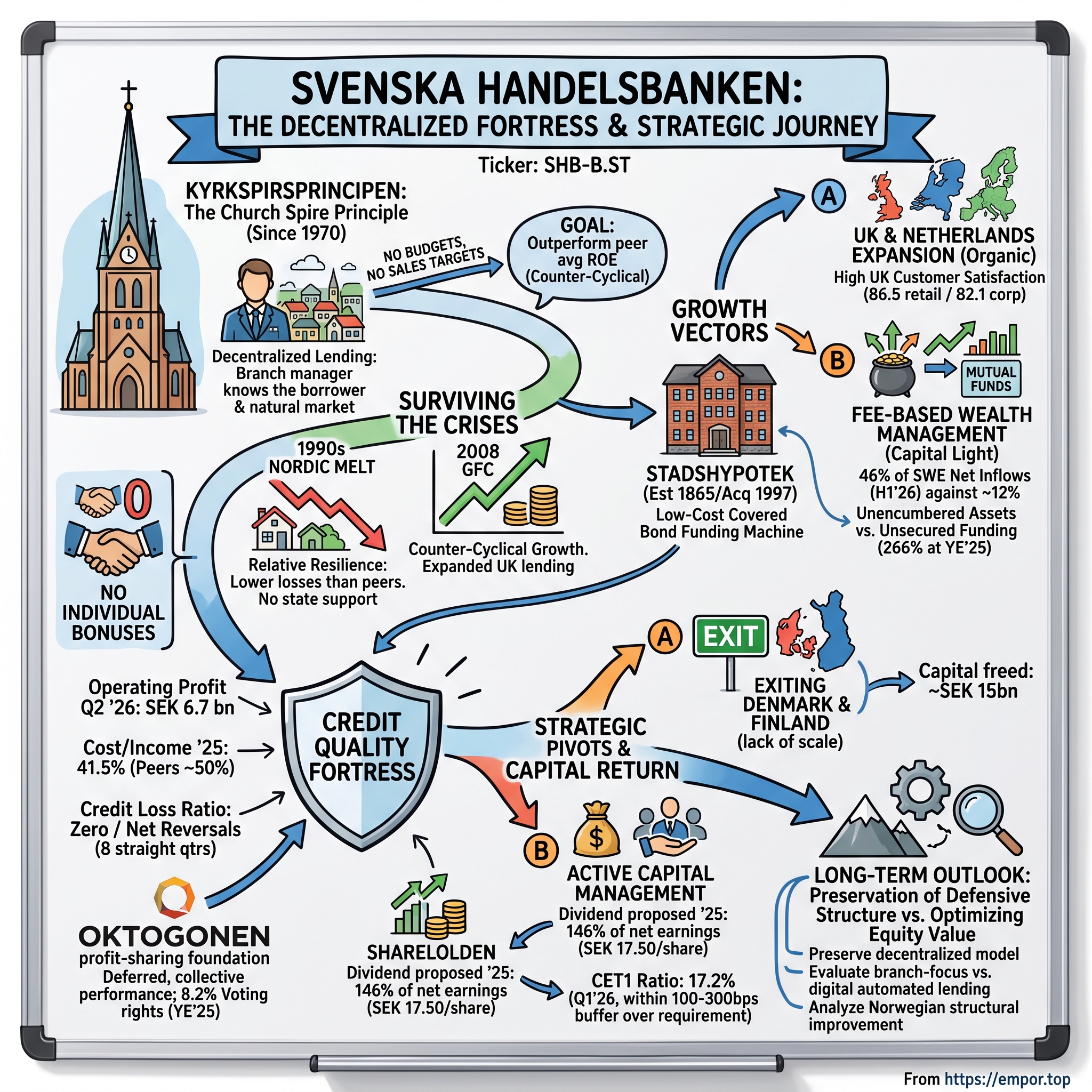
Svenska Handelsbanken: The Decentralized Fortress
I. Introduction & Episode Roadmap
On the morning of July 15, 2026, Michael Green sat in front of a camera in Stockholm and delivered second-quarter performance figures that appeared remarkably steady by European banking standards. Svenska Handelsbanken reported an operating profit of SEK 6.7 billion, a return on equity of roughly 13%, and a cost-to-income ratio of 44%. Its credit loss ratio stood at zero — not merely low or manageable, but zero on a loan book exceeding SEK 2.2 trillion.2
During the presentation, technical difficulties interrupted the visual deck. "I'm having a bit of trouble with the slides here," Green said, mid-presentation, before continuing without them.2 The moment underscored the identity of a bank built on the principle that central corporate machinery matters less than local branch managers who know their borrowers directly.
Equity markets responded coolly, sending Handelsbanken shares down more than 4% that day.7 Analysts on the call focused less on credit quality and more on stagnant loan growth. They questioned why Swedish lending had remained flat over the past year despite broader economic expansion, and why return on allocated capital in the United Kingdom stood below 12% compared with 16.3% in Sweden. Mediobanca analyst Riccardo Rovere framed the issue directly: with risk costs at zero and lending stagnant, he asked whether the bank should take more risk.2
That interaction captures Handelsbanken's central investment debate. Svenska Handelsbanken AB (publ), listed in Stockholm under the ticker SHB-B.ST, is a 155-year-old institution operating on a distinct premise: a commercial bank functions best when corporate headquarters does not dictate branch lending decisions.2 Founded in 1871, its stock is the oldest continuously listed security on the Stockholm exchange.15 For over fifty years, the group has pursued a single primary financial target: outperforming its peer group average return on equity. To achieve this, it operates without central budgets, top-down sales targets, or individual performance bonuses for loan officers.1
This operating model has delivered exceptional efficiency alongside persistent structural tensions. In 2025, Handelsbanken achieved a cost-to-income ratio of 41.5%, compared with an estimated peer average of roughly 50.2%.1 Credit losses were virtually non-existent, with the bank recording net credit loss reversals for eight consecutive quarters.6 Since 2019, average quarterly credit losses have averaged roughly SEK 3 million — a negligible figure across a turbulent period marked by the pandemic, rapid central bank interest rate hikes, elevated inflation, and a real estate slowdown in the Nordic region.2
However, overall profitability metrics have trended downward. Return on equity decreased from 15.9% in 2023 to 14.6% in 2024 and 13.0% in 2025. Over the same three-year period, operating profit from continuing operations declined from SEK 36.3 billion to SEK 35.0 billion and then to SEK 30.8 billion, while earnings per share dropped from SEK 14.70 to SEK 11.98.13 The Common Equity Tier 1 (CET1) ratio eased from 18.8% to 17.6% and 17.2%, driven not by asset impairment but by substantial capital distributions — including a proposed dividend of SEK 17.50 per share for 2025, representing 146% of annual earnings.6 Meanwhile, core lending growth in Sweden has stalled, shifting earnings generation toward asset management, mutual fund inflows, and fee-based capital-light revenue.
The core analytical question is therefore not whether Handelsbanken's balance sheet remains secure, but whether its defensive structure delivers optimal value to equity investors. Under Michael Green, who assumed the role of President and Group Chief Executive Officer on January 1, 2024, Handelsbanken is executing a strategy designed to preserve its decentralized 1970s operating model while streamlining central costs, distributing excess capital, and evaluating whether traditional branch-focused relationship banking remains competitive against digital lending platforms and automated credit scoring.9
At year-end 2025, Handelsbanken employed an average of approximately 11,900 staff across its operations, managed SEK 3.39 trillion in total assets, and operated branch networks across four core markets: Sweden, the United Kingdom, Norway, and the Netherlands. The bank's annual report explicitly lists every individual branch alongside the name of its manager — reflecting an organizational structure that places primary operational authority at the branch level.1
Three myths worth dismantling first
Evaluating Handelsbanken requires separating historical reality from long-standing market narratives. Three common assumptions frequently obscure the company's actual operating record.
First, the belief that Handelsbanken emerged from the 1990s Nordic banking crisis without significant loan losses is inaccurate. While the bank sustained substantial absolute credit losses, its performance was notable primarily because those losses were significantly lower than those of its domestic competitors.
Second, the assertion that Handelsbanken has surpassed its peer group's average return on equity every year for over five decades is based on internal benchmarks rather than a standardized external metric. The comparison reflects the bank's own historical evaluation against a self-selected peer group that management has redefined on multiple occasions.1
Third, the perception of Handelsbanken as a low-payout, hyper-conservative capital hoarder is challenged by recent capital management actions. For 2025, the Board of Directors proposed a dividend payout totaling 146% of net earnings, actively reducing capital reserves toward target regulatory thresholds.6
These nuances reframe the investment narrative: rather than an invincible institution immune to market cycles, Handelsbanken represents a disciplined risk-mitigation model actively distributing accumulated surplus capital to shareholders.
The road ahead
The analysis unfolds across several key areas: 1. The 1970 organizational restructuring that established the bank's decentralized model. 2. An examination of Handelsbanken's actual performance during the 1990s Nordic banking crisis. 3. The internal incentive structures, including the Oktogonen profit-sharing foundation and the zero-bonus compensation policy. 4. The historical international expansion and subsequent strategic exits from Denmark and Finland. 5. Segment economics and financial position as of mid-2026. 6. Governance dynamics under CEO Michael Green and the influential Industrivärden–Lundberg ownership sphere.
The examination concludes with strategic frameworks, competitive analysis, key risk factors, the bull-versus-bear investment case, and core metrics for monitoring execution.
The story begins in 1970 with an institution facing severe operational challenges and the appointment of an economist brought in to overhaul its structure.
 Subscribe on LinkedIn
II. The Jan Wallander Revolution & "Kyrkspirsprincipen" (1970–1990)
In 1970, Handelsbanken was the largest commercial bank in Sweden and one of two nationwide universal banks dominating corporate lending alongside SEB.8 It was also bureaucratically calcified, under regulatory pressure, and losing ground. Seeking new direction, the board selected an unconventional chief executive: Jan Wallander, an academic economist who had been running Sundsvallsbanken, a modest regional bank six hours north of Stockholm.
The economist who fired the planners
Wallander was not a banker in the conventional sense. As a researcher, he had studied how organizations actually operate rather than how their organization charts suggest they should work. He arrived at Handelsbanken with convictions that ran counter to conventional management wisdom, starting with corporate budgeting. Wallander argued that a budget is either roughly right, providing no new information, or substantially wrong, actively misleading decision-makers. In banking, where results are shaped by uncontrollable interest rates, credit cycles, and asset markets, he contended that forecasts become operational liabilities.
Rather than trimming the budget, Wallander abolished it entirely. He also eliminated central sales targets, top-down marketing campaigns, and long-range strategic planning. In their place, he established a single, straightforward corporate objective that remains printed in the annual report today: Handelsbanken's goal is to achieve higher profitability than the average of peer banks in its home markets.1 This relative return target meant the bank could not meet its goal through reckless expansion, because peer risk was embedded directly into the benchmark.
This approach diverged sharply from standard management frameworks—such as management by objectives, balanced scorecards, and quarterly targets—which assume performance improves by setting and measuring against advance specifications. Wallander's counter-argument was that in a business dominated by external variables, advance targets incentivize employees to game the system. A branch instructed to expand lending by 8% will meet that quota, but the marginal loans required to reach it are often the highest-risk credit extended all year. Removing the quota eliminated the incentive for marginal risk.
The church spire, and what it actually means
The next challenge was decentralizing operational authority. In Handelsbanken parlance, this philosophy became known as kyrkspirsprincipen, or the church spire principle: the concept that a branch's natural market comprises the area a manager can survey from the local church tower. Beyond the corporate folklore, this principle defines the bank's legal and organizational structure. Customer responsibility at Handelsbanken remains geographical: every customer across the group is affiliated with a physical branch, regardless of the products used or transaction channels selected.1 Country general managers hold overall responsibility for their respective markets, while decisions requiring national coordination are made by national boards where member unanimity is required.1
For credit risk analysis, the operational implication is clear: the local branch that understands the borrower retains sole credit authority, and corporate headquarters cannot compel a branch to approve a loan it has rejected. Central management can decline credit applications, but it cannot mandate lending volume. Fifty-six years later, CEO Michael Green articulated this same constraint when analysts pressed for more aggressive lending: "It's not that the CEO of the bank actually steers exactly how the risk should be taken in the bank. That's not how it works."2
Why autonomy produced thrift instead of chaos
This autonomy fostered cost discipline rather than operational fragmentation because Wallander paired authority with localized financial accountability. When a branch controls its credit decisions, it also manages its individual profit and loss statement, including charges for all central corporate services consumed. A branch without sales quotas has no incentive to pursue unprofitable volume, and a branch billed directly for central overhead scrutinizes corporate expenses. Consequently, cost pressure originates from the branch network rather than top-down restructuring initiatives. This structural accountability explains why Handelsbanken's cost-to-income ratio has consistently outperformed peers over decades rather than single cost-cutting cycles; in 2025, the bank maintained a cost-to-income ratio of 41.5% compared to an estimated peer average near 50.2%.1
This discipline relies on internal transfer pricing. Branch income statements reflect charges for head-office services consumed, while commercial transactions generated by branch clients—such as foreign exchange hedges or interest rate derivatives executed via the investment bank—are credited back to the local branch. Green explained this mechanism when addressing analyst concerns that branch cost-to-income evaluation might discourage lower-margin corporate lending, noting that ancillary relationship revenue "comes the month after."5 As a result, branch managers are incentivized to evaluate total relationship profitability rather than isolated loan margins, preventing selective underwriting.
The asterisk on the fifty-year record
This historical record includes structural qualifications detailed in the bank's financial disclosures. The peer-comparison series underpinning the group's performance record dates to 1973, but its composition has shifted over time: the benchmark included only Swedish banks from 1973 to 2002, and expanded to Nordic peers from 2003 to 2012.1 Furthermore, the 2025 assessment of goal achievement was measured as of September 30, 2025, because several peer institutions had not yet published full-year results before the report's approval.1 These disclosures demonstrate that while the performance tracking is transparent, the benchmark remains internally defined and subject to periodic adjustments.
Wallander's structural model established a distinct selection mechanism: an organization built to resist volume-driven growth because internal incentives do not reward loan volume. The endurance of this decentralized framework faced its primary test when macro-level credit stress hit the Swedish financial system twenty years later.
III. Surviving the Crises: 1990s Nordic Meltdown & 2008 GFC
Sweden deregulated its credit markets in the mid-1980s, setting off a rapid expansion in bank lending. Commercial property values soared, and credit standards eroded as rising collateral values obscured underlying risk. When interest rates subsequently spiked, the krona's fixed exchange rate came under speculative pressure, and property prices plummeted, the Swedish banking system plunged into systemic failure.
The Swedish government's response established a restructuring template later studied globally. State-linked PK-banken's successor, Nordbanken, was recapitalized and renationalized, while Gota Bank was declared insolvent in September 1992 and taken over. Non-performing assets were transferred into two dedicated workout companies, Securum and Retriva, and the government extended a blanket guarantee over bank liabilities to stabilize funding across the system.
Myth versus reality: what the loss data actually shows
Examining Handelsbanken's performance during this period requires distinguishing corporate myth from empirical data—a distinction critical for evaluating its risk framework.
Popular narrative holds that Handelsbanken navigated the crisis virtually unscathed. The historical record indicates otherwise. According to Peter Englund's reconstruction of the crisis for a Riksbank macroprudential conference, Handelsbanken recorded credit losses of SEK 0.7 billion in 1990, SEK 2.8 billion in 1991, SEK 7.1 billion in 1992, SEK 6.0 billion in 1993, and an additional SEK 5.7 billion from 1994 through 1996. Cumulative losses reached roughly SEK 22 billion against a 1990 loan portfolio of SEK 174.7 billion.8 This represented a cumulative credit loss exceeding 12% of its pre-crisis loan book. Furthermore, Handelsbanken granted interest concessions on approximately 3% of its loan portfolio in 1992.8 The institution suffered substantial financial damage.
The bank's true advantage lay in its relative resilience. By comparison, SEB incurred roughly SEK 37 billion in losses on a SEK 210 billion loan book, Nordbanken lost approximately SEK 49 billion on SEK 215 billion, and Sparbanken Sverige recorded nearly SEK 39 billion on SEK 221 billion. Gota Bank suffered the most severe damage, losing around SEK 29 billion on a loan portfolio of just SEK 78 billion.8 While Handelsbanken's loss rate was substantial, it remained significantly lower than those of its peers. Most importantly for solvency, Englund highlights that while every other major Swedish bank entered discussions with the government's Bank Support Agency, Handelsbanken never applied for support.8
This independence came with an important structural caveat. Like all Swedish financial institutions, Handelsbanken operated beneath the government's blanket liability guarantee, which stabilized systemic funding costs and risk premiums. While the bank required no direct equity injection or bailout, it nonetheless benefited from the state's intervention in the broader funding environment. Handelsbanken demonstrated superior underwriting discipline compared to its domestic peers, yet it still depended on the broader stabilization of the national banking sector.
Stadshypotek: buying a funding machine, not a sales force
The strategic advantage of navigating the crisis intact became clear in 1997, when Handelsbanken acquired Stadshypotek, a mortgage institution founded in 1865 that has operated as a wholly owned subsidiary ever since.16 This acquisition proved to be a pivotal structural transaction in the bank's modern history. Rather than acquiring customer distribution, Handelsbanken acquired a low-cost funding engine. Mortgages originated across the branch network are transferred to Stadshypotek's balance sheet, which issues covered bonds secured by those mortgages—providing access to the lowest-cost wholesale funding available in European capital markets. In 2025, Handelsbanken issued SEK 150 billion in long-term debt, including SEK 100 billion in covered bonds.1 By maintaining low levels of overall asset encumbrance, the group preserves substantial unissued covered bond capacity as an operational liquidity buffer. At year-end 2025, its ratio of unencumbered assets to unsecured market funding stood at 266%.1
In practice, Handelsbanken maintains a deep reserve of unpledged, high-quality mortgage assets. During liquidity shocks when unsecured credit markets constrict, the bank can pledge these assets to secure funding immediately. This structural asset buffer provides a concrete mechanical foundation for the bank's balance-sheet stability.
Covered bonds provide a structural cost advantage due to their dual-recourse design. Unlike unsecured debt backed solely by the issuing bank, covered bonds grant investors a direct claim on both the bank and a ring-fenced pool of underlying mortgages. This dual security lowers investor risk, allowing the bank to issue debt at narrower yields. For a commercial lender operating on net interest margins, lower funding costs directly expand profitability. Stadshypotek provided Handelsbanken with scalable, direct access to this funding mechanism for branch-originated loans without intermediary fees.
2008: the same playbook, polarity reversed
The 2008 global financial crisis unfolded with a reversed dynamic. While the 1990s crisis had been a domestic Swedish collapse, the 2008 panic was an international wholesale liquidity freeze. Nordic institutions were relatively sheltered, and Handelsbanken entered the crisis in a position of strength. As European competitors faced dilution from emergency capital raises, state bailouts, or forced balance-sheet contraction, Handelsbanken preserved its equity base and expanded corporate and UK lending at attractive credit spreads.
This dynamic illustrates the counter-cyclical feature of Wallander's operating model. Rather than competing aggressively for market share during credit booms, Handelsbanken expands when distressed competitors withdraw. Because local branch managers retain lending authority during downturns and funding costs remain contained, the bank can extend credit while peers face regulatory or capital constraints. Market share gains are thus realized primarily during periods of broader market dislocation.
For contemporary investors, the key consideration is the value of this defensive posture during extended periods of benign credit conditions. In the absence of a major Nordic banking crisis since 2019, Handelsbanken's structural relative advantage has yielded muted organic loan growth. This raises a fundamental operational question: what prevents local decision-makers within a decentralized framework from easing underwriting discipline during prolonged economic expansions?
IV. Anatomy of the Machine: Oktogonen, Incentives, & Culture
The bank's answer lies in its compensation architecture.
The zero-bonus rule, and the carve-out that proves it
Handelsbanken does not pay individual performance bonuses or sales commissions to loan officers and customer-facing staff. Rather than an informal cultural preference, this rule is codified in the remuneration guidelines adopted by shareholders at the annual general meeting. Variable compensation across the group is granted "partly through the Oktogonen profit-sharing scheme and partly through performance-based variable remuneration." The latter is "applied with great caution and to a very limited extent"—offered exclusively to specific personnel in Capital Markets and asset management whose earnings derive from fees or intermediary transactions where the bank incurs no credit, market, or liquidity risk.1
That carve-out reflects the underlying logic of the bank's system: variable compensation is prohibited wherever employees create balance-sheet exposure. Staff authorized to extend credit receive fixed salaries. By eliminating individual volume bonuses, Handelsbanken removes the structural moral hazard common in commercial lending, where loan officers receive upfront bonuses for generating credit volume that may default years later.
Oktogonen: the most elegant incentive in banking, and the one that shrank
The primary collective mechanism is Stiftelsen Oktogonen, a profit-sharing foundation created during the Wallander restructuring. Profit-sharing provisions are triggered only if Handelsbanken meets its corporate goal of outperforming peer profitability, subject to an overall evaluation by the Board.1 When approved, allocations are distributed equally among all eligible employees regardless of role or location—meaning a branch receptionist receives the same allocation as the chief executive.1 Executive officers, including the Chief Executive Officer, participate in the foundation on identical terms.1 Because the foundation invests primarily in Handelsbanken shares, decades of contributions turned it into a major shareholder; at the end of 2025, Oktogonen held 159,225,141 shares, representing 8.2% of total voting rights.113
The design aligns employee interests through deferred, collective relative performance. Staff cannot increase their individual allocation by expanding loan volume, as isolated transactions do not alter group-wide relative return on equity. Because profit shares are released only upon retirement, personal financial outcomes remain tied to long-term risk management.
However, financial disclosures show that the economic scale of Oktogonen has diminished significantly over time. The 2025 profit-sharing allocation was SEK 142 million, compared with SEK 96 million in 2024, and included a net reversal of SEK 39 million in the fourth quarter of 2025.16 Spread across approximately 11,700 employees, the allocation represents a modest sum rather than a major wealth driver. Responding to analyst Sofie Peterzens of Goldman Sachs regarding the scheme's current relevance to staff, Chief Financial Officer Mårten Bjurman acknowledged that forecasting allocations is "always a little bit of a guessing game," while maintaining that the scheme "still plays a big role" culturally.6 Group Chief Executive Officer Michael Green noted a practical constraint: Handelsbanken must wait for UK peer institutions to publish their full-year financial results before calculating the final relative comparison.6
This shift carries dual implications for investors. On one hand, variable compensation expenses remain low and predictable, without hidden bonus accruals. On the other hand, the financial mechanism that historically accumulated substantial equity wealth for long-tenured employees now exerts a weaker financial pull. Maintaining a rigorous risk culture without the same financial payoff presents an ongoing operational test for management.
In addition to its role as an incentive, Oktogonen functions as a major governance factor. Holding 8.2% of total voting power, employees represent the second-largest voting block in the company. This dual role as staff and shareholders creates strong internal alignment against speculative lending that could imperil equity value, while simultaneously creating structural resistance to aggressive headcount reductions or corporate restructurings.
Credit culture as the observable output
The tangible result of this incentive framework is consistent credit quality. Underwriting decisions prioritize cash-flow repayment capacity and familiar borrower relationships over asset valuations. Green summarized this principle on the second-quarter 2026 earnings call, noting that "banking is about lending out money and then getting them back."2 The empirical record supports the statement: in 2025, Handelsbanken recorded net credit loss reversals of SEK 313 million—yielding a negative credit loss ratio of 0.01%, following negative 0.02% in 2024.1 Since 2019, average quarterly credit losses have hovered near SEK 3 million.2 Consequently, Handelsbanken maintains high credit ratings among privately owned commercial banks—including AA− from Standard & Poor's, AA+ from Fitch, and Aa2 from Moody's at year-end 2025—with Moody's elevating the bank's Baseline Credit Assessment to A1 in 2026, a rating held by very few institutions globally.142
At the same time, credit losses near zero indicate an underwriting posture that consistently declines marginal commercial lending opportunities. While protecting capital during downturns, this conservative risk profile limits credit expansion during growth cycles—a dynamic that becomes particularly evident as Handelsbanken operates outside its home Swedish market.
V. The Over-Expansion Era & International Missteps (2000s–2020)
The logic of exporting the model was seductive. If radical decentralization, local credit authority, and a refusal to chase loan volume produced durable outperformance in Sweden, why should the church spire principle not work in Copenhagen, Helsinki, Oslo, Amsterdam, or Manchester? Handelsbanken spent roughly two decades testing that premise, building organic branch networks across Northern Europe rather than acquiring established domestic players.
That organic strategy was philosophically consistent but financially demanding. Building a branch network from scratch requires absorbing a complete cost base long before generating the volume required to break even. Handelsbanken’s branch overhead is particularly heavy because it relies on experienced commercial bankers holding genuine credit authority. In a home market representing roughly 70% of group lending, that overhead is amortized across a massive loan portfolio.1 In foreign markets dominated by entrenched incumbents like Danske Bank, Nordea, or OP, the same fixed overhead became a persistent drag on group returns.
The day the bank admitted it
On October 19, 2021, Handelsbanken formally acknowledged these structural headwinds, announcing plans to exit Denmark and Finland and initiate divestment processes for both country operations. The disclosure laid out the underlying arithmetic: Denmark and Finland accounted for 10% of group income and 13% of group costs, but generated only 8% of operating profit, while tying up approximately SEK 15 billion in allocated capital and roughly SEK 12 billion in Common Equity Tier 1 capital.10 Then-CEO Carina Åkerström cited changing regulations and lack of scale. New regulatory rules required standalone central infrastructure in each national market, eroding cross-border operational efficiencies, while Handelsbanken's modest market share offered little prospect of scaling without heavy investment.10
The strategic admission was clear: Handelsbanken was committing a disproportionate share of group operating expenses and capital to earn a sub-proportionate share of group profit. Post-crisis financial regulations had raised the minimum viable scale for national banking operations, leaving two of the group's five key geographical markets below that threshold.
Benchmarking the exits
Management subsequently executed the exits in an orderly manner. On June 20, 2022, Jyske Bank agreed to acquire the Danish operations—encompassing a loan portfolio of roughly DKK 66 billion, deposits of around DKK 36 billion, 43 branches, approximately 600 employees, and more than 130,000 customers. The transaction was structured as an asset-based cash consideration plus a premium of DKK 3 billion.11 Jyske’s shares rose 11.5% following the announcement, signaling market confidence that the buyer had acquired a solid franchise at an attractive price.11 While a sub-scale operation is naturally worth more to an established market consolidator than to a niche foreign operator, the market reaction underscored that Handelsbanken was monetizing a business that a competitor could immediately render more profitable simply through operational scale.
The Finnish operations were sold piecemeal rather than as a single entity. On May 31, 2023, Handelsbanken agreed to sell its retail banking, asset management, and investment services to S-Bank; its small and medium-sized enterprise business to Oma Savings Bank; and its life insurance operations to Fennia Life.12 The Oma Savings Bank component alone involved roughly EUR 460 million in loans, EUR 1.2 billion in deposits, around 14,000 SME customers, and approximately 40 transferring staff, priced at net asset value plus EUR 15 million in cash.12 The Finnish wind-down proved complex and extended over several years; by 2025, key units had been transferred while remaining assets were managed through a separate discontinuation process, recording a net loss of SEK 266 million from discontinued operations for the year.1
For equity investors, the strategic pivot yields a mixed evaluation: positive on capital allocation discipline, but cautionary on long-term expansion strategy. Admitting that a two-decade international expansion failed to achieve scale and executing orderly exits without distressed pricing reflects board discipline. However, it also indicates that two decades of capital deployment destroyed value relative to simply returning that capital to shareholders. Furthermore, the experience reveals a fundamental boundary of Wallander's model: Handelsbanken’s competitive advantage compounds gradually through local relationships built over time. Radical decentralization provides an effective framework for operating an established banking franchise, but an inefficient mechanism for building one from scratch.
That structural tension now centers on the bank's remaining international footprint, particularly in Norway.
VI. Segment Economics: Where Handelsbanken Makes Money Today
At its operational core, Handelsbanken functions primarily as a domestic Swedish power with three smaller international appendages.
In 2025, the Sweden segment generated SEK 22,655 million in operating profit out of a group total of SEK 30,750 million.1 The UK contributed SEK 4,457 million, Norway SEK 2,894 million, the Netherlands SEK 754 million, and Capital Markets SEK 112 million.1 By the second quarter of 2026, Sweden accounted for 75% of home-market operating profits, the UK 13%, Norway 9%, and the Netherlands 3%.2 Geographically, 70.7% of total lending was concentrated in Sweden, 12.5% in Norway, 9.9% in the UK, and 4.8% in the Netherlands.1
The group's revenue mix is more balanced than its reputation as a traditional mortgage lender implies. Net interest income of SEK 42,542 million represented roughly three-quarters of total 2025 revenue of SEK 56,796 million, while net fee and commission income supplied roughly one-fifth at SEK 11,863 million.1 The share of net interest income has gradually declined—not because loan balances contracted, but as central bank rate cuts squeezed deposit margins while fee income continued to expand.
Handelsbanken Sweden: the engine, and its dependence on rates
Handelsbanken Sweden. The Swedish business represents the group's core engine: a spread-based lending franchise tied to a large domestic savings operation. Average lending volume in 2025 reached SEK 1,591 billion, comprising SEK 971 billion in household mortgages and SEK 621 billion in corporate lending, supported by average deposits of SEK 839 billion.1 The segment recorded a cost-to-income ratio of 31.7% and a return on allocated capital of 15.3%, compared with 29.9% and 17.3% in 2024.1 By the second quarter of 2026, the Swedish cost-to-income ratio stood at 34% and return on allocated capital reached 16.3%.2
Swedish net interest income fell 12% in 2025 to SEK 25,415 million. The underlying breakdown is instructive: higher business volumes added just SEK 26 million, whereas shifting margins and funding costs subtracted SEK 3,447 million.1 In practical terms, virtually the entire earnings drop was rate-driven rather than volume- or credit-driven. As a deposit-heavy bank, Handelsbanken's domestic earnings expand during high policy rate environments and contract as rates normalize—reflecting cyclical interest rate sensitivity rather than a structural strategic shift.
By contrast, the savings and asset management business expanded rapidly. Group assets under management rose 8% in 2025 to SEK 1,284 billion—with SEK 1,210 billion invested in the bank's proprietary mutual funds—driven by net inflows of SEK 74.3 billion, including SEK 73.0 billion from Sweden alone.1 By the second quarter of 2026, Swedish assets under management grew 23% year-over-year to roughly SEK 1,230 billion.7 Long-term distribution metrics highlight this momentum: while holding approximately 12% of the Swedish mutual fund market by volume, Handelsbanken captured 27% of all net market inflows over the past decade and 46% of net inflows in the first half of 2026.2 Accumulated net inflows over the decade approached SEK 320 billion.2
This trajectory highlights a key structural evolution in Handelsbanken's business model. A branch network that appears costly during price wars over low-margin mortgages operates as an effective distribution channel for higher-margin savings products. Long-standing client relationships allow advisors to capture fund inflows without competing solely on lending rates. Furthermore, fund management fees generate capital-light earnings—an advantageous dynamic for an institution actively returning excess capital. When an analyst from Bernstein noted during the second-quarter 2026 call that low commission income represented a structural drag on return on equity, Chief Financial Officer Mårten Bjurman agreed with the diagnosis and pointed to the savings build as the bank's strategic response.2
Handelsbanken UK: the growth vector that keeps not arriving
Handelsbanken UK. The British subsidiary remains the bank's most debated international unit. Operating through a nationwide branch network, Handelsbanken UK targets business owners, family companies, and mid-market commercial enterprises.1 Its customer satisfaction scores lead the group by a wide margin: in the 2025 EPSI survey, UK retail clients rated the bank at 86.5 against a sector average of 76.1, while corporate clients scored it 82.1 against an industry benchmark of 65.7.1
Translating customer loyalty into group-level financial returns has proven more gradual. UK operating profit fell 22% in 2025 to SEK 4,457 million (down 18% in local currency), return on allocated capital dropped from 17.1% to 13.0%, and the cost-to-income ratio rose from 52.5% to 57.5%.1 Average lending grew 1% to GBP 18.1 billion, with household lending down 2% and corporate lending up 3%.1 Operating performance stabilized in mid-2026: second-quarter operating profit rose 11% year-over-year, lending expanded 7%, the cost-to-income ratio came in at 61%, and return on allocated capital reached 12%.27
These figures illustrate an operational tension: profit growth recovered even as the cost-to-income ratio rose, because British interest rate cuts reduced revenue faster than fixed overhead could adjust. Executive management asserts that the UK division will grow into its cost base as transaction volumes expand. As Bjurman stated on the second-quarter 2026 call: "as volumes grow, you will see key figures in that market enhanced only by that."2 However, after more than a decade of international operation, the UK segment has yet to match domestic Swedish returns. Moreover, analysts pointed out during the call that the reported 12% return on allocated capital assumes an internal tax rate of roughly 20%, compared with an actual UK tax rate near 28%.2 Bjurman noted in response that adjusting internal tax allocations for the UK would require deducting taxes elsewhere across the group.2
In addition, the British wealth management operations remain sub-scale and have not replicated the Swedish savings flywheel. Total assets under management at Handelsbanken Wealth & Asset Management rose to GBP 4.8 billion at year-end 2025, but net organic inflows were negative at GBP −151 million—indicating that asset growth stemmed from market appreciation rather than new client deposits.1 As a result, the UK unit contrasts with Sweden: delivering strong customer satisfaction and improving loan momentum, but lacking the capital-light fee engine required to boost returns independent of prevailing interest rates.
Norway and the Netherlands: one drag, one bright spot
Norway and the Netherlands. The Norwegian market has presented ongoing operational headwinds. Lending contracted approximately 5% year-over-year in the second quarter of 2026 amid intense mortgage price competition, while a loan-to-deposit ratio near 300% leaves the Norwegian loan book heavily reliant on group wholesale funding.75 Return on allocated capital in Norway stood at 10.8% in 2025.1 As in Sweden, the primary success in Norway has been in wealth management: the bank's share of net mutual fund inflows ran at more than twice its existing market share, helping drive a 30% year-over-year increase in Norwegian assets under management by mid-2026.172
Although the Netherlands accounts for just 3% of home-market operating profit, it represents the group's fastest-growing country operation. By the second quarter of 2026, Dutch lending grew 10% year-over-year while assets under management expanded 28%, with Bjurman noting that the Dutch corporate loan book had roughly doubled over six years.27 Return on allocated capital reached 9.7% in 2025 and approached 11% by mid-2026.12
Capital Markets and Asset Management: the quiet half of the story
The bank's fourth operational division functions primarily as an internal support engine rather than an independent profit center. Handelsbanken's Capital Markets business—encompassing trading, investment banking, and corporate finance—reported an operating profit of SEK 112 million in 2025 on total income of SEK 1,684 million, with an unadjusted cost-to-income ratio exceeding 100%.1
This unit operates as a centralized service provider whose revenue is systematically credited back to local branches. Under group segment accounting, a profit allocation mechanism transferred SEK 402 million out of Capital Markets and into the respective country segments in 2025, ensuring that income from branch-originated transactions—such as foreign exchange and interest rate derivatives—is recognized directly by the originating branch.1 As CEO Michael Green explained during the first-quarter 2026 call, group earnings ultimately flow through local branch profit-and-loss statements, with branches receiving financial credit the month after transaction execution.5 Consequently, the modest reported standalone profit for Capital Markets reflects a deliberate accounting allocation rather than poor operational performance.
By contrast, asset management generates substantial capital-light earnings. In 2025, Handelsbanken's Swedish fee and commission income included SEK 5,275 million from mutual fund management, SEK 960 million from custody and asset administration, SEK 769 million from insurance products, and SEK 1,317 million net from payment services.1 This fee-based revenue expands without requiring capital backing or credit extension. However, it remains vulnerable to industry-wide fee compression driven by low-cost index products—a trend management acknowledged in early 2026 after noting a negative mix effect as client inflows shifted toward lower-fee fund products.5
In summary, three of Handelsbanken's four geographical markets generate returns on allocated capital in the 10% to 12% range, while Sweden delivers roughly 16%. As a result, overall group return on equity reflects a blended average pulled down by international operations. This profitability gap explains why capital allocation and regional efficiency dominated analyst discussions during recent earnings calls.
VII. Current Management, Governance, & Lundberg Influence
The insider's insider
Michael Green's path to the chief executive role was entirely internal. Born in 1966, he joined Handelsbanken's Gothenburg branch as a corporate advisor in 1994 and spent three decades advancing through the organization — serving as Head of US Operations, Head of Handelsbanken in Western Sweden, Head of Capital Markets, and from 2020, General Manager of Handelsbanken Sweden, the group's largest and most profitable division.19 When the board announced his appointment on October 23, 2023, to succeed Carina Åkerström as President and CEO from January 1, 2024, Chairman Pär Boman called him "the natural choice," citing record profits and improved customer satisfaction under his Swedish leadership.9
Elevating a 30-year insider sends a distinct governance signal: Handelsbanken does not recruit external leaders to transform its culture, but promotes executives shaped by it. Whether that continuity represents institutional stability or insular complacency remains a central question for investors.
Over his first two and a half years in office, Green's operational focus has centered on central efficiency. Under his direction, the bank executed a targeted central cost program. Group operating expenses decreased by 7% in 2025 — or roughly 3% on an underlying basis when adjusted for currency movements, restructuring charges, and Oktogonen allocations — as average group headcount declined from 12,703 to 11,888 and underlying fourth-quarter staff expenses dropped 5% year-over-year.61 These cost reductions were concentrated in head-office support and central overhead rather than local branch operations. Management reported that streamlining central administration improved branch morale, pointing to an internal employee satisfaction survey that reached an all-time high.6 Additionally, the bank reduced its reliance on external IT consultants by moving software development in-house.5
Giving the money back
In tandem with cost discipline, Green's administration has aggressively returned capital to shareholders. This capital distribution policy represents the most economically significant pivot of his tenure. Contrary to perceptions of Handelsbanken as a capital-hoarding institution with a modest payout ratio, the Board proposed a total dividend of SEK 17.50 per share for 2025 — comprising an ordinary dividend of SEK 8.00 and a special dividend of SEK 9.50 — representing 146% of annual net profit.61 This distribution sent approximately SEK 35 billion out of the bank at the end of the first quarter of 2026.2 Elevated payout levels persisted into 2026, with dividend accruals reaching SEK 2.93 per share in the first quarter (91% of quarterly profit) and SEK 4.77 per share for the first half of the year (82% of net income).42
These distributions systematically reduced the bank's capital buffer. The Common Equity Tier 1 (CET1) ratio moved from 18.8% at year-end 2024 to 17.6% at year-end 2025 — standing 285 basis points above regulatory requirements — and reached 17.2% in the first quarter of 2026, or 250 basis points above requirement, placing it within management's target range of 100 to 300 basis points over regulatory minimums.164 When questioned by analysts regarding the rationale for lowering capital reserves, Green noted that loan portfolio quality metrics did not justify holding excess capital.5 Pressed on why management did not compress the buffer further in the second quarter of 2026, Chief Financial Officer Mårten Bjurman stated that altering capital targets mid-year required significant structural justification and that the bank remained comfortable at 250 basis points above requirement.2
This capital allocation strategy demonstrates responsiveness to equity shareholders, but it also creates direct mechanical headwinds for net interest income. Bjurman explicitly attributed part of the second-quarter 2026 decline in net interest income to lower liquidity balances following the massive dividend distribution.2 Consequently, capital return shifts earnings generation from balance-sheet asset growth to direct shareholder payouts — a trade-off that creates shareholder value only if the distributed capital was genuinely redundant.
Pay, and the awkward question it raises
At the executive level, compensation structure mirrors the bank's broader zero-bonus philosophy. In 2025, Green received a base salary of SEK 14.6 million, or SEK 19.8 million including pension benefits, with variable compensation set at zero — matching the 100% fixed salary structure of 2024.1 His personal equity holding stood at 124,118 shares, including 95,000 Class A shares.1 For a Chief Executive managing SEK 3.4 trillion in total assets, this represents a modest compensation package and equity stake. While eliminating short-term variable pay removes incentives to pursue risky loan growth, it also leaves executive compensation largely insulated from equity market performance.
The Industrivärden sphere, and what an activist would say about it
Behind executive management lies a tightly held ownership and governance structure. As of December 31, 2025, investment firm Industrivärden held 230,000,000 shares representing 11.8% of total voting power — the only shareholder exceeding 10%. The Oktogonen Foundation held 8.2% of votes, the Lundberg group held 4.9%, BlackRock held 3.6%, and Vanguard held 3.3%, distributed across a broader base of more than 200,000 shareholders.13 Capital structure features dual-class shares: Class A shares carry one vote each, while Class B shares carry one-tenth of a vote.1
The corporate governance interlocks between the bank and its primary shareholders are extensive. Board Chairman Pär Boman served as Handelsbanken's President and CEO from 2006 to 2015 and currently serves as Deputy Chairman of Industrivärden.1 Board member Fredrik Lundberg has served as President of L E Lundbergföretagen since 1981, chairs Industrivärden, and personally holds 89,275,000 Class A shares.1 Boman personally holds 189,348 shares, and his board chairman fee for the 2025–2026 corporate year was SEK 5.94 million out of total board compensation of SEK 20.60 million.1 Reflecting hands-on oversight, Boman participated in all 10 credit committee meetings, all 12 board meetings, all 7 audit committee meetings, all 8 remuneration committee meetings, and all 7 risk committee meetings during the year.1
From an activist investor perspective, this interlocking governance model presents distinct structural trade-offs. A former chief executive serving as chairman across all key board committees limits independent board oversight of historical strategy. Furthermore, the controlling shareholder sphere creates a self-reinforcing network: Industrivärden's chairman and deputy chairman sit on Handelsbanken's board, while bank employees — via the Oktogonen Foundation — control the second-largest voting block. While this ownership structure effectively insulates the bank from short-term market pressures and speculative acquisition attempts, it also creates resistance to radical strategic reviews. That tension surfaced on the second-quarter 2026 earnings call when ABG Sundal Collier analyst Magnus Andersson noted that Norwegian operations had shown limited structural improvement since 2021, asking why the bank should not divest the unit and distribute the underlying capital.2
Green rejected the suggestion, asserting that Norway maintains a strong product offering, that digital infrastructure investments have been completed, and that the bank will remain committed to the market.2 However, Green added that management remains open to growing international markets through inorganic additions, while clarifying that no transactions were under consideration.2 Andersson observed that this openness differed from previous executive teams, who had passed on acquiring S-Bank in Finland and Danske Bank's retail operations in Norway.2 Green declined to comment on past decisions while reiterating that organic expansion remains the primary strategic focus.2 Nevertheless, the exchange marked the first explicit acknowledgment by current leadership that selective inorganic growth could be considered alongside organic expansion.
VIII. The Playbook: Business, Banking, & Investing Lessons
Five transferable lessons emerge from Handelsbanken's history, each carrying a structural limitation worth highlighting.
Decentralization only works when the incentive system enforces restraint. Handing lending authority to hundreds of branch managers would prove reckless at most financial institutions, where loan officers are compensated on volume. Handelsbanken eliminated individual variable pay for staff capable of creating credit exposure, confining performance bonuses to business units that take no balance-sheet risk.1 Operational autonomy and incentive design function as a single unified policy; adopting the organizational structure without the compensation rules merely distributes the authority to create bad loans. The limit: the collective profit-sharing allocation has shrunk to SEK 142 million annually, meaning the framework increasingly relies on corporate culture and career norms rather than financial incentives.1
Relative benchmarks beat absolute targets in cyclical businesses. A bank chasing a fixed 15% return on equity during a low-interest-rate environment will routinely reach for risk. A bank targeting profitability above its peer group average will not, because competitors' risk-taking is directly embedded in the benchmark. This relative structure explains why Handelsbanken avoided the worst excesses of the 1980s Swedish credit boom, and why Chief Executive Michael Green could tell analysts in 2026 that local branches determine their own credit appetite rather than responding to corporate directives.2 The limit: a relative goal can permit comfortable mediocrity in absolute terms. If the broader banking sector generates an 11% return, achieving 12% satisfies the corporate mandate while delivering modest long-term compounding for shareholders.
Scale is local, not global. The decision to exit Denmark and Finland quantified a reality many international lenders resist: the two country operations consumed 13% of group costs while generating just 8% of group operating profit.10 Post-crisis regulatory frameworks increased the fixed costs of operating a national subsidiary—requiring standalone governance, compliance, and capital infrastructure—which raised the minimum viable scale for foreign operations. Handelsbanken responded by concentrating resources in markets where it could command scale or credibly expand. The limit: Norwegian operations now face a similar structural test, yet executive management has declined to apply the same exit criteria.
Cost discipline that comes from below survives; cost programs that come from above do not. Handelsbanken's cost advantage stems from decades of branch-level accountability rather than periodic restructurings. However, central overhead required a top-down correction during the 2024–2025 period, when group operating expenses fell 7% and average headcount contracted by more than 800 staff.16 Chief Financial Officer Mårten Bjurman informed analysts in early 2026 that the central cost program had concluded with no follow-up initiative planned, asserting that every employee within the bank remains highly cost-conscious.5 The limit: relying entirely on decentralized cost discipline forecloses further central expense targets, leaving investors to trust an internal cost culture they cannot directly monitor.
A relationship model is a distribution asset before it is a lending asset. This evolution reframes the strategic purpose of the branch network. For half a century, branches functioned primarily as an underwriting mechanism, relying on local knowledge to reduce credit losses. Recent fund flows demonstrate that the same network is equally effective as a distribution channel for capital-light wealth management products. Bank disclosures reflect this shift, with savings inflows and assets under management increasingly leading quarterly reporting ahead of loan growth.26 The limit: this strategic pivot partly reflects sluggish credit demand rather than a proactive choice, exposing the bank to fee compression from passive index funds—a competitive challenge that branch relationships cannot easily solve.
The lesson taught by omission
The sixth lesson is one Handelsbanken rarely articulates: a business optimized for durability is not automatically structured for rapid growth, and the two objectives frequently conflict. Every mechanism that protects the balance sheet—local credit authority, the absence of volume incentives, relative return benchmarks, and a refusal to lend against inflated collateral values—also slows decision-making.
This cadence represents the operating model working as designed rather than an execution failure. An organization structured to resist top-down volume targets cannot easily be instructed to accelerate lending. Executive management can cut central expenses, return excess capital, and exit underperforming markets because those are centralized subtractive decisions. However, corporate headquarters cannot manufacture credit demand, as lending authority sits with thousands of branch employees trained to decline transactions when risk exceeds prospective returns.
For equity investors, loan expansion depends less on management directives than on broader macroeconomic conditions. Handelsbanken grows when its client base grows; Bjurman acknowledged as much when stating that materially outpacing Swedish economic growth would require loosening credit standards.6 Underwriting Handelsbanken thus represents a bet on economic expansion across the Nordics and the United Kingdom, sustained growth in the fee-based savings franchise, and the option value of its defensive balance sheet during the next credit downturn—rather than a bet on management's ability to drive top-line loan growth.
IX. Hamilton Helmer's 7 Powers & Porter's 5 Forces
Evaluating Handelsbanken through Hamilton Helmer's strategic framework reveals that three of the seven powers apply with genuine force, while the remaining four offer little structural protection.
The three powers that are real
Counter-positioning represents the bank's primary competitive advantage. A competitor cannot adopt Handelsbanken's model incrementally. To match it, domestic peers such as SEB, Swedbank, or Nordea would have to rebuild a dense branch network, delegate credit authority away from centralized scoring engines, and dismantle the individual bonus structures their bankers expect — accepting higher overhead and lower short-term volume growth while shareholders watch. Counter-positioning exists when an incumbent's rational response is not to imitate, which matches the competitive dynamics in the Nordic market. The empirical evidence appears in the persistent cost-to-income gap: Handelsbanken recorded a ratio of 41.5% in 2025 compared with an estimated peer average of roughly 50.2%, sustaining that structural advantage across decades rather than quarters.1
Process power provides a deeper, less replicable defense. What Handelsbanken possesses is not a rigid policy manual, but an accumulated organizational capability: thousands of employees trained over decades to turn down unprofitable or overly risky business. Chief Executive Officer Michael Green described the mechanism directly, noting that the performance gap against peers "really shows in the volatile times when there is an economic downturn."2 Process power relies on slow accretion and slow imitation, a dynamic supported by thirty-six years of comparative loss data.81
Switching costs apply, but within narrow operational boundaries. They remain strong in small-to-medium enterprise and corporate banking relationships, where local managers understand the borrower's business model, management team, and succession plan. The customer satisfaction gap in the United Kingdom — where Handelsbanken scored 82.1 among corporate clients against an industry benchmark of 65.7 — provides measurable evidence of client stickiness.1 Conversely, switching costs are negligible in Swedish residential mortgages, which function as commodity products repriced every three months. Chief Financial Officer Mårten Bjurman confirmed this vulnerability, noting second-quarter 2026 margin pressure across both Swedish residential mortgages and corporate lending.2
The four powers that are not
Understanding what Handelsbanken lacks is equally important for evaluating its long-term strategy. The bank enjoys no meaningful network economy, as existing customers gain no direct utility when new clients join. It possesses no scale economy advantage over larger regional institutions like Nordea. It holds no cornered resource, nor does it command brand-driven pricing power; Green explicitly acknowledged that the bank never conducts mortgage business at its published list price.5 Assertions that Handelsbanken exhibits five or six of Helmer's seven powers overstate its structural moat.
Porter: an industry that punishes everyone equally
Applying Michael Porter's Five Forces model presents a similarly nuanced picture of the competitive landscape.
Threat of new entrants: low, but driven by regulatory barriers. Barriers to entry reflect regulatory and capital hurdles rather than competitive deterrence — encompassing banking licenses, capital buffers, resolution frameworks, and the specialized covered-bond funding architecture that Stadshypotek has developed since 1865.16 Handelsbanken's total capital requirement, including Pillar 2 guidance, stood at 18.8% of risk-weighted assets — or SEK 146 billion — at year-end 2025.1 While digital-only challengers can target specific financial products, they cannot easily replicate low-cost, large-scale covered-bond funding.
Bargaining power of buyers: high and expanding in core categories. Swedish mortgage products are transparent, heavily compared, and repriced quarterly. This buyer sensitivity was evident in Handelsbanken's Swedish net new mortgage market share, which fluctuated from 6% in the first half of 2025 to 12% in the second half — a volatility profile indicative of a price-sensitive market rather than a relationship-driven one.6
Rivalry: intense and geographically asymmetric. As Sweden's largest combined lender, Handelsbanken is structurally constrained to grow roughly in line with national gross domestic product. Bjurman acknowledged this limit, noting that growing materially faster "would mean that we would have to alter our risk appetite, and we obviously do not want to do that."6 In Norway, elevated competitive intensity has caused loan balances to contract.2 In the United Kingdom and the Netherlands, smaller market share leaves room for organic expansion, explaining higher growth rates in those regions.
Threat of substitutes: real and structural. Green highlighted the most direct substitute threat: corporate borrowers increasingly bypassing traditional bank loans in favor of the commercial bond market.5 This disintermediation represents a structural shift in corporate credit rather than a temporary cyclical move. Concurrently, the fee-generating savings business faces substitution from low-cost passive index products; Bjurman pointed to a negative mix effect in the first quarter of 2026 resulting from a higher share of assets under management shifting into lower-fee funds.5
Supplier power: moderate and predominantly regulatory. Depositors provide the primary raw material, but regulators set the operational parameters. Handelsbanken paid SEK 1,596 million in Swedish risk tax in 2025 — set at 0.06% of total liabilities — alongside resolution and deposit guarantee fees.1 In the second quarter of 2026, regulatory fees increased by 11%, driven by mandatory interest-free central bank deposit requirements.2 These non-negotiable costs scale directly with balance-sheet size rather than underlying profitability.
Synthesis: Handelsbanken combines two genuine structural powers — counter-positioning and process power — with operation in a sector characterized by challenging economics. This combination explains its historical performance profile: consistent top-tier relative efficiency paired with modest absolute growth.
X. The Investor Stress Test: Risk Radar & Bull vs. Bear Case
Current risk radar
Swedish and Nordic commercial real estate. This is the largest identifiable concentration on the balance sheet and it deserves the top slot. At the end of 2025, lending to real estate management and development stood at SEK 700 billion, or 30.3% of total lending, with a further SEK 262 billion, or 11.4%, to housing co-operative associations.1 Add mortgages to private individuals at SEK 1,159 billion and 50.2%, and more than nine-tenths of Handelsbanken's loan book is, in one form or another, secured on property.1 Bernstein's analyst framed it accurately on the Q2 2026 call: "you're mostly a real estate lender, both on the corporate and the retail side."2
Green's rebuttal is worth taking seriously, because it distinguishes exposure from activity. Most branch work, he argued, is with SMEs and mid-corporates who borrow far less than a property company but generate payments, FX, and asset management revenue — so measuring the bank by balance-sheet composition overstates how much of its economics depends on real estate.2 That is a fair point about revenue. It is not a rebuttal about risk, which is measured on the balance sheet.
The external picture supports vigilance rather than alarm. In its Financial Stability Report published May 29, 2026, the Riksbank found that property companies' financial situation has improved since the 2022–23 rate increases and that financial conditions are relatively favorable — but that structural vulnerabilities remain.14 Companies still carry high debt with shorter interest-rate fixation periods and shorter maturities, meaning rate changes hit cash flows faster.14 The office rental market has weakened for several years with particularly high vacancies in Stockholm's suburbs, and landlords have increasingly used temporary rent discounts rather than cutting headline rents — which the Riksbank notes means actual market rents may be lower than the levels underpinning current property valuations.14 High net asset value discounts in listed property, the report adds, may indicate the market expects further depreciation.14 The Riksbank's adverse scenario is explicit: if rates and risk premia rise, interest coverage ratios could return to 2023 levels, when the sector was under real strain.14
Translate that into the bank's mechanics. Handelsbanken's protection is that it lends on cash-flow repayment capacity rather than collateral marks, which means a valuation decline alone does not create a loss — the borrower has to stop being able to pay. The risk is that in a scenario combining higher rates with rising vacancies, both conditions arrive together. The bank has published no loss under that scenario, and investors should not assume one.
Net interest income compression. The most immediate and visible pressure. Group NII fell 7% in 2025 on a currency-adjusted basis, then 13% year on year in Q1 2026 and 10% for the first half of 2026 — 9% adjusted for currency — with the decline attributed to lower margins following short-term rate cuts.652 The Q2 2026 sequential bridge is a clean illustration: volume growth contributed a positive SEK 90 million, but margins and funding costs subtracted SEK 249 million, of which roughly SEK 40 million came from Norway's mandatory eight-week notice period before customer rates can be raised.2 The remainder split between funding costs rising faster than asset yields, and the loss of interest-earning liquidity after the SEK 35 billion dividend.2 Bjurman was clear that the notice-period effect reverses but the central bank spread effect does not.2 Handelsbanken benefits from higher rates and suffers from lower ones; that has not changed.
Growth, or the absence of it. This is the risk analysts pressed hardest. Swedish lending has been flat for roughly a year — Sweden is around 75% of home-market profit — while the economy grows.2 Bjurman's answer was candid: asked whether management was happy with lagging the market, he said "the answer is obviously no."2 The stated causes are genuine but partial: some corporate exposures were deliberately exited, some volume migrated to the bond market, and net figures obscure gross customer wins.25 What management could not offer was a mechanism by which growth resumes other than waiting for corporate demand to recover.
Political and tax risk in the home market. Sweden's bank risk tax is a direct, non-negotiable levy on size rather than profitability. Handelsbanken paid SEK 1,596 million of risk tax in 2025, calculated at 0.06% of the tax base derived from total liabilities, alongside resolution fees and deposit guarantee charges that together produced group regulatory fees of SEK 2,800 million.1 For a bank whose entire strategy involves carrying a very large, very safe balance sheet, a tax assessed on liabilities rather than risk is structurally punitive — it charges Handelsbanken the same rate as a far riskier lender of the same size. There is no evidence of imminent change in either direction, but the levy is a standing political variable that scales with the bank's balance sheet and cannot be underwritten away.
Execution risk in technology. Handelsbanken invests roughly SEK 3–3.5 billion a year in IT development, with Q2 2026 development spend up 6% year on year, and management says AI initiatives fit within that run rate.2 The bank has AI programs in administration, anti-money-laundering and transaction monitoring, and code assistance.2 The concern, raised directly by SEB's Andreas Håkansson, is whether years of cost reduction concealed underinvestment.5 Bjurman denied it, attributing savings to reduced consultant dependence and better development governance, and conceded the bank is not a first mover in AI.5 UBS's Johan Ekblom then found the sharper edge: AI benefits typically materialize as reduced staffing, but Handelsbanken's staffing decisions sit with branches — does decentralization blunt the payoff? Green's answer was that large infrastructure and AI investments are decided centrally by himself, the CFO and the Head of IT, and only branch-level resourcing is decentralized.5 That is a reasonable answer and also a meaningful qualification to the "no central control" story.
Accounting judgments and one-offs worth watching. Handelsbanken's reported results in the current cycle have been flattered by items that will not repeat. A VAT reassessment in Sweden and Denmark contributed roughly SEK 200 million to other income in the fourth quarter of 2025, and a much larger VAT refund of SEK 1,127 million landed in the first quarter of 2026 — the difference between a headline 13.6% ROE and an underlying 11.7%, and between a 39.5% cost/income ratio and an underlying 42.8%.645 Management flagged the adjustment clearly rather than burying it, which is to its credit, but investors reading only the headline metrics would have drawn a materially wrong conclusion about the quarter. Bjurman indicated further VAT recoveries are possible for subsequent years but declined to quantify them.6
A second recurring source of noise sits in net gains and losses on financial transactions. The customer-driven portion runs at roughly SEK 500 million a quarter, but valuation swings on derivatives used to hedge funding and liquidity risk pushed the line down to SEK 160 million in Q2 2026.2 Bjurman insisted these effects average to zero over a twelve-month view but declined to say whether the position was in or out of the money — an answer that was consistent with prior calls and also entirely unverifiable from outside.2 Investors should treat this line as unforecastable rather than as a signal.
Regulatory and model risk. IRB model reviews are underway in both the UK and Sweden, with a 50 basis point element in the CET1 requirement tied to the Swedish review.6 Green declined to forecast outcomes, saying it was "too early to tell."6 Risk-weight floors on low-risk mortgage and property lending mean that Handelsbanken's superior credit quality does not translate proportionally into lower capital charges — a structural drag on ROE that the bank cannot fix through underwriting. Asked whether branches had adjusted lending standards to reflect that very low-risk and moderately-risky lending carry similar capital charges, Green separated the two issues, arguing capital requirements are a cost to be allocated, not a reason to change credit standards.2
The bull case
The bull argument rests on three legs, and each has evidence behind it.
First, the savings franchise is compounding faster than the market appreciates. Capturing 46% of Swedish mutual fund net inflows in the first half of 2026 against a 12% market share is not a marketing statistic; it is proof that the branch network functions as a distribution asset even when it is not functioning as a lending asset.2 Fee income reached a quarterly record in Q2 2026, up 9% year on year, with savings-related fees up 14%.27 Capital-light income growing at that rate directly addresses the ROE criticism.
Second, capital return is substantial and demonstrably sustainable. Total shareholder return exceeded 30% in 2025, and the bank has distributed well above 100% of earnings while remaining inside its capital target range and being upgraded by Moody's.62 The share price reached an all-time high during the first quarter of 2026.5 This is not financial engineering; it is a genuinely overcapitalized bank normalizing.
A useful way to test the second leg is to ask what the market is implicitly assuming. Handelsbanken has distributed more than it earned for a full year while its shares reached an all-time high during the first quarter of 2026 and Moody's upgraded its standalone credit assessment.52 That combination is unusual: rating agencies rarely reward banks that are shrinking their capital base. It suggests the agencies agree with management that the capital being returned was genuinely surplus rather than a buffer being spent.
Third, the credit position is a real option in a downturn. If Swedish or Nordic property stress materializes, Handelsbanken enters it with net loss reversals rather than provisions, the highest combined private-bank ratings globally, an A1 Baseline Credit Assessment, and unencumbered assets at 266% of unsecured market funding.12 The historical pattern is that this bank gains share precisely when peers cannot lend. That optionality is unpriced in a benign environment and valuable in a hostile one.
The bear case
The bear argument is equally grounded, and in the near term it has more supporting data.
First, structurally lower ROE than the model's reputation implies. Group ROE has fallen for two consecutive years to 13.0%, and three of four home markets earn returns near or below 11–13%.12 If NII stays compressed and Swedish volumes stay flat, the mix will not fix itself quickly.
Second, the growth problem may be structural rather than cyclical. Bjurman's admission that growing materially faster than GDP in Sweden would require altering risk appetite is, read coldly, an acknowledgement that the domestic business is ex-growth by design.6 Handelsbanken's answer to the growth question is a promise about the UK and the Netherlands — units that together represent 16% of home-market profit.2 A skeptical investor should ask how many years the UK gets to "grow into its cost structure" before the thesis is falsified.
Third, capital return is a depleting resource. Paying out 146% of earnings works while there is surplus capital. At 250 basis points above requirement and inside the target range, the surplus is largely spent. From here, dividends must be funded from earnings, which means the distribution rate should fall.
Fourth, governance is closed and may resist a needed change of course. A chairman who is the former CEO and sits on every board committee, an ownership sphere whose principals occupy the same seats at Industrivärden, and an employee foundation as second-largest voting bloc together make an unsolicited strategic review essentially impossible.113 The Norway question — raised by an analyst who explicitly noted that Denmark was more profitable when it was sold than Norway is today — is precisely the kind of question this structure is designed not to be forced to answer.2
Fifth, the peer benchmark itself may be flattering. The corporate goal compares Handelsbanken to banks operating in its home markets — a set that includes several institutions carrying materially higher credit risk and materially worse cost structures. Beating a weak average is easier than earning a good absolute return, and an investor whose alternative is a global equity index is not benchmarked against Nordic banking. The bank's own disclosure that peer cost/income averaged roughly 50.2% in 2025 is simultaneously evidence of Handelsbanken's efficiency and evidence that the comparison group is not a demanding one.1
Sixth, the model faces a generational test that has not yet been run. Handelsbanken's advantage depends on customers valuing a person in a branch enough to accept a price that is not always the lowest. That proposition has never been tested on a cohort that has only ever bought financial products through an app. Customer satisfaction scores remain above sector averages in every home market, on both private and corporate sides — which is real evidence, but evidence about today's customers, not tomorrow's.1
XI. Epilogue & Core KPIs to Watch
An exchange during the second-quarter 2026 earnings call captured the strategic debate surrounding Handelsbanken. When an analyst suggested the bank accept a five-basis-point risk cost to restart loan growth, Chief Executive Officer Michael Green replied that local branches determine credit allocation, focus on highly rated borrowers, and adhere to the fundamental discipline of collecting extended credit.2
That response underscored the core of Jan Wallander's operating design: intentionally foregoing marginal credit expansion to protect balance-sheet quality. For decades, critics argued that Handelsbanken's decentralized framework would prove obsolete. Modern skepticism, however, focuses on a different reality: the model operates as designed, producing an exceptionally safe institution that grows modestly in mature markets with returns on equity that no longer significantly exceed sector averages.
This reality forms the central investment thesis. While credit discipline and balance-sheet strength remain intact, return on equity has declined for three consecutive years—driven largely by shifting interest rate cycles rather than credit deterioration.3 The strategic question is whether profitability will rebound as monetary cycles evolve or whether structural growth has settled into a lower baseline.
Handelsbanken's primary asset is not an expanding market footprint, but a decades-proven record of credit preservation. In an environment characterized by low credit losses across the broader banking sector, market valuations prioritize growth over defensive risk management. Yet the bank's relative performance benchmark has endured precisely because absolute targets frequently fail during credit downcycles.
Governance dynamics reinforce this continuity. With a board chaired by a former chief executive, a CEO who spent thirty years rising through the organization, and a workforce controlling the second-largest voting block, the institutional culture remains deeply self-reinforcing. While this governance structure preserved operational stability through five decades and multiple banking crises, it also insulates management from external pressures—making strategic debates, such as calls to reassess sub-scale operations in Norway, particularly notable.
Under Green's leadership, management has paired traditional credit discipline with a willingness to streamline operations. Reducing central overhead, returning excess capital to shareholders, exiting non-core international markets, and rejecting growth that requires risk dilution reflect a consistent strategy. Whether board oversight eventually extends this restructuring to underperforming geographic segments remains a key governance test, even as recent leadership comments signal an openness to selective inorganic opportunities.
The three numbers that matter
Evaluating Handelsbanken's execution requires monitoring three core financial metrics:
1. Return on equity relative to the peer average. This relative benchmark remains the primary corporate target established during the 1970 restructuring.1 Investors should monitor the performance spread over peer averages rather than absolute return figures, examining management's annual disclosures regarding peer group composition and measurement dates.1 Compression in this relative margin directly undermines the bank's core investment rationale.
2. Net fee and commission income, and net flows into assets under management. Asset management represents Handelsbanken's primary capital-light growth driver. The key indicator is the bank's market share of net fund inflows relative to its total asset market share, which ran at more than double its existing market share in Sweden and Norway in mid-2026.26 Expanding fee income supports group return on equity without consuming capital; convergence between inflow share and total market share would signal slowing momentum in asset gathering.
3. The credit loss ratio through a full property cycle. Handelsbanken's valuation premium depends on maintaining superior credit performance during periods of sector stress, particularly within Nordic real estate. During the 1990s banking crisis, cumulative credit losses reached significant absolute levels but remained roughly half the rate recorded by its most impaired domestic competitors.8 Assessing credit quality requires measuring the loss gap against peer averages during severe economic downturns rather than during benign periods.
References
-
Annual and Sustainability Report 2025 — Svenska Handelsbanken AB, February 2026 ↩↩↩↩↩↩↩↩↩↩↩↩↩↩↩↩↩↩↩↩↩↩↩↩↩↩↩↩↩↩↩↩↩↩↩↩↩↩↩↩↩↩↩↩↩↩↩↩↩↩↩↩↩↩↩↩↩↩↩↩↩↩↩↩↩↩↩↩↩↩↩
-
Earnings call transcript: Handelsbanken posts solid Q2 2026, shares fall 4.3% — Investing.com, 2026-07-15 ↩↩↩↩↩↩↩↩↩↩↩↩↩↩↩↩↩↩↩↩↩↩↩↩↩↩↩↩↩↩↩↩↩↩↩↩↩↩↩↩↩↩↩↩↩↩↩↩↩↩↩↩↩↩↩↩↩↩↩↩
-
Highlights of Handelsbanken's Annual Report January – December 2025 — Svenska Handelsbanken AB via Nasdaq, 2026-02-04 ↩↩
-
Handelsbanken's Interim Report January – March 2026 — Svenska Handelsbanken AB via Nasdaq, 2026-04-22 ↩↩↩↩
-
Earnings call transcript: Handelsbanken reports solid Q1 2026 with profit growth — Investing.com, 2026-04-22 ↩↩↩↩↩↩↩↩↩↩↩↩↩↩↩↩↩↩
-
Earnings call transcript: Handelsbanken Q4 2025 sees strong shareholder return — Investing.com, 2026-02-04 ↩↩↩↩↩↩↩↩↩↩↩↩↩↩↩↩↩↩↩↩↩↩↩
-
Handelsbanken Q2 2026 slides: strong profits, weak growth weigh on shares — Investing.com, 2026-07-15 ↩↩↩↩↩↩↩
-
The Swedish 1990s banking crisis: A revisit in the light of recent experience — Peter Englund, Riksbank Macroprudential Conference, 2015-06-23 ↩↩↩↩↩↩↩
-
Michael Green appointed new President and Group Chief Executive Officer — Svenska Handelsbanken AB via Nasdaq, 2023-10-23 ↩↩↩
-
Handelsbanken to leave Denmark and Finland — Svenska Handelsbanken AB via Nasdaq, 2021-10-19 ↩↩↩
-
Jyske Bank agrees to buy Handelsbanken's Danish operations; shares rise — Euronews/Reuters, 2022-06-20 ↩↩
-
Inside information: Oma Savings Bank Plc has agreed to acquire Handelsbanken's SME enterprise operations in Finland — GlobeNewswire, 2023-05-31 ↩↩
-
The shareholders — Svenska Handelsbanken AB Investor Relations ↩↩↩
-
Financial Stability Report 2026:1 — Sveriges Riksbank, 2026-05-29 ↩↩↩↩↩
-
Quick facts about Handelsbanken — Svenska Handelsbanken AB ↩
 LinkedIn
 WhatsApp
 Reddit
 Hacker News
 Email
Email Kindle
 RSS Feed
 Spotify
 Apple Podcasts
 Amazon Music
 Audible
 YouTube