SGS S.A.: The Invisible Sovereign of World Trade
I. Introduction & Episode Roadmap
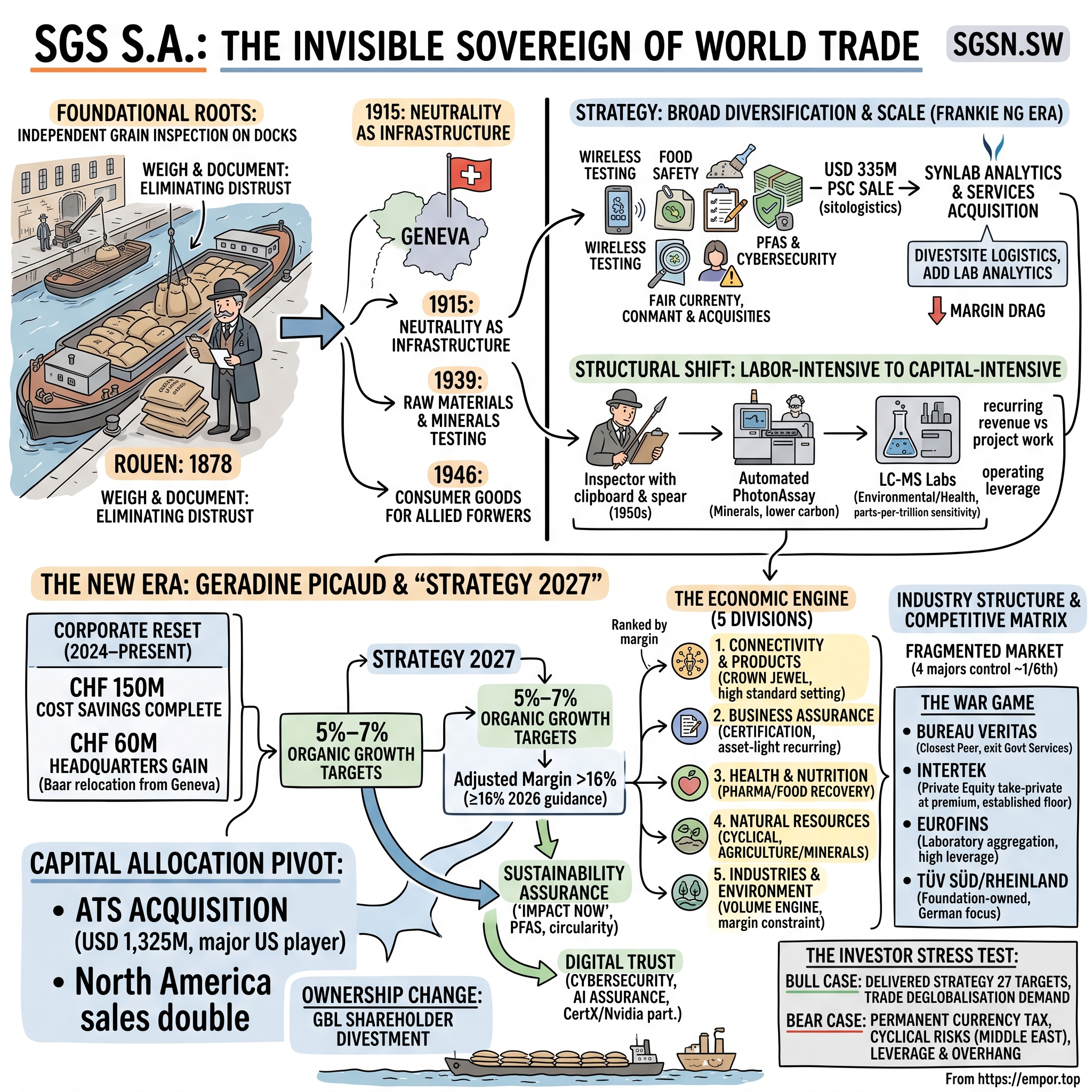
Roughly 100,000 times a day in ports, factories, and laboratories across six continents, routine quality and safety checks occur unnoticed by the public. A container of children's sleepwear is pulled off a manufacturing line in Guangdong to cut a swatch for flammability testing. A shipment of Chilean copper concentrate is sampled at berth, sealed, and split three ways so the buyer, seller, and referee each hold an identical portion. A pallet of infant formula is routed to a mass spectrometer to test for heavy metals at parts-per-billion sensitivity. A car's telematics firmware is delivered to a cybersecurity lab to probe for vulnerabilities before deployment.
These transactions depend on an authoritative verification — a signature backing the quality and safety of the goods.
For nearly 148 years, a major share of those signatures has carried three letters: SGS. The company is the world's largest testing, inspection, and certification business, operating a network of more than 2,500 laboratories and facilities across 115 countries with a workforce exceeding 100,000 people.1 In 2025, it translated that operational scale into record sales of CHF 6,945 million, record adjusted operating income of CHF 1,108 million, and record free cash flow.1 It functions as critical infrastructure for global trade — essential and pervasive, yet largely invisible until testing processes encounter friction or failure.
Why testing looks like a tollbooth — and where the analogy breaks
The investment thesis for testing, inspection, and certification rests on a compelling premise: demand is driven by regulation, contract law, and insurance standards rather than discretionary corporate budgets. A European importer requiring verified carbon data under the Carbon Border Adjustment Mechanism must secure verification to comply with customs rules. A medical device manufacturer cannot ship products without regulatory certification. Demand scales with the increasing technical and regulatory complexity of global commerce. Individual laboratory setups remain inexpensive relative to the trade value they unlock. Furthermore, once a client integrates a provider's accreditations into its regulatory filings, product approvals, and audit trails, switching vendors introduces compliance risk rather than a simple cost saving.
That recurring revenue model resembles an economic tollbooth, but three factors complicate the analogy.
First, a tollbooth business depends on its cost structure. SGS operates a labor-intensive model — employing inspectors, chemists, and auditors — with a substantial fixed-cost baseline. When volumes decline in a region, as occurred across the Middle East in 2026, management faces a choice between protecting operating margins and maintaining regional capacity, and it has repeatedly chosen to preserve capacity.2 Second, currency fluctuations present a persistent reporting challenge. SGS generates revenue in roughly 100 currencies but reports in Swiss francs, creating foreign translation headwinds across recent reporting periods.1 Third, the sector is more fragmented and competitive than the tollbooth model suggests — a reality underscored in 2026 when private equity acquired the industry's most profitable operator outright.
The four questions this story tests
The origin and evolution. How a grain-inspection outfit established on the Rouen docks in 1878 expanded into a Swiss institution, and why the core challenge it addressed then — information asymmetry between distant buyers and sellers — remains the central problem it solves today.3
The margin puzzle. For most of the past decade, SGS led the global testing, inspection, and certification sector in revenue while trailing peers on profitability. In 2023, which serves as the baseline for its current operational strategy, its adjusted operating income margin stood at 14.7%, down 70 basis points from the prior year.4 By comparison, Intertek Group plc, despite generating roughly half of SGS's revenue, maintained operating margins several percentage points higher.5 The central analytical question is why SGS lagged on profitability, and whether its recent margin recovery reflects structural operational improvements or cyclical tailwinds.
The capital allocation pivot. After years operating as an acquisitive roll-up, SGS pledged greater capital discipline, only to execute the largest acquisition in its history in July 2025.6 Determining whether this deal represents strategic discipline or a return to aggressive expansion requires evaluating the acquired assets, their integration, and the purchase valuation.
Ownership and the overhang. Groupe Bruxelles Lambert has served as SGS's anchor shareholder since 2013 but has progressively reduced its stake.78 This divestment carries major governance implications, raising questions about corporate oversight and accountability as the key shareholder gradually exits.
A fifth question reframes the broader sector landscape. In June 2026, private equity buyers agreed to take the industry's most profitable operator private at a premium approaching 60%.25 This transaction suggests either that public markets have systematically undervalued testing assets, or that private capital is paying a steep premium for businesses whose long-term growth and durability may be tested. The outcome indicates whether SGS's valuation reflects company-specific execution or a broader repricing across the testing sector.
The company's story begins in a Normandy river port, where a founder with a small stake identified a persistent flaw in how international trade managed risk and trust.
 Subscribe on LinkedIn
II. Foundational Roots: The Rouen Grain Trade & The Geneva Relocation (1878–1990s)
On the docks of Rouen in 1878, the Seine hummed with barge traffic. Industrializing Europe required immense grain imports from Russia, the Americas, and the Black Sea. Sacks and bulk holds carrying tens of thousands of tonnes were traded across borders on the basis of shipping documents that neither buyer nor seller could independently verify.
Henri Goldstuck, a young Latvian immigrant, observed a persistent inefficiency that traders treated as an inevitable cost of business: cargoes shrank or degraded in transit. Grain arrived lighter, wetter, overheated, or infested. Buyers suspected sellers, sellers blamed shippers, and shippers blamed the weather. Lacking empirical proof, market participants priced in a substantial margin of distrust.
Goldstuck offered a straightforward solution: place an independent inspector on the quayside when a vessel discharges. Weigh the cargo, sample it, document its condition, and sell that verification to whichever party needs credibility.
The first product was a guarantee, not a service
He borrowed capital from an Austrian partner and began inspecting grain arrivals in Rouen in 1878, trading as Goldstuck, Hainze & Co.3 Within a year, the firm expanded to Le Havre, Dunkirk, and Marseille, introducing the core offering that built its reputation: the Full Outturn Guarantee, a service SGS still provides today.3
That guarantee structure established the operational blueprint for the business. A Full Outturn Guarantee did not merely report cargo condition; it placed the inspector’s own credibility, and ultimately capital, behind the measurement. Rather than selling billable labor, the firm transferred transaction risk from unverified counterparties to an independent referee. Subsequent offerings from SGS—whether certification marks, laboratory reports, or carbon verification statements—rely on that same core proposition.
The economics of this design were compelling. While traditional service providers bill for effort, Goldstuck sold verifiable certainty, creating demand on both sides of a transaction. Sellers required proof of dispatch, while buyers needed verification of receipt. A single inspection, conducted once on-site, eliminated disputes that both counterparties sought to avoid. The inspection fee remained small relative to total cargo value, yet building a competing reputation for impartial verification presented high barriers to entry.
The business scaled rapidly. By 1913, the firm inspected 21 million tonnes of grain annually across 45 European offices, establishing itself as the market leader in grain inspection.3
Neutrality as infrastructure
The outbreak of World War I turned a French corporate domicile into an operational liability. In 1915, the company relocated its head office from Paris to Geneva to maintain operations from a neutral jurisdiction, and on 19 July 1919 it adopted the name it still carries, Société Générale de Surveillance.3
That Swiss relocation was driven less by tax or banking considerations than by institutional neutrality. An inspection certificate holds value only if both counterparties view the issuer as strictly impartial. Domiciling in a neutral state functioned as a strategic product feature disguised as a corporate move. That advantage compounded over a century: institutional Swiss neutrality provides commercial trust when a customs authority in Africa accepts an SGS certificate for goods manufactured in Asia and bound for Europe.
Subsequent conflicts and post-war realignments reinforced the value of third-party verification. By 1939, SGS expanded into raw materials, minerals, and metals testing through laboratory acquisitions across Europe, while opening offices in Argentina and Brazil.3 Starting in 1946, the firm grew through contracts with the Allied powers to inspect consumer goods for military personnel, later verifying imports arriving under the Marshall Plan.3 Economic reconstruction proved highly inspection-intensive: whenever vast quantities of goods move between parties lacking established relationships—whether in post-war relief, newly sovereign states, or emerging markets—third-party verification becomes essential.
Diversification, forced early
Management addressed its revenue concentration before market shifts forced a reorganization. Around 1950, agricultural services still accounted for roughly 80% of revenue.3 SGS initiated systematic diversification in 1955 by forming an industrial services unit to inspect machinery and goods, expanding into oil, gas, and chemicals testing in 1962. In 1965, it secured its initial government contract for pre-shipment inspection in the Congo.3
Government services reflected both the strengths and vulnerabilities of the testing model. Under pre-shipment inspection programs, governments in developing economies contract private inspectors to verify import values, quantities, and customs classifications prior to export, effectively outsourcing customs enforcement. While these contracts generate high-margin recurring revenue, they remain subject to sudden political cancellation. SGS still operates government services within its consumer-products division, where anti-fraud and conformity assessment delivered solid growth in 2025; nevertheless, the durable lesson from decades of such mandates remains clear: revenue granted by a sovereign can be withdrawn by a sovereign.1 Competitor Bureau Veritas experienced that vulnerability in 2026, exiting government services after contract terminations in the Middle East and Africa.23
By 1980, half the company's revenue came from services that had not existed a decade earlier—a notable shift for a firm already a century old.3 This transition demonstrated that the company's primary competitive advantage rested on its global network and brand reputation rather than on any individual testing protocol.
SGS went public in 1981, and sales roughly doubled within four years.3 The 1980s added life sciences and systems certification; the 1990s brought entry into former Soviet bloc markets—where the company opened 28 offices by the end of the decade—and, in 1991, entry into China through a joint venture that grew into one of the largest testing footprints in the country, with more than 15,000 staff across over 90 offices and more than 200 laboratories.3
Over time, that physical footprint evolved into a durable asset. Replicating a global testing network requires more than capital expenditure, as each facility carries regulatory accreditations that take years to earn and are granted site-by-site, method-by-method.1 Local network density provides a key competitive edge: an exporter shipping from Ho Chi Minh City requires rapid sample turnaround before a vessel departs, making local proximity far more critical than access to a distant regional hub.
Yet while an accredited global network creates high barriers to entry, physical scale alone does not guarantee superior profitability—a structural reality that would challenge SGS over the subsequent two decades.
III. The Modern Inflection & The Frankie Ng Era (2000s–2023): Scale, Diversification, & Margin Drag
The transformation that defined SGS in the 2000s and 2010s was driven less by geography than by technological complexity.
An inspector on a quay with a clipboard, sampling spear, and scales provides a service whose cost is dominated by labor and whose pricing power is constrained by low barriers to entry. By contrast, a laboratory operating liquid chromatography–mass spectrometry to detect per- and polyfluoroalkyl substances at parts-per-trillion sensitivity represents a fundamentally different economic model. The instruments require substantial capital, the testing methods demand accredited scientists, and clients cannot easily replicate the infrastructure in-house.
As global regulations shifted from verifying basic contract fulfillment—whether a buyer received the agreed quantity—to assessing chemical safety and regulatory compliance, the industry's economics transitioned from variable labor to capital-intensive laboratory assets with inherent operating leverage. This structural shift applied equally to wireless testing chambers for connected devices, microbiology suites for food safety, and cybersecurity evaluation labs where the tested subject is software.
This transition is illustrated in minerals testing, where the traditional method for measuring gold content—fire assay—requires melting samples, chemically separating the metal, and weighing it. While accurate, fire assay is labor-intensive, slow, requires lead, and generates hazardous waste. SGS expanded an alternative technology called PhotonAssay, which bombards sealed samples with high-energy photons to deliver results in minutes with roughly four times lower carbon emissions and no hazardous lead waste.15 Clients receive assay data during active drilling programs rather than weeks later, allowing the testing provider to replace variable labor and consumables with capital assets running continuous throughput. Scaled across chemistry, microbiology, and electronics, this model reshaped the sector's margin potential.
Frankie Ng's nine years: breadth over depth
Frankie Ng served as chief executive of SGS from 2015 until the 2024 annual general meeting.9 Under his tenure, the company expanded into life sciences, food safety, wireless testing, digital services, and sustainability assurance, with the group framing itself as the industry's undisputed leader during those years.9
The company maintained a continuous acquisition strategy—executing small bolt-on deals to fill regional and technical gaps—punctuated by two major portfolio adjustments that signaled shifting strategic priorities. In June 2019, SGS sold Petroleum Service Corporation to Aurora Capital Partners for USD 335 million. PSC, owned since 2004, employed approximately 3,500 people, generated about USD 300 million in revenue, and focused on product-handling and site logistics rather than core testing services.10 The transaction represented the largest divestment in the group's history, generating an exceptional gain of CHF 268 million.103 Eighteen months later, SGS executed the largest acquisition in its history by purchasing SYNLAB Analytics & Services, adding environmental, food, hygiene, pharmaceutical, and product testing capabilities.113 In 2021, the group reorganized into the five operating divisions it maintains today.3
Together, these transactions reflected a strategic pivot away from labor-intensive site logistics toward capital-intensive laboratory analytics. However, while the strategic rationale aligned with broader industry trends, operational execution created organizational complexity.
Where the margin went
By 2023, financial performance reflected growing margin pressure. Revenue reached CHF 6,622 million, supported by organic growth of 8.1%, yet adjusted operating income fell 5.1% to CHF 971 million. The adjusted operating margin contracted to 14.7%, with management attributing 0.5 percentage points of the decline to adverse foreign exchange.4 Even adjusted for currency movements, top-line expansion outpaced profit growth.
Three primary mechanisms accounted for this margin gap:
Mix. A portfolio weighted toward field inspection and environmental services yields structurally lower margins than one concentrated in consumer-product testing or systems certification. These structural differences limit the utility of direct group margin comparisons with peers operating under different segment balances.
Structure. SGS maintained a complex corporate and regional administrative structure. The group's subsequent efficiency program eventually identified CHF 150 million in run-rate savings from procurement efficiencies and a streamlined operating model.1 Cost reductions of this scale underscored operational slack that had accumulated during prior expansion phases.
Acquisition arithmetic. Continuous small acquisitions during a low-interest-rate decade accumulated integration costs, brand fragmentation, and administrative overhead. While SGS does not disclose transaction-level returns, group return on invested capital remained resilient, standing at 22% in 2023, rising to 24% in 2024, and holding at 24% in 2025.4121 These figures indicate that while SGS generated strong returns on its installed asset base, incremental returns on new capital deployment had moderated.
During the same period, Eurofins Scientific SE demonstrated the margin potential of a highly concentrated laboratory footprint. By 2025, Eurofins generated €7,296 million in revenue with an adjusted EBITDA margin of 22.5%, following aggressive acquisition in biopharmaceuticals, food, and environmental testing.13 While Eurofins operated with higher financial leverage and a distinct segment mix, its performance highlighted investor questions regarding whether SGS's broad diversification served as a competitive moat or a drag on profitability.
A capital structure adjustment during the late Ng tenure also altered trading dynamics. At the annual general meeting on 28 March 2023, shareholders approved a 25-for-1 share split effective 12 April, increasing the total share count from 7,495,032 to 187,375,800 and reducing nominal value per share from CHF 1 to CHF 0.04.28 The stock had previously traded in the thousands of Swiss francs per share, reflecting decades of retained earnings without stock splits. While economically neutral, the split expanded retail participation and enhanced trading liquidity ahead of major share placements by the reference shareholder.
The ownership overhang
Ownership dynamics introduced additional governance considerations. In June 2013, EXOR agreed to sell its entire 15% stake in SGS to a wholly owned subsidiary of Groupe Bruxelles Lambert for net proceeds of €2.0 billion, generating a consolidated capital gain of approximately €1,530 million—with GBL taking its place as a reference shareholder alongside the long-standing von Finck family holding.7
This ownership structure provided stability for over a decade until GBL reallocated capital toward private assets. On 6 March 2025, GBL sold 8.5 million SGS shares—representing 4.5% of total equity—via an accelerated bookbuild for roughly €0.8 billion, reducing its holding to approximately 14.6% while remaining the largest shareholder and accepting a 90-day lock-up on the remainder.8 GBL framed the sale as consistent with its November 2024 strategic update and reiterated support for SGS and Strategy 27.8
While the immediate market impact of share placements is technical, the structural shift altered corporate governance dynamics. An anchor investor actively reducing its position provides less long-term oversight than a permanent owner, leaving corporate governance and executive leadership as the primary safeguards for shareholder interests—a reality that heightened the significance of selecting Frankie Ng's successor.
IV. The New Era: Géraldine Picaud, "Strategy 2027", & The Corporate Reset (2024–Present)
The leadership handover was carefully structured. SGS announced that Géraldine Picaud would succeed Frankie Ng as chief executive effective at the annual general meeting on 26 March 2024, having already joined on 1 December 2023 to oversee finance, digital and strategic transformation, acquisitions, IT, and procurement.9 Ng had informed the board of his intent to step down while facilitating an orderly transition.9
Directing finance and operations for four months prior to assuming the chief executive role created an unusual sequence: a comprehensive corporate strategy launched before the incoming chief executive formally took office.
The plan, and what it actually promised
On 26 January 2024, during the 2023 full-year earnings presentation, SGS introduced Strategy 2027, titled "Accelerating growth, building trust." Ng presented the financial results, while Picaud outlined the new strategic framework.4
The plan established specific quantitative targets: annual organic sales growth of 5% to 7%, an increase of at least 1.5 percentage points in adjusted operating income margin by 2027 compared with 2023—measured in reported terms rather than constant currency—and free cash flow conversion exceeding 50% by 2027.4 Accompanying these financial goals was a restructuring effort that established a streamlined operating model designed to deliver CHF 100 million in run-rate cost savings by the end of 2025, supported by a reconstituted twelve-member executive committee.4 Management estimated the global testing, inspection, and certification market at CHF 190 billion, growing at 4% to 5% annually, implying that SGS aimed to outperform underlying market expansion by roughly 1.5 to 2 percentage points.4
At a capital markets event in Antwerp in November 2024, management refined those objectives. The company targeted at least CHF 600 million in incremental revenue from sustainability services and CHF 200 million from digital trust by 2027, alongside a doubling of North American sales and bolt-on acquisitions contributing 1% to 2% in annual growth. Management also reported that the initial CHF 100 million cost-savings program was progressing ahead of schedule and raised the target by identifying an additional CHF 50 million in procurement savings.14
Who Picaud is, and what her CV predicts
Picaud joined SGS with a background in corporate finance, having served as group chief financial officer at building-materials company Holcim and optical manufacturer Essilor International.9 Both roles involved complex global balance sheets—one demanding strict capital discipline in a capital-intensive sector, the other requiring the integration of widespread acquisitions.
This experience influenced her operational approach at SGS. During the February 2026 earnings call, when asked why margin expansion had exceeded initial targets, Picaud attributed the performance to rapid execution of the cost program rather than an expanded savings pool.15 When asked whether margins would continue to expand, she declined to raise targets, stating that management prioritized preserving flexibility to reinvest excess returns into digital and artificial intelligence capabilities.15 Chief Financial Officer Marta Vlatchkova reinforced this stance, advising analysts that the company would not pursue 17% to 18% operating margins at the expense of top-line growth, noting that the profitability gap relative to primary peers had largely closed.15
This approach reflects a calculated strategic decision to forgo maximum short-term margin expansion in favor of reinvestment, leaving future organic growth as the metric by which that capital allocation will be judged.
The merger that wasn't
An unexpected strategic development occurred early in Picaud's tenure. On 15 January 2025, following market speculation, SGS confirmed preliminary discussions with competitor Bureau Veritas regarding a potential business combination.16 Reports indicated that a merger would have created an entity valued at over $33 billion through an all-stock transaction designed to capture significant cost synergies. However, on 27 January 2025, both companies announced that discussions had concluded without an agreement; Bureau Veritas noted that talks ceased despite a conviction in sector consolidation, while SGS reaffirmed its commitment to executing Strategy 2027.1718
The brief negotiations highlighted three structural factors. First, they indicated that leadership remained open to transformative consolidation alongside internal operational restructuring. Second, they underscored a widespread industry view among executives that scale and consolidation offer substantial economic advantages. Third, the decision to abandon complex cross-border negotiations preserved operational focus on internal restructuring, though neither company disclosed specific terms or reasons for terminating discussions.
Execution: what has actually been delivered
Financial results over the first two years of the plan reflected steady operational delivery.
In 2024, sales rose to CHF 6,794 million supported by 7.5% organic growth, adjusted operating income reached CHF 1,040 million—expanding operating margin by 60 basis points to 15.3%—and free cash flow increased 23.8% to CHF 748 million.12 Picaud attributed the performance to early structural reorganization, characterizing the results as an initial benchmark for the group's performance culture.12
In 2025, revenue reached CHF 6,945 million with organic growth of 5.6%, while adjusted operating income expanded to CHF 1,108 million, lifting margins by an additional 70 basis points to 16.0%.1 Free cash flow prior to real estate transactions stood at CHF 774 million, representing a 57% cash conversion rate. Reported earnings per share reached CHF 3.48; excluding the one-time gain from the sale of its Geneva headquarters, adjusted earnings per share were CHF 3.21, a 3.5% increase.1 Net debt decreased to CHF 2,566 million, lowering leverage to 1.7 times operating earnings.1
The cost-reduction initiative met its full target, achieving CHF 150 million in run-rate savings by the end of 2025, with CHF 115 million reflected in operating results during 2024 and 2025 and the remainder taking effect in 2026.1 Vlatchkova noted during the earnings call that efficiency savings generated slightly more than 80 basis points of organic margin expansion in 2025, with part of the gain reinvested in commercial operations and digital trust services.15
Operational momentum persisted into early 2026. First-quarter revenue reached a record CHF 1.75 billion, driven by 5.3% organic growth and a 7.3% contribution from acquisitions, which offset an 8.7% foreign exchange translation drag—a currency headwind management had specifically forecast in February.2715
This management approach has been characterized by detailed financial disclosures—providing specific margin bridges for efficiency gains, acquisitions, and currency effects—and direct acknowledgement of underperforming units. During the February 2026 call, when addressing delays in the Business Assurance consulting division, Picaud noted that the unit had faced headwinds for two years, prompting leadership changes and revised operational expectations.15
The company's capital discipline was further reflected in its headquarters relocation. SGS moved its registered office from Geneva to Baar in the canton of Zug and sold its historic Place des Alpes property, citing underutilization of the Geneva facility and closer proximity to Zurich airport. The real estate sale generated a CHF 60 million operating income gain in the first half of 2025 and CHF 67 million in net cash proceeds.1921 Shareholders endorsed the corporate relocation with 88.99% approval.19
The governance layer
Governance and executive leadership underwent notable updates in late 2025 and 2026. On 11 December 2025, Calvin Grieder, who had served as a director since 2019 and board chairman since 2020, announced his intention to retire at the 2026 annual general meeting, proposing Gilbert Ghostine as his successor.20 Ghostine, chairman of Sandoz and a board member at Danone and Four Seasons Hotels and Resorts, was elected chairman by shareholders on 26 March 2026, alongside approval of a scrip dividend of CHF 3.20 per share offered at a 5% discount.2021 In July 2026, SGS announced that European regional head Malcolm Reid would retire after 38 years with the firm, succeeded by Rafael Navazo, while Mauricio Rocha was appointed to the executive committee as head of Latin America.2
Ghostine's arrival as independent board chairman coincides with the final phase of Strategy 2027. He will oversee the completion of the current strategic framework and the formulation of the company's subsequent long-term plan, which management scheduled for presentation at a capital markets event in Europe on 17–18 November 2026.2
With the corporate reset largely completed, the central operational question turns to segment-level profitability and organic growth across SGS's core business units.
V. Segment-Level Breakdown & Economic Engine
Walk through SGS's five divisions and you are effectively touring five different businesses that happen to share a brand, a lab network, and a balance sheet.
Industries & Environment is the volume engine and the margin problem. In 2025 it generated sales of CHF 2,295 million on 6.5% organic growth, delivering CHF 300 million of adjusted operating income for a 13.1% margin — an improvement from 12.1% the prior year, driven by safety services and inspection.1 This is asset-heavy, people-heavy work: industrial testing, non-destructive testing, environmental laboratories, construction-materials testing, inspection and supervision of major projects. It is the division most exposed to project cycles and to regional disruption, and in the first half of 2026 it showed exactly that, with organic growth of 4.7% but a margin that fell to 11.1% as Middle East disruption bit and the newly consolidated American acquisition changed the mix.2
Natural Resources is the cyclical heart, and the oldest business in the house. Sales of CHF 1,636 million in 2025 on 3.4% organic growth produced CHF 223 million of adjusted operating income at a 13.6% margin, down from 14.4%, as strong metallurgical testing was offset by a poor European harvest and softness in oil, gas and chemicals.1 Picaud's explanation on the February 2026 call was notably unhedged: agriculture had suffered from a bad European crop, minerals had boomed on gold, copper and critical minerals, and oil and gas had slowed — and crucially, Vlatchkova explained that SGS had deliberately chosen not to cut inspectors when volumes dipped, because the business is cyclical by definition and capacity is hard to rebuild.15 That is a defensible operating decision and an honest one. It is also the mechanism by which a "tollbooth" business can post a falling margin.
Connectivity & Products is the crown jewel and the clearest evidence for the mix argument. Sales of CHF 1,352 million in 2025 — under a fifth of the group — generated CHF 308 million of adjusted operating income at a 22.8% margin, up from 21.6%.1 Consumer electronics, wireless, electric-vehicle components, product safety, softlines and hardlines testing all benefit from short product cycles: every new model is a new test, and the customer's alternative is a delayed launch. In the first half of 2026 the division grew 6.8% organically at a 22.7% margin, with double-digit growth in softlines driven by a surge in PFAS testing.2 Picaud pointed to a structural driver behind that surge: after a French ban in January 2026, a European restriction covering clothing, footwear and food-contact materials was set to apply from October.152 That is the business model in miniature — a rule changes, and a testing requirement is created out of nothing.
Health & Nutrition is the repair job that appears to be working. Sales of CHF 882 million in 2025 on 7.3% organic growth produced CHF 124 million of adjusted operating income and a 14.1% margin, a striking recovery from 11.4% a year earlier.1 Food and nutraceutical testing grew at double digits; pharma was solid but uneven, with clinical research strong in Europe and drug development softer.1 The first half of 2026 saw growth moderate to 4.5% with the margin at 12.7%, held back by project delays in European clinical work.2 The division is small enough that a handful of contract phasings move the reported number, which argues for reading it over years rather than halves.
Business Assurance is the asset-light certification engine: CHF 780 million of 2025 sales, CHF 153 million of adjusted operating income, a 19.6% margin — down slightly from 20.1% — on 4.2% organic growth.1 This is where ISO management-system certification, sustainability audits, food and medical-device certification and digital trust services live. It grew 7.3% organically in the first half of 2026 at an 18.9% margin.2
Why a third of revenue carries a disproportionate share of profit
The arithmetic is stark. Connectivity & Products and Business Assurance together produced roughly CHF 2.1 billion of 2025 sales — about 31% of the group — but CHF 461 million of adjusted operating income, roughly 42% of the total.1 The other three divisions supplied 69% of revenue and 58% of profit.
The reason is not that certification auditors are cleverer than mineral inspectors. It is that recurring, standard-setting work with low marginal cost per incremental client behaves differently from project work priced per man-day. A certification body maintains a scheme, trains auditors once, and then renews thousands of certificates on multi-year cycles. A consumer-products lab buys a wireless chamber once and runs it around the clock. In both cases the incremental unit is cheap. In inspection and supervision, the incremental unit is a person on a site.
That structural truth cuts both ways for the investment case. It means group margin will drift upward if the high-return divisions outgrow the rest — which they have been doing. It also means that the very diversification management defends as a source of resilience is, mechanically, a drag on reported profitability. Both statements are true simultaneously, and any honest assessment has to hold them together.
Where the optionality actually sits
Two growth vectors deserve accurate sizing rather than enthusiasm.
Sustainability assurance is now genuinely material. The offering SGS brands as IMPACT NOW grew 15.1% in total in 2025, driven by renewable energy and greenhouse-gas verification, PFAS testing, circularity and recycled-materials work, and ESG audits.1 By the end of 2025 sales were already above 75% of the CHF 1 billion 2027 target.1 Asked directly in February 2026 whether the American environmental backlash and softening European regulation were slowing demand, Picaud pushed back with the growth number and argued the driver was consumer awareness as much as regulation — people want to know whether products contain heavy metals, PFAS or contaminants.15 The evidence supports her on trajectory; the falsifiable part of the claim is whether growth survives a genuine regulatory retreat rather than a rhetorical one.
Digital trust — cybersecurity evaluation, information-security certification, and increasingly AI assurance — is smaller and faster. Total growth was 19.2% in 2025, with 2025 sales likewise past 75% of the CHF 350 million 2027 target, supported by high-assurance cybersecurity evaluations, expansion in data and AI through CertX, and a stated partnership with Nvidia.1 In the first half of 2026 it grew 38.0% in total — but the composition is the important part: 18% organic and roughly 29% from acquisitions.152 Even at the 2027 target, digital trust would be around 5% of group sales. It is real optionality with a genuine growth rate, not a replacement engine, and it should be sized accordingly.
The concept underneath is worth stating plainly for non-specialists. Certifying that a connected device is secure is conceptually identical to certifying that a shipment of grain weighs what the invoice says. A buyer cannot verify the claim themselves, the cost of being wrong is high, and a credible third party with recognised accreditation can charge for closing the gap. Nothing about the business model changed. Only the sample did.
The geography beneath the divisions
The divisional view conceals a second engine, which is regional. In 2025, testing and inspection revenue split roughly as CHF 2,027 million in Europe growing 2.4% organically, CHF 1,994 million in Asia Pacific growing 7.7%, CHF 778 million in North America growing 3.9%, CHF 616 million in Latin America growing 13.6%, and CHF 750 million across Eastern Europe, the Middle East and Africa growing 5.3%.1 By the first half of 2026 the ranking had shifted: Asia Pacific accelerated to 9.9%, Latin America held at 9.0%, North America improved to 6.1% after a weak first quarter, Europe remained the laggard at 2.3%, and the Eastern Europe, Middle East and Africa region turned negative at minus 2.8%.2
Three things follow. First, roughly a third of SGS's testing revenue sits in a European market growing at barely a third of the group rate — a structural drag that no amount of digital trust growth entirely offsets. Picaud was direct about the cause on the February 2026 call, citing recession in Germany and the difficulties of the European automotive industry, and describing both Europe and North America as regions SGS was "in a process to fix."15 Second, Latin America's double-digit expansion is real but concentrated: management confirmed Chile is the largest business in the region and that Argentina, where hyperinflation is capped in the organic-growth definition, is only around a tenth of regional sales — so the growth is genuine volume, not inflation accounting.15 Third, the North American doubling ambition is the single largest strategic bet in the plan, and it is being achieved substantially through acquisition rather than organically. By the 2025 results, North American sales in dollars had nearly doubled against the 2023 baseline including the full scope of acquisitions.1 That is a legitimate way to hit a target. It is not the same thing as winning share.
Which raises the question of who else can do this, and how defensible the position really is.
VI. Industry Structure, Moats, & The Competitive Matrix
A single figure illustrates the structure of the testing, inspection, and certification sector: SGS estimates its total addressable market at CHF 190 billion, expanding at an underlying 4% to 5% annually.4 Against that total, SGS's record CHF 6.9 billion in revenue represents less than 4% of global demand.1
Combining SGS with the other listed majors — Eurofins at €7.3 billion, Bureau Veritas at €6.5 billion, and Intertek at £3.4 billion — shows that the four largest global providers control roughly one-sixth of the market.13225 The remaining five-sixths consists of internal corporate laboratories, municipal and government facilities, university research units, and thousands of niche regional specialists.
That fragmentation represents the defining structural feature of the sector, carrying two opposing implications. On one hand, it supports above-GDP organic growth for decades as corporations continuously outsource captive, in-house laboratory operations. On the other, it limits individual pricing power: unlike true monopoly infrastructure assets, testing providers almost always face competition from alternative accredited facilities.
The war game
Bureau Veritas serves as SGS's closest structural peer. In 2025, the company generated €6,466.4 million in revenue with 6.5% organic growth, a 16.3% adjusted operating margin, 107% cash conversion, and a €200 million share buyback — achieving sector-leading organic expansion and a profitability level now aligned with SGS.22 It maintains strong positions in marine and offshore testing as well as building and infrastructure, areas where SGS has less presence. However, Bureau Veritas also illustrated the sector's underlying cyclicality when, on 29 July 2026, it lowered its 2026 organic growth forecast from mid-to-high single digits to mid-single digits. Management cited geopolitical tension, macroeconomic uncertainty, and its exit from government services following contract terminations across the Middle East and Africa, reporting first-half revenue of €3,258.4 million, 5.0% organic growth, and a 15.5% adjusted operating margin.23 This adjustment demonstrates that SGS's recent Middle East headwinds reflect a broader regional shock affecting both industry leaders simultaneously rather than an isolated operational lapse.
Intertek Group plc long served as the sector's profitability benchmark but is transitioning to private ownership. In 2025, Intertek reported revenue of £3.43 billion, up 4.3% at constant currency with 3.9% like-for-like growth, and an adjusted operating margin of 18.1% — an expansion of 90 basis points that approached its medium-term target of 18.5%.5 On 10 April 2026, private equity firm EQT submitted an unsolicited offer at £51.50 per share, which Intertek's board rejected three days later; subsequent proposals at £54.00 and £58.00 were similarly turned down on 24 April and 8 May.24 On 18 June 2026, the boards agreed on a recommended final cash acquisition by a vehicle owned by EQT alongside co-investors Luxinva and Mubadala. The deal offered £60.00 per share in cash plus a retained final dividend of 107.7 pence — bringing total value to £61.077 per share, valuing Intertek's equity at approximately £9.3 billion with an enterprise value of about £10.7 billion.25 The cash price represented a 59% premium over the pre-announcement closing price of £37.70.25
That substantial premium underscores a notable disconnect between public equity markets and private valuations. Before EQT's approach, public markets valued the industry's most profitable operator at approximately 11 to 12 times enterprise value to adjusted operating profit. Private equity, operating with long-term capital horizons and freedom from quarterly public disclosures, valued the business at more than 1.5 times that multiple. That transaction establishes a valuation benchmark across the entire sector, directly influencing how investors assess SGS.
Eurofins Scientific SE remains the sector's most active acquirer, operating a laboratory-aggregation strategy backed by higher financial leverage and a product mix focused on biopharmaceuticals, food, and environmental testing.13 Its higher reported profit margins reflect a distinct business structure and financial metric rather than direct operational superiority.
TÜV SÜD, TÜV Rheinland, and TÜV NORD occupy a unique position as foundation-owned German organizations with deep roots in industrial and automotive testing throughout German-speaking Europe. Their governance structure shapes their market posture: free from public equity market scrutiny, activist shareholder pressure, or take-private dynamics, foundation-controlled entities can maintain long-term pricing discipline without short-term margin demands. In an industry where public companies balance margin expansion against top-line growth, these foundation-backed competitors operate without those public capital market constraints.
华测检测 Centre Testing International represents a growing domestic competitor in China, reporting 2025 revenue of RMB 6.621 billion (up 8.82%) and net profit attributable to shareholders of RMB 1.016 billion (up 10.35%).26 Although its global scale is roughly one-tenth that of SGS, it competes aggressively across Chinese consumer and industrial testing markets where SGS has operated since 1991 — demonstrating that local facility density provides a strong defensive advantage for domestic incumbents.
Testing the powers, honestly
Evaluating SGS through strategic business frameworks yields a nuanced assessment of its competitive moat.
Scale economies are genuine but geographically bounded. While high-volume laboratory equipment like mass spectrometers achieves lower unit costs through sample throughput, scale advantages in testing remain primarily local — sample volume in Chile does not improve laboratory utilization in Rotterdam. Global scale provides centralized procurement leverage and shared method development, as evidenced by the CHF 50 million in procurement savings SGS secured under its cost reduction program.1 However, it does not create the sweeping global cost advantages seen in capital-intensive manufacturing sectors.
Switching costs represent the company's strongest competitive barrier. As Picaud explained to analysts in February 2026, regulatory accreditation requires extensive validation time, forming a core barrier to entry; acquiring an established laboratory grants immediate access to accreditations that would otherwise require years to secure.15 For corporate clients, switching testing providers requires re-validating testing protocols, updating regulatory filings, and assuming potential compliance exposure, creating substantial customer retention.
Counter-positioning is virtually non-existent across the sector. No structural impediment prevents peers like Bureau Veritas or regional laboratories from offering identical inspection services. Competition centers on geographical proximity, accreditation breadth, and turn-around speed rather than a proprietary business model that competitors cannot replicate.
Branding represents an enduring asset built over nearly a century and a half. A testing certificate serves as a guarantee of trust, and a Swiss-headquartered brand recognized by global customs authorities carries premium authority compared to an unfamiliar facility. This reputation enables SGS to secure multi-country corporate contracts.
Network economies, in the strict sense, are absent because individual clients derive no direct utility from other clients using the same provider. Instead, SGS relies on facility network density, which offers customers operational convenience across multiple markets without generating winner-take-all dynamics.
Applying Porter's Five Forces framework yields consistent conclusions. Buyer power is moderate and increasing as multinational corporations centralize procurement. Supplier power remains minimal, outside specialized scientific disciplines. Substitution risk represents a persistent factor: the primary alternative to third-party testing is a client's internal laboratory, which becomes attractive whenever corporate outsourcing costs rise. Barriers to entry are high for accredited multi-regional testing but low for basic, localized inspection. Finally, industry rivalry remains high, with major players competing for market share and acquisition targets in a fragmented sector. Picaud acknowledged this competitive dynamic, noting that rival firms are entering SGS's core target verticals and driving up competition for acquisition targets.15
Myth versus reality
Three widespread market assumptions regarding SGS warrant critical re-examination.
Myth: SGS trades at a persistent discount to Intertek that a margin recovery will close. Historically accurate, this narrative no longer reflects market realities. Intertek accepted an acquisition offer at £60.00 per share in cash, establishing an enterprise value of approximately seventeen times its 2025 adjusted operating profit.255 By comparison, in late July 2026, SGS held a market capitalization of roughly CHF 19 billion against net debt of CHF 3.9 billion, translating to an enterprise value near twenty times its 2025 adjusted operating income.2921 Based on these figures, SGS trades at a premium rather than a discount relative to its primary peer, meaning future investment performance depends on organic growth execution rather than valuation catch-up.
Myth: Regulated demand makes the testing sector non-cyclical. Performance in mid-2026 challenged this assumption when both leading European operators reported regional slowing. SGS experienced operational headwinds in the Middle East, while Bureau Veritas lowered its full-year organic growth guidance, both citing geopolitical instability and regional contract cancellations.223 While regulatory mandates dictate whether testing is mandatory, overall trade volumes and economic activity determine how many tests are performed — creating direct exposure to macroeconomic fluctuations.
Myth: SGS's broad diversification serves as a defensive moat. Management contends that broad service offerings reduce earnings volatility, a point illustrated in 2025 when strong metallurgical testing offset weakness in European agricultural harvests.151 However, operating across diverse, lower-margin field inspection lines mechanically depresses group profit margins relative to specialized peers. Picaud acknowledged this trade-off, indicating that management might consider divesting select non-core business lines to unlock shareholder value.15 Consequently, broad diversification represents a deliberate portfolio choice involving clear margin trade-offs rather than a structural competitive moat.
SGS maintains a formidable position grounded in regulatory accreditations, geographic density, and brand trust, competing within a sector supported by long-term secular growth trends but constrained by market fragmentation. It remains a durable, highly cash-generative business, though one subject to clear operational and competitive limits.
VII. Stress Testing the Investment Thesis: Bull vs. Bear Case & Activist Analysis
The case for continued compounding
The bull argument no longer rests on a promise. It rests on delivery, which is a materially stronger foundation than it was two years ago.
SGS set three testable targets in January 2024 and, by the end of 2025, had effectively cleared the hardest one early: the margin improvement target of at least 1.5 percentage points by 2027 versus 2023 was already 1.3 points delivered, with further procurement savings still to flow through in 2026.1 Cash conversion at 57% cleared the 50% threshold with room to spare.1 Organic growth landed inside the 5% to 7% band in both 2024 and 2025 and again in the first half of 2026.1212 Management declared the pillars of Strategy 27 fully implemented ahead of schedule and committed to laying out the next phase in November 2026.12
The mix argument runs in the company's favour. Digital trust, sustainability services and consumer-products testing all grow faster than the group and carry higher margins, so the arithmetic of mix shift adds margin without requiring a single additional cost cut.
The trade-policy argument is genuinely counter-intuitive and worth stating carefully. Deglobalisation does not obviously reduce testing demand; in many cases it increases it. When a supply chain relocates from China to Vietnam or Mexico, every new supplier requires qualification, every new facility requires audit, and every new route requires inspection. Picaud pointed to exactly this dynamic in North America, describing demand driven by data centres, energy infrastructure, aerospace and defence, and pharmaceutical reshoring.152 North American organic growth accelerated to double digits in the second quarter of 2026 after a soft first quarter.2
And there is the valuation reference point that did not exist a year ago. With Intertek being taken private at an enterprise value of roughly £10.7 billion on 2025 adjusted operating profit of about £621 million — approximately 17 times — a floor has arguably been established for what an informed private buyer will pay for a high-quality TIC asset.255
The case against
Currency is not a rounding error. In 2025, adverse foreign exchange reduced reported sales growth by 5.1 percentage points and cut adjusted operating income by CHF 66 million, worth 20 basis points of margin.151 In the first half of 2026 the drag was 5.8 points on sales.2 Vlatchkova illustrated the point vividly: 2025's 2.2% reported sales growth in Swiss francs would have been 3.9% in euros and 8.3% in dollars.15 Management flagged that first-quarter 2026 would carry an 8% to 9% headwind at then-current rates, and the actual outcome was minus 8.7%.1527 This is not a hedging failure; it is structural translation exposure that recurs every period the franc strengthens, and it directly suppresses reported margin because the plan is stated in reported terms.
Cyclicality is live, not theoretical. The Middle East situation cost roughly 60 basis points of first-half 2026 organic growth and about 80 basis points in the second quarter, on a region representing around 2% of sales, and drove roughly CHF 8 million of the CHF 18 million of first-half restructuring charges.215 Natural Resources margin fell in 2025 on a bad European crop and soft oil and gas.1 These are ordinary business risks — but they falsify any claim that regulated demand makes results non-cyclical.
The margin ceiling may be self-imposed. Management has now twice told the market it prefers reinvestment to margin maximisation, and 2026 guidance of "≥16%" is, in substance, a commitment to hold rather than to expand.115 If reinvestment produces faster organic growth, that is value-creating. If it does not, the company will have traded a certain gain for an uncertain one.
Leverage moved the wrong way, by design. Net debt rose CHF 1,350 million in the first half of 2026 to CHF 3,916 million, principally to fund the American acquisition and the cash portion of the dividend, taking expected year-end leverage to around 2.2 times adjusted EBITDA against a stated preference to sit near 1.7 and below 2.0 sustainably.215 Financial expenses rose to CHF 53 million from CHF 43 million, and the CFO indicated no material step-up in the second half.215 This is manageable, but it removes the balance-sheet headroom that would otherwise absorb a downturn.
The share overhang has not been retired. GBL's remaining stake, and its stated portfolio rotation, mean further placements remain possible.
The risk radar that actually applies
Most macro risk lists are noise for a company like this. Four are not.
Artificial intelligence cuts in both directions, and the net effect is unresolved. On the demand side it creates work: SGS sells assurance for AI systems, and Picaud described clients asking whether an algorithm is sound and whether it is biased.15 On the supply side it threatens the labour-intensive core. Asked directly whether AI efficiency gains were realistic and margin-accretive, Picaud described SGS as a people business with substantial optimisation potential, said the first effect would be upskilling followed by identifiable productivity gains, and framed AI as both an internal efficiency tool and an external revenue source.15 That answer is honest and non-specific. No quantified AI productivity target has been disclosed. Investors should treat AI as an unquantified swing factor rather than a known tailwind, and note that a competitor who automates report generation and sample triage faster would erode the cost advantage that density currently provides.
Talent concentration is the hidden operating constraint. Accredited chemists, wireless engineers, cybersecurity evaluators and lead auditors are not interchangeable, and they are the binding constraint on growth in exactly the high-margin lines the strategy depends on. This is also why management's decision to retain inspectors through a downturn is more defensible than it first appears — rebuilding accredited capacity is slower and dearer than carrying it.15
Cybersecurity and data integrity risk is existential rather than financial. A company whose product is trust holds enormous volumes of confidential client test data. A material breach or a falsified-results scandal would damage the brand asset in a way no operating result could offset. SGS discloses no specific incident, and none is alleged here — but the asymmetry is worth naming, because the downside is not proportionate to the direct cost.
Regulatory retreat is the cleanest falsifier of the growth story. If sustainability reporting requirements are meaningfully rolled back rather than merely debated, a growth engine now approaching CHF 1 billion of sales loses its statutory driver and must survive on voluntary demand alone.1 Management argues consumer awareness would carry it. That proposition has not yet been tested by an actual repeal.
The activist's brief
A skeptical investor would press on four fronts, and management has given partial answers on all of them.
Was the big acquisition disciplined, or a relapse? On 2 July 2025, SGS agreed to acquire Applied Technical Services for USD 1,325 million enterprise value on a debt-free, cash-free basis — 11.2 times 2026 EBITDA including run-rate synergies — for a business expected to deliver USD 460 million of sales and USD 95 million of EBITDA before synergies in 2026, with at least USD 30 million of annual run-rate synergies within three years and accretion to EPS from year one.6 ATS brought 2,100 professionals across 85 US facilities in manufacturing, aerospace and defence, power generation and insurance.6 The deal closed in January 2026.1
The bull reading: 11.2 times including synergies is not an obviously silly multiple for a business in regulated, high-growth end markets, particularly against the roughly 17 times a private buyer subsequently paid for Intertek. The bear reading: 11.2 times including synergies is a materially higher multiple excluding them, and SGS has committed to a specific integration outcome. The evidence so far is thin but positive — at the half year, management said cost synergies in procurement, real estate and leadership consolidation had begun, reiterated at least CHF 5 million of synergies in 2026 against a CHF 30 million target split evenly between cost and cross-selling, and launched a combined data-centre offering.215 Notably, ATS was kept as a standalone entity with its own board reporting directly to the CEO, rather than absorbed.15 That preserves brand and culture; it also makes synergy realisation harder to verify from outside.
Is the growth price or volume? SGS does not disclose a price-volume split, so this cannot be resolved from public data. What can be observed is that growth has moderated from 8.1% in 2023 to 7.5% in 2024 to 5.6% in 2025 and 5.6% in the first half of 2026 — a pattern consistent with post-inflation price contribution fading while volume holds.41212 Management also disclosed that deliberate pruning of low-margin contracts cost roughly 10 to 20 basis points of first-half organic growth, which is a small but genuine quality-over-quantity signal.15
Is the portfolio too complex? This was asked directly on the July 2026 call, and the exchange is the most revealing in either transcript. Citi's Arthur Truslove noted the private-equity-driven portfolio activity around SGS's peers and asked whether operating on a diversified basis maximised shareholder value, and what SGS might do to demonstrate hidden value. Picaud's answer conceded the debate is live, acknowledged there were business lines SGS "might consider to effectively divest and unlock some value" as part of an ongoing portfolio review, and then defended breadth on the grounds that a blended portfolio reduces earnings volatility and that SGS is a deep specialist in several businesses rather than a generalist.15 That is a more open answer than she gave in February 2026, when she said there was nothing SGS wanted to sell beyond "little things here and there."15 The shift in tone within five months, coinciding with a private-equity bid for a peer, is an analytical fact worth tracking.
Is capital allocation sustainable? SGS maintained the dividend at CHF 3.20 per share for 2025 but has been paying it partly in shares.1 The 2026 scrip take-up was 61.4%, redirecting close to CHF 400 million of cash toward growth.2 This is an elegant solution and also a form of dilution: shareholders who take cash are diluted by those who take stock. Management framed it as core to Strategy 27's financial-profile pillar and said in February 2026 that it expected to continue.15 An activist would reasonably ask when a company generating CHF 774 million of free cash flow returns to paying its dividend entirely in cash.1
What about goodwill? A roll-up that has bought dozens of businesses a year for two decades necessarily carries a large acquired-intangibles balance, and the honest position is that an outside observer cannot test it deal by deal. What is observable is that SGS has not reported a material goodwill impairment across the periods reviewed here, and that group return on invested capital has held at 24% through a period of heavy acquisition activity — evidence that the aggregate book is earning its keep, even if individual deals cannot be audited.121 The item to watch is amortisation of intangible assets, which rose in the first half of 2026 driven specifically by the American acquisition.2 Rising amortisation is not a cash cost, but it widens the gap between adjusted and reported profitability, and the wider that gap becomes the more an investor is relying on management's own definition of performance. That is the standard trade a large acquirer asks its shareholders to accept.
One accounting note deserves flagging without alarm. Reported earnings in both 2025 and the first half of 2026 were materially affected by the headquarters disposal, and SGS itself presents EPS and free cash flow both with and without that gain — appropriate disclosure that nonetheless means headline growth rates require care.12 Restructuring charges have been running high but declining, guided to CHF 20 to 40 million for 2026 after roughly CHF 45 million in 2025, and the CFO declined to guide on other non-recurring items, noting they had historically averaged around CHF 120 million and were by nature unpredictable.15 A line item averaging nine figures below adjusted operating income is not trivial, and the gap between adjusted and reported operating income — CHF 1,108 million versus CHF 1,014 million in 2025 — is where it lives.1
VIII. Key Business & Investing Lessons
The tollbooth principle, and its fine print. Businesses positioned at the intersection of trade, regulation, and legal liability enjoy something rarer than discretionary growth: demand created by law rather than buyer choice. When the European Union restricted per- and polyfluoroalkyl substances in clothing and footwear, it did not create an optional service for testing companies; it created a mandatory requirement for their customers.152 That statutory backing provides steady baseline demand. However, the fine print is that a testing provider with substantial fixed overhead and no local monopoly functions more like a toll road operator: while it collects steady fees, it must continuously maintain its laboratory infrastructure, and competitors can build accredited alternatives nearby. SGS's history illustrates both sides of that dynamic—nearly 148 years of commercial relevance, alongside a decade in which durable demand coincided with contracting operating margins.
Scale is not a strategy, and revenue leadership is not an achievement. The central lesson from SGS's recent history is that revenue scale does not automatically yield superior profitability. For years, the company operated as the industry's largest player by sales while trailing major peers on operating margin—a divergence that persisted until management launched an efficiency program to capture 150 million Swiss francs in run-rate cost savings.1 Investors evaluating market leaders must distinguish between operational size and capital efficiency, as the two metrics frequently diverge. Furthermore, SGS's margin recovery stemmed from structural cost discipline rather than a change in its underlying business model, illustrating that administrative slack represents latent shareholder value requiring a specific operational catalyst.
Currency mismatch is a permanent tax, not a temporary headwind. SGS reports its financial results in Swiss francs while generating revenue across roughly 100 currencies and maintaining corporate overhead in a persistently strong home currency. Across 2025 and the first half of 2026, foreign exchange translation reduced reported revenue growth by more than five percentage points in each reporting period.12 Because long-term currency hedging across dozens of volatile markets is commercially impractical, translation headwinds represent a structural feature of the company's domicile rather than a temporary operational setback. Notably, management chose to frame its Strategy 2027 margin targets in reported terms rather than constant currency, accepting direct accountability for foreign exchange translation in its published goals.
This dynamic demonstrates that reporting currency significantly influences top-line perception. For instance, the same operational performance that yielded 2.2% reported sales growth in Swiss francs translated to 8.3% growth when measured in U.S. dollars.15 Evaluating SGS alongside peers reporting in dollars or euros requires adjusting for currency effects. Analyzing organic revenue growth and constant-currency margin expansion provides a clearer assessment of operational execution than reported figures alone.
Portfolio pruning is a distinct value-creation skill, and it has a shelf life. SGS's corporate evolution highlights a multi-year sequence: two decades of rapid expansion, the divestment of a non-core logistics provider, the acquisition of a major analytics firm, a group-wide efficiency program, a headquarters property sale, small non-core disposals, and an active portfolio review.1011115 While each step unlocked value trapped in an oversized organizational footprint, portfolio rationalization has inherent limits; operational slack can be eliminated only once. Sustained long-term value creation will depend on organic growth execution, making the strategy outline scheduled for the November 2026 capital markets event a critical benchmark for the company's next phase.
IX. Epilogue & The 3 Core KPIs to Watch
On 24 July 2026, SGS reported first-half sales of CHF 3,683 million, driven by 5.6% organic growth that accelerated to 5.9% in the second quarter, a 15.1% adjusted operating margin, and record free cash flow of CHF 260 million. Management also confirmed its full-year targets: 5% to 7% organic growth, 5% to 7% additional revenue from acquisitions, an adjusted operating margin of at least 16%, and cash conversion exceeding 50%.2 The stock barely moved.
That market non-reaction summarizes the company's current position. The operational turnaround has been delivered and priced in by investors; the corporate reset is complete, but the long-term reinvention is just beginning. Chief Executive Géraldine Picaud closed the earnings call by asserting that at SGS "we turn promises into tangible performance" — a claim supported by two years of execution, but one that will face renewed scrutiny from a higher baseline when management presents its next strategic plan in November.15
Owning the business at this stage presents a distinct challenge. The immediate value-creation levers have already been pulled: administrative overhead reduced, corporate real estate monetized, and underperforming business lines restructured. Future value creation depends on the more demanding discipline of allocating capital to high-return growth assets in a market where quality testing businesses are increasingly expensive. Picaud acknowledged this dynamic, telling analysts that competition for bolt-on acquisition targets had intensified noticeably during her tenure, while emphasizing that SGS would maintain strict discipline requiring payback and a double-digit return on invested capital within five years.15 That rule stands as the company's clearest and most measurable capital allocation commitment.
Three key operational metrics will determine performance from here.
Organic revenue growth. This metric serves as the primary test of whether SGS is capturing underlying market demand or relying on inflation-driven pricing. Management targets 5% to 7% annual organic growth against an estimated market growth rate of 4% to 5%, requiring the firm to consistently outpace the broader sector.4 Revenue composition remains critical: expansion driven by digital trust, sustainability assurance, and consumer products carries significantly higher profit margins than field inspection volumes, generating greater incremental value.
Adjusted operating income margin, in reported terms. Strategy 2027 pledged a margin expansion of at least 1.5 percentage points above the 2023 baseline of 14.7%.4 With most of that gain already realized through structural cost reductions, future performance depends on operational execution. As efficiency savings taper and management reinvests surplus capital into artificial intelligence and digital infrastructure, the key analytical question is whether margins can continue to expand. Stable margins paired with accelerating organic revenue would confirm the return on reinvested capital, whereas flat margins alongside slowing top-line growth would indicate diminishing returns.
Free cash flow conversion. Maintaining cash conversion above 50% provides the ultimate test of earnings quality, capital expenditure control, and working capital discipline. Free cash flow conversion reached 57% in 2025.1 Following the U.S. acquisition, which increased leverage toward 2.2 times operating earnings against a target of 1.7 times, robust cash conversion serves as the primary mechanism for balance sheet deleveraging.215 Performance should be measured against historical seasonality, with approximately one-third of annual conversion generated in the first half and two-thirds in the second.15
Beyond individual KPIs, a broader strategic question remains. For nearly 148 years, SGS has built its business on a single core proposition: providing authoritative verification to resolve trust gaps between trading counterparties. As global commerce has evolved, that verification has expanded from grain shipments to machinery, petroleum, consumer electronics, carbon emissions, and software algorithms. Each transition succeeded because the firm leveraged its accredited global network and reputation while adapting its testing capabilities to increasingly complex domain science.
Géraldine Picaud has demonstrated an ability to streamline operations and capture efficiency gains across a broad global footprint. The long-term test for leadership is whether SGS can generate sustainable organic growth when cost reductions and small bolt-on acquisitions are no longer sufficient to drive valuation—and whether a publicly traded company subject to quarterly market scrutiny can sustain long-term capital deployment through economic cycles, especially as private equity buyers signal that public markets may be underestimating the intrinsic value of testing infrastructure.
References
-
SGS 2025 Full Year Results Press Release — SGS SA, 2026-02-11 ↩↩↩↩↩↩↩↩↩↩↩↩↩↩↩↩↩↩↩↩↩↩↩↩↩↩↩↩↩↩↩↩↩↩↩↩↩↩↩↩↩↩↩↩↩↩↩
-
SGS 2026 Half Year Results Press Release — SGS SA, 2026-07-24 ↩↩↩↩↩↩↩↩↩↩↩↩↩↩↩↩↩↩↩↩↩↩↩↩↩↩↩↩↩↩
-
SGS 2023 Full Year Results Earnings Release and Launch of Strategy 2027 — SGS SA, 2024-01-26 ↩↩↩↩↩↩↩↩↩↩↩
-
Intertek 2025 Full Year Results Announcement — Intertek Group plc, 2026-03-03 ↩↩↩↩↩
-
SGS Has Signed an Agreement to Acquire ATS, a Major American Player — SGS SA via PR Newswire, 2025-07-02 ↩↩↩
-
EXOR Announces Agreement to Sell Its Entire Stake in SGS to GBL for €2 Billion — EXOR, 2013-06-03 ↩↩
-
GBL Successfully Completes the Sale of 8.5 Million Shares of SGS SA — Groupe Bruxelles Lambert, 2025-03-06 ↩↩↩
-
Géraldine Picaud to Succeed Frankie Ng as Chief Executive Officer — SGS SA, 2024-01 ↩↩↩↩↩
-
SGS Sells Petroleum Services Corporation for USD 335 Million to Aurora Capital Partners — SGS SA, 2019-06 ↩↩↩
-
SGS Completes Acquisition of SYNLAB Analytics & Services — SGS SA, 2021-01-04 ↩↩
-
SGS 2024 Full Year Results Press Release — SGS SA, 2025-02-11 ↩↩↩↩↩↩
-
Eurofins 2025 Full Year Results Press Release — Eurofins Scientific SE, 2026-01-29 ↩↩↩
-
Capital Markets Event 2024: Executing Strategy 27 at Full Speed — SGS SA, 2024-11-20 ↩
-
Earnings Call Transcript: SGS Posts Record H1 2026 Results — Investing.com, 2026-07-24 ↩↩↩↩↩↩↩↩↩↩↩↩↩↩↩↩↩↩↩↩↩↩↩↩↩↩↩↩↩↩↩↩↩↩↩↩↩↩↩↩↩↩
-
Statement: SGS Confirms Discussions with Bureau Veritas — SGS SA, 2025-01-15 ↩
-
Discussions Between SGS and Bureau Veritas Have Ended — SGS SA, 2025-01-27 ↩
-
Bureau Veritas Statement on End of Discussions with SGS — Bureau Veritas via GlobeNewswire, 2025-01-27 ↩
-
Swiss Multinational SGS to Move HQ from Geneva to Zug — SWI swissinfo.ch ↩↩
-
Succession to the Chair of the SGS Board of Directors — SGS SA, 2025-12-11 ↩↩
-
SGS Shareholders Approve All Resolutions at the Annual General Meeting — SGS SA, 2026-03-26 ↩
-
Sector-Leading Organic Revenue Growth of 6.5% in FY 2025 — Bureau Veritas, 2026-02-24 ↩↩
-
Bureau Veritas: Delivering on Our Commitments with Higher Sequential Organic Growth in Q2 — Bureau Veritas via GlobeNewswire, 2026-07-29 ↩↩↩
-
Rejection of Possible Offer from EQT — Intertek Group plc via Investegate, 2026-04 ↩
-
Rule 2.7 Announcement: Recommended Final Cash Acquisition of Intertek Group plc by Isotope Bidco Limited — Intertek Group plc, 2026-06-18 ↩↩↩↩↩
-
2025 Annual Report of Centre Testing International Group Co., Ltd. — Centre Testing International, 2026-03-30 ↩
 LinkedIn
 WhatsApp
 Reddit
 Hacker News
 Email
Email Kindle
 RSS Feed
 Spotify
 Apple Podcasts
 Amazon Music
 Audible
 YouTube