The Land Grab in Europe's Industrial Heart: The Story of SEGRO
I. Introduction & The June 2026 Takeover Drama
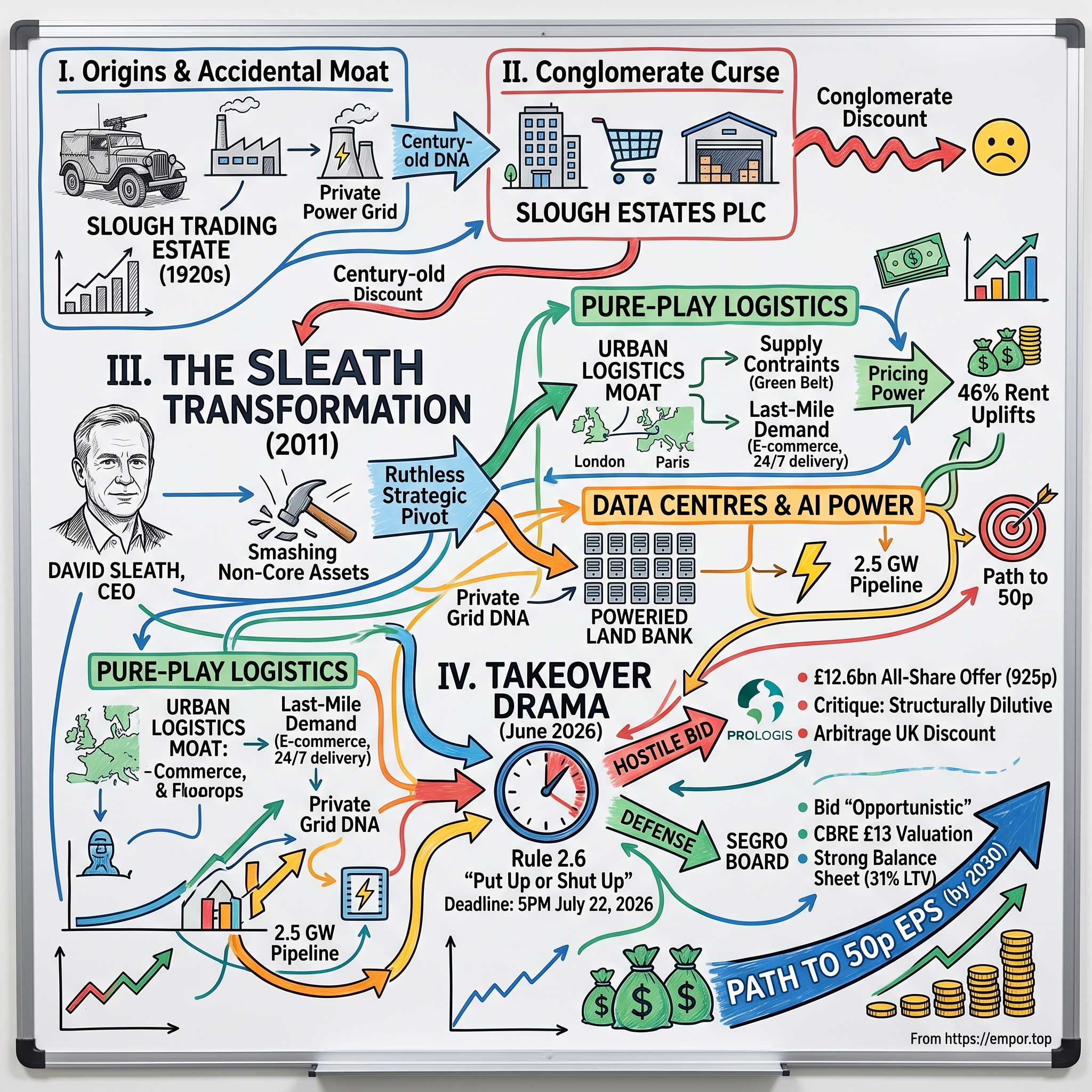
On the morning of June 24, 2026, traders staring at their SGRO screens watched the stock detonate. In the space of a few minutes SEGRO Plc — the sober, century-old owner of warehouses and industrial estates that most retail investors could not pick out of a lineup — leapt roughly 19 percent, its biggest single-day move in living memory.1 The reason had arrived not as a friendly overture but as a public ambush. Prologis, the $100-billion-plus Californian logistics-property colossus and the largest warehouse landlord on earth, had gone over the heads of SEGRO's board and told the market directly: we made an offer, they turned us down, and we think you, the shareholders, should force them back to the table.
The numbers were built to seduce. Prologis proposed an all-share exchange of 0.084 of its own shares for each SEGRO share, an implied 925 pence per share that valued SEGRO's equity at roughly £12.6 billion — about $16.6 billion — and represented a premium of just under 25 percent to where the stock had been trading before the leak.2 It would have been the largest-ever takeover of a publicly listed European property company. The original approach, it later emerged, had been submitted privately on June 16, and SEGRO's directors had sat on it, rejected it, and said nothing until Prologis forced the issue into daylight.2
SEGRO's response was not the careful diplomacy of a board playing for time. On June 23 it had already "unanimously and unequivocally" rejected the proposal, telling Prologis the offer fell "a long way short" of the company's own view of value.3 That is the language of a fight, not a negotiation. And the moment the news broke, the whole apparatus of the UK Takeover Code swung into motion. Under Rule 2.6(a), Prologis was placed on a clock: it had until 5:00 p.m. on July 22, 2026 either to announce a firm intention to make an offer or to walk away, the so-called "put up or shut up" deadline.4 As this is written, that clock is still running.
Strip away the drama and the two sides are arguing about one question that has hung over British equities for years: what is a high-quality UK-listed asset actually worth? Prologis's case is a critique of SEGRO's engine. It argues that SEGRO's growth has been funded in a structurally dilutive way — raising equity to build warehouses faster than its earnings per share can keep up — and that bolting SEGRO's European portfolio onto Prologis's global platform would unlock scale, cheaper capital, and a faster path to monetizing SEGRO's development, power, and data-centre pipeline.2 In plain terms: you own great assets, but you are running them with an inferior balance sheet, and we can do it better.
SEGRO's defense is a critique of the price and the timing. Management framed the bid as "opportunistic" — an attempt to seize a prized European portfolio while UK and European real estate trades at a persistent discount to American peers, the so-called "UK discount." To put a number on what it thinks its bricks are worth, SEGRO leaned on an independent appraisal by the property adviser CBRE that, according to reporting around its defense, valued the underlying portfolio at the equivalent of roughly £13 per share — a premium of more than 40 percent to the Prologis offer.5 And to prove the assets could grow without a new owner, it unveiled a headline-grabbing target: a "Path to 50p" of adjusted earnings per share by 2030, up from 36.6 pence in 2025.6
It is worth pausing on who Prologis is, because the identity of the raider tells you what is being fought over. Prologis is not a financial buyer looking to strip and flip. It is the world's dominant logistics-real-estate operator, a member of the S&P 500 with a portfolio spanning the Americas, Europe, and Asia and a cost of capital that a UK-listed peer can only envy. Its interest in SEGRO is strategic and specific: SEGRO would hand Prologis a commanding position in the supply-constrained markets around London, Paris, and the German logistics corridors, plus something Prologis has been vocal about wanting globally — a pipeline of land where the power is already secured for data centres. In the language of the bid, combining the two "European-heavy portfolios" would resolve SEGRO's structural constraints and accelerate the monetization of exactly the assets SEGRO is proudest of.2 When the world's biggest warehouse owner decides your warehouses are the ones it must have, that is both a compliment and a threat.
The structure of the bid also matters, and it is one of SEGRO's better defensive cards. Because Prologis proposed an all-share exchange rather than cash, SEGRO shareholders are being asked not simply "do you want 925 pence?" but "do you want to swap your SEGRO shares for Prologis shares at this ratio?" That reframing invites every holder to form a view on Prologis's own valuation, its US-dollar earnings, its exposure to a slowing American logistics market, and the currency risk of holding a New York-listed stock. An all-share offer is cheaper for the bidder and riskier for the target's holders, and it gives SEGRO's board a natural line of attack: you are not being offered cash certainty, you are being offered paper whose value you must independently judge.
This is where the story gets interesting for a long-term investor, because both sides can be partly right. A portfolio can be genuinely world-class and still be run in a way that leaks value to new shareholders. A bid can be genuinely opportunistic and still be the market telling management something uncomfortable. The task of this episode is not to referee the takeover — that will be settled by capital, not commentary — but to understand how the two arguments came to exist at all.
To do that we have to go back more than a hundred years, to a muddy field outside London stacked with the discarded lorries of the First World War. The story of how a motor-repair depot in Slough became the crown jewel of European logistics, the accidental data-centre capital of the continent, and the target of the largest hostile real-estate battle of the decade is a story about land, power, planning, and one CEO's decision, fifteen years ago, to burn the company's own past to the ground.
 Subscribe on LinkedIn
II. The Slough Origins: Military Surplus & Private Power
Picture the aftermath of the Great War. The guns had fallen silent in November 1918, and the British Army was left holding an absurd, rusting inheritance: tens of thousands of trucks, cars, ambulances, and motorcycles scattered across the battlefields of France and the depots of England, most of them worn out, many of them broken, all of them suddenly surplus to a nation that no longer needed to move an army. The government wanted them gone. On a flat stretch of farmland beside the Bath Road in Slough, west of London, it had already begun assembling a vast mechanical-transport depot to gather and repair them.
In 1920 a small group of entrepreneurs looked at that field of scrap and saw a business.[^7] Sir Percival Perry — who had built Ford's British operation — along with Redmond McGrath and, soon, Sir Noel Mobbs, bought the depot outright. The initial logic was simple arbitrage: take the army's broken vehicles, repair them in the workshops, and sell them off to a country desperate for cheap motor transport in the boom that followed the war. It worked. Thousands of reconditioned vehicles rolled back out of Slough and into civilian hands.
But the founders soon noticed something more valuable than the vehicles. Once the repair trade slowed, they were left holding acres of solid, serviceable industrial buildings — workshops with power, floors, and roofs — sitting on well-connected land near London. Rather than sell the sheds, they rented them to small manufacturers and traders who could not afford to build their own. This was the pivot that mattered. The Slough Trading Estate, incorporated in the early 1920s, became one of the world's first purpose-built, professionally managed industrial parks: a place where a business could simply turn up, lease a unit, plug in, and start making things.[^7]
Here the founders made a decision whose consequences no one alive could possibly have foreseen. Early tenants needed reliable electricity, and Britain's fragmented, patchy power supply of the 1920s could not guarantee it. So the estate built its own. It erected a private, coal-fired power station and strung its own low-voltage distribution grid across the site, becoming, in effect, a self-contained utility that could offer factories something rare and precious: guaranteed power on demand. For a manufacturer, that was the difference between a production line that ran and one that stalled.
Sit with the strangeness of that for a moment. A steam turbine burning coal in the 1920s, built to keep light-engineering workshops humming, established a principle of local energy control — the right to generate, distribute, and sell power across privately held land — that would lie dormant for the better part of a century. In the 2020s, when the scarcest input in the entire technology economy turned out to be not chips or capital but raw electrical power to feed artificial-intelligence data centres, that century-old arrangement would suddenly become one of the most valuable features of any real-estate portfolio in Europe. The founders were not visionaries about computing. They were pragmatists about factories. But moats are often built by accident, and this one was poured in concrete and copper before the transistor existed.
The template that outlived its inventors
What the founders had stumbled into was a business model, not just a property. The Slough Trading Estate offered small firms a bundle that was genuinely novel for its time: ready-built premises, shared power, shared roads and services, and a landlord whose incentive was to keep tenants growing rather than to squeeze them out. Household names took space there over the following decades — chocolate, pharmaceuticals, light engineering, food — and the estate became a kind of incubator for British manufacturing, the physical embodiment of the idea that a business should be able to rent its factory the way it rented its telephone line. That is the DNA that runs, unbroken, into the modern logistics landlord: SEGRO's core proposition today is still "we own the essential space, you focus on your operation." The century changed the tenants and the technology; it did not change the trade.
The estate prospered through the interwar years, survived the bombing of the Second World War (Slough's industrial concentration made it a Luftwaffe target), and emerged as a fixture of the British industrial landscape — memorialized, unkindly, in John Betjeman's 1937 poem that opened "Come friendly bombs and fall on Slough." The irony that the poet chose Slough as his symbol of soulless industrial modernity is delicious in hindsight: the very concentration of power, connectivity, and industrial land that Betjeman found so ugly is exactly what would make the place indispensable to the digital age. The company that owned it, though, had grander ambitions than a single estate outside London. It was about to spend the next several decades turning a focused industrial landlord into something much bigger, much more complicated, and — as its own shareholders would eventually complain — much harder to love.
III. The Slough Estates Era: "Slow Grow" & The Conglomerate Curse
By the second half of the twentieth century, Slough Estates plc — as the listed company was known — had grown out of its home county and gone looking for the world. Decades of expansion carried it across the United Kingdom and into continental Europe, with substantial positions in France and Belgium, and then across the Atlantic into North America. The model that had worked beside the Bath Road — buy land, put up buildings, collect rent — was portable, and management ported it enthusiastically.
The trouble was what it bought along the way. A pure industrial landlord is a simple thing to value: sheds, tenants, rent, yield. But Slough Estates did not stay pure. Over the boom decades of the 1980s and 1990s it accumulated the full smorgasbord of commercial real estate — suburban office parks, high-street shops, shopping centres, business parks, and industrial yards — spread across multiple countries and currencies. On paper this was diversification. In practice it was the classic conglomerate trap: a portfolio assembled by opportunity rather than design, in which no single strategy was pursued with enough conviction to build a durable edge, and the whole was worth less than the sum of its parts.
The market noticed, and the market, as ever, was merciless in shorthand. Institutional investors took the company's name — Slough — and turned it into a verdict: "slow grow." The nickname stuck because it was fair. Through years when office towers and retail palaces were minting money for more focused developers, Slough Estates delivered the lagging, muddled returns of a business that owned a bit of everything and a lot of nothing in particular. Its capital structure was complex, its asset base sprawling, and its narrative — to the extent it had one — was "we own property, in several places, of several kinds."
For a long-term investor, the "slow grow" era is worth dwelling on precisely because it is unglamorous, and because it is the setup for everything that follows. The company was not badly run in any dramatic sense. It collected its rents, paid its dividends, and endured. But it was a cautionary study in what happens when a real-estate business optimizes for size and safety rather than focus. Every category it added — offices, retail, business parks — diluted the one thing that would later prove to be a genuine moat: concentrated ownership of supply-constrained industrial land near major cities. The good assets were in there. They were just buried under everything else.
Diversification is often sold to shareholders as risk reduction, and sometimes it is. But diversification into businesses with mediocre economics is not risk reduction; it is return reduction dressed up as prudence. A portfolio spread across offices, shops, and warehouses in half a dozen countries meant that when any single category boomed, Slough Estates only partly participated, and when a category busted, it was fully exposed. The conglomerate structure smoothed the ride and flattened the returns — which is precisely the trade that patient, long-term capital does not want.
Why the market punishes complexity
There is a deeper principle here that applies far beyond real estate. Public markets pay a premium for legibility — for businesses an investor can understand, forecast, and compare against a clean set of peers. A focused warehouse REIT can be benchmarked against other warehouse REITs; its rents, yields, and occupancy tell a coherent story. A conglomerate that owns offices in one country, shops in another, and industrial yards in a third forces every analyst to become a mini-holding-company, valuing each piece separately and then discounting the whole for the complexity of the wrapper. That "conglomerate discount" is not irrational. It reflects the genuine cost of capital allocated by a head office that must be an expert in too many businesses at once, and the genuine risk that management will cross-subsidize weak divisions with the cash flows of strong ones. Slough Estates lived under that discount for years, and it was self-inflicted.
By the mid-2000s the pressure to do something about all this was building. The industrial and logistics category was beginning its long structural ascent, driven by forces — e-commerce, supply-chain reconfiguration, the demand for space near cities — that were only starting to be understood. Slough Estates was sitting on some of the best urban industrial land in Britain and Europe, and hiding it inside a structure that guaranteed the market would never fully credit it. The stage was set for a reinvention. It would begin, fittingly, with a new name.
IV. The Rebranding & The GFC Trial by Fire
In 2007 the company did two things that, in hindsight, marked the beginning of the modern era. First, it converted into a Real Estate Investment Trust — a REIT — the tax-efficient structure, newly available in the UK that year, that allows a property company to distribute rental income to shareholders without being taxed twice, provided it pays out the bulk of its earnings as dividends. For an income-generating landlord, becoming a REIT is less a strategy than a rationalization; it aligns the corporate form with the underlying business. Second, and more symbolically, it retired the freighted old name. "Slough Estates Group" was compressed into a sleek, modern, faintly abstract acronym: SEGRO. The "slow grow" jibe was, at least on the letterhead, buried.
Then the roof fell in. The 2008–2009 Global Financial Crisis was, for leveraged property companies, an extinction event. Credit vanished, asset values collapsed, and any landlord that had borrowed too aggressively against a portfolio suddenly faced the terrifying arithmetic of debt covenants breaching as valuations fell. SEGRO itself was not immune to the pain of the downturn; the whole sector was repriced brutally. But a crisis that destroys the over-leveraged also creates the opportunity of a lifetime for anyone with the nerve and the balance sheet to buy when others are forced to sell.
That opportunity had a name: Brixton plc. Brixton was a specialist in exactly the assets that would later prove golden — industrial and warehouse property concentrated in West London, around the powerhouse locations of Park Royal and the corridor near Heathrow.7 It was also drowning. Heavily indebted and facing a liquidity crunch as the crisis bit, Brixton was precisely the kind of distressed, high-quality target that appears once a cycle. In 2009 SEGRO acquired it, absorbing a portfolio of prime, supply-constrained London industrial estates at a moment when almost no one else could write the cheque.7 The deal folded some of the best last-mile real estate in the country into SEGRO's balance sheet at a discount to what it would cost to build the same buildings from scratch.
It is worth being precise about what buying at that moment required, because it is easy to admire counter-cyclical courage in hindsight and forget how frightening it felt at the time. In 2009 the consensus view was that commercial property had further to fall, that tenants would keep failing, and that anyone deploying capital into real estate was catching a falling knife. Debt was scarce and expensive; equity investors were shell-shocked. To buy a distressed rival in that climate, a company needed not only conviction about the assets but the financial capacity to act — and SEGRO, like many landlords, was itself managing a stretched balance sheet through the downturn and leaning on shareholders to shore it up. Choosing to expand rather than merely survive, in that environment, was the kind of decision that either defines a franchise or ends a career.
The strategic significance of Brixton is hard to overstate, and it is best understood through the lens of what those assets became. Park Royal, the sprawling industrial district straddling northwest London, is sometimes called "the breadbasket of London" — the dense cluster of warehouses, food producers, and distribution units that physically supplies the restaurants, shops, and offices of the West End and central city. There is essentially no way to build a second Park Royal; the land does not exist and the planning permission would never come. By consolidating that footprint in the depths of a crisis, SEGRO did not just buy buildings. It bought a position that could never be replicated, at a price only a crisis could produce.
For the analytically minded, Brixton is the first clear evidence of a capability that would define the modern SEGRO: counter-cyclical capital allocation. Buying supply-constrained assets from a forced seller at a discount to replacement cost is the single most reliable way a real-estate company creates durable value, because it captures the gap between distressed market price and long-run economic worth. SEGRO did it once here, and it would build the rest of its strategy around doing it deliberately. But the company that emerged from the crisis was still, in its bones, the old conglomerate — a REIT with a new name and one brilliant acquisition, but still stuffed with the offices, retail, and non-core holdings of the "slow grow" years. It would take an outsider's cold eye, and a willingness to say something close to heresy, to finish the job.
V. The Great David Sleath Transformation
David Sleath was not a property man by training. He was a chartered accountant — a former Arthur Andersen auditor who had run the finance function at the engineering group Wagon plc before joining SEGRO as finance director in 2006.[^7] That background matters, because when he was appointed chief executive in April 2011, he looked at SEGRO's sprawling balance sheet not with the developer's romantic attachment to bricks but with the auditor's unsentimental question: which of these assets actually earns its keep, and which are just here because they have always been here?
That an accountant rather than a developer ended up reshaping British logistics real estate is not incidental to the story; it is central to it. Developers fall in love with buildings. They see a plot and imagine what could rise on it, and that romance is exactly what leads property companies to keep marginal assets and chase trophy projects. An accountant sees a spreadsheet of returns on capital employed and asks, coldly, whether each asset clears its hurdle rate. Sleath brought that discipline to a company that had spent decades accumulating out of sentiment and opportunism. His temperament — analytical, patient, willing to be unpopular — was the precise medicine the "slow grow" patient needed.
The answer he arrived at was radical, and he did not soften it. By his own later account, Sleath's message to the organization was blunt to the point of alarming: the company could not survive if it continued on its existing path. That is a startling thing for a new CEO to say about a century-old FTSE company that was, by most conventional measures, perfectly stable. But Sleath had seen the future of the portfolio, and it was not offices in the suburbs or shops on the high street. It was warehouses — big-box logistics on the motorway network, and urban industrial units wedged into the last available land near major cities.
What followed between roughly 2011 and 2015 was one of the more disciplined corporate transformations in British real estate. Sleath launched an aggressive capital-recycling program: selling billions of pounds of non-core assets — the suburban offices, the retail parks, the scattered international holdings, the American portfolio — and plowing the proceeds into prime industrial and urban logistics.[^7] This is easy to describe and brutally hard to do. Selling assets means shrinking the company in the short term, booking losses on things bought at higher prices, and enduring the skepticism of investors who wonder why management is dismantling a business rather than growing it. Sleath absorbed that skepticism and kept selling.
The discipline of selling
The mechanics of capital recycling deserve a closer look, because they are the engine of the whole transformation and the antidote to the "slow grow" curse. The idea is deceptively simple: continuously sell mature or non-core assets and redeploy the proceeds into higher-returning development and acquisition, so the balance sheet is always working rather than stagnating. In practice it demands two rare institutional traits. First, the willingness to sell things that are performing perfectly well, simply because the capital could earn more elsewhere — a discipline that runs against every instinct to hold winners. Second, the honesty to admit which assets were mistakes and exit them at a loss. Sleath's SEGRO did both, shedding suburban office parks, retail, and geographically stranded holdings across several years and pouring the money into warehouses in the right locations. The company that emerged was smaller in square footage of asset types but far larger in the one type that mattered.
The conviction was tested almost immediately, and viciously. In late 2011 one of SEGRO's largest tenants, the German mail-order giant Neckermann, collapsed into insolvency — a body blow that threatened a large chunk of income and seemed to vindicate every doubter who thought betting the company on warehouses and their tenants was reckless. Sleath's response revealed the thesis underneath the strategy. He held the line, because his bet was never on any single tenant; it was on the physical real estate itself. If the location was good enough — near enough to a city, scarce enough in supply — then when one occupier failed, another would take the space, often at a higher rent. The demand was for the box, not the brand inside it. The space was re-let, and the point was proven.
Then came the piece of financial engineering that let the whole strategy scale. Expanding aggressively across continental Europe would normally require either a mountain of new debt or a flood of dilutive equity — neither of which a newly disciplined SEGRO wanted. So in October 2013 Sleath created the SEGRO European Logistics Partnership, or SELP: a 50:50 joint venture with PSP Investments, one of Canada's largest pension managers.8 SEGRO seeded it with roughly €1 billion of grade-A logistics assets and land, and in return got a partner willing to match its capital euro for euro, an off-balance-sheet vehicle through which to grow the European platform, and — crucially — a stream of asset-management and development fees for running the whole thing.8 SELP let SEGRO punch above the weight of its own balance sheet.
The vehicle grew into a giant. By the end of 2025, SELP's portfolio was valued at roughly €6.8 billion, generating around €367 million of annualized headline rent across 5.7 million square metres, and it had become an active consolidator in its own right — including, in early 2025, the purchase of the former Tritax EuroBox big-box assets.9 For an investor, SELP is a study in the economics of the asset manager overlaid on the asset owner: SEGRO earns not just its half of the rents and capital growth, but recurring fees for managing its partner's half too. It is capital-light income sitting on top of capital-heavy property — and it is one of the reasons the Prologis debate over "how SEGRO funds itself" is more nuanced than a single equity raise makes it look. But before we get to the funding fight, we have to understand why the warehouses Sleath bet everything on turned out to be such extraordinary assets in the first place.
VI. The Moat & Economics of Urban Logistics
Here is a question that sounds trivial and is not: what is so special about a warehouse? A shed is a shed. Steel frame, concrete floor, roller doors, a car park. Anyone with capital and a construction crew can build one. In most of the world, industrial property is the definition of a commodity — abundant, cheap per square foot, and utterly undifferentiated. So how did SEGRO turn the humble warehouse into one of the highest-quality real-estate franchises in Europe?
The answer is not the building. It is the ground beneath it, and the two forces that make that ground almost impossible to replicate: the explosion of demand for last-mile logistics, and the near-total impossibility of adding supply near a British city. Start with demand. Over the past decade and a half, the way goods reach people has been rewired. E-commerce trained consumers to expect next-day and same-day delivery; grocery and instant-delivery networks compressed that expectation to hours. Every one of those promises is a real-estate problem in disguise. To deliver a parcel to a doorstep in central London within a day, an operator — Amazon, DHL, Royal Mail, a supermarket, a returns processor — needs physical space stacked with inventory close to that doorstep. Distance is cost. The nearer the warehouse sits to the customer, the cheaper and faster the last mile.
The scale of that demand shift is easy to underappreciate because it happened gradually and then all at once. A traditional retailer selling from physical shops needs comparatively little warehouse space; a pallet arrives, goods go to the shop floor, customers carry them home. An online retailer selling the same volume needs vastly more logistics space, because every individual item must be stored, picked, packed, and shipped to a doorstep, and a meaningful fraction of it comes back as returns to be processed. Industry rules of thumb during the e-commerce boom held that online sales required roughly three times the logistics space of equivalent store-based sales. Multiply that by a decade of relentless online-penetration growth and by the newer demands of same-day grocery and instant delivery, and you have a structural, multi-year surge in demand for exactly the space SEGRO owns — with the demand concentrated, crucially, near where people actually live.
Now the supply side, and this is where SEGRO's century in Britain becomes a weapon. The United Kingdom runs one of the most restrictive planning systems in the developed world, and around its major cities it maintains a legally protected "Green Belt" — a ring of land on which development is, in practice, forbidden. Layer on top of that the simple fact that industrial land near a city is constantly under threat of being converted to higher-value housing, and you arrive at a startling conclusion: it is virtually impossible to create meaningful new industrial space near London. The stock that exists is, more or less, the stock that will ever exist. And SEGRO owns the largest single concentration of it in Greater London — the Park Royal breadbasket chief among them.
Run this through Hamilton Helmer's "7 Powers" framework and the moat resolves into something concrete. The dominant power here is what Helmer calls a cornered resource: SEGRO controls a scarce, valuable input — supply-constrained urban industrial land, protected from new competition by the planning system itself — that rivals cannot obtain at any reasonable price. The planning regime is not a cost SEGRO pays; it is a wall that protects SEGRO's incumbency, because the same rules that make it hard for SEGRO to build also make it impossible for anyone else.
A second power layers on top: scale economies and the deep, pan-European relationships that come with them. A logistics operator planning warehouses across London, Paris, Frankfurt, and Warsaw would rather deal with one landlord who can serve every metro than assemble a patchwork of local ones, and that network is not something a new entrant can conjure. There are switching costs, too, though softer ones — a tenant that has fitted out a warehouse to its exact specification, integrated it into a delivery network, and staffed it locally does not move casually when the rent ticks up. The relationship, once embedded in an operator's supply chain, tends to persist.
The economic consequence of all this is pricing power — the ability to raise rents faster than inflation because tenants have nowhere else to go. A distribution operator whose entire delivery model depends on being within a certain radius of the urban core cannot respond to a rent increase by relocating to a cheaper site fifty miles away; the whole point was the location. That inelasticity of demand, colliding with a fixed supply of land, is the machine that drives SEGRO's rents. It is why the company could report a 6.0 percent like-for-like rental increase in 2025 and, more strikingly, average uplifts of 46 percent when UK leases came up for review and reset to current market levels.10 We will return to what that reversion is worth. For now, hold the mechanism: scarce land plus captive demand equals durable pricing power.
SEGRO is not alone in having spotted this, of course, and the competitive landscape sharpens what its edge actually is. Prologis is the global leader by scale; Tritax Big Box and others compete for UK big-box logistics; a wave of private capital — pension funds, sovereign wealth, private-equity real-estate arms — has poured into European warehousing chasing the same tailwind. What distinguishes SEGRO is not that it owns warehouses, which anyone with capital can, but the specific concentration and irreplaceability of its urban holdings and its powered land. In big-box logistics on the motorway network, where land is more available, competition is fierce and returns are more ordinary. It is in the supply-starved urban cores and the power-constrained data-centre sites that SEGRO's position becomes genuinely hard to attack. The moat is not the asset class; it is the postcode.
A skeptic should push back here, and it is worth doing so honestly. Moats built on planning restriction are moats built on politics, and politics changes — a theme we will return to when we examine the Grey Belt reforms. Demand tailwinds that look structural can prove cyclical; e-commerce penetration does not rise forever, and a saturated online-retail market grows more slowly. And "pricing power" measured in a supply-starved decade may soften if development ever catches up. The moat is real, but it is not a law of physics. It is a bet that scarcity persists. Which brings us to the part of SEGRO's land bank that turned scarcity into something close to a monopoly on the most contested resource of the decade: electricity.
VII. The "Hidden" Crown Jewel: Data Centres & The AI Grid Constraints
Return, now, to that coal-fired power station the founders built in Slough in the 1920s. For eighty years it was a footnote — a quaint piece of industrial self-sufficiency. Then the internet needed somewhere to live. Data centres, the windowless buildings full of servers that run the digital economy, cluster where three things coincide: reliable power, fibre connectivity, and proximity to a major population and financial centre. Slough, with its decades-old power infrastructure, its dense fibre routes into London, and its position at the western edge of the capital near Heathrow, quietly became the beating heart of European computing. Today the Slough cluster is the largest data-centre concentration in Europe and among the largest in the world — a distinction almost nobody outside the industry associates with an unglamorous town west of London.
SEGRO sits on top of this cluster, and its advantage is not merely that it owns the land. It is that its Slough holdings carry a rare planning designation: Simplified Planning Zone status, or SPZ. In ordinary circumstances, getting permission to build a large data centre in Britain is a years-long ordeal of applications, objections, and appeals. Inside an SPZ, whole categories of industrial and even multi-storey data-centre development are pre-approved, which can shave years off the time between deciding to build and switching on the servers. In an industry where the constraint is speed-to-power, that pre-cleared runway is worth a fortune.
What a data centre actually is, and why power is the bottleneck
Strip away the mystique and a data centre is a warehouse for computers. Instead of pallets of goods, it holds row upon row of servers; instead of loading docks, it has fibre-optic cables carrying data in and out; and instead of forklifts, it has enormous cooling systems fighting a constant war against the heat that thousands of processors throw off. That last point is the hidden engine of the whole business. Every watt of electricity a server consumes to compute becomes a watt of heat that must be removed, which requires still more electricity for cooling. The result is a building whose defining specification is not its floor area but its power density — how many megawatts it can draw and dissipate. A modern AI data centre is, in effect, a giant electrical appliance with a roof, and the roof is the least important part.
To understand why this matters so much in 2026, you have to understand what artificial intelligence did to the electricity map. Training and running large AI models consumes staggering amounts of power — a single large data-centre campus can demand as much electricity as a small city. Across Europe and North America, the binding constraint on building AI capacity is no longer capital or chips; it is the grid. Utilities cannot connect new load fast enough, and a plot of land with a secured, multi-megawatt grid connection is worth vastly more than an identical plot without one. SEGRO, thanks to a century of controlling power distribution across its estates, holds what amounts to a bank of "powered land" — sites where the electricity is spoken for and the connection is real.
The scale of the optionality is genuinely large, though investors should be precise about what is proven and what is promise. On the proven side, the standing data-centre assets SEGRO actually owns and lets today represent a modest slice of the portfolio — on the order of £220 million in value.10 On the promise side sits the pipeline: SEGRO has described one of Europe's largest banks of powered land, totaling around 2.5 gigawatts of potential data-centre capacity, of which roughly 1.1 gigawatts is available to pre-let by the end of 2028.10 To translate the jargon: a gigawatt is a unit of power, and 1.1 gigawatts is enough electricity to run something like a million homes. SEGRO is claiming it can offer hyperscale customers that much power, on pre-cleared land, over the next few years.
Who leases this capacity, and why they are desperate, completes the picture. The buyers are the "hyperscalers" — the handful of cloud and AI giants whose appetite for computing capacity has become effectively unlimited — and the specialist data-centre operators who serve them. For these customers, the constraint on growth is not money; it is the physical inability to secure powered sites fast enough. A location where the land is owned, the planning is pre-cleared, and the grid connection is contracted is worth an enormous premium precisely because it collapses a multi-year timeline into a much shorter one. That is the arbitrage SEGRO is positioned to capture: not the electricity itself, but the years of waiting it can eliminate.
The strategic move layered on top is a deliberate climb up the value chain. Historically, a landlord like SEGRO would build a "powered shell" — the building and the electricity connection — and lease it to a data-centre operator who then fitted out the interior with the expensive cooling, electrical, and server infrastructure. That is safe but low-yield. SEGRO has begun moving toward developing "fully fitted" data centres itself, as with a joint venture at Premier Park in West London, capturing higher development yields — in the 7 to 8 percent-plus range management has pointed to — and a larger share of the economics.6 The trade-off is equally real: fitting out data centres is capital-intensive and technically demanding, pulling a property company toward a more operational, higher-risk business than warehouse leasing.
This is the asset that Prologis's bid is really chasing, and it is the asset that makes SEGRO's own valuation so contentious. A 2.5-gigawatt pipeline that is mostly optionality is nearly impossible to price: bulls see a call option on the AI build-out worth many billions; bears see megawatts that will not turn into signed leases until grid connections, hyperscaler demand, and construction all line up. The honest position is that the powered land is a genuine and rare cornered resource, and that its ultimate value is unproven and will be revealed one signed lease and one energized substation at a time. Which is the perfect place to examine the argument at the centre of the takeover fight: how SEGRO pays for all of this.
VIII. The Funding Model Debate & Capital Allocation
Every growth company faces the same iron constraint: development costs money up front and pays back over years. For a REIT, which by law must distribute most of its earnings as dividends and therefore cannot easily retain profits to self-fund, the tension is acute. To build warehouses and power data centres, SEGRO must raise capital — and the choice of how it raises that capital is the fault line running straight through the Prologis battle. Before assessing the argument, it is worth meeting the two people whose job it is to make these calls.
David Sleath, now a decade and a half into the top job, is the rare CEO whose credibility is genuinely earned rather than asserted. He said in 2011 that he would tear the old company apart and rebuild it around logistics, and he did exactly that, through skepticism and a tenant bankruptcy and a property cycle. That track record is his single greatest asset in a takeover defense, because it lets him say "trust me on the next five years" and be taken seriously. His financial alignment, it should be noted, is real but modest in relative terms: his shareholding of roughly 0.09 percent of the company, worth on the order of £11 million, ties his wealth to the stock while remaining a small fraction of the equity — and his pay is weighted toward long-term share-price and sustainability performance rather than short-term earnings.[^7] An activist would fairly note that a founder-level ownership stake this is not; Sleath is a highly aligned professional manager, not an owner-operator.
Alongside him now sits a new chief financial officer, and the timing of her arrival is conspicuous. Susanne Schroeter-Crossan took the CFO role on December 1, 2025, succeeding the long-serving Soumen Das.11 Her résumé is built for exactly this moment: she was CFO of the German-listed residential landlord LEG Immobilien from 2020 to 2023, giving her deep credibility in continental real-estate capital markets, and most recently CFO of sennder, a digital freight-technology company, adding a logistics-technology dimension. Before that came senior capital-markets roles at Deutsche Bank, Morgan Stanley, and Standard Chartered across London, Germany, and Hong Kong.11 A company bracing for a valuation fight and a European growth push hired a CFO fluent in both German real estate and global capital markets. That is not an accident of the calendar.
Now the critique. Prologis argues, in effect, that SEGRO has been funding its development machine by repeatedly tapping shareholders for fresh equity in ways that dilute existing owners rather than by using debt or self-funding through asset sales. The exhibit for the prosecution is the placing of February 2024: SEGRO issued roughly 111 million new shares at 820 pence each, raising about £907 million of gross proceeds in a single, rapid, largely non-pre-emptive fundraise to feed its pipeline.12 Issuing new shares below the value existing holders ascribe to the assets, the argument goes, quietly transfers value from current owners to new ones — and if it becomes a habit, it caps how fast earnings per share can grow no matter how fast the portfolio expands.
The evidence gives the critique some teeth. SEGRO's total assets under management have swelled to roughly £22 billion, and its gross rents have grown briskly, yet adjusted earnings per share in 2025 came in at 36.6 pence, up a relatively modest 6.1 percent.610 That gap — rapidly growing assets, more slowly growing per-share earnings — is the mathematical signature of a company whose share count keeps rising. On the numbers, an investor can see exactly what Prologis is pointing at: the pie is getting bigger, but it is being cut into more slices, so each slice grows less than the whole.
SEGRO's answer is that the critics are looking at the wrong engine. Its real growth is not bought with new shares; it is already sitting inside the existing portfolio, locked in and waiting, in the form of reversion. Because leases are long and market rents have risen sharply, the rents SEGRO actually collects lag well below what its space would command if re-let today.
At the end of 2025 the portfolio was around 12 percent reversionary, which SEGRO quantified as roughly £99 million of additional headline rent available simply by resetting existing leases to market over time — with a further slug from letting vacant space bringing the total embedded income opportunity to about £152 million.10 That £152 million is growth that requires no new equity, no new buildings, and no new risk; it is the difference between contracted rent and market rent, harvested at each review and renewal. The 46 percent average uplift on UK rent reviews in 2025 is the proof that the gap is real and being captured — when a lease signed years ago resets to today's market, the rent can jump by nearly half, and that step-up flows almost entirely to the bottom line.10
Myth versus reality: is dilution the whole story?
It is tempting to reduce the funding debate to a morality tale — disciplined self-funder versus serial diluter — but the reality is more textured, and a fair analysis has to hold two facts at once. The myth, pushed by the harshest version of the bidder's case, is that SEGRO habitually issues cheap equity because it cannot fund itself any other way, quietly impoverishing loyal shareholders to chase size. The reality is that SEGRO issues equity selectively, at moments when it judges the return on the resulting development to exceed the cost of the dilution, and it backs that with a genuinely conservative balance sheet and a large fee-earning joint-venture platform that most pure diluters do not have. The 2024 placing was substantial, but it was a discrete event tied to a specific pipeline, not a quarterly reflex.12
At the same time, the counter-myth — that dilution simply does not matter because the assets compound — does not survive contact with the earnings-per-share record. A shareholder does not own a portfolio; a shareholder owns a claim on per-share earnings and per-share net asset value, and if the share count rises in lockstep with the assets, that shareholder runs to stand still. The 6.1 percent growth in adjusted EPS to 36.6 pence in 2025, against far faster growth in the asset base, is the honest scoreboard.610 The truthful synthesis is that SEGRO's funding model is defensible but not costless: it has built a magnificent business at the enterprise level while leaving per-share compounding merely good rather than great — and "merely good" is precisely the gap a bidder with a cheaper cost of capital is trying to arbitrage.
So who is right? Both, partially, which is what makes the fight genuine rather than theatrical. Prologis is correct that SEGRO's per-share earnings growth has lagged its asset growth, and that reliance on equity issuance is why. SEGRO is correct that a large, low-risk, self-funding growth engine — reversion plus vacant-space leasing — exists inside the portfolio independent of any fundraising, and that a conservative balance sheet at around 31 percent loan-to-value leaves room to fund development with debt as well as equity.10 The unresolved question, the one the "Path to 50p" target is designed to answer, is whether management can convert that embedded potential into per-share earnings fast enough to make the dilution critique moot. That is a question about execution — and execution is where the investing lessons live.
IX. Playbook: Business & Investing Lessons
Step back from the takeover noise and SEGRO's hundred-year arc offers a handful of lessons durable enough to outlast whatever happens on July 22.
The first is the power of pivoting early, ruthlessly, and permanently. David Sleath's 2011 restructuring is close to a textbook case of the hardest thing a management team is ever asked to do: abandon comfortable, cash-generating legacy assets — the offices and retail that had defined the company for decades — to concentrate everything on a structural wave that was still gathering. The difficulty was never intellectual; plenty of executives could see that logistics was ascendant. The difficulty was emotional and institutional: selling good businesses at a loss, shrinking the company, and enduring years of doubt before the thesis paid off. Most incumbents pivot too late, hedging by keeping the old alongside the new until the new is obvious and the advantage is gone. SEGRO's edge was that it went all-in while the outcome was still uncertain.
The second lesson refines the first: land is good, but power and planning are the real moats. Owning a warehouse is owning a commodity — anyone can build one, and in most places they do. What cannot be commoditized is a warehouse that comes with pre-approved planning permission and a secured, multi-megawatt grid connection in a location where neither can be obtained anew. The Slough SPZ and the powered land bank are the difference between renting out sheds and controlling a chokepoint. For investors evaluating any asset-heavy business, the question is not "what do they own?" but "what do they own that no one else can replicate?" — and the answer is almost never the building.
The third lesson is about structural arbitrage, and it cuts in an uncomfortable direction. The entire Prologis bid exists because of the "UK discount" — the persistent tendency of British and European public markets to value high-quality companies below what a private buyer or a foreign strategic acquirer will pay. That discount is an opportunity for the buyer and a vulnerability for the target. A company trading below the replacement cost of its own assets is, whether management likes it or not, an invitation. The defense against that vulnerability is not indignation; it is a credible, specific plan to close the gap yourself before someone closes it for you — which is precisely what "Path to 50p" is attempting to be.
The fourth lesson is the one Prologis has weaponized: scale and dilution are in permanent tension, and how you manage that tension determines who captures the value you create. Raising equity to fund a high-yielding development pipeline grows total assets and total rents, and that is genuinely good for the size and quality of the business. But if earnings per share do not keep pace — if the share count grows as fast as the profits — then all that growth accrues to the enterprise without rewarding the per-share owner, and you hand a corporate raider a ready-made argument that your assets would be better off under someone with a cheaper cost of capital. Growth that dilutes is growth that invites a bid. The lesson is not "never issue equity"; it is "issue it only when the return on the new capital clearly exceeds the dilution, and be able to prove it."
Taken together, these lessons frame SEGRO as a company that got the big strategic call spectacularly right and left one flank — the per-share funding model — exposed enough for a giant to charge through it. Which sets up the war-game: from here, why does SEGRO win, and what breaks the case?
X. Bull vs. Bear Case & Current Risk Radar
Lay the two cases side by side and the SEGRO debate becomes a clean test of competing beliefs about scarcity, execution, and the cost of capital.
The bull case is the story of the independent champion vindicated. In this telling, Prologis's July 22 deadline passes without a firm offer, or with one SEGRO's shareholders reject, and the company remains independent. It then does exactly what management promised: harvests the roughly £152 million of embedded rental growth already sitting in the portfolio, converts the reversion into earnings, and marches toward its 50-pence-per-share target by 2030.610 Meanwhile the data-centre optionality starts to crystallize — the 1.1 gigawatts of powered land available by 2028 gets pre-let to hyperscalers hungry for AI capacity, at premium rents, proving that the CBRE appraisal near £13 per share was closer to the truth than the Prologis offer at 925 pence.5 The bull case is, at its core, a bet that SEGRO's cornered resources — scarce urban land, pre-cleared planning, secured power — are worth far more than the public market currently credits, and that time and execution will reveal it.
The activist's stress test sharpens the same case from the other direction, and a serious long-term owner should run it deliberately. A skeptical investor would ask: if the assets are truly worth £13 a share, why has the public market persistently valued them below that, and what specifically will change that? They would probe the governance question of a board rejecting a 25 percent premium "unequivocally" within days — was that considered judgment or reflexive entrenchment? They would question whether the "Path to 50p" is a genuine operating plan or a defensive number reverse-engineered to justify saying no. They would look hard at the capital-allocation record and ask whether the same money raised in equity placings might have compounded better returned to shareholders or reinvested more selectively. None of these challenges is unanswerable, but a management team that cannot answer them concretely — with reversion schedules, lease-review data, and a credible timeline for the data-centre monetization — is relying on reputation rather than evidence, and reputation is not a valuation.
Run the competitive analysis through Porter's five forces and the bull case gains structure. The threat of new entrants is low, throttled by the planning system and the impossibility of assembling comparable land. The bargaining power of suppliers — chiefly of land and power — is a wash, because SEGRO already owns the scarce inputs. Rivalry among existing landlords is real but muted near supply-constrained cities, where the land is simply spoken for. The bargaining power of tenants is limited by their own inelastic need to be near the urban core. And the threat of substitutes — building further out, or logistics technology reducing space needs — is slow-moving. On this framework, SEGRO's competitive position is genuinely strong; the debate is about price, not quality.
The bear case does not dispute the quality of the assets. It disputes the price, the funding, and the macro backdrop. If interest rates stay "higher for longer," property valuations remain under pressure as the yields investors demand rise, and a portfolio marked at today's values could be worth less tomorrow — a particular danger for a business that funds growth partly with equity priced off those valuations. Execution risk sits underneath the data-centre dream: grid-connection delays, such as those tied to the Iver substation that would feed the Slough pipeline, could stall the rollout and turn "1.1 gigawatts by 2028" into a slipping promise. And the demand tailwind is not guaranteed — a sluggish UK economy or a maturing e-commerce market could push estimated rental value growth below the 3-to-6 percent range management guides to, slowing the very reversion the bull case relies on. In the bleakiest version of the bear case, the public market simply refuses, indefinitely, to value SEGRO at replacement cost, and Prologis — or the next suitor — eventually buys the company on the cheap precisely because independence failed to close the discount.
The current risk radar sharpens three specific exposures worth watching. The first is grid capacity: electricity, not planning or capital, is now the binding constraint on the entire 2.5-gigawatt data-centre pipeline, and it depends on utilities and substations outside SEGRO's control. The second is regulatory, and it is subtle. In December 2024 the Labour government under Keir Starmer introduced "Grey Belt" reforms to the planning framework, aimed at unlocking lower-quality Green Belt land to help build 1.5 million homes.[^14] Anything that eases planning restrictions is a double-edged sword for SEGRO: it might speed up SEGRO's own developments, but over the long run it could also increase the supply of developable land and erode the scarcity that underpins the entire moat. A company whose advantage is built on planning restriction has a structural interest in planning staying restrictive — an uncomfortable position to defend publicly. The third is refinancing: managing debt maturities in a higher-rate world, currently cushioned by a conservative loan-to-value ratio around 31 percent but not immune if rates stay elevated.10
For an investor trying to cut through all of this, the signal-to-noise ratio is best on a short list of key performance indicators. Watch like-for-like rental growth and the average uplift on rent reviews — the 46 percent UK figure in 2025 is the live measure of whether pricing power is intact.10 Watch EPRA net tangible assets per share — 925 pence at the end of 2025 — as the running scoreboard on whether the assets are appreciating or being marked down.6 And watch data-centre megawatts actually leased, the single number that will convert the powered-land optionality from a story into cash flow. Those three metrics, tracked over time, will tell the real story long after the takeover headlines fade.
XI. Epilogue: The Put-Up-or-Shut-Up Deadline
And so the whole hundred-year arc — the field of broken army lorries, the private power station, the "slow grow" conglomerate, the crisis-era steal of Brixton, the auditor-CEO who burned the old company down, the warehouses that became a monopoly on urban land, the coal turbine that became a bet on artificial intelligence — collapses into a single date on a calendar. As this is written on July 17, 2026, Prologis has until 5:00 p.m. on July 22 to put up a firm bid or walk away.4 Everything in SEGRO's history has led to a standoff over one question it cannot fully control: whether the public market will let it prove its own thesis, or whether a larger rival with a cheaper cost of capital will take the assets before that thesis pays off.
It is worth naming what makes this particular battle a landmark, beyond its size. Hostile takeovers of large, well-run FTSE 100 companies are rare; hostile takeovers in real estate, where the assets are illiquid and the value hinges on subjective appraisals, are rarer still. That Prologis was willing to break cover publicly and put SEGRO's board on a statutory clock signals a conviction that the "UK discount" has widened to the point where even a premium bid can be accretive to the buyer. If Prologis succeeds, it will validate a thesis that has stalked London-listed equities for years: that the best British assets are worth more in foreign or private hands than the public market will pay. If SEGRO successfully defends itself and then delivers on its targets, it will be a rare and instructive counterexample — proof that a management team can close the discount from the inside. Either way, the episode will be studied.
There is a real irony in the timing. David Sleath spent fifteen years building exactly the kind of focused, high-quality, structurally advantaged business that investing textbooks tell you to build — and the reward for that success is to become the most attractive takeover target in European real estate. The very scarcity that makes SEGRO's land irreplaceable is what makes SEGRO itself worth stealing. A worse company would never have drawn Prologis's attention. Excellence, in a discounted market, is its own kind of vulnerability.
Whatever happens at the deadline, the deeper question outlasts it. SEGRO's defense rests on a claim that its assets are worth far more than 925 pence a share, and that an independent company can capture that value through reversion, development, and the slow monetization of its power bank. That is a claim about the future, and claims about the future are not facts; they are hypotheses waiting to be tested against grid connections, rent reviews, interest rates, and hyperscaler demand. Prologis's counter-claim — that SEGRO's funding model leaks value and that global scale would fix it — is equally a hypothesis. The market is about to run the experiment in real time, with £12.6 billion on the table.
For the long-term investor, the useful posture is neither to root for the plucky British champion nor to cheer the American consolidator, but to watch which hypothesis the evidence supports as it arrives: whether the reversion converts to per-share earnings, whether the megawatts get leased, whether the discount closes on its own or only under a bid. The founders who bought a scrapyard in Slough in 1920 could not have imagined any of it. But they understood the one thing that still sits at the center of the story a century later: control the scarce, essential ground that everyone else needs, and the world will eventually come to you — sometimes with a rent cheque, and sometimes, as in the summer of 2026, with a takeover offer.
References
-
SEGRO soars 19% as it rejects "compelling" £12.6bn all-share bid from Prologis — QuotedData, 2026-06-24 ↩
-
Prologis Makes a £12.6 Billion Bid for UK Landlord Segro — Bloomberg, 2026-06-24 ↩↩↩↩
-
Statement Re: Unsolicited Proposal from Prologis Inc — SEGRO plc / StockTitan, 2026-06-24 ↩
-
Statement Re: Rule 2.6 Takeover Code Deadline — London Stock Exchange, 2026-06-24 ↩↩
-
SEGRO Defends Independence with CBRE £13 Asset Valuation — Bloomberg, 2026-07-03 ↩↩
-
SEGRO Targets 50p EPS by 2030 in Defense Against Prologis — Financial Times, 2026-07-03 ↩↩↩↩↩↩
-
SEGRO Recoups Cost of Brixton Acquisition through Sale of the Great Western Industrial Park — Proactive Investors ↩↩
-
SEGRO European Logistics Partnership (SELP) Joint Venture Overview — SELP ↩↩
-
SELP completes purchase of Titanium Ruth Holdco (previously Tritax EuroBox) assets — SEGRO plc, 2025-03-06 ↩
-
Segro plc Appoints Susanne Schroeter-Crossan as Chief Financial Officer, Effective December 1, 2025 — MarketScreener ↩↩
-
SEGRO plc Results of Placing and Retail Offer (£907m placing at 820p) — Business Wire, 2024-02-27 ↩↩
 LinkedIn
 WhatsApp
 Reddit
 Hacker News
 Email
Email Kindle
 RSS Feed
 Spotify
 Apple Podcasts
 Amazon Music
 Audible
 YouTube