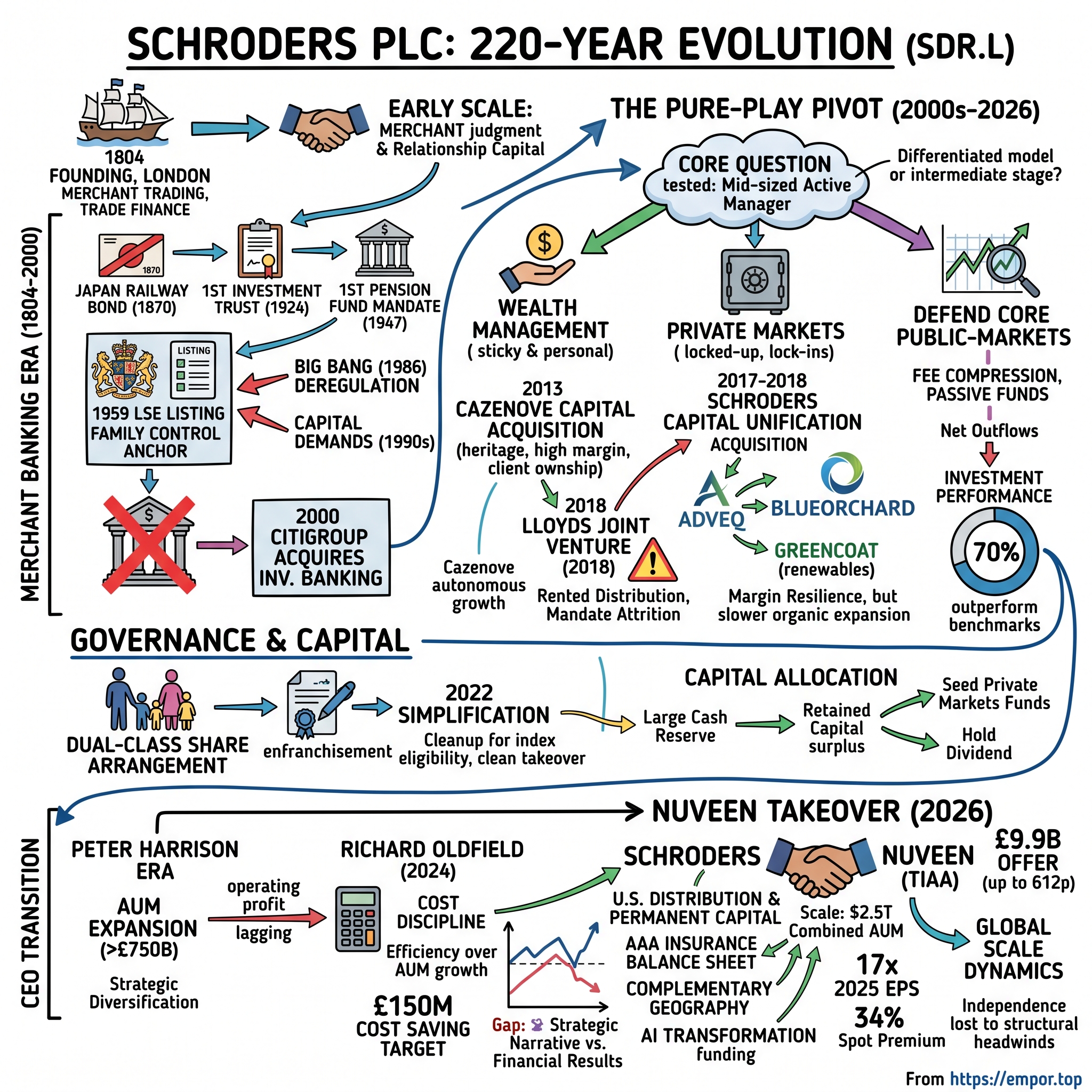
Schroders plc: The 220-Year Evolution of a UK Asset Management Giant
I. Introduction & Episode Roadmap
On the morning of 12 February 2026, several hundred analysts, journalists, and portfolio managers gathered at 1 London Wall Place, the glass-and-stone complex near the Barbican that Schroders had occupied since 2018. They attended for a routine event: full-year results. What they received instead was a valediction.
Richard Oldfield, fifteen months into his tenure as Group Chief Executive, opened with a line that set the tone. "Not really a normal annual results presentation," he said, before thanking the audience for buying the shares and pushing them up twelve percent since New Year.[^1] Then he delivered the core news. Nuveen—the asset management arm of American retirement institution TIAA—had agreed to acquire Schroders plc for up to 612 pence a share in cash and permitted dividends, valuing the company at roughly £9.9 billion.1 The Board recommended the offer unanimously. A firm founded in 1804, listed since 1959, and controlled by the same German-descended merchant family for eight generations was being sold to a U.S. institution established to pay pensions to university professors.
The shares closed up around thirty percent.[^1] Commentary quickly framed the sale as another blow to City of London independence.
Yet the broader strategic narrative lies in the two decades of increasingly urgent corporate repositioning that preceded the sale—and what those moves reveal about whether traditional active asset management remains a durable business model.
The core question tested in this study is straightforward to frame: in an industry where BlackRock and Vanguard have made index exposure nearly free, and where an ETF tracking global equities costs single-digit basis points annually, what is the competitive role of a mid-sized active manager? Schroders' response, developed over roughly fifteen years, rested on three pillars: expanding into private markets, where fees remained higher and capital was locked up; building wealth management, where client relationships were sticky and personal; and defending the core public-markets franchise long enough for the first two engines to reach scale. That strategy drove the establishment of Schroders Capital, the acquisition of Cazenove Capital, the purchase of renewable investor Greencoat, and a joint venture with Lloyds Banking Group.
It did not, however, generate consistent earnings growth. By 2024, Schroders' cost-to-income ratio had reached 75 percent, operating profit was declining despite rising assets under management, and the shares had gone nowhere for years.2 That gap—between a coherent strategic narrative and financial results that failed to materialize—forms the central analytical focus of this story.
The roadmap begins in the merchant-banking era with the single most consequential decision in the firm's modern history: selling the investment bank to Citigroup in 2000. It turns next to the wealth management expansion built on the 2013 purchase of Cazenove Capital and the Lloyds partnership, followed by the private-assets pivot that culminated in the Greencoat acquisition. It then examines governance structure, including the 2022 collapse of the dual-class share arrangement that had shielded family control for decades, before assessing the management transition from Peter Harrison's expansionary tenure to Oldfield's restructuring, evaluated against analyst questioning on earnings calls. Finally, the analysis considers the Nuveen transaction through competitive strategy frameworks to evaluate what Schroders truly owned—and what its trajectory demonstrates about the underlying economics of active asset management.
Throughout, the analytical rule remains constant: separating management claims from demonstrated financial performance. Schroders spent a decade assuring shareholders it was building a differentiated, higher-margin business. For much of that decade, the financial results indicated otherwise.
 Subscribe on LinkedIn
II. Founding Context & The Merchant Banking Era (1804–2000)
Hamburg in the early 1800s was a Hanseatic trading city with a merchant class accustomed to thinking across international trade routes rather than national borders. Johann Heinrich Schröder emerged from that environment, entering a London partnership with his elder brother in 1804—the beginning of a firm that would outlive the Napoleonic Wars, the gold standard, the British Empire, and all of its original competitors.3
The early business focused on trade finance in the most literal sense: accepting paper for shipments of sugar, cotton, tobacco, and rice moving between Russia, South America, the United States, and Europe.3 It was credit-intensive and reliant on the merchant's judgment of counterparty risk. The firm scaled by shifting from financing physical goods to underwriting governments and infrastructure. By 1870, Schroders issued a bond to fund Japan's first railway—an early instance of cross-border emerging-market underwriting.3
The twentieth century pushed the firm deeper into asset management. In 1924, Schroders launched its first investment trust and began managing client funds, establishing a dedicated investment department in 1926 and winning its first UK pension fund mandate in 1947.3 The asset management unit that would eventually form the core of a £9.9 billion business originated as an adjunct to merchant banking, powered by existing institutional relationships. When Schroders listed on the London Stock Exchange in 1959, the offering was oversubscribed eighteen times, and the family retained a controlling interest—an ownership structure that would direct strategy for the next six decades.3
That sequence highlights a recurring strategic pattern: Schroders systematically leveraged established client relationships to expand into adjacent, higher-margin activities. Merchants relying on the house for trade credit later turned to it for bond underwriting; corporate clients using its acceptance facilities entrusted it with pension mandates; and pension trustees familiar with its investment team purchased its investment trusts. These transitions relied not on technological breakthroughs, but on deepening relationship capital.
By the 1980s, that model faced severe structural pressure. The 1986 Big Bang deregulation of the London market dismantled the protected environment where British merchant banks thrived. Capital demands in modern investment banking escalated faster than a family-controlled house could comfortably support. Although Schroders maintained respected corporate advisory relationships and a strong mid-market franchise, by the late 1990s it faced global competitors with balance sheets an order of magnitude larger that routinely used balance-sheet lending to win mandates. Capital had become the primary competitive asset in investment banking.
The masterstroke, and why it was one
The resulting industry consolidation unfolded rapidly. Barings collapsed in 1995; Warburg was absorbed by Swiss Bank Corporation; Kleinwort Benson joined Dresdner. One by one, independent British merchant banks were acquired by larger continental and American institutions as scale became indispensable in leveraged finance, equity underwriting, and global M&A.
Schroders faced three options: raise substantial capital to compete, merge with a larger bank, or sell the investment banking division entirely. The family chose to sell.
On 19 January 2000, Citigroup agreed to acquire Schroders' investment banking operations for £1.35 billion, or approximately $2.2 billion.4 Sanford Weill, Citigroup's co-chairman, noted that the acquisition doubled the American firm's European presence and accelerated its growth timeline by two to three years.4 Schroders Chairman Win Bischoff framed the decision concisely, stating that the firm's optimal path was to focus strictly on asset management and private banking.4
Schroders retained the operations then viewed as lower-margin: asset management, private banking, institutional pensions, mutual funds, and Schroder Ventures.4 It also retained significant liquidity, earmarking roughly £450 million of the sale proceeds to expand its private bank, grow its international mutual fund distribution, and strengthen its UK pension business.4
The strategic impact of that transaction became clear in hindsight. Exiting investment banking in January 2000—weeks before the dot-com market peak and eight years before the 2008 financial collapse—allowed Schroders to avoid the risks of the era's debt expansion. The firm entered 2008 without a proprietary trading desk, structured credit inventory, or reliance on wholesale funding markets. Consequently, during the global financial crisis, Schroders experienced declines in client asset values rather than structural balance-sheet distress, unlike integrated banking peers that required state bailouts or forced restructurings.
That insulation was a byproduct of market positioning rather than prescient risk forecasting. Schroders sold its investment bank primarily because the unit lacked the scale to compete globally and Citigroup offered an attractive price. Nevertheless, judged by capital allocation outcomes, the result transformed the group into an unleveraged, fee-generating manager backed by a substantial cash reserve and anchored by stable family ownership.
That £1.35 billion capital injection served as the anchor for the firm's subsequent evolution, providing the capital later deployed to acquire Cazenove, Adveq, BlueOrchard, Benchmark, and Greencoat. Yet that liquidity cushion also gave Schroders two decades to execute its repositioning—a buffer that reduced immediate urgency even as market pressures mounted.
The question for the next two decades was whether a pure-play active asset management model represented a durable standalone business or merely an intermediate stage in a consolidating industry.
III. The Cazenove Transformation & The Wealth Engine (2013–2018)
In March 2013, two of the oldest institutions in the City agreed to combine. One had been founded in 1804 and the other in 1823. Between them, they had served the British establishment for four centuries—Cazenove counted Queen Elizabeth II among its clients—and neither had ever been owned by anyone outside that elite social circle.5
It was tempting to view the transaction as heritage buying heritage. In reality, Schroders was buying its way into a higher-margin fee structure that it could not construct organically.
To understand why Schroders spent £424 million on a firm holding a small fraction of its assets under management, one must look to the economics of fee margins—where the deal's true strategic logic rested.
Two businesses that look the same and are not
An institutional public-equity mandate and a private client portfolio can hold identical securities, yet function as entirely different businesses. The institutional mandate is won through a competitive tender, priced against a benchmark, monitored by consultants, and terminated by a committee whenever three-year performance disappoints. Its fee is measured in tens of basis points and compresses with every renewal cycle. By contrast, a private client portfolio is built on a personal relationship, priced as part of a service bundle including tax structuring, trusts, financial planning, and lending, and terminated primarily during major life events such as death or divorce.
Disclosures from Schroders years later illustrated this structural divergence. In 2025, the net operating revenue margin on the group's flagship public-equities book ran at 45 basis points, exiting the year at 44.6 Multi-asset generated 24 basis points, while core solutions—the outsourced chief investment officer and fiduciary business—earned just six basis points.6 Meanwhile, Cazenove Capital and the broader wealth unit commanded 48 basis points, exiting 2025 at 52 basis points—even before counting interest income earned on client cash reserves.6
Comparing six basis points to fifty-two highlights two distinct business models rather than a minor variance. It explains why a wealth division managing a small fraction of overall group assets can generate a disproportionate share of total earnings. By 2024, Wealth Management accounted for 27 percent of Schroders' group operating profit despite representing a small fraction of its asset base.[^8]
Buying the bank to the landed gentry
Cazenove was established in 1823 and spent nearly two centuries as a premier City institution, serving as stockbroker to the monarch and corporate adviser to much of the FTSE.5 While its corporate broking arm had previously been sold to JPMorgan, Cazenove Capital Holdings remained by 2013 as a wealth manager and fund business with an enviable client roster and an irreplaceable brand.
On 25 March 2013, Schroders agreed to acquire Cazenove Capital Holdings for £424 million, paying 135 pence in cash per ordinary share.5 The combined private banking and wealth operation held £28.4 billion in assets at year-end 2012, with Schroders committing to retain the Cazenove name.5 Cazenove Chairman David Mayhew framed the transaction around the enhanced service it would offer private wealth and charity clients.5
Preserving the Cazenove brand was a commercial necessity rather than a sentimental gesture. Schroders was acquiring deeply personal client relationships that rarely survive a rebadging onto an acquirer's letterhead. Retaining the name and key leaders ensured client asset retention. Mary-Anne Daly, who joined through the acquisition, subsequently led the Wealth Management division until 2025—a twelve-year leadership continuity reflecting how carefully the business was integrated.[^8]
Financially, the £424 million purchase price represented approximately 2.5 percent of combined assets under management and advice. While a full valuation relative to listed UK wealth peers at the time, it sat well below the multiples that advisory and platform businesses commanded a decade later. The ultimate measure of the deal lay in its subsequent execution. By 2024, Cazenove achieved an eight percent organic net new business rate in the UK—characterized by the Chief Financial Officer as industry-leading—while wealth operating profit rose 15 percent year over year.[^8] Over the three years leading into 2025, Wealth Management's adjusted operating profit compounded at 15 percent annually.6 The acquisition proved successful not through aggressive cost synergies, which remained modest, but because Schroders acquired a genuine growth engine and allowed it to operate autonomously.
The Lloyds bet: renting a distribution channel
Manufacturing investment products becomes a commoditized exercise without direct access to end savers. In the UK, reaching retail investors requires navigating independent financial advisers, investment platforms, or retail banks—each collecting fees while retaining primary ownership of the client relationship. In October 2018, Schroders attempted to bypass these intermediaries.
The resulting transaction structure was complex. Schroders and Lloyds Banking Group created a financial planning joint venture, later named Schroders Personal Wealth, owned 50.1 percent by Lloyds and 49.9 percent by Schroders.7 Lloyds contributed £13 billion in existing wealth assets and acquired up to a 19.9 percent stake in the holding company of Schroders' UK wealth management business.7 More significantly, Schroders was appointed active manager for approximately £80 billion in Scottish Widows and Lloyds insurance and wealth assets, while £400 million in private client assets transferred to Schroders' UK wealth unit.7 Total consideration for the asset transfers and joint-venture equity was approximately £200 million.7 Management set a target to build a top-three UK financial planning firm within five years.7
Schroders Chief Executive Peter Harrison designated wealth management a strategic priority, while Lloyds Chief Executive António Horta-Osório described the venture as a platform for growth.7 Both assertions reflected strategic intent rather than guaranteed execution.
Initial market consensus held that Schroders had solved its retail distribution challenge: a major clearing bank with millions of mass-affluent clients would funnel customers into a jointly owned advisory firm, which would then allocate client capital into Schroders products—combining manufacturing and distribution without requiring Schroders to acquire a bank.
Execution proved far more troublesome, offering a case study in the structural limits of bank distribution partnerships. Bank-led financial advice models in the UK historically faced structural friction: branch referral pipelines proved less productive than pitch presentations implied, regulated financial advice remained costly to deliver across mass-affluent account sizes, and organizational integration between a clearing bank and an asset manager proved difficult. Concurrently, the £80 billion Scottish Widows mandate functioned as a declining asset rather than a perpetual fee stream. Annual mandate attrition, normally expected to average around £3 billion, surged to approximately £14 billion in 2024 alone as Scottish Widows exited the bulk purchase annuity market and reallocated away from quantitative equity strategies.[^8] Even in 2025, Scottish Widows generated £7 billion in net outflows.[^1]
For investors, the outcome demonstrated that renting a distribution channel under contractual terms is fundamentally different from owning client relationships. Schroders accessed distribution controlled by a partner whose strategic priorities shifted over time—and as those priorities changed, client assets departed. Conversely, the proprietary Cazenove franchise, where Schroders owned the client relationship, demonstrated durable asset retention.
The quieter piece: Benchmark
Alongside these high-profile deals, Schroders executed a smaller strategic transaction, acquiring an initial equity stake in Benchmark Capital—a technology and service platform for independent financial advisers—and subsequently expanding to full ownership. Benchmark operated under a fundamentally different economic model than Cazenove: it serviced financial advisers rather than end clients, generated a net operating revenue margin of 21 basis points in 2025 compared to Cazenove's 48 basis points, and derived revenues from platform administration and adviser software rather than discretionary portfolio management.6
Benchmark provided Schroders with a secondary, technology-enabled route to UK retail investors that operated independently of banking partners. However, the business model proved vulnerable to broader market conditions. In 2025, Benchmark generated £1.0 billion in net new business, representing a 2.9 percent growth rate, which management attributed to macroeconomic and regulatory policy uncertainty dampening adviser activity.6 While plausible, that performance underscored the cyclical nature of adviser-led platforms compared to high-net-worth discretionary wealth management.
Together, Cazenove at the high end, Benchmark in the adviser channel, and the Lloyds joint venture targeting mass-affluent clients represented a coordinated strategy to span the spectrum of UK wealth.2 In practice, only Cazenove emerged as a high-margin, durable competitive engine. While acquiring one highly successful engine out of three strategic initiatives provided meaningful earnings growth, it reflected a series of tactical bets rather than an integrated, fully functioning distribution ecosystem.
These structural realities took on critical importance as the asset management industry encountered its next major secular disruption.
IV. The Pivot to Private Assets: Greencoat & Schroders Capital (2019–2023)
By 2018, European fund distribution platforms presented a stark contrast. Investors could purchase a global equity exchange-traded fund for single-digit basis points with daily liquidity. Next to it sat actively managed equity funds charging 75 basis points or more, offering three-year track records that rarely outperformed their benchmarks net of fees. Faced with that cost disparity, capital predictably moved toward lower-cost passive products.
That fee compression dismantled the traditional growth model for European active mutual funds, and Schroders felt the impact directly. The clearest evidence appeared in 2024, when Schroders recorded net outflows of £21.6 billion from Public Markets, with equities alone losing £18.2 billion.6 These figures reflected a new baseline in an era dominated by passive funds and declining investor appetite for higher-margin regional equity strategies in Asia, emerging markets, and the United Kingdom.
Management responded by shifting the firm's strategic center of gravity toward private assets that could not be easily indexed.
Building a private markets business by assembly
Rather than building a private markets division organically, Schroders assembled one through acquisitions. The firm bought Adveq, a Swiss private equity fund-of-funds and secondaries specialist founded in 1997, in 2017–2018. It added BlueOrchard, a pioneer in microfinance and impact investing, in 2019 while retaining its independent brand.3 These joined existing internal capabilities in real estate, insurance-linked securities, securitized credit, and infrastructure debt.
On 6 July 2021, Schroders unified these units under a single division: Schroders Capital, which launched with £46.1 billion in assets under management across private equity, securitized products and asset-based finance, private debt, real estate, infrastructure, insurance-linked securities, and BlueOrchard.8 Chief Executive Peter Harrison described the consolidation as the fulfillment of the group's growth strategy, while Georg Wunderlin, appointed to lead the division, framed it as a mechanism for sharing expertise across previously siloed investment teams.8
Beyond organizational restructuring, the consolidation served a practical commercial purpose. Institutional investors and wealth intermediaries typically prefer scaled platforms offering centralized client coverage, standardized reporting, and unified administrative structures over fragmented boutiques. Consolidating the brand established the operational framework required to distribute private assets through Schroders' existing institutional and wealth distribution channels.
Why locked-up capital changes the business
The structural advantages of private markets stem from capital commitment terms. In open-ended mutual funds, investors can redeem capital daily, making fee revenues highly sensitive to short-term market sentiment. By contrast, closed-end private market funds require clients to commit capital for eight to twelve years. Managers collect management fees on committed or invested capital throughout the fund life, while gaining access to performance-based carried interest—an earnings stream unavailable in standard public-market mandates.
Although private assets yield higher fee margins than public strategies, the premium at Schroders proved modest compared to industry averages for direct buyout funds. Schroders Capital generated a net operating revenue margin, excluding performance fees, of 57 basis points in both 2024 and 2025.6 While roughly 25 percent above the group's equity margin and more than twice its multi-asset margin, this fell well short of the triple-digit basis points generated by flagship private equity firms. The difference reflected asset mix: Schroders Capital was heavily weighted toward real estate, infrastructure, securitized credit, and fund-of-funds strategies rather than higher-fee buyout vehicles.
Nevertheless, locked-up capital provided critical revenue stability. During market downturns, committed private market funds continue to generate contractual management fees even as open-ended mutual funds experience client redemptions and asset depreciation.
Greencoat: paying up for the energy transition
On 21 December 2021, Schroders expanded its renewable investment platform by acquiring a 75 percent stake in Greencoat Capital at an enterprise value of £358 million. The agreement included an earn-out of up to £120 million payable after three years based on revenue targets and key management retention, alongside options to purchase the remaining 25 percent at fair market value over time.9
Greencoat managed £6.7 billion in assets as of 30 November 2021, having expanded its asset base by 48 percent annually and its revenues by 36 percent annually over the preceding four years.9 Chief Executive Peter Harrison described Greencoat as a high-growth market leader operating in a rapidly expanding sector with strong institutional demand.9
The transaction carried a premium valuation of approximately five percent of assets under management, well above multiples for traditional asset managers. Management justified the price by pointing to Greencoat's historical growth rate, attractive fee margins on renewable infrastructure equity, and anticipated long-term institutional demand for energy-transition assets. Structurally, the deal mitigated risk by acquiring 75 percent initially, linking earn-outs to revenue and talent retention, and staging the purchase of the remaining equity.
Subsequent performance across Schroders Capital proved mixed. Overall private markets assets reached £70.1 billion at year-end 2024 and £72.6 billion at year-end 2025—representing annual asset growth below five percent during a year when overall group assets grew six percent.62 Gross fundraising remained virtually flat at £10.9 billion in 2025 compared to £10.8 billion in 2024.6 Excluding the Future Growth Capital venture, net new business within private markets fell from £4.5 billion to £4.1 billion.6 Meanwhile, non-fee-earning dry powder—committed client capital awaiting deployment—increased to £4.9 billion.6
During the annual results presentation, Chief Financial Officer Alex Bird noted that accumulating dry powder provided investment flexibility but underlined the urgency of accelerating capital deployment, while Group Chief Executive Richard Oldfield acknowledged that 2025 net new business performance was softer than desired.[^1] When questioned by Autonomous Research regarding deployment bottlenecks, Oldfield offered operational remedies, citing expanded private equity staffing and the integration of artificial intelligence tools to accelerate deal screening.[^1]
That response highlighted a broader structural challenge: acquiring high-growth specialized managers did not automatically translate into sustained organic expansion across a broader platform, as private markets growth depended heavily on distribution reach, deployment capacity, and underlying fund returns. In March 2025, management established a target to generate £20 billion in cumulative net new business within Schroders Capital by the end of 2027.2 After the first year, the firm had delivered approximately £4.6 billion toward that goal, including initial inflows from Future Growth Capital.6 Meeting the three-year target would require a significant acceleration in fundraising and deal execution.
Ultimately, the pivot into private markets achieved margin resilience rather than transformative expansion. While private assets insulated revenue margins against fee compression in public equities, growth across the platform progressed more slowly than projected—leaving the fundamental challenge of firm-wide scale unresolved.
V. Governance, Family Control, & The Share Class Simplification
Every so often a company's share register tells you more about its strategy than its strategy does. Schroders was one of those companies.
For decades the firm had two classes of stock: voting ordinary shares and non-voting ordinary shares with identical economic rights. Economically, a pound invested in each bought the same claim on profits. Politically, they were nothing alike. The Schroder family and connected trusts — collectively the Principal Shareholder Group — held 47.93 percent of the ordinary voting shares, alongside 20.44 percent of the non-voting shares.10 In practice, no board decision could be made against them, and no hostile approach could succeed without them.
This is the classic founding-family arrangement, and it produced the classic founding-family results, both good and bad. On the positive side, it is genuinely difficult to imagine a widely held FTSE 100 asset manager selling its investment bank at the top of a bull market, or spending twenty years slowly reallocating capital toward wealth and private markets while quarterly earnings went sideways. Patient capital is not a slogan when the largest holder measures its horizon in generations. Oldfield made exactly this point on the Nuveen call, crediting the family's long-standing commitment for the firm's ability to take a long-term view.[^1]
On the negative side, entrenched control removes the market's most reliable pressure valve. There is no activist campaign, no proxy fight, no credible takeover threat to force a cost review. The 75 percent cost-to-income ratio Schroders carried into 2024 did not appear overnight; it accreted over years in which no external party had the power to insist otherwise.
Untangling the shares
In April 2022, the board moved to simplify. The proposal: convert every non-voting share into a voting ordinary share on a one-for-one basis, and compensate existing voting shareholders for their dilution with a bonus issue of three additional ordinary shares for every seventeen held.10 Following enfranchisement and the bonus issue, each £1 ordinary share was sub-divided into five 20-pence shares, completing on 20 September 2022.
Chairman Michael Dobson framed it as being in the interests of all shareholders.10 The mechanics tell you who really benefited and who conceded. The Principal Shareholder Group's holding of ordinary shares fell from roughly 47.9 percent to approximately 43.1 percent — a real reduction in formal voting power, though nowhere near enough to end effective control.10 Non-voting holders, who had historically traded at a discount, received full votes without paying for them. Both classes needed to approve separately at a 75 percent threshold, and both did.10
Why do it at all? Three reasons, in ascending order of importance. First, index eligibility and liquidity: a single line of stock trades better and is cleaner for passive funds to hold. Second, governance optics — dual-class structures score badly with stewardship teams and proxy advisers, an awkward position for a company that sells governance-aware investing to clients. Third, and least discussed at the time, a simplified capital structure is a prerequisite for a clean takeover. You cannot easily run a scheme of arrangement across two share classes with different voting rights and a controlling family straddling both.
Nobody should claim the 2022 enfranchisement was designed to enable the 2026 sale. But it is a fact that the structure that made Schroders effectively untakeable was dismantled four years before Schroders was taken over, and that when the offer came, the family's irrevocable undertakings covering approximately 41 percent of shares made the outcome a formality.1 By the time of the vote, press coverage put the founding family's economic stake at around 42 percent.11
The capital allocation record
The family's fingerprints are visible in the dividend. Schroders paid 21.5 pence per share in both 2023 and 2024, and again in 2025 — held flat rather than cut, through a period when operating profit was falling.62 The final dividend stayed at 15.0 pence across all three years.6 In March 2025, the board stated its intention to hold the dividend at its current level while bringing the payout ratio back toward 50 percent — in other words, to grow into the distribution rather than reduce it.2
That is a conservative, income-oriented preference, and it is defensible. But it also has a cost. On the March 2025 call, Deutsche Numis's David McCann asked directly why no new share buyback had been announced, given the capital surplus.[^8] Oldfield deferred the answer to the strategy session, where the message was that surplus capital — which had risen from £551 million to £838 million, helped by a Tier 2 bond issuance — would be deployed organically into growth and into seed and co-investment, not returned.[^8] A year later, surplus capital stood at £865 million after allowing for an estimated £250 million impact from Basel 3.1, which Schroders must absorb because it is regulated as a bank.6
A skeptical investor would put it this way: management chose to retain a large capital surplus and commit up to £500 million to seeding its own private-markets funds, while the shares traded at a multiple that implied the market did not believe in the growth those funds would deliver.62 That is a legitimate strategic choice. It is also a bet that the company's internal return on capital beat the return from buying back its own equity — a bet that the eventual 34 percent takeover premium suggests the market had not been pricing in.[^1]
The bill for that surplus, and for the cost base it sat alongside, came due when a new chief executive arrived.
VI. CEO Transition & Restructuring: Harrison to Oldfield (2024–2025)
On 6 March 2025, Richard Oldfield delivered his first annual results presentation as chief executive by opening with a personal story about his teenage daughters. He recounted reading the weekend newspapers with them, where discussions centered on geopolitical uncertainty, demographic shifts, climate change, and artificial intelligence—raising the question of how to navigate an unpredictable economic environment. He told analysts and investors that Schroders could not afford to be a passive follower.[^8]
The rhetoric served a strategic purpose for an executive with an accounting background. Addressing broker reports that characterized him as purely focused on numerical targets, Oldfield stressed that the cost-reduction program he was introducing would not compromise the core investment franchise.[^8] To emphasize client engagement, he noted that he had met with clients daily since assuming the role, completing more than 120 meetings in four months.[^8]
Regardless of the presentation style, the underlying strategy marked a clear departure from the expansionary model pursued over the preceding eight years.
Peter Harrison began his career as a graduate trainee at Schroders in 1988 before taking roles at Newton, Flemings, and JPMorgan, leading global investments at Deutsche Asset Management from 2004 to 2006, and heading the boutique firm RWC Partners. He returned to Schroders in March 2013 as Global Head of Investment and was appointed Group Chief Executive in April 2016.12
As an investor by background, Harrison focused his tenure on portfolio expansion, long-term asset acquisition, and strategic diversification.
The scoreboard
Measured by asset growth, Harrison expanded the business significantly. Assets under management more than doubled to over £750 billion during his eight-year tenure, transforming Schroders from a traditional public-markets manager with a small wealth division into a broader group spanning private assets, wealth management, solutions, and international joint ventures.12 Announcing Harrison's planned retirement on 24 April 2024, Chair Elizabeth Corley praised his leadership and highlighted that expansion in assets.12
Financial performance, however, lagged asset expansion. Operating profit for 2024 fell three percent to £640.5 million, even as assets under management grew four percent to £778.7 billion.2 Operating expenses continued to rise at roughly two percent annually despite previous cost cuts, pushing the cost-to-income ratio to 75 percent.2 This efficiency gap persisted despite Schroders absorbing £86.2 million in restructuring charges in 2023.2
Oldfield directly addressed this disconnect during his initial presentation, stating, "It's not good enough to deliver AUM growth and not operating profit growth."[^8] The statement signaled an explicit departure from the prior focus on top-line asset accumulation.
The accountant takes over
Richard Oldfield's appointment as Group Chief Executive was announced on 10 September 2024 and became effective on 8 November 2024. He had joined Schroders as Group Chief Financial Officer in 2023 after nearly three decades at PwC.13 He worked alongside Meagen Burnett, who had joined as Group Chief Operating Officer in 2023 before succeeding Oldfield as CFO. Burnett outlined three operational priorities: instilling cost discipline, allocating capital strictly based on return potential, and accelerating operational restructuring.[^8]
The appointment of a former professional services partner alongside an operational specialist underscored a shift in management focus from investment strategy to operating efficiency.
Organizational changes followed quickly. Management reduced the senior leadership body by replacing the 23-member Group Management Committee with a 9-member Group Executive Committee.2 In November 2024, a central transformation office was created under Burnett's oversight.2 On 6 March 2025, management formally announced financial restructuring targets: achieving £150 million in annualized net cost savings by the end of 2027 at an estimated implementation cost of £200 million, implying a two-year payback period, while targeting a cost-to-income ratio below 70 percent.2
Management paired the cost plan with three operational targets: stabilizing Public Markets revenues by the end of 2027, securing £20 billion in cumulative net new business within Schroders Capital from 2025 through 2027, and achieving an annual net new business growth rate of 5 to 7 percent of opening assets in Wealth Management.2
These specific, dated metrics provided clear benchmarks against which market participants could assess management's execution.
Year one: what actually happened
In 2025, initial transformation outcomes exceeded management's interim guidance. In-year net savings realized through the income statement reached £75 million, surpassing the guidance of £50 million, while £102 million of the £150 million annualized target was secured.6 Gross savings totaled £94 million, with £19 million reinvested into the business; workforce headcounts dropped by 10 percent and vendor accounts declined by 12 percent.[^1] The cost-to-income ratio improved by four percentage points to 71 percent.6 Adjusted operating profit increased 25 percent to £756.6 million, driving a 29 percent increase in adjusted operating earnings per share.6
Total assets under management reached a record £823.7 billion as net flows swung from £10.8 billion in redemptions to £11.2 billion in net inflows. Public Markets recorded positive organic growth for the first time since 2021, generating £3.7 billion in net inflows compared to £21.6 billion in net outflows the prior year, supported by major institutional mandates including £4.0 billion from St. James's Place and £3.3 billion from PGGM.6 Investment performance also strengthened, with at least 70 percent of assets outperforming benchmarks across one, three, and five-year horizons, up from 58 percent on a three-year basis a year earlier.6
Management also pursued focused rationalization across non-core operations. During 2025, Schroders closed its convertibles desk, exited Munich real estate and Australian private credit, announced the planned closure of its Brazilian business, restructured South Korean operations, and initiated the sale of its Indonesian unit. Concurrently, Schroders transferred its minority stake in Schroders Personal Wealth back to Lloyds in exchange for full ownership of Cazenove Capital and a multi-year contract to manage the underlying wealth assets.6 The transfer generated a one-off gain of £113.3 million.6
Exiting the financial planning joint venture six years after its creation marked a retreat from the 2018 bank-distribution thesis. Economically, however, the trade allowed Schroders to relinquish its stake in a mass-affluent advisory firm in exchange for full operational control of Cazenove Capital, its highest-margin growth driver.
What management got wrong, and how they handled it
Despite the overall earnings improvement, two of management's three medium-term operational targets lagged in year one. Wealth Management recorded a net new business growth rate of 2.7 percent against its 5 to 7 percent annual target, hampered by lower-margin charity redemptions, client cash drawdowns late in the year, and soft inflows at Benchmark, although the UK private client book expanded by 5.2 percent within the target range.6 Fundraising in Schroders Capital also fell behind the required pace to meet its three-year target.
Management addressed these operational shortfalls directly in public disclosures. The results release explicitly described the wealth growth rate as below expectations, isolated the impact of charity redemptions and Benchmark performance, and followed prior warnings provided during the third-quarter trading update.6[^1] Additionally, Burnett fulfilled earlier commitments to enhance financial reporting, introducing simplified statutory disclosures, exit revenue margins, quarterly asset flow reporting, and detailed breakdowns of the solutions division.[^8]2
This transparency in reporting aligned with management's stated focus on accountability and clear financial reporting.
Two factors temper the initial restructuring results. First, market tailwinds provided substantial support, as market appreciation and investment returns added £56.9 billion to assets under management, leading Oldfield to acknowledge that favorable market conditions contributed significantly to the Public Markets recovery.6[^1] Second, management projected net cost savings of £25 million for 2026—one-third of the level achieved in 2025—explaining that initial quick-win efficiencies would give way to more complex, longer-term operational realignments.[^1] Whether the restructuring could maintain momentum into deeper platform changes remained an open question prior to the Nuveen acquisition announcement.
The bear case, stated properly
The central structural critique of Schroders heading into its restructuring was that it occupied an increasingly difficult position in global asset management: mid-sized scale. The firm lacked the massive index volume, technology budget, and global distribution scale of leaders like BlackRock—whose Aladdin platform represents technology investment levels difficult for a £750 billion manager to replicate—while remaining too large and complex to operate with the agility and focus of a specialist boutique.
This competitive squeeze was evidenced by persistent net outflows in traditional public equity funds, slower relative growth in private markets, high operating costs, an underutilized capital surplus, and a dual-class ownership structure that historical insulation had shielded from external market pressure.
By early 2026, restructuring had demonstrated initial cost savings, positive net flows, improved investment performance, and steady expansion in higher-margin wealth activities. However, these internal improvements did not resolve the broader industry challenge of scale—a challenge that was ultimately addressed through the combination with Nuveen.
VII. The £9.9B Nuveen Takeover & Global Scale Dynamics
Richard Oldfield told attendees at the 12 February 2026 presentation that Schroders had never been for sale. "This business has never been up for sale," he stated in response to a direct question from Deutsche Bank analyst David McCann regarding potential rival approaches.[^1] By management's account, the transaction emerged instead from preliminary discussions with Nuveen that revealed an unexpected strategic fit.
Regardless of how those talks originated, Nuveen submitted multiple approaches before the board evaluated a five-year standalone growth plan and concluded unanimously that the buyout offer offered superior value.[^1]
The terms
Under the agreed terms, Schroders shareholders were entitled to receive up to 612 pence per share: 590 pence in cash consideration from Pantheon LLC, a wholly-owned Nuveen subsidiary, alongside up to 22 pence in permitted dividends declared before completion.61 The offer represented approximately £9.5 billion in cash consideration, valuing Schroders at roughly £9.9 billion.1
The transaction valued Schroders at 17 times its 2025 fully diluted adjusted operating earnings per share. This represented a 34 percent premium over its prior-day closing price of 456 pence, a 47 percent premium over its three-month volume-weighted average price, and a 61 percent premium over its twelve-month average.[^1] To secure the outcome, members of the Principal Shareholder Group signed irrevocable undertakings covering approximately 41 percent of the voting shares.1
The gap between the 34 percent spot premium and the 61 percent twelve-month premium reflected the market's gradual re-rating of Schroders stock as Oldfield's restructuring showed early progress throughout 2025. Nuveen effectively acquired the firm at a valuation that recognized initial cost efficiencies, but captured the remaining upside of the three-year turnaround plan without paying full price for its completion.
The industrial logic
At year-end 2025, Nuveen managed $1.4 trillion in assets, while Schroders managed roughly $1.1 trillion.1 The combined entity controls nearly $2.5 trillion, or £1.8 trillion—comprising £1.3 trillion in public markets and £307 billion in private assets across more than forty countries.[^1]6
Although less prominent in European retail markets, Nuveen serves as the investment arm of TIAA, the Teachers Insurance and Annuity Association founded in 1918 to manage retirement funds for American academics. TIAA operates as the sixth-largest insurer in the United States, providing a substantial general account backed by permanent capital.[^1] That balance sheet enables Nuveen to warehouse assets, seed new strategies, and anchor fund closes internally—a capability Schroders lacked while relying strictly on equity retained earnings and a modest Tier 2 bond, leading Oldfield to note, "we don't have patient capital."[^1]
Geographically and strategically, the platforms exhibit clear complementarity. Nuveen concentrates heavily in the United States and the Middle East, whereas Schroders maintains established distribution networks across the United Kingdom, continental Europe, and Asia.[^1] Nuveen provides fixed-income depth and a private-markets platform supported by TIAA's general account—a AAA-rated insurance balance sheet of roughly £239 billion capable of seeding and anchoring funds.[^1] Schroders contributes active public-market capabilities, non-U.S. distribution, the Cazenove wealth franchise, and specialized private-asset strategies. Oldfield characterized the two firms as matching puzzle pieces—an assessment supported by their complementary geographic and distribution profiles.[^1]
Critically, management emphasized that the deal was not predicated on cost reduction. "There aren't big cost savings in this deal. It's about growth," Oldfield stated.[^1] In asset management M&A, where expense synergies across overlapping distribution and back-office functions typically drive deal economics, prioritizing cross-selling over cost cuts relies on a less predictable revenue expansion thesis.
While executives cited the firms' combined history—Schroders founded in 1804, Nuveen in 1898, and TIAA in 1918—as evidence of a shared long-term culture,[^1] cultural alignment in asset management mergers remains difficult to verify prior to integration and rarely guarantees commercial success.
What was promised, and what it is worth
Nuveen committed to maintaining the Schroders brand, preserving London as the combined group's non-U.S. headquarters and largest operating hub with over 3,100 employees, and retaining existing investment and wealth management teams.1[^1] Oldfield agreed to remain as Schroders Chief Executive, reporting to Nuveen Chief Executive William Huffman and joining Nuveen's executive management committee.1
Huffman framed the combination as an expansion of market reach, product breadth, and investment talent, while Oldfield asserted that the transaction would accelerate Schroders' strategy to build a leading public-to-private platform.1 Oldfield estimated on the earnings call that the merger advanced Schroders' strategic timeline by at least a decade, saving years of organic investment needed to build U.S. distribution, secure balance-sheet seeding capital, and complete its private-asset product line.[^1]
While corporate governance undertakings carry regulatory weight in UK takeover offers, long-term operational arrangements often evolve. The Schroders brand and London operations retain commercial value—underscored by Schroders ranking among the top five global asset management brands in 2025—making near-term continuity likely, though deeper integration decisions will inevitably surface as the combined firm matures.[^1]
The dissent
Shareholder support was nearly unanimous, though minor institutional opposition emerged. At the Court Meeting and General Meeting on 16 April 2026, 99.99 percent of votes cast approved the takeover, well above the 75 percent threshold.11 However, boutique manager JO Hambro publicly opposed the offer, arguing that the 612 pence price undervalued Schroders by ten to fifteen percent.11
The dissent highlighted a credible valuation argument: Schroders was one year into a turnaround that had beaten initial cost targets, while its share price was re-rating upward. Investors believing that the £150 million cost savings would fully materialize, that Schroders Capital would hit its £20 billion fundraising goal, and that Wealth Management would restore 5 to 7 percent annual asset growth could project a standalone valuation exceeding 612 pence by 2028. Conversely, the board concluded that realizing that upside required three consecutive years of execution across divisions where two out of three primary targets had missed in year one, making guaranteed cash consideration preferable to execution risk.
Because the founding family held 41 percent of the voting shares and committed them via irrevocable undertakings, external shareholder debate remained largely theoretical.
Why independence lost
The decision of a 222-year-old, profitable, and well-capitalized institution to sell reflected broader structural headwinds reshaping the active asset management industry.
First, the escalating capital required for technology and artificial intelligence infrastructure challenged mid-sized managers. Responding to analyst inquiries regarding AI disruption in wealth management, Oldfield remarked that artificial intelligence would fundamentally alter the industry, noting that "the only people that seem to have not worked out it was going to impact Wealth and Asset Management are the investors."[^1] He characterized AI as "the hammer" for restructuring operations around distributed ledger technology and data, adding that merging with Nuveen provided the scale required to fund that transformation.[^1] Group COO Meagen Burnett noted that technology and data platform investments represented a significant share of the remaining transformation budget, though management declined to break out a specific AI allocation.[^1]
Second, regulatory capital requirements imposed an ongoing drag. As a bank-regulated institution, Schroders faced an estimated £250 million capital requirement under Basel 3.1 rules—a significant regulatory burden for a firm generating revenue primarily from fee margins rather than balance-sheet lending.6
Third, global institutional mandates increasingly favored mega-scale managers capable of offering comprehensive public, private, active, and passive strategies globally. Operating as a mid-sized active manager made compounding market share increasingly difficult alongside dominant U.S. rivals.
The transaction remains subject to regulatory and court approvals, with completion expected in the fourth quarter of 2026, at which point Schroders' London listing will be canceled.114 In the interim, the company continued to report as a listed entity. On 30 July 2026, Schroders reported its half-year results, having previously disclosed first-quarter 2026 assets of £814.4 billion with net outflows of £2.2 billion excluding joint ventures, as early-quarter inflows were reversed by market volatility in March.1516 At that date, Schroders' total published group assets stood at £867.8 billion.17
VIII. Playbook: Business & Investing Lessons
Four lessons emerge from this two-century arc, generalizing well beyond asset management.
1. Clean up the balance sheet before the storm. Schroders exited investment banking at a moment when the business was profitable and the buyer was eager—not when it was distressed. That timing produced an unleveraged fee business with a substantial cash position, which is why 2008 was a difficult year rather than an existential crisis. The broader principle is clear: the right time to sell a capital-intensive, scale-losing business is while a buyer still values it, and the true test of scale is not current profitability, but the ability to fund future rounds of required investment. Schroders answered that question regarding investment banking in 2000 and asset management in 2026, delivering the same answer both times.
2. Pivot up the margin curve—but verify that the new curve is actually steeper. The strategic logic of shifting from commoditized public funds into wealth and private assets is sound: 6 basis points on fiduciary management and 52 basis points on wealth represent fundamentally different businesses. Where execution faltered was in assuming that entering a higher-margin category automatically confers that category's growth. Schroders Capital delivered margin resilience at 57 basis points, but expanded net new business more slowly than targeted. The lesson is that alternative investments are not a monolithic market to enter; they consist of specific franchises with distinct fundraising records, and acquiring one does not guarantee a sector-average return.
3. Distribution ownership is destiny—and rented distribution is not ownership. The contrast within Schroders' history functions almost as a controlled experiment. Cazenove, where Schroders owned client relationships directly, compounded adjusted operating profit at 15 percent annually over three years. By contrast, the Lloyds arrangement, where Schroders rented access to third-party clients and mandates, generated years of net outflows as the partner's strategic priorities shifted, culminating in Schroders exiting the joint venture. Owning the final client relationship commands a premium; contractual access to a partner's distribution is worth far less than initial transaction announcements suggest.
4. Founding-family governance is a genuine double-edged sword. Family control provided Schroders with a 20-year strategic horizon, an unusual tolerance for flat earnings during multi-year transitions, and insulation from short-term market pressure. However, it also eliminated external pressure mechanisms that might have forced an earlier cost review, allowing a 75 percent cost-to-income ratio to persist. When the family ultimately decided to sell, their decision was effectively finalized before minority shareholders could meaningfully intervene. The same 41 percent voting stake that protected the long-term strategy for generations ended the firm's independence in a single afternoon. Investors in family-controlled businesses must price both sides of that equation: the benefit of patience and the reality of powerlessness.
A fifth, quieter lesson underpins all four: Schroders' most valuable assets across 222 years were never its investment products, but its client relationships and brand reputation—assets built gradually over time that cannot be easily purchased. Every successful strategic move in the firm's history involved acquiring or preserving relationships, while every disappointing initiative involved acquiring investment capacity in the hope that client relationships would follow.
IX. Analysis: 7 Powers, Porter's 5 Forces, & Bear vs. Bull Case
Strip away the narrative and ask the war-game question: what did Schroders actually own that a competitor could not replicate?
Hamilton Helmer's 7 Powers
Cornered resource and branding — strong, but narrower than claimed. Schroders held a top-five global asset management brand ranking for seven consecutive years and retained fifth place in 2025.2[^1] More concretely, the Cazenove name carries genuine pricing power among UK high-net-worth clients, charities, and family offices—a segment where the charities team expanded its market share from 10.7 percent to 14.1 percent over five years.6 That represents a cornered resource in the Helmer framework: 222 years of stewardship reputation cannot be duplicated by a competitor at any price. However, that power remains geographically bounded. It commands a premium in London but carries far less weight in Chicago—which explains both why Nuveen sought the acquisition and why Schroders struggled to expand organically in the United States.
Switching costs — high in wealth and private assets, negligible in public markets. A private client at Cazenove faces capital gains realization on transfer, the loss of a multi-decade personal relationship, and the administrative friction of re-establishing trust structures and financial planning. A private markets LP is contractually locked into a fund for its entire lifecycle. By contrast, an institutional equity mandate carries minimal switching costs: a investment consultant recommends a change, a board committee approves it, and £4 billion moves within a single quarter. The 2024 net outflow of £21.6 billion from Public Markets served as empirical proof.6
Scale economies — weak, and this was the core vulnerability. Schroders' £150 million cost-efficiency target roughly matched what a US mega-manager spends on technology over a comparable period. The artificial intelligence and data platform investments that management described as essential require a vast asset base to amortize fixed costs, whereas Schroders operated at one-fifth the scale of BlackRock. Management's stated rationale for the merger—gaining a balance sheet capable of seeding funds and providing greater firepower for technology—amounted to an admission that scale power was absent on a standalone basis.[^1]
Process power — moderate and improving. The recovery in client investment performance, with 70 percent or more of assets outperforming benchmarks across one, three, and five-year horizons, alongside the retention of over 95 percent of top-rated employees group-wide and in Public Markets specifically, indicated that the core investment organization functioned effectively.6[^1] Whether that reflected durable process power or simply a favorable market environment for active managers remained difficult to isolate.
Counter-positioning and network economies — largely absent. Schroders possessed no structural business model advantage that an established incumbent could not copy, and active asset management does not generate network effects at this scale.
Porter's Five Forces
Buyer power emerged as the defining force in public markets. Institutional clients—including pension schemes, insurers, and sovereign wealth funds—negotiated fees aggressively with consultant backing and terminated mandates based on trailing three-year performance. The steady erosion in public equity revenue margins from 46 to 45 basis points, down to an exit rate of 44 basis points, represented buyer power expressed in plain arithmetic.6 In private wealth management, buyer power was materially lower: high-net-worth individuals rarely negotiate aggressively on fees and switch providers infrequently.
Threat of substitutes remained structural and severe. A low-cost global equity ETF functions as a direct substitute for an actively managed equity fund at a fraction of the management fee, placing the burden of proof entirely on the active manager. Interestingly, Schroders' internal data offered a nuance to the simplest passive-takeover narrative: Oldfield highlighted three consecutive years of positive inflows into US mutual funds, arguing that predictions of the traditional fund format's demise were premature.[^8] Schroders also adapted to changing buyer preferences by launching European active ETFs, which crossed $1 billion in assets within four months and ranked highest for net inflows among European active ETFs in the first quarter of 2026.[^1]15
Rivalry remained intense and accelerated through global industry consolidation. European peers such as Amundi, DWS, Legal & General, M&G, and abrdn, alongside major US asset managers, competed continuously for institutional mandates. In UK wealth management, St. James's Place, Rathbones, Quilter, Evelyn Partners, and private banks all targeted the same high-net-worth market. The combination with Nuveen was itself a competitive response to industry rivalry: scale players combining to raise capital requirements for remaining independents.
Supplier power operated uniquely in asset management, where the primary suppliers are portfolio managers and senior investment professionals who remain highly mobile. This reality explained why the Greencoat transaction structure tied earn-out payments to management retention, and why achieving a ten percent overall headcount reduction while retaining 95 percent of top-rated investment talent represented an operational necessity rather than a routine HR metric.9[^1]
Threat of new entrants into traditional, public-market asset management was low due to distribution barriers. However, in specialized growth niches—such as active ETFs, evergreen private markets vehicles, and semi-liquid wealth products—the threat of new entry remained high as well-capitalized global incumbents expanded aggressively into those categories.
The KPIs that actually matter
Three operational metrics contained the most signal regarding Schroders' fundamental trajectory, providing a clearer picture than headline assets under management, which fluctuated primarily with market movements.
First, net new business in Wealth Management and Schroders Capital, measured as an organic growth rate against opening assets. These two divisions represented the firm's higher-margin growth engines. Management established explicit, dated targets for both: delivering 5 to 7 percent annual organic asset growth in Wealth Management, and securing £20 billion in cumulative net new business within Schroders Capital across the 2025–2027 period.2 Year one delivered a 2.7 percent growth rate in Wealth Management and approximately £4.6 billion in Schroders Capital net inflows.6 These two numbers served as the primary indicator of whether the group's strategic pivot was gaining traction.
Second, the net operating revenue margin in basis points by segment, particularly the exit rate. Blended group revenue margins can improve artificially when public equity markets appreciate. Segment exit rates isolated that market effect to reveal whether the underlying product mix was shifting toward higher-fee strategies. Public equity margins exiting 2025 at 44 basis points compared to a full-year average of 45 basis points signaled ongoing fee compression, whereas Wealth Management exiting at 52 basis points against a full-year average of 48 basis points demonstrated positive pricing power.6
Third, the adjusted cost-to-income ratio. This metric offered the clearest measurement of whether operational restructuring was delivering durable efficiency gains. The ratio improved from 75 percent to 71 percent in 2025, with management guiding toward 70 percent in 2026 and below 70 percent for full-year 2027.62 Because the ratio naturally improves during equity bull markets and deteriorates during market corrections, monitoring its performance during market downturns provided the true test of structural cost reduction.[^1]
Bull and bear, honestly stated
The bull case rested on three core arguments. First, Schroders demonstrated in 2025 that it could reduce operating expenses faster than scheduled while improving investment performance and reversing client outflows—delivering 25 percent operating profit growth and a 29 percent increase in adjusted operating earnings per share.6 Second, higher-margin divisions continued to expand faster than traditional lower-margin strategies, evidenced by a ten percent increase in Wealth Management revenue and a 15 percent three-year compound annual profit growth rate in that unit.6 Third, combining with Nuveen directly addressed the primary constraints of Schroders' standalone strategy—the lack of permanent balance-sheet capital, limited US distribution, and a subscale technology budget—by pairing the business with an institution backed by TIAA's £239 billion insurance general account and an established American retirement franchise.[^1]
The bear case was equally grounded in structural realities. Outflows from public equity markets represented a long-term structural trend rather than a temporary cyclical shift; a single year of positive net flows supported by market gains and major institutional mandate wins did not signal a permanent reversal, as highlighted by the return to £2.2 billion in net outflows in the first quarter of 2026.15 Second, fundraising in Schroders Capital grew more slowly in 2025 than in 2024, leaving the division trailing the annual pace required to meet its three-year £20 billion target.6 Third, the Wealth Management unit missed its overall organic growth target despite solid performance in its core UK private client book. Finally, cross-border integration under Nuveen carried execution risks, particularly given management's explicit statement that the transaction was not driven by cost synergies—meaning success depended on cross-selling and cultural alignment across geographic regions.[^1]
An additional, longer-term risk involved artificial intelligence. Management's view that AI will restructure investment research, portfolio management, back-office operations, and financial advice carries two-sided implications.[^1] If AI technology significantly reduces the cost of delivering financial planning and portfolio management, the premium valuation and scarcity value of traditional wealth management brands could compress faster than market models anticipate. The sell-off across European wealth management equities on AI disruption concerns in early 2026 reflected growing investor focus on that potential risk.[^1]
Ultimately, Schroders pursued a logically sound corporate strategy, but executed the transition too slowly to remain an independent listed company. Internal operational improvements were showing progress, but the central strategic question was whether those changes could generate sufficient scale fast enough to compete globally. The £9.9 billion Nuveen transaction resolved that timeline, offering shareholders an immediate 34 percent cash premium in exchange for the long-term option value of standalone execution.
X. Epilogue & Final Reflections
There is a familiar pattern in British corporate history: a company with a long history, a respected brand, capable management, and an inadequate balance sheet is acquired by a larger American institution that promises to preserve its identity.
Schroders' outcome is more instructive than most because the firm was not in distress. It held record assets, demonstrated improving investment performance, surpassed its initial cost-reduction targets, and operated under a board that had recently assured the market that its standalone strategy was succeeding.6 It sold anyway, because the leaders who had directed the firm across eight generations concluded that the projected returns from another decade of independence, discounted for execution risk, were worth less than 612 pence per share in cash today.
That decision highlights a broader structural challenge across mid-tier active asset management. If an institution with a top-five global brand, a differentiated UK wealth franchise, a £72 billion private markets platform, and no net debt cannot sustain the economics of independence, the number of standalone European active managers capable of doing so is small and shrinking. This consolidation drive reflects less on operational execution than on the escalating fixed costs of technology, regulatory compliance, and global distribution, which have risen faster than fee income in a market dominated by low-cost passive products.
The unifying theme across Schroders' history is a willingness to abandon functioning models. A firm that originated by financing shipments of sugar and cotton between Hamburg and London ended as an operating unit within an American retirement institution. In the intervening two centuries, it served as a bond underwriter for Japanese railways, a City accepting house, an investment bank, a pension manager, a private bank, a renewable infrastructure investor, and an ETF issuer. At each transition, legacy operations were still generating revenue when management chose to exit them. Merchant trading gave way to bond underwriting; underwriting yielded to acceptances; the investment bank was sold near a market peak; and the Lloyds joint venture was unwound six years after its launch. The convertibles desk, the Munich real estate team, and the Brazilian and Indonesian units were all closed while still functioning, because functioning was no longer sufficient.6
Schroders survived 222 years not by defending established positions, but by deciding—often before market conditions forced the outcome—that legacy assets no longer represented the best allocation of capital. The transaction with Nuveen applied that same logic, with the fundamental difference that the asset being sold was Schroders itself.
Whether that choice ultimately proves correct will be evaluated inside a $2.5 trillion American asset manager, through financial reporting that public shareholders will never see.
References
-
Recommended Cash Acquisition of Schroders plc by Nuveen, LLC — Nuveen / PR Newswire, 2026-02-12 ↩↩↩↩↩↩↩↩↩↩
-
Schroders Strategy Update and Annual Results 2024 — Schroders plc / London Stock Exchange RNS, 2025-03-06 ↩↩↩↩↩↩↩↩↩↩↩↩↩↩↩↩↩↩
-
Citigroup buys unit of U.K.'s Schroders for $2.2-billion (U.S.) — The Globe and Mail, 2000-01-19 ↩↩↩↩↩
-
Schroders buys Cazenove in a £424m ($646m) deal — Private Banker International, 2013-03-25 ↩↩↩↩↩
-
Schroders plc Annual results 2025 — Schroders plc / London Stock Exchange RNS, 2026-02-12 ↩↩↩↩↩↩↩↩↩↩↩↩↩↩↩↩↩↩↩↩↩↩↩↩↩↩↩↩↩↩↩↩↩↩↩↩↩↩↩↩↩↩
-
Schroders and Lloyds enter into strategic partnership — Actuarial Post, 2018-10-23 ↩↩↩↩↩↩
-
Schroders brings together its private assets capabilities under Schroders Capital brand — Schroders plc, 2021-07-06 ↩↩
-
Acquisition of 75% shareholding in Greencoat Capital — Schroders plc RNS via Investegate, 2021-12-21 ↩↩↩↩
-
Proposals to simplify the Company's dual share class structure through enfranchisement — Schroders plc, 2022-04-26 ↩↩↩↩↩
-
Schroders Shareholders Approve $13.4 Billion Sale to Nuveen — Global Banking & Finance Review, 2026-04-16 ↩↩↩
-
Future retirement of Peter Harrison — Schroders plc, 2024-04-24 ↩↩↩
-
Schroders CFO Richard Oldfield to succeed Peter Harrison as group CEO — Investment Week, 2024-09-10 ↩
-
Q1 2026 Update — Schroders plc RNS via Investegate, 2026-04-16 ↩↩↩
-
Results library: corporate results, reports and presentations — Schroders plc ↩
-
Schroders global — assets under management as at 30 July 2026, Schroders plc ↩
 LinkedIn
 WhatsApp
 Reddit
 Hacker News
 Email
Email Kindle
 RSS Feed
 Spotify
 Apple Podcasts
 Amazon Music
 Audible
 YouTube