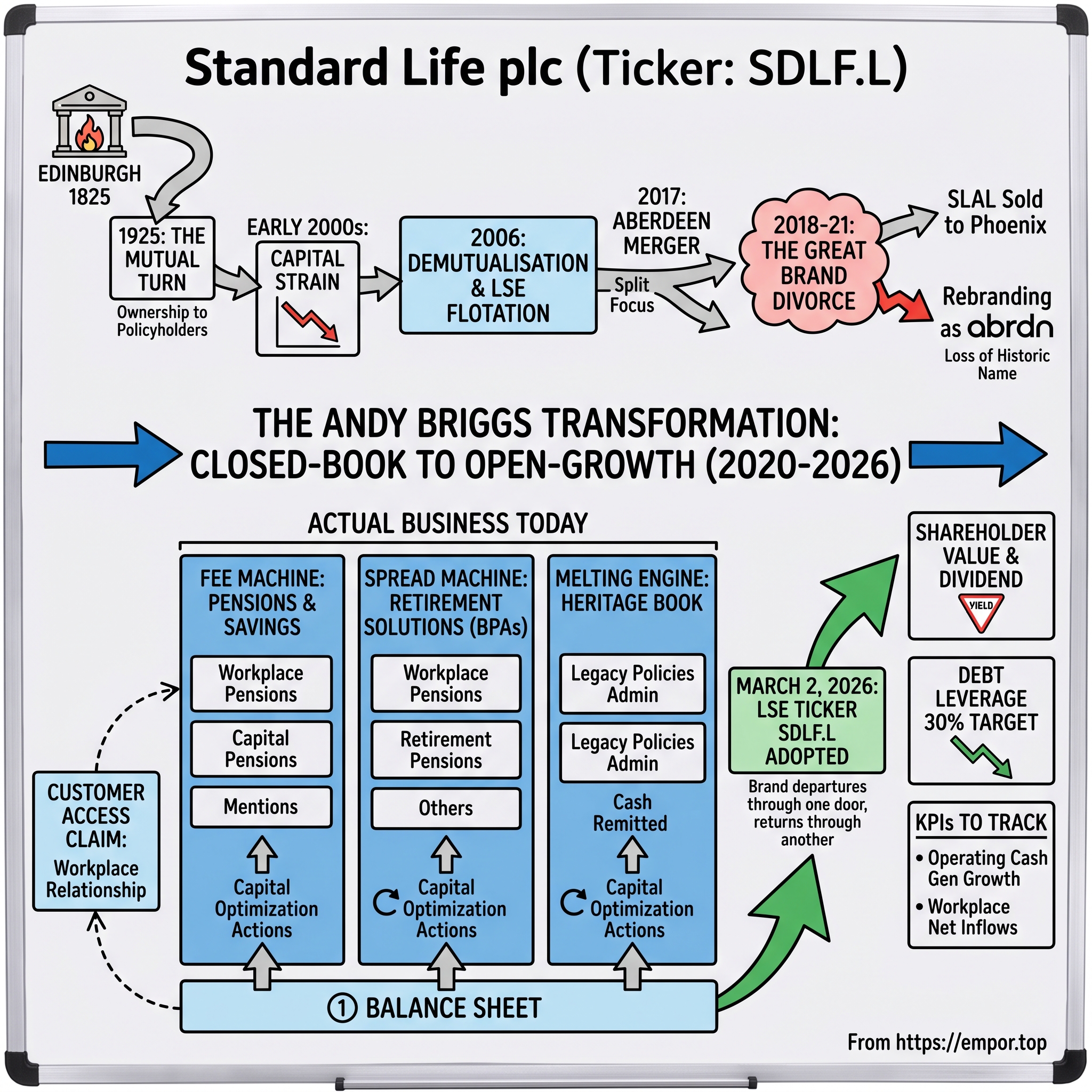
Standard Life plc: The 200-Year Rebirth of a Financial Giant
I. Introduction & Episode Roadmap
On the morning of 2 March 2026, something quietly unusual occurred on the London Stock Exchange. A FTSE 100 company that had traded for years under the ticker PHNX—a symbol borrowed from the mythical bird that burns to ash and returns—began trading under a new four-letter code: SDLF.4 The SEDOL did not change. The ISIN did not change. The Legal Entity Identifier did not change. Not a single share certificate in a single drawer in an Edinburgh flat became invalid.4 Mechanically, nothing changed at all.
And yet the shift represented one of the most remarkable round trips in modern British corporate history. The company now trading as Standard Life plc is not the Standard Life that floated in 2006. It is Phoenix Group Holdings—a business built by acquiring closed life insurance books—which bought Standard Life's operating insurance company in 2018, acquired the brand separately three years later, spent five years growing into it, and then, on 24 February 2026, formally registered the name at Companies House and adopted it as its own.3 The brand departed through one door of Scottish finance and returned through another. The 200-year-old name is now attached to the balance sheet, not to the asset manager that inherited it.
That narrative shift introduces a far more pragmatic investment question.
What the company actually is today. Standard Life plc administers roughly £317 billion in assets for about 12 million customers—roughly one in five UK adults.[^5]2 Management frames the business as the only at-scale UK provider focused solely on retirement savings and income: workplace pensions, retail pensions and drawdown, individual annuities, and bulk purchase annuities for corporate defined benefit schemes.[^22] The company rests on an immense, gradually declining heritage book of closed policies that generates predictable actuarial cash flows, which fund an active growth business at the front end.
The three questions this story has to answer. First, did the rebrand signal genuine operational transformation, or was it expensive corporate staging? Second, can a company historically skilled at buying run-off books win organic market share against Aviva, Legal & General, Aegon, and Scottish Widows in workplace pensions, and against L&G, Rothesay, PIC, and Aviva in bulk annuities—two of the most competitive segments in European financial services? Third, is the cash funding the dividend durable, or does it reflect the drawdown of a wasting asset?
That third question challenges a long-standing market consensus. For much of the past decade, Phoenix represented the classic UK yield trap—a stock held for a dividend yield exceeding 9% amid underlying solvency concerns. That perception has shifted. The shares traded at 903p on 30 July 2026, compared with a 52-week low of 615p, after reaching an all-time high of 921p three days earlier, giving the business a market capitalisation of approximately £9.0 billion.25 Against the 55.40p dividend declared for 2025, the yield sits near 6%—a figure distinct from the high-yield profile that defined the stock in 2023.[^5] A re-rating has occurred, and evaluating whether that re-rating is justified forms the core of this analysis.
This analysis does not presume the rebrand was inherently strategic, nor that executive management is beyond critique. Instead, it distinguishes between aspects of the transformation backed by verifiable evidence—cash remitted, capital ratios, net flows, and cost reductions against historical targets—and those relying on management projection.
The road ahead. The historical account begins in Edinburgh in 1825, moving through 180 years of mutual with-profits actuarial culture to the 2006 flotation. It then focuses on the pivotal events for modern investors: the 2017 merger with Aberdeen Asset Management that fractured the institution's strategic focus, the 2018 sale of the insurance business to Phoenix, the subsequent brand separation, Andy Briggs's operational overhaul, the underlying segment economics, key analyst debates, the risk landscape, and a stress-test of the bull and bear investment cases. The story begins with a fire office in Georgian Edinburgh.
 Subscribe on LinkedIn
II. Mutual Origins to Demutualisation: The Legacy Infrastructure (1825–2006)
On 23 March 1825, in an Edinburgh still lit by oil lamps and energized by the intellectual legacy of the Scottish Enlightenment, a fire insurance office named the Insurance Company of Scotland established a life subsidiary: The Life Insurance Company of Scotland.6 Seven years later, in early 1832, an Act of Parliament received royal assent and the board adopted the name The Standard Life Assurance Company.6
What followed was less about insurance than about the financial infrastructure supporting the British Empire. Standard Life expanded along global trade routes, opening branches in Canada, the West Indies, India, and continental Europe while absorbing nine other insurance companies between 1844 and 1878, including the Colonial Life Assurance Company in 1866.6 A Scottish actuary's promise, backed by an Edinburgh balance sheet, became an exportable financial product.
The mutual turn—and what it actually meant. The pivotal structural shift occurred in 1925 when, marking its centenary, Standard Life converted from a proprietary company into a mutual—reportedly the first British proprietary life office to do so.6 Shareholders were bought out, transferring ownership to policyholders whose earnings accrued as policy bonuses rather than shareholder dividends.6
The with-profits mutual served as the central engine that both built and eventually strained the institution. In simple terms, a with-profits fund operates like a shared pool. Policyholders contribute premiums, which the company invests across equities, property, and bonds. Rather than passing along volatile annual investment returns directly to savers, actuaries release returns at a smoothed rate, retaining excess returns in prosperous years to buffer payouts during market downturns. This retained capital forms the "inherited estate"—an accumulated buffer built over generations. Standard Life introduced a two-tier bonus structure in 1955, layering special claims bonuses on top starting in 1963.6
This structure allowed policyholders to capture equity market growth with reduced perceived volatility. However, it created a fundamental vulnerability: a commitment to smooth returns effectively functions as a financial guarantee during prolonged downturns, and guarantees demand substantial regulatory capital.
The early 2000s: when the reservoir ran low. The dot-com crash exposed these capital demands. UK life insurers had maintained heavy equity allocations to support long-dated guarantees. When equity markets dropped by roughly half, the accumulated capital buffers evaporated. Equitable Life—the world's oldest mutual life insurer—closed to new business in 2000 following a House of Lords ruling on guaranteed annuity rates. In response, regulators mandated realistic balance sheet reporting, requiring insurers to value guarantees at market rates rather than historical actuarial conventions.
For Standard Life, the regulatory shift posed an existential challenge. Under the updated valuation rules, the company's capital position was severely weakened, and its mutual structure provided no mechanism to raise fresh equity capital. In 2004, the company cut 1,000 jobs, and Chief Executive Iain Lumsden resigned, succeeded by his deputy, Sandy Crombie.8 What had been Europe's largest mutual life insurer faced acute capital constraints precisely as the industry shifted toward unbundled, transparent, low-margin pension products.
The 2006 exit from mutuality. To resolve its capital constraints, Standard Life demutualised. On 10 July 2006, the company floated on the London Stock Exchange at 230p per share, entering the FTSE 100 index immediately.8 Approximately 2.4 million policyholder-members received shares, yielding an average windfall of about £1,550 per person.7 The transaction marked one of the largest ownership transfers from mutual members to a public share register in British history. Notably, more than 300,000 members never claimed their shares, leaving roughly 60,000 claims outstanding a decade later when the unclaimed assets trust closed on 9 July 2016.7
Demutualisation fundamentally altered the company's governance dynamics. While a mutual answers to policyholders who cannot easily exit, a listed entity answers to public shareholders who trade daily. This transition to public market scrutiny exposed the business to short-term performance pressures, driving sharper strategic shifts over the subsequent two decades.
The decade nobody talks about. Between 2006 and 2017, Standard Life adapted its operating model to public market realities. Unable to rely on capital-intensive with-profits products amid tightening regulatory demands, the company pivoted toward fee-generating businesses: pension platforms, asset management, and adviser-facing wrap services.
The strategic rationale was straightforward: fee income required minimal regulatory capital, scaled with asset growth, and commanded higher valuation multiples than traditional underwriting. By the mid-2010s, executive management viewed the business primarily as an asset manager with an attached insurance entity, rather than a traditional life insurer operating investment funds. This strategic orientation set the stage for the corporate transactions that followed in 2017 and 2018.
What this century of history leaves behind. This historical evolution left three distinct legacies that remain visible in the company's 2026 financial accounts.
First, an extensive heritage portfolio of legacy policies—including with-profits funds, older pensions, and savings contracts—that requires ongoing administration, capital backing, and eventual payout. Standard Life plc continues to operate 22 separate with-profits funds, representing a structural reflection of its historical product expansion and corporate acquisitions.[^22]
Second, an established distribution network in UK corporate pensions built over decades. Relationships with pension trustees, employee benefit consultants, and independent financial advisers represent durable institutional connections that cannot easily be duplicated.
Third, the Standard Life brand itself, which became central to subsequent corporate restructurings. The 2006 flotation shifted the fundamental question of corporate strategy to a public market board—setting up the strategic realignments that unfolded a decade later.
III. The Mega-Merger Misstep & The Great Brand Divorce (2017–2021)
In early 2017, the strategic logic behind combining two of Scotland's largest financial institutions appeared compelling on paper. Rapid growth in passive index funds was eroding profit margins across active asset management. Standard Life in Edinburgh and Aberdeen Asset Management were each experiencing organic asset redemptions separately. By combining, the firms created an asset manager overseeing roughly £660 billion, aiming to establish the scale required to defend fee structures against global competitors such as BlackRock and Vanguard.9 On 6 March 2017, the companies announced an all-share merger valuing the combined entity at approximately £11 billion, with Standard Life shareholders taking 66.7% and Aberdeen holders 33.3%—a ratio reflecting Standard Life's £7.5 billion market value against Aberdeen's £3.8 billion.9 The deal completed on 14 August 2017.10
The initial governance design highlighted immediate structural compromises. Keith Skeoch of Standard Life and Martin Gilbert of Aberdeen served as co-chief executives.9 Standard Life chairman Gerry Grimstone assumed the chairmanship of the merged group, while Aberdeen chairman Simon Troughton became deputy chairman.9 Duplicating leadership roles across both legacy management teams deferred necessary decisions regarding operational control.
Why it failed, mechanically. Three forces compounded.
The strategic premise was flawed. The merger assumed that scale could protect active management fees. However, net outflows stemmed from changing product demand rather than insufficient scale. Aberdeen had suffered more than three years of redemptions prior to the transaction, driven by emerging-market weakness and a broad migration of institutional capital toward index products.9 Merging two declining active franchises produced a larger declining franchise, while institutional clients invested with both managers hit concentration limits that forced them to reduce exposure to the combined entity.
Operating cultures were fundamentally misaligned. Standard Life operated with an Edinburgh life insurer's long-term orientation, focusing on multi-decade horizons, regulatory capital ratios, and actuarial reserving. Aberdeen functioned as an equity house focused on quarterly performance, generating alpha, and individual portfolio manager accountability. These technical differences dictated conflicting compensation structures, risk tolerances, and governance standards.
The life insurance business became strategically displaced. Rebranding the group primarily as a standalone asset manager left the capital-intensive life insurance operations misaligned with executive priorities. Public markets valued asset managers on fee-earning assets under management, whereas the life insurance balance sheet absorbed regulatory capital and depressed corporate valuation multiples.
Enter Phoenix — the buyer who valued exactly what the seller didn't. Across the transaction table sat Phoenix Group, an insurer built by consolidating closed life insurance books. The consolidator strategy involved acquiring non-active policy portfolios, running administrative infrastructure at lower unit costs, and harvesting regulatory capital over time as policy liabilities matured. Under Chief Executive Clive Bannister, Phoenix executed a series of portfolio acquisitions, culminating in a December 2019 agreement to buy ReAssure from Swiss Re and MS&AD for £3.2 billion—a deal expected to generate roughly £7.0 billion of incremental cash flows over time, completing on 22 July 2020 and taking Phoenix to around 14 million policies.1617
The economics of closed-book consolidation rely on valuation divergence between different owner models. Primary insurers often view legacy books as capital-intensive administrative burdens that depress returns on equity. Consolidators treat those same portfolios as predictable, actuarially modeled cash flows. Value creation occurs through three primary levers: reducing administrative costs through shared technology platforms, optimizing regulatory capital models under Solvency II, and acquiring books at a discount to embedded value from sellers seeking to reallocate capital. By the time the ReAssure transaction closed, Phoenix described itself as Europe's largest life and pensions consolidator, with £329 billion of assets under administration and 14.1 million policies.17
The Standard Life transaction preceded ReAssure. Announced in February 2018, Phoenix agreed to acquire Standard Life Assurance Limited and related entities for total consideration of £3.24 billion — £2.0 billion cash, a £0.3 billion pre-completion dividend from SLAL, and new Phoenix shares giving Standard Life Aberdeen a 19.99% stake — part-financed by a £950 million rights issue.11 It completed on 31 August 2018.12
This transaction structure reflected an incomplete exit. Standard Life Aberdeen sold its primary insurance unit while taking a 20% equity holding in the buyer and establishing a long-term agreement to manage the underlying assets. The firm sought to eliminate balance sheet capital demands while retaining fee-earning assets under management.
The brand divorce. Three years later came the transaction that completed the corporate separation. On 23 February 2021, Standard Life Aberdeen agreed to hand the Standard Life brand, and the colleagues supporting it, to Phoenix.13 The commercial architecture was intricate: SLA paid Phoenix £32 million toward employee transfer costs and £34 million to settle legacy matters, while buying back three distribution platforms—the Wrap SIPP, Wrap Onshore Bond, and UK Trustee Investment Plan, together holding around £36 billion of assets—for £62.5 million upfront.1314 The asset management partnership was extended to at least 2031, covering roughly £147.4 billion of Phoenix assets.13
Myth versus reality. Media reports frequently stated that Phoenix bought the Standard Life brand for £148 million. However, corporate disclosures show that the brand transfer was embedded inside a broader package of business swaps, cost contributions, and legacy settlements without a standalone price for the name itself.14 In net terms, the seller paid to exit the associated cost base, while legal completion of the brand transfer ran into late 2022.13
And then abrdn. Requiring a new identity after surrendering its historic name, Standard Life Aberdeen rebranded in 2021 under Chief Executive Stephen Bird to abrdn—removing the vowels on the advice of agency Wolff Olins, which explained that the mark "symbolises the free-flowing movement of money."[^16] The styling drew widespread criticism from financial media. City AM ran a front page reading "Abrdn: an apology - sry we kp tkng th pss ot of yr mssng vwls."[^16] By 2024, the company's chief investment officer was publicly comparing the mockery to corporate bullying.[^16] In 2025, under Chief Executive Jason Windsor, the vowels returned and the company became Aberdeen again—a change Windsor described as "a pragmatic decision marking a new phase."[^16]
The capital allocation verdict. Stripping away corporate staging reveals a stark strategic outcome. Standard Life Aberdeen divested its cash-generative insurance division, retained a major stake in the buyer, and subsequently sold down that holding—placing just under 40 million Phoenix shares at 660p in January 2022 for around £264 million, cutting its holding from 14.4% to 10.4%.15 It kept the asset management business, whose organic outflow problem the original merger had failed to solve. Meanwhile, Phoenix acquired more than £100 billion of assets under administration, an enterprise workplace distribution channel it could never have built organically, and a name with 200 years of trust attached. Whether Phoenix could use any of it to drive organic growth remained the critical operational question facing its leadership.
IV. The Andy Briggs Transformation: Closed-Book to Open-Growth (2020–2026)
Andy Briggs became group chief executive of Phoenix on 10 March 2020.18 Thirteen days later, the United Kingdom entered its first national COVID-19 lockdown, creating an extraordinary environment in which to begin dismantling a company's founding business model.
The man. Briggs was born in March 1966 and grew up in Chelmsford, Essex — outside the traditional feeder routes for Scottish financial leadership.18 He studied mathematics and actuarial science at Southampton, joined Prudential as an actuarial trainee in 1987, and stayed nineteen years, rising to lead the group's UK and European retirement income business.18 Crucially, after qualifying as an actuary, he deliberately transitioned into sales and marketing roles — an unusual move for a technical specialist, producing an executive capable of engaging both actuarial reserving committees and employee benefit consultants.18
He then ran the UK life operations of three major insurers: managing director of Scottish Widows, group chief executive of Friends Life (the listed consolidator built by Clive Cowdery that was later acquired by Aviva), and chief executive of UK Insurance at Aviva until April 2019.18 He chaired the Association of British Insurers and received an MBE in the 2021 New Year Honours for charitable fundraising.18 By the time he arrived at Phoenix, he had operated on every side of a UK life insurance transaction: buyer, seller, integrator, and regulatory counterparty.
His public presentation is measured and direct. On investor calls, he addresses questions straightforwardly, passes technical detail to his chief financial officer, and notes operational challenges early — a behavioural pattern evaluated in Section VII.
The strategic problem he inherited. The consolidation model carried an inherent expiration date. Acquiring a closed book, harvesting regulatory capital, and running down policies produces a declining cash flow curve. To maintain scale, the business had to execute continuous acquisitions, yet the supply of large UK life portfolios available at reasonable prices was finite. Public markets reflected this constraint through a permanently elevated dividend yield, signaling skepticism regarding long-term cash generation.
Briggs's response, formalized in a three-year strategy unveiled in March 2024, sought to convert the declining run-off portfolio into a funding source for organic growth. Management framed the objective as establishing "the UK's leading retirement savings and income business," serving customers across their adult lives from age 18 to 80-plus.[^21] The strategy was structured around three pillars: grow, optimise, and enhance.[^22]
Grow: building an open front door. The underlying infrastructure was already in place. Auto-enrolment had established mandatory workplace pension inflows across UK employers. Through the acquired Standard Life workplace franchise, Phoenix already ranked as a top-three provider.[^22] The company re-entered the individual annuity market in 2023, capturing a 12% market share by the end of 2024.[^21] It expanded bulk purchase annuities, secured FCA authorization for an in-house financial advice service, and launched the Standard Life Guaranteed Lifetime Income Fund to complete a product range spanning initial workplace contributions to decumulation.[^22]
Analytically, this expansion represented product shelf assembly and distribution execution rather than structural innovation. The strategy carried lower execution risk than inventing new financial products, but it also operated under a lower margin ceiling because competitors offered comparable product suites.
Optimise: bringing the money home. The more significant operational shift occurred in asset management. Historically, Phoenix outsourced asset management across its entire portfolio. Briggs began bringing assets backing annuity liabilities in-house — the fixed-income portfolio required to match long-dated pension liabilities. By mid-2025, the group managed £5 billion of its £39 billion annuity-backing asset pool internally and announced plans to internalize an additional £20 billion.[^22]
Annuity providers generate earnings on the spread between asset yields and policy liabilities. Managing asset allocation directly allows the firm to re-optimize bond portfolios dynamically — taking advantage of market dislocations without altering liability matching — and retain yield enhancement that previously went to third-party asset managers. Management termed these actions "annuity portfolio yield reoptimisation," which generated £189 million of operating cash in the first half of 2025 alone.[^22]
Briggs set explicit boundaries for asset internalization. In September 2025, he clarified that public credit, derivatives, and select private debt would move in-house, while specialized private asset origination would remain with external asset managers, emphasizing that the group had "no intention of becoming a fully fledged asset manager."[^23] Given the costly asset management expansion described in Section III, this boundary maintained operational focus.
Enhance: the unglamorous engine room. Beneath product distribution lay a complex technology footprint comprising millions of policies across legacy administration systems inherited from prior acquisitions. The integration programme migrated policyholder records onto modern platforms, including TCS BaNCS, transferring an additional 0.8 million policies in the first half of 2025.[^22] Rather than attempting to migrate a remaining block of 1.9 million policies, Phoenix entered a strategic agreement with Wipro to administer those records on their existing systems.[^22]
Policy migrations carry significant operational risk, including data corruption, customer service disruption, and regulatory intervention. Outsourcing administration for those 1.9 million policies accelerated cost reductions while, as Briggs stated, increasing "execution certainty as we are no longer migrating these policies."[^22] By year-end 2025, 75% of group policies operated on target platforms, and cumulative run-rate cost savings reached £180 million against a £250 million target — ahead of management's original schedule.[^5]
The lobbying arm, and what it reveals. A key element of the group's strategy involves public policy advocacy. The company operates a dedicated policy research unit — formerly Phoenix Insights, renamed the Standard Life Centre for Future Retirement in 2025 — a change Briggs described on a September 2025 investor call as "a bit of a clue of the direction of travel for the group."[^23]
Research published by the center recommended raising default UK auto-enrolment contribution rates from 8% to 12%. Briggs advocated for this policy publicly, pointing to international benchmarks: the UK's average household savings rate of roughly 10% compares with approximately 20% in Canada, while Australia continues raising its mandatory employer contribution toward 12%.[^23] Under current UK rules, employers contribute only 3% of the 8% minimum.[^23]
The commercial incentive behind this advocacy is clear. For a business whose fee revenues scale with assets under administration, statutory increases in savings rates expand the addressable market. In September 2025, Briggs characterized the addressable market as "huge" at £3.5 trillion and "already growing really strongly," noting that "if we address this under provision, it's going to grow even faster still."[^23]
This policy engagement reflects a commercial effort to expand market volume alongside a broader retirement adequacy debate. However, regulatory risk remains two-sided: future government policy could focus on reducing fee caps or provider charges rather than raising statutory contribution levels.
The rebrand. Following these operational adjustments, corporate identity was aligned with commercial strategy. The group formally registered Standard Life plc at Companies House on 24 February 2026 and began trading under the ticker SDLF on 2 March.34 Operating units SunLife, Phoenix Life, and ReAssure continued trading under their respective brand names.2 Accompanying the rebrand, management introduced a target to assist three million additional customers with retirement planning over the next decade, supported by the brand's largest marketing investment in ten years.2
While corporate rebranding carries execution costs, the shift addressed a clear structural misalignment: operating its primary growth, workplace pension, and consumer-facing channels under the Standard Life brand while listing the parent company as Phoenix — a name associated in public markets with closed-book run-off portfolios. The strategic test remains whether the group can achieve its target of three million additional customers and sustain workplace pension net inflows, metrics evaluated in Section IX.
V. Core Segment Economics & Industry Structure
To evaluate Standard Life plc accurately, investors must analyze it not as a traditional insurer, but as three distinct operations sharing a single balance sheet—each with different unit economics, capital demands, and competitive environments.
Business one: Pensions & Savings — the fee machine. This is the capital-light unit. Assets under administration reached £204.6 billion at the end of 2025, up 7%.[^5] The business holds customer funds, collects basis-point administration fees, and carries negligible balance sheet investment risk because policyholders absorb market fluctuations.
The underlying unit economics reflect distinct market dynamics. Management disclosed that the revenue margin across the overall pensions and savings book averaged around 46 basis points in the first half of 2025, but that the workplace revenue margin was "typically high 20s" of a basis point.[^23] This margin gap is structural: Financial Conduct Authority charge caps on default funds, aggressive employer negotiations, and competitive tenders managed by employee benefit consultants keep workplace fees low, whereas retail and legacy books command higher margins. Consequently, as the workplace channel expands, the blended revenue margin gradually compresses.
Operating profit margin nonetheless expanded, rising from 12 basis points to 17 in 2024 and reaching 19 basis points in the first half of 2025.[^23] This expansion stemmed from operating leverage, as revenue grew 5% on a 5% larger average asset base while costs declined.[^23] Management targeted over half of group operating profit growth between 2024 and 2026 to originate from Pensions & Savings, implying approximately £450 million in segment operating profit by 2026 and a profit margin in the low 20s of a basis point, alongside slowly declining revenue margins and flat costs absorbing inflation.[^23] Interim performance supported this trajectory: the segment delivered £179 million in operating profit in the first half of 2025 (up 20%) and achieved 23% growth for full-year 2025.[^22][^5]
The underlying flow dynamics reveal a split performance. Workplace net inflows reached £5.3 billion in 2025 with 247,000 new members, representing a 14% increase.[^5] Conversely, retail net outflows ran at £4.4 billion in the first half of 2025 alone.[^22] Contraction in legacy individual pensions and bonds continues to offset workplace expansion. While management set an ambition to advance from a top-ten to a top-five retail provider, the retail book currently acts as a drag on net flows rather than an organic growth engine.[^22]
Business two: Retirement Solutions — the spread machine. This capital-intensive unit operates on opposite principles, taking long-term liabilities directly onto the balance sheet in exchange for guaranteed lifetime payout obligations.
Bulk purchase annuities (BPAs) represent the primary growth vehicle, driven by British corporations seeking to offload defined benefit pension liabilities. In a buy-in, a pension scheme purchases an insurance policy matching its liabilities; in a buy-out, the scheme transfers both liabilities and members entirely to the insurer. The unit economics rely on investing upfront premium assets to meet multi-decade payment obligations, with profitability determined by achieving asset yields above initial pricing assumptions and maintaining accurate longevity models over thirty-year horizons.
The total market opportunity remains substantial: the UK retirement savings and income market holds over £3.5 trillion in assets, driven by a multi-decade structural transition from defined benefit to defined contribution schemes.[^22] However, BPA market conditions have tightened. Overall market volumes in 2025 totaled £38.2 billion, falling below the £47.7 billion recorded in 2024 and £49.1 billion in 2023, even as transaction counts reached a record 367 compared with 293 the previous year.2026 The market fragmented into smaller transactions, with sub-£100 million deals accounting for over 85% of total transactions by number in the first half of 2025.20
Standard Life maintains a competitive but non-dominant position in pension risk transfer, writing £3.9 billion in volumes in 2025—roughly 10% market share—behind Legal & General (£10.2 billion; 27% share), Pension Insurance Corporation (£6.8 billion; 18%), Rothesay (£5.2 billion; 14%), and Aviva (£4.6 billion; 12%).19 In July 2025, the company completed its largest BPA transaction to date, a £1.9 billion buy-in for the internal scheme of a major employee benefit consultancy—a notable endorsement given the buyer's professional actuarial capability.[^22]
Reported returns remain attractive: management indicated a new business capital strain of approximately 3% with an internal rate of return in the mid-teens across the £3.2 billion of BPAs and £600 million of individual annuities written in the first half of 2025.[^23] Individual annuities performed strongly, generating £1.2 billion in premiums in 2025, while market share expanded from 11% to 13% during the year as higher interest rates revived demand for guaranteed income among older savers.[^5][^23] Segment operating profit expanded 36% in the first half of 2025 and 19% for full-year 2025, while the contractual service margin—the stock of unearned future profit on insurance contracts—rose 17% to £3.806 billion.[^22][^5]
A key industry dynamic involves funded reinsurance, where insurers transfer liabilities and underlying assets to offshore reinsurers to lower capital requirements and expand writing capacity. While improving capital efficiency, funded reinsurance creates counterparty exposure if a reinsurer encounters financial distress. The Prudential Regulation Authority (PRA) maintains heightened oversight of these arrangements, with stress-test implications discussed in Section VIII.21
Business three: Heritage — the melting engine. The remainder of the group's £317 billion in assets under administration sits within the closed heritage book. Unlike active growth segments, the closed book generates cash as it contracts: as policies mature and claims are settled, required regulatory capital is released to the holding company.
Operational rationalization further accelerates capital release. In the first half of 2025, management closed 65 funds out of approximately 5,000, while data and model refinements—termed "capital improvement actions"—generated £81 million in operating cash during the period.[^22] Management guidance projects recurring capital release from these actions at approximately £500 million annually.[^22] Although providing immediate cash generation, these receipts represent the orderly consumption of a finite asset base over time.
How the three fit together. Executive management presents this hybrid model as a structural advantage. Combining capital-light fee channels with capital-intensive spread underwriting provides diversification benefits under Solvency II regulatory rules, reducing required capital per unit of risk compared with monoline competitors.[^22] In September 2025, Andy Briggs noted that this capital flexibility allows the group to maintain pricing discipline in bulk annuities, permitting it to withdraw from aggressive BPA tenders without leaving capital unallocated.[^23] The operational validity of this strategy depends on whether the group can sustain cash generation during periods of reduced BPA volume—a dynamic evaluated in Section VII.
VI. Microeconomics & Competitive Moats: 7 Powers & Porter's 5 Forces
When employee benefits consultants are asked why a FTSE 100 company changes its workplace pension provider, the response is usually a brief pause, followed by a simple observation: "They mostly don't."
That pause captures the core structural dynamic of the business and serves as the starting point for a competitive analysis. Applying Hamilton Helmer's 7 Powers framework—which asks not whether a business is good, but what specifically prevents competitors from arbitraging away its returns—Standard Life plc possesses some genuine powers, several contested ones, and at least one claim where disclosures fall short of management assertions.
Switching costs: strong, and the strongest thing here. Changing an enterprise workplace pension scheme is not a routine procurement decision; it is an extensive organizational project. It requires board sign-off, payroll and HR system integration, employee re-boarding, trade union consultation, and, in trust-based schemes, formal trustee resolutions carrying fiduciary liability. These switching costs are paid primarily in organizational friction and management focus rather than direct monetary outlays—a dynamic that makes established providers exceptionally difficult to dislodge.
The flow metrics reflect this inertia. Workplace net inflows of £5.3 billion in 2025, alongside 247,000 new members joining, represent a combination of new scheme mandates and recurring automatic contributions from existing clients.[^5] Statutory auto-enrolment ensures that an incumbent provider receives monthly cash inflows from every participating employee without incurring ongoing acquisition expenses—creating an arrangement close to a legislated distribution annuity within UK financial services.
Scale economies: real but shared. Administering 12 million customers across consolidated platforms reduces unit costs per policy, and the £180 million in cumulative run-rate savings delivered against a £250 million target demonstrates that operational efficiency levers function as intended.[^5] However, competitors such as Aviva, Legal & General, and Scottish Widows operate at similar scale—with Scottish Widows alone administering roughly £232 billion for 10 million customers as of 2024. Within this market, scale serves as a prerequisite for top-tier competition rather than a unique competitive differentiator.
Brand: real, hard to quantify, and easy to overclaim. The Standard Life brand retains long-standing recognition among independent financial advisers and pension trustees, and the parent company's decision to buy the trademark before adopting it as the plc name underscores management's evaluation of its equity.1 Chief Executive Andy Briggs noted in September 2025 that "the Standard Life brand lands really positively" in the bulk annuity sector.[^23] While that reflects management's perspective rather than a direct financial metric, measurable evidence appears in institutional selection rates.
In workplace pensions, Standard Life became the first provider to secure the "Master Trust Treble" across the Corporate Adviser, Pensions Age, and Professional Pensions industry awards, while receiving gold ratings across its Defined Contribution Master Trust, Master Trust, and Group Personal Pension propositions in 2025 sector evaluations.[^22] Although industry awards do not equal cash flow, they serve as a practical proxy in a sector where corporate advisers select shortlists based on institutional reputation.
The customer-access claim, examined. Executive management asserts a third competitive pillar alongside scale and capital efficiency: privileged customer access. With roughly one in five UK adults holding a policy, management argues that the group observes customer demand patterns that competitors cannot easily replicate.[^22] A workplace pension franchise establishes a relationship with a saver decades prior to retirement. This dynamic supports the strategy of assembling a complete product lineup spanning accumulation, decumulation, and guaranteed income: the lowest-cost customer for a retirement income product is an individual already enrolled within the provider's pension network.
However, a structural gap remains in this framework. Historically, the business operated primarily as an administrator of policy books rather than an active manager of customer relationships—a common limitation of consolidation platforms. Disclosed initiatives aimed at bridging this gap remain preliminary: regulatory approval from the Financial Conduct Authority for an in-house advice unit that management confirmed would start small before scaling, a mobile application rated 4.7 stars, integration with national pension dashboard systems, and a partnership with customer engagement specialist Life Moments.[^22]
These developments represent operational inputs rather than financial outputs. Demonstrating a true customer-access moat requires evidence of measurably higher asset retention as policyholders reach retirement and make distribution decisions. Until those conversion metrics are disclosed, customer access functions as potential energy rather than an established moat.
Cornered resource: this is where the claim is weakest. In Helmer's framework, a cornered resource requires preferential access to a scarce asset. Standard Life's internal asset management capabilities are being expanded rather than cornered—with £5 billion managed internally out of a £39 billion annuity-backing asset pool, and an additional £20 billion scheduled for internalization using capabilities the chief financial officer described as newly established.[^22][^23] Peer institutions maintain similar infrastructure: Aviva, Legal & General, and M&G operate internal credit management units, while specialist insurers like Rothesay and Pension Insurance Corporation were constructed around them. In this domain, Standard Life is closing an operational gap rather than establishing an exclusive advantage.
Counter-positioning: partial, and dependent on rivals' constraints. The company's primary structural argument rests on capital allocation flexibility—the capacity to pivot toward capital-light fee operations when credit spreads narrow, and toward capital-intensive bulk annuities when spreads widen. Monoline bulk purchase annuity specialists lack this optionality and must maintain underwriting volumes regardless of market pricing. However, whether this qualifies as counter-positioning in a strict sense—an advantage competitors cannot emulate without impairing their legacy core—remains questionable, given that composite peers like Aviva and Legal & General maintain identical business models. The structure is better understood as a defensive diversification benefit shared among the market's largest composite providers.
Porter's five forces, evaluated.
Threat of new entrants: low, serving as the sector's primary structural protection. Solvency UK capital rules, Prudential Regulation Authority authorization, matching adjustment approvals for annuity portfolios, and the administrative scale required to service millions of accounts form barriers measured in years and substantial capital.23 However, external capital enters the market through acquisitions rather than de novo startups.
Addressing this trend in September 2025, Andy Briggs characterized capital inflows as "a real strong endorsement of the market," noting that investors were prepared to allocate substantial funds to participate.[^23] While accurate, this entry mechanism carries competitive implications: well-capitalized owners purchase existing platforms to bypass regulatory barriers, creating pressing demands to deploy capital and write new underwriting business. Barriers that can be acquired protect an incumbent's regulatory license rather than its pricing margins.
Rivalry: high and intensifying. Industry data illustrates market pressure: total bulk purchase annuity volumes fell 20% year-over-year in 2025 while transaction counts reached record levels, forcing competitors to contend for smaller deal sizes.2019 In workplace pensions, the competitive field includes Aviva, Legal & General, Aegon, and Scottish Widows, alongside low-cost master trusts such as NEST and People's Partnership, whose fee caps restrict industry pricing flexibility.
Buyer power: moderate to high. Corporate pension trustees conduct structured auctions advised by actuarial consultants who evaluate pricing down to individual basis points. In the workplace market, employee benefit consultants exercise similar influence on behalf of corporate sponsors, maintaining persistent pressure on fee structures.
Supplier power: low overall, with targeted operational dependencies. External asset managers compete actively for investment mandates, and Standard Life's asset internalization reduces third-party reliance. The primary supplier risk centers on administrative technology, where third-party providers Tata Consultancy Services (TCS) and Wipro manage large segments of the legacy policy estate—creating administrative switching friction that management seeks to avoid.[^22]
Threat of substitutes: low for core products, moderate for wrappers. Pension tax relief provides structural tax advantages relative to individual savings accounts or property investments, while auto-enrolment establishes default participation. While retiring policyholders can substitute income drawdown for a lifetime annuity, Standard Life offers both options across its product lineup.
The composite view. Standard Life plc operates within a structurally protected industry, occupying defensible positions across key segments: a top-three standing in workplace pensions, roughly fifth place in bulk purchase annuities, and a growing 13% market share in individual annuities. The competitive moat is largely industry-wide rather than proprietary to the company. Consequently, the core investment thesis depends less on overall sector attractiveness and more on whether executive management can outperform four well-capitalized composite peers—a question that requires ongoing tracking of operational execution against reported milestones.
VII. Conference Call Forensics & Management Credibility
There is a moment in the September 2025 half-year results Q&A that tells you more about this management team than any slide. Andrew Sinclair of Bank of America stands up, opens with "great to see the Standard Life brands coming back to the fore," and asks three technical questions. Briggs hands them to his CFO — then adds, unprompted: "if you didn't know, Andy started his career at Standard Life in Edinburgh, hence, the reference to brand, he's feeling good about it."[^23]
It is a small thing. It is also a chief executive signalling that he knows exactly who is in the room and what they care about. Now the harder evidence.
Target-setting behaviour: a genuine track record of over-delivery. In March 2024 the company set a three-year framework: operating cash generation of £1.4 billion in 2026, cumulative total cash generation of £4.4 billion across 2024–26, adjusted operating profit of £900 million in 2026, and £250 million of run-rate cost savings.[^21] At the 2024 full-year results in March 2025, it reported operating cash generation of £1,403 million, up 22% — hitting the 2026 target two years early — and consequently raised the cumulative cash target from £4.4 billion to £5.1 billion and the 2026 profit target from £900 million to £1.1 billion.[^21]
Delivering a three-year target in year one, then raising it, is a meaningful credibility event. The honest caveat is that it also invites the question of whether the original target was set low enough to be beatable. A charitable read: a management team taking over a business the market did not trust needs an early win. A skeptical read: sandbagging.
Willingness to name a miss. Here the evidence is genuinely good, and it is the strongest single argument for this team's credibility. In the same March 2025 presentation where he announced the upgrades, Briggs volunteered a failure. On the leverage ratio — stuck at 36% against a 30% target for 2026 — he said plainly: "I'm disappointed that it has remained flat at 36% this year, despite repaying debt because Own Funds has been lower than I would have liked."[^21]
He then did the thing that distinguishes accountability from apology. Pressed on leverage in the Q&A, he described the fix in mechanical terms — and disclosed that growth in unrestricted Tier 1 own funds had been written into the management team's annual incentive plan: "for Nic and I, for the whole management team, growth in the unrestricted Tier 1, Own Funds is one of the key measures there."[^23] Naming a shortfall, identifying the specific driver, and repricing your own bonus against it is behaviour, not rhetoric.
The subsequent numbers back it up. Leverage improved to 34% at the half-year 2025 after a £200 million debt repayment, and to 33% by the end of 2025.[^22][^5] CFO Nic Nicandrou — who joined in December 2024 after a long career at Prudential, including five years running its Asian business — was careful not to promise a straight line: "the path to 30% will not be linear and deleveraging will be managed within the upper half of our 140% to 180% operating range."[^21][^22] Guidance that pre-commits to bumpiness is harder to fail than guidance that doesn't.
The three pressure points analysts keep returning to.
Capital discipline in bulk annuities. Andrew Baker of Goldman Sachs asked in September 2025 whether M&A in the UK bulk annuity space would impair the group's ability to deploy its planned £200 million of capital at attractive margins.[^23] Briggs's answer was direct on the question of discipline: "Are we confident that over time, we'll be able to deploy our £200 million of capital? Yes, we are. But we will be disciplined, and we will not deploy the capital if we can't get attractive returns. We're focused on returns."[^23]
The behavioural evidence partially corroborates this. First-half 2025 BPA volumes were, in Briggs's own description, "relatively modest" — and Nicandrou explicitly flagged that both the excess cash figure and the solvency ratio were flattered by that low volume, noting that had the group written the same BPA volumes as in the first half of 2024, the coverage ratio would have been around three points lower.[^22] A management team that tells you its capital ratio looks better than it should because it wrote less business is not managing to the headline.
Own funds and the denominator problem. This is the subtler and more persistent challenge. Leverage is debt over own funds; you can improve it by repaying debt or by growing own funds. In 2024 own funds fell, and Briggs conceded that all reporting peers had seen the same.[^23] The reason is technical but important: the group hedges its annuity liabilities using swaps that extend asset duration to cover one-in-200-year cash flows, so when rates rise, the mark-to-market loss on assets exceeds the gain on liabilities, depressing own funds.[^23] The hedging is deliberate — it protects the solvency surplus and therefore the dividend — but it means own funds growth is genuinely hard to control.
IFRS losses versus cash. The most uncomfortable disclosure in this company's accounts is that it keeps reporting statutory losses. FY2024: a loss after tax of £1,078 million, driven by £1,297 million of adverse economic variances.[^21] First half 2025: a loss of £156 million.[^22] Nicandrou's answer to this, when Andrew Baker raised it, was unusually blunt — he asked permission to explain "why I regard that as noise," and then argued that because the hedging stabilises the solvency balance sheet while the IFRS balance sheet does not capture all the hedged components, the resulting IFRS volatility is an accounting mismatch.[^23]
This deserves scrutiny rather than acceptance, because "our losses are an accounting artefact" is exactly what a company with real problems would also say. Nicandrou's supporting evidence is the part that matters: dividends are paid from distributable reserves at the plc level, which stood at £5.6 billion at the end of 2024 and £5.7 billion at the half-year 2025, fed by remittances from life subsidiaries that made £500 million of UK GAAP profit in 2024 and a further £400 million in the first half of 2025 — after absorbing the hedge-related impacts.[^23]
That is a checkable, cash-based chain of reasoning rather than an assertion — the dividend traces to statutory profits at the operating subsidiaries, not to a management-defined metric. It does not make the IFRS loss disappear, and a genuinely skeptical investor should keep watching whether adjusted operating profit ever converts into positive statutory profit. Management's own stated milestone is that £1.1 billion of operating profit in 2026 would exceed recurring uses on an IFRS basis and support an upward trajectory in shareholders' equity.[^21] That is a specific, dated, falsifiable promise.
A disclosure change worth flagging. One item belongs in any honest credibility assessment: the group stopped publishing its long-term undiscounted cash generation disclosure. Pressed on this by Dominic O'Mahony of BNP Paribas Exane in March 2025, Briggs explained that with higher interest rates, "the market said we need to understand discounted numbers, not undiscounted numbers," and that the direction of travel was to replace it with operating cash generation split by business unit.[^23]
The explanation is reasonable — an undiscounted multi-decade cash total is a genuinely poor metric in a 4% rate world. But investors should note what changed. A long-dated disclosure that let outsiders independently model the run-off's duration was withdrawn, and the promised replacement — segmental operating cash generation — had not yet been delivered at the point the old one disappeared. Management committed to providing it at the full-year results.[^22] When a company retires a metric that supported the bear case and replaces it later, the replacement deserves careful reading rather than gratitude.
Narrative consistency across calls. Comparing March 2025 to September 2025 to February 2026, the story does not shift. The financial framework — cash, capital, earnings — is unchanged. The strategic priorities — grow, optimise, enhance — are unchanged. Operating cash generation is consistently identified as the primary metric, with the same justification each time. The 2026 targets set in 2024 and upgraded in 2025 were still being reported against, unchanged, at the 2025 full-year results in February 2026: mid-single-digit OCG growth, approximately £1.1 billion of adjusted operating profit, and around £500 million of excess cash.[^5] Where management has changed its mind — on asset in-housing, on migrating versus outsourcing 1.9 million policies — it has explained the change and quantified it.
The most useful thing about all of this, for an investor, is not that management is impressive. It is that they have made enough dated, numeric commitments that they can be caught if they are wrong.
VIII. Current Risk Radar & Skeptical Investor Stress Test
On 17 November 2025, the Bank of England published stress test results for eleven of the UK's largest life insurers—covering more than 90% of sector annuity liabilities—and followed a week later, on 24 November, by releasing individual firm results for the core scenario.21 For an industry historically accustomed to confidential supervisory dialogue, this disclosure provided unprecedented public visibility into balance sheet vulnerabilities across the sector.
The aggregate findings were reassuring on the surface yet revealing under closer examination. Under the core stress scenario, sector-wide solvency capital coverage dropped from 185% to 154%, absorbing an £8.6 billion reduction in surplus capital alongside £12.9 billion in credit downgrades, while all participating insurers maintained regulatory compliance.22 The exploratory scenarios highlighted deeper structural vulnerabilities: asset concentration stress reduced aggregate solvency coverage to 153%, while funded reinsurance recapture—a stress scenario in which a reinsurer defaults and underlying liabilities return to the primary insurer—reduced coverage to 144%, reflecting £12.3 billion in recaptured liabilities, or approximately half of total market exposure.2122 The Prudential Regulation Authority noted that funded reinsurance remains in early adoption and warned that "further growth could amplify its impact."21
This supervisory baseline establishes a specific framework for evaluating the company's primary operational and financial risks.
Risk one: credit and private asset quality — the highest-consequence exposure. Internalizing asset management and seeking enhanced yield on annuity portfolios require higher allocations to illiquid credit, private debt, infrastructure loans, and commercial real estate backing long-dated obligations. The economic rationale is clear: because annuity liabilities are long-term and illiquid, matching them with illiquid assets allows insurers to capture an illiquidity premium without taking uncompensated risk.
The vulnerability lies in credit downgrades rather than outright defaults. Under Solvency UK rules, if an asset is downgraded from investment grade to sub-investment grade, it incurs significantly higher regulatory capital charges and risks losing matching adjustment eligibility. Consequently, the insurer must set aside additional capital precisely when market conditions strain its balance sheet. The Bank of England stress test's £12.9 billion in aggregate downgrades quantified this specific transmission mechanism.22 For a group planning to bring an additional £20 billion in annuity assets in-house, credit selection remains a central operational sensitivity.[^22]
Risk two: BPA competition and spread compression. Competitive pressures in the bulk purchase annuity market are already evident: total industry volumes declined 20% in 2025 compared with 2024, even as transaction counts set a new record and private-capital-backed entrants actively acquired market share.2019[^23] The risk to Standard Life is subtle. Bidding discipline may prevent the firm from winning unprofitable transactions, but persistent margin compression restricts the volume of capital it can deploy at target returns. In turn, slower expansion in spread-based earnings places greater reliance on the fee-generating pensions and savings division to drive overall profit growth.
Risk three: operational and outsourcing concentration. Millions of policyholder accounts are administered under long-term arrangements with third-party vendors Tata Consultancy Services and Wipro.[^22] Halting the migration of 1.9 million policies reduced immediate technical conversion risks but deepened reliance on external service providers. Under the Financial Conduct Authority's Consumer Duty framework, any significant administrative disruption—such as data corruption, platform outages, or delayed retirement payouts—carries direct regulatory and reputational penalties. Operational outsourcing delivers cost efficiency, but it shifts administrative control to third-party infrastructure.
Risk four: regulatory and political shifts. Regulatory developments present both opportunities and headwinds. Solvency UK reforms that took effect on 30 June 2024 expanded matching adjustment eligibility, enabling life insurers to invest more flexibly in unlisted credit and long-term domestic assets.2324 Similarly, proposed Pension Schemes Bill legislation establishing a £25 billion minimum scale threshold for default funds supports large-scale consolidation, a threshold Chief Executive Andy Briggs noted the company comfortably exceeds.[^22] Conversely, potential regulatory tightening by the Prudential Regulation Authority—such as stricter capital requirements on funded reinsurance or higher capital buffers following the 2025 stress test—would directly reduce distributable capital and pressure dividend coverage.21
Risk five: cyber security and data protection. Administering retirement records for approximately one in five UK adults creates significant cyber security exposure.[^22] Because much of this policyholder data resides on third-party technology platforms across multiple jurisdictions, technical execution is distributed while legal accountability remains concentrated. Under Consumer Duty and UK data protection legislation, Standard Life remains fully accountable for data breaches or operational failures occurring at outsourced suppliers. While no material breaches have been reported, this structural exposure expands alongside the administrative outsourcing that drives operating cost reductions.
Risk six: longevity and actuarial assumptions. Long-term annuity profitability depends on actual policyholder lifespans aligning with actuarial projections. Accelerating improvements in life expectancy—driven by medical advancements in treating cardiovascular disease or dementia—would increase lifetime payout obligations across the annuity portfolio. While insurers transfer a portion of this longevity exposure to international reinsurers, doing so converts insurance risk into counterparty credit risk—the exact exposure evaluated in the Bank of England's funded reinsurance stress scenario.
The bear case: a skeptical investor stress test. A short thesis on Standard Life plc centers on four interconnected arguments:
Cash generation relies on finite management actions. Recurring management actions—including portfolio yield re-optimization, capital model refinements, and fund rationalization—generate approximately £500 million in annual operating cash.[^22] Skeptics argue that capital extraction from legacy actuarial buffers is inherently finite. From this perspective, market valuations risk applying growth multiples to a cash flow stream derived in part from the orderly drawdown of a heritage portfolio.
Divergence between statutory and operating metrics. Reporting consecutive IFRS net losses alongside expanding adjusted operating profits creates persistent analytical tension.[^21][^22] Although management presents a cash-based reconciliation supported by subsidiary dividend remittances, relying on alternative performance measures over audited statutory results requires investors to accept management's proprietary reporting framework.
Structural complexity obscures underlying performance. Managing 22 distinct with-profits funds, rationalizing roughly 5,000 investment funds at a pace of 65 per half-year, navigating multiple administrative outsourcing platforms, and maintaining dual Solvency II and IFRS 17 balance sheets creates substantial operational opacity.[^22] While common among legacy life insurers, this complexity makes independent verification of long-term cash sustainability challenging for external analysts.
Growth depends heavily on statutory tailwinds. Although workplace pension inflows continue to expand, they are partially offset by persistent outflows across the retail book, while workplace expansion relies on mandatory auto-enrolment contributions accessible to all major competitors.[^22]
Management's counter-proof and critical milestones. Disclosed financial results provide a measurable counterweight to the bear thesis. Operating cash generation expanded 22% in 2024 and 5% in 2025 to reach £1,474 million, while the solvency capital coverage ratio strengthened from 172% to 176% and debt leverage declined from 36% to 33%.[^21][^5] Expanding cash generation while simultaneously increasing regulatory capital and reducing debt contrasts with a simple asset run-off profile. Furthermore, the contractual service margin—representing the stock of unearned future profit on insurance contracts—grew 17% in 2025, indicating that new business additions exceeded the annual profit recognized during the year.[^5] Retaining £423 million in excess cash in 2025 to fund debt reduction rather than dividend expansion provides further evidence of balance sheet discipline.5
Resolving this debate depends on specific, verifiable operational milestones over the next 18 months: whether operating cash generation maintains mid-single-digit growth as initial capital optimization actions mature, and whether the Pensions & Savings division delivers the roughly £450 million in operating profit targeted for 2026.[^23]
IX. Key KPIs to Track & Strategic Playbook
While corporate reporting frequently floods investors with dozens of metrics, management has consistently highlighted three core performance indicators that define the underlying investment case. Everything else remains secondary commentary.
KPI one: Operating cash generation, and specifically its growth rate. Management defines operating cash generation as "the sustainable surplus generation in our Life operating companies, that's also remitted as dividends up to the holdco," making it "the primary driver of shareholder dividends."[^22] Operating cash generation reached £1,474 million in 2025, growing 5% following 22% growth in 2024, supported by forward guidance targeting mid-single-digit annual expansion.[^5][^21]
The centrality of this metric is structural: it provides the definitive test between the legacy run-off thesis and the organic growth case. If skeptics are correct that the heritage portfolio is merely being drawn down, operating cash generation will stagnate and fall as policy run-off accelerates and capital optimization actions expire. If the growth case holds, expanding cash flows from Pensions & Savings and Retirement Solutions will more than offset the natural decay of the closed book.
The composition of these cash flows is as vital as the headline figure. Management committed to disclosing a segmental breakdown of operating cash generation alongside full-year results, providing visibility into the relative cash contributions of expanding growth units versus the declining heritage book.[^22] This reporting enhancement will allow external analysts to verify whether recurring cash generation originates from sustainable open business.
KPI two: Workplace net inflows and new member additions. This serves as the primary leading indicator for the capital-light fee business. Workplace net inflows reached £5.3 billion in 2025, supported by 247,000 new members joining the platform—a 14% increase in member additions.[^5]
Analyzing both metrics independently is essential because they capture distinct commercial dynamics. Net inflows reflect automated contributions from existing scheme members, measuring the earnings power of the installed corporate base. New member additions indicate whether the group is actively winning scheme mandates against competitors. Sustained net inflows alongside stagnant member growth would signal reliance on statutory auto-enrolment rather than organic market share expansion. Meanwhile, persistent retail net outflows represent a drag on overall performance, contrasting with management's target to advance from a top-ten to a top-five retail provider.[^22]
KPI three: The Solvency II pair—shareholder capital coverage ratio and debt leverage. Evaluated together, these indicators demonstrate balance sheet health, as either metric can be cosmetically improved by compromising the other. At year-end 2025, the shareholder capital coverage ratio stood at 176%, positioning it within the 140% to 180% target operating range and in the upper half preferred by management.[^5][^23] Concurrently, the debt leverage ratio fell to 33%, progressing toward management's target of approximately 30% by year-end 2026.[^5]
Tracking both metrics simultaneously is necessary to evaluate capital discipline: an insurer can reduce leverage by consuming surplus capital, or inflate capital buffers while maintaining high debt loads. Evaluating the underlying composition of these ratios remains essential, given Chief Financial Officer Nic Nicandrou's explicit disclosure that lower bulk annuity volumes had flattered the half-year 2025 coverage ratio by approximately three percentage points.[^22]
Secondary metrics requiring contextual interpretation. Two commonly cited indicators provide limited insight into underlying performance.
The first is the headline IFRS accounting result. While statutory net losses require monitoring, accounting fluctuations in a hedged annuity portfolio stem primarily from interest rate and equity mark adjustments that are structurally offset on the regulatory balance sheet funding dividend distributions.[^23] Evaluating short-term accounting swings as operational performance signals risks misinterpreting core cash generation.
The second metric is total assets under administration. The total assets under administration figure of £317 billion is heavily influenced by broader equity and fixed-income market valuations.[^5] In years with favorable market returns, asset appreciation on £317 billion far exceeds organic workplace net inflows of £5.3 billion, meaning headline asset growth reflects macro market movements rather than commercial execution. Organic net flows provide a far more precise measure of franchise health.
Three durable lessons from this story.
Brands represent valuable strategic assets omitted from corporate balance sheets until acquired. Standard Life Aberdeen treated a 200-year-old brand as a residual element within a broader package of business transfers and cost settlements, disclosing no standalone valuation for the name.1314 Five years later, the buyer adopted the brand for its parent FTSE 100 listing and centered its consumer strategy around the identity, supported by its largest marketing campaign in ten years.2 Corporate divestitures during periods of strategic realignment can lead sellers to undervalue legacy assets that no longer align with core priorities, creating value for disciplined consolidators.
Corporate simplification creates value only when retaining businesses with durable distribution. Following the 2018 transaction, both entities pursued strategic focus. The insurance business retained capital-intensive legacy policy books and successfully expanded operating cash generation. Conversely, the standalone asset manager retained a capital-light model but spent subsequent years fighting asset outflows and executing multiple corporate rebrandings.[^16] For investors evaluating corporate restructurings, strategic focus depends less on pursuing high-multiple fee models and more on controlling durable customer distribution channels.
Capital discipline requires abstaining from unviable growth opportunities. Demonstrable underwriting discipline is evident in management's deliberate restraint within bulk purchase annuities, where half-year transaction volumes remained relatively modest and executive leadership explicitly acknowledged that this flattered the reported capital position.[^22][^23] While immediate reporting metrics often incentivize rapid capital deployment, long-term returns depend on underwriting restraint during periods of heightened market competition.
X. Bull vs. Bear Case & Epilogue
Two intelligent investors can look at the same set of facts here and reach opposite conclusions, which is what makes this an engaging security rather than a settled one. Here is each case at its strongest.
The bull case.
The core bull argument centers on a mispriced corporate transition. For a decade, public markets valued Phoenix as a run-off vehicle—a shrinking cash stream with an elevated yield to compensate for long-term decay. Supporters argue that operational metrics invalidate that framing: operating cash generation expanded 22% in 2024 and 5% in 2025, adjusted operating profit rose 31% and then 15% to reach £945 million, the contractual service margin grew 17%, workplace pension net inflows compounded, and the balance sheet strengthened across coverage and leverage metrics simultaneously.[^21][^5]
If this transition holds, the valuation framework shifts. A business generating an increasing share of earnings from fee income on £204.6 billion in assets under administration—at expanding profit margins with minimal capital requirements—resembles a capital-light wealth platform more than a closed-book insurer.[^5] Meeting the 2026 target of approximately £450 million in Pensions & Savings operating profit would make the fee-based division the primary driver of group profit growth, fundamentally altering the group's earnings profile.[^23]
Specific operational catalysts support this thesis: internalizing £20 billion in additional annuity-backing assets to improve yield capture and portfolio optimization, simplifying 12 of 22 with-profits funds to release roughly £150 million in capital while lowering hedging costs, and capturing the remaining £70 million under a £250 million efficiency program.[^22] Structural tailwinds provide broader support, including a £3.5 trillion UK retirement savings market, a systemic shift toward defined contribution schemes, legislative minimum scale requirements favoring large workplace platforms, and Solvency UK reforms that expand asset allocation flexibility.[^22]23
Meanwhile, balance sheet repair addresses a persistent market objection: debt leverage declined from 36% to 33%, with management targeting 30% by year-end 2026.[^5] Reaching that target would leave approximately £500 million in annual excess cash fully discretionary, giving the board capital to fund organic growth, selective acquisitions, further debt reduction, or share buybacks.[^5][^23]
The bear case.
The core bear counter-argument holds that an appealing narrative masks a structurally challenging business, and that the stock's re-rating already reflects the initial operational improvements.
Analyzing flow quality reveals immediate friction. While workplace inflows appear robust, mandatory pension contributions flow equally to major competitors. Revenue margins in workplace pensions remain compressed in the high twenties of a basis point, with management guiding toward further gradual decline.[^23] Concurrently, retail net outflows of £4.4 billion in a single half-year indicate that the fee-generating division faces persistent legacy redemptions.[^22] Accumulating assets while fee margins contract forces the business onto a margin treadmill, where earnings growth requires capping operating costs against inflationary pressure indefinitely.
Competitive dynamics in spread underwriting present a second constraint. Total bulk purchase annuity market volumes contracted 20% in 2025 despite record transaction counts, as private-capital-backed entrants intensified pricing competition.2019[^23] Standard Life captures roughly 10% of total volume, trailing Legal & General's 27% market share.19 Maintaining a disciplined fifth-place standing in a price-sensitive auction market indicates limited pricing power, regardless of operational execution.
Accounting results highlight further analytical tension. The group reported consecutive statutory net losses—£1,078 million in 2024 and £156 million in the first half of 2025—while executive communications emphasized alternative operating cash generation metrics.[^21][^22] Although management provides a cash reconciliation tied to subsidiary dividend remittances, asking public markets to look past audited statutory losses requires investors to accept proprietary reporting conventions over GAAP results.
Asset internalization carries distinct credit risk. Transferring £20 billion in annuity assets to an expanding internal credit team increases exposure to illiquid debt, where rating downgrades trigger mandatory capital charges under Solvency UK rules.[^22] Prudential Regulation Authority stress tests demonstrated that sector solvency coverage fell from 185% to 154% under core stress scenarios and to 144% under funded reinsurance recapture—levels that preserve regulatory compliance but restrict excess capital buffers.2122
Finally, the central structural challenge remains unchanged: the heritage portfolio backing corporate cash flows is inherently in run-off. Management actions generating approximately £500 million in annual capital releases have a finite lifespan.[^22] If capital extraction slows before open growth channels fully mature, holding company cash flows would narrow, threatening the coverage of a dividend requiring approximately £550 million annually.[^22]
A second-layer note on the register.
A key structural overhang on the share register has largely resolved. Aberdeen's equity stake—which stood at 19.99% following the 2018 transaction and 14.4% in early 2022—was systematically divested, starting with a placement of nearly 40 million shares at 660p in January 2022.1115 The presence of a non-natural institutional shareholder seeking an orderly exit creates a persistent drag on equity valuations. Consequently, the stock's recent price appreciation reflects technical supply relief alongside fundamental operational progress.
Where the two cases actually meet.
Both perspectives rely on the same reported data, differing on long-term trajectory. Bullish investors view open growth channels as expanding faster than closed books contract, arguing that valuation multiples have not caught up to operational changes. Bearish observers view the company as a well-administered insurer in a competitive, heavily regulated market, where recent gains reflect finite cost reductions, capital optimization, and balance sheet repair rather than proprietary pricing power.
Resolving this debate depends on specific, upcoming disclosures. Will Pensions & Savings operating profit reach the £450 million target in 2026?[^23] Will detailed segmental reporting confirm that open channels generate an expanding share of operating cash?[^22] Will debt leverage hit the 30% target by year-end 2026, and how will executive leadership allocate the resulting discretionary capital?[^5] Finally, can management halt retail net outflows? Each milestone carries a defined timeline.
Epilogue.
The corporate journey highlights a notable transformation in modern UK financial history. In 2006, demutualization distributed equity to 2.4 million policyholder-owners, over 300,000 of whom left their shares unclaimed.7 A decade later, the standalone institution pursued a complex merger, divested its primary insurance operating company in 2018, surrendered its historic brand name in 2021, and temporarily dropped its vowels.
Meanwhile, the brand was acquired by a consolidator built through closed-book policy acquisitions—including Abbey Life and ReAssure—led by a mathematician who had previously directed three major UK insurance competitors. On 2 March 2026, that group formally registered the name and placed Standard Life plc on the London Stock Exchange main board.4
Moving forward, corporate identity matters less than financial execution. Standard Life plc presents a clear operational test: a UK retirement provider combining a contracting heritage book, automated workplace pension inflows, a competitive annuity franchise, a deleveraging balance sheet, and a series of explicit financial targets. Whether these elements produce a durable growth platform or simply a well-managed business navigating a mature industry remains a question that upcoming cash generation results will determine.
References
-
Phoenix Group becomes Standard Life — Professional Adviser, 2026-03-02 ↩
-
Phoenix Group rebrands to Standard Life after strong growth of pensions business — Corporate Adviser, 2026-03-02 ↩↩↩↩
-
Phoenix Group completes its name change to Standard Life — Money Marketing, 2026-02 ↩↩
-
Phoenix Group rebrands as Standard Life with new LSE ticker SDLF — TipRanks, 2026-03-02 ↩↩↩↩
-
2025 Annual Financial Report (RNS) — Investegate / Standard Life plc, 2026-02-24 ↩
-
The Standard Life Assurance Company — Company History — Company-Histories.com ↩↩↩↩↩↩
-
Standard Life to close door on unclaimed shares — The Irish Times, 2016-06-27 ↩↩↩
-
Standard Life history: One of the first Empire builders — The Scotsman ↩↩
-
Standard Life and Aberdeen agree to £11bn merger — International Adviser, 2017-03-06 ↩↩↩↩↩
-
Asset management roundup: Aberdeen Standard Life merger completes — IPE, 2017-08-14 ↩
-
Acquisition of Standard Life Assurance (RNS) — Phoenix Group Holdings / Investegate, 2018-02-23 ↩↩
-
Phoenix Group Holdings plc Solvency and Financial Condition Report, 31 December 2018 — Phoenix Group, 2019 ↩
-
Strategic partnership between Standard Life Aberdeen and Phoenix Group Holdings — Aberdeen plc, 2021-02-23 ↩↩↩↩↩
-
Standard Life brand sold to Phoenix — Money Marketing, 2021-02-23 ↩↩↩
-
Abrdn sells 4% stake in Phoenix Group for £264m — Citywire New Model Adviser, 2022-01-27 ↩↩
-
Phoenix proposes £3.2bn acquisition of ReAssure — Pensions Age, 2019-12-06 ↩
-
Phoenix completes acquisition of ReAssure Group plc — ReAssure, 2020-07-22 ↩↩
-
L&G dominates UK pension risk transfer market with 27% share — IPE, 2026 ↩↩↩↩↩
-
Bulk annuity and longevity hedging — H2 2025 — Hymans Robertson, 2025 ↩↩↩↩↩
-
Life Insurance Stress Test: 2025 Results — Bank of England Prudential Regulation Authority, 2025-11-17 ↩↩↩↩↩↩
-
UK bulk annuity sector 'resilient to severe market shock', stress test finds — IPE, 2025-11 ↩↩↩↩
-
Solvency UK Reforms: Considerations for Life Insurers — PwC UK ↩↩↩
-
Solvency II — Bank of England Prudential Regulation Authority ↩
-
Standard Life plc (SDLF.L) share price and market data — Yahoo Finance, accessed 2026-07-30 ↩
-
LCP predicts record-breaking BPA activity in 2025 despite fall in volumes — Pensions Age ↩
 LinkedIn
 WhatsApp
 Reddit
 Hacker News
 Email
Email Kindle
 RSS Feed
 Spotify
 Apple Podcasts
 Amazon Music
 Audible
 YouTube