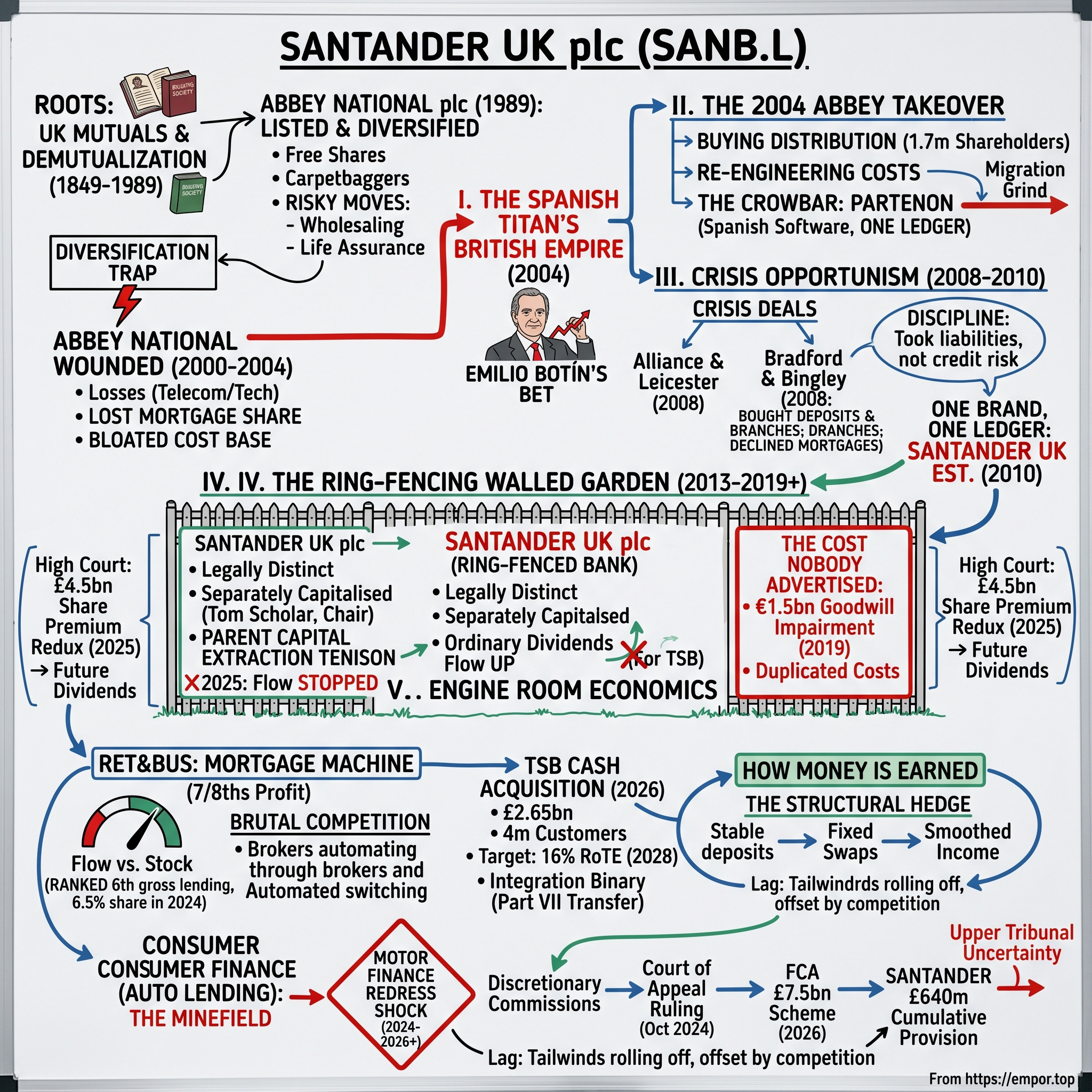
Santander UK plc: The Spanish Titan's British Empire
I. Prologue: The Motor Finance Shock & The Spanish Titan's British Bridgehead
There is a particular kind of silence that settles over a bank's investor relations department when the lawyers walk in.
On the morning of October 28, 2024, Santander UK was supposed to be a routine story. Third-quarter numbers, a few analyst questions about mortgage spreads, done by lunch. Instead, the bank did something British lenders almost never do: it postponed its results announcement outright, hours before publication, while it worked out what a court had just done to it.1
Three days earlier, the Court of Appeal had handed down a judgment in a set of cases about car loans — specifically, about the commissions car dealers earned for arranging finance. The ruling went far beyond what the industry had assumed possible, and it landed on a sector that had spent fifteen years treating dealer commissions as boring plumbing.2 Shares in UK motor lenders fell. Close Brothers suspended new lending in parts of its motor book. And Santander UK, the British arm of a Spanish banking group headquartered nearly a thousand miles away in Madrid, went quiet.
When the bank finally reported, it carried a provision of £295 million against historical motor finance commission claims.[^3] That number would not hold. It grew through 2025 and again in 2026, and by the middle of this year the cumulative charge stood at £640 million, of which £623 million remained on the balance sheet at June 30, 2026.3
Here is the paradox worth sitting with. Santander UK is not a niche foreign outpost. It is one of the largest deposit-takers in Britain, holding £227.2 billion of customer deposits and £204.7 billion of mortgages as of mid-2026 — a balance sheet that would make it a systemically important institution in most countries on earth.3 It is now the UK's third-largest bank by personal current accounts and its fourth-largest mortgage lender.4 Its branches sit on high streets in Bolton and Bournemouth. Its brand is red and Spanish and utterly unremarkable to the British public.
And yet its ordinary shares cannot be bought. All of Santander UK plc's ordinary equity is unlisted and held by Santander UK Group Holdings plc, itself wholly owned by Banco Santander SA.5 What trades under SANB.L on the London Stock Exchange is a slice of the capital structure, not the business: £325 million of sterling preference shares, alongside listed additional tier 1 securities and a long tail of senior and covered debt.5 This is, in other words, a credit story wearing an equity ticker — which makes the analytical question sharper, not softer. Holders of these instruments are exposed to exactly one thing: whether a ring-fenced British bank keeps generating enough capital to service them, inside rules designed to stop its Spanish parent from reaching in.
How did a Spanish bank end up here at all? Not through organic patience. Santander bought its way into Britain in three moves — a landmark cross-border takeover in 2004, an opportunistic double-strike during the 2008 collapse, and, most recently, a £2.65 billion cash purchase of TSB completed on April 30, 2026 that added four million customers and 4,500 staff in a single afternoon.4
The story that follows runs roughly like this:
- The mutual and the mistake. Two Victorian building societies become Abbey National, Abbey National becomes the first UK mutual to demutualise, and demutualisation becomes an invitation to wander into businesses it did not understand.
- The Botín bet. How
Emilio Botínturned a wounded British mortgage lender into a proof of concept for cross-border banking, using a piece of Spanish software as the crowbar. - The crisis roll-up. Buying deposits and branches while explicitly refusing the assets that were killing everyone else.
- The cage. UK ring-fencing, and what it does to the economics of owning a British bank from Madrid — including the specific accounting manoeuvres that let cash move upstream.
- The engine room. Mortgage margin warfare, the structural hedge, and why a bank with a huge home-loan book can still struggle to earn its cost of equity.
- The minefield. Motor finance redress, the FCA's £7.5 billion scheme, and what it reveals about how regulated distribution risk compounds silently for a decade.
- The verdict spine. Where the case for this franchise is genuinely strong, where it rests on management assertion, and the small number of metrics that would settle the argument.
To understand why Santander could buy its way into Britain, you have to understand what had gone wrong with the institution it bought.
 Subscribe on LinkedIn
II. Roots & Demutualization: The Rise and Fall of Abbey National
Two Victorian institutions sit at the root of this story, and neither of them was a bank.
The first, founded in 1849, was the National Freehold Land and Building Society, set up to buy London land and parcel it out to people who wanted to own a home and — because property ownership carried voting rights — a say in the country.6 The second, the Abbey Road & St. John's Wood Permanent Benefit Building Society, was established in 1874 to lend against houses in north-west London.6 Both were mutuals: owned by their members, funded by their members' savings, lending that money back out as mortgages. No shareholders, no profit motive beyond covering costs and building reserves.
In 1944, with Britain's housing stock cratered by bombing and the post-war rebuild looming, the two merged into Abbey National Building Society.6 For four decades it did the same thing over and over: take deposits from savers, lend them to homebuyers, keep the spread. It was arguably the most boring successful business model ever devised, and it worked precisely because it was boring.
The July That Ended Mutuality
Then came 1989. Abbey National became the first building society in the UK to demutualise, converting into a public limited company and listing on the London Stock Exchange.6 Members received free shares. Roughly 1.8 million people who had never owned equity in their lives suddenly held a stock certificate, and a generation of British savers learned a new word: "carpetbagger" — someone who opened accounts at mutuals purely to collect the windfall when they floated.
The strategic logic was seductive and, in hindsight, corrosive. As a mutual, Abbey National could only grow as fast as its members' savings and its retained earnings allowed. As a plc, it could raise equity, borrow in wholesale markets, and buy things. What nobody adequately priced was the change in incentive. A mutual has no shareholders demanding a rising return on equity. A listed bank does. And the fastest way to raise return on equity in a low-margin business is to do something riskier.
Abbey did. Through the 1990s and into the 2000s it acquired its way outward — into life assurance with Scottish Mutual, into private banking with Cater Allen, into asset finance with Lombard, into protection with Scottish Provident.6 It also built a large wholesale treasury operation, taking positions in corporate credit and structured instruments that had nothing to do with lending money to families in Watford.
The Diversification Trap
Here is the mechanism that matters, because it recurs constantly in banking and investors keep re-learning it. A retail mortgage bank has an unusual asset: an enormous, sticky, low-cost deposit base gathered from ordinary households. That funding is genuinely cheap. The temptation is to conclude that cheap funding is a licence to buy higher-yielding assets — and to forget that the reason the funding is cheap is that depositors believe the bank is safe.
Abbey National put its cheap retail funding to work in wholesale credit markets, and when the technology and telecom credit cycle turned at the start of the 2000s, the losses arrived from businesses that most of its customers did not know it was in. Simultaneously, and more damagingly, it was losing ground in the one thing it had been built to do. Nimbler competitors — Northern Rock with its aggressive wholesale-funded lending, HBOS with its scale, Lloyds TSB with its distribution — took mortgage share while Abbey's attention was elsewhere.
Underneath both problems sat a third: the plumbing. Successive acquisitions had left Abbey with a patchwork of systems, each acquired brand carrying its own processing stack, its own reconciliations, its own operations staff. Cost-to-income ratios drifted upward. That ratio — operating costs divided by income — is the single most revealing number in retail banking, because a bank with a bloated cost base cannot compete on price without destroying its own profitability. Abbey could not cut prices to win mortgages back, because it could not afford to.
By 2004 the picture was clear enough that everyone in the City could see it. Abbey National still owned something genuinely valuable: millions of retail relationships, a very large mortgage book, and a deposit franchise that had taken 150 years to assemble. But it had wrapped that asset in a loss-making wholesale operation, an expensive operating model, and a management team that had spent a decade proving it could not allocate capital.
That combination — an irreplaceable franchise attached to a fixable operating problem — is the single most attractive setup in acquisition finance. It is also the setup that most acquirers get wrong, because fixing an operating problem requires capabilities that money cannot buy in the moment. Somebody was going to bid for Abbey National. The question was whether the bidder would have the machinery to do anything with it.
The answer came from Spain, from a man who had been waiting for exactly this.
III. The 2004 Abbey Takeover: Emilio Botín's Masterstroke
On the morning of October 21, 2004, roughly 900 people gathered at the Wembley Conference Centre in north London.7 They were a fraction — a rounding error, really — of Abbey National's 1.7 million small shareholders, most of whom had received their stock free fifteen years earlier and never thought about it again. They had come to vote on whether to hand their bank to a Spaniard.
The vote split in a revealing way. Measured by share value, 94.6% approved. Measured by headcount — one vote per shareholder, the mutual's ghost still in the room — only 64.8% did.7 Institutions wanted the deal. A large minority of the individuals who had been handed shares in 1989 did not, and their objection was straightforward: at a valuation of around £8.7 billion, they felt they were being bought cheaply just as Abbey's profitability was recovering.7 A Deutsche Bank analyst said as much at the time.7
Emilio Botín, chairman of Banco Santander, offered them the language of empire rather than arithmetic: the vote, he said, was "a decisive step towards the creation of one of the world's leading banking groups."7
The Man and the Method
Botín was not a conventional banker. He ran Santander as a family enterprise that happened to be a listed multinational — the third generation of Botíns to lead it, with a personal style that combined ferocious deal appetite with an obsession over operational detail that most chairmen delegate away. Under him, Santander had grown from a mid-sized Spanish regional lender into a genuine international force, primarily by buying banks in Spain and Latin America and then rebuilding them from the inside.
Britain was the logical next frontier, and the logic was defensive as much as offensive. Spain and Latin America gave Santander growth but also volatility — currency risk, political risk, credit cycles that could turn violently. A large, boring, sterling-denominated mortgage bank in a mature legal system was ballast. It would earn less in the good years and lose far less in the bad ones.
The formal terms were announced in the second half of 2004, structured as a scheme of arrangement, with completion set for November 12.8 The deal was, at the time, the largest cross-border acquisition of a British bank by a foreign institution, and the City reaction ranged from scepticism to derision. The case against was not stupid: cross-border retail banking synergies had a dismal historical record, Spanish management had no experience of British consumer regulation, and Abbey's problems looked cultural rather than technical.
The Crowbar Was Software
What the sceptics missed was that Santander was not buying Abbey to run it. It was buying Abbey to replace it — and it had a specific, tested instrument for doing so.
That instrument was Partenon, Santander's proprietary core banking platform, developed in Spain and deployed across its acquisitions. To understand why this mattered, it helps to abandon banking vocabulary entirely. A bank's core system is the ledger: the piece of software that knows what every account holds, processes every transaction, and calculates every interest payment overnight. Most large banks built theirs in the 1970s and 1980s, then bolted acquisitions onto the side rather than migrating them, because migration is terrifying — get it wrong and millions of people cannot access their money on a Monday morning.
The result, at a bank like Abbey, was a dozen ledgers that did not speak to each other, each requiring its own operations team to reconcile, each blocking any product change that touched more than one system. Every acquisition Abbey had made added a layer. This is why its costs would not come down: the cost base was not a spending decision, it was an architectural fact.
Santander's insight was that if you own a single scalable core, an acquisition stops being an integration problem and becomes a migration project. You do not merge two banks; you empty one into the other. And once the migration is complete, the entire duplicated middle and back office — the reconciliation teams, the parallel processing centres, the systems maintenance contracts — becomes redundant in one stroke.
The financial commitments made at the time were unusually specific. Santander projected €150 million of run-rate cost savings in the first year, €300 million by year two, and €450 million by year three, with a further €150 million expected from 2007 onwards specifically from implementing Partenon.8 Short-term IT initiatives alone were targeted at €128 million.8 The deal was guided to be accretive to Santander's earnings per share from 2006.8 Revenue synergies were also projected — roughly €220 million of pre-tax earnings by 2007 across protection insurance, general insurance, consumer loans and SME products — though these were, as revenue synergies almost always are, the softest part of the case.8
Reading the Deal Two Decades Later
Set against what else was happening in banking M&A at the time, the Abbey transaction looks better in retrospect than it did in the moment. Within three years, RBS would lead a consortium to buy ABN AMRO in a deal that destroyed the institution, and Bank of America would acquire Countrywide and inherit a decade of litigation. Both were bets on acquiring assets and revenue. Santander's was a bet on acquiring distribution and then re-engineering the cost of serving it — a fundamentally different and more controllable proposition.
That said, honest assessment requires acknowledging what the deal did not do. It did not turn Santander UK into a structurally superior competitor to Lloyds or HSBC in returns terms. It did not give Santander pricing power in British mortgages. And two decades on, the group has twice had to revisit the value it ascribed to the UK, most notably with a €1.5 billion goodwill impairment taken in the third quarter of 2019 — a subject we will return to, because the stated reasons say a great deal about what owning a British bank actually costs.9
The migration itself was a grind. Partenon was rolled into Abbey in phases across 2006 and 2007, and the transition period produced its share of service disruptions and customer complaints. But the cost line moved, and the operating model that emerged had one decisive property: capacity. Santander UK could now absorb another bank without adding another ledger.
Four years after the Abbey vote, it would get the chance to prove it — under conditions nobody at Wembley had imagined.
IV. Crisis Opportunism: The 2008 Financial Crisis Roll-Up
In September 2007, queues formed outside Northern Rock branches — the first bank run in Britain in over a century, filmed and broadcast, a visual that permanently altered how the British public thought about banks. Within a year the entire UK banking system was in the emergency ward. HBOS was rescued by Lloyds in a shotgun merger the government waved through. RBS, briefly the largest bank in the world by assets, required a state bailout. Wholesale funding markets — the mechanism through which banks borrowed from each other to fund lending — simply stopped functioning.
The banks that failed shared a common design flaw. They had funded long-dated assets, principally mortgages, with short-dated wholesale borrowing rather than with retail deposits. The model worked beautifully while credit was abundant, generating rapid growth at low apparent cost. When the market shut, these institutions discovered they had built businesses that required continuous access to funding they did not control.
Santander UK was in a different position — not because it was smarter about credit, but because the Abbey franchise it had bought was fundamentally deposit-funded, and because its Spanish parent had capital and appetite when almost nobody else did. It went shopping in the middle of a fire.
Two Deals, Twelve Weeks Apart
The first target was Alliance & Leicester, another demutualised building society, wholesale-funded and visibly wobbling. On July 14, 2008, its board recommended shareholders accept Santander's bid, valuing the business at roughly £1.26 billion. Shareholders ratified it that September, and the takeover took effect on October 10.10 For a bank with a large branch network and a substantial deposit base, that price reflected a market that had stopped believing in the equity value of British lenders altogether.
The second deal was structurally different and more instructive. Bradford & Bingley, a specialist buy-to-let and self-certified mortgage lender, was nationalised on September 29, 2008. On the same day, the government confirmed that Santander would acquire B&B's £20 billion savings business and its branch network for £612 million, including the transfer of £208 million of capital relating to offshore companies.10
Read that structure carefully, because it is the whole lesson. The British state took the mortgage book — the buy-to-let and self-certified loans that were about to go bad — into public ownership, where it would be wound down over years at taxpayer expense. Santander took the deposits, the savers, and the branches. It bought the liabilities and the distribution while explicitly declining the assets.
To most people, "buying liabilities" sounds like buying a problem. In banking, it is the opposite. A retail deposit base is the raw material of the entire business: cheap, sticky, government-insured funding that can be lent out at a spread for decades. Loans are a commodity you can originate any time you have funding and capital. Millions of savings relationships built over a century cannot be originated at all — they can only be acquired.
The Discipline That Made It Work
What separated Santander from the acquirers who blew themselves up in the same window was not superior foresight about house prices. It was a refusal to take on credit risk it could not underwrite. Lloyds took HBOS whole — book, brand, and all — and spent the following decade absorbing the consequences. Santander took the funnel and left the exposure with the state.
There is a fair counter-argument that deserves airing: Santander was buying with an implicit backstop from a parent whose own domestic market was, at that moment, heading into a catastrophic property bust of its own. Spanish banks were not obviously safe harbours in 2008. The deals worked, but part of the reason they were available at those prices was that very few buyers had any capital at all — and being one of the few bidders in a distressed auction is a position, not a skill.
One Brand, One Ledger
The consolidation followed quickly. Santander UK was established in January 2010, combining Abbey with Bradford & Bingley's savings business and branches; Alliance & Leicester merged into the renamed business that May.10 Abbey, Alliance & Leicester and Bradford & Bingley all disappeared as consumer brands, replaced by a single red livery, and the group has operated under one brand ever since.5
The three-brand-to-one collapse was possible only because of what had been built after 2004. Each acquired business was migrated onto the common core rather than run in parallel. This is the point where the Partenon investment paid its real dividend — not in the Abbey deal itself, but in the option value it created to consolidate two more banks at marginal cost. Optionality of that kind rarely appears in a deal model and is often the largest source of value in platform acquisitions.
By the early 2010s Santander UK held roughly a tenth of the British mortgage stock and a branch network in the low thousands, assembled almost entirely from the wreckage of the mutual sector. Three Victorian building societies, demutualised in a wave of 1980s and 1990s financial liberalisation, had been reassembled into a single Spanish-owned bank within twenty years.
Which raised a question British policymakers were, at that exact moment, becoming intensely interested in: what happens when a systemically important British deposit-taker is a subsidiary of a foreign group?
V. The Ring-Fencing Walled Garden & Parent Capital Extraction
The Independent Commission on Banking, chaired by Sir John Vickers, was set up in the wreckage of the bailouts to answer a deceptively simple question: how do you stop taxpayers from having to rescue banks again?
Its answer was structural rather than merely prudential. Rather than only demanding more capital, the Commission proposed physically separating the part of a bank that society cannot live without — current accounts, savings, payments, small business banking, mortgages — from the part that can be allowed to fail: trading, complex derivatives, most investment banking. The retail core would be "ring-fenced," legally distinct, separately capitalised, separately governed, and structurally protected from losses elsewhere in the group.
That principle was legislated in the Financial Services (Banking Reform) Act 2013, with the largest UK banking groups required to comply by January 1, 2019.11 It has shaped Santander UK's economics ever since.
Building the Fence
Santander UK's implementation played out in 2018. An application was made in February of that year for a ring-fencing transfer scheme, and the transfers were largely effected that July. Santander UK plc became the group's principal ring-fenced bank, serving all UK personal customers and the vast majority of business customers, while activities not permitted inside the fence moved to Banco Santander's London branch.12
Inside the fence, Santander UK plc operates as something close to a standalone bank that happens to be wholly owned. It maintains its own board — chaired since July 18, 2025 by Tom Scholar, who joined the board that May, and who came to the role having previously served at the very top of the UK Treasury.5 It holds its own capital and its own liquidity pool. It cannot rely on the parent's resources in a crisis, and — this is the part that matters commercially — the parent cannot freely use the subsidiary's.
The capital position reflects that autonomy. At the end of 2025, Santander UK plc reported a CET1 capital ratio of 15.8% and a liquidity coverage ratio of 162%, both well above minimum requirements.5 At the wider Santander UK Group Holdings level, CET1 stood at 15.7% at both December 2025 and March 2026, falling to 14.2% by June 2026 as the TSB purchase consumed capital.133 Those are not the ratios of a bank operating close to the edge, and they are one reason the listed preference and AT1 instruments have behaved as they have.
The Cost Nobody Advertised
Ring-fencing is usually discussed as a safety measure. For a foreign-owned group, it is also a tax — and Santander quantified it in unusually blunt terms.
In September 2019, the parent booked a goodwill impairment of approximately €1.5 billion against Santander UK. The stated reasons were specific: ring-fencing had shifted roughly €40 billion of assets into Banco Santander's London branch, of which €25 billion came from an initial transfer out of Santander UK, and had increased costs through the duplication of functions — the combined effect being a reduction in Santander UK's capacity to generate profit. Competitive pressure in Britain and Brexit-related uncertainty were also cited.9
That is a striking admission. A large chunk of the value Santander thought it had built in Britain was written down because a regulatory structure made the business smaller and more expensive to run. It is the clearest available evidence that the ring-fence is not merely a governance formality but a genuine economic constraint on how a global group can use a British subsidiary.
The regime is now being loosened at the margin. The government confirmed in July 2025 that ring-fencing would be retained but acknowledged it had become overly prescriptive, and HM Treasury published the conclusions of a full Ring-Fencing Review in May 2026 — retaining structural separation while proposing reforms to shared operational services, thresholds, and the interaction of ring-fencing with capital and MREL requirements.14 The direction is helpful for Santander UK's cost base. The magnitude is, as yet, unproven.
How Money Actually Gets Out
The mechanics of upstreaming cash from a ring-fenced subsidiary are worth spelling out, because they are where the parent-child tension becomes visible.
The primary channel is ordinary dividends. In 2023 Santander UK plc paid £1,530 million on its ordinary shares; in 2024, £1,311 million — of which £804 million was designated as special dividends.5 Those are substantial extractions from a bank earning roughly £1.4 billion of pre-tax profit, and they demonstrate that when the group wants capital out, it can get it out.
Then, in 2025, the flow abruptly stopped. Only £26 million of ordinary dividends were paid, with the annual report explicitly attributing the change to the anticipated TSB acquisition, and noting that the CET1 ratio rose partly because of "almost no dividend."5 Capital was retained in Britain because the group wanted to deploy it in Britain — the ring-fence working in the direction that suits the parent.
The second channel is the securities themselves. Dividends on preference shares and other equity instruments — the instruments trading under SANB.L and alongside it — cost £132 million in 2025, £129 million in 2024 and £123 million in 2023.5 These payments are contractual in character, and unlike ordinary dividends they do not stop when the group changes strategy.
The third mechanism is the least visible and the most interesting to a sceptical reader of accounts. On September 18, 2025, the High Court confirmed a reduction of Santander UK plc's share premium account by £4,501 million, with an equivalent increase in retained earnings.5 In plain terms: a large block of capital that was legally locked into a non-distributable reserve was converted into distributable reserves. No cash moved and no economic value was created. What changed was the legal capacity to pay dividends in future. A bank does not undertake that exercise casually, and an investor watching parent-subsidiary dynamics should read it as preparation for optionality on distributions in the years ahead.
The Internal Competition Problem
None of this happens in isolation. Banco Santander allocates capital across a portfolio that includes Brazil, Mexico, Spain, the United States, and a growing digital bank. Emerging-market units have historically produced higher returns on tangible equity than the UK, and the group's stated ambition has been to lift overall RoTE toward the mid-teens.
Santander UK has not been carrying that average. Its RoTE was 10.0% at December 2025, 10.4% in the first quarter of 2026, and 9.1% in the first half of 2026 after the motor finance charge and TSB costs.133 The group is now targeting around 16% RoTE for Santander UK by the end of 2028, supported by at least £400 million of TSB cost synergies.4
That target does real work in this story. A subsidiary earning around 10% inside a group targeting mid-teens returns is, on the group's own arithmetic, a dilutive holding. Management's answer has been to buy scale rather than exit — the largest inward investment in UK banking in over fifteen years, on the company's own description.13 Whether that answer proves correct depends almost entirely on what happens in the engine room.
VI. Engine Room Economics: Segments, Mortgage Wars & The Structural Hedge
Strip away the history and Santander UK is a machine that does one thing at enormous scale: it borrows money from British households at one rate and lends it back to British households, secured on their homes, at a slightly higher one. Everything else is a rounding error dressed up as a division.
The 2025 numbers make the concentration unambiguous. Retail & Business Banking produced £1,291 million of pre-tax profit out of a total £1,482 million for Santander UK plc — roughly seven-eighths of the entire enterprise.5 Mortgages accounted for 85% of customer loans.5 This is not a diversified financial group. It is a mortgage bank with two side businesses attached.
Segment One: The Mortgage Machine
The core book stood at £167.3 billion at the end of 2025, up from £165.1 billion a year earlier, with a stock loan-to-value ratio of 52%.5 That LTV figure is the most important credit statistic in the business. It means that across the whole portfolio, houses are worth roughly twice the debt secured against them. UK house prices would need to fall catastrophically before the bank faced widespread losses on the collateral itself — and the asset quality data supports that read, with the Stage 3 ratio (loans in default) at 1.18% at year-end, improved by 24 basis points.5
The more revealing story is in flow rather than stock. Gross mortgage lending was £16.1 billion in 2024, then jumped to £25.3 billion in 2025.5 That is not a modest recovery; it is a strategic reversal. And the 2024 figure explains why. In that year, Santander UK ranked only sixth among British residential lenders with a 6.5% share of gross lending — behind Lloyds at 19.4%, Nationwide at 17.3%, NatWest at 11.2%, Barclays at 9.1% and HSBC at 8.2%.15
Hold those two facts together, because the combination is the single most useful insight into how this bank has been run. Santander UK holds roughly a tenth of the outstanding UK mortgage stock but was writing only about a fifteenth of new lending. It was, in other words, deliberately shrinking its share of a market it had spent twenty years building — choosing margin over volume when mortgage pricing was unattractive, then re-entering hard in 2025 when the arithmetic improved. Management has described this as pricing discipline and a "return to growth."5 That framing is defensible. It is also worth noting that a bank which cannot profitably defend its share of the flow in a competitive year does not have pricing power; it has a choice between two unattractive outcomes.
Why Mortgage Margins Compress
UK mortgages have become one of the most brutally efficient consumer markets in the world, for reasons that have very little to do with the banks.
Most borrowers now fix their rate for two or five years. When the fix expires, they do not passively roll onto the lender's standard variable rate; a broker — increasingly running automated systems that monitor the whole market — contacts them and re-brokers the loan. The result is that essentially the entire mortgage stock reprices on a rolling basis at whatever the sharpest lender in the market is offering.
A branch network is worth almost nothing in this contest. The customer never visits one. What matters is showing up at the top of a sourcing system's results, which means price. When several large banks simultaneously hold surplus deposits and want mortgage assets, the outcome is predictable and margin goes to the borrower.
Segments Two and Three
Corporate & Commercial Banking is the mid-market and SME arm. It produced £324 million of pre-tax profit in 2025, down from £351 million, with the decline driven mainly by higher credit impairment charges partly offset by cost discipline.5 Its differentiating pitch is the Banco Santander network: helping British exporters and internationally active companies bank across borders, formalised through platforms like Navigator Global, with over 400 new clients onboarded in 2025.5 It is a genuine and unusual advantage among UK ring-fenced banks — and it is also, at roughly a fifth of group profit, too small to change the character of the enterprise.
Consumer Finance is the auto lending business: point-of-sale finance for cars, vans, motorbikes and leisure vehicles through dealer networks. Structurally it should be attractive — 98% of lending is secured on the vehicle and default rates are low.5 Instead it recorded a pre-tax loss of £76 million in 2025, following a £175 million loss in 2024, in both cases driven by provisions for historical commission payments.5
That is a striking outcome. The smallest of three segments, accounting for about 3% of the loan book, has generated consecutive losses large enough to reduce group profit by several percentage points. It is a lesson about the shape of regulated consumer risk: exposure is not proportional to balance sheet, it is proportional to the number of past transactions where conduct might be challenged.
The Structural Hedge, Explained Properly
Now to the mechanism that most determines whether this bank earns an acceptable return — and which almost no retail investor understands.
Start with the problem. A bank holds deposits that pay little or no interest: current account balances, instant-access savings paying near zero. Behaviourally these balances are extremely stable in aggregate; individuals come and go but the pool persists for years. The bank also holds shareholders' equity, which by definition costs nothing to fund.
If the bank simply left that money in overnight deposits at the Bank of England, its income would swing violently with policy rates. Base rate at 5% and the bank looks wildly profitable; base rate at 0.1% and the same balances earn nothing. Earnings would be a leveraged bet on the Monetary Policy Committee.
The structural hedge fixes this. The bank invests those stable, rate-insensitive balances into a rolling ladder of fixed-rate instruments — typically interest rate swaps — spread evenly across several years of maturity. Think of it as a bond ladder: each year a slice matures and is reinvested at whatever rates prevail. The bank gives up the windfall when rates spike, and is protected when rates collapse. The output is a smoothed, predictable income stream.
The critical detail is the lag. Because the ladder reinvests slowly, the yield on the hedge reflects an average of the last several years of interest rates, not today's. After the near-zero decade, the swaps rolling off carried extremely low yields, so every maturity replaced at higher rates lifted income — a mechanical tailwind that had nothing to do with commercial performance.
The disclosed numbers show both the tailwind and its limits. The structural hedge notional fell from £110 billion at December 2024 to £103 billion at December 2025, which management framed as positioning for further Bank Rate reductions.5 Then it expanded sharply to £118 billion by June 2026, with duration extended from 2.3 to 2.6 years and the yield improving from roughly 3.0% to 3.2%, according to CFO commentary on the group's second-quarter call.16 The half-year statement put gross average hedge yields at 3.11%.3
Here is what that actually tells an investor. Banking net interest margin was 2.23% for 2025, then 2.22% in the first quarter of 2026 and 2.25% in the first half.133 Net interest income actually fell 2% in the first quarter as higher deposit costs outweighed the hedge benefit.13 The tailwind is real but it is now being consumed by deposit competition rather than dropping through to profit. Management guides that banking NIM will be stable in 2026.13 "Stable" is an accurate description of a hedge benefit that is running roughly level with the cost of retaining depositors — and it is a considerably more sober message than the structural-hedge-as-multi-year-tailwind story told across the sector two years ago.
Deposits themselves tell the same story from the other side. Customer deposits grew to £183.6 billion at Santander UK plc by end-2025, with the annual report noting savings growth after a strong ISA season and explicit "customer migration from Current Accounts."5 That migration is the quiet erosion of the whole model: every pound that moves from a near-zero current account into a competitive term deposit is a pound that stops feeding the cheap-funding engine.
Which brings us to the people responsible for making the arithmetic work — and to the liability that has been eating the results.
VII. Modern Management, Strategy & The Motor Finance Minefield
On March 1, 2026, Mahesh Aditya took over as chief executive of Santander UK, replacing Mike Regnier.5 It is worth pausing on who the group chose, because the appointment is a statement about what Madrid thinks the UK problem is.
Aditya was not a British retail banker groomed through the branch network. He came from inside Banco Santander's global machine, having joined the group in 2017 and served as group chief risk officer and as chief executive of Santander Consumer USA. His two defining credentials are risk and consumer finance — precisely the two disciplines at the centre of the UK's largest open sore — with a mandate to integrate TSB on top.
His first published words as CEO, in the first-quarter statement, were carefully constructed. He led with technology and customer relationships, described "good business performance," and only then acknowledged that pre-tax profit had fallen to £202 million because of the motor finance charge.13 He also flagged a proactive customer outreach programme in response to global economic uncertainty. It is a disciplined communication, and also a familiar one: lead with the transformation narrative, book the damage in the third paragraph.
Above him sit two figures who have run this group for a decade. Ana Botín has served as executive chair since succeeding her father, and had herself run Santander UK before that — an unusual case of a group chair with direct operating experience of the subsidiary in question. Héctor Grisi, as group chief executive, has driven the "One Transformation" programme that pushes global technology platforms and shared operating models across every market.
Testing the Narrative Against the Record
Management credibility is best assessed by comparing what was promised against what was delivered, and by watching how misses get explained.
On costs, the record is genuinely strong. Santander UK plc cut operating expenses 4% in 2025, driven by simplification and automation, including a reduction of more than 2,700 full-time employees over twelve months.5 First-quarter 2026 costs fell 7%, and the cost-to-income ratio improved from 60% to 55%.13 At the group holdings level the ratio was 52% for 2025 and 54% for the first half of 2026 including TSB.3 The company has said repeatedly that it will take costs out, and it has taken costs out. That is not rhetoric; it is a multi-year pattern.
On technology, the claims are harder to verify from outside. The 2025 annual report describes deploying enterprise AI across the business, most customer-facing teams using AI in interactions, most developers deploying AI-assisted code, and a 50% alert reduction in some financial crime use cases.5 The half-year statement disclosed 4.3 million AI-supported customer calls.3 These are activity metrics. They are consistent with the cost trajectory, but an investor should treat the specific efficiency attribution as management's characterisation rather than as demonstrated causation.
On returns, the record is weaker and management has been notably slower to dwell on it. Santander UK's RoTE has sat around 10% while the group has targeted mid-teens. The response has not been a granular UK profitability plan but an acquisition, with a 16% RoTE target attached to 2028 and £400 million of synergies. In the first quarter the company stated it would set out its 2026–28 strategy and KPIs only after TSB completed.13 That sequencing is defensible on practical grounds. It also means the UK subsidiary has spent a period without published medium-term targets against which it could be measured — the kind of gap a sceptical investor should register.
On the second-quarter call, Grisi was measured about upside: asked whether synergies could exceed £400 million, he said it was "too soon to say," pending the Part VII transfer.16 He also acknowledged UK margin compression and "really strong competitive in deposits."16 Both are candid answers. Half the £400 million restructuring cost had already been taken by mid-year, with the remainder expected in following quarters.16
The Minefield: How Motor Finance Went Wrong
The mechanism at the heart of the redress crisis is almost comically simple, which is exactly why it persisted.
For years, when a customer bought a car on finance, the dealer arranged the loan. Under discretionary commission arrangements, the dealer had latitude to set the customer's interest rate — and the dealer's commission rose with that rate. The salesperson advising on the loan was paid more if the customer paid more. Customers were generally not told this. The FCA banned discretionary commission arrangements in 2021 and opened a review of historical cases in January 2024.[^18]
Then came the October 2024 Court of Appeal decision, which went considerably further than the regulator's framing, and briefly implied that undisclosed commissions across a huge historical population might be unlawful.2 Sector-wide liability estimates ran into the tens of billions.17 Regnier, then still CEO, publicly warned about the scale and economic consequences of the redress being contemplated.[^20]
The Supreme Court delivered its judgment on August 1, 2025, and it split the difference. It rejected the proposition that dealers owe fiduciary duties to borrowers, and rejected the bribery claim that depended on it. But it upheld one claimant's case under section 140A of the Consumer Credit Act — the "unfair relationship" provision — where the undisclosed commission was 25% of the credit advanced and 55% of the total charge for credit, the lender had an undisclosed commercial tie to the dealer, and the customer was commercially unsophisticated.18
That outcome removed the catastrophic tail and left a defined, expensive problem. The FCA consulted in October 2025 and confirmed its scheme on March 30, 2026. It covers agreements from April 6, 2007 to November 1, 2024, expects around £7.5 billion of redress on roughly 12.1 million agreements at an average of £829 each, with a total cost to firms of about £9.1 billion including administration. Claims for agreements from April 2014 onward opened on June 30, 2026, earlier agreements from August 31, 2026, and most consumers should be compensated during 2027.19
Santander UK's provisioning walked up alongside the legal process: £295 million in the 2024 accounts, an additional £183 million in 2025 taking the total to £461 million, then a further £179 million in the first quarter of 2026 taking it to £633 million — described by the company as "at the upper end of the previously assessed range."513 Critically, the company decided not to challenge the final scheme rules, choosing implementation over litigation "to bring greater certainty to its customers."13 After utilisation of costs, £623 million remained provided at June 30, 2026, with related legal challenges before the Upper Tribunal creating timing uncertainty and substantive hearings expected by the first quarter of 2027.3
Not challenging is the right read of a bank that wants the issue closed. But investors should note what remains open: the provision is an accounting estimate built on scenarios and assumptions, the company itself says the ultimate impact could differ, and the Upper Tribunal proceedings mean the timetable is not fully in the bank's hands.53
What Else Could Break
Four risks are material enough to name, and each has a specific mechanism rather than a general worry.
Conduct tail risk beyond motor finance. The DCA episode demonstrated that a distribution practice can sit unremarked for a decade and then be repriced retrospectively across an entire industry. The relevant question for any consumer lender is not whether current practice complies, but which current practice will look indefensible in 2035.
Deposit repricing. The migration from current accounts into term savings is already visible in the disclosures and is already offsetting the hedge benefit. If competition for deposits intensifies faster than the hedge reprices, net interest margin guidance of "stable" becomes optimistic.
UK macro drag. UK growth was 1.3% in 2025, with the Bank of England cutting Bank Rate four times to end the year at 3.75% and management expecting two further cuts in 2026.5 Falling rates help mortgage affordability and volumes; they compress deposit margins. Meanwhile credit impairments rose £122 million in 2025 and cost of risk was 11 basis points in the first quarter, with management explicitly guiding that impairments will keep trending toward pre-pandemic levels.513 That is normalisation, not deterioration — but it removes a tailwind that has flattered bank earnings since 2022.
Integration and resilience. TSB brought 4 million customers onto a bank that must now execute a Part VII banking business transfer in the first half of 2027, subject to court sanction and regulatory non-objection.3 The company has identified TSB integration as a top risk in its own filings.5 British banking history contains a specific and vivid warning here: TSB itself suffered a catastrophic core migration failure in 2018 under previous ownership. Santander's own record of platform migrations is far better, but the base rate for this class of project is unforgiving, and the reputational asymmetry is severe.
VIII. Strategic Frameworks: Porter's 5 Forces & Hamilton Helmer's 7 Powers
Frameworks are useful here for a specific reason: UK retail banking looks, on the surface, like an oligopoly that should print money, and it consistently does not. Understanding why requires being precise about where the competitive pressure actually lands.
Porter's Five Forces
Rivalry among existing competitors — very high. Five large ring-fenced banks plus Nationwide compete for essentially the same customers with essentially the same products. Concentration usually implies pricing discipline. In UK mortgages it does not, because the product is a commodity intermediated by brokers, capacity is abundant, and every competitor holds surplus deposits it needs to deploy. The evidence is in the flow-share data: a bank holding a tenth of the stock was writing a fifteenth of new business in 2024 because it declined to price at the market clearing level.15
Bargaining power of buyers — high, and rising. Two structural changes did this. Broker platforms turned mortgage shopping into a price comparison exercise, and the Current Account Switch Service made moving a current account a seven-day automated process rather than an administrative ordeal. The switching costs that once protected incumbents were dismantled by policy, deliberately.
Bargaining power of suppliers — medium. A bank's suppliers are its depositors and its wholesale creditors. Depositors have gained power as rates rose and digital comparison made yield visible; the migration from current accounts to term savings is that power being exercised. Wholesale creditors price off the bank's credit standing: Santander UK issued the equivalent of £10.5 billion of medium-term funding in 2025 across covered bonds, RMBS, AT1 and senior unsecured, and guided to £8–12 billion for 2026 after £6.1 billion in the first quarter.513 It also repaid £7.1 billion of the Bank of England's TFSME scheme in 2025, leaving £3.9 billion outstanding.5 Access has not been a constraint.
Threat of new entrants — low for balance sheet, high for the relationship. Nobody is building a £200 billion mortgage book from scratch; capital requirements and MREL make that prohibitive. But Monzo, Starling and Revolut never intended to. They targeted the primary customer relationship — the app people open daily, the account salary lands in — while leaving the capital-intensive lending to incumbents. If the digital banks own the interface and the incumbents own the balance sheet, the incumbents become wholesale funders of somebody else's customer relationship. Santander UK's counter has been to compete on the same ground, with 7.4 million digital customers, fifteen app releases in 2025, and 82% of transactions now completed digitally.135
Threat of substitutes — low. A regulated sterling current account and a regulated mortgage have no real substitute. This is the force that keeps the industry alive.
The net read: an industry with a strong defensive perimeter and weak internal pricing discipline. Nobody destroys these banks; nobody earns spectacular returns in them either.
Hamilton Helmer's 7 Powers
Process Power — the strongest claim, and partially evidenced. The single-core architecture is a genuine structural difference from peers running decades of accreted systems. The evidence that it converts into economics is real but not overwhelming: costs down 4% in 2025 and 7% in the first quarter of 2026, a cost-to-income ratio in the low-to-mid 50s, and headcount down materially.513 Against that, a mid-50s ratio is competitive but not dominant among large UK banks, and it did not prevent a decade of sub-cost-of-equity returns. Process power here is best understood as a cost floor advantage rather than a profit ceiling advantage.
Scale Economies — moderate, and just increased. Fixed technology and compliance costs spread across a larger book is the entire economic logic of buying TSB: £400 million of synergies against roughly £34 billion of mortgages and £35 billion of deposits acquired.5 The arithmetic is credible precisely because the acquirer intends to remove the acquired bank's infrastructure rather than operate it.
Switching Costs — moderate and eroding. Current account inertia is real. Regulation has spent fifteen years attacking it. Mortgages have essentially none.
Counter-Positioning — weak. Santander UK is not doing something structurally different that incumbents cannot copy. Its international corporate network is a differentiator against domestic-only rivals like Lloyds, but it sits in the segment producing about a fifth of profit.
Branding — modest. The Santander brand is well recognised in Britain, but recognition in a commoditised market does not sustain a price premium.
Cornered Resource and Network Economies — largely absent. There is no scarce input the bank controls, and deposits do not become more valuable to each customer as more customers join.
The honest summary: one genuine power of moderate strength, one that just got bigger, and several that are weak or eroding. That is a fair description of a competent, structurally advantaged-on-cost bank in a market that does not reward advantage generously.
IX. The Investment Story Spine: Bull vs. Bear Case & Key KPIs
Because the ordinary equity is unlisted, "the investment case" here is a question about credit quality and cash generation supporting listed preference shares, AT1 securities and senior instruments — and about whether the enterprise underneath them is strengthening or weakening.
Why It Works From Here
The cost engine is proven, and it just got a bigger job. The evidence is behavioural rather than aspirational: consecutive years of cost reduction, thousands of roles removed, and a demonstrated migration capability applied to three prior acquisitions. TSB is the highest-conviction part of the case because the synergy mechanism is the one this organisation has executed before.
The credit book is genuinely conservative. A stock LTV around half, defaults near 1%, an auto book almost entirely secured on vehicles, and low exposure to commercial real estate and buy-to-let.5 For holders of subordinated instruments, this matters more than growth: the question is loss absorption, and this balance sheet is built to absorb.
Capital and liquidity carry real headroom. Double-digit CET1 well above requirements and a liquidity coverage ratio above 160% mean the motor finance charges were absorbed through earnings without recapitalisation.53 A £640 million cumulative conduct hit that dents profit but never threatens capital is the definition of a manageable problem.
Scale in current accounts changed. Third by personal current account balances is a materially better position than fourth or fifth for the cheap-deposit engine that funds everything.4
What Would Break It
The returns gap is the whole bear case. Around 10% RoTE against a group targeting mid-teens is not a rounding error — it is the difference between a business that creates value and one that consumes it. The 16% target for 2028 requires simultaneous delivery of synergies, stable margins in a falling-rate environment, benign credit, and no new conduct shock. Each is plausible; all four together is a demanding sequence.
Conduct risk has proven to be recurring, not one-off. The provision has been raised three times. The company acknowledges the ultimate impact could differ, and the Upper Tribunal timetable is outside its control.53 An activist reading the accounts would note that a segment representing 3% of loans has driven two consecutive years of segment losses.
The parent-subsidiary relationship cuts both ways. Prior years saw well over a billion pounds of ordinary dividends flow to Madrid, including special dividends; 2025 saw almost none because the group wanted the capital deployed on TSB; and a £4.5 billion share premium reduction has since enlarged distributable reserves.5 Minority security holders do not control that dial. The governance question is not whether the ring-fence works — it does — but whether capital retention decisions will continue to align with instrument holders once integration is complete.
Margin may simply not expand. The clearest falsification test is already visible: net interest income fell in the first quarter of 2026 despite hedge reinvestment, because deposits cost more.13 If that pattern persists, the structural hedge stops being a tailwind and becomes an offset.
Integration is a binary. A clean Part VII transfer in 2027 converts synergies into earnings. A botched one converts them into remediation costs and regulatory attention — and the branch commitment through 2028 means the cost base cannot be cut quickly if revenue disappoints.3
Myth vs. Reality
Myth: Santander UK is a growth story riding a structural hedge tailwind. Reality: the hedge is being consumed by deposit repricing, and management guides to stable — not expanding — margins.13
Myth: it is one of Britain's dominant mortgage lenders. Reality: it holds roughly a tenth of the stock but ranked sixth in new lending in 2024 at 6.5% share, and had to buy TSB to reach fourth place.154
Myth: a Spanish parent gives it a capital advantage. Reality: ring-fencing means it stands on its own capital, and the parent wrote €1.5 billion of goodwill off the UK precisely because the regime made the business less profitable.9
The Three KPIs That Settle the Argument
1. Banking net interest margin, read against structural hedge yield and duration. This is the profitability question in one number. The hedge yield and notional are disclosed; margin is disclosed quarterly. If the hedge yield keeps rising while margin stays flat, deposit competition is winning and the "stable NIM" guidance is doing heavy lifting.
2. Cost-to-income ratio, tracked through the TSB integration. This is the test of whether the single-core architecture is a real advantage or a story. A ratio that grinds down toward and through the low 50s while absorbing an acquired bank would be strong evidence. A ratio that stalls in the mid-50s as integration costs recur would indicate the advantage is narrower than claimed.
3. Cost of risk, alongside movements in the motor finance provision. Two liabilities in one metric: whether the loan book behaves as its conservative construction implies, and whether the conduct estimate has stopped moving. Cost of risk has already begun normalising by management's own guidance; a provision that holds steady through the 2027 redress payouts would materially close out the largest open question in the story.13
X. Playbook & Key Lessons
Twenty-two years after a Spanish bank bought a wounded British mortgage lender, the record permits four durable conclusions.
1. In banking M&A, the ledger is the deal. Santander did not buy Abbey National because it had a better view on UK house prices. It bought Abbey because it owned a single scalable core banking platform and therefore could do something with the franchise that Abbey could not do for itself. Every subsequent acquisition — two in the crisis, one in 2026 — has run the same play: acquire distribution, migrate the customers, delete the acquired institution's infrastructure. Acquirers without that capability end up operating two banks and calling it synergy. The corollary is a warning: the same concentration that makes migration cheap makes a failed migration existential, which is why TSB's Part VII transfer in 2027 is the highest-stakes operational event in this company's near-term future.
2. In a crisis, buy the funnel, not the inventory. The 2008 roll-up worked because Santander took deposits, savers and branches while the state took the mortgage book that was about to sour. Deposit franchises take a century to build and cannot be originated; loan books can be written any week you have capital. Buyers who took whole institutions in that window — assets and all — spent the following decade paying for the privilege.
3. A regulated subsidiary is an asset you own but do not fully control. Ring-fencing gave Santander UK its own board, its own capital, and its own liquidity, and it gave the parent a quantified bill: €1.5 billion of goodwill written off, on the explicit grounds that structural separation shrank the business and duplicated its costs. Capital can still move upstream — through ordinary dividends, through contractual payments on listed instruments, and through court-sanctioned reserve reorganisations — but it moves on the regulator's terms and on the group's strategic timetable, not on any minority holder's.
4. Opaque distribution compounds silently, then arrives all at once. Discretionary commission arrangements were a small, profitable feature of a small segment for years. They were banned in 2021, reviewed from 2024, litigated to the Supreme Court in 2025, and resolved into an industry redress scheme approaching £9 billion in 2026. For Santander UK the cumulative charge reached £640 million, turning a 3% segment into a two-year drag on group profit. The transferable lesson is about structure rather than conduct: any business where the person advising a customer is paid more when the customer pays more carries a liability that does not show up in any current-period metric — until a court decides it does.
The through-line across all four is the same. This is a franchise assembled through disciplined acquisition and operated with genuine cost competence, sitting in a market that rewards neither with exceptional returns. The next three years will test whether buying scale finally closes the gap between a competent British bank and the returns its Spanish owner expects — and the quarterly disclosures will make the answer visible long before 2028 arrives.
References
-
Santander UK Delays Results After Court Ruling on Motor Finance — Financial Times, 2024-10-28 ↩
-
UK Court Ruling on Motor Finance Commissions Causes Banking Headaches — Reuters, 2024-10-28 ↩↩
-
Quarterly Management Statement — Q2 2026, Santander UK Group Holdings plc / Santander UK plc (SANB) — Investegate, 2026-07 ↩↩↩↩↩↩↩↩↩↩↩↩↩↩
-
Santander UK completes cash acquisition of TSB Banking Group — Santander UK, 2026-04-30 ↩↩↩↩↩
-
Santander UK plc 2025 Annual Report — Santander UK plc, 2026-03-09 ↩↩↩↩↩↩↩↩↩↩↩↩↩↩↩↩↩↩↩↩↩↩↩↩↩↩↩↩↩↩↩↩↩↩↩↩↩↩
-
Abbey shareholders vote for Santander takeover — Money Marketing, 2004-10-21 ↩↩↩↩↩
-
Acquisition of Abbey National — Banco Santander SA RNS, Investegate, 2004 ↩↩↩↩↩
-
Santander board approves first 2019 dividend and goodwill adjustment of its UK subsidiary — Banco Santander, 2019-09-24 ↩↩↩
-
Santander Media Centre & Historical Announcements — Santander UK plc ↩↩↩
-
Ring-Fencing Regulatory Framework — Bank of England, Prudential Regulation Authority ↩
-
Santander UK Group Holdings plc — Update on Ring-Fencing and Part VII Transfer Scheme — Santander UK, 2018 ↩
-
Santander UK Group Holdings plc Quarterly Management Statement — Q1 2026, Santander UK, 2026-04 ↩↩↩↩↩↩↩↩↩↩↩↩↩↩↩↩↩↩
-
Safeguarding Stability, Enabling Growth: The Ring-Fencing Review — HM Treasury, 2026-05-18 ↩
-
Lloyds and Nationwide cement top spots as largest resi and BTL lenders — Mortgage Strategy, 2025-07-18 ↩↩↩
-
Santander (SAN) Q2 2026 Earnings Call Transcript — The Globe and Mail / The Motley Fool, 2026-07 ↩↩↩↩
-
UK banks face multi-billion pound hit from car finance court ruling — S&P Global Market Intelligence, 2024-11-05 ↩
-
Supreme Court judgment in Hopcraft appeals: defining the legal boundaries of broker-lender relationships in motor finance — Norton Rose Fulbright, 2025-08 ↩
-
FCA confirms motor finance redress scheme — Financial Conduct Authority, 2026-03-30 ↩
 LinkedIn
 WhatsApp
 Reddit
 Hacker News
 Email
Email Kindle
 RSS Feed
 Spotify
 Apple Podcasts
 Amazon Music
 Audible
 YouTube