SalMar ASA: The Salmon That Has to Earn Its Way Back
I. The record harvest, and the expensive deal
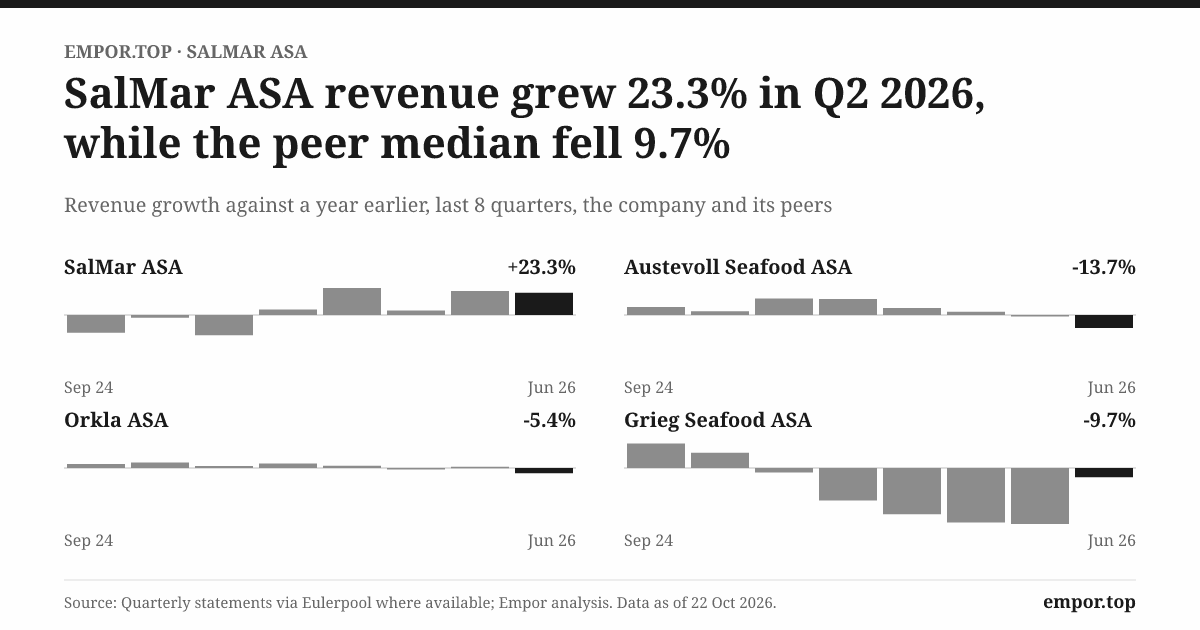
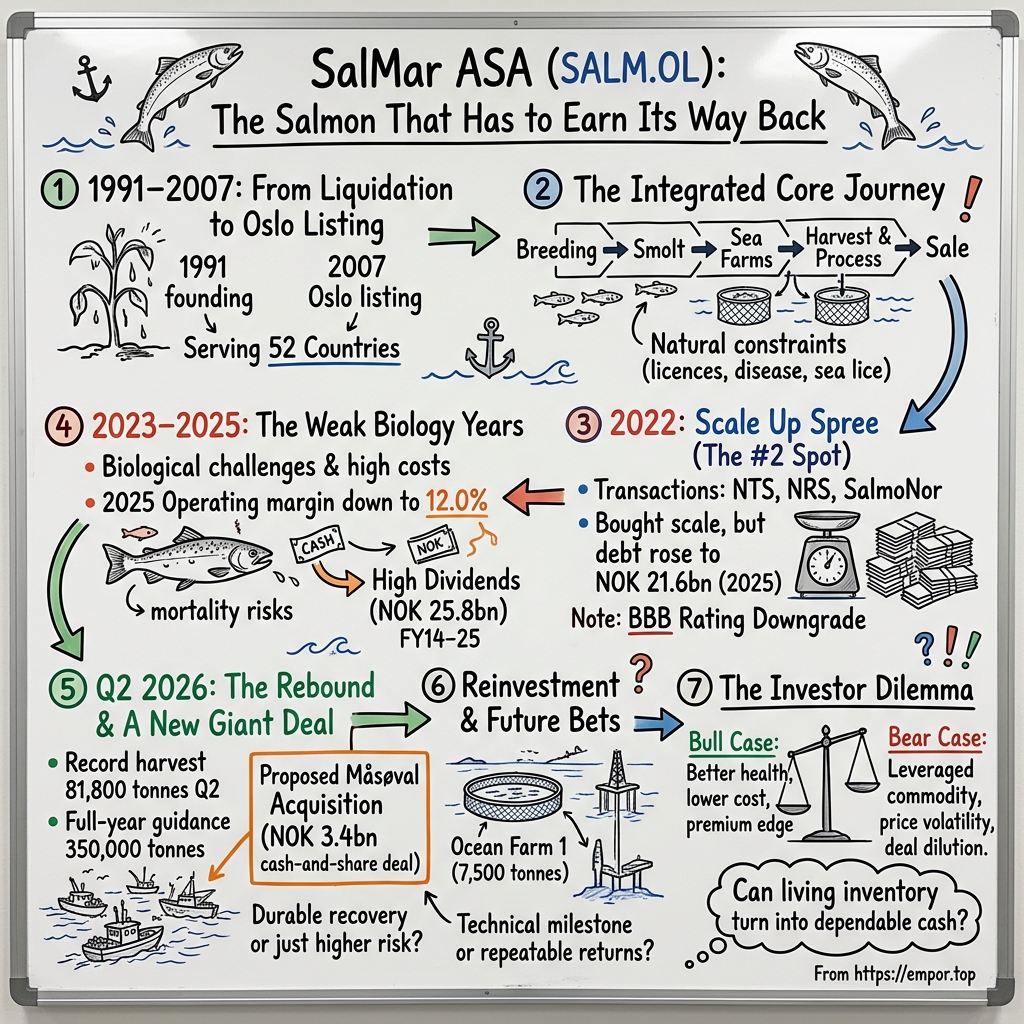
On the morning of 25 August 2026, SalMar's management walked into Hotel Continental in Oslo with the kind of quarter salmon farmers dream about and rarely get.1 Over the spring the company had pulled 81,800 tonnes of salmon out of the sea, more than in any second quarter in its history, and turned them into NOK 1.237bn of operational EBIT, more than double the year before.1 The fish had grown faster than usual, more of them had survived, and more of them graded as superior. Frode Arntsen, the chief executive, called it "a solid foundation for further volume growth and lower costs throughout the value chain".1
Then came the second piece of news, the one that made the quarter more than a recovery story. Seven weeks earlier SalMar had agreed to buy about 70% of Måsøval, a family-controlled salmon farmer on the same stretch of the Trøndelag coast, for NOK 39.50 a share.2 The bill came to about NOK 3.4bn, mostly cash, with roughly a tenth paid in SalMar shares.2 The whole of Måsøval was being valued at about NOK 4.84bn.2
Put those two facts side by side and you have the tension that runs through this story. The fish are finally behaving. The biology that wrecked SalMar's 2025 has turned, and the company raised its full-year harvest guidance by 20,000 tonnes to 350,000 tonnes.1 But a company that carries roughly NOK 20bn of net interest-bearing debt, whose credit rating had been cut in March, chose this moment to commit billions more to another Norwegian producer.34 Is that the confident move of an operator who knows the turn is real, or the familiar reflex of an industry that buys growth whenever the cash starts flowing?
Four questions follow the salmon through this story. The first is whether better biology can sustain higher earnings, or whether one strong summer is mostly cool water and luck. The second is whether the giant 2022 expansion, which made SalMar the world's second-largest salmon farmer, actually created value for each share or merely made the company bigger. The third is where the cash goes now: towards paying down debt, or into dividends and the next acquisition. The fourth is whether the stock market's premium for SalMar fits the returns and risks a sceptical owner can actually see.
A word on the boundary before the fish start moving. SalMar ASA is a listed company on the Oslo Stock Exchange, and this is its story.5 Its controlling shareholder, Kverva, is a private group with interests well beyond salmon, and its other businesses are not part of the economics discussed here, except where money moves between them and SalMar.6
Finally, a sense of scale. SalMar's 350,000 tonnes of expected 2026 harvest, which counts its half of a Scottish joint venture, makes it a giant by any normal standard.1 Yet Mowi, the industry leader, expects to harvest about 600,000 tonnes this year, after trimming its guidance from 605,000 when it agreed to sell a Canadian business.7 Mowi is nearly twice as large. If scale alone decided returns, the bigger company would win every argument. It doesn't, and the reason why begins with a bankrupt fish plant on an island in the Norwegian Sea.
 Subscribe on LinkedIn
II. From a bankrupt plant to a salmon company
Frøya is a low, wind-scoured island off the coast of Trøndelag, the kind of place where the sea is both the view and the economy. In February 1991, Gustav Witzøe and his partners started SalMar there with two modest assets: a single salmon-farming licence and a harvesting and processing plant bought from a company that had gone into liquidation.8 The main business at first was processing frozen salmon. In its first year the company produced about 800 tonnes of fish.9
Witzøe is the figure who shapes everything that follows. He co-founded the company, ran it at different times, stepped back to chair it, and through the private group Kverva he still controls it. He controls 80% of the votes in Kvarv, the ultimate parent above Kverva Industrier, which held a little over 44% of SalMar at the end of 2025.6 That is the family-founder structure Norwegian salmon is famous for: a coastal entrepreneur who built a listed company but never let go of the wheel.
The growth from there was steady rather than flashy. SalMar bought two more licences in 1992, began producing its own smolt (young salmon raised in freshwater before they go to sea) in 1995, and sold off herring and fishmeal businesses in 2005 to focus on salmon.8 It listed on the Oslo Stock Exchange on 8 May 2007.5 In 2011 it opened InnovaMar on Frøya, a harvesting and processing plant the company describes as among the most efficient in the world.8 Stakes in Iceland's Arnarlax, later renamed Icelandic Salmon, and a half share of Scottish Sea Farms gave it a foothold outside Norway.8 By 2025 SalMar's salmon was reaching customers in 52 countries.6
Following one fish
To understand what SalMar actually sells, follow a single salmon. It begins as an egg from selected broodstock, hatches in freshwater, and spends a year or so in tanks, increasingly in recirculating aquaculture systems on land, until it is ready to be moved to sea as a smolt. In the pens along the coast it spends another year and a half or so growing to harvest size, eating feed that makes up more than 40% of a farmer's operating costs.4 Then it is pumped onto a wellboat, carried to a plant like InnovaMar or InnovaNor on Senja, killed, gutted, graded and either shipped whole on ice or cut into fillets and portions.
At every step SalMar can win or lose money. Better genetics and smolt mean faster growth and fewer deaths. Good site selection and lice control mean fewer costly treatments. Smart harvest timing means selling when prices are high rather than when the pens are full. Processing at scale means lower cost per kilo and the option to freeze or fillet when the fresh market is weak. Owning the whole chain, which is what vertical integration means here, gives SalMar control over cost, yield and timing that a farmer who sells live fish to someone else's plant doesn't have.
What vertical integration doesn't give SalMar is control over price. Salmon is sold by weight, with prices set by the market and adjusted for size and quality, and revenue is booked when the buyer's carrier picks the fish up or it is delivered.6 Some of it is sold on contract: about 29% of group volume in 2025 went out under fixed-price contracts.6 The company doesn't disclose how long those contracts run, whether they carry minimum volumes, or what share of revenue they make recurring.6 Contracts dampen price swings on part of the volume, but they're agreements on a commodity's price for a period, not a subscription. When spot prices jump, fixed-price contracts actually cost money, as SalMar found in early 2026, when 47% of its processing volume was locked into contracts during a rising market.10
The ceiling on supply
The other thing that makes salmon economics unusual is that nobody can simply build more. In Norway, farming requires a licence that caps the maximum biomass a company can keep in the sea, and new capacity has been rationed for years. A licence is permission to try, not a guarantee of output, because the amount of saleable fish that permission produces depends on biology. Disease, sea lice, jellyfish, algae and bad weather can kill fish or force early harvest at low weights, and every dead or downgraded fish carries the feed, labour and capital already spent on it. That's why a scarce licence is valuable, and why it's also a hostage to whatever happens in the water.
So SalMar's history gives a clear verdict. The company grew by being very good at operating fish farms and by owning more of the chain than most competitors. But the product is still a market-priced commodity, and its economics still turn on biology, licensed capacity and harvest timing. Whether SalMar has something more durable than skill, an advantage the market cannot compete away, is the next question, and the answer lives in the water.
III. The advantage lives in the water
Picture a site off the coast of Northern Norway in late spring: steel rings sitting in exposed water, the current running cold and strong, a wellboat waiting to carry fish to InnovaNor on Senja. The same salmon that went into these pens as smolt now has to survive the winter, reach weight, make grade and reach a customer in Asia or Europe at the right moment. If it dies, all the money spent on it is lost. If it is harvested early because of disease, it sells at a discount. If it arrives in a week when every farmer in Norway is harvesting, it sells cheaply. Every advantage SalMar claims has to show up somewhere in that sequence.
SalMar's earnings come from a few clearly separated engines. Norway is the dominant base, split into Central Norway around Frøya and Northern Norway from Troms up. In 2025, SalMar's Norwegian harvest was 271,800 tonnes, about 19% of all Norwegian salmon.4 The Sales and Industry segment buys and sells every fish harvested in Norway, running the processing plants.10 Icelandic Salmon, about 52% owned, and Scottish Sea Farms, a 50% joint venture with Lerøy, extend the company beyond Norway.4 And SalMar Ocean, the offshore unit, is small but strategically interesting.
The reason Norway gets most of the airtime is simple: it is nearly the whole earnings story. In the second quarter of 2026, Norway harvested 71,500 of the group's 81,800 tonnes and generated NOK 1.227bn of the group's NOK 1.237bn in operational EBIT.1 Everything outside Norway, added together, roughly broke even. Iceland lost money, with an operational loss of NOK 6.3 per kilo, and Scottish Sea Farms earned about NOK 1 per kilo.11 When investors talk about SalMar's edge, they're really talking about its Norwegian farming.
Even inside Norway, the edge is uneven. In 2025, Northern Norway earned NOK 20.7 of operational EBIT per kilo while Central Norway, SalMar's home region and the heart of the 2022 acquisitions, earned just NOK 6.3.10 The same company, the same management systems, the same processing network, and a threefold difference in profit per fish. That gap is the best single clue about where SalMar's advantage really comes from. It comes from the water and the biology a particular region allows, more than from any company-wide magic.
The war game against the neighbours
Mowi is the yardstick. Mowi's expected 2026 harvest of 600,000 tonnes is about 1.7 times SalMar's group guidance, and it spreads that volume across Norway, Scotland, Chile, Canada, Ireland and the Faroes, owns its own feed mills and runs a large consumer-products arm.7 SalMar is far more Norwegian and far more focused on farming. Lerøy, the other large Norwegian listed producer, expects to harvest about 195,000 tonnes in Norway in 2026, or about 217,000 tonnes including its half of Scottish Sea Farms.12 Lerøy also owns a whitefish fishing fleet and a large distribution business. On that map, SalMar sits as the purest large-scale Norwegian farmer: bigger than Lerøy in Norway, smaller than Mowi overall.
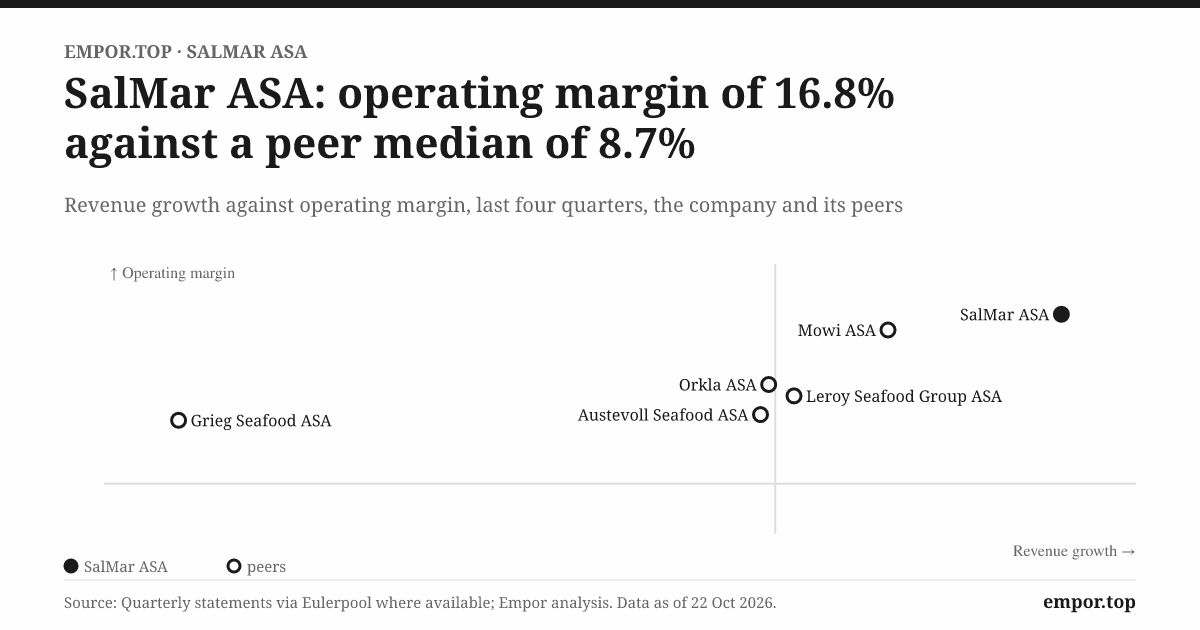
The cost and profit comparison is where SalMar's reputation was built. Nordic Credit Rating, which compared operational EBIT per kilo for Mowi, SalMar and Lerøy's Norwegian operations from 2018 to 2025, concluded that SalMar's strong operational focus and high biological quality "have enabled it to outperform its peers historically".4 In the same paragraph it added the sentence every SalMar bull has to sit with: "Its strong run ended in 2025".4 The 2026 evidence suggests a renewed lead. In the second quarter of 2026, SalMar's Norwegian operations earned NOK 17.2 per kilo, while Lerøy's farming earned about NOK 5.30 per kilo.112 Mowi's blended farming cost fell to EUR 5.21 per kilo, down from EUR 5.39 a year earlier.7 Different accounting definitions make precise peer comparisons treacherous, but the direction is clear: in good biological years SalMar converts a Norwegian fish into more profit than most of its neighbours.
What would break that edge? The mechanism is not a rival with better software or a cheaper factory. It's a bad run of biology at SalMar's own sites, which turns its cost advantage into a cost disadvantage within a season or two. That's exactly what happened in Central Norway in 2025. So the right test of the moat isn't one great quarter. It's whether cost per kilo, superior-grade share and mortality stay ahead of peers across several year-classes of fish. SalMar publishes those measures only partially and in prose. On the second-quarter call, management said mortality was 40% below its ten-year average, growth 33% above it and the superior share 9 percentage points higher.11 Those are impressive figures, but they compare SalMar with itself, not with competitors.
Who has the power in a sale of salmon? On the surface, SalMar's customers look weak. No single customer accounted for more than 10% of group revenue in 2024 or 2025, and the fish went to 52 countries.6 Low customer concentration means no single supermarket chain can make or break a year. But buyers don't need to be large to hold power when they can buy the same fish from Mowi, Lerøy, a Chilean farmer or a Faroese one. Salmon prices are set by global supply and demand, and an importer in Warsaw or Seoul will pay SalMar the market price, not a SalMar price. Low customer concentration doesn't remove commodity pricing pressure. It just spreads it out.
The option at sea
Now picture a different kind of farm. Ocean Farm 1 is a huge semi-submersible steel structure anchored at Frohavet off the Trøndelag coast, built to withstand exposed water where conventional pens could not survive. It arrived in 2017 and produced what SalMar describes as the world's first offshore-farmed salmon harvest in 2018.8 The company says the installation has now completed several production cycles with strong biology. In the 2026 cycle it finished harvesting in May without a single sea-lice treatment.11
This is the most romantic part of the SalMar story, and it deserves a sceptic's eye. Ocean Farm 1's capacity is about 7,500 tonnes, round weight.9 In 2025 the whole of SalMar Ocean harvested 7,200 tonnes against a group total of 284,500 and lost NOK 170m at the operational level.10 The offshore unit is a technical success and a commercial rounding error. It matters because it could unlock farming areas far from the crowded coast, where licences are scarce and lice spread easily. It doesn't yet earn its keep.
The record on commercialisation is the important clue. When SalMar set out its green-bond case to investors, it described a "serial expansion" of offshore technology: Ocean Farm 2 units of about 10,000 tonnes each from 2024, and a much larger Smart Fish Farm for the open ocean, 23,000 tonnes per unit, with the first unit costing an estimated NOK 2.3bn and in operation from the second quarter of 2024, subject to government approval.9 By the 2023 Capital Markets Day, investments in new semi-offshore units were "on hold" pending the licence regime, and the Smart Fish Farm sat on a regulatory timeline that ran into 2026.13 Today neither Ocean Farm 2 nor the Smart Fish Farm is in operation. The constraint was largely regulatory and tax-related, not purely technical, but the effect for owners is the same: ambition on the timeline, not in the earnings.
That leaves a calibrated verdict on the moat. Licences, scale, Norwegian geography, farming know-how and high processing utilisation can and do give SalMar a cost advantage in good biological years. But the company has published no price premium over the market, no retention data and no sustained series showing peer-leading cost through bad years as well as good. The 2025 Central Norway numbers show how fast the edge can disappear. SalMar's moat is operational, real but perishable, and it has to be re-earned with every generation of fish. The company decided in 2022 that the best way to extend it was to buy a great deal more water.
IV. The deal that made SalMar number two
Autumn 2022 on the Norwegian coast felt like a high-stakes card game. NTS, a holding company with a controlling stake in Norway Royal Salmon (NRS) and a large position in SalmoNor, had been in SalMar's sights since February, when SalMar bid NOK 120 per NTS share, a 29% premium, paid about four-fifths in SalMar shares and one-fifth in cash.14 Holders of just over half the NTS shares had backed the bid before it was even launched.14 The process then stretched across most of the year. Then, in a few weeks of November, SalMar completed the merger with NRS, settled its tender offer for NTS and brought SalmoNor into the fold.15 The acquired businesses were consolidated from November 2022.15 When Arntsen presented the year's results in February 2023, his first line was a declaration of rank: "SalMar has grown to become the world's second largest salmon producer."15
The strategic logic was straightforward. NRS had farms in Northern Norway, where SalMar already did well, and SalmoNor added capacity in Central Norway near Frøya. Putting the licences together meant more fish through the same processing plants and more scale over which to spread costs. It also meant more coastline to choose from when deciding where to put fish into the sea. The company folded the new farms into a combined Norwegian operating structure and said it would optimise operations in 2023.15
Paid for with shares and debt
The deals were paid for partly with new shares. SalMar issued about 17.9m shares in the NRS merger and another 9.5m in the NTS offer, taking registered shares to 145.1m by 8 November 2022.16 The annual report recorded a NOK 9.1bn capital contribution connected with the share issues.17 Today about 135m shares are outstanding, around 15% more than the roughly 118m before the deals.617 The rest was paid in cash and debt. Borrowings, about NOK 6.6bn at the end of 2021, had risen to roughly NOK 21.6bn, excluding leases, by the end of 2025.6
That's where acquired growth needs to be separated from organic growth. SalMar's revenue grew about 16% a year in kroner from 2020 to 2025, but a large part of that came from buying other companies' fish farms rather than growing more fish on existing sites.6 The group harvested about 193,700 tonnes in 2022, which already included two months of acquired volume, and 284,500 tonnes in 2025.1510 The larger base after 2022 tells you that SalMar became a bigger company. It doesn't tell you that its original farms got better.
For a shareholder, the question is not whether SalMar got bigger. It's whether each share got more valuable. The record here is uncomfortable. Return on invested capital, about 33% in 2018 before the deals, fell to about 5% in 2025.6 Diluted earnings per share in 2025 were well below the level of 2018, despite a company that now harvests far more fish.6 Part of that decline came from biology and prices, and part from Norway's resource-rent tax, which took effect from 2023. But part of it is simple arithmetic: more shares and much more debt, over an asset base that had not yet produced a step change in profit.
Management says integration was completed in 2023.8 There's operating evidence for that. Fearnley, a Norwegian broker, estimated that the integration of NTS and NRS produced about NOK 844m of annual synergies, or roughly NOK 10–11 per kilo of harvested fish.18 Group harvest grew. But synergies on paper and returns in reality diverged, because the acquired Central Norway sites ran straight into the biological troubles of 2024 and 2025. A deal that bought scale and some cost savings didn't buy immunity from disease. Its full per-share return is still unresolved.
The wellboat company that came along
One part of the deal shows both the complexity and the discipline of what SalMar acquired. Through the transaction period SalMar became majority owner of Frøy, a fish-farming service company running wellboats and service vessels.8 After a strategic review it agreed in 2023 to sell its 72% stake to a vehicle owned by Goldman Sachs Asset Management's infrastructure funds for about NOK 4.8bn, valuing Frøy at about NOK 6.6bn.19 Nordic Credit Rating welcomed the sale because it reduced uncertainty about SalMar's capital structure and brought in more money than the agency had expected.19
The sale can be read two ways. The generous reading is focus: SalMar decided it was a salmon farmer, not a shipping company, and sold a non-core asset at a good price. The less generous reading is that a large acquisition brought in businesses SalMar didn't want and had to unwind, and that the cash went partly into an extraordinary dividend rather than debt reduction. Nordic Credit Rating later noted, critically, that SalMar had paid out 0.86 times its earnings as dividends over four years even excluding the extraordinary dividend tied to Frøy.4 Both readings are true. Frøy was a sound exit, but it is also evidence that the deal's balance sheet benefits were partly handed to shareholders rather than banked.
In March 2026, the external referee spoke. Nordic Credit Rating lowered SalMar's long-term rating from BBB+ to BBB with a stable outlook, citing slower-than-expected deleveraging, lower expected salmon prices and leverage that acquisitions had pushed up.20 The agency still credited SalMar with strong profitability and with having cemented its place as the world's second-largest salmon farmer.4 It also forecast that net debt would fall in 2026.20 But its observation that SalMar's net debt was 3.5 times EBITDA at the end of 2025, above the company's own policy range of 1.0–2.5 times, was a quiet verdict on the 2022 deal's financing.4
So the deal changed SalMar's competitive scale and was integrated into its Norwegian operations. Whether it created value for each share remains open, because earnings weakened, leverage rose and the share count expanded at the same time. What turned the post-merger years from disappointing into painful was not the deal itself. It was the fish.
V. The weak fish years changed the earnings story
Set two moments side by side. In 2025, SalMar harvested more salmon than in any year before, passing 300,000 tonnes when its half of Scottish Sea Farms is counted, and earned an operating margin of just 12%, down from 20% the year before.216 Net profit attributable to shareholders fell from about NOK 2.97bn to about NOK 1.1bn.6 Then, the following summer, the same company reported its record second quarter and raised its volume guidance. In a little over twelve months SalMar went from having more fish and less money to having more fish and more money. The question is how much of the second state is earned, and how much is borrowed from the weather and the market.
The damage began in the water. Central Norway's biological problems in 2024 and 2025 included disease and lice pressure.4 Operational EBIT per kilo there was just NOK 6.3 in 2025, against more than three times as much in Northern Norway.10
The low point was the first quarter of 2025, when SalMar reported a pre-tax loss of about NOK 623m, driven partly by a NOK 1bn negative fair-value adjustment on the fish still in the sea.10 That accounting line deserves a moment of explanation, because it makes salmon farmers' profits unusually jumpy. Under international accounting rules, live fish are valued at what the market would pay for them, less the cost to finish growing them. When forward salmon prices fall, the value of every fish in the pens falls with them, and the loss goes straight through the income statement even though not a single fish has been sold. That's why SalMar steers investors towards operational EBIT, which strips out these swings, and why reported net profit can mislead in either direction.
Through the middle of 2025 the operating picture stayed weak. Operational EBIT per kilo was about NOK 8 in the second quarter of 2025 and below that in the third.10 Nordic Credit Rating summarised the year in one line: SalMar's strong run ended in 2025 "due to beforementioned biological issues and low achieved prices".4
The turn, in sequence
The recovery didn't start in August 2026. It started in the fourth quarter of 2025, when operational EBIT jumped to about NOK 1.83bn on 84,100 tonnes, more than NOK 21 per kilo, as costs in the value chain fell and prices recovered.10 The first quarter of 2026 kept going: NOK 25.1 per kilo across the group, with Central Norway, the problem child, earning NOK 29.8 per kilo, against NOK 12.7 a year earlier.10 The company attributed it to high average weights, high superior share, low mortality and strong growth in fish put to sea in autumn 2024.10
That sequence matters, because it shows the improvement is not a single-quarter blip. For three consecutive quarters before the record second quarter, Norwegian profit per kilo had been rising, and the improvement came from cost and quality, the parts SalMar can influence, not just from the market price.
Reading the record quarter carefully
The headline volume of the second quarter of 2026 hides a more complicated story. Operational EBIT per kilo actually fell from NOK 25.1 in the first quarter to NOK 15.1.110 CFO Ulrik Steinvik's bridge between the two quarters shows why: higher volume added about NOK 479m, while weaker price achievement took away about NOK 740m.11 Spot salmon prices fell by about NOK 14 per kilo between the quarters, and SalMar's achieved price fell by about NOK 10.11 The contract share of about 35% cushioned part of the drop.11
The timing made it worse. Most of the quarter's volume was harvested in June, when prices were lowest, and two Central Norway sites with outbreaks of infectious salmon anaemia, a notifiable viral disease known as ISA, had to be harvested that month, which hurt both cost and price.11 Northern Norway earned NOK 19.4 per kilo, Central Norway just NOK 10.9.11 So the record quarter was a record for tonnes, not for profit per fish, and its weakest part was again Central Norway.
That pattern matters for the next test. If the volume rises because fish are healthy and grow fast, the gain will show up in cost per kilo and margins. If volume rises because the company is pulling fish out early, or bunching harvest into a low-price month, the gain will show up only in tonnes. In the third quarter, SalMar harvested 105,100 tonnes, up about 13% on a year earlier.22 But it also said that Central Norway volumes late in the quarter were affected by harvesting due to ISA and fish-welfare considerations, which affected costs.22 The disease hasn't gone away.
On the second-quarter call, management gave concrete evidence for the cost claims. Reported cost per kilo in the first half fell about NOK 5, or about 7%, against a year earlier, and on-growth cost per kilo fell 12% year to date.11 Steinvik said about a third of the reduction came from cheaper feed and two-thirds from other operational improvements, adding that "feed costs are only part of the equation".11 Standing biomass cost per kilo in Central Norway was down 38% year to date, savings still sitting in fish not yet harvested, which management said would flow through in the third and fourth quarters.11
That's more specific than most farmers' recovery talk, and it splits the explanation honestly between what SalMar did and what the market gave it. Feed prices fell 8% in 2024 and 14% in 2025, according to Nordic Credit Rating, a tailwind every Norwegian farmer enjoyed.4 And Arntsen himself credited the weather: "A cool and rainy summer has created excellent growth conditions for our salmon."11 Genetics, smolt quality, vaccines and feed strategy were cited as the company's own contributions.11
There's one notable gap in the record. The published transcript of the second-quarter presentation records no analyst question-and-answer session.11 On a day when the company was explaining both a guidance raise and a NOK 3.4bn acquisition, investors got prepared remarks and no visible public cross-examination of the forecasts. The raised Norway guidance, to 307,000 tonnes, and the expected cost reductions in the second half remain forecasts until the full-year numbers arrive.11
The earlier explanations, read back now, sort the weak period into two piles. Biology and market prices caused most of the damage: disease at Central Norway sites, low prices in 2025. But some causes were operating and timing choices. The early-2026 hit to Sales and Industry came partly from a scheduled upgrade at InnovaMar and partly from fixed-price contracts that cost money when the spot price rose.10 Iceland's weak first quarter came from accelerating harvest at a site with low-weight fish.10 A June-heavy harvest profile is a choice made under biological pressure, not an act of God. Some of the volatility is in SalMar's hands.
So the verdict is cautiously positive. The second-quarter improvement has real operating support: higher volumes, better fish and lower costs. But price and harvest timing still moved the result more than costs did, and ISA reappeared in the next quarter. A full-year cycle of profit per kilo, alongside mortality and superior share, is the measure that will confirm or deny the turn. And part of that answer depends on whether the money SalMar is spending on new fish farms makes the old ones cheaper to run.
VI. The new fish farms have to earn their place
At Frohavet, Ocean Farm 1 finished another harvest in May 2026, emptied of fish that never needed a single sea-lice treatment.11 Its next cycle was due to start in late August or early September, with about 5,000 tonnes expected in the second quarter of 2027.11 Meanwhile, deep in the 2025 annual report, sits a quieter fact: NOK 479m of capitalised development costs, mostly relating to Smart Fish Farm and Ocean Farm 2, projects still in development.6 One is a working machine at sea. The other is spending on a balance sheet, waiting for permission to become a farm.
Before the offshore dream, there's the ordinary work of keeping a salmon company productive. In 2025 SalMar spent about NOK 1.95bn on property, plant, equipment and intangible assets, about 7% of revenue, down from about NOK 2.58bn, nearly 10% of revenue, in 2024.6 These figures exclude acquisitions, licence purchases and new leases, so they understate the full investment bill. At its 2023 Capital Markets Day, management guided maintenance capex of about NOK 3 per kilo and said any larger new projects would be communicated separately.13
The money went into the plumbing of the value chain. The Tjuin smolt facility was completed in 2023 and delivered its first fish in 2024, part of a push to put bigger, hardier smolt into the sea so that fish spend less time exposed to lice and disease.8 InnovaMar, the flagship processing plant, was upgraded in early 2026, which hurt that quarter's results but helped the next: Sales and Industry earned NOK 219m in the second quarter with better operating metrics after the upgrade and record throughput at InnovaNor.11 The workforce also grew, from 3,345 to 3,574 people at year-end, about 7%, while revenue grew less than 4%, and personnel costs rose to about NOK 3.1bn.6 For a year when profit collapsed, that's a company investing through the trough, betting the biology would turn.
There's one disclosure gap. SalMar doesn't report research and development as a separate expense line in its annual accounts.6 Its quarterly reports show that R&D costs sit in group eliminations, at about NOK 0.3 per kilo of harvested fish in the first quarter of 2026.10 For a company that tells its story as a technology pioneer, owners can't easily see how much of the innovation spending goes through the income statement and how much is capitalised.
The offshore promise against the offshore record
The ambition has been stated plainly and repeatedly. In its green-bond materials, SalMar sketched a serial roll-out: the Smart Fish Farm, a structure for the open ocean with a planned capacity of 23,000 tonnes per unit and an estimated first-unit cost of NOK 2.3bn, was due in operation from the second quarter of 2024, with more units to follow from 2026, all subject to government approval.9 Ocean Farm 2 units were to follow Ocean Farm 1 from 2024.9
By September 2023, at the Capital Markets Day, the language had shifted. Investments in new semi-offshore units were on hold because of uncertainty about the future licence regime for exposed farming; a map of regulatory milestones for offshore farming ran into 2026 before any permits would be granted.13 Nordic Credit Rating noted that Norway's resource-rent tax had constrained SalMar's investment plans, including offshore farming, which is currently exempt from the tax but could become subject to it if profitable.4 Today neither the Smart Fish Farm nor Ocean Farm 2 harvests fish. Approval, design and pilots are steps, not revenue.
The offshore unit's present scale tells the same story. SalMar Ocean harvested 7,200 tonnes in 2025, about 2.5% of group volume, and lost NOK 170m at the operational level.10 In March 2025 SalMar bought out Aker's 15% stake, renaming the business SalMar Ocean, so it now carries all of the risk and all of the option.10 In the second quarter of 2026, the unit harvested 4,800 tonnes and earned about NOK 75m of EBITDA, or NOK 15.7 per kilo, after a very good cycle.11 One good cycle at one installation does not make an industry.
Where the option has already paid
The most tangible payoff so far came in an unexpected form. In March 2026, Norway's Directorate of Fisheries notified SalMar that development licences tied to Arctic Offshore Farming, a semi-offshore project in Northern Norway, corresponding to about 6,112 tonnes of maximum allowable biomass, could be converted into ordinary aquaculture licences.10 SalMar paid about NOK 130m and folded the capacity into its ordinary production in Northern Norway.10 In other words, the clearest commercial return from the offshore programme so far has been the right to farm more fish the conventional way. That's a perfectly good return. It's just not the offshore business the slides described.
What would prove the option is real? Not another technical first. It would take offshore sites that, across several cycles, match or beat conventional farms on cost per kilo, survival and capacity utilisation, and earn cash returns after their much larger construction costs. Until then, offshore farming is plausibly future-material, because it could add growing space where licences are scarce, but it is not a present earnings driver. And because the bets on the future are funded from the same pool of cash that pays dividends and services debt, the next question is where that cash has actually gone.
VII. Where the cash went—and what is left for debt
Follow the money from a strange year. In 2025, SalMar's profit collapsed, yet its operations generated about NOK 3.26bn of cash, almost three times the group's net profit of about NOK 1.12bn.6 Stretch the lens over twelve years and the pattern holds: from 2014 to 2025, cash from operations totalled about NOK 43.7bn, against net profit of about NOK 28.4bn.6 SalMar has consistently turned more cash than profit. And yet, over the same twelve years, it paid out about NOK 25.8bn in dividends, more than the NOK 22.3bn of free cash flow it generated after capital spending.6 Cash at the bank shrank from about NOK 1bn at the end of 2013 to NOK 759m at the end of 2025.6 The gap was filled with borrowed money.
Why cash outran profit
The reconciliation is worth walking through once, because salmon accounting is strange. Start with 2025's net profit of about NOK 1.1bn. Add back about NOK 1.95bn of depreciation, amortisation and write-downs, which reduce profit but don't consume cash.6 Add back the fair-value adjustments on live fish, which are accounting estimates, not cash, and subtract a NOK 190m paper gain from remeasuring SalMar's existing stake in Wilsgård when it took control.6 Working capital barely moved, absorbing only about NOK 43m.6
That last point is why one year is not a trend. In a normal growth year, a salmon farmer ties up a lot of cash in fish growing in the sea, which is why SalMar's inventory, measured against cost of sales, sits at around 400 days.6 In 2025 that investment was unusually small. And cash taxes went the other way: SalMar paid about NOK 2.17bn in tax against a tax expense of about NOK 571m, because it settled the full NOK 1.998bn that arose from a 2022 tax-return amendment.6 Strip out that one-off and underlying operating cash in 2025 would have looked stronger still.
The dividend tradition is deep in SalMar's culture. Over twelve years the median payout was about 81% of net profit.6 In 2025 it reached 274%, because the dividend was set on the strength of the previous year's profit and paid out of a year in which profit had fallen by almost two-thirds.6 In July 2026, SalMar paid NOK 10 per share, about NOK 1.3bn, a smaller cheque than in prior years but still a substantial call on cash in a year of deleveraging.11 The company also completed a small buyback in 2026, for up to 100,000 shares and NOK 65m.23
Then there's interest. In 2025 SalMar paid about NOK 1.46bn in interest expense against just NOK 41m of interest income.6 That's the price of the 2022 deal and the dividends paid since, and it comes out of every kilo of salmon before shareholders see a krone.
At the end of 2025, interest-bearing debt was about NOK 21.6bn before leases.6 Net of cash, that's about NOK 20.8bn, or about NOK 22.5bn including lease liabilities.10 By the end of June 2026, net debt including leases had come down to about NOK 21bn, helped by stronger cash flow from the first half.3 SalMar reported around NOK 14.4bn of unused credit facilities.3
Those facilities are real, and SalMar has kept its access to credit markets open. In February 2026 it sold a NOK 750m ten-year green bond, and in the second quarter it issued two new three-year bonds totalling NOK 2.75bn and bought back NOK 517m of a bond maturing in January 2027.1011 That matters, because the 2025 annual report showed about NOK 9.5bn of debt maturing in 2027, including a NOK 6bn term loan.6 But access to credit is not the same thing as a light debt burden. At the end of 2025, leverage remained above SalMar's policy range.4 Its covenants require an equity ratio above 30%, and at the end of June it was 34.5%, depressed by the dividend.1011
The price of Måsøval
This is the balance sheet onto which SalMar placed the Måsøval agreement. The deal values all of Måsøval's equity at about NOK 4.84bn.2 The NOK 39.50 per share was 19.3% above Måsøval's last traded price, but the share had already risen on speculation after Kverva bought a 10% stake in Måsøval earlier in 2026.1824 Measured against the share price before the sale process began, Finansavisen calculated the premium at about 72%.[^25] The analyst numbers are just as stark. Fearnley's Theodor Rosenberg estimated the price at about 12.3 times Måsøval's expected 2027 EV/EBIT, versus 8.4 times for SalMar itself.18 SEB's Sander Lie put it at NOK 311 of enterprise value per kilo of expected 2026 production, against a sector average of NOK 216 and SalMar's own NOK 255.24
In plain English, SalMar is buying a smaller farmer at a richer price than the market puts on SalMar. The justification is synergy and scarcity. Management estimates annual operating cost synergies of around NOK 300m, to be refined after closing.11 Fearnley estimated NOK 300–350m and calculated that, with synergies, the multiple falls to roughly 7.6–8.1 times, below SalMar's own.18 SEB noted that no new capacity has been auctioned in the Mid-Norway region since 2020, which makes existing licences there scarce.24 Management said that including Måsøval's own published expectations, group volume potential would rise to about 412,000 tonnes.11
The structure adds detail that owners should notice. About 90% of the price is cash, roughly NOK 3.1bn for the 70% stake.2 Heimstø, the seller, can sell its SalMar consideration shares back to SalMar at NOK 461.40 each for twelve months after completion, which means even the share portion can become cash.2 And SalMar has promised to let the minority shareholders sell at the same NOK 39.50, so if they all accept, the cash bill rises towards the full NOK 4.84bn valuation.2 Completion requires regulatory approval and is not expected before early 2027.11
So the deal is not obviously reckless: synergies of the size SalMar delivered after NTS and NRS would make it reasonable, and the capacity sits next door to SalMar's processing network. But it is a bet that synergies will be realised and that biology in Central Norway, where Måsøval also farms, will cooperate. A sceptical owner would ask a simpler question: with net debt above the company's own target range, why buy at a premium before the balance sheet is repaired? The answer depends partly on who is making the decision, and for whom.
VIII. Who controls the salmon—and who answers for the capital?
When Frode Arntsen presents SalMar's plans, the most important person in the room is often the one sitting beside him. Gustav Witzøe, the co-founder, became chair in June 2022 after three years back in the chief executive's office.821 Through Kverva Industrier, the family's private group owned about 44% of SalMar at the end of 2025.6 No other shareholder comes close: Folketrygdfondet, Norway's state pension manager for domestic assets, held about 3.5%.6 When SalMar's board approves a dividend, a bond issue or a NOK 3.4bn acquisition, it does so with the controlling owner's chair at the head of the table.
Founder control is not inherently a problem. Some of the best long-term compounders in Norwegian seafood have been family-controlled, because a family owner can think in decades and ride out bad years without panicking. But control comes with two specific risks for minority owners: money flowing between the listed company and the owner's other businesses, and a board that is too close to the owner to check it.
The money flows are material enough to watch. In 2025, SalMar sold about NOK 1.36bn of goods and services to companies controlled by Kverva, about 5% of group revenue, and bought about NOK 551m from them, roughly 3.9% of cost of goods sold.6 It also traded with associated companies, with about NOK 225m of sales and NOK 110m of purchases.6 SalMar says these transactions are on market terms and that it uses independent third-party valuations for anything not immaterial.6 There's no evidence in the filings that the prices were off-market. But the company doesn't publish a multi-year schedule showing what each flow is for, how it is benchmarked and who approved it, which is what a minority owner would need to judge it independently.
Måsøval adds a new wrinkle: before SalMar agreed the deal, Kverva held a 10% stake in the target.24 Nothing in the record suggests impropriety, and the stake may well have helped SalMar secure the deal. But it is precisely the kind of overlap between the listed company and its controlling owner that the board's independent members exist to scrutinise.
The board's structure is the second check. Of the seven shareholder-elected directors, two, Witzøe and Leif Inge Nordhammer, a former SalMar chief executive, sit on the board of Kverva AS and are not classed as independent.6 The other five are classified as independent of management, major business associates and major shareholders.6 That's a reasonable balance on paper. With Kverva holding around 44% of the shares, however, ordinary resolutions at a general meeting need only modest support from other investors to pass, and at the annual general meeting on 22 June 2026, all items were resolved in line with the board's calling notice.25 Shareholder dissent in a controlled company is rarely visible in a vote; it shows up in the share price.
The revolving chief executive's chair
One feature of SalMar's history deserves more attention than it gets. Between 2011 and October 2022, the company had six different chief executives: Yngve Myhre, Leif Inge Nordhammer for a second spell, Trond Williksen, Olav-Andreas Ervik, Witzøe himself, and Linda Aase, who held the job for about five months in 2022.8 The founder stayed constant; the person running the company changed every two years or so. That's not an indictment, since several of those transitions were planned, but it does suggest that the real centre of gravity in SalMar has long been the controlling owner, not the chief executive's office.
Arntsen broke that pattern. He took over in October 2022, just as the NTS and NRS deals closed, and has now led SalMar for four years.8 He came from inside Norwegian seafood rather than from finance or consulting, with senior roles at Lerøy Midt, Midnor and HitraMat, regional farming and processing businesses on the same coast.9 His tenure has a clear arc. He integrated the acquired companies in 2023, sold Frøy after a strategic review, steered the company through the biological crisis of 2024 and 2025, and is now presiding over a recovery and another acquisition.8 On delivery, the record is mixed. Integration delivered measurable synergies, the biology is better and the cost claims are specific. But Nordic Credit Rating's downgrade cited slower-than-expected deleveraging, which is the one goal any acquisition-heavy management team most needs to hit.20
Arntsen's pay rose from about NOK 6.8m in 2023 to about NOK 9.3m in 2025.21 The 2025 figure included a NOK 1.3m short-term bonus and about NOK 2.8m of long-term incentive awards.21 Over the same period, net profit attributable to shareholders fell from about NOK 2.97bn to about NOK 1.1bn.6 On its face, that looks like pay rising while owners' earnings fell.
The design of the scheme explains part of it. The long-term plan grants share awards over a three-year performance period, vesting in thirds each year: one third unconditionally, one third only if an EBIT per kilo condition is met, and one third only if SalMar's total shareholder return beats its peers.21 Awards are capped at six months' salary, and the value vesting in any year at one year's salary.21 The 2025 increase partly reflected the scheduled vesting of awards granted in earlier, better years, and the remuneration report says all components were within policy.21 A single year's package doesn't prove misalignment. But a scheme in which a third of the long-term award vests regardless of performance is a softer link between pay and per-share outcomes than the "performance culture" language in the report suggests.
The legal and political weather
Three external overhangs belong in this part of the story because they shape what the controlling owner and management can control. The first is legal. In January 2024 the European Commission sent a Statement of Objections to six Norwegian salmon producers, including SalMar, Mowi and Lerøy, alleging that between 2011 and 2019 they exchanged commercially sensitive information about prices, volumes and capacity in spot sales of fresh salmon into the EU.26 A Statement of Objections is a preliminary view, not a finding; SalMar disputes it, and if the Commission concludes there was an infringement, fines can reach up to 10% of a company's annual worldwide turnover.266 UK supermarkets have brought damages claims before the Competition Appeal Tribunal, and a Spanish supermarket chain has filed a claim too.6 SalMar recorded NOK 67m of litigation and legal-claims expense in 2025.6 Former NTS minority shareholders are also appealing for higher compensation for their compulsorily redeemed shares, after a district court ruled in SalMar's favour in 2025.6
The second is political. Norway's resource-rent tax on aquaculture applies from the 2023 income year, taking a share of the profits from farming in Norwegian waters on top of ordinary corporate tax. In early 2023, Arntsen said the proposal was "based on incorrect assumptions and should be permanently set aside", and SalMar put new investments on hold while it was debated.15 The tax stayed. It changes the economics of every new investment in coastal farming and helps explain why SalMar's tax rate has sat well above Norway's ordinary corporate rate since 2023.6
The third is currency. In 2025, about 60% of SalMar's contract revenue was in US dollars or euros, while most of its costs and salaries were in Norwegian kroner.6 The company hedges some of this with forward contracts and options, but even after hedges it estimated that a 10% weaker krone at year-end would have raised pre-tax profit by about NOK 1.14bn.6 A strong krone does the reverse. For a company whose 2025 pre-tax profit was about NOK 1.7bn, that's an enormous lever that sits entirely outside management's control.10
So Kverva's control can support a long horizon, and nothing in the record shows minority owners being disadvantaged. But the related-party flows, the controlling owner's overlapping stake in Måsøval, and a pay scheme that partly rewards tenure all argue for scrutiny rather than trust. Management's credibility will rest on delivery against cost, debt and earnings per share, not on scale. And the stock market, for now, is extending that credibility in advance.
IX. The premium has to be earned
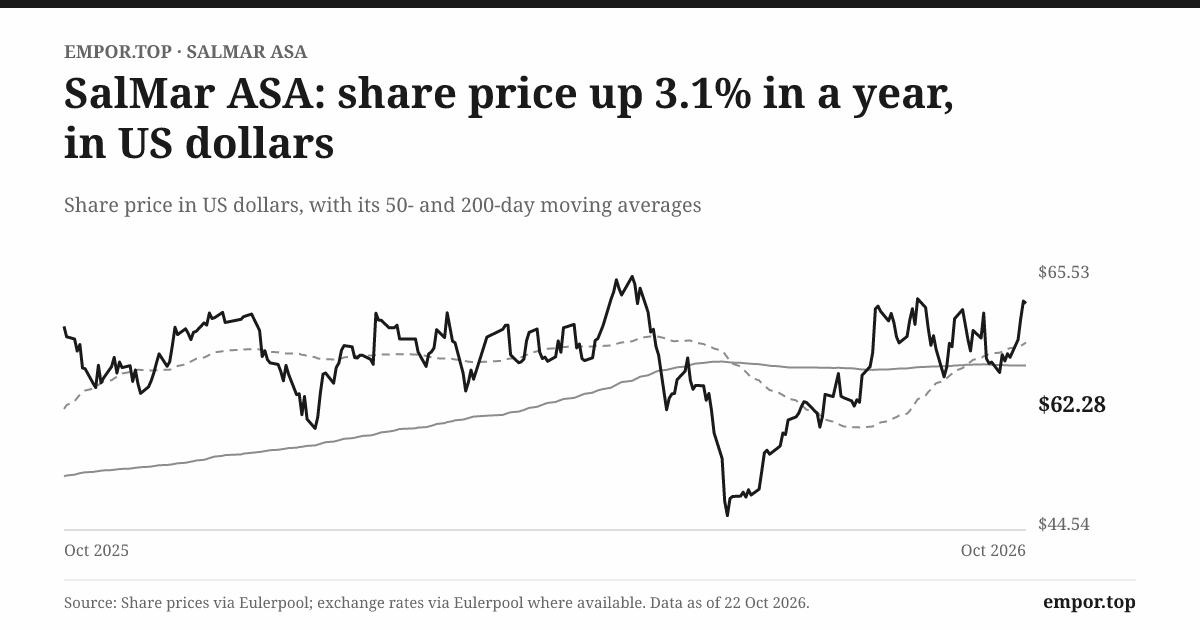
On 22 October 2026, SalMar shares closed at NOK 581.50, about 6% below their 52-week high and well above their low of about NOK 452.5 The company was worth about NOK 78bn on the stock market and about NOK 99bn including its debt. That price arrived despite a 2025 profit collapse, a recent credit downgrade and an expensive acquisition yet to close. Either investors are seeing something in the fish that the accounts haven't yet shown, or they are paying in advance for a recovery that still has to happen.
What the price assumes
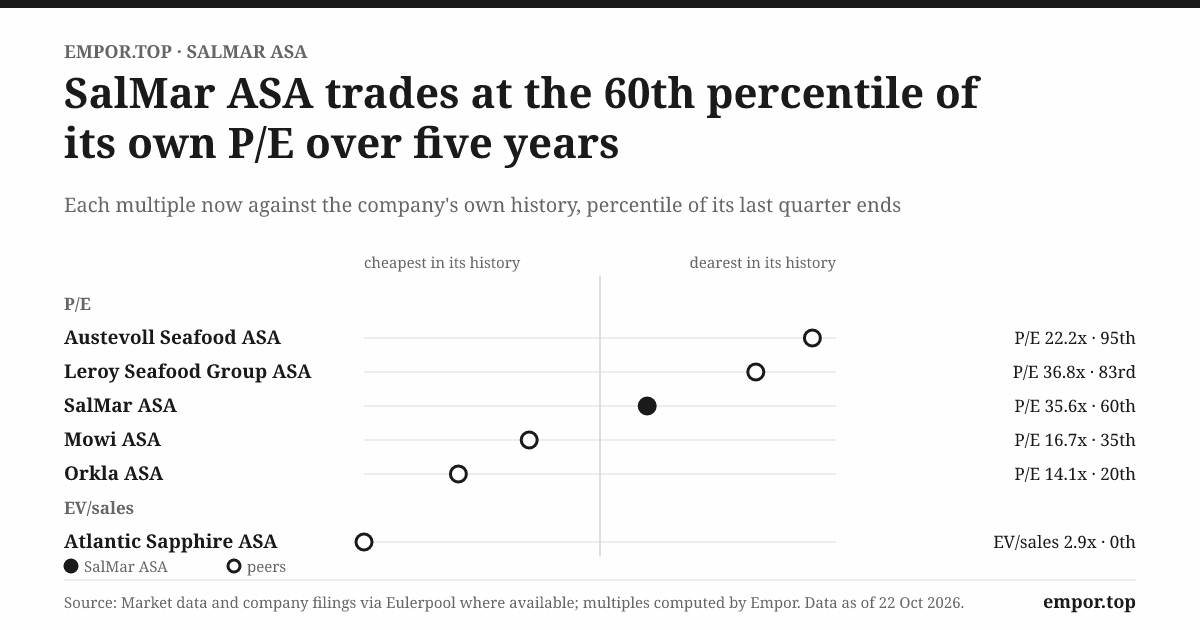
On trailing earnings the shares trade at about 35.6 times, above SalMar's own five-year median of about 31 times.6 That figure is inflated because the trailing year includes the weak tail of 2025 and the fair-value swings of live fish and leaves an earnings yield below 3%. A better measure for a capital-heavy company is enterprise value against EBITDA, which looks through debt and depreciation. SalMar trades at about 12.8 times. Mowi, on the same day, traded at about 8.2 times EBITDA and 15.4 times trailing earnings.27 SalMar is priced at roughly a 50% premium to the industry leader on EBITDA.
Why might a smaller, more indebted company with weaker recent earnings trade above Mowi? The bull answer is quality of earnings. SalMar's Norwegian farming has historically earned more per kilo than its peers, its contract share is moderate, and it is a purer bet on Norwegian salmon at a time when Norway's licence system keeps supply growth low.4 The bear answer is that a premium for being a better operator assumes the 2025 lapse was an exception, and that the market is pricing in a recovery management has guided to but not yet delivered for a full year. One broker, SEB, estimated SalMar at about 13 times its forecast 2027 earnings, a reminder that the premium narrows sharply if forecasts of higher volumes and lower costs are met.28 Peer multiples are context, not a target. They show what the market expects, which is a lot.
Run the industry through Michael Porter's five forces and the shape of SalMar's position becomes clearer. The threat of new entrants is low in Norway, where scarce licences and the cost of an integrated chain form major barriers to entry, as Nordic Credit Rating notes.4 That is the strongest structural support for the whole industry, and the reason salmon farmers have earned high returns over long periods.
Buyer power is moderate to high: SalMar's customer base is dispersed, but buyers can source the same fish from other farmers, and spot prices adjust weekly.6 Supplier power is meaningful. Feed makes up more than 40% of operating costs, and SalMar, unlike Mowi, does not make its own feed, so it buys this single largest input from outside suppliers.4 Substitutes are real but slow: other proteins, other seafood and, eventually, land-based or offshore farming. Rivalry is intense in the market but restrained in capacity, because no one can add biomass at will. The result is a classic commodity industry with a regulatory ceiling on supply. Prices are volatile, but the ceiling props up long-term returns for those who hold licences and manage biology well.
Hamilton Helmer's seven powers framework asks a tougher question: what lets a company earn returns above its cost of capital that competitors cannot arbitrage away? Of the seven, SalMar can claim two with conviction. The first is cornered resource: Norwegian licences in good water, which cannot be replicated at any price because the state doesn't issue them freely. The second is scale economies in processing and logistics, where InnovaMar and InnovaNor spread fixed costs over very large volumes. A third, process power, the hard-to-copy operating know-how that produces lower mortality and higher superior share, is plausible but intermittent: it was visible before 2024, vanished in Central Norway in 2025 and reappeared in 2026.
The others don't apply. SalMar has no network effects, no meaningful switching costs for buyers, no consumer brand that commands a premium, and no counter-positioning against incumbents, because it is one. Its moat, in short, is a licence and an operating discipline, not a franchise. That moat supports good returns across a cycle; it doesn't make SalMar immune to the cycle.
Two ways the story can end
Here is the bull case, stated as strongly as the evidence allows. Better smolt, better genetics and better vaccines have made SalMar's fish healthier, and second-quarter mortality 40% below the ten-year average is evidence of that.11 Costs are falling for reasons beyond cheap feed, and savings already sitting in the standing biomass will flow through later in 2026.11 Management expects low global supply growth in 2026 and strong demand, which should support prices.1 SalMar's processing plants are running at high utilisation, so more fish through the same plants means rising profit per kilo without proportional fixed-cost growth. Måsøval adds scarce Central Norway capacity at a price that looks reasonable once synergies are counted. And Nordic Credit Rating's own base case has net debt falling sharply and the EBITDA margin returning to about 30%.4
Now the bear case. Salmon remains a commodity, and SalMar's achieved price fell about NOK 10 per kilo between the first and second quarters of 2026 alone.11 Biology recurs: ISA hit Central Norway again late in the third quarter.22 Iceland and Scotland are still weak, and Scottish Sea Farms dragged on profit through fair-value losses.11 Leverage is above SalMar's own policy range, a credit downgrade has already happened, and the company is about to spend up to NOK 4.84bn on Måsøval.42 A krone strengthening by 10% could remove more than NOK 1bn of pre-tax profit.6 The EU competition case could end in a fine. And the 2026 recovery coincides with cool water, cheaper feed and firmer prices than in 2025, three gifts no management can promise to repeat.
A sceptical long-term investor sitting across from SalMar's board would press on a simple allocation choice. If cash is scarce and debt above target, why pay a premium for Måsøval before repairing the balance sheet? Why keep paying dividends above free cash flow, as the company has over twelve years? Why pay an incentive in which a third of long-term awards vests regardless of performance? And why should the market pay a premium multiple for earnings that have yet to be repeated for a full year? Management's answers, insofar as they are public, are that leverage and liquidity leave room for "attractive growth opportunities such as the acquisition of Måsøval".11 That's an assertion of capacity, not an argument about returns.
Three measures will settle the argument. The first is operational EBIT per kilo in Norway, by region, which was NOK 17.2 in the second quarter, with Central Norway still far behind the north.11 The second is the biology that drives it: mortality and superior share, which management says are at record levels.11 The third is net interest-bearing debt to EBITDA after dividends, capex and acquisitions, which stood at about 3.5 times at the end of 2025 against a policy range of 1.0–2.5 times.4 If profit per kilo holds up across a full year, biology stays strong and leverage falls into range even after Måsøval, the premium will look justified. If the rebound turns out to depend on favourable prices while the debt and acquisition costs persist, it won't.
That's the spine of the investment case. SalMar can win from here if better biology becomes repeatable cost and cash improvement. It may not if the rebound depends on prices and weather while debt and deal costs stay. Behind that scorecard lies a set of lessons that apply well beyond one Norwegian farmer.
X. Playbook: Business & Investing Lessons
Lay three moments from SalMar's life side by side. In 1991, a coastal entrepreneur bought a single licence and a plant out of a liquidation and began processing frozen salmon on Frøya.8 In 2017, a giant steel structure arrived at Frohavet to see whether salmon could be farmed in water no pen had survived before.8 In 2022, the company issued millions of new shares and borrowed billions to buy its neighbours and become number two in the world.16 Three ways to buy or build capacity: one distressed and cheap, one inventive and uncertain, one large and expensive. Each one teaches something different.
The first lesson comes from Central Norway in 2025. SalMar had the licences, the smolt, the plants and the people, and still earned barely NOK 6 per kilo there, because the fish were sick and had to come out early and small.10 For founders, the lesson is that capacity is not output; the asset is only as valuable as the operating system that converts it into a product someone will pay full price for. For investors, it means valuing a farmer on its licences alone is valuing a promise. A licence is only potential until the fish reaches the grade and the buyer pays.
The second lesson comes from the 2022 deal and the years that followed. SalMar bought scale, folded it into its operations and captured hundreds of millions of kroner a year in synergies.18 Then biology turned, and the larger company, now carrying far more debt and more shares, saw its return on capital fall to a fraction of its old level while interest consumed well over a billion kroner a year.6 Scale had made the good years better and the bad year much more expensive. The wider lesson is that in a cyclical, biological business, leverage converts operating volatility into equity volatility. Scale can lower the cost per kilo; it can also make a bad cycle more expensive.
The third lesson comes from the sea. Ocean Farm 1 really is a world first, and it really does grow healthy fish with no lice treatments.11 But nearly a decade after it arrived, the offshore unit still harvests a sliver of the group's volume and lost money in 2025, while the promised Smart Fish Farm and Ocean Farm 2 have yet to produce a fish.109 The commercial payoff so far was the conversion of development licences into ordinary ones, a regulatory reward rather than an offshore profit.10 Founders love technical milestones because they are visible; investors should price them only when they repeat at a profit. A technology first is a story. Repeatable commercial returns are the business.
The fourth lesson comes from the dividend table. For twelve years SalMar paid out more in dividends than it generated in free cash flow, and borrowed the difference, while telling a story of operational excellence.6 In good years, that looked like generosity backed by a strong franchise. When the cycle turned, it left the company above its own leverage target, downgraded by a rating agency and buying a new farm with borrowed money.4 The lesson is that a payout ratio is a choice about where risk sits, not a measure of how good the business is. A dividend paid from borrowed money is a loan to shareholders, repaid by the next cycle.
Put the lessons together and the line between operating success and per-share value creation becomes clear. SalMar has been an excellent operator for most of its history; its Norwegian fish, in most years, earn more per kilo than its neighbours'. But operating success compounds for owners only when it is not diluted by new shares, consumed by interest or paid out faster than it is earned. The company's next chapter will be judged on which side of that line it lands.
XI. Epilogue
Tonight SalMar stands at an interesting place. The fish are growing well. The third-quarter trading update showed harvests still climbing, and the full report arrives on 3 November 2026.22 The 350,000-tonne full-year guidance looks within reach.1 The debt is lower than it was at the start of the year, but still above where the company itself wants it.34 And a NOK 3.4bn acquisition is waiting for regulators.2
The first moment to watch is the November report. It will show whether the costs management said were sitting in the standing biomass, particularly in Central Norway, flowed through into profit per kilo in the third quarter, or whether the late-quarter ISA harvests ate the savings.1122 If Norwegian profit per kilo rises as volumes grow, the case that better biology has become a structural cost improvement strengthens. If profit per kilo falls even as tonnes rise, the story becomes one of volume without margin, and the premium valuation will be harder to defend.
The second moment is the completion of Måsøval, which management doesn't expect before early 2027.11 At NOK 39.50 per share, the price is set.2 What isn't set is how many minority shareholders take the same offer, whether Heimstø uses its option to sell its SalMar shares back for cash, and how quickly the roughly NOK 300m of annual cost synergies management has estimated show up in the combined accounts.112 A clean integration, with synergies visible by the end of 2027 and Central Norway biology holding up, would vindicate the price. A slow one, with disease at the acquired sites, would repeat the uncomfortable post-2022 pattern.
The third moment is the year-end balance sheet. It will reconcile operating cash flow, capital spending, the July dividend and any acquisition outflows into one number: net interest-bearing debt. Nordic Credit Rating's base case expects net debt to fall by several billion kroner in 2026 and FFO to net debt to rise above 30%.20 If SalMar meets that, it will have shown that free cash can finally repair the balance sheet even in a year of expansion. If it misses, and the board proposes another generous dividend anyway, the old pattern of paying out more than the business earns in cash will have reasserted itself.
Each outcome answers a piece of the question this story began with. Until those figures arrive, the question stays open: has SalMar made the fish business more productive, or simply made the company larger?
XII. Outro
Go back to the pen off the Norwegian coast. In the cold water a salmon circles, alive and growing, carrying a share of the NOK 15.1 of operational profit SalMar earned on every kilo it harvested in the second quarter.1 The company can choose its feed, its smolt, its vaccines, its harvest week and its next acquisition. It can't choose the water temperature, the lice pressure, the virus drifting in from a neighbouring site or the price an importer will pay on the day the fish comes out.
That is SalMar's particular wager, and the reason it is unlike almost any other company on the Oslo Stock Exchange. It is trying to turn living inventory into dependable cash, 350,000 tonnes of it this year, one harvest at a time.1 The balance sheet has been stretched on the assumption that the fish will cooperate. This summer, they did. The rest of the story belongs to the next generation in the pens.
References
-
SalMar Q2 2026: Record-strong biological performance — SalMar, 2026-08-25 ↩↩↩↩↩↩↩↩↩↩↩↩
-
SalMar enters into agreement to acquire 70% of the shares in Måsøval — SalMar, 2026-07-08 ↩↩↩↩↩↩↩↩↩↩↩
-
SalMar ASA Full Rating Report — Nordic Credit Rating, 2026-03-20 ↩↩↩↩↩↩↩↩↩↩↩↩↩↩↩↩↩↩↩↩↩↩
-
SalMar Annual Report 2025 — FinancialFilings, 2026-03-27 ↩↩↩↩↩↩↩↩↩↩↩↩↩↩↩↩↩↩↩↩↩↩↩↩↩↩↩↩↩↩↩↩↩↩↩↩↩↩↩↩↩↩↩↩↩↩↩↩↩↩↩↩
-
Mowi posts record second-quarter harvest as earnings rise 23% — We Are Aquaculture, 2026-07-16 ↩↩↩
-
SalMar Quarterly Report Q1 2026 — SalMar, 2026-05 ↩↩↩↩↩↩↩↩↩↩↩↩↩↩↩↩↩↩↩↩↩↩↩↩↩↩
-
Earnings call transcript: SalMar lifts 2026 volume outlook after strong Q2 — Investing.com, 2026-08-25 ↩↩↩↩↩↩↩↩↩↩↩↩↩↩↩↩↩↩↩↩↩↩↩↩↩↩↩↩↩↩↩↩↩↩↩↩
-
Lerøy Q2 operating profit falls 16% as harvest volumes decline — Salmon Business, 2026-08-19 ↩↩
-
SalMar Capital Markets Day 2023 Presentation — SalMar, 2023-09 ↩↩↩
-
SalMar offers €1.5 billion for NTS — Salmon Business, 2022-02-14 ↩↩
-
SalMar: New industrial powerhouse established in the last quarter of 2022 after successful completion of the transactions with NTS, NRS and SalmoNor — SalMar, 2023-02-22 ↩↩↩↩↩↩
-
SalMar – New share capital registered — Euronext, 2022-11-08 ↩↩
-
Fearnley ser synergier på inntil 350 millioner kroner etter SalMars Måsøval-kjøp — iLaks, 2026-07-09 ↩↩↩↩↩
-
NCR comments: SalMar ASA sells stake in Frøy ASA for NOK 4.8bn — Nordic Credit Rating, 2023 ↩↩
-
SalMar ASA Rating Action Report — Nordic Credit Rating, 2026-03-20 ↩↩↩↩
-
SalMar's Q3 harvest volume increased by 12.8% year on year — Fish Farming Expert, 2026-10-06 ↩↩↩↩↩
-
SalMar – Share buyback program has been completed — SalMar, 2026-08-28 ↩
-
SEB: Was Måsøval overpriced? Here's why it doesn't matter — Salmon Business, 2026-07-09 ↩↩↩↩
-
SalMar – Minutes from Annual General Meeting — SalMar, 2026-06-22 ↩
-
Commission sends Statement of Objections to six companies in farmed Atlantic salmon cartel case — European Commission, 2024-01-25 ↩↩
-
Mowi ASA Statistics & Valuation — Stock Analysis, 2026-10-22 ↩
-
SEB raises SalMar target price after volume guidance and Måsøval deal — Salmon Business, 2026-08-26 ↩
 LinkedIn
 WhatsApp
 Reddit
 Hacker News
 Email
 Kindle
 RSS Feed
 Spotify
 Apple Podcasts
 Amazon Music
 Audible
 YouTube