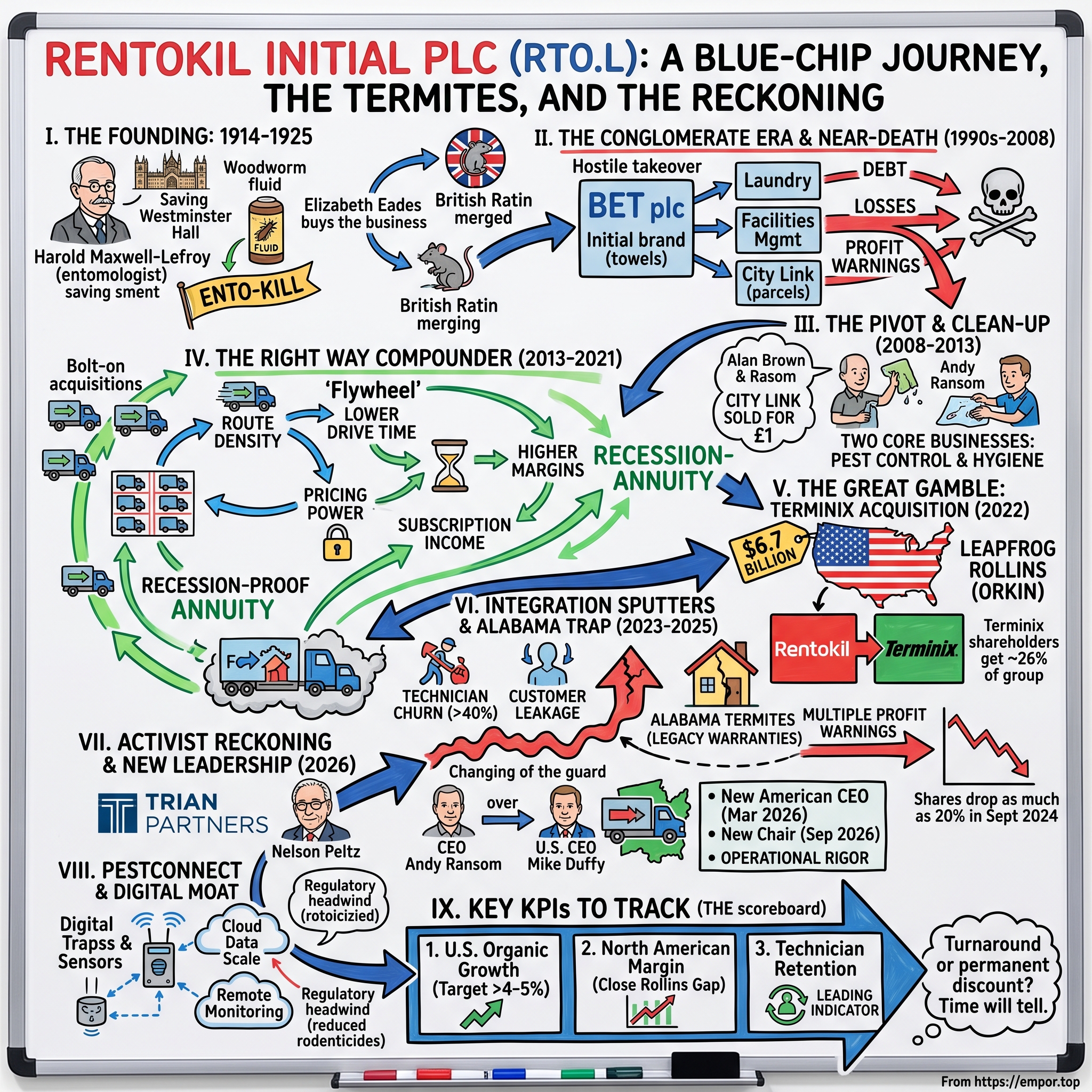
Rentokil Initial: The Blue-Chip Roll-Up, The Alabama Termite Trap, and the Activist Reckoning
I. Introduction & The Hook: The $6.7 Billion Gamble
There is a particular kind of company that European fund managers fall in love with, and then quietly build entire careers around. It is never glamorous. It rarely makes headlines. It sells something nobody wants to think about at dinner. And it compounds, year after boring year, until one day you look up and realize the unglamorous little company has become a £10-billion titan that half the pension funds on the continent own and none of them can quite explain to their spouses.
Rentokil Initial plc, listed in London under the ticker RTO.L, was that company. For the better part of a decade it was the textbook European compounder: a century-old multinational that had discovered a genuinely wonderful business hiding inside an unlovely one. The insight was almost embarrassingly simple. Take the fragmented, mom-and-pop world of pest control and washroom hygiene — thousands of one-truck, one-technician local operators scattered across every developed economy on earth — and buy them, one bolt-on at a time, layering them into a dense, route-based, subscription-fed machine that threw off cash like a stuck faucet. Rats and cockroaches, it turned out, are a recession-proof annuity. People will cut almost anything before they let a restaurant fail its health inspection or let termites eat their house.
Then, in a single stroke, Rentokil bet the entire franchise on America. On December 14, 2021, chief executive Andy Ransom announced an agreement to acquire the American number-two, Terminix Global Holdings, for roughly $6.7 billion in cash and stock.1 The deal closed on October 12, 2022, funded with about $1.3 billion of cash and 643.3 million new Rentokil shares, handing former Terminix holders roughly 26% of the combined company.2 The logic was to leapfrog the legendary Rollins, Inc. — owner of Orkin and the undisputed margin gold standard of North American pest control — and crown Rentokil king of the world's single largest pest market.
The reality, over the three years that followed, was closer to a cautionary tale. The merger dredged up legacy operational problems, technician and customer churn, a run of profit warnings, a chart that fell off a cliff — Rentokil's shares dropped as much as 20% in a single session in September 20243 — and, inevitably, an activist. Nelson Peltz's Trian Partners built a stake, took a board seat, and helped engineer a top-to-bottom changing of the guard: a new American CEO in March 2026 and a new chair to follow in September.45
This is the story of how the greatest roll-up in modern British business history worked so beautifully for so long, why route density is one of the more elegant moats in all of services, and what happens when a disciplined serial acquirer decides to swallow something nearly its own size. From an entomologist poisoning himself in a Westminster laboratory to a boardroom fight on the London Stock Exchange, the throughline is a single, unromantic idea — the economics of the truck that is already on the street — and the question of whether a business built on hundreds of tiny deals could survive one enormous one.
 Subscribe on LinkedIn
II. Act I: The Westminster Beetle & The Poisoned Professor (1914–1925)
Begin in the medieval gloom of Westminster Hall, the oldest surviving part of the Palace of Westminster, where English kings had lain in state and where the great oak hammer-beam roof — commissioned by Richard II in the 1390s — had stood for five centuries. By 1914 it was quietly rotting from the inside. The enemy was Anobium punctatum, the deathwatch beetle, a creature so named because its larvae bore through old timber and the adults tap their heads against the wood to attract mates, a sound superstitious Britons once associated with sitting up beside the dying. The nation's parliamentary heritage was, literally, being eaten.
The Office of Works turned to Harold Maxwell-Lefroy, Professor of Entomology at Imperial College London, a Cambridge-trained naturalist who had spent years as an economic entomologist in India before returning to build Britain's first serious pest-science program.6 Maxwell-Lefroy was the sort of scientist who believed a problem was not solved until it was killed, and he attacked the beetles with chemistry. His fluid was a fearsome cocktail — roughly 50% tetrachloroethane, 40% trichloroethylene, with cedarwood oil, soap, and paraffin wax rounding it out — brushed and injected into the ancient timbers.7 It worked. The roof was saved, and Maxwell-Lefroy discovered something more valuable than a chemical formula: that there was a real, paying market for the systematic eradication of things that destroy buildings.
In 1924 he and his assistant, Elizabeth "Bessie" Eades, began bottling the woodworm fluid out of a small operation in Hatton Garden, London.6 He wanted to call it "Ento-Kill," but a similar name was already registered, so he prepended a letter and arrived at the brand that would outlive him by a century: Rentokil. The corporate vehicle, Disinfectants and General Products Ltd, was incorporated on September 29, 1924.6
Then came the twist that reads like something out of a Gothic novel. In October 1925, Maxwell-Lefroy — a man whose entire genius was the industrial application of toxic gases — was accidentally poisoned by the very fumes he was experimenting with in his own Imperial College laboratory, and died.7 The professor was gone barely a year after founding his company. It was Bessie Eades, the assistant, who kept the flame alive, buying the business and carrying the Rentokil name forward through the lean interwar years. It is a small but telling origin detail: the company that would one day be defined by its ruthless operational discipline was rescued, at its very birth, by an employee who simply refused to let it die.
The other half of the modern company was assembling in parallel, and it involved rats. In 1927 a Danish chemist, Sophus Frederiksen, founded British Ratin to commercialize a bacterial culture marketed as a selective rodent exterminator — a biological rat-killer.7 For three decades Rentokil (insects) and British Ratin (rodents) circled the same fragmented market. In 1957 the two combined, with British Ratin acquiring Rentokil and, in a rare act of branding humility, adopting its target's stronger name to become Rentokil Laboratories.7 Insects and rodents, woodworm fluid and rat bacteria, were now under one roof. The template that would define the company for the next seventy years — grow by absorbing your neighbours, and keep the best brand — was set from almost the very beginning. What nobody yet knew was how badly the company would eventually forget its own lesson.
III. Act II: The Conglomerate Era & Near-Death Experience (1990s–2008)
Fast-forward past the postwar decades of steady, unremarkable growth, and you arrive at the moment Rentokil stopped being a pest-and-hygiene specialist and started believing it could run anything. The 1990s were the high-water mark of the diversified services conglomerate — the idea that a sufficiently good management team could take a generic "operational excellence" playbook and apply it to any low-glamour, cash-generative business, from cleaning to catering to security to parcels. Rentokil drank deeply.
The defining swing came in 1996, when Rentokil — then a mid-sized company — launched an audacious hostile takeover of BET plc, a business-services group several times its own size.87 It was David swallowing Goliath, financed with debt and executed with the swagger of a management team convinced of its own genius. The prize buried inside BET was the Initial brand, a name with a lovely provenance: the Initial Towel Supply Company, founded in 1903, which had made its money renting clean, monogrammed ("initialled") towels to London's offices and clubs.7 The merged company became Rentokil Initial, and washroom hygiene — the roller towels, soap dispensers, and sanitary units that are the unsung plumbing of every commercial building — joined pest control at the core.
Had it stopped there, the story would be simpler. It did not. Through the late 1990s and 2000s, Rentokil Initial metastasized into a sprawling services conglomerate: pest control and washroom hygiene, yes, but also workwear laundry, tropical plant rental, corporate facilities management, and — in the decision that would come to symbolize the whole overreach — parcel delivery. In 2006 the company bought Target Express and folded it into City Link, a British overnight-parcels business.7 On paper, it was another route-based operation with trucks and depots. In reality, it was a brutally competitive, capital-hungry, low-margin logistics war against the likes of Royal Mail and the big integrators, with none of the pricing power or customer stickiness that made pest control such a joy.
By 2008 the diversification had curdled into something close to a crisis. City Link was hemorrhaging money, plagued by a botched integration, savage price competition, and operational chaos. The group ground out profit warning after profit warning; the share price collapsed; debt covenants tightened around a balance sheet that had grown heavy during the acquisition spree. The market's verdict was damning and, in hindsight, largely correct: Rentokil Initial had become a bloated conglomerate that had buried two genuinely excellent businesses inside a portfolio of mediocre ones. It was a value trap. The lesson the young Rentokil had known instinctively — density and focus beat scale-for-its-own-sake — had been thoroughly unlearned. It would take an outsider to relearn it, and he was about to walk through the door.
IV. Act III: The Alan Brown Clean-Up & The £1 Disposal (2008–2013)
In March 2008, into this mess walked Alan Brown, formerly chief financial officer of the chemicals giant ICI — a man with the temperament of an auditor and none of the sentimentality of an empire-builder.7 Alongside him came Andy Ransom, a lawyer by training who had joined as head of M&A and mergers integration and would rise to run the business. Their diagnosis was unromantic and ruthless: Rentokil owned two wonderful businesses and a collection of distractions, and the distractions were killing it.
The pivot was intellectual before it was operational. Brown and Ransom understood — in a way the conglomerate-era leadership had lost sight of — that not all route-based businesses are created equal. A parcel is a one-off, price-shopped transaction with no recurring contract and no switching cost; a pest-control account is a multi-year subscription protecting something the customer cannot afford to lose. Washroom hygiene had the same annuity quality. The right strategy was not to be a generic services operator; it was to concentrate ruthlessly on the two segments where local density plus recurring contracts produced durable, high-margin cash flows, and to exit everything else.
Which brings us to one of the more famous transactions in modern British corporate history — famous not for its size but for its price. After five years of trying and failing to fix City Link's chronic losses, Brown made the clean break in April 2013, selling the entire parcel-delivery business to the private-equity firm Better Capital for the nominal sum of £1.[^9] A pound. For a business that had once been acquired for hundreds of millions and had consumed vast management attention. It was an act of financial catharsis: Rentokil paid, in effect, to make the losses someone else's problem, taking a hit to walk away clean.
The postscript turned grim, and it vindicated the decision. On Christmas Day 2014, under Better Capital's ownership, City Link collapsed into administration, ultimately costing around 2,700 jobs and igniting a national political row over the timing of the announcement and the treatment of workers.7 But by then Rentokil had been insulated for over eighteen months; the fire it had walked away from burned down someone else's house. The company also moved to shed its lower-margin Initial Facilities division, further concentrating the portfolio around the two compoundable cores. Brown stepped down in autumn 2013, handing Ransom a leaner, focused machine — the restructuring surgeon replaced by the operator who would now spend a decade putting the strategy into overdrive. The clean-up had removed the rot. The question was what to build on the cleared ground.
V. Act IV: The "Right Way" Compounder: Route Density & The Roll-Up Flywheel (2013–2021)
Andy Ransom took the top job in late 2013 with a strategic framework so simple it could fit on a laminated card — which was rather the point. Branded internally as the "RIGHT WAY," it committed the company to profitable, focused growth in pest control and hygiene, executed through a relentless, disciplined program of small acquisitions. The genius was not novelty. It was the refusal to deviate.
Here is the flywheel Ransom built. In its most active years, Rentokil executed on the order of a hundred or more "bolt-on" acquisitions annually — small, independent, often family-owned local operators in fragmented markets around the world.7 Each one was tiny. Collectively they were transformative. To understand why, you have to understand the single most important number in a route-based service business, and it is not revenue. It is drive time.
Picture two pest-control technicians, each starting the day in the same truck. The first works for a local one-man shop with five customers scattered across a suburb; he spends thirty minutes driving between each stop and, by day's end, has completed maybe six visits. The second works for Rentokil, which has quietly bought out three of that suburb's small operators and now has twenty-five customers packed into the same zip code; she drives five minutes between stops and completes a dozen visits in the same day. Same truck. Same wage. Same fuel. Roughly double the billable work. This is what practitioners call "windshield time," and squeezing it is the whole game.
The magic is in the margin on the marginal stop. Once the truck and the technician are already on the street, the incremental cost of servicing one more nearby customer is close to nothing — no extra vehicle, no extra salary, barely any extra fuel — so the gross margin on those densely clustered, acquired routes is extraordinarily high. This is Hamilton Helmer's Scale Economies power in its purest, most local form: the advantage does not accrue to whoever is biggest nationally, but to whoever is densest in each individual neighbourhood. That density then funds everything else. Rentokil could outspend the local shop on marketing, pay technicians better, invest in better equipment, and still earn a fatter operating margin — a self-reinforcing loop where density funds the tools that win more density.
Sitting underneath the density was the second pillar: the subscription. Pest control is not a one-time job; it is an ongoing service relationship, and a large majority of Rentokil's pest revenue recurs under contract, typically in the range of 70% to 85% of the book renewing year after year. That recurring base is what turns a collection of local trucks into a compounding annuity.
And then, pricing power — perhaps the most underappreciated feature of the whole model. Think about the asymmetry from the customer's side. A pest-control contract costs a restaurant a few thousand pounds a year, a rounding error against its rent and payroll. But the cost of failure — a rodent sighting that goes viral, a health inspector's closure notice, a bedbug outbreak at a hotel, termites structurally condemning a family home — is catastrophic and potentially existential. When the price of the service is trivial and the price of failure is ruin, customers do not switch providers to save a few percent. That asymmetry let Rentokil push through steady mid-single-digit annual price increases with minimal churn, layering pricing on top of density on top of acquisitions.
The London market fell hard for all of this. Organic revenue growth of roughly 3-5%, topped up by the acquisition engine, translated into years of double-digit earnings growth and superb cash conversion. Rentokil became a core holding for the quality-compounding crowd, its multiple climbing as investors extrapolated the flywheel forward. But every compounder eventually confronts the same temptation: the domestic and mid-sized deals get used up, and the biggest prize sits in the biggest, hardest market. For Rentokil, that prize was in America — and reaching for it would test whether a machine built for hundreds of small bites could survive one enormous one.
VI. Act V: The Great $6.7 Billion Gamble: Acquiring Terminix (2022)
Every roll-up eventually meets its geographic reckoning, and for pest control the reckoning is North America. The United States is the single largest pest-control market on earth, and it is where the industry's most admired operator lives: Rollins, Inc., parent of Orkin, a company that has turned local route density into best-in-class margins and a valuation multiple that European investors could only gaze at with envy. Rentokil was a global champion almost everywhere — except in the one market that mattered most, where it remained a distant challenger to Rollins. For a management team whose entire identity was scale economies, that gap was intolerable.
The obvious way to close it was not another hundred bolt-ons. It was to buy the number-two player outright. Terminix Global Holdings was the second-largest pest-control provider in the U.S., a household brand recently spun out of ServiceMaster, with enormous scale and a residential termite franchise stretching across the American South. It also had a problem, which was the entire reason it was available at a reasonable price: it was operationally broken. Terminix suffered chronic technician turnover, weak customer service, and stagnant growth — a business with a great footprint and a mediocre engine. Rollins ran on all cylinders; Terminix sputtered.
Ransom's thesis was that Rentokil's operating system — the density playbook, the RIGHT WAY discipline — was exactly the missing engine. Bolt Terminix's footprint onto Rentokil's operational know-how, and you would create the North American number one, a business large enough and dense enough to eventually earn Rollins-like economics. On December 14, 2021, he announced the roughly $6.7 billion cash-and-stock agreement, and on October 12, 2022, the deal closed, with Terminix shareholders taking about 26% of the enlarged group and the combined company adding a New York listing to its London home.12
Did Rentokil overpay?
This is where the neutral investor has to slow down, because the answer depends heavily on which number you believe. On headline 2021 consensus EBITDA, before any synergies, Rentokil paid on the order of 19x EV/EBITDA — a full price for a services asset. Management's counter was synergies: a promised roughly $150 million of annual pre-tax cost savings at the outset, which, credited against the purchase price, pulled the effective multiple down toward the low-to-mid teens. On that math, the deal looked defensible, even cheap, relative to where Rollins routinely traded — often in the 25-30x EBITDA range.
But the multiple comparison flatters the deal in a way worth naming plainly. Rollins commanded its premium because it was a disciplined, high-margin, organically compounding machine. Terminix was the opposite: technician turnover reportedly above 40%, weak retention, and a residential book that needed rebuilding. Paying 19x for a lower-quality asset is not obviously cheaper than paying 27x for a great one — you are buying a turnaround, not an annuity, and turnarounds carry execution risk that a spreadsheet synergy line cannot capture. The synergy-adjusted multiple only materializes if the synergies materialize, on schedule, without offsetting revenue leakage. The bull framing was "we bought Rollins-quality scale at a discount." The bear framing, which the next three years would stress-test brutally, was "we paid a top-of-cycle price for someone else's mess and called the difference synergies." Both were live hypotheses on the day the deal closed. Only one of them could be right.
VII. Act VI: "Bad House, Good Neighborhood" — Integration Sputters & The Alabama Termite Trap (2023–2025)
There is an old real-estate line for a property with great bones in a great location that has been let go: a bad house in a good neighborhood. It is a useful frame for what Rentokil bought. The North American footprint — the neighborhood — was outstanding. The Terminix house sitting on it needed to be gutted to the studs. And gutting a house while its residents still live in it, on national television, is a good description of what integration turned into.
What the combined machine actually looks like
Start with the scale, because it explains why every subsequent stumble was so consequential. In its 2025 full-year results, Rentokil reported group revenue of roughly $6.9 billion and adjusted operating profit of about $1.07 billion, up 5.4%.910 The center of gravity had shifted decisively across the Atlantic: North America generated around $4.29 billion of revenue — roughly 62% of the entire global group — with pest control making up about 84% of that regional total, on the order of $3.5 billion.119 North American adjusted operating profit was approximately $749 million at a 17.4% margin.11 Pest control dwarfs the legacy Hygiene & Wellbeing arm, which contributed a little over $1.2 billion of group revenue.9
Translate that out of accountant and the strategic reality is stark: after a century of global diversification, the fate of Rentokil Initial now rests overwhelmingly on the performance of residential and commercial pest control in a single country. The company had concentrated its risk on precisely the market where the acquired asset was weakest. That is either the boldest expression of conviction in the density playbook or a dangerous single-point dependency, and for three years it looked mostly like the latter.
The integration sputters
The friction was human before it was financial. Terminix and legacy Rentokil North America ran different pay plans, different routing, different IT systems, and — crucially — different cultures. Merging them meant harmonizing all of it, and harmonization is where value quietly leaks. Technicians on the losing side of a pay-plan change get unhappy and quit; in a business where the customer's actual relationship is with the individual who shows up at their door each month, a departing technician often takes the customer's loyalty with them. Voluntary turnover spiked, wage inflation crept in, and the branch-migration program — physically combining Terminix and Rentokil branches onto shared systems and routes — repeatedly disrupted the local sales motion just as it was meant to be improving it. By 2024, North American organic pest-control growth had slowed to a crawl, running low-single-digit while Rollins kept posting mid-to-high single digits — the precise gap the deal was supposed to close was instead widening.
The Alabama termite trap
Buried inside the Terminix balance sheet was a liability with a distinctly Southern Gothic flavor. Along the U.S. Gulf Coast — Mobile and Baldwin Counties in Alabama especially — the invasive Formosan subterranean termite does not merely nibble; it can structurally devastate a home. For decades, Terminix had sold lifetime termite-protection warranties promising to repair future damage. Many of those legacy contracts were, in hindsight, underpriced and under-serviced, and when the Formosan termites did their work, the repair bills and lawsuits arrived.
Worse, Terminix's own response to the problem had been a reputational disaster. Before the Rentokil acquisition, the company had run what it internally called a "clean sheet initiative" — imposing steep price increases and altered terms on legacy Mobile-area customers, in effect trying to force liability-heavy accounts to cancel themselves. Regulators saw it differently. In November 2020, Terminix settled with the Alabama Attorney General, agreeing to a package that included a $25 million consumer restitution fund and a $19 million payment, alongside remediation for affected customers.12 Rentokil inherited the open book of termite claims, the ongoing arbitrations, and the reputational damage. The company has been forced to carry meaningful provisions against these legacy obligations and has described them as a liability that will run off over many years rather than quarters; the exact terminal date is not something an outside investor can pin down precisely from disclosure. The takeaway for the neutral analyst is not the specific provision number, which moves, but the category of risk: Rentokil bought a book of long-tailed, litigation-prone warranty liabilities in a jurisdiction with a demonstrated appetite for large arbitration awards, and that tail will be draining cash and management attention for a long time.
The trust-damaging pattern
Operational stumbles are forgivable; a pattern of them, poorly explained, is what breaks a management team's credibility. On September 11, 2024, Rentokil issued an unscheduled trading update — its third warning on North America in roughly a year — cutting profit expectations after July and August sales came in soft, guiding North American second-half organic growth down to around 1%, and flagging job cuts. The shares fell as much as 20% in a day.3 Ransom, to his credit, told analysts on the call that he was "disappointed" in the execution of the very growth strategy the company had launched that March3 — an admission, but also a tacit concession that management had misjudged its own turnaround.
The harder question, which analysts pressed repeatedly, was mechanical: why, exactly, was residential retention slipping, and why did management keep being surprised by it? Answers tended toward the general — marketing inefficiency, integration disruption, colocation timing — rather than the specific. And as 2025 wore on, Rentokil raised its Terminix synergy target to roughly $325 million gross (about $225 million net) of annual pre-tax cost savings by the end of 2026.13 Rising synergy numbers are usually cheered, but here they invited a more skeptical reading: with reported cost synergies climbing while organic growth languished, some analysts worried the synergy line was doing double duty — genuinely capturing efficiencies, but also cushioning the reported numbers against underlying softness in the core U.S. business. Whether that skepticism was fair or not, it was corrosive, and it created exactly the opening that a certain kind of investor waits for.
VIII. Act VII: The Activist Strike & The March 2026 Changing of the Guard
Activists are drawn to a specific scent: a great set of assets, a depressed valuation, and a management narrative that has stopped being believed. By mid-2024, Rentokil was giving off all three, and Nelson Peltz's Trian Partners — the firm with a long track record of muscling its way onto the boards of consumer and industrial names — moved in. Trian first disclosed a position of roughly $400 million, and on September 25, 2024, just two weeks after the brutal profit warning, Rentokil confirmed a settlement: Trian held a 2.26% stake, and its partner and head of research, Brian Baldwin, would join the board effective October 1, taking seats on the nominating and compensation committees.4
Note what did not happen. There was no proxy war, no public letter-writing campaign, no scorched-earth fight. Rentokil's board, chaired since 2019 by Richard Solomons — himself a seasoned operator from his years running InterContinental Hotels — chose to co-opt rather than combat. That was a rational read of the situation, because Trian's thesis was not really adversarial to the underlying business. It was almost the opposite of the classic break-up-the-conglomerate activist pitch. Trian's argument was that Rentokil had assembled a genuinely world-class geographic footprint and then executed on it poorly; that the discount to Rollins was a self-inflicted execution and disclosure problem, not a portfolio problem; and that the fix was operational rigor, leadership stability in North America, and transparency — not financial engineering. When an activist and a board agree on the diagnosis, the fight moves quickly to the remedy.
The remedy was people. North America had already churned through senior leaders — the region had seen presidents come and go in quick succession, a revolving door that itself signaled how hard the integration was proving. Under pressure to put a proven, U.S.-based operator in charge of what had become a U.S.-dominated company, the board went outside. On January 13, 2026, Rentokil announced that Mike Duffy would become chief executive.5
Who is Mike Duffy?
Duffy is, pointedly, not a lifer pest-control executive and not British. He is a U.S. citizen, based in North America, with a quarter-century running large, logistics-heavy, route-intensive B2B businesses — precisely the operational domain where Rentokil was struggling. He was serving as CEO of OnTrac, a last-mile e-commerce delivery firm, where Rentokil credited him with building a culture of sales excellence and refocusing the business on multi-site operational efficiency and technology.5 His résumé also included the top job at FleetPride, a distributor of heavy-truck parts, and at C&S Wholesale Grocers — both fragmented, multi-site, labor-and-routing businesses. The message in the appointment was unmistakable: Rentokil was no longer looking for someone who understood entomology; it wanted someone who understood how to run thousands of trucks and technicians efficiently and how to turn around a demoralized field workforce.
Duffy joined as CEO-designate on February 16, 2026, and took over as chief executive on March 16, 2026, with Andy Ransom stepping down after more than a decade at the top and staying on to smooth the handover through the May 7 annual meeting.5 His incentive package was engineered to point him at exactly the levers the bears worried about: a base salary of $1.6 million, an annual bonus opportunity up to 225% of salary, and long-term incentive awards up to 375% of salary, weighted toward share-price recovery and returns on capital, with a requirement to build and hold shares worth at least 400% of base salary.5 The structure tied his personal wealth to the same thing public shareholders cared about — a recovery in North American returns — though a skeptic would note that generous "golden handcuffs" also richly reward a new CEO simply for the cyclical rebound the previous team's fixes may already have set in motion.
The board refresh finished at the top. On April 15, 2026, Rentokil announced that Richard Solomons would retire and that Thérèse Esperdy — a former JPMorgan banker with chair and non-executive experience at Imperial Brands, Smith & Nephew, Moody's, and National Grid — would join as chair-designate on July 1 and become chair on September 1, 2026, on annual fees of £725,000.14 Within roughly eighteen months of Trian's arrival, Rentokil had a new CEO, a new chair on the way, and an activist in the boardroom. The changing of the guard was complete. Whether it changed the trajectory was, as of mid-2026, still an open question.
IX. Act VIII: PestConnect & The Digital Moat: Tech-Enabled Scale Economies
Step away from the boardroom drama for a moment, because there is a quieter part of the Rentokil story that the profit warnings obscured, and it is the part most likely to matter over the next decade. It is called PestConnect, and it represents the company's attempt to bolt a genuine technology moat onto its physical route density.
Here is the old way pest control worked, essentially unchanged for a century. A technician drives to a commercial site — a food-processing plant, a hospital, a warehouse — and physically walks the perimeter, opening dozens or hundreds of bait stations and traps to check whether anything has been caught. Most are empty. The visit happens on a fixed monthly schedule whether or not there is a problem, which means the single most expensive input, the technician's time, is spent largely inspecting empty boxes. It is reactive and it is inefficient.
PestConnect inverts the model. Rentokil deploys sensor-enabled digital traps that detect when a rodent enters or is caught and transmit that signal automatically over cellular and cloud networks to a monitoring center. The technician no longer drives out to check empty traps on a calendar; the system tells them where the actual activity is, so visits are triggered by data rather than schedule. Explained simply: it is the difference between a night watchman walking every corridor once an hour and a building wired with motion sensors that only summon him where something moves.
The strategic payoff runs on several distinct mechanisms, and it is worth separating them rather than blurring them into "tech is good." First, labor efficiency: by directing technicians only to sites with real activity, PestConnect attacks windshield time from a new angle, effectively raising route density without buying a single additional customer. Second, switching costs: commercial PestConnect is typically sold on three-year contracts rather than the standard annual arrangement, and once a hospital or food plant has wired the monitoring into its own compliance and audit systems, ripping it out is genuinely disruptive — a far stickier relationship than a handshake service contract.15 Third, and hardest for any local competitor to replicate, is data scale: with hundreds of thousands of connected devices deployed globally, Rentokil accumulates an enormous dataset on rodent behavior, which it uses to train models — marketed under names like PestConnect and its analytics layer — that optimize trap placement and predict infestations. A one-truck local operator cannot assemble that dataset at any price. This is Scale Economies expressed through data rather than trucks.
And then there is a regulatory tailwind that could turn a nice-to-have into a must-have. Governments across Europe and beyond have been tightening restrictions on chemical rodenticides, driven by concern over secondary poisoning of owls, kestrels, and other predators that eat poisoned rodents. As anticoagulant baits face curbs, sensor-driven "precision" monitoring — which Rentokil says can sharply cut rodenticide use by targeting intervention only where needed — shifts from an efficiency story to a compliance one. For large, ESG-scrutinized multinational customers operating across jurisdictions, a data-driven, low-chemical solution may become the only acceptable option, and few competitors can offer it at scale.
A neutral note is warranted before the moat gets oversold: PestConnect's economics are strongest in commercial and industrial accounts, not in the residential and termite business that has actually been dragging North American results. The digital moat is real and probably durable, but it is concentrated in the part of the portfolio that was already healthy. It is an argument for the long-term quality of the franchise; it is not, on its own, the fix for the specific U.S. residential problem the new CEO was hired to solve. With the moats now on the table, it is worth war-gaming them formally.
X. Act IX: The Playbook: Porter's 5 Forces & Hamilton Helmer's 7 Powers
Strip away the narrative and put the business on the analyst's workbench, and Rentokil turns out to be an unusually clean case study — a business whose competitive advantages are textbook, and whose vulnerabilities are equally legible.
The 7 Powers
Scale Economies is the master power, and it is worth restating precisely why Rentokil's version is special. The advantage is not national scale; it is local density, earned zip code by zip code, driving down cost-per-stop and lifting technician utilization. National scale layers on secondary benefits — purchasing power over fleet vehicles, fuel, chemicals, and increasingly the data scale behind PestConnect — but the core engine is local. This is why the industry can support two large winners (Rentokil and Rollins) plus thousands of small operators simultaneously: density is won market-by-market, so a national giant that is thin in a given suburb enjoys no advantage there over a well-run local incumbent.
Switching Costs are high and structural, especially in commercial accounts. A restaurant, hospital, or food producer cannot casually swap pest providers, because the regulatory, legal, and reputational cost of a lapse dwarfs any price saving — and once monitoring software and compliance records are integrated, inertia hardens into lock-in.
Brand carries real weight. Rentokil, Terminix, and Orkin function as trust marks to national accounts that need to know their provider will show up, document the work, and satisfy an auditor. In pest control, brand is essentially a promise of reliability and compliance, and that promise is worth paying for.
Cornered Resource is more modest but real: experienced, licensed technicians — particularly in specialized commercial work — are genuinely scarce, and scale players who can offer structured career paths, training, and digital tools have an edge in attracting and keeping them. The irony, sharply illustrated by the Terminix integration, is that this "power" flips into the company's single greatest vulnerability the moment technician turnover rises. The scarce resource is only an advantage while you are retaining it.
The remaining Helmer powers — network economies, counter-positioning, and process power — are weaker here. There is a plausible counter-positioning argument for PestConnect's preventive model against the traditional reactive one, but incumbents can and do adopt sensors too, so it is more of a lead than a structural wall.
Porter's Five Forces
The forces analysis reaches the same destination from another road. Threat of new entrants is a paradox: it is trivially easy to start a one-truck pest business — the barrier to entry is almost nil — but it is extraordinarily hard to reach the density and margin required to compete with Rentokil or Rollins on national accounts. The barrier to scale is the real moat. Buyer power is low, thanks to a fragmented customer base for whom the service is a tiny share of operating costs, underpinning the pricing power described earlier. Supplier power is medium and concentrated in one input — labor. Technician wages and availability are the perpetual pressure on the model, and the only durable offset is exactly the route density that lets a company extract more value from each hour of that labor. Threat of substitutes is very low; there is no meaningful DIY substitute for eliminating a termite colony or a commercial bedbug infestation. And competitive rivalry, benign for most of the world, is intense in North America, where Rentokil and Rollins compete hard for major commercial accounts and where, for the past three years, Rollins has plainly had the better of it.
The synthesis for an investor is this: Rentokil sits inside a genuinely attractive industry structure with real, identifiable moats — and its recent troubles have come almost entirely from the one force it can most control, its own execution against the labor input and the integration. That is, paradoxically, encouraging and worrying at once. Encouraging, because self-inflicted problems are fixable in a way that structural ones are not. Worrying, because it means the entire bull case now rests on management competence rather than on the durability of the moat.
XI. Act X: The Bull vs. Bear Case & Skeptical-Investor Stress Test
So put the two cases head to head, and stress-test each the way a hard-nosed long/short investor would, without flinching from the uncomfortable parts of either.
The skeptic's cross-examination
The sharpest bear question is whether the Terminix deal has already permanently destroyed value regardless of what happens next. The acquisition loaded the balance sheet — leverage sat around 2.6x net debt to EBITDA at the 2025 results, with management targeting a 2-2.5x range before capital returns could meaningfully broaden13 — and diluted returns on invested capital from Rentokil's historically respectable levels down toward mid-single digits as the goodwill-heavy purchase price landed on the denominator. If North American organic growth never reaccelerates to Rollins-like mid-single-digit rates, the price paid for Terminix becomes a permanent drag on capital efficiency, and no amount of cost synergy fully rescues it. Cost synergies improve the margin; they do not, by themselves, generate the growth that justifies the multiple paid.
The second cross-examination is churn, and it is more subtle. In this business the customer's true relationship is with the individual technician at the door. If the integration's new pay plans keep technician turnover elevated, customer retention will follow it down, and the company will be forced to spend ever more on digital marketing — at rising customer-acquisition cost — simply to replace customers it should never have lost. High churn is not just a cost line; it is a slow leak in the compounding machine, and it is the single most important thing to watch.
The bear case
Assemble the pessimist's scenario and it is coherent. North American integration stays slow and disruptive under a brand-new CEO still learning the industry. Technician churn keeps residential retention depressed, forcing expensive marketing to fill the bucket. Legacy termite liabilities prove stickier than provisioned, or the litigation appetite spreads beyond Alabama, producing unexpected cash charges that gnaw at free cash flow. And the $325 million synergy target slips or arrives net of revenue leakage, leaving margins stuck below the Rollins benchmark. In that world, Rentokil remains a decent business trading at a permanent discount — the roll-up that finally bit off more than it could integrate.
The bull case
The optimist's scenario is equally coherent, and the 2025 results gave it real ammunition. Note the actual trajectory: North American pest-control organic growth, which had flatlined near zero in the first half, accelerated to around 2.6% by the fourth quarter of 2025, and free cash flow jumped roughly 29% to about $530 million at a 113% conversion rate, funding the deleveraging.1310 If that inflection is real rather than a seasonal blip, the bull story writes itself: Duffy applies his multi-site logistics turnaround experience to stabilize the branches and optimize routes; Trian's presence enforces genuine capital-allocation discipline, throttling back the giant M&A appetite in favor of buybacks and dividends as leverage falls into the target range; PestConnect keeps compounding in high-margin commercial accounts; and North American margins grind from the mid-teens back toward the 20%-plus that Rollins earns. Close that margin gap even partway, and a stock priced for permanent disappointment re-rates toward the premium the assets arguably deserve.
The honest resolution is that both cases hinge on the same variable — North American execution — and that, as of mid-2026, the evidence is genuinely mixed. The fourth-quarter growth acceleration and the cash-flow inflection are real, verifiable data points in the bulls' favor. But one improving quarter under a departing CEO does not yet prove that the turnaround has taken, and the new CEO has not yet reported a single result of his own. This is precisely the kind of situation where an investor's edge comes not from picking a side today but from knowing exactly which numbers will settle the argument. Which brings us to the scoreboard.
XII. Epilogue: 1-3 KPIs to Track & Key Takeaways
If you are going to follow this story, ignore the noise — the press releases, the synergy slides, the boardroom personalities — and watch three numbers, because they will tell you who was right long before the narrative catches up.
First, North American organic revenue growth. This is the master health check, the single figure that adjudicates the entire bull-bear debate. It strips out acquisitions and currency to reveal whether the underlying business is genuinely winning and keeping customers. For years it languished near zero while Rollins compounded at mid-to-high single digits; the late-2025 acceleration toward the mid-2% range was the first real evidence of stabilization.10 The bar is clear: sustained progress toward 4-5% would confirm that churn has been arrested and the marketing spend is finally productive. Stalling back toward 1% would validate the bears.
Second, North American operating margin. Density synergies are supposed to show up here, and only here. The 2025 regional margin sat around 17.4%11, a meaningful distance below the 20%-plus that best-in-class Rollins earns. Watch whether it expands sequentially as branch colocations complete and route density improves. Margin is where the whole "we bought scale at a discount" thesis either proves itself or quietly dies.
Third, technician (and broader employee) retention. This is the leading indicator that moves before the other two. Because the customer relationship lives with the individual technician, retention is the canary: if turnover stays elevated, customer churn and margin pressure will follow with a lag, no matter what any given quarter's revenue print says. It is the most important number that most casual observers never look at.
Zoom out, and Rentokil Initial is the definitive stress test of the roll-up as a business model. For a decade the company demonstrated the sheer power of the strategy — buy fragmented local operators, layer them into dense recurring routes, and let the economics of the truck-already-on-the-street compound into one of Europe's great quality franchises. Then it asked the harder question that every serial acquirer eventually faces: what happens when the deals you have been doing a hundred at a time are replaced by a single deal nearly your own size, in your most important market, on an asset that needs rebuilding rather than merely bolting on?
The answer, three and a half years in, is genuinely unresolved. The moat is real and the assets are excellent; the execution has been poor and the price paid was full. Management credibility took real damage in the profit-warning years — a run of misses, vague explanations, and a synergy narrative that strained belief — which is exactly why the board was rebuilt around an American operator, an activist director, and an incoming chair. The company is now, in effect, a turnaround wearing the clothes of a compounder. Whether it grows back into those clothes depends almost entirely on three numbers in one country, and the person hired in 2026 to move them. The greatest roll-up story in modern British business has not ended. It has simply, at last, become interesting.
References
-
Rentokil Initial to Acquire Terminix for $6.7 Billion — Quality Assurance & Food Safety, 2021-12-14 ↩↩
-
Acquisition of Terminix Completion — Rentokil Initial plc, 2022-10-12 ↩↩
-
UK's Rentokil to cut jobs, flags weakness in North America business — U.S. News / Reuters, 2024-09-11 ↩↩↩
-
Nelson Peltz's Trian takes board seat at pest control maker Rentokil — CNBC, 2024-09-25 ↩↩
-
Rentokil Initial plc appoints Mike Duffy as Chief Executive — Rentokil Initial plc, 2026-01-13 ↩↩↩↩↩
-
History of Rentokil Initial Plc — FundingUniverse ↩↩↩↩↩↩↩↩↩↩
-
Rentokil bid threatens BET Plant Services — Construction News, 1996-02-22 ↩
-
Rentokil Initial 2025 Preliminary Results Statement — Rentokil Initial plc, 2026-03-05 ↩↩↩
-
Rentokil FY2025 slides: stock surges on turnaround progress — Investing.com, 2026-03-05 ↩↩↩
-
Rentokil Initial 2025 Annual Report & Financial Statements — Rentokil Initial plc, 2026 ↩↩↩
-
Terminix Announces Mobile Bay Formosan Termite Settlement with Alabama Attorney General — Business Wire, 2020-11-05 ↩
-
BofA upgrades Rentokil on Terminix integration progress — Investing.com, 2026 ↩↩↩
-
Rentokil Initial plc appoints Thérèse Esperdy as Chair — Rentokil Initial plc, 2026-04-15 ↩
-
Rentokil Initial Investor Relations — PestConnect and digital pest control ↩
 LinkedIn
 WhatsApp
 Reddit
 Hacker News
 Email
Email Kindle
 RSS Feed
 Spotify
 Apple Podcasts
 Amazon Music
 Audible
 YouTube