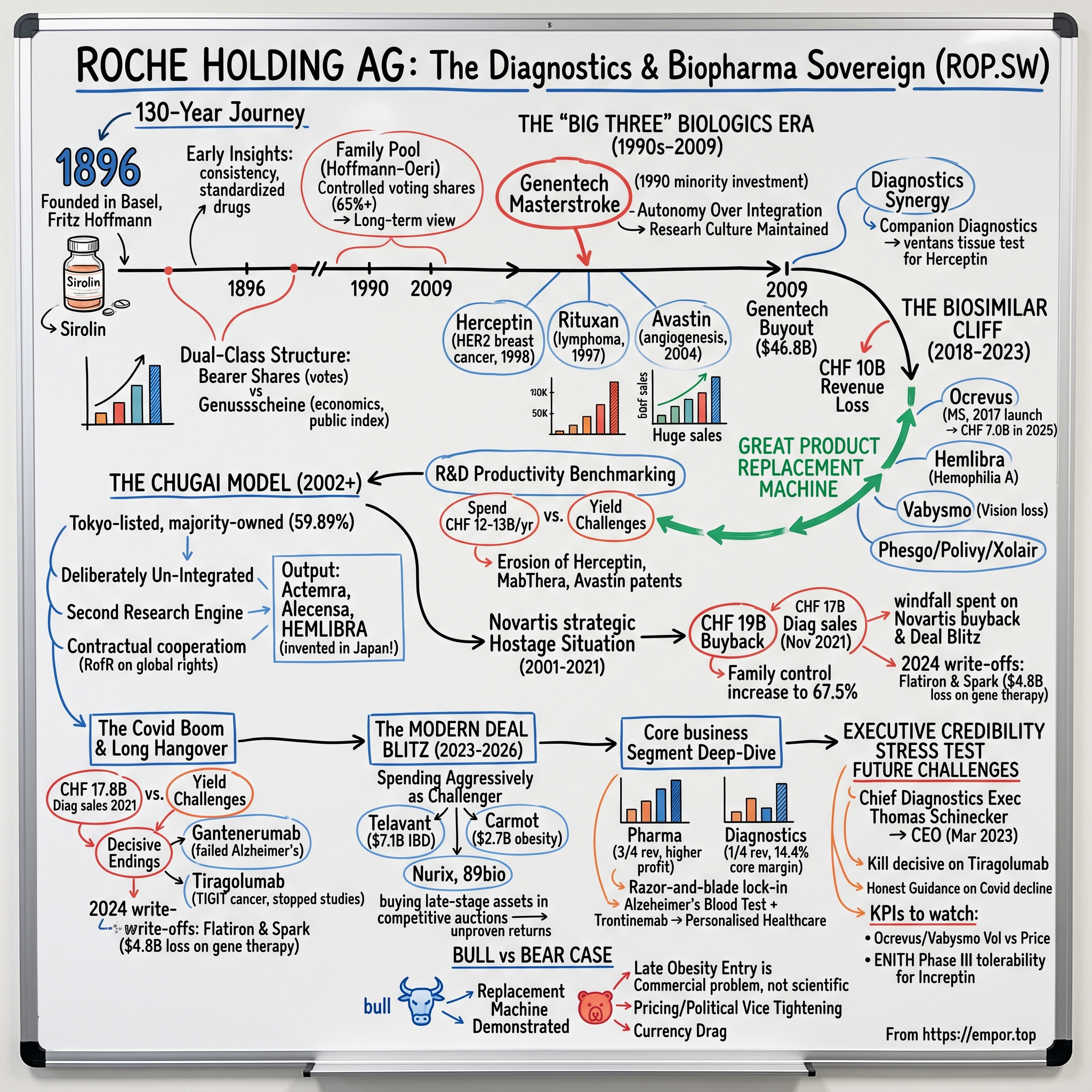
Roche Holding AG: The Diagnostics & Biopharma Sovereign
I. Introduction & Episode Roadmap (00:00 - 08:00 / 8 min)
On the morning of July 23, 2026, Roche's leadership team walked into a half-year results presentation carrying a genuinely strange set of numbers. Sales had grown 6% at constant exchange rates. Sales had also shrunk 2%. Both statements were true, and the gap between them — an eight-percentage-point currency chasm opened by a surging Swiss franc — is a decent metaphor for the entire company.1
Roche is a Basel institution that earns most of its money in dollars, reports in francs, is controlled by a Swiss family pool that has held together since 1948, runs its most productive research engine out of Tokyo, and books nearly half its pharmaceutical revenue in a United States that spent 2025 threatening it with tariffs. It is, in the most literal sense, a company that lives in translation.
The first-half figures underneath the currency noise were these: CHF 30.4 billion of group sales, split CHF 23.6 billion pharmaceuticals and CHF 6.7 billion diagnostics, generating CHF 11.9 billion of core operating profit — a core margin of 39.0%, up 1.7 percentage points year on year. Core earnings per share reached CHF 10.85.1 For the full year 2025, the group turned over CHF 61.5 billion and CHF 21.8 billion of core operating profit, and raised the dividend to CHF 9.80 — the thirty-ninth consecutive annual increase, a streak that began when the Berlin Wall was still standing.2
The central paradox. Roche has already pulled off the single hardest trick in large-cap biopharma, and almost nobody gives it credit. Between 2018 and 2023 it walked off a patent cliff that vaporised something close to CHF 10 billion of annual revenue from three drugs — Herceptin, MabThera/Rituxan and Avastin — and replaced it. Not with accounting, not with price increases, but with new medicines: Ocrevus in multiple sclerosis, Hemlibra in haemophilia, Vabysmo in retinal disease, Phesgo and Polivy in oncology. That is the good news, and it is genuinely rare.
The bad news is that surviving one cliff buys you a ticket to the next one. Roche's most valuable current asset, Ocrevus, faces a competitive squeeze that management has already conceded on the record. Its fastest-growing product, Xolair, was selected by the Centers for Medicare & Medicaid Services in January 2026 for the third round of Medicare price negotiation, with negotiated prices effective January 1, 2028.3 Its two most expensive recent bets — a $7.1 billion inflammatory bowel disease deal and a $2.7 billion obesity deal — are both catch-up plays in markets where rivals arrived first. And its late-stage research record includes two genuinely painful failures: gantenerumab in Alzheimer's and tiragolumab in cancer immunotherapy, the latter consuming roughly a dozen studies and thousands of patients before being abandoned.4
So the question that animates this story is not whether Roche is a great company. It has been one for a century. The question is whether the machine that replaced CHF 10 billion once can do it again, in therapeutic areas where Roche is the challenger rather than the incumbent, under a CEO who came up through the diagnostics business rather than the drug labs.
The governance oddity that makes it all possible. Most listed companies would have been forced to answer that question quarterly, at gunpoint. Roche is not most companies. Its share capital is split into two instruments: 106,691,000 voting bearer shares, or Inhaberaktien, trading under the ticker RO; and 702,562,700 non-voting equity securities, the Genussscheine or participation certificates, trading as ROP — the instrument that dominates index funds, foreign portfolios and the ADR, and the one most investors actually own.5 At the end of 2025 a pooled shareholder group of Hoffmann and Oeri family members controlled 69,318,000 bearer shares, or 64.97% of the votes, under a pooling agreement that has existed since 1948 and was extended indefinitely in 2009.5
Read that again: the people who own roughly a tenth of the economics control roughly two-thirds of the votes. Depending on your priors, that is either the greatest structural advantage in European pharma or an unaccountability machine. This story will argue it has been mostly the former and occasionally the latter, and will be specific about which is which.
Where we're going. Four threads run through what follows. First, the Genentech playbook — a 1990 minority investment that became the most consequential capital allocation decision in biotech history, and the "autonomy over integration" philosophy it created. Second, 中外製薬株式会社 Chugai Pharmaceutical Co., Ltd., the Tokyo-listed, majority-owned, deliberately un-integrated subsidiary that has quietly out-invented much of Roche's own research organisation. Third, the CHF 19 billion unwind of Novartis's stake — a piece of financial engineering that ended a 20-year strategic hostage situation. And fourth, the modern deal blitz, where Roche has spent aggressively on late-stage assets in obesity, immunology and metabolic disease, and where the returns are still entirely unproven.
To understand why a company would structure itself this way, you have to go back to a Basel apartment in 1896, and to a young man whose father-in-law's money was about to disappear.
 Subscribe on LinkedIn
II. Founding Ethos, Family Control, & The "Big Three" Biologics Era (08:00 - 22:00 / 14 min)
Fritz Hoffmann was twenty-eight years old and, by the standards of Basel's chemical dynasties, an unpromising heir. He had married Adèle La Roche, appended her name to his own in the Swiss fashion, and on October 1, 1896 founded F. Hoffmann-La Roche & Co in a city already crowded with dye-makers turning coal tar into colour and, increasingly, into medicine.6
His actual insight was not chemical. It was industrial. In the 1890s, medicine was compounded by pharmacists, one jar at a time, with dosages that varied by shop. Hoffmann's bet was that patients and doctors would pay for consistency — branded, standardised, factory-made preparations of known strength. That is a boring idea. It is also the entire basis of the modern pharmaceutical industry. His first commercial hit arrived in 1898: Sirolin, an orange-flavoured cough syrup, which became the firm's first bestseller.6
The early decades nearly killed the company — the First World War stranded assets in Russia, and Fritz died in 1920 with the business badly wounded. What saved it, and what defines it still, was the decision by the family to hold on and to formalise their grip. The pooling agreement dates from 1948.5 By the time Roche's mid-century blockbusters arrived — the benzodiazepines Librium and Valium, synthesised by the Polish-born chemist Leo Sternbach in the Nutley, New Jersey labs — the company had the two things that would define it: enormous cash generation, and an ownership structure that let management spend it on whatever they wanted for as long as they wanted.
The dual-class moat, and what it actually bought
It is worth being precise about the mechanism, because "family control" is usually shorthand for either patience or entrenchment, and the two look identical until they don't.
The structure works like this. The Genussscheine that most outside investors hold carry full economic rights — dividends, liquidation proceeds — but no vote. The bearer shares carry the votes. Because the pool holds a supermajority of bearer shares, no outside investor can force a strategic change, a break-up, a leveraged recapitalisation, or a board seat. Two additional family members, Maja Oeri and Melchior Oeri, each held a further 3.79% of bearer shares outside the pool at the end of 2025, which is a reminder that the family bloc is even wider than the formal agreement suggests.5
What did this buy? Chiefly, the ability to be wrong for a decade without being fired. In the late 1980s and early 1990s, the consensus view on Wall Street was that monoclonal antibodies — large, complex, protein-based drugs grown in living cells rather than synthesised in vats — were scientifically fascinating and commercially dubious. They were expensive to manufacture, had to be injected, and no one knew whether payers would reimburse them. A quarterly-driven management team facing activist pressure would have found it very hard to commit the capital. Roche's did not have to ask.
The counterfactual matters for how you read today's Roche. The same insulation that permitted a fifteen-year bet on antibodies also permitted Roche to sink roughly $4.8 billion into Spark Therapeutics in 2019 and write the goodwill off entirely five years later.7 Insulation is not judgement. It is only the freedom to exercise judgement without interruption — which cuts both ways, and we will return to it.
The Genentech masterstroke
In 1990 Roche paid for a 60% stake in Genentech, the South San Francisco company that had essentially invented the biotech industry a decade earlier by cloning human insulin.6 The reported price was around $2.1 billion — a number that, measured against what followed, looks less like an acquisition and more like a clerical error in Roche's favour.
The genius was not the price. It was the structure. Roche did not absorb Genentech. It left the company listed, left its research culture alone, left its scientists in California arguing with each other in the way that California scientists do, and supplied the one thing Genentech could not generate on its own: a balance sheet deep enough to fund decade-long antibody programmes and build global manufacturing. Roche took the commercial rights outside the United States. Genentech kept its soul.
Between 1990 and 2009 that arrangement produced the three drugs that made modern Roche. Rituxan, a monoclonal antibody that hunts the CD20 protein on B-cells, transformed the treatment of non-Hodgkin lymphoma. Herceptin, targeting the HER2 receptor, turned an aggressive and often fatal breast cancer subtype into a survivable disease — and, crucially, only worked in patients whose tumours over-expressed HER2, which meant you had to test for it first. Avastin attacked tumours indirectly, by starving them of blood supply. Together the three generated well over $200 billion of cumulative sales across their commercial lives and made Roche the undisputed leader in oncology for roughly two decades.
In 2009, Roche bought out Genentech's remaining public shareholders, paying $95.00 per share for the minority in a transaction valued at roughly $46.8 billion.6 It was an audacious moment to do it — global credit markets had just been through their worst year since the 1930s, and Roche funded the deal in a bond market that had barely reopened. The strategic logic was that Roche no longer wanted to be a landlord to its own most important research asset. The cost was that it now paid full price for something it had originally acquired for a rounding error.
Two things are worth drawing out here. First, Roche's greatest value creation came from buying access early and cheaply, then leaving the acquired company alone — the exact opposite of the industry-standard mega-merger that strips out duplicate functions and destroys the acquired culture in the process. Second, the Big Three were not just drugs; they were the seed of Roche's most durable structural asset. Herceptin required a HER2 test. Rituxan required CD20 confirmation. Roche was already the world's largest diagnostics company. The two divisions, historically viewed as an odd couple by analysts who periodically demanded a break-up, turned out to be selling complementary halves of the same clinical decision.
That was the empire at its height. And empires at their height are always about to be invoiced.
III. The Biosimilar Cliff & The Great Product Replacement Machine (22:00 - 38:00 / 16 min)
Every pharmaceutical executive knows the date their patents expire. Roche's problem, sometime around 2016, was that it knew three of them, and they were bunched together like cars in a fog bank.
Herceptin, Rituxan and Avastin were biologics, and biologics had long enjoyed a comforting myth: they were too complex to copy. You cannot reverse-engineer a protein grown in a living cell the way a generics manufacturer reverse-engineers a small-molecule pill. For years that myth held. Then regulators built approval pathways for "biosimilars" — close-enough copies — and manufacturers in Korea, India and the US started building the cell-culture capacity to make them. By the late 2010s, copies were arriving from Amgen, Pfizer, Biocon and others, first in Japan and Europe, then in the United States where the money actually is.
Roche told investors to expect a gap of roughly CHF 9.6 billion between 2018 and 2023, assuming what it called conservative erosion of 60% to 70%. The forecast proved broadly right. The erosion arrived in waves rather than a single collapse — the first Japanese biosimilars of Rituxan and Herceptin landed in 2018, Avastin copies followed in late 2019, and by early 2022 the three reference products were shedding between a fifth and a third of their sales year on year.8 The bleeding continued long after the headline cliff was declared over: as recently as 2024 the trio still cost Roche about CHF 1 billion of lost exclusivity impact, and in 2025 their combined sales fell another 6%.8
Here is the part that deserves more attention than it gets. Losing CHF 10 billion of high-margin revenue is not merely a revenue problem; it is a margin problem, because those drugs were long since paid for. Every franc of Herceptin revenue in 2017 carried close to zero incremental development cost. Replacing it with newly launched drugs means replacing pure-profit francs with francs that still have launch costs, sales forces and clinical programmes attached. Most companies that walk off a cliff like this see their operating margin compress for years.
Roche's did not. That is the operating proof point, and it is worth stating plainly: the company absorbed a decade-long erosion of its most profitable products while keeping group core operating margins in the mid-thirties and, by the first half of 2026, pushing them to 39.0%.1 The mechanism was not cost-cutting heroics. It was that the replacement products arrived on schedule and scaled fast.
The new wave, and what each one proves
Ocrevus is the anchor. Multiple sclerosis is an autoimmune disease in which the immune system attacks the insulating sheath around nerve fibres; ocrelizumab depletes the B-cells driving that attack. It was the first therapy approved for primary progressive MS, a form with no prior options. In 2025 it generated CHF 7.0 billion, up 9%, making it Roche's largest product.2 Roche has been extending its life with Ocrevus Zunovo, a subcutaneous version that turns an infusion-centre appointment into an injection — and on the July 2026 call, pharmaceuticals head Teresa Graham reported subcutaneous patient numbers rising from 24,000 at the end of the first quarter to 44,000 by mid-year.9
But the same call contained the more revealing detail. Graham moved the full-year Ocrevus outlook to the "lower end" of the high-single-digit to low-double-digit range, citing competitive pressure.9 That is a management team conceding, in advance, that its biggest product is losing momentum. Investors should take the transparency as a credibility marker and the substance as a warning: the MS market now contains multiple B-cell therapies and a growing set of oral options, and the days when Ocrevus grew unchallenged are over.
Hemlibra is the most interesting drug in the portfolio for reasons that have nothing to do with its sales line. Haemophilia A patients lack clotting factor VIII; the historical treatment was to infuse the missing factor several times a week, often intravenously, often in children. Emicizumab is a bispecific antibody — think of it as a molecular clamp with two different jaws, engineered to grab the two proteins that factor VIII would normally bring together, physically holding them in position so clotting proceeds. It is given as a subcutaneous injection as infrequently as monthly. It generated CHF 4.8 billion in 2025, growing 11%.2 And it was invented in Japan, by Chugai, which is Section V's story.
Vabysmo is the commercial masterclass. It treats wet age-related macular degeneration and diabetic macular oedema — conditions where leaky blood vessels flood the retina — by blocking two pathways at once rather than the single VEGF pathway that Regeneron's Eylea addressed. The clinical benefit is fewer injections into the eye, which patients care about enormously. Sales reached CHF 4.1 billion in 2025, up 12%.2 In the first half of 2026, CHF 2.1 billion.1
The Vabysmo story also shows how quickly a great launch turns into a grind. On the July 2026 call, UBS analyst Colin White pushed management on whether the branded retina market could really stabilise as aflibercept biosimilars flooded in. Graham's answer was notable for what it revealed: Vabysmo volumes grew about 30% while sales grew about 8%, meaning price is being given back at roughly three times the rate volumes are being won.9 She framed 2–3% overall retina market growth as the "new normal." That is an honest answer, and it is also the sound of a franchise transitioning from land-grab to trench warfare.
Phesgo and Polivy are the quiet compounders — Phesgo up 48% to CHF 2.4 billion, Polivy up 38% to CHF 1.5 billion in 2025.2 Phesgo is the clearest example of Roche's lifecycle craft: it combines two established HER2 antibodies into a single under-the-skin injection given in minutes rather than hours. It creates no new biology. It creates enormous convenience, and convenience defends franchises against copies in ways that patents no longer can.
Xolair grew 32% in 2025 to CHF 3.1 billion, powered by its expansion into food allergy — and is precisely the product CMS selected for negotiation.23 Roche's fastest grower is now on a government price-setting list. That is the modern American pharmaceutical bargain in one sentence.
Tecentriq is the cautionary tale in the middle of the success story. Roche's PD-L1 checkpoint inhibitor — a drug that releases the brake tumours use to hide from the immune system — reached CHF 3.6 billion in 2025, but grew only 3%, and CHF 1.7 billion in the first half of 2026.21 By the standards of most companies that would be a triumph. By the standards of the market Tecentriq competes in, it is a distant second place: Merck's Keytruda became the best-selling drug in the world while Roche's entrant settled into a collection of niches. Roche has kept extending it — a subcutaneous formulation, and in 2026 an FDA priority review in colon cancer — but the franchise is being managed rather than grown.1 It is worth holding this in mind, because Tecentriq is the clearest evidence in the portfolio that Roche's commercial machine cannot rescue a molecule that arrives second with comparable rather than superior data. That precise question now hangs over the obesity programme.
There is also a geographic pattern in the replacement wave that most summaries miss. In the first half of 2026, Roche's pharmaceutical sales grew 6% in the United States, 11% in Japan and 10% across international markets — but just 1% in Europe.1 Europe is where austerity-era reference pricing, mandatory rebates and aggressive biosimilar substitution have most thoroughly commoditised older biologics. The implication is uncomfortable for a Basel-headquartered company: Roche's growth is now overwhelmingly a US and Asia story, which means its revenue base is increasingly exposed to precisely the two jurisdictions running the most active pricing interventions — American Medicare negotiation and Chinese volume-based procurement.
The honest read on the replacement machine is that it worked, and that its success has been mechanically demonstrated rather than merely asserted. But it worked with drugs largely discovered eight to fifteen years ago. Whether the current pipeline can do it a third time is a question about research productivity — and about the two very different engines Roche uses to generate it.
IV. Segment Deep-Dive: Pharma vs. Diagnostics & The Companion Synergy (38:00 - 54:00 / 16 min)
Walk into the central laboratory of a large teaching hospital anywhere in the developed world and you will hear a particular sound: a low mechanical clatter, tubes of blood moving along tracks, robotic arms pipetting, analysers the size of small cars processing thousands of samples an hour. There is a decent chance the machines say Roche on the side.
This is the division that most equity analysts have historically wanted the company to sell, and it is the reason the company survived 2020.
The economics of the odd couple
The split is roughly three-quarters pharmaceuticals, one-quarter diagnostics by revenue, and considerably more lopsided by profit. In 2025 the Pharmaceuticals Division turned over CHF 47.7 billion and the Diagnostics Division CHF 13.8 billion.2 The profitability gap is stark: management confirmed on the July 2026 call that the diagnostics core operating margin was 14.4% for 2025, against a group figure in the mid-thirties.9 Do the arithmetic and diagnostics contributes about a fifth of revenue and closer to a tenth of core operating profit.
So why keep it? The answer is a genuine mechanism rather than a slogan, and it has three parts.
First, the razor-and-blade lock-in. Roche's cobas analysers are capital equipment installed under multi-year contracts. Once a hospital laboratory validates a platform — trains staff, integrates it with the hospital information system, certifies its results for clinical use — swapping vendors means revalidating hundreds of assays and retraining everyone. The instrument is a one-time sale; the reagents are an annuity. This is a switching-cost business masquerading as a hardware business, and its revenue is far less cyclical and far less patent-dependent than drugs.
Second, companion diagnostics. Herceptin only works in HER2-positive tumours. Roche's Ventana tissue-staining business supplies the pathology tests that identify them. In July 2026 the FDA approved a Ventana PTEN assay as a companion diagnostic in prostate cancer.1 When Roche runs a clinical trial that requires patient selection by biomarker, it can develop the drug and the test in parallel, submit them together, and launch them together — while a drug-only competitor must find a diagnostics partner and negotiate. It is a real advantage. It is also frequently overstated: most oncology companies get their companion tests developed perfectly well through partnerships, and the synergy shows up as speed and coordination rather than as an unassailable barrier.
Third — and this is where the strategy is currently being tested — diagnostics is becoming a growth market again for a specific reason. Roche received CE marks in the first half of 2026 for the Elecsys pTau217 blood test for Alzheimer's disease and an Elecsys interferon-gamma release assay for tuberculosis, and launched the Axelios 1 sequencing platform on June 29, 2026.19 The pTau217 test matters disproportionately. Diagnosing Alzheimer's has historically required a PET scan or a spinal tap — expensive, unpleasant, and rationed. A blood test that identifies amyloid pathology changes the funnel entirely. And Roche happens to have an anti-amyloid antibody in Phase III. The PrevenTRON prevention study will use the pTau217 test to identify cognitively unimpaired people at high risk.10 That is the personalised-healthcare thesis in its purest available form: the test creates the patient population, and Roche sells both.
Whether it produces returns is unproven. It is, at minimum, the most concrete version of the argument for keeping the two divisions together in twenty years.
The COVID boom and the long hangover
Then there was 2020 and 2021, when the diagnostics division briefly became one of the most important businesses on earth.
In 2021, Roche's group sales reached CHF 62.8 billion, with diagnostics up 29% to CHF 17.8 billion. COVID-19 medicines and diagnostics together contributed roughly CHF 6.7 billion, of which the testing portfolio alone was CHF 4.7 billion, alongside CHF 3.6 billion of Actemra/RoActemra — repurposed as a treatment for severely ill COVID patients — and CHF 1.6 billion of Ronapreve.11
This was a windfall of unusual quality: enormous cash, near-zero incremental development cost, and no lasting franchise. Management said so at the time, guiding 2022 for roughly CHF 2 billion of COVID revenue decline.11 What followed was four years of reported numbers that looked mediocre and underlying numbers that looked strong — a divergence that punished investors who read only the top line. Group sales in 2024 were CHF 60.5 billion, below the 2021 peak, while the underlying pharmaceutical business grew 8%.12 The base business was compounding the entire time; the COVID runoff was masking it.
The instructive part is what the windfall was spent on. Roche did not distribute it as a special dividend. R&D expenditure ran at CHF 13.0 billion in 2024 before being deliberately reduced to CHF 12.2 billion in 2025 — a 3% cut — as management reprioritised.122 The cash also underwrote the Novartis buyback and the deal blitz of 2023–2026. Whether that was better than returning it to shareholders is one of the central capital-allocation questions of this story.
More recently the division's growth has been throttled by two forces that have nothing to do with the pandemic. In the first half of 2026 diagnostics grew 3%, but 6% excluding China, where government procurement reform has compressed reagent prices; the division also absorbed CHF 43 million of US tariff costs, and management committed only to keeping margins "broadly stable" for the year.9 For a business sold to investors as the stable, recurring ballast of the group, absorbing a geopolitical tariff shock and a Chinese pricing reset in the same half is a reminder that ballast can still get wet.
Which brings us to the part of Roche that has quietly been the most productive of all — and that sits 9,500 kilometres from Basel.
V. The Chugai Model & R&D Productivity Benchmarking (54:00 - 01:08:00 / 14 min)
In October 2002, Roche did something that looked, at the time, like a conventional Japanese market-entry deal and turned out to be one of the most under-appreciated structures in the industry. It merged its Japanese operation into 中外製薬株式会社 Chugai Pharmaceutical Co., Ltd., a Tokyo-listed company founded in 1925, and took majority control — 59.89% of the shares as of the end of 2025.13
What Roche did not do is the interesting part. It did not delist Chugai. It did not rename it. It did not replace its chief executive, dissolve its research organisation, or fold its pipeline into Basel's portfolio review. The alliance agreement explicitly commits both parties to cooperate in keeping Chugai listed on the Prime Market of the Tokyo Stock Exchange.13 Chugai holds exclusive rights to develop and market Roche products in Japan. Roche holds a right of first refusal on Chugai's products everywhere except Japan, South Korea and Taiwan, with Chugai retaining co-promotion rights in the UK, Germany and France. The agreement has been amended twice — in August 2014 to strengthen collaboration at the early research stage, and again in July 2022.13
Consider what this arrangement actually is. Roche consolidates a majority-owned subsidiary that competes for capital on its own terms, is disciplined by its own public shareholders, publishes its own results, and gets to say no. In an industry where the default is to centralise research under a single global head with a single portfolio committee, Roche has deliberately maintained a second, culturally distinct research organisation with its own priorities.
What the second engine produced
The output speaks for itself. Actemra/RoActemra — tocilizumab, the interleukin-6 blocker that became a rheumatoid arthritis mainstay and then, unexpectedly, a COVID-19 therapy — came out of Chugai. So did Alecensa in ALK-positive lung cancer. So, most importantly, did Hemlibra.
Hemlibra deserves a moment because of what its invention says about research culture. The bispecific-clamp concept was not an obvious extension of anything Roche was doing. It required a team willing to spend years on a molecular engineering problem that most portfolio committees would have killed as too speculative for a rare disease with an existing, adequate, standard of care. A centralised global R&D function optimising for expected net present value would very likely have deprioritised it. A semi-autonomous Japanese subsidiary with its own budget and its own scientific pride did not.
The lesson generalises uncomfortably for the rest of big pharma: research productivity may be less about the size of the budget than about the number of genuinely independent decision-making nodes that can fund a heretical idea. Roche has two. Most of its peers have one.
Benchmarking the money
Roche spends roughly CHF 12–13 billion a year on research and development — CHF 13.0 billion in 2024, CHF 12.2 billion in 2025, roughly a fifth of sales.122 That places it consistently among the top two or three R&D spenders in the industry alongside Merck & Co., Johnson & Johnson, and, latterly, Eli Lilly.
Absolute spend, however, is a terrible metric. What matters is yield, and yield is where the picture gets genuinely contested. On the July 2026 call, Thomas Schinecker claimed a Phase III success rate of about 80%, "significantly above the average of the industry," alongside 16 blockbuster products and a pipeline whose internal valuation he said had risen 93% since the end of 2022, with 19 potential launches by 2030.9
Investors should treat all of those numbers with care. A Phase III success rate is highly sensitive to what you count — line extensions and new formulations of proven molecules are far more likely to succeed than novel mechanisms, and a portfolio rich in the former will flatter the average. "Pipeline value up 93%" is a company-computed risk-adjusted NPV, not an audited figure, and the base period was chosen by management. These are not lies. They are marketing metrics, and they should be weighted accordingly against the two events that actually tested the research organisation.
The cracks: gantenerumab and tiragolumab
The first was Alzheimer's. Roche spent well over a decade on gantenerumab, an anti-amyloid antibody, and in late 2022 the pivotal programme failed to deliver a clinically meaningful slowing of cognitive decline — while competitors' anti-amyloid antibodies went on to win approvals. Roche had been in the field longest and finished behind.
The second was worse, because it was Roche's home turf. Tiragolumab targeted TIGIT, a checkpoint protein that, in theory, would amplify the effect of a PD-L1 inhibitor like Roche's Tecentriq and finally give Roche a weapon against Merck's Keytruda, which had run away with the cancer immunotherapy market. On November 26, 2024, Roche announced that the Phase III SKYSCRAPER-01 study in 534 previously untreated non-small cell lung cancer patients had missed its primary endpoint.4 Worse followed. In the head-to-head SKYSCRAPER-06 trial, patients receiving the tiragolumab regimen were at roughly a third greater risk of death than those on the Keytruda-based comparator — an outcome so unambiguous that the study was stopped. Roche discontinued the programme in July 2025, having run about a dozen key Phase II and III studies collectively seeking to enrol close to 5,000 patients.4
The honest analytical conclusion is not that Roche's science is broken. TIGIT failed for the entire industry; Merck and Arcus posted their own disappointments. It is that Roche committed enormous late-stage capital to a mechanism before the biology was de-risked, and did so in a therapeutic area where it was the trailing player trying to catch a dominant incumbent. That pattern — heavy commitment as a follower — is precisely the pattern of the acquisitions we turn to next.
The strategic response has at least been coherent. Management cut R&D spend while raising late-stage investment, redirecting what it described on the July call as CHF 1.3 billion of R&D efficiencies into Phase III expansion, and pushing an aggressive renegotiation of contract research organisation terms.9 Doing more late-stage work with less total money is the correct response to a productivity problem. Whether it works is a 2028 question.
VI. Capital Allocation, M&A Benchmarking, & The Novartis Buyback (01:08:00 - 01:24:00 / 16 min)
For twenty years, Basel contained an awkward secret. Roche's largest single shareholder was the company across town that competed with it in almost every market it served.
Novartis had accumulated a third of Roche's voting shares beginning in 2001 under Daniel Vasella, in what was widely understood as the opening move of a merger that never came. The stake sat there for two decades — a strategic overhang, a perpetual takeover rumour, and a standing invitation for a rival to know more about Roche's shareholder register than was comfortable.
On November 4, 2021, it ended. Roche repurchased all 53.3 million bearer shares at CHF 356.9341 each, a total of roughly CHF 19 billion, financed with debt, and cancelled them.14 Reuters valued the transaction at $20.7 billion.15 The family pool abstained from board deliberations on the deal.14
Why this was a genuinely excellent piece of financial engineering
Three things happened simultaneously, and they are worth separating.
First, cancelling the shares was accretive to earnings per share for every remaining holder, including the non-voting Genussscheine that outside investors hold. Roche bought back roughly a third of its voting capital at a price that, in hindsight, looks reasonable against what the shares subsequently earned.
Second, it removed the strategic hostage situation. Chairman Christoph Franz framed it as a "disentanglement of the two competitors" that let Roche regain full strategic flexibility.14 That is corporate-speak, but it is accurate: no competitor now sits on the register.
Third — and this is where a sceptical investor should pay attention — the family pool's voting power rose mechanically to roughly 67.5%, because the denominator shrank while their holding did not.14 The family paid nothing and received a substantial consolidation of control, funded by company debt.
Set against that, the free float of bearer shares rose from 16.6% to 24.9%, improving index eligibility and liquidity for the voting line.14 And the family's cooperation was arguably a precondition for the deal happening at all — an unrelated buyer of Novartis's stake would have created a new overhang. But an activist looking for a governance grievance would start exactly here: a control-enhancing transaction paid for with shareholder-funded leverage, executed by a board on which the beneficiaries recused themselves from the vote but not from the outcome.
Then Roche went shopping — as a follower
Having cleaned up its register, Roche spent the next five years buying its way into therapeutic areas where it had arrived late. The pattern is consistent enough to constitute a strategy, and expensive enough to demand scrutiny.
Telavant, October 2023, $7.1 billion upfront. Roche bought Telavant Holdings from Roivant and Pfizer, acquiring rights outside Japan to RVT-3101 — now afimkibart — an antibody against TL1A, a protein implicated in both intestinal inflammation and the fibrotic scarring that makes inflammatory bowel disease progressive.1617 TL1A is genuinely promising biology: the hope is a drug that not only calms inflammation but slows the tissue damage that eventually sends patients to surgery.
The comparison that matters is Merck's acquisition of Prometheus Biosciences, announced April 16, 2023 at $200 per share for approximately $10.8 billion, for a TL1A antibody at a similar stage.18 So Roche paid roughly two-thirds of Merck's price for a comparable asset — and did so six months later, meaning the target's risk profile had if anything improved. On price alone, Roche's deal compares reasonably.
On timing it compares badly. Merck moved first. Roche paid $7.1 billion for a Phase II asset that had already been publicly validated by a rival's willingness to pay $10.8 billion — the definition of buying into a hot auction after the price has been discovered. Afimkibart is now in the AMETRINE Phase III programme in ulcerative colitis, with primary completion estimated for early 2027, and a paediatric study that began in April 2026.19 Nothing is proven yet.
Carmot Therapeutics, December 2023, $2.7 billion upfront plus $400 million in milestones. This bought Roche a place in obesity — specifically CT-388, a weekly injectable dual GLP-1/GIP agonist, and CT-996, an oral GLP-1.2021 Eli Lilly's Zepbound and Novo Nordisk's Wegovy were already commercial. Roche was, generously, five years behind.
Then Roche kept buying. In March 2025 it licensed petrelintide from Denmark's Zealand Pharma for $1.65 billion upfront — $1.4 billion immediate plus $250 million in anniversary payments — with milestones taking the total to as much as $5.3 billion, plus up to $350 million more of reimbursement if the combination programme proceeds.22 Petrelintide is an amylin analogue, a different appetite-regulating hormone pathway, intended both as a standalone and combined with CT-388. In September 2025 Roche agreed to acquire 89bio for $14.50 per share, about $2.4 billion at closing, plus contingent value rights of up to $6.00 per share — a headline of up to roughly $3.5 billion, at a 52% premium to the 60-day volume-weighted average price — for pegozafermin, a Phase III FGF21 analogue for metabolic dysfunction-associated steatohepatitis.23 In June 2026 it paid Nurix Therapeutics $700 million upfront in a deal worth up to $2.3 billion for bexobrutideg, an oral BTK degrader, splitting development costs 60/40 and US profits 50/50.24
Add it up and Roche has committed well over $12 billion of upfront cash in under three years to build positions in obesity, IBD, liver disease and B-cell degradation — all as a challenger.
The tuck-ins, and the one that went wrong
The diagnostics and data acquisitions have a mixed but instructive record. Foundation Medicine (genomic tumour profiling) and Flatiron Health (real-world oncology data) were bought to feed the personalised-healthcare engine. Flatiron in particular was written down as part of a CHF 3.2 billion goodwill impairment in 2024 covering both Flatiron and Spark — though on the July 2026 call Schinecker pointed to Flatiron swinging from roughly CHF 250 million of annual losses to profitability as evidence the fix worked.129
Spark Therapeutics was the outright failure. Roche paid about $4.8 billion in 2019 for the gene therapy pioneer behind Luxturna, an inherited-blindness treatment. By 2024 Luxturna sales had fallen 59% to roughly $20.5 million, the lead haemophilia A candidate SPK-8011 had been discontinued in December 2024, and Roche concluded there was "no surplus from the estimated future revenues of the Spark Therapeutics business to support the carrying value of the goodwill," nor significant synergies with the rest of the division.7 It took a full goodwill impairment, incurred roughly $185 million of restructuring in 2024 and estimated a further $341 million in 2025.7
That is a clean, total loss of roughly $4.8 billion on a thesis about gene therapy economics that turned out to be wrong — and it is a useful corrective to any account of Roche as an infallible allocator.
The verdict on the shift
The pattern across three decades is unmistakable. Roche's greatest returns came from buying access early — a minority stake in Genentech, a majority position in an independent Chugai — and letting the acquired scientists work. Its recent capital has gone into buying assets late, at prices set by competitive auctions, in fields where the first movers already have commercial infrastructure.
That is not automatically wrong. Roche's cash generation is enormous, its cost of capital low, and doing nothing while the industry's growth migrates to metabolic disease would be its own kind of negligence. But it is a materially different risk profile, and it should be judged by a different standard: not "did we buy a great company cheaply," but "did we buy a molecule that wins on data." That question lands squarely on the desk of a chief executive who, three years in, is still being measured.
VII. Current Management & Executive Credibility Stress Test (01:24:00 - 01:38:00 / 14 min)
In March 2023, Roche did something that European pharma boards almost never do: it handed the top job to the diagnostics guy.25
Thomas Schinecker had run Roche Diagnostics since 2019 — which is to say, he had run the division through the single most operationally demanding period in its history, scaling PCR and antigen test manufacturing from nothing to billions of units while governments queued. He was an unusual choice not because he lacked pedigree but because Roche's identity is a pharmaceutical identity, and its CEOs are supposed to be able to argue about clinical trial design at dinner.
He replaced Severin Schwan, who had run the company since 2008 — a fifteen-year tenure that encompassed the full Genentech buyout, the entire biosimilar cliff, the COVID windfall and the Novartis unwind. Schwan moved to the chairmanship, which is a common Swiss arrangement and a permanently contentious one: the executive whose strategic decisions now require oversight becomes the person providing it.
What three years of behaviour reveals
The most reliable way to assess a management team is not what it promises but what it does when things go wrong. Roche has provided several opportunities.
On the Spark write-off, management did not equivocate. The disclosure was explicit about the reasoning — no surplus of future revenue over carrying value, no synergies — and quantified restructuring costs prospectively.7 Companies frequently bury this kind of thing in an "exceptional items" line with no narrative. Roche did not.
On tiragolumab, management killed it decisively. After SKYSCRAPER-06 showed active harm relative to the Keytruda comparator, the programme was discontinued rather than salami-sliced into ever-smaller subgroups. The counterargument is that it should never have reached that scale — roughly 5,000 planned patients is an enormous commitment to an unvalidated mechanism.4 But the exit was clean.
On guidance, the record is consistent. Roche guided 2025 for mid-single-digit sales growth and high-single-digit core EPS growth, delivered 7% and 11% respectively at constant rates, and then set the identical guidance framework for 2026 — reaffirming it at the half-year with sales tracking at 6% and core EPS at 9%.1221 Setting a target you comfortably clear is not the same as setting an ambitious one, and a sceptic would note that "mid-single-digit / high-single-digit" is a low bar for a company with this much operating leverage. But the framework has not been moved, redefined or quietly abandoned, which is more than can be said for several peers.
On the diagnostics reset, management said the quiet part out loud early. The 2022 guidance explicitly flagged roughly CHF 2 billion of COVID revenue decline rather than hiding behind "normalisation."11
On incentives, the structural picture deserves a caveat. Roche's executive long-term compensation is built around performance share plans measured against a peer group of large-cap pharmaceutical companies and internal earnings metrics; the detailed weightings and vesting conditions are set out in the annual remuneration report rather than in the results releases reviewed here, and are not restated in this piece. What matters analytically is the structural point that no pay design can fix: because outside shareholders cannot vote, the ultimate sanction for poor capital allocation is not a proxy fight but the family pool's own judgement. Compensation alignment in a controlled company is a matter of the controller's preferences, not the market's.
Where the pressure sits now
The July 23, 2026 call is the best available window into how the story is holding up under questioning, and the tenor was notably more sceptical than the results warranted.9
On obesity, Bank of America's Sachin Jain pressed on the maturity of the incretin and amylin datasets. Teresa Graham declined to rank Roche's own candidates — "I don't think I can pick a favourite" — and positioned petrelintide (tolerability) and CT-388, now carrying the international non-proprietary name enicepatide, as complementary rather than competing.9 That is a defensible portfolio answer. It is also exactly what a company says when it does not yet know which asset wins.
On divarasib, Citi's Graham Parry challenged whether the CHF 1–2 billion peak sales assumption still made sense given Phase III data showing superiority over approved KRAS G12C inhibitors. Graham confirmed the estimate was being "reevaluated" but deferred the number to Roche's Pharma Day, scheduled for September 28, 2026.91 Deferring is legitimate; it also means one of the pipeline's clearer wins remains unquantified.
On Gazyva's move into autoimmune disease, Goldman Sachs's James Quigley questioned whether a CHF 2 billion peak estimate was too conservative across four indications. Graham's answer was unusually candid about pricing: Gazyva is anchored to oncology pricing and is "not in the same ballpark" as dedicated immunology drugs.9 Management choosing to explain why its own forecast is low rather than talking it up is a small but real credibility marker.
On giredestrant — the oral oestrogen receptor degrader that represents Roche's most important near-term launch — Barclays' James Gordon raised what he called mixed discussant feedback at ASCO about whether physicians would want longer-term survival data before switching from established CDK4/6 inhibitors, warning it could blunt initial uptake.9 Graham's answer leaned on tolerability rather than efficacy, noting that roughly half of patients cannot stay on their current therapy over time, and she declined to talk up the consensus first-year forecast of around CHF 300 million, calling it plausible for a chronic therapy with a multi-year uptake curve.9 Declining to inflate a launch forecast in front of analysts is unusual behaviour and worth noting; it is also an admission that the launch will be slow.
On capital allocation, Berenberg's Luisa Hector probed the deal strategy following the Nurix and PathAI transactions. Schinecker's response contained the line most worth remembering: "Most of the time when we won the deals, we're not the highest bidder."9 It is a claim about discipline that is essentially unfalsifiable from outside — losing bids are never disclosed — and it sits uneasily against a $7.1 billion Phase II purchase and a 52% premium paid for 89bio.1623 Investors should file it as management's self-description, not as evidence.
The chief financial officer, Alan Hippe, handled the mechanical questions: research spend up 1%, selling and administrative costs up 3%, full-year loss-of-exclusivity impact revised down to about CHF 600 million, and a projection that "other revenue" — royalties and out-licensing income — would grow from roughly 3% to 5% of sales by the end of the decade.9 That last point deserves more attention than it received on the call: a rising share of high-margin, capital-free revenue is a quiet but genuine margin support, and it is exactly the kind of thing that shows up in results before anyone talks about it.
The activist's angle
What would a genuinely hostile investor say? Probably four things. That the governance structure makes accountability theoretical — no outside holder can vote to change anything. That the chairman is the architect of the strategy he now supervises. That the group has run a diagnostics division at a 14.4% margin for years while a pure-play peer would be pushed to fix or sell it.9 And that the company wrote off roughly $4.8 billion on Spark and impaired CHF 3.2 billion in a single year without any visible consequence for anyone.712
None of those is easily rebutted. The counter is simply that the same structure produced Genentech, Chugai, and the survival of a CHF 10 billion patent cliff. Which is another way of saying that the case for Roche's governance is empirical rather than principled — it has worked, so far.
VIII. Strategic Moat & Competitive Frameworks (01:38:00 - 01:50:00 / 12 min)
Strip away the narrative and ask a harder question: if a well-funded competitor set out to destroy Roche, where would it aim?
Seven Powers, honestly scored
Hamilton Helmer's framework asks which durable advantages actually prevent competitors from arbitraging away your returns. Four apply to Roche with varying force.
Process Power is the strongest and least visible. Manufacturing a monoclonal antibody is not chemistry; it is agriculture. Living cells are grown in bioreactors, coaxed into secreting a complex protein, and the protein is purified through a process where small changes in temperature, feed or timing alter the product. This is why biosimilars took decades to arrive and still cannot be swapped in as freely as generic pills. Roche has been doing it at global scale since the Genentech era, and has extended it into bispecific engineering — the Vabysmo and Hemlibra class of molecules, where two different binding arms must be built into one antibody without it falling apart or aggregating. That capability took decades and cannot be bought.
Switching Costs are real in diagnostics and considerably weaker in pharmaceuticals. A validated cobas platform is genuinely sticky. A prescription is not: when a biosimilar arrives at a 40% discount, formularies switch, as Roche learned three times over. The moat here is asymmetric, and investors should not let the diagnostics stickiness colour their view of drug franchises.
Scale Economies show up in clinical development. Running Phase III programmes across dozens of countries simultaneously, with the regulatory affairs organisation to file in each, is a fixed-cost capability that only a handful of companies possess. It is why Roche can put a drug in front of five FDA priority reviews at once, as it did in the first half of 2026.1 It is also, notably, what made the tiragolumab failure so expensive — scale amplifies both correct and incorrect convictions.
Cornered Resource is the most interesting claim, and the honest answer is that Roche has one and it is not a molecule. It is the Chugai arrangement: a majority-owned, independently listed, culturally distinct research organisation with a contractual right of first refusal flowing to Roche outside three Asian markets.13 No competitor can replicate it, because no competitor can persuade a successful Japanese pharmaceutical company to accept majority ownership while retaining autonomy — that deal was available once, in 2002.
What Roche conspicuously lacks is Network Economies and Branding in the consumer sense. Doctors do not prescribe Roche drugs because other doctors do.
Porter's five forces, applied to a company under pressure
Buyer power is high and rising, and this is the single most important structural change in Roche's world. The Inflation Reduction Act gave the US government the power to set prices for high-spend Medicare drugs. In January 2026, CMS announced the third negotiation cycle — the first to include drugs paid under Medicare Part B, which is where physician-administered biologics live — selecting 15 drugs representing roughly $27 billion of spending, about 6% of the Part B and Part D total, with prices effective January 1, 2028.3 Xolair was on the list.3 Roche's Part B-heavy oncology and infused portfolio is precisely the exposure profile that this expansion targets. In Europe, single-payer systems apply the same pressure through reference pricing without the drama.
Supplier power is low, with one exception worth flagging: peptide and biologic manufacturing capacity for obesity drugs is genuinely constrained industry-wide, and Roche is building into that constraint late.
Threat of substitutes is moderate-to-high and structurally worsening. Biosimilars are now a proven, well-capitalised industry rather than a theoretical risk. And in metabolic disease specifically, the substitution threat is oral: if convenient oral GLP-1 drugs work, the value of a weekly injectable compresses. Roche's own oral candidate, CT-996, is early.
Threat of new entrants is low in manufacturing terms and, increasingly, moderate in discovery terms. Machine-learning-driven protein design is lowering the cost of generating novel binders. It does not yet lower the cost of proving they work in humans, which remains the real barrier — but a technology that compresses discovery timelines erodes the advantage of incumbents whose edge is partly institutional memory. Roche's response has included a new AI-focused R&D hub in Massachusetts and, in 2026, an agreement to acquire PathAI for AI-driven pathology.261
Rivalry is extreme and asymmetric. Against Merck & Co. in immuno-oncology, Roche lost: Keytruda won the market, and the TIGIT gambit to leapfrog it failed outright. Against Regeneron in retina, Roche won on product and is now fighting on price. Against Eli Lilly and Novo Nordisk in obesity, Roche is a late challenger with better-funded incumbents ahead of it. Against Danaher and Thermo Fisher in diagnostics, the fight is a grinding, capital-intensive share war compressed further by Chinese procurement reform.9
The synthesis: Roche's defensive moats — manufacturing, diagnostics installed base, development scale — are genuinely durable. Its offensive position in the two markets that will determine growth after 2030, obesity and immunology, rests on assets it bought rather than built, competing against companies that got there first. That tension is the investment case.
IX. Investment-Story Spine: Bull vs. Bear Case (01:50:00 - 02:02:00 / 12 min)
Myth versus reality, before the cases
Three consensus beliefs about Roche deserve testing.
Myth: Roche is a slow, sleepy Swiss compounder. Reality: it just delivered 13% constant-currency core operating profit growth in 2025 and expanded margins by 1.7 points in the first half of 2026 while absorbing tariffs and Chinese price reform.21 Sleepy companies do not do that.
Myth: the family structure means shareholders are trapped with no recourse. Reality: economically, the non-voting holders have been treated well — thirty-nine consecutive dividend increases, and a buyback that cancelled a third of the voting capital and accreted earnings to everyone.214 Governance recourse is genuinely absent; economic mistreatment is not evident.
Myth: Roche is a late, hopeless entrant in obesity. Reality: the CT-388 Phase II data were competitive on efficacy. Reality also: late is late, and the data contained a warning we will get to.
The bull case
One: the replacement machine is demonstrated, not theoretical. Most pharma bull cases rest on pipeline promises. Roche's rests on a completed job — CHF 10 billion of legacy revenue replaced without margin destruction, and a group that has since grown into record profitability.82 The current wave of launches is broader than the last: five FDA priority reviews were underway at mid-2026, including giredestrant in early breast cancer with a decision target of November 30, 2026, plus Enspryng, Tecentriq and Gazyva expansions.1 Fenebrutinib produced Phase III MS data that management characterised as reducing relapses to roughly one every 17 years, and divarasib beat approved KRAS G12C inhibitors head-to-head.19 Those are not press releases about mechanisms; they are controlled comparisons against approved competitors.
Two: the diagnostics annuity, plus a new reason to own it. The division's recurring reagent revenue is the ballast that lets Roche fund decade-long research through patent cycles. The new argument is the Alzheimer's blood test — a genuinely disruptive diagnostic paired with an internally developed anti-amyloid antibody, trontinemab, which uses a "Brainshuttle" transferrin-receptor mechanism to ferry the antibody across the blood-brain barrier. Roche presented long-term data at AAIC in July 2026 and is running TRONTIER 1 and 2 in symptomatic disease plus PrevenTRON in cognitively unimpaired high-risk individuals.10 If trontinemab clears amyloid at high rates with materially lower rates of brain swelling than approved antibodies, Roche will own both the test that finds patients and the drug that treats them.
Three: the optionality is real even if individually unlikely. Enicepatide's Phase II results were strong on their face: 22.5% placebo-adjusted weight loss at 48 weeks at the 24 mg dose, with 47.8% of patients losing at least a fifth of their body weight, 26.1% losing at least 30%, and 54% no longer meeting the clinical definition of obesity versus 13% on placebo.27 Weight loss had not plateaued at 48 weeks. Add petrelintide's different mechanism, a combination programme, pegozafermin in liver disease and afimkibart in ulcerative colitis, and Roche holds four independent shots at large new markets.222319
Four: the horizon advantage. A company that cannot be pressured into a buyback-funded quarter can fund a fifteen-year Alzheimer's programme. Whatever else the governance structure does, it demonstrably permits patience.
The bear case
One: late entry into obesity is a commercial problem, not a scientific one — and the data hinted at it. BioPharma Dive's read on the enicepatide results captured the issue: the efficacy looked broadly comparable to Lilly's tirzepatide rather than clearly superior, and the gap between the two efficacy calculations — 22.5% excluding dropouts versus 18.3% counting them — prompted Jefferies analyst Michael Leuchten to flag "treatment adherence questions with some of the doses."28 Discontinuations due to adverse events ran at 5.9% versus 1.3% on placebo.27 Roche will enter Phase III with the ENITH programme roughly two years after acquiring the asset, into a market where Zepbound and Wegovy are entrenched and oral competitors are arriving.2827 Comparable efficacy plus a multi-year timing deficit plus constrained manufacturing capacity is a difficult commercial equation, and no amount of portfolio breadth fixes it.
Two: research productivity is unproven at the level management claims. The 80% Phase III success rate and 93% pipeline value increase are internally computed.9 The externally verifiable record includes a failed anti-amyloid programme, a discontinued TIGIT programme that consumed roughly a dozen studies, a fully impaired gene therapy acquisition and a CHF 3.2 billion goodwill charge in one year.4712 A bear would argue Roche has been buying its way out of a discovery problem, and that the acquisitions themselves are the evidence.
Three: the pricing and political vice is tightening from both ends. Xolair's selection for negotiation is the beginning, not the end — the Part B expansion puts Roche's infused oncology and neurology portfolio directly in scope for future cycles.3 Simultaneously, Roche committed $50 billion of US investment over five years in April 2025, spanning new plants in Pennsylvania, Indiana, Kentucky, New Jersey, Oregon, Arizona, California and Massachusetts, and stated it would eventually export more medicine from the US than it imports.26 Read that honestly: it is a capital commitment made under tariff pressure, redirecting enormous capex toward political risk management rather than pure return maximisation. And the tariffs still bit — CHF 43 million against diagnostics in one half-year alone.9
Four: the currency and concentration problem. With the franc appreciating sharply, an 8-point currency drag turned genuine growth into a reported decline in the first half of 2026.1 Roche cannot hedge this away structurally: it earns dollars, euros and yen and reports francs. Meanwhile, the top five growth drivers alone generated CHF 11.0 billion in the half — over a third of group revenue from five products.1 Concentration cuts both ways.
Five, the governance stress point. If the acquisitions disappoint, there is no mechanism by which outside shareholders can force a change of strategy or leadership. That is not a hypothetical: it is the defining feature of the security most readers would own.
X. Essential KPIs to Watch (02:02:00 - 02:08:00 / 6 min)
Three metrics carry disproportionate information about whether the story above resolves well. They are deliberately few, because most of what gets reported quarterly is noise.
One: the Ocrevus and Vabysmo volume-versus-price split. These two products contributed CHF 5.5 billion of the CHF 11.0 billion generated by Roche's top five growth drivers in the first half of 2026.1 The number to watch is not total sales — currency and rebates make that nearly uninterpretable quarter to quarter — but the relationship between volume growth and value growth that management now discloses in commentary. Vabysmo grew volumes roughly 30% while growing sales 8%, meaning price concession is running well ahead of share gain.9 If that gap widens, the retina franchise is being commoditised by aflibercept biosimilars faster than management's "2–3% new normal" framing implies. For Ocrevus, the equivalent tell is whether the subcutaneous conversion continues at the pace seen in the first half — 24,000 to 44,000 patients in a quarter — or stalls, because that conversion is the primary defence against newer MS entrants.9 Watch also whether the full-year outlook, already moved to the lower end of its range, moves again.
Two: the ENITH Phase III readouts and the tolerability profile, not just the weight-loss headline. Enicepatide's Phase III programme entered the field in the first quarter of 2026.27 When data arrive, the headline percentage will be the least informative number. What matters is the treatment-regimen estimand — the figure that counts people who quit — because it measures what happens in the real world rather than in the subset who tolerated the drug. Watch the discontinuation rate against the class benchmark, whether the dose response still has not plateaued at longer durations, and what the combination with petrelintide adds.22 A drug that matches Zepbound on efficacy but does not beat it on tolerability, arriving years later, has a hard commercial path regardless of how good the pivotal slide looks.
Three: group core operating margin against diagnostics divisional margin. The group figure reached 39.0% in the first half of 2026 and the diagnostics division sat at 14.4% for 2025, with management committing only to keeping it "broadly stable" through tariffs and Chinese price reform.19 These two lines together answer the question that matters most for a company entering an expensive commercial build-out: can Roche fund launches in obesity, MASH and immunology without eroding the profitability that makes the whole structure work? If group margin holds or expands while diagnostics stabilises, the launch investment is being absorbed by operating leverage. If group margin compresses, Roche is buying growth with profitability — a materially different investment.
Everything else — quarterly currency effects, individual regulatory decisions, the fate of any single tuck-in — is detail around these three.
XI. Outro & Playbook Lessons (02:08:00 - 02:15:00 / 7 min)
Two lessons survive the 130 years, and both cut against how the pharmaceutical industry has actually behaved.
The first is about acquisition philosophy: autonomy beats integration. The standard big-pharma playbook of the last twenty-five years has been the transformational merger — Pfizer and Pharmacia, Bristol Myers Squibb and Celgene, and a dozen others — justified by cost synergies and pipeline breadth. The pattern is depressingly consistent: the synergies are real, the scientists leave, and the acquiring company emerges larger and less inventive.
Roche's two best decisions ran the other way. It bought into Genentech in 1990 and deliberately left it alone for nineteen years, funding the research rather than restructuring it.6 It took majority control of Chugai in 2002 and contractually committed to keeping it listed, independently managed and culturally distinct — an arrangement that produced Actemra, Alecensa and Hemlibra.13 In both cases Roche bought proximity to invention rather than the invention itself, and let the inventors keep running the lab.
The uncomfortable corollary is that Roche has been drifting away from its own best lesson. The Telavant, Carmot, Zealand, 89bio and Nurix transactions are asset purchases at auction-set prices in fields where the company arrived late.1620222324 They may work. But they are a different game, played for different odds, and the historical evidence for Roche's excellence does not transfer to them.
The second is about governance: control structures are neutral instruments that take on the character of their holders. The dual-class arrangement that lets the Hoffmann and Oeri families outvote every outside investor is, in the abstract, indefensible. In practice it enabled a company to absorb the loss of CHF 10 billion of annual revenue without panicking into a value-destructive restructuring, to bet on antibody biology through a decade of scepticism, and to fund the CHF 19 billion removal of a competitor from its own share register.814
What it has not done is prevent expensive mistakes. Roche wrote off roughly $4.8 billion on Spark and impaired CHF 3.2 billion in a single year, and nothing visible happened to anyone as a result.712 Patient capital is not the same thing as wise capital; it merely removes the interruption. The investor's question is therefore not whether the structure is good governance — it plainly is not — but whether the people it empowers keep making decisions worth defending.
For thirteen decades the answer has mostly been yes. The next answer will be written in obesity clinics, ulcerative colitis trials and Alzheimer's prevention studies, by a diagnostics executive running a pharmaceutical company, spending shareholder money in markets where someone else got there first.
References
-
Roche's strong momentum continues in the first half of 2026, delivering +6% sales growth at constant exchange rates — Roche Holding AG, 2026-07-23 ↩↩↩↩↩↩↩↩↩↩↩↩↩↩↩↩↩↩↩↩
-
Roche reports strong 2025 results with 7% sales growth — Roche Holding AG, 2026-01-29 ↩↩↩↩↩↩↩↩↩↩↩↩↩↩
-
Initial Price Applicability Year 2028: Drugs Selected for Negotiation and Renegotiation — Centers for Medicare & Medicaid Services, 2026-01-27 ↩↩↩↩↩
-
Roche's TIGIT-targeting drug for cancer fails its biggest test — BioPharma Dive, 2024-11-26 ↩↩↩↩↩
-
Roche Absorbs $2.4B Impairment in Overhaul of Spark Gene Therapy Unit — BioSpace, 2025-03-11 ↩↩↩↩↩↩↩
-
Roche's replacement strategy proves its mettle against biosimilars — Financial Times, 2023-01-26 ↩↩↩↩
-
Earnings call transcript: Roche posts strong H1 2026 profit growth — Investing.com, 2026-07-23 ↩↩↩↩↩↩↩↩↩↩↩↩↩↩↩↩↩↩↩↩↩↩↩↩↩
-
Roche presents new data in Alzheimer's disease from across its integrated pharmaceutical and diagnostics portfolio at AAIC — Roche Holding AG, 2026-07-07 ↩↩
-
Roche reports good results in 2021 — Roche Holding AG, 2022-02-03 ↩↩↩
-
Roche delivers strong sales growth in 2024 — Roche Holding AG, 2025-01-30 ↩↩↩↩↩↩↩↩
-
Strategic Alliance with Roche — Chugai Pharmaceutical Co., Ltd. ↩↩↩↩↩
-
Roche repurchases 53.3 million Roche bearer shares held by Novartis — Roche Holding AG, 2021-11-04 ↩↩↩↩↩↩↩
-
Roche to buy back Novartis stake for $20.7 billion — Reuters, 2021-11-04 ↩
-
Roche enters into definitive agreement to acquire Telavant from Roivant and Pfizer — Roche Holding AG, 2023-10-23 ↩↩↩
-
Roche buys Telavant for $7.1 bln to boost IBD pipeline — Reuters, 2023-10-23 ↩
-
Merck Strengthens Immunology Pipeline with Acquisition of Prometheus Biosciences, Inc. — Merck & Co., 2023-04-16 ↩
-
A Study to Assess the Efficacy and Safety of Induction Therapy With Afimkibart (RO7790121) in Participants With Moderately to Severely Active Ulcerative Colitis — ClinicalTrials.gov, NCT06588855 ↩↩
-
Roche to acquire Carmot Therapeutics, entering the incretin market — Roche Holding AG, 2023-12-04 ↩↩
-
Roche to buy Carmot Therapeutics for up to $3.1 billion — Reuters, 2023-12-04 ↩
-
Roche broadens obesity drug plans with $1.65B Zealand deal — BioPharma Dive, 2025-03-12 ↩↩↩↩
-
Roche enters into a definitive merger agreement to acquire 89bio, and its phase 3 FGF21 analog for the therapy of moderate to severe MASH — Roche Holding AG, 2025-09-18 ↩↩↩↩
-
Roche announces global collaboration with Nurix Therapeutics to co-develop and co-commercialise bexobrutideg — Roche Holding AG, 2026-06-08 ↩↩
-
New Roche CEO Thomas Schinecker takes helm facing pipeline reset — Bloomberg, 2023-03-15 ↩
-
Roche to invest USD 50 billion in pharmaceuticals and diagnostics in the United States over the next five years — Roche Holding AG via GlobeNewswire, 2025-04-22 ↩↩
-
Roche announces positive Phase II results for its dual GLP-1/GIP receptor agonist CT-388 in people living with obesity — Roche Holding AG, 2026-01-27 ↩↩↩↩
-
Roche, trailing in obesity, showcases new data for GLP-1 shot — BioPharma Dive, 2026-01-27 ↩↩
 LinkedIn
 WhatsApp
 Reddit
 Hacker News
 Email
Email Kindle
 RSS Feed
 Spotify
 Apple Podcasts
 Amazon Music
 Audible
 YouTube