Raiffeisen Bank International AG: Central Europe's Premier Bank in a Geopolitical Crucible
I. Prologue: The Most Dangerous Dividend in Europe (0:00 - 0:15 / 15 min)
On the afternoon of July 29, 2026, shares in Raiffeisen Bank International closed at €56.30 on the Vienna Stock Exchange — down 2.7% on the day, but up 127.75% over the previous twelve months and 47% since the start of the year.1 For a bank that spent the better part of four years being described in the financial press as a hostage, a pariah, and a case study in stranded capital, that is a remarkable number. It is also the single most important fact to understand before anything else in this story, because it means the trade most people think they are looking at is already over.
The consensus narrative on RBI, repeated in research notes and newspaper columns from roughly 2022 through 2024, went like this: here is an Austrian bank with a genuinely excellent Central and Eastern European franchise, trading at somewhere between 0.4 and 0.5 times tangible book value, because a large slice of its earnings and equity sat inside Russia behind a wall of capital controls that no amount of Viennese diplomacy could breach. Buy the stub, wait for the write-off, collect the re-rating.
That was a good trade. It was also, by the middle of 2026, a substantially completed one. RBI's market capitalisation now sits around €18.5 billion against reported consolidated equity of €20.8 billion at the end of 2025 — of which €19.5 billion was attributable to shareholders.2 The bank is no longer priced as a distressed asset. It is priced as a normal European bank with an unresolved problem attached. The interesting question for a long-term investor in July 2026 is therefore not "when does the discount close" but something considerably harder: what exactly is the market now paying for, and is it right?
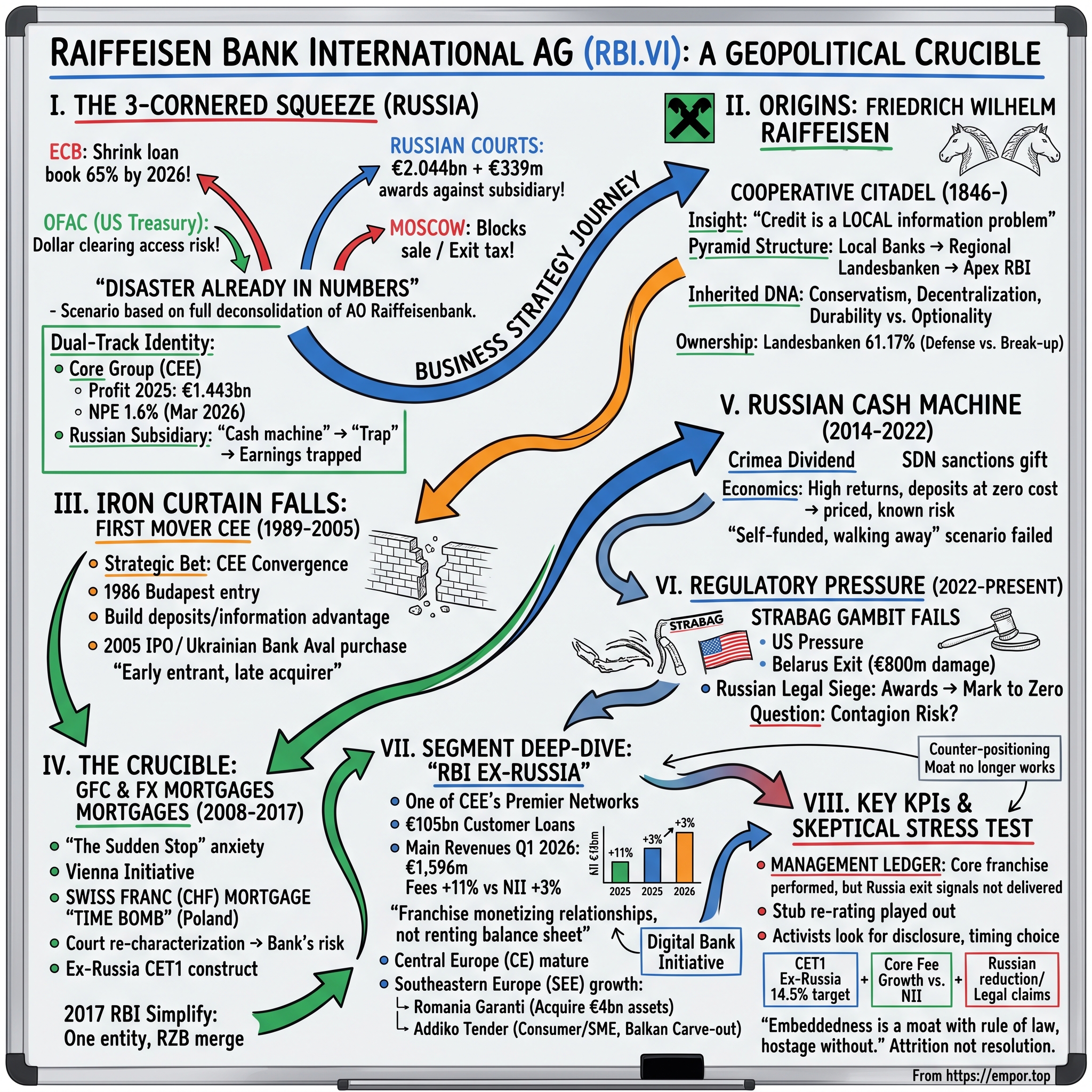
Here is the paradox that makes this company worth three hours of your attention. RBI's own capital disclosure has, since 2023, been built around a scenario that most investors would consider catastrophic. The headline solvency metric management steers to — the Common Equity Tier 1 ratio "excluding Russia" — is explicitly calculated on the assumption that the bank deconsolidates АО Райффайзенбанк, its Russian subsidiary, and loses the entire equity of that business in the process.3 That ratio stood at 15.5% at the end of 2025 and 14.9% at the end of the first quarter of 2026, after acquisition effects.24 In other words: the disaster is already in the numbers. Management has been running the company for three years as though Russia were worth zero.
That is either an extraordinary act of conservatism or an admission of what everyone already suspects. Probably both.
The three-cornered squeeze. RBI sits at the intersection of three authorities whose interests are mutually incompatible. The European Central Bank, its prudential supervisor, formally pressed the bank in 2024 to cut its Russian loan book by 65% by 2026 and to shrink its international payment volumes sharply.56 The US Treasury's Office of Foreign Assets Control put the bank on notice that continued high-volume Russian operations could jeopardise its access to dollar clearing — a threat that, for a bank whose entire value proposition to CEE corporates is cross-border settlement, would be closer to a death sentence than a fine.7 And Russian courts, meanwhile, have moved in precisely the opposite direction: awarding a sanctioned counterparty €2.044 billion plus interest against the Russian subsidiary in April 2025,8 then a further €339 million in December 2025.9 Moscow has also, according to reporting by Reuters, simply refused to let the bank sell — not because it distrusts RBI, but because it values it too much as one of the last working financial pipes between Russia and Europe.10
Comply with the ECB and you shrink the asset.
Comply with OFAC and you accelerate the shrinkage.
Try to exit and Moscow blocks the door while its courts help themselves to the furniture.
It is worth pausing on how unusual this is. European banks have faced sanctions exposure before, and several have paid enormous fines for violating them. What RBI faces is different in kind: it is not accused of wrongdoing. Its problem is that lawful presence in a market has become a liability, and that the three authorities with power over it want three incompatible things. There is no compliance department in the world that can optimise against that. The only variables management genuinely controls are the speed of shrinkage and the quality of what remains.
The dual-track identity. RBI reports, in effect, as two companies. The first — call it the core group — is a top-tier retail and commercial bank spanning Austria, the Czech Republic, Slovakia, Hungary, Romania, Serbia and a dozen smaller markets, with roughly 43,000 employees serving 17.9 million customers across more than 1,400 branches.1 In 2025 that core group earned a consolidated profit of €1.443 billion, up 48% year on year, on net interest income of €4.184 billion and fee income of €2.002 billion.2 Its non-performing exposure ratio finished the year at 1.7%, which management called a historic low, and fell further to 1.6% by March 2026.24 This is not a damaged franchise. It is, on the operating metrics, one of the better-performing bank networks in Europe.
The second company is the Russian subsidiary: once astonishingly profitable, now systematically starved. Its loan book has contracted by roughly 78% in ruble terms since February 2022, and customer deposits are down 41% over the same period.4 It still generates earnings. Those earnings cannot leave.
Why the two companies cannot simply be separated. The obvious question — why not spin it off, gift it away, hand the keys to the doorman and walk — has an answer that explains the entire last four years. A sale requires the approval of a Russian government commission, on terms that include a mandatory valuation discount and an exit tax. An abandonment risks the appointment of an external administrator and, more dangerously, criminal exposure for the Russian nationals who run the bank and who did nothing wrong. A deconsolidation without either requires the group's auditors to agree that control has genuinely been lost, which is a judgment nobody wants to make prematurely.
And underneath all of it sits the awkward fact that the Russian state does not want RBI to leave. That is not a negotiating position that responds to price.
Where this episode goes. We start in a German famine in the 1840s with a mayor who invented cooperative credit; move through the collapse of the Iron Curtain and the single most consequential strategic bet in modern Austrian finance; survive the global financial crisis and a Swiss franc mortgage disaster that is still generating provisions three decades after the loans were written; build the Russian cash machine and watch it become a trap; dissect the failed attempt to smuggle stranded capital out of Moscow inside an Austrian construction company; and finish with the two acquisitions RBI launched in 2026 — in Romania and in Austria itself — that tell you what management actually believes about its own future. Along the way, a leadership change: Johann Strobl, who ran the bank through the entire crisis, handed the chief executive's office to Michael Höllerer on July 1, 2026.11
To understand why a bank would behave this way — patient, cooperative, congenitally allergic to being taken over, and slow to cut losses — you have to start with a man who died in 1888.
 Subscribe on LinkedIn
II. Origins: Friedrich Wilhelm Raiffeisen & The Cooperative Citadel (0:15 - 0:35 / 20 min)
The winter of 1846–47 in the Westerwald, a poor upland region east of the Rhine, was one of the worst in living memory. The potato harvest had failed. Bread prices had tripled. In the village of Weyerbusch, the mayor — a former Prussian artillery officer named Friedrich Wilhelm Raiffeisen, invalided out of the army by an eye disease that would eventually leave him nearly blind — did something that local officials of the period generally did not do. He organised.
Raiffeisen bought flour on credit, built a communal bakery, and distributed bread to families who could not pay. Then he did the more radical thing: rather than repeat the charity the following year, he built an institution designed to make the charity unnecessary. His insight was that rural poverty in nineteenth-century Germany was not primarily a productivity problem. It was a credit problem. Farmers who needed a cow or seed corn borrowed from cattle dealers and village moneylenders at rates that guaranteed they would never get free. What they lacked was not effort but access to capital at a price that reflected their actual risk rather than their bargaining weakness.
His solution — the Genossenschaft, the cooperative credit union — rested on three principles that would echo for a century and a half. Membership was local, so that the people lending were the people who knew whether the borrower was reliable. Liability was joint and unlimited, so that members had every incentive to police each other. And profit was not the point: surpluses went back into the reserve, and the institution existed to serve its members rather than to extract from them. Selbsthilfe, Selbstverwaltung, Selbstverantwortung — self-help, self-administration, self-responsibility. It was, in effect, an early and highly effective solution to the information problems that make lending to the poor expensive: replace credit scoring with social proximity.
Raiffeisen himself was not a natural institution-builder. He was chronically ill, frequently broke, and by the 1860s his failing eyesight forced him to dictate his writing to his daughter Amalie. His 1866 book Die Darlehnskassen-Vereine — the loan-fund associations — was less a treatise than an operating manual, and it spread because it was practical rather than because it was profound. He also spent much of his later career in a doctrinal argument with Hermann Schulze-Delitzsch, whose competing urban cooperative model paid dividends to members and admitted people from outside the immediate district. Raiffeisen insisted on neither. The disagreement sounds antiquarian until you notice that it is the same argument European banking has been having ever since: is a bank an institution that serves a community, or a vehicle that distributes returns to owners? RBI's answer, embedded in its shareholder register, has never been fully settled.
The model spread. It crossed into Austria-Hungary, where it found extraordinarily fertile ground in a largely agrarian empire, and it organised itself into a shape that survives essentially intact today: a three-tier pyramid. At the base sit hundreds of independent local Raiffeisen banks, each legally its own cooperative, each owned by its members. In the middle sit eight regional institutions, the Raiffeisen-Landesbanken, one per Austrian federal state, which pool the liquidity of the local banks and provide the services no village institution could build alone. And at the apex sat the central institution — historically Raiffeisen Zentralbank Österreich, later merged into Raiffeisen Bank International — which acted as the group's liquidity clearing house, its treasury, and its window onto international capital markets.
The DNA this created. Three inherited traits matter for anyone analysing RBI today.
The first is a genuine conservatism about credit. The cooperative tradition is relationship-based and local, and RBI's modern loan-loss experience broadly reflects it — the group's risk costs in 2025 were €192 million, roughly €100 million lower than the prior year, against a loan book above €100 billion.2 That is a low number by any European standard. It is not an accident of the cycle; it is a house style.
The second is decentralisation. RBI's network subsidiaries are real banks with real local management, local brands and local deposit franchises, not branch offices of Vienna. That has been an operational strength in fragmented markets. It also means integration costs are real and synergies are harder to force than the M&A slides usually suggest.
The third — and this is where the heritage stops being charming and starts being an investment variable — is the ownership structure. The eight regional Landesbanken collectively control 61.17% of RBI's shares, leaving a free float of under 39%.1 They are bound by a shareholders' agreement. Raiffeisen-Holding Niederösterreich-Wien alone holds roughly a quarter of the company.
Think about what that means. RBI is a listed, ECB-supervised, systemically significant European bank whose controlling shareholder is a syndicate of regional agricultural cooperatives. No hostile acquirer can take this company. No activist can force a break-up. No proxy fight can change the board. The takeover premium that other European banks carry in their valuation simply does not exist here.
The flip side is that capital agility runs through a committee. When RBI needed to move fast during the Russian crisis — to raise equity, to accept a punitive exit, to restructure the group — it had to move at the speed of a shareholder base that is itself a federation. Michael Höllerer's appointment as chief executive is instructive on this point: he came to the job directly from running Raiffeisenlandesbank Niederösterreich-Wien, the largest of those regional owners, having previously served as RBI's chief financial officer.11 Whether you read that as continuity or as capture depends on your priors. What is not debatable is that the owners chose one of their own.
For an investor, the cooperative citadel is best understood as a permanent trade: durability in exchange for optionality. You are unlikely to lose this company to a bad takeover. You are also unlikely to be rescued by a good one.
That fortress mentality was about to meet the most open strategic opportunity of the twentieth century.
III. The Iron Curtain Falls: First Mover into CEE (1989–2005) (0:35 - 1:00 / 25 min)
In 1986, three years before anyone in Western Europe seriously believed the Warsaw Pact would dissolve, Raiffeisen Zentralbank opened a subsidiary in Budapest. It was a small, almost eccentric decision. Hungary was a communist state. Its banking system was a monobank apparatus. The commercial logic was thin to the point of invisibility.
Three years later the Berlin Wall came down, and that eccentric decision turned out to be the most valuable option in Austrian corporate history.
To appreciate why RZB moved when the world's largest banks did not, you have to understand what Vienna looked like on a map in 1989. Austria's capital sits closer to Prague, Bratislava and Budapest than it does to most of Germany. For four centuries under the Habsburgs, these were not foreign markets; they were the same market. Austrian firms had legal relationships, language skills, and family networks across a region that Cold War geography had arbitrarily walled off. When the wall came down, Vienna did not discover Central Europe. It reconnected with it.
Meanwhile, the global banking giants were looking elsewhere. Wall Street was consolidating domestically and building derivatives desks. The City of London was absorbing the Big Bang. The great European universal banks were focused on the single-market integration of Western Europe and, increasingly, on Asia. Post-communist Central Europe in 1990 looked to them like what it objectively was: a collection of small, poor, legally chaotic economies with no credit bureaus, no property registries worth the name, and currencies nobody wanted. A rounding error with substantial headline risk.
RZB saw something different, and the difference was one of framing. To a global bank, CEE was an emerging market allocation competing against Brazil and Indonesia. To an Austrian bank, it was the natural hinterland — the economic catchment area a Vienna-headquartered institution should serve, and a region that, if European integration meant anything, would eventually converge toward Western income levels. That convergence thesis was the whole bet. Buy banking market share cheaply in economies at 30% of German GDP per capita, and wait.
How they built it. The expansion mixed greenfield construction with opportunistic acquisition, market by market: Poland, Slovakia, the Czech Republic, Bulgaria, Croatia, Russia, Ukraine, Romania, Serbia, Bosnia, Albania, Kosovo, Belarus. The method was consistent — arrive early, register a local banking licence, start with corporate and trade finance for the Austrian and German multinationals already moving production east, then use that corporate foothold and the deposit base it generated to build out retail.
The sequencing mattered enormously and is worth dwelling on, because it is the mechanism behind RBI's durable position. Corporate banking in a newly opened economy is a relationship business with very few credible providers. If you are the bank that financed a German auto-parts supplier's first Slovak plant in 1993, you are still, plausibly, that company's bank in 2026 — and you are also the bank for its payroll accounts, which means you are the retail bank for several thousand Slovak households, which means you have cheap deposits, which means you can lend at a spread nobody arriving in 2005 can match. First-mover advantage in banking is not brand. It is accumulated deposits and accumulated credit information.
Russia, 1996. RZB opened АО Райффайзенбанк in Moscow in 1996, in the interval between the collapse of the Soviet Union and the ruble crisis of 1998. The positioning was specific and, for twenty-five years, brilliantly successful: be the safest Western bank in Russia. Not the biggest, not the most aggressive — the safest. Serve the European multinationals that needed to operate in Russia, the trade finance flows moving in both directions, and the affluent Russian retail and private-banking customer who wanted their money inside a Western-owned institution rather than a domestic one. The franchise was built on an implicit promise: we are a European bank, subject to European supervision, and your deposits here are safer than they would be anywhere else in this country.
Hold that thought. It becomes important in Section V.
The 2005 IPO. By the early 2000s the CEE network had become large enough to deserve its own capital structure. RZB carved the international operations into a separate holding company, Raiffeisen International Bank-Holding AG, and floated it on the Vienna Stock Exchange in April 2005 at an issue price of €32.50 — at the time the largest initial public offering in Austrian history.12
The timing was, in retrospect, close to perfect for the seller and merely adequate for the buyer. The mid-2000s were the absolute peak of the CEE convergence trade: EU accession in 2004 had just de-risked Poland, Hungary, Czechia, Slovakia and the Baltics in the eyes of global capital; credit was growing at 30%-plus annually across the region; and every Western European bank that had ignored the East in 1990 was now bidding aggressively for whatever assets remained.
Raiffeisen International spent the proceeds fast. In 2005 it acquired a 93.5% majority in Bank Aval, Ukraine's second-largest bank — the largest acquisition in the group's history at the time.13 In 2006 it bought eBanka in the Czech Republic. The roll-up logic was sound in isolation: scale in each market, cost synergies, and a bigger platform on which to sell the same products.
The Ukrainian purchase deserves a second look with the benefit of two decades, because it is the acquisition that most tests the convergence thesis. In 2005, Ukraine was the region's great remaining prize: forty-six million people, a large industrial base, and a banking system barely penetrated. The Orange Revolution the previous winter had produced a government that Western investors read as a decisive turn toward Europe. Buying the country's second-largest bank looked like buying Poland ten years early.
What followed instead was the 2008 credit collapse, the 2014 annexation of Crimea and war in the Donbas, a currency that lost most of its value, and then, in 2022, full-scale invasion. RBI still operates in Ukraine. Its people have kept branches open through blackouts and missile strikes, which is a genuinely remarkable operational achievement and one that rarely appears in valuation models. But as a capital allocation decision, Bank Aval is a reminder that convergence is a thesis about political trajectory dressed up as a thesis about GDP per capita. When the politics break, the economics follow, and no amount of underwriting quality protects you.
There is a broader pattern here worth naming, because it recurs. RBI has historically been an excellent early entrant and a mediocre late-cycle acquirer. The greenfield entries of 1989–1996 were made when assets were nearly free and competition was absent. The acquisitions of 2005–2012 were made when the convergence thesis was fully priced and every buyer in Europe was making the same argument. The first set created enormous value. The second set, as the next section shows, created a decade of provisions.
The convergence trade had one more year to run. Then the world's credit markets stopped.
IV. The Crucible: GFC, Foreign Currency Mortgages, & Reorganization (2008–2017) (1:00 - 1:20 / 20 min)
In the autumn of 2008, a specific anxiety gripped the offices of the International Monetary Fund and the European Bank for Reconstruction and Development. It had a name: the sudden stop.
The Central and Eastern European growth model of the previous decade had a structural dependency that nobody had stress-tested. The region's banking systems were overwhelmingly foreign-owned — Austrian, Italian, French, Belgian, Swedish parents holding the majority of banking assets in most CEE countries. Those parents had funded rapid local loan growth not from local deposits, which were insufficient, but from wholesale funding raised in Vienna, Milan and Paris and pushed east. When the global interbank market froze after Lehman Brothers, the mechanical response of every Western parent bank was to pull liquidity home to defend its own balance sheet.
If they all did it simultaneously, CEE would experience a coordinated credit stop of a magnitude that would make the 1998 Russian default look mild. It was a textbook collective action problem: rational for each bank individually, catastrophic for all of them together.
The answer was the Vienna Initiative, convened in January 2009 — a coordination mechanism assembling the IMF, the EBRD, the European Commission, the European Investment Bank, home and host regulators, and the major Western banking groups with CEE exposure. RBI, as one of the largest such groups, was central to it. The commitment was straightforward: parent banks pledged to maintain their exposure to CEE subsidiaries and to recapitalise them if needed, in exchange for coordinated official support and a guarantee that they would not be individually disadvantaged for staying.
It worked, more or less. It is also one of the more genuinely interesting episodes in the history of European financial policy, because it demonstrated something that the eurozone crisis would later obscure: that cross-border banking integration can be defended by coordination if the coordination happens fast enough. RBI's participation reflected an unromantic reality — its CEE network was the company. It had nowhere to retreat to.
That absence of a retreat option is worth sitting with, because it is a permanent feature of this business rather than a 2009 curiosity. UniCredit could pull back from CEE and remain an Italian bank. Société Générale could exit Russia and remain a French bank. KBC could retrench to Belgium. RBI cannot retrench to Austria in any meaningful sense, because the Austrian domestic retail market belongs to the cooperative Landesbanken who own it, not to the listed entity. Strip the East out of RBI and there is no there there. This has two consequences investors should hold permanently. First, RBI is a leveraged bet on the Central and Eastern European convergence thesis with no diversifying ballast, which cuts in both directions. Second, in any crisis, RBI's incentive is always to stay and repair rather than to exit and redeploy — which is exactly the behaviour observed in Ukraine, and arguably in Russia too.
The Swiss franc time bomb. But the crisis exposed a second problem that turned out to be far more expensive and far longer-lived, and it is the single best case study in this story of how a product that looks like a competitive advantage can be a decade-delayed liability.
Here is the mechanism, stripped of jargon. In the mid-2000s, a Polish or Hungarian household wanting a mortgage faced local-currency interest rates of 7–9%, because their central banks were still fighting inflation. Swiss franc interest rates were around 2%. So banks across the region — RBI among many others, this was an industry-wide practice — offered mortgages denominated in Swiss francs. The borrower earned zlotys and repaid in zlotys, but the loan principal was fixed in francs. Monthly payments fell by a third or more. Demand was overwhelming.
The catch is obvious in hindsight and was not exactly hidden at the time: the borrower had been sold a currency position they did not understand and could not hedge. If the zloty weakened against the franc, both the monthly payment and the outstanding principal would rise in local-currency terms. A Polish family could make every payment on time for a decade and owe more than they originally borrowed.
That is precisely what happened. The franc strengthened through the financial crisis as investors fled to safety, and then, on January 15, 2015, the Swiss National Bank abandoned its euro peg and the franc jumped roughly 20% in minutes. Across the region, the political and legal consequences followed. Hungary imposed a statutory conversion of foreign-currency mortgages into forint. Croatia did something similar. And Poland — the biggest exposure — chose the slowest and most expensive route: individual litigation, borrower by borrower, in the Polish courts, with rulings that increasingly voided the loan contracts altogether on consumer-protection grounds.
RBI's exposure came predominantly through Poland. It had acquired Polbank EFG, which merged into Raiffeisen Bank Polska at the end of 2012, precisely as the franc problem was maturing. When RBI eventually exited Polish retail banking — BNP Paribas agreed in April 2018 to acquire the core operations of Raiffeisen Bank Polska for PLN 3.25 billion — the transaction was explicitly structured to exclude the foreign-currency retail mortgage portfolio.14 BNP took the going concern. RBI kept the lawsuits.
That decision has cost real money for years. RBI booked €493 million of provisions for Polish mortgage loans in the third quarter of 2024 alone, forcing a downward revision of that year's return-on-equity guidance.15 The issue is live enough in 2026 that management's medium-term profitability target is defined as at least 13% return on equity excluding Russia and excluding Polish foreign-currency loan provisions and legal costs2 — an accounting construction that tells you exactly how large the drag still is. On the first-quarter 2026 earnings call, the chief financial officer described the strategy as approaching borrowers with settlement offers before they file suit, an attempt to buy certainty at a discount rather than litigate to exhaustion.16
The analytical lesson is not "banks make mistakes." It is more specific: a product whose economics depend on a macro variable the customer bears but does not understand will eventually be re-characterised by courts as the bank's risk. That re-characterisation can arrive twenty years after origination and ten years after you sold the business. Underwriting standards can be immaculate and the loss can still land, because the loss is legal rather than credit.
The corporate simplification. Amid this, RBI did the necessary but unglamorous work of restructuring itself. Raiffeisen International merged back into parent RZB in 2010, and in 2017 the two were combined in a reverse merger creating the single entity Raiffeisen Bank International AG. The driver was regulatory: under Basel III and direct ECB supervision, a two-tier structure with a listed subsidiary and an unlisted parent created capital that looked adequate at one level and thin at another, plus minority interests that could not be counted where they were needed. One entity, one capital base, one supervisor.
By 2017 RBI had a clean structure, a repaired balance sheet, a new chief executive in Johann Strobl, and a Russian subsidiary that was about to become the most profitable thing it owned.
V. The Russian Cash Machine & The Geopolitical Trap (2014–2022) (1:20 - 1:45 / 25 min)
There is a specific kind of business that looks like genius right up until the moment it looks like negligence, and the distinguishing feature is usually that nothing about the business changed — only the world around it.
The story of AO Raiffeisenbank between 2014 and 2022 is the cleanest example in modern European banking.
The Crimea dividend. When Russia annexed Crimea in 2014, the West's response included sectoral sanctions that restricted the ability of Russia's large state-owned banks — Сбербанк Sberbank, Банк ВТБ VTB Bank and others — to raise long-term funding in Western capital markets. The intent was to squeeze the Russian financial system. One of the unintended effects was to hand a competitive gift to the Western-owned banks still operating inside Russia.
Consider the position of a large Russian corporate, or a European multinational with Russian operations, in 2015. You need dollar and euro trade finance. Your traditional state-bank relationship has just become complicated. Sitting there, fully licensed, fully capitalised, and entirely un-sanctioned, is a subsidiary of an Austrian bank that has been operating in Moscow since 1996 with a reputation for not doing anything stupid. Where does your business go?
The economics that followed were extraordinary. Under Strobl, who became chief executive in 2017, the Russian subsidiary became a machine: it took deposits in rubles at close to zero cost from customers who wanted safety, ran a conservative loan book with minimal credit losses, earned enormous spreads in a high-nominal-rate environment, and generated fee income from being the most reliable payment provider in the country. Returns on equity ran well above what any Western European retail bank could dream of, and in strong quarters Russia contributed a substantial share of group profit.
And here is where the analytical honesty matters. RBI's management did not stumble into this. They understood that a large fraction of group earnings was coming from a jurisdiction with an authoritarian government, arbitrary courts, and an active territorial conflict with a neighbour where RBI also owned a bank. This was a known, priced, deliberately-held risk. The bank's reasoning — and it was not unreasonable at the time — was that the Russian business was self-funded in local currency, held conservative assets, and could in a worst case simply be walked away from with a write-off of its equity.
What nobody modelled was the actual outcome: that you would not be allowed to walk away.
February 2022. When Russia launched its full-scale invasion of Ukraine, the sanctions architecture that followed was orders of magnitude beyond 2014. Major Russian banks were removed from SWIFT and added to the US Specially Designated Nationals list. The Russian central bank's foreign reserves were frozen. Western corporates announced exits by the dozen.
And a bitter irony emerged. Precisely because AO Raiffeisenbank was un-sanctioned, Western-owned, and still connected to the international correspondent banking system, it became — by process of elimination — one of the last functioning conduits for legitimate cross-border payments between Russia and the rest of the world. Salaries for the remaining Western employees in Russia, payments for pharmaceuticals and food, settlement for energy flows that sanctions had deliberately exempted: a very large share of it ran through one Austrian-owned bank in Moscow.
This gave RBI the worst possible form of strategic importance. It was too useful to Russia to be released and too exposed to the West to be comfortable. Reuters reporting in 2025 made the mechanism explicit: Russian authorities have blocked sale attempts partly because they fear a locally-owned successor would immediately be sanctioned, and partly because they want to preserve the pipe — including payment processing for gas delivered through TurkStream, Moscow's remaining route into the European Union.10
There is a further irony inside the irony. The 1996 promise that built the Russian franchise — your money is safer with a European bank — turned out to be exactly correct for depositors and exactly backwards for shareholders. Russian customers who kept savings at AO Raiffeisenbank were never expropriated. The bank kept paying, kept clearing, kept operating. It was the Austrian owners whose property rights evaporated. The safety was real; it just accrued to the wrong party. Any investor evaluating a Western financial franchise in an authoritarian jurisdiction should note the asymmetry: the local operating licence is protected precisely because the host state values the service, and the equity is trapped for precisely the same reason.
The lock closes. The legal machinery of the trap assembled quickly. Russian presidential decrees required approval from a government commission for any sale of a Western-owned bank or business, and the terms that emerged in practice were punitive: mandatory discounts to valuation plus an exit tax paid to the Russian budget. Dividends could not be transferred out. Capital could not be repatriated.
The consequence for financial reporting was that RBI had to invent a parallel accounting universe. From 2022 onward the bank has reported two versions of itself: the consolidated group as IFRS requires, and a "core group" excluding Russia — and later excluding Belarus — that represents the business shareholders can actually access. By 2026 the core-group presentation is the primary one in RBI's own communications. The Russian numbers are disclosed but functionally quarantined.
Investors should be clear-eyed about what that reporting split does and does not tell you. It is genuinely useful: it isolates the earnings power and capital position of the part of the bank that can pay dividends. It is also, unavoidably, a form of management framing — it invites you to value a business that legally does not yet exist as a separate entity, and it moves attention away from the consolidated balance sheet where the Russian assets still sit. Both things are true simultaneously.
The bank was now running an operation it could not sell, could not fund, could not extract cash from, and could not close. It needed to find a way out that did not require moving a single euro across the Russian border.
Someone in Vienna thought they had found one.
VI. The Regulatory Pressure Cooker & The Strabag Gambit (2022–Present) (1:45 - 2:10 / 25 min)
The idea was, on paper, elegant. That is usually the warning sign.
The engineering. RBI's Russian subsidiary was sitting on a very large pile of rubles it could not convert or send home. Meanwhile, a 24.1% stake in Strabag SE — the Austrian construction group, listed in Vienna, one of Europe's largest builders — was held by Rasperia Trading Limited, an entity historically linked to the sanctioned Russian industrialist Олег Дерипаска Oleg Deripaska.
The plan: AO Raiffeisenbank would buy the Strabag stake from Rasperia using rubles inside Russia. It would then distribute those Strabag shares to its Vienna parent as a dividend in kind. No cash would cross the border. No ruble would need converting. RBI would end up holding a valuable Austrian equity stake in Vienna, funded by capital that had been stranded in Moscow. In one motion, roughly €1.5 billion of trapped value would materialise on the right side of the border.
The collapse. The problem was not the Austrian regulator or the mechanics. It was that the counterparty's ultimate economic connection ran back toward a sanctioned individual, and the United States Treasury does not care very much whether a structure is technically compliant if it delivers value to sanctioned interests. Through early 2024, US scrutiny of RBI intensified sharply, with OFAC engaging directly on the bank's Russian operations.7 In May 2024, under explicit pressure from Washington and facing the risk of secondary sanctions, RBI abandoned the transaction.171819
That episode deserves a moment of analysis rather than narration, because it settled a question that had been genuinely open in European banking. RBI's management had structured a deal that plausibly complied with the letter of EU sanctions law. It was killed anyway, by a regulator with no formal jurisdiction over an Austrian bank's Russian subsidiary — but with total control over access to dollar clearing. The lesson, which applies far beyond this company: for any bank operating internationally, US sanctions policy is not one legal constraint among several. It is the binding one, and it operates on the basis of perceived intent rather than technical compliance.
The ECB tightens simultaneously. In parallel, RBI's prudential supervisor moved. In April 2024 the bank disclosed that the ECB had asked it to reduce its Russian loan book by 65% by 2026 relative to the 2023 level, alongside sharp reductions in international payment volumes.56 The ECB's concern was not political; it was prudential and reputational. A supervised European bank running a large operation in a jurisdiction that had demonstrated willingness to expropriate foreign assets represented a risk the supervisor did not want on its books.
Judged purely on execution, RBI has delivered on the shrinkage. The Russian loan book was down roughly 60% from the start of the war by the end of 2025, and by the first quarter of 2026 the reduction reached about 78% in ruble terms, with deposits down 41% from February 2022.24 Management framed this on the Q1 2026 call as continued progress, while noting flatly that "all the restrictions which have been introduced to Russia will remain in place for the foreseeable future" — a considerably more resigned formulation than the exit optimism of 2023.16
RBI did successfully exit one jurisdiction. It sold its 87.74% stake in Belarus's Priorbank to UAE-based Soven 1 Holding, closing on November 29, 2024, at an estimated cost of roughly €300 million to consolidated profit from the gap between price and book value, plus a further €500 million from the reclassification of historical foreign-exchange losses.20 Note the price of freedom: roughly €800 million of accounting damage to escape a market a fraction of the size of Russia. That is the template investors should hold in mind for any eventual Russian resolution.
The counter-attack. Meanwhile Russia's legal system went to work. In September 2024 a Russian court froze RBI's shares in its own subsidiary — a straightforward mechanism to prevent any sale. Then came Rasperia. Having lost the Strabag transaction, Rasperia sued, and in 2024 a Russian court awarded damages of over €2 billion against AO Raiffeisenbank. RBI booked an €840 million provision in the fourth quarter of 2024, reflecting the award net of expected recovery from enforcing claims against Rasperia's assets in Austria. On April 24, 2025, a Russian appeal court confirmed the first-instance verdict: €2.044 billion plus interest.8
Then it happened again. On December 18, 2025, the Arbitration Court of the Kaliningrad Region ruled against Strabag, its Austrian shareholders and AO Raiffeisenbank in a second Rasperia suit, awarding a further €339 million — covering, in the court's framing, compensation Rasperia allegedly failed to receive from a 2024 reduction in Strabag's authorised capital, unpaid 2024 dividends, and accrued interest. AO Raiffeisenbank booked the full €339 million as a provision in the fourth quarter of 2025.9
RBI's response to that second verdict is the most revealing disclosure the company has made in years. It stated that the ruling had "no impact on the financial results of RBI Group excluding Russia, and no impact on the P/B zero CET1 ratio."9 Read that carefully. Management is telling investors: this does not matter to you, because we already assume the Russian subsidiary is worth nothing. Every euro a Russian court extracts from AO Raiffeisenbank is a euro subtracted from a number the core group has already written down to zero.
That is intellectually coherent. It is also an admission that the Russian business has ceased to be an asset with recoverable value and has become, for reporting purposes, a contained liability of unknown duration. The residual risk is not the write-off — it is contagion: the possibility that a Russian court or authority reaches beyond the subsidiary to the parent, or that Western regulators impose penalties at group level. On this, RBI's own behaviour is telling. The group has a claim against Rasperia in Austria valued at approximately €2.4 billion, and as of the May 2026 earnings call it still had not been filed, with management saying it was exploring approaches that would "limit the risk of retaliation."16 A bank that holds a €2.4 billion claim and declines to press it is a bank that believes the counterparty can hurt it back.
The accounting judgment investors should scrutinise. One technical point deserves flagging, because it sits at the heart of everything above and is a judgment rather than a fact. Under IFRS, an entity consolidates a subsidiary when it controls it — meaning it has power over the relevant activities, exposure to variable returns, and the ability to use that power to affect those returns. RBI continues to consolidate AO Raiffeisenbank. It also runs its primary capital disclosure on the assumption that the subsidiary will one day be deconsolidated with a total loss of equity.
Those two positions are reconcilable — control today, expected loss tomorrow — but they mean the accounting outcome hinges on the date at which control is judged to have been lost, and that date is a matter of judgment informed by facts that are moving. A Russian court freezing the shares, a government commission refusing every sale, an appointed external administrator: each pushes toward the argument that control has already gone. When and if deconsolidation is recognised, the consolidated income statement takes a large one-off hit including the recycling of accumulated foreign-exchange translation reserves — the same mechanism that produced roughly €500 million of the Belarus exit cost, on a far smaller business.20 The ex-Russia capital ratios are designed to make that event a non-event for solvency. They do not make it a non-event for reported earnings or headline book value, and investors should expect the gap between the two presentations to be genuinely confusing on the day it happens.
Which raises the question the market is now trying to price: if Russia is a zero and the discount has closed, what is actually left?
VII. Segment Deep-Dive: Dissecting "RBI Ex-Russia" & Core CEE Economics (2:10 - 2:30 / 20 min)
Strip out Moscow entirely and what remains is not a rump. It is one of the two or three most significant banking networks in Central and Eastern Europe, and by 2026 it is behaving like a consolidator rather than a survivor.
The core group carried roughly €105 billion of customer loans at the end of the first quarter of 2026, up 3% in three months, funded by a deposit base built over three decades of local presence.4 The group as a whole reported €210.3 billion of total assets at the end of 2025.21 The operating engine produced main revenues of €1,596 million in the first quarter of 2026, up 5% year on year, split between net interest income of €1,076 million and net fee and commission income of €520 million — with the fee line growing 11%, three times the pace of net interest income.4
That divergence is the most important operating detail in the quarter, and it is worth explaining rather than merely reporting. Net interest income is what a bank earns on the spread between lending and funding; it rises when central bank rates rise and compresses when they fall. Fee income comes from payments, cards, asset management, insurance distribution and transaction banking — it is largely rate-independent and, in a rate-cutting cycle, it is the thing that determines whether earnings hold. RBI's fee income growing at 11% while spread income grows at 3% tells you the franchise is monetising customer relationships rather than merely renting out the balance sheet. For a bank facing eventual rate normalisation across CEE, that mix shift is the difference between a structural business and a cyclical one.
Where the money is made. RBI's core operations divide, broadly, into three blocks.
Central Europe — the Czech Republic, Slovakia and Hungary — is the mature end. These are high-income, highly digitalised markets with excellent credit quality and correspondingly compressed margins. Competition is serious: Erste Group, KBC, and strong domestic players contest every segment. RBI's 2021 acquisition of Equa bank in Czechia was a scale play in exactly this logic — in a market where technology and compliance costs are largely fixed, sub-scale banks earn their cost of capital and nothing more.
Hungary deserves a specific flag, because it is where political risk lives inside the core group. Successive Hungarian governments have used sector-specific bank levies and windfall taxes as fiscal instruments with little warning. Any model of RBI's Hungarian earnings should carry a permanent haircut for this. Management pointed to higher banking levies as one of two reasons core-group consolidated profit fell 19.6% year on year in the first quarter of 2026, to €209 million.4
Southeastern Europe — Romania, Serbia, Bosnia, Albania, Kosovo, Croatia — is the growth end. Lower banking penetration, higher structural margins, faster nominal GDP growth, and a convergence story that still has road left. Romania is the centrepiece. RBI's Romanian operations held €17.5 billion of assets and served 2.3 million customers at the end of 2025.22
And in 2026, RBI decided to double down there. On March 28, 2026, it agreed to acquire 100% of Garanti Bank S.A. and its leasing arm Motoractive IFN — the Romanian operations of Garanti BBVA — for €591 million.22 The target brings about €4 billion of assets and roughly 2% market share, and on completion, expected in the fourth quarter of 2026, would make Raiffeisen Bank S.A. Romania's third-largest bank by assets. The cost is about 60 basis points of CET1.
Then, six weeks later, RBI launched a second and stranger deal: a voluntary public tender offer for Addiko Bank AG, published on May 14, 2026, at €26.50 per share, valuing the Vienna-listed, Southeastern-Europe-focused consumer and SME lender at roughly €517 million.23 The offer was raised in May amid a competitive bidding situation involving Slovenia's NLB,24 Addiko's board came out in support, and by July 24, 2026, acceptances reached 55.58% of shares subject to the offer, clearing the minimum threshold of more than 55%; the offer period was scheduled to close on July 29, 2026.2523 RBI has indicated it intends to sell Addiko's Serbian, Bosnian and Montenegrin subsidiaries to Alta Pay, linked to Serbian businessman Davor Macura — a carve-out that management said would reduce the deal's initial capital cost of roughly 45 basis points of CET1 to around 10 basis points.1626
Group functions and the Vienna head office handle corporate and investment banking for CEE blue chips, cross-border treasury, trade finance and debt capital markets — the legacy business that made RZB relevant to Austrian and German exporters in the first place, and the reason dollar clearing access is existential rather than merely convenient.
The digital question. Alongside the branch networks, RBI has pursued a digital-only proposition aimed at consumer lending in markets where it lacks branch density — the logic being that unsecured consumer credit is the highest-margin retail product and the one least dependent on physical presence. This is the right strategic instinct and the hardest thing in European retail banking to execute. The reason is unglamorous: a digital bank without a primary current-account relationship acquires customers through price and comparison sites, which selects for the least loyal and most rate-sensitive borrowers, and it must fund itself with term deposits gathered the same way. That combination produces thin, cyclical margins unless the bank can convert those customers into full relationships. RBI has not disclosed segment-level economics for this business at a level that would let an outside investor judge whether the conversion is happening. Until it does, treat the digital initiative as an option rather than an earnings contributor, and note that management's own framing of growth on the 2026 calls leaned on acquisitions and core-market loan growth rather than on digital scaling.16
A note on funding and ratings. One second-layer item worth tracking rather than assuming: RBI's cost of wholesale funding, and the rating agencies' treatment of the Russian overhang. A bank's senior unsecured spread is the market's continuous, unfiltered vote on its risk — considerably more honest than an equity price, because bondholders care only about survival. A tightening of RBI's spreads relative to Erste Group's would be independent confirmation that the credit market, not just the equity market, has accepted the ex-Russia construct. A widening around any new Russian legal development would tell you the containment thesis is being questioned by the people with the most to lose.
What the acquisitions actually signal. Two deals in two months, deploying north of €1.1 billion of headline consideration and roughly 70 basis points of core capital, at a moment when the Russian position remains unresolved. There are two readings and investors should hold both.
The charitable reading: management has concluded that CEE banking consolidation is happening now, that scale in Romania and the Balkans is available at prices below where these franchises will trade in five years, and that waiting for Russian clarity means missing the window. The core group is generating capital — CET1 excluding Russia was 14.9% in March 2026 against a medium-term target of 14.5% — so the capital is genuinely surplus.416
The sceptical reading: a management team that has been unable to solve its central strategic problem for four years is buying growth in adjacent markets, and the capital being deployed is capital that could instead have funded buybacks at a valuation that was, until quite recently, deeply depressed. RBI guided that its CET1 ratio excluding Russia would dip to about 14.3% at the end of 2026 before rebuilding to 14.5% in 2027.16 That is thinner than the 15.5% the bank carried at the end of 2025 — a genuine, if modest, reduction in the buffer that has been the entire investment case.
The honest answer is that this is a judgement call about which reasonable people will disagree, and it will be resolved by execution: whether Garanti Romania and the retained Addiko operations deliver the cost synergies management implies, and whether the Serbian carve-out closes on the stated terms. Those are the things to watch, not the press-release rationale.
VIII. Business & Investing Playbook: Strategy, Moats, & Lessons (2:30 - 2:45 / 15 min)
Strip away the geopolitics and ask the flat question: does RBI's core business have a durable advantage, or is it simply a well-run bank in growing markets? The two are very different investments.
Scale economies, but locally. Hamilton Helmer's first power is the cleanest fit here, with an important qualification. Banking has enormous fixed costs that have nothing to do with size of customer base: core banking systems, mobile apps, anti-money-laundering infrastructure, regulatory reporting under EU rules that apply identically to a €4 billion bank and a €40 billion one. Compliance cost inflation since 2015 has been the single largest force pushing European banking consolidation.
But — and this is where naive scale arguments about banking fail — the scale that matters is per market, not group-wide. Being the fourth-largest bank in eight countries is worth far less than being the second-largest in four, because deposit pricing power, brand recall and branch density are all local phenomena. This is precisely the logic behind the Romanian and Addiko transactions: they are not diversification, they are density.
Switching costs, which are real and under-appreciated. The stickiest thing a bank owns is a primary current account — the one that receives the salary and pays the utilities. Moving it is a genuine hassle, and the behavioural evidence across European retail banking is that customers change banks less often than they change spouses. On the corporate side the lock-in is stronger still: a company whose treasury management, FX hedging, payroll and trade finance all sit with one bank faces real operational cost to move. This is the mechanism that produces RBI's cheap deposits, and cheap deposits are the entire reason a bank earns a spread. It is a real moat. It is also a slowly eroding one, as digital-first challengers pick off the profitable, transaction-heavy customer segments without carrying branch costs — a risk RBI has responded to with its own digital bank initiatives, but which is unlikely to reverse.
Counter-positioning that no longer works. From 2014 to 2022 RBI enjoyed something close to a Helmer-style counter-positioned advantage in Russia: a Western-owned, un-sanctioned bank in a market where the incumbents were constrained and no new Western entrant would arrive. Competitors could not copy the position because they had not been there since 1996. This produced extraordinary returns — and then the same uniqueness that made it lucrative made it inescapable. The advantage and the trap were the same fact.
Branding power, of a specific and limited kind. The Raiffeisen gable-cross logo — two stylised horse heads, drawn from a Germanic folk custom of mounting carved horse heads on rooftops to ward off harm — is one of the most recognised financial marks in Central Europe. In markets where banking trust was destroyed twice within living memory, first by communist expropriation and then by 1990s hyperinflation and bank failures, a mark that signals Western, old, and still standing has genuine economic value in deposit gathering.
But brand power in banking is asymmetric and worth being precise about. It helps enormously on the liability side — people will accept a lower deposit rate at a bank they trust — and almost not at all on the asset side, because nobody has ever paid a premium interest rate for the privilege of borrowing from a prestigious lender. The value of the Raiffeisen name is therefore a funding-cost advantage, not a pricing advantage. That is a real but bounded moat, and it is precisely the moat that digital challengers attack when they offer higher deposit rates to customers who have decided that deposit insurance makes brand irrelevant.
Process power in credit. The 1.6% non-performing exposure ratio across a €105 billion loan book spanning a dozen legally distinct emerging-market jurisdictions is not luck.4 Underwriting discipline built over thirty years of local presence — knowing which Romanian developers pay and which Hungarian sectors turn first — is genuinely hard to replicate quickly. It is also the advantage most likely to be tested if CEE growth stalls, and it should be re-examined every cycle rather than assumed.
Governance as anti-power. The 61.17% cooperative control block is a defence, not an advantage. It removes takeover risk. It also removes the discipline that takeover risk imposes, insulates management from shareholder pressure, and means a minority investor's influence over capital allocation is effectively nil. Price it as what it is: reduced downside volatility purchased with permanently reduced governance leverage.
Porter's five forces, briefly. Regulators are not one of Porter's forces but function as the dominant one here — the ECB dictates capital, dividends and business reductions; OFAC controls dollar access; local authorities levy sector taxes at will. Rivalry is high: Erste Group, UniCredit, OTP Bank, KBC, Intesa Sanpaolo and strong domestic champions like Banca Transilvania contest every CEE market, and consolidation is intensifying it in the short run. New entrants face high barriers in traditional banking — capital requirements, licensing, branch and deposit scale — but low ones in payments and consumer credit, where fintechs attack the highest-margin slices. Supplier power, meaning depositors, rises whenever rates rise and customers start shopping for yield. Buyer power is highest in mortgages, which are near-commoditised, and lowest in transaction banking, which is where RBI's fee growth is coming from.
How RBI stacks up against the field. The useful comparison set is narrow. Erste Group is the closest analogue — Austrian-headquartered, CEE-focused, similar markets, no Russian exposure — and for most of the post-2022 period it traded at a materially higher multiple of book precisely because it lacked RBI's problem. That spread was the entire arbitrage. As RBI's shares re-rated through 2025 and into 2026, the spread compressed, which means the easy relative-value argument is gone and any remaining case has to rest on RBI's own operating trajectory rather than on convergence toward a peer. OTP Bank is the aggressive regional consolidator with a Hungarian home base and its own political entanglements; UniCredit and Intesa Sanpaolo bring Italian parent balance sheets and less regional focus; KBC is the disciplined, high-return bancassurance operator that most investors treat as the quality benchmark for the region. Against that field, RBI's distinguishing features are breadth of country footprint, a demonstrated willingness to buy, and a legal overhang nobody else carries.
The KPIs that actually matter. Three, and only three.
First, the CET1 ratio excluding Russia. This is the master variable, because it already embeds full loss of the Russian subsidiary and therefore measures the solvency of the business shareholders can access. It is what pays dividends and funds acquisitions. Management targets 14.5% medium-term and has guided to roughly 14.3% at the end of 2026 on acquisition effects.16 Watch whether it rebuilds on schedule.
A practical note on reading it: because this ratio nets out the Russian subsidiary entirely, it will move on things that have nothing to do with Russia — acquisition closings, risk-weighted asset growth from lending, regulatory model changes. Do not confuse a decline caused by buying a Romanian bank with a decline caused by deterioration.
Second, core-group fee income growth against net interest income. This is the cleanest read on whether the CEE franchise is a structural business or a rate trade. Fees at 11% versus spread income at 3% in the first quarter of 2026 is the pattern to monitor; if fee growth converges down toward NII growth as rates fall, the profitability targets get harder.4
Third, the pace of Russian asset reduction and the direction of Russian legal claims. Not because the assets have value — they are marked at zero for capital purposes — but because reduction pace determines regulatory standing with the ECB and OFAC, and new claims measure whether the contained liability is staying contained.
Everything else — cost-to-income, return on equity, loan growth — is downstream of these three.
IX. The Activist & Skeptical Investor Stress Test: Bull vs. Bear Case (2:45 - 3:00 / 15 min)
Imagine a well-prepared sceptic on the earnings call. What do they actually ask?
The management credibility ledger. Johann Strobl ran RBI from 2017 until handing over to Michael Höllerer on July 1, 2026.11 The record is genuinely mixed, and pretending otherwise in either direction would be dishonest.
On the credit side of the ledger: the core franchise has performed. Core-group profit of €1.443 billion in 2025 was up 48% year on year, credit quality reached record lows, cost discipline held, and the bank raised its dividend 45% to €1.60 per share, approved at the April 9, 2026 annual general meeting and paid on April 17.227 The Belarus exit was executed and closed.20 The capital position was rebuilt to a level that permitted two acquisitions. And the decision to publish a capital ratio that assumes total loss of the Russian subsidiary was, whatever its framing effects, an unusually candid disclosure choice for a European bank.
On the debit side: management repeatedly signalled a Russian exit that has not happened. Strobl personally travelled to Moscow to pursue a sale; deals were explored and failed; Russian authorities blocked a transaction with a local buyer as recently as late 2025.10 The Strabag structure was pursued far enough to become a public embarrassment before being abandoned under American pressure.1718 A sceptic would argue that senior management underestimated, for at least two years, how completely the exit decision had passed out of their hands — and that shareholder communication reflected hope rather than probability during that period.
The fairest reading is that this was a problem with no good solutions, and that management's real error was one of framing rather than action: presenting as a timing question something that was always a sovereign-consent question. That distinction matters for how you weigh future guidance from the same team, and there is now a new chief executive and, since January 1, 2026, a new chief financial officer in Kamila Makhmudová, a two-decade RBI veteran who came up through the group's M&A and corporate development functions.28 The M&A background is not incidental given what the bank did in the following three months.
The bear case. Four distinct threads, in rough order of severity.
Contagion beyond the subsidiary. The base case — Russia written to zero — is priced. The tail risk is that Russian legal action reaches the parent, or that a Western enforcement action produces a group-level penalty. RBI's own unwillingness to file its €2.4 billion Austrian claim against Rasperia for fear of retaliation is evidence that this risk is real rather than theoretical.16
Valuation has done the work. This is the argument the bulls of 2023 should now be most uncomfortable with. At €56.30, up 127.75% in a year, RBI is no longer a deep-value situation.1 With a market capitalisation near €18.5 billion against €19.5 billion of attributable equity — and with the ex-Russia capital construct implying that the accessible business is smaller than stated group equity — the stock is arguably at or above book value on the numbers that matter. The re-rating thesis has largely played out. What remains must be earned through operating performance, and management's own 2026 guidance points to a return on equity of about 10.5%, below the medium-term target of at least 13% and below what a bank trading at book value needs to justify that multiple.216
Poland, forever. The foreign-currency mortgage overhang has now been provisioned across many years and is still large enough that management excludes it from its own profitability target. Settlement strategies may accelerate closure, but they also crystallise cost.
Political and macro exposure in the core. Hungarian bank levies, Romanian fiscal pressure, and a rate-cutting cycle across CEE all compress the earnings the bull case depends on. Management explicitly attributed the first-quarter 2026 profit decline to higher levies and to risk costs rising €56 million on macro effects from the Iran conflict — a reminder that geopolitical risk for this bank is not confined to Russia.4
The bull case. Also four threads.
The core franchise is genuinely good. Fee income compounding at double digits, an NPE ratio at 1.6%, loan growth guided at about 7% for 2026, and a demonstrated ability to consolidate its markets. Guidance for 2026 sits at roughly €4.4 billion of net interest income and €2.1 billion of fee income, with a cost-to-income ratio around 52.5%.216 Those are respectable numbers for a European bank and superior to most Western European retail peers on growth.
Optionality is now free. Because the Russian business is marked at zero in the capital construct, any resolution that produces recovery above zero — a permitted sale, a negotiated settlement, an eventual geopolitical thaw — is upside that nobody is paying for. This is the most attractive structural feature of the situation and the one least dependent on management skill.
Consolidation runway. Southeastern European banking remains fragmented. If the Garanti Romania and Addiko transactions execute as described, RBI will have demonstrated it can be a disciplined regional consolidator, which is a repeatable capability rather than a one-off.
Capital return is now credible. A dividend of €1.60 for 2025, up 45%, with a 40% payout ratio confirmed for 2026 implying roughly €1.80 per share on management's own numbers.216 After years of suspended and constrained distributions, this is a bank returning capital again.
What an activist would actually attack. Since no activist can win a proxy fight against a 61.17% control block, the realistic pressure points are disclosure and capital discipline, argued in public. Three would be the obvious targets.
The first is the opacity of the Russian position itself. RBI discloses a capital ratio that assumes total loss, which is conservative, but it discloses considerably less about the path: what the subsidiary's residual equity actually is, what the range of outcomes on the outstanding Russian judgments looks like, what conditions would have to hold for a permitted sale, and what the group's contingency plan is if a Russian authority moves against the parent's remaining interests. Investors are being asked to trust a containment narrative with limited visibility into the container.
The second is the timing of the 2026 acquisitions. Deploying capital into two deals within eight weeks, immediately after a share price that more than doubled, is a defensible strategic call and a questionable sequencing one. A sceptic would note that the same capital could have been returned when the shares traded near the 52-week low of €24.34, and that management chose to buy other banks at market prices instead of buying its own at a discount.1 Management's counter — that the consolidation window in Romania and the Balkans was open and would close — is plausible, but it is an assertion about timing, and assertions about timing are exactly what this management team's record on Russia gives a sceptic licence to discount.
The third is the Addiko carve-out structure. Acquiring a Vienna-listed bank and simultaneously arranging to sell three of its Balkan subsidiaries to a buyer linked to a single regional businessman is the kind of arrangement that invites questions about valuation, process and counterparty diligence — particularly for a bank whose recent history includes a transaction abandoned over the identity of the party on the other side. The right posture is not suspicion; it is insistence on disclosure of the carve-out terms when the deal completes.
What would falsify each case. For the bulls: a CET1 ratio excluding Russia that fails to rebuild toward 14.5% in 2027, fee income growth converging toward zero, or any legal claim that pierces the parent. For the bears: closure of the Romanian and Addiko deals on stated terms with visible synergy delivery, plus any meaningful step toward a permitted Russian sale. Those are observable events, not opinions, and they are the right things to watch.
X. Epilogue & Lessons for Long-Term Investors (3:00 - 3:05 / 5 min)
There is a symmetry to this story that is almost too neat. Friedrich Wilhelm Raiffeisen built an institution around the principle that credit should be local, that lenders should know their borrowers, and that the risk you can see is the risk you can manage. A hundred and eighty years later, his name sits on a bank whose central problem is that it holds an asset it cannot see into, cannot manage, and cannot sell — subject to courts whose reasoning it cannot predict and regulators on two continents whose demands are mutually exclusive.
The cooperative movement's answer to information asymmetry was proximity. The modern group's greatest vulnerability is a jurisdiction where proximity bought it nothing at all.
It is tempting to read this as a story about one bad decision — the choice to stay in Russia too long. That reading is too easy, and it flatters the reader. RBI did not make one bad decision. It made a coherent thirty-year strategy that produced enormous value, and the single feature that made the strategy work in Prague, Bratislava, Bucharest and Belgrade is the same feature that made it catastrophic in Moscow: showing up early, staying through the difficult years, and building a business too embedded to be easily replaced.
Embeddedness is a moat when the host state is bound by the rule of law and a hostage situation when it is not. The strategy did not change. The jurisdiction did.
Four things are worth carrying away.
The first is about the shape of geopolitical risk. It does not usually arrive as a slow deterioration in returns. It arrives as a step function that converts a high-margin asset into an inextricable liability, overnight, while the operating business underneath continues performing perfectly well. AO Raiffeisenbank's fundamentals in March 2022 were not meaningfully worse than in January 2022. Its value to shareholders had gone to approximately zero anyway. When a business earns extraordinary returns in a jurisdiction with weak property rights, the correct question is never "how good are the returns" but "under what circumstances can I stop"?
The second is about regulatory hierarchy. RBI's abandoned Strabag structure was, as far as anyone has publicly demonstrated, legal. It was killed by an authority that had no jurisdiction over the transaction and total leverage over the bank's future. Any institution that clears dollars operates, functionally, under US supervision regardless of where it is headquartered. That is a fact about the architecture of global finance, not a fact about this company.
The third is about ownership structure, and it is the quietest of the four. RBI's cooperative control block has been the subject of governance complaints for two decades. It also meant that during the most dangerous stretch of 2022 and 2023 — when the equity traded at a fraction of book and any listed peer would have been a takeover candidate or a break-up target — nobody could force this company to do anything at a bad price. Control structures that look like a discount in normal times can be worth something in genuinely abnormal ones. That is not an argument for concentrated ownership generally. It is an argument for pricing it as a two-sided variable rather than a one-sided penalty.
The fourth is about stub-value investing, and it is the least comfortable. The classic version of this trade — buy the conglomerate at a discount because one segment is toxic, wait for separation, collect the re-rating — worked here, spectacularly, for anyone who bought when the market was pricing catastrophe. But it worked because of a specific mechanism: management published a capital ratio that assumed the toxic asset was worthless, which gave the market a credible number to underwrite. The re-rating followed the disclosure, not the resolution. Russia is no closer to being sold in July 2026 than it was in 2023; what changed is that investors came to believe the core group could stand alone.
That is the subtle and slightly uncomfortable point. The discount closed on an accounting construct rather than a transaction. Which means the remaining question for anyone looking at this bank today is not whether the stranded asset gets freed — it is whether a well-run Central European banking network, growing loans at 7%, earning around 10.5% on equity, buying its neighbours, and carrying an unresolved sovereign hostage on its consolidated balance sheet, is worth roughly what its book says it is.
Michael Höllerer inherits that question. He also inherits a company in a materially better position than the one his predecessor was handed a crisis with: capital rebuilt, dividends restored, two acquisitions in flight, and a market that has decided to believe the ex-Russia story. What he does not inherit is a solution to Moscow, because there isn't one available at any price the bank controls.
The most likely outcome is not a dramatic resolution. It is attrition — the Russian book shrinking quarter by quarter until whatever remains is small enough that its eventual write-off is an accounting event rather than a corporate one. That is not a satisfying ending for a narrative. It is, for a bank, probably the best one available.
That question has no clever answer. It has an operating answer, which will arrive one quarter at a time.
References
-
Raiffeisen Bank International AG — Company Details, Prime Market — Wiener Börse (Vienna Stock Exchange), accessed 2026-07-29 ↩↩↩↩↩
-
RBI: Preliminary results 2025 — Raiffeisen Bank International ↩↩↩↩↩↩↩↩↩↩↩
-
RBI: First to third quarter of 2025 — Raiffeisen Bank International, 2025-10-30 ↩
-
RBI generated a consolidated profit of EUR 209 million in the core group (excluding Russia) in the first quarter of 2026 — Raiffeisen Bank International, 2026-05-05 ↩↩↩↩↩↩↩↩↩↩↩
-
Austria's RBI says ECB asks it to cut loans in Russia by 65% by 2026 — Reuters, 2024-04-18 ↩↩
-
ECB demands Raiffeisen accelerate scale-back of Russian operations — Financial Times, 2024-04-18 ↩↩
-
Raiffeisen Bank International confronts US scrutiny over Russia ties — S&P Global Market Intelligence, 2024-03-20 ↩↩
-
Russian appeal court confirms first-instance verdict in Rasperia case – AO Raiffeisenbank required to pay EUR 2.044 billion plus interest to Rasperia — Raiffeisen Bank International, 2025-04-24 ↩↩
-
AO Raiffeisenbank (Russia) to book EUR 339 million provisions in Q4/2025 related to Rasperia's second Russian lawsuit — Raiffeisen Bank International, 2025-12-18 ↩↩↩
-
Austria's Raiffeisen Bank Fails Again to Exit Russia as Authorities Block Sale — The Moscow Times (reporting Reuters), 2025-10-01 ↩↩↩
-
Michael Höllerer will succeed Johann Strobl as CEO of RBI on 1 July 2026 — Raiffeisen Bank International, 2025-12-17 ↩↩↩
-
Raiffeisen International acquires Ukrainian Bank Aval — United Bulgarian Bank ↩
-
Closing of the acquisition of the core banking operations of Raiffeisen Bank Polska — BNP Paribas ↩
-
RBI 1-9/2024: EUR 856 million consolidated profit excluding Russia and Belarus, FY 2024 ROE guidance revised down on higher Poland provisions — Raiffeisen Bank International, 2024-10-29 ↩
-
Earnings call transcript: Raiffeisen Bank sees Q1 2026 profit rise despite market dip — Investing.com, 2026-05-05 ↩↩↩↩↩↩↩↩↩↩↩↩
-
Raiffeisen drops plan to buy Strabag stake after US pressure — Reuters, 2024-05-08 ↩↩
-
Raiffeisen drops €1.1bn deal linked to Oleg Deripaska under US pressure — Financial Times, 2024-05-08 ↩↩
-
Raiffeisen Scraps Plan to Buy Strabag Stake After US Pressure — Bloomberg, 2024-05-08 ↩
-
RBI successfully closes the sale of Priorbank JSC — Raiffeisen Bank International, 2024-11-29 ↩↩↩
-
Raiffeisen Bank International AG — Results & Reports — Raiffeisen Bank International ↩
-
Agreement on the acquisition of Garanti BBVA Group Romania — Raiffeisen Bank International, 2026-03-28 ↩↩
-
RBI on the interim status of acceptances of the voluntary public tender offer for all Addiko shares as of 24 July 2026 — Webdisclosure, 2026-07-24 ↩↩
-
Raiffeisen Raises Addiko Takeover Offer as Bidding Race Heats Up — Bloomberg, 2026-05-13 ↩
-
Raiffeisen Secures 55% Shareholder Support for €517 Million Addiko Bank Bid — Bloomberg, 2026-07-16 ↩
-
Raiffeisen Bank International AG announces its intention to launch a voluntary takeover offer to the shareholders of Addiko Bank AG — EQS News ↩
-
RBI: Annual General Meeting approves dividend of EUR 1.60 per share for the 2025 financial year — Raiffeisen Bank International, 2026-04-09 ↩
-
RBI appoints Kamila Makhmudová as CFO to the Management Board — EQS News ↩
 LinkedIn
 WhatsApp
 Reddit
 Hacker News
 Email
Email Kindle
 RSS Feed
 Spotify
 Apple Podcasts
 Amazon Music
 Audible
 YouTube