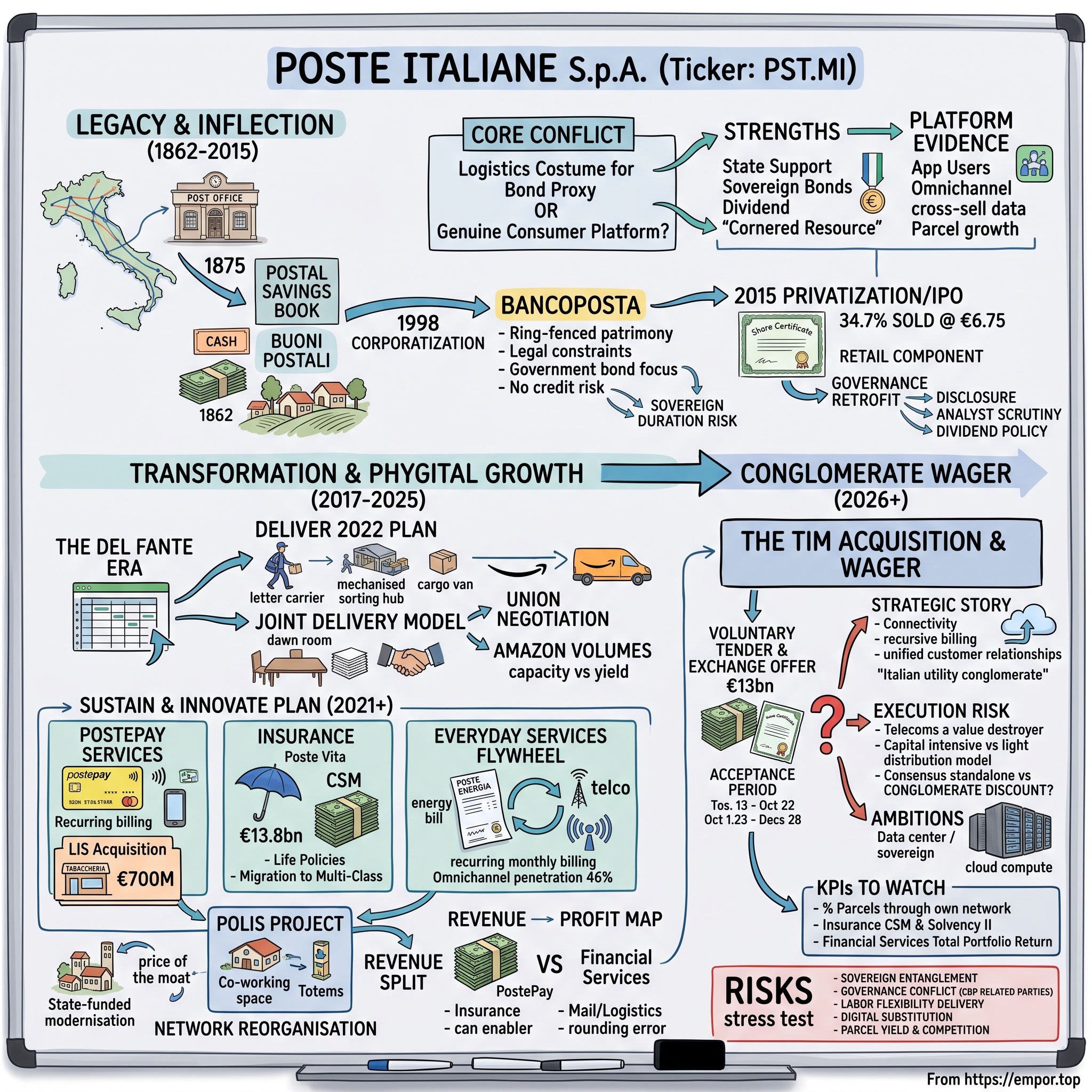
Poste Italiane: Italy's Phygital Monolith and Financial Engine
I. Introduction & Episode Roadmap
At 5:00 in the morning on 23 July 2026, in a negotiating room in Rome, the last signature went onto a document that Italy's postal unions and Poste Italiane's management had been arguing over, on and off, for roughly eighteen months. The agreement did not raise anybody's wages — the pay deal had been settled the previous year. What it did was rearrange the management layer sitting above roughly 13,000 post offices, replacing a structure in which a single provincial manager nominally supervised about a hundred branches with one in which that manager supervises ten hubs, each of which supervises about ten spokes.[^1] Twenty-four hours later, the chief executive opened a results call by describing the previous morning's signing as a "landmark agreement," and then spent the next twenty minutes talking about artificial intelligence, a €13 billion takeover of a telecoms company, and the dissolution of two of his own four business divisions.[^1]
That juxtaposition — union negotiators in a Roman conference room at dawn, and an AI orchestration layer routing 27 million daily customer interactions — is the whole company in a single frame. Poste Italiane S.p.A. (PST.MI) is a 164-year-old postal administration that today derives almost none of its profit from delivering letters. In the 2025 financial year the group reported revenues of €13.1 billion, adjusted operating profit of €3.24 billion and net profit of €2.22 billion, all records, and proposed a dividend of €1.25 per share.1 Of that operating profit, the overwhelming majority came from selling life insurance, distributing government savings products, running prepaid cards, and — increasingly — selling electricity, gas and mobile phone contracts to the same people who walk in to collect a pension.
The core question for an investor is deceptively simple: is this a bond proxy wearing a logistics costume, or a genuine consumer platform that happens to have started life as a post office?
The bond-proxy reading is not unfair. Poste's insurance and banking arms sit on an enormous portfolio of Italian government securities. Its distribution fees come from a state lender. Its controlling shareholders are the Italian Treasury and a state-owned development bank. Its dividend has grown at a compound rate management describes as roughly 15% a year since 2017, and it has returned close to €9 billion to shareholders since 2016.1 For a decade, buying Poste has been, functionally, a leveraged way to own Italian sovereign credit with an equity coupon attached.
The platform reading is the one management has spent nine years trying to make true, and it is no longer obviously wrong. The company's app had 18.2 million registered users and 4.2 million daily active users in the first half of 2026 — a scale that puts it at the top of the Italian consumer app rankings — and 78% of app users hold two or more Poste products, against under 40% for non-app users.[^1] Parcel volumes grew 13% in the first half of 2026 while mail revenue fell 3%.[^1] Something real is happening underneath the state-owned wrapper.
What makes 2026 the year to examine the question closely is that Poste has stopped being merely a diversified financial-postal hybrid and started behaving like an acquirer of national infrastructure. In March 2026 it launched a voluntary public tender and exchange offer for all of TIM (Telecom Italia), Italy's incumbent telecoms operator — a business roughly comparable in market value to a third of Poste itself.2 The acceptance period opened on 20 July 2026 and runs to 11 September.2 If it completes, Poste will have converted itself from a phygital distribution company into something closer to an Italian national utility conglomerate spanning mail, logistics, banking, insurance, payments, energy retail, mobile, fixed-line broadband and — if the data-centre ambitions the CEO sketched on the July call materialise — sovereign cloud compute.
That is either the logical extension of a distribution moat, or the most expensive case of empire-building in recent European corporate history. This piece is an attempt to work out which, and what evidence would settle it.
The route runs as follows. First, what the company actually is today, in economic rather than institutional terms. Then a compressed history: from the 1862 founding through the 1998 corporatisation that created BancoPosta, to the 2015 privatisation that imposed public-market discipline on a state bureau. Then the Matteo Del Fante era, which turned a chronic underperformer into a serial beater of its own guidance. Then the acquisition record — LIS, Nexive, Benetton's logistics arm, and now TIM — benchmarked on price and logic. Then a segment-by-segment dissection of where the profit actually comes from, because the headline revenue split is deeply misleading. Then the strategic plan and an assessment of management credibility built from what they said on earnings calls versus what they delivered. Then the risks, including the ones management does not lead with. Then a competitive war-game using Helmer's 7 Powers and Porter's Five Forces. And finally the investment spine — why this wins from here, what breaks it, and the small number of metrics worth actually tracking.
 Subscribe on LinkedIn
II. The Italian Phygital Leviathan: What is Poste Italiane Today?
Walk into a post office in a town of four thousand people in Basilicata on a Tuesday morning and you will see something that does not exist anywhere else in Western Europe at this density. There is a queue. In it: a pensioner collecting a state pension in cash, a small business owner paying a bollettino — the Italian payment slip that settles everything from utility bills to municipal taxes — a woman renewing a car insurance policy, and a teenager topping up a prepaid card. In many such towns, the commercial banks left years ago. As Del Fante put it on the July 2026 call, many of Poste's smaller offices "operate in markets where traditional banks have withdrawn, leaving Poste as a primary financial presence."[^1]
That sentence is the load-bearing fact of the entire investment case, and it is worth being precise about why. Poste operates roughly 13,000 post offices across Italy, supplemented by around 49,000 third-party network points — tobacconists, newsagents, corner shops — that accept payments and card top-ups.[^1] Layered on top is a digital estate that in the first half of 2026 handled 4.2 million daily active app users, with peaks above 5 million in July, and around 27 million daily interactions across all channels.[^1] Management counts roughly 40 million "hybrid" customers who engage across both physical and digital channels, and reports that omnichannel sales penetration — transactions that touch both — reached 46% in the first half of 2026.[^1] Total customer financial assets stood at €613 billion at the end of June 2026, up €13 billion in six months.[^1]
For context on what €613 billion means: it is roughly a quarter of Italian GDP, held in savings books, postal bonds, deposits, life policies and mutual funds, on behalf of a customer base that spans more than half the Italian population.
The revenue map lies; the profit map tells the truth
Here is where most casual analysis of Poste goes wrong. Look at the revenue split for the 2025 financial year and you see a business that appears balanced: Financial Services generated €5.7 billion, Mail, Parcel & Distribution €3.9 billion, Insurance Services €1.8 billion, and PostePay Services €1.7 billion.1 Mail and parcels look like a solid 30% of the company.
Now look at where the profit came from. Financial Services produced adjusted operating profit of €1.04 billion, up 16%. Insurance produced €1.59 billion, up 11%. PostePay produced €586 million, up 11%. Those three together account for essentially the entire group adjusted operating profit of €3.24 billion.1 The logistics business — the one with roughly 119,000 average employees behind it, the vans, the sorting hubs, the letter carriers[^1] — contributes a rounding error at the operating line. In the first half of 2025 it earned €67 million of adjusted operating profit on €1.9 billion of revenue, a margin of about 3.5%, and that figure was down 31% year on year.
The analytical conclusion is uncomfortable and important: Poste Italiane's physical network is not a profit centre. It is a customer acquisition and retention asset whose returns show up in somebody else's segment. The letter carrier who loses money delivering a birthday card is the reason a pensioner trusts the institution enough to roll a maturing postal bond into a multi-class life policy. That is a genuine economic mechanism, not a slogan — but it means the network's value can only be assessed by looking at what the financial segments earn, and by asking whether those earnings would survive if the network shrank.
The everyday-services flywheel
The most interesting recent development is the deliberate broadening of what the network sells. PostePay Services now bundles payments, a mobile virtual network operator, and — since 2022 — retail electricity and gas. In the first half of 2026 the energy business reached 1.2 million customers and €84 million of revenue, while the telco arm passed 5 million clients.[^1] These are not high-margin businesses in isolation; energy retail is a thin-spread commodity business and MVNOs are structurally squeezed. Their function is different: they generate a recurring monthly billing relationship with a customer who might otherwise interact with Poste twice a year.
The evidence that this works is the cross-selling data management chooses to disclose. The gap between app users holding two or more products (78%) and non-app users (under 40%) is the single cleanest proof point in the company's disclosure.[^1] Management declines to publish its actual cross-selling index, saying only that moving the index up by one product "creates a multiple of revenues."3 That vagueness is worth noting: it is the one place where an otherwise granular discloser goes soft, and it happens to be the metric that most directly validates the platform thesis. A sceptic is entitled to discount claims that cannot be checked.
What the customer-acquisition-cost argument really claims
The standard framing is that Poste acquires customers more cheaply than either digital-only challengers such as Revolut or N26 or traditional Italian banks such as Intesa Sanpaolo and UniCredit. The mechanism is that the foot traffic is already there and already paid for by the universal service obligation. That is directionally true, but it needs a caveat: the network is paid for whether or not it generates a sale. The relevant comparison is not zero-cost acquisition versus paid acquisition; it is whether the incremental revenue per branch visit exceeds what the branch costs to keep open. Management's answer is the hub-and-spoke reorganisation and the advisory model — roughly 2,800 "dynamic" advisers serving affluent clients and about 5,100 personal advisers covering the mass market — which exists precisely because branch productivity has been the weak link.4
Myth versus reality
Three consensus descriptions of Poste Italiane are worth testing before going further, because each is partly wrong in a way that changes the analysis.
Myth: "It's a post office." Reality: mail generated roughly €1 billion of revenue in the first half of 2026 out of €6.8 billion group revenue, and the entire logistics division earns a low-single-digit operating margin.[^1] Poste is a life insurer and deposit-taker that owns a delivery company.
Myth: "It's a state-protected monopoly, so the growth is fake." Reality: the protected parts — universal service mail, postal savings distribution — are the slowest-growing or outright declining parts of the business. The growth is coming from payments, energy, telco and life insurance, all of which are contested markets where Poste competes against Nexi, Enel, Iliad, Generali and Intesa Sanpaolo without statutory protection. The state gives Poste the shelf; it does not guarantee that anything sells off it.
Myth: "The dividend is safe because the government needs it." Reality: the government's need for dividends is real, but it cuts both ways. A controlling shareholder with a fiscal deficit is also a controlling shareholder who might prefer Poste to underwrite nationally strategic assets. The €13 billion offer for a telecoms incumbent is the first serious test of which instinct dominates.
Which raises the obvious question: how did a state postal bureau, of all institutions, end up with a national wealth-management sales force in the first place?
III. Legacy, Corporatization, & The 2015 IPO Inflection
The answer starts with a decision taken thirteen years after Italian unification. The Kingdom of Italy established a unified postal administration in 1862, and by 1875 had added something that would prove far more consequential than mail delivery: the libretto di risparmio postale, the postal savings book. The state needed a way to mobilise the savings of a largely rural, largely unbanked population, and the post office — already present in every village — was the only institution with the reach to do it. Postal savings certificates, buoni fruttiferi postali, followed. The arrangement was simple and enormously durable: citizens deposited money at the post office, the state used it, and the post office took a fee for gathering it.
That structure has survived every political rupture in modern Italian history. On the November 2025 earnings call, Del Fante noted that Poste had recently marked 150 years of postal savings and counted roughly 27 million Italians who own the product.3 There are not many consumer franchises in Europe with a century and a half of continuous distribution and near-universal household penetration.
1998: the year the bureau became a company
The problem with the arrangement, by the 1990s, was that everything except postal savings had become a fiscal wound. Poste was a loss-making arm of the state, chronically overstaffed, notorious for service quality, and a byword in Italian conversation for institutional dysfunction. The reform that changed it converted the entity into a joint-stock company, Poste Italiane S.p.A., and — critically — created BancoPosta as a ring-fenced patrimony within it.
The design of BancoPosta is genuinely unusual and repays a moment's attention, because it explains much of what makes Poste's economics work. BancoPosta collects retail deposits and offers current accounts, but it does not have a full banking licence and cannot lend to businesses or households on its own balance sheet. Instead, it is legally obliged to invest its deposit base in Italian government securities or place them with the state. In effect, Italy created a deposit-gathering institution that is structurally forbidden from taking credit risk.
The consequences are double-edged, and both edges matter. On one hand, BancoPosta has never had a non-performing loan crisis, because it has never made a loan. Through the Italian banking convulsions of 2011–2017 — when Monte dei Paschi required repeated state rescue and the sector carried some of Europe's worst asset quality — Poste's deposit franchise simply kept earning a spread on government paper. On the other hand, this is not a moat so much as a substitution: Poste swapped credit risk for sovereign duration risk. It cannot lose money on a bad borrower. It can absolutely lose money on a bad Italian bond market.
Del Fante was unusually blunt about the constraint on the November 2025 call, describing investing in government securities as "the only thing we can do by law."3
2015: the state sells a third of itself
By 2015, Prime Minister Matteo Renzi's government was hunting for both privatisation proceeds and a mechanism for imposing discipline on state-owned enterprises. Poste was the obvious candidate: profitable, cash-generative, universally recognised, and badly in need of external accountability.
The offering that priced on 23 October 2015 was Italy's largest since 1999. The Treasury sold 453 million ordinary shares at €6.75 apiece — 34.7% of the share capital, or 38.2% assuming full exercise of the greenshoe — raising €3,058 million, valuing the equity at roughly €8.8 billion.5 Demand ran at approximately 3.35 times the shares offered. Notably, 30% of the deal was reserved for retail investors and employees, and 303,536 retail applications came in, including 26,234 from Poste's own staff.5 Trading began on 27 October.
The retail-heavy structure was deliberate and politically shrewd: it turned a privatisation that unions opposed into one in which tens of thousands of employees became shareholders. It also created a share register with an unusually large domestic retail component, which has shaped the company's dividend behaviour ever since.
What the government emphatically did not do was relinquish control. Following a subsequent transfer of 35% of the share capital from the Treasury to Cassa Depositi e Prestiti — itself controlled by the Treasury — ownership settled into a structure that persisted through the end of 2025: the Ministry of Economy and Finance holding 29.26% directly and CDP holding 35%, for combined state control of roughly 64%.6
For investors, the 2015 listing was less a privatisation than a governance retrofit. Control never moved. What moved was disclosure: quarterly reporting, analyst scrutiny, a published dividend policy, and a management team whose compensation could be tied to metrics an outsider could verify. That turned out to be enough — but only once somebody arrived who intended to use it.
IV. The Matteo Del Fante Era: Turnaround to Multi-Platform Powerhouse
In April 2017 the Italian government appointed as chief executive a man whose entire prior career had been about regulated infrastructure and capital allocation, not mail. Matteo Del Fante had spent years at JPMorgan, then run Terna S.p.A., the operator of Italy's high-voltage electricity transmission grid — a business whose defining characteristic is that you earn a regulated return on a rate base, and your job is to deploy capital where the return exceeds the cost of capital and nowhere else.
That background shaped everything that followed. Del Fante did not arrive with a vision of Poste as a technology company. He arrived with a spreadsheet mentality applied to an asset base nobody had ever run commercially: a national network of buildings, staff and customer relationships that had been managed as a public service obligation rather than as a distribution platform.
He was reappointed in 2020 and again in 2023, and in 2026 the Treasury's slate again confirmed him — nine consecutive years in a market where corporate leadership turnover, particularly at state-influenced companies, tends to track the electoral cycle. That continuity is itself an analytical fact: strategic plans that span five years mean something different when the person who wrote them is still there in year seven.
Deliver 2022: fixing the thing that was actually broken
The first plan, "Deliver 2022," addressed a structural absurdity. Poste's delivery model had been built for letters: a carrier walked a route once a day, delivering flat mail, and the economics assumed volume. But Italian mail volumes were falling and Italian e-commerce was rising from a low base — Italy's online penetration lagged northern Europe considerably, which meant the growth runway was longer but the near-term volumes thinner.
The fix was the joint delivery model: reconfiguring routes and vehicles so a single carrier could handle both letters and parcels up to a few kilograms, and extending delivery into afternoons and weekends where volumes justified it. This sounds mundane. It was in fact the hardest thing the company did, because it required renegotiating working practices with unions in a company where the workforce is both large and deeply organised.
Alongside it came two commercial decisions that defined the decade. The first was industrial automation — investment in mechanised sorting hubs to bring down per-parcel handling cost, without which the joint delivery model would simply have moved a loss from one place to another. The second was strategic and counterintuitive: rather than treat Amazon as the existential threat to postal parcel economics that it had become for postal operators elsewhere, Poste signed up to carry Amazon's volume, using the retailer's density to fill its own network.
That decision has aged well but deserves a sceptical footnote. Carrying a dominant e-commerce platform's volume fills capacity, but it also concentrates bargaining power on the customer's side and tends to compress yield per parcel. Poste's disclosure on this is deliberately limited — unit economics of individual large client contracts are not published — and the visible symptom shows up in the tariff data. In the 2025 financial year the average parcel tariff declined about 2% year on year.1 Management's counter-narrative, articulated repeatedly on calls, is client diversification: broadening the parcel mix beyond any single account so that density is bought from many customers rather than one. The first-half 2026 numbers give that argument some support — parcel volumes rose 13% to 179 million items, with growth described as coming across a diversified client base — but yield discipline remains the open question.[^1]
2024 Sustain & Innovate: selling electricity through a post office
The second plan pushed Poste into territory no European postal operator had seriously occupied. In 2022 and 2023, as the European energy crisis sent household bills to levels that generated genuine panic, Poste launched Poste Energia: fixed-price electricity and gas contracts sold at the counter and through the app.
The strategic logic was not about energy margins. It was about trust arbitrage. In a market where consumers were being cold-called by retailers offering opaque variable tariffs during a price shock, an institution with 160 years of state association offering a fixed price had a distribution advantage that no amount of marketing spend could replicate. By the end of 2025 the business had passed one million clients, reaching 1.2 million by mid-2026.1[^1]
There is a second-order effect worth naming, because it complicates the tidy story. Energy retail is a low-margin, working-capital-intensive business with real commodity exposure, and it introduces a category of risk — wholesale price movement against fixed retail commitments — that Poste had never carried. Management's framing is that the product is a relationship anchor rather than a profit engine, and the disclosed revenue supports that. But "we are doing it for the cross-sell" is exactly the argument that precedes most value-destroying diversification, and it deserves to be tested against actual segment margins rather than accepted.
The Polis wager
One further initiative from this period deserves attention because it reveals how Del Fante thinks about the network. Under Law Decree 59 of 6 May 2021, Italy allocated funding from the complementary fund of its National Recovery and Resilience Plan to a programme called Polis: converting 6,933 post offices in municipalities of fewer than 15,000 inhabitants into round-the-clock digital hubs for public administration services — registry documents, social security certificates, passports, electronic identity cards — supported by a €1.2 billion investment plan and accompanied by 250 co-working sites.12
Read commercially, Polis is an extraordinarily favourable arrangement. The state funds the modernisation of the branch network that Poste uses to sell insurance and energy, in exchange for Poste providing public services in places where public services have thinned out. The company gets refurbished premises, 7,000 upgraded ATMs, self-service totems and a reason for citizens in small towns to keep walking through the door.
Read politically, it is the price of the moat. Poste's network is protected from competition partly because the state has decided it is national infrastructure. Infrastructure that the state funds is infrastructure the state has a claim on. The programme was 5,633 offices complete as of 31 May 2026, with 170 co-working spaces delivered — solid execution against a 2026 deadline.12 The strategic point is that the deepest source of Poste's competitive advantage is also the deepest source of its dependence.
What the Del Fante record establishes so far is competence at execution rather than brilliance at strategy. The plans were not visionary; they were obvious things a well-run company would do, executed with unusual persistence in an environment — Italian labour relations, state ownership, legacy cost base — where obvious things are typically impossible. That is a real, if unglamorous, form of management quality. The harder test is capital allocation, and that is where the record gets more interesting.
V. Capital Allocation & M&A Playbook: Benchmarking Strategic Bets
For most of Del Fante's tenure, Poste's acquisition strategy could have been summarised in one sentence: buy things in Italy that make our network denser, pay a sensible multiple, and do not go abroad. It was a discipline that European corporate history suggests is harder to maintain than it sounds. In 2026 that discipline was, depending on your reading, either extended to its logical conclusion or abandoned entirely.
LIS (2022): buying the shop counter
On 28 February 2022, Poste announced it would acquire LIS Holding S.p.A. from International Game Technology PLC for €700 million — a figure that included roughly €70 million of conventional net cash, implying an enterprise value near €630 million.7[^9] The deal completed on 15 September 2022 and remains the largest acquisition in Poste's history prior to the TIM offer.[^9]
What Poste bought was a network of nearly 54,000 affiliated points of sale — overwhelmingly tobacconists and neighbourhood shops — through which Italians pay bills, top up prepaid cards and phones, and buy vouchers.[^9] Italy's tabaccheria is a genuinely distinctive piece of retail infrastructure: a licensed, ubiquitous, high-footfall outlet that functions as an informal financial services counter for cash-preferring consumers.
The strategic logic was precise. Poste's payments arm already had the largest prepaid card franchise in Italy and 13,000 of its own counters. LIS added roughly four times that number of acceptance points and, crucially, internalised processing margin that Poste had previously been paying away. It converted PostePay from a card issuer with a captive network into an issuer with a national acceptance footprint.
On price, the deal looked defensible rather than cheap: an enterprise value implying roughly nine to ten times EBITDA at a time when listed European paytech comparables — Nexi, Worldline — traded meaningfully higher. Poste bought an infrastructure asset at an infrastructure multiple in a sector then being valued as growth. That the comparables subsequently de-rated severely does not retroactively make it a bad deal; it does mean the "we bought at a discount to peers" framing was partly a function of a sector bubble that has since deflated.
Nexive (2021): buying the competition at a distressed price
The Nexive transaction was smaller and, in governance terms, considerably more pointed. Nexive Group was Italy's second mail operator, held by PostNL and Mutares, carrying roughly 12% of the Italian mail market and around 350 million items a year on approximately €200 million of pro-forma 2019 revenue. Poste agreed to buy it in November 2020 and completed on 29 January 2021, paying €34.4 million for the equity based on an enterprise value of €50 million against €15.6 million of net debt at completion.[^10]
Two things about this deal deserve emphasis. First, the price: buying your only meaningful domestic competitor in the core legacy business for the price of a mid-sized office building is the kind of outcome that only occurs when the asset is distressed and the buyer is the sole logical acquirer. Second, the regulatory route. The Italian Competition Authority reviewed the concentration in December 2020 under a temporary special regime introduced by a recent change in Italian law — an emergency-era provision designed to facilitate approvals during the pandemic period.8
Stated plainly: the incumbent bought the challenger in a liberalised market under a temporary regulatory relaxation, and consolidated domestic mail share to a level that would ordinarily attract intense scrutiny. That is a legitimate observation for a shareholder to file under both "capital allocation win" and "regulatory risk that has not yet been tested." The synergy logic — denser routes, fewer duplicated networks in a structurally declining market — is sound. The durability of the outcome depends on political and regulatory tolerance that is not contractually guaranteed.
The bolt-ons: logistics, freight and fashion
Around these sat a series of smaller moves. A strategic investment in and joint venture with the German digital freight platform sennder addressed long-haul full-truckload transport, digitising a part of the chain Poste had historically managed manually. A partnership with DHL Express, announced in March 2023, gave Poste an international express capability without building one.[^12] And in April 2026, Poste Logistics took 51% of Benetton Logistics, creating a joint venture named Logistic 360 anchored on the Castrette di Villorba facility near Treviso — a 400,000 square metre site handling up to 30 million garments, with 100,000 square metres of next-generation automation.9 It consolidated from April 2026 and made a small initial contribution to first-half parcel revenue.[^1]
The Benetton deal is a good illustration of the underlying logic: Poste is buying contract-logistics capability for specific verticals rather than acquiring generic scale. Fashion logistics has returns handling, seasonality and SKU complexity that generalist parcel networks handle badly and specialists handle profitably.
TIM: the deal that changes the argument
And then there is Telecom Italia. Poste began building its position in February 2025, acquiring an initial roughly 10% stake from CDP, and added progressively thereafter, at a total invested cost of about €1.1 billion.3 By November 2025 the stake's market value had reached approximately €1.9 billion, and the two companies had begun harvesting commercial synergies: a contract migrating Poste's MVNO onto TIM's mobile infrastructure from the first quarter of 2026, worth about €20 million a year in savings; "TIM Energia powered by Poste Italiane" launched across more than 750 TIM retail outlets from 29 September 2025; and a joint venture with TIM Enterprise for cloud services.3
On the November 2025 call, asked to justify tying up €1.1 billion that could have earned a sovereign yield, Del Fante gave a precise answer: at roughly 3.5%, the foregone net interest income was around €40 million a year, against which he set the MVNO savings, the energy distribution, and the cloud joint venture.3 It was a disciplined, quantified defence of a minority stake.
Four months later the framing changed entirely. On 22 March 2026 Poste launched a voluntary totalitarian public tender and exchange offer for all TIM ordinary shares, offering per share €1.67 in cash plus 0.218 newly issued Poste shares — terms adjusted, without changing economic substance, following TIM's reverse stock split effective 15 June 2026.2 Consob approved the offer document on 15 July 2026 and the acceptance period opened on 20 July, running to 11 September with a possible reopening from 21 to 25 September.2 TIM's board unanimously deemed the consideration fair on 18 July.
The financial mechanics have moved sharply in Poste's favour on paper. The implied value of the offer rose 21% from announcement to roughly €13.1 billion, with the implied offer price per TIM share rising from €6.35 to €7.66 and the embedded premium expanding from 9% at announcement to 31% on spot and 43% on the six-month volume-weighted average.[^1] Management notes the combined entity would carry a market capitalisation of about €45 billion with €23 billion of free float, and targets closing by the end of the third quarter of 2026 with a combined business plan in the first quarter of 2027.[^1] Bridge financing for the cash component was secured from banks, and management stated there is no plan for a hybrid bond.[^1]
Here is the honest assessment. The strategic story — connectivity as a fourth recurring-billing relationship alongside banking, insurance and energy, sold through the largest retail network in Italy plus TIM's roughly 4,000 outlets — is coherent, and the early synergy proof points are real and quantified. The counter-argument is equally serious. European telecoms has been a value-destroying sector for two decades; Poste is a company whose entire investment identity rests on capital-light distribution economics acquiring one of the most capital-intensive businesses in Europe; and the offer's improving optics are a function of TIM's share price rising, which is partly a consequence of Poste's own bid. The premium expanded because the target re-rated, not because Poste negotiated better terms.
The July call surfaced a further ambition that will unsettle anyone who bought this stock for its dividend: data centres. Del Fante described support for a 20 megawatt TIM project already underway and a much larger scheme in Lombardy with a first tranche of about 70 megawatts, arguing that private infrastructure capital would absorb most of the real estate capital expenditure.[^1] That may prove correct. It is also precisely the kind of adjacency creep that turns a disciplined domestic consolidator into a conglomerate.
VI. Segment Economics & The Profit Engine Deep Dive
To understand where Poste's money actually comes from, it helps to abandon the org chart and think about four different businesses that happen to share a customer list and a building.
1. Insurance Services (Poste Vita) — the quiet giant
Poste Vita is Italy's largest life insurer, and almost nobody outside Italy thinks of Poste Italiane as an insurance company. In the 2025 financial year the segment produced €1.8 billion of revenue and €1.59 billion of adjusted operating profit — a profit-to-revenue relationship that looks bizarre until you understand the accounting.1
Under IFRS 17, a life insurer's profitability is governed by the Contractual Service Margin, or CSM. The layman's version: when you sell a long-term policy, you do not book the profit immediately. You park the expected future profit in a reserve — the CSM — and release it into earnings gradually over the life of the contract. The CSM is therefore a stock of already-written, not-yet-recognised profit. Poste's group CSM stood at €13.8 billion at the end of June 2026, growing at a normalised annualised rate of about 1.5% in the first half.[^1]
That number is the single best forward-visibility indicator in the whole company. It means roughly €13.8 billion of profit has been contractually locked in and is waiting to be recognised, subject to assumptions holding. Insurance revenue rose 9% in the first half of 2026 to €983 million, driven precisely by a higher CSM stock and a higher release rate.[^1]
The product story matters. Poste's traditional stronghold was Class I — capital-guaranteed policies backed by a segregated fund of, overwhelmingly, Italian government bonds. Since roughly 2024 the company has been deliberately migrating clients into multi-class products, which blend a guaranteed component with a market-linked one. By the third quarter of 2025 multi-class accounted for over 70% of life investment and pension gross written premiums.3
The rationale management gives is customer-centric: in a falling-rate environment, the expected return on a partly unguaranteed product is higher.3 The rationale a sceptic gives is capital: less guarantee means less required capital. When pressed on this in November 2025, the CFO acknowledged only "a marginal benefit," and Del Fante explained why the benefit is small — Poste's multi-class contracts always retain a minimum 60% Class I component, with the remaining 40% itself containing fixed income, so the equity exposure released is residual.3 That is a specific, checkable, non-evasive answer, and it counts in management's favour.
The migration does produce a visible cost: lapses. Rebalancing clients out of old policies shows up as policy surrenders. The lapse rate was 8.3% in the third quarter of 2025, improving to 6.6% by the second quarter of 2026 as the rebalancing wave passed, with roughly 35% of lapses reinvested into new life products in the more recent period against more than 50% earlier.3[^1] That declining reinvestment ratio is worth watching — it is the difference between managed portfolio rotation and genuine customer attrition.
Solvency is not currently a concern. The Poste Vita group Solvency II ratio was 312% at end-September 2025 and 303% at end-June 2026, against a stated managerial ambition of around 200% through the cycle, and already reflecting a 100% profit remittance to the parent.3[^1] The combined ratio on protection business ran at 82% in the first half of 2026, among the best in the market.[^1]
The distribution economics complete the picture. Poste Vita's products are sold through Poste's own counters. There is no external broker taking a commission, no bancassurance partner extracting a distribution rent. In an industry where distribution costs routinely consume a large share of the value chain, owning the shelf is the whole game.
2. Financial Services (BancoPosta) — deposits, distribution and duration
BancoPosta generated €5.7 billion of revenue and €1.04 billion of adjusted operating profit in 2025, with profit up 16%.1 Its revenue has four legs, and they behave very differently.
Net interest income. BancoPosta gathers deposits — retail balances stable at around €59 billion in mid-2026, plus more volatile public-administration balances — and invests them in Italian government securities.[^1] NII reached €676 million in the second quarter of 2026.[^1] Management does not manage NII in isolation; it manages what it calls total portfolio return, combining NII with realised capital gains from active portfolio management. The logic, explained repeatedly on calls since 2018: when rates fall, NII falls but the bond portfolio appreciates, and gains can be harvested to offset. In November 2025 Del Fante disclosed that the investment portfolio had turned mark-to-market positive for the first time, at roughly €700 million, with over €2 billion of gross positive capital gains available to deploy.3 For 2026, total portfolio return guidance was raised to about €2.8 billion from €2.7 billion as rates moved up.[^1]
This is a genuinely well-run treasury operation and management deserves credit for the consistency of the framing. It is also, unavoidably, a carry trade on Italian sovereign credit funded by sticky retail deposits.
Postal savings distribution fees. Poste distributes CDP's savings books and bonds and takes a fee. This produced €443 million in the second quarter of 2026 and €883 million in the first half.[^1] The contract runs to end-2026, and on 24 July 2026 Poste announced it had agreed a term sheet with CDP for a successor agreement covering 2027 to 2030, targeting average annual revenues of €1.9 billion against about €1.8 billion over the prior three years.[^1]
The structure of the new agreement is instructive. Compensation scales with performance in reducing net outflows, with what the CFO described as a degrading scale over time reflecting expected outflow patterns.[^1] Postal savings is a runoff business at the gross level — the redemption load each year is enormous, and as Del Fante conceded in November 2025, improved quarterly inflows represent good product design by CDP rather than a structural reversal.3 What Poste has secured is not growth; it is four years of visibility on a declining but very large annuity, with incentives aligned to slow the decline.
Consumer loan and mortgage distribution. Poste originates on behalf of partner lenders and takes a fee without retaining credit risk. Fees reached €130 million in the first half of 2026, down from stronger prior-year levels as higher rates compressed volumes.[^1] Small, but structurally attractive: fee income with no balance-sheet consequence.
Asset management. €112 million in the first half of 2026, growing on higher assets under management.[^1] The smallest leg, and the one most exposed to the fee compression sweeping European asset management.
3. PostePay Services — the growth engine
PostePay generated €1.7 billion of revenue and €586 million of adjusted operating profit in 2025, and remains the fastest-growing division: first-half 2026 revenue up 7% to €860 million with adjusted operating profit up 12% to €310 million.1[^1]
The core payments business grew 5% in the first half to €611 million, on transaction value up 8% and total ecosystem transactions up 13%.[^1] The gap between transaction growth and revenue growth reflects a regulatory headwind: an EU law change on instant payments compressed pricing. Stripping that out, management put underlying payment revenue growth at roughly 5% in 2025 and claimed market share gains.3
The most interesting product dynamic is the migration from the classic PostePay prepaid card to PostePay Evolution, which carries an IBAN. The distinction matters more than it sounds. A card without an IBAN is a spending instrument. A card with an IBAN can receive a salary, pay direct debits and function as a de facto current account. Del Fante disclosed that Evolution generates about €18 per year in revenue per card and that the base reached 10.7 million in late 2025.3 This is a five-year deliberate migration from a low-value product to a banking relationship, executed on a customer base that in many cases would never open a traditional bank account.
The division also houses the telco and energy businesses discussed earlier, and one asset with genuine option value: SPID, Italy's public digital identity system, where Poste is by far the largest identity provider. Del Fante noted in November 2025 that Poste manages close to 30 million digital identities serving over a billion authentications a year, that several competing providers had begun charging users roughly €6–7 annually, and that Poste was observing the market before deciding.3 Monetising even a fraction of that base would be highly accretive; the constraint is political, not technical.
4. Mail, Parcels & Distribution — the backbone that doesn't pay
Which brings us back to the segment that employs most of the people and earns almost none of the profit. Revenue was €3.9 billion in 2025, up 2.7%.1 In the first half of 2026 the division generated just over €2 billion, up 6%, with the composition telling the whole story: parcel revenue up 13% to €908 million, mail revenue down 3% to about €1 billion on volumes down roughly 7%, offset by repricing that lifted average mail tariffs about 3%.[^1]4
Poste delivered 349 million parcels in 2025, making it Italy's number one operator by volume.1 Volumes reached 179 million items in the first half of 2026.[^1]
The most important operational metric in this division is one that rarely gets attention: the share of parcels delivered through Poste's own postal network rather than through dedicated wholesale capacity. That share reached 48% in the second quarter of 2026, up five percentage points year on year.[^1] Every parcel that rides an existing letter-carrier route absorbs fixed cost that was going to be incurred anyway. This is the mechanical link between the declining mail business and the growing parcel business — and it is why the joint delivery model was worth the union fight.
The counterweight is price. Average parcel tariffs fell about 2% in 2025, pressured by high volumes of low-value items — second-hand marketplace shipments and boxless returns.13 Boxless returns, in particular, are a structurally low-price product: a customer hands over an unpackaged item at a counter. High volume, thin revenue per unit.
Competition is intense and well capitalised: Amazon's own logistics arm, BRT within the DPD group, GLS, DHL and UPS. Poste's structural advantage is the density of the last mile in a country with substantial rural and mountainous geography, where competitors' unit economics deteriorate faster than Poste's. Its structural disadvantage is a cost base built for a different product.
The investor conclusion for this segment is that it should be judged as an enabler, not a profit centre — but that judgement has a limit. If parcel yield keeps eroding while mail volumes fall faster than routes can be consolidated, the network stops being a cheap customer-acquisition asset and becomes a subsidised one. The hub-and-spoke reorganisation and the parcel-through-postal-network ratio are the two levers management is pulling. Neither has yet been proven across a full cycle.
VII. The "Connecting Platform 2028" Strategy & Management Credibility
On 20 March 2024 Poste presented a five-year plan called "The Connecting Platform." The headline targets: revenue of €13.5 billion by 2028, operating profit of €3.2 billion, net profit of €2.3 billion, cumulative dividends of at least €6.5 billion over the plan, a payout ratio of at least 65%, and dividend per share of at least €1.00 in 2026.[^14]
By the end of 2025 — the second year of a five-year plan — Poste reported revenue of €13.1 billion, adjusted operating profit of €3.24 billion, net profit of €2.22 billion, and proposed a dividend of €1.25 per share at a 73% payout.1 Every 2028 target was effectively met or exceeded three years early.
This admits two readings, and an honest analysis holds both.
Reading one: exceptional execution. Del Fante has now delivered three consecutive strategic plans on or ahead of schedule through a pandemic, a European energy crisis, and a complete interest-rate cycle. Guidance was raised repeatedly during 2025 and again in 2026, when full-year adjusted operating profit guidance moved to €3.4 billion.4 Very few European large caps have that record.
Reading two: the targets were soft. A management team that hits a five-year plan in year two either got lucky on exogenous variables or set a bar it was confident of clearing. Both are partly true here. A material share of the outperformance came from the rate cycle: BancoPosta's total portfolio return is directly geared to European monetary policy, and the 2024 plan was built on rate assumptions that reality exceeded. When the CFO explained the 2026 guidance upgrade, the "key component" he named was the rates environment.[^1] That is honest disclosure, and it also means a meaningful part of the beat was not earned by operational improvement.
The fairest summary: the operating businesses have compounded steadily and genuinely, and the rate cycle amplified the result into something that looks more spectacular than the underlying trend.
What management does when it has good news
The February 2026 Capital Markets Day was where the plan's status became explicit. Poste presented record 2025 results, guided 2026 to revenue of €13.5 billion, adjusted operating profit above €3.3 billion and net profit excluding the TIM stake of €2.3 billion, and committed to a payout above 70% of net profit excluding TIM.1 Rather than issue a new multi-year plan, management deferred it — signalling that the next plan would come by year-end 2026, once the TIM situation resolved.10
Then on 24 July 2026, alongside first-half results, management pre-announced three of the pillars of that future plan without publishing the numbers.[^1]
The first was the CDP postal savings term sheet for 2027–2030, discussed above — de-risking the single largest fee stream.
The second was a structural simplification: collapsing four business units into two. Phase one, by end-2026, brings banking, insurance and payments into a single financial and insurance hub, with PostePay demerged and its payments business allocated to BancoPosta. Phase two, across 2027 and 2028 and subject to regulatory and legal approval, allocates the Poste Vita stake to BancoPosta.[^1] The claimed benefits are higher net interest income from increased BancoPosta regulatory capital enabling additional leverage capacity, improved cross-selling between current accounts and prepaid cards via a new digital platform in 2027, and cost efficiency through redeployment of up to 25% of the combined BancoPosta and PostePay workforce.[^1]
When an analyst pressed on quantification, the CFO was notably restrained: the phase-one NII benefit is "a couple of tens of million," and he explicitly declined to say more.[^1] Asked whether phase two implied seeking a banking licence or relying on the Danish Compromise treatment of insurance holdings, Del Fante was categorical: "We're not a bank and will never be a bank with a banking licence," explaining the mechanism instead as consolidating risk under a single umbrella so that the Bank of Italy can apply more predictable capital absorption parameters.[^1]
That answer is worth flagging as an unresolved item. The entire capital-release rationale for phase two depends on a regulatory outcome that has not been granted, and the presentation footnote acknowledges it is subject to a change in law.[^1] Investors should treat the phase-two benefit as an option, not a plan.
The third pillar was the hub-and-spoke network reorganisation described at the outset, enabled by the union agreement signed on 23 July.[^1] Del Fante was explicit that the agreement contains no new financial terms — pay was settled separately the previous year — and that its value is permitting new roles, new incentives and a restructured provincial footprint, plus changes needed for the logistics transformation.[^1] That distinction matters: Poste secured operational flexibility without buying it with a wage concession, which is not the usual outcome in Italian collective bargaining.
Wrapped around all three is the artificial intelligence programme, which management quantified more specifically than most European incumbents have managed: approximately €150 million of annual IT operating and capital expenditure savings plus €50 million in customer relations costs within four years, and redeployment of up to 20% of overhead full-time-equivalent staff over five years.[^1] The architecture described — a universal knowledge base, hybrid cloud, an "AI orchestrator" routing customer interactions between digital self-service and branch advisory — is coherent. Whether it delivers is unknowable today. The number to hold management to is the €200 million combined cost saving, because unlike revenue synergies it is checkable.
The tone of the calls
Reading the November 2025 and July 2026 transcripts back to back reveals a consistent management voice with a specific tell.
Analysts push on the same three or four things: the durability of net interest income as rates move; postal savings outflows and the CDP renewal; parcel tariff dilution; and Solvency II sensitivity. On each, management answers with mechanism rather than reassurance. On NII, the total-portfolio-return framing has been repeated since 2018 and was restated verbatim in July 2026.3[^1] On the 2027 Solvency II standard formula review, the CFO gave a specific and deliberately modest estimate of a mid-to-high single-digit percentage-point benefit, up to about 10 points, and when an analyst at Morgan Stanley pushed that it seemed low given Poste's high risk margin, he declined to be talked upward.3 Guiding down against analyst pressure is a small but genuine credibility marker.
Where management goes vague is predictable: cross-selling indices ("we don't disclose"), large-client parcel unit economics, and forward guidance beyond 2026 while the TIM offer is live. On the last, the CFO did something subtle in July 2026 — asked about a consensus figure of roughly €3.8 billion of adjusted operating profit for 2028 on a standalone basis, he said it "broadly reflects a trajectory for the standalone business," without endorsing any specific year, and Del Fante added that consensus excluded the newly announced CDP agreement and capital optimisation.[^1] That is guidance-by-implication delivered while formally declining to guide. Sophisticated, and worth recognising for what it is.
The credibility verdict: high on delivery, high on disclosure granularity, honest about the contribution of exogenous factors, and appropriately hedged where outcomes depend on regulators. The open question is not whether this team executes. It is whether a team that has spent nine years proving it can execute domestic infill is the right team to integrate a telecoms incumbent.
VIII. The Skeptical Investor Stress Test & Risk Radar
Imagine an activist investor building a short thesis. What would they attack?
1. The sovereign entanglement
They would start with the balance sheet. Poste Vita's segregated funds and BancoPosta's deposit-backed portfolio are dominated by Italian government securities, and BancoPosta is legally prohibited from doing much else.3 A sharp widening in the spread between Italian and German government bonds hits Poste in two places simultaneously: it depresses the insurance Solvency II ratio and it drives unrealised losses through comprehensive income.
Management's mitigations are real. The Solvency II ratio at 303% carries an enormous buffer over the roughly 200% managerial ambition.[^1] The portfolio is run on a total-return basis with substantial banked capital gains available.3 And the insurance liabilities are unusually sticky — Italian households do not typically surrender guaranteed policies en masse.
But the honest framing is not that the risk is hedged. It is that Poste is structurally long Italy and cannot be otherwise. The company is, in effect, part of the machinery by which the Italian state finances itself at retail — a primary distributor of instruments like BTP Valore to households. That makes it politically indispensable, which is protective in a crisis. It also means there is no version of an Italian sovereign event in which Poste Italiane equity is a safe place to hide.
2. The state as both patron and principal
Which leads to governance. The state controls roughly 64% of the equity through two vehicles.6 In September 2024 the Italian cabinet approved a decree enabling the Treasury to sell down all or part of its direct 29.3% holding while retaining control via CDP's 35%, as part of a broader programme to raise around €20 billion from asset disposals between 2024 and 2026.11 Following political and union criticism, the government indicated it would retain at least 51%.11
The consequence for the share register is a persistent technical overhang. Every time privatisation speculation surfaces, the market prices the possibility of a block placement.
The more substantive governance question is conflict of interest. CDP is simultaneously Poste's second-largest shareholder and its largest commercial counterparty — the entity whose savings products generate roughly €1.8–1.9 billion of Poste's annual fee revenue.[^1] Poste bought its initial TIM stake from CDP.3 Poste is in the process of buying a 20% stake in Polo Strategico Nazionale, the national cloud vehicle, from CDP.[^1] These are related-party transactions between entities under common ultimate control, negotiated in a context where the controlling shareholder has policy objectives — telecoms sovereignty, cloud sovereignty, employment in small municipalities — that are not identical to maximising minority shareholder returns.
An activist would ask a blunt question: would Poste Italiane, if it were a purely private company, have bid €13 billion for a European telecoms incumbent? The strategic logic is defensible on its own terms. But the fact that the answer is genuinely uncertain is the governance discount in a sentence.
3. Labour: flexibility bought, not yet banked
Roughly 119,000 average full-time equivalents, represented by powerful unions, in a country where collective bargaining is national and adversarial.[^1] Human resources costs rose 1% in the first half of 2026 to nearly €2.9 billion, with cost per FTE up 1% to about €48,000 reflecting the salary increase from the collective agreement.[^1]
The encouraging metric is productivity: value added per FTE improved 5% to €92,000, comfortably outpacing the 1% cost increase, and ordinary HR costs fell to 39% of revenue.[^1] Operating leverage is genuinely improving.
The risk is that the July 2026 agreement, the 25% BancoPosta-PostePay redeployment and the 20% overhead reduction are all still ahead of delivery. Del Fante himself called the 25% figure "ambitious."[^1] Historically, European postal operators have found headcount reduction achievable through attrition and near-impossible through anything else. Poste's attrition is meaningful — roughly 6,000 exits a year, broadly offset by hiring — which gives management a slow but real lever, provided it stops replacing the leavers.3
4. Digital substitution and the mail cliff
Mail volumes fell about 7% in the first half of 2026.4 Italy's certified email system (PEC) and its digital identity infrastructure (SPID and the electronic ID card) have made physical registered mail — historically among the highest-margin postal products — substitutable for a growing share of legal and administrative correspondence. Repricing has offset the volume decline so far, lifting average tariffs about 3%.[^1] Repricing works until it triggers further substitution, and there is no way to know in advance where that line sits.
5. Parcel yield and the regulatory wildcard
Average parcel tariffs declined about 2% in 2025.1 A separate risk sits upstream: a proposed European-level duty on small parcels imported from outside the EU, discussed at €1 to €2 per item. Asked about it in November 2025, Del Fante gave a two-sided answer — a first-order negative, since Poste distributes a meaningful volume from Chinese platforms, but a possible second-order positive, in that higher friction makes it less attractive for those platforms to build their own Italian logistics infrastructure.3 The candour is welcome; the exposure is real and not quantified.
6. Execution risk in the TIM transaction
This is now the largest single risk in the equity, and it is worth being specific about the mechanics. If the tender achieves the 50% threshold but falls short of two-thirds, Poste can proceed with a lower acceptance and accumulate further shares in the market after a six-month "best price rule" window during which it cannot pay more than the offer price.[^1] Del Fante's framing was that Poste has "all the time and patience" and would wait for the right window.[^1]
That is a reasonable position for a controlling-minded acquirer. It is a less comfortable one for a minority shareholder, because the intermediate state — majority control without full ownership, a combined plan not yet published, integration underway, and a target carrying substantial leverage and capital expenditure obligations — is precisely the configuration in which conglomerate discounts form. Poste has committed to a combined business plan in the first quarter of 2027. Until then, investors are underwriting a transaction whose financial architecture has not been disclosed.
7. Concentration and cyber
Two items belong on the radar without dominating it. First, dependence on a small number of very large parcel clients, whose unit economics are undisclosed. Second, cyber and data privacy: an institution holding around 30 million digital identities, tens of millions of payment cards and €613 billion of customer assets is among the highest-value targets in Italy, and the AI programme increases both the data surface and the automation of processes touching it.
IX. Frameworks & Playbook: Hamilton Helmer's 7 Powers & Porter's 5 Forces
Strip away the narrative and ask the war-game question: if you had unlimited capital and wanted to destroy Poste Italiane's economics, where would you attack?
Helmer's 7 Powers
Cornered Resource — the strongest power, and the most fragile. The 13,000-office network in a country where the state has legislated a universal service obligation cannot be replicated. Not because it is expensive — a well-funded competitor could theoretically build branches — but because the returns on doing so are negative for anyone who does not also have a mail monopoly, a state savings distribution contract and an insurance manufacturer to amortise the cost across. The publicly funded modernisation programme described earlier turns that network into state-subsidised entrenchment.
It also illustrates the fragility. The cornered resource exists because the state pays for it and mandates it. Change the political settlement and the moat becomes a cost base. This is the crucial distinction between Poste's position and a genuinely private cornered resource such as a mineral deposit or a patent: Poste's is renewable by legislation, and therefore revocable by legislation.
Scale Economies — real, and currently improving. Fixed sorting and delivery infrastructure spread across rising parcel volumes; the LIS network processing high-frequency micro-payments at negligible marginal cost. The measurable proof is the rising share of parcels delivered through the postal network and the widening gap between value added per FTE and cost per FTE.[^1]
Switching Costs — understated in most analyses. A customer whose pension is credited to a PostePay Evolution card, whose life policy sits with Poste Vita, whose electricity is billed by Poste Energia and whose digital identity is issued by Poste faces genuine friction in leaving. The 78% two-or-more-product rate among app users is switching cost expressing itself as an operating metric.[^1]
Network Effects — the weakest claim. PostePay is widely accepted, but a payment card is not a true two-sided network in the way a scheme like Visa is; the underlying rails belong to card schemes and national payment infrastructure. What Poste has is distribution ubiquity and brand default status among cash-preferring consumers, which is powerful but is not a network effect and should not be priced as one.
Process Power — plausible, unproven. The claim is that Poste has built onboarding and advisory workflows suited to an ageing, less digitally confident population that neobanks serve badly. The 4.2 million daily active app users and the successful migration of the customer base onto a single SuperApp — an exercise Del Fante correctly described as risky because of attrition — are supporting evidence.3 Whether it constitutes durable process power or merely current competence will show in whether cross-selling keeps compounding after the reorganisation.
Counter-Positioning — historically decisive, now diminishing. BancoPosta's inability to lend meant it never suffered the non-performing loan crises that devastated Italian banks. Incumbent lenders could not copy the model without abandoning their core business. But this power was a product of an era in which Italian bank asset quality was catastrophic. With Italian banks now well capitalised and highly profitable, the relative advantage has narrowed considerably.
Branding — real in a specific sense. Poste's brand equity is not aspirational; it is institutional trust. That is exactly the asset that made a fixed-price energy contract sell during a price shock. It has limits: it does not command a price premium in parcels, and it does not travel outside Italy.
Porter's Five Forces
Threat of new entrants: very low in physical distribution, moderate in digital payments. Nobody is building 13,000 Italian branches. But Satispay, Revolut, PayPal and Nexi compete for exactly the digital transactions Poste needs to grow, and they carry none of the physical cost base.
Buyer power: low for retail, materially higher for enterprise parcel clients. Individual depositors and policyholders have negligible leverage — the products are sticky and the alternatives inconvenient. Large e-commerce shippers have substantial leverage, and the 2% tariff decline in 2025 is the visible consequence.1
Supplier power: moderate and structurally organised. Labour is the dominant input, and it is nationally unionised. The July 2026 agreement demonstrates that constructive outcomes are achievable, but it took eighteen months of negotiation for a change that does not touch pay.[^1]
Threat of substitutes: high for letters, low-to-moderate elsewhere. Digital communication is steadily eliminating physical mail. Postal savings faces substitution from retail government bond programmes and mutual funds, though Poste distributes many of the alternatives too. Physical parcel delivery has no substitute.
Competitive rivalry: high in parcels, intensifying in payments, structurally muted in savings distribution. Poste competes against Amazon Logistics, BRT, GLS, DHL and UPS in parcels — a genuinely brutal market. In postal savings, the CDP relationship is effectively exclusive.
The synthesis: Poste's advantage is not any single power but the specific combination of a state-subsidised distribution network, an exclusive state savings mandate, an in-house insurance manufacturer and a payments franchise, all pointed at one captive national customer base. Each element on its own would be attackable. Together they produce economics — over 24% adjusted operating margin at group level in 2025 — that no European postal operator and few European retail financial institutions match.1 The vulnerability is that two of the four legs depend on political settlements rather than commercial contracts.
X. The Investment Spine: Bull vs. Bear Case & 3 Key KPIs
Why this wins from here
The case rests on a mechanism that is observable rather than asserted: Poste owns the most valuable retail shelf in Italy and has spent nine years proving it can put progressively higher-margin products on it. The sequence is documented — prepaid cards, then IBAN-enabled accounts, then life policies, then energy, then mobile, and now potentially fixed-line connectivity — with each addition raising products per customer and extending the billing relationship. The evidence that it is working is not management assertion but disclosure: adjusted operating profit compounding roughly 10% a year, PostePay operating profit up 12% in the most recent half, an insurance CSM of €13.8 billion providing multi-year earnings visibility, and a demonstrated 78%-versus-40% cross-selling gap between engaged and unengaged customers.[^1]
The near-term earnings profile also has unusually low uncertainty by European large-cap standards. The CDP term sheet fixes the largest fee stream through 2030. The CSM pre-funds the insurance division's profit recognition. The bond portfolio carries banked capital gains available to smooth a falling-rate environment. And the dividend is underwritten by a controlling shareholder — the Italian Treasury — with a structural fiscal incentive to keep receiving it.
What breaks the case
Four things, in rough order of probability.
The TIM integration disappoints. This is the largest identifiable risk. European telecoms is capital-hungry and has destroyed shareholder value for two decades. If the combined plan due in the first quarter of 2027 reveals capital expenditure requirements that compete with the dividend, the entire reason a large part of the shareholder base owns this stock is compromised.
Rates fall faster than the offset works. A meaningful share of recent profit growth came from the rate cycle. Management's total-return framing is credible and has been consistently applied, but harvesting capital gains to plug an NII hole is a finite strategy — you can only sell the appreciated bond once.
The state's needs diverge from shareholders'. Employment obligations, universal service, sovereign-cloud and telecoms-sovereignty objectives, and the appetite of a government financing one of Europe's largest debt burdens all create pressure points where the controlling shareholder's interest and the minority's could separate.
Logistics economics deteriorate. If parcel yields keep falling while mail volumes decline faster than routes can be consolidated, the network flips from cheap distribution asset to subsidised liability.
The bull case, stated fairly
Poste hits the roughly €3.8 billion of standalone adjusted operating profit that consensus implies for 2028 — a figure the CFO characterised as broadly reflecting the trajectory, before adding that it excludes the new CDP agreement and the capital optimisation from the financial hub.[^1] The AI programme delivers its €200 million of identified cost savings. The financial hub releases capital that BancoPosta redeploys into higher net interest income. TIM closes, the combined entity's plan shows credible synergies, and Poste re-rates from a postal-financial hybrid trading at a conglomerate discount toward a consumer platform multiple. Dividends continue compounding from the €1.25 paid for 2025, with management having already indicated 2026 will be higher.[^1]
The bear case, stated fairly
TIM proves to be exactly what European telecoms has been for twenty years: a capital sink. Integration absorbs management attention that the core platform needs. A sovereign spread event compresses the insurance solvency buffer and the bond portfolio simultaneously. Mail declines outrun repricing. The 25% and 20% workforce redeployment targets meet the reality of Italian labour law and deliver a fraction of what was promised. And the market, watching a company that once made a virtue of domestic infill discipline now discussing 70-megawatt data centres, applies a widening conglomerate discount.
The three KPIs worth tracking
Everything above collapses into three observable measures. An investor who tracks only these will know whether the thesis is intact.
1. The ratio of parcels delivered through Poste's own postal network. This ran at 48% in the second quarter of 2026, up five points year on year.[^1] It is the single cleanest measure of whether the logistics transformation is real, because it directly determines whether growing parcel volume absorbs the fixed cost of the legacy delivery network or requires incremental cost to serve. Watch it alongside the average parcel tariff — rising penetration with falling tariffs means volume is being bought rather than earned.
2. The insurance Contractual Service Margin, together with the Solvency II ratio. The CSM stood at €13.8 billion at end-June 2026 with normalised annualised growth of 1.5%, and the Solvency II ratio at 303%.[^1] The CSM is the stock of contracted-but-unrecognised profit — the forward earnings visibility of the largest profit centre. Solvency is the constraint that determines whether that profit can be remitted to the parent and paid out. If CSM growth turns negative while lapses stay elevated, the insurance engine is running down, regardless of what reported profit says in any given quarter.
3. Total portfolio return in Financial Services. Guided to approximately €2.8 billion for 2026, combining net interest income with active portfolio management gains.[^1] This is the metric management itself uses, which is both convenient and appropriate, because it is the only way to see through the mix shift between interest accrual and realised gains as rates move. It is also the clearest single read on the sovereign-carry component of earnings. If total portfolio return holds while the mix shifts toward NII, the balance sheet is working. If it holds only because gains are being harvested faster than they are being replenished, the earnings are being borrowed from the future.
One further item is not a KPI but a scheduled event: the combined business plan for Poste and TIM, promised for the first quarter of 2027. Until it exists, the largest capital allocation decision in the company's history has been made without the market seeing the model behind it.
References
-
Poste Italiane: FY-25 Preliminary Results & 2026 Strategy Update — Poste Italiane, 2026-02-26 ↩↩↩↩↩↩↩↩↩↩↩↩↩↩↩↩↩
-
Poste Italiane: Consob Approves the Offer Document for the Public Tender Offer on TIM — TG Poste, 2026-07-16 ↩↩↩↩
-
Poste Italiane Q3 & 9M 2025 Results Conference Call Transcript — Poste Italiane, 2025-11-13 ↩↩↩↩↩↩↩↩↩↩↩↩↩↩↩↩↩↩↩↩↩↩↩↩↩
-
Poste Italiane Q2 2026 slides: record H1 results, AI transformation — Investing.com, 2026-07-24 ↩↩↩↩
-
The initial public offering of the ordinary shares of Poste Italiane S.p.A. successfully ends with demand that is 3 times over the offer — Italian Ministry of Economy and Finance, 2015-10-23 ↩↩
-
Poste Italiane S.p.A. Corporate Profile — Borsa Italiana / Euronext ↩↩
-
Poste Italiane buys paytech firm LIS from IGT for 700 mln euros — Reuters, 2022-02-28 ↩
-
Italian Antitrust Clearance for the Nexive Acquisition — AGCM (Autorità Garante della Concorrenza e del Mercato), 2021-01-15 ↩
-
Poste: strategic partnership with Benetton Group for fashion logistics — TG Poste, 2026-04-20 ↩
-
2024–2028 Strategic Plan and Group Strategy targets — Poste Italiane ↩
-
Italy approves decree to sell stake in Poste Italiane — Reuters, 2024-09-17 ↩↩
 LinkedIn
 WhatsApp
 Reddit
 Hacker News
 Email
Email Kindle
 RSS Feed
 Spotify
 Apple Podcasts
 Amazon Music
 Audible
 YouTube