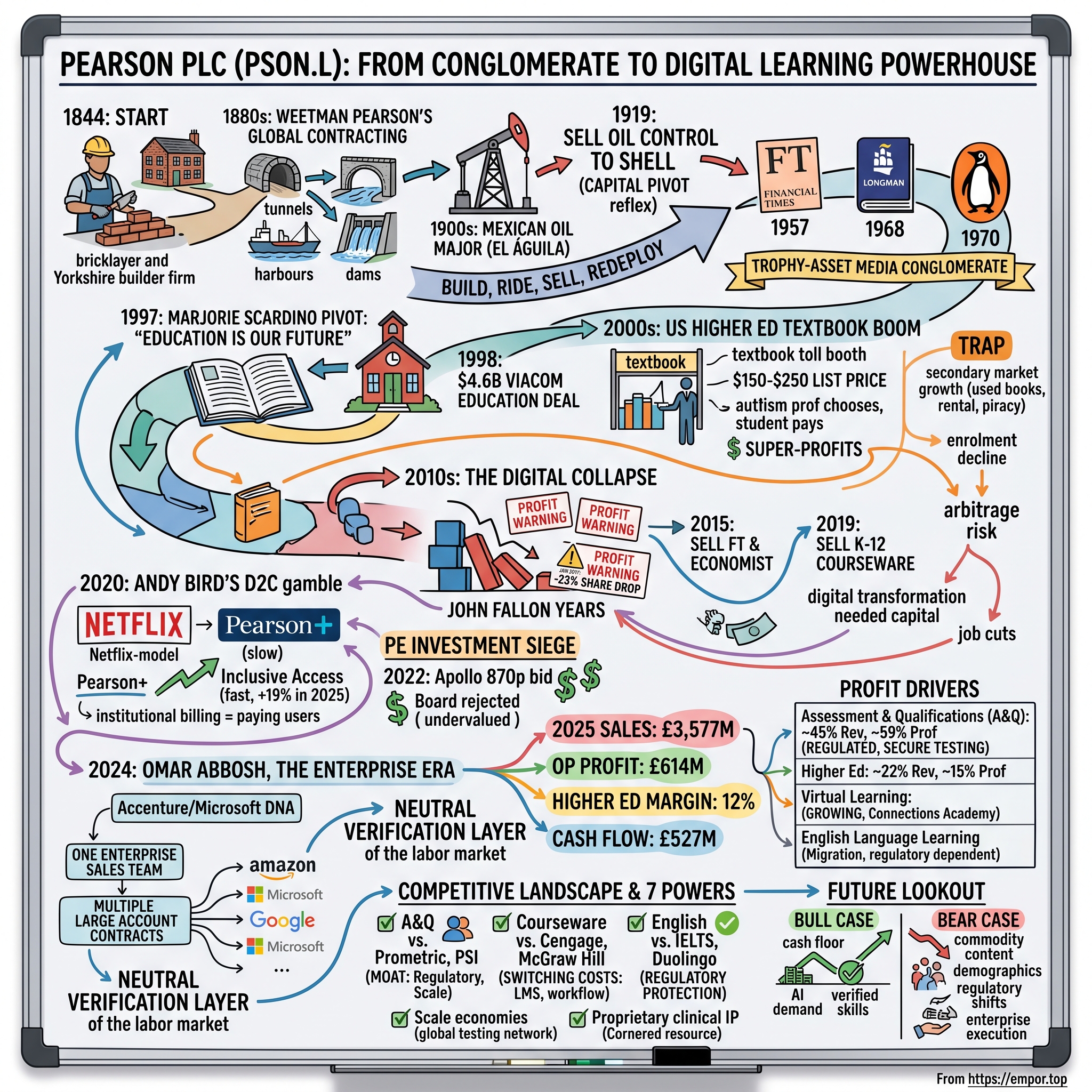
Pearson plc: From Media Empire to Digital Learning & Testing Powerhouse
I. Introduction & The Pearson Paradox
On a February morning in 2026, in a room off London's Strand, Omar Abbosh stood in front of a group of sell-side analysts and did something unusual for the chief executive of a 180-year-old British company. He asked them to stop thinking of Pearson as a publisher.
"Over 80% of Pearson's profit comes from assessments and virtual schools," he told them, before walking through what those businesses actually involve: biometric security, secure chain-of-custody for exam materials, incident response protocols, statistical evidence that testing standards have been maintained year over year, and capacity management across a global network of secure physical facilities. Then came the line he clearly wanted to land: Pearson's services "act as verification infrastructure for companies, industry associations, states and government agencies."
Not content. Infrastructure.
It is a striking pitch from a company that, within living memory, owned the Financial Times, half of The Economist, Penguin Books, Madame Tussauds, Château Latour, and a controlling interest in one of the world's largest oil producers. Pearson has been, at various points in its life, a Yorkshire building contractor, a global civil engineering firm, a Mexican oil major, a merchant bank, a media conglomerate, and the world's largest education publisher. Each of those identities was, at the time, the obvious and permanent answer to the question "what is Pearson?" Each was eventually sold.
The current answer looks like this. For the year ended 31 December 2025, Pearson reported sales of £3,577 million and adjusted operating profit of £614 million, with the adjusted operating margin expanding from 16.9% to 17.2%.1 Adjusted earnings per share were 64.5p, the full-year dividend rose 5% to 25.2p, free cash flow reached £527 million, and return on capital improved to 11.3%.12 Net debt stood at £1.1 billion, or 1.3 times adjusted EBITDA — comfortably inside the group's self-imposed ceiling of 2 times.2 The shares are listed in London as PSON.L with an American depositary receipt on the NYSE under PSO; at the end of July 2026 the equity was valued at roughly £8 billion.3
Here is the paradox worth sitting with. For most of the 2010s, public markets treated Pearson as a melting ice cube — a print textbook business being disassembled by Amazon's used-book marketplace, rental models, PDF piracy, and student refusal to pay $200 for a chemistry text. That diagnosis was not wrong. It was simply incomplete. While the courseware business was being pulled apart in full view, a quieter machine was compounding inside the same corporate wrapper: a high-stakes assessment and qualifications operation that today generates roughly 45% of group revenue and close to 59% of group adjusted operating profit.2 Nobody writes headlines about the nursing licensure exam. Everybody writes headlines about the death of the textbook.
Whether the market has now over-corrected is the live question. Pearson shares have roughly doubled from their 2020 lows and trade well above the 870p per share that Apollo Global Management put on the table in 2022 — a bid the board rejected as significantly undervaluing the company.4 That looks, four years on, like a good call. But a good call on a single bid is not the same as a durable business case, and the bear argument has changed shape rather than disappeared. It is no longer "students won't buy textbooks." It is "when a free frontier model can tutor a student through organic chemistry, what exactly is the courseware for?"
That question has a satisfying answer and an uncomfortable one, and Pearson's investors have to hold both. The satisfying answer is that a chatbot cannot issue a nursing licence, cannot certify that a candidate sat an exam under supervised conditions with verified identity, and cannot be presented to a court as evidence that a psychological assessment was administered using a properly normed instrument. The uncomfortable answer is that a chatbot can absolutely replace a $60 digital study guide, and Pearson still sells a lot of those.
There is a second, quieter tension inside the company that is worth naming at the outset. Pearson's leadership describes it as a single business with shared capabilities. Its financial statements describe something closer to a three-part holding company: a regulated testing operation earning a 23% margin, a courseware business earning 12%, and a state-funded virtual schools operator earning 16%.2 The strategic case for keeping them together rests on synergies that are real but hard to audit from outside. The financial case for separating them rests on a multiple gap that is easy to see and hard to close. That argument has been dormant since Apollo walked away. It is not settled.
This is the story of how Pearson got here, and whether the current version of the company deserves to be believed. The route runs through five stages: the long odyssey from Victorian construction to media conglomerate; the great divestiture and the digital collapse that nearly broke the company under John Fallon; Andy Bird's direct-to-consumer gamble and the private equity siege that followed; Abbosh's enterprise-and-AI reframing; and finally the segment-by-segment reality of where the profit actually comes from, what protects it, and what could take it away.
Start where Pearson started — with a bricklayer.
 Subscribe on LinkedIn
II. The 180-Year Odyssey: Construction, Oil, Media, & The Publishing Pivot (1844–2000)
The founding scene is not a garage or a dorm room. It is a muddy contract yard in Huddersfield, Yorkshire, in 1844, where Samuel Pearson ran a small building firm doing the unglamorous work of an industrialising Britain: drains, culverts, canal walls.
The firm would have stayed small and local were it not for Samuel's grandson. Weetman Dickinson Pearson, born in 1856, took over the family business and turned it into one of the great contracting houses of the late Victorian world — building harbours, tunnels, and dams on four continents. The most consequential decision of his life, though, had nothing to do with construction. Working in Mexico under the Porfirio Díaz government, Pearson concluded that the country's geology held oil, and he began drilling. The Mexican Eagle Petroleum Company — Compañía Mexicana de Petróleo El Águila — became one of the largest oil producers on earth. In 1919, Pearson, by then the 1st Viscount Cowdray, sold control of his oil interests to the Royal Dutch Shell group.5
That single transaction is the hinge of the entire Pearson story, and it established a corporate reflex that has now repeated for a century: build or buy an asset, ride it to maturity, sell it near the top, redeploy into something entirely different. Most companies die defending their original business. Pearson has systematically abandoned its original business, over and over, and survived by doing so.
It is worth pausing on how unusual that is. The default corporate life cycle is to identify with a product, defend it past the point of rationality, and expire alongside it. Kodak had the digital patents. Blockbuster had the customer relationships. What separated Pearson was partly luck — the Mexican oil concession was a spectacular piece of fortune — but mostly a governance structure in which the controlling family and, later, the board treated the company as a portfolio to be reallocated rather than a craft to be preserved. That instinct is the single most durable thing about Pearson, and it explains the events of the last fifteen years far better than any thesis about education technology does.
The oil money went into an eclectic portfolio through the mid-twentieth century — engineering, banking, china, wine — and then, decisively, into media and publishing. Pearson acquired the Financial Times in 1957, the educational publisher Longman in 1968, and Penguin Books in 1970, alongside a 50% interest in The Economist, Madame Tussauds, Château Latour, and a stake in television production. By the 1980s Pearson was a trophy-asset conglomerate: intellectually glamorous, structurally incoherent, and — like most conglomerates of that era — valued by the market at a discount to the sum of its parts.
The person who ended that arrangement arrived in 1997.
Marjorie Scardino was an American, a former lawyer, a former newspaper publisher in Georgia, and the first woman to run a FTSE 100 company. She arrived with a slogan that sounded soft and turned out to be a demolition order: "Education is our future." Scardino's insight was that of Pearson's many businesses, only one had the combination of scale, recurring demand, and structural growth to justify a global company — and it was the one nobody at London dinner parties wanted to talk about. Textbooks.
She moved fast and expensively. In 1998, Viacom sold its educational, professional and reference publishing operations for $4.6 billion in total, with Pearson taking the education division for approximately $3.6 billion and the private equity firm Hicks, Muse, Tate & Furst taking the reference and professional assets.6 Combined with Addison Wesley Longman, the acquisition created Pearson Education and made Pearson the largest educational publisher in the world. At the time it was the largest deal the book business had ever seen.
It worked, financially, for about a decade — and that is precisely the problem worth understanding.
The economics of US higher education courseware in the 2000s were, on paper, extraordinary. A market-leading introductory textbook could carry a list price of $150 to $250. The student paid, but the professor chose, which meant the buyer had no price sensitivity and the payer had no choice. New editions could be issued every three years, resetting the used-book market to zero. Gross margins were high, capital intensity was low, and the revenue recurred with the academic calendar. It looked like an annuity.
It was not an annuity. It was a toll booth on a road that was about to be rerouted, and the toll itself was funding the reroute. Every price increase strengthened the incentive for students to buy used, rent, share, or pirate. Every new edition issued purely to kill the secondary market taught professors and administrators that the publisher was extracting rather than serving. Pearson was earning super-profits from a business model whose profitability was itself the disruption trigger.
This is the trap that defines the next fifteen years of Pearson's history, and it is a general lesson rather than a Pearson-specific one: a legacy business earning abnormal returns does not signal a moat; it may signal an unclaimed arbitrage that someone else will eventually claim. Scardino's pivot into education was strategically correct in direction and dangerously wrong in timing assumption. She bought a print monopoly at the top of the print monopoly's life.
There is a second, subtler inheritance from the Scardino years that shapes Pearson today, and it is more positive. Bundled into the Simon & Schuster and Addison Wesley assets, and expanded through subsequent purchases, was a collection of testing and assessment businesses that nobody at the time regarded as the point of the deal. Pearson VUE, founded in the mid-1990s as a computer-based testing venture, sat inside the group as a curiosity attached to a publishing empire. The clinical assessment catalogue — psychological and cognitive instruments used by clinicians, schools and courts — was treated as a specialist publishing line. Neither was the reason anyone bought Pearson stock in 2005.
Both are now the reason to own it. This is a recurring pattern in conglomerates and one worth generalising: the most valuable asset in a diversified company is frequently the one that receives the least management attention and the least investor commentary, precisely because its economics are boring and its customers are institutions. The businesses that generate press releases are rarely the businesses that generate cash.
By the time Scardino stepped down in 2012, having handed over to her long-serving lieutenant John Fallon, the cracks were already visible in the US higher education market. What followed was not a gentle transition. It was a collapse.
III. The Great Unwinding & The Digital Transition Nightmare (2010–2020)
There is a specific date on which Pearson's decade of pain became undeniable to the outside world: 18 January 2017. The company cut profit guidance, cut the dividend, and warned of "unprecedented" pressure in its US higher education courseware business. The shares fell roughly 23% in a day.7 It was, by most counts, the fifth profit warning in a short span, and the market's patience — already thin — snapped.
To understand how a company gets to five profit warnings, you have to understand what management was actually watching. Pearson's US higher education revenue depended on the number of new textbooks sold into a given course each semester. That number was being attacked from four directions at once, and each attack compounded the others.
First, the secondary market industrialised. Amazon and Chegg turned used-book trading from a campus bulletin board into a liquid national marketplace with next-day delivery. A single new copy could now serve four or five sequential students, and Pearson captured revenue on exactly one of them.
Second, rental became the default. Renting a $200 text for $40 a semester was strictly better for the student and catastrophic for the publisher's realised revenue per student.
Third, piracy went from marginal to normal. A scanned PDF circulating in a course group chat is functionally a zero-price competitor with an identical product.
Fourth — and this is the one management consistently underweighted — enrolments themselves stopped cooperating. US higher education enrolment declined through the mid-2010s, so even a stable share of a stable market would have produced falling volumes.
Fallon's response was to sell the family silver to fund the transition. In 2015, Pearson sold the Financial Times to Nikkei for £844 million.8 Weeks later it sold its 50% stake in The Economist Group for £469 million, with Exor taking the largest slice and the Group buying back the remainder.9 The Penguin exit was staged: a merger with Bertelsmann's Random House in 2013 created Penguin Random House, and Pearson progressively sold down until Bertelsmann took full control at the end of the decade.10 In 2019, Pearson sold its US K-12 courseware business to Nexus Capital for $250 million — a headline number that sat uncomfortably against decades of investment in that franchise.11
Two things are true about these disposals at once, and investors should hold both.
They were strategically necessary. A company cannot fund a technology transition in one division while running a media conglomerate in another, and the assets sold — however beloved — were not going to compound at a rate that justified their capital. The FT and The Economist are wonderful institutions and structurally challenged businesses.
They were also, in aggregate, a bad trade on execution. The proceeds funded a digital transformation that did not arrest the decline on the timetable management promised. And the record on inorganic capital allocation in that period was poor. Pearson acquired the learning management system provider eCollege in 2007 at a gross price of $538 million — around $477 million net of cash received and the disposal of eCollege's Datamark unit12 — and by 2016 had announced it was exiting the LMS market entirely.13 It bought the K-12 data analytics firm Schoolnet for $230 million in cash in 2011,14 an asset that ultimately went out of the door with the K-12 courseware sale. These were not small errors of judgement at the edges. They were bets on owning the digital plumbing of education made by a company whose actual advantage lay elsewhere.
The human cost was severe. In 2017 Pearson announced a further 3,000 job cuts as part of a cost programme intended to take out hundreds of millions of pounds annually.15 Thousands of employees paid for a strategic misdiagnosis made a decade earlier.
What did the market do with all this? It applied a punitive multiple to the entire enterprise. And here is the analytically interesting part: the punishment was applied uniformly. Assessment & Qualifications — the licensure testing, clinical instruments, and UK qualifications businesses — was growing and structurally advantaged throughout this period. But because it sat inside a company whose headline story was "textbook publisher in decline," it was valued as though it shared the same fate. Conglomerate discounts are usually discussed as a governance problem. In Pearson's case it was an information problem: the disclosure did not let outsiders see the two businesses separately, and the narrative did not encourage them to try.
Pearson also drew the attention that always follows sustained underperformance in a cash-generative company. Shareholder unrest over executive pay surfaced at the annual meeting in 2017, and by 2020 the register had attracted activist capital — a signal that professional investors had concluded the gap between Pearson's asset quality and its market value was a management problem rather than an industry problem.
By the time John Fallon announced his departure, Pearson had shed nearly every business that made it famous, cut its dividend, cut thousands of jobs, and still not demonstrated that the remaining business could grow. The board's next choice said a great deal about what it thought the problem was. It did not hire a publisher. It hired a man from Disney.
IV. Direct-to-Consumer Pivot & The Private Equity Siege (2020–2023)
Andy Bird arrived in October 2020 with a diagnosis that was simple, plausible, and — as it turned out — only partly right.
Bird had spent years running Walt Disney International, a business built on the idea that you own the relationship with the end consumer and monetise it repeatedly across formats. He looked at Pearson and saw a company that manufactured products used by tens of millions of students and had a direct relationship with almost none of them. The professor chose; the bookstore sold; the student paid once and then vanished into the used-book market. Pearson knew almost nothing about its own end users.
The fix, in Bird's framing, was Netflix — not the content library, the business model. In 2021 Pearson launched Pearson+, a direct-to-consumer subscription app giving students access to a library of more than 1,500 eTextbooks plus study tools, priced at $9.99 a month for a single title and $14.99 a month for the multi-title tier, with a four-month minimum commitment.1617 Bird's public argument was that student behaviour had already shifted from ownership to access in every other category of media, and education was simply late.18
The arithmetic was genuinely attractive when you drew it on a whiteboard. A single $150 print textbook that served four sequential students generated $150 for Pearson across four student-years. If each of those four students instead paid $14.99 a month for the months they needed the book, Pearson captured revenue from all four rather than one. The company was not trying to raise prices; it was trying to raise the proportion of users who paid anything at all. That is a fundamentally different — and better — argument than the one publishers had been making for a decade.
What actually happened is more instructive than either the bull or bear caricature. Pearson+ did not fail; it also did not transform the economics of higher education courseware. Direct subscriptions grew, but slowly. The tool that has done more heavy lifting in the years since is not the consumer app at all — it is Inclusive Access, an institutional billing model where the digital course material is bundled into tuition or course fees and every enrolled student is automatically a paying user at a negotiated lower per-student price. Inclusive Access grew 19% in 2025 and 19% again in the first quarter of 2026, while US digital subscriptions grew 2%.219
That divergence is the single most useful lesson from the Bird era. The problem in courseware was never that students refused to pay for access. It was that the channel let them avoid paying. Fixing the channel — going through the institution's billing system — did more than fixing the product. Consumer-brand thinking identified the right problem and reached for the wrong instrument.
Bird did other things that mattered more to the shape of today's Pearson than Pearson+ did.
He exited the Online Program Management business — the capital-hungry model where a company fronts the marketing and technology costs of taking a university's degree online in exchange for a long revenue share. Pearson Online Learning Services generated £155 million of revenue and £26 million of adjusted operating losses in 2022, and in March 2023 Pearson handed it to the private equity firm Regent with no upfront payment, retaining 27.5% of adjusted EBITDA over six years and 27.5% of any onward sale proceeds.20 Selling a business for nothing is not a triumph. Exiting a structurally loss-making, capital-intensive model in which Pearson had no evident advantage was nonetheless the right call, and the deferred structure at least preserved optionality on a recovery.
He bought Credly in January 2022 for a total value of $200 million including Pearson's pre-existing stake of nearly 20% — roughly $140 million of upfront consideration, about $40 million for the existing holding, and deferred payments.21 Credly is the infrastructure behind the verified digital badges that appear on LinkedIn profiles: at acquisition it had issued 50 million credentials to 25 million people.21 That purchase looks, with hindsight, considerably more strategically coherent than the consumer app. And he bought the Romanian language-learning platform Mondly in April 2022 for total consideration of £135 million — £105 million upfront and £30 million deferred.22 Mondly was the closest thing Pearson owned to a pure consumer digital product, and it has since been repositioned entirely toward institutional and enterprise customers, a quiet acknowledgement that a paid consumer language app is a difficult place to stand when a free AI tutor exists.
Then, in March 2022, the private equity industry made its move.
Apollo Global Management approached the Pearson board three times in quick succession, escalating from 800p to 854p and finally to 870p per share plus the 14.2p final dividend — a total of 884.2p, valuing the company at roughly £7 billion. The board rejected all three, concluding that the proposals significantly undervalued Pearson and its future prospects, and Apollo walked away.4
The bid deserves careful reading, because it is the closest thing to an independent appraisal Pearson has ever received.
Apollo is not a strategic buyer with synergies to justify a premium. It is a financial buyer that underwrites cash flows and leverage. Its willingness to pay a substantial premium to the then-market price is direct evidence that a sophisticated, unsentimental party looked at Pearson's assessment cash flows and concluded the public market was mispricing them. That is a genuine data point in the bull case.
But two counterpoints belong alongside it. First, private equity bids are struck at the price at which the buyer makes an attractive return, not the price at which the asset is fairly valued — the bid is a floor indication, not a fair value. Second, and more importantly, the board's rejection created an obligation. Turning down 884.2p is only vindicated if the company subsequently delivers value above it. With the shares around 1,326p in late July 2026,3 plus four years of dividends and roughly £1.4 billion of buybacks executed since 2020,2 the board has cleared that bar. It took four years and a bull market to do it, and shareholders were asked to take the execution risk that Apollo offered to remove. On the evidence, they were right to.
Bird retired in 2023 having stabilised the company without fully re-rating it.23 The board's next hire changed the vocabulary again.
V. The Enterprise & AI Era: Current Management & Strategy (2024–Present)
When Pearson announced in September 2023 that Omar Abbosh would become chief executive, the signal in the CV was unmistakable. Abbosh had spent three decades at Accenture, rising to chief strategy officer, before moving to Microsoft to run its Industry Solutions business.23 He assumed the role on 8 January 2024.
This was not a content executive, a publisher, or a consumer-brand builder. It was a large-account enterprise technology operator — someone whose professional life had been spent selling multi-year transformation contracts to the chief executives of Fortune 500 companies. Boards hire for the problem they think they have. Pearson's board had concluded that the problem was no longer print decline. It was that Pearson had valuable capabilities and no ability to sell them to enterprises.
Abbosh has been unusually explicit about this. On the 2025 full-year results call he described the structural issue directly: Pearson "had a lot of what the market in enterprise needed. It just didn't sell to it." The remedy was a single enterprise sales team, created essentially from scratch in 2024, empowered to sell across every Pearson division into one corporate customer.
The management team as it stands today. Abbosh leads. The chair is Omid Kordestani, formerly a senior business leader at Google and executive chairman of Twitter, who joined the board in 2022 — an appointment plainly intended to put Silicon Valley product and platform judgement in the chair. The finance seat has just changed hands: Sally Johnson, Pearson's group CFO since 2020 and a 26-year veteran of the company, informed the board she was leaving for a chief financial officer role at a large privately owned business. Simon Robson, previously group CFO of Sky, joined Pearson on 30 March 2026 and took over as group CFO and executive director on 8 May 2026.2
That transition is worth flagging as a live governance item rather than a footnote. Johnson was the continuity thread through two chief executives and the architect of the cost discipline and cash conversion record that underpins the current story. Robson arrives from a business with genuinely relevant DNA — Sky is a subscription operator with heavy technology spend and complex content economics — but he has never run finance at a company whose profit depends on delivering millions of secure, regulated exams. The 2026 interim results on 31 July 2026 will be his first set of numbers. Investors are entitled to watch whether guidance discipline survives a new CFO's first budget cycle.
Does management deserve to be believed? The honest answer is: more than in 2017, and not yet unconditionally.
The case for credibility rests on behaviour over time rather than rhetoric. Since the pandemic, Pearson has hit its guidance each year, and the 2025 result landed within the range set twelve months earlier: 4% underlying sales growth, 6% underlying profit growth, margin up 30 basis points.1 The company set 2026 guidance of mid-single-digit underlying sales growth, adjusted operating profit of £640 million to £685 million at year-end exchange rates, and free cash flow conversion of 90% to 100%,2 and it reiterated that guidance unchanged at the Q1 update on 1 May 2026 and again in the pre-close note on 26 June 2026.1924 That is the "underpromise and deliver" cadence Fallon never established.
Management has also been reasonably candid about problems. The CFO explicitly pre-warned analysts in February that Assessment & Qualifications would decline in the first quarter of 2026 because of the lost New Jersey student assessment contract and headwinds at PDRI — the personnel assessment business hit by US federal government hiring and spending reductions — telling the room she wanted them "ahead of Q1."24 When Q1 duly came in at minus 1% for that division, nobody was surprised.19 Pre-committing to a bad quarter is a small thing that says something real about disclosure culture.
There are three places where scepticism remains warranted.
The first is the power metrics. Abbosh introduced a short list of leading indicators intended to signal future health: a renewals rate across Pearson Professional Assessments and US Student Assessment, average annual bookings from net-new customers in those businesses, and a count of large enterprise customers. In 2025 the renewals metric was 96%, down from 99% in 2024; new-customer bookings were £33 million, down from £36 million; and the count of "Advanced" and "Elite" enterprise customers rose to 49 from 45.25 Management attributed the renewals decline to New Jersey and noted 38 other competitive renewals won. That is a fair explanation. It is still the case that two of the three metrics management chose to be judged on moved backwards in the year they were introduced, and that deserves more attention than it received.
The second is the £87 million impairment. Pearson wrote off legacy higher education product development assets as it converged four courseware platforms down to one, and disclosed that the write-off mechanically improves adjusted operating profit in Higher Education by around £15 million a year on average over the following six years through lower amortisation.124 Everything about that is properly disclosed and the strategic logic — one modern stack instead of four — is sound. But investors should be clear-eyed: roughly £15 million of the 2026 profit bridge is an accounting consequence of writing down past investment, not an operating improvement. It is included in the guidance range. Management said so. It should still be mentally separated from earned progress.
The third is the enterprise backlog disclosure. Abbosh has told the market that partnerships signed in 2025 lock in "hundreds of millions of dollars" of revenue with existing customers and add incremental cumulative commitments of "hundreds of millions of dollars" through to 2030, spread across three divisions. Pressed by Citi's analyst on how that compared with a year earlier, and by Deutsche Numis on how large the Enterprise Solutions business actually is, management gave qualitative answers — the CFO offered only that Enterprise Solutions is "kind of 10%, 20%" of the £282 million Enterprise Learning & Skills division. When a company introduces a new growth vector as the centrepiece of its equity story, "hundreds of millions, across several years, across several divisions" is not a disclosure standard that permits independent verification. It is the single most important thing for Pearson to fix in its reporting.
The strategy itself is a coherent three-part proposition. Pearson positions itself as "the world's lifelong learning company," with a core of assessment and verification, execution synergies across divisions, and two growth vectors: enterprise skilling and early careers. The enterprise vector produced nine partnerships with major technology and services firms, including Amazon, Google, Microsoft, IBM, Cognizant, TCS, HCLTech, Deloitte, Salesforce and ServiceNow across various forms — certification delivery, credentialing, English assessment, and skilling content.225 The early careers vector was reinforced by the July 2025 acquisition of eDynamic Learning, North America's largest digital career and technical education provider, for an enterprise value of $225 million at approximately 13 times adjusted EBITDA.24 Management sizes the US early careers opportunity at roughly $6 billion and describes it as fragmented with no clear winner.25
On AI, Abbosh makes an argument that is more interesting than the usual defensive crouch. Asked directly by Goldman Sachs what the primary generative AI risk was, he conceded the obvious vulnerability — a purely digital product where the user is also the buyer is exposed to a free AI substitute — and then argued that Pearson has almost none of that. The exception he named was Mondly, which is why it was repositioned. His broader claim is that an internet flooded with synthetic content, deepfakes and false identities produces a "flight to safety": employers and institutions need verified skills and verified identities more, not less. Pearson's core capability, in this telling, is verification, and AI increases demand for verification.
That argument has real logic and one uncomfortable gap. It explains why assessment demand should rise. It does not explain why anyone needs Pearson's courseware in five years, and management's answer there — deep integration with learning management systems, curriculum alignment, and instructor workflow — is a switching-cost argument, not a product-superiority argument. Switching costs decay when the alternative gets dramatically better.
Internally, AI is already showing up as cost. Pearson reported that AI content development tools cut content editing time by at least 40%, translation costs by nearly a third, and content alignment costs by a quarter, while AI customer service agents handled over 130,000 interactions and cut volumes by around 40% where deployed.25 Group-wide, cost savings generated roughly 200 basis points of margin in 2025 — of which the company reinvested all but the 30 basis points that showed up in the reported margin.2425 Whether that reinvestment produces growth is the whole question, and it is not yet answerable.
Which brings us to the part of the story where the money actually is.
VI. Segment-Level Deep Dive: Revenue Engine & Profit Drivers
If you want to understand Pearson, ignore the brand and follow the profit.
In 2025, Assessment & Qualifications produced £1,604 million of sales and £361 million of adjusted operating profit at a 23% margin.225 That is roughly 45% of group revenue generating close to 59% of group profit. Higher Education produced £775 million of sales — around 22% of the group — but only £93 million of profit at a 12% margin, about 15% of the total. Virtual Learning contributed £511 million of sales and £81 million of profit at a 16% margin. English Language Learning delivered £405 million of sales and £50 million of profit at a 12% margin. Enterprise Learning & Skills — renamed from Workforce Skills in January 2025 when the IT Professional learning business moved across from Higher Education — generated £282 million of sales and £29 million of profit at a 10% margin.225
Read that distribution slowly. The division everyone argues about — Higher Education — contributes about one pound in seven of Pearson's operating profit. The division nobody discusses contributes nearly three in five.
Assessment & Qualifications: the actual company. This is four businesses under one heading, and they have almost nothing in common except that failure is unacceptable in all of them.
Pearson Professional Assessments, the business most people still call Pearson VUE, runs high-stakes computer-based testing: around 5,500 test centres across more than 180 countries and territories, delivering close to 21 million exams a year for more than 450 client organisations.26 Its customers are the bodies that decide who is allowed to practise a profession. Cisco, Amazon Web Services and Microsoft certifications run through it. So do nursing licensure, accountancy qualifications, and government-mandated tests. On the 2025 results call Abbosh described a wider network of some 20,000 secure physical facilities across Pearson's assessment operations, and spelled out what "operational excellence" concretely means in this business: biometric identity checks, secure custody of exam materials through the supply chain, incident response, and statistical proof that this year's exam maintains the same standard as last year's.
Here is the plain-English version of why that matters. If a company loses a customer's data, it is a scandal. If Pearson allows a candidate to cheat the nursing licensure exam, someone unqualified ends up administering medication to a patient. The regulator's tolerance for failure is effectively zero, and the cost of switching provider is not the software licence — it is the risk that the transition itself compromises the integrity of a professional credential. That is why 2025 renewals across the large-contract businesses ran at 96%, with Pearson Professional Assessments described as delivering near-perfect retention.25
US Student Assessment delivers statewide K-12 testing, and it is the volatile member of the family. Pearson lost the New Jersey contract, won new statewide work in Wyoming, won a competitive bid in Maryland, and renewed close to 40 other competitive contracts.1925 State testing contracts are large, multi-year, competitively bid, and politically exposed. Winning is lumpy; losing is public. Sales in this sub-business grew 2% in 2025.2
Clinical Assessment is the least-discussed and possibly most defensible asset Pearson owns. It publishes the standardised psychological and cognitive instruments — the Wechsler intelligence scales among them — that clinicians are trained on and that courts, schools and insurers accept as evidence. Sales grew 8% in 2025 on digital conversion, pricing and international traction, and the business achieved its first statewide digital platform adoption in Tennessee.2 The switching cost here is not contractual, it is professional: a clinical psychologist trained for years on a specific instrument, whose reports must be defensible to a school district or a court, does not casually adopt an unvalidated alternative. Norming a new psychometric instrument takes years and large representative samples. That is a genuine barrier, and it is owned outright.
UK & International Qualifications grew 9% in 2025 on volume, pricing and international expansion.2 It runs the Edexcel exam board and, from 2025, the UK government's primary school testing contract — delivering examinations across 16,500 UK schools from 2026.25
Higher Education: the argument nobody at Pearson enjoys having. US Higher Education grew 3% in 2025 with adoption share held flat, Inclusive Access up 19% and US digital subscriptions up 2%; International Higher Education declined 7%.2
Then an analyst on the results call said the quiet part out loud: Cengage grew around 10% in US higher education and McGraw Hill in the mid-twenties, both claiming adoption share gains, both larger and faster-growing in Inclusive Access — and this had been the pattern for a couple of years. Abbosh's response was refreshingly direct. He said Pearson had historically not paid enough attention to two things: product quality and selling ability. The platform stack was old, which is why four courseware platforms are being converged into one. Inclusive Access penetration was around 44% of the relevant revenue base against a market leader at roughly 60%. His framing was "it's just all upside." The divisional head added that when he joined, Pearson had 170 different ways of integrating with a learning management system, now reduced to fewer than 10.
That exchange is the most valuable minute of disclosure Pearson gave investors in 2025, and it cuts both ways. Admitting that a competitor is out-executing you, and naming the specific mechanisms, is the behaviour of credible management. It is also an admission that Pearson has been losing a two-year execution race in a division representing a fifth of revenue, and "we know what to do" is a plan, not a result. The gap to 60% Inclusive Access penetration is the single cleanest measure of whether this is fixed.
Virtual Learning: the surprise. Connections Academy operates full-time online public schools — 41 schools across 31 states after two openings for the 2025/26 year, with all six long-term school contracts renewed.2 Fall 2025 enrolments rose 13%, second-half sales rose 18%, and first-quarter 2026 sales rose 21% with enrolment growth accelerating to 15%.219 Profit rose 29% on an underlying basis as operating leverage kicked in, lifting the margin from 13% to 16%.25
This division was widely written off as a pandemic bubble deflating. It is instead the fastest-growing thing Pearson owns, and management attributes the turn to unglamorous execution — a rebuilt enrolment portal that removed friction, targeted marketing, better retention, and embedded career programmes.2 The honest caveat came from the divisional head on the call: growing that fast creates teacher vacancies, because you cannot easily hire teachers in the fourth quarter. Operational capacity, not demand, is the constraint. The other caveat is structural: this is state-funded education revenue, which makes it exposed to state budget cycles and to political shifts in attitude toward virtual schooling.
English Language Learning: holding price while volume falls. Sales grew 1% in 2025 and profit rose 16% underlying on cost savings.2 Inside that, the Pearson Test of English held revenue flat while its own volumes fell 5% — against a global market where, on management's estimate, volumes fell around 15%.225 Pearson is gaining share in a shrinking market, because migration and study-abroad policy tightened across the main destination countries. Management flagged in May 2026 that Middle East conflict was producing early signs of further disruption to migration and study-abroad demand.24 Pearson launched PTE Express for US-bound learners and renewed its agreement with Australia's Department of Home Affairs.2
Enterprise Learning & Skills: small, fast, and unproven. Vocational Qualifications — the BTEC franchise, plus apprenticeship contracts with the UK Ministry of Defence, and international wins in Uzbekistan and Saudi Arabia — is the bulk of it.2 Enterprise Solutions, where the nine strategic partnerships sit, grew 20% in the fourth quarter of 2025 off a base management will only describe as roughly 10–20% of the division.25 Doubling that would move group revenue by roughly one percentage point. The optionality is real; the near-term materiality is not.
What this all adds up to: Pearson is a high-quality regulated testing business with a fair-quality courseware business and a fast-growing virtual schools business attached, and the market has historically priced the whole thing off the middle one.
VII. Competitive Landscape & Industry Structure
Three separate wars are being fought here, on three different sets of terms, and Pearson's position in each is materially different.
War one: high-stakes professional testing. The combatants are Pearson Professional Assessments, Prometric, PSI Services, and the Educational Testing Service. This is the most attractive structure of the three, for a reason that has nothing to do with technology: the customer is not the test-taker. The customer is a nursing board, a state licensing authority, a professional institute, or a technology company that wants its certification to mean something. That customer buys on security, reliability, geographic coverage and psychometric defensibility, and buys on multi-year contracts with high renewal rates.
Pearson's advantage here is scale in a business with a large fixed cost base. Twenty-one million exams a year across 5,500 centres spreads the cost of proctoring technology, security infrastructure, and remote-invigilation development across a denominator no smaller player can match.26 The competitive risk is not disruption; it is contract-by-contract loss, exactly as New Jersey demonstrated. This is a market where you lose slowly, in chunks, to competent rivals — not suddenly, to a startup.
There is an ownership dimension here that investors should register. Prometric and PSI have both passed through private equity hands, and financial ownership in a business where the product is trustworthiness creates a particular tension: the pressure to extract cost sits directly against the requirement to over-invest in security and reliability. Pearson's structural advantage in this fight may ultimately be less about technology than about being a publicly listed strategic owner with a multi-decade time horizon and a reputational asset it cannot afford to damage. That is not a glamorous moat. It is a real one, and it is the kind of advantage that only becomes visible when a competitor has an incident.
The other observation about this market is that it is not really one market. Certification testing for technology vendors, professional licensure for regulated occupations, government and admissions testing, and pre-employment personnel assessment have different buyers, different renewal dynamics and different cyclicality. Pearson's PDRI business — personnel assessment sold largely into the US federal government — was a drag through 2025 and into 2026 because of federal hiring and spending reductions, while Clinical Assessment grew 8% and UK qualifications grew 9% in the same period.2 Diversification inside the division is doing useful work, and it is the reason a 45%-of-revenue segment can absorb a major contract loss and still guide to low-to-mid single digit growth.
War two: higher education courseware. Pearson competes with McGraw Hill (Platinum Equity-backed), Cengage, and Wiley. This is where Pearson is currently losing on relative growth, and the reason is worth being precise about, because it is not primarily a content problem.
The competition has shifted from what is in the book to how the material reaches the student and gets billed. The winner in a given course is whoever is easiest for the professor to plug into the university's learning management system, easiest for the bookstore and bursar to bill through Inclusive Access, and least likely to generate a support ticket in week one of the semester. Pearson's own admission that it had 170 LMS integration paths is a confession of exactly this kind of friction. McGraw Hill and Cengage got to institutional billing faster and more aggressively, and compounded from there. Pearson's platform convergence programme and more aggressive Inclusive Access push for the 2026 academic year are a direct response, and the fall 2026 semester is the first clean read on whether it works.
There is also a shared enemy. Open Educational Resources — free, peer-reviewed, professor-authored content — was supposed to destroy this industry a decade ago and did not. Abbosh's explanation on the results call is the correct one: free content is not the product. The product is content that is maintained, aligned to a curriculum, aligned to the assessments, integrated with the LMS and the student information system, and supported when it breaks. An individual professor cannot sustain that. The same argument, notably, is the one Pearson must now make against AI-generated study material — and it is a weaker argument against a system that improves every six months than against a static PDF.
War three: English language testing. PTE Academic faces IELTS (jointly operated by IDP Education, the British Council and Cambridge), TOEFL (ETS), and the Duolingo English Test. This is the most genuinely contested market Pearson operates in, and the outcome depends on regulators rather than customers.
The Duolingo English Test is cheaper, taken at home, adaptive, and AI-scored, and it has achieved remarkable institutional acceptance — thousands of institutions across more than a hundred countries, including the great majority of top-ranked US universities.27 But visa acceptance is a different gate from admissions acceptance. The United States and Canada accept the DET for study visa purposes, while the United Kingdom and Australia have generally required a Secure English Language Test taken under supervised conditions.27 That distinction is Pearson's protection, and it is a regulatory line, not a technological one.
The bear case here is simple and should not be dismissed: regulatory lines move. Every year that at-home proctoring technology improves, the argument for requiring a physical test centre weakens, and every immigration authority faces cost and access pressure from applicants. If the UK Home Office or the Australian Department of Home Affairs were to admit a low-cost at-home test to the approved list, PTE's pricing umbrella would come under immediate pressure. Nothing in Pearson's 2025 or 2026 disclosures suggests that is imminent. Nothing guarantees it will not happen.
The near-term reality is more prosaic and, for now, more important: the entire market shrank around 15% in 2025 because migration policy tightened across the main destination countries.25 When the pie contracts by that much, share gains feel like standing still.
The war that has not started yet. There is a fourth front worth watching, because it does not exist as a competitive market today and might by 2030: corporate skills verification. Today, when a large employer wants to know whether an employee can actually use a particular AI tool, the answer is usually a completion certificate from an internal learning platform that nobody outside the company recognises. Pearson's bet — expressed through Credly, through the nine enterprise partnerships, and through Certiport's role in vendor certification — is that this becomes a properly credentialed market with externally verifiable standards, and that whoever runs the verification layer captures the economics.
The competitive set in that scenario is unclear and probably formidable: the hyperscalers already run their own certification programmes, LinkedIn already owns the display surface for professional credentials, and the AI labs themselves have every incentive to certify competence in their own products. Pearson's counter is that it is the neutral party — Microsoft will not accept a Google-issued credential as proof of skill, and vice versa, which creates room for an independent verifier that all of them can use. That is a genuinely attractive position if the market develops. It is worth stressing that this is a hypothesis about the future rather than a description of a business Pearson operates at scale today.
VIII. Hamilton Helmer's 7 Powers & Porter's 5 Forces Analysis
Strip away the narrative and ask the structural question: what actually prevents a competitor from taking Pearson's profit?
Cornered Resource — strong, and the most underrated of the group. Pearson holds two things that cannot be replicated with capital alone. The first is regulatory approval: PTE's standing as an accepted test for immigration and study purposes in specific jurisdictions is granted by governments, not won in a market. The second is proprietary psychometric intellectual property — the clinical instruments whose norms were established over decades across large representative populations. A competitor with unlimited money still needs years and a normed sample to produce a rival to a Wechsler scale that a court will accept. That is a cornered resource in the strict sense.
Switching Costs — strong in assessment, moderate and eroding in courseware. In clinical assessment the switching cost is professional retraining plus evidentiary risk. In state testing it is contractual and operational: migrating a statewide programme mid-cycle risks the validity of a year's results. In courseware, the switching cost is real — LMS integration, gradebook continuity, mid-semester disruption — but it is annual, not permanent. Every course adoption cycle is a fresh decision, and Pearson's competitors have been winning more of those decisions than Pearson has for two years running.
Scale Economies — strong in testing. The fixed costs of a global secure testing network, remote proctoring development, anti-cheating technology, and security operations are spread across roughly 21 million annual exams. Pearson also disclosed product and technology cash spend of approximately £1 billion in 2025, and that number cuts both ways: it is an absolute spending advantage no smaller rival can match, and it is a very large annual cash commitment against £614 million of adjusted operating profit.25 Scale only counts as a power if the spending it enables produces a better product. In Higher Education, on the evidence of relative growth rates, it has not yet.
Process Power — moderate to strong, and genuinely hard to see from outside. This is the accumulated institutional capability in psychometrics, test security, regulatory compliance and large-scale logistics that Abbosh described. It cannot be bought; it accretes. It is also the power most vulnerable to being overstated by management, since it is unmeasurable by outsiders. The observable proxies are renewal rates and contract wins — which is precisely why the drop from 99% to 96% renewals matters more than its size suggests.
Network Economies — weak, with one exception. Pearson is mostly not a network business. Credly is the exception: employers issue badges because workers display them, and workers display them because employers recognise them. That is a genuine two-sided network, and Credly's designation as a credentialing partner for Microsoft's skilling platform strengthens it.25 But Credly sits inside a division contributing under 5% of group profit. The network is real and currently immaterial.
Branding — moderate and asymmetric. "Pearson" carries limited consumer pull and considerable institutional weight. No student chooses Pearson; many procurement officers and regulators specifically require it.
Counter-Positioning — absent, and this is the honest weak point. Pearson has no business model that incumbents or insurgents cannot copy without damaging themselves. Duolingo counter-positions against Pearson — cheap, at-home, AI-scored, structurally impossible for a test-centre operator to match without cannibalising its own network. Pearson does not counter-position against anyone.
Porter's five forces, briefly and where they differ from the above:
Threat of substitutes is the sharpest force and it is bimodal. In study content, substitution risk is high and rising: a frontier language model is a plausible replacement for a study guide, and free. In accredited certification, substitution is near zero — an AI tutor cannot issue a nursing licence. Pearson's protection is that roughly 90% of its profit comes from the second category and about 10% from the first.1 That ratio is the single most important fact in the investment case, and it is management's own disclosure, so it deserves independent scrutiny rather than acceptance.
Buyer power is moderate and uneven. State education departments run competitive procurement and extract price — New Jersey proved they will switch. Universities negotiate hard on Inclusive Access rates. Enterprises signing multi-year skilling deals have alternatives. But regulators requiring a specific accredited test have almost no leverage at all, and Abbosh was blunt on the results call that customers are not currently demanding a share of Pearson's AI-driven cost savings, on the grounds that only two or three companies globally can deliver what Pearson delivers. That is a strong claim about pricing power; the test of it will come in the next contract cycle, not in a management statement.
Supplier power is low. Authors and academics compete for distribution, and Pearson's technology suppliers — the hyperscalers and AI labs — are simultaneously its enterprise customers, which is an unusual and somewhat protective arrangement.
Rivalry is intense in courseware, disciplined and contract-based in testing.
Threat of new entrants is low in high-stakes assessment, where regulatory approval and security track record are the barriers, and low-but-not-zero in language testing, where an AI-native entrant has already shown it can achieve institutional acceptance.
The synthesis: Pearson's powers are strong, real, and concentrated in the businesses that generate most of its profit. They are weakest precisely where the market's attention is focused. That mismatch is the entire investment debate.
IX. The Investment Story Spine: Bull vs. Bear Case
Why Pearson wins from here.
The bull case begins with a structural observation rather than a growth story. Assessment & Qualifications generates £361 million of operating profit at a 23% margin from long-duration contracts with a 96% renewal rate, in markets where the customer is a regulator and failure is unacceptable.225 That is not a growth asset; it is a cash floor. It funds the group's product and technology investment, its progressive dividend, and its buybacks regardless of what happens to textbooks. Any argument about Pearson's future starts from a base that is unusually hard to break.
Second, the AI-demand argument is more than a talking point. If artificial intelligence genuinely shortens the half-life of skills, the derived demand is for reskilling and — critically — for proof of skills. Pearson sells the proof. The nine enterprise partnerships are early evidence that the largest technology employers in the world reached the same conclusion and chose Pearson to execute it, and management has stated these are contractually committed dollar amounts rather than headcount-linked estimates.2425 If even a portion converts, Enterprise Solutions compounds off a small base into something material by 2030.
Third, Virtual Learning has quietly become a growth engine, with enrolments accelerating and margins expanding on operating leverage.219 Nobody was underwriting that in 2023.
Fourth, the courseware bear case may be fighting the last war. Print decline is largely worked through; the Higher Education division grew in 2025 and guidance calls for faster growth in 2026.2 Inclusive Access converts students who previously paid nothing into students who pay something, and at 44% penetration against a leader at 60%, the self-help runway is quantified rather than hypothetical.
Fifth, capital allocation has been disciplined and shareholder-friendly: £1.4 billion returned via buybacks since 2020, a 5% dividend increase, leverage at 1.3 times, and a return on capital of 11.3% that sits more than 250 basis points above post-tax weighted average cost of capital.224
Why the case could break.
The first and most serious risk is generative AI commoditising the study-content layer faster than Pearson's switching costs can hold. Management's defence is that only about 10% of profit sits in digital courseware and that the rest is protected by operational complexity. But that 10% understates the exposure, because Higher Education is also the division where Pearson is spending heavily on platform convergence and where a competitor is growing at five to eight times Pearson's rate. A structurally shrinking, sub-scale courseware business is worse than a shrinking one — it consumes management attention and capital while contributing 15% of profit.
Second, demographics. The US college-age population faces a well-documented multi-year decline from the mid-2020s. Pearson's Higher Education division is exposed to the number of enrolled students, and the divisional head's own guidance for 2026 was broadly flat enrolments, up in the first half and slightly down in the second. Share gains have to run faster than the market shrinks, indefinitely.
Third, regulatory dependency in English Language Learning cuts both ways. Pearson's PTE moat is a set of government approvals. Those same governments tightened migration policy and took roughly 15% out of the market in a single year.25 A business whose demand and whose competitive protection both derive from the same policy lever is more fragile than its margin suggests, and the Middle East disruption management flagged in May 2026 is a live example.24
Fourth, enterprise execution risk. Nine logos is not a business. The disclosure is qualitative, the base is small, and building an enterprise sales motion from scratch inside a 180-year-old publisher is exactly the kind of transformation that takes longer and costs more than planned. Pearson has a documented history of announcing digital pivots that did not arrive on schedule.
Fifth, contract lumpiness in the crown jewel. New Jersey removed enough revenue to push a division representing 45% of the group into decline for a quarter. State assessment contracts are re-tendered on cycles, and a bad tender season would hit the part of the business the bull case depends on most.
Sixth, cost of capital and the buyback. Pearson issued a £350 million ten-year bond in April 2026 and guided to adjusted net finance costs of around £80 million in 2026 against £57 million in 2025, explicitly including the cost of funding the buyback.219 Buying back stock with borrowed money at a rising interest cost is a defensible choice at 1.3 times leverage and a share price the board considers cheap. It is a less defensible one if growth disappoints, and it converts a balance-sheet strength into a fixed charge.
The activist stress test. What would a determined activist or a returning private equity buyer attack?
Almost certainly the structure. Pearson today is a 23%-margin regulated testing business stapled to a 12%-margin courseware business and a 16%-margin state-funded virtual schools operator. Those three assets have different growth rates, different customers, different capital needs, and different natural owners. A break-up thesis writes itself: separate Pearson Professional Assessments and Clinical Assessment into a pure-play verification company that would command a materially different multiple, and let courseware find a strategic buyer or a private equity consolidator. Apollo's 2022 approach was, in substance, a bet that this value was trapped.4
Second, the activist would attack disclosure. Pearson does not break out Enterprise Solutions revenue. It quantifies its most-promoted growth vector as "hundreds of millions of dollars" across multiple years and divisions. It introduced power metrics and then saw two of the three decline in year one. An activist would demand segment-level reporting granular enough to let the market value the testing business independently — and would argue, with some justification, that the historic conglomerate discount is partly self-inflicted.
Third, the £1 billion product and technology spend. That is a very large annual number relative to £614 million of profit, and the return on it is asserted rather than demonstrated in the division where it most needs demonstrating.
Fourth, the reinvestment of cost savings. Management generated 200 basis points of margin from savings in 2025 and delivered 30 basis points to shareholders, reinvesting the rest. Medium-term guidance is for 40 basis points of average annual margin improvement.224 An activist would ask, reasonably, why a business with these competitive characteristics is only converting a fraction of its savings into margin, and would want the reinvestment justified project by project.
The counter-argument to all of it is that Pearson's current management has done exactly what it said it would do for three consecutive years, and that a break-up would destroy real execution synergies. But investors should notice that the strongest defence of the current structure is a promise about the future, while the case for change rests on the observable multiple.
X. Playbook & Key Investing Lessons
Lesson 1: Accreditation beats content. The most durable asset in education is not the best explanation of photosynthesis. It is the legal or professional requirement that someone must pass a specific test administered by a specific approved provider. Content can be substituted the moment something better appears; accreditation can only be substituted by a regulator changing its mind. Pearson's entire recovery rests on the fact that it owned both, and the accredited half survived.
Lesson 2: Abnormal profits in a legacy business are a warning, not a moat. The $200 textbook was the most profitable product Pearson ever sold and the reason it nearly lost the company. When the buyer does not choose and the chooser does not pay, extraction is easy and the resentment it generates funds the disruption. Investors looking at any business with unusually high margins and a captive customer should ask who is angry about it and what they are building.
Lesson 3: Selling the trophies is usually right and rarely rewarded on schedule. Disposing of the Financial Times, The Economist and Penguin was strategically correct and, in the short run, looked like an admission of defeat.8910 The proceeds bought a decade of transition that the company would not otherwise have survived. But focus is a necessary condition for value creation, not a sufficient one — Pearson focused in 2015 and did not re-rate until the 2020s, because it focused on a business it was still learning to run.
Lesson 4: In the AI era, distribution beats content ownership. Owning copyrighted textbooks is a depreciating advantage when a language model can generate a competent explanation of any undergraduate topic. Owning the integration into the university's learning management system, the billing relationship with the bursar, the regulator's approved-provider list, and the secure test centre network is not. Pearson's most valuable AI-era assets are the ones that have nothing to do with content.
Lesson 5: Watch what management chooses to be measured on, and then watch the measurement. Introducing power metrics was a genuine governance improvement. Two of the three going backwards in year one, with a reasonable explanation attached, is exactly the kind of nuance that separates disclosure from marketing.
Lesson 6: The disruption narrative and the disruption itself run on different clocks. Open Educational Resources were going to destroy educational publishing in 2013. Massive open online courses were going to destroy universities in 2014. Neither happened, and investors who shorted the narrative rather than the cash flows lost money for years. The reason, in both cases, was the same: the disruptive product replaced the content but not the system — the accreditation, the integration, the maintenance, the support, the institutional procurement. Generative AI is a far more capable substitute than either, and this time the content replacement is genuinely excellent. But the question that determines outcomes is unchanged: does it replace the system? For a study guide, plainly yes. For a proctored licensure exam, plainly no. Most of the interesting analysis lives in figuring out which category a given revenue line belongs to — which is exactly why Pearson's disclosed 90/10 profit split deserves independent testing rather than acceptance.
Lesson 7: A rejected takeover creates an accountability clock. When a board turns down a cash offer, it converts a hypothetical strategy into a measurable obligation with a known reference price. Pearson's board is one of the relatively few to have cleared that bar. The discipline the episode imposed — a public benchmark against which every subsequent year is judged — was arguably worth more to shareholders than the bid itself.
The KPIs that matter. Pearson reports a great many numbers. Three of them carry most of the information:
-
Assessment & Qualifications underlying sales growth and margin. This division is roughly 45% of revenue and 59% of profit. If it grows in the low-to-mid single digits at a 23% margin, the group's cash floor holds and everything else is optionality. If contract losses accumulate and the margin slips, no amount of enterprise storytelling compensates.
-
Inclusive Access penetration in US Higher Education. Management has publicly framed the gap as roughly 44% for Pearson against approximately 60% for the market leader. This is the cleanest available measure of whether Pearson's channel-execution problem is being fixed, and it is directly comparable against McGraw Hill and Cengage. The fall 2026 adoption season is the first fair test.
-
PTE volume growth and the list of approved jurisdictions. English Language Learning's profit is protected by government approvals and threatened by government policy. Volume tells you about demand; the approvals list tells you about the moat. Both move.
Notably absent from that list is Pearson+ subscriber growth. On the evidence of the last four years, the direct-to-consumer app has been the less important half of the higher education story.
XI. Epilogue & Strategic Outlook
There is a version of Pearson in 2030 that is genuinely interesting, and it looks almost nothing like the company that appears in most people's mental image.
In that version, Pearson does not sell books. It operates as the verification layer of the global labour market: the infrastructure that certifies a nurse in Ohio, a cloud architect in Bangalore, a chartered accountant in Manchester, an English speaker applying for an Australian visa, and a mid-career worker who has just completed a corporate AI reskilling programme and needs the credential to be believed by a hiring system that no longer trusts a résumé. Pearson would be invisible in that world in the same way payment rails are invisible — noticed only when it fails.
The strategic logic for that outcome is sound. If AI genuinely reconfigures occupations at the pace its proponents claim, then the scarce commodity is not information but trust: proof that a specific human can actually do a specific thing. Pearson's core competence — designing, securing, delivering and defending assessments at scale under regulatory scrutiny — is precisely the competence that produces trust. That is a better place to stand than almost anywhere else in the education value chain.
The gap between that logic and reality is execution, and it is not small. Pearson today grows in the mid single digits, not double digits. Its fastest-growing division is virtual schools, which is a good business but not the verification infrastructure thesis. Its enterprise ambitions are real, contracted, and disclosed with a vagueness that makes independent verification impossible. Its courseware division is being out-executed by smaller rivals. And its own chosen leading indicators went backwards in the first year they were published.
Omar Abbosh has now had two and a half years and has delivered what he said he would deliver in each of them — a materially better record than the decade that preceded him, and one that has been rewarded with a share price well above the level at which the board rejected a takeover in 2022. Omid Kordestani chairs a board that made a contrarian call on that bid and has been vindicated on price. Simon Robson arrives at the finance desk in the middle of it, inheriting a set of guidance commitments he did not write, with the interim results on 31 July 2026 as his opening statement.
The risk radar for the next three years is reasonably well defined, and it is shorter than the usual macro checklist because most of the standard risks do not apply. Pearson has no meaningful commodity input, no complex physical supply chain, and modest leverage. What it does have is currency translation exposure large enough to swamp operating performance — every one cent move in the sterling-dollar rate is worth roughly £5 million of adjusted operating profit, which is why 2025's 6% underlying profit growth arrived as 2% on a headline basis.2 It has regulatory and political exposure in three separate places: US state education budgets, immigration policy in the English-testing destination countries, and US federal hiring for the personnel assessment business. It has cybersecurity and data-privacy exposure of an unusually acute kind, because a security failure in a high-stakes testing business damages the exact asset — trust — that the entire investment case rests on. And it has execution risk in a transformation that is being run simultaneously across platform convergence, enterprise sales build-out, and a new chief financial officer.
What they are actually attempting is the fourth or fifth complete reinvention in Pearson's corporate life. The Yorkshire builder became an engineering house; the engineering house became a Mexican oil producer; the oil producer became a media conglomerate; the media conglomerate became an education publisher; and the education publisher is now trying to become verification infrastructure. Every previous transition worked, eventually, because the company was willing to sell the thing that made it famous.
The open question is whether this one is different in kind. The previous mutations were mostly about ownership — buy this, sell that, redeploy capital. This one requires Pearson to be operationally better than competitors at things it has not historically been good at: enterprise selling, platform engineering, and shipping product fast enough to stay ahead of tools that improve monthly. Capital reallocation is a board skill. This is a company skill. They are not the same, and Pearson has more evidence of the first than the second.
For long-term investors, the practical question is narrower than the narrative. Does the assessment franchise hold its renewal rate and its margin? Does Higher Education close the execution gap on a measurable metric? And does the enterprise backlog convert into reported revenue that can be audited rather than described? The answers will arrive contract by contract, semester by semester, over the next three years — which is, appropriately enough, roughly the same cadence at which the company has always remade itself.
References
-
Pearson 2025 Preliminary Results (Unaudited) — PR Newswire, 2026-02-27 ↩↩↩↩↩
-
Pearson 2025 Full Year Results announcement — Pearson plc, 2026-02-27 ↩↩↩↩↩↩↩↩↩↩↩↩↩↩↩↩↩↩↩↩↩↩↩↩↩↩↩↩↩↩
-
Pearson plc company page and share price — London Stock Exchange ↩↩
-
Pearson rejects third unsolicited takeover proposal from Apollo — Financial Times, 2022-03-28 ↩↩↩
-
Weetman Dickinson Pearson — Grace's Guide to British Industrial History ↩
-
Viacom Sells Off Part of Simon & Schuster — The Washington Post, 1998-05-18 ↩
-
Pearson shares plunge after another profit warning — CNBC, 2017-01-18 ↩
-
Nikkei buys Financial Times from Pearson for £844m — Financial Times, 2015-07-23 ↩↩
-
Pearson to sell Economist stake for $731 million — CNBC, 2015-08-12 ↩↩
-
Bertelsmann to take full control of Penguin Random House — Reuters, 2019-12-18 ↩↩
-
Pearson sells US K-12 courseware business for $250 million — Reuters, 2019-02-18 ↩
-
Pearson plc Form 6-K: acquisition of eCollege — U.S. Securities and Exchange Commission, 2007-05-14 ↩
-
Pearson to leave learning management system market by 2018 — Inside Higher Ed, 2016-02-03 ↩
-
Pearson buys Schoolnet for $230 million — eSchool News, 2011-04-27 ↩
-
Pearson launches $14.99/month textbook subscription service — EdScoop, 2021-07-27 ↩
-
Pearson launches direct-to-consumer subscription service in bid for student sales — Higher Ed Dive, 2021 ↩
-
How Pearson is using technology to reinvent itself in a post-textbook world — Fortune, 2022-11-18 ↩
-
Pearson Q1 2026 Trading Update (Unaudited) — Pearson plc, 2026-05-01 ↩↩↩↩↩↩↩
-
Pearson sells online learning arm to private equity firm Regent — The PIE News, 2023-03-21 ↩
-
Pearson Acquires Digital Credentialing Leader Credly — Pearson plc, 2022-01-31 ↩↩
-
Pearson acquires leading online language learning platform — PR Newswire, 2022-04-28 ↩
-
Pearson Appoints Omar Abbosh as Chief Executive Officer — Pearson plc, 2023-09-20 ↩↩
-
Pearson Interim Results 2026 Pre-Close Aide Memoire — Pearson plc, 2026-06-26 ↩↩↩↩↩↩↩↩↩↩
-
Pearson 2025 Full Year Results Presentation — Pearson plc, 2026-02-27 ↩↩↩↩↩↩↩↩↩↩↩↩↩↩↩↩↩↩↩
-
About Pearson VUE / Pearson Professional Assessments — Pearson VUE ↩↩
-
Duolingo English Test: accepted countries, schools and visa requirements — Times Higher Education ↩↩
 LinkedIn
 WhatsApp
 Reddit
 Hacker News
 Email
Email Kindle
 RSS Feed
 Spotify
 Apple Podcasts
 Amazon Music
 Audible
 YouTube