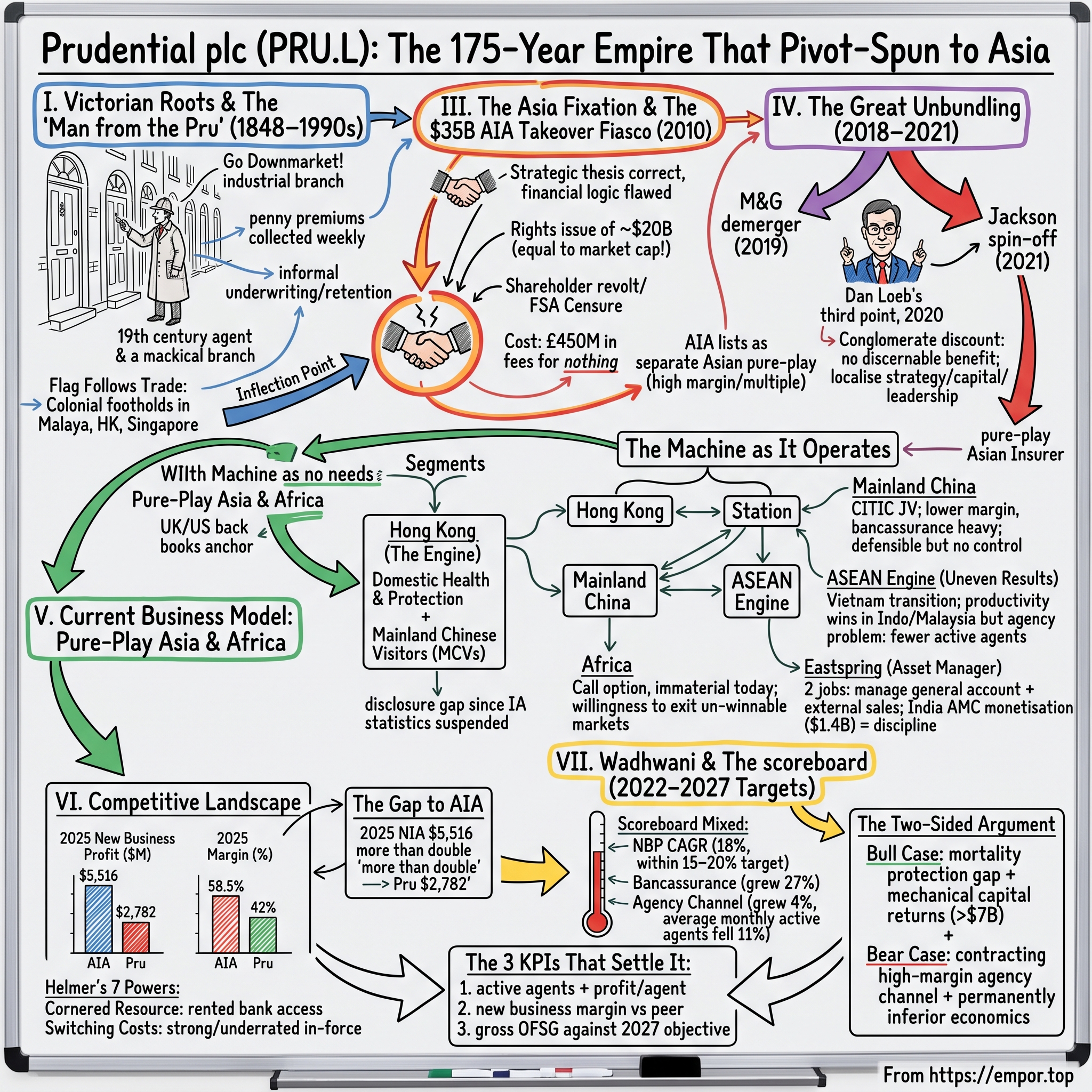
Prudential plc: The 175-Year Empire That Pivot-Spun Its Way to Asia
I. Introduction & Episode Roadmap
On a Tuesday morning in March 2026, a British company founded in the year Karl Marx published the Communist Manifesto reported its annual results in United States dollars, from a business that no longer sells a single policy in the United Kingdom.
That sentence contains most of what makes Prudential plc strange. The company was incorporated in London in 1848 to lend money and sell life assurance to Victorian professionals. Its most famous employee was a fictional archetype — the Man from the Pru, the agent in a mackintosh who knocked on terraced-house doors every Friday to collect a penny premium. Today the group's largest single profit pool is Hong Kong, its fastest-growing distribution channel runs through the branch network of Chinese and Southeast Asian banks, its asset manager is headquartered in Singapore, and its regulator for group solvency purposes is the Hong Kong Insurance Authority.1 The London Stock Exchange listing remains, alongside a Hong Kong listing under 2378.HK, but almost nothing else about the company would be recognisable to a shareholder from 1990.
The numbers, in mid-2026, describe a business of real but not overwhelming scale. Prudential's shares changed hands around 1,043 pence in July 2026, valuing the equity at roughly £26 billion, or something close to $35 billion depending on the exchange rate you pick.2 For the 2025 financial year the group reported new business profit of $2,782 million, up 12% on constant currency, at a new business margin of 42% — two percentage points better than the prior year.3 Operating free surplus generated from the in-force book and asset management rose 15% to $3,059 million, the dividend went up 15% to 26.60 cents, and management completed a $2 billion buyback before launching another for $1.2 billion.3
Those are good numbers. They are also, and this is the uncomfortable part, materially worse numbers than the ones reported on the very same day by the company across town.
友邦保險 AIA Group — the Asian life insurer Prudential tried and failed to buy in 2010 — posted 2025 value of new business of $5,516 million at a margin of 58.5%.[^4] That is roughly double Prudential's new business profit on a margin more than sixteen percentage points higher, from an overlapping set of markets, selling broadly similar products to broadly similar customers. Sixteen years after the deal collapsed, the acquisition target has become almost twice the size of the would-be acquirer in the metric that matters most.
So the investment question in front of anyone looking at Prudential today is not whether Asia's protection and savings gap is real. It is. The question is narrower and harder: does Prudential have a mechanism — in distribution, in underwriting, in cost, in capital — that closes any part of that gap with AIA, or is the discount a permanent and accurate reflection of a permanently second-place franchise?
Chief Executive Anil Wadhwani, in the job since February 2023, has answered that question with a five-year plan, a set of 2022–2027 targets, and a great deal of language about "quality growth."[^5] Three years in, the scoreboard is genuinely mixed. New business profit has compounded at 18% since 2022, above the midpoint of the 15–20% target range.4 Bancassurance new business profit crossed $1 billion and grew 27% in 2025.4 But the agency channel — historically the heart of the franchise and still more than half of new business profit — grew just 4%, and the average number of monthly active agents fell to about 57,000, down 11% year-on-year.35 Wadhwani's own assessment on the results call was unusually blunt for a CEO: he was "pleased with the quality focus that has led to higher productivity, but less pleased with active agent numbers."4
That tension is the spine of this story. Here is how it unfolds.
First, the Victorian roots — briefly, because the penny-a-week years matter mainly for what they left behind: a brand, a set of colonial-era licences in Malaya and Hong Kong, and a UK back book that eventually became an anchor. Then the Tidjane Thiam era and the $35.5 billion bid for AIA that nearly destroyed him, cost shareholders £450 million in fees, and earned the company a regulatory censure three years later. Then the great unbundling — the M&G demerger in 2019, Dan Loeb's activist letter in 2020, the Jackson spin-off in 2021 — that turned a three-legged conglomerate into a pure-play Asian insurer. Then the machine as it actually operates today, market by market, channel by channel, with the accounting demystified. Then the competitive war-game against AIA, Manulife, and the Chinese state giants. Then management's execution record tested against its own prior promises. Then the risks, the activist stress test, the lessons, and the two or three numbers that will actually settle the argument.
Start in a London that had not yet built the Underground.
 Subscribe on LinkedIn
II. Victorian Roots & The "Man from the Pru" (1848–1990s)
Hatton Garden, London, May 1848. Europe was on fire — revolutions in Paris, Vienna, Berlin, Milan — and in a modest office in Holborn a group of businessmen registered the Prudential Mutual Assurance, Investment and Loan Association. The proposition was unremarkable: loans and life assurance for the professional middle classes, the clerks and shopkeepers who had money but no aristocratic land to borrow against.
It nearly failed. The middle-class market was crowded, and Prudential's early years were a scramble. What saved the company was a decision that looks, from a modern vantage point, like one of the great distribution insights in financial history: go downmarket.
In 1854 Prudential launched what became known as the Industrial Branch — life assurance sold to working-class families in premiums of a few pence, collected weekly, in cash, at the door. The economics were brutal on paper. Administrative cost per policy was enormous relative to premium. Lapse rates were high. But the addressable market was the entire British working class, and nobody else wanted it.
The mechanism that made it work was the agent. Prudential built an army of collectors who walked the same streets every week, knew every family on the round, and became a fixture of working-class life. The Man from the Pru was not a marketing invention; he was an operating model. He collected the premium, but he also underwrote informally — he knew who was drinking, who was sick, who had lost a job — and he retained the customer through sheer physical presence. Persistency, in an era before credit bureaus and direct debits, was a function of relationships.
This is worth dwelling on, because it is the same mechanism Prudential is still trying to run in Jakarta and Kuala Lumpur in 2026, and the reason a modern investor should care about a number as unglamorous as "active agents." Insurance is not bought; it is sold. In markets where consumers have no cultural habit of buying protection, the agent is not a sales channel — the agent is the product's only route to existence. Everything else in this story is downstream of whether Prudential can still build and hold that army.
The colonial expansion followed the flag. Through the 1920s and 1930s Prudential established life operations across British territories in Asia and Africa — the early footholds in Malaya, Singapore, India, and Hong Kong that would, seventy years later, be re-described in investor presentations as a "structural growth franchise." It is genuinely rare for a financial institution to hold operating licences and brand recognition in a market for a century. Prudential's Hong Kong, Singapore, and Malaysia businesses trace to that era, and that longevity is not decorative: in a product where the customer is asked to trust that a company will still exist in thirty years to pay a claim, a hundred-year track record of paying claims is a real asset.
Then came the long, slow curdling of the home market.
By the 1990s and 2000s the UK life industry had become a difficult place to earn a return. Product margins compressed as distribution moved to independent financial advisers who competed on price. With-profits funds carried legacy guarantees written in a high-rate era that became expensive as gilt yields collapsed. Solvency II, phased in from 2016, imposed a capital regime that penalised long-dated guaranteed liabilities and forced insurers to hold capital against risks they could not easily hedge. And the annuity market — Prudential's UK bread and butter — was gutted overnight by the 2014 pension freedoms, which removed the effective requirement for retirees to buy an annuity at all.
The result was a company with two incompatible halves. One half was a growth business in Asia, where new business profit compounded at rates that would flatter a technology company. The other half was a mature UK and European savings business generating cash but very little growth, plus a US annuity business, Jackson National Life, whose earnings swung violently with equity markets and interest rates because of the embedded guarantees in variable annuity contracts.
Institutional investors are not good at valuing that combination, and they did not try very hard. They applied something close to a sum-of-the-parts discount, and the Asian business — the part that deserved a growth multiple — never got one while it sat inside the same corporate wrapper as a book of British with-profits liabilities.
Management could see the problem. What they could not agree on, for the better part of a decade, was whether to solve it by shrinking or by buying. In 2010, under a new and ambitious chief executive, they chose to buy.
III. The Asia Fixation & The $35B AIA Takeover Fiasco (2000–2010)
Tidjane Thiam had been chief executive of Prudential for less than five months when he decided to attempt the largest acquisition in the history of the insurance industry.
Thiam was not a conventional British insurance executive. Born in Côte d'Ivoire, educated at École Polytechnique and INSEAD, a former McKinsey partner and, briefly, a cabinet minister in his home country before a coup ended that career, he arrived at Prudential via Aviva as chief financial officer and was elevated to the top job in October 2009. He was the first Black chief executive of a FTSE 100 company, he was brilliant, he was in a hurry, and he had a thesis that was — this is the part that gets lost — substantially correct.
The thesis was demographic and simple. European insurance markets were saturated: high penetration, low growth, brutal price competition. Asian markets were the opposite. Insurance penetration across most of emerging Asia was a fraction of developed-market levels. State welfare provision was thin. Urbanisation was creating tens of millions of households a year with, for the first time, savings to protect and a middle-class fear of catastrophic medical bills. The gap between the financial protection Asian families needed and what they had was measured in trillions. Prudential, uniquely among Western insurers, already had the licences and the agency infrastructure to serve it.
If you believed all that, the logical move was to get as big as possible in Asia as fast as possible. And in early 2010, an opportunity appeared that would never come again.
American International Group had been effectively nationalised in the 2008 crisis and was under instruction from the US government to sell assets and repay the taxpayer. Its crown jewel was AIA — the pan-Asian life insurer descended from the business Cornelius Vander Starr founded in Shanghai in 1919, with agency forces and licences across Hong Kong, Thailand, Singapore, Malaysia, and, crucially, a wholly-owned life licence in Mainland China that no foreign insurer had been granted since.
Thiam bid $35.5 billion.6
The strategic logic was impeccable and the financial construction was not. Prudential proposed to fund the deal with a rights issue of roughly $20 billion — an amount close to the company's entire market capitalisation at the time — asking existing shareholders to more than double their investment in a business they already owned, at a price set by a distressed seller under political pressure to maximise proceeds.
The revolt was immediate and it came from the buy side, not the sell side. Robin Geffen of Neptune Investment Management organised a coalition of institutional holders explicitly opposed to the deal, arguing that the price was too high, the leverage too great, and the integration risk unmanageable.7 The opposition spread. By late May, with the extraordinary general meeting approaching and approval looking doubtful, Thiam attempted to renegotiate the price downward. AIG refused. On 2 June 2010, Prudential walked away.6
The bill was extraordinary for a transaction that never happened: about £450 million, or roughly $660 million — approximately a third of the group's 2009 operating profit — including £153 million in break fees and £81 million in underwriting charges and currency hedges.7 Shareholders had paid a third of a year's earnings for nothing at all. Thiam very nearly lost his job; the board deferred his bonus and he survived a censure motion at the annual meeting.
The story had a coda that arrived three years later and told investors something important about governance. In March 2013 the Financial Services Authority fined Prudential group companies £30 million and publicly censured Thiam personally.8 The offence was not the bid itself but the concealment of it: Prudential had failed to tell its regulator it was pursuing a transformational acquisition, even when the FSA asked detailed questions in February 2010 about the company's Asian growth strategy and its plans for raising equity and debt capital. The regulator learned about the deal when it leaked to the press. The FSA found that Thiam bore personal responsibility for a "serious error of judgment."8
It is worth being precise about what that episode revealed, because the temptation is to file it under "hubris" and move on. The deeper failure was a belief that a strategic insight, however correct, entitles management to bypass the constraints that exist to test it — shareholder consent, regulatory disclosure, price discipline. Thiam had the right map and drove off the road.
And then came the irony that has shadowed Prudential ever since. In October 2010, four months after Prudential's withdrawal, AIG listed AIA on the Hong Kong Stock Exchange in what was then one of the largest IPOs in history. Freed to operate as a standalone Asian pure-play with local management and local capital, AIA proceeded to do exactly what Thiam had promised Prudential would do with it. It became the highest-margin, highest-multiple life insurer in Asia, the benchmark against which every peer including Prudential is now measured, and — by 2025 — a company reporting new business value roughly double its would-be acquirer's.[^4]
There is a defensible counter-reading. Denied the ability to buy scale, Prudential was forced to build it. The company spent the following decade growing its Asian agency force organically, deepening its bancassurance partnerships, and expanding market by market, which is slower but cheaper and does not require integrating two agency cultures. Whether that consolation is worth anything depends entirely on whether the organic machine can eventually match the acquired one — and that remains, sixteen years later, an open question.
What the failed bid did settle was the destination. From 2010 onward, the only strategic argument left inside Prudential was about how quickly to shed everything that was not Asia.
IV. The Great Unbundling: M&G, Jackson, and Dan Loeb's Activist Catalyst (2018–2021)
Every conglomerate discount has the same anatomy: a set of businesses that no single investor wants to own together, held together by a corporate centre that insists on the benefits of diversification.
By 2018, Prudential's version was acute. The group contained three genuinely distinct financial institutions. There was Prudential Corporation Asia — a growth business in protection and savings, capital-generative, valued by the market on new business multiples. There was M&G Prudential — the UK and European savings and investment arm, with a with-profits back book, an asset manager, and a mature annuity portfolio, valued on dividend yield. And there was Jackson National Life — a US variable annuity writer whose profitability depended on equity market levels and interest rate paths, and whose capital requirements could swing by billions on a market move, valued on nothing anybody could agree on.
An Asia growth investor looking at Prudential had to underwrite US equity-market tail risk. A UK income investor had to underwrite Indonesian agency recruitment. Nobody was buying the whole thing at full price, and the share price said so.
The first cut came in March 2018 with the announcement that M&G Prudential would be demerged. It completed in October 2019, with M&G plc listing separately on the London Stock Exchange and Prudential shareholders receiving shares in both entities.9 The strategic rationale was straightforward: strip out the low-growth, capital-heavy European liability profile so that what remained could be valued on its growth characteristics. The immediate effect on the share price was modest, which told you something — the market had been discounting the M&G problem, but it was not the biggest problem.
The biggest problem was Jackson. And on 24 February 2020, that problem acquired a very loud spokesman.
Daniel Loeb's Third Point LLC disclosed a stake of approximately 5% of Prudential's outstanding shares and published a letter to the board.10 Bloomberg put the position at around $2 billion.11 The letter's argument was surgical and, crucially, it was not really about financial engineering. Loeb's contention was that PruAsia and Jackson "share no discernable benefit from being operated under the same corporate umbrella," and that Prudential needed to localise "strategy, capital, and leadership" — code for the observation that a business earning its profits in Hong Kong and Jakarta was being run from a London head office by executives whose careers had been made in European insurance.10 He argued the separation could roughly double the value of the shares within three years.
Activist letters routinely overreach. This one landed because it articulated what long-only institutional holders had been muttering for years and because its central claim was hard to rebut: what, precisely, was the synergy between a US annuity writer and a Southeast Asian agency force?
Management did not fight it, which is itself worth noting — the board had reportedly been working on Jackson options already, and Third Point's arrival converted an internal debate into a public commitment. The mechanics took eighteen months and a pandemic. In September 2021 Prudential completed the demerger of Jackson Financial Inc., distributing shares to Prudential holders and listing the business on the New York Stock Exchange, retaining a minority stake that was subsequently sold down.12 The company then raised fresh equity in Hong Kong to strengthen the balance sheet of what remained.
What emerged was a genuinely different company. Prudential plc after 2021 was an Asia and Africa life, health, and asset management group, listed in London and Hong Kong, with senior leadership and the bulk of executive operations based in Hong Kong. The regulatory architecture followed the business: in 2021 Prudential was formally designated into the Hong Kong Insurance Authority's group-wide supervision framework, making a Hong Kong regulator the primary arbiter of the group's solvency.1 A company that had been supervised from Canary Wharf for its entire existence was now supervised from Wan Chai.
Here is the honest assessment of the unbundling, five years on. Structurally, it worked. Prudential today is a clean, comprehensible business with a coherent capital model — the 2025 free surplus ratio ended at 221%, against a stated normal operating range of 175–200%, and S&P upgraded the group's financial strength rating to AA.4 Management can no longer hide operational weakness behind portfolio complexity, and investors get exactly the exposure the label promises.
Strategically, the verdict is unresolved. Loeb's thesis was that structure was the binding constraint — remove the conglomerate, unlock the value. The structure came off in 2021. The valuation gap to AIA did not close. That suggests the constraint was never only structural, and points toward the harder, slower question of operating performance: agent productivity, product mix, expense ratios, and the quality of what actually gets sold. Which is where the story goes next.
V. Current Business Model & Segment Deep-Dive: Where the Money Moves
Before the map, the vocabulary — because life insurance accounting is genuinely obscure and most investor confusion about this sector is definitional rather than analytical.
The five numbers that matter, in plain English
When an insurer sells a thirty-year policy, it collects premiums for decades and pays claims for decades. There is no useful sense in which the first year's premium is "revenue." So the industry invented a way to book the economics up front.
Annual Premium Equivalent (APE) is the volume measure — regular premiums plus a tenth of single premiums, so a lump-sum policy is not counted as though it recurs forever. It answers: how much did we sell?
New Business Profit (NBP), also called value of new business, is the estimated present value of all future profits from what was sold this year, net of the capital cost of writing it. It answers: what is that business actually worth to shareholders? Divide NBP by APE and you get new business margin — the profitability of a dollar of sales. Prudential's 42% and AIA's 58.5% are the same calculation on similar books, which is why the comparison stings.3[^4]
Contractual Service Margin (CSM) is the IFRS 17 accounting version of the same idea: a balance-sheet store of unearned profit that gets released into the income statement as the insurer delivers service over the policy's life. Prudential's closing CSM reached $25 billion in 2025, up 14%, with a stable release rate of 9.5% feeding $2.6 billion into operating profit.4 Think of it as a reservoir: new business fills it, and a steady tap drains it into earnings. A growing reservoir with a stable tap is the cleanest visible evidence that reported profits are backed by real sales rather than accounting relief.
Operating Free Surplus Generation (OFSG) is the cash question. Regulatory capital rules force insurers to lock up capital behind their promises; OFSG measures how much of that capital is released each year as policies mature and claims are settled, plus asset management profits. It is the closest thing to free cash flow in insurance, and it is what funds dividends and buybacks. Prudential's gross OFSG of $3,059 million in 2025, against $2.7 billion of expected transfer from the in-force book, is the number that pays for the capital returns.34
Now the map.
Segment 1: Hong Kong — the engine, and the concentration
Hong Kong is where Prudential makes the most money and takes the most concentrated risk.
The 2025 segment delivered new business profit of $1.2 billion, up 12%, on sales volume growth of 8% and two points of margin expansion.4 Both proprietary channels grew: agency new business profit rose 9% with monthly active agents up 12%, and bancassurance grew 25% with a six-point margin improvement.4 Health and protection products made up over 60% of new agency cases and about 40% of bancassurance cases — a mix shift that matters because protection business earns higher margins and generates capital faster than savings business.4
The franchise has two customer bases, and they behave differently. Domestic Hong Kong residents buy medical and critical illness cover in a market where public hospital waiting lists make private coverage a practical necessity. Mainland Chinese Visitors — MCVs — travel to Hong Kong specifically to buy US dollar and multi-currency denominated savings and medical policies unavailable at home, an offshore diversification decision as much as an insurance purchase.
The MCV flow is the single most scrutinised variable in the story and the most opaque. On the H1 2025 call, BNP Paribas analyst Dominic O'Mahony asked directly whether geopolitics and currency moves had dented appetite for US dollar product; Wadhwani's answer was that MCV traffic flows had grown 10% year-on-year and demand drivers remained intact.13 Management has consistently described the Hong Kong franchise as balanced between domestic and cross-border, and the 2025 results support that.
There is, however, a disclosure problem investors should register. The Hong Kong Insurance Authority historically published separate statistics on new business premiums from Mainland visitors — for 2024 the figure was HK$62.8 billion, up 6.5%, representing 28.6% of total individual new office premiums.14 The IA then announced a comprehensive review of its data collection scope for non-local policyholders and suspended publication of separate MCV statistics, a notice that has now appeared in consecutive quarterly releases.15 The industry's single most useful independent cross-check on cross-border demand has gone dark. That does not mean anything sinister; it does mean investors are now more reliant on company-reported commentary for a flow that is subject to Beijing's capital-account policy.
Segment 2: Mainland China — the joint venture with a state partner
中信保诚人寿 CITIC Prudential Life is a 50/50 joint venture with 中信集团 CITIC Group, one of China's largest state-owned conglomerates. Foreign insurers were historically barred from wholly owning Chinese life licences, and the JV structure — with its shared control, shared board, and shared strategic agenda with a state partner — remains the entry ticket.
The 2025 performance was the group's strongest: new business profit up 27%, driven by bancassurance, where profit rose 59%.4 All top ten bank partners delivered double-digit sales growth, with CITIC Bank particularly strong.16 Agency recruits rose 14% and active agents 7%.16
But read the mix, not the headline. Participating business — where policyholders share in investment returns rather than receiving a fixed guarantee — jumped 24 percentage points to 39% of new sales, and management expects a further modest margin decline in 2026 as that shift continues.4 This is deliberate and it is defensive. Chinese government bond yields have fallen hard, and an insurer that has sold guaranteed-return savings products into a falling-yield environment faces a spread compression problem that compounds for decades. Regulators under the C-ROSS II solvency regime have pushed the industry in the same direction, cutting guaranteed rates and forcing capital charges that penalise guarantee-heavy books. Shifting to participating products transfers investment risk to policyholders, and the price of that safety is lower margin.
The business also funded itself locally, issuing RMB 5 billion of perpetual bonds in January 2026 with a further RMB 4 billion of refinancing announced for June.16 Local-currency capital raised onshore for an onshore liability book is the right structure — it means the group is not exporting balance sheet into a currency and regulatory regime it cannot control.
The analytical read: Mainland China is delivering Prudential's fastest growth, but growth that is increasingly bank-distributed and increasingly lower-margin, in a market where the state sets the product rules and two domestic giants dwarf every foreign JV. It is a real business. It is not a business where Prudential controls its own destiny.
Segment 3: The ASEAN engine — where the agency problem lives
Southeast Asia is where the multi-channel model is supposed to prove itself, and where the 2025 results were most uneven.
Indonesia grew new business profit 11% with margins four points higher, driven by medical repricing and a shift to more profitable traditional products.16 Agency profit grew 6% despite civil disruption in the third quarter, and new business profit per active agent rose 18% — a genuine productivity win.16 The bancassurance channel grew 53%, helped by momentum through Standard Chartered and UOB and a promising start from the new partnership with Bank Syariah Indonesia, the country's largest Islamic bank with roughly 20 million customers.416
Malaysia managed 5% growth for the year after a difficult first half in which market-wide disruption from medical repricing hit the whole industry's agency channel; the second half rebounded with 21% growth.16 Prudential also resolved a long-running dividend claim and raised its shareholding in the conventional life business to 70% in January 2026.4
Singapore grew just 2%, with 5% sales growth offset by two points of margin compression as the mix shifted toward savings and wealth products.16 Agency sales accelerated 27% in the second half, but bancassurance profit was flat and a new partnership with CIMB was added in the fourth quarter.16
Vietnam was, in management's own framing, a transition year: a new Insurance Law and regulatory changes suppressed industry-wide sales, and Prudential's new business fell while margins improved.16 The Vietnamese life market has been through a genuine consumer-trust crisis over bank-channel mis-selling, and the regulatory response has been to tighten distribution rules across the board.
The common thread is the agency channel, and it is the sharpest operational problem Prudential has. Across the group, agency new business profit grew 4% against bancassurance's 27%.4 Active agents fell about 11% to roughly 57,000 monthly average, with declines concentrated in the emerging ASEAN markets — the Philippines and Vietnam most acutely.5 Productivity per active agent rose 15%, more than offsetting the headcount decline, which is why profit still grew.4
Management's explanation is a deliberate quality-over-quantity transformation: stop mass-recruiting agents who sell one policy to a relative and disappear, and instead recruit full-time professionals through the PRUVenture programme, which now accounts for more than 40% of new recruits in Hong Kong after 43% growth, and which management says made new recruits in Malaysia six times more productive.4
That explanation is coherent and it is supported by the productivity data. It is also, unavoidably, the explanation an insurer would give if it were simply losing agents to competitors. JP Morgan's Farooq Hanif put the tension directly to management in August 2025: active agents flattish to down, productivity up a lot — where does that go?13 Wadhwani's answer conceded the point and committed to pushing both levers.13 By the March 2026 results, active agents had grown 9% in the second half, which is early evidence the programme is working, but not yet proof.4 This is the single operating metric on which the medium-term case most depends.
Segment 4: Eastspring — the asset manager doing two jobs
Eastspring Investments manages $278 billion, up 8% in 2025, across roughly ten Asian markets.416
It does two distinct things. First, it runs the general account — the pool of policyholder assets Prudential must invest to back its liabilities. This is captive, sticky, low-fee, and strategically vital: asset-liability matching in Asian bond markets with limited long-dated supply is a genuine technical skill, and getting it wrong is how insurers fail. Second, it sells funds to external retail and institutional clients at higher fees.
In 2025 Eastspring took net inflows of nearly $13 billion — $7 billion internal, $6 billion external — with investment performance improving to 65% of funds beating benchmark over three years, up from 61%.16 Operating profit after tax rose 12%.16
Two portfolio actions defined the year. Eastspring Korea was divested. And in December 2025 Prudential listed its Indian asset management business, ICICI Prudential Asset Management, on the Indian exchanges — a pure offer for sale by Prudential Corporation Holdings that, together with a pre-IPO placement, realised net proceeds of about $1.4 billion and left Prudential holding 35%.1718 The offering was heavily oversubscribed at listing.19
The India AMC listing is the clearest evidence in this story that management's capital allocation framework has teeth. Prudential owned a stake in a high-quality, fast-growing Indian asset manager. It concluded that the stake was worth more monetised than held at 49%, crystallised the value, and committed the entire proceeds to shareholders — half in 2026, half in 2027.4 Selling a good asset because the price is right, rather than keeping it because it is growing, is precisely the discipline that was absent in 2010.
Segment 5: Africa — a real option, honestly sized
Prudential operates across eight African markets — Nigeria, Ghana, Kenya, Uganda, Zambia, Cameroon, Côte d'Ivoire, and Togo — serving over 1.7 million customers through more than 13,000 agents and 600 bank branches.20 African APE grew 24% in 2025.16
It is immaterial to group results and management does not pretend otherwise. What makes it interesting is the discipline applied to it. Asked by UBS analyst Nasib Ahmed in August 2025 about exits in Africa, Wadhwani said the Francophone markets were exited because "we did not see that opportunity" to win and scale, while the Anglophone markets grew north of 20%.13 Prudential deployed capital into eight-plus African markets, decided some of them could not be won, and withdrew. For a company whose defining historical error was refusing to walk away from a deal, the willingness to walk away from a market is a data point worth logging.
Africa is a call option on insurance penetration below 1% across a continent adding population faster than any other. It costs little and it might be worth something in a decade. It should be valued accordingly — which is to say, at close to nothing today.
Which raises the question the whole segment map has been circling: in every one of these markets, somebody else is selling the same policy. How defensible is any of this?
VI. Competitive Landscape, Industry Structure & Helmer's 7 Powers
Picture a shopping mall in Kowloon on a Saturday afternoon. On the third floor there is a Prudential service centre. Two floors up, an AIA one. Around the corner, Manulife. In the bank branch on the ground floor, an HSBC Life adviser is running a retirement-planning conversation. Four institutions, one customer, broadly identical products, and a fight that is decided almost entirely by who gets in front of the customer first and who the customer's cousin already bought from.
That is Asian life insurance. It is not a technology market where a better product wins. It is a distribution market where access wins.
Industry structure
Barriers to entry are genuinely high, but not in the way people assume. Capital is one barrier: regulatory solvency regimes — RBC frameworks across ASEAN, C-ROSS II in China, the Hong Kong group-wide supervision regime — require insurers to hold substantial capital against long-dated promises, and that capital earns a regulated return. Licensing is another: China's foreign-ownership rules, Indonesia's local-partner requirements, and India's caps have historically forced joint ventures rather than greenfield entry.
But the highest barrier is time. Building an agency force of tens of thousands of licensed advisers with functioning leadership hierarchies, training infrastructure, and compensation systems takes decades. So does building a claims-paying reputation. A well-funded new entrant can buy capital and hire actuaries; it cannot buy thirty years of a family's experience of Prudential paying out on a grandfather's policy.
This is why insurtech disruption has been so much less consequential in Asian life than the 2018-vintage predictions suggested. Digital channels sell simple, cheap, low-margin products — term life, travel, small medical. The profit pool sits in complex, advised, long-duration protection and savings products that consumers do not buy without a human being explaining them. Prudential's own numbers illustrate the point: technology is being deployed to make agents more productive — PRUForce managed nearly 11 million leads, PRUAction delivered a 15% productivity lift in Singapore, $300 million of APE flowed through the Customer Engagement Platform, underwriting time in Hong Kong fell about 50%, and AI-enabled claims processes cut fraud, waste and abuse by more than $100 million in 2025.4 Every one of those is technology augmenting distribution, not replacing it.
Peer benchmarking
友邦保險 AIA Group is the direct comparison and the uncomfortable one. Its 2025 value of new business grew 15% at constant currency to $5,516 million, with margin expanding from 54.5% to 58.5% and Hong Kong margin at 68.5%.[^4] Annualised new premiums rose 9% to $9,484 million.[^4] In Q1 2026 AIA grew VONB 13%.21 Prudential grew new business profit 10% in the same quarter.22
The gap decomposes into three things. First, geography: AIA earns a larger share of profit in high-margin Hong Kong and Thailand, and Prudential's mix includes lower-margin bancassurance-heavy markets. Second, channel: AIA's premier agency model, built on recruiting graduates into a full-time professional career, produces higher-margin advised sales than bank-branch distribution. Third, product: AIA's mix skews more heavily to protection.
Prudential's management has effectively conceded the first point and is attacking the second and third. Barclays analyst Larissa van Deventer put the margin gap to CFO Ben Bulmer directly in August 2025 — over 19 percentage points below a key competitor at that point — and asked how much was recoverable.13 Bulmer's answer named four levers: repricing, operating leverage as renewal premiums scale, improved health and protection mix, and improved agency contribution.13 Two years of margin expansion, from 38% to 42%, suggests those levers are real. Whether they can close sixteen points is a different claim, and management has never made it.
Manulife competes hard in Hong Kong and across Asia with a strong wealth and MPF franchise. HSBC Life leverages the largest retail bank branch network in Hong Kong, and is the most direct threat to Prudential's bancassurance economics. And in Mainland China, 中国平安 Ping An Insurance and 中国人寿 China Life Insurance operate at a scale that makes every foreign JV a rounding error — Ping An alone runs an agency force and a technology platform that dwarfs the entire foreign-invested segment. Prudential's Chinese business is not competing for market leadership; it is competing for a profitable niche in premium urban segments.
Hamilton Helmer's 7 Powers, tested
Cornered Resource — partially present. The 50/50 CITIC JV licence is genuinely scarce; so is the Standard Chartered relationship, running since 1998, which under the 2014 agreement covered 11 markets across Asia and Africa on a 15-year exclusive basis, extended to African markets in 2018.232425 Exclusive bank distribution in markets where branch networks are the primary financial touchpoint is a real cornered resource. The qualification: it is rented, not owned. Bank partnerships come up for renewal, competitors bid, and the price of exclusivity is paid in upfront fees and ongoing commissions. Prudential's Q1 2026 disclosures include the cash cost of centrally funded bancassurance arrangements as a distinct item.4 A cornered resource you must re-purchase every fifteen years at auction is a weaker power than the phrase implies.
Scale Economies — present but modest. Bulmer's evidence is the clearest available: total costs growing more slowly than revenue, renewal premiums up 11% in H1 2025 creating scalable expense allowables, corporate expenditure flat over 2025, and restructuring costs falling to $171 million with guidance below $100 million in 2026.413 Eastspring's shared investment platform lowers unit costs across ten markets. This is real operating leverage, but it is incremental, not step-change.
Switching Costs — strong and underrated. A whole-life or critical-illness policy written at 35 is priced on the health of a 35-year-old. Surrendering it at 50 to buy elsewhere means re-underwriting at 50 — with fifteen years of accumulated medical history — plus surrender penalties. This is the most durable power in the portfolio and it is why in-force books throw off predictable cash for decades. It is also why the 88% retention rate, improved one point in 2025, is a more meaningful number than it looks.4
Brand — real, and the hardest to verify. A century of claims payment in Hong Kong, Singapore, and Malaysia is not marketing. Its value shows up as a lower cost of customer acquisition and higher agent recruitment appeal. The counter-evidence is that AIA has the same asset in the same markets and converts it more efficiently.
Counter-Positioning, Network Economies, Process Power — largely absent. There is no business model a competitor cannot copy, no network effect (my policy is worth no more because you bought one), and no proprietary process rival insurers cannot replicate.
Four powers, two strong, two rented. That is a defensible business, not an unassailable one.
Porter's Five Forces
Threat of new entrants: low. Capital, licensing, and the decades required to build distribution keep the field small. Digital entrants nibble at the low-margin edges.
Bargaining power of suppliers: high, and this is the structurally important one. The suppliers here are agents and partner banks, and both have leverage. Top-producing agents are mobile, courted continuously by AIA and Manulife, and can move a book of client relationships. Banks auction their branch access to the highest bidder. The industry's economics leak persistently to its distributors, which is precisely why the agency productivity and bancassurance margin lines deserve more investor attention than headline sales.
Bargaining power of buyers: moderate. Simple term products are price-transparent and commoditised. Complex advised protection and savings products are not — most buyers cannot compare two participating policies on price, and do not try.
Threat of substitutes: moderate and rising. Bank deposits, mutual funds, and state pension schemes compete for the savings dollar. In Mainland China specifically, the yield on a guaranteed savings policy versus a bank wealth-management product is a live consumer comparison.
Competitive rivalry: high. Agent poaching in Hong Kong and Singapore is continuous, and bank partnership renewals are genuinely contested auctions.
The structural conclusion: this is an attractive industry with an unattractive supplier problem. Insurers who solve distribution economics — by owning the agent relationship rather than renting it — earn superior returns. That is exactly what AIA's premier agency model does, and exactly what Prudential's agency transformation is attempting to replicate. The competitive question and the management question turn out to be the same question.
VII. Current Management, Capital Allocation & Execution Track Record
When Prudential named its new chief executive in May 2022, the choice was unusual in one specific way: the company hired an operator from the competition.26
Anil Wadhwani had spent roughly twenty-five years at Citigroup, running consumer banking businesses across Asia and the Middle East — a career built on distribution economics, branch productivity, and the unglamorous mechanics of selling financial products to mass-affluent customers at scale. He then spent five years as president and chief executive of Manulife Asia, where he ran precisely the business he would later compete against, across precisely the markets Prudential cares about.
That background explains the shape of everything he has done since taking office in February 2023. Wadhwani is not an actuary and not a capital markets engineer. He is a distribution executive, and his entire programme is a distribution programme: recruit better agents, make them more productive, deepen bank partnerships, use technology to increase advisers' selling time. When he says "quality growth" — and he says it constantly — the operational translation is: fewer agents selling more, higher-margin policies.
CFO Ben Bulmer, an actuary by training and a long-tenured Prudential insider, provides the counterweight. His public role has been to convert Wadhwani's operational narrative into a capital framework investors can model, and he has been notably willing to give forward numbers that can be checked.
The targets, and the scoreboard
The 2022–2027 framework set two headline objectives: new business profit compounding at 15–20% a year, and gross operating free surplus generation above $4.4 billion by 2027.4
Three years in, the NBP CAGR from 2022 to end-2025 stood at 18%, just above the midpoint of the range.4 That is delivery. On capital generation, management guided from August 2023 that 2025 would be the inflection point on the path to the 2027 objective; 15% gross OFSG growth in 2025 hit that marker.4 Bulmer's arithmetic for the remaining path is unusually explicit: repeat 2025's new business levels in 2026 and neutralise operating variances, and 2027 gross OFSG would exceed $4 billion; add double-digit new business growth and a return to positive variances and you clear $4.4 billion.4
That is a falsifiable claim, and investors should hold it to that standard. The load-bearing assumption is "a return to positive variances" — the gap between what the in-force book actually delivers and what the actuarial models expected. Underlying variances improved to negative $45 million in 2025 from negative $113 million, driven by stronger health claims management.4 The direction is right. But variances have been negative through the objective period, and the 2027 target requires them to turn positive.
Capital allocation
The capital story since 2024 is the most concrete evidence available about this management team.
The dividend rose 13% in 2024 and 15% in 2025, to 26.60 cents, with guidance for greater than 10% growth in both 2026 and 2027.34 A $2 billion buyback launched in 2024 was completed by the end of 2025, ahead of schedule.4 In January 2026 a $1.2 billion programme launched, comprising $500 million of recurring capital returns plus $700 million of the India AMC proceeds, to complete by December 2026; roughly 20 million shares were repurchased for $312 million in the first quarter.2227 A further $1.3 billion is expected in 2027 — $600 million recurring plus the $700 million balance of IPO proceeds.4 Total planned returns between 2024 and 2027 exceed $7 billion, against a market capitalisation around $35 billion.24
The framework behind it is stated and specific: capital above the 175–200% free surplus operating range is assessed regularly and returned if judged to be excess over the medium term.4 Holding company free cash flow was $1.6 billion in 2025 from $2.1 billion of remittances, and management guides to remitting roughly 70% of business-unit OFSG to the centre.4
Two observations. First, this is a genuine escalation of commitment: the plan went from "more than $5 billion" at the half year to "over $7 billion" once the India proceeds were confirmed, and management delivered the increment rather than absorbing it.134 Second, and less comfortably, buying back 5% of the share count annually is what a company does when it cannot find higher-returning uses for capital — while simultaneously telling investors it operates in the world's fastest-growing insurance markets. New business IRRs above 25% with payback periods under four years are excellent, and only $0.8 billion was reinvested into new business in 2025, up 5%.4 The capital returns are the right decision given the reinvestment opportunity actually available. But the size of the returns relative to the size of the reinvestment is itself a statement about how much profitable growth this business can absorb.
What the calls reveal
Earnings calls are where narrative meets scrutiny, and Prudential's have been informative.
The consistent pattern in the prepared remarks is disciplined repetition — the same four or five KPIs, the same guidance framework, quarter after quarter. That consistency is a credibility asset. Investors can check this management against its own prior words, and so far the words have held.
The Q&A is where the texture appears. Michael Chang of CGSI pressed on how buyback quanta are determined and whether Prudential would adopt a formulaic payout ratio; Bulmer declined to give one beyond 2027, offering "a durable framework" instead — a defensible answer, but an answer that preserves discretion.13 Van Deventer asked what could prevent Prudential reaching its 2027 objectives; Wadhwani's response listed markets where he was explicitly not satisfied — Malaysia and Vietnam — rather than deflecting.13
That willingness to name underperformance is the most useful credibility signal in the file. A CEO who says on the record that he is "not satisfied on agency performance in a few of our markets," and who repeats a version of that admission six months later when the active agent number is worse, is behaving like someone running a diagnosis rather than a campaign.134 It does not make the strategy correct. It does make the reporting trustworthy, which is the precondition for evaluating anything else.
Which brings us to what could go wrong.
VIII. Current Risk Radar & Skeptical Investor Stress Test
Every insurance business is a bet that the future resembles the assumptions in the model. Here are the places where Prudential's assumptions are most exposed.
Risk 1: The Chinese yield curve. This is the most mechanically dangerous risk in the portfolio and the least visible. A life insurer that has sold guaranteed-return savings policies must reinvest maturing bonds at prevailing yields for decades. If Chinese government bond yields stay structurally low, the reinvestment yield on the back book falls below the guaranteed crediting rate, and the spread that funds profitability inverts. Japanese life insurers spent the 1990s and 2000s demonstrating exactly how this ends. Prudential is managing the exposure — the pivot to participating products shifts investment risk to policyholders, and asset derisking actions taken in Mainland China in 2024 moderated spread income growth.4 But management's own guidance is for further margin decline in China through 2026 as the participating mix rises.4 The defence works; it costs profitability. Separately, C-ROSS II capital requirements continue to tighten what a foreign JV can write and how much capital it must hold, which is part of why the business now funds itself with onshore perpetual bonds.16
Risk 2: Cross-border policy. Mainland residents buying Hong Kong insurance policies is, from Beijing's perspective, a capital outflow with an insurance wrapper. The practice sits inside a regulatory grey zone that has been tightened before — the 2016 UnionPay restrictions on card payments for insurance premiums are the precedent — and could be tightened again with little notice. Because Hong Kong is Prudential's largest profit pool and MCV is a substantial share of it, a policy shift here is the highest-severity single-point risk in the story. The suspension of separate MCV statistics by the Insurance Authority reduces investors' ability to monitor it independently.15 Meanwhile 粤港澳大湾区 Greater Bay Area integration and proposed cross-boundary insurance service centres point the other way — toward formalisation rather than restriction. Both scenarios are live; neither is forecastable.
Risk 3: Bancassurance renewal economics. Bancassurance was the 2025 growth story, crossing $1 billion of new business profit at a five-point margin improvement, and had already delivered about 95% of the lower end of its 2027 objective.4 That success creates its own exposure. Exclusive bank distribution is bought with upfront access fees and ongoing commissions, and the contracts are finite. When a partnership comes up for renewal, the bank runs an auction, and the incumbent's alternative to overpaying is losing a channel that now generates over a third of group new business profit. The channel that is currently outperforming is also the channel where Prudential has the least pricing power over its own economics.
Risk 4: Currency. Prudential reports in US dollars and earns in Indonesian rupiah, Malaysian ringgit, Vietnamese dong, Thai baht, and Chinese renminbi. Emerging-market currency depreciation compresses reported results even when local operations perform. This is why management reports growth on constant exchange rates — legitimate for measuring operations, but a shareholder's return is denominated in actual currency. Eastspring's funds under management illustrate the gap: $277.7 billion at end-2025 fell to $268.9 billion by the end of Q1 2026, on market volatility and adverse foreign exchange, despite net inflows.22
Risk 5: Execution. The transformation programme is not finished. Roughly $400 million of a planned $1 billion capability investment had been deployed by mid-2025, with $300–350 million more expected to largely complete the programme in 2026.134 Management has explicitly said it will not spend the full billion if it does not need to — sensible, but it means the programme's cost, and therefore its returns, are still moving targets.
The activist stress test
Suppose Third Point returned in 2026. What would the letter say?
"You fixed the structure and the discount survived." The strongest bear argument is empirical. The conglomerate came apart between 2019 and 2021, senior operations moved to Hong Kong, and Prudential still trades at a meaningful discount to AIA on new business multiples. The market is not confused about the structure. It is expressing a view about operating quality — specifically, that a 42% margin business does not deserve a 58.5% margin business's multiple.3[^4] Management's counter is that margin has expanded four points in two years and geography explains part of the gap. Both things are true. Neither settles it.
"Your agency force is shrinking and you are calling it strategy." This is the sharpest available attack. Active agents fell 11% in 2025.5 Agency new business profit grew 4% while bancassurance grew 27%.4 Management attributes the decline to a deliberate shift away from mass recruitment, and the productivity data supports it: profit per active agent rose 15%, MDRT qualifiers are more than seven times as productive as non-qualifiers, and Prudential has the second-largest MDRT force globally.4 But "second-largest MDRT force" is a scale statistic; the skeptic's metric is MDRT density — qualifiers as a share of agents — and on that measure the peer comparison is less flattering, which is precisely why AIA converts similar sales volumes into materially higher margin. The falsifiable test is simple: if the transformation is real, active agent numbers stabilise and then grow while productivity holds. The 9% second-half increase in active agents is the first supporting evidence.4 One half-year is not a trend.
"You are returning $7 billion because you cannot deploy it." An activist could argue the buyback is a confession. Prudential operates in the fastest-growing insurance markets on earth and is choosing to shrink its share count rather than fund growth. Management's defence — that new business IRRs exceed 25% and the business simply does not consume much capital to grow — is actually the correct one, and it is a feature of protection-led business rather than a bug. But it does cap the compounding rate, and investors should price a capital-returning insurer differently from a capital-absorbing compounder.
IX. Playbook: Business & Investing Lessons
Strip away the geography and four transferable lessons remain.
Lesson 1: Pruning creates clarity, not necessarily value. Prudential ran the textbook conglomerate-simplification playbook — two demergers, a headquarters relocation, a regulatory redomicile — and executed it competently. The result is a company that is far easier to analyse and a management team with nowhere to hide. What it did not produce was multiple expansion to peer levels. The lesson for investors is that structural discounts and operational discounts look identical from the outside and behave completely differently. If the discount is structural, a spin-off closes it. If it is operational, a spin-off simply removes the excuse. Prudential's experience since 2021 strongly suggests the residual gap is operational — which means the remedy is a decade of agent productivity, not another corporate action.
Lesson 2: In emerging markets, distribution is the product. Every insurer in Hong Kong sells substantially the same critical illness policy. The differentiation is entirely in who sits across the table from the customer and whether that person is trusted. This is why the industry's supplier power problem is its defining economic feature, and why the most important competitive question about any Asian insurer is not "what do you sell?" but "who sells it, and do they work for you or for themselves?" An agency force is simultaneously a company's greatest asset and its most mobile one.
Lesson 3: Strategic conviction is not a substitute for price discipline. Thiam's read on Asian demographics was right, and it is the read that governs Prudential's strategy to this day. He was still wrong about the deal, because a correct thesis executed at the wrong price and financed the wrong way destroys capital just as efficiently as a wrong thesis. The £450 million of costs for a transaction that never closed is the purest available illustration.7 The contrast with 2025's India AMC monetisation — selling a growing asset at a good price and returning the proceeds — is what disciplined capital allocation looks like from the other side.17
Lesson 4: Capital-light beats capital-heavy in a low-rate world, and the mechanism is worth understanding. A guaranteed-return savings policy requires the insurer to hold capital against the risk that investment returns fall short of the promise; a health or protection policy requires capital against mortality and morbidity, which are far more predictable and largely uncorrelated with markets. The result is that protection business converts to cash faster and is worth more per dollar of premium. Prudential's numbers make the point: 36% of 2025 new business profit came from health and protection, another 50% from fee-based participating and linked savings products that limit direct market exposure.4 The addition to 2027 capital emergence from new business grew 16% against 12% profit growth — new business converting to cash faster than it converts to profit.4 Two years of new business added $0.3 billion to expected 2027 free surplus emergence.4 That is the compounding engine, and it is only available to insurers willing to sell the harder, less headline-friendly product.
X. Bear vs. Bull Case & Key KPIs to Watch
The bull case
The demand side is the strongest part of the argument and it does not depend on management. Prudential estimates a $43 trillion mortality protection gap across its markets, with growth rates expected at roughly twice the global average.4 Whatever discount one applies to a company-sourced estimate, the underlying facts are not seriously disputed: Asian households are wealthier, older, and more urban than a generation ago, state health provision has not kept pace, and the private protection market is structurally undersupplied. This is a market that grows whether or not Prudential executes well.
The distribution position is genuinely difficult to replicate. Prudential describes itself as the leading life bancassurance franchise in Asia, and the 2025 evidence supports the claim — 13 markets delivering double-digit growth in the channel, a partnership with Standard Chartered running since 1998, new partnerships with Bank Syariah Indonesia and CIMB, and health and protection now representing one in two policies sold through banks.416 Against Porter's supplier-power problem, having long-dated exclusive contracts with the region's major banks is the best available defence.
The capital story is now visible and mechanical rather than promissory. The CSM reservoir is growing 9% underlying — top of the guided range for a third consecutive year — while releasing at a stable rate.4 Gross OFSG hit its inflection point on schedule. Over $7 billion of returns is committed against a $35 billion market capitalisation, funded from generation rather than balance-sheet depletion, with the free surplus ratio comfortably inside its operating range and an S&P upgrade to AA confirming it.24
And the valuation gap is itself the opportunity: on the seven-powers reading, switching costs and brand are strong and durable, scale economies are improving, and the rented cornered resources are at least long-dated. If margin continues expanding two points a year and the agency force stabilises, the gap to peer multiples narrows on operating grounds rather than sentiment.
The bear case
The bear case is not that Asia disappoints. It is that Prudential participates in Asia at permanently inferior economics.
The agency channel is the crux. A life insurer whose agent count fell 11% in a year, whose agency profit grew 4% against bancassurance's 27%, and whose CEO says he is "less pleased with active agent numbers" is describing a franchise in which the highest-margin channel is contracting while the lowest-margin channel carries growth.345 Push that trend forward and Prudential becomes, in effect, a wholesale product manufacturer distributing through other people's banks — a structurally lower-margin business with weaker customer ownership and recurring renewal risk.
The margin gap compounds this. Sixteen points of new business margin against the direct peer is not a rounding difference; it is the difference between an excellent business and a good one, and it persists after two years of improvement.3[^4] Some of it is geography, which is not fixable. Some is channel mix, which is fixable only by solving the agency problem — the very problem currently unsolved.
The macro overlay is unhelpful. Chinese growth deceleration and property-sector stress weigh on consumer confidence and on the JV's asset side. Low Asian yields compress spreads on the savings book. And the MCV flow that supports Hong Kong is a function of Chinese policy toward capital movement, monitored with less independent data than a year ago.15
Finally, competition is intensifying from below as well as above. Domestic Chinese insurers operate at scale with technology stacks and distribution reach no foreign JV can match, and regional players increasingly compete for the same agents in the same malls.
Reading the frameworks against the two cases
The framework analysis does not resolve the debate; it locates it precisely. Prudential's strong powers — switching costs on the in-force book, brand, improving scale economies — protect the existing book of business and the cash it generates. They say very little about the price of new business, which is set in the competitive market for agents and bank shelf space where supplier power is high and rivalry is intense. So the bull case is really a claim about the in-force book and the capital it releases, and the bear case is really a claim about new business economics. Both can be right simultaneously, which is roughly what the current valuation implies: a business whose existing cash flows are secure and whose competitive future is contested.
The three KPIs that settle it
1. Monthly average active agents, and new business profit per active agent, together. Neither number alone means anything. Rising productivity with collapsing headcount is a shrinking franchise dressed as a quality strategy; rising headcount with falling productivity is mass recruitment relapse. What validates the transformation is both rising, or headcount stable with productivity rising. The 2025 baseline is roughly 57,000 active agents, down 11%, with profit per active agent up 15% and a 9% second-half recovery in agent numbers.45 This is the single most diagnostic disclosure in the reporting pack.
2. Group new business margin, and its trajectory against the peer. Margin captures product mix, channel mix, and pricing discipline in one figure. It stood at 42% for 2025 and 38% for Q1 2026 — quarterly figures run below full-year because of seasonal mix, so compare like with like.322 The question to ask each period is not whether margin rose, but whether the gap to AIA's disclosed margin narrowed.
3. Gross operating free surplus generation, against the stated 2027 objective of above $4.4 billion. This is where growth becomes cash and where management's most checkable promise sits. The 2025 figure was $3,059 million, with expected transfer from the in-force book guided to $3.1 billion in 2026.34 Watch the variance line inside it: management's path to the objective requires operating variances to turn positive, and they were negative $45 million in 2025.4 If variances stay negative into 2027, the target is missed regardless of how good sales look.
XI. Outro & Key Takeaways
The Man from the Pru collected pennies because nobody else would walk those streets. That was the original insight: distribution reaches where products cannot, and the company that owns the relationship owns the economics. A hundred and seventy-eight years later, the streets are in Jakarta, Kuala Lumpur, and Guangzhou, the pennies are US dollar-denominated critical illness premiums, and the collector carries an AI-assisted lead-generation app. The business is the same business.
What changed is everything around it. Prudential spent the 2010s discovering that the Asian franchise it had built almost by accident during the imperial era was worth more than the British company that owned it — and the 2020s dismantling that company to prove the point. The dismantling worked, in the narrow sense that Prudential today is exactly what it claims to be. The harder proof is still pending. Structural clarity was the easy part; agent productivity, margin convergence, and the conversion of new business into free surplus are the slow part, and they are being executed in the shadow of a competitor that has done all of it better for fifteen years.
The evidence as of mid-2026 is genuinely two-sided. Three years of double-digit growth delivered against explicit guidance, an 18% new business profit CAGR, a capital generation inflection reached on the promised date, and over $7 billion committed to shareholders is a real execution record.4 A shrinking agent force, a sixteen-point margin deficit, and a channel mix drifting toward rented bank distribution is a real structural concern.3[^4]5 Management has not obscured either side, which is itself the most encouraging thing in the file.
For long-term investors, the useful posture is neither the growth story nor the value trap but the diagnostic one: this is a company with secure in-force cash flows and contested new business economics, and the contest will be settled in the agency numbers over the next several reporting periods rather than in any strategic announcement. Watch the agents, watch the margin gap, watch the free surplus. The rest is narrative.
References
-
Prudential is Designated into the Hong Kong Groupwide Supervision Framework for Insurance Groups — Prudential plc, 2021 ↩↩
-
Prudential (PUK) Market Cap & Net Worth — StockAnalysis, 2026-07 ↩↩↩
-
Prudential plc 2025 Full Year Results — Prudential plc, 2026-03-18 ↩↩↩↩↩↩↩↩↩↩↩↩
-
Full Year 2025 Results Presentation Transcript — Prudential plc, 2026-03-18 ↩↩↩↩↩↩↩↩↩↩↩↩↩↩↩↩↩↩↩↩↩↩↩↩↩↩↩↩↩↩↩↩↩↩↩↩↩↩↩↩↩↩↩↩↩↩↩↩↩↩↩↩↩↩↩↩
-
Prudential PLC (PUK) Full Year 2025 Earnings Call Highlights — GuruFocus, 2026-03 ↩↩↩↩↩↩
-
Prudential Aborts $35.5bn AIA Bid After Shareholder Revolt — Financial Times, 2010-06-02 ↩↩
-
Prudential Says Collapse of AIA Bid to Cost 450 Million Pounds — Bloomberg, 2010-06-02 ↩↩↩
-
FSA fines Prudential £30 million and censures CEO for failing to inform regulator of 2010 acquisition plans — Financial Conduct Authority, 2013-03-27 ↩↩
-
Prudential Completes M&G Demerger to Focus on Growth Markets — Reuters, 2019-10-21 ↩
-
Third Point Sends Letter to Prudential plc Highlighting Opportunity to Separate US and Asian Businesses — Business Wire, 2020-02-24 ↩↩
-
Dan Loeb's Third Point Takes Stake in Prudential, Pushes for US Split — Bloomberg, 2020-02-24 ↩
-
Prudential Completes Demerger of US Business Jackson Financial — Reuters, 2021-09-13 ↩
-
Prudential PLC Half Year 2025 Results Analyst and Investor Call Transcript — Prudential plc, 2025-08-27 ↩↩↩↩↩↩↩↩↩↩↩↩
-
Insurance Authority releases provisional statistics for 2024 — Hong Kong Insurance Authority, 2025-04-25 ↩
-
Hong Kong insurance market extends growth run as data gap widens — Insurance Business Asia, 2026 ↩↩↩
-
Prudential plc 2025 Full Year Results Presentation — Prudential plc, 2026-03-18 ↩↩↩↩↩↩↩↩↩↩↩↩↩↩↩↩
-
Prudential announces successful listing of ICICI Prudential Asset Management's equity shares on Indian stock exchanges — Prudential plc, 2025-12-19 ↩↩
-
ICICI Prudential Asset Management Company IPO Details — ICICI Direct, 2025-12 ↩
-
ICICI Prudential AMC IPO spurts on market debut — Business Standard, 2025-12-19 ↩
-
Prudential Africa CEO Maps 2026 Growth Agenda in Ghana Visit — News Ghana, 2026 ↩
-
AIA delivers very strong VONB growth of 13 per cent in the first quarter of 2026 — AIA Group Limited, 2026-04-30 ↩
-
Prudential plc Q1 2026 Business Performance Update — Prudential plc, 2026-04-29 ↩↩↩↩
-
Prudential and Standard Chartered Celebrate 25 Years of Strategic Bancassurance Partnership — Prudential plc, 2024-11-01 ↩
-
Standard Chartered and Prudential Bancassurance Agreement — Standard Chartered PLC RNS via Investegate, 2014 ↩
-
Prudential and Standard Chartered Extend Exclusive Bancassurance Partnership to the African Continent — Prudential plc, 2018 ↩
-
Prudential Names Former Manulife Executive Anil Wadhwani as Chief Executive — The Wall Street Journal, 2022-05-25 ↩
-
Prudential announces launch of USD 1.2 billion share buyback programme — Prudential plc, 2026-01 ↩
 LinkedIn
 WhatsApp
 Reddit
 Hacker News
 Email
Email Kindle
 RSS Feed
 Spotify
 Apple Podcasts
 Amazon Music
 Audible
 YouTube