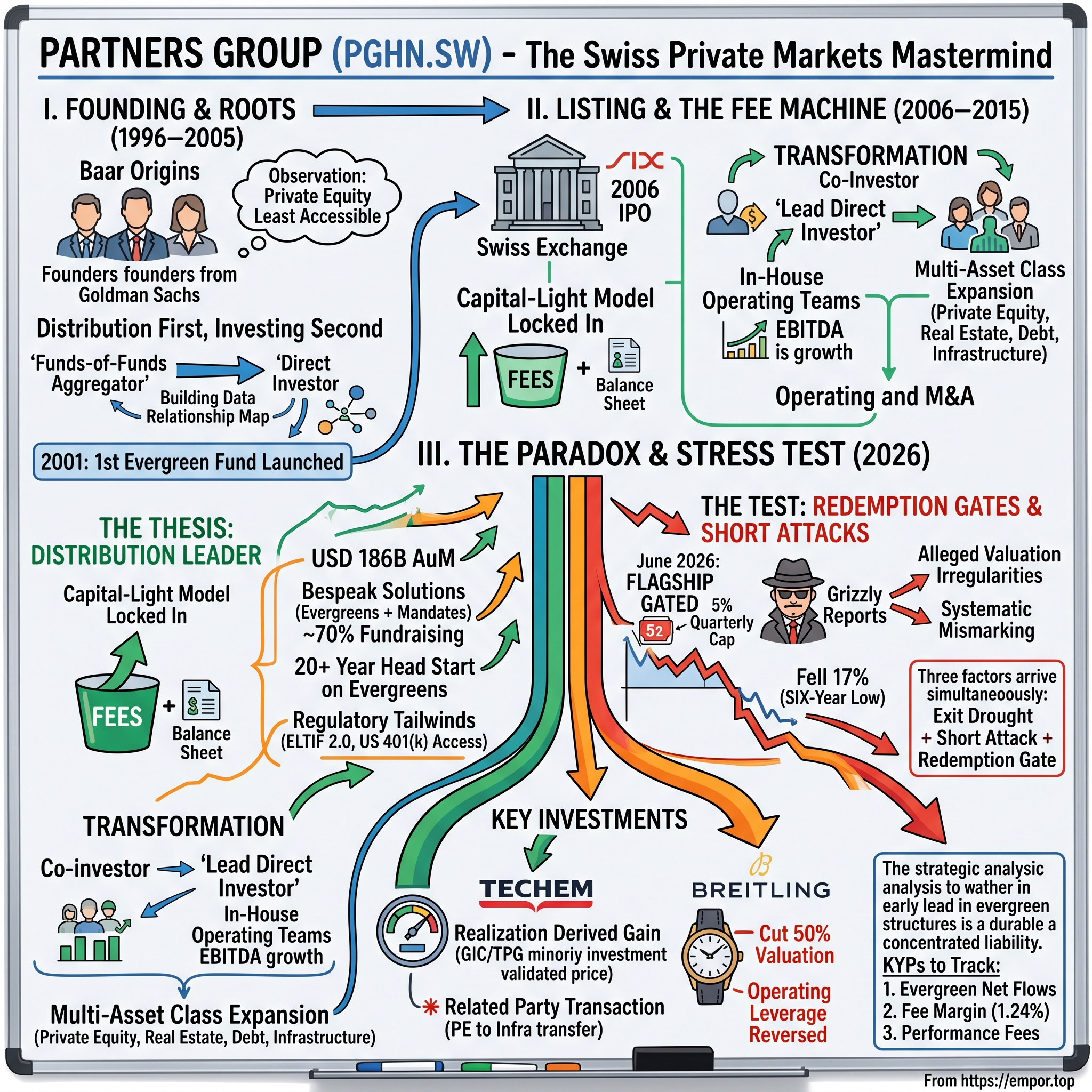
Partners Group: The Swiss Private Markets Mastermind
I. Introduction & Episode Roadmap
On the morning of June 3, 2026, traders on the SIX Swiss Exchange watched something they had not seen in twenty years. Shares of Partners Group Holding AG — the quiet Baar-based firm that had spent two decades compounding at roughly 18% a year and paying an ever-rising dividend — fell more than 17% in a single session, hitting six-year lows by lunchtime.1
The trigger was not a fraud, a covenant breach, or a failed deal. It was a sentence in a fund document. Partners Group had told holders of its flagship evergreen private equity vehicle that they could not all have their money back at once.
Quarterly redemption requests in the Luxembourg-domiciled Partners Group Global Value SICAV had reached roughly 9.8% of net asset value. The fund's rules capped withdrawals at 5% per quarter. Partners Group applied the cap.2
That is the paradox at the center of this story. The single feature that made Partners Group special — its two-decade head start in building open-ended "evergreen" private markets funds for individual investors — became, in one quarter, the reason its equity was repriced harder than almost any other listed alternative asset manager.
The Swiss anomaly
Partners Group manages roughly USD 186 billion of assets as of June 30, 2026.3 It was founded in 1996 by three Goldman Sachs alumni in the canton of Zug, a low-tax jurisdiction better known for commodity traders and holding companies than for global finance.4
It never built a Wall Street balance sheet. It never assembled an insurance annuity engine the way Apollo did. It does not lend against its own book at scale. What it built instead was a fee machine: capital-light, high-margin, and structurally biased toward recurring management fees rather than lumpy carried interest.
In 2025, that machine produced revenues of CHF 2,563 million and EBITDA of CHF 1,611 million — an operating margin just under 63%.5 Very few businesses of any kind sustain that. Even fewer distribute almost all of it, which Partners Group does through a dividend that reached CHF 46.00 per share for 2025.5
The thesis — and the test
The bull case has always rested on one claim: that Partners Group solved distribution before its competitors did. It launched its first evergreen private markets fund in 2001, the industry's first US 1940 Act evergreen private equity fund in 2009, Europe's first private equity ELTIF in 2016, and its first US defined-contribution offering in 2015.4
By the end of 2025, evergreen vehicles held USD 56.2 billion of assets and accounted for 59% of the year's fundraising.67 The pipe was built. Then, in the first half of 2026, USD 3.8 billion flowed back out of it.3
So the question this story has to answer is not whether Partners Group was early. It clearly was. The question is whether being early to a structure that can experience runs is a durable advantage or a concentrated liability — and whether a stock trading around CHF 683 in late July 2026, roughly 40% below its 52-week high of CHF 1,158, is pricing distress or discovering a flaw.[^8]
Roadmap
The story runs in six movements. First, the founding and the Swiss DNA — how a fund-of-funds aggregator turned itself into a direct investor. Second, the 2006 listing and the capital-light model it locked in. Third, the segment economics: where the fees actually come from and why the margin is what it is.
Fourth, the hidden engine — evergreen architecture, private wealth distribution, and the regulatory land grab in US retirement plans and European ELTIFs. Fifth, capital allocation on the ground, tested against three specific investments that went three different ways.
And finally, the stress test: a short-seller alleging systematic mismarking, a redemption gate that actually fired, and a market that no longer takes management's marks on faith. That last part is where the analysis has to be hardest, so the story begins where the confidence came from.
 Subscribe on LinkedIn
II. Baar Origins & Swiss Private Banking Roots (1996–2005)
Picture Zug in 1996. A lake, a medieval old town, roughly 90,000 people in the whole canton, and a tax regime that had already attracted a dense population of holding companies. It was not a financial center. Zurich was forty minutes north. London was a different universe.
Into this setting walked Marcel Erni, Alfred Gantner, and Urs Wietlisbach, three Swiss bankers who had done time at Goldman Sachs and concluded that the most interesting asset class in the world was also the least accessible.4
Leaving the best seat in finance
It is worth pausing on how odd the decision was. In 1996, a Goldman Sachs vice presidency was among the most valuable positions in global finance. Walking away from it to sell an unfamiliar product, from an unfamiliar address, to conservative Swiss institutions was not an obvious career move.
The three did not have a proprietary trading edge, a technology, or a balance sheet. What they had was an observation about a market failure — and, crucially, a shared willingness to be the people who solved a plumbing problem rather than the people who made the glamorous investments.
That temperament persists in the firm's culture and shows up in its product decisions for the next thirty years. Partners Group has consistently chosen to be first into a structure rather than first into a deal.
The access problem
In the mid-1990s, private equity was not an asset class in the modern sense. It was a network. If a Swiss pension fund or a Geneva private bank wanted exposure to a US buyout fund, it faced three problems: it did not know which managers were good, it could not get into the good ones, and it could not write a check large enough to be interesting.
The last constraint is the one that mattered most and is least appreciated today. Top-tier US buyout funds set minimum commitments in the tens of millions of dollars and rationed allocations to existing relationships. A Swiss pension fund with a modest alternatives sleeve was simply not a customer they wanted.
Partners Group's founding insight was that this was a distribution and information problem before it was an investing problem. The firm's first product, launched in 1997, was a listed private equity fund domiciled in Luxembourg and Switzerland — a way to put an illiquid asset class inside a wrapper a Swiss private banker could actually sell.4
That sequencing matters. Most American private markets giants started as investors and later built distribution. Partners Group started as a distributor and built the investing muscle afterwards. Almost everything that follows — the evergreen funds, the private wealth channel, the mandate business — descends from that original orientation.
Buying other people's mistakes
The second building block was secondaries. In 1998, Partners Group completed what it describes as the era's largest private equity secondary transaction.4 Secondaries mean buying existing commitments from investors who want out — usually at a discount, usually because the seller has a liquidity problem rather than because the assets are bad.
The economics were attractive, but the strategic value was greater. Every secondary deal required Partners Group to underwrite a portfolio of funds it did not manage, which meant building a database of how thousands of underlying companies actually performed. Fund-of-funds allocation did the same thing from the other direction.
By 1999 the firm had enough conviction to make its own direct investments in private equity, real estate, and mezzanine debt.4 That was the pivot. Fund-of-funds is a structurally difficult business: the manager charges a fee on top of the underlying manager's fee, controls nothing, and gets squeezed the moment clients learn enough to go direct.
Partners Group saw the ceiling early and started climbing over it. The data it had accumulated as an allocator became the sourcing edge it used as a principal — a genuinely non-obvious use of a business that most people would have run for the fees alone.
The transition also carried a commercial risk that is easy to miss in hindsight. A fund-of-funds manager depends on being welcome in other managers' funds. The moment it starts bidding for the same companies, it becomes a competitor rather than a client. Partners Group navigated that by concentrating its direct activity in the middle market, where the mega-funds were not looking, and by continuing to be a large and useful buyer of secondaries — a service that even rivals valued.
Being simultaneously a customer, a liquidity provider, and a competitor to the same universe of managers is an unusually delicate commercial position. That it held is one of the more underappreciated achievements of the firm's first decade.
Building the wealth channel before anyone wanted it
While Blackstone, KKR, and Carlyle courted CalPERS and the big US state plans, Partners Group was doing something that looked, at the time, like a rounding error. In 2001 it launched its first evergreen private markets fund — an open-ended structure designed so an individual investor could subscribe and, subject to limits, redeem.4
Consider how strange that was. The entire premise of private equity is that illiquidity is the source of the return. Locking capital up for ten years is what lets a manager rebuild a company without worrying about quarterly marks. An open-ended private equity fund is, structurally, a promise to provide liquidity from an illiquid pool.
The firm's answer was portfolio construction: hold a revolving mix of seasoned assets, listed proxies, and cash so that ordinary redemptions could be met from natural cash generation rather than forced sales. It worked for two decades, through the global financial crisis and the pandemic. Whether it works under a coordinated withdrawal is the question that arrived in 2026.
The offices followed the strategy — New York in 2000, Singapore in 2004, the first infrastructure investment the same year.4 What the firm was really building in this period was a relationship map: Swiss and European private banks that would, fifteen years later, become the shelf space through which tens of billions of individual investor dollars flowed.
By 2005 Partners Group had the ingredients — data, direct investing capability, an evergreen structure, and a distribution network. What it lacked was permanent capital of its own and a currency to pay its people. That is what the next chapter solved.
III. The SIX Listing & The Direct Investing Pivot (2006–2015)
On March 24, 2006, Partners Group listed on the SIX Swiss Exchange with an initial market capitalization of roughly CHF 1.7 billion.8 At the time, going public was a contrarian act for a private markets firm — Blackstone would not list until 2007, KKR until 2010, and both would spend years defending the decision.
Why list at all
The standard argument for listing an asset manager is liquidity for founders. That was not the primary logic here, and the evidence is in what the firm did afterwards.
Partners Group did not use the listing to lever up. It used it for three things: institutional credibility with pension trustees who wanted an audited, regulated, publicly scrutinized counterparty; a liquid equity currency to pay and retain investment professionals; and modest seed capital to launch new strategies alongside clients.
The choice to remain capital-light — to avoid warehousing large balance-sheet positions or building a credit book funded with corporate debt — defined the P&L that exists today. It also defined the constraint: without a balance sheet to deploy, growth has to come almost entirely from persuading other people to hand over money.
By its own account at the March 2025 Capital Markets Day, the firm compounded its share price at roughly 18% annually and its dividend at roughly 17% annually from listing through early 2025, when its market capitalization stood near CHF 35 billion.8 Those are the numbers that built the reputation. They are also, on the current CHF 18 billion market capitalization, a reminder of how much of that compounding the market has taken back in eighteen months.[^8]
The crisis that validated the model
The listing was tested almost immediately. The global financial crisis arrived within two years, and it hit private markets managers in a specific way: exits stopped, so performance fees vanished, while portfolio marks fell and clients stopped committing new capital.
What protected Partners Group was the structure of its fee base. Closed-end commitments are contractual. A pension fund that has committed to a ten-year fund cannot decide in a bad year to stop paying management fees on that commitment. Revenue from that base kept arriving through the worst of the crisis.
That experience shaped the firm's subsequent obsession with recurring fees over opportunistic ones, and it is why the 2009 launch of a US 1940 Act evergreen private equity fund — in the depths of the crisis, when almost nobody wanted private equity — reads in hindsight as a considered bet rather than an accident of timing.4
It also seeded a belief that proved half-right and half-dangerous: that structural design, more than market conditions, determines whether an asset manager survives a shock. In 2008 the structure held because clients could not leave. In 2026 the newer structure was tested precisely because they could.
From passenger to driver
The more consequential shift in this decade was investment, not financial. Partners Group moved from co-investing beside other sponsors to leading its own buyouts.
Leading a deal is a fundamentally different business. As a co-investor you underwrite someone else's thesis and accept their governance. As a lead you own the board, hire the CEO, and are accountable for the operating plan. The fees are far higher; so is the reputational exposure when a company underperforms.
To support this, Partners Group built in-house operating capability — teams whose job was to sit inside portfolio companies driving pricing, procurement, digitization, and add-on acquisitions. The firm brands this "transformational investing," and the strategic claim behind it is specific: that returns should come from growing earnings rather than from buying at one multiple and selling at a higher one.
That claim is testable, and Partners Group has offered a metric for it. In its April 2026 response to short-seller allegations, the firm stated that 81% of gains in its flagship strategy were realization-derived — crystallized through actual exits — versus an industry average it put at 23%.9
An independent reader should treat a self-selected, self-computed statistic with caution, particularly one published in the middle of a defense against valuation allegations. But it is at least a falsifiable claim of the right shape: the honest test of a private markets manager is not what it marks assets at, but what it sells them for.
Widening the aperture
The same period saw Partners Group build out beyond private equity. Infrastructure grew from that first 2004 investment into a platform focused on energy transition and digital assets. Private real estate and private debt followed, and the firm made its first US defined-contribution offering in 2015 and launched Europe's first private equity ELTIF in 2016.4
The strategic logic of multi-asset-class expansion in private markets is not diversification for its own sake. It is that large institutions increasingly prefer to hire one manager across several categories rather than assemble a roster — which converts a fund-selling relationship into something closer to an outsourced allocation mandate.
That preference is the seed of the bespoke mandate business that now dominates Partners Group's fundraising. But mandates and funds only matter to a shareholder through the fee lines they produce, and those lines have a very particular shape.
IV. Segment Economics & Financial Engine
Strip away the narrative and Partners Group is two revenue lines with completely different personalities.
The first is management fees: a percentage charged on fee-paying assets, billed regardless of performance, arriving with the reliability of a subscription. In 2025 this line produced CHF 1,744 million, up 7% as reported and 12% in constant currency.5
The second is performance fees: the manager's share of profits, recognized only when investments are actually sold and hurdles cleared. In 2025 this line produced CHF 819 million, up 60%, representing 32% of total revenue.5
The subscription business
The management fee margin — fees divided by fee-paying assets — ran at 1.24% in 2025.10 Understanding why that number is high and stable is most of the investment case.
Traditional long-only asset managers have watched fee margins collapse toward a handful of basis points because their product is substitutable and index funds set the price. Private markets fees have held up because there is no index alternative, because clients are locked in for years, and because managers are selling access to deals rather than exposure to a market.
The consequence is operating leverage of a kind rarely seen outside software. Fixed costs — people, offices, compliance across dozens of jurisdictions — are covered by the management fee line alone. Every additional franc of performance fee falls close to the bottom line.
That is why the EBITDA margin sits where it does: 62.8% in 2025 against 63.6% in 2024.5 It is also, quietly, a mild warning. Margin drifted down even as performance fees surged 60%, which implies the cost base grew faster than the recurring fee line. On a 20% revenue increase, net profit rose only 12%.5
Where the assets sit
At the end of 2025 the USD 184.9 billion of assets broke down as private equity USD 85.8 billion, private credit USD 40.2 billion, infrastructure USD 35.7 billion, real estate USD 22.2 billion, and a small royalties business at USD 1.0 billion.6
Six months later, the composition had shifted more than the headline suggested. Total assets reached USD 186 billion, but private equity had fallen to USD 79.2 billion while infrastructure rose to USD 41.4 billion.3
That is a meaningful mix change in half a year. Private equity is the highest-fee, highest-carry asset class; infrastructure and credit are steadier but generally carry lower economics. Assets falling in the segment that generates the most performance fee potential, while growing in segments that generate less, is a headwind to future fee margin that the aggregate number hides.
The tail-down problem
There is a structural drag in this business that outsiders consistently underestimate. Closed-end funds wind down. As a vintage matures and sells its assets, its fee base shrinks — and the fees typically step down from committed capital to invested capital along the way.
Partners Group discloses this explicitly. For 2026 it guided to gross new client demand of USD 26–32 billion against tail-down effects of USD 10–13 billion.6 So the firm has to raise roughly USD 12 billion just to stand still.
This is the number that separates gross fundraising headlines from actual economics, and it is to management's credit that they publish it. Guidance discipline of this sort — showing the offsetting negative alongside the flattering positive — is one of the more reliable signals of a management team that expects to be held to its numbers.
The three-container model
One structural feature deserves explanation because it drives so much of the fee analysis. Partners Group raises money through three different containers, and they behave very differently.
Traditional programs are the classic closed-end funds — finite life, fixed vintage, and the source of the tail-down drag. They held USD 60.2 billion at the end of 2025.6
Mandates are bespoke arrangements where a single large institution hires Partners Group to run a custom private markets allocation, often across several asset classes. They held USD 68.5 billion.6 Mandates are stickier than funds and, because they are negotiated individually, generally carry lower headline fee rates in exchange for far larger and longer-lived tickets.
Evergreens are the open-ended vehicles, at USD 56.2 billion.6
Together, mandates and evergreens are what the firm calls "bespoke solutions," and they accounted for 72% of capital raised in 2025 and 52% in the first half of 2026.63 The strategic direction is unmistakable: away from selling products on a three-year cycle, toward being embedded in a client's allocation permanently.
The trade-off is a subtle margin question. Mandates dilute headline fee rates while extending duration; evergreens support fee rates while introducing redemption risk. A shareholder is effectively being asked to accept lower or riskier fee margins in exchange for longer, more predictable relationships. Whether that trade is good depends entirely on whether the duration is real — which is exactly what 2026 put in doubt on the evergreen side and left untouched on the mandate side.
Cash out the door
The capital allocation policy is simple to the point of austerity: earn it, pay it out. The proposed 2025 dividend of CHF 46.00 per share rose 10% year over year and represents the overwhelming majority of net profit of CHF 1,261 million.5 The effective tax rate was 18%.5
A near-total payout is a strong statement of confidence in the recurring fee base — you do not commit to a rising dividend if you expect management fees to be volatile. It is also, in a downturn, a rigidity. Partners Group has no large retained buffer to lean on, and its balance sheet capital is largely committed alongside clients rather than sitting idle.
That commitment is real alignment. It is also correlated exposure: when portfolio marks fall, the firm's own investments fall with the fee base and with the performance fee outlook, all at once. The people setting that policy are the subject of the next section.
V. Modern Management & Incentive Structure
There is a photograph problem with Partners Group. Search for its leadership and you find a company that looks, in 2026, almost nothing like its founding myth: a Utah-born American runs it from a firm headquartered in a Swiss town of 25,000 people, and its most visible public advocate is a former CEO who now chairs the board.
David Layton
Layton joined Partners Group in 2005, initially working from New York as Head of Private Equity Americas.11 In 2016 he founded the firm's Americas headquarters near Denver, in Broomfield, Colorado — a campus that grew to roughly 150 staff.11
He became co-CEO on January 1, 2019, succeeding Christoph Rubeli and serving alongside André Frei, and became sole CEO on July 1, 2021 when Frei stepped back to become Chairman of Sustainability.11
Two things about that biography matter analytically. First, Layton is a direct private equity investor by training, not a distribution executive or a financier — which shows in how he talks about deals. On the H1 2026 update, his framing was defensive on valuations: the firm remains "highly selective as new investments are often demanding high valuations, particularly in private equity."3
Second, he is American, and the strategic priority of his tenure has been the United States — retirement plans, registered investment advisors, and the wealth platforms that sit between. A Swiss firm chose a CEO whose native market is the one it most needs to win. That is either excellent succession planning or an admission that Europe alone cannot deliver the growth ambition.
Steffen Meister
Meister ran Partners Group as CEO before moving to the board, and as executive chairman he has become the firm's public philosopher of "democratization" — the argument that private markets should be available to ordinary savers, not just institutions.8
Executive chairmen are a governance flag worth naming. A chairman who is also an executive dilutes the board's independence from management, and a skeptical investor should note that the person leading the board is not structurally positioned to challenge strategy from the outside.
In practice, Meister has been the firm's front line in a fight. When the short-seller Grizzly Research published its allegations, it was Meister who announced that Partners Group would sue, telling a Swiss newspaper the firm had "decided to take legal action against those responsible at Grizzly Research."12
There is an established body of academic work arguing that companies which sue their short-sellers underperform afterwards — Grizzly itself has publicized exactly that literature. That does not make the allegations correct. But it is a reason for an investor to weigh the substance of the rebuttal rather than the volume of the response.
Alignment, and its limits
Partners Group states that its employees collectively remain the firm's largest investor group.13 The founders — Erni, Gantner, and Wietlisbach — have retained substantial personal stakes and remain involved; Gantner, for instance, chairs the board of portfolio company Breitling.14 Precise current founder percentages are not aggregated in the materials reviewed here.
Employee ownership at this scale is genuine alignment. Compensation is weighted toward long-vesting equity and shares of performance fees, which ties the people making investment decisions to whether those decisions eventually produce cash rather than marks.
But alignment is not the same as accuracy. Performance-fee-linked compensation rewards realizations, which is good; carried interest accrual and reported valuations are set within the same house, which is why the valuation question keeps returning.
The bench
Two other figures shape how the story is told to investors. Joris Gröflin, the chief financial officer, has been the voice explaining the mechanics of performance fee timing — including the candid framing of the 2025 pull-forward.5 Juri Jenkner, as president, has carried the message on the long-range growth plan, describing the 2025 results as setting the firm "firmly on the path" toward the 2033 asset target.6
The division of labor is instructive. The CFO discusses what happened and why it will not repeat; the president discusses the destination. That is a normal corporate arrangement, but for an analyst it means the two narratives should be checked against each other rather than consumed separately. A pipeline accelerated into one year is, by definition, a pipeline not available in the next — and enthusiasm about a 2033 target does not change that arithmetic.
The credibility scorecard
Judge management by behavior over time and the record is mixed rather than damning.
On the positive side: Partners Group publishes forward guidance ranges for fundraising, publishes the offsetting tail-down figures, publishes quarterly business updates, and has hit its ranges. In September 2025 it pulled its performance fee guidance range of 25–40% of revenues forward into that year rather than waiting.10 It then delivered 32%.5
On the negative side, that pull-forward has a cost the company acknowledged. CFO Joris Gröflin explained that large transactions from the pipeline of mature assets were accelerated into 2025 — which flattered 2025 and left 2026 guided to the lower end of the same range.5
Pulling exits forward when the exit window opens is defensible investing. Presenting the resulting year as evidence of momentum, then guiding down the following year, is the kind of sequencing that erodes trust if it repeats. It has not yet repeated. It is worth watching.
Where management's narrative faces its real test is not in the fee lines at all. It is in the product that made the firm famous.
VI. The Hidden Growth Engine: Private Wealth & Evergreen Structures
For twenty years, the evergreen fund was Partners Group's proudest achievement and its least understood one. In 2026 it became the most scrutinized structure in European finance. To understand why, it helps to strip out the jargon entirely.
What an evergreen fund actually is
A traditional private equity fund is a closed box. You commit capital, it gets drawn down over a few years, companies are bought, improved, and eventually sold, and money comes back over roughly a decade. You cannot leave. Nobody new can join.
An evergreen fund is an open box. New investors subscribe monthly or quarterly. Existing investors can request their money back, also periodically. The fund never winds down; it perpetually recycles capital into new assets.
For an individual investor this is transformative. There are no capital calls to manage, no ten-year lockup, no J-curve of early losses before returns arrive, and the money is deployed immediately into a mature, already-diversified portfolio.
For the manager it is even better. A closed-end fund forces you back on the road every three or four years to raise the next vintage. An evergreen fund compounds its own fee base — assets grow, fees grow, and no re-selling is required. It converts a project business into a subscription business.
The mechanism nobody read closely
The catch is arithmetic. A fund holding illiquid private companies cannot honor unlimited withdrawals, so evergreen structures contain a gate: typically, redemptions in any quarter are capped at around 5% of net asset value, with excess requests prorated and rolled forward.
The gate is not a defect. It is the load-bearing element that makes the structure possible at all, and Partners Group has been explicit about its purpose. Liquidity features exist, in Layton's framing, "to protect long-term investors, and to ensure that returns continue to be driven by the quality of the underlying private assets rather than by short-term flow dynamics."2
That is analytically correct and, in a stressed quarter, entirely beside the point. A gate has a reflexive property: because being prorated is costly, and because everyone knows the cap exists, the rational response to rising redemptions is to request redemption early. The mechanism designed to prevent a run creates an incentive to join one.
The reservoir analogy
The cleanest way to picture the structure is a reservoir. Water flows in from new subscriptions and from the cash the portfolio itself throws off — dividends, refinancings, asset sales. Water flows out as redemptions. The reservoir holds a buffer of cash, liquid credit, and listed securities so that ordinary outflows never require draining the deep end, where the illiquid private companies sit.
In normal conditions the reservoir self-regulates: inflows exceed outflows, the buffer refills, and nobody thinks about the depth. The design fails only in a specific scenario — when inflows stop and outflows spike at the same moment.
That is precisely what a broad market drawdown produces. Individual investors stop subscribing because they feel poorer, and they redeem because they need cash or want out. The two flows are correlated by construction, which means the buffer is stressed exactly when it is least able to be replenished.
Every manager running these structures knows this. The industry's answer has been the gate, plus careful management of what sits in the shallow end. Neither answer eliminates the correlation; they only slow it down.
The scale Partners Group built
By the end of 2025 the evergreen platform held USD 56.2 billion, sat across more than thirty funds in five asset classes, and generated 59% of the year's fundraising.671 Roughly 65,000 individual investors were on the platform alongside more than 1,200 institutional clients.8
Importantly, the client base is not retail-dominated in aggregate. Partners Group has disclosed that institutional investors represent over 80% of assets, with private wealth under 20%.2 In Q1 2026, institutions drove more than 80% of inflows.15
That mix is a genuine shock absorber, and it is the strongest argument against the most alarmist reading of 2026. But it cuts the other way on the growth story: if private wealth is under a fifth of assets after twenty-five years of leading the category, the democratization thesis is a long way from delivered.
The regulatory land grab
Two policy developments frame the opportunity. In Europe, the ELTIF 2.0 regime rewrote the rules for long-term investment funds sold to individuals, and Partners Group had launched Europe's first private equity ELTIF back in 2016.4
In the United States, President Trump signed Executive Order 14330, "Democratizing Access to Alternative Assets for 401(k) Investors," on August 7, 2025.16 It directed the Department of Labor to reexamine ERISA fiduciary guidance within 180 days and consider rescinding the 2021 statement that had discouraged private equity in defined contribution plans, and directed the SEC to consider revising accredited investor and qualified purchaser thresholds.16
The addressable market is enormous — US defined contribution assets run into the trillions. Partners Group has been positioning for it since its first DC offering in 2015.4
But note how management framed the timeline. Speaking in September 2025, weeks after the order, Layton said widespread adoption of private assets in 401(k) plans could take a decade.17 For a CEO with every commercial incentive to talk up a tailwind, that is notably restrained — and it is the single most useful sentence for calibrating how much of the retirement opportunity belongs in a valuation today.
What actually happened
In the first half of 2026, evergreen strategies attracted USD 4.2 billion of client demand and suffered USD 3.8 billion of redemptions, with 79% of the withdrawals concentrated in three mature strategies.3
Roughly flat net flows, in a platform of USD 56 billion, is not a collapse. But the concentration is informative: the pressure came from the oldest, most seasoned vehicles — precisely the funds whose investors have held longest, have the largest embedded gains, and are most able to leave.
Management now expects the evergreen platform to slow overall net asset growth by 1–2% in the second half of 2026, with a similar effect through 2027.2 Growth has not stopped. But the machine that was supposed to compound automatically has, for at least eighteen months, gone into reverse gear.
The other half of the case is what happens inside the portfolio companies themselves — and there, the record is genuinely uneven.
VII. Case Studies in Value Creation & M&A Discipline
Three investments tell the real story of Partners Group's operating capability, and they resolve in three different directions. Any honest assessment has to hold all three at once.
Techem: the marquee realization, with an asterisk
In 2018, Partners Group's private equity business led the acquisition of Techem, a German company founded in 1952 that reads energy and water meters in apartment buildings — an unglamorous business serving over 440,000 customers across 18 countries and more than 13 million dwellings.18
The transformation thesis was that Techem was not really a metering company but a data company. Every meter is a sensor. Every sensor produces building efficiency data. In a Europe legislating hard on decarbonization, that data has value beyond billing.
The execution delivered. Between 2018 and the 2025 transaction, Techem's revenues exceeded EUR 1 billion and EBITDA grew approximately 50%.18 That is organic earnings growth, not multiple expansion — the exact proof point the transformational investing framework requires.
The transaction itself was announced in October 2024 and completed in 2025 at an enterprise value of EUR 6.7 billion, with GIC, TPG Rise Climate, and Mubadala investing alongside.18[^20]
Here is the nuance most coverage missed. This was not a clean exit. Partners Group retained a controlling stake in Techem — but moved it from its private equity business into its infrastructure business.18 Co-investors La Caisse and Ontario Teachers' Pension Plan sold out; Partners Group stayed.
Transferring an asset from one of your own funds to another, at a valuation you helped set, with third-party minority investors validating the price, is a legitimate and increasingly common structure. The third-party capital is meaningful evidence that the mark was real. But it is a related-party transaction in substance, and an investor should count it as a partial realization rather than a full one.
Breitling: the case that went the other way
In October 2021, Partners Group bought a significant minority stake in Breitling, the Swiss watchmaker, from CVC Capital Partners. On December 23, 2022, it increased that position to become Breitling's largest shareholder, with CVC remaining invested alongside.14 Reporting at the time put the implied valuation near USD 4.5 billion.
Alfred Gantner — one of the three founders — took the chairmanship of Breitling's board, with CEO Georges Kern continuing to run the business.14 The plan was omni-channel expansion, geographic growth, and new products drawing on the brand's archives.14
It has not worked so far. By February 2026, reporting indicated the holding's value had been cut by as much as 50% versus 2023 levels, with CVC marking its remaining stake at roughly 0.5x invested capital and Partners Group at roughly 0.7x, reflecting its lower 2021 entry price.19
The causes were a combination of self-inflicted and external: aggressive boutique expansion that underperformed, soft luxury watch demand, US tariffs on Swiss exports, sales down 3% in 2025 with UK sales down 25%, and a Moody's downgrade citing a sharp earnings decline made worse by increased fixed costs.19
Read that last clause carefully, because it is the mirror image of the Techem story. The operational playbook — build owned boutiques, premiumize, take control of distribution — raised the fixed cost base. When demand softened, that operating leverage worked in reverse.
This is the fair test of "operations over financial engineering." Operational value creation is not risk-free; it is a different risk. It converts a multiple bet into an execution bet, and execution bets can be lost. A founder chairing the board did not prevent it.
Empira: buying capability rather than assets
On December 3, 2024, Partners Group agreed to acquire Empira Group, a vertically integrated residential real estate manager founded in 2014 and also headquartered in Zug, with a portfolio carrying a gross development value of roughly EUR 14 billion and more than 250 employees across 13 offices.20 The deal closed in early 2025.
Terms were not disclosed, and the company said it did not expect a material impact on 2025 financial results.20 The acquisition contributed roughly USD 4 billion of platform assets.
The strategic logic was capability, not scale: Empira builds residential property rather than merely owning it, giving Partners Group development expertise in European housing at a moment when policy across the continent favors new supply. Empira continues under its own brand.20
The financial discipline is notable in what it was not. Partners Group did not do a transformational, share-issuing asset management roll-up during the cheap-money years. It bought a specific capability, at an undisclosed but evidently immaterial price, after rates had normalized. Management's stated M&A framework — adding "select high-performance investment engines with complementary strengths" — has so far been matched by behavior.8
What the three have in common
Look past the outcomes and one discipline recurs: Partners Group prefers to buy control of businesses whose demand is created by regulation or structural necessity rather than by consumer sentiment.
Techem sells into a European building stock that is legally required to measure and reduce energy consumption. Empira develops housing into markets with acute supply shortages and policy support for construction. Both are, in effect, bets that governments will keep needing something built or measured.
Breitling was the exception — a discretionary luxury purchase whose demand depends on how wealthy consumers feel in a given quarter, and whose pricing power in the United States turned out to be sensitive to tariffs on Swiss exports.19
That is the analytically useful observation. Partners Group's operating playbook — install management discipline, expand owned distribution, digitize, bolt on acquisitions — raises fixed costs in exchange for higher long-run margins. That trade works beautifully when volumes are underwritten by regulation and painfully when they are set by consumer mood.
The pattern
Across the three, a consistent shape emerges. Partners Group is genuinely good at industrial and infrastructure-like assets with contracted or regulation-driven demand, where operational improvement compounds. It has been considerably less good at consumer-facing, brand-dependent, cyclical businesses.
That is not a criticism so much as a scouting report — and it matters because private equity assets fell from USD 85.8 billion to USD 79.2 billion in the first half of 2026 while infrastructure grew.63 The mix is shifting toward what the firm does well and away from where it earns most.
Which brings the story to the harder question: if the assets are what they say they are, why is the market pricing them as though they are not?
VIII. The Investor's Stress Test: Realization Drag & Market Risks
The most uncomfortable fact about Partners Group in mid-2026 is not any single event. It is that three separate pressures — an industry-wide exit drought, a short-seller alleging systematic mismarking, and a redemption gate that actually fired — arrived within ninety days of one another and are not independent.
The realization bottleneck
Start with the mechanical problem. Performance fees are recognized on exit. When rates rose from 2022, transaction velocity fell across the industry and hold periods extended well beyond the traditional four to five years.
For Partners Group this produced a whipsaw. The exit window reopened in 2025, the firm accelerated large transactions from its mature pipeline, and performance fees jumped 60% to CHF 819 million.5 Then in the first half of 2026 the window narrowed again, and performance income fell below 20% of total revenues — under the 25–40% guidance band.3
Realizations tell the same story in cash: USD 26 billion returned to clients in 2025, up 47%, versus USD 9 billion in the first half of 2026.63 Investment activity was equally subdued at USD 9 billion deployed.3
There is a defensible reading of low deployment — Layton's stated selectivity at high valuations is exactly what a disciplined investor should do late in a cycle. But it has a second-order consequence: capital that is not deployed does not generate future performance fees, so restraint today extends the earnings trough into future years.
The short attack
On April 30, 2026, Partners Group publicly responded to a report by Grizzly Reports, a short-selling firm, which alleged valuation irregularities across the evergreen platform — understated software exposure, inflated EV/EBITDA multiples, discrepancies between preferred and common equity movements, and rising payment-in-kind loans indicating portfolio stress.9 The report reportedly compared the situation to Wirecard and suggested a large share of assets could be significantly mismarked.
Partners Group called the publication "frivolous, defamatory, and highly misleading" and rebutted point by point.9 The evergreen platform contributed 34% of revenue, it said, not "nearly half." Software exposure across its private credit platform was 9.9%, below the industry average on S&P Capital IQ classifications.9
On specific assets the rebuttal was concrete, which is the part that carries evidentiary weight. Zenith Longitude Limited, a holding vehicle for the logistics firm Apex Logistics, was exited in Q4 2025 consistent with its carrying value. The Russian subsidiary of STADA Arzneimittel — roughly 10% of revenues — had been written to zero since nationalization, and 90% of the overall position was exited in Q1 2026 above its valuation. The atNorth data center asset was fully realized in Q1 2026 above previous marks. On Unit4, the firm said Grizzly had used EBITDA figures 13% below current levels.9
Weigh this carefully. Naming assets and citing exits above carrying value is the strongest available defense of a private valuation, because it substitutes cash outcomes for opinions. Grizzly's counter-argument — that a manager can exit its best-marked assets first — is unfalsifiable in the short run.
What is not in dispute is that a short-seller moved the equity of a CHF 18 billion company materially, that Partners Group initiated legal proceedings rather than only publishing data, and that the market has since demanded a discount to reported book economics.12[^8]
The gate
Then came June. Redemption requests in the Global Value SICAV, a fund of roughly USD 8.6 billion, hit approximately 9.8% of NAV for Q2 2026 against a 5% quarterly cap.1 A Delaware-domiciled private equity evergreen vehicle saw repurchase requests around 6% of NAV.2 Three mature evergreen funds holding USD 9.7 billion in aggregate saw estimated Q2 redemptions between 3.5% and 5%.2
Partners Group applied the caps, with unfulfilled requests rolling into the next quarter.1 The shares fell over 17% — the worst single day since the 2006 listing — and dragged Blackstone, KKR, and Ares down in sympathy.1
Two pieces of context matter enormously here, and both cut in Partners Group's favor on the specific facts while cutting against the structure in general.
First, this was not idiosyncratic. Through the first half of 2026, proration became the operating norm across the industry. Blackstone's BCRED received redemption requests equal to 7.9% of assets in Q1 2026 and lifted its cap to meet them; Blue Owl's OCIC faced requests for 21.9% of shares; the Cliffwater Corporate Lending Fund saw 14% against a 7% cap; Blue Owl suspended quarterly redemptions on OBDC II on February 18, 2026.21 Against that field, roughly 10% at Partners Group's flagship is mid-pack, not an outlier.
Second, the honest structural point is the one an S&P analyst made about the category: gating is a legitimate liquidity management tool that nonetheless creates real risk of investors being unable to access money when they need it.21 Sector observers were blunter — the whole semi-liquid label was oversold to advisors who did not read the terms.21
The refinancing wall beneath the portfolio
There is a slower-moving risk under all of this that gets less attention because it does not generate headlines. Companies acquired between 2019 and 2021 were bought at high multiples and financed at interest rates that no longer exist.
As those debt packages mature, they refinance at materially higher cost. The effect on equity value is arithmetic: more of the company's cash flow goes to lenders, less accrues to the owner, and the equity cushion thins. A business whose earnings have grown strongly absorbs this comfortably. A business whose earnings have gone sideways does not.
Breitling illustrates the mechanism in miniature — a Moody's downgrade attributed to earnings decline made worse by a higher fixed cost base.19 Rising payment-in-kind loans, one of the specific items Grizzly flagged, are the accounting fingerprint of the same pressure: interest deferred rather than paid in cash.9
Partners Group's counter is that its portfolio skews toward infrastructure-like assets with contracted revenues, where cash flows service debt reliably. The evidence supports that for the infrastructure book. It says less about the private equity book, which is where both the leverage and the performance fee potential concentrate.
What an activist would attack
A skeptical investor building the short case would not lead with the gate. They would lead with three quieter things.
First, valuation governance. The firm both sets marks and earns fees on those marks, its evergreen NAVs are struck frequently, and there is no listed comparable to check against. Independent third-party validation is asserted, but the reported valuation of the Breitling stake at roughly 0.7x invested capital shows the marks do move — which is reassuring on process and unflattering on outcomes.19
Second, cross-fund transactions. Techem moving from a private equity vehicle to an infrastructure vehicle under common management is defensible with third-party capital validating the price, but the more often such structures appear, the harder it becomes to distinguish realizations from reshuffling.
Third, the dividend. Paying out nearly all earnings while the fee base faces a 1–2% growth drag and performance income runs below guidance is a bet that the trough is shallow.23 It leaves little internal capital for opportunistic acquisitions in exactly the environment where distressed managers become cheap.
Beyond those, the ordinary risk radar applies with real force: portfolio companies bought at 2019–2021 multiples face refinancing walls at higher rates; regulators in the US and Europe are increasing scrutiny of private asset valuations and retail distribution; and the Breitling experience shows that operationally intensive strategies amplify demand shocks.
The counter to all of this is that the underlying business still compounds. Whether it does depends on whether the advantages are structural or merely historical.
IX. Strategic Frameworks: 7 Powers & Porter's 5 Forces
Frameworks are only useful if they are allowed to return an unflattering answer. Applied honestly to Partners Group in 2026, several of them do.
Hamilton Helmer's 7 Powers
Switching costs — genuinely high, and the most durable power the firm has. A closed-end commitment is contractual for ten to twelve years. A bespoke mandate embeds the manager in a client's asset allocation, reporting, and governance. Mandate assets reached USD 68.5 billion by the end of 2025, and bespoke solutions represented 72% of that year's capital raised.6
This is why the fundraising number held up in 2026 even as the equity fell 40%. Clients committing USD 16 billion in the first half of 2026 — up from USD 12 billion a year earlier — were not reacting to a share price.3 That divergence between operational and market outcomes is the single most important fact for anyone assessing whether the franchise is impaired.
Cornered resource — real, but eroding. The twenty-year head start in evergreen structures and the depth of Swiss and European private bank relationships were a genuine cornered resource for two decades. They are not cornered anymore. Blackstone, KKR, Apollo, Blue Owl, and BlackRock all now run large semi-liquid wealth vehicles, and several run bigger ones.
Scale economies — medium. At USD 186 billion, Partners Group is large enough to see most mid-market deals and to fund dedicated operating teams, but it is a fraction of the size of the largest US managers. In a business where the fixed cost of global compliance and distribution keeps rising, being fifth-largest in a consolidating industry is a more precarious position than being first.
Brand — high, and currently under stress. Swiss financial brands trade on perceived prudence. That premium is exactly what a mismarking allegation attacks, which is why the response was so forceful. Brand power that requires litigation to defend is real but expensive.
Process power — the open question. The claim that transformational investing produces realization-derived rather than mark-derived gains is the closest thing to process power here.9 Techem supports it. Breitling contradicts it. Two data points do not settle a question this large.
Counter-positioning and network economies — largely absent. Partners Group does not do something its rivals cannot copy without cannibalizing themselves; the mega-managers copied the evergreen model directly. And unlike an exchange or a marketplace, its clients derive no benefit from other clients joining.
Porter's Five Forces
Rivalry: high and intensifying. The competitive front has moved from deal sourcing to wealth-platform shelf space, where the largest managers can spend more on wholesalers, technology, and marketing than Partners Group can.
Buyer power: rising. Large institutions negotiate fee breaks. Wealth platforms — the gatekeepers to the individual investor channel — increasingly do the same, because they choose which two or three managers get distributed. A stable 1.24% fee margin is the number to watch for evidence of erosion.10
Supplier power: low to moderate. Sellers of quality mid-market companies have choices, but Partners Group competes on operating capability and long hold horizons rather than only price.
Threat of new entrants: low for the platform, moderate for the products. Nobody builds a twenty-year track record and multi-jurisdiction compliance apparatus from scratch. But an existing giant can launch a competing evergreen fund in months, which is precisely what happened.
Substitutes: moderate and underrated. The honest substitute question in 2026 is not index funds. It is whether the illiquidity premium still exists after fees when public equities have delivered strong returns with daily liquidity — and whether investors who have just experienced a gate will keep paying for a structure whose main selling point was that it felt liquid.
Where it sits against the field
Peer comparison sharpens the picture. Blackstone, KKR, Apollo, and Brookfield each manage several times Partners Group's assets, and each has an engine Partners Group does not: Apollo's insurance liabilities, Blackstone's real estate scale, KKR's balance sheet, Brookfield's operating businesses. Those engines generate capital internally rather than requiring it to be raised.
Partners Group's answer has been to compete on structure and service rather than scale — bespoke mandates, five asset classes under one roof, and a willingness to build custom vehicles for individual clients. That is a real differentiator with large institutions who want an outsourced allocator rather than a fund menu.
The European comparison is more direct. EQT is the closest analogue in size and listing, and it competes on similar ground in mid-market and infrastructure deals. CVC, now also listed, competes for the same European buyouts — and, as the Breitling co-investment showed, sometimes stands on the same side of the table.
The competitive conclusion is uncomfortable but clear. In institutional mandates, Partners Group is a legitimate leader. In wealth distribution, it invented the category and is now the fifth or sixth largest participant in it. Being the pioneer of a market you do not lead is a difficult position, because the pioneering is already in the price and the leadership is not in the numbers.
The net reading: Partners Group has one very strong power (switching costs on institutional mandates), one deteriorating one (its distribution head start), and an unresolved one (process). That is a good business facing a narrowing edge, not an impregnable one.
X. The Playbook: Business & Investing Lessons
Four lessons generalize beyond this company.
1. Own the distribution pipe first — but understand what you have promised. Building evergreen vehicles fifteen years ahead of the competition created a fundraising engine that kept working when institutional allocators paused. It also created an obligation to provide liquidity from illiquid assets. Distribution advantages built on a structural promise are only as durable as the promise, and the promise is only tested in the bad quarter.
2. Operations over leverage is a different risk, not less risk. Techem's roughly 50% EBITDA growth over seven years is what the model looks like when it works.18 Breitling's boutique-driven fixed cost expansion, meeting a soft luxury market and tariffs, is what it looks like when it does not.19 Operational value creation replaces financial risk with execution risk — which is harder to hedge and slower to detect.
3. Capital-light economics are wonderful and fragile at the same time. A ~63% EBITDA margin with near-full payout is a genuinely exceptional structure, and it exists because management fees on locked-up capital cover the fixed cost base.5 The fragility is that the same capital-light design leaves no buffer, and margin already drifted down in a record revenue year — which suggests the operating leverage runs both ways.5
4. Institutionalize without losing alignment — but recognize that alignment is not verification. The founder-to-professional CEO handover was executed cleanly across two stages, and employees remain the largest investor group.1113 Yet a founder chaired the board of the investment that was marked down hardest, and the firm both sets and earns fees on its own valuations.1419 Skin in the game aligns incentives; it does not substitute for third-party price discovery.
5. Being early is not the same as being defensible. Partners Group led the evergreen category by roughly fifteen years and still watched the largest US managers replicate the structure and out-raise it. A head start buys time to build something that compounds — relationships, licenses, operating capability — but the structure itself was never protectable. First-mover advantage in financial products decays unless it converts into something a competitor cannot buy.
6. Disclose the offsetting negative. The most credible thing in Partners Group's investor communication is not a growth number. It is the tail-down guidance published alongside the fundraising guidance, which tells shareholders how much of the gross number is simply replacing what is running off.6 Managements that volunteer the denominator tend to be managements that expect to still be around when the numbers are checked.
The final lesson is the one 2026 taught the whole industry: when a product's core feature is a structural safeguard that has never been triggered, the market prices it as a benefit until the day it is triggered, and as a liability thereafter.
XI. Bull vs. Bear Case & Key Investor KPIs
The bull case
The bull case begins with a simple observation: the operating business did not break in 2026. Client commitments in the first half reached USD 16 billion against USD 12 billion a year earlier, full-year guidance of USD 26–32 billion was reconfirmed twice, and assets under management still grew year over year to USD 186 billion.315
If a firm's valuation methodology were genuinely fraudulent, institutional clients — who conduct operational due diligence, sit on advisory boards, and receive audited fund reports — would be the first to leave. Instead they supplied more than 80% of inflows.215
Second, the specific rebuttals to the short thesis were concrete rather than rhetorical: named assets exited at or above carrying value in Q4 2025 and Q1 2026.9 Actual sale proceeds are the only real evidence in private markets, and Partners Group produced some.
Third, the structural demand story remains intact. Executive Order 14330 and the ELTIF 2.0 regime are real regulatory changes opening real pools of capital, and Partners Group has products, licenses, and platform relationships already in place.164
Fourth, the fee base is a subscription business at 1.24% on assets that are largely contractually locked, generating a margin most listed companies cannot approach.105 If performance fees merely return to the middle of the 25–40% guidance band, earnings recover substantially without any change in strategy.6
And the price has moved a long way. At roughly CHF 683 in late July 2026 against a 52-week high of CHF 1,158, the equity is down about 40% while assets under management rose.[^8]
The bear case
The bear case is that the market is not mispricing this business — it is repricing a structural flaw that was always there.
The evergreen platform was the growth engine, and management now expects it to subtract 1–2% from net asset growth through H2 2026 and 2027.2 Redemptions in the first half consumed nearly all of gross evergreen demand.3 A subscription business whose subscribers can leave is not really a subscription business.
Worse, the damage may be reflexive. The reason the wealth channel worked was the perception of accessible liquidity. Roughly 65,000 individual investors have now watched a gate close.81 Advisors who sold "semi-liquid" without explaining proration are unlikely to sell it as enthusiastically again.
Second, the mix is deteriorating where it matters. Private equity assets fell from USD 85.8 billion to USD 79.2 billion in six months while lower-economics infrastructure grew.63 Performance income below 20% of revenues is running under guidance, and 2026 was already guided to the lower end after 2025's pull-forward.35
Third, competition in the wealth channel is now against firms with more capital and more distribution muscle. The 1.24% fee margin has held, but it has never been tested against managers willing to buy shelf space.
Fourth, the valuation question is unresolved rather than settled. Litigation does not adjudicate marks. Breitling shows the marks move.19 Until a full cycle of exits validates the carrying values, an investor is being asked to trust a process rather than observe a price.
Fifth, the near-full payout leaves the firm structurally short of dry powder precisely when consolidation opportunities are cheapest — and the USD 450 billion by 2033 ambition explicitly contemplates acquiring "high-performance investment engines."8 Those two commitments are in tension.
Myth versus reality
Three consensus narratives are worth correcting.
Myth: Partners Group is a retail private equity firm that got caught in a retail run. Reality: institutions supply over 80% of assets and drove over 80% of Q1 2026 inflows.215 The equity was repriced on a channel representing under a fifth of the business. That is either an overreaction or a judgment that the small channel was carrying most of the growth expectation — and the second reading is the more defensible one.
Myth: the gate proved the assets are mismarked. Reality: a gate proves that requested withdrawals exceeded a contractual cap. Those are different claims. Mismarking would show up as exits below carrying value, and the disclosed exits in Q4 2025 and Q1 2026 were at or above marks.9 The valuation question remains open, but the gate is not evidence for it.
Myth: the fee machine is broken. Reality: management fees grew, the fee margin held at 1.24%, and gross fundraising in the first half of 2026 exceeded the prior year.5103 What broke was the performance fee line and the growth rate of the evergreen platform — a cyclical problem and a structural one respectively, neither of which has yet touched the recurring base.
The three KPIs that matter
Everything above collapses into three numbers worth tracking.
1. Evergreen net flows. Not gross demand — net. Gross fundraising was never the problem in 2026; USD 3.8 billion of redemptions against USD 4.2 billion of demand was.3 This single series resolves the central bear argument. If net flows turn convincingly positive, the wealth engine survived a scare. If they stay negative into 2027, the model needs rebuilding.
2. Management fee margin on fee-paying assets. Reported at 1.24%, this is the cleanest read on pricing power.10 Erosion here would signal that competition for wealth-platform distribution, or the shift toward infrastructure and credit, is compressing the economics that make the whole structure work.
3. Performance fees as a percentage of total revenue, against the 25–40% band. This measures whether marks convert to cash.6 It is simultaneously the exit-market indicator, the earnings-recovery indicator, and — because realizations validate valuations — the most direct running answer to the short thesis.
Three numbers, published semi-annually. They do more work than any narrative.
XII. Epilogue & Strategic Outlook
The next chapter is already scheduled. Interim results for the first half of 2026 were due on September 1, 2026 — the first full accounting of a half-year that contained a short attack, a redemption gate, and the worst trading day in the company's listed history.3
Beyond that, management's stated horizon is 2033: assets above USD 450 billion, with private equity over USD 200 billion, infrastructure over USD 100 billion, private credit over USD 70 billion, real estate over USD 50 billion, and royalties — today barely USD 1.5 billion — targeted above USD 30 billion.83
That is roughly a tripling from here, and it depends on three things going right simultaneously: the evergreen channel recovering, US retirement capital arriving faster than the decade Layton himself suggested, and the firm winning share in energy transition and digital infrastructure against much larger competitors.17
None of those is implausible. None is proven. And the royalties target in particular — thirty billion from a standing start of one and a half — is the kind of number that reveals how much of the 2033 plan is aspiration rather than extrapolation.
What is not in doubt is what Erni, Gantner, and Wietlisbach actually built. Three men left Goldman Sachs for a Swiss town most people cannot place on a map and, over thirty years, correctly predicted that private markets would stop being an institutional specialty and become mainstream financial infrastructure.
They understood earlier than almost anyone that in asset management, the enduring advantage is rarely the investing. It is the architecture — the structures, the licenses, the shelf space, the client relationships that take twenty years to build and cannot be bought.
The irony of 2026 is that the architecture worked exactly as designed, and the design is what frightened the market. A gate that fires is a gate doing its job. Whether investors ever again pay a premium for a structure they have watched close is the open question this company now has to answer in public, quarter by quarter, with numbers rather than press releases.
References
-
Partners Group Shares in Free Fall — finews, 2026-06-03 ↩↩↩↩↩↩
-
Partners Group expects solid net AuM growth for 2026 despite recent uncertainty around evergreen redemptions — Partners Group, 2026-06-04 ↩↩↩↩↩↩↩↩↩↩
-
Partners Group provides business update and reports record fundraising in H1; reconfirms full-year guidance — EQS News / Partners Group, 2026-07 ↩↩↩↩↩↩↩↩↩↩↩↩↩↩↩↩↩↩↩↩
-
Partners Group's operating profit (EBITDA) increases 19% to CHF 1.61 billion, also supported by stronger performance fees; proposed dividend of CHF 46.00 per share — Partners Group, 2026-03-10 ↩↩↩↩↩↩↩↩↩↩↩↩↩↩↩↩↩
-
Partners Group delivers double-digit growth in 2025, in demanding market environment — Partners Group, 2026-01-14 ↩↩↩↩↩↩↩↩↩↩↩↩↩↩↩↩
-
Partners Group Financial Reports & Annual Presentations — Partners Group ↩↩
-
Partners Group shares key messages from its Capital Markets Day — Partners Group, 2025-03-12 ↩↩↩↩↩↩↩↩
-
Partners Group condemns defamatory publication by Grizzly Reports, a short-selling hedge fund — EQS News / Partners Group, 2026-04-30 ↩↩↩↩↩↩↩↩↩
-
Partners Group reports H1 results: management fees in line with AuM growth and increased performance fee guidance for full year — Partners Group, 2025-09-02 ↩↩↩↩↩↩
-
Partners Group announces Co-CEO succession; David Layton to succeed Christoph Rubeli — Partners Group, 2018-08-30 ↩↩↩↩
-
Partners Group Takes Legal Action Against U.S. Investor Grizzly Research — Swissquote, 2026-05-26 ↩↩
-
Partners Group to increase its stake in leading independent Swiss watchmaker Breitling — Partners Group, 2022-12-23 ↩↩↩↩↩
-
Partners Group provides interim business update — Partners Group, 2026-04-10 ↩↩↩↩
-
Democratizing Access to Alternative Assets for 401(k) Investors — The White House, 2025-08-07 ↩↩↩
-
Widespread adoption of private assets in 401(k)s could take a decade, Partners Group CEO says — Pensions & Investments, 2025-09-02 ↩↩
-
Partners Group and a consortium of minority investors, including GIC, TPG Rise Climate, and Mubadala, to invest in next growth phase at Techem — Partners Group, 2025-07-14 ↩↩↩↩↩
-
Breitling valuation slashed as CVC and Partners Group reassess strategy — Private Equity Wire, 2026-02-23 ↩↩↩↩↩↩↩↩
-
Partners Group agrees to acquire real estate platform Empira Group — Partners Group, 2024-12-03 ↩↩↩
-
Private Credit Confronts the Limitations of the 'Semi-Liquid' Label — WealthManagement.com, 2026-03-25 ↩↩↩
 LinkedIn
 WhatsApp
 Reddit
 Hacker News
 Email
Email Kindle
 RSS Feed
 Spotify
 Apple Podcasts
 Amazon Music
 Audible
 YouTube