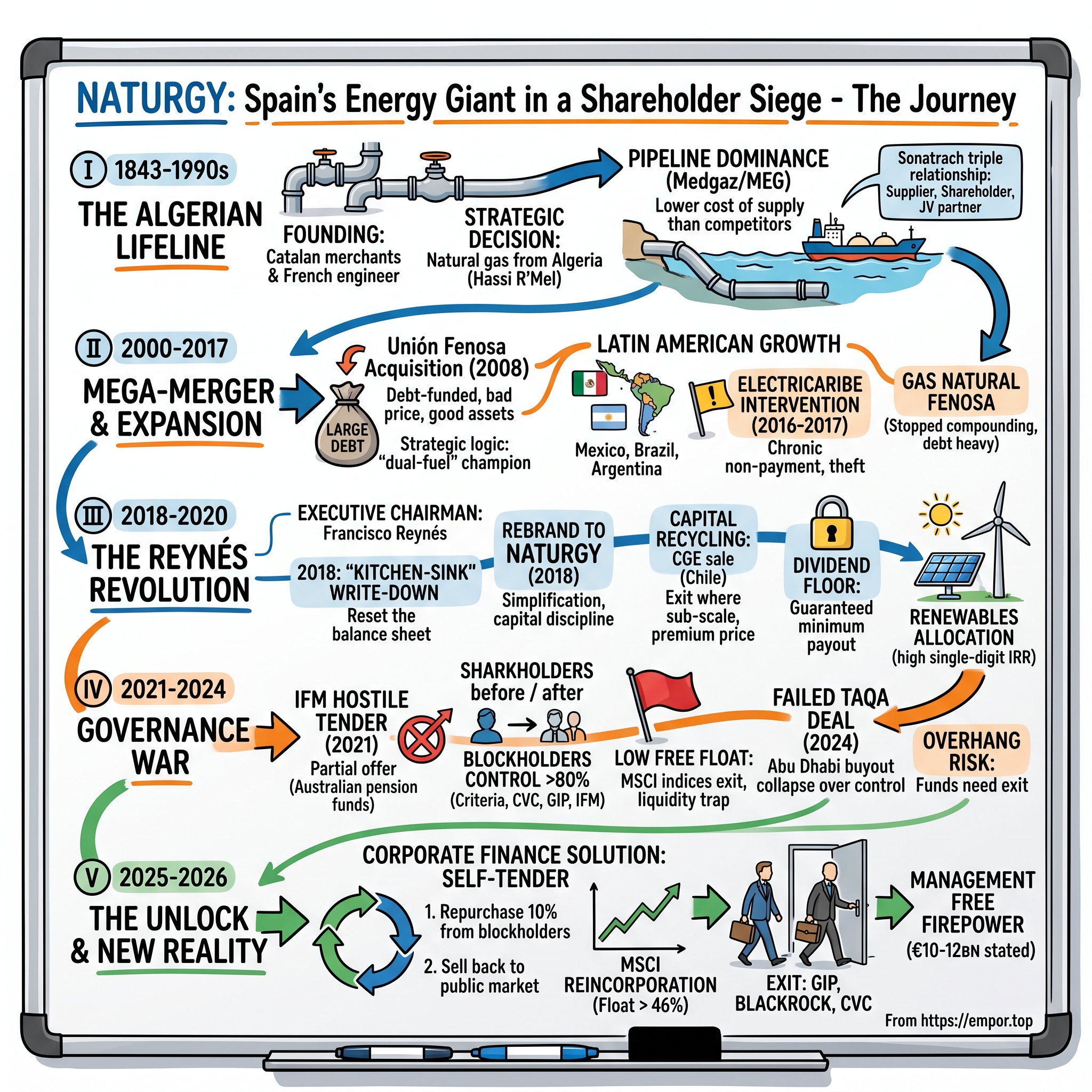
Naturgy: Spain's Energy Giant in a Shareholder Siege
I. Introduction & Episode Roadmap
On 27 May 2026, at some point after the Madrid market closed, a syndicate desk at Goldman Sachs began calling institutional investors across Europe with an offer that would have been unthinkable eighteen months earlier: roughly 107 million shares of Naturgy Energy Group, at €28.55 apiece, a discount of less than five percent to that day's close. The seller was CVC Capital Partners, which had bought into the Spanish utility in 2018 at around €18 a share and had spent much of the intervening period publicly and privately looking for a way out.
By the following morning the book was covered and CVC was gone — roughly €3.1 billion returned to its funds, a holding period of eight years, and an exit executed not through a negotiated mega-deal with a Gulf sovereign wealth fund but through the most ordinary mechanism in capital markets: selling stock to strangers who wanted it.1
That transaction is the punchline to a story that most investors still tell wrong. The consensus description of Naturgy — repeated in broker notes, in the financial press, and in the outline that frames this article — is that it is a fine business trapped inside a broken shareholder register. Four blockholders controlling more than eighty percent of the equity. A free float so thin that MSCI threw the stock out of its indices. A board split between a Spanish foundation with a fifty-year time horizon and private equity funds whose vintage clocks were running out. Aborted mega-transactions littering the runway: a corporate split abandoned in 2023, a €20-billion-plus Abu Dhabi buyout that collapsed in June 2024.
All of that was true. Almost none of it is true today. As of the first half of 2026, Naturgy's free float exceeded 46 percent — the highest level, the company says, in its more than 180-year history.2 CVC is out. BlackRock, which inherited Global Infrastructure Partners' stake, is out. What remains is a Spanish anchor shareholder, CriteriaCaixa, at roughly 28 percent, an Australian infrastructure fund, IFM Investors, at around 15.5 percent, and a genuinely liquid public market for everything else.
So the honest framing of this story is not "how does a great asset escape a shareholder siege?" but something more interesting for a long-term investor: the siege has lifted, and now the business has to be judged on its own terms. The excuse is gone. For eight years, every disappointment at Naturgy could be attributed to governance paralysis. Starting now, results are the argument.
And the business underneath is substantial. Naturgy generated EBITDA of €5,334 million in 2025 and net income of €2,023 million, on capital expenditure of €2,142 million and net debt of €12,317 million — leverage of about 2.3 times EBITDA even after spending €2.3 billion buying back its own stock during the year.3 It distributes gas to more than five million connection points in Spain alone, operates roughly 116,578 kilometres of electricity network in Spain, owns the largest combined-cycle gas turbine fleet in the country at 7.4 gigawatts, and runs one of Europe's larger long-term LNG procurement books. Market capitalisation sits in the region of €27 billion at a share price around €29–30.4
But scale is not the same as an edge, and a stock that has re-rated after a governance fix is not automatically a good business.
The questions worth asking are harder. Is Naturgy's regulated cash flow really as defensive as it looks, given that Spanish network remuneration is reset by a regulator every six years and the gas grid faces structural volume decline? Is the liberalised half of the company — gas trading, thermal generation, retail supply — a durable earnings engine or a windfall that happens to be running hot? Does management deserve the benefit of the doubt after delivering guidance for seven straight years, or does the extension of an executive chairman's mandate to 2030 alongside €10–12 billion of stated acquisition firepower represent exactly the moment when disciplined companies stop being disciplined?
The story that follows runs in seven movements: the founding of Spain's gas industry in nineteenth-century Barcelona and the Algerian supply relationship that still shapes the P&L; the debt-funded acquisition of Unión Fenosa at the top of the credit cycle and the Latin American expansion that followed; Francisco Reynés's arrival in 2018 and the write-down that reset the company; the governance war of 2021–2024; the corporate split that never happened; a segment-level examination of where the money actually comes from; and finally a stress test of the investment case, the powers that may or may not be real, and the small number of metrics that will tell you whether any of this is working.
It begins, as Spanish energy stories tend to, in Barcelona.
 Subscribe on LinkedIn
II. Early Roots: Gas Catalana, Pipeline Dominance & The Algerian Lifeline (1843–1990s)
Picture Barcelona in the 1840s: a walled city, still hemmed in by fortifications, lit at night by oil lamps that guttered in the sea wind. In 1843 a group of Catalan merchants and a French engineer founded the Sociedad Catalana para el Alumbrado por Gas — the Catalan Society for Gas Lighting — and set about doing something no Spanish company had done: manufacturing town gas from coal and piping it under the streets.5 The company listed on the Barcelona exchange in 1853. Its gasworks, the Fábrica del Sol, still stands.
This matters less as heritage marketing than as an explanation of corporate DNA. From its first decade, this was a business whose asset was not a product but a network — a buried, capital-intensive, municipally-franchised network with a fixed cost base and a customer who could not realistically switch. Every subsequent chapter of the company's history is a variation on that theme: acquire the pipe, secure the concession, spread the fixed cost over more connection points, and let the regulator set the return.
The century that followed was a slow accumulation of Spanish gas distribution franchises, punctuated by a name change to Catalana de Gas. The strategically decisive period came much later, and it came from a problem rather than an opportunity: Spain had almost no domestic hydrocarbons. A country industrialising rapidly in the 1960s and 1970s had to import its energy or do without it, and the cheapest molecules in the neighbourhood lay under the Algerian Sahara, at Hassi R'Mel.
The Algerian relationship became the defining commercial fact of the company's modern history. Spain was an early adopter of liquefied natural gas, taking Algerian LNG by tanker into regasification terminals long before LNG became a global commodity trade. But the truly consequential decision was to go one step further and build a pipe. The Maghreb–Europe Gas Pipeline — 2,200 kilometres running from Hassi R'Mel across Morocco, under the Strait of Gibraltar, and into the Iberian grid — entered service in November 1996 at a cost of nearly ECU 3 billion, championed above all by the company's then-president, Pere Durán Farrell.6
Here is the economics of that decision in plain terms. LNG is flexible but expensive: you must liquefy the gas at minus 162 degrees Celsius, ship it, and regasify it, and each of those steps costs money and consumes a slice of the gas itself. A pipeline has enormous upfront capital cost and zero flexibility — it goes where it goes — but its marginal cost of delivery is trivially low. If your demand is stable and your source is fixed, the pipe wins on landed cost, and it wins by a wide margin. Combining a pipeline into Algeria with long-term, oil-indexed take-or-pay contracts gave the Spanish gas incumbent a structurally lower cost of supply than any competitor could replicate, because the competitor would have had to build a second pipe.
The corporate architecture caught up in 1991, when Catalana de Gas absorbed Gas Madrid and combined with the gas distribution assets of Repsol under state encouragement, producing Gas Natural SDG — a single national gas distribution business with something close to a monopoly position in Spanish gas networks.5 The Spanish state got a national champion; Repsol got a large shareholding it would eventually monetise; and the company got the asset base it still runs today.
The reason this ancient history is worth even fifteen minutes of a long-term investor's attention is that the Algerian relationship never stopped being a live P&L item. Sonatrach, the Algerian state hydrocarbon company, is not merely Naturgy's supplier — it holds roughly 4.1 percent of Naturgy's equity and co-owns the Medgaz pipeline, a second, direct Algeria-to-Spain link that bypasses Morocco.3
That triple relationship — supplier, shareholder, and joint-venture partner in the infrastructure connecting the two — is unusual, and it cuts both ways. It aligns interests in a way a pure arm's-length contract cannot, because a supplier who owns equity has a stake in the buyer's profitability. It also means a commercial dispute and a shareholder relationship and a diplomatic relationship all run through the same counterparty, which is precisely the sort of concentration that governance-minded investors flag.
The long-term contracts are periodically repriced, and those repricings are hard commercial fights. Naturgy and Sonatrach spent years in dispute over price revisions before reaching a definitive agreement covering 2023 and 2024 supplies, with criteria set for revisions running through 2027.7 Management's 2026 net debt guidance explicitly incorporates a roughly €400 million payment to Sonatrach — a reminder that a two-decade-old contract can still move the balance sheet by the price of a mid-sized wind farm.8
The geopolitical dimension is equally live. The Maghreb–Europe pipeline through Morocco went cold when Algeria's relations with Rabat broke down, leaving Medgaz as the primary pipeline artery. On the first-half 2026 earnings call, management was asked whether Algerian volumes could be scaled up; the answer was concrete and limiting — Medgaz can add perhaps 0.6 to 1 billion cubic metres a year through existing compression, and beyond that the physical pipe is the constraint.8 That is the honest version of a "cornered resource": genuinely advantaged, genuinely finite, and hostage to two governments' willingness to keep talking.
By the late 1990s, then, the company held an outstanding gas franchise and a supply position no one could copy. What it did not hold was electricity. In a liberalising Iberian market where Iberdrola and Endesa were building integrated power businesses, that omission looked less like focus and more like a strategic gap — and closing it would produce the most expensive decision in the company's history.
III. The Mega-Merger Era: Buying Unión Fenosa & The LatAm Expansion (2000–2017)
The early 2000s in Spanish energy were a period of restless consolidation. Deregulation had unbundled generation from networks and opened retail supply, and the received wisdom of the era held that the winners would be "dual-fuel" champions selling gas and power to the same customer over the same relationship. Gas Natural had the gas. It needed the power, and it spent the decade trying to buy it — including an abortive run at Endesa that ended with the Italian utility Enel and Spain's Acciona taking that prize instead.
Which left Unión Fenosa: Spain's third-largest electric utility, with generation, distribution networks, and a sprawl of Latin American concessions. Its controlling shareholder was ACS, the construction conglomerate run by Florentino Pérez, and by 2008 ACS was a leveraged builder in a world where credit was about to stop being free.
The deal was structured in stages. In the summer of 2008 Gas Natural agreed to buy ACS's 45 percent holding, taking an initial 9.99 percent slice for roughly $2.3 billion and completing the remaining 35.31 percent in February 2009 for about $8.1 billion. Crossing the 30 percent control threshold triggered a mandatory offer for the whole company, and the full transaction valued Unión Fenosa at approximately €16.8 billion.9
Consider the timing. The purchase agreement with ACS was signed weeks before Lehman Brothers failed. Completion of the second tranche landed in February 2009, when European credit markets were closed to almost everyone and Spain was two years away from the sovereign debt crisis that would put its banking system in intensive care. Gas Natural was buying a large, cyclically-exposed power business at a multiple struck in the last days of the bubble — roughly eleven times EV/EBITDA on then-current earnings — and funding a substantial part of it with debt.
Did they overpay? Almost certainly, on price. The subsequent decade of Spanish power was defined by collapsed demand, a tariff deficit the government eventually clawed back from utilities, and an electricity price environment nothing like the one underwritten in 2008. But the strategic logic proved more durable than the financial arithmetic. The combined-cycle gas turbines acquired in that deal — plants that spent much of the 2010s running at miserable load factors and looking like the definition of a stranded asset — became, fifteen years later, one of Naturgy's most profitable businesses, for reasons no one in 2008 could have modelled. We will return to that.
The lesson an investor should extract is narrower and more useful than "don't buy at the top." It is that in regulated and quasi-regulated infrastructure, asset quality and price are separable questions. Gas Natural bought good assets at a bad price. The bad price cost shareholders a decade of returns on that capital; the good assets are still earning. The reverse trade — a great price for structurally impaired assets — has historically been the more dangerous of the two.
Unión Fenosa also came with a Latin American footprint, and Gas Natural leaned into it. Over the following years the group assembled gas and power distribution concessions across Mexico, Brazil, Argentina, Panama, Colombia and Chile, culminating in the 2014 acquisition of Compañía General de Electricidad in Chile for roughly €2.6 billion. The pitch was straightforward: regulated distribution networks in emerging economies offer the same essential-service economics as Spain, with faster connection growth and inflation-indexed tariffs.
The pitfalls were also straightforward, and Colombia delivered the definitive case study. Electricaribe, the distributor serving roughly 2.5 million customers on Colombia's Caribbean coast, had been under Gas Natural Fenosa's management since 2009. It suffered from chronic non-payment, theft, and infrastructure underinvestment in a region where politically it was near-impossible to cut off customers or raise tariffs enough to fund the network. On 14 November 2016 the Colombian Superintendency of Domestic Public Services intervened in the company; in March 2017 it moved to liquidate it.10
Naturgy did what a Spanish multinational does: it went to arbitration, filing a claim under the Colombia–Spain bilateral investment treaty for approximately US$1.6 billion, alleging expropriation. On 12 March 2021 the UNCITRAL tribunal dismissed the claim in its entirety, finding that Colombia had legitimately exercised its police powers under domestic public-services law. The tribunal also dismissed Colombia's €500 million counterclaim.11
That outcome deserves more weight than it usually gets. A total loss — asset gone, compensation zero, legal costs sunk — is the maximum realisation of country risk, and it happened not through a dramatic nationalisation but through the ordinary application of a host state's utility regulation. For anyone modelling emerging-market regulated networks as "bond-like with growth," Electricaribe is the counterexample: the tariff mechanism is only as good as the political willingness to enforce collection, and treaty protection is not insurance.
There is a second-order point about the Latin American strategy that is easy to miss and useful to carry forward. Naturgy did not lose money in Colombia because it misjudged the tariff formula. It lost money because it acquired a distribution network embedded in a region where the underlying social contract of a utility — the customer pays, and if they do not, service stops — did not hold. Non-technical losses from theft, chronic non-payment, and the political impossibility of enforcement are not risks a regulated-return model prices; they are risks that void it. Any investor evaluating emerging-market network acquisitions should treat collection rates and the political enforceability of disconnection as the first-order diligence question, well ahead of the headline allowed return.
By 2017 the group had been renamed Gas Natural Fenosa, and it looked the part of a conglomerate that had stopped compounding. Debt was heavy, the international portfolio was scattered across jurisdictions with wildly different risk profiles, the Spanish core was mature, and the equity traded at a discount that the market attributes to companies it cannot cleanly value. The shareholder register was in flux too: Repsol had been selling down, and in 2016 GIP had bought a fifth of the company. The board concluded that what it needed was not another acquisition but an operator willing to say no. In February 2018, it hired one.
IV. The Reynés Revolution: Rebranding to Naturgy & Capital Discipline (2018–2020)
Francisco Reynés Massanet arrived at a company that had, in effect, lost the argument for its own existence. He came from Abertis, the Spanish toll-road group, where he had spent years running an infrastructure business on the principle that the job is to own long-duration assets, run them cheaply, and return the cash — and he had chaired Cellnex through its separation and listing as a European tower company. His reputation was not for vision. It was for subtraction: fewer businesses, fewer management layers, fewer excuses, and a hard hurdle rate applied without sentiment.
His first significant act as executive chairman was to take the pain. Naturgy's 2018 results carried impairments large enough to swing the group to a net loss of €2,822 million for the year, against a small profit the year before — a headline loss of roughly €2.83 per share on a company earning around €1.4 billion the following year.12 Write-downs concentrated in thermal generation and international assets whose carrying values had been set in a different price world.
It is worth being precise about what a "kitchen-sink" write-down does and does not signal. It does not create value; the economic damage happened years earlier, when the capital was deployed. What it does is reset the base against which future returns are measured, and — more importantly for a new chief executive — establish which prior decisions the incoming management refuses to defend. Reynés was drawing a line: the balance sheet he would be judged on started in 2018.
The rebrand followed in June 2018, when shareholders approved changing the corporate name from Gas Natural Fenosa to Naturgy Energy Group.13 Renaming a utility is usually a low-information event, and the cynical reading — that a company deriving most of its earnings from gas and thermal generation was scrubbing the word "gas" from its masthead ahead of a decade of ESG mandates — is not wrong. But there was a second, more defensible motivation. "Gas Natural Fenosa" was a compound of two merged companies that had never fully integrated; the name itself advertised the seam. A single brand was part of collapsing a federation into a company.
The substance of the 2018–2022 plan was simplification and capital discipline. Operating costs were attacked, management layers removed, and — the part that mattered most — the portfolio was pruned rather than expanded. The signature disposal came in 2020, when Naturgy agreed to sell its Chilean electricity distribution business, CGE, to State Grid Corporation of China for approximately €2.57 billion, a transaction completed in 2021.1415
Sold to the buyer with the lowest cost of capital in the world, in a market where Naturgy was a sub-scale foreign owner, at a price that comfortably exceeded what the asset had cost in the 2014 CGE acquisition on a like-for-like basis. That is what capital recycling is supposed to look like: exit where you are not the natural owner, and take the strategic buyer's premium.
Reynés paired the operational work with a promise aimed squarely at the shareholder register: a hard floor under the dividend. Establishing an explicit minimum cash distribution transformed the equity story. It gave income funds a reason to own a Spanish utility with a complicated ownership structure, and it gave the private equity holders — who could not sell easily — a mechanism to extract returns while they waited. For a company whose stock had limited liquidity, the dividend became the primary channel through which value reached owners.
There is a bear reading of this, and it deserves airing. A high, explicitly guaranteed dividend at a capital-intensive company in the middle of an energy transition is a constraint, not a strength. Every euro promised to shareholders is a euro unavailable for grid investment or renewable development, and a floor that is politically hard to cut becomes a ratchet. The counter-argument — which Naturgy's numbers so far support — is that the group's cash generation has comfortably covered both, with free cash flow after minorities of €2,242 million in 2025 against a dividend of €1.77 per share on roughly 970 million shares.3 But the constraint is real, and it explains a great deal about the choices in later chapters, including why renewable capacity targets have been trimmed rather than debt-funded.
The capital that came back from Latin American disposals was pointed at renewables: wind and solar in Spain, a growing platform in Australia through Global Power Generation, and early positions in the United States. The stated discipline was an internal rate of return hurdle in the high single digits, applied project by project. By the end of 2025 the group's renewable fleet reached 8,085 megawatts including batteries, up 10.5 percent year-on-year, with more than 1.2 gigawatts under construction.3
Reynés had, by 2020, done the operational job he was hired for. What he had not fixed — because it was not his to fix — was who owned the company. That problem was about to become the only thing anyone wanted to talk about.
V. The Governance Siege: IFM's Hostile Tender, Sovereign Funds & The Failed Taqa Deal (2021–2024)
In January 2021, a fund manager from Melbourne did something that had almost never been done to a Spanish national champion: it launched an uninvited partial tender offer.
IFM Investors is not a conventional private equity firm. It is owned by a group of Australian pension funds, and it invests with the duration those liabilities imply — airports, ports, pipelines, held for decades. Its Global Infrastructure Fund announced an all-cash voluntary partial offer for up to 22.69 percent of Naturgy, at €22.07 per share.1617 IFM was not trying to take control; it was trying to buy a large, permanent minority position in a European regulated network business at a moment when the market was pricing Naturgy as a complicated gas company.
The Spanish establishment treated it as an incursion. CriteriaCaixa — the holding company through which the "la Caixa" Banking Foundation owns its industrial portfolio and funds one of Europe's largest charitable programmes — was Naturgy's anchor shareholder and had no interest in a new foreign fund gaining influence. Criteria bought shares in the open market to defend its position, declined to tender, and made clear it viewed Naturgy as a strategic Spanish asset. The offer also required Spanish government clearance under foreign investment rules introduced during the pandemic, which arrived with conditions attached.
The acceptance period ran from 9 September to 8 October 2021, and IFM ended up lowering the minimum acceptance condition it had originally set at 17 percent. When the dust settled, IFM had acquired 105,021,887 shares — 10.83 percent of the capital — for roughly €2.3 billion.18 It later built toward 15.5 percent.
Judge the outcome from IFM's side and it was a partial success: it got a serious position and board representation in a business it wanted. Judge it from the perspective of anyone who owned the remaining shares and it was a disaster. The register now looked like this: CriteriaCaixa in the mid-twenties, CVC (which had bought Repsol's stake in 2018) and GIP each around twenty percent, IFM in the mid-teens, and the residual public shareholders holding roughly a tenth of the company.
That last number is where the real damage lived, and it is worth explaining why, because "low free float" sounds like a technicality and is not.
Index providers do not care how large a company is; they care how much of it is actually purchasable. MSCI applies free-float thresholds precisely so that index funds tracking its benchmarks can buy and sell without moving the price. When Naturgy's float fell to around ten percent, the stock lost its place in those indices, and with it the automatic, price-insensitive demand from passive funds that underpins liquidity for most large European equities.3
The consequences compound. Thin trading widens bid-ask spreads. Wide spreads deter active managers, because a position they cannot exit at a reasonable cost is a position they must size small. Small positions mean less research coverage. Less coverage means slower price discovery. And a stock where a single seller of two percent can move the price by five percent is a stock where every large holder is trapped — which in turn means none of them can sell, which keeps the float low. The trap is self-reinforcing.
Meanwhile, the fund clocks were running. CVC had entered in 2018; GIP in 2016. Closed-end infrastructure and buyout funds typically target realisation within five to seven years, and by 2023 both were well past that. They needed an exit. There was no liquid market to sell into. So they needed a buyer for the whole block — which meant they needed a buyer willing to trigger a mandatory offer for all of Naturgy, and they needed CriteriaCaixa's cooperation to make it work.
Enter Abu Dhabi. In April 2024, Taqa — the Emirati state-backed energy group — confirmed it was in talks with Naturgy shareholders about acquiring the CVC and GIP stakes, and separately in discussions with CriteriaCaixa about a cooperation agreement to jointly control the company. The combined CVC-plus-GIP holding of roughly 41 percent, if acquired, would trigger a mandatory bid for 100 percent, implying an enterprise value comfortably above €20 billion. Naturgy's market capitalisation rose above €24 billion on the speculation.19
It fell apart on 10 June 2024. Taqa and CriteriaCaixa announced simultaneously that talks had ended without agreement.202122 The reported sticking points were not about price to the public — they were about control. Taqa was said to have wanted 51 percent of the joint vehicle through which the two would govern Naturgy; Criteria, which had defended its primacy against IFM three years earlier, refused to become a junior partner in a company it regarded as a Spanish strategic asset.19 Reports also pointed to disagreement over the price CVC and GIP would receive for their blocks. There was, additionally, the unavoidable geopolitical awkwardness of an Emirati state entity taking control of a company whose largest gas supplier and fellow shareholder is the Algerian state.
The stock fell as much as 13 percent on the news, and market value dropped back toward €21 billion.19 The arbitrage community that had piled in on takeover speculation was carried out. And the underlying problem was now worse than before: two private equity funds, still trapped, now publicly known to be desperate, with a failed process behind them advertising to any future buyer exactly how hard the seller's position was.
What is striking in retrospect is how completely the eventual solution differed from the one everyone spent three years pursuing. Nobody bought Naturgy. Instead, Naturgy bought part of itself — and then sold it back to the market. That resolution belongs to a later chapter. First, there was one more grand plan that had to fail.
VI. Project Gemini: The Grand Corporate Split That Wasn't (2022–2023)
In February 2022, Francisco Reynés stood in front of investors and proposed to take the company apart.
The idea was called Project Gemini, and its logic was impeccable on a whiteboard. Naturgy would demerge into two separately listed companies. The first — call it NetworksCo — would hold the regulated gas and electricity distribution grids in Spain and Latin America: predictable, regulator-set returns on a defined asset base, the sort of cash flow profile that infrastructure funds and pension money value at high multiples. The second — MarketsCo — would hold everything exposed to markets: renewable generation, gas procurement and LNG trading, the combined-cycle fleet, and retail supply.
Why would splitting a company create value when the assets are identical before and after? The answer is that it isn't really about the assets — it is about the buyers. A regulated network business and a commodity trading business attract entirely different pools of capital with different required returns. Infrastructure investors will pay a high multiple for a bond-like, inflation-linked, regulator-protected earnings stream. Energy investors will pay for optionality and growth in generation. Bolt the two together and neither buyer can value what they are being offered, so both discount it — the conglomerate discount, which is not a market inefficiency so much as a rational response to being sold a bundle.
There was a second, less-discussed motive. A separately listed NetworksCo would be a perfect asset for exactly the kind of infrastructure buyer that CVC and GIP needed. Rather than requiring a single acquirer to swallow all of Naturgy, the split would create a vehicle those funds could exit into, through trade sales or block placements, without triggering a full takeover. Gemini was, among other things, a liquidity solution dressed as a strategic one.
Three forces killed it.
The first was history's timing. Russia invaded Ukraine days after the plan was unveiled. European gas prices went from elevated to unprecedented, and the assumptions underpinning a standalone MarketsCo — that you could put a defensible valuation on a portfolio of long-term gas contracts and merchant generation — became untenable. In an environment where the forward curve moved by more in a week than it previously had in a year, no bank could underwrite the separation, and no investor could price the resulting equity. Splitting a company requires allocating contracts, hedges, collateral obligations and credit facilities between two entities; doing that during the most violent commodity dislocation in modern European history was not a matter of will.
The second was Madrid. Spain's government took the view that separating the country's principal gas distribution network from the contracts and infrastructure that supply it raised questions of security of supply — questions that had gone from theoretical to urgent overnight. A country that had just watched Europe's gas dependency become a national security crisis was not going to bless a corporate reorganisation that fragmented control of its own gas chain.
The third was the boardroom. Any demerger requires agreeing how to divide the debt, and debt allocation is a zero-sum negotiation. Load NetworksCo with leverage and you maximise its efficiency but limit the multiple; load MarketsCo and you make a volatile business fragile. Shareholders with different time horizons and different return requirements had no reason to converge on an answer. Criteria wanted a durable dividend-paying industrial asset. The private equity holders wanted the structure that maximised near-term realisable value. IFM wanted infrastructure-quality yield. Four blockholders, four answers.
Naturgy formally shelved the plan in February 2023, citing market volatility.23 The word used was "frozen." It has not been revived.
The investor's lesson is not that Gemini was a bad idea. Structurally, it was probably the right idea, and versions of it have created substantial value elsewhere in European utilities. The lesson is about the conditions under which good structural ideas can be executed: they require a stable pricing environment for the pieces, a supportive or at least indifferent regulator, and a shareholder base capable of reaching consensus. Naturgy had none of the three. When you own a company where any major structural change requires unanimity among parties with incompatible objectives, you should assume that no major structural change will happen — and value the company on the assumption that it stays exactly as it is.
Which turns out to be a perfectly reasonable way to value it, because as it is, it makes a great deal of money. The question is where from.
VII. Segment Architecture & Core Economics: Networks vs. Energy Markets
Here is the first thing to correct about how Naturgy is usually described. The standard summary — roughly 55 to 60 percent of EBITDA from regulated networks, the rest from liberalised businesses — is no longer accurate. In 2025, distribution networks contributed €2,710 million of EBITDA and the energy markets businesses contributed €2,722 million.3 The split is essentially even. Naturgy is not a regulated utility with a trading arm attached; it is two businesses of comparable size, one of which is genuinely defensive and one of which is not.
That distinction should change how an investor thinks about the earnings stream. Roughly half of this company's profit is set by a regulator on a six-year cycle. The other half is set by gas spreads, power prices, ancillary service markets, weather, and hedging skill. Both halves can be good businesses. Only one of them is predictable.
The networks: a regulated asset base, and what a regulator giveth
Start with the regulated half, because it is the foundation of the credit and the dividend.
The mechanics are simpler than the jargon suggests. A distribution network operator invests capital in pipes, cables, transformers and meters. The regulator recognises that capital as a "regulated asset base" and grants the operator an annual revenue allowance calculated to cover operating costs, depreciation, and a permitted financial return on the asset base. Customers pay that allowance through network charges embedded in their bills.
Volumes matter less than they do in a normal business, because the allowance is largely independent of how much gas or electricity actually flows. What matters is the size of the asset base and the permitted return — which is why the phrase "utilities are a bet on the regulator" is not cynicism but an accurate description of the cash flow.
Which is why 22 December 2025 was an important date for Naturgy shareholders. Spain's competition and markets regulator, the CNMC, approved the circulars governing electricity network remuneration for the 2026–2031 period and set the financial remuneration rate at 6.58 percent — an increase of 100 basis points over the 5.58 percent that applied in the prior six years.2425 The methodology also rewards investment up to a ceiling of 0.13 percent of Spanish GDP, and introduces incentives for network quality, loss reduction and electrification.
A hundred basis points on the permitted return sounds modest. On a large asset base compounding over six years, it is not.
And it arrived alongside a broader recognition that Spain has under-invested in its grid — a point made unforgettably on 28 April 2025, when the Iberian peninsula suffered a total system collapse. At 12:33 that afternoon the Spanish grid lost roughly 15 gigawatts of generation within five seconds, and most of Spain and Portugal went dark for around ten hours.26 Investigations pointed to the grid's inability to manage a voltage surge, which cascaded. Whatever the ultimate attribution, the political consequence was immediate: grid resilience stopped being a technical topic and became a national one. Naturgy's UFD electricity distribution arm has committed €1.33 billion to reinforcing and digitalising its Spanish network through 2028.27
The results are already visible. Spain electricity distribution EBITDA rose 10.6 percent to €741 million in 2025 on a larger remunerated asset base and retroactive recognition of prior-year remuneration.3 In the first half of 2026 the same business jumped 24 percent to €637 million, helped by a €74 million retroactive adjustment for maintenance costs incurred in 2021 and 2022.8 The underlying signal — strip out the retroactive items and you still have a growing asset base earning a higher permitted return — is genuinely positive. The caveat is that retroactive true-ups flatter growth rates and do not repeat.
There is a subtlety in that 0.13 percent of GDP investment ceiling that investors should understand, because it is the binding constraint on how large this business can become. Spain has capped the amount of network investment it will remunerate as a share of national output. That is a deliberate consumer-protection device: network costs land on bills, and an uncapped incentive to build would be an uncapped incentive to raise tariffs.
The practical effect is that the total pool of remunerated Spanish grid capex is politically determined, and the distributors — Naturgy's UFD alongside Iberdrola's i-DE, Endesa's e-distribución and EDP — compete for shares of a fixed allocation rather than growing independently. Naturgy's electricity network can grow faster than the pool only by winning a larger slice, which depends on where demand and connection requests actually materialise. Data centres, industrial electrification and electric vehicle charging concentrated in UFD's franchise territories would be genuinely valuable; the same investment landing in a competitor's territory is not.
Naturgy's electricity distribution footprint sits at 116,578 kilometres of line and 3.88 million connection points in Spain, with volumes up 1.5 percent in 2025 and connection points up 0.5 percent.3 Those are the growth rates of a mature developed-market grid: single-digit, driven by electrification rather than population, and dependent on the regulator recognising the capital. It is a good business. It is not a fast one, and any bull case built on Spanish grid growth alone is arguing about a few percentage points a year.
Spanish gas distribution is the harder story. Nedgia, Naturgy's gas network business, served 5,312,000 connection points across 57,206 kilometres at the end of 2025 and generated €756 million of EBITDA — down 0.9 percent, as a recovery in residential demand was offset by the annual reduction in regulated remuneration.3 Total Spanish gas volumes fell 0.8 percent and connection points declined 0.4 percent. These are not catastrophic numbers. They are, however, the numbers of a business in slow structural decline, and the regulator's framework has been steadily reducing what it pays for that network.
A new gas framework covering 2027–2032 has now been published, retaining the parametric remuneration formula with stability provisions and introducing incentives for biomethane injection.825 Biomethane is the strategic answer to the gas grid's long-term problem, and the concept is worth explaining plainly: organic waste — from landfills, sewage treatment, and livestock farms — is digested to produce a gas that, once cleaned up, is chemically equivalent to natural gas and can be injected into the existing pipes with no modification to the network or to customers' boilers. If it works at scale, a declining fossil asset becomes a renewable-gas distribution asset, and the terminal value problem largely disappears.
The honest assessment is that it is nowhere near scale. Naturgy's renewable gases segment ran three operating biomethane plants totalling 4.1 megawatts of installed capacity at the end of 2025, with a fourth 2.5-megawatt plant added in early 2026, and the segment lost €4 million.3 Against a gas network serving five million connection points, that is a pilot programme, not a transition. The partnerships signed with waste-management firms and project developers to build plants through 2030 may change that. Until the capacity numbers move by orders of magnitude, biomethane is optionality, not a plan, and investors should treat management's decarbonisation framing for the gas grid accordingly.
Latin American networks — gas distribution in Mexico, Brazil, Argentina and Chile, electricity in Panama and Argentina — contributed the balance of the segment. Their common characteristic in 2025 was that operational progress was eaten by currency. Argentine gas distribution grew EBITDA 8.1 percent to €147 million on significant approved tariff increases, but absorbed a €69 million foreign exchange hit. Brazil's inflation-linked Rio tariff update was offset by a €22 million currency drag; Mexico's tariff updates by €24 million. Group-wide, foreign exchange reduced 2025 EBITDA by €200 million and net income by €82 million, with the Argentine peso alone accounting for €94 million of the EBITDA impact.3
The Chilean gas business fell 32 percent to €304 million, though that comparison is distorted by a €105 million provision reversal booked in 2024.
The conclusion an investor should draw about the Latin American portfolio is that it is a genuine business generating real regulated cash, but the euro-reported earnings are structurally suppressed by currencies that depreciate against the euro over time. Inflation-indexed tariffs compensate for local inflation with a lag; they do not compensate for translation. This is not a risk that goes away, and it should be treated as a permanent tax on that portfolio's contribution rather than a temporary headwind.
Energy markets: the half that surprised everyone
The liberalised businesses generated €2,722 million of EBITDA in 2025, up 7.1 percent, and the composition is instructive.3
Energy management — the procurement, transport and wholesale placement of gas — earned €815 million, up 8.4 percent, with total gas sales of 173 terawatt-hours. The economic engine here is the spread between the cost of contracted molecules and their realised sale price. Naturgy buys gas under long-term contracts indexed to different benchmarks, principally oil-linked Algerian volumes and US LNG linked to Henry Hub, and sells into European markets priced against TTF, or into Asia against JKM. In 2025, Henry Hub averaged 52 percent above 2024 while TTF was 12 percent higher and Brent was 14 percent lower — a decoupling that management navigated through what it describes as diversified procurement and proactive hedging of US LNG volumes.3
That description deserves scrutiny rather than acceptance. "Proactive hedging" is what every trading business says when it makes money. The falsifiable question is whether the result is repeatable, and the honest answer is that a portfolio of long-term contracts with different indexations is genuinely valuable in a decoupled market and genuinely dangerous in the wrong one. Management's approach — hedging the majority of exposure in advance while retaining some upside — reduces variance but does not eliminate the fundamental point: this is a spread business whose good years and bad years are determined substantially by things outside its control.
Thermal generation is the segment that broke the model everyone had for it. Spanish thermal EBITDA doubled to €563 million in 2025, on production up 42 percent and combined-cycle output up 63.6 percent.3 Some of that was a one-off: a favourable court ruling allowed recovery of Special Hydrocarbon Tax paid between 2014 and 2018, contributing €146 million at the EBITDA line. But the structural driver is more important and more durable.
Here is the mechanism in plain language. Solar panels and wind turbines produce electricity when the sun shines and the wind blows, and they produce it without spinning mass — no heavy turbine rotating in synchrony with the grid frequency. Conventional thermal plants do have that spinning mass, and it provides inertia: a physical buffer that resists sudden changes in frequency, giving the system seconds to respond when something goes wrong. As renewable penetration rises, that buffer shrinks, and grid operators must procure stability services — voltage control, frequency response, reserve capacity — from whatever plant can provide them. In Spain, that is overwhelmingly the combined-cycle gas fleet, and Naturgy owns the largest one at 7.4 gigawatts.
So Naturgy's CCGTs increasingly earn money not for the electricity they sell into the day-ahead market at €65.3 per megawatt-hour average pool prices, but for being available and controllable in the ancillary services markets.3 The April 2025 blackout made this argument for management far more effectively than any investor presentation could. Assets acquired in 2008 as part of an overpriced merger, written down as obsolete, are now being paid a scarcity rent for a physical property — rotational inertia — that the energy transition has made scarce.
Investors should hold two thoughts here simultaneously. The mechanism is real and likely persistent for years, because Spain cannot build grid-scale storage and synchronous compensation fast enough to replace it. But it is also, by construction, a transitional rent. Batteries, synchronous condensers and grid-forming inverters are precisely the technologies being deployed to substitute for it, and Naturgy is itself installing batteries. The company is being paid handsomely today for a service it is helping to make less scarce tomorrow.
Renewable generation contributed €586 million, up only 1.7 percent — the weakest growth in the liberalised portfolio.3 Spain actually declined 5.2 percent to €422 million, as higher capacity and prices were offset by poor hydro and wind resource and higher generation taxes; Spanish renewable output fell 6.6 percent, with hydro down 14.7 percent. Australia nearly doubled to €71 million and the United States grew to €11 million on the commissioning of the 261-megawatt Grimes solar plant.
This is the part of the story where management's actions and its rhetoric diverge most visibly, and it deserves the attention. On the first-half 2026 call, Naturgy cut its renewable capacity addition target for the year from 1.2 gigawatts to 1.0 gigawatts. The chief financial officer, Steven Fernández, attributed the reduction to stricter profitability requirements as lower power price forecasts damaged project economics.8 Management framed it, as it has since 2018, as "value over size."
Take that at face value or not, but note what it means. A company that has told the market for years that renewables are the centre of its transition strategy is voluntarily building fewer of them because the returns are not there. The intellectually consistent reading is that Spanish solar economics have deteriorated — captured prices for solar in a market with enormous midday solar penetration are structurally lower than average pool prices, a phenomenon known as cannibalisation — and that discipline is the correct response. The sceptical reading is that a company committed to a rising dividend has limited capital and is prioritising the payout. Both can be true.
Cannibalisation is worth a sentence of explanation, because it is the central economic problem of mature solar markets and it is frequently glossed over. When a large amount of solar capacity is installed in one grid, all of it generates at the same time — the middle of a sunny day — and the resulting supply glut drives the wholesale price toward zero precisely when your plant is producing. The average price in the market may look healthy; the price your solar plant actually captures falls as more solar is added. Spain, with among the best solar resource in Europe and rapid deployment, is further into this dynamic than most markets.
It is why batteries have gone from optional to essential in project economics: storage shifts generation from the hours when power is worthless to the hours when it is not, and it is the reason Naturgy's forward pipeline pairs more than half of new capacity with storage.
What matters for investors is that renewable EBITDA growth of 1.7 percent does not currently support a narrative of transition-driven earnings growth, and the 2027-onward guidance of more than 2.0 gigawatts of annual additions — more than half paired with batteries — is a promise that has not yet been tested.8
Supply — the retail business selling gas and power to Spanish households, SMEs and industrials — earned €535 million, down 17.4 percent.3 The comparison is distorted by a €63 million judicial ruling booked in 2024, but the underlying picture is a competitive retail market with compressed margins across all segments and losses on the regulated gas tariff. Naturgy grew its customer base, with SME electricity volumes up 41.7 percent, by adapting pricing. Growing volumes into a market with falling margins is a choice, not a victory, and it is the segment where Naturgy has the least protection from competitors.
One emerging demand source deserves a brief note, because it is where much of the European utility sector's current optimism is concentrated. Naturgy has roughly 900 megawatts of data centre-related projects under development and a pipeline of around 2 gigawatts beyond that, and management has been explicit about how it intends to participate: a "power and land" model, selling long-term power purchase agreements and grid-connected sites rather than taking equity in the data centres themselves.8 Acceleration is being held back pending new Spanish regulation expected around the end of 2026.
That posture is worth reading carefully, because it is a capital allocation statement disguised as a commercial one. Owning data centres would mean competing for returns in a business Naturgy does not understand, against buyers with lower costs of capital and better technology relationships. Selling firm, decarbonised power and interconnection to those buyers is exactly the business Naturgy is in, and it converts an AI-driven demand shock into higher grid utilisation and contracted generation offtake without taking technology risk.
If the load actually arrives, it addresses the single biggest weakness in the renewables story — captured price cannibalisation — by adding demand that is flat, large, and willing to sign twenty-year contracts. If it does not arrive, or arrives in someone else's network territory, Naturgy has spent very little finding out. That is a sensible way to hold an option, and it should be judged on contracted megawatts signed rather than pipeline announced.
Put the two halves together and the picture is of a company whose 2025 EBITDA was flat year-on-year at record levels, whose net income nonetheless rose 6.4 percent, and whose free cash flow after minorities improved 58 percent to €2,242 million.3 The earnings quality question is whether the liberalised half's strength — ancillary services, favourable trading spreads, tax rulings — is a plateau or a peak. The first half of 2026 offered a partial answer: EBITDA of €2,975 million and net income of €1,215 million, up 5 and 6 percent respectively, with net debt falling to €11,745 million and leverage at 2.2 times, prompting management to raise full-year 2026 guidance to above €5.5 billion of EBITDA and above €2.1 billion of net income.2
Guidance raised is a fact. Whether the people raising it have earned the right to be believed is a separate question.
VIII. Management Credibility, Board Dynamics & Capital Allocation
The best evidence about a management team is not what it says it will do. It is the accumulated record of what it said it would do and what subsequently happened.
On that test, Reynés's Naturgy has a strong file. The company has met or exceeded its EBITDA and net income guidance consistently since 2018, including through the European energy crisis, when most utilities' forecasts became works of fiction. It delivered record earnings in 2023 on renewables and network contributions.28 It has held leverage in a narrow band — 2.3 times at the end of 2025, 2.2 times at mid-2026 — while simultaneously funding a rising dividend and a €2.3 billion buyback.32 It disposed of assets at good prices rather than acquiring at bad ones. When it cut its renewable target in 2026, it explained the reason specifically rather than vaguely, and the reason was consistent with the capital-discipline framing it has used since 2018.
That last point matters more than it might appear. Narrative consistency across cycles is one of the few reliable tells for management quality, because it is hard to fake over eight years. The "value over size" language Reynés used at the 2025 strategic plan presentation is the same language he used in 2018, and — critically — it has been applied in both directions: to justify selling assets when prices were high and to justify not building assets when returns were low. Managers who invoke discipline only when it is convenient tend to abandon it at the top of a cycle.
Compare the February 2026 full-year call with the July 2026 half-year call and the consistency holds at a finer grain.338 In February, management guided 2026 EBITDA above €5.3 billion and net income above €1.9 billion, with net debt around €13.5 billion and capex around €2.1 billion.3 By July, EBITDA guidance had moved above €5.5 billion, net income above €2.1 billion, and net debt down to around €13 billion — an upgrade delivered without a change in the capital plan or the dividend, which is the pattern of a company beating on operations rather than reshaping the story to fit the result. Guidance that moves up while capex and distributions stay fixed is meaningfully different from guidance that moves up because the definition changed.
There is also a disclosure practice worth crediting. Naturgy publishes its results reports, tender documentation and significant-event notices through the CNMV, Spain's securities regulator, with sufficient granularity that an outside investor can reconstruct segment EBITDA, foreign exchange effects by currency, one-off items, and the mechanics of each treasury share transaction.34 That is not universal among European utilities, and it is the reason the sceptical earnings-quality analysis later in this article is possible at all. A company that itemises its own one-offs is easier to distrust in the short run and easier to trust in the long run.
Where the record is weaker is on structural transformation. Project Gemini was announced with fanfare and abandoned. The Taqa process consumed enormous management and board attention and produced nothing but a 13 percent share price decline. In 2023, shareholders reportedly attempted to install a chief operating officer to dilute the executive chairman's concentration of power; the proposal did not succeed. These are not trivial. An executive chairman who has failed at two major structural initiatives and defeated an attempt to constrain his authority is exactly the profile that governance-focused investors watch carefully.
Which makes the events of 2025 and 2026 the most interesting management story at this company — because the thing that finally worked was neither a split nor a sale, but a piece of straightforward financial engineering.
The unlock
On 20 February 2025, Naturgy presented its 2025–2027 Strategic Plan. The headline numbers were €6.4 billion of investment over three years with roughly 75 percent directed to Spain, average annual net profit around €1.9 billion, a dividend trajectory rising from a minimum of €1.70 per share in 2025 to €1.80 in 2026 and €1.90 in 2027 subject to maintaining a BBB credit rating, and total shareholder distributions of approximately €5.8 billion over the plan period.293
Buried in the plan was the mechanism that mattered. Naturgy would launch a voluntary partial tender offer to repurchase up to 10 percent of its own share capital — not to shrink the company, but to buy shares from its own blockholders and then sell them back to the public market. Reynés framed it directly: "We must return the company to its natural state of liquidity."29 The board was expanded from twelve to sixteen directors to accommodate proportional representation and IFM's demand for an additional seat.
The execution was precise. On 24 June 2025 the tender completed, acquiring 88 million shares — 9.1 percent of capital — at €26.50, for €2,332 million.[^30]3 All reference shareholders participated, reducing their holdings as intended. Then the reintroduction: on 7 August 2025 an accelerated bookbuild placed 19,305,000 treasury shares (2 percent) with institutions, alongside a bilateral sale of 34,100,000 shares (3.5 percent) to an international financial institution, both at €25.90 — the tender price adjusted for the €0.60 dividend paid days earlier. On the bilateral sale, Naturgy entered a total return swap, retaining economic exposure while transferring the shares. On 9 October a second bookbuild placed a further 34,100,000 shares for €883 million.3
The result: free float rose from 10 percent to 18.7 percent. On 5 November 2025 MSCI announced Naturgy's reincorporation into its indices, effective 25 November.3 The passive bid returned.
Then the blockholders started walking through the door that had just been opened. On 11 December 2025, GIP placed 68,825,911 shares — 7.1 percent — at €24.75, cutting its stake from 18.5 to 11.4 percent, with CriteriaCaixa buying 2 percent in the offering to reach 26.0 percent; float rose to 23.3 percent.3 On 3 March 2026 BlackRock completed the exit, selling the remaining 11.4 percent, 110.8 million shares, at €25.20 for approximately €2.79 billion — a 5.6 percent discount that knocked 6 to 7 percent off the share price and made Naturgy one of Europe's worst-performing utilities that day.30 And in May, CVC followed.
Two observations for investors. First, this is what a well-designed liquidity solution looks like, and it is worth understanding why it succeeded where three years of M&A did not. The tender did not require any shareholder to agree with any other shareholder about strategy, structure, or control. It required only that each of them wanted to sell some shares at €26.50 — which they did. It converted an unanimity problem into an individual-choice problem. That is a genuinely clever piece of corporate finance, and Reynés and the board deserve credit for it.
Second, look at the exit prices. GIP's final block cleared at €25.20 and CVC's at €28.55, against a share price around €29–30 in mid-2026.1304 The blockholders who spent years waiting for a €27-plus takeover ended up selling into the market at levels not far from where the failed 2024 deal was rumoured to be priced — but three to five years later, having foregone the certainty. Meanwhile, buyers of those blocks at a five percent discount have done well. The overhang that Bernstein and others flagged as the persistent risk was, once the float was fixed, simply absorbed.
What comes next, and why it is the real risk
Board governance was adapted alongside the ownership change. On 17 February 2026 the board appointed Lars Bespolka as a director at IFM's proposal, taking IFM's proprietary directors from two to three, while BlackRock-GIP reduced from three to two; renewed IFM's Jaime Siles and CriteriaCaixa's Ramón Adell until 2030; created a new Strategic Vision Committee chaired by the executive chairman with representatives of all board groups; and — the item investors should note most carefully — renewed Francisco Reynés as Executive Chairman until 2030, beyond the current strategic plan.3 Management also confirmed on the mid-2026 call that special bylaw majorities have been removed, enabling faster decision-making.8
Here is the activist's question, and it is a fair one. Naturgy has just removed the structural constraints on its own decision-making: the deadlocked register is gone, the supermajority provisions are gone, the executive chairman's mandate runs four more years, and management describes €10–12 billion of balance sheet firepower available for strategic deployment.8 On the same call, Reynés outlined acquisition criteria — hard-currency geographies, a preference for electricity and regulated assets, earnings accretion, returns above the cost of capital, clear management control — and stated that "we are not a distressed buyer on any project anywhere at any time."
Every element of that is reassuring in isolation.
Collectively, it describes a company with a large chequebook, no internal brake, and a chairman who has spent eight years being praised for restraint and now has the freedom to do something big. The historical base rate for European utilities deploying ten billion euros into cross-border regulated acquisitions is not encouraging — and this company's own most expensive lesson, the Unión Fenosa purchase, was precisely a large acquisition executed with strategic logic at a cyclical peak.
Naturgy's current capital allocation is, to be clear, conservative. Of 2025's €2,142 million capital expenditure, networks took 47 percent (up from 40 percent in 2024) and renewables 36 percent (down from 44 percent), and capex fell 6.1 percent year-on-year.3 That is a company tilting toward regulated returns and away from merchant risk. Management guided 2026 capex to around €2.1 billion. The dividend commitment is being met.
But the record of discipline was built under constraint. The next four years will test whether it was a philosophy or an adaptation. An investor holding this stock should watch acquisition announcements with more scepticism than the company's guidance record alone would warrant, precisely because the conditions that produced that record have changed.
IX. The Acquired Playbook: Strategic & Investing Lessons
Four lessons travel beyond Naturgy.
Lesson 1: Free float is not a technicality; it is a mechanism, and mechanisms can be fixed. For three years, the market treated Naturgy's ownership structure as an intractable problem requiring a corporate solution — a split, a takeover, a strategic partner. It turned out to be a plumbing problem with a plumbing solution.
The instructive part is why everyone looked in the wrong place: the four blockholders each framed the problem as "how do I exit my block," which is an M&A question, when the tractable question was "how does the company manufacture liquidity," which is a treasury question. The generalisable insight is that when a company's problem is that its shares are hard to trade, the solution set includes actions the company itself can take with its own balance sheet — and the market will frequently misprice that possibility, because it is watching for a deal.
Investors should also note the corollary: a self-tender that buys stock from insiders and resells it to the public is only value-neutral if the price is right. Naturgy transacted at €26.50 and the shares subsequently traded higher, which means the exiting blockholders, not the continuing shareholders, gave up the upside.
Lesson 2: The assets everyone writes off pay for the ones everyone celebrates. Naturgy's combined-cycle gas fleet was, for most of the 2010s, the textbook stranded asset: low load factors, ESG-toxic, impaired on the balance sheet. In 2025 it doubled its profits because a grid saturated with intermittent generation discovered it needed physical inertia and controllable capacity more than it needed marginal megawatt-hours. Meanwhile the renewables business — the strategic centrepiece, the reason for the rebrand — grew EBITDA 1.7 percent.
This is not an argument against the energy transition. It is an argument for being extremely careful about which parts of a transition are actually profitable and when. Transitions create scarcity in unexpected places, and the market's consensus about which assets are obsolete is frequently a decade early, which for an equity holder is indistinguishable from wrong.
Lesson 3: Long-term commodity contracts are leverage in both directions, and the counterparty risk is political. Naturgy's Algerian relationship gave it a landed-cost advantage no competitor could replicate — and periodic price-revision fights, a €400 million payment embedded in this year's balance sheet plan, a pipeline route through Morocco that geopolitics closed, and a supplier who is also a shareholder. Its Russian exposure is starker still: a Yamal LNG contract signed in 2013 covering roughly 38 terawatt-hours a year with take-or-pay obligations through 2041, against which Naturgy has warned of purchase commitments of roughly €11 billion that may be affected by the EU's ban on Russian LNG.31
The EU's nineteenth sanctions package, adopted in October 2025, set 1 January 2027 as the end of Russian LNG imports under long-term contracts while providing force majeure cover for buyers exiting early. Management's position on the mid-2026 call was that Naturgy holds sufficient alternative gas with free-destination clauses to cover its commitments, and its 2027 guidance of €5.3 billion EBITDA and €1.9 billion net income is set on a worst-case assumption of zero Yamal volumes — with the CFO stating he felt "extremely comfortable" even on that basis.8
Separately, Naturgy has publicly argued the EU should reconsider the ban, citing supply-adequacy risk.32 An investor should note both things: the guidance is stress-tested, which is good disclosure, and the company is simultaneously lobbying to keep the contract, which tells you the contract is worth something.
Lesson 4: Governance stalemate does not destroy operations; it destroys options. Through the entire siege, Naturgy's operating performance was fine — better than fine. EBITDA rose from €3,744 million in 2021 to over €5.3 billion. What the stalemate destroyed was the ability to do anything structural: no split, no sale, no transformative combination, no meaningful index representation.
The distinction matters for how you value such a company. Governance deadlock should compress the multiple, not the earnings, and it should compress it by roughly the value of the strategic options foregone. When the deadlock breaks, that discount should unwind — which is precisely what happened here, and precisely why the interesting question now is whether the business can grow earnings rather than whether it can fix its register.
X. Valuation, 7 Powers & Bull vs. Bear Stress Test
Where the durable advantages actually are
Hamilton Helmer's framework asks which structural conditions allow a business to earn returns above its cost of capital without competitors arbitraging them away. Applied honestly to Naturgy, the picture is uneven.
Scale economies are real but bounded. Nedgia's density in Spanish gas distribution — five million connection points over 57,000 kilometres — spreads fixed operating and maintenance costs across a customer base no entrant could assemble. But in a regulated business, scale advantages accrue substantially to customers rather than shareholders, because the regulator sets revenue by reference to efficient costs. Scale here protects the franchise; it does not generate excess returns.
Switching costs are effectively absolute in the network businesses and effectively zero in retail supply. A Spanish household cannot choose a different gas pipe. It can change electricity retailer with a phone call, which is why supply margins compressed 17.4 percent in 2025 while distribution held. Investors should mentally separate these: Naturgy has enormous switching-cost protection over roughly half its earnings and essentially none over its retail business.
Cornered resource is the strongest genuine claim, and it is twofold: the Algerian supply position with equity in Medgaz and a supplier-shareholder relationship, and the 7.4-gigawatt Spanish combined-cycle fleet with a single remote control centre operating it. Neither can be replicated — you cannot build a second pipeline to Algeria or permit a new CCGT fleet in Spain today. But the first depends on bilateral relations between Madrid and Algiers, and the second earns a rent that policy is explicitly trying to eliminate through storage deployment.
Counter-positioning is weak. Naturgy is not doing something incumbents cannot copy; it is doing roughly what Iberdrola, Endesa and EDP are doing, with a different asset mix.
Network effects are absent in any meaningful sense — a utility's "network" is physical infrastructure, not a demand-side feedback loop.
Process power has a modest case. The centralised control of the thermal fleet, the hedging apparatus in energy management, and the operating cost reduction achieved since 2018 are real capabilities. Whether they constitute durable process advantage or simply competent management is not resolvable from outside.
Brand is negligible. Retail energy is bought on price.
The summary judgement: Naturgy's protection comes overwhelmingly from regulation and physical assets, not from anything the company invented. That is a perfectly good source of durable cash flow. It is not a source of compounding excess returns, and it means the single most important determinant of long-term shareholder value at this company is regulatory outcome, not competitive execution.
The competitive terrain
Porter's framework maps the same conclusion. New entrants face a wall: distribution concessions require regulatory award, and greenfield network build is uneconomic against an incumbent. Suppliers hold meaningful power — Sonatrach's contract revisions and Cheniere's Henry Hub-linked terms are negotiated positions, not price-taking, and the Yamal situation shows how a supplier relationship can become a liability without any commercial failure.
Buyers are weak in distribution and strong in retail and industrial supply, where Iberdrola, Endesa, Repsol and a long tail of independents compete on price. Substitutes are the genuine long-term threat: heat pumps replacing gas boilers, rooftop solar reducing grid offtake, and electrification generally eroding gas distribution volumes over a ten-to-twenty-year horizon. Rivalry is intense in retail and merchant renewables, muted in regulated networks.
Against peers, the useful comparison is this: Iberdrola offers a larger, more geographically diversified regulated-network growth story with a lower dividend yield; Endesa offers a similar Iberian mix under Enel's control; Naturgy offers the highest cash yield of the group and the largest exposure to gas — both as a distribution asset in structural decline and as a trading and generation business currently earning well. An investor is essentially choosing how much gas exposure to accept in exchange for cash return today.
The bull case, examined
The bull case rests on four legs. The first is that roughly half of EBITDA now sits behind regulatory frameworks that have just been reset favourably in Spanish electricity — 6.58 percent for six years, with an investment-friendly methodology and a political environment newly attentive to grid resilience after April 2025. The second is that the liberalised half is not the volatile liability it was assumed to be: the thermal fleet's ancillary-services role is a structural change, not a spike, and the trading book has demonstrated it can earn through decoupled price environments. The third is the cash return: a dividend guided to €1.80 in 2026 and €1.90 in 2027 against a share price around €29–30 implies a yield in the low-to-mid six percent range, funded by free cash flow of €2.2 billion and supported by leverage of 2.2 times.23 The fourth is the governance unlock itself — index membership restored, blockholder overhang cleared, decision-making unblocked.
Each of those is evidence-based rather than rhetorical. The weakest link is the second: the durability of liberalised earnings is asserted more confidently than the data yet supports, since 2025 benefited from a €146 million tax recovery, and the ancillary-services premium is a function of a supply-demand imbalance that Spain is actively investing to close.
The bear case, examined
The bear case is more interesting than the standard "gas is dying" formulation.
Start with what the bear does not need to believe. They do not need Spanish gas distribution to collapse — a 0.8 percent annual volume decline against a slowly-eroding regulated revenue allowance is a grinding headwind, not a cliff, and biomethane offers genuine if unproven optionality.
What the bear does need is one or more of the following. Regulatory reset risk: the 2027–2032 gas framework and the 2026–2031 electricity framework together determine the majority of the defensive earnings stream for the next six years. The electricity outcome was good. Gas remuneration has been declining annually, and a regulator under political pressure to hold down consumer bills in a cost-of-living environment has every incentive to be tougher next time.
The normalisation of the liberalised half: if ancillary services revenue compresses as batteries arrive, if gas spreads narrow as global LNG supply expands through the late 2020s, and if the Yamal contract ends without replacement economics, the €2.7 billion of energy markets EBITDA has meaningful downside. Management's own worst-case 2027 guidance of €5.3 billion EBITDA is below the 2026 guidance of €5.5 billion — which is management telling you, in guidance form, that it expects earnings to go sideways or slightly down.
Currency: €200 million of annual EBITDA erosion from Latin American translation is not a one-off; it is the run-rate cost of that portfolio. Capital allocation: the €10–12 billion firepower question discussed above. Renewables underdelivery: capacity targets have been cut twice in direction — down for 2026 — and the 2027-onward ramp to over 2 gigawatts annually is unproven.
A short-seller's specific challenge would focus on earnings quality. Across 2024 and 2025, reported results included a €105 million Chilean provision reversal, a €63 million electricity subsidy ruling, a €146 million hydrocarbon tax recovery, and a €74 million retroactive network remuneration adjustment in the first half of 2026 — favourable one-offs in consecutive periods, each individually legitimate, collectively material to the growth rate the company reports.38
They would also note that the total return swap retained on 34.1 million shares means Naturgy holds economic exposure to its own equity off the share count, and that treasury share adjustments have been used to lift the effective dividend per share to €1.77 from a €1.70 minimum — technically correct, but a reminder that per-share figures at this company require reading the footnotes.3
None of these are accusations of impropriety. They are the reasons a careful investor should model underlying earnings rather than reported growth, and should be sceptical of any bull case built on extrapolating the last two years' trajectory.
The synthesis
The defensible statement is this: Naturgy is now a liquid, reasonably-leveraged, high-cash-return European utility with an unusually even split between regulated and market-exposed earnings, whose regulated half has just been handed a favourable six-year electricity settlement and faces a harder gas settlement, and whose market-exposed half is currently earning well for reasons that are partly structural and partly transitional. The governance discount that dominated the story for five years has been closed. What replaces it as the central question is whether a management team that built its reputation under constraint will allocate capital well without it.
XI. Epilogue & Key KPIs to Watch
There is a scene worth holding onto from the first-half 2026 earnings call. Asked about the Yamal contract, management declined to quantify what it contributes — then guided 2027 on the assumption that it contributes nothing, and said they were comfortable. Asked about renewables, they lowered the target and explained precisely why. Asked about acquisitions, they described a filter rather than a target. That is, on balance, the behaviour of a management team that would rather be believed than admired.
Whether that holds is the open question. Reynés's mandate now runs to 2030 with a reconstituted board, a restored float, no supermajority provisions, and a balance sheet management describes as capable of deploying €10–12 billion. The company that spent 2018 to 2024 unable to do anything can now do almost anything. The next chapter will be written in acquisition announcements, or in their absence.
The likely paths from here are three. Naturgy stays as it is — a cash-returning, moderately-growing Iberian utility with a Latin American tail — and the equity performs roughly as the dividend plus regulated asset base growth suggests. Or it deploys the firepower into European or North American regulated networks, which either extends the compounding runway or repeats 2008. Or, less discussed but not impossible, the restored float and cleaner governance make Naturgy an acquisition candidate itself, now that a buyer would face one anchor shareholder rather than four irreconcilable ones.
Three metrics will tell an investor which path is unfolding, and none of them are the ones the company leads with in its presentations.
First: the Spanish regulated asset base and its permitted return, tracked separately for electricity and gas. This is the foundation of the dividend and the credit rating. The electricity settlement is fixed at 6.58 percent through 2031, so what matters there is asset base growth — how much investment the CNMC's 0.13-percent-of-GDP ceiling actually admits, and how much of it Naturgy captures against Iberdrola, Endesa and EDP.
On gas, the variable is the annual remuneration trajectory under the 2027–2032 framework and, critically, whether the biomethane incentives translate into meaningful injected volumes rather than pilot plants. If gas network EBITDA holds near €750 million while electricity network EBITDA compounds, the defensive half is working.
Second: energy markets EBITDA excluding one-off items, and specifically the split between thermal generation and energy management. This is the swing factor in the whole P&L, and it is where the bull and bear cases actually diverge. Watch whether Spanish thermal can sustain earnings near 2025's level once the tax recovery is stripped out, because that number is a direct proxy for how much the Spanish system is willing to pay for firm, inertia-providing capacity — and it will decline as batteries and grid-forming technology scale. Watch energy management's contribution through the post-Yamal transition and through the global LNG supply wave arriving in the late 2020s. If this segment holds above €2.5 billion without one-offs, the liberalised half is structural. If it drifts toward €2 billion, the company is a regulated utility with a shrinking trading arm, and should be valued as one.
Third: cumulative capital deployed into acquisitions, and the disclosed return basis for each. This is the discipline test, and it is deliberately not a financial metric the company reports. Every euro of the stated firepower that is deployed should come with a stated expected return relative to weighted average cost of capital, and investors should hold management to the criteria Reynés articulated — hard currency, regulated or electricity assets, accretive, control. Deviation from those criteria on a large transaction would be the single clearest signal that the constraint, rather than the philosophy, was doing the work for the past eight years.
The 183-year-old company that started by lighting Barcelona's streets has spent the last decade being defined by who owned it. It no longer is. That is the good news and the challenge in the same sentence.
References
-
CVC exits Naturgy following accelerated placement of 11.08% at €28.55 per share — The Corner, 2026-05-27 ↩↩
-
Naturgy improves first-half results and upgrades its 2026 guidance — Naturgy, 2026-07-22 ↩↩↩↩
-
Naturgy FY25 Results Report — Naturgy, 2026-02-18 ↩↩↩↩↩↩↩↩↩↩↩↩↩↩↩↩↩↩↩↩↩↩↩↩↩↩↩↩↩↩
-
Naturgy Energy Group S.A. Company Overview & Financial Analysis — MarketScreener, 2026 ↩↩
-
20th Anniversary of the Maghreb–Europe Gas Pipeline — Naturgy ↩
-
Naturgy finalises definitive price agreement with Sonatrach for gas supplies — The Corner ↩
-
Earnings call transcript: Naturgy lifts 2026 outlook after strong H1 2026 — Investing.com, 2026-07-22 ↩↩↩↩↩↩↩↩↩↩↩↩
-
Gas Natural to take over Union Fenosa — Power Engineering, 2008 ↩
-
Gas Natural rules out negative impact from Electricaribe intervention — The Corner, 2016 ↩
-
Naturgy Energy Group S.A. and Naturgy Electricidad Colombia S.L. v. Republic of Colombia, Award — Jus Mundi, 2021-03-12 ↩
-
'Naturgy' to replace 'Gas Natural Fenosa' as the energy company's brand — Naturgy, 2018-06 ↩
-
Naturgy sells its electricity grids in Chile to China State Grid — Naturgy, 2020 ↩
-
State Grid International Development completed the acquisition of 96.04% of Compañía General de Electricidad — MarketScreener, 2021 ↩
-
IFM Investors announces a partial voluntary tender offer for up to a 22.69% stake in Naturgy — IFM Investors, 2021-01-26 ↩
-
IFM Launches $6.2 Billion Tender Offer for Spain's Naturgy — Bloomberg, 2021-01-26 ↩
-
IFM GIF acquires c. 105 million Naturgy shares representing 10.83% of the equity share capital — IFM Investors, 2021-10 ↩
-
Naturgy plummets on no Criteria-Taqa takeover agreement; What next? — Investing.com, 2024-06-11 ↩↩↩
-
Abu Dhabi's Taqa ends talks to buy stake in Spain's Naturgy — Reuters, 2024-06-10 ↩
-
Taqa and CriteriaCaixa terminate negotiations over Spanish energy group Naturgy — Financial Times, 2024-06-10 ↩
-
Taqa y CriteriaCaixa dan por terminadas las negociaciones sobre Naturgy — RTVE, 2024-06-10 ↩
-
Spain's Naturgy shelves plan to split in two due to market volatility — Reuters, 2023-02-15 ↩
-
La CNMC aprueba las Circulares de retribución de las redes eléctricas y fija una tasa del 6,58% — CNMC, 2025-12-22 ↩
-
Comisión Nacional de los Mercados y la Competencia (CNMC) Energy Regulation Portal — CNMC, 2026 ↩↩
-
The Iberian Peninsula Blackout — Causes, Consequences, and Challenges Ahead — Baker Institute, 2025 ↩
-
Naturgy drives the energy transition by investing €1.33 billion in its electricity grid in Spain up to 2028 — Naturgy ↩
-
Spain's Naturgy posts record net profit boosted by renewables and network earnings — Reuters, 2024-02-27 ↩
-
Naturgy boasts of shareholder "unanimity": new strategic plan and self-tender for 10% of the capital — Ara, 2025-02-20 ↩↩
-
Naturgy shares fall 6% as BlackRock completes stake exit — Investing.com, 2026-03-03 ↩↩
-
Naturgy warns $13 billion in Russian LNG purchase commitments may be hit by EU ban — Global Banking and Finance Review ↩
-
Naturgy: EU should reconsider its plans to ban Russian LNG imports — LNG Prime, 2026-07-22 ↩
-
Naturgy Energy Group FY2025 Earnings Call Transcript — Seeking Alpha, 2026-02-18 ↩
-
CNMV Official Filings & Regulatory Communications Portal — Comisión Nacional del Mercado de Valores, 2026 ↩
 LinkedIn
 WhatsApp
 Reddit
 Hacker News
 Email
Email Kindle
 RSS Feed
 Spotify
 Apple Podcasts
 Amazon Music
 Audible
 YouTube