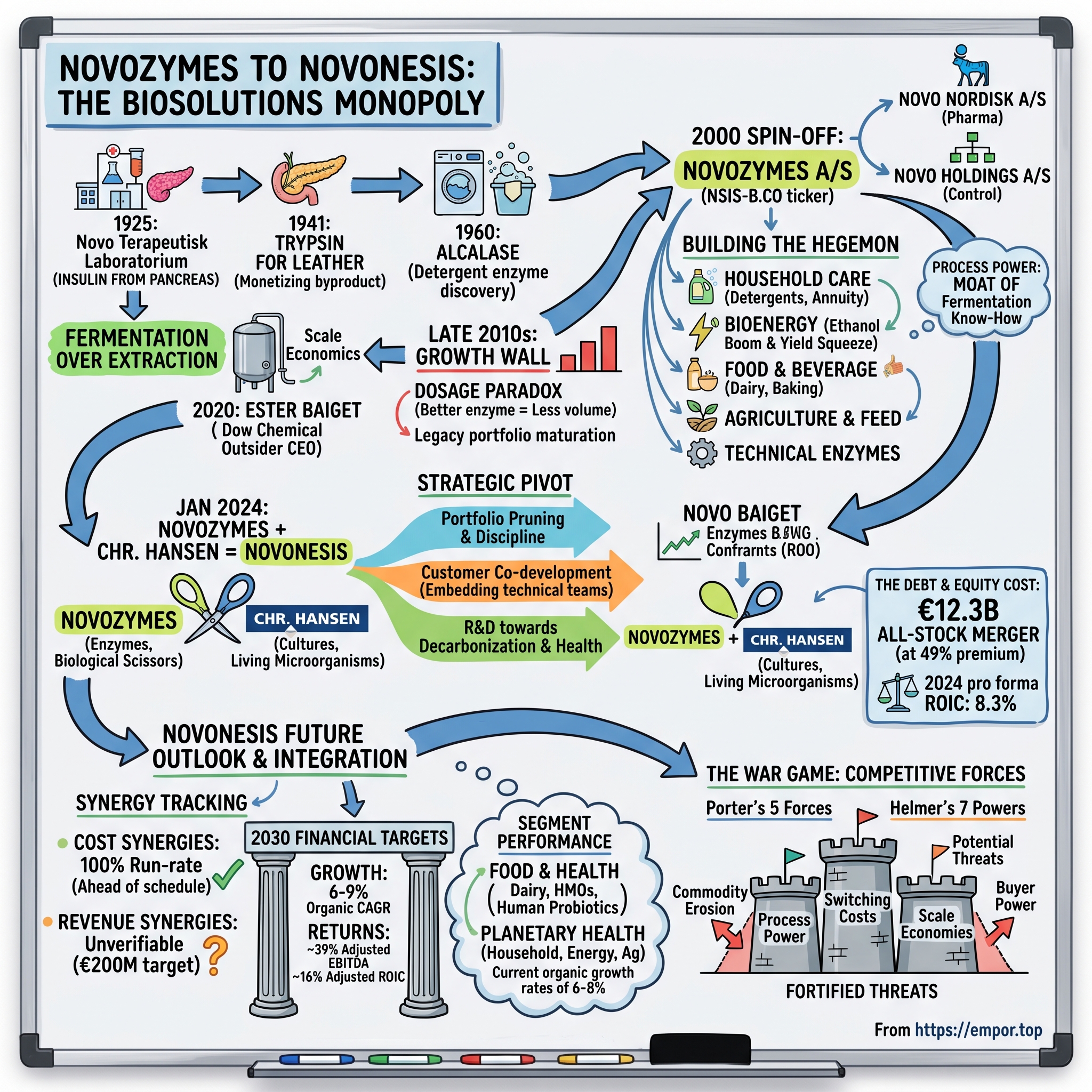
Novonesis: The Biosolutions Monopoly
I. Introduction & Episode Roadmap
Open the door of a household washing machine anywhere in the world, and you are looking at a chemical reactor. Inside it, at 30 degrees Celsius in slightly alkaline water, a set of proteins is quietly dismantling the molecular structure of last night's dinner — cutting protein chains at their weak points, unzipping starch into sugar, snipping fats into fatty acids. Those proteins are enzymes. They cost the detergent maker a rounding error per wash. They also determine whether the shirt comes out clean.
There is a very good chance those enzymes were made in Kalundborg, Denmark, or in Blair, Nebraska, or in Tianjin, China, in a steel fermentation tank the size of a small apartment building, by a company most consumers have never heard of. That is the business. It has always been the business.
For a quarter-century that company was called Novozymes — a November 2000 spin-off from the Danish insulin maker Novo Nordisk that inherited the enzyme division and left the pharmaceutical business behind.[^1] It grew into the closest thing industrial biotechnology has to a hegemon, supplying enzymes into detergents, bread, beer, corn ethanol, animal feed, textiles, leather, and pulp. It became the kind of company that is invisible to consumers and unavoidable to manufacturers.
Then, on January 29, 2024, it stopped being Novozymes. On that date the combination with Chr. Hansen Holding — Denmark's other great biological franchise, the company that supplied the bacterial cultures that turn milk into cheese and yogurt — formally completed, creating a group of roughly €3.7 billion in annual revenue and about 10,000 employees, renamed Novonesis.1 It trades on Nasdaq Copenhagen as NSIS-B.2
The strategic logic was elegant on a slide. Novozymes sold enzymes — biological scissors, catalysts that break molecules apart or stitch them together, but which are not themselves alive. Chr. Hansen sold cultures — actual living microorganisms, strains of bacteria that ferment, colonize, protect, and produce. One company sold the tool; the other sold the organism. Put them together and you could, in theory, walk into a cheese plant and sell the starter culture, the coagulating enzyme, the flavor enzyme, and the shelf-life protection in a single conversation.
That is the promise. This article is about whether it is being delivered.
Two and a half years on, the evidence is genuinely mixed in an interesting way. The cost side of the merger has gone better than promised: management reported reaching a 100% run rate on cost synergies a full year ahead of schedule.3 The growth side has held up — 8% organic growth in 2024, 7% in 2025, 7% again in the first quarter of 2026, with an adjusted EBITDA margin that climbed from 36.1% to 37.1% to 37.8%.456 But the €200 million revenue synergy target that was the entire intellectual justification for paying a 49% premium has quietly stopped being reported as a separate line item, folded instead into a broader 2030 volume growth ambition.78 And the return on invested capital that the pre-merger Novozymes generated — the number that made it a great business — was reset by the transaction to a pro forma 8.3% in 2024, with management now targeting roughly 16% by 2030.7 Doubling ROIC over six years is the honest admission of what a €12.3 billion all-stock deal did to the balance sheet.
So here is the roadmap. First, how a Danish insulin laboratory accidentally discovered that the enzymes it was throwing away were worth more than it realized, and why Novo Nordisk eventually cut the enzyme business loose. Second, how that business built a genuine process moat over four decades — and then hit a growth wall in the late 2010s that no amount of R&D seemed to fix. Third, the arrival of an outsider CEO from Dow Chemical and the strategic pivot she ran. Fourth, an unsentimental autopsy of the merger itself, including the structure by which the controlling shareholder took a worse exchange ratio than everyone else. Fifth, the actual unit economics underneath each division. Sixth, a war-game of the competitive position using Helmer's 7 Powers and Porter's 5 Forces. Seventh, what management actually says when analysts push back on earnings calls — and where the answers get thin. And finally, the explicit bull and bear spine, and the small number of metrics that will settle the argument.
The through-line is a question that applies well beyond Denmark: what happens when a company with a nearly unassailable position in a slow-growing market buys growth, and pays for it in equity?
 Subscribe on LinkedIn
II. The Novo Nordisk Heritage & The 2000 Spin-Off
In 1925, two Danish brothers, Harald and Thorvald Pedersen, founded a laboratory in Copenhagen to manufacture insulin.[^10] The raw material was pancreas — specifically, the pancreas glands of slaughtered cattle, shipped in from Danish abattoirs. The company was called Novo Terapeutisk Laboratorium, and its business model was, in the most literal sense, biological extraction: take an organ, apply chemistry, isolate the molecule that keeps diabetics alive.
Here is the detail that made everything else possible. The pancreas is not only an insulin factory. It is the body's primary source of digestive enzymes — trypsin, amylase, lipase. Every batch of insulin extraction left behind a residue rich in proteins that could break down other proteins, starches, and fats. For years that residue was waste.
In 1941, the company launched its first enzymatic product: trypsin, extracted from those same pancreases, sold to tanneries for softening leather.[^10] It is worth pausing on how modest this was. A pharmaceutical company had found a way to monetize a byproduct by selling it to the leather trade. Nobody was drawing up a strategy deck about industrial biotechnology. They were selling the offcuts.
The accident that built a franchise
The transformation came in 1960. Novo's researchers, working on fermentation rather than extraction, found themselves in possession of an enzyme with an unusual property profile: it worked in hot water, it worked in alkaline conditions, and — critically — it kept working in the presence of the harsh surfactants used in laundry detergent.[^10] It removed blood and sweat stains that soap alone could not touch. They named it Alcalase, and it was Novo's first detergent enzyme produced by fermentation rather than harvested from animal organs.[^10]
Two things happened at once, and both mattered more than the discovery itself.
The first was the shift from extraction to fermentation. Extracting enzymes from cattle pancreas caps your output at the number of cattle slaughtered. Growing microorganisms in a tank does not. Fermentation turned a supply-constrained artisanal process into a manufacturing business with scale economics — more tank volume, more product, lower unit cost. Every structural advantage Novonesis has today descends from that conversion.
The second was the discovery of the ideal customer. Detergent is a colossal, globally distributed, brand-driven consumer category with a handful of dominant manufacturers. Those manufacturers compete on cleaning performance. An enzyme that measurably improves stain removal at low cost is not a commodity input to them — it is a product claim. It is the reason a detergent can advertise cold-water washing, which saves the consumer energy and saves the brand a sustainability headline.
That combination — tiny share of the customer's cost, decisive share of the customer's performance — is the single most important economic fact about this company, and it was established in the 1960s. Everything since has been an attempt to reproduce it in other industries.
Why Novo Nordisk let it go
By the late 1990s, Novo Nordisk was running two businesses under one roof that had almost nothing in common except a shared fermentation heritage. One made insulin: high gross margins, long clinical trials, regulatory gatekeepers, patent cliffs, and an addressable market being redrawn by the global diabetes epidemic. The other made industrial enzymes: lower gross margins, capital-intensive fermentation capacity, B2B sales cycles measured in years, and customers who were themselves large sophisticated manufacturers.
In November 2000, Novo Nordisk split into three entities: Novo Nordisk A/S, Novozymes A/S, and the holding company Novo A/S.[^1] Novozymes took the enzyme business and listed separately, initially led by CEO Steen Riisgaard.
The strategic argument was capital allocation, and it was sound. Inside a combined company, every krone of enzyme R&D competed against a Phase III insulin trial for board attention. Those two investments have entirely different risk profiles, time horizons, and hurdle rates, and forcing them into one budget process guarantees that one of them gets systematically underfunded. Separating them meant enzyme research could be priced against enzyme returns.
But there was a second argument that mattered more over time. A separately listed enzyme company could be valued on its own multiple. Investors who wanted industrial biotechnology exposure could buy it directly rather than buying it embedded, and invisible, inside a pharma story.
The foundation shield
What did not change in 2000 was who ultimately controlled the business.
The Novo Nordisk Foundation, through its holding company Novo Holdings A/S, retained a controlling position in all the spun-out entities. At the end of 2025, Novo Holdings held A and B shares in Novonesis equivalent to roughly 25.5% of share capital and approximately 63.4% of the votes.9 The mechanism is a dual-class structure: A and B shares carry the same DKK 2 nominal value, but each A share carries ten votes to a B share's one, and Novo Holdings controls all of the A shares.9
For a long-term investor, this cuts both ways, and it is worth being honest about both edges.
The favorable reading is the one the company tells: a foundation owner with a multi-decade horizon and no redemption pressure can tolerate research programs that take fifteen years to pay off, can absorb a bad quarter without a proxy fight, and cannot be forced into a value-destroying auction by an activist. In a business where developing and scaling a new microbial strain genuinely takes a decade, that is not a governance footnote — it is a real input to the R&D function.
The unfavorable reading is that 63.4% of the votes means minority shareholders have no realistic mechanism to force a change of strategy, a change of management, or a change of capital allocation policy if they conclude one is needed. The protection from hostile takeovers is also the removal of the takeover premium and the removal of the discipline that comes with it. And, as the merger structure would later demonstrate in detail, a controlling shareholder that sits on both sides of a transaction creates conflicts that no independence committee fully neutralizes.
Which brings us to what Novozymes actually did with three decades of patient capital.
III. Building the Enzyme Hegemon: Scaling & Historical Inflections (2000–2019)
Picture the inside of a modern industrial fermentation plant. It does not look like a laboratory. It looks like an oil refinery that smells faintly of bread. Stainless steel vessels holding a hundred thousand liters or more, wrapped in cooling jackets, fed by sterilized pipes carrying sugar and nitrogen and trace minerals. Inside each one, a genetically optimized fungus or bacterium is doing one job: secreting a single protein into the broth, as fast and as purely as it can be persuaded to.
The economics of that tank are the economics of the company. The capital cost is largely fixed. The variable cost is feedstock, energy, and downstream purification. The output is measured in grams of target protein per liter of broth. Push that yield from four grams to eight, and you have halved your unit cost without spending another euro on steel. That is the game Novozymes played, strain by strain, for forty years.
Household Care: the annuity
The detergent franchise built on Alcalase became the group's cash engine, and it grew through a mechanism that is easy to miss. The pitch to Procter & Gamble or Unilever was never simply "our enzyme cleans better." It was "our enzyme lets you clean at a lower temperature."
That reframing is worth dwelling on. Heating water is the dominant energy cost of doing laundry. A detergent that works at 30 degrees instead of 60 saves the consumer real money on an electricity bill and lets the brand claim a carbon reduction. Enzymes made that possible, because they are catalysts that work at body temperature — that is what they evolved to do. Every incremental degree of wash-temperature reduction across the developed world was, functionally, an enzyme sale.
It also created switching costs that have nothing to do with contracts. When a detergent brand reformulates around a specific enzyme blend, it re-runs consumer panels, stain-removal testing, stability testing across shelf life, and packaging compatibility work. Swapping the enzyme supplier means redoing that. For an input worth a low single-digit percentage of the formulation cost, no procurement team volunteers for that project.
Bioenergy: the boom that taught an expensive lesson
If Household Care was the annuity, bioenergy was the growth stock — and then the cautionary tale.
The US Renewable Fuel Standard created, essentially by legislative fiat, an enormous new market for corn ethanol. Ethanol production is an enzymatic process: alpha-amylase liquefies corn starch into shorter chains, glucoamylase converts those chains into fermentable glucose, and yeast does the rest. Every gallon of American ethanol required enzymes, and Novozymes was the primary supplier into a market that scaled from marginal to multi-billion-gallon in roughly a decade.
For years this was extraordinary. Then it stopped being extraordinary, for three separate reasons that arrived together.
First, the mandate stopped growing. A policy-created market grows only as fast as the policy allows, and the blend wall — the practical limit of how much ethanol can go into gasoline — capped volumes.
Second, ethanol producers got better at squeezing yield, and enzyme dosing became a cost line to optimize rather than a performance lever to maximize. Third, the customers consolidated and got sharper on procurement.
The result showed up in the numbers. In 2019, Novozymes reported that bioenergy sales declined 3% organically and agriculture and feed declined 5%, with difficult conditions in both weighing on the group.10 Household Care, the supposed annuity, declined 6% organically that year.10 This was after a 2018 in which bioenergy had grown well and household care had been flat.11
The dosage paradox
The mid-to-late 2010s exposed a structural problem that sits at the heart of the enzyme business, and any investor evaluating this company needs to understand it.
Novozymes' R&D produced better enzymes. Better enzymes are more efficient. More efficient enzymes mean the customer needs less of them to achieve the same result. If you sell by the kilogram, improving your product reduces your volumes.
This is the opposite of most technology businesses, where a better product lets you sell more. It is closer to the position of a lighting manufacturer that invents the LED: you have made your customer's life better and your own unit volumes worse. The only escape is pricing — charging for the value delivered rather than the mass shipped — and that requires the customer to accept value-based pricing on an input they are simultaneously trying to use less of.
Compounding this, a large part of the legacy portfolio had matured. Detergent enzymes, starch-processing enzymes, and baking enzymes are decades old. The patents that protected the original molecules expired. Manufacturing know-how still protected the cost position — this is genuinely hard chemistry to run at scale — but the intellectual property barrier had thinned, and Chinese fermentation capacity began appearing in the most commoditized categories.
Organic growth compressed into the low single digits, and the market repriced the shares accordingly. For a company that had been valued as a secular compounder, that was a painful reassessment.
The strategic conclusion
The internal diagnosis that emerged was uncomfortable but correct: the problem was not execution, it was the addressable market. Selling catalysts into mature industrial processes is a good business with a low growth ceiling. Growth required moving up what you might call the biological complexity curve — from selling isolated proteins that perform a mechanical function, toward selling living organisms that perform a biological function.
An enzyme cleans a shirt. A live bacterial culture colonizes a gut, protects a crop root system, or ferments a flavor profile over weeks. The second category is harder to make, harder to validate, and much harder for a competitor to copy — because you are not selling a molecule that can be reverse-engineered, you are selling a strain with a proprietary genome and a decade of application data behind it.
That conclusion pointed, eventually and inexorably, at a company forty kilometers away in Hørsholm that had spent 150 years doing exactly that. But before Novozymes could make that move, it needed someone willing to make it.
IV. Current Management & Strategic Pivot (2020–2022)
On February 1, 2020, Ester Baiget took over as President and CEO of Novozymes.12 She was 48 years old, a Spanish national who had been living in Switzerland, holding a chemical engineering degree and an MBA from Tarragona.12 She was, by the standards of Danish industrial biotechnology, an outsider on nearly every dimension.
Her career had been spent almost entirely at Dow. She joined in 1995 as an engineer in Tarragona, Spain, and worked her way through manufacturing, technical, commercial, and strategic roles, ending as Business President for Dow's Industrial Solutions and a member of the company's executive leadership team.12
The choice was a statement, and the statement was not subtle.
Novozymes had been run for most of its independent life by scientists. Its self-image was a research institution that happened to have customers. Hiring a commercial operator from one of the world's largest chemical companies — someone whose professional formation was in portfolio management, plant utilization, pricing, and margin structure rather than strain engineering — was the board saying that the constraint was no longer science. The science was fine. The constraint was that the company had not been aggressive enough about converting science into price, or about deciding which businesses deserved capital.
What actually changed
The early Baiget agenda was less about grand strategy than about industrial discipline, and it showed up in three places.
The first was portfolio pruning: being willing to walk away from low-margin business that consumed manufacturing capacity without earning a return. Fermentation capacity is the scarce resource in this company. Every liter of tank volume filled with a commodity enzyme sold at a defensive price is a liter not available for something better. Chemical company executives are trained to think this way. Scientists, understandably, are not — they tend to see every product as a technical achievement worth defending.
The second was customer co-development. Rather than selling a catalog product and letting the customer figure out the application, the model shifted toward embedding technical teams inside the customer's development process. This is slower and more expensive per account, but it changes the nature of the relationship: the supplier stops being a vendor and becomes a party to the customer's product roadmap. It is also, not incidentally, the single most effective way to make an input hard to swap out.
The third was where R&D money went. The pivot pushed research toward decarbonization applications and human health rather than incremental improvements to mature industrial enzymes. That is a bet on the addressable-market problem identified in the previous section, and it was the intellectual groundwork for what came next.
Rainer Lehmann joined as Chief Financial Officer, appointed to the executive leadership team in an announcement dated October 10, 2023, and taking the CFO role at the combined company from January 2024.1 He arrived from Sartorius, where he had spent from 2006 to 2023 in senior finance and operations roles including CFO of the Stedim Biotech business — a bioprocessing equipment company, which is to say someone who understood the capital intensity of fermentation from the supplier side.
The inflation stress test
Then 2021 and 2022 handed management an unplanned but extremely informative experiment.
Industrial fermentation is energy-hungry and feedstock-hungry. You are buying sugar, buying nitrogen sources, running compressors, sterilizing equipment, and drying product. When European energy prices spiked following the invasion of Ukraine, and when agricultural feedstock costs rose alongside them, the cost base of every fermentation plant in the company moved sharply.
The test was whether those costs could be passed through to customers.
They largely were. The company raised prices into a B2B customer base that includes some of the most sophisticated procurement organizations on earth — Procter & Gamble, Unilever, Nestlé, the large ethanol producers — and did not visibly surrender share to do it.
The analytical conclusion matters more than the fact. Pricing power in a B2B input business is not a matter of brand or of goodwill; it is a matter of the customer's alternatives. If a detergent maker could have switched enzyme suppliers cheaply, it would have when prices rose. That it broadly did not is direct behavioral evidence that the switching costs described earlier are real and are quantifiable in the customer's own decisions. This is the most credible single piece of evidence for the moat thesis, precisely because it was an involuntary test rather than a management assertion.
Two qualifications keep this honest. Pass-through was not instantaneous and it was not complete in every category, and margins compressed before they recovered. And pricing power measured during a broad, industry-wide cost shock — where every competitor faces the same pressure — is easier to demonstrate than pricing power in a stable-cost environment where a rival can undercut you without damaging its own economics. The 2022 evidence is genuine but should not be over-extrapolated.
By late 2022, Baiget had a company with restored margin discipline, a demonstrated ability to price, and an unsolved growth problem. The solution she chose was the largest transaction in the company's history.
V. The $12.3B Mega-Merger: Novozymes + Chr. Hansen = Novonesis
On December 12, 2022, Novozymes and Chr. Hansen announced they would combine.13 The headline value was approximately $12.3 billion, and the structure was all-stock: Chr. Hansen shareholders would receive newly issued Novozymes B-shares rather than cash.14
To understand why this was the deal, you need to understand what Chr. Hansen was.
Founded in Denmark in the 1870s, Chr. Hansen's original business was rennet — the enzyme preparation, traditionally from calf stomach, that curdles milk into cheese. From that starting point it built the world's leading library of bacterial cultures for food fermentation: the specific strains of Lactobacillus and Streptococcus that determine whether milk becomes yogurt or cheese, what texture it has, how tangy it tastes, and how long it survives on a shelf. It extended into probiotics for human health, natural colors, and microbial products for agriculture.
The comparison to Novozymes is instructive. Both companies sold biology into food and industry. But Novozymes sold catalysts — proteins that make a reaction happen faster, and are not alive. Chr. Hansen sold organisms — living bacteria that reproduce, metabolize, and interact with their environment. If Novozymes sold you a very good pair of molecular scissors, Chr. Hansen sold you a colony of very well-behaved workers.
The valuation question
Now the uncomfortable part.
At settlement, Chr. Hansen shares were exchanged at a ratio of 1.5326 new Novozymes B-shares per Chr. Hansen share for shareholders other than Novo Holdings, and that ratio reflected an implied premium of 49% to Chr. Hansen's undisturbed price.14 In total, all Chr. Hansen shares were exchanged for 187,298,646 new Novozymes B-shares of DKK 2 nominal each, admitted to trading on Nasdaq Copenhagen on January 31, 2024.14
Chr. Hansen was not a cheap asset before the premium. It traded at a multiple that reflected its own quality — a high-return, low-capital-intensity business with genuine pricing power in dairy cultures. Paying a 49% premium on top of that is, arithmetically, paying a very full price.
Two defenses are available and both deserve scrutiny.
The first is that all-stock deals are not the same as cash deals. Novozymes was itself trading at a healthy multiple, so it was paying with an expensive currency for an expensive asset. That mitigates the overpayment, but only partially — and only if you believe the acquirer's own shares were fairly or generously valued at the time, which is precisely the sort of judgment that looks different in hindsight.
The second is that the premium buys synergies. Announced targets were €200 million in annual revenue synergies with an €80–90 million EBIT impact within four years, plus €80–90 million of cost synergies within three years, alongside a 6–8% organic revenue growth ambition.1 If those numbers land, the premium is defensible. If they do not, the premium is a permanent transfer from Novozymes shareholders to Chr. Hansen shareholders.
The structural detail nobody should skip
Here is the part of the transaction that reveals the most about how this company is governed.
Novo Holdings owned approximately 22% of Chr. Hansen — 28,983,112 shares — and it exchanged those shares at a ratio of 1.0227, not 1.5326.14
Read that again. The controlling shareholder, which sat on both sides of the transaction, accepted roughly two-thirds of the exchange ratio granted to everyone else. In practical terms, Novo Holdings surrendered a large slice of the premium it could have claimed on its Chr. Hansen stake, and in doing so reduced the number of new shares issued and therefore the dilution suffered by Novozymes' existing free-float shareholders.
This is the strongest available argument that the foundation structure has genuine value for minority investors. In a conventional public-company merger, a 22% shareholder in the target would have extracted the same premium as everyone else, and the acquirer's shareholders would have eaten the full dilution. Here the controlling owner effectively subsidized the deal to protect the other side of its own house.
The skeptical reading is that Novo Holdings was not being generous — it was rebalancing between two pockets it already owned, and it structured the exchange to keep its post-merger stake in the combined entity at a level it wanted. The differential ratio was, in that view, a mechanism for managing its own ownership arithmetic rather than an act of shareholder friendship. Both readings can be true simultaneously. What matters for a minority investor is the outcome, and the outcome was less dilution than a standard structure would have produced.
The combination completed on January 29, 2024, creating a group with roughly €3.7 billion in annual revenue and about 10,000 employees, chaired by Cees de Jong, with Baiget as CEO and Lehmann as CFO.1
The commercial thesis, tested
The cross-sell logic is best understood through a specific example, because in the abstract it sounds like every merger deck ever written.
Take a cheese plant. To make cheese you need a starter culture — bacteria that acidify the milk. You need a coagulant — an enzyme that curdles it. You may want a flavor-development enzyme to accelerate ripening, a protective culture to inhibit spoilage organisms, and a lactase enzyme if you are making a lactose-free variant. Pre-merger, that plant bought cultures and coagulant from Chr. Hansen and specialty enzymes from Novozymes, or from a rival. Post-merger, one salesperson, one technical service team, and one supply relationship can cover all of it — and, more valuably, can develop combinations that neither company could design alone, because optimizing an enzyme and a culture together requires owning both.
That is a real mechanism, not a slide. Whether it produces €200 million of incremental revenue is a different question, and the honest answer as of mid-2026 is that the company has made it harder to check — a point we will return to.
The first year told an encouraging story: 2024 delivered 8% organic pro forma sales growth with an adjusted EBITDA margin of 36.1%, with volumes up around 6% and pricing contributing roughly 2%.4 For a company in the middle of merging two 10,000-person organizations, holding growth at that level was a genuine execution result, not a rounding error.
But headline growth tells you nothing about where the money actually comes from.
VI. Segment Breakdown, Economics & Materiality Sizing
Start with a housekeeping point that matters for anyone reading the filings, because the reporting structure does not match the intuitive product structure.
Novonesis reports two divisions, not three. Planetary Health Biosolutions covers Household Care and the Agriculture, Energy & Tech businesses. Food & Health Biosolutions covers Food & Beverages together with Human Health. The Human Health business — probiotics, dietary supplements, human milk oligosaccharides — is a sub-unit inside Food & Health rather than a reported segment of its own. That structure gives management flexibility in how much granularity it discloses, and investors should be aware that a fast-growing, high-margin unit sits inside a larger reported number.
FY2025 revenue was approximately €4.15 billion, up from €3.83 billion in 2024.[^17] Group organic growth was 7% in 2025, split between Food & Health at 8% and Planetary Health at 6%.5 In 2024 the split ran the other way: Food & Health grew 7% and Planetary Health grew 9%.4 Neither division has run away from the other, which is roughly what management guided when it said in August 2025 that both divisions should grow within the group range through 2030.7
Planetary Health: scale economics and cyclicality
This is the industrial half of the company, and its economics are the economics of the fermentation tank.
Household Care behaves like an annuity with slow structural growth. Its unit volumes are tied to global detergent consumption, which grows roughly with population and income in emerging markets and barely at all in developed ones. Its upside comes from enzyme penetration — more enzyme types per formulation, more markets moving to cold-wash — and from pricing. Its downside is the dosage paradox and the persistent threat of low-cost competition in the most commoditized enzyme classes.
Energy is the more interesting story and has been the recent surprise. Double-digit growth in Energy contributed to Planetary Health's 2025 performance despite an overall divisional result of 6%.5 On the full-year 2025 call, when Nordea's Thomas Flint asked directly whether US ethanol yields were approaching a physical ceiling of around three gallons per bushel, Chief Scientific Officer Claus Crone Fuglsang did not dispute the premise. He redirected to where remaining conversion potential exists — fiber processing, waste reduction, protein fractionation — and pointed to biodiesel and second-generation ethanol in Brazil and India as growth vectors.3
That exchange is worth flagging because it is the most important structural question about the segment, and the answer was a redirect rather than a rebuttal. The honest reading is that corn ethanol enzyme intensity in the mature US market is approaching diminishing returns, and that future growth in Energy depends on new geographies, new feedstocks, and selling adjacent products into the same plants rather than on selling more enzyme per bushel of American corn.
Management's own framing supports this. On the Q1 2026 call, Planetary Health head Tina Sejersgaard Fanø ranked the growth drivers explicitly: increased ethanol production volume first, market share gains second.6 Second-generation ethanol — the technically harder process that converts agricultural residue rather than food starch, and which has been "about to happen" for twenty years — remained under 5% of the energy segment, though growing.6 That is an appropriately sized disclosure of a long-dated option rather than an inflated one, and management deserves credit for stating the number plainly.
Agriculture is smaller and lumpier. On the Q1 2026 call, DNB Carnegie's Lars Topholm pushed on apparent weakness within the division, and Fanø acknowledged a double-digit decline in the plant and tech businesses, attributing it to order timing and difficult prior-year comparisons, while noting plant represented only around 5% of divisional sales.6 A double-digit decline in a 5% business is not thesis-changing. But the pattern of quarterly volatility being explained by timing is one to watch across several quarters rather than accept once.
Food & Beverage: the near-zero-churn book
The dairy, baking, and beverage businesses have the most attractive qualitative characteristics in the group, for a reason that has nothing to do with technology.
A cheese culture is not a specification, it is a taste. Consumers form expectations about what a particular cheddar or a particular yogurt tastes like, and those expectations are set by the specific bacterial strains doing the fermenting. Change the culture and you change the product. That means a dairy processor cannot switch suppliers on price without risking the thing consumers actually buy it for.
Baking works similarly through a different mechanism. Anti-staling enzymes extend the period during which bread stays soft. For a supermarket bakery supply chain, shelf life translates directly into waste reduction, which translates into margin. The enzyme is a tiny input cost delivering a large logistics benefit.
The result is a book of business with very low churn and steady pricing. It is also the division most exposed to a specific, live headwind: country exits.
Following the merger, Novonesis moved to cease business in Russia, with the exit expected to conclude within about twelve months and to weigh on 2025 organic growth by roughly one percentage point at group level and around three percentage points within Food & Beverages.15 Chr. Hansen had supplied cultures and enzymes into Russian milk, yogurt, and cheese production; Novozymes' chairman had stated in 2022 that the company would neither sell nor supply to Russia and Belarus.15 The drag persisted into 2026: Q1 2026's Food & Health organic growth of 9% included roughly three percentage points of country-exit headwind, and management built approximately one percentage point of group-level exit impact into full-year 2026 guidance.6
This is worth understanding correctly. The exits are a deliberate, self-inflicted reduction in reported growth taken for governance reasons. Underlying commercial momentum in the division is materially better than the headline. Investors should adjust for it — and should also note that it will annualize out, meaning some of the apparent growth acceleration in 2027 will be arithmetic rather than commercial.
Human Health: the growth vector with a proof burden
This is the smallest of the three product areas and the one carrying the most narrative weight.
Human Health delivered 10% organic growth in 2025, outpacing both divisions and the group.[^19] On the full-year call, Bank of America's Matthew Yates asked the obvious question — how the business was growing at that rate when peers in probiotics were visibly struggling. Divisional head Henrik Jørck Nielsen attributed it to being locked in with the right customers, specifically successful US brands, plus a fragmented market that allowed share gains, noting the business was growing well despite others struggling.3
That answer is plausible and also unfalsifiable from the outside, which is exactly why the Q1 2026 call was more informative. Nielsen conceded North American consumer softness had hit probiotics demand, citing fewer online searches for probiotics and weak US sentiment, while pointing to strong percentage growth in Chinese dietary supplements from a small base and moderate growth in Europe.6
The analytically useful conclusion is that Human Health is a genuinely faster-growing, higher-margin business that is nonetheless exposed to discretionary consumer spending in a way the industrial divisions are not. A shopper who cancels a probiotic subscription in a soft month does not stop buying detergent or bread. This is a growth vector with a consumer-cyclical tail attached, and it is being sold to investors primarily on the growth.
Human milk oligosaccharides are the most interesting piece of it. HMOs are complex sugars naturally present in breast milk that feed beneficial gut bacteria in infants; they cannot practically be extracted at scale, so they are manufactured by precision fermentation — engineering a microorganism to produce a specific human sugar molecule. The barriers are real: process development, regulatory approval as an infant nutrition ingredient, and capacity. In Q1 2026 the company announced an opportunistic acquisition of a production facility in Thailand, which Baiget described as capacity optionality for HMO production, fully embedded within capital expenditure guidance of 12–14% of sales, with further HMO scaling investment already inside the 2030 plan.6
Buying an existing plant rather than building one is a reasonable way to de-risk capacity for a product whose demand curve is still uncertain. It is also, quietly, an admission that HMO demand may be arriving faster than internal capacity can be built.
Carbon capture, enzymatic bio-materials, and the newer explorative areas announced with the 2030 strategy — biopharma processing aids, future fuels and chemicals, and specialized nutrition proteins — belong in the optionality bucket.7 They are strategically and politically resonant, and they are not material to revenue today. Sizing them honestly is the correct treatment, and it is worth noting that management has generally done so rather than inflating them.
Which raises the question of how defensible any of this actually is.
VII. Competitive Dynamics, 7 Powers & 5 Forces Analysis
Run the war game properly. If a well-capitalized competitor decided tomorrow to take Novonesis's detergent enzyme business, what would it have to do?
It would need to find or engineer a protease that performs at least as well under alkaline, surfactant-heavy, low-temperature conditions. It would need to express that protease in a production organism at commercially viable yield. It would need to build or acquire fermentation capacity at a scale where unit costs are competitive. It would need to navigate regulatory approvals in every jurisdiction of sale. And then it would need to persuade a detergent manufacturer to reformulate, re-test, and re-validate a product line around an unproven supplier, in order to save a fraction of a percent on total product cost.
The last step is where most attacks die. That asymmetry is the moat.
Helmer's 7 Powers, honestly applied
Process Power is the primary and most durable advantage. This is accumulated, largely tacit knowledge about how to make fermentation work at industrial scale: which strain modifications improve secretion without killing the organism, how to compose growth media, how to control foaming and oxygen transfer in a 100,000-liter vessel, how to recover and stabilize the product. It is not written down in a patent because much of it cannot be. It compounds over decades and it is exactly what a new entrant cannot buy. The evidence is straightforward — this industry has had obvious economics for forty years and no new entrant has taken meaningful share of the high-value categories.
Switching Costs are real and demonstrated, and the 2021–2022 pricing pass-through is the proof. The mechanism, established earlier, is the mismatch between the input's share of cost and its share of performance. The important nuance is that switching costs vary enormously by category. They are near-absolute in dairy cultures, where the strain defines the taste. They are high in detergent, where reformulation is expensive. They are much lower in commodity starch-processing enzymes, where the output is a defined conversion and one glucoamylase is broadly substitutable for another. The moat is not uniform across the portfolio, and the segments where it is thinnest are exactly where Chinese capacity has been building.
Scale Economies operate on both R&D and manufacturing. Research and development ran at roughly €463 million in 2025 against approximately €4.15 billion of revenue.[^17] A competitor with a quarter of the revenue and the same ambition would need to spend four times as much as a percentage of sales to match that absolute research budget. On the manufacturing side, the largest fermentation footprint amortizes fixed costs across the most volume.
Cornered Resource takes the form of the accumulated strain libraries — now combining Novozymes' enzyme-producing organisms with Chr. Hansen's culture collection — plus the patent estate. The strain collection is the more valuable half, because a patent expires and a proprietary organism with a decade of application data behind it does not.
There is a newer element worth noting. The company disclosed that AI has cut protein shape prediction from roughly a year to under a minute.16 This is a genuine change in research productivity, but investors should think carefully about who it advantages. Computational protein design tools are increasingly available to everyone. If the hard part of enzyme development shifts from "design the molecule" to "manufacture it at scale," that strengthens Process Power relative to discovery capability — which is good for Novonesis. But if it lowers the barrier to designing a competitive molecule, it erodes part of the discovery advantage. The net is probably favorable, and it is not certain.
Branding, Network Economies, and Counter-Positioning are largely absent, and pretending otherwise would be sloppy. This is a B2B ingredient supplier. There is no consumer brand, no network effect between customers, and no business-model asymmetry that incumbents cannot copy.
Porter's Five Forces
Rivalry is oligopolistic. The industrial enzyme market is concentrated, with the largest handful of players — Novonesis, dsm-firmenich, and IFF prominent among them — accounting for more than half the market, and with a regulatory filing analysis finding that four companies and their subsidiaries submitted 64% of enzyme applications: Novozymes, DSM, IFF, and AB Enzymes.17 IFF's position came largely through its 2021 combination with DuPont's Nutrition & Biosciences business, which carried the Danisco enzyme franchise.17 Kerry Group and BASF compete in overlapping territory.
Concentration does not eliminate rivalry. On the Q1 2026 call, Food & Beverage head Andrew Taylor was asked about dairy competition and acknowledged directly that dsm-firmenich holds strong enzyme positions, arguing the Novonesis advantage lies in combining cultures and enzymes into integrated solutions for productivity and flavor, particularly in cheese.6 That is a candid answer — it concedes the competitor's strength and locates the differentiation in the merger thesis rather than in product superiority. It is also, of course, exactly what management needs to be true.
Buyer Power is high in principle and lower in practice. The customer list includes some of the most concentrated and capable procurement organizations in global consumer goods. They negotiate hard, they benchmark constantly, and they run dual-sourcing programs. What blunts them is the reformulation cost and the co-development entanglement described earlier. The equilibrium is a supplier that can price to value but cannot price abusively — which is roughly what the disclosed 1–2 percentage points of annual price contribution in the 2030 plan describes.7
Threat of New Entrants is low in high-value categories and moderate in commoditized ones. Chinese fermentation capacity is the live issue: China is among the fastest-growing enzyme markets globally, and building fermentation capacity there is cheaper than in Europe.17 The risk is not that a Chinese producer takes the dairy culture business. It is margin pressure in basic amylases and glucoamylases, and a gradual squeeze on the parts of the portfolio where the customer genuinely does not care whose enzyme it is.
Threat of Substitutes is low and arguably declining. The substitute for a biological catalyst is a chemical process — usually one that runs hotter, uses harsher reagents, and produces more waste. Environmental regulation and corporate carbon commitments push the other way. This is one force that has been working steadily in the company's favor for thirty years and shows no sign of reversing.
Supplier Power is modest. Inputs are agricultural feedstocks and energy — commodity, volatile, but broadly available.
The net picture is a structurally advantaged business in an oligopoly with real but uneven moats, facing a slow erosion at the commodity end and holding firm at the specialty end. Which is exactly why the merger mattered: it was a bet on shifting the portfolio mix toward the defensible end. The question is whether management is reporting honestly on whether that bet is working.
VIII. Transcript Deep Dive & Management Credibility
The most useful thing about an earnings call is not the prepared remarks. It is the Q&A, where a sell-side analyst who has been covering the sector for fifteen years asks the question the press release was designed to avoid.
Across the FY2025 call on February 25, 2026 and the Q1 2026 call on May 5, 2026, a consistent pattern emerges: management is concrete and comfortable on cost, capacity, and pricing; more general when pressed on quarterly divisional softness; and notably quiet on the specific commitment that justified the merger premium.36
Where the answers are specific
On margin construction, Morgan Stanley's Tom Wrigglesworth asked how the 37–38% guidance for 2026 would bridge from 2025. Lehmann's answer was operational rather than aspirational: roughly 400 new commercial hires added during 2025 would be present in the cost base from the start of 2026, quarterly progression should be fairly consistent, and pricing should contribute around one percentage point annually.3 That is a CFO describing arithmetic he has actually done.
On capital expenditure, SEB's Søren Samsøe challenged guidance of 12–14% of sales — a substantial step up. Lehmann broke it into components: enzyme capacity expansion, particularly in India; completion of a US dairy culture facility in Q4 2026; and an ERP implementation.3 Again, specific and checkable.
On financing, Lehmann disclosed the issuance of €1.7 billion of senior unsecured notes to refinance the bridge loan used for the Feed Enzyme Alliance acquisition, an S&P rating of A– with stable outlook, and an expectation of roughly 1.7x net debt to EBITDA by year-end 2026 despite elevated capital spending.6 Net debt to EBITDA stood at 1.9x at end-2025 and 2.0x at the end of Q1 2026, against a policy target of around 1.5x.567
That last set of numbers deserves a note. The company is running above its stated leverage target, with elevated capex, having just spent €1.5 billion in cash on the Feed Enzyme Alliance. That is a defensible posture for an A–rated business with strong cash conversion — free cash flow before acquisitions was €770.4 million in 2025, or 19% of sales.5 But it is a posture, not a coincidence, and the promised path back to 1.5x depends on both EBITDA growth and capex normalizing to high single digits by 2030 as guided.7
On the Feed Enzyme Alliance itself: Novonesis agreed on February 11, 2025 to acquire dsm-firmenich's share of the 25-year-old alliance for €1.5 billion, and the transaction completed on June 2, 2025, with dsm-firmenich receiving approximately €1.4 billion net of transaction costs.1819 By Q1 2026, management reported the acquisition was delivering synergies as planned and contributing roughly 50 basis points to EBITDA margin expansion.6 Buying out a joint venture partner in a business you already co-run is among the lowest-risk acquisitions available — you know the assets, the customers, and the cost base — and the early reporting is consistent with that.
Where the answers get softer
Two moments are worth flagging as analytical facts.
On the FY2025 call, Danske Bank's André Thormann pushed on Agriculture, Energy & Tech, noting that after timing adjustments the actual Q4 growth was around 3%. Baiget's response emphasized the full-year 6% and the double-digit Energy performance rather than engaging with the quarterly figure.3 That is a legitimate framing — quarterly volatility in a business with lumpy ordering genuinely is noise — but it is also a deflection, and the same move appeared again in Q1 2026 when plant and tech softness was attributed to timing and comparisons.6 Once is noise. A pattern of attributing weakness in the same division to timing is worth tracking.
On currency, Q1 2026 carried a six percentage point headwind, and management expressed confidence that pricing power would offset the impact on EBITDA margins, targeting a neutral year-over-year effect.6 Adjusted EBITDA margin in the quarter was 37.8%, down from 38.3% a year earlier, so the offset was not complete in the quarter itself.6 Management did not obscure this — it was disclosed clearly — but "we expect pricing to offset FX" is a forward statement that should be verified against subsequent quarters rather than accepted.
The disclosure question that matters most
Here is the gap that a serious investor should focus on.
The merger was justified to shareholders with a specific, quantified commitment: €200 million in annual revenue synergies with an €80–90 million EBIT contribution within four years, plus €80–90 million of cost synergies within three years.1 Cost synergies have been over-delivered — the company reported reaching a 100% run rate a year ahead of plan, and said as much explicitly in the 2025 annual report.16[^24]
Revenue synergies are a different story. When the 2030 targets were announced on August 20, 2025, growth was framed as driven mainly by volume "including synergies," plus a 1–2 percentage point annual price contribution — with revenue synergies no longer quantified as a separate, trackable line.7
This is not fraud and it is not necessarily bad faith. Revenue synergies are genuinely hard to isolate: when a cheese plant buys more from Novonesis, attributing the increment to the merger versus to normal commercial effort involves judgment. But it is a disclosure regression on the single number that determined whether a 49% premium was justified. The company chose to make the most falsifiable part of its merger thesis unfalsifiable, and it did so at the moment when it would have become checkable.
A second, smaller version of the same pattern: pre-merger Novozymes was tracked on EBIT margin. Novonesis guides and reports on adjusted EBITDA margin. EBITDA excludes the depreciation of newly stepped-up assets and the amortization of purchase price allocation — precisely the charges the acquisition created. Adjusted net profit is likewise reported excluding PPA.6 Every one of these choices is defensible individually and common practice in post-merger reporting. Collectively, they move the scoreboard away from the metrics that would show the acquisition's cost.
To management's credit, the 2030 ROIC target does not hide from this. Committing to roughly 16% adjusted ROIC excluding goodwill by 2030, from a pro forma 8.3% in 2024, is management stating plainly that returns on capital were halved by the transaction and that recovering them is the central task of the strategy period.7 That is an unusually candid target to put in writing, and it is the right one to be judged on.
IX. Activist Stress Test & Risk Radar
Imagine an activist fund building a position and preparing a presentation. Set aside for a moment that the dual-class structure makes the campaign nearly hopeless — the analysis is still worth doing, because it identifies what would actually have to go wrong.
The capital allocation case
Slide one writes itself: you turned a high-return business into an average-return business, and you did it with your own stock.
The numbers support the framing. A pro forma adjusted ROIC excluding goodwill of 8.3% in 2024 is not a return that justifies a premium multiple.7 Including goodwill, the picture is worse — the balance sheet now carries the accounting consequence of a €12.3 billion all-stock transaction at a 49% premium. The stated path back to roughly 16% by 2030 is credible only if organic growth lands at the upper end of 6–9% and margin reaches roughly 39% and capex normalizes to high single digits.7 Three things going right simultaneously is not the base case in most corporate plans.
Slide two: you promised discipline and then spent €1.5 billion in cash while running above your leverage target. The Feed Enzyme Alliance buyout is a good asset at what appears a reasonable price for a business already known intimately. But the sequencing — a mega-merger, then a €1.5 billion bolt-on, then elevated capex, with leverage at 2.0x against a 1.5x policy — is a pattern of expansion, not consolidation.6719
Slide three: the metric changes. The move from EBIT to adjusted EBITDA, the exclusion of purchase price allocation from adjusted net profit, and the disappearance of separately tracked revenue synergies would all appear on this slide.
The governance case
The dual-class structure means minority shareholders own approximately three-quarters of the economics and control roughly a third of the votes.9 An activist cannot win a vote. That is the end of the campaign, and it is why this stress test is analytical rather than practical.
The genuinely interesting governance question is not the voting arithmetic — it is whether the foundation's presence on both sides of the merger produced a fair process. The differential exchange ratio suggests the conflict was recognized and addressed in a way that favored minorities rather than harmed them.14 That is meaningful evidence, and it should be weighed against the structural concern rather than dismissed by it.
The integration case
Slide four: culture. Novozymes was an engineering and research organization built around molecular optimization. Chr. Hansen was a commercial bioscience company built around customer applications and living strains. Merging 10,000 people across those two traditions, while simultaneously exiting a country, integrating a joint venture buyout, and implementing a new ERP system, is a lot of concurrent change.13
The evidence so far runs against the pessimistic reading. Organic growth of 8%, 7%, and 7% across 2024, 2025 and Q1 2026 is not what a botched integration looks like — botched integrations show up as salesforce disruption and share loss within four to six quarters, and that has not appeared.456 An employee engagement score of 8.6, which the company said placed it in the top decile of firms using the same framework, is a soft indicator but a real one.16
The live risk radar
Consumer demand in Human Health. The most immediate operating risk, and management has acknowledged it: North American probiotics softness, visible in declining online search interest.6 This is the division carrying the highest growth expectations, and it is the one most sensitive to discretionary spending.
Commodity erosion from low-cost fermentation. The slow, grinding risk. Not dramatic in any single quarter, but a persistent drag on the mature end of the portfolio, and structurally harder to resist as Chinese capacity matures.17
Bioenergy's yield ceiling. Discussed above. The US corn ethanol enzyme opportunity has been thoroughly mined. Growth requires new geographies and new feedstocks, both of which depend on policy in Brazil, India, Malaysia, and Indonesia — which is to say, on decisions outside the company's control.6
Foreign exchange. With reporting in euros and substantial dollar and emerging-market revenue, currency has been a material headwind — six percentage points in Q1 2026 alone, and a roughly 50 basis point drag embedded in 2026 margin guidance.56 This is translation noise rather than economic damage, but it obscures underlying performance for several quarters at a time.
Regulatory timelines. Novel strains and novel ingredients require food-safety approval, and European timelines run slower than US and Asian equivalents. For HMOs and specialized nutrition proteins in particular, approval pace is a direct constraint on commercialization pace. Management has explicitly listed overcoming regulatory barriers as a pillar of the 2030 strategy, which is an acknowledgment that this is a live bottleneck rather than a theoretical one.16
Geopolitical and supply chain. Direct Middle East exposure was described on the Q1 2026 call as marginal to none on revenue.6 The larger exposure is emerging markets generally, which grew 9% in 2025 and where two-thirds of the 400 new commercial hires were deployed.35 Growth concentrated in emerging markets is growth with more political and currency variance attached.
Execution risk on the capex cycle. Spending 12–14% of sales on capacity, a US dairy culture plant, an ERP rollout, and HMO capacity in Thailand simultaneously is a lot of construction and systems risk in one strategy period.36 ERP implementations in particular have a long history of disrupting order-to-cash in exactly the way that damages a supplier's reliability reputation.
X. Playbook & The Investment Spine
The durable lessons
The ingredient monopolist's formula. Sell something that is a trivial fraction of your customer's cost and a decisive fraction of your customer's performance. This is the most reliable structural position in B2B, and it explains why enzyme and culture suppliers, flavor houses, and specialty additive makers persistently earn returns that their customers — much larger, much more famous companies — cannot. The constraint is that this position is defended by making yourself hard to replace, not by making yourself large.
Manufacturing know-how outlasts patents. The most durable asset here is not the patent estate; it is the accumulated ability to run fermentation at scale profitably. Patents expire on a schedule. Tacit process knowledge does not, provided the organization retains the people and keeps building on it. Investors evaluating any process-intensive business should ask which of the two is actually doing the defending.
Patient capital is real, and it has a price. Foundation ownership genuinely enables decade-long research horizons and genuinely prevented a value-destroying auction. It also removes the takeover discipline, removes minority shareholders' ability to force change, and concentrates enormous strategic authority in an owner whose objectives are not purely financial. The merger's differential exchange ratio is the best available evidence that this particular owner uses its power reasonably.14 It is evidence, not a guarantee.
Improving your product can shrink your market. The dosage paradox is a genuine structural feature, not a temporary problem, and it is the reason this business must continuously move up the complexity curve. Any company whose innovation reduces the quantity of its own product that customers need faces the same treadmill.
Why Novonesis wins from here
The bull case rests on four evidenced mechanisms rather than on assertion.
Switching costs are demonstrated, not claimed. The 2021–2022 cost pass-through was an involuntary experiment in whether customers would leave over price, and they largely did not. The 1–2 percentage points of annual price contribution built into the 2030 plan is a modest, achievable extension of behavior already observed.7
The cost side of the merger has been over-delivered. Reaching a 100% cost synergy run rate a year early is the kind of result that says the integration machinery works.16[^24] It also raises the probability that other integration commitments are met, because the same teams execute them.
The portfolio has genuinely shifted toward defensible growth. Human Health at 10% organic growth in 2025 and dairy cultures with near-zero churn are structurally better businesses than commodity starch enzymes.[^19] The 33 product launches in 2025 and the disclosure that solutions developed within the prior five years account for 25% of revenue are the operating evidence that the innovation engine is producing sellable output rather than papers.5
Substitution pressure runs in the company's favor. Every incremental carbon regulation and every corporate emissions commitment makes a biological process more attractive relative to a chemical one. This is a tailwind that requires no execution.
Why it may not
The bear case is equally concrete.
The premium may simply not be recoverable. Paying 49% over an already-full multiple sets a high bar, and the honest scoreboard — ROIC excluding goodwill at a pro forma 8.3% in 2024 with a target of roughly 16% by 2030 — says the bar has not yet been cleared and will not be for years.7 If organic growth settles at the lower end of 6–9%, or if margin plateaus at 38% rather than 39%, the return on the transaction is mediocre and permanent.
The revenue synergy commitment has become unverifiable. This is the single most important item on the bear side, because it is the one that was supposed to justify the price. Investors have been asked to accept a qualitative "including synergies" in place of a number that was originally specified precisely.17
The legacy businesses may erode faster than the new ones grow. Household Care faces the dosage paradox and low-cost competition. Bioenergy faces a yield ceiling in its largest market. Both are inside Planetary Health, which grew 6% in 2025 and 5% in Q1 2026 — respectable, but the slower half of the group, and dependent on policy decisions abroad for reacceleration.56
Human Health's growth is more consumer-cyclical than its framing implies. Management's own Q1 2026 commentary on US probiotics softness is the evidence.6
And the balance sheet has less room than it did. Leverage above target, capex at 12–14% of sales, and a 40–60% dividend payout policy together mean the next few years are committed.67 There is capacity for opportunistic moves — the Thailand plant proved that — but not for another transformational one.
The three metrics that settle it
Group organic sales growth, measured against the 6–9% CAGR through 2030. Everything else is downstream. If the combined company cannot sustain the growth rate the merger was supposed to unlock, the transaction failed regardless of how well the cost integration went. Watch the underlying rate excluding country-exit effects, and watch whether the exits stop being cited once they annualize out.
Adjusted EBITDA margin against the roughly 39% 2030 target — read alongside adjusted ROIC excluding goodwill against roughly 16%. These belong together deliberately. Margin alone can be manufactured through mix and cost discipline. ROIC is the number that tells you whether the capital deployed in the merger, the Feed Enzyme Alliance buyout, and the current capex cycle is earning its keep. Management chose to put both in writing, so both are fair grounds for judgment.
Food & Health versus Planetary Health growth spread. The merger thesis was that combining enzymes with cultures would produce growth neither company could generate alone, and the clearest place that shows up is in the food and health businesses that contain the cross-sell opportunity. If Food & Health persistently outgrows Planetary Health once country-exit distortions wash out, the commercial logic is working. If the two converge at the low end of the range, the €200 million was a slide.
XI. Outro & Epilogue
There is a certain symmetry in how this story runs. A Danish laboratory in 1925 extracted insulin from cattle pancreas and discovered that the leftover enzymes could soften leather. A century later, the descendant of that laboratory engineers microorganisms to produce human milk sugars in Thailand and to convert agricultural residue into fuel in Brazil. The through-line is the same idea in both centuries: biology can do industrial work more cheaply and more cleanly than chemistry, if you are patient enough to learn how to make it scale.
Novonesis today is the closest thing that idea has to an incumbent. It supplies the biological infrastructure underneath detergent, bread, cheese, beer, animal feed, fuel, and infant nutrition, from a position of oligopoly and with a set of moats that are real if uneven. Its foundation owner has enabled a research horizon that few listed companies could sustain and has, on the evidence of the merger structure, used its control with some restraint.
But the company that exists in 2026 is not the company that existed in 2022. It made a very large bet, paid for it with equity at a full price, and reset its own returns on capital in the process. The cost half of that bet has been won. The growth half is still being played, and management has made it somewhat harder for outsiders to keep score. Between now and 2030, the answer arrives quarter by quarter in exactly two places: the organic growth rate, and the return on the capital it took to buy it.
The patient capital thesis says give it time. The discipline of investing says watch the numbers anyway.
References
-
The combination of Novozymes and Chr. Hansen is now successfully completed, creating Novonesis — Novonesis, 2024-01-29 ↩↩↩↩↩↩↩
-
Earnings call transcript: Novonesis full-year 2025 results — Investing.com, 2026-02-25 ↩↩↩↩↩↩↩↩↩↩
-
12M 2024: Novonesis delivers strong full-year results and expects continued growth in 2025 — GlobeNewswire, 2025-02-26 ↩↩↩↩
-
Novonesis delivered strong organic sales growth of 7% in 2025 — GlobeNewswire, 2026-02-25 ↩↩↩↩↩↩↩↩↩↩
-
Earnings call transcript: Novonesis Q1 2026 shows strong sales growth — Investing.com, 2026-05-05 ↩↩↩↩↩↩↩↩↩↩↩↩↩↩↩↩↩↩↩↩↩↩↩↩↩↩
-
2030 financial targets announced: Organic sales growth acceleration, margin expansion and ROIC improvement — Novonesis, 2025-08-20 ↩↩↩↩↩↩↩↩↩↩↩↩↩↩↩↩
-
Ester Baiget appointed new CEO of Novozymes — Novonesis, 2019-10-30 ↩↩↩
-
Novozymes and Chr. Hansen to combine and create a leading global biosolutions partner — GlobeNewswire, 2022-12-12 ↩
-
Settlement of the combination of Novozymes and Chr. Hansen Holding successfully completed — GlobeNewswire, 2024-02-02 ↩↩↩↩↩↩
-
Novonesis to shut down its operations in Russia — EnergyWatch, 2024 ↩↩
-
Message from the Chair and the CEO — Novonesis Annual Report 2025 ↩↩↩↩↩
-
Top Companies in Industrial Enzymes Market — MarketsandMarkets ↩↩↩↩
-
Novonesis to acquire dsm-firmenich's share of the Feed Enzyme Alliance — GlobeNewswire, 2025-02-11 ↩
-
dsm-firmenich completes sale of its stake in Feed Enzymes Alliance to Novonesis for €1.5 billion — dsm-firmenich, 2025-06-02 ↩↩
 LinkedIn
 WhatsApp
 Reddit
 Hacker News
 Email
Email Kindle
 RSS Feed
 Spotify
 Apple Podcasts
 Amazon Music
 Audible
 YouTube