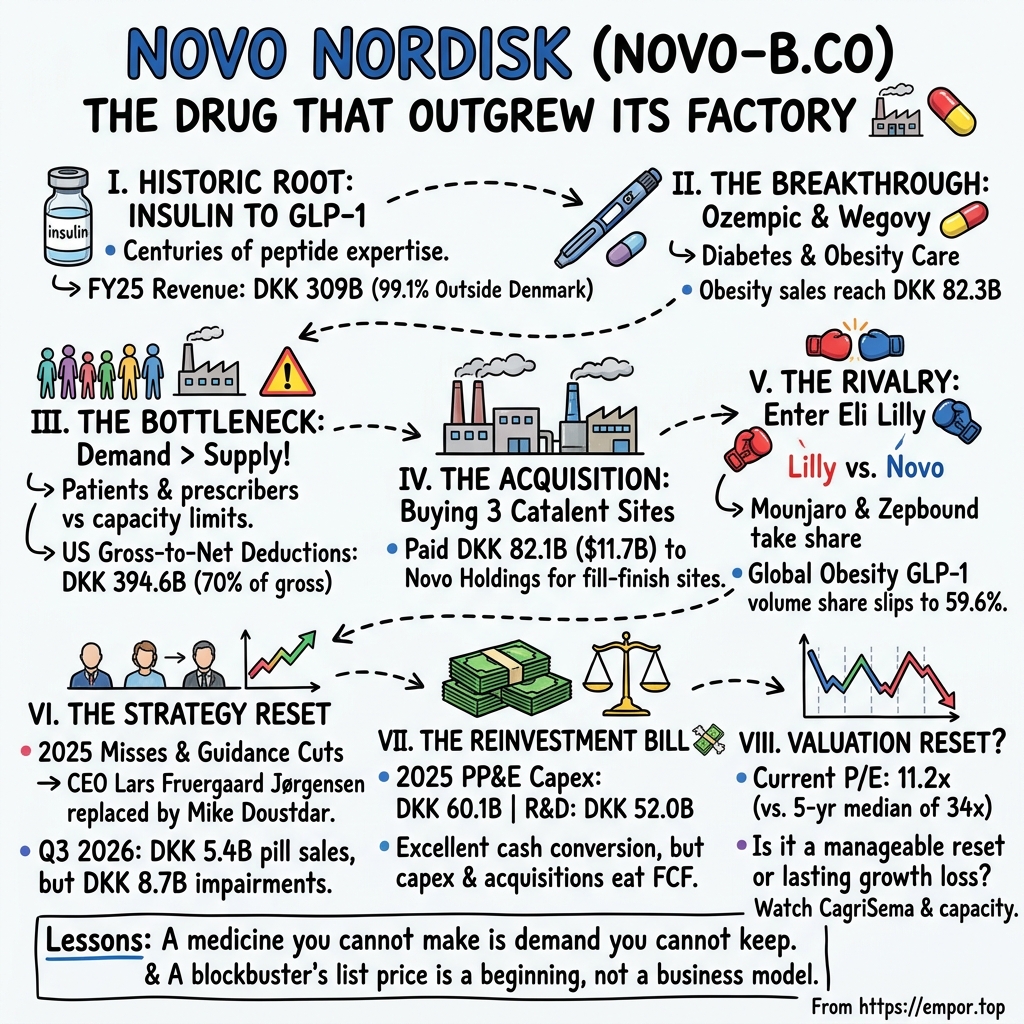
Novo Nordisk: The Drug That Outgrew Its Factory
I. The Pill That Made a Danish Company a Global Story
On the morning of 4 November 2026, Novo Nordisk published a quarterly report that read like two different companies stapled together. In one, a brand-new product was flying. The Wegovy pill, a once-daily tablet version of the obesity medicine that had made Novo one of the most talked-about companies on earth, had sold about DKK5.4 billion in the three months to September, roughly US$800 million, in only its third quarter on the market.1 More than three-quarters of that came from the United States, where the pill had launched in January.1 On the earnings call that day, Novo's head of US operations said the tablet was taking around 80% of new-to-brand prescriptions among obesity pills, and that more than eight million prescriptions had been written for it so far.2
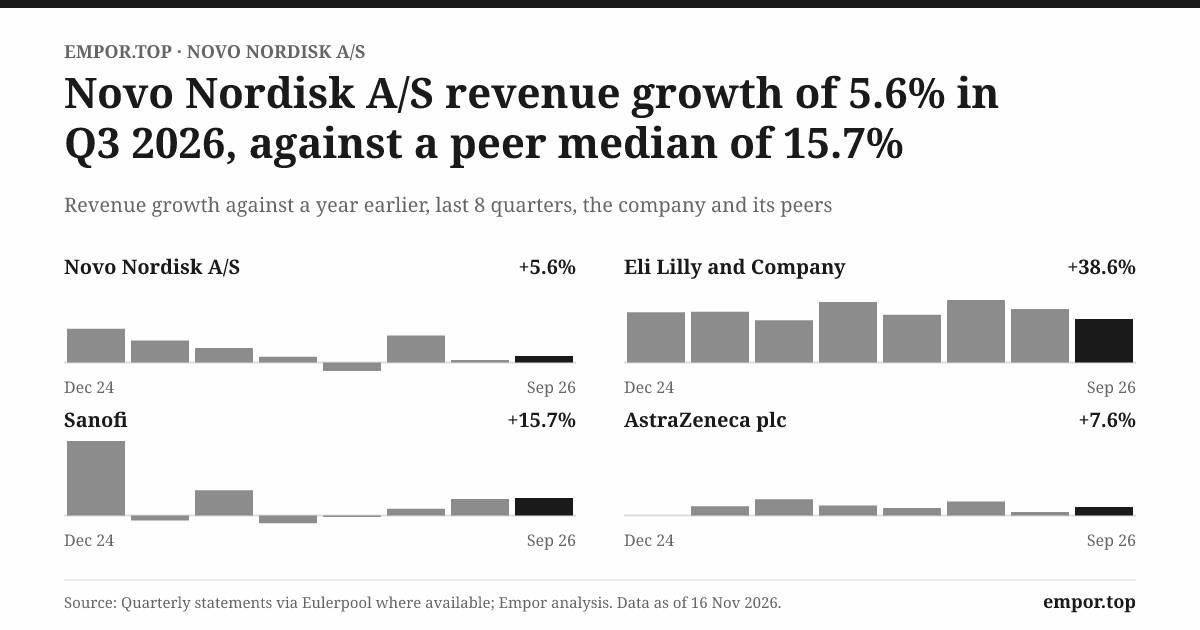
In the other company, the numbers were going backwards. Reported operating profit for the quarter fell 9% at constant exchange rates, dragged down by DKK8.7 billion of write-downs.1 Ozempic, the diabetes injection that had once been the engine of the whole enterprise, sold 5% less than a year earlier at constant currency, and the injectable form of Wegovy slipped 2%.1 Group sales grew 4% at constant exchange rates, which counted as good news only because the year had started so badly.1 That same morning management raised its forecast for 2026, and the raised forecast was for adjusted sales growth somewhere between minus 2% and plus 2%.1
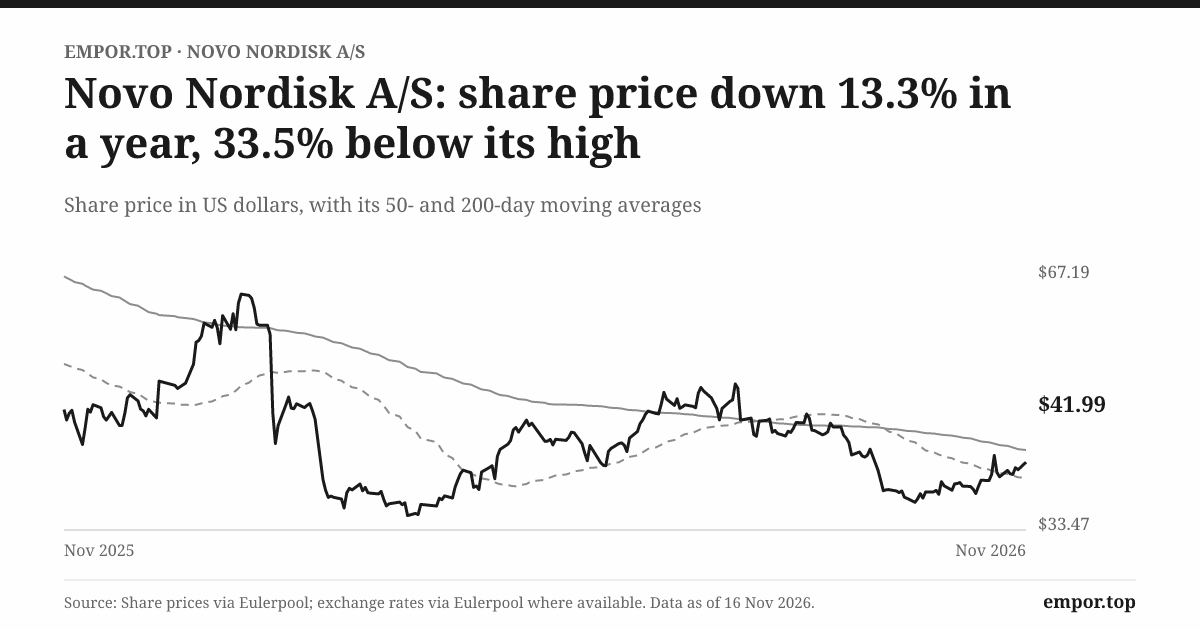
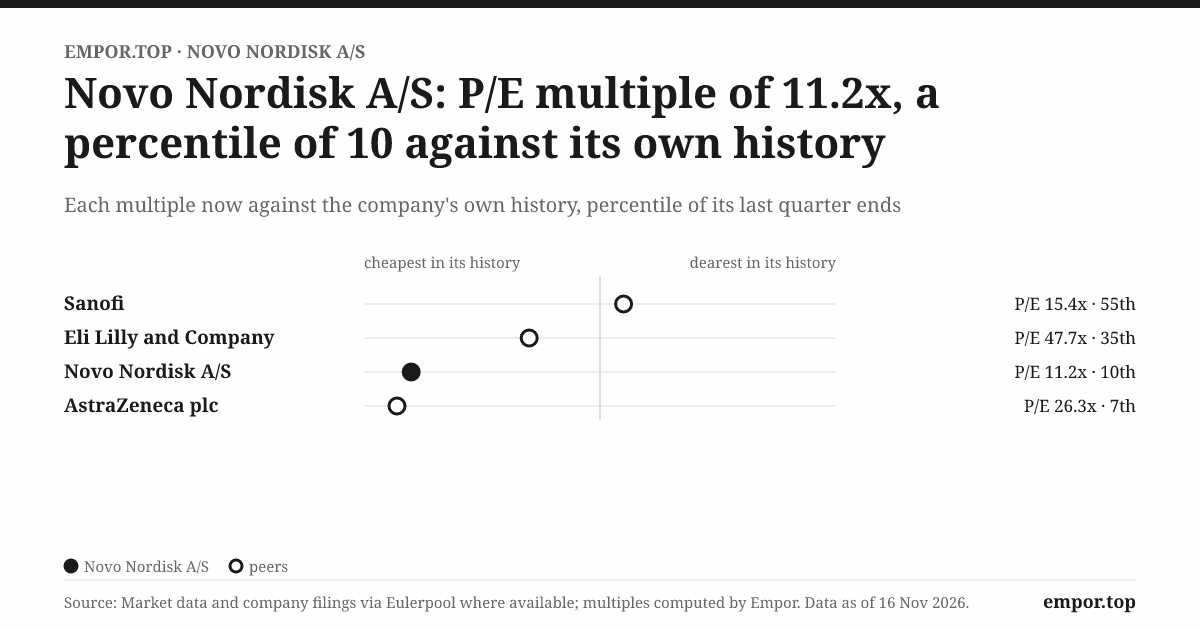
Hold those two images side by side, because they frame everything that follows. A pill selling hundreds of millions of dollars a month should be the opening of a victory lap. Instead it arrived at a company that had spent the previous eighteen months replacing its chief executive, cutting about 9,000 jobs, telling investors that 2026 sales might fall by as much as 13%, and watching its share price collapse.34 On 16 November 2026, Novo's B shares closed at DKK285.25, almost 29% below their high of the past year, and the market valued the whole company at about DKK1.3 trillion, roughly US$187 billion.3 The stock traded at about 11 times trailing earnings, against a median of 34 times over the previous five years.3
That gap between what the medicines can do and what the market will pay for the company is the puzzle of this story. The bull reading is that investors confused a temporary supply-and-pricing squeeze with a permanent decline, and are now pricing one of the great franchises in modern medicine like a utility. The bear reading is harsher: that the extraordinary growth of 2021 to 2024 was never a normal growth rate at all. It was what happens when a company owns nearly the whole supply of a drug the world suddenly wants, and when supply loosens, competitors arrive and payers bargain, the surge becomes an ordinary pharmaceutical business with an extraordinary capital bill attached.
To judge between those readings, three questions matter more than any others. The first is what actually made Novo's advantage: the molecule, the factories, the relationships with doctors and payers, or some combination. The second is whether that advantage survives a market in which Eli Lilly sells competing drugs and American insurers can play one company against the other. The third is whether the enormous sums Novo has poured into factories, acquisitions and research since 2023 will earn back their cost.
One point of housekeeping before the story begins, because Novo's ownership confuses even professional investors. The company in this story is Novo Nordisk A/S, listed in Copenhagen with American depositary receipts in New York, whose operating group comprises factories, laboratories and sales forces.3 Above it sits Novo Holdings A/S, an investment company wholly owned by the Novo Nordisk Foundation, one of the richest charitable foundations in the world.3 At the end of 2025 Novo Holdings owned 28.1% of the share capital but controlled 77.3% of the votes, thanks to a class of A shares that carry ten times the voting weight of the B shares sold to the public.3 The Foundation and Novo Holdings are separate entities with their own investments, including, as this story will show, a contract manufacturer they bought for billions of dollars. When they act, they act as the controlling shareholder of the listed company, not as the listed company itself. That distinction will matter a great deal when the story reaches the factories.
The pill is the newest chapter. The real story starts with a much older product, one that taught a Danish company how to make protein medicines by the ton.
 Subscribe on LinkedIn
II. Insulin Built the Factory Before Semaglutide Filled It
Novo Nordisk likes to tell its origin story in a single sentence: since 1923, its founders and successors have been in the business of treating diabetes.5 The details are a Scandinavian business legend. Within a couple of years of the discovery of insulin in Canada, Danish scientists had begun extracting it from animal pancreases, and two rival Danish companies grew out of that work. They competed for decades before eventually merging into the company that exists today. For this story, though, the romance matters less than what the century of insulin left behind.
Insulin is a peptide hormone, a small protein. A chemical pill like aspirin is assembled in a reactor the way a recipe is mixed in a bowl. A peptide drug is closer to a living product: it is grown by engineered microorganisms in huge fermentation tanks, purified through many steps, and then filled under sterile conditions into vials, cartridges or pens that patients inject themselves. Every stage has to meet the standards of regulators in dozens of countries, and a contamination problem at a single filling line can stop a product from reaching pharmacies. Anyone who wants to sell such medicines to tens of millions of people needs two kinds of plant. The first makes the active pharmaceutical ingredient, or API, the drug substance itself. The second does what the industry calls fill-finish: putting a precise dose into a sterile device and packaging it. A company can be brilliant at the first and still be stuck at the second.
Decades of insulin made Novo very good at both, and it made the company something else as well: a specialist. By 2016 Novo was selling diabetes medicines in around 170 countries, employing about 42,000 people, and generating more than four-fifths of its sales from diabetes and obesity care.5 Its modern insulins alone brought in about DKK47.5 billion that year.5 This was a company built around one chronic disease, and around the industrial machinery needed to serve it at global scale.
Fast-forward to 2025 and the specialisation had become even more extreme. Novo reported revenue of about DKK309 billion, roughly US$47 billion, and 99.1% of it was earned outside Denmark.3 A company headquartered in a country of six million people was, economically, a global exporter whose biggest single market was the United States. Diabetes care remained the largest business, obesity care had grown into a franchise of its own, and the rare-disease unit, which sells haemophilia and growth-hormone treatments, had shrunk to a minor part of the whole.3 By the third quarter of 2026, that rare-disease segment, now reported as blood and endocrine disorders, brought in about DKK5.5 billion of the quarter's DKK79.2 billion in sales.1 It is a respectable business, growing at double digits that quarter, but it cannot carry the investment case. Novo is a diabetes and obesity company with a side line.
The reason that specialisation matters is that the obesity boom turned out to be a manufacturing problem as much as a scientific one. When demand for a medicine explodes, the constraint is rarely the idea. It is the number of sterile pens a company can fill each week, the number of fermentation tanks it can run, and the speed at which regulators approve new lines. Novo entered the 2020s with more experience of making injectable peptides at scale than almost anyone else on the planet. That was the foundation of its advantage.
It was also, as the following years would show, a foundation that had to be rebuilt at enormous cost. In 2025 Novo spent about DKK60.1 billion on property, plant and equipment, about 19% of sales, mostly on API and fill-finish capacity.3 To put that in perspective, the entire stock of property, plant and equipment on Novo's balance sheet at the end of 2014 was worth about US$4.1 billion; by the end of 2025 it was worth about US$31.6 billion, nearly eight times as much.3 A company that once looked like a high-margin brand business, earning enormous returns on a modest asset base, had become a heavy industrial operation.
The clue that shows what that did to the economics is the return on invested capital. In 2016, Novo earned operating profit after tax equal to about 155% of the capital tied up in the business, a figure so high it looks like a typing error but simply reflected how few assets the insulin and Victoza franchises needed.3 By 2025 that return had fallen to about 34%.3 Over the same period, each krone of assets went from generating about 1.15 kroner of revenue a year to about 0.57.3 A 34% return is still excellent by the standards of most industries, so this is not a story of collapse. It is a story of a company that had to put far more capital to work to sell each krone of medicine, and that is the distinction this story will keep returning to: having production capacity is one thing; earning attractive returns on it is another.
So what had the century of insulin really bought? It bought know-how, regulatory credibility and a global distribution network that let Novo exploit a scientific opportunity faster than smaller rivals could. It did not buy immunity from the economics of capital-intensive growth, and it did not guarantee that the next big molecule would be Novo's alone. The molecule that tested both of those propositions had been in Novo's laboratories since the early 2000s, and its predecessor had already shown the company how large the opportunity might become.
III. From Victoza to Ozempic: The Dose Became the Growth Engine
The hormone at the heart of this story is called GLP-1, short for glucagon-like peptide-1. The human gut releases it after a meal. It tells the pancreas to release insulin when blood sugar is high, slows the emptying of the stomach, and signals to the brain that the body has had enough to eat. For a person with type 2 diabetes, a drug that mimics GLP-1 lowers blood sugar. For almost anyone, it also tends to reduce appetite. The trouble is that natural GLP-1 breaks down in the bloodstream within minutes, so the drug-making challenge was to engineer a version that would last long enough to be useful.
Novo's first answer was liraglutide, sold for type 2 diabetes as Victoza. It had to be injected once a day, but it worked, and it became a large business. In 2016 Victoza sold about DKK20 billion and held about 58% of the value of the GLP-1 diabetes market.5 That year Novo also presented the LEADER trial, which showed that Victoza reduced the risk of heart attacks, strokes and cardiovascular death in people with type 2 diabetes, a result that would matter enormously for how doctors and payers came to see the whole class.5
Then Novo did something that, in hindsight, looks like the first move in a much bigger game. It took the same molecule, raised the dose to 3 mg, and sold it for weight management as Saxenda. Saxenda launched in May 2015 and sold about DKK1.6 billion in 2016, more than three times its first-year sales, and Novo described it as the market-leading anti-obesity medication in the United States by value.5 For a company that had always thought of obesity as a risk factor for diabetes, this was a quiet admission that obesity might become a market in its own right.
The molecule that turned that possibility into a phenomenon was semaglutide. Novo's chemists modified the GLP-1 structure so the drug would bind to a protein in the blood and survive for about a week, which meant one injection could replace seven. In December 2016, after six clinical trials known as SUSTAIN, Novo filed once-weekly semaglutide for approval in the United States and the European Union as a type 2 diabetes treatment.5 It went on to become Ozempic. The obesity version, at a higher dose, became Wegovy. A once-daily tablet form for diabetes, Rybelsus, followed, using an absorption enhancer that lets the peptide survive the stomach long enough to enter the bloodstream.
This is the most important strategic fact about Novo's modern history, and it is easy to miss. Ozempic and Wegovy are not two discoveries. They are one molecule sold at different doses, under different labels, to different patients and reimbursed by different payers. That gave Novo an astonishing amount of leverage from a single piece of science. It also concentrated the company's fortunes on that molecule to a degree that few large pharmaceutical companies would accept by choice.
The financial results show what that leverage did. Over the ten years from 2015 to 2025, Novo's revenue in Danish kroner grew at about 11% a year, a fine record for any large drugmaker.3 But the average conceals a sharp change of gear. Over the five years from 2020 to 2025, growth accelerated to about 19.5% a year, and in 2023 and 2024 revenue rose by more than a quarter each year.3 Net profit followed almost exactly, compounding at about 19% a year over the five years.3 For a company of Novo's size, this was not normal pharmaceutical growth. It was the growth of a company that had found a new market and had very little competition in it.
By 2025, obesity care was a business of about DKK82.3 billion a year on its own, larger than the whole of Novo had been in some years of the previous decade.3 Diabetes care was still larger, and it still generated most of the group's sales, but obesity was where the growth came from. The pattern sharpened in 2026. In the first nine months, adjusted obesity-care sales rose 20% at constant exchange rates while diabetes-care sales fell 5%.1 In the third quarter alone, obesity care grew 22% and diabetes care fell 5%.1 Novo's old engine was decelerating at the same time as the new one was accelerating.
This is where the popular version of the Novo story and the record begin to diverge. The popular version says Novo invented the obesity-drug market and therefore owns it. The record says something more qualified. Novo did create the branded market, first with Saxenda and then with Wegovy, and it still had the largest share of it in 2025. But the market it created turned out to be so large and so profitable that it attracted the best-funded competitor in the industry, and it attracted American payers who were horrified by what a market of tens of millions of patients on a high-priced chronic medicine could do to their budgets.
There was also the question of what comes after semaglutide. Novo's answer was CagriSema, a combination of semaglutide with cagrilintide, a long-acting version of another appetite hormone called amylin. The company had hoped CagriSema would deliver weight loss of about 25%. In December 2024, the first big phase 3 trial, REDEFINE 1, showed average weight loss of 22.7%, and Novo's shares fell by about a fifth in a day.6 The result was clinically impressive by any historical standard. It simply was not the knockout that investors had priced in, and it was not clearly better than what Lilly's tirzepatide had already shown. Later data looked better in some settings: by the autumn of 2026, a trial called REDEFINE 9 reported about 21% weight loss at 68 weeks on the 1 mg dose, and a trial called REIMAGINE 5 in type 2 diabetes showed CagriSema producing 12.4% weight loss against 9.1% for tirzepatide when each was given at a lower dose.2 On the November 2026 call, Doustdar said Novo was preparing for a US launch of CagriSema in early 2027, subject to regulatory approval.1
That conditional clause is the right way to read Novo's pipeline. New formats and new indications, from heart disease to liver disease, from higher doses of Wegovy to the oral pill, all enlarge the opportunity. Novo's own history shows that approvals become valuable only when they turn into prescriptions that payers reimburse at a profitable net price. Saxenda was the market leader in obesity for years but stayed a small business, because insurers largely refused to pay for weight-loss drugs and patients could not afford them on their own. Science opened the door. Access and price decided how many people walked through it.
For investors, the conclusion is clear: semaglutide transformed Novo's growth and broadened a market that had barely existed a decade earlier, but the two brands that matter most share a single molecule and depend on continued clinical, regulatory and commercial execution. And for a few remarkable years in the early 2020s, the binding constraint on that execution was not science or even price. It was the factory.
IV. The Demand Was There; The Doses Weren't
Picture a pharmacy counter in an American suburb sometime in 2023. A patient arrives with a prescription for Wegovy that a doctor has written after a long conversation about weight, blood pressure and blood sugar. The pharmacist checks the system and shakes their head: the starting dose is out of stock, or the wholesaler has allocated only a handful of pens to the store this week. The patient goes home. Some try another pharmacy. Some wait. Some give up, and some turn to compounded copies sold online. Multiply that scene by millions, and you have the strange economics of the GLP-1 boom: the demand was there; the doses weren't.
To understand why this mattered so much, it helps to follow a prescription drug's money from the patient to the manufacturer. The patient and the doctor create demand. But in the United States, the patient rarely pays the list price. An insurer or employer health plan pays most of the bill, and those plans usually hire pharmacy benefit managers, or PBMs, to negotiate with drugmakers. The PBM decides whether a drug goes on its formulary, the list of medicines the plan will cover, and on what terms. To win a good place on that list, the manufacturer pays rebates. Meanwhile the physical product travels through wholesalers, which buy from the manufacturer and sell to pharmacies, and which are owed charge-backs when pharmacies sell to customers entitled to lower prices. Government programmes add their own mandatory discounts. The result is that the list price is a starting point for a series of negotiations, and the price the manufacturer actually keeps, the net price, can be a fraction of it.
Novo's own numbers show how large that fraction is. In 2025, the company recorded DKK394.6 billion of rebates, discounts and returns against its US gross sales, equal to 70% of those gross sales.3 Read that slowly. For every 100 kroner of medicine Novo sold in America at list price, it kept about 30. At the end of 2025 it still owed DKK134.4 billion in unpaid sales deductions and returns, a liability larger than a year's sales of most mid-sized drug companies.3 Wholesaler charge-backs are typically settled within about 30 days, while managed-care and Medicare rebates take around 100 days.3 This is not a footnote to Novo's business model. It is the business model, and it is why the auditor singled out US sales rebates as the key judgment in Novo's accounts.3
Novo had learned this lesson painfully once before. In 2016, consolidation among PBMs had left only a handful of very large buyers, and they used that power to extract much bigger rebates on insulin. Novo's chairman told shareholders that the share price had fallen from about DKK400 to about DKK255 during the year, that contract negotiations for 2017 had required higher-than-expected rebates to secure broad coverage, and that the company's long-term financial targets had to be lowered.57 The CEO wrote that Novo had to lay off close to 1,000 of its 42,000 employees that autumn.5 That episode matters here because it shows the mechanism. When a market has alternatives and buyers are concentrated, the buyers win, whatever the clinical data say.
In the early GLP-1 years, that mechanism was suspended, because Novo was selling everything it could make. The shortage was a limit on volume, but it also gave Novo leverage on price, because a payer cannot easily demand a deep rebate on a drug that is already sold out. The two constraints existed at once: manufacturing capacity capped how many patients Novo could serve, while US concessions absorbed a large and rising share of the gross price on the patients it did serve.
Novo's response was to build. By the time it presented its third-quarter 2024 results, management was describing an investment programme across API production and fill-finish, in Denmark, the United States and elsewhere, with the explicit aim of supplying more patients.8 Capital expenditure on property, plant and equipment rose from about DKK47.2 billion in 2024 to about DKK60.1 billion in 2025.3 Inventory days stayed around 300, which means Novo was holding roughly ten months of production costs in stock, a reminder of how long the chain from fermenter to pharmacy shelf is.3 The most dramatic single move in that build-out, the purchase of three fill-finish factories from the company's own controlling shareholder, deserves its own chapter.
The question for investors is not whether Novo built capacity. It clearly did. The question is whether that capacity turned into usable supply and profitable sales. The evidence by late 2026 is mixed, and the mixture is instructive.
On supply, the news is good. The US Food and Drug Administration removed semaglutide injectables from its shortage list, and litigation involving compounders that had relied on the shortage now appears among Novo's legal matters.1 Novo's international operations reported injectable Wegovy volume growth close to 70% for the year to date in 2026, which would have been impossible without more supply.2 By the third quarter, Novo's executives were talking about launching the Wegovy pill in more than 20 markets by the first half of 2027, earlier than they had planned.2 In the United Kingdom, they said, the pill had taken around 90% of the oral obesity segment in recent weeks.2 Factories that once limited Novo were now letting it reach new markets faster.
On profitability, the news is worse. Once a medicine is no longer scarce, payers regain their leverage, and Novo's own management described what happened next. On the November 2026 call, the head of US operations said realised prices for Wegovy had fallen by about 30% to 35% in the third quarter compared with a year earlier, "a little on the high end" of the range, while Ozempic's erosion was running at about 10% to 15% a year.2 The company's outlook assumed lower realised prices in the US, "linked to investments in market access, amplified by the MFN agreement", a reference to the most-favoured-nation pricing arrangement agreed with the US government.2 Management also said US list prices would fall on 1 January 2027.2 In the third quarter, US sales grew only 1% at constant exchange rates while international sales grew 8%.1
Put the clues together and the reveal is uncomfortable for anyone who thought capacity was the whole story. Novo solved the shortage, and in doing so it removed one of the reasons it had been able to hold its price. More pens on more pharmacy shelves meant more patients, but each additional patient came with a lower net price. The factories did their job. The question they could not answer was whether the market would pay as much for abundance as it had paid for scarcity.
That is why the right tests of Novo's capacity programme are not the size of the cheques or the number of new plants. They are production utilisation, the absence of shortages, market share and net price, and on the last two the evidence so far points to a company winning volume while giving back price. The largest cheque of all went to an unusual seller, and it raises a question that goes beyond capacity: who decides what a factory is worth when the buyer and the seller share a controlling owner?
V. Three Catalent Sites, Bought from the Controlling Owner
In February 2024, the world's hottest drug company did something that would normally be unremarkable in the pharmaceutical industry and was, in this case, anything but. Novo Holdings, the investment arm of the Novo Nordisk Foundation, agreed to buy Catalent, one of the largest contract development and manufacturing organisations in the world, an American company that filled vials and syringes for dozens of drugmakers. In a linked deal, Novo Nordisk A/S agreed to buy three of Catalent's fill-finish sites from Novo Holdings once that acquisition closed.89 Novo Holdings completed its purchase of Catalent in December 2024, and Novo Nordisk then took ownership of the three sites, at Anagni in Italy, Bloomington in Indiana and Brussels in Belgium.93
The structure is the whole story, so it is worth spelling out. Novo Holdings acquired Catalent, all of it, at a valuation of about US$16.5 billion including debt.9 Novo Nordisk, the listed company, did not buy Catalent. It bought three manufacturing sites and related assets from its controlling shareholder for DKK82.1 billion, about US$11.7 billion, with a further DKK1.0 billion settlement in 2025.3 The rest of Catalent, with its many other customers, stayed with Novo Holdings.
The strategic case was straightforward, and Novo made it forcefully at the time. Fill-finish was the bottleneck. Demand for Wegovy and Ozempic was running far ahead of supply, and building a sterile filling plant from scratch, then getting it approved, takes years. Buying existing plants staffed by experienced people, with regulatory approvals already in place, was a way to buy time. In its third-quarter 2024 investor presentation, Novo described the Catalent sites as a way to increase its filling capacity and said it expected them to start adding capacity from 2026.8 For a company that was turning away patients because it could not fill enough pens, the logic was compelling.
The harder question is price, and here the popular version of the story goes wrong in two opposite directions. One version says Novo Nordisk overpaid wildly, because US$11.7 billion is more than two-thirds of the US$16.5 billion paid for the whole of Catalent, and it got only three of Catalent's sites. The other version says the deal was a bargain, because the sites were strategically priceless to a company that could sell every pen it filled. Neither version survives contact with the evidence.
The whole-Catalent price is not a valid comparable for three sites. Catalent's value included its debt, its many other plants, its customer contracts and its businesses unrelated to Novo's needs, and it also reflected Catalent's troubled recent financial history. The three sites Novo bought were, by the logic of the deal, some of the most strategically valuable in the network for a GLP-1 manufacturer. A high share of the enterprise value attributed to a few prized plants could be reasonable. It could also be excessive. Novo Nordisk does not disclose standalone earnings, revenue or EBITDA for the three sites, and without that, or a directly comparable sale of similar plants, no outside investor can establish whether the price was high or low. The honest verdict is that the price cannot be tested from public information. That is itself the finding.
That limitation matters more than it would in an ordinary acquisition because of who was on the other side of the table. Novo Holdings was Novo Nordisk's controlling shareholder.3 It was the seller in a transaction worth about a quarter of Novo Nordisk's annual revenue at the time. Novo's related-party note discloses the transaction and the price, as it must, but it does not describe the pricing as arm's length or set at market terms.3 The minority B-share investors who own most of the economic value of Novo Nordisk had no vote on the deal.
Scale matters in judging governance risk, and on this the record is reassuring in one respect and silent in another. The Catalent sites dominate Novo's related-party dealings. The recurring purchases Novo made in 2025 from companies affiliated with Novo Holdings, including Catalent's remaining business, the enzyme maker Novonesis, the research services company Altasciences and the IT company NNIT, totalled about DKK1.5 billion, roughly half a percent of group sales.3 There is no disclosed royalty, brand fee or management fee flowing up to the controlling shareholder.3 The day-to-day relationship is not a tunnel draining value from minorities. The single big transaction is the exception, and it is the one where pricing cannot be verified from outside.
There is also a structural point that a skeptical investor would raise. The Foundation's mission and Novo Holdings' investment strategy are not identical to the interests of Novo Nordisk's minority shareholders. Novo Holdings kept the rest of Catalent, a business that serves many other drugmakers, including potentially Novo's competitors. The arrangement may have been the fastest way to secure the capacity Novo needed, since a listed drug company buying the whole of a contract manufacturer that serves its rivals would have raised competition and customer concerns. It also meant that the controlling shareholder chose which assets the listed company bought and at what price. When the capacity was scarce and the drug was sold out, urgency made that look like a detail. As net prices fell through 2025 and 2026, it began to look like a question.
The capacity itself also turned out to be less permanent than the strategic case implied. In the third quarter of 2026, Novo took a DKK4.1 billion impairment for what it called the "right-sizing" of its manufacturing network.1 The company did not attribute that charge specifically to the Catalent sites, and it would be wrong to assume it did. But the fact that Novo was writing down manufacturing assets less than two years after paying DKK82 billion for fill-finish capacity tells investors that the network had been built for a demand curve that did not fully materialise at the prices once expected. Building ahead of demand is often right in a shortage. It becomes expensive when the shortage ends and the price falls at the same time.
The Catalent deal was not Novo's only big bet on the future. In October 2025, under its new chief executive, Novo agreed to buy Akero Therapeutics, an American biotech developing efruxifermin for metabolic dysfunction-associated steatohepatitis, or MASH, a serious form of fatty liver disease, for about US$4.7 billion in cash plus a contingent value right that pays more if the drug reaches a defined regulatory milestone.10 MASH is a natural extension of a company whose medicines already treat obesity and diabetes, the conditions most often tied to fatty liver. But Akero added a potential future business, not a current earnings pillar, and it is responsible for most of the DKK30 billion Novo spent on intangible assets in 2025.3 When an analyst asked about efruxifermin on the November 2026 call, Doustdar's answer was short: "we have to follow the data."2 That is the right standard for judging the purchase too. Its value will be decided by clinical and commercial outcomes, not by the strategic narrative that justified it.
The Catalent and Akero deals share a lesson that belongs in any assessment of Novo's capital allocation. Urgency and strategic logic justify a purchase; they do not price it. And the reason Novo felt so much urgency in 2024 had a name: a company in Indianapolis that had stopped being a distant second.
VI. Lilly Made the First-Mover Lead a Race Again
Every great business story eventually reaches the moment when the founder's advantage meets a rival that is just as well equipped. For Novo, that rival was Eli Lilly, and the weapon was tirzepatide, sold as Mounjaro for type 2 diabetes and Zepbound for weight management. Where semaglutide mimics one gut hormone, tirzepatide mimics two, GLP-1 and another called GIP, and it has generally been seen as producing greater average weight loss than semaglutide. Lilly also built supply aggressively. Within a few years, the market that Novo had opened was a two-company race, and in 2025 Lilly was the faster runner.
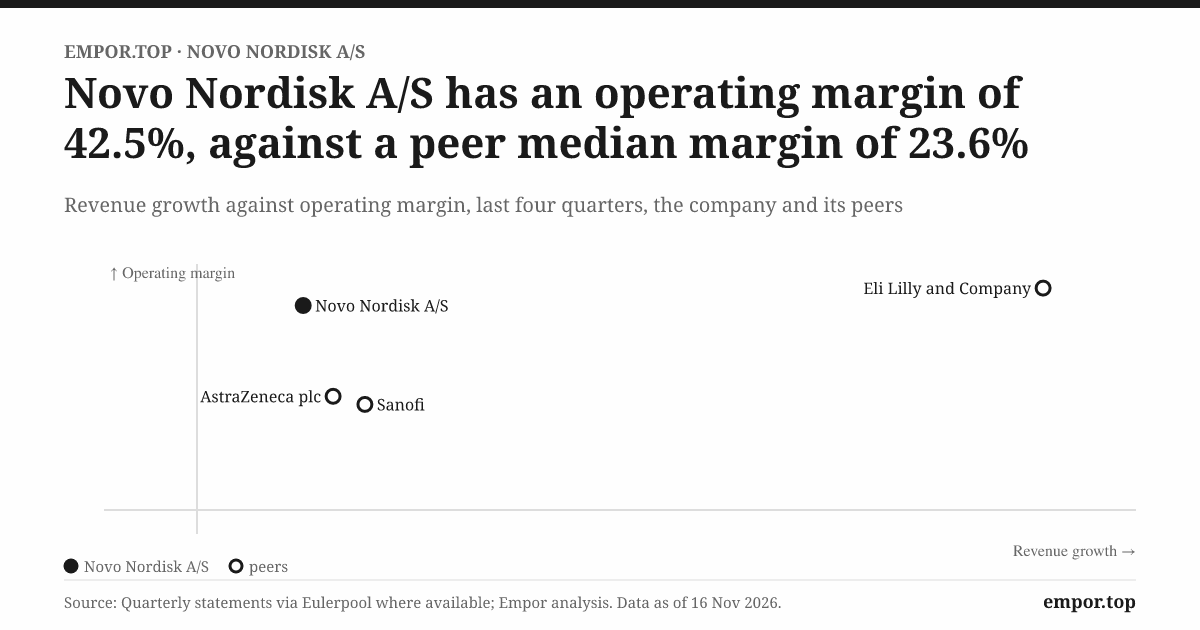
The scale of the reversal is visible in Lilly's own filings. In 2025, Lilly's revenue rose 45% to about US$65.2 billion.11 Mounjaro alone sold about US$23 billion, nearly double the previous year, and Zepbound sold about US$13.5 billion, almost three times as much as in 2024.11 Together, the two tirzepatide brands sold more than US$36 billion. Novo's whole group, by comparison, reported about DKK309 billion of revenue in 2025, roughly US$47 billion, across every product it sells.3 Those are not like-for-like comparisons, because Lilly also sells cancer, immunology and neuroscience drugs and Novo sells insulin and rare-disease products, but they make the direction unmistakable. The company that had been the challenger had become the larger business.
Yet Novo still led in volume. In 2025, it held about 59.6% of the global branded obesity GLP-1 market by volume, and about 54.6% of global GLP-1 volume across obesity and diabetes combined.3 Both shares had fallen.3 Lilly's dollar sales and Novo's volume shares can both be true at once because the price and the mix differ: Novo sells large volumes outside the United States, often at lower prices, while Lilly's growth was concentrated in the US, where prices are highest. Novo's strength is breadth, built on a distribution network that already reached around 170 countries a decade ago;5 Lilly's strength is momentum in the most profitable market.
This is a war game with five moving pieces, and understanding them explains why neither company can rest. The first piece is clinical efficacy and tolerability: how much weight patients lose, how well they tolerate the nausea and other side effects, and what the drug does for the heart, kidneys and liver. The second is the preference of physicians and patients, which is shaped by data, convenience and marketing. The third is supply, which favoured whichever company could fill more pens in a given quarter. The fourth is payer coverage, which decides whether a patient can afford the drug at all. The fifth is the net price after rebates, which decides what the manufacturer keeps.
On efficacy, Lilly's tirzepatide had the edge for most patients, and Novo's answer, CagriSema, had not yet reached the market in November 2026. On supply, both companies had largely caught up with demand by 2026. On payer coverage and net price, the two companies were now bidding against each other, which is exactly the situation that produced Novo's insulin troubles a decade earlier. When payers have two effective drugs to choose from, they can demand bigger rebates for exclusive or preferred positions. Novo's 30% to 35% year-over-year erosion in Wegovy's realised price is the clearest evidence that this is happening.2
On form, the battle had moved into pills. Novo's Wegovy pill reached the US market first, in January 2026, and took an early lead in the oral obesity segment.12 But Novo's own executives acknowledged a weakness. Asked about prescription-tracking data, the head of US operations said, "We've consistently seen a lower capture rate for Wegovy pill than the competitive oral product," meaning that independent data providers record a smaller share of the pill's prescriptions than those of Lilly's oral rival, possibly because of how the drug is sold through direct-to-consumer channels.2 Whatever the cause, a market that measures itself through such data will read Novo's position as weaker than the company says it is. Novo's first-mover advantage in pills could prove as temporary as its first-mover advantage in injections.
There is a further complication in how Novo's volume is sold in the US. On the call, analysts pressed on how much of the pill's growth came from the Medicare "Bridge" programme, a government demonstration arrangement that gives some older Americans coverage for obesity drugs. The answer was direct but not quantified: "without Bridge, there is less growth than the 20% sequential growth," the US head said.2 Asked what would happen to that coverage after 2027, he called it "difficult to predict."2 Growth that depends on a time-limited government programme is real, but it is not proof of durable private-market demand.
Distinguish this competition from customer concentration, because the two are often confused. Novo says the three major US wholesalers account for a "large proportion" of its total net sales, but it does not quantify that proportion or disclose its largest customers.3 Nor does it publish a breakdown of supplier concentration.3 The wholesalers matter as a credit and distribution exposure: they hold Novo's receivables and move its products. But they are not the ones squeezing price. The concessions that shape Novo's economics come from payers and PBMs, which negotiate formulary access, and from government programmes. The risk is not that one large customer leaves. It is that a small number of large buyers can pit Novo against Lilly in every contract cycle.
So what is Novo's moat in this contest? It is real, but it is a different and smaller moat than the one investors assumed in 2023. Novo has scale in manufacturing, established brands that doctors know and trust, the largest global volume share and a broad international distribution network. The record of 2025 and 2026 shows the limit of all of those: Lilly took share anyway, payers extracted deeper concessions, and Novo's prices in its most important market fell sharply. The history of the insulin market in 2016 had already shown that clinical leadership does not protect price when buyers are concentrated and a credible alternative exists. The GLP-1 market of 2025 repeated that lesson on a larger scale.
The conclusion is that the claim of a durable moat narrows to a smaller version. Novo has a substantial market presence and an industrial base that few companies can match. It does not have demonstrated immunity from product or price competition. The evidence that would change that verdict is specific: Novo's market share by geography in branded GLP-1 prescriptions, prescription growth that holds up outside temporary programmes, realised net prices that stabilise rather than continue falling, and new supply that adds profitable volume rather than simply cheaper volume. Until then, the competitive landscape is a race, not a franchise.
Losing ground in a race is a management problem as well as a market one, and by the spring of 2025 the board had decided it was a problem the existing management could not solve.
VII. A New CEO Inherits a Forecast That Broke
On 16 May 2025, Novo Nordisk announced that Lars Fruergaard Jørgensen would step down as chief executive.1213 It was a remarkable fall. Jørgensen had taken over at the start of 2017, after the insulin pricing crisis, and had presided over the most spectacular growth period in the company's history, the years in which Wegovy turned a Danish diabetes specialist into a household name. But by the spring of 2025, the share price had fallen sharply from its 2024 peak, Lilly was taking share, and the company had cut its outlook more than once.1213 The board tied the decision to the company's recent market challenges and the fall in its share price.12
The choice of successor said a lot about the board's diagnosis. On 29 July 2025, Novo named Maziar Mike Doustdar, the executive vice president in charge of International Operations, as president and chief executive, effective 7 August.14 Doustdar was a company lifer who had run the international business, everything outside the United States, for years. In 2016, during the insulin crisis, the board had singled him out alongside the incoming head of North America as a leader who had "demonstrated their ability to lead their organisations through challenging times."5 He had become senior vice president for International Operations in 2013.14 His reputation was that of a commercial operator who had built Novo's position across dozens of mid-sized markets, not a scientist or a financier. The same day, Novo appointed Martin Holst Lange as chief scientific officer and Emil Kongshøj Larsen to succeed Doustdar in international operations.14 The board chose continuity of culture and a change of emphasis: an operator to fix execution.
Doustdar's first months were about cost. Novo undertook a company-wide transformation that eliminated about 9,000 positions, aiming for annualised savings of about DKK8 billion from 2026.3 Headcount, excluding the Catalent sites, fell from about 74,200 at the end of 2024 to about 69,500 at the end of 2025.3 The restructuring cost was large: roughly DKK9 billion of transformation costs landed in the third quarter of 2025 alone.2 There is a useful echo here. In 2016 Novo also responded to US pricing pressure by laying off close to 1,000 employees, about 2% of its workforce.5 This time the cut was about ten times larger in number. Pricing pressure is not new at Novo. What was new was the scale, and the speed at which the company had expanded before discovering it needed to shrink.
Then came the forecast that broke. Novo's full-year 2025 numbers showed revenue up about 6% in Danish kroner and net profit up only about 1%.3 Then, in early February 2026, Novo told investors to expect 2026 adjusted sales and operating profit to fall by between 5% and 13% at constant exchange rates, blaming lower US prices and the loss of exclusivity for semaglutide in markets including China, Brazil and Canada.4 Novo's shares fell by about 17% in Copenhagen.4 For a company that had been growing at more than 20% a year only two years earlier, guiding to a decline was a shock. The width of the range, eight percentage points from top to bottom, also told investors how little visibility management claimed to have.
The year then went better than that forecast. Novo raised its outlook during 2026, and by November the adjusted sales range was minus 2% to plus 2%, with adjusted operating profit guided to the same range.12 The company said the improvement was "driven by increased expectations for GLP-1 product sales," which in practice meant the Wegovy pill and international volumes.1 Free cash flow was expected to reach DKK60 billion to DKK70 billion for the year.2
How should an investor judge that sequence? A guidance raise looks like a sign of competence, and some of it is. The pill launched well and international markets grew faster than expected. But there are two readings of the February forecast. In one, management was prudent and the business beat a conservative plan. In the other, the company simply did not know where its prices were heading and drew a range wide enough to survive almost anything. The evidence leans toward the second reading being at least part of the story. A forecast that runs from minus 13% to minus 5% and ends up near zero is a forecast that was wide because the uncertainty was real, not one that was precise and then beaten.
The live calls are where this credibility test happens, and the November 2026 call was revealing in what management said and what it did not. In the prepared remarks, the tone was confident: the pill launching in seven markets, more to come, volumes rising.2 In the analyst questions, the pressure came on 2027. Asked by one analyst what growth to expect next year, Doustdar declined to give a number and instead offered "building blocks"; asked again by another, his answer was blunt: "We're not guiding."2 Asked about the likely benefit of CagriSema to Novo's broader franchise, he described it as "not high, it's not low, it's medium."2 That is consistent with a management team that has learned not to overpromise. It is also a management team that, after a year of resetting expectations, is not yet willing to stake its credibility on the next one.
The gap between reported and adjusted figures is the other part of the credibility question, and in the third quarter of 2026 it was unusually wide. Reported operating profit fell 9% at constant exchange rates because of DKK8.7 billion of impairments, of which DKK4.6 billion related to ziltivekimab, an experimental cardiovascular anti-inflammatory drug, and DKK4.1 billion to the right-sizing of the manufacturing network.1 Adjusted operating profit, which excludes those charges, rose 27%, helped by comparison with a third quarter of 2025 that had absorbed about DKK9 billion of transformation costs.12 Both numbers are accurate. Neither alone tells the truth. The reported number punishes the company for writing down investments it made; the adjusted number flatters it by comparing against a quarter weighed down by restructuring. A sensible reading is that underlying profitability stabilised in 2026, but the impairments are a real record of capital that did not earn its expected return.
Incentives deserve a brief look alongside the forecasts. Doustdar earned about DKK20.7 million in 2025, having been in the role from August, with variable pay calculated for the full year; the CFO earned about DKK18.7 million.15 Total executive remuneration rose to about DKK474 million in 2025 from about DKK365 million in 2024, while group net profit rose only about 1%.153 The gap is mostly explained by about DKK220 million of termination payments and recruitment arrangements following the CEO change and other executive departures.15 That is a material one-off, not a pattern of rising pay for falling results. Shareholders seemed to accept that reading: the 2026 annual general meeting approved the remuneration report with 98.1% support.16
The governance vote that mattered more went the other way. At the same meeting, about 57% of the votes cast opposed the re-election of the chair, Lars Rebien Sørensen.16 He was re-elected anyway, because Novo Holdings' votes alone outweigh all others, and he described his appointment as temporary until a successor is found.16 Sørensen is no ordinary chair. He was Novo's chief executive for 16 years until the end of 2016, the leader who built the company into a global pharmaceutical group, and by 2026 he was back, this time as chair.516 A majority of the votes cast at the meeting opposed him. The vote did not change the outcome, but it was an unusually public expression of minority dissatisfaction at a company where control is not in doubt. Novo's board was also only about 40% independent among shareholder-elected members in 2025.3
There was one more leadership change. In November 2026, Novo said that its long-serving chief financial officer, Karsten Munk Knudsen, would leave at year-end after 27 years, to be succeeded by Luigi La Corte, formerly of the dermatology company Galderma.2 An outsider will now own the guidance that the insiders spent 2026 rebuilding.
So can Doustdar rebuild credibility? The Q3 recovery is evidence of better near-term trading, but not yet of restored forecasting credibility. One year of beating a wide and pessimistic forecast does not erase two years of misses, and the comparison is distorted on both sides by transformation costs and impairments. The test will come with a forecast that is narrow enough to be wrong, and that is met. Behind every forecast, though, sits a simpler question that investors had largely stopped asking during the boom years: how much of this profit actually turns into cash?
VIII. The Cash Engine Meets the Investment Bill
For most of its modern history, Novo Nordisk was a cash machine of almost boring reliability. Sell insulin and GLP-1 drugs at high margins, spend modestly on factories, pay out about half the profit as dividends, and buy back shares with much of the rest. Over the twelve years from 2014 to 2025, Novo reported cumulative net profit of about DKK648 billion and generated about DKK786 billion of cash from operations, about 121% of its accounting profit.3 That is an excellent conversion rate, and it is worth understanding why it happens before asking why it has become harder to rely on.
Accounting profit and cash diverge for two main reasons. The first is the effect of non-cash charges. When a company depreciates a factory or writes down an asset, the expense reduces profit but no cash leaves the building, because the money was spent when the factory was built. A company that is building lots of factories and taking impairments will tend to have operating cash flow higher than its profit. The second is working capital: money tied up in inventory and receivables, or released by paying suppliers later. In the first nine months of 2026, Novo's net profit of about DKK86.3 billion turned into about DKK121.0 billion of operating cash flow, after adding back about DKK28.2 billion of depreciation, amortisation and impairment and about DKK8.6 billion of other non-cash items, and after absorbing a DKK18.6 billion working-capital outflow.13
Operating cash flow is not the same as cash available to shareholders, though. The factories have to be paid for. Over those twelve years, Novo's free cash flow, the cash left after capital spending, totalled about DKK510 billion, and about DKK301 billion of it, roughly 59%, went out as dividends.3 Much of the rest went to buybacks, and the company's cash balance rose by only about DKK12.5 billion over the period.3 For most of those years, the formula worked smoothly because capital expenditure was modest.
Then the investment bill arrived. In 2024 and 2025, free cash flow became much more volatile because capital spending on factories soared and acquisitions added further outflows. Novo's free cash flow in 2025 was less than half of its 2024 level, measured in dollars, about US$4.4 billion against about US$10.1 billion.3 In the same year, Novo paid about US$7.8 billion in dividends.3 In other words, in 2025, dividends exceeded free cash flow, and the gap was financed in part by borrowing. That is not a crisis for a company with Novo's balance sheet, but it is a sharp break with the past, and it explains why debt rose.
Borrowings, excluding leases, rose from about DKK96.0 billion at the end of 2024 to about DKK122.4 billion at the end of 2025, as Novo issued bonds, including EUR10 billion of Eurobonds in 2025, and financed its acquisitions.3 Net debt excluding leases stood at about DKK95.4 billion, or 0.64 times EBITDA.3 That is a modest ratio for a company of Novo's profitability, and the rating agencies agreed. In May 2025, S&P upgraded Novo to AA with a stable outlook; Moody's had upgraded the company to Aa3 in January 2025.1718 Those ratings place Novo among the strongest corporate borrowers in the world. A skeptic should note one detail, though: S&P's rationale assumed revenue growth of about 16% to 18% in 2025 and 2026, slowing toward 10% by 2027.17 Novo grew far more slowly than that in 2025 and guided to roughly flat sales in 2026. The rating remains strong evidence of debt capacity. It is not validation of the growth forecast that underpinned it.
The capital-allocation mix has changed, too. For two decades, the formula was dividends plus buybacks with modest capex. Since 2024, Novo has been trying to do everything at once: pay a rising dividend, buy back shares, build factories, buy the Catalent sites, buy Akero and expand research. Research and development expense reached about DKK52.0 billion in 2025, or about 16.8% of sales, up from about 14% in 2023.3 In the first nine months of 2026, Novo returned DKK61.9 billion to shareholders, DKK51.9 billion in dividends and DKK10.0 billion in buybacks, while spending DKK37.2 billion on property, plant and equipment.1 Capital expenditure was about 11% lower than a year earlier, and management had guided 2026 capex to around DKK55 billion, below 2025's level.13 Combined with the workforce cuts, that suggests management is now seeking efficiency after rapid expansion rather than continuing to build at full speed.
The 2026 numbers also contain a trap for the careless. Novo changed its definition of free cash flow in the first quarter of 2026 and restated prior periods, so the DKK83.8 billion of free cash flow reported for the first nine months of 2026 is not directly comparable with earlier years' figures on the old basis.1 And the DKK26.8 billion 340B rebate reversal booked in the first quarter of 2026, which lifted reported revenue and profit, brought in no cash at all.1 Investors who look only at reported profit will overestimate how much the business improved in 2026; investors who look only at the new free-cash-flow definition may overestimate how much cash the business generates relative to its past.
Two smaller items belong in the money trail because they affect reported profit without reflecting the medicines. The first is currency. With 99.1% of sales outside Denmark, Novo classifies foreign-exchange risk as high and hedges centrally, typically 12 months ahead for major currencies such as the dollar, the Chinese yuan and the Japanese yen.3 In 2025, financial income included a net foreign-exchange gain of about DKK8.3 billion, after a loss of about DKK5.4 billion in 2024.3 Swings that large can make the profit line move in ways that tell an investor nothing about Wegovy. The second is receivables. Net trade receivables rose to about DKK95.1 billion by September 2026, from about DKK70.9 billion at the end of 2025, and the interim report gives no ageing table.3 The year-end 2025 ageing was clean, with only DKK375 million more than a year overdue and fully provided.3 But a quarter-on-quarter jump of that size, concentrated in the US where three wholesalers dominate, deserves watching.
So how much of Novo's profit becomes cash available to shareholders? Over the long run, a great deal. In the current investment cycle, noticeably less, and with more volatility. The right questions now are not about the size of the spending but about its return: whether the new capacity is used, whether launches like the pill earn profitable sales, whether R&D outcomes justify the expense, and whether net debt stabilises. Those questions lead back to the factory floor, and to the lessons that a company forced to make its own supply has to teach.
IX. Lessons from a Company That Had to Make Its Own Supply
Go back to that suburban pharmacy counter in 2023, the patient with a prescription and no pens on the shelf. That scene is the key to Novo's story, because it contains in miniature every one of the forces that made the company and then tested it. A blockbuster prescription is only valuable if the company can make the drug, deliver it, and get paid for it. Novo was brilliant at the first, good at the second, and discovered that the third was not in its control. The lessons belong to this company, though founders and investors in many industries can borrow them.
The first lesson comes from the shortage itself. In the years when Novo could not fill enough Wegovy pens, patients who were turned away did not simply wait. Some went to compounded copies, and many went to Lilly, which was building supply as fast as it could. Demand that a company cannot serve does not stay in a queue; it finds another supplier, and some of those patients never come back. Novo's decision to spend DKK60.1 billion on property, plant and equipment in a single year, and to buy fill-finish sites at a price that could not be tested from outside, was a response to that discovery.3 The lesson is that in a market for a breakthrough medicine, production is strategy, not a cost centre. A medicine you cannot make is demand you cannot keep.
The second lesson comes from the rebates. In 2025, 70% of Novo's US gross sales went back to payers, wholesalers and government programmes as rebates, discounts and returns.3 The company first learned that lesson with insulin in 2016, when concentrated PBMs forced a cut in its long-term targets, and learned it again with Wegovy in 2025 and 2026, when price erosion of 30% to 35% a year followed the end of the shortage.52 A drug's list price is what makes headlines, but it is not what the company keeps, and the gap widens as soon as buyers have an alternative. For investors, that means the right measure of a drug company's success is net price multiplied by volume, not the list price multiplied by prescriptions. A blockbuster's list price is a beginning, not a business model.
The third lesson comes from the Catalent transaction. When Novo needed capacity urgently, its controlling shareholder bought a contract manufacturer and sold three of its sites to the listed company for about US$11.7 billion.3 The strategic logic was clear. The price could not be verified by minority shareholders, the sites' standalone earnings were never disclosed, and within two years Novo was writing down parts of its manufacturing network.1 Strategic urgency is real, but it is also the condition under which buyers pay the most and ask the fewest questions. The lesson is not that the deal was wrong. It is that the urgency that justified it is exactly why it needed an independent test. When the bottleneck is strategic, urgency does not remove the need to test the price.
The fourth lesson comes from Lilly. Novo created the branded obesity-drug market, held about 59.6% of its global volume in 2025, and still lost share to a company whose product arrived later.3 Being first gave Novo a head start in brand recognition, physician familiarity, manufacturing experience and payer relationships. None of those prevented patients and doctors from switching to a drug that produced more weight loss, or payers from demanding bigger rebates when they had a choice. First-mover advantage in pharmaceuticals is real but rented; the lease is renewed every time a new trial reads out and every time a contract comes up. A first mover owns a head start; patients, prescribers and payers decide whether it lasts.
There is a wider lesson that ties all four together. Novo's edge came from the combination of biology, production and market access. The molecule made the market possible. The factories decided how much of it Novo could serve. Market access decided what Novo was paid. Each can strengthen the others: a better molecule wins payer coverage, more supply wins prescriptions, broad access justifies more factories. But none of them, alone or together, guarantees pricing power, and the moment one of them weakens, the others are exposed. That is the frame for the final judgment, which is where the market's price comes in.
X. Analysis & Bear vs. Bull Case
On 16 November 2026, the market priced Novo Nordisk at about 11.2 times trailing twelve months of earnings, an earnings yield of about 8.9%.3 Its enterprise value was about 7.7 times EBITDA, and the dividend yielded about 4.1%.3 Eli Lilly, its closest peer, traded at about 42 times estimated 2026 earnings on the same day, a forward measure that is not directly comparable but makes the gulf in sentiment obvious.19 The market is no longer paying for Novo as a growth company. The question is whether it is paying too little for a manageable reset or a fair price for the lasting loss of a growth engine.
Start with what the headline multiple hides. The trailing earnings include the first quarter of 2026, when Novo booked the DKK26.8 billion reversal of 340B rebate provisions after a decision by the federal Health Resources and Services Administration became final.13 That reversal lifted reported revenue and profit but brought in no cash, and Novo excludes it from its adjusted figures.1 Stripping it out after tax, while also allowing for the third-quarter impairments that depressed earnings in the opposite direction, leaves the ordinary earnings multiple somewhat higher than 11, closer to the low-to-mid teens. Still low against Novo's own history, but not quite the bargain the headline implies. The 340B reversal is also evidence about accounting judgment rather than pricing power: it showed how much of Novo's reported US revenue depends on estimates of rebate liabilities that can change by billions when a legal interpretation changes.3
Now apply the frameworks once, carefully. Michael Porter's five forces describe the industry. The threat of new entrants is low in the near term, because developing a GLP-1 class drug requires years of trials and building peptide manufacturing at scale requires tens of billions of kroner, but it is rising over time as semaglutide loses exclusivity in markets such as China, Brazil and Canada and as a crowd of competitors develop oral and next-generation drugs.4 Supplier power is modest; Novo makes its own API and now owns much of its fill-finish capacity, although it does not disclose supplier concentration.3 Buyer power is high and is the decisive force, as 70% gross-to-net in the US shows: payers, PBMs and government programmes extract most of the list price.3 The threat of substitutes is moderate: bariatric surgery, lifestyle programmes and compounded drugs are imperfect alternatives, but competing branded drugs are a direct substitute for Novo's. Rivalry is intense, in effect a duopoly with Lilly in which both firms compete on efficacy, supply and price. The industry structure is attractive in its barriers to entry and unattractive in buyer power and rivalry.
Hamilton Helmer's seven powers ask which durable advantages Novo actually holds. Scale economies are real: Novo's manufacturing network and global distribution lower unit costs and let it serve far more countries than most rivals. Process power, the hard-to-copy know-how of making peptides at scale, is also real, built over a century. Cornered resource, in the form of patents on semaglutide, is valuable but time-limited and already expiring in some markets. Branding has some force, since Ozempic became a household word, but brand alone did not stop patients switching to Lilly. Switching costs are low for a patient whose doctor writes a different prescription, and payers switch formularies every contract cycle. Network effects and counter-positioning do not apply. The conclusion is that Novo holds two durable powers, scale and process, both of which are shared with Lilly, and one fading power in patents. That is a strong position in a strong industry. It is not a monopoly.
The bull case builds on those strengths. Novo has scale, established brands, the broadest global reach in the category, a manufacturing base it spent years building, and a pill that reached the US market first and was taking most of the new oral prescriptions in its segment.2 Obesity is a chronic condition that affects hundreds of millions of people, and only about 5.6 million were being treated with Novo's obesity medicines in late 2026, by the company's own count.2 International markets are early in adoption and grew faster than the US through 2026. CagriSema, the higher-dose Wegovy and new indications could add growth from 2027. If oral Wegovy and future products bring in new, profitable patients rather than simply converting existing ones at lower prices, today's valuation assumes too little.
The bear case is about price and share. Lilly has taken share and is a larger company by revenue.11 US rebates already consume most of the gross price, and the most-favoured-nation agreement and lower list prices from 2027 will push them further.2 Semaglutide is losing exclusivity in important markets. Reported earnings remain vulnerable to impairments, price changes and accounting judgments like the 340B reversal. The pill's growth depends in part on a time-limited Medicare demonstration programme.2 And the capital-intensive model has lowered returns on capital from extraordinary to merely good. In this view, the volume gains of the next few years are absorbed by price erosion and competition before they can restore the earnings growth of the boom years.
A skeptical activist, of the kind who reads related-party notes for fun, would push on three points. First, whether the capacity bought from the controlling shareholder was worth its price, given the subsequent manufacturing write-downs. Second, whether management can explain its forecast changes without leaning on adjusted measures that strip out impairments, restructuring and rebate reversals, when the reported trend tells a harsher story. Third, whether the board can hold the controlling shareholder to account, given minority opposition to its chair's re-election.316 None of those questions proves that minority investors have been harmed. All of them explain part of the discount.
The verdict is that the discount reflects real uncertainty about price, share and growth, not an obvious mistake by the market. The bull case needs evidence that oral Wegovy and future products add profitable patients faster than prices fall; the bear case is that competition and rebates absorb the volume gains before they restore historical earnings growth. Three indicators will settle the debate more than any others. The first is whether Novo's share of branded GLP-1 prescriptions stabilises.3 The second is whether sales growth at constant exchange rates can move sustainably above the roughly flat full-year guide.1 The third is free cash flow, which fell sharply in 2025 and began recovering in 2026.31 If share stabilises, growth turns positive on a reported basis and cash after capex keeps rising, the reset will look like a pause. If share keeps slipping while growth stays flat, it will look like a new normal.
XI. Epilogue
Tonight, as Copenhagen goes dark in the middle of November, Novo Nordisk stands at a fork in its own story. It has a pill on the market in seven countries and more launches coming, a combination drug it hopes to launch in the United States in early 2027, a manufacturing network it spent tens of billions of kroner building, and a forecast for 2026 that sits right at zero growth.12 It has spent DKK37.2 billion on property, plant and equipment in the first nine months of 2026 alone.1 It also has a chief financial officer leaving at year-end, a chair who has described himself as temporary, and a chief executive who has declined to say what 2027 will look like.216
The next moments that will decide the story are already on the calendar, and the company's own third-quarter presentation sketches the launches and capacity it is counting on.20 The first is the full-year 2026 report in early 2027, when Novo will announce its results against the raised outlook and, almost certainly, give its first formal forecast for 2027.21 That forecast will be the first one made under the new chief financial officer, and the width of its range will say as much as its midpoint. A narrow range that is later met would be the first real sign that forecasting credibility is returning. Another wide range, or another miss, would tell investors that the company still does not know where its prices are heading.
The second moment is 1 January 2027, when Novo's lower US list prices take effect.2 Lower list prices could reduce the rebates Novo pays and the gap between gross and net sales, which might simplify the accounting and broaden access. They could also simply lower the price Novo receives. Watch whether US sales growth turns positive after the change, and whether the gross-to-net figure in the 2026 annual report falls from the 70% recorded in 2025.
The third is CagriSema. A US approval and launch in 2027 would give Novo a product that competes more directly with Lilly's tirzepatide on weight loss. But approval is not revenue. The test will be how quickly CagriSema wins payer coverage, at what net price, and whether it brings in new patients or simply moves existing Wegovy patients to a new brand. The same test applies to the pill: whether sales growth broadens beyond the tablet, and whether the tablet adds patients rather than converting them.
The fourth is supply. Novo's new capacity should reduce the risk of a return to the shortages of 2022 to 2024. Watch for the opposite problem: underused capacity and further impairments of the kind Novo took in the third quarter of 2026. Factories that are full and earning money will vindicate the investment programme; factories that are written down will confirm the bear case that Novo built for a price that no longer exists.
Set against the three questions this story started with, the evidence is concrete even if the answers are not yet in. Novo's advantage came from biology, production and access working together. That advantage is now a shared one in a two-company race, under heavy buyer power. And whether the investment pays back will be visible in net price, share, capacity utilisation and cash flow after capex. The tension that remains is simple to state and hard to resolve: Novo has built the capacity to serve far more patients than ever before, at exactly the moment when each of those patients is worth less to it than before.
XII. Outro
Come back to that morning in November 2026. A pill selling about DKK5.4 billion a quarter, launched less than a year earlier, in a company whose reported profit was still falling.1 On one side of the ledger, the triumph of science: a peptide that once had to be injected every day now taken as a tablet, by millions of people who wanted it. On the other side, the arithmetic of the market: DKK394.6 billion in rebates, discounts and returns against US gross sales, owed to the payers, wholesalers and government programmes that decide who gets treated and at what price.3
Novo Nordisk is unlike any other company in this story because it learned, in a single decade, every way a great medicine can be worth less than it should be. It could not make enough of it. It could not keep the price it set. It could not stop a rival from making something better. And it could not escape the factories it had to buy to keep up. Its defining challenge now is to turn remarkable medicines into reliably supplied, reimbursed and profitable treatment at global scale. Novo Nordisk made the world want the drug; now it has to prove it can make the drug worth wanting.
References
-
Form 6-K: Financial report for the period 1 January 2026 to 30 September 2026 — Novo Nordisk A/S via SEC, 2026-11-04 ↩↩↩↩↩↩↩↩↩↩↩↩↩↩↩↩↩↩↩↩↩↩↩↩↩↩↩↩↩↩↩
-
Novo Nordisk Q3 2026 Earnings Call Transcript — Stock Analysis, 2026-11-04 ↩↩↩↩↩↩↩↩↩↩↩↩↩↩↩↩↩↩↩↩↩↩↩↩↩↩↩↩↩↩
-
Annual Report 2025 — Novo Nordisk A/S, 2026 ↩↩↩↩↩↩↩↩↩↩↩↩↩↩↩↩↩↩↩↩↩↩↩↩↩↩↩↩↩↩↩↩↩↩↩↩↩↩↩↩↩↩↩↩↩↩↩↩↩↩↩↩↩↩↩↩↩↩↩↩↩↩↩↩↩↩↩↩
-
Novo Nordisk stock sinks by 17% after bleak 2026 forecast — Euronews, 2026-02-04 ↩↩↩↩
-
Annual Report 2016 — Novo Nordisk A/S, 2017-02-07 ↩↩↩↩↩↩↩↩↩↩↩↩↩↩
-
Novo Nordisk shares plunge after CagriSema obesity drug trial disappoints — Reuters via Yahoo Finance, 2024-12-20 ↩
-
Novo Nordisk cuts long-term profit target — Reuters via Yahoo Finance, 2016-02-03 ↩
-
Novo Holdings completes acquisition of Catalent — Catalent, 2024 ↩↩↩
-
Novo Nordisk acquires Akero Therapeutics — Novo Nordisk, 2025 ↩
-
Eli Lilly and Company Form 10-K for fiscal year 2025 — SEC, 2026 ↩↩↩
-
Novo Nordisk ousts CEO after falling behind in weight-loss market — Reuters via Investing.com, 2025-05-16 ↩↩↩
-
CEO of Novo Nordisk to step down after share-price decline — Associated Press, 2025-05-16 ↩↩
-
Maziar Mike Doustdar appointed as president and chief executive officer of Novo Nordisk — Novo Nordisk via BioSpace, 2025-07-29 ↩↩↩
-
Annual General Meeting 2026: minutes and voting results — Novo Nordisk A/S, 2026-03-26 ↩↩↩↩↩↩
-
Research Update: Novo Nordisk A/S Upgraded to AA — S&P Global Ratings, 2025-05-19 ↩↩
-
Valuation: Eli Lilly and Company — MarketScreener, 2026-11-16 ↩
 LinkedIn
 WhatsApp
 Reddit
 Hacker News
 Email
 Kindle
 RSS Feed
 Spotify
 Apple Podcasts
 Amazon Music
 Audible
 YouTube