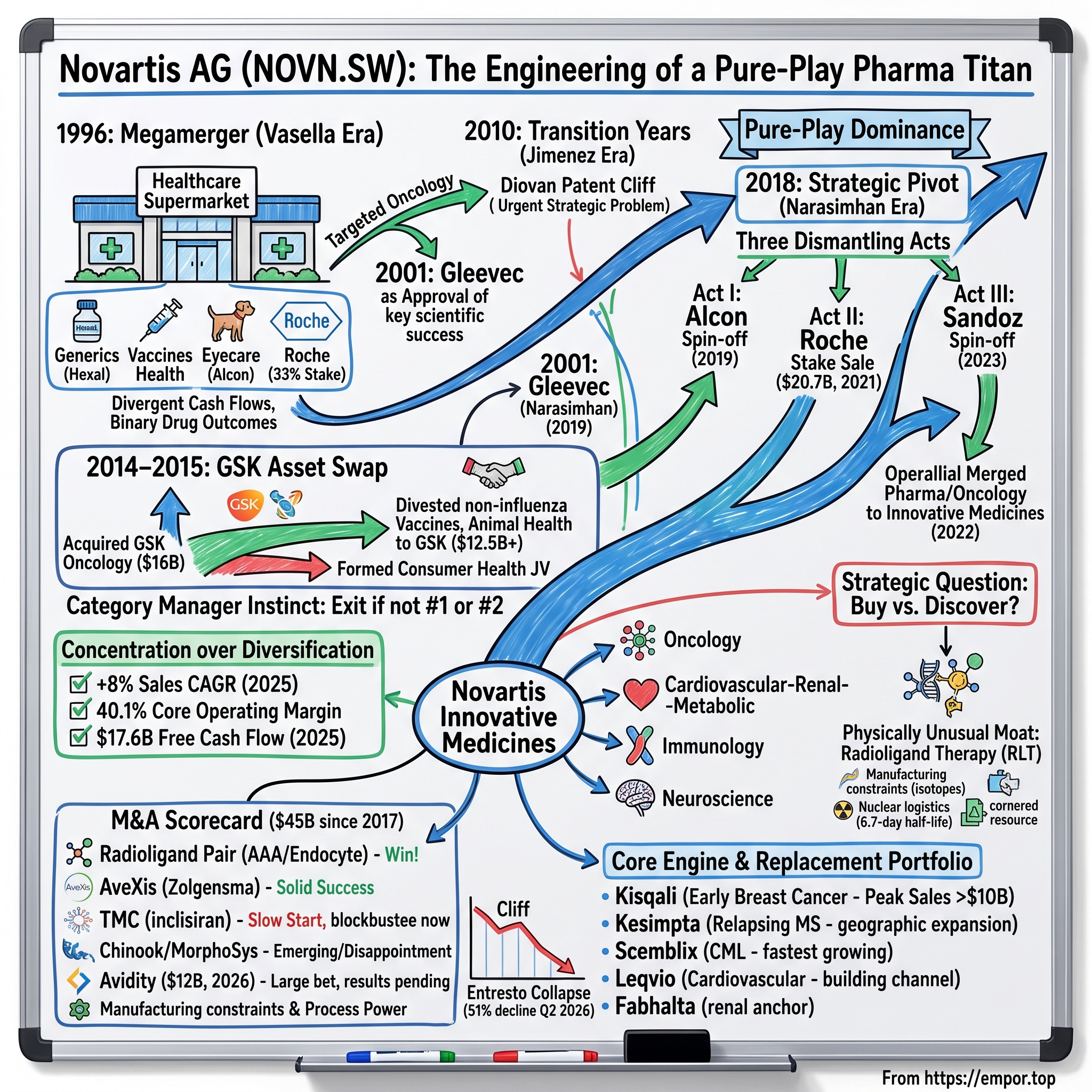
Novartis AG: The Engineering of a Pure-Play Pharma Titan
I. Introduction & Episode Roadmap
On the morning of July 21, 2026, Novartis reported that a drug which had been the single largest product in its portfolio one year earlier — Entresto, the heart failure medicine — had shrunk by roughly half in a single quarter, to $1.18 billion.1 In most large-cap pharmaceutical companies, that sentence would be the headline, followed by a guidance cut and a bruised share price. At Novartis it was a subplot. The same release showed group net sales of $14.4 billion, up 1% in constant currency, and a core operating margin of 41.2%.1 The company reaffirmed full-year guidance. The shares had spent the prior twelve months climbing from CHF 91.56 to CHF 131.28, and the stock was trading around CHF 130 in late July 2026, giving Novartis a market value of roughly CHF 248 billion.2
That is the interesting question, and it is the one this episode is built around: what does a company have to look like internally for the loss of its biggest drug to register as a rounding error?
The answer is not luck. It is the product of thirty years of deliberate, sometimes brutal, corporate surgery. Novartis was born in 1996 as a Swiss conglomerate assembled from chemical-industry ancestors, and for its first two decades it grew by addition — generics, eyecare, vaccines, animal health, over-the-counter consumer products, and a 33% voting stake in its cross-town rival Roche. Then, beginning around 2014 and accelerating sharply after 2018, it went the other way.
Vaccines went to GSK. Animal health went to Eli Lilly. The consumer joint venture stake was cashed out for $13.0 billion.3 Alcon, the eyecare business, was spun off to shareholders in 2019.[^4] The Roche stake was sold back to Roche for $20.7 billion in 2021.[^5] Sandoz, the generics arm that had once been the company's namesake, was spun out in 2023.[^6]
What remains is a single-business company: innovative medicines, four therapeutic areas, and nothing else. There is no hedge left in the structure, which is the point and also the risk.
The financial result of that dismantling is now visible. In full-year 2025, Novartis reported net sales of $54.5 billion, up 8% in constant currency; core operating income of $21.9 billion, up 14%; a core operating margin of 40.1%, reached two years ahead of the company's own timetable; and free cash flow of $17.6 billion, an all-time high.4 Harry Kirsch, then the chief financial officer, made the comparison explicit on his final earnings call: in the six-division era, the company's free cash flow typically sat in the $10–12 billion range.5 Fewer businesses, more cash.
So the roadmap for this episode. We start with the 1996 megamerger and the empire-building instincts of Daniel Vasella, because you cannot understand the deconstruction without understanding what was built. We move through Joe Jimenez's transition years and the three-way asset swap with GSK that reset the portfolio. We spend real time on Vas Narasimhan's pivot — the Alcon spin, the Roche exit, the Sandoz separation — and then we grade the acquisitions he made with the proceeds, because roughly $45 billion of shareholder capital has gone out the door in targeted M&A since 2017 and the results are genuinely mixed. We look under the hood at the current commercial engine, spend a section on radioligand therapy because it is the most physically unusual moat in large-cap pharma, and then stress-test the whole thing: management incentives, competitive structure, the risk radar, and the bull and bear cases.
Two threads run through all of it, and it is worth naming them now so you can watch them develop.
The first is a genuine strategic question: does concentration beat diversification in pharmaceuticals? Vasella's answer was no — he built a healthcare supermarket precisely because drug discovery is binary and patent cliffs are brutal. Narasimhan's answer is yes, and the Entresto quarter is the closest thing we have to a controlled experiment on that disagreement.
The second thread is more skeptical. A company that replaces lost revenue by buying assets from biotech is running a different business model than a company that discovers them. Novartis does both, and does both well. The bear case is that the ratio has drifted, and that the price of external innovation is rising faster than the productivity of internal research — which would make the growth algorithm progressively more expensive to run.
Let's begin in Basel, in 1996, when the largest corporate merger in history to that point was announced by two companies that had spent a century making dyes.
 Subscribe on LinkedIn
II. Origins: The 1996 Megamerger & The Empire-Building Era (1996–2010)
The Rhine bends through Basel, and for most of the nineteenth century the riverbank was lined with the works of men who dyed textiles. Silk ribbons, mostly. The chemistry of synthetic dyes — coal-tar derivatives, aniline colors — was the frontier technology of its day, and the Basel firms that mastered it discovered something in the process: the same molecules that stained fabric also stained tissue, and some of them killed the microbes they stained. That accidental adjacency is how a cluster of Swiss dye-makers became one of the world's densest concentrations of pharmaceutical capability.
On March 7, 1996, two of those descendants — Ciba-Geigy and Sandoz — announced they would merge. The combined entity was valued at roughly $29 billion, the largest corporate merger announced anywhere to that date, and it began operations on December 20, 1996 under a coined name assembled from the Latin novae artes, new skills.[^9] The choice of a neutral, invented name over either heritage brand was itself a signal: this was not a Ciba-Geigy takeover of Sandoz dressed in polite language, and neither legacy culture was going to win.
The man handed the integration was Daniel Vasella, and he was an unusual choice. Trained as a physician in Bern, he had come to Sandoz through its US affiliate rather than through the Basel establishment, and he arrived in the CEO's chair at 42 with no prior experience running a public company. What he had was a clinician's read on where medicine was heading and an appetite for scale that would define the next fourteen years.
Vasella's strategic thesis was diversification, and it deserves a fairer hearing than it usually gets. Pharmaceutical research is a business of binary outcomes: a Phase III trial either reads out or it does not, and a patent either holds or it expires on a known date, at which point 80–90% of a product's revenue can evaporate within eighteen months. Vasella's answer was to surround that volatile core with businesses whose cash flows were steadier and whose fortunes were uncorrelated with any single molecule. Generics would grow as branded drugs lost exclusivity — a natural hedge against the parent company's own patent cliffs. Eyecare was a device-and-consumables business with demographic tailwinds. Consumer health and animal health added distribution scale and brand equity. The theory was that the whole would be less volatile than the parts, and that a lower cost of capital would follow.
Execution matched ambition. Sandoz was rebuilt from a mid-tier generics operation into a top-two global player through a rapid sequence of acquisitions in the mid-2000s, including Eon Labs and the German generics group Hexal. The eyecare push was larger still. In April 2008, Novartis bought a 25% stake in Alcon from Nestlé for $10.4 billion, at $143 per share, with a negotiated call option over Nestlé's remaining holding. It exercised that option on January 4, 2010, acquiring a further 52% for $28.1 billion at $180 per share, and subsequently bought in the public minority — a total commitment of roughly $51 billion for the world's leading ophthalmic surgery and vision care franchise.6 Around the same period the company assembled what would become a roughly one-third voting stake in Roche, its Basel neighbor and rival, a position that was never converted into control and never fully explained.
Meanwhile the innovative core delivered two products that defined the era, and one of them deserves more than a passing mention because it changed how the entire industry thinks about drug discovery.
Gleevec (imatinib) was approved in 2001 for chronic myeloid leukemia, a cancer driven by a single, well-characterized genetic abnormality — a swapped fragment between two chromosomes that produces a permanently switched-on signaling protein.[^9] The insight was that if you knew the precise molecular cause, you could design a molecule to block precisely that cause, rather than poisoning every fast-dividing cell in the body and hoping the tumor died first. It worked. CML went from a disease that killed most patients within a decade to one that many patients live with indefinitely.
The strategic consequence inside Novartis was larger than the revenue. Gleevec established the company as the institutional home of targeted oncology at a moment when most of the industry was still organized around broad-spectrum cytotoxics. That reputation is why, more than a decade later, GSK was willing to sell its oncology portfolio to Novartis rather than someone else, and why Novartis's oncology franchise was the one asset nobody inside the company ever seriously proposed divesting.
Diovan (valsartan), meanwhile, became one of the largest cardiovascular franchises in the world and — as we will see — the patent cliff whose approach forced the strategic reckoning of the following decade. Novartis in 2010 was, by revenue, one of the two or three largest healthcare companies on earth.
And yet the equity market never paid for the assembly. Here is where the conglomerate thesis broke down in practice. Internal capital allocation inside a diversified healthcare group is a contest between businesses with wildly different economics: an innovative oncology molecule can earn gross margins near 90% and returns on incremental capital that are difficult to compute because the capital required is so small, while a generics plant earns single-digit margins on heavy fixed assets, and surgical eyecare demands continuous manufacturing reinvestment. Rational managers of a generics division will argue hard for capital they can genuinely deploy. Rational managers of the whole company will find it difficult to say no often enough. The result was a portfolio where the fastest-compounding business was chronically capital-starved relative to its opportunity, and the slowest was chronically fed.
There was a second, subtler cost. Sandoz's business model was to attack originator patents; Novartis Pharmaceuticals' business model was to defend them. Housing both under one roof created a permanent internal contradiction in lobbying posture, pricing philosophy, and talent identity. Investors, for their part, applied the usual conglomerate treatment: they valued the sum against a set of pure-play comparables and marked it down.
By the time Vasella handed the CEO role to Joe Jimenez in early 2010, remaining as chairman until 2013, the machine he had built was the largest it would ever be. The next fifteen years would be spent taking it apart.
III. The Transition Era: Portfolio Pruning & The GSK Asset Swap (2010–2018)
Joe Jimenez arrived in the CEO's office with a résumé that would have been unremarkable at Procter & Gamble and was mildly scandalous in Basel. He was an American consumer-goods executive — H.J. Heinz, ConAgra — who had joined Novartis in 2007 to run the consumer health division and then the pharmaceuticals division. He was not a physician. He did not come from the bench. What he brought instead was a category manager's instinct, the habit of asking a question that pharmaceutical companies had historically been able to avoid: in each business we operate, are we number one or number two, and if not, why are we here?
He inherited an urgent problem. Diovan's US exclusivity was ending, and the revenue hole was large enough to dominate every planning conversation. He also inherited an activist-adjacent shareholder base increasingly willing to say out loud that the sum of Novartis's parts was worth more than the whole, and that the market was applying a persistent discount relative to more focused peers.
There is a useful way to think about what a patent cliff does to a management team. A drug that has been on the market for a decade carries almost no incremental cost — the salesforce is paid for, the trials are done, the plant is built. The last billion dollars of a mature blockbuster's revenue is very close to the last billion dollars of its operating profit. When that revenue disappears, it does not take a proportional slice of costs with it. It takes almost all of itself straight out of earnings.
That arithmetic is why patent cliffs create such strategic urgency, and why they so often trigger either desperate acquisitions or genuine structural change. Jimenez, to his credit, chose the second.
Jimenez's answer arrived in April 2014 and remains one of the more elegant pieces of portfolio engineering in the industry's history. Rather than sell unwanted businesses for cash and then go shopping — a sequence that invites a valuation penalty on the sale and an acquisition premium on the purchase — Novartis and GSK executed a simultaneous three-part swap in which each company handed the other the assets where it was subscale.
The mechanics, completed on March 2, 2015: Novartis acquired GSK's oncology portfolio for $16 billion in cash plus up to $1.5 billion in development milestones, bringing in Tafinlar, Mekinist, Votrient, Promacta, Tykerb and Arzerra — products with roughly $2.0 billion of 2014 sales. Novartis divested its non-influenza vaccines business to GSK for $5.25 billion upfront, with milestones taking the total to as much as $7.1 billion plus royalties. And the two companies pooled their consumer health operations into a joint venture in which GSK held control and Novartis retained 36.5% and four of eleven board seats.7 Separately, the animal health business went to Eli Lilly for $5.4 billion.
The logic is worth stating plainly because it is the most transferable lesson in this episode. Novartis was a distant also-ran in vaccines, competing against GSK, Merck, Sanofi and Pfizer with a subscale portfolio. It was similarly positioned in animal health. It was, however, genuinely top-tier in oncology.
Market position in pharmaceuticals is not a vanity metric. It determines whether you can afford the fixed cost of a specialist salesforce calling on a narrow set of physicians, whether the leading investigators in a disease area will run your trials, and whether payers treat you as a negotiating counterparty or simply a price-taker. Below a certain scale in a therapeutic area, all three of those turn against you at once, and the business earns less than its cost of capital no matter how well it is run.
A number-four vaccines business, in other words, is not a smaller version of a number-one vaccines business. It is a structurally different and worse business. Trading it for scale where you already lead is closer to arbitrage than to a divestiture.
The swap also had a quieter accounting virtue. Because it was structured as an exchange, Novartis did not have to raise a large slug of debt or issue equity to fund a $16 billion oncology acquisition. It paid, substantially, with businesses it had decided not to want.
Three years later Jimenez closed the loop on the consumer piece. On March 27, 2018, Novartis agreed to sell its 36.5% joint venture stake to GSK for $13.0 billion in cash, closing on June 1 and booking a pre-tax gain of $5.8 billion.3 The JV structure had done its job: it had given the consumer assets time to be worth more inside a focused owner than they had been inside Novartis, and it had given Novartis an exit at a negotiated price rather than a distressed one. The proceeds went straight onto the balance sheet as dry powder.
Assessing Jimenez's tenure honestly requires holding two things at once. On portfolio strategy he was decisive and, with hindsight, right — he established the principle that Novartis would exit any business where it could not credibly lead, and that principle governed everything that followed. On operating performance the record is more ordinary: core margins through the mid-2010s ran in the low thirties, well below where the company sits today, and the pharmaceutical division's growth was for several years dependent on a small number of products. The Alcon acquisition he inherited underperformed its thesis badly enough that by 2016 the company was publicly weighing strategic options for it. And the Roche stake — an enormous, non-controlling, non-strategic position — simply sat there, absorbing capital and generating dividend income and governance awkwardness in roughly equal measure.
Those two unresolved assets, Alcon and Roche, plus the still-unresolved question of Sandoz, were the inheritance handed to Jimenez's successor. What happened next is the reason this company looks the way it does.
IV. The Vas Narasimhan Strategic Pivot: Engineering Pure-Play Dominance (2018–2023)
Vas Narasimhan took over as CEO on February 1, 2018, at 41 years old. His background is unusual for the job in a way that turned out to matter. He is a physician — University of Chicago undergraduate, Harvard Medical School, a Harvard master's in public policy — who spent time doing tuberculosis and HIV work in India before joining Novartis in 2005. He rose through vaccines, then global drug development, becoming the company's chief medical officer and head of drug development before the top job. He had never run a commercial P&L of any size.
That biography predicts the strategy. A career development executive looks at a healthcare conglomerate and sees resources trapped in businesses that do not compound scientific advantage. A career commercial executive might have seen synergy. Narasimhan saw drag.
It also predicts his management style, which has been consistent enough over eight years to be treated as a genuine input rather than a personality note. He runs the company like a clinical program: hypothesis, endpoint, readout. Guidance is framed as a target with a date attached. Pipeline assets are discussed in terms of what would falsify the thesis rather than what would confirm it. On earnings calls he answers scientific questions himself and in detail — including questions about trial powering, biomarker correlation, and regulatory precedent — which is unusual for a chief executive and occasionally exposes him to commitments a more guarded operator would avoid.
The flip side is a certain confidence about scientific judgment that has not always been vindicated. The BeiGene partnership, the pelabresib acquisition, and the multi-year delay in getting Leqvio's commercial channel right all involved calls that turned out to be wrong, and all three were calls in Narasimhan's own domain of expertise rather than in areas he had delegated.
The dismantling came in three acts, each larger and each harder than the last.
Act I: Alcon, April 2019. Alcon had never earned its purchase price. Rather than sell it into a market that knew that, Novartis spun it off — distributing shares to existing holders on April 9, 2019, creating a standalone eyecare company and leaving Novartis a focused medicines company.[^4] A spin-off is not a valuation event in the way a sale is; it does not generate cash and it does not let management claim a price. What it does is stop the internal capital contest. Eyecare manufacturing is capital-hungry in a way that innovative medicines is not, and every franc of Alcon capex was a franc unavailable to oncology. The spin also handed shareholders the choice Novartis's management had been making on their behalf: own the eyecare exposure, or don't.
Act II: Roche, November 2021. The 33% voting stake in Roche was the strangest item on the balance sheet — a position with no board control, no operational integration, and no coherent strategic purpose two decades after it was assembled. On November 4, 2021, Novartis agreed to sell the entire holding, 53.3 million shares, back to Roche in a bilateral transaction at CHF 356.9341 per share, equivalent to $388.99, for total proceeds of $20.7 billion.[^5] The Financial Times noted at the time that the buyback resolved a long-running governance oddity for both Basel companies.8
The financial judgment here is favorable but should be stated precisely. Selling a large illiquid stake bilaterally to the only natural buyer is a negotiation with an obvious asymmetry, and Novartis conducted it at a moment when Roche's shares were near record levels. The company converted a passive, low-strategic-value asset into $20.7 billion of deployable capital without a market-clearing discount. That is good execution. It is not, however, evidence of investment skill — the stake had been held for two decades and its returns were largely a function of Roche's operating performance, over which Novartis had no influence.
Act III: Sandoz, October 2023. This was the philosophical one. Sandoz was not merely a division; it carried the name of one of the two founding companies. On October 4, 2023, Novartis distributed 100% of Sandoz Group AG to shareholders — one Sandoz share for every five Novartis shares — and Sandoz began trading on the SIX Swiss Exchange as an independent generics and biosimilars company.[^6] Sandoz shares opened below expectations on debut, which is common for spin-offs as index funds and mandate-constrained holders sell.9
The industrial logic was that generics and innovative medicines had diverged into genuinely different businesses. Commodity small-molecule generics compete on manufacturing cost and price, in markets characterized by structural deflation. Innovative medicines compete on scientific differentiation and evidence. They require different capital intensity, different talent, different regulatory postures, and — critically — different tolerances for failure. Running both requires a management team to be excellent at two incompatible things.
Underneath these three headline transactions ran an operational reorganization that gets less attention and may matter more. In April 2022 Novartis merged its separate pharmaceuticals and oncology commercial units into a single innovative medicines organization split by geography — US and International — rather than by therapy area, cutting a management layer in the process.10 For a company that had spent two decades adding structure, removing it was the harder cultural act.
The measurable output of the whole program: core operating margin moved from the low thirties in the mid-2010s to 40.1% in 2025, hitting the company's target two years ahead of the plan set at its investor day.4 Free cash flow reached $17.6 billion. Those numbers are the strongest available evidence that concentration did what Narasimhan said it would.
The honest counter-argument is that margin expansion of this kind has a natural ceiling and a composition effect: you improve the average partly by removing the low-margin businesses, which is arithmetic rather than operational improvement. The question that separates the two explanations is what happens to the remaining business when it is put under stress. In 2025 and 2026 it was — and we will get to that. First, the capital.
V. M&A Strategy & Capital Allocation Scorecard: Did Novartis Overpay?
Selling businesses is the easy half of portfolio transformation. The hard half is what you do with the money, and here the record demands genuine scrutiny rather than applause.
Since 2017 Novartis has deployed something on the order of $45 billion in targeted acquisitions. The strategy is consistent and stated openly: buy de-risked or nearly de-risked assets in the four therapeutic areas, plus platform technologies that create durable manufacturing or delivery advantages. On the Q2 2026 call, asked directly whether the recent $12 billion Avidity purchase signaled a shift toward larger deals, Narasimhan pushed back — the standing approach, he said, is a steady cadence of transactions with upfronts in the sub-$2 billion range, with occasional larger deals when an asset fits both the platform and the therapeutic-area strategy.11 That framing is defensible, and it is also the kind of statement worth checking against the actual ledger.
The radioligand bet: Advanced Accelerator Applications ($3.9 billion, 2017) and Endocyte ($2.1 billion, 2018). AAA brought Lutathera, an approved radioligand therapy for neuroendocrine tumors, and — more valuable — a European radiopharmaceutical manufacturing and distribution network.12 Endocyte brought the PSMA-targeted asset that became Pluvicto.[^17] Combined outlay: $6.0 billion. Pluvicto alone reached $1,994 million in 2025 sales, growing 42% in constant currency, and $651 million in the second quarter of 2026, up 43%.41 The company guides to more than $5 billion in peak sales. These two deals also created an entirely new manufacturing capability that competitors have spent years trying to replicate. On any reasonable measure of capital efficiency this was the best money the company has spent in a decade.
AveXis ($8.7 billion, 2018). Novartis paid $8.7 billion for a gene therapy company whose lead asset, Zolgensma, was a one-time treatment for spinal muscular atrophy.[^18] The science worked: Zolgensma became a multi-billion-dollar product and changed the natural history of a fatal childhood disease. But the deal also imported problems. Data-handling irregularities in preclinical work surfaced after approval and drew an FDA rebuke. Clinical holds slowed the intrathecal formulation intended for older patients. And the underlying commercial arithmetic of a curative one-time therapy is unforgiving: you treat the accumulated prevalent population, revenue spikes, and then you are selling only into the annual incidence of new births. Zolgensma group sales were $1,232 million in 2025, flat in constant currency — the mature plateau the model predicts.4
The intrathecal version finally arrived as Itvisma, and management's own framing on the Q2 2026 call is instructive about how they now think about the category: expect a ramp over roughly three years as reimbursement is secured country by country, with ex-US sales likely exceeding US sales, and a combined Zolgensma-plus-Itvisma potential of around $3 billion.11 That is a solid outcome against $8.7 billion of purchase price and eight years of elapsed time. It is not a spectacular one.
The Medicines Company ($9.7 billion, 2019). This is the deal that has drawn the most criticism, and the criticism was earned — for a while. Novartis paid $9.7 billion for a company whose value rested essentially on one asset: inclisiran, a twice-yearly siRNA that lowers LDL cholesterol.[^19] The scientific case was strong. The commercial case ran into a wall. Inclisiran, marketed as Leqvio, is physician-administered, which in the US means it flows through the "buy-and-bill" reimbursement channel — a system cardiology practices were not set up to operate. Launch tracked well below expectations for three years, and the acquisition became shorthand for pharma overpaying for single-asset biotechs.
The 2025–26 data complicate that verdict. Leqvio reached $1,198 million in 2025, up 57%, crossed into blockbuster territory, and grew a further 59% in the second quarter of 2026 to $480 million.41 Management attributes the inflection to depth within targeted US health systems, a 23.3% share in the Medicare Part B segment, and inclusion on China's national reimbursement drug list.11 Two cardiovascular outcomes trials read out in 2027.
The fair current assessment: Novartis paid a full price and then took roughly six years to build the commercial channel the asset required. Six years of delay on a $9.7 billion outlay is expensive in a way that never appears in any reported metric — it is the compounding the capital did not do.
Whether the internal rate of return ultimately clears the cost of capital now depends heavily on those outcomes trials and on how the newly approved oral PCSK9 inhibitors reshape the market. Narasimhan addressed that threat directly on the Q2 call, arguing that Leqvio's buy-and-bill positioning insulates it from the gross-to-net price war he expects between oral and antibody competitors, and pointing to unusually strong siRNA uptake in Asia and the Middle East.11 That is a coherent argument. It is also, at this stage, a hypothesis.
Chinook ($3.2 billion upfront, 2023) and MorphoSys (€2.7 billion, 2024). The Chinook deal built a renal franchise and has produced approvals: Vanrafia (atrasentan) received FDA accelerated approval in April 2025 for proteinuria reduction in IgA nephropathy, joining Fabhalta, which had been granted accelerated approval in the same disease in August 2024 and in C3 glomerulopathy in March 2025.1314 Fabhalta grew to $505 million in 2025 and $225 million in the second quarter of 2026.41 A third renal asset, zigakibart, has been delayed — Novartis amended the Phase III protocol to align the proteinuria readout with an interim kidney-function analysis expected in the first half of 2027, a decision management framed as optimizing competitive label positioning.5
MorphoSys is the clearest disappointment. Novartis paid €2.7 billion in 2024, principally for pelabresib in myelofibrosis.15 Within months, a safety signal emerged around leukemic transformation, the regulatory filing was pushed back, two MorphoSys sites were closed with roughly 330 jobs cut, and the company took an impairment on the asset.16 By late 2025 there was a partial recovery: 96-week Phase III data showed comparable leukemic transformation rates to control and durable spleen and symptom responses, giving Novartis an agreed EU filing path in 2026 — but in the US, China and Japan the company must run an entirely new Phase III trial in a narrower population.5 A €2.7 billion asset that requires a fresh pivotal study eight years after the original program began is, on any honest reckoning, a capital allocation error partially recovered.
Avidity ($12 billion, 2026). The largest deal of the Narasimhan era was announced on October 26, 2025 at $72.00 per share — a 46% premium — and closed in the first half of 2026, funded primarily with debt.17 It brings the antibody-oligonucleotide conjugate platform, which uses an antibody to deliver RNA therapeutics into muscle tissue, and three late-stage neuromuscular programs. The company has told investors it dilutes core margin by one to two percentage points and pushes the return to 40%-plus margins out to 2029.18 Early evidence is encouraging — a BLA for del-zota in Duchenne muscular dystrophy was submitted in the second quarter of 2026, and del-brax hit its primary and key secondary biomarker endpoints in FSHD — but these are biomarker readouts, not outcomes, and Narasimhan was appropriately careful on the call: the base case for FSHD remains a 2028 submission, with an accelerated path an upside case dependent on FDA agreement.11
The bolt-on layer. Beneath the headline deals runs a steady stream of smaller transactions that gets almost no attention and is arguably the more repeatable part of the strategy. In February 2025 Novartis agreed to acquire Anthos Therapeutics — a company it had helped create — for $925 million upfront plus up to $2.15 billion in milestones, bringing in abelacimab, a monthly factor XI antibody aimed at anticoagulation without the bleeding risk of existing agents. In April 2025 it bought Regulus Therapeutics for $800 million upfront, with contingent value rights taking the total to as much as $1.7 billion, adding an oligonucleotide program in polycystic kidney disease.32 In October 2025 it completed the acquisition of Tourmaline Bio for roughly $1.4 billion, adding an anti-IL-6 antibody for cardiovascular inflammation.33 Three further transactions closed during 2026.
None of these will individually move a $54 billion revenue base. Collectively they represent the operating rhythm Narasimhan describes as the core strategy — a continuous intake of external science at prices that do not require a capital markets event. It is also the layer where diligence quality is hardest for outsiders to assess, because failures are quietly absorbed rather than announced.
What does the full ledger add up to? Two clear wins (the radioligand pair), one solid but expensive success (AveXis), one deal that looked like a mistake for five years and is now working (TMC), one franchise-builder still proving itself (Chinook), one clear error (MorphoSys), and one very large bet whose outcome is unknown (Avidity).
That is a reasonable batting average for the category and a poor one for a company that would like to be valued on internal R&D productivity. Novartis is, on this evidence, a highly capable acquirer and integrator of external science, with an internal engine that is good but not sufficient on its own to fund the growth rate management has promised.
Investors should price it accordingly — and watch, closely, whether the price of external innovation keeps rising. Narasimhan himself flagged the trend on the Q2 call: upfronts above $1 billion for assets with minimal clinical data have become normal, which he described as a significant shift over the arc of the sector, requiring correspondingly higher conviction in the underlying science.11 When the input cost of a strategy rises faster than the output value, the strategy has a shelf life.
VI. The Core Engine Today: Segment Mechanics, Blockbusters, & Economics
Strip away the history and what is Novartis, mechanically, in the middle of 2026?
It is a company that sold $54.5 billion of medicine in 2025 and converted 40.1% of it into core operating income and $17.6 billion into free cash flow.4 It reports as a single business — no more segments to slice — organized commercially into US and International, and scientifically into four therapeutic areas: cardiovascular-renal-metabolic; immunology; neuroscience; and oncology.18 (Older descriptions of the company list five pillars; the current structure counts four, with solid tumors and hematology under a single oncology umbrella.)
The revenue base is undergoing the most violent recomposition in the company's history, and 2025–26 is the crossover point. Three large products lost US exclusivity in the middle of 2025 — Entresto, Promacta and Tasigna. The scale of the Entresto event was extraordinary: $7,748 million of 2025 sales, still the largest product in the portfolio, falling 51% in constant currency in the second quarter of 2026 to $1,181 million.41 Tasigna fell 58% and Promacta 65% in the same quarter.1 Add the January 1, 2026 start of the Inflation Reduction Act's negotiated Medicare price for Entresto — a maximum fair price of $295 per month, a 53% cut from list — and you have a franchise being compressed from two directions simultaneously.19
Against that, the replacement portfolio grew 36% in constant currency in the quarter.11 Look at the individual engines.
Kisqali is the largest and most important. A CDK4/6 inhibitor for HR+/HER2- breast cancer, it spent years as the number-three product in a class dominated by Pfizer's Ibrance and Eli Lilly's Verzenio. The NATALEE trial changed that. In September 2024 the FDA approved Kisqali in the adjuvant setting for stage II and III early breast cancer at high risk of recurrence — meaning it moved from treating metastatic disease to preventing recurrence in patients who have just had surgery.20 That is a fundamentally larger and longer-duration population. Kisqali reached $4,783 million in 2025, up 57%, and $1,695 million in the second quarter of 2026, up 43%, crossing $1 billion of US sales in a quarter for the first time.41 Management guides to more than $10 billion of peak sales — which would make it the largest product in company history.18
The number worth watching is not the growth rate but the mix. Novartis says 58% of new US patients now come from the node-negative and single-node-positive early breast cancer populations where its label is exclusive — segments its competitors cannot address.11 That is a much better foundation than share taken in a contested market. The offsetting fact, raised by a UBS analyst on the Q4 2025 call: Kisqali's US loss of exclusivity is guided to the third quarter of 2031 including pediatric exclusivity, just outside the 2030 planning horizon.5 Every dollar of Kisqali growth is also a dollar of future cliff.
Cosentyx, the IL-17A inhibitor, is the mature immunology anchor: $6,668 million in 2025 growing 8%, and $1,824 million in the second quarter of 2026 growing 10% — though management flagged that the quarterly figure was flattered by one-time items and that underlying US growth runs in the mid-single digits.4111 It competes against AbbVie's Skyrizi and Rinvoq, Johnson & Johnson's Tremfya, and Eli Lilly's Taltz in a genuinely crowded market. Its growth now comes from indication expansion rather than share gain — hidradenitis suppurativa, an intravenous formulation, and a pending US filing in polymyalgia rheumatica following positive Phase III data.11 Peak sales guidance is $8 billion.
Kesimpta, a self-injected monthly B-cell therapy for relapsing multiple sclerosis, reached $4,426 million in 2025 and grew 32% in the second quarter of 2026.41 Its competitive position is a case study in delivery-format advantage: it competes primarily against Roche's Ocrevus, which requires an infusion center visit. The remaining opportunity is geographic — management notes that roughly two-thirds of patients outside the US on disease-modifying therapy are still on older agents rather than B-cell therapies.11
Scemblix (asciminib) is the fastest-growing product in the portfolio, up 89% in the second quarter of 2026 to $562 million after 85% growth in 2025.14 It is a CML drug with a novel binding mechanism, and it is displacing Novartis's own legacy franchise — Gleevec's successors Tasigna and, indirectly, imatinib generics. Management expects to reach first-line new-prescription leadership in the US during the second half of 2026, and notes something commercially unusual: payers are accepting Scemblix in first line despite the availability of multiple generic alternatives, on the strength of superiority data.11 That is genuine pricing power, and it is rare.
Fabhalta and Vanrafia anchor the emerging renal franchise, and Rhapsido (remibrutinib), an oral BTK inhibitor launched in chronic spontaneous urticaria, is the newest large bet — over 4,000 prescribers and 10,000 patients treated by mid-2026, with 60% of use in the first-line setting.11 Management is deliberately restraining the ramp to protect pricing across future indications, telling analysts not to expect an inflection and describing a disciplined approach to gross-to-net because "any points we give now, we won't be able to get back."11 Whether that is prudent long-term pricing strategy or a rationalization of slow access wins is not yet resolvable from outside.
The first-half 2026 group numbers show the crossover in progress: net sales of $27.5 billion, down 2% in constant currency; core operating income of $10.8 billion, down 7%; core margin of 39.4%, down 270 basis points.1 Management guides to a second half that reverses this — mid-single-digit sales growth, mid-to-high-single-digit core operating income growth — because the prior-year comparison base finally clears the generic entries.11
For investors, the implication is straightforward: 2026 reported growth is nearly meaningless as a signal. What matters is the growth rate of the non-Entresto portfolio, and that has been running above 35%.
A myth worth checking. The consensus story about Novartis is that becoming a pure play made the company safer. That is precisely backwards, and it is worth being clear about why.
Diversification did not reduce Novartis's exposure to patent cliffs — Entresto's collapse would have happened regardless of whether Sandoz sat in the same corporate structure. What diversification did was dilute the impact on group results by attaching a large, slow-growing, low-margin revenue base to the same income statement. That is smoothing, not risk reduction, and investors have never paid a premium for smoothing they can replicate themselves by owning two stocks.
What the pure-play structure actually did was raise the volatility of reported results while improving the quality of the underlying business. A single-business company with 40% core margins and no cushion will show larger swings when a franchise breaks. The 51% Entresto decline is exactly that. The correct question is not whether the swings got bigger — they did — but whether the average return improved enough to compensate, and whether the replacement engine is deep enough to absorb the next one. On the first, the margin and cash flow evidence is affirmative. On the second, 2026 is the first real data point, and it passed. A second cliff arriving before the next generation of launches matures would be a genuinely different test.
A second, smaller myth: that a pure-play structure removes complexity. It does not. Novartis today runs four therapeutic areas, at least four distinct technology platforms — small molecules, biologics, radioligands, and nucleic-acid therapeutics including siRNA and antibody-oligonucleotide conjugates — and a manufacturing footprint spanning conventional plants, gene therapy suites and nuclear pharmacies. The complexity moved from the corporate structure into the science. It did not disappear.
VII. The Hidden Growth Engine: Radioligand Therapy (RLT) & Supply Chain Moats
Here is a business problem no other large pharmaceutical franchise has to solve. A patient in Ohio is scheduled for treatment on Thursday afternoon. The medicine for that appointment does not exist yet on Monday. It cannot be manufactured too early, because from the moment it is made it begins to disappear — halving in potency roughly every 6.7 days. There is no warehouse, no safety stock, no forward inventory. If a flight is delayed or a road is closed, that dose is not late; it is worthless, and the patient is not treated.
That is radioligand therapy, and it is the most physically distinctive business inside Novartis.
The concept is easier than it sounds. Take a molecule that binds selectively to a protein found on the surface of a cancer cell — for Pluvicto, that protein is PSMA, which prostate cancer cells display in abundance. Attach to that molecule a radioactive isotope, Lutetium-177. Inject it. The targeting molecule circulates and docks onto the tumor cells; the isotope then delivers a short-range dose of radiation directly at the target, killing the cell it is attached to while sparing tissue a few millimeters away. It is, in effect, radiotherapy delivered by courier rather than aimed from outside the body.
The clinical results have been sufficient to build a franchise. Pluvicto was first approved in the post-chemotherapy setting; on March 28, 2025 the FDA extended the label to patients who had received an androgen receptor pathway inhibitor and were appropriate to delay chemotherapy — the pre-taxane setting — based on the PSMAfore trial, which showed a 59% reduction in the risk of radiographic progression or death and more than doubled median radiographic progression-free survival, from 5.6 to 11.6 months.21 The approval roughly tripled the eligible population. By the second quarter of 2026, more than 70% of new US patients were being treated in that pre-taxane setting, and Novartis had submitted for a further expansion into hormone-sensitive disease based on the PSMAddition study — an indication management says would add about 75% more eligible patients.1122
Now the interesting part, which is the supply chain.
Lutetium-177's 6.7-day half-life makes conventional pharmaceutical logistics impossible. You cannot manufacture in one large plant and distribute globally. Instead, you need reactor access to produce the isotope, a network of manufacturing sites positioned within hours of treatment centers, and a nuclear-certified cold-chain logistics operation that can guarantee patient-specific doses arrive on schedule. Novartis has built exactly that: US production in New Jersey and Indiana with a third California site established, further capacity coming online in Florida, Japan and China, and a European network inherited from the Advanced Accelerator Applications acquisition.21512 As of the second quarter of 2026, more than 880 US treatment sites and more than 650 sites outside the US were administering the therapy.11
In Hamilton Helmer's vocabulary this is Process Power layered on a Cornered Resource. The isotope supply is genuinely scarce and reactor-constrained. The manufacturing and logistics competence is accumulated, tacit, and slow to build — you cannot buy it, and you cannot hire it quickly, because there are not many people in the world who have done it.
There is also a demand-side component that gets less attention. A hospital cannot simply decide to start administering radioligand therapy. It needs licensed handling facilities, trained nuclear medicine staff, radiation safety protocols, and a scheduling system that can absorb a delivery window measured in hours. Every one of the more than 1,500 sites Novartis has qualified worldwide represents an investment by that institution as well as by Novartis. That is a form of switching cost — not contractual, but operational, and none the weaker for it.
The offsetting economics deserve equal weight. This is a capital-intensive, logistics-heavy business embedded in a company whose average gross margin is built on conventional pharmaceutical economics. Novartis does not disclose franchise-level profitability, and the CFO has repeatedly flagged that gross margin is pressured by portfolio mix as newer, more complex products grow.11 The reasonable inference is that radioligands carry meaningfully lower gross margins than a small molecule like Rhapsido. Investors should not assume the growth in this franchise flows through to profit at the group average rate.
But moats should be tested rather than admired, and this one has been tested twice.
First, on supply. In 2022 and 2023, before capacity caught up with demand, Novartis had to pause enrollment in clinical trials and manage allocation because it could not make enough Pluvicto. That is a rare and telling failure mode: a company constrained not by demand, not by reimbursement, but by physics and plant. The company has since invested heavily and management now states that supply fully meets the expanded indication's needs.21 The scar is instructive nonetheless — the same barrier that keeps competitors out also caps how fast Novartis itself can grow.
Second, on generics. On the Q2 2026 call, a Goldman Sachs analyst raised that generic versions of Lutathera had been cleared to launch by the Delaware courts. Narasimhan's answer was revealing in its structure. He first noted that neither challenger had yet received FDA approval and argued regulators should apply a high threshold to confirm equivalent radiation delivery to the tumor. He then made the commercial argument: even against a lower-priced entrant, Novartis believes its ability to deliver on time, in full, every time, across a global network, mitigates the impact — because physicians running a radioligand clinic cannot tolerate a missed delivery.11
That is the moat thesis stated precisely, and it is falsifiable. If a generic radioligand launches and takes meaningful share on price, the "product is the supply chain" argument weakens considerably. If it launches and stalls because oncology practices will not risk a scheduling failure, the argument is validated in a way no investor deck could achieve. This is one of the most genuinely informative natural experiments available in large-cap pharma over the next two years, and it is worth watching regardless of one's view on the stock.
The forward-looking question is whether the platform generalizes. Novartis is developing an Actinium-based PSMA therapy, HER2-targeted radioligands, GRPR-targeted agents, and follow-ons in neuroendocrine tumors.115 If radioligand therapy becomes a modality applicable across many tumor types rather than two, the manufacturing network becomes a shared asset amortized across a much larger revenue base — which is precisely the shape of a durable structural advantage. If it stays a two-product niche, the network is an expensive way to serve a limited market.
VIII. Current Management, Incentives, & Skeptical Investor Stress Test
On February 4, 2026, Harry Kirsch closed his final earnings call as chief financial officer with an observation that doubled as a defense of the entire strategy: over the prior five years the company had compounded sales at 8% and core operating income at 15%, expanding core margin by more than 1,000 basis points in constant currency and reaching the 40% target two years ahead of the plan set at investor day.5 He had been CFO since 2013, through twenty-two years at the company, and had presided over the reduction from six divisions to three and then to one. Mukul Mehta, a two-decade Novartis finance veteran who had run finance for the International region and the pharmaceuticals unit, took over on March 16, 2026.23
Narasimhan, entering his ninth year as CEO, is the constant. His public style is unusually technical for a large-cap chief executive — he answers clinical questions on earnings calls himself, in detail, including questions about trial powering assumptions and biomarker correlation, and he is willing to say he does not know. Asked on the Q4 2025 call why the pelacarsen cardiovascular outcomes trial was taking longer than modeled, his answer began: "I wish we knew, Steve. Honestly, obviously, I can only give you an opinion. I can't actually give you a fact because we're completely blinded."5 He then offered a hypothesis about event rates being lower than published literature suggested, possibly because trial patients were unusually well managed on other risk factors. That is a more useful and more honest answer than the industry norm.
The credibility record on targets is, on balance, strong. The 40% core margin target was set for 2027 and delivered in 2025. Full-year 2025 guidance was raised twice during the year and then met — high single-digit sales growth guided, 8% delivered; low-teens core operating income growth guided, 14% delivered.54 The 2026 guidance of low-single-digit sales growth and a low-single-digit core operating income decline was set in February and reaffirmed in April and again in July, with the first half landing at the upper end of the internal range.124
Where management deserves harder questioning:
On the incentive structure. Novartis's Long-Term Performance Plan is based on three performance conditions — net sales growth, core operating income growth, and innovation — weighted equally at roughly one-third each.25 Note what is absent: relative total shareholder return, and any environmental or social measure. Access-to-medicines and sustainability metrics sit in the annual incentive plan, not the long-term plan; the compensation committee has considered adding them to the LTPP and concluded the current metrics are preferable.25
This is worth flagging because published descriptions of Novartis's pay structure frequently assert that a fixed share of long-term incentive is tied to access-to-medicines targets. The plan rules say otherwise. Where those metrics sit — annual bonus versus multi-year equity — changes what behavior they actually drive.
The more substantive practical consequence is that two-thirds of long-term executive incentive is driven by absolute growth in sales and core operating income — the two metrics most directly improvable by acquiring revenue with the balance sheet. A skeptical investor is entitled to note that this design does not penalize overpaying, because purchase price does not appear in either metric. The 2023–25 cycle vested at 188% of target, the highest of Narasimhan's tenure, and CEO realized compensation for 2025 came to roughly CHF 24.9 million — figures disclosed in the compensation report filed with the company's 2025 annual report.31
On R&D productivity versus purchased growth. This is the central bear argument, and it has not been refuted. Of the eight in-market assets Novartis showcased at its November 2025 capital markets day as having $3–10 billion peak sales potential, several — Pluvicto, Leqvio, Kisqali's expansion notwithstanding — trace to acquisitions rather than internal discovery.18 More than ten of the thirty-plus high-value pipeline candidates were licensed or acquired within the prior two years.18 Novartis's internal engine has genuinely produced — Cosentyx, Kesimpta, Scemblix and Fabhalta are all homegrown, and that is a better internal record than most peers can claim. But the growth algorithm as currently constructed requires a continuing external supply of assets purchased at prices Narasimhan himself describes as having risen dramatically.
On commercial launch execution. The record here is mixed and worth stating plainly. Leqvio took roughly six years to find its channel. Pluvicto was supply-constrained at exactly the moment demand inflected. Rhapsido's ramp is being deliberately throttled for pricing discipline. Against that: Kisqali's early breast cancer launch, Scemblix's line-of-therapy advancement, and Fabhalta's renal rollout have all tracked or beaten plan. The pattern suggests Novartis executes well in specialist settings where it already has a salesforce and relationships, and struggles where it must build a new channel from scratch.
On China. In 2021 Novartis paid $650 million for rights to BeiGene's PD-1 inhibitor tislelizumab and $300 million for an option on the TIGIT candidate ociperlimab. It terminated the ociperlimab option in July 2023 and returned tislelizumab's rights to BeiGene in September 2023, citing a reassessment of its strategy in the PD-1 category.26 Roughly $950 million was committed and largely written off. The company was willing to cut quickly, which is a genuine virtue; it also demonstrated a misjudgment of both the competitive dynamics in checkpoint inhibitors and the US regulatory timeline for China-originated assets. Meanwhile the commercial China business is performing well — Leqvio's national reimbursement listing has driven a share doubling, and management now believes it could become the largest product Novartis has ever sold in that market.11
The activist's version of the argument. Put the individual criticisms together and you can construct the letter a concentrated shareholder might write.
It would begin with the observation that the easy value-unlocking is finished. Alcon, Roche and Sandoz were three enormous, identifiable pools of trapped value, and all three have been released. There is no fourth. From here, the equity return depends entirely on operating performance and R&D output, which is a harder game than portfolio surgery and one in which Novartis's record is good rather than exceptional.
It would then note the incentive design problem: with two-thirds of long-term compensation tied to absolute sales and core operating income growth, and none tied to relative shareholder return or return on invested capital, an executive team facing a revenue hole has a compensation-aligned reason to buy revenue. Net debt nearly doubling in six months to fund a $12 billion acquisition is exactly the behavior that structure would predict, and the fact that it may also be the right strategic decision does not resolve the governance question.1
It would flag disclosure. Novartis reports as a single business, which is honest but means investors no longer get segment-level detail on the profitability of individual therapeutic areas. The company discloses brand-level sales and group-level margin, with nothing in between. There is no public way to check whether the radioligand franchise, with its extraordinary manufacturing and logistics cost base, is actually as profitable as the group average — a material question given how central that franchise is to the growth story.
And it would ask about the accounting judgment embedded in acquired intangibles. A company that has spent roughly $45 billion buying assets carries a large balance of intangibles whose values rest on peak-sales assumptions. The MorphoSys impairment demonstrated that those assumptions can move quickly.16 Investors should treat future impairment announcements not as one-off charges but as retrospective marks on capital allocation.
The reasonable counter to all of this is the record: guidance met or beaten, a margin target hit two years early, and a patent cliff of unprecedented size absorbed inside four quarters. That is not the profile of a management team that needs supervision. But the questions above are the ones that will determine the next five years, and none of them is settled by the last five.
On the political exposure. On December 19, 2025, Novartis was one of nine companies to sign a most-favored-nation pricing agreement with the US administration, committing to align US prices with those paid in other developed countries, to sell through the TrumpRx direct-to-consumer channel — Mayzent's listed price falling from $9,987 to $1,137 — and to extend MFN pricing to state Medicaid programs.27 In April 2025 the company had already announced a $23 billion US manufacturing and R&D investment over five years, seven new facilities plus three expansions, explicitly in the context of threatened pharmaceutical tariffs.28 Management has folded the MFN impact into the 2025–2030 CAGR guidance.5
The unresolved question, which Narasimhan addressed candidly on the Q4 2025 call, is what MFN does to launch strategy outside the US. For a product already on the market like Rhapsido, exposure runs through the Medicaid rebate and management believes it is manageable within tighter pricing corridors. For an asset like ianalumab launching in G7 markets in 2027, the entire US net price becomes the reference point, not just the Medicaid portion — and the company said plainly that it is still working through whether it can price for value in every geography without damaging the US, while stating its aspiration to launch everywhere patients need the medicine.5
Read that carefully and it is an executive telling investors that a core element of the global commercial model is unresolved. That is unusually direct, and it is also a warning: international reference pricing does not merely reduce prices, it can make certain launches uneconomic, which means patients in smaller markets may simply not get some drugs. The second-order consequences of that policy have not been modeled by anyone, including management.
IX. Porter's 5 Forces & Hamilton Helmer's 7 Powers Analysis
War-game the industry structure, and Novartis's position resolves into something more specific than "big pharma is a good business."
Where the powers are real.
Process Power and Cornered Resource in radioligand therapy have already been laid out and are the most differentiated advantage in the portfolio — genuinely difficult to replicate, and about to be tested by generic entry.
Scale Economies in clinical development and commercial distribution are real but widely shared. Novartis can run large global trials across dozens of countries simultaneously and field specialist salesforces in cardiology, oncology, neurology, dermatology and nephrology at once. So can Roche, Merck, AstraZeneca, AbbVie, Johnson & Johnson and Eli Lilly. This is table stakes for the top tier rather than a differentiator against it — the relevant comparison is against mid-caps and biotechs, where it is decisive.
Intangible Assets — patents and regulatory exclusivities — are the industry's foundational power and the one Novartis has just been reminded is time-limited. Entresto's collapse is the cleanest possible demonstration that a patent is a depreciating asset with a known expiry, and that litigation can shorten it.
Counter-Positioning is the power management implicitly claims: that a pure-play innovative medicines company has structural advantages a diversified competitor cannot copy without destroying its own business. The evidence for it is the margin and cash flow record. The limitation is that counter-positioning requires incumbents to be unable to respond, and here they can — several peers have made similar moves. Sanofi divested its consumer arm. Johnson & Johnson separated Kenvue. GSK spun off Haleon. Novartis moved earlier and more completely, but it was not alone, and being first to an obvious idea confers timing advantage rather than permanent structure.
Where Novartis has no meaningful power is worth stating: it has no network effects, no switching costs at the patient level beyond clinical inertia, and no branding power that survives generic entry — as Entresto's 51% single-quarter decline demonstrates.
Now the five forces.
Buyer power is high and rising, and this is the most important structural change in the industry. The IRA gave Medicare direct negotiating authority, and Entresto was in the first negotiated cohort, with a maximum fair price effective January 1, 2026 that cut the list price by 53%.19 The MFN agreement extends price constraint further, into launch pricing and into international reference pricing.27 European single-payer authorities have long applied cost-effectiveness thresholds. The direction of travel is unambiguous: the pricing latitude that made pharmaceutical economics attractive for four decades is narrowing.
Threat of substitutes is high and structurally asymmetric. Generic small molecules enter at 80–90% discounts within months of exclusivity loss. Biosimilars erode more slowly. The IRA's differential — small molecules become negotiation-eligible nine years after approval versus thirteen for biologics — creates a real distortion in R&D incentives away from oral small molecules, which is a strange outcome for a policy intended to lower costs.
Rivalry is high in every therapeutic area Novartis occupies. Oncology is contested by Merck, Roche, AstraZeneca and Eli Lilly. Immunology is dominated by AbbVie's Skyrizi-and-Rinvoq machine. In cardiovascular, the arrival of oral PCSK9 inhibitors directly challenges Leqvio's positioning. In multiple sclerosis, Kesimpta fights Roche's Ocrevus.
Supplier power is bifurcated — negligible for standard chemical inputs, meaningful for radioisotopes, where reactor capacity is finite and the number of qualified producers is small. This is the mirror image of the radioligand moat: the same scarcity that excludes competitors constrains Novartis.
Threat of new entrants is low at the scale Novartis operates. The capital and regulatory barriers to building a global commercial pharmaceutical company are prohibitive. But this understates the actual competitive threat, which does not come from new integrated entrants. It comes from small biotechs producing single assets that then get auctioned to the highest bidder — a market where Novartis is a buyer, not a defender, and where rising asset prices transfer value from large-cap shareholders to biotech venture investors.
Put together, the structural read is this: Novartis operates in an industry with excellent unit economics and deteriorating pricing power, holds one genuinely differentiated manufacturing advantage, a portfolio of time-limited patent assets, and scale that protects it from below but not from peers. The pure-play structure improves capital allocation and margin; it does not change the industry's fundamental physics.
X. Risk Radar & Earnings Transcript Teardown
The material risks, in rough order of near-term consequence.
Patent cliff execution — the one already happening. Entresto's US exclusivity ended in mid-2025 after a Delaware district court found MSN Pharmaceuticals' proposed generic non-infringing and declined to enjoin the launch, despite a brief appellate stay.29 Novartis had won an earlier appellate ruling on a related patent in January 2025 and had been fighting on multiple fronts for years.30 The outcome was total: a 51% constant-currency decline in a single quarter.1 Promacta and Tasigna followed. The forward risk is not Entresto — that is done — but the pattern. Kisqali's US exclusivity is guided to the third quarter of 2031 inclusive of pediatric exclusivity and existing generic settlements.11 Cosentyx faces biosimilar competition later in the decade. Every product on the growth list has a date.
Political and pricing risk. The MFN agreement and the IRA together represent a structural reduction in the US price premium that has historically funded global pharmaceutical R&D. Management has quantified the impact only in aggregate, folding it into the 5–6% 2025–2030 CAGR guidance.5 The specific risk investors should watch is launch pricing for new assets, where international reference pricing may force genuinely difficult choices between launching in a market and protecting the US price.
Radioisotope supply chain. A reactor outage, a transport disruption, or a manufacturing failure translates directly into missed patient treatments and lost revenue with no inventory buffer. Novartis has diversified production sites specifically to mitigate this, but the risk cannot be engineered away.
Pipeline execution. The 2026 second-half readout calendar is unusually dense and unusually consequential: pelacarsen in cardiovascular risk reduction, remibrutinib in relapsing MS, del-desiran in myotonic dystrophy, ianalumab in immune thrombocytopenia, and further Rhapsido indications.11 Management has said explicitly that positive outcomes would allow it to raise mid-to-long-term growth guidance — which is the polite way of saying the current guidance depends on some of them working.
Balance sheet and cost of capital. Net debt rose to $39.4 billion at June 30, 2026 from $21.9 billion at the end of 2025, driven by $15.3 billion of M&A and $9.1 billion of dividend payments.1 That is a substantial increase in a single half-year, funded largely by debt taken on for Avidity.
It is comfortably serviced by roughly $17.6 billion of annual free cash flow, and Novartis remains among the higher-rated credits in the sector. But it removes the balance-sheet slack that made the last several years of opportunistic dealmaking easy, and it does so at a moment when management has told investors the price of external assets is rising. Core net financial expense is guided to roughly $1.7 billion for 2026, up from prior-year levels specifically because of Avidity funding costs.5 The company is also committed to a $10 billion buyback programme targeted for completion by the end of 2027 and to a dividend it has raised in Swiss francs every year since 1996 — including through the Alcon and Sandoz separations, when it declined to rebase.5 Those are hard commitments competing for the same cash.
Concentration and single-country policy risk. Roughly half of pharmaceutical industry profits are earned in one country whose pricing policy changed twice in three years. Novartis's response — a $23 billion US manufacturing commitment and an MFN agreement — reduces tariff and political exposure but locks in pricing concessions. Both moves were rational given the alternatives. Neither is reversible.
Now the transcripts, which reward close reading.
The single most useful analytical exercise on Novartis right now is to read the Q4 2025 call against the Q2 2026 call and note what changed in management's language.
On the Q4 2025 call, with Entresto's decline still ahead of them in the comparison base, management framed 2026 as "a year of two halves" — first-half sales declining low single digits and core operating income declining low double digits, second half recovering to mid-single-digit sales growth.5 By July, first-half sales had declined 2% and core operating income 7% — better than the guided low-double-digit decline — and the second-half framing was unchanged, with the additional detail that roughly $800 million of US Entresto sales remained in the prior-year third-quarter base.11 Guidance discipline held. That is a point in management's favor.
The Q2 2026 Q&A also shows analysts probing exactly the right places. Michael Leuchten of Jefferies pressed on whether second-half margin expansion implied cost control that would not recur — a question about earnings quality, not earnings. Mehta's answer identified third-party spend above $10 billion as the productivity target and conceded gross margin would remain pressured by portfolio mix.11 Colin White of UBS pushed on the composition of a one-percentage-point revenue benefit management had attributed to phasing; the eventual explanation was inventory movements associated with a new SAP system rollout across multiple geographies.11 That is a legitimate one-off, disclosed proactively, and reversing in the third quarter — but it is exactly the kind of item that inflates a quarter and deserves the scrutiny it received.
Two exchanges are worth flagging as genuine uncertainty rather than resolved fact. Sachin Jain of Bank of America asked how management defines "clinically meaningful" ahead of three major readouts; Narasimhan declined to commit beyond primary endpoint statistical significance, noting the company wants to preserve the ability to present data at medical congresses.11 That is a reasonable position and also a reminder that investors will get less pre-readout signal than they want. And Graham Parry of Citigroup pinned down the pelacarsen powering: a 13–15% cardiovascular risk reduction would constitute a win, while the trial is powered for 20% in the higher-Lp(a) population.11 The gap between those numbers is where the debate about that asset's commercial value will be settled.
XI. The Investment Story Spine: Bull vs. Bear Case & Key KPIs
Why Novartis wins from here.
The bull case rests on three legs, and each can be checked against evidence rather than assertion.
First, the replacement portfolio is demonstrably working. The company absorbed the largest patent expiry in its history — a product that was 14% of group revenue — and returned to growth within four quarters, with the growth-driver portfolio compounding at 36% in constant currency.11 That is not a projection; it happened. Kisqali at 43%, Kesimpta at 32%, Scemblix at 89%, Leqvio at 59%, Pluvicto at 43% and Fabhalta at 88% in a single quarter constitutes an unusually broad set of engines rather than dependence on one.1
Second, the margin structure has been proven at scale. A 40.1% core operating margin, achieved two years early, and $17.6 billion of free cash flow validate the pure-play thesis in the only way that counts.4 Management targets a return to 40%-plus by 2029 after absorbing Avidity dilution.18
Third, the platform bets create optionality that a product-by-product model does not. If radioligand therapy generalizes beyond prostate and neuroendocrine tumors, and if the antibody-oligonucleotide conjugate platform delivers across multiple neuromuscular diseases, Novartis owns two manufacturing-and-delivery capabilities amortized across many products rather than two.
What could break the case.
The bear case is equally concrete.
The pricing environment is deteriorating in a way that is structural, not cyclical. IRA negotiation, MFN commitments, and international reference pricing collectively compress the returns available on any given approval. A company whose growth algorithm assumes it can buy assets at rising prices and monetize them at falling prices faces a squeeze from both ends.
The M&A dependence is real and the price of external innovation is rising by management's own account. If the internal engine cannot carry a larger share of the load, the growth rate becomes a function of capital deployed rather than science produced — and capital-funded growth deserves a lower multiple than discovery-funded growth. The MorphoSys outcome shows what happens when diligence on a late-stage asset misses a safety signal.
The concentration risk is the mirror image of the pure-play virtue. Novartis has no diversification left. There is no eyecare business, no generics business, no consumer brands to cushion a bad clinical year. When Entresto broke, the growth portfolio caught it. There is no guarantee the next cliff arrives with a replacement portfolio this mature.
And the 2026 second-half readouts are genuinely binary. A pelacarsen miss removes a first-in-class cardiovascular franchise from the model. A remibrutinib MS failure narrows what management has described as potentially one of the largest brands in company history to a urticaria drug.
The three KPIs that matter.
If you track only three things, track these.
One: growth of the non-Entresto, non-generic-eroded portfolio, in constant currency. Reported group growth in 2026 is corrupted by base effects and tells you almost nothing. The underlying question — is the replacement engine outrunning the erosion — is answered by the growth-driver line, and it needs to stay in the high double digits through 2027 to support the 5–6% five-year CAGR.
Two: core operating margin trajectory against the 2029 return-to-40%-plus commitment. This is the cleanest test of whether the pure-play thesis holds under acquisition dilution. Watch it half by half, not quarter by quarter, given the seasonal skew management has flagged.
Three: Pluvicto's quarterly sales and site count. This is the single best proxy for whether the radioligand moat is real. It captures commercial execution, the hormone-sensitive launch, supply chain performance, and — once generic radioligands actually reach the market — the durability of the "product is the supply chain" argument, all in one number.
XII. Playbook & Strategic Lessons
Four transferable lessons come out of thirty years of Novartis, and they generalize well beyond pharmaceuticals.
Conglomerate discounts are not a market error to be argued away; they are a signal about internal capital allocation. For two decades Novartis argued that diversification reduced risk. The market disagreed and applied a discount. The company's own results after separation — margin expansion of more than 1,000 basis points and free cash flow rising from a $10–12 billion range to $17.6 billion — suggest the market was reading something real.54 The mechanism was not investor psychology. It was that businesses with fundamentally different return profiles competing for the same capital pool produce compromise allocation, and compromise allocation underperforms. The lesson for any multi-business company: if the market persistently discounts your structure, interrogate your capital allocation before you blame your investor relations.
In some businesses, the moat is physical rather than legal. Novartis's patents on Entresto were defended by expensive lawyers across multiple jurisdictions for years, and the franchise still halved in one quarter when a court ruled the other way. Its radioligand position is defended by a 6.7-day half-life, a network of manufacturing sites, and nuclear logistics that cannot be replicated by legal argument. When a product must be manufactured to order and delivered within days, the supply chain becomes the differentiated asset. This applies far outside medicine — anywhere perishability, regulatory certification, or physical proximity creates a barrier that capital alone cannot cross quickly. The caution: physical moats also constrain the moat-holder, as Novartis learned when its own supply ceiling limited Pluvicto's growth.
Exit any business where you cannot credibly be first or second. This was Jimenez's contribution and it survived his departure. Novartis was fourth or fifth in vaccines and animal health; it traded both for scale in oncology, where it was already leading, and did so through an asset swap that avoided paying an acquisition premium in cash.7 Subscale positions in high-fixed-cost industries do not gradually improve. They consume management attention and capital while earning below the cost of capital, and the correct response is a trade rather than a turnaround.
Recycle passive capital into strategic capital — but do not mistake monetization for skill. The Roche stake, held for two decades without control or integration, was converted into $20.7 billion at a favorable moment, funding a decade of pipeline acquisition without balance sheet strain.[^5] That was well-executed.
It is worth being precise about what it proves. It demonstrates discipline in recognizing a non-core asset and competence in negotiating its exit. It does not demonstrate investing acumen, and the returns on the assets it funded — Leqvio's slow start, MorphoSys's impairment, Avidity's unresolved bet — are where the actual skill is being measured.
A fifth lesson, harder to act on: incentive design should reflect the strategy you actually run. A company whose growth depends materially on buying assets should measure its executives on what those assets return, not only on the revenue and profit they add.25 Absolute growth metrics reward deployment; they are silent on price. Novartis's results to date suggest the team has largely resisted that pull — but the design leaves the question to management character rather than to structure, and character is not a control.
And a caution about reading the transformation backwards. It is tempting to narrate thirty years of Novartis as a single coherent plan executed by successive stewards. It was not. Vasella built a conglomerate because the logic of the 1990s favored scale and hedging. Jimenez dismantled the weakest parts because the mid-2010s punished subscale positions. Narasimhan finished the job because the 2020s reward focus and platform depth. Each was responding to the conditions of their decade, and each inherited optionality created — sometimes accidentally — by the last. The Roche stake was not accumulated as a war chest for gene therapy. It became one.
Which brings the story back to where it started, on a July morning in 2026 when the loss of a $7.7 billion drug read as a footnote. That outcome was engineered over thirty years and roughly $60 billion of divestitures and $45 billion of acquisitions. Whether the engineering holds depends on things no amount of portfolio surgery can control: whether pelacarsen works, whether the FDA agrees on a biomarker, whether a generic radioligand can actually reach a patient in Ohio on a Thursday afternoon. The structure has been optimized. The science remains the variable.
References
-
Novartis delivered sales growth in Q2 and further advanced the pipeline; Full-year guidance reaffirmed — Novartis, 2026-07-21 ↩↩↩↩↩↩↩↩↩↩↩↩↩↩↩↩↩
-
Novartis AG (NOVN.SW) share price and market capitalization data — Financial Modeling Prep market data, 2026-07-28 ↩
-
Novartis to sell stake in consumer healthcare joint venture to GSK for USD 13.0 billion to focus on strategic priorities — Novartis, 2018-03-27 ↩↩
-
Novartis delivered high single-digit sales growth, achieved 40% core margin and further advanced the pipeline in 2025 — Novartis, 2026-02-04 ↩↩↩↩↩↩↩↩↩↩↩↩↩↩↩
-
Novartis Fourth Quarter and Full Year 2025 Results — Interim Financial Report and Conference Call, 2026-02-04 ↩↩↩↩↩↩↩↩↩↩↩↩↩↩↩↩
-
Novartis Clinches Alcon Acquisition — Chemical & Engineering News, 2010-12-20 ↩
-
Novartis announces completion of transactions with GSK — Novartis, 2015-03-02 ↩↩
-
Roche to buy back $20.7bn stake from rival Novartis — Financial Times, 2021-11-04 ↩
-
Sandoz shares fall on market debut following spin-off from Novartis — Reuters, 2023-10-04 ↩
-
Novartis revamps structure to combine pharma and oncology units — Bloomberg, 2022-04-04 ↩
-
Novartis Q2 2026 Results — Investor Presentation and Conference Call, 2026-07-21 ↩↩↩↩↩↩↩↩↩↩↩↩↩↩↩↩↩↩↩↩↩↩↩↩↩↩↩↩↩
-
Novartis bids to acquire Advanced Accelerator Applications to strengthen oncology presence — Novartis, 2017-10-30 ↩↩
-
Novartis receives FDA accelerated approval for Vanrafia (atrasentan) for proteinuria reduction in primary IgA nephropathy — Novartis, 2025-04-02 ↩
-
Novartis receives FDA accelerated approval for Fabhalta (iptacopan) for the reduction of proteinuria in primary IgA nephropathy — Novartis, 2024-08-08 ↩
-
Novartis to strengthen oncology pipeline with agreement to acquire MorphoSys AG for EUR 68 per share or an aggregate of EUR 2.7bn in cash — Novartis, 2024-02-05 ↩
-
Novartis shutters MorphoSys sites, lays off staff after pelabresib delay — BioPharma Dive, 2024-11-27 ↩↩
-
Novartis agrees to acquire Avidity Biosciences, an innovator in RNA therapeutics, strengthening its late-stage neuroscience pipeline — Novartis, 2025-10-26 ↩
-
Novartis projects +5-6% cc sales CAGR 2025-2030, with long-term growth backed by 30+ potential high-value pipeline assets — Novartis, 2025-11-20 ↩↩↩↩↩↩
-
Medicare Drug Price Negotiation Program: Negotiated Prices for Initial Price Applicability Year 2026 — Centers for Medicare & Medicaid Services, 2024-08-15 ↩↩
-
FDA approves ribociclib with an aromatase inhibitor and Kisqali Femara Co-Pack for early high-risk breast cancer — U.S. Food and Drug Administration, 2024-09-17 ↩
-
FDA approves Novartis radioligand therapy Pluvicto for earlier use before chemotherapy in PSMA-positive metastatic castration-resistant prostate cancer — Novartis, 2025-03-28 ↩↩↩
-
PSMAddition data show Novartis Pluvicto delays progression to end-stage prostate cancer — Novartis, 2025-10-18 ↩
-
Novartis appoints Mukul Mehta as Chief Financial Officer, as Harry Kirsch retires after 22 years with the company — Novartis, 2025-07-17 ↩
-
Novartis delivered strong growth in priority brands and launches in Q1; FY 2026 guidance reaffirmed — Novartis, 2026-04-28 ↩
-
Novartis AG Long-Term Performance Plan rules and compensation disclosure (SEC exhibit) — U.S. Securities and Exchange Commission ↩↩↩
-
After TIGIT divorce, Novartis returns tislelizumab to BeiGene as PD-1 gains first European nod — Fierce Pharma, 2023-09-18 ↩
-
Fact Sheet: President Donald J. Trump Announces Largest Developments to Date in Bringing Most-Favored-Nation Pricing to American Patients — The White House, 2025-12-19 ↩↩
-
Novartis Pledges $23 Billion US Investment as Tariffs Loom — Bloomberg, 2025-04-10 ↩
-
District Court Denies Novartis's Request for Injunctive Relief Against MSN's Generic Version of Entresto — Biosimilars Law Bulletin, 2025-07-18 ↩
-
Novartis wins appeal in Entresto patent dispute, court ruling shows — Reuters, 2025-01-10 ↩
-
Novartis AG Form 20-F for the fiscal year ended December 31, 2025 — U.S. Securities and Exchange Commission, 2026-02-04 ↩
-
Novartis drops up to $1.7B to bolster oligo pipeline with Regulus buy — BioSpace, 2025-04-30 ↩
-
Novartis completes acquisition of Tourmaline Bio — Novartis, 2025-10-28 ↩
 LinkedIn
 WhatsApp
 Reddit
 Hacker News
 Email
Email Kindle
 RSS Feed
 Spotify
 Apple Podcasts
 Amazon Music
 Audible
 YouTube