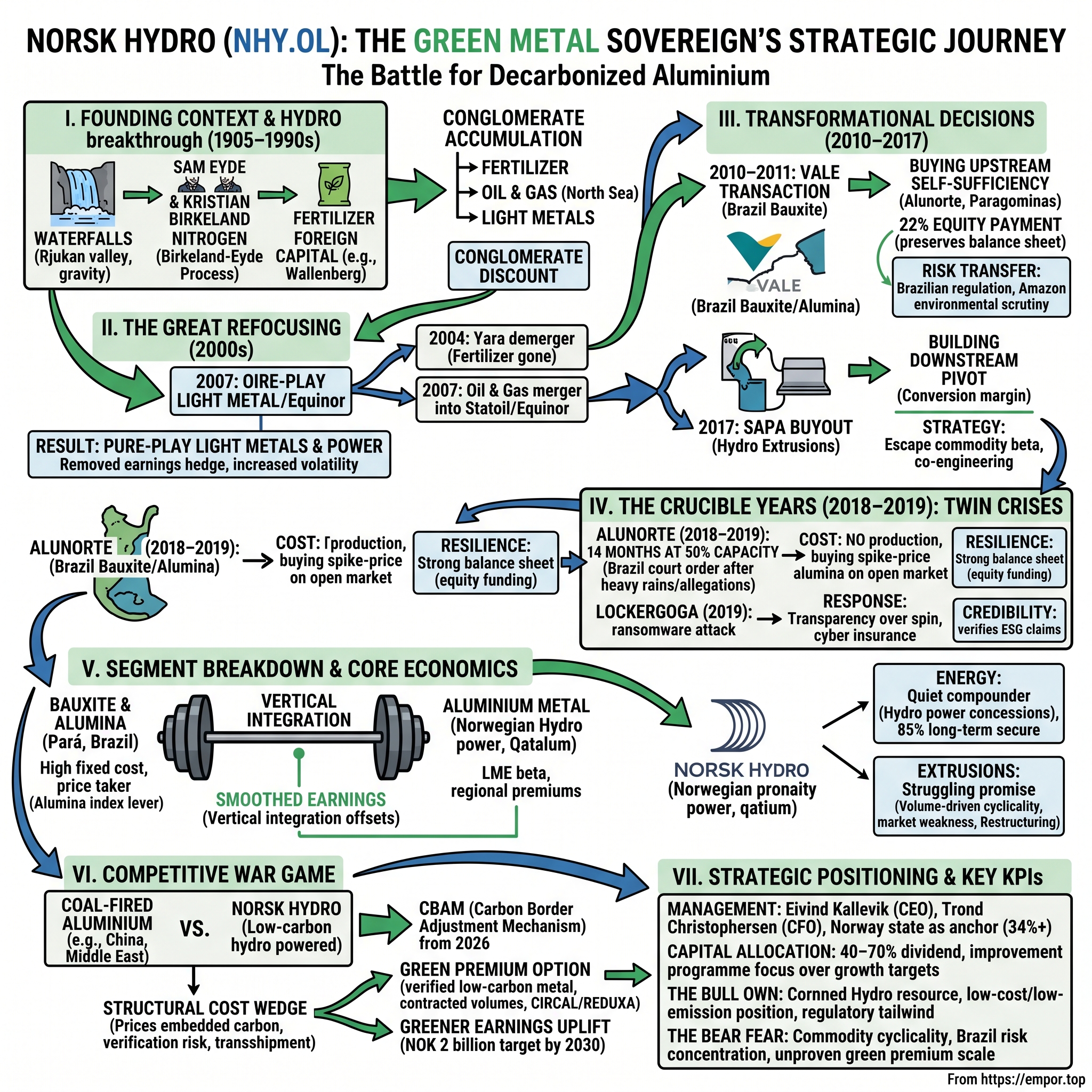
Norsk Hydro: The Green Metal Sovereign & The Battle for Decarbonized Aluminium
I. Introduction & Episode Roadmap (00:00 - 00:15)
On a grey Wednesday morning in late July 2026, a webcast studio in Oslo filled with the familiar cadence of a Norsk Hydro quarterly call. Eivind Kallevik, two years into the CEO job, opened the way he always opens: with safety statistics. Not with the metal price, not with the beat, not with the headline. With injury rates. Only then did he get to the number the market wanted — adjusted EBITDA of NOK 8.9 billion for the second quarter, up from NOK 7.8 billion a year earlier, with free cash flow of NOK 4 billion and adjusted earnings per share climbing roughly 31 percent year over year.12
It was, by any measure, a strong quarter. And yet the stock had spent the preceding three months going the other way. Shares in Norsk Hydro ASA traded around NOK 84.5 in late July 2026 against a fifty-two-week range spanning roughly NOK 61 to NOK 120, a market capitalization near NOK 166 billion, and a fifty-day average well above the current price.3 Aluminium on the London Metal Exchange had started the second quarter above USD 3,500 per tonne and finished it near USD 3,086.1 That single spread — a company executing well while its share price tracks a metal price it cannot control — is the entire Norsk Hydro investment question in one image.
Here is the central puzzle. How did a Norwegian nitrogen-fertilizer startup founded in 1905, powered by waterfalls in a mountain valley, execute two of the largest corporate separations in Nordic history, absorb a USD 4.9 billion South American mining acquisition, survive a fourteen-month environmental shutdown of the world's largest alumina refinery outside China, get hit by one of the most destructive corporate ransomware attacks ever recorded — and emerge as the Western world's designated champion of low-carbon aluminium?
And the harder question that follows: does any of that matter to the share price?
Hydro's strategic architecture is genuinely distinctive. It owns roughly 13.7 TWh of Norwegian hydroelectric generation, feeding smelters that emit around 4.0 kilograms of CO2 per kilogram of aluminium against a global average more than three times higher.4 It owns bauxite and alumina assets in Pará, Brazil, at world scale. It runs the largest aluminium extrusion business on earth. And since January 1, 2026, the European Union's Carbon Border Adjustment Mechanism has been in its definitive phase, meaning importers of aluminium into the EU must now buy and surrender certificates against the embedded carbon in the metal they bring in — not merely report it, as during the transitional period.56
On paper, this is a regulatory tailwind arriving precisely when a company has spent a decade positioning for it. The honest analytical question is whether it converts into durable earnings. Because the evidence of the last eighteen months is mixed in a way that matters: at the November 2025 Investor Day, management lowered the 2030 EBITDA ambition for Extrusions from NOK 10–12 billion to NOK 8–10 billion, trimmed the Recycling ambition's upper end, cut near-term capital allocation, and announced the closure of five European extrusion plants affecting 730 employees.78 The green-premium businesses — the ones that are supposed to escape commodity beta — are precisely the ones where targets came down. Meanwhile, the segment carrying the quarter was primary Aluminium Metal, riding the LME.
That tension is the spine of this story. Here is the route:
First, the hydroelectric founding in Telemark and the century of conglomerate accumulation that followed. Second, the great refocusing — spinning out Yara International in 2004 and folding oil and gas into Statoil in 2007. Third, the Vale transaction that bought Hydro upstream self-sufficiency and permanently attached its valuation to the Brazilian Amazon. Fourth, the crucible years: Alunorte and LockerGoga, back to back. Fifth, a segment-by-segment tour of where the profits actually live. Sixth, the competitive war game against coal-powered Chinese and Middle Eastern capacity. Seventh, management, capital allocation, and whether the numbers management sets get hit. Eighth, moats and risks. Ninth, the bull and bear cases and the handful of metrics worth tracking. And finally, what a 121-year-old industrial company teaches about reinvention.
It begins with a physicist, an entrepreneur, and a waterfall.
 Subscribe on LinkedIn
II. Founding Context & The Hydroelectric Breakthrough (1905–1990s) (00:15 - 00:35)
Picture the Rjukan valley in Telemark in the first years of the twentieth century: a gorge so deep and steep that the village at its floor sits in shadow for half the year, with the Rjukanfossen waterfall dropping more than a hundred metres of raw, unharnessed energy into it. To a farmer, it was scenery. To Sam Eyde, a Norwegian engineer-entrepreneur with an appetite for capital markets, it was a power station that had not been built yet.
Eyde's problem was that he had energy and no product. The physicist Kristian Birkeland had the opposite problem — a laboratory process and no way to scale it. Birkeland had been experimenting with electric arcs in magnetic fields, chasing the aurora borealis, when he and Eyde recognized that a sufficiently violent, sufficiently sustained electric arc could rip nitrogen out of the atmosphere and fix it into nitric acid, and from there into fertilizer. The world was at that moment facing a genuine Malthusian anxiety: natural nitrate deposits in Chile were finite, and without new nitrogen, global agriculture had a ceiling.
The Birkeland–Eyde process was the answer, and it was voracious in exactly the resource Norway had in obscene abundance. The company that became Norsk Hydro was, at its origin, a way to convert Norwegian gravity into food.
The Capital Behind the Waterfall
What made it real was money, and the money was not Norwegian. Eyde secured backing from Swedish and French financiers — the Wallenberg banking interests in Stockholm chief among them — to fund the construction of hydroelectric capacity and the industrial complexes at Rjukan and Notodden. The pattern established here recurs across Hydro's entire history: Norwegian natural endowment, foreign capital, state involvement arriving later to consolidate national control.
That last piece matters more than it sounds. Norway's early-twentieth-century concession laws were explicitly designed to prevent foreign owners from permanently alienating Norwegian waterfalls. The state built itself into the ownership structure of Norwegian heavy industry as a matter of doctrine, not accident. When you look today at a Norwegian government stake of 34.26 percent in Norsk Hydro, held through the Ministry of Trade, Industry and Fisheries, with the Folketrygdfondet holding a further block on behalf of the national pension scheme, you are looking at the residue of a century-old political decision about who gets to own Norway's rivers.[^9]
Metals, Then Oil, Then Everything
Hydro's expansion into aluminium followed the logic of the power, not the logic of the market. Aluminium smelting is, in the most literal sense, solidified electricity: the Hall-Héroult process runs an enormous current through alumina dissolved in molten cryolite, and electricity typically represents the single largest input cost in the entire operation. A country with stranded, cheap, renewable hydroelectric power and no domestic use for it has one obvious industrial application. Post-war Norwegian industrial policy pushed hard into primary aluminium at Årdal, Sunndal, Høyanger and elsewhere along the western fjords, and Hydro consolidated its position as Europe's leading primary producer through the absorption of the state smelting champion Årdal og Sunndal Verk in the 1980s.
Then came the North Sea. Norway's offshore oil and gas discoveries from the late 1960s onward turned a modest Nordic economy into one of the wealthiest per capita on earth, and Hydro — as an established national industrial champion — took licence positions alongside the purpose-built state company Statoil. By the 1990s Hydro was producing hundreds of thousands of barrels a day.
The Conglomerate Problem
And so by the end of the 1990s, Norsk Hydro was three companies wearing one ticker: a global fertilizer business, a North Sea petroleum producer, and a light metals group. Each had entirely different capital intensity, entirely different cycle timing, entirely different competitors, and entirely different investor bases. An energy analyst covering Hydro had to have a view on urea prices. A materials analyst had to have a view on the Troll field.
The market did what markets do with that structure: it applied a discount. Investors could buy pure-play exposure to each of Hydro's three businesses elsewhere, more cheaply and more cleanly. The internal capital allocation was worse than the external optics — three divisions competing for the same krone, with the winner determined partly by cycle timing and partly by internal politics.
The lesson embedded here is one that recurs across the entire narrative: Hydro's structural advantages have always been real, and its ability to convert them into shareholder returns has always depended on whether the corporate structure was clean enough for the market to see them. That realization drove the most consequential decade in the company's history.
III. The Great Refocusing: Two Divorces & The Vale Transformation (2000–2015) (00:35 - 01:05)
There is a particular kind of corporate courage involved in giving away the profitable part of your company. Between 2004 and 2011, Norsk Hydro did it twice, then spent USD 4.9 billion buying into a jurisdiction that would later cost it fourteen months of production.
Divorce One: Yara Goes Its Own Way (2004)
The fertilizer business was Hydro's founding business — the Birkeland-Eyde legacy, the reason the company existed. It was also, by the early 2000s, a global nitrogen player operating in a market with completely different economics from metals: driven by gas prices, agricultural cycles, and emerging-market food demand rather than by construction and automotive.
Hydro demerged it in 2004 and listed it on the Oslo Stock Exchange as Yara International. The strategic reading is straightforward: management concluded that the founding business and the growth business had nothing to teach each other, and that shareholders were better served owning each independently. It worked. Yara became one of the world's leading nitrogen companies as a standalone entity. More importantly for what followed, it proved to Hydro's board that structural surgery was survivable — that you could cut off a limb the company had carried for a century and the patient would walk.
Divorce Two: Handing Over the Oil (2007)
The second separation was larger and considerably harder to justify to anyone focused on near-term earnings. In 2007, Hydro merged its entire petroleum and energy division with Statoil, the Norwegian state oil champion that would later rename itself Equinor. Hydro shareholders received Statoil shares; Hydro itself kept the aluminium and the hydropower.
Read that decision through the lens of 2007. Oil prices were on their way toward USD 140 a barrel. The North Sea was still generating enormous cash. Hydro's oil division was, in cash-flow terms, the safety net underneath a cyclical metals business — the thing that paid the dividend when the LME collapsed. Management deliberately cut the net away.
The stated logic was that Hydro's petroleum business lacked the scale to compete globally against supermajors, and that a combined Norwegian national champion would be a stronger operator on the Norwegian continental shelf. The unstated logic was that Hydro's management wanted to run an aluminium company. What emerged was a pure-play light metals and renewable power business with no fossil-fuel earnings cushion whatsoever.
Investors should hold both readings simultaneously. It was strategically clarifying and it removed a genuine hedge. Every subsequent Hydro downturn has been experienced without the buffer that division would have provided. The company chose focus over diversification, and focus has a cost that shows up in the volatility of the earnings stream, quarter after quarter, to this day.
The Vale Transaction: Buying the Whole Value Chain
Which brings us to the most consequential capital allocation decision in modern Hydro history.
An aluminium smelter without secure alumina supply is a hostage. Alumina — refined aluminium oxide — is the smelter's feedstock, and it is produced by refining bauxite ore through the Bayer process. If you own smelters but buy alumina on the open market, you eat the alumina price as a cost, and the alumina market is thin, opaque, and prone to violent spikes. Hydro, with a large European smelter fleet, was structurally short.
Vale, the Brazilian mining giant, owned the answer: a portfolio of world-class bauxite and alumina assets in the state of Pará, in the eastern Amazon. Vale wanted to concentrate on iron ore. Hydro wanted upstream security. The deal announced in 2010 and completed in early 2011 transferred to Hydro the Paragominas bauxite mine, 91 percent of the Alunorte alumina refinery — the largest alumina refinery in the world outside China — 51 percent of the Albras aluminium smelter, and 81 percent of the CAP refinery project.910
The structure of the payment is the part worth studying. Hydro did not write a cheque for USD 4.9 billion. It paid roughly USD 503 million in cash, assumed net debt of about USD 655 million, and issued 22 percent of its own common shares to Vale — with total consideration valued near USD 4.9 billion as of April 2011.1011 In other words, Hydro paid for the majority of the deal in its own equity, making Vale its largest single shareholder overnight and preserving the balance sheet.
Was It a Good Deal?
Fifteen years on, the assessment has to be split.
On integration: it worked exactly as designed. Hydro moved from being structurally short alumina to being structurally long, with bauxite reserves at Paragominas measured in decades and a pipeline running roughly 244 kilometres from the mine to the refinery — a slurry pipeline being a genuinely elegant piece of infrastructure, essentially pumping wet ore across the rainforest rather than trucking it. Alunorte's output feeds Hydro's own smelters in Norway, Brazil and the Middle East, and the surplus gets sold into the market. When alumina prices spike, Hydro captures the spike as a producer instead of absorbing it as a buyer. That is a structural improvement in earnings quality that persists to this day.
On risk: it was expensive in ways that were not on the term sheet. Hydro imported into its risk register a set of exposures it had never previously carried — Brazilian environmental regulators, Brazilian federal and state courts, Amazonian community relations, indigenous land questions, and the reputational surface area of operating heavy industry in the world's most scrutinized rainforest. Within seven years, that bill came due in spectacular fashion.
On dilution: issuing a fifth of the company is not free. Every share of Hydro EBITDA since 2011 has been divided among a materially larger share count. The counterfactual — Hydro as a cash-paying buyer with a leveraged balance sheet going into the 2018 Alunorte crisis — is not obviously better, which is probably the strongest defence of the structure.
The pattern that emerges across all three of these moves is a management team willing to make irreversible structural decisions rather than incremental ones. That is genuinely rare in heavy industry, where the default is to defer. It is also, as the next chapter shows, no protection at all against events.
IV. The Crucible: Twin Crises & Downstream Pivot (2016–2019) (01:05 - 01:30)
In February 2018, an extraordinary volume of rain fell on Barcarena, in Pará. Local residents reported contaminated water. Allegations circulated that Alunorte's bauxite residue deposits had overflowed and released untreated effluent into surrounding waterways. What happened next was, for Norsk Hydro, the most expensive fourteen months in its modern history — and it began, appropriately, with the company having just made its biggest downstream bet.
The Sapa Buyout: Building the Other Half of the Business
Rewind slightly. Hydro had for years run its extrusion business as a fifty-fifty joint venture with the Norwegian conglomerate Orkla, under the Sapa name. Extrusion is the process of pushing heated aluminium billet through a shaped die — think of an industrial-scale pasta machine — to produce profiles: window frames, curtain-wall systems, heat sinks, automotive crash structures, battery enclosures. It is the part of the aluminium chain that touches actual customers and actual engineering problems, rather than selling an undifferentiated ingot into a global price.
In July 2017, Hydro agreed to buy out Orkla's half. The transaction valued Sapa at an enterprise value of NOK 27 billion, with Hydro paying roughly NOK 11.86 billion in cash for the equity after adjusting for net debt and normalized working capital, and it completed on October 2, 2017.1213 Overnight Hydro absorbed around 22,400 employees across some 40 countries and created what became Hydro Extrusions, the largest extrusion business in the world.13
The strategic logic was to move earnings away from the LME. A primary smelter's profit is essentially the metal price minus its cost stack; it has no pricing power. An extrusion business charges a conversion margin — a spread in euros or dollars per tonne over the cost of the metal itself — and that spread is set by engineering value, service, proximity, and switching costs rather than by a screen in London. Buying Sapa was Hydro's attempt to purchase earnings stability.
Whether it delivered stability is a question we will return to with some force, because the answer as of 2026 is: less than promised.
Alunorte: Fourteen Months at Half Capacity
Then Pará. In the aftermath of the February 2018 rains and the contamination allegations, Brazilian authorities acted with speed and severity. A Pará state court ordered Alunorte to cut production by 50 percent, and environmental authorities embargoed the use of one of the refinery's bauxite residue deposits.14 Hydro subsequently imposed further curtailment itself.
Consider what a 50 percent curtailment means at the world's largest alumina refinery outside China. Alunorte is a plant with roughly 6.3 million tonnes of nameplate capacity and an enormous fixed cost base — you cannot halve a refinery's costs by halving its output. Simultaneously, Hydro's own smelters still needed alumina, which now had to be purchased on the open market. And because Alunorte's absence removed a meaningful chunk of global supply, the market price of that alumina went sharply higher. Hydro was, in effect, forced to buy back at a spike price the product it was being prevented from making.
The resolution came in stages, and slowly. In September 2018, Alunorte, Norsk Hydro do Brasil and Brazilian federal and state prosecutors signed a Term of Adjusted Conduct — a negotiated compliance agreement committing the company to investment and monitoring obligations. The environmental agency IBAMA lifted its embargo on the new residue deposit area in October 2018.14[^16] The production embargo itself was not lifted by the federal court until May 2019, and the final embargo on the DRS2 deposit area came off in September 2019, roughly nineteen months after the crisis began.14
What should an investor take from this episode? Two things, and they point in opposite directions.
The uncomfortable one: Hydro's technical investigations and subsequent third-party reviews did not substantiate the most severe contamination allegations, and yet the company still lost more than a year of production at its most important upstream asset. That is the definition of non-technical risk. In a jurisdiction with active prosecutors, engaged civil society, and courts willing to act on precautionary grounds, being right on the engineering is not sufficient. This risk did not disappear in 2019; it is a permanent feature of owning heavy industry in the Amazon, and it remains live on Hydro's risk register today.
The more encouraging one: the company survived it with the balance sheet intact — partly because the Vale deal had been paid for in equity rather than debt. Structural conservatism in 2011 bought resilience in 2018. That is not luck; that is what a strong balance sheet is for.
LockerGoga: The Attack That Became a Case Study
Hydro had barely returned to normal operations when, in the small hours of March 19, 2019, its IT systems began encrypting themselves.
The malware was LockerGoga, and it moved through Hydro's global network with brutal efficiency, locking systems across operations in dozens of countries. Casthouses lost automated control. Extrusion plants lost order management. Employees — tens of thousands of them — reverted to paper. Old-timers who remembered pre-digital procedures were, briefly, the most valuable people in the company. In some plants, staff dug out laminated instruction sheets from the 1980s.
Management's response has since been taught in business schools and cited by law enforcement as a template. Hydro refused to pay the ransom. And rather than issuing minimal disclosures, the company went to the opposite extreme: daily webcasts, open press briefings, candid admissions of what was still broken and what was not yet understood. The chief financial officer at the time fronted much of it personally.
The financial damage was real — the company indicated the attack could cost up to around USD 75 million across the first half of 2019, with the bulk landing in the first quarter.15 Europol later announced arrests connected to the attack in October 2021.16
The strategic insight is more interesting than the number. Hydro had cyber insurance and recovered a meaningful portion of the loss, but the durable asset it created was credibility. A company that tells you the truth in detail when things are on fire earns the benefit of the doubt when it tells you things are fine. For a business whose entire equity story rests on verified environmental claims — on customers believing that a tonne of Hydro REDUXA really does carry 4.0 kilograms of CO2 per kilogram — a demonstrated institutional bias toward disclosure over spin is not a soft asset. It is the foundation of the product.
Two crises in eighteen months, one geological and political, one digital. Both stress-tested the company that emerged from the great refocusing. What emerged on the other side was a five-segment industrial group whose profit pools are far less evenly distributed than the org chart suggests.
V. Segment Breakdown & Core Economics: Where the Profits Live (01:30 - 02:00)
If you want to understand Norsk Hydro as an investment rather than as a story, you have to internalize one fact: the segments do not contribute proportionally, and which one carries the quarter flips violently depending on where two prices sit.
Compare two consecutive quarters. In the first quarter of 2026, Bauxite & Alumina generated adjusted EBITDA of NOK 747 million against NOK 5,135 million in the same quarter a year earlier — a collapse of roughly 85 percent. In the same quarter, Aluminium Metal generated NOK 5,034 million against NOK 2,546 million, roughly doubling.17 By the second quarter of 2026, Bauxite & Alumina had fallen further to NOK 522 million while Aluminium Metal delivered NOK 6,421 million.1
Same company. Same assets. Same management. Total group adjusted EBITDA barely moved — NOK 8,668 million in Q1, NOK 8,923 million in Q2.171 The internal composition changed almost beyond recognition.
This is vertical integration doing exactly what it is supposed to do. When alumina is expensive, the refinery makes money and the smelter suffers. When alumina is cheap, the smelter's input cost falls and its margin expands. Owning both means the group captures the aggregate rather than being whipsawed by the split. It is a genuine structural advantage — and it is also why headline group EBITDA is a poor guide to what is actually happening underneath.
Bauxite & Alumina: The Fixed-Cost Barbell
Paragominas mines bauxite. The slurry pipeline carries it to Alunorte. Alunorte refines it into alumina using caustic soda, energy, and the Bayer process. The economics are those of a high-fixed-cost, price-taking industrial asset: earnings are levered almost entirely to the Platts alumina index and to volume, with cash cost discipline as the only real lever management controls.
Through 2026 that lever has been running against the tide. Management characterized the global alumina market on the Q2 2026 call as carrying an oversupply of roughly 1.6 million tonnes for the year, with prices averaging around USD 308 per tonne, and noted that Chinese refineries were benefiting from low raw material costs.2 The index traded between roughly USD 297 and USD 330 per tonne across the first half.171
The segment's structural improvement project has been fuel switching — moving Alunorte's boilers from heavy fuel oil to natural gas and electrification, which lowers both cost and Scope 1 emissions simultaneously. Management has targeted a 70 percent emission reduction at Alunorte by 2030.18 It is a rare capital project where the decarbonization case and the cost case point the same direction, which is precisely why it has survived successive rounds of capex trimming.
Aluminium Metal: Solidified Electricity
The mental model for a smelter is simple. Revenue is the LME price plus a regional premium — the extra amount a buyer in Europe or the US Midwest pays for physical delivery in their region. Costs are alumina, power, carbon anodes, and labour. The margin is what is left. Hydro's smelter fleet spans Norway (Sunndal, Årdal, Karmøy, Høyanger, Husnes), the Qatalum joint venture in Qatar, and Albras in Brazil.
Two things made 2026 unusually good for this segment. First, LME prices spent much of the period above USD 3,000 per tonne, peaking above USD 3,500 in the second quarter.1 Second, alumina — the largest variable input — was cheap. That combination is close to the ideal state for a smelter, and it is why Aluminium Metal produced NOK 6.4 billion of EBITDA in a single quarter against NOK 2.4 billion a year earlier.1
Two things complicated it. The US imposed Section 232 tariffs on aluminium imports at 25 percent from March 2025, rising to 50 percent from June 2025, which drove the US Midwest premium from roughly 20 cents per pound to near a dollar.19 Regional premiums are now substantially a function of trade policy rather than logistics. And the Qatalum joint venture ran at approximately 60 percent capacity through mid-2026 as shipping constraints through the Strait of Hormuz limited raw material inflow and product outflow; on the Q2 call, management held that reduced level as its base case and acknowledged that on-site storage was "getting fuller day by day."2 That is a candid answer to an awkward question, and it is worth noting as a governance data point.
The moat claim for this segment is the carbon cost curve. Norwegian smelters running on hydroelectric power sit in the lowest quartile globally for CO2 intensity, which under a carbon-pricing regime translates into a cost advantage rather than merely a marketing one. That claim is only as good as the carbon price and the enforcement — a point we return to.
Extrusions: The Promise That Has Not Yet Paid
This is where the analytical honesty has to be sharpest, because Extrusions is the segment that was supposed to make Hydro less cyclical, and the evidence of the last two years is that it has struggled.
The business converts billet into engineered profiles across a network of plants serving construction, automotive, and industrial customers. Its earnings driver is the conversion spread per tonne multiplied by volume. In principle the spread is defensible because customers co-engineer parts with Hydro over multi-year programmes; in practice, volume has been the problem. European construction has been weak. European automotive build rates, particularly for electric vehicles, disappointed against the projections that underpinned the segment's growth plan.
The numbers show a business grinding rather than compounding. Extrusions delivered NOK 1,299 million of adjusted EBITDA in Q1 2026 and NOK 1,463 million in Q2 2026, against NOK 1,174 million and NOK 1,260 million in the corresponding quarters of 2025 — improvement, but from a low base, and in Q4 2025 the segment recorded negative NOK 62 million.17120 European extrusion market demand grew just 0.4 percent year over year in Q2 2026, with North America flat.1
Management's response was decisive and expensive. In November 2025 Hydro announced the closure of five European extrusion plants — Cheltenham and Bedwas in the UK, Lüdenscheid in Germany, Feltre in Italy, and Drunen in the Netherlands — affecting 730 employees, at an estimated restructuring cost of NOK 1.9 billion including NOK 460 million of impairments and NOK 1.25 billion of provisions booked in Q4 2025, against expected run-rate improvements above NOK 0.5 billion per year.721 That is why the fourth quarter of 2025 showed a reported net loss of NOK 2,156 million despite adjusted net income of NOK 1,673 million.20 Extrusion Europe emerged with 28 plants, five recycling centres, and roughly 7,000 employees.7
The conclusion an investor should draw: Extrusions is not the counter-cyclical ballast it was purchased to be. It is a fixed-cost network business with real operating leverage in both directions, and its earnings depend on European construction and automotive volumes to a degree the original acquisition thesis understated. Management is now managing it accordingly — shrinking the footprint to fit the demand rather than waiting for demand to grow into the footprint. That is the correct response. It is also an admission.
Energy: The Quiet Compounder
Roughly 40 hydroelectric plants across Norway generating in the region of 13.7 TWh in a normal year, with near-zero marginal cost.4 The segment is a natural hedge: when European power prices spike, Hydro's smelters pay more but Hydro's generators earn more.
The catch is hydrology. Energy EBITDA fell to NOK 787 million in Q1 2026 and NOK 499 million in Q2 2026, from NOK 1,180 million and NOK 1,069 million a year earlier, with management attributing the decline substantially to lower production driven by water availability.171 Rainfall is not a business risk one can hedge away.
The forward-looking work here has been contract security rather than capacity growth. Across 2025 and 2026 Hydro signed a series of long-term renewable sourcing agreements — including a ten-year deal with Eviny for 0.5 TWh annually from 2031 to 2040 — such that by mid-2026 the company reported securing roughly 85 percent of its Norwegian smelter power requirement for the 2030s, and had contracted 14 TWh of long-term renewable power in the first quarter alone.117 It also committed NOK 1.2 billion to the Illvatn pumped storage project, adding 48 MW of capacity and 107 GWh of annual generation.208
Locking in power for the 2030s at a moment of European energy uncertainty is arguably the single most important de-risking Hydro has done recently, and it receives a fraction of the attention that green-metal branding gets.
Metal Markets and Recycling: The Strategic Bet
Recycling aluminium requires roughly 5 percent of the energy needed to make it from ore. That is the entire thesis in one sentence. Hydro CIRCAL contains at least 75 percent post-consumer scrap and carries a footprint of around 1.9 kilograms of CO2 equivalent per kilogram, versus 4.0 for the hydro-powered primary product REDUXA.4
Hydro accelerated here through acquisition, buying the Polish recycler Alumetal in 2023 via a tender offer that was raised to PLN 82.00 per share, implying aggregate equity consideration of roughly PLN 1,265 million and an enterprise value near PLN 1,651 million including dividend payable; the company held over 97 percent of the shares by the end of June 2023 and completed in July.[^24][^25] The European Commission cleared the deal unconditionally in May 2023.22
The operating results have been erratic. Recycling delivered NOK 160 million of adjusted EBITDA in Q1 2026 — described by the company as its strongest quarterly result since mid-2023.17 Read that carefully: the best quarter in nearly three years was NOK 160 million, in a group generating close to NOK 9 billion a quarter. Improvement continued into Q2 on strong US margins.21 But this is a business in the foothills of the ambition set for it.
Which is the honest summary of the whole segment tour: two upstream businesses generate almost all the cash and swap the crown depending on the alumina price; hydropower quietly underwrites the cost position; and the two segments meant to deliver the green-premium future are, so far, small and difficult. That gap between where the profits are and where the story is defines the competitive fight.
VI. Competition & Industry Structure: The Battle Against Coal-Fired Aluminium (02:00 - 02:20)
Here is the war game, stated plainly. Global primary aluminium production runs at roughly 70 million tonnes a year. China accounts for well over half of it. And a large share of Chinese capacity has historically been powered by captive coal-fired generation in provinces such as Shandong and Xinjiang — which means that the marginal tonne of aluminium in the world is made with coal.
Hydro's entire strategic position is a bet that this fact will eventually be priced.
The Peer Landscape
Set the players out. 中国宏桥 China Hongqiao Group is the largest single producer on earth at roughly six million tonnes of annual primary output, historically coal-intensive with an estimated carbon intensity in the low-to-mid teens of kilograms of CO2 per kilogram of aluminium. 中国铝业 CHALCO, the state-controlled champion, operates at comparable scale with a mixed coal-and-hydro power base. ОК РУСАЛ Rusal in Russia runs on Siberian hydroelectric power and consequently has a genuinely low carbon intensity — but carries sanctions risk and geopolitical exclusion from much of the Western market. Alcoa Corporation and Rio Tinto both operate mixed portfolios spanning hydro, gas and coal, at roughly two to three million tonnes each. Emirates Global Aluminium runs on Gulf natural gas at intermediate intensity and meaningful scale.
Hydro's own primary output sits at roughly two million tonnes annually. Note the implication: Hydro is not large in global terms. Hongqiao alone produces around three times as much. Hydro cannot win this fight on scale, and it has never tried to. Its position rests on being the largest producer of the specific kind of aluminium that European regulation is designed to favour.
How CBAM Actually Works
The Carbon Border Adjustment Mechanism is best understood as an attempt to close a loophole in the EU's own emissions trading system. European industry pays for carbon under the EU ETS. Non-European industry does not. Absent an adjustment, the rational response is to move production outside Europe and import — carbon leakage, in the jargon, where the emissions do not fall, they simply relocate along with the jobs.
CBAM puts a charge on the embedded carbon in imported goods, indexed to the EU ETS price. From January 1, 2026, the mechanism entered its definitive phase: importers above a 50-tonne annual threshold must be authorised declarants and must purchase and surrender certificates covering the embedded emissions in their imports of aluminium, steel, cement, fertilizer, hydrogen and electricity, with the first annual declaration for the 2026 period due by September 30, 2027.56
The arithmetic is simple and, for Hydro, favourable. If a Chinese tonne carries roughly 13 to 16 kilograms of CO2 per kilogram of aluminium and a Hydro Norwegian tonne carries roughly 4, then every euro on the carbon price widens the landed-cost gap by the difference — around nine to twelve kilograms of CO2 per kilogram, or nine to twelve tonnes of CO2 per tonne of metal. At any meaningful ETS price, that is not a rounding error. It is a structural cost wedge.
Where the Bull Case Gets Tested
Now the skepticism, because this is where a careful investor has to push.
First: the mechanism has been live for barely seven months as of this writing, and the first real compliance cycle does not conclude until late 2027. There is no meaningful body of evidence yet on enforcement quality, on how embedded emissions from complex supply chains get verified, or on how aggressively the calculation methodologies will be policed. A carbon border tax is only as strong as its weakest verification step.
Second: transshipment. Metal can be re-melted, alloyed, extruded, or otherwise transformed in a third country before entering Europe. The scope of CBAM has been an active policy question precisely because downstream products were initially outside it. If high-carbon primary metal can be converted into a semi-finished product in a third country and imported outside the mechanism's scope, the wedge leaks.
Third — and this is the point that matters most for the equity — a cost advantage is not the same as a realized premium. Hydro sells REDUXA and CIRCAL at premiums, and it has real customer commitments: a long-term wire rod offtake with the European cable producer NKT covering 274,000 tonnes of REDUXA, a five-year contract with Nexans for 85,000 tonnes of low-carbon wire rod through 2030, and ongoing collaborations with automotive customers including Porsche and Mercedes-Benz.412 Those are genuine, contracted, multi-year volumes with named counterparties, and they are the strongest available evidence that the green premium is a market and not a slide.
But scale it. Hydro planned CIRCAL sales of around 60,000 tonnes and REDUXA sales of around 425,000 tonnes for 2024.18 Against roughly two million tonnes of primary output plus recycled volumes, the low-carbon branded book is a minority of what Hydro sells. Most Hydro metal is still sold as metal. And management's own target for the total additional earnings from greener products — the "greener earnings uplift" — is NOK 2 billion by 2030.188 That is a real number and a meaningful one. It is also, against group EBITDA that reached NOK 28.9 billion in 2025, roughly seven percent.23
So the correct framing is not "CBAM transforms Hydro's economics." It is: CBAM plus green branding is worth a mid-single-digit percentage uplift to group earnings on management's own numbers, arriving gradually, while the other ninety-plus percent of the business remains a leveraged bet on the LME, the alumina index, Norwegian rainfall, and European construction. Anyone underwriting Hydro primarily on decarbonization is underwriting the smaller half of the company.
Which makes the question of who is allocating the capital, and how well they have kept their word, unusually important.
VII. Current Strategy, Management & Capital Allocation (02:20 - 02:45)
When Norsk Hydro announced in March 2024 that Eivind Kallevik would become president and chief executive, succeeding Hilde Merete Aasheim, the appointment surprised almost nobody who followed the company.[^28]24 Kallevik had spent roughly a quarter century inside Hydro. He was chief financial officer from 2013 to 2019 — meaning he was in the CFO seat for both the Alunorte curtailment and the LockerGoga attack, and was one of the public faces of the radical-transparency response. He then ran Aluminium Metal, the group's largest earnings engine, from 2019 until taking the top job in May 2024.
That is an unusual profile: a finance executive who then went and ran the metal. He knows the cost stack of a potline and he knows what a covenant does. His public register is notably unpromotional — he opens quarterly calls with safety statistics before financials, uses conservative framing, and has been willing to describe European market conditions in blunt terms. On announcing the extrusion closures he characterized the European reality as requiring "decisive action."7
The chief financial officer is Trond Olaf Christophersen, previously in corporate development, whose public posture has been similarly measured. Asked about cost inflation on the Q2 2026 call, his answer was that the company did "not see any significant cost inflation overall," with offsetting pluses and minuses across the portfolio — a specific, checkable answer rather than a hedge.2
The Norwegian State as Anchor Shareholder
The Norwegian state, through the Ministry of Trade, Industry and Fisheries, held 34.26 percent of Norsk Hydro as of early 2025, with the Folketrygdfondet holding a further block on behalf of the national pension scheme.[^9]
The benefits are real: an effectively permanent, non-activist anchor holder; immunity from hostile takeover; a long time horizon; and political alignment with the decarbonization agenda that underpins the strategy. The costs are equally real and less discussed. A state holding above one-third confers a blocking position on major corporate decisions. Employment and regional-industrial considerations sit closer to the boardroom than they would in a purely private company — relevant context when reading a decision to close five plants across four countries, or to keep Norwegian capacity running through a downturn. And a skeptical investor would note that the state shareholder has never been tested by a scenario in which the value-maximizing action and the Norwegian industrial-policy action clearly diverge.
Capital Allocation: The Framework and the Record
Hydro's stated framework is straightforward: a dividend policy targeting 40 to 70 percent of adjusted net income over the cycle, supplemented by buybacks, within a defined capital structure.
The record against it has been consistent. For 2025, the board proposed a total shareholder distribution of NOK 5.9 billion, representing 60 percent of adjusted net income, with a dividend of NOK 3.0 per share.2320 Shareholders approved it at the annual general meeting on May 7, 2026, with the shares trading ex-dividend from May 8.25 Sixty percent sits squarely in the middle of the stated band — neither stretching to please the market in a strong year nor retreating in a weak one. Full-year 2025 capital expenditure came in at NOK 12.1 billion.20
Returns have cleared the hurdle, narrowly. Adjusted return on average capital employed was 10.2 percent for 2025 against a stated minimum target of 10 percent, and the rolling twelve-month figure was 10.1 percent at the end of Q1 2026 and 10.9 percent at the end of Q2.23171 The five-year average, which spans the extraordinary 2021-22 energy-crisis years, was 13.5 percent as presented at the 2025 Investor Day.8 The distinction matters: the five-year number reflects a commodity boom, while the current number reflects a normal-to-good market. A ten percent return on capital in a strong aluminium price environment is adequate rather than impressive, and it is the single most important sanity check on the entire green-premium narrative.
The Target Reset: What Investor Day 2025 Actually Said
This is where management credibility gets assessed properly, by comparing what was promised against what was subsequently delivered or withdrawn.
At the Capital Markets Day in November 2024, Hydro laid out a 2030 architecture: adjusted EBITDA of NOK 10–12 billion from Extrusions, NOK 5–8 billion from Recycling, a NOK 6.5 billion improvement programme, annual capex guidance of NOK 15 billion in 2024 real terms with optional flexibility of NOK 1–2 billion for accelerated growth, a maintained 10 percent RoaCE floor, and a NOK 2 billion greener earnings uplift.18 The Extrusions target explicitly assumed demand growth of roughly 30 percent in North America and 20 percent in Europe.18
Twelve months later, at the Investor Day on November 27, 2025, several of those numbers came down. The Extrusions 2030 EBITDA target was cut to NOK 8–10 billion, attributed to delayed market recovery and reduced near-term capital allocation. The Recycling range was narrowed to NOK 5–6 billion — the floor confirmed, the NOK 8 billion ceiling removed. Capital allocation for 2025 and 2026 was reduced to NOK 13.5 billion from NOK 15 billion, and the NOK 1–2 billion flexibility was withdrawn entirely.78 Alongside, the company disclosed a strategic workforce programme eliminating approximately 750 white-collar positions with expected net run-rate savings of about NOK 1 billion from 2026.8
How should that be read?
The bearish reading is direct: the growth targets underpinning the "escape from commodity beta" thesis were revised down within a single year of being set, because the demand assumptions did not materialize. A management team that told the market in November 2024 that European extrusion demand would grow 20 percent by 2030 was, in November 2025, closing five European extrusion plants. Investors should discount 2030 targets accordingly — not because management is dishonest, but because the underlying macro forecasts are unreliable, and no amount of operational excellence substitutes for volumes that never arrive.
The more balanced reading notes three things. First, the cuts were announced clearly and attributed to specific causes rather than buried. Second, the improvement programme — the part genuinely within management's control — has over-delivered: NOK 1.2 billion in 2025 against a NOK 600 million annual target, and NOK 1.4 billion cumulatively since late 2024.823 Third, and most importantly, management responded to weak demand by cutting capacity, cutting capex, and cutting headcount rather than by chasing low-margin volume or maintaining a footprint on hope. The Q2 2026 call reinforced this posture: on the Slovalco restart, the incremental 75,000 tonnes required roughly NOK 400 million and was explicitly kept within existing full-year guidance, with the remaining 100,000 tonnes deferred pending further refurbishment assessment.2
The pattern across both readings is the same: Hydro's management controls costs well and forecasts demand badly. That is a reasonable profile for a cyclical industrial company, and it argues for weighting the improvement programme and the balance sheet more heavily than the 2030 EBITDA slides.
The Portfolio Moves
Two further capital allocation decisions deserve note. The Hydro Rein renewable development arm was partly sold rather than fully funded: Macquarie Asset Management acquired 49.9 percent for USD 332 million, announced in October 2023 and completed in June 2024, leaving Hydro with 50.1 percent of a business carrying roughly 8.4 GW of gross development capacity and long-term power purchase agreements totalling around 5.3 TWh annually.[^31]2627 The logic is capital-light growth — a renewable development pipeline is capital-hungry and returns-dilutive if funded entirely on balance sheet, and bringing in an infrastructure partner scales it without impairing group returns. It is also, read less charitably, an admission that Hydro did not want to carry that capex.
And on technology, the HalZero programme continued through 2026. HalZero converts alumina to aluminium chloride prior to electrolysis, keeping chlorine and carbon in a closed loop so the process emits oxygen rather than CO2 — eliminating process emissions from both electrolysis and anode baking, in principle.28 Under development since 2016 and supported by a NOK 141 million grant from the Norwegian state enterprise Enova, the test facility at Porsgrunn was commissioned during the first quarter of 2026, with pilot production of zero-carbon primary aluminium targeted for 2030.172928 The realistic assessment: this is genuine, credible, long-dated R&D with no earnings contribution this decade, and it should be valued as optionality, not as a plan.
That distinction — between what is contracted and what is aspirational — runs through every part of the moat analysis.
VIII. Playbook, Moats & Risk Radar (02:45 - 03:05)
Strip away the branding and ask the Helmer question directly: what would a competitor have to do to take Hydro's profits, and why can't they?
Cornered Resource — the strongest of the powers, and the only unambiguous one
Hydro's Norwegian hydroelectric concessions and its Pará bauxite position are not replicable. Norway is not issuing new large-scale hydroelectric concessions on Rjukan-era terms; the rivers are allocated. The Paragominas resource base is measured in decades of supply, connected to Alunorte by dedicated infrastructure. A competitor with unlimited capital cannot buy an equivalent set of Norwegian waterfalls, because they are not for sale.
This is the real moat, and it predates every strategy document. Note what it actually protects: a cost position and a carbon position, not a price. It makes Hydro a low-cost, low-emission producer. It does not let Hydro set the price of aluminium.
Process Power — real but narrow
Hydro's proprietary cell technology, including the HAL4e line at Karmøy, delivers genuinely leading energy efficiency per kilogram of primary aluminium. That is decades of accumulated metallurgical knowledge that a new entrant cannot buy off the shelf. But the honest boundary is that efficiency advantages in Hall-Héroult smelting are incremental — a few percent of a cost stack — and diffuse over time as competitors improve. HalZero could be a step change, but it is a decade away from commercial scale at best.
Scale Economies and Switching Costs — contested
The Extrusions thesis rests here: co-engineered structural components designed jointly with automotive OEMs over multi-year development programmes, where requalifying a supplier means retooling, re-testing and re-certifying. That switching friction is real for specific high-engineering parts — battery enclosures, crash structures.
But the 2025 evidence tests the strength of it. If switching costs were powerful across the segment, weak demand would compress volume while protecting margin. What actually happened was that Hydro had to close five plants to defend profitability.7 That suggests a large portion of the extrusion book is more commoditized than the co-engineering narrative implies — standard profiles for building systems, where the customer's switching cost is a phone call. The switching-cost power is genuine at the top of the product mix and thin across the middle of it.
Porter's Five Forces, quickly
Supplier power is now largely internalized upstream, which was the whole point of the Vale transaction — though caustic soda and carbon anodes remain external and can move sharply. Buyer power is high for standard ingot, where the buyer's alternative is the LME screen, and materially lower for verified low-carbon and engineered products, where fewer suppliers can meet the specification. Threat of substitutes is low: high-strength steel and composites compete at the margin, but aluminium's strength-to-weight ratio remains structurally advantaged in electrified transport, where every kilogram saved is range gained. Barriers to entry are extreme in capital terms and effectively absolute in resource terms. Rivalry is where it hurts — intense and price-driven in primary metal against subsidized, coal-powered Chinese capacity operating at three times Hydro's scale, and considerably gentler within the regional low-carbon niche where the qualified supplier set is short.
The Risk Radar
Brazil, permanently. The Alunorte episode demonstrated that Hydro can lose more than a year of production at its most important upstream asset on the basis of allegations it does not accept. Community relations, indigenous land questions, and prosecutorial activism in Pará remain live. Hydro's own disclosures around Brazilian operations reflect an extensive ongoing monitoring and engagement programme.30 This is the single largest tail risk in the company, and it is not diversifiable within the portfolio.
Power price and contract renewal. Norwegian smelters need enormous, cheap, long-dated electricity. The mitigation has been aggressive contracting — approximately 85 percent of the 2030s Norwegian requirement secured by mid-2026.1 The residual is the remaining 15 percent plus the terms achieved on renewal, in a European power market where industrial demand and data centre demand increasingly compete for the same renewable megawatt-hours.
Cyclicality, undiminished. The 2018-19 crises did not reduce Hydro's beta to the LME and alumina index; the segment swings of 2026 prove it. This is not a defect to be engineered away — it is what the business is.
Geopolitics and trade policy. Section 232 tariffs reshaped the US premium structure.19 Strait of Hormuz constraints reduced Qatalum to roughly 60 percent capacity.2 Both are external, unhedgeable, and currently active.
CBAM implementation risk. Discussed above, and worth restating in one line: an unenforced or leaky carbon border is a bull case that quietly evaporates without any announcement.
Cybersecurity. Hydro has been hit once, hard, and responded well. Industrial operators remain among the most-targeted sectors, and the recovery playbook is not a preventative control.
Execution risk in the transformation. The recycling and greener-products build-out requires the market for verified low-carbon metal to grow faster than the market for cheap metal. So far the branded volumes are real but small, and the segment EBITDA is measured in hundreds of millions of kroner against group earnings measured in tens of billions.
Which sets up the final question: on this evidence, what does the bull actually own, and what does the bear actually fear?
IX. Bull vs. Bear Case & Key KPIs (03:05 - 03:20)
The Bull Case
The strongest version of the bull argument does not lead with green branding. It leads with the cost curve.
Hydro owns irreplaceable renewable power and captive bauxite. That combination puts its smelters in the low-cost, low-emission quartile globally, and low-cost producers in commodity industries do not need to win the narrative — they simply survive downturns that kill higher-cost competitors and harvest disproportionately in upturns. The vertical integration between Bauxite & Alumina and Aluminium Metal has demonstrably smoothed group earnings through 2026, with alumina weakness offset almost exactly by smelter strength.171
Layered on top of that base is genuine option value. The regulatory environment in Europe has moved decisively toward pricing embedded carbon, and Hydro is positioned on the correct side of that line with verified, differentiated products and named multi-year customer contracts rather than aspirations. The greener earnings uplift target of NOK 2 billion by 2030 is management's own quantification of that option.8
Capital discipline supports the case. The dividend has been paid within policy. Capex was cut when returns did not justify it. Underperforming capacity was closed rather than defended. The improvement programme has over-delivered against its annual targets.8 Hydro Rein was partnered rather than self-funded. Net debt of NOK 16.3 billion at the end of Q2 2026 against annualized EBITDA approaching NOK 36 billion is conservative for a cyclical industrial.1
The Bear Case
The strongest bear argument is equally simple: this is a commodity company wearing an ESG costume, and the market prices it accordingly.
Look at the composition of 2026's earnings. Aluminium Metal — the pure LME-beta segment — carried both quarters. The segments that are supposed to differentiate Hydro were marginal: Recycling produced NOK 160 million in its best quarter in nearly three years, and Extrusions is emerging from a NOK 1.9 billion restructuring.177 When the LME fell from USD 3,532 to USD 3,086 across the second quarter, the share price followed regardless of operational execution.13
The 2030 targets have already been cut once, within a year of being set, because European demand did not appear.188 A skeptical long-short investor would press further on several points. Portfolio complexity: five reporting segments spanning mining, refining, smelting, power generation, recycling and fabrication, with wildly different return profiles — is the sum of the parts genuinely worth more than the pieces, or has Hydro rebuilt a conglomerate under a different name after spending 2004-2007 dismantling one? Governance: a 34 percent state holder whose interests in Norwegian employment and industrial policy have not yet been tested against a genuinely value-maximizing but politically painful decision.[^9] Returns: a 10.2 percent adjusted RoaCE in 2025, barely clearing a 10 percent hurdle, in a period of historically supportive metal prices — what does that number look like at USD 2,300 aluminium?23 And disclosure: adjusted EBITDA and adjusted net income sit persistently above reported figures, most visibly in Q4 2025 when a reported net loss of NOK 2,156 million accompanied adjusted net income of NOK 1,673 million.20 The adjustments were disclosed and explained, but any investor should track how frequently "one-off" restructuring charges recur.
Finally, the concentrated operational risk. A single refinery complex in the Brazilian Amazon underpins Hydro's upstream self-sufficiency, and it has already been shut to half capacity for over a year once. That is not a hypothetical risk; it is a demonstrated one.
Myth versus Reality
Myth: CBAM hands Hydro pricing power in Europe. Reality: CBAM raises rivals' landed costs, which is not the same as letting Hydro raise prices. The benefit shows up as a cost wedge and a share-of-wallet advantage, and management's own quantification of the total greener uplift is roughly seven percent of current group EBITDA.823
Myth: Extrusions de-risked Hydro from the commodity cycle. Reality: it swapped LME cyclicality for European construction and automotive cyclicality, and the 2025 restructuring is the evidence.7
Myth: Hydro is a renewable energy company. Reality: hydropower is a cost input and a hedge, and Energy contributed NOK 499 million of the NOK 8,923 million generated in Q2 2026 — under six percent.1
Myth: the Alunorte crisis is history. Reality: the specific embargoes were lifted by late 2019, but the underlying jurisdictional and social risk is a permanent feature of the asset base.14
The Metrics That Actually Matter
Three, and only three. Not because others are uninteresting, but because these are the ones that will move the thesis.
1. Hydro Extrusions adjusted EBITDA per tonne. This is the cleanest test of whether the entire downstream strategy is working. It isolates the conversion spread from both metal price and volume, which means it answers the only question that matters about Extrusions: does Hydro command an engineering premium, or is it a tolling operator with a cost problem? Volume recovery would be pleasant; margin per tonne holding or expanding through a weak volume environment would be proof of the switching-cost claim. Watch whether the post-restructuring network delivers the promised sub-NOK 0.5 billion run-rate improvement in margin terms rather than merely in absolute cost savings.
2. Alunorte cash cost per tonne of alumina. This is the health monitor on the asset that carries the most risk and, in good years, the most upside. It captures caustic soda costs, energy costs, the fuel-switching programme's progress, and operational stability all at once. A rising cash cost with a falling alumina price is the specific combination that turns a strategic asset into a cash drain, and it is the number that would show it first.
3. Volumes of verified low-carbon and recycled product sold — CIRCAL and REDUXA, in kilotonnes, alongside realized premium. The entire differentiation thesis is testable here. If CBAM works and if European customers genuinely pay for verified low carbon, these volumes and the premiums attached to them should compound visibly through the late 2020s toward the NOK 2 billion greener earnings target. If they plateau, then Hydro is a well-run, low-cost, cyclical aluminium producer with excellent hydro assets — a perfectly respectable thing to be, and a materially different investment case from the one on the strategy slides.
X. Epilogue & Strategic Lessons (03:20 - 03:30)
There is a photograph, taken in the Rjukan valley more than a century ago, of a hydroelectric power station under construction beneath a waterfall that had done nothing useful for the whole of geological time. The men in it were building a fertilizer plant. They would have found the idea that their company would one day be valued on the carbon intensity of automotive body panels entirely incomprehensible.
Three lessons survive the century.
The first is that structural surgery beats structural apology. Between 2004 and 2007, Norsk Hydro gave away its founding business and its most profitable business inside three years. Most management teams facing a conglomerate discount respond with segment disclosure improvements and investor day slides explaining why the parts belong together. Hydro cut. Yara became a global nitrogen leader on its own. The petroleum assets went into what became Equinor. What remained was a company that could be understood — and, crucially, a company whose management could stop arbitrating between three incompatible capital allocation cases. The cost was the loss of a genuine earnings hedge, and Hydro has paid that cost in volatility every cycle since. Focus is not free. It is simply usually worth it.
The second is that owning the input beats hedging the input, and that both come with a bill. The Vale transaction gave Hydro control of its own feedstock, paid for largely in equity rather than debt — a structure that looked conservative in 2011 and looked brilliant in 2018, when the Alunorte curtailment arrived and found a balance sheet strong enough to absorb it. But integration is not risk reduction; it is risk transformation. Hydro exchanged alumina price risk for Brazilian jurisdictional risk, and the 2026 segment results show the first half of that trade working exactly as designed while the second half remains permanently outstanding.
The third is that credibility is an operating asset. When LockerGoga encrypted the company's systems across dozens of countries, Hydro's leadership chose to broadcast its own failures daily rather than manage the story. That decision cost nothing and bought something durable. For a company whose products are sold on a verified number — 4.0 kilograms of CO2 per kilogram, 1.9 for the recycled grade — an institutional reflex toward disclosure is not a public relations posture. It is the thing that makes the number believable to a purchasing manager at an automotive OEM. The same reflex was visible in November 2025, when management cut its own 2030 targets and said plainly why.
And what of the thesis itself?
Norsk Hydro in 2026 is a genuinely low-cost, genuinely low-carbon producer of a commodity whose price it does not control, operating with a fortress-like resource position and an unusually disciplined capital allocation record, in an industry where more than half the world's supply is made by competitors it cannot match on scale. Its differentiation strategy is real, contracted, and small. Its cyclicality is real, large, and undiminished. The regulatory tailwind it has spent a decade positioning for has finally arrived, and the honest verdict is that it is too early to know whether the wind is strong enough to matter.
What is knowable is this: the company has repeatedly demonstrated the willingness to make hard structural decisions ahead of being forced into them — spinning out Yara, handing over the oil, buying the upstream, closing the plants. Whether that reflex is enough to convert a hundred-year-old resource endowment into durable shareholder returns depends on things happening outside Oslo: on European carbon enforcement, on Brazilian courts, on Chinese capacity discipline, on how much a purchasing manager in Stuttgart is genuinely willing to pay for a lower number on a certificate.
The waterfall is still falling. What it is worth, as always, depends on what the world decides it needs.
References
-
Norsk Hydro: Operational strength delivering solid results (Q2 2026 results) — Norsk Hydro ASA / GlobeNewswire, 2026-07-22 ↩↩↩↩↩↩↩↩↩↩↩↩↩↩↩↩↩↩↩
-
Earnings call transcript: Norsk Hydro posts solid Q2 2026 results as shares rise — Investing.com, 2026-07-22 ↩↩↩↩↩↩↩↩
-
Norsk Hydro ASA (OSL:NHY) Stock Price & Overview — StockAnalysis.com ↩↩
-
Low-carbon aluminium: Hydro REDUXA and Hydro CIRCAL — Norsk Hydro ASA ↩↩↩↩
-
Carbon Border Adjustment Mechanism — European Commission, Taxation and Customs Union ↩↩
-
CBAM Definitive Regime from 2026 — Deutsche Emissionshandelsstelle (DEHSt) ↩↩
-
Norsk Hydro: Hydro to close five European extrusion plants — Norsk Hydro ASA / GlobeNewswire, 2025-11-26 ↩↩↩↩↩↩↩↩
-
Hydro Investor Day 2025: Strategic discipline securing long-term value creation — Norsk Hydro ASA, 2025-11-27 ↩↩↩↩↩↩↩↩↩↩↩
-
Hydro takes over Vale's aluminium business in transforming transaction — Norsk Hydro ASA, 2010-05-02 ↩
-
Hydro-Vale aluminium transaction to be completed today — Norsk Hydro ASA, 2011-02-28 ↩↩
-
Vale S.A. Form 6-K, disclosure of aluminium asset transaction with Norsk Hydro — U.S. Securities and Exchange Commission, 2011 ↩
-
Hydro acquires Sapa to create a global aluminium champion — Norsk Hydro ASA, 2017-07-10 ↩
-
Norsk Hydro – Acquisition of Sapa completed — Norsk Hydro ASA, 2017-10-02 ↩↩
-
Alunorte timeline: the Brazil situation — Norsk Hydro ASA ↩↩↩↩
-
Norsk Hydro cyber attack could cost up to $75m — Computer Weekly, 2019 ↩
-
Europol detains hackers behind 2019 Norsk Hydro ransomware attack — TechCrunch, 2021-10-29 ↩
-
Hydro's first quarter 2026: Strong results reflect solid operational performance — Norsk Hydro ASA, 2026-04-29 ↩↩↩↩↩↩↩↩↩↩↩
-
Hydro Capital Markets Day 2024: Accelerating the green aluminium transition — Norsk Hydro ASA / GlobeNewswire, 2024-11-27 ↩↩↩↩↩↩
-
Trump administration increases steel and aluminum Section 232 tariffs to 50% and narrows reciprocal tariff exception — White & Case LLP, 2025 ↩↩
-
Hydro's fourth quarter 2025 results: Solid upstream performance driving strong cash flow generation — Norsk Hydro ASA, 2026-02-11 ↩↩↩↩↩↩
-
Hydro to close five European extrusion plants — Norsk Hydro ASA, 2025-11-26 ↩
-
Commission approves acquisition of Alumetal by Norsk Hydro — European Commission, 2023-05-04 ↩
-
Norsk Hydro: Integrated Annual Report 2025 — Increasing resilience to reach 2030 ambitions — Norsk Hydro ASA / GlobeNewswire, 2026-02-13 ↩↩↩↩↩↩
-
Norsk Hydro appoints Eivind Kallevik as new CEO — Reuters, 2024-03-14 ↩
-
Norsk Hydro: Ex-dividend NOK 3.0 today — Norsk Hydro ASA / GlobeNewswire, 2026-05-08 ↩
-
Hydro and Macquarie formally begin renewable energy partnership — Norsk Hydro ASA, 2024-06 ↩
-
Macquarie Asset Management completes investment in Hydro Rein — Macquarie Group, 2024 ↩
-
HalZero – zero-emission electrolysis from Hydro — Norsk Hydro ASA ↩↩
-
Hydro's HalZero technology reaches a new milestone — Norsk Hydro ASA, 2023 ↩
 LinkedIn
 WhatsApp
 Reddit
 Hacker News
 Email
Email Kindle
 RSS Feed
 Spotify
 Apple Podcasts
 Amazon Music
 Audible
 YouTube