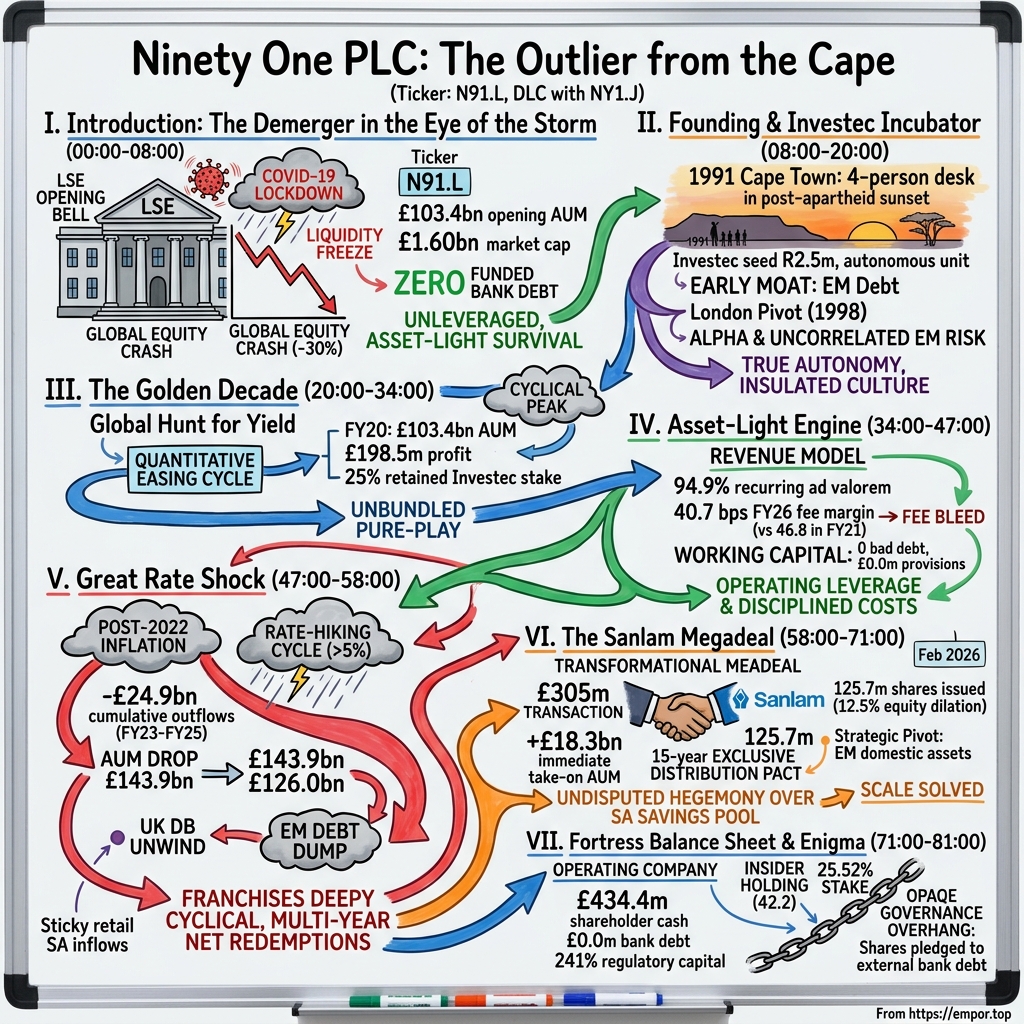
Ninety One PLC: The Outlier from the Cape
Central Questions of the Story
- The Organic Growth Engine: Can Ninety One keep winning client money on its own, and hold its active fees against passive funds? Or does its headline growth now depend on alliances with other companies' balance sheets?
- The Sanlam Trade-Off: Did the roughly £305m purchase of Sanlam Investment Management lock up the Southern African savings pool for good? Or did it swap high-margin global ambition for lower-yielding captive assets?
- The Owner-Operator Paradox: Does the 25.5% stake held by Forty Two Point Two, the leadership vehicle, mean the people running the firm are fully aligned with shareholders? Or does the bank debt secured against those shares create a risk at the top of the register that outsiders cannot see?
- The Cash-Harvesting Machine: Can a debt-free, asset-light manager, still led by its founders after more than three decades, keep paying out most of what it earns while developed-market clients pull money from active equities?
I. Introduction: The Demerger in the Eye of the Storm (00:00 – 08:00 / 8 min)
Monday, 16 March 2020. A new name went live on the London and Johannesburg exchanges that morning, and almost nobody was in a mood to celebrate. Pubs in London would be ordered shut within days. The S&P 500 fell about 12% that single day. Credit markets had seized up, and money market funds were facing runs. Into that liquidity freeze came Ninety One, the business everyone in fund management had known for years as Investec Asset Management, now spun out of its banking parent and trading under a ticker of its own12.
The timing could hardly have been worse. An active asset manager earns a slice of the money it looks after. When markets fall by a third, revenue falls with them, regardless of how good the investment team is. And this manager's speciality, emerging-market debt and equities, is exactly what institutional allocators sell first in a panic.
The new company held £103.4bn of client assets at its first year-end, on 31 March 20203. It began public life worth roughly £1.6bn. It had no bank loans and no bonds1. Something else mattered even more: Ninety One had no parent to call. Investec, the specialist bank that had incubated it for almost thirty years, kept a minority stake, but it was no longer standing behind the business1.
The verdict, six and a half years on, is easier to give than it would have been that week. Ninety One did not need a rights issue, did not cut its dividend to zero, and did not go looking for a rescuer. The reason was structural, not heroic. The firm had almost no fixed claims on its cash: no debt to roll, no covenants to meet, and a cost base built mainly from bonuses that shrink when profits do. In the year to March 2021, its first full year as a listed company, Ninety One still made adjusted operating profit of £206.2m3.
The unusual shape of the company
Ninety One is really two companies that behave as one. Ninety One plc is incorporated in England and has its primary listing in London. Ninety One Limited is incorporated in South Africa and has its primary listing in Johannesburg. A dual-listed company agreement binds them: identical economic and voting rights per share, cross-guarantees, one set of consolidated accounts and the same dividend per share on both registers41. The structure is unusual, but it is the obvious one for a firm with a London head office and a Cape Town soul. It lets South African pension funds own the business in rand on their home exchange, and lets UK and global investors own it in sterling.
The second unusual feature is at the top. Hendrik du Toit has run the business since it was founded in 1991. Kim McFarland, the finance director, joined in 19934. That is more than three decades with the same chief executive and essentially the same finance chief, an almost unheard-of continuity in a listed financial firm. Through Forty Two Point Two, the vehicle that holds shares for leadership and staff, the people who run the firm also own about a quarter of it4.
The roadmap
The story runs in four acts. First, a small South African fund manager inside a bank decided it could compete in London. Second, it rode the long post-crisis hunt for yield to more than £100bn and a separate listing. Third, the 2022 rate shock delivered three straight years of client withdrawals totalling about £25bn4. Fourth, in 2025 and 2026, Ninety One answered by buying Sanlam's asset management arm with its own shares, the biggest strategic decision since the demerger54.
Each act tests the same question: is Ninety One a durable franchise or a well-run cyclical bet on emerging markets? To answer it, the story starts in Cape Town, before democracy.
 Subscribe on LinkedIn
II. Founding & The Investec Incubator: 1991–2008 (08:00 – 20:00 / 12 min)
South Africa in 1991 was a country between two worlds. Nelson Mandela had walked out of Victor Verster prison the year before. Sanctions were being lifted one by one, but exchange controls still kept most South African savings inside the country. The rand was volatile, inflation ran in double digits, and the big life insurers and banks dominated local fund management with comfortable, cartel-like ease.
Investec was then a small, ambitious bank, the outsider among South Africa's financial institutions. Hendrik du Toit, a young economist trained at Stellenbosch, persuaded its leadership to back a separate asset management business. Investec's founding generation, Stephen Koseff and Bernard Kantor among them, agreed. The founding team was tiny, and the starting capital modest1. The founding year later gave the company its name.
The key decision: autonomy
The most important early choice was about governance, not investing. The asset manager was run as a distinct business rather than as a product shelf for the bank. That distinction sounds bureaucratic, but it matters. Bank-owned fund managers are often pushed to sell the bank's products and absorb its overheads, and they get starved of capital whenever the bank's lending book needs it. Ninety One's later accounts show how small the administrative bond with Investec had become: recharges for shared services were just £4.0m in FY21 and £4.5m in FY22, paid at cost, and they then disappeared34. Autonomy did not arrive in 2020. It had been built up over decades.
London, and the outward turn
The defining strategic move came in the late 1990s. Investec bought Guinness Flight Hambro in 1998 and gave the young South African asset manager a platform in London. Du Toit moved there to lead it. Most emerging-market fund managers stayed home and sold local expertise to local savers. Du Toit went the other way: he took that expertise to the world's largest pools of capital and competed with European and American managers on their own ground.
The logic was simple. South African savings were capped by the size of the economy and by exchange controls. Global pension money was effectively unlimited. Few managers in London or New York had analysts who had actually lived through an emerging-market currency crisis. That lived experience became a selling point.
What it built
The business that came out of this period rested on a handful of capabilities. The first was emerging-market debt, where it became one of the recognised institutional names. The second was a quality-focused global equity strategy, branded Global Franchise. The third was multi-asset and South African equity and bond funds for its home market. The approach, as management described it, was bottom-up and fundamental: pick specific companies and countries rather than trade macro themes1.
The distribution model followed. Ninety One won segregated mandates from UK pension schemes and local authority pools, then US and Asian institutions, often through consultant-led searches. It also built a wholesale advisor business in the UK and Europe. By the end of this period it managed tens of billions of pounds, most of it from clients outside South Africa1.
Myth vs reality: "the emerging-market specialist"
The neat version of this story calls Ninety One an emerging-market specialist. The reality is more mixed. By the time of the demerger, a large share of its money sat in global and developed-market equity strategies and in multi-asset funds, and the UK was by far its largest revenue base1. The emerging-market label describes its heritage and research edge better than it describes its revenue. That gap matters later. When developed-market clients left active equities after 2022, the damage hit businesses that had nothing to do with Africa.
The cultural blueprint
Two habits from this period recur throughout the story. First, the firm grew by hiring people and building systems, not by buying rivals. It made no large acquisitions until Sanlam, and even that one was paid for in shares rather than debt4. Second, it never ran a proprietary trading book or used meaningful balance-sheet leverage. It sold expertise and charged a fee. In a bank-owned world that was a quiet act of discipline. It also meant the firm would one day be easy to separate.
For investors, this is the root of the asset-light model: a business whose productive assets are people, client relationships and track records. That makes it cheap to run and hard to bankrupt. It also means those assets can walk out of the door, which is why the next era of growth was both lucrative and fragile.
III. The Golden Decade of Active Alpha & The Demerger: 2008–2020 (20:00 – 34:00 / 14 min)
After the 2008 crisis, central banks pushed interest rates in the developed world to zero and kept them there. For a UK pension trustee or a Japanese insurer, government bonds stopped paying enough to cover promised returns. The hunt for yield began, and emerging-market debt was one of its obvious destinations: sovereign and corporate bonds paying several percentage points more than gilts or Treasuries, in economies growing faster than the developed world.
Investec Asset Management was well placed to catch that wave. Over the decade its client assets grew steadily, and by 31 March 2020, even after the March crash, it managed £103.4bn3. Net flows in that final year were positive, at about £6bn4. Adjusted operating profit was £198.5m3.
Cyclical tailwind or genuine franchise?
This is where sceptical investors should push. Was the golden decade a sign of skill and client loyalty, or of a rising tide? The evidence points to both, in proportions that matter.
On the franchise side, the firm grew through more than one cycle. It kept building institutional relationships that last years, and its long-term investment record was competitive: years later, management reported that about three-quarters of its assets had beaten their benchmarks over ten years4. On the cyclical side, much of the growth came from asset classes, such as emerging-market debt and high-quality growth equities, that were themselves products of zero rates. When that monetary regime ended, so did much of the growth. Section V tests this directly.
November 2019: the separation
Investec's board formalised the separation in late 2019. Its own strategic case was straightforward. The bank and the asset manager had different capital needs, different regulators and different investor bases. Bank investors priced the combined group as a bank and gave the fund manager's high-return, low-capital earnings little credit1.
Several pieces of the architecture still shape Ninety One today:
- The name. "Investec Asset Management" was retired, partly to end client confusion with Investec's wealth and banking businesses. "Ninety One" refers to the founding year, an inward-looking choice of name for a firm with outward ambitions1.
- The share distribution. Most shares went directly to Investec plc and Investec Limited shareholders. Investec kept about 25% at listing1. It distributed a further 15% to its own shareholders in May 2022, and its stake had fallen to about 9% by March 20264.
- Forty Two Point Two. The leadership and staff vehicle took a substantial position at listing, so management came out of the demerger as the largest single shareholder rather than as employees of a new parent14.
- No debt dowry. Demerged businesses are often loaded with debt on the way out so the parent can extract cash. Ninety One was not. It listed with no funded borrowings1.
Cleaning up the plumbing
Separation is not only legal. Shared IT, offices and administration have to be unpicked. The recharges to Investec mentioned earlier faded to nothing after FY2234. Several other things signal a clean break: the related-party disclosures now concern Sanlam and Forty Two Point Two rather than the former parent, and the unmodified audit opinions since listing raise no separation-related matters4.
The timing problem
The demerger released a high-return, pure-play manager into public markets. The return on equity in the accounts shows how little capital it needs: at times it was well above 50%3. But that clean separation came close to the peak of the cycle that had built it. FY22 would be the high point: £143.9bn of assets, £663.9m of net revenue and £230.4m of adjusted operating profit3. Then the rate regime changed.
Investors who bought at the demerger did not get a growth company. They got a cash machine at the top of its cycle, and the next five years would show how much of its economics would survive when the tide went out. To see why, it helps to look under the hood at how the machine makes money.
IV. The Asset-Light Engine: Revenue Model, Unit Economics, and Flow Dynamics (34:00 – 47:00 / 13 min)
Imagine Ninety One's executive committee reviewing its fee schedules after March 2026. On one side of the table are global investment consultants advising pension funds with billions to place. Their opening line hasn't changed in a decade: the index fund costs a few basis points, so justify the gap. On the other side are wholesale platforms that rank funds by price. The Sanlam mandates, newly arrived, are large, valuable and cheap per pound of assets. The question in that room is not whether fees will fall. It is how slowly.
How the machine charges
A basis point is one-hundredth of a percentage point. If Ninety One manages £1bn for a client at 40 basis points, it earns £4m a year. It earns that fee as long as the money stays, and it rises or falls with the value of the portfolio every day.
Almost all of Ninety One's income comes this way. In FY26, management fees were £617.3m of £650.2m in net revenue, about 95%4. Performance fees, earned when specific mandates beat agreed hurdles, contributed £32.9m4. They are a pleasant extra rather than a foundation, which is healthy. Managers that depend on performance fees have far lumpier earnings.
Most contracts can be cancelled at short notice. Segregated institutional accounts and pooled funds offer daily to monthly liquidity and no lock-ins4. The big exception is the new Sanlam arrangement, with its initial 15-year term4. The business, then, is recurring but not contracted. Revenue repeats because clients choose to stay, not because they must.
The fee bleed
The single most important number in this section is the average fee rate. It fell from 46.8 basis points in FY21 to 45.0 in FY23 and FY24, then 44.0 in FY25 and 40.7 in FY2646. Over five years, that is roughly a 13% cut in the price per pound managed.
Two forces drove the decline, and they should be kept separate:
- Slow, structural erosion (FY21–FY25). About three basis points went over four years as the mix shifted towards fixed income and larger institutional mandates, and as clients renegotiated. That is the industry's normal background decline.
- A step change from Sanlam (FY26). More than three basis points went in one year, because the Sanlam assets carry much lower fees than Ninety One's legacy book4. Only about two months of the full Sanlam book sat in FY26, so the full-year effect on FY27's average rate is likely to be larger again.
The decomposition matters. The organic bleed is real but gradual. The Sanlam drop was a deliberate trade of price for volume. Investors should judge it by whether it brings more pounds of profit, not by the fee rate alone.
Where the money is earned
Measured by the location of the contracting entity, the UK accounted for about 60% of FY26 revenue, South Africa about 26% and the rest of the world about 13%4. These are booking locations, not the clients' nationalities: many global clients contract through London. Still, it shows how far the firm's economics run through two countries. No single client provides a material share of revenue; the company says it has "no single customer that it relies on"4.
The quality of the receivables
A small detail is reassuring. Trade and other receivables were £264.3m at March 2026, but they include policyholder and subscription balances4. The shareholder fee receivables are almost all less than 30 days old, and the expected credit loss provision was nil4. Fees are usually deducted directly from fund assets held by custodians. There is little room for credit risk to hide in the accounts.
The cost structure: a built-in shock absorber
Here is the clever part of the business model, and the part the COVID listing tested first. The largest cost is people, and a large share of pay is variable and tied to profit. When profit falls, the bonus pool falls with it. The rest of the cost base, mainly IT, offices and third-party administration, is relatively small. Business expenses were £158.1m in FY26, and third-party administration was £40.4m of that4.
Ninety One's reported operating margins stayed in a band of roughly 26% to 32% from FY17 to FY26, through a pandemic, a rate shock and three years of outflows43. That is not a business without pain. FY26's margin, about 26%, was the lowest in the decade4. But the margin bent rather than broke.
Where the cash goes
Capital expenditure was £7.1m in FY26, under 1% of revenue4. Shareholder operating cash flow before tax was £242.8m against profit before tax of £207.5m, so the business converted more than all of its accounting profit into cash4.
One caution for anyone reading the headline cash-flow statement. Ninety One runs a South African linked life assurance company, and its policyholder flows pass through the consolidated statements. That is why the company shows "cash" of £15bn in some years and £600m in others4. About £13.6bn of policyholder investments and matching liabilities sit on the balance sheet but belong to policyholders4. Strip them out and the shareholder business is a simple, highly cash-generative fee machine.
The conclusion is that this is a high-quality, low-capital revenue engine with one structural weakness: its price keeps falling. The engine itself is sound. The danger is that the fuel, client assets, starts leaking faster than markets refill it. From 2022, that is what happened.
V. The Great Rate Shock: Outflows, Emerging Market Winter, and the Active Squeeze (47:00 – 58:00 / 11 min)
On 23 September 2022, the UK chancellor delivered his "mini-budget". Gilt yields jumped. Within days, many UK defined-benefit pension schemes faced margin calls on their liability-driven investment hedges, the leveraged gilt positions they had used to match their long-term promises. To raise cash, they sold whatever they could sell quickly. Liquid active equity and credit mandates were near the top of the list. The Bank of England had to step in to stabilise the gilt market.
Around the same time, the Federal Reserve was in its fastest tightening cycle in four decades. US Treasury yields would reach about 5%. For an allocator who had bought emerging-market debt to earn a premium over safe assets, the logic collapsed: why take Brazilian or Indonesian risk for a few extra points when a US Treasury bill pays 5% with none?
The damage
Ninety One's net client flows told the story. Clients withdrew about £10.6bn in FY23, £9.4bn in FY24 and £4.9bn in FY25, a cumulative outflow of roughly £25bn over three years467. Client assets fell from £143.9bn at the FY22 peak to £126.0bn in FY2446. Net revenue fell from £663.9m to £588.5m over the same period, and adjusted operating profit fell from £230.4m to about £190m46.
To put £25bn in context, it is close to a fifth of the FY22 asset base. Markets partly offset the outflows. Without them the decline in assets would have been much worse.
Historical falsification: was the franchise structural or cyclical?
This period is the best test the firm's own record offers of the bull claim that Ninety One has a durable global franchise.
The claim was not refuted entirely. Ninety One stayed solidly profitable through the worst of it, kept its long-term investment record competitive, and kept paying dividends. That is better than several UK peers managed. But the history narrows the claim considerably. Outside South Africa, the firm's flows are cyclical and tied to the rate regime. When risk-free cash pays 5%, developed-market institutions withdraw from active equities and emerging-market debt, and Ninety One has no special mechanism to stop them. Its developed-market "franchise" is a set of good products in out-of-favour asset classes, not a captive client base.
Even after flows recovered, the developed-market weakness persisted. In FY26, total organic net flows turned positive at about £2.8bn, but the UK still saw net outflows of about £1.5bn and the Americas about £1.1bn4. The recovery came from elsewhere, above all Africa and parts of Asia.
Regional divergence
South Africa behaved differently. Exchange controls, retirement fund rules and long-standing local relationships kept South African savers more loyal. Ninety One's domestic retail and institutional franchise was not immune, but it was much more resilient. This pattern explains the Sanlam decision more than any slide deck could. When the developed world kept withdrawing money, the home market kept paying.
Management's response
What did management do while revenue fell? Its behaviour is worth looking at as evidence about the people running the firm.
Fixed executive salaries stayed frozen. Base pay was unchanged for five consecutive years. Executive directors receive no pension4. Chief executive variable pay fell by about 20% in FY24, in line with lower profit, and his total pay fell from about £3.2m in FY23 to about £2.6m46. Investment teams were largely kept intact. Group headcount stayed around 1,190 to 1,210 rather than being cut sharply4.
The financial result was a moderate decline in profit rather than a collapse, and the dividend continued. The payout ratio rose instead, from about 60% of profit in FY22 to above 70% over the next three years4. Management did not defend the share price with leverage or a vanity acquisition. It let the variable cost model absorb the shock.
What it did not do was stop the outflows. No asset manager can do that by itself. That limit brought the board to the most consequential decision since the demerger.
VI. The Sanlam Megadeal: Buying Scale or Surrendering Independence? (58:00 – 71:00 / 13 min)
On 20 November 2024, Ninety One and Sanlam, South Africa's largest insurance group, announced an agreement that would change the shape of both businesses58. Ninety One would take over Sanlam's third-party asset management business in South Africa, Sanlam Investment Management, and the active management of Sanlam UK's assets. Sanlam would be paid in Ninety One shares, become a major long-term shareholder, and appoint Ninety One as its primary active manager for 15 years589.
The deal closed in two stages. The UK leg completed in June 2025, and the larger South African leg on 2 February 20264.
The mechanics
The consideration was entirely shares, a total of 125.7m new shares4:
- About 13.7m plc shares, worth roughly £24m, for the UK business, issued in June 2025 at about 173p.
- About 112m plc and Limited shares, worth roughly £282m, for SIMSA, issued in February 2026, the plc shares at about 253p.
The total value was about £305m4. Note the price difference between the two legs. Ninety One's share price had risen sharply between the stages, so Sanlam received fewer pounds' worth of value per share in the UK leg and more in the South African one. Because the number of shares was fixed, Ninety One's existing shareholders gave away the same percentage of the company either way.
PwC, the auditor, made the accounting treatment its only key audit matter. It agreed that the transaction passed IFRS 3's "concentration test": substantially all of the value lay in a single group of similar assets, the management contracts. As a result, the deal was accounted for as an asset acquisition rather than a business combination4. The practical effect is simple: no goodwill was recognised. The roughly £280m of acquired value became intangible assets, mainly contracts, to be amortised over their expected lives4. Only £4.2m of amortisation went through FY26 because the main leg closed so late in the year4. A full year will be considerably larger, likely around £20m. Management excludes this from its adjusted earnings, so investors should watch both the adjusted and statutory figures.
What Ninety One got
Immediate scale. The Sanlam take-on added £18.3bn of assets, and together with organic inflows and markets, lifted group assets to a record £171.8bn at March 20264.
Distribution. Sanlam's tied-agent and advice network is one of the biggest retail savings channels in South Africa. Being its primary active manager for 15 years gives Ninety One preferred access to a stream of savings it does not have to fight for in each consultant search59.
An anchor investor. Sanlam committed to support Ninety One's international private and specialist credit funds with its balance sheet58. For a manager trying to grow in private markets, a committed seed investor is valuable because new funds struggle to raise money without a track record.
What it gave up
Equity. The new shares increased the share count by about 14%, and Sanlam came to hold about 12.5% of the enlarged company4. Forty Two Point Two's stake fell from about 28.4% to about 25.5%4.
Price per pound. As covered in the previous section, the fee rate fell by more than three basis points in a single year4.
Geographic balance. A firm that spent three decades going global took a decisive step back towards South Africa. That is not necessarily a mistake, but it changes what shareholders own: more rand earnings, more exposure to the South African economy and currency, and less to the global growth story in the IPO pitch.
The arithmetic investors should do
Was it accretive? There is a quick way to check. Shareholders gave up about 12.5% of the company. To break even, the Sanlam assets need to deliver more than about 12.5% of the combined group's profit, after amortisation and integration costs. Revenue alone won't settle it. Low-fee assets with high servicing costs can add revenue and still dilute profit.
Ninety One's adjusted EPS rose from 15.5p in FY25 to 17.4p in FY264. But markets were strong, organic flows turned positive, and Sanlam contributed for only a few months. FY27, the first full year, is the real test. Management has presented the deal as both strategically and financially compelling10. The proof will show up in FY27 profit per share, not in assets under management.
Benchmarking against the M&A graveyard
UK asset management mergers have a poor record. Standard Life and Aberdeen merged in 2017 and spent years losing assets and cutting costs. Jupiter's 2020 purchase of Merian added scale but did not stop the outflows that followed. Henderson's merger with Janus produced a business that was more stable but not obviously more valuable for years.
The Sanlam deal differs in three ways. It is a contract-plus-distribution deal rather than a merger of two investment cultures. There is no debt involved. And the seller stays on as a shareholder and client with a 15-year commitment, so both sides have an interest in keeping the assets in place. Those features reduce the risk of the usual failure modes. They do not remove it. Key managers inherited from Sanlam can still leave, and Sanlam's agents can still steer savers to cheaper alternatives once the novelty fades.
The verdict for now: the deal strengthened Ninety One in South Africa and made it larger. It is not yet clear whether it made each share more valuable. The question that matters now is whether the balance sheet and the ownership structure above it are as solid as the operating business.
VII. The Fortress Balance Sheet & The Forty Two Point Two Enigma (71:00 – 81:00 / 10 min)
Open the 2026 annual report and turn to the financial risk notes. The numbers there are almost dull. Shareholder cash and cash equivalents were £434.4m at 31 March 20264. There were no bank loans, overdrafts or bonds4. The only "debt" was £104.3m of office lease liabilities, which IFRS 16 requires to be shown as borrowings4. The fact sheet's debt-to-equity ratio of 0.15 is all leases.
Now turn to the directors' report. In a footnote to the major-shareholders table, the company says Forty Two Point Two's share purchases were partly funded with third-party debt, and that a portion of its Ninety One shares are pledged to those lenders4. The operating company is a fortress. The largest shareholder, above it, is leveraged.
The fortress
A few figures are worth understanding rather than memorising.
Net cash. Cash less lease liabilities gives net cash of about £330m4. That is about a sixth of the market value. The fact sheet's enterprise value of about £1.4bn reflects it.
Regulatory capital. Asset managers must hold capital set by regulators to cover operational risk and wind-down costs. Ninety One held £353.4m of qualifying capital against a requirement of £115.6m, a coverage ratio of about 241%4. That surplus of more than £200m is the real buffer. It is also a constraint: not all the cash on the balance sheet can be paid out.
Interest. The cash earned £15.5m of interest income in FY26, comfortably more than the £3.5m of interest expense, almost all of it on leases4. Cash sits with counterparties rated at least A- by Fitch and in money market funds4.
Cash conversion. As covered in Section IV, shareholder operating cash before tax exceeded profit before tax4.
The fact sheet's ratios fit this picture. Return on equity fell from above 60% to about 22% in FY26, but mainly because equity roughly doubled with the Sanlam share issue4. That isn't operational deterioration. It's what happens when you pay for contract assets with stock. The fact sheet's return on capital employed of 1.4% is similarly distorted by the policyholder balances, and should be ignored for this business.
Stress-testing "fortress"
Is there disconfirming evidence in the company's own record? The strongest test was FY23–FY25: three years of outflows, falling revenue and a rising payout ratio. The balance sheet survived without strain. Cash stayed in the hundreds of millions, no borrowings were taken on, and buybacks continued at a modest pace46. The balance-sheet claim holds up against the firm's toughest period since listing. The honest caveat: the firm's biggest capital commitment in that period was paid in shares, not cash, so the cash pile was never tested against a large acquisition.
The owner-operator
Forty Two Point Two holds shares on behalf of the leadership and staff through the Marathon Trust4. Its stake rose steadily from about 22% in FY21 to about 28% in FY25 through open-market purchases, and then fell to about 25.5% after the Sanlam issue4. The insiders bought throughout the downturn. That is a strong signal of conviction, and it means the people who make decisions bear the consequences.
But someone lent them the money.
The pledge question
What do outsiders know? The company confirms the debt funding and the pledge. Voting rights remain with Forty Two Point Two. Ninety One gives no guarantee to the vehicle4. That last point matters. If the trust's lenders call, the listed company is not on the hook.
What does the company not disclose? The size of the debt, the loan-to-value ratio, the share-price level that would trigger margin calls, the interest burden, and the proportion of the 256.6m shares that are pledged4. Those are the facts an outsider would need to measure the risk, and none of them is public.
How material is it? Think about the mechanism. If the share price fell sharply, the lenders might demand more collateral or sell pledged shares. Forced selling from a holder of a quarter of the company would weigh on the share price, and could create a feedback loop. The fact sheet notes the shares have fallen by up to 57% in the past five years4. The trust has evidently survived such a fall before, since its stake rose rather than fell. That is reassuring evidence, but not proof, because the debt may have grown since then.
The verdict: there is no evidence of distress at Forty Two Point Two, and plenty of evidence of insider conviction. But "aligned owner-operator" and "leveraged shareholder" describe the same entity. A skeptical activist would ask for one simple disclosure: the share price at which the pledge arrangements require action. Until that is published, investors are trusting management on the one balance sheet in the structure they cannot see.
With the plumbing understood, the next question is the one that decides the long-term value of any asset manager: why should clients keep choosing this one?
VIII. Strategic Moats & The Competitive Arena (81:00 – 90:00 / 9 min)
Picture a consultant's finals presentation in the City. A UK pension scheme has shortlisted four managers for an emerging-market debt mandate: Ninety One, a global giant such as BlackRock, a specialist such as Ashmore, and a broad active house such as Schroders. Each gets an hour. The consultant's scorecard covers people, process, performance and price. In the next room the scheme's trustees have a fifth option they barely mention, because they don't need to: an index fund for a fraction of the cost.
That is Ninety One's competitive reality. The full moat analysis belongs here.
Hamilton Helmer's 7 Powers
Cornered Resource: real, but regional. The 15-year Sanlam agreement, together with Ninety One's long position in South African retirement savings, is the closest thing the firm has to a cornered resource45. Rivals cannot easily buy a comparable exclusive relationship with a dominant domestic distributor. The limit: Sanlam is a single counterparty with its own bargaining power, and South Africa is a small, volatile market.
Process Power: plausible, partly evidenced. Decades of on-the-ground research into emerging-market sovereigns and companies are hard to copy quickly. The evidence for it is the long-term record, with about three-quarters of assets ahead of benchmark over ten years4. The counter-evidence is Section V: good process didn't stop £25bn of outflows. Process power protects returns. It does not protect flows when an asset class falls out of fashion.
Switching Costs: low to moderate. Wholesale investors can switch funds in a click. Institutional mandates are stickier, because consultant reviews take many months, but the FY23–FY25 outflows show they do move once the decision is made.
Scale Economies: modest. At about £172bn, Ninety One is mid-sized. BlackRock and Schroders run multiples of that. The variable pay model protects margins in downturns, but Ninety One can't match the global giants' technology and distribution spending.
Branding: niche-strong. It has a respected institutional name in emerging markets and sustainability-themed investing, and almost no brand among retail savers outside South Africa.
Network Effects and Counter-Positioning: absent. Fund management has no network effects. There is no counter-positioning against incumbents; Ninety One is the incumbent active model that passive funds counter-position against.
Porter's Five Forces
Buyer power: high. Consultants and platforms push down fees relentlessly, as the decline from about 47 to about 41 basis points shows4.
Threat of substitutes: extreme. Index funds, ETFs, factor strategies and, in institutional portfolios, private credit and private equity all compete for the same allocation.
Rivalry: intense. UK active managers including Schroders, abrdn, Jupiter and Ashmore fight for a shrinking pool of active public-market money, and most are cutting costs or consolidating.
Supplier power: moderate. The real "suppliers" are star fund managers, who can leave and take clients with them. Third-party administrators such as fund platforms matter but can be replaced.
Threat of new entrants: low to moderate. Regulation, track-record requirements and distribution make it hard to start an institutional manager, but boutiques keep spinning out of larger firms.
The verdict
Ninety One has one narrow, durable advantage, South African distribution, which Sanlam reinforced. It has one real but non-protective capability, emerging-market research. In developed-market active equities it has no structural moat beyond performance. Competition there is a contest of track records, and track records come and go.
That makes the investment case a bet on whether its strongest assets, home distribution and emerging-market expertise, are about to come back into fashion. The market has a view on that, expressed in the share price.
IX. Bull vs. Bear Case & Valuation Stress Test (90:00 – 97:00 / 7 min)
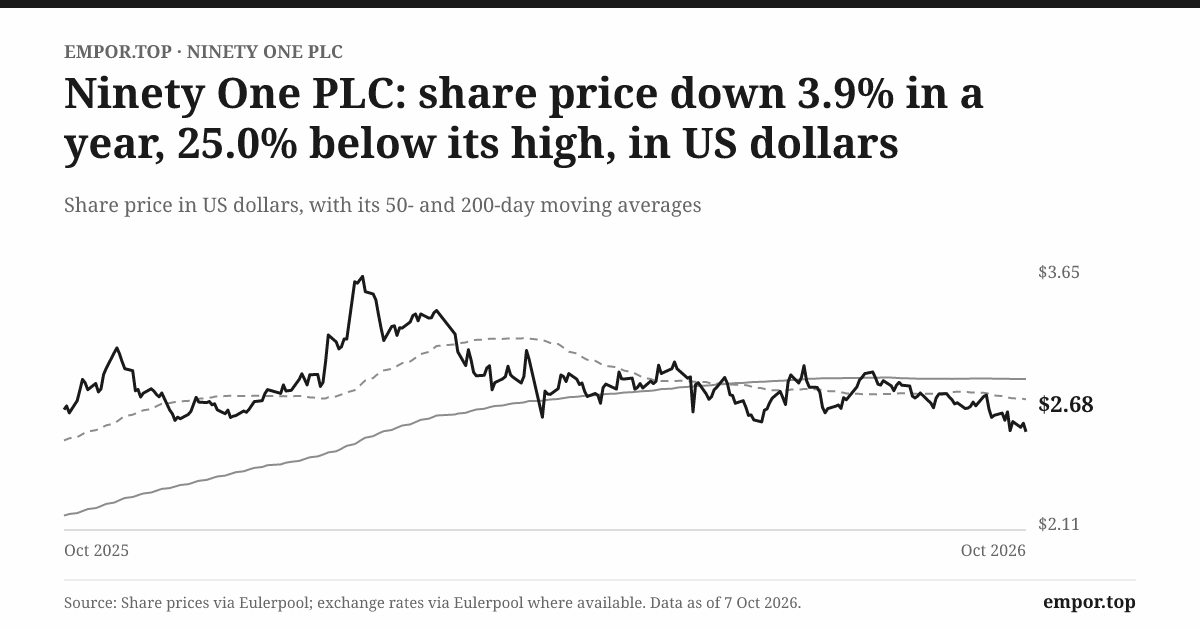
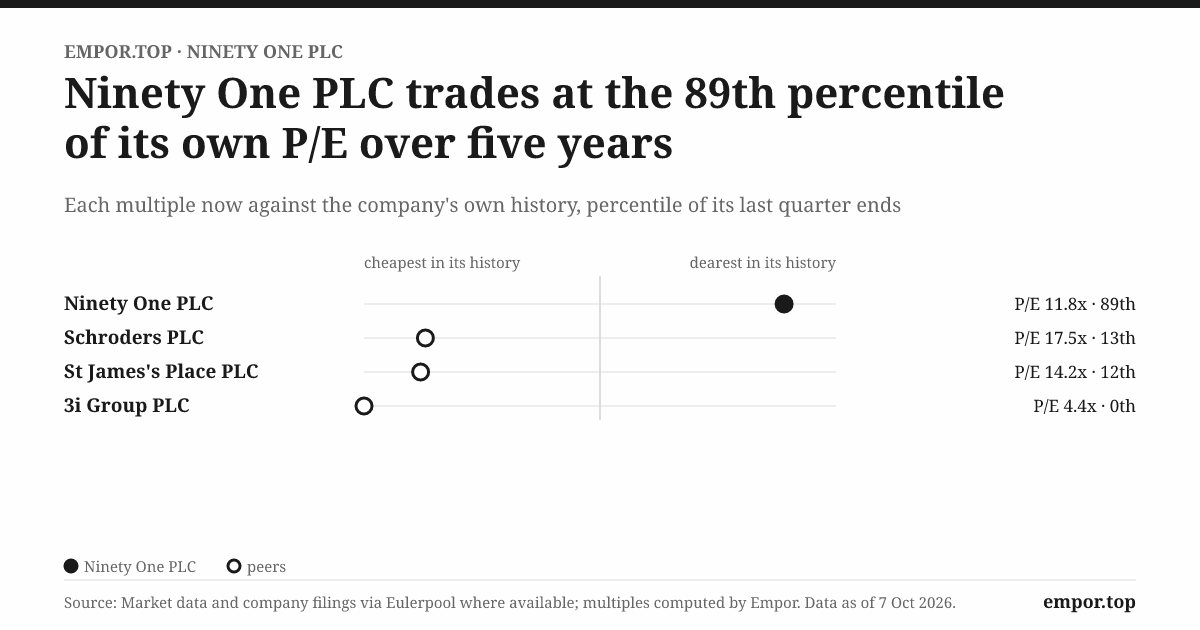
In early October 2026, Ninety One shares trade at about 203p, close to their 52-week low and about 22% below the high4. The market value across both lines is roughly £2bn. At that price, the stock trades on about 12 times trailing earnings, above its own five-year median of about 10, and offers a dividend yield of about 6.6% based on the FY26 dividend of 13.4p4. Price-to-book is in the high twos4.
What is the market assuming? A dividend yield above 6% on a business that pays out three-quarters of profit implies investors expect little growth. Roughly, at this price an investor gets the current cash and very little credit for the future. That is how markets price a melting ice cube, a business whose cash flows are expected to shrink slowly.
Compare that with peers. Schroders, Ashmore and Jupiter all trade at similar single-digit to low-teens earnings multiples, with similar or higher yields4. The market is not singling out Ninety One. It is treating the whole active-management industry as a declining annuity.
The three numbers to track
Before the cases, the KPIs that will settle the argument:
- Organic net flows, especially excluding Sanlam transfers. FY26: about +£2.8bn group-wide, but negative in the UK and the Americas4. Direction: improved from three years of outflows.
- Average management fee rate. FY26: 40.7 basis points, down from 44.04. Direction: falling, and likely to fall again in FY27 as the full Sanlam book is included.
- Adjusted EPS. FY26: 17.4p, up from 15.5p4. Direction: recovering, but not yet back to the FY22 peak of 19.2p3.
The bull case
1. The emerging-market turn. If the dollar weakens and the global rate cycle continues to ease, the logic of 2022 runs in reverse. Cash yields fall, the premium on emerging-market debt looks attractive again, and institutions rebuild allocations. Ninety One is one of the obvious beneficiaries. Even a modest recovery in flows would have outsized effects on earnings, because the cost base is largely fixed apart from bonuses.
2. Sanlam distribution pays off. If the 15-year partnership turns Sanlam's agents into a steady source of new money, organic flows in South Africa could grow by billions of pounds a year, and the deal would prove accretive despite the dilution.
3. Cash return. With net cash, low capital needs and a high payout ratio, Ninety One returns cash at a pace few businesses can match. Since listing it has returned more than 60% of its initial market value through dividends and buybacks4. In a flat scenario, investors are paid well to wait.
The bear case
1. Fee bleed continues. If the average fee falls below the high 30s in basis points as active equities shift to cheaper products, revenue will struggle to grow even if assets do.
2. Developed-market irrelevance. If UK and US outflows persist, Ninety One becomes primarily a South African asset manager with a London office. Its earnings would then rise and fall with the rand and the South African economy, and its multiple might settle closer to local peers.
3. Dilution and governance friction. The Sanlam shares are permanent. If the deal underperforms, the dilution remains. Add the undisclosed pledge arrangements at Forty Two Point Two and a large strategic shareholder that is also a key client, and the governance structure becomes harder to analyse than a simple founder-led firm.
An activist's stress test
A skeptical activist would ask four questions:
- Why not disclose the Sanlam book's profit contribution separately, so shareholders can judge the deal?
- What is the pledge trigger at Forty Two Point Two?
- Is it right to keep an IFRS 16-inflated cost base after signing a long new Cape Town head-office lease, when part of the business is shrinking?
- After more than three decades of the same leadership, what is the succession plan?
None of these points to wrongdoing. All of them are areas where disclosure falls short of what an outside owner would want.
The market's verdict is clear and cautious. It is pricing a cash yield, not a growth story. Upside depends less on multiple expansion than on the timing of an emerging-market recovery and on Sanlam producing more profit than the dilution cost. With that in mind, the lessons of Ninety One's story become clear.
X. Playbook: Business & Investing Lessons (97:00 – 101:00 / 4 min)
Lesson 1: "Never borrow against assets that take the lift home every evening." Ninety One's productive assets are people and client relationships. Both can leave at any time. Since its founding, the firm has refused to put debt against them. That is why a listing in the middle of a pandemic crash and three years of outflows amounting to a fifth of its assets never forced it to raise emergency capital. The wider lesson for founders: in a people business, leverage turns a bad year into an existential one. A fund manager's strength is not the cash it holds. It is having nothing to repay when clients leave.
Lesson 2: "Make the bonus pool the shock absorber." In FY24, the chief executive's variable pay fell by about a fifth because profit fell4. That was not generosity. It was the design. When most pay depends on profit, margins bend instead of breaking, and shareholders do not have to choose between cutting the dividend and cutting the investment team. Investors should look for this structure in any people business: the best protection against a downturn is a cost base that falls on its own.
Lesson 3: "When the world stops buying, go home and own the front door." Faced with fee pressure and outflows in London and New York, Ninety One used its own shares to buy privileged access to South Africa's biggest retail savings channel. It traded part of its global story for a 15-year contract at home. Whether that was wise will not be clear until the FY27 numbers. What is clear is the principle: a mid-sized active manager without global scale must own something rivals cannot buy. For Ninety One, that is the distribution door in Cape Town.
Lesson 4: "Alignment cuts both ways." Forty Two Point Two bought shares through the downturn and became the largest owner. That is the strongest alignment signal a management team can send. But it bought partly with borrowed money. The lesson for investors is to ask two questions about any owner-operator: how much do they own, and what did they borrow to own it?
XI. Epilogue & Outro (101:00 – 105:00 / 4 min)
Tonight, Ninety One manages about £172bn. It has more than 1,300 staff, no debt, and the same leaders who founded it more than three decades ago4. Its share price sits close to its 52-week low. The market values it as a high-yield annuity with a dwindling future. Management presents it as a firm about to benefit from an emerging-market recovery and a transformational South African partnership. The next eighteen months should show which story is closer to the truth.
Three moments will decide it.
The FY27 interim results in November. These will be the first half-year with a full six months of Sanlam assets. They will show where the fee rate settles and whether profit per share rose with the larger asset base. A fee rate in the high 30s in basis points, alongside rising adjusted EPS, would suggest the trade of price for volume is working. Falling EPS would suggest the 12.5% given to Sanlam was too much.
Organic flows outside Sanlam. The UK and the Americas lost money in FY26 even in a recovering market4. A turn to inflows there would be the first sign that the developed-market business is not slowly shrinking. Continued outflows would leave Ninety One more South African, more exposed to the rand, and more dependent on a single partner.
Any filing about Forty Two Point Two. Disclosures under UK and JSE rules would show any refinancing of the trust's debt, release of pledged shares or, in a crash, forced sales. The best outcome is a dull one: no news, or a voluntary disclosure that makes the risk measurable.
The central tension remains. Ninety One showed that it can survive almost anything. It has not yet shown that it can grow on its own in the markets that made it famous.
Outro
Go back to March 2020. A newly independent fund manager from Cape Town listed in London as the world shut down, with no parent and no lifeline, and the only protection it had was the way it had been built: no debt, flexible costs and owners who ran it. Six years later, those same features have carried it through a pandemic, a gilt crisis and three years of withdrawals, and paid shareholders a fortune in dividends along the way.
What it has not escaped is the question every active manager faces: why should anyone pay for active management? Ninety One's answer, for now, is one partnership in South Africa and a promise about the next emerging-market cycle. In an industry full of leverage, empire-building mergers and financial engineering, Ninety One's rarest asset has been simplicity: owning its own shop, keeping its debt at zero and letting cash do the talking. The next chapter will show whether simplicity is enough.
References
-
Ninety One Prospectus for Demerger and Admission to LSE — Investec Group & Ninety One, 2020-03-02 ↩↩↩↩↩↩↩↩↩↩↩↩↩
-
Ninety One CEO Hendrik du Toit on Demerger, Active Management and Emerging Markets — Financial Times, 2020-03-15 ↩
-
Ninety One Integrated Annual Report 2022 — Ninety One PLC, 2022-06-07 ↩↩↩↩↩↩↩↩↩↩
-
Ninety One Integrated Annual Report 2026 — Ninety One PLC, 2026-06-02 ↩↩↩↩↩↩↩↩↩↩↩↩↩↩↩↩↩↩↩↩↩↩↩↩↩↩↩↩↩↩↩↩↩↩↩↩↩↩↩↩↩↩↩↩↩↩↩↩↩↩↩↩↩↩↩↩↩↩↩↩↩↩↩↩↩↩↩↩↩↩↩↩↩↩↩↩↩↩↩
-
Ninety One Proposed Acquisition of Sanlam Investment Management and Strategic Partnership — London Stock Exchange RNS, 2024-11-20 ↩↩↩↩↩↩
-
Ninety One Integrated Annual Report 2024 — Ninety One PLC, 2024-06-05 ↩↩↩↩↩↩
-
Ninety One Integrated Annual Report 2023 — Ninety One PLC, 2023-06-06 ↩
-
Sanlam and Ninety One Partner to Create Pan-African Investment Champion — Sanlam Investor Relations, 2024-11-20 ↩↩↩
-
Ninety One Agrees Landmark Asset Management Deal with Sanlam — Citywire, 2024-11-20 ↩↩
-
Ninety One Final Results for the Year Ended 31 March 2026 — London Stock Exchange RNS, 2026-06-02 ↩
 LinkedIn
 WhatsApp
 Reddit
 Hacker News
 Email
Email Kindle
 RSS Feed
 Spotify
 Apple Podcasts
 Amazon Music
 Audible
 YouTube