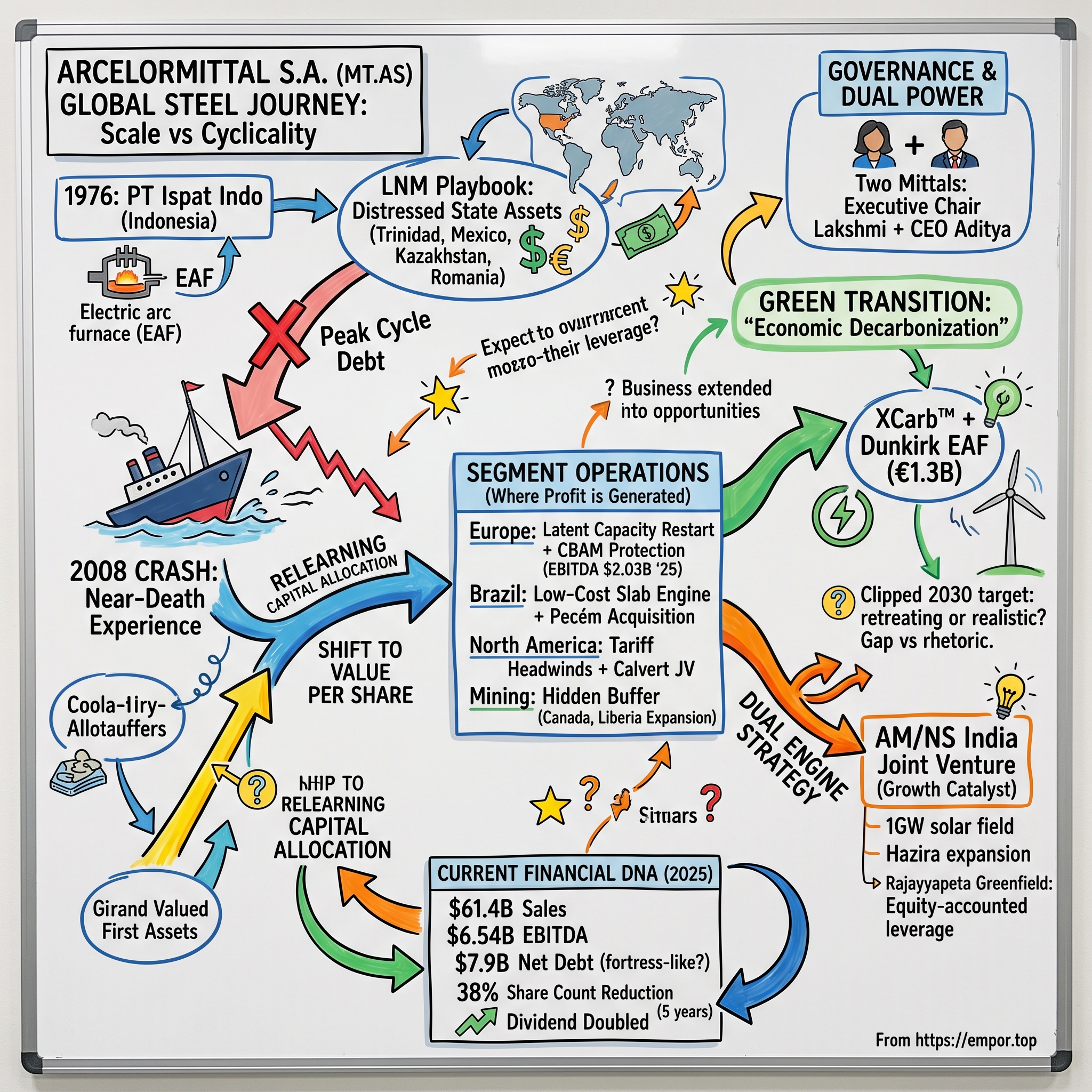
ArcelorMittal S.A.: The Colossus of Global Steel & The Masterclass in Capital Allocation
I. Introduction & Episode Roadmap
In the summer of 2006, a Luxembourg boardroom became the unlikeliest battlefield in European capitalism. On one side sat the directors of Arcelor S.A., the continent's industrial crown jewel, a company stitched together from the national steel champions of France, Luxembourg and Spain. On the other stood a man who had left India three decades earlier because his own government would not let him build a steel mill, and who had spent the intervening years buying up the world's unwanted, unloved, state-owned smelters — in Trinidad, in Mexico, in Kazakhstan, in Romania — and making them work.
Arcelor's management had called his shares "monkey money." A French minister had questioned whether Europe wanted this kind of owner. Arcelor had gone so far as to invite a Russian oligarch in as a white knight rather than accept him. And on June 25, 2006, after five months of siege, the board capitulated. Mittal Steel acquired Arcelor for €26.9 billion — roughly $34.4 billion — a price 49% above the opening bid in January and nearly double where Arcelor's shares had traded before the offer.1
That deal created ArcelorMittal, and for a brief, giddy moment it looked like the definitive act of the commodity supercycle: one company, roughly a tenth of world steel output, unrivalled pricing power. Two years later it nearly killed the company. By September 30, 2008, net debt stood at $32.5 billion, and within a quarter ArcelorMittal was cutting production by as much as 45% across its plants.2
The interesting story is what happened next. Twenty years on, the company that emerged from that near-death experience is almost unrecognisable in its financial DNA. In the twelve months to December 2025, ArcelorMittal generated sales of $61.4 billion on 54.0 million tonnes of steel shipments, produced EBITDA of $6.54 billion, and finished the year with net debt of $7.9 billion.3 It has retired 38% of its own share count in five years and doubled its dividend over the same period.4 The volume-at-any-price roll-up became, by degrees, a per-share compounding machine.
ArcelorMittal S.A. (MT.AS, Euronext Amsterdam) today is not simply the world's largest steelmaker outside China. It is a hybrid: an integrated steel producer with a portfolio spread across Europe, North America, Brazil, Ukraine and Kazakhstan-free Central Asia; a captive iron ore miner in Canada and Liberia; a 60% owner of India's fastest-growing steel joint venture; and — increasingly — a holder of financial stakes that it trades in and out of with the discipline of an investment firm.
Three themes run through everything that follows.
Scale versus cyclicality. The M&A playbook that built the company nearly destroyed it. The current management's answer has been to cap balance-sheet risk, spend a fixed capital budget, and return the rest. Whether that discipline survives contact with a genuine upcycle is the single most important open question for shareholders.
The green transition trilemma. Steel is one of the hardest sectors on earth to decarbonise, and Europe is trying to do it with the highest energy costs in the developed world while competing against imports made in coal-fired furnaces. ArcelorMittal has spent five years telling investors it would lead this transition. In April 2026 it cut its own 2030 emissions target by more than half.5 That gap between rhetoric and revealed preference deserves scrutiny, not applause.
The dual engine. Mature European and North American assets generate cash; India, Liberian iron ore and Brazilian slab absorb it. The bet is that the growth engine compounds faster than the legacy engine decays. The evidence so far is mixed and worth examining honestly.
The story begins, as most good industrial stories do, with someone who had no other options.
 Subscribe on LinkedIn
II. Origins: The LNM Playbook & The Roll-Up Era (1976–2004)
Picture a rice paddy in East Java in the mid-1970s. The Indonesian air is thick; the ground is soft. A 26-year-old from a Marwari trading family in Rajasthan, raised in Kolkata around his father's modest steel business, is standing on land his family has just bought, planning to put a steel mill on it.
Lakshmi Niwas Mittal did not go to Indonesia because he saw a great opportunity there. He went because India's licence raj made it effectively impossible for a private family to expand steel capacity at home. The constraint was the strategy. PT Ispat Indo, founded in 1976, was a small wire-rod mill in Surabaya — and critically, it was built around electric arc furnace technology rather than the enormous integrated blast furnaces that defined steelmaking everywhere else.
That technology choice, made for reasons of cost and scale rather than vision, shaped everything. A blast furnace is a vast, permanently hot cathedral of a machine: it consumes iron ore and metallurgical coal, runs continuously for years between relines, and punishes any owner who cannot keep it full. An electric arc furnace is closer to an enormous electric kettle that melts scrap steel. It is smaller, cheaper, faster to start and stop, and it can be sited near a market rather than near a coal seam. Mittal learned the economics of flexible steelmaking in a market where flexibility was the only affordable option.
Buying What Nobody Wanted
The playbook that followed was almost embarrassingly simple to describe and extraordinarily difficult to execute. Through the late 1980s and 1990s, Mittal bought distressed, state-owned or recently privatised steel plants in economies that were either developing or violently restructuring: an operation in Trinidad and Tobago in 1989 that was reportedly bleeding roughly a million dollars a day; Sicartsa in Mexico; the vast Karmet works in Temirtau, Kazakhstan, in 1995; assets in Romania, Poland, South Africa and Algeria.
Sellers were governments desperate to offload payroll and pollution. Prices were often close to scrap value. What Mittal brought was not capital — he had little — but a set of unglamorous operating disciplines: centralised procurement of scrap, ore and coal across the group so that a mill in Kazakhstan bought at the same terms as a mill in Mexico; the transfer of metallurgical know-how between plants that had never spoken to each other; Western management accounting laid over Soviet-era operations; and an export orientation that let acquired mills sell into hard-currency markets while their domestic economies recovered.
The strategic insight underneath was about the shape of the industry, not any single asset. Steel outside China was — and largely remains — brutally fragmented. Fragmentation means nobody has the discipline to cut capacity in a downturn, which means downturns are savage, which means distressed assets are always available somewhere. A buyer with a repeatable turnaround process and a global balance sheet could arbitrage that permanent dysfunction. For roughly fifteen years, that is exactly what happened.
Why It Worked — and Where It Was Always Going to Break
It is worth being precise about the source of the returns, because the popular version of this story credits management genius when the more durable explanation is structural.
Every one of those acquisitions was a claim on a specific inefficiency: a plant built for a planned economy that no longer existed, staffed for a workforce policy rather than an output target, and priced by a seller whose alternative was closure and unemployment. The buyer's advantage was not that he was smarter about metallurgy. It was that he was the only bidder willing to take on the political and operational mess, and that he had a template — procurement, benchmarking, capital triage — that could be dropped onto a new site within months rather than years.
That model has two hard limits, and both eventually bound. First, the supply of orphaned state-owned steel plants is finite; by the mid-2000s the obvious ones in Eastern Europe, Latin America and Africa had been bought. Second, and more dangerously, a turnaround playbook that generates spectacular returns on assets purchased at scrap value generates ordinary returns on assets purchased at fair value — and terrible returns on assets purchased at peak-cycle value with borrowed money. The discipline that made the early deals work was the price, not the process. When the acquisitions got bigger and more competitive, the price discipline was the first thing to go.
The other limitation is subtler and shows up in the modern business. A company assembled from three dozen plants across twenty countries, each with its own union agreements, environmental legacy and political patron, is extraordinarily difficult to rationalise later. Every closure becomes a national controversy. ArcelorMittal has spent the past fifteen years paying the integration bill for the speed of the first thirty years.
The American Consolidation and the Birth of Mittal Steel
The pivot from emerging-market opportunism to global scale came in the United States. American integrated steel had collapsed under legacy pension and healthcare obligations; Bethlehem Steel, LTV and Weirton had all failed. The investor Wilbur Ross assembled their carcasses into International Steel Group in 2002, stripped of the "legacy costs" through bankruptcy court, and then sold the whole thing.
In October 2004, Mittal agreed to merge his holdings with ISG in a transaction valued at roughly $4.5 billion, creating Mittal Steel Company N.V.6 US regulators cleared it in March 2005. The combination made Mittal the world's largest steelmaker by shipments, overtaking Arcelor, and gave the group a New York and Euronext listing — the currency it would need for what came next. Ross joined the board.
For investors, the origin story matters for one reason above all: it establishes what kind of capital allocator this management team was formed to be. The Mittal machine was built to buy assets cheaply during dislocation, integrate them ruthlessly, and grow shipments. Nothing in the first three decades trained it to say no to a deal. That instinct was about to be tested at its absolute limit — and then, a decade later, deliberately unlearned.
III. The Battle for Arcelor: The Ultimate Hostile Megamerger
There is a specific kind of European corporate arrogance that only appears when a national champion is threatened, and Arcelor's management summoned all of it.
Arcelor had been created in 2002 from the three-way merger of France's Usinor, Luxembourg's Arbed and Spain's Aceralia. It was, on paper, everything Mittal Steel was not: high-specification automotive flat steel, deep patent portfolios, elite European engineering, embedded relationships with Renault, PSA, Volkswagen and the German premium marques. It was also, in the language of its own executives, a producer of "perfume" — as against Mittal's "eau de cologne."
On January 27, 2006, Mittal Steel launched an unsolicited offer worth €18.6 billion — around $22.7 billion.1 The reaction was not a negotiation. It was a national emergency.
Five Months of Trench Warfare
Arcelor's defence was a masterclass in every tactic available to a cornered European board, and it is worth cataloguing because it explains why the eventual outcome mattered so much.
It raised legal obstacles across multiple European jurisdictions simultaneously. It launched a share buyback of roughly 20% of its own stock, both to return cash and to shrink the float available to the bidder. It hiked its dividend. It moved assets — including, controversially, its Dofasco operation in Canada — into a Dutch foundation designed to be beyond the reach of an acquirer. And in its most audacious move, it recruited Alexey Mordashov, the principal owner of ПАО Северсталь Severstal, as a white knight who would swap his Russian steel and mining assets for roughly a third of an enlarged Arcelor.
The rhetoric was uglier than the tactics. Arcelor's leadership disparaged Mittal Steel's paper as low-quality currency; European politicians openly questioned whether the company's ownership structure and geography were appropriate for a European champion. Whatever the intended message, the received one was unmistakable, and it hardened rather than weakened the bid.
Mittal's counter-strategy had three parts, and each of them targeted the gap between Arcelor's management and Arcelor's owners.
First, price. The offer was raised repeatedly, ultimately to €26.9 billion — 49% above January's opening bid, and close to double the pre-bid share price.1 At some point, a defence built on national sentiment cannot survive that arithmetic.
Second, shareholder mobilisation. Working with advisers, Mittal Steel secured written support from holders of roughly 20% of Arcelor's shares — enough to undermine the Severstal counterproposal and to obstruct the buyback.1 The Severstal deal had a fatal design flaw: it would have handed one individual a blocking stake without a shareholder vote on the merits. Arcelor's own institutional investors revolted.
Third, governance concessions. Mittal accepted a board structure and governance framework designed to reassure Luxembourg, France and Spain, and made commitments about the European industrial footprint. The lesson — that hostile acquirers of politically sensitive assets must buy legitimacy as well as shares — has been repeated many times since, most recently in Nippon Steel's long campaign for U.S. Steel.
On June 25, 2006, Arcelor's board dropped the Severstal plan and accepted. The combined entity had a pro forma equity value of €37.7 billion.1 In 2007 the group tidied up the structure, buying in the remaining minorities of ArcelorMittal Brasil for $5.4 billion.1
What the Deal Actually Bought
Strip away the drama and the strategic logic was real. Arcelor brought what Mittal Steel had never had: genuine product differentiation. Automotive flat steel is not a commodity in the way rebar is. Press-hardened grades sold under the Usibor and Ductibor names are engineered to specific stamping and crash-performance requirements, qualified into a carmaker's platform over a multi-year homologation process, and extremely inconvenient to re-source mid-cycle. That is the closest thing the steel industry has to a switching cost.
It also bought scale that has never been replicated outside China — a footprint spanning Europe, the Americas and, later, India, with the ability to move slab between continents and to throttle high-cost production in one region while running low-cost production flat out in another.
The problem, of course, was the timing and the funding. The purchase was consummated at the top of the most violent commodity cycle in modern history, financed substantially with debt, and followed by a further wave of acquisitions. Eighteen months after the deal closed, the world stopped buying steel.
IV. The Commodity Supercycle, The 2008 Crash, & The Long Deleveraging (2008–2020)
The peak was intoxicating. In 2008, ArcelorMittal was on track to report full-year EBITDA of $24.2–24.7 billion, against $19.4 billion in 2007.2 To calibrate: that single year produced roughly four times the EBITDA the company generated in all of 2025, from a business that shipped a similar order of tonnes. That is the entire argument about steel cyclicality in one comparison.
Management spent accordingly, adding assets across Ukraine, South America and North America. And then, in September 2008, demand simply stopped. Order books emptied within weeks. Iron ore and coking coal, which had been repricing upward every quarter, collapsed. ArcelorMittal responded faster and harder than any peer, cutting output by up to 45% across its units and slashing capital expenditure toward $3 billion for 2009.2
The arithmetic of a blast furnace makes this brutal in a way that is easy to underestimate. Fixed costs — labour, maintenance, the sheer thermodynamic cost of keeping a furnace hot — do not fall with volume. Run a blast furnace at 60% and you do not earn 60% of the margin; you often earn none. Net debt, which had reached $32.5 billion at the end of September 2008, was pulled back to $26.5 billion by year-end through emergency working capital release, but the company spent the following decade in a state of permanent balance-sheet anxiety, punctuated by rights issues, asset sales and credit-rating pressure.2
Strategic Surgery
The response was a decade of subtraction, and it is the most instructive period in the company's history because it reveals what management was willing to give up.
The Aperam spin-off (2011). Shareholders approved the demerger of the stainless steel business at an extraordinary general meeting in Luxembourg on January 25, 2011, receiving one Aperam share for every twenty ArcelorMittal shares.7 Stainless steel has a different cost structure, different customers and a different cycle from carbon steel; separating it removed complexity and let each business be valued on its own terms. It was also, bluntly, a way to hand shareholders value without selling assets into a bad market.
European capacity rationalisation. The permanent closure of blast furnaces at Florange in France and the liquid phase at Liège in Belgium generated years of political conflict, union occupations and ministerial threats of nationalisation. These were not efficiency exercises; they were an admission that Europe had too much integrated capacity for the demand that existed and that ArcelorMittal was not going to subsidise the difference indefinitely. The political scar tissue from those closures still shapes how European governments treat the company today — and, as it happens, how willing they are to co-fund its decarbonisation projects now.
Selling ArcelorMittal USA (2020). In September 2020 the company agreed to sell substantially all of its US operations to Cleveland-Cliffs, completing the transaction on December 9, 2020.8 The headline consideration was approximately $1.4 billion — 78.2 million Cliffs shares, preferred stock worth around $373 million, and $505 million in cash — but the more telling number is the enterprise value of roughly $3.3 billion once Cliffs' assumption of pension and post-retirement obligations was counted.8
That deal is the clearest single expression of the strategic shift. ArcelorMittal handed a competitor six steelmaking facilities, eight finishing plants, coke ovens, iron ore mines and a coal complex — and kept the Calvert joint-venture processing facility in Alabama, the Mexican operations and the highly profitable Dofasco mill in Canada. It exchanged tonnage and legacy liabilities for cash, equity in the buyer and a lighter footprint. For a company whose founding instinct was to accumulate, deliberately shrinking the US business was close to heresy. It was also correct: the legacy US integrated model carried obligations that made mid-cycle returns structurally unattractive.
What the Deleveraging Actually Cost
The subtraction story is usually told as a triumph of discipline, and the balance sheet outcome justifies that. But shareholders paid for it in a currency that rarely appears in the strategy presentations: dilution.
The pattern of the 2010s was that every serious downturn was met not only with asset sales but with equity issuance, because a company carrying that much debt into a collapse in steel spreads has no other lever. The results tell the story bluntly. ArcelorMittal reported a net loss of $2.45 billion in 2019 and a further loss of $733 million in 2020 — two consecutive loss-making years immediately before the recovery — on a weighted average share count that had reached roughly 1.14 billion shares.23 Compare that to the 763 million weighted average shares outstanding in 2025.23 The entire buyback programme of the past five years has, in effect, been the process of buying back the equity issued to survive the previous decade.
That reframing matters for how investors should read the "38% share count reduction" headline. It is a genuine and impressive achievement in absolute terms. It is also, in part, the repair of self-inflicted damage rather than pure incremental value creation. The honest conclusion is that the current capital allocation framework is credible precisely because management has personally lived through what happens when it is abandoned — and that the compounding only becomes unambiguous value creation from here, on a share count that is now well below where the company started the cycle.
The Deals That Went Wrong
Two episodes deserve honest treatment, because a story that only recounts good decisions is marketing.
Ilva/Taranto. In November 2018 ArcelorMittal took over the operation of Italy's enormous, heavily polluted Taranto steelworks — Europe's largest single site — through a lease-and-purchase structure. What followed was six years of political whiplash: the Italian government revoked the legal protections that had shielded operators from criminal liability while the environmental remediation plan was executed, the ownership structure was repeatedly renegotiated with the state agency Invitalia, and ArcelorMittal ultimately handed operational control back and deconsolidated the business.
The affair is not over. In June 2025 ArcelorMittal initiated international arbitration against Italy, claiming its investment had been unlawfully expropriated through discriminatory and disproportionate measures, and seeking damages in excess of €1.8 billion.9 Then, on January 12, 2026, the extraordinary commissioners of Acciaierie d'Italia served ArcelorMittal with a writ before the Court of Milan seeking approximately €7 billion, alleging that the company had induced the Italian entity's directors into a deliberate, long-running strategy of transferring resources to the parent and running the plants down.10 ArcelorMittal categorically rejects the allegations, says it invested roughly €2 billion attempting to rehabilitate the business, and intends to defend vigorously.9
Investors should note the accounting judgment embedded here. On the fourth-quarter 2025 call, CFO Genuino Christino confirmed that no provision has been taken against the €7 billion claim because management does not believe it has merit, and indicated the litigation could run for a couple of years.4 That is a defensible position — provisioning requires a probable outflow — but it means a very large contingent liability sits entirely outside the balance sheet, with resolution measured in years rather than quarters. It is the single largest binary legal overhang on the equity.
Kazakhstan. On October 28, 2023, an underground explosion at the Kostenko coal mine in the Karaganda region killed dozens of workers in the worst industrial accident in the country's post-Soviet history.11 Within weeks, ArcelorMittal agreed to exit the country entirely. The sale of ArcelorMittal Temirtau — the descendant of that 1995 Karmet purchase — completed in December 2023, with consideration of $286 million, a further $250 million repaying intra-group dues, and an additional $450 million sovereign-guaranteed payment of intra-group loans in four annual instalments.12 The asset was renamed Qarmet.
The uncomfortable reading is that the disposal was reactive rather than anticipatory. A business had been operated for nearly three decades in a jurisdiction with deteriorating safety and regulatory conditions, and the exit came only after a catastrophe. The charitable reading is that management moved decisively once the risk crystallised and accepted a modest price to eliminate it. Both are true. What is unambiguous is that the group's subsequent, heavily promoted safety transformation programme — a multi-year effort management now cites on every call, with the lost-time injury frequency rate reaching a record-low 0.45x in the first quarter of 2026 — was born in the aftermath of Kostenko.13
By 2020 the company that emerged from this decade of surgery was smaller, less levered, less exposed to legacy liabilities, and considerably harder to describe in a sentence. Understanding where it actually earns money now requires taking the segments apart.
V. Segment Financial Economics: Where Revenue & Profit Are Generated
Here is the number that frames everything in this section. In 2025 — a genuinely poor year for global steel — ArcelorMittal earned $121 of EBITDA per tonne shipped. As Christino put it on the fourth-quarter call, that is "almost double the margin that we achieved at previous cyclical low points."4 In the first quarter of 2026, the figure rose to $131 per tonne, against a 2012–2019 average of roughly $89.13
Whether that improvement is structural — as management insists — or merely the flattering effect of a particular commodity configuration is the central analytical question. The evidence is in the segments.
Europe: The Turnaround Case, Not the Value Trap
Europe remains the largest single business by shipments and, in 2025, the largest by EBITDA at $2.03 billion.3 For most of the past decade this segment has been the bear case incarnate: high electricity and natural gas costs, an emissions trading system that charges for carbon while imported steel arrived carbon-free, weak automotive and construction demand, and roughly 25–30 million tonnes a year of imports.
Two policy changes have altered that picture. The EU's Carbon Border Adjustment Mechanism became fully operational on January 1, 2026, imposing a carbon cost on imported steel comparable to what domestic producers pay under the emissions trading system. And from July 1, 2026, a new tariff-rate quota regime replaced the old safeguard: annual duty-free quotas cut to 18.3 million tonnes — an average reduction of roughly 47% across 26 product categories — with the out-of-quota tariff doubling from 25% to 50%, quarterly rather than annual quota management, and a melt-and-pour origin rule applying from October 1, 2026 to prevent transshipment.14
On the first-quarter 2026 call, Christino was explicit that European steel prices had already moved up by close to €100 per tonne on the index since CBAM's introduction, that the benefit was not yet visible in reported results, and that the combination of CBAM and the quota regime was "very, very powerful."13 He also flagged something unusual: management expects European shipments in the second half of 2026 to exceed the first half, reversing the normal seasonal pattern.13
The credible part of this is that ArcelorMittal has idle European capacity it can restart cheaply. Aditya Mittal was specific on the fourth-quarter call: the latent capacity is not subject to relines and does not require rehiring permanently laid-off workers, and it includes the ramping Sestao mini-mill in Spain, a new electric furnace at Gijón, and spare blast furnace capacity.4 A furnace in Poland restarted in late April 2026, with others in France and Spain being prepared.13 Management sizes the opportunity at roughly 30% of the displaced import volume — around 8 million tonnes of the 10 million total is flat product, and ArcelorMittal's share of domestic flat supply is about 30%.4
The sceptical counter is threefold. Protection raises domestic prices but also invites customer substitution and downstream offshoring — if European carmakers and appliance manufacturers face higher input costs than Asian competitors, some of that production migrates rather than paying up. Management acknowledges this, noting that downstream CBAM and quota extensions are under discussion but that downstream industries "are not as well organized as steel."4 Second, the benefit is partly competed away: every European producer has idle capacity and the same incentive to restart. Third, import front-running was substantial — inventories built ahead of July 1, and management conceded that second-quarter imports remained elevated.13 The genuine test of the European thesis arrives in the second half of 2026 and, more definitively, in 2027.
North America: Repaired, but Still Paying a Tariff Toll
North America generated $1.24 billion of EBITDA in 2025, a year disrupted by operational problems in Mexico.3 The segment is anchored by Dofasco in Hamilton, Ontario — among the most profitable integrated mills on the continent — plus the Mexican flat and long operations and the Calvert joint venture in Alabama, where a new electric arc furnace is ramping.
The complication is that ArcelorMittal is, in the United States, largely an importer. Section 232 tariffs of 50% apply to steel entering the US from Canada and Mexico, and on the first-quarter 2026 call Christino confirmed that the company receives no relief and that the headwind remains roughly $150 million per quarter — about $600 million annualised, against a segment that earned $1.24 billion of EBITDA in 2025.13 That is a very large tax on an otherwise strong asset base.
Management's stated preference is for North America to be treated as a single tariff bloc under a renegotiated USMCA, with Canada and Mexico erecting equivalent barriers against third-country imports so material can move freely inside the zone.13 Whether that materialises is entirely outside the company's control. The hedge is to melt steel inside the United States: the first Calvert electric arc furnace was running above 20–25% utilisation in the first quarter of 2026, targeted to complete its ramp by year-end and to add roughly $85 million of EBITDA, with a second furnace under active consideration.13
Asked directly whether a newly published US tariff-relief framework for Canadian and Mexican producers building US capacity might apply retroactively to Calvert, Christino declined to speculate and promised an answer the following quarter.13 That is a reasonable answer, but investors should register that a material part of the North American earnings recovery depends on trade policy the company can lobby for but not determine.
Brazil: The Low-Cost Engine
Brazil earned $1.44 billion of EBITDA in 2025 on a smaller shipment base than Europe — the highest margin per tonne of any steel segment.3 The reasons are structural: iron ore at the mine gate, cheap hydroelectric power, deep-water export terminals at Tubarão, and a domestic market where ArcelorMittal is the quality and product-range leader in both flat and long steel.
The 2023 acquisition of Companhia Siderúrgica do Pecém for $2.2 billion added roughly 3 million tonnes of low-cost slab capacity with direct deep-water access.15 The strategic value is not just Brazilian earnings; it is optionality. Brazilian slab can be shipped to European and North American finishing lines, which means the group can arbitrage regional spreads without building new upstream capacity anywhere expensive. On the fourth-quarter call, Aditya Mittal made this explicit as part of the European restart logic: "we have a lot of slab capacity in Brazil. So we can augment our facilities with slabs from Brazil."4
Downstream investment continues — the completed Vega automotive galvanising expansion, further Tubarão downstream capability under evaluation, the Serra Azul pellet feed project and the Barra Mansa rolling investment.3 Brazil is the closest thing in the portfolio to a genuinely advantaged cost position that does not depend on politics.
Mining: The Hidden Margin Buffer
The Mining segment contributed $1.11 billion of EBITDA in 2025 on iron ore shipments of 36.3 million tonnes from ArcelorMittal Mines Canada and Liberia.3 Roughly half the group's iron ore requirement is met internally.
Why does this matter? Because iron ore is the single largest input cost in integrated steelmaking, and its price is set in a global market that moves independently of steel prices. When ore spikes, non-integrated steelmakers watch their margins evaporate; a partly self-supplied producer captures the ore margin instead. It is a structural hedge, not a growth story — but in a business where the difference between a good year and a bad one is $30 per tonne of spread, it is a meaningful one.
Liberia has become the more interesting half. The phase two expansion is targeting 20 million tonnes of capacity by the end of 2026, with 2026 shipments guided above 18 million tonnes and incremental EBITDA of more than $250 million.13 The Mineral Development Agreement was extended to 2050 — a $200 million payment made in the first quarter of 2026, capitalised and amortised over the agreement's life — and management is studying a further expansion to 30 million tonnes, noting that the rail infrastructure can already accommodate it and that the incremental capital would be mostly rolling stock and mine development.4 A brownfield ore expansion where the railway is already built is precisely the kind of project that generates high returns; the risk is jurisdictional rather than technical.
AM/NS India: The Growth Catalyst, and Where the Capital Is Going
ArcelorMittal and Nippon Steel completed the acquisition of Essar Steel India through India's insolvency process on December 16, 2019, for $5.7 billion, forming AM/NS India with ArcelorMittal holding 60%.16 The purchase price implied a replacement cost far below what a greenfield plant would have required — the classic distressed-asset play, executed one final time and in the fastest-growing large steel market on earth.
The Hazira plant in Gujarat is expanding from roughly 9 million tonnes toward a design capacity of 15 million tonnes, starting up toward the end of 2026 and completing in 2027, with expected EBITDA of around $400 million.13 Alongside it, a 1 gigawatt solar and wind project supplies low-cost renewable power to the Indian operations, contributing roughly $0.2 billion of annual EBITDA.3
The bigger commitment is the greenfield. In the first quarter of 2026, ArcelorMittal detailed a new integrated facility at Rajayyapeta on India's east coast with a phase one capacity of 8.2 million tonnes per annum and capital expenditure of $7.5–8.0 billion over five to six years.13 The long-term stated vision is Indian capacity above 40 million tonnes.4
Two observations for investors. First, the sequencing has changed: management confirmed on the first-quarter call that the further Hazira expansion beyond 15 million tonnes has been deferred in favour of starting Andhra Pradesh, which is a real prioritisation decision, not a rounding of plans.13 Second, and more importantly, the funding structure has not been disclosed. Asked directly whether the greenfield would be self-funded, bank-financed, or supported by equity injections from the shareholders — and whether those injections would appear in group capex guidance — Aditya Mittal said only that the company is "focused on minimizing funding costs" and would update the market later.4 AM/NS India is equity-accounted, which means its debt does not appear in ArcelorMittal's net debt. A multi-billion-dollar build financed at the joint-venture level is real leverage on the group's economic interest that will not show up in the headline balance-sheet metric management markets so heavily. That is not an accusation of impropriety; it is a reason to look at the joint venture's own accounts.
VI. Industry Structure, Dynamics, & The Chinese Overcapacity Surge
To understand why steel is such a difficult business, start with a number that has barely moved for a decade: world crude steel production runs at roughly 1.8–1.9 billion tonnes a year, and China accounts for slightly more than half of it.
That single fact explains almost everything about global steel pricing. China's mills were built to feed a property and infrastructure boom that has now decisively ended. The furnaces did not disappear when the apartment towers stopped going up. State-linked producers — 中国宝武 Baowu Steel, 河钢集团 HBIS Group, 鞍钢集团 Ansteel Group — face social and political pressure to maintain employment and utilisation, so when domestic demand falls, output goes abroad.
The mechanism is worth spelling out plainly, because it is the engine of the entire industry's misery. A blast furnace that cannot be shut down will sell its last tonnes at any price above cash cost. When roughly 100 million tonnes a year of surplus Chinese steel arrives in Southeast Asia, Europe, the Middle East and Latin America at that marginal price, it does not merely take market share; it sets the clearing price for everyone. Domestic producers in every affected region are forced to match a price that reflects someone else's political constraints rather than their own costs.
This is the structural condition ArcelorMittal has operated under for fifteen years, and it is why the trade policy shift of 2025–26 matters so much. On the fourth-quarter 2025 call, Aditya Mittal framed the change in almost geopolitical terms: the fundamental shift, he argued, was "a realization that countries around the world need the steel industry" for supply resilience and national security, producing action not only in Europe but in Canada and Brazil.4 Christino went further in the first quarter, arguing the sector "today offers much more defensive characteristics" because more effective trade protection is producing "increasingly regionalized market structures."13
That claim deserves testing rather than acceptance. Regionalisation is real — but regionalised markets are also markets where a global footprint is worth less. If steel becomes a set of walled national gardens, the value of being able to ship Brazilian slab to European lines falls, and the value of simply owning the biggest domestic mill inside each wall rises. ArcelorMittal is arguing that trade barriers help it. Structurally, they help domestic incumbents — which ArcelorMittal is in Europe, Brazil, Canada and increasingly India, but is emphatically not in the United States.
Reading the Competition
The US mini-mills. Nucor and Steel Dynamics run scrap-fed electric arc furnaces with variable cost structures, decentralised management, low carbon intensity and — across a full cycle — the best returns on invested capital in the industry. They are the proof that flexibility beats scale in a cyclical commodity. Their weakness is product: the very highest-specification automotive exposed grades remain harder to produce consistently from scrap, though that gap has narrowed considerably.
Regional integrated players. Cleveland-Cliffs, POSCO and Tata Steel are all geographically concentrated and levered to a single regional automotive or construction cycle, carrying the heavy periodic capital burden of blast furnace relines. Cliffs, in particular, bought the assets ArcelorMittal was pleased to sell.
Nippon Steel. The instructive contrast. Nippon Steel completed its $14.9 billion acquisition of U.S. Steel on June 18, 2025, accepting an extraordinary set of conditions — including a US government "golden share" with veto rights over plant closures and production decisions, plus roughly $11 billion of committed investment through 2028 — in order to buy its way inside the American tariff wall.17 ArcelorMittal, facing the same wall, has instead spent a fraction of that sum on a Calvert electric arc furnace and returned the difference to shareholders. Two global producers, the same problem, opposite answers. Nippon Steel is buying a growth platform at a control premium with strings attached; ArcelorMittal is buying its own equity. Which was correct will take a decade to judge, but the divergence tells you everything about the two management teams' theories of value.
Myth versus Reality
Four consensus narratives about this company deserve fact-checking against the record.
Myth: ArcelorMittal is the world's largest steelmaker. It is not, and has not been for years. 中国宝武 Baowu Steel produces roughly double ArcelorMittal's crude steel volume, and following the completion of its U.S. Steel acquisition, Nippon Steel moved ahead as well.17 The accurate description is that ArcelorMittal is the largest steelmaker headquartered outside China and the only one with genuinely global integrated operations. Scale bragging rights transferred east a decade ago; what remains distinctive is the geographic spread, not the tonnage.
Myth: the company is a leveraged play on the steel price. Historically true, decreasingly so. Roughly a quarter of first-quarter 2026 EBITDA came from Mining and the India joint venture combined, neither of which tracks European hot-rolled coil spreads.13 An investor buying the equity today is buying a steel cycle, an iron ore cycle, an Indian industrial growth story and a European policy trade in one instrument — which is either diversification or an inability to express a clean view, depending on your temperament.
Myth: the green steel transition is the company's central strategic project. The capital allocation says otherwise. Electric arc furnace conversion accounts for 11% of 2026 strategic capex, against 37% for electrical steels and 22% for renewables.13 Management has repeatedly said projects proceed only when the economics clear, and it cut its own 2030 target rather than approve projects that did not. Decarbonisation is a constraint being managed, not a growth strategy being pursued.
Myth: the balance sheet is fortress-like. Management markets a strong investment-grade balance sheet, and the credit metrics support the description. But net debt has risen for six consecutive quarters through March 2026, and the group's largest growth commitment — the Indian greenfield — will be financed at a joint-venture level that does not consolidate into that headline figure.313 The balance sheet is sound. It is not as simple as the single number suggests.
How ArcelorMittal Actually Competes
Two mechanisms hold up under examination. The first is product differentiation in automotive steel, where qualification cycles and crash-performance specifications create real switching costs, and where the company is now extending the franchise into electrical steels for motors and transformers — a segment with genuine demand growth from electrification and one absorbing 37% of 2026 strategic capex.13 On the first-quarter call, management said steel's intensity in vehicles has been broadly stable and that aluminium substitution is "less of an issue" than it was, though this is management's own assessment rather than independently verified data.13
The second is the geographic and asset flexibility already described — the ability to throttle high-cost production, feed finishing lines from low-cost slab, and restart idle capacity when spreads justify it.
What does not hold up as an advantage is scale in purchasing. ArcelorMittal buys iron ore, coal and freight in the same global markets as everyone else, at prices set by Vale, Rio Tinto, BHP and the Baltic indices. Being large helps at the margin; it is not a moat. Any thesis that rests primarily on procurement scale is weaker than it sounds.
The one dimension where scale genuinely compounds is research and development — and, increasingly, the capital required to decarbonise. Which is where the argument gets difficult.
VII. The Decarbonization Imperative, XCarb™, & Strategic Stakes
In April 2026, ArcelorMittal published its sustainability report and quietly performed one of the more consequential retreats in European industrial policy. The group's 2030 carbon intensity reduction target — previously 25% against a 2018 baseline, with a more ambitious 35% target for Europe — was cut to "up to 10%," and the Europe-specific target was dropped entirely.5 The stated logic was that the new figure reflects only projects that have reached a final investment decision with financing committed, rather than an aspirational portfolio. The 2050 net zero ambition was retained.
The campaign group SteelWatch characterised the change as a move "beyond delaying investment decisions to openly retreating."5 On the first-quarter call, an analyst from ODDO asked directly what a realistic timeline for the original 30%-scale reduction would now be. Head of Investor Relations Daniel Fairclough did not answer the question. He confirmed the change had been well flagged, restated that the target is now based on announced projects, and pivoted to the sequencing of the next electric arc furnace project.13
That exchange is worth dwelling on, because it is a live example of how to assess management credibility. The company is not being evasive about what it is doing — the disclosure is clear and arguably more honest than a target built on hope. But it did make a public commitment in 2021, market it heavily, and then materially reduce it. Investors evaluating the next set of promises should weight them accordingly.
The Physics Problem, in Plain Terms
Steelmaking accounts for something on the order of 7–9% of global direct carbon dioxide emissions, and the reason is chemical rather than merely energetic. Iron ore is iron bonded to oxygen. To make metal you must strip the oxygen out, and for two centuries the industry has done that by burning metallurgical coal, which grabs the oxygen and leaves carbon dioxide. The carbon is not incidental to the process; it is the process.
There are two ways out. Melt recycled scrap in an electric furnace — clean if the electricity is clean, but constrained by how much scrap exists and by the residual copper and tin contamination that makes scrap-based steel harder to use in exposed automotive panels. Or use direct reduced iron: strip the oxygen with natural gas or hydrogen instead of coal, producing a solid iron feedstock that goes into an electric furnace. Hydrogen-based DRI is the only route to genuinely near-zero primary steel, and it requires vast quantities of cheap green hydrogen that do not currently exist at industrial scale or price.
ArcelorMittal's XCarb programme covers this transition — low-carbon products, an innovation fund and the underlying asset conversions.18 The revealing detail is which projects actually got approved.
Economic Decarbonisation: The Dunkirk Test Case
On February 10, 2026, ArcelorMittal confirmed a €1.3 billion investment in a 2 million tonne electric arc furnace at Dunkirk, France, targeted for commissioning in 2029, cutting emissions per tonne of steel roughly threefold to around 0.6 tonnes.19 Aditya Mittal has been careful to use a specific phrase: "we call it economic decarbonization in ArcelorMittal. We call it economic decarbonization because it has to make economic sense."4
The preconditions management set out were explicit and are worth listing, because they constitute the company's actual price for decarbonising: a long-term competitive low-carbon electricity contract, which was secured with EDF; a level playing field on carbon costs, delivered by CBAM; and effective import protection, delivered by the tariff-rate quota. Add state support — French energy efficiency certificates covering roughly 50% of the Dunkirk investment19 — plus the avoided cost of relining the blast furnace being replaced, and the project clears the return threshold.
Here is the sobering part. Including Dunkirk alongside the previously announced Sestao and Gijón electric furnace projects, management guides to incremental EBITDA from those three projects of roughly $200 million.13 On the first-quarter call, BNP Paribas analyst Tristan Gresser pushed hard on exactly this: close to 4 million tonnes of new electric furnace steel, and only $200 million of incremental EBITDA, with apparently minimal productivity gain or green premium baked in.13 Christino's response was that the figure is genuinely incremental to existing production, that most of the projects replace rather than add capacity, and that the assumptions are commercially sensitive because the sales teams are actively marketing the future green steel volumes.13
Read plainly: ArcelorMittal is spending well over a billion euros of gross capital, half subsidised, to convert existing capacity, and is guiding to a return that is acceptable rather than exciting. That is an honest characterisation of decarbonisation economics in European steel, and it is a useful corrective to a decade of green steel enthusiasm. It also explains why the 2030 target came down: management will not approve projects that fail the return test simply to hit a published number. Shareholders should probably regard that as a feature. Climate stakeholders will not.
Management has also been clear about sequencing — projects will be done one at a time to avoid overloading people and capital, with total capex held at $4.5–5.0 billion a year — and about lobbying for the EU emissions trading system review to reflect what Aditya Mittal called the reality that "the steel industry is not able to adapt at the rate or pace that the ETS system is currently designed to do."4
The Vallourec Trade: Capital Allocation Disguised as Strategy
In March 2024, ArcelorMittal agreed to buy 28.4% of Vallourec S.A. from funds managed by Apollo at €14.64 per share, for roughly €955 million.20 The strategic rationale offered was adjacency: Vallourec makes premium seamless tubes used in energy infrastructure, including hydrogen transport, geothermal and carbon capture. Rather than build tubular capacity, ArcelorMittal bought a deleveraged specialist at a low valuation.
On May 19, 2026, it sold roughly 10% of Vallourec's share capital at €24.00 per share via an accelerated bookbuild, raising about $667 million in gross proceeds, retaining approximately 17.3% and one board seat — and explicitly committed the proceeds to the share buyback programme.21
Strip the strategy language away and this was a well-executed financial investment: buy at €14.64, sell a third of the position at €24, recycle the proceeds into repurchasing your own stock. It worked. But it should reframe how investors read the "strategic stake" vocabulary. ArcelorMittal's management is, demonstrably, willing to treat equity positions as tradeable rather than permanent, and to fund buybacks from asset sales rather than operating cash flow. Both are legitimate. Neither is quite the same as the industrial logic originally presented.
The Skeptical Stress Test
Two questions remain unanswered by evidence rather than assertion.
Will automotive customers pay a sustained premium for low-carbon steel once regulatory compliance pressure eases? Management declines to disclose its assumptions on commercial sensitivity grounds — a reasonable position that is nonetheless unfalsifiable from outside. The $200 million EBITDA guide for three electric furnace projects suggests management is not modelling a large premium.
And is CBAM actually enforceable? On the fourth-quarter call, management said import offers were already including CBAM costs, that European spot prices had responded, and that no meaningful circumvention or resource-shuffling had yet been observed — while acknowledging that anti-circumvention legislation is still being developed and that downstream products remain outside the mechanism.4 Six months of clean data is encouraging. It is not proof. The downstream loophole in particular is a genuine structural gap: a tariff on steel that does not apply to steel-containing goods simply moves the value-add offshore.
The Energy Exposure Nobody Can Hedge Forever
There is one further risk that runs underneath both the decarbonisation plan and the European recovery case, and the first quarter of 2026 illustrated it precisely.
Electrifying steelmaking converts a coal problem into an electricity and natural gas problem. That is progress for emissions and a transfer of risk for shareholders: a blast furnace's input cost is set in the seaborne coal market, while an electric arc furnace's input cost is set by whichever grid it plugs into. Europe's grids are expensive and politically administered. India's direct reduced iron route runs on natural gas. Both are exposed to events on the other side of the world.
When conflict involving Iran disrupted energy markets in early 2026, management fielded questions on it from four directions at once: gas availability and force majeure risk for the Indian operations, freight rates on Liberian iron ore, diesel costs in mining, and Ukrainian power prices that pushed that business to negative EBITDA for the quarter.13 The answer in each case was the same — multi-year hedging programmes, diversified gas sourcing, no force majeure notices received.13 That is a competent operational response, and it worked for a quarter. It is not a permanent solution. Hedges roll off, and a producer whose long-term competitiveness depends on the delta between European and Asian energy prices has bought time, not immunity. Asked at what point the industry would need to introduce energy surcharges, management deflected to the strength of its hedging horizon rather than answering the underlying question.13
The company's structural hedge against all of this is not financial. It is the ability to make steel in Brazil with hydroelectricity and domestic ore, in India with contracted gas and captive renewables, and in Canada with low-carbon power — and to send the output wherever the spread is best. Which brings the story back to the people deciding where the capital goes.
VIII. Current Management, Governance, & The Capital Allocation Revolution
There is a moment on nearly every ArcelorMittal earnings call now where an analyst asks about the buyback, and the answer arrives with the cadence of a catechism. On the first-quarter 2026 call, Barclays' Tom Zhang noted that no buybacks had happened in nearly a year despite positive trailing free cash flow. Christino's reply: "the policy has been really great. I mean we bought more than 38% of our stock. And I think we are close to restart that." Pressed on whether the policy waits for full-year numbers, he said simply: "it is more dynamic."13 Six weeks later, the Vallourec proceeds were allocated to buybacks.21
That exchange captures the current management culture better than any strategy slide: a policy repeated until it is boring, and then executed.
The Two Mittals
Lakshmi N. Mittal, Executive Chairman, is the architect. His defining characteristic across five decades was a willingness to buy assets nobody else would touch and to believe he could run them better — an instinct that built an empire and then nearly broke it. He remains chairman, and the family's presence is not symbolic: Lakshmi and Usha Mittal held 39.81% of shares and 44.54% of voting rights as at April 30, 2025.22
Aditya Mittal became CEO in February 2021 after serving as CFO through the entire deleveraging decade. That biography matters. The person now running the company is the person who spent ten years managing the consequences of the last acquisition binge, negotiating with banks, selling assets and explaining to credit rating agencies why the balance sheet would improve. His public language is relentlessly quantitative and unusually disciplined about returns — he is the one who insisted on the phrase "economic decarbonization," and who told analysts that idle European capacity would come back only when the order book justified it and the tonnes cleared the cost of capital: "We don't want to bring in capacity just for the sake of bringing back capacity."4
The CFO, Genuino Christino, and IR head Daniel Fairclough do most of the quarterly communication, and their style is worth noting: bridges are given segment by segment, guidance is repeated verbatim across quarters, and when a question cannot be answered — the retroactive tariff relief question, the greenfield funding structure — they say so rather than improvising. That consistency is itself a credibility signal. Investors should weigh it against the two places where the narrative did shift materially: the climate target, and the deferral of the Hazira phase two expansion.
The Paradigm Shift, Quantified
The framework is simple and has been unchanged for years: roughly half of investable cash flow goes to growth capital, and a minimum of 50% of post-dividend free cash flow returns to shareholders, predominantly through buybacks.
The results speak. Since 2021, the company has generated $23.5 billion of investable cash flow.4 The share count has fallen 38% in five years. The base dividend has doubled over the same period, reaching a proposed $0.60 per share for 2026 — now paid quarterly, with the first instalment of $0.15 paid in the first quarter.3 In 2025 alone, the company repurchased 8.8 million shares for $262 million and paid $421 million of dividends, and separately cancelled 77.8 million treasury shares, reducing shares in issue to 775 million.322
The mechanics of why this works are worth explaining, because share buybacks in cyclical industries are frequently value-destructive. When a company repurchases stock below tangible book value, each buyback increases the tangible assets — the mills, the mines, the port facilities — owned per remaining share. ArcelorMittal has spent most of the past five years trading below the accounting value of its own hard assets. Buying back a third of the company at those levels transfers substantial value to the holders who stayed, provided the assets are genuinely worth their carrying value. That last proviso is the caveat: book value in steel is only meaningful if the assets earn a return, and European blast furnaces have periodically been written down.
The Activist's Line of Attack
A skeptical investor would press on four points, and it is worth stating them plainly.
Net debt is going the wrong way. Management markets balance-sheet discipline, but net debt rose from $5.1 billion at the end of 2024 to $7.9 billion at the end of 2025, driven by $1.9 billion of M&A and shareholder returns, and reached $9.3 billion by March 31, 2026 on seasonal working capital.313 Some of this is timing and reverses in the second half. Some of it is not: acquisitions brought $1.7 billion of assumed net debt alongside $0.2 billion of cash consideration in 2025.4 The number to watch is where net debt sits at December 2026, after the working capital release management has promised.
Growth capex is expanding while returns are unproven. Strategic capital expenditure guidance rose to $1.7–2.0 billion for 2026, against $1.1 billion actually spent in 2025 — itself below the guided range.313 The $7.5–8.0 billion Indian greenfield sits largely outside that envelope, at the joint-venture level. A company that promises discipline and then steadily expands its growth budget is following a familiar pattern.
Portfolio complexity. Equity-accounted joint ventures in India, a minority stake in a listed French tube maker, an arbitration claim against Italy and a €7 billion claim against the company, mining assets in Liberia and Canada, and a Ukrainian business that was EBITDA-negative in the first quarter of 2026 and free cash flow negative for all of 2025.134 Each is individually defensible. Collectively they make the enterprise genuinely hard to value.
Governance concentration. A family controlling roughly 45% of voting rights, with the founder as executive chairman and his son as CEO, is an owner-operator structure with real alignment — and also one where minority shareholders have limited ability to force a change of course if capital allocation deteriorates.
IX. Strategic Position, Bear vs. Bull Stress Test, & Key KPIs
The Powers, Honestly Graded
Running ArcelorMittal through Hamilton Helmer's 7 Powers framework produces a shorter list than the company's scale might suggest.
Cornered resource is the strongest. The Liberian iron ore concession — now secured to 2050, with rail infrastructure already sized for 30 million tonnes — and ArcelorMittal Mines Canada supply roughly half the group's ore requirement at cost rather than market price. That is a genuine, durable, hard-to-replicate asset. Peers without captive ore cannot manufacture one.
Process power in automotive metallurgy is real but narrower than commonly claimed. Press-hardened and advanced high-strength grades are difficult to qualify and expensive to switch, which supports pricing on a specific slice of the product mix. It does not protect rebar, wire rod, or commodity hot-rolled coil, which are most of the tonnage.
Scale economies are the most overstated. Global purchasing scale in iron ore, coal and freight yields modest advantage in markets dominated by a handful of large sellers and transparent indices. Scale in R&D and in the ability to spread a multi-billion-dollar decarbonisation programme across many plants is more real.
Switching costs exist only in the qualified automotive franchise. There is no network effect, no counter-positioning, no branding power worth naming, and — importantly — no cornered position in scrap or process technology that competitors cannot buy.
Through Porter's lens, the picture is harsher. Supplier power is high: the seaborne iron ore market is an oligopoly, and European energy costs are set by policy and geopolitics, not negotiation. Buyer power is high: global automotive OEMs are consolidated, sophisticated and expert at running competitive tenders. The threat of substitutes is modest but real, chiefly aluminium and composites in vehicles. Barriers to entry are high in capital terms but have been repeatedly overwhelmed by state-directed capacity additions, which is the defining failure of the industry's structure. Rivalry is intense and, outside China, undisciplined.
The honest conclusion: ArcelorMittal's economics are driven far more by the cycle and by policy than by proprietary advantage. The improvement in EBITDA per tonne is largely explained by portfolio surgery — exiting loss-making US legacy assets, Kazakhstan and Ilva — plus captive mining and, most recently, trade protection. Those are real and durable improvements. They are not a moat in the classical sense, and investors should not price them as one.
The Bear Case
European industrial production fails to recover, and the German infrastructure and defence spending that management cites as a medium-term demand driver arrives slower and smaller than hoped — a risk an ODDO analyst raised directly on the first-quarter call, to which management responded that it saw no significant change in its assumptions.13 The tariff-rate quota triggers customer retrenchment and downstream offshoring rather than volume recovery, because the mechanism protects steel but not steel-containing goods. CBAM circumvention emerges once traders have had time to restructure supply chains. European energy costs remain structurally high — a risk made vivid by the conflict involving Iran, which management cited as driving both energy volatility and higher freight rates in the first half of 2026.13 Section 232 continues to tax the North American business at roughly $600 million a year. Decarbonisation capital gets spent at acceptable rather than attractive returns, dragging group ROIC down over a decade. And the €7 billion Italian claim, currently unprovisioned, produces an adverse outcome.
The Bull Case
Trade protection does what management says it will, allowing European utilisation and spreads to normalise toward levels that support a real cost of capital for the first time in fifteen years. The strategic project pipeline delivers the guided incremental $1.8 billion of EBITDA — Liberia, Indian expansion, Calvert, electrical steels, renewables — on capital already largely committed.13 AM/NS India compounds in a market growing 6–8% a year, moving group earnings away from Europe structurally rather than cyclically. Captive iron ore continues to buffer margins. And the buyback machine, restarted with Vallourec proceeds and running against a share count already down 38%, keeps compounding per-share value while the equity trades below tangible book.
The bull case does not require a commodity supercycle. It requires trade protection to hold, projects to deliver on time, and management to keep doing what it has said it will do for five years. That is a lower bar than most cyclical bull cases — which is precisely why the bear case focuses on execution and policy rather than on price.
The Three KPIs That Matter
EBITDA per tonne shipped. This is the cleanest single measure of whether the "structural improvement" claim is true. Management has anchored on it explicitly: $121 for 2025, $131 in the first quarter of 2026, against a 2012–2019 average near $89.413 It nets out volume, isolates margin, and is comparable across cycles. If it holds above $120 through a normal cycle, the structural thesis is validated. If it reverts toward $90 in the next downturn, the improvement was cyclical dressing.
Net debt alongside the cadence of shareholder returns. The capital allocation framework only means something if the balance sheet stays inside its limits while at least half of post-dividend free cash flow goes out the door. Watch whether net debt falls in the second half of 2026 as the promised working capital release arrives, and whether buybacks run continuously rather than in bursts funded by asset sales.
Non-European EBITDA growth — specifically Mining and AM/NS India. This is the test of whether the growth engine is real. Liberian shipments toward 20 million tonnes, Hazira's ramp toward 15 million tonnes, and the equity-accounted contribution from India together determine whether ArcelorMittal is a European steel company with side businesses or a genuinely diversified industrial. Track the joint venture's own leverage as the Andhra Pradesh greenfield is funded.
Second-quarter results, due July 30, 2026, will be the first reporting period to capture both the full pricing effect management has promised and the initial weeks of the new European quota regime. Management has set expectations high: an improvement in every steel segment, driven by both volume and price.13 Having pre-committed publicly and repeatedly to that outcome, they will own the result either way.
X. Epilogue & Playbook Lessons
Fifty years after a young man put a steel mill on a rice paddy because his own country would not let him build one at home, the enterprise that grew out of it has completed a full arc: from opportunistic acquirer, to over-levered giant, to disciplined operator that shrank itself by more than a third.
Three lessons survive the retelling.
Cyclical champions must repair balance sheets at the peak, not the trough. ArcelorMittal reached $32.5 billion of net debt in September 2008 because it deployed peak-cycle cash flow into peak-cycle assets. Everything painful about the following decade flowed from that single failure of timing. The current $4.5–5.0 billion annual capital ceiling and the refusal to expand it even as trade protection improved the outlook are the institutional memory of that mistake, encoded as policy. The test of whether the lesson truly took is not this year but the next genuine boom.
In a low-growth industry, the denominator is the strategy. Between 2021 and 2026, ArcelorMittal grew revenue not at all — 2025 sales of $61.4 billion were below 2019's — yet created substantial value per share by retiring 38% of its equity while trading below tangible book, doubling the dividend, and selling assets into strength.34 The transition from asking "how many tonnes can we ship?" to "how much value accrues to each remaining share?" is the single most important thing that happened to this company in the last decade, and it is a template that far more industrial businesses could follow than currently do.
Owner-operator capital has a specific shape. A family holding roughly 45% of votes can make thirty-year bets on Liberian iron ore concessions and Indian greenfield mills that a professionally managed company with a three-year executive tenure structurally cannot. It can also mark its own homework on climate targets, defer awkward disclosures on joint-venture funding, and leave minority shareholders with limited recourse. The alignment is genuine and the constraint is genuine, and any investor buying this equity is buying both.
What remains unresolved is the largest question of all. ArcelorMittal has built a case that European steel is entering a structurally better era — protected by CBAM and quotas, decarbonising only where the economics work, running assets it can restart cheaply into demand it expects to recapture. Every element of that case is currently supported by policy that was written in 2025 and 2026 and could be rewritten. The company's own hedge against that fragility is the part of the business that has nothing to do with Europe: iron ore out of Liberia, slab out of Brazil, and a joint venture in India that management intends to grow past 40 million tonnes.
The steel is the same. The question, as it has been for twenty years, is whether the capital allocation is.
References
-
Mittal Steel's acquisition of Arcelor SA (2006) — Goldman Sachs, Our Firm: History ↩↩↩↩↩↩
-
ArcelorMittal reports full year and fourth quarter 2008 results — ArcelorMittal / SEC Form 6-K, 2008 ↩↩↩↩
-
ArcelorMittal reports fourth quarter 2025 and full year 2025 results — ArcelorMittal, 2026-02-05 ↩↩↩↩↩↩↩↩↩↩↩↩↩
-
ArcelorMittal Q4 and full year 2025 earnings call transcript — ArcelorMittal Investors, Results and Presentations, 2026-02-05 ↩↩↩↩↩↩↩↩↩↩↩↩↩↩↩↩↩↩↩↩
-
ArcelorMittal cuts 2030 climate target by more than half, marking a regressive shift — SteelWatch, 2026 ↩↩↩
-
International Steel Group Inc. — Form 8-K announcing merger with Ispat International / Mittal Steel, U.S. Securities and Exchange Commission, 2004-10 ↩
-
Spin-Off of Aperam from ArcelorMittal — Aperam, Investors: Corporate Governance ↩
-
Cleveland-Cliffs Inc. Completes Acquisition of ArcelorMittal USA — Cleveland-Cliffs Inc., 2020-12-09 ↩↩
-
Statement re Acciaierie d'Italia — ArcelorMittal, 2026-01-29 ↩↩
-
ArcelorMittal Hit With €7 Billion Claim Over Troubled Steelworks — Bloomberg, 2026-01-13 ↩
-
Kazakhstan says ArcelorMittal mine fire death toll rises, completes transfer of assets — Reuters, 2023-10-29 ↩
-
ArcelorMittal completes sale of ArcelorMittal Temirtau — ArcelorMittal, 2023-12-08 ↩
-
Earnings call transcript: ArcelorMittal beats Q1 2026 EPS forecast — Investing.com, 2026-04-30 ↩↩↩↩↩↩↩↩↩↩↩↩↩↩↩↩↩↩↩↩↩↩↩↩↩↩↩↩↩↩↩↩↩↩↩↩
-
EU steel safeguard overhaul: key implications of the new tariff-rate quota regime, live 1 July 2026 — Trade Compliance Resource Hub, 2026-04-09 ↩
-
ArcelorMittal completes acquisition of CSP in Brazil — Reuters, 2023-03-09 ↩
-
ArcelorMittal and Nippon Steel complete acquisition of Essar Steel — ArcelorMittal / GlobeNewswire, 2019-12-16 ↩
-
Nippon Steel completes $14.9B US Steel takeover; Trump secures golden share — Mining.com, 2025-06-18 ↩↩
-
ArcelorMittal confirms the construction of an electric arc furnace in Dunkirk, France: a €1.3 billion investment — ArcelorMittal / GlobeNewswire, 2026-02-10 ↩↩
-
ArcelorMittal to buy 28.4% stake in Vallourec for around $1 billion — Reuters, 2024-03-12 ↩
-
ArcelorMittal unlocks value through partial sell-down of its shareholding in Vallourec with proceeds allocated to share buybacks — ArcelorMittal / GlobeNewswire, 2026-05-19 ↩↩
-
ArcelorMittal announces the publication of its Annual Report 2025 on Form 20-F — ArcelorMittal, 2026-03-06 ↩↩
-
ArcelorMittal S.A. Annual Report on Form 20-F for the year ended 31 December 2025 — ArcelorMittal ↩↩
 LinkedIn
 WhatsApp
 Reddit
 Hacker News
 Email
Email Kindle
 RSS Feed
 Spotify
 Apple Podcasts
 Amazon Music
 Audible
 YouTube