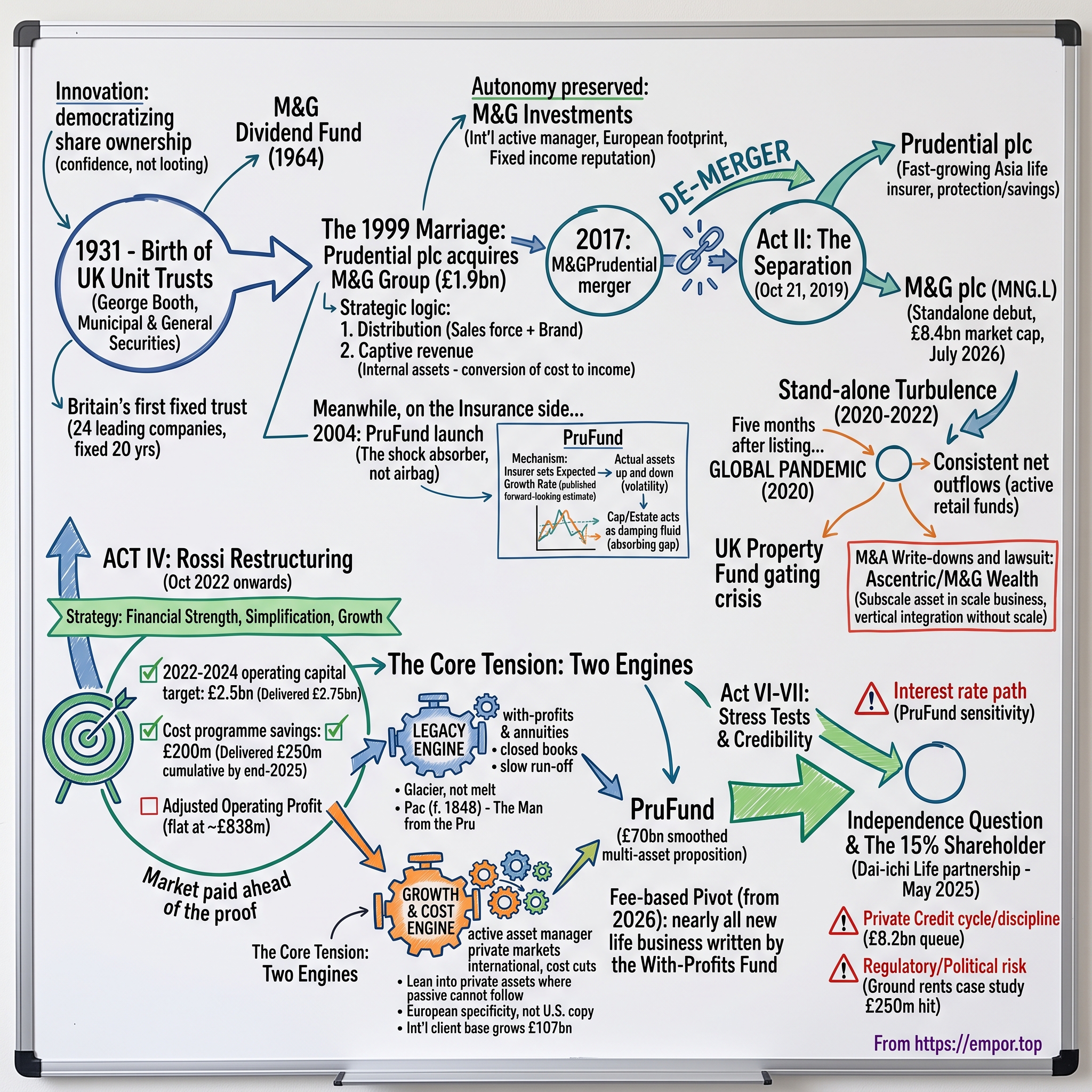
M&G plc: The Savings Engine, The Demerger, and The High-Yield Dilemma
I. Introduction & Episode Roadmap
On 21 October 2019, at eight o'clock in the morning, a company that had existed for eighty-eight years without ever having a share price of its own began trading on the London Stock Exchange.1 There was no roadshow, no bookbuild, no anchor investors. M&G plc arrived on the market the way an adult child arrives at their own front door for the first time: handed the keys, given a mortgage, and told to get on with it. Every Prudential plc shareholder simply woke up owning one M&G share for every Prudential share they held, whether they wanted it or not.1
That is an unusual way to be born, and it explains a great deal about the seven years that followed. A demerged company inherits a shareholder register it did not choose, a balance sheet it did not build, and a set of businesses that were assembled to serve someone else's strategy. Index funds had to hold it. Income funds piled in for the yield. Growth investors sold. For much of its early life, M&G traded less like a franchise and more like a bond with an equity wrapper — a machine for converting a very old book of British life insurance policies into cash dividends.
Today the machine looks different, and the numbers have moved in ways that deserve scrutiny rather than applause. At the end of 2025 the group managed and administered £375.9 billion of assets, up from £345.9 billion a year earlier, and reported £7.8 billion of net inflows from open business against £1.9 billion of net outflows the year before — a swing of nearly £10 billion.2 Adjusted operating profit before tax was £838 million, essentially unchanged from £837 million.2 That combination is the whole story in miniature: a large and genuine improvement in commercial momentum that has not yet shown up in profit. The market has been willing to pay ahead of the proof. M&G shares changed hands around 350 pence in late July 2026, close to the top of a twelve-month range whose floor was 247 pence, giving the group a market capitalisation of roughly £8.4 billion.3 On the 20.5 pence of dividend declared for 2025, that is a yield near 5.8% — high by FTSE 100 standards, but a long way from the 9%-plus distress yield the shares carried for much of the post-listing period.2 The re-rating has already happened. The question is what has to be true to justify it.
The core tension inside M&G runs between two engines that pull in opposite directions.
The first is the legacy engine. Inside M&G sits The Prudential Assurance Company Limited — the entity founded in 1848 that made "the Man from the Pru" a fixture of British domestic life — carrying a closed book of traditional with-profits policies and annuities that requires no new customers to keep producing capital.4 Bolted to it is PruFund, a £70 billion "smoothed" multi-asset proposition sold almost entirely through UK financial advisers, which absorbs market volatility on behalf of nervous retirees and has become one of the most distinctive products in British retail finance.5
The second is the growth-and-cost engine. M&G Investments is a genuinely international active asset manager with £345 billion under management, of which £81 billion sits in private markets and £107 billion comes from clients outside the UK.5 It competes in a market where passive funds have compressed fees for two decades, and where scale increasingly beats craft. Its answer has been to lean into the places where passive cannot easily follow — private credit, real estate, infrastructure, high-conviction European equities — and to cut costs everywhere else.
The roadmap from here. Act I covers the origins: a 1931 invention that democratised British share ownership, and the twenty-year marriage inside Prudential that made M&G a household name while burying it inside a conglomerate. Act II is the separation itself, and why a company chose to hand its UK business to its own shareholders rather than sell it. Act III is the difficult early standalone years — a pandemic, persistent outflows, and an acquisition spree in wealth that ended in write-downs and a lawsuit. Act IV is the Andrea Rossi restructuring, its targets, and its execution record measured against what was actually promised. Act V examines the competitive machinery: how PruFund really works, whether private markets scale is a moat or a fashion, and what Hamilton Helmer's 7 Powers framework does and does not support here. Act VI stress-tests the whole thing from both sides, including the case an activist would make. And the closing act narrows everything down to the small number of metrics that will actually tell an investor whether this is working.
Start where it started: with a fixed portfolio of twenty-four shares, sold to people who had never owned equities in their lives.
 Subscribe on LinkedIn
II. Origins & Evolution: Unit Trusts to the Prudential Empire (1931–2017)
Britain in 1931 was not an obvious place to launch an investment product. Sterling had just left the gold standard, unemployment was climbing toward three million, and the Wall Street Crash was two years in the rear-view mirror with the wreckage still smoking. Share ownership was the preserve of the wealthy — not because ordinary people lacked money, but because they lacked a mechanism. Buying a diversified portfolio required capital, a stockbroker, and the confidence to use both.
Into that gap stepped Municipal & General Securities, and George Booth, with an idea imported from America and adapted for British conditions. In 1931 the firm launched the First British Fixed Trust, the United Kingdom's first unit trust.4 The structure was almost aggressively simple: pool small sums from many investors, buy the shares of twenty-four leading British companies, and then do nothing. The portfolio was fixed for a twenty-year life.6 No manager would trade it. No one would change their mind.
That last detail matters more than it looks. The fixed portfolio was not a limitation, it was the product. In 1931 the barrier to retail investing was not access — it was trust. A fund that could not be tinkered with was a fund that could not be looted, and the constraint substituted for a track record nobody yet had. M&G's founding insight was that the retail investor's binding constraint is confidence, not returns. Ninety-five years later, PruFund sells on very nearly the same proposition: a promise about the experience of investing, not just the outcome.
The firm spent the following decades inventing products for the British saver with a consistency that is easy to overlook. The M&G Dividend Fund arrived in 1964 for investors who wanted income rather than capital growth.4 In 1973, as interest rates fell after recession, M&G launched the UK's first retail high-yield corporate bond fund — an unglamorous decision that seeded a fixed income franchise which would later become the firm's institutional calling card.4 By the 1990s M&G was the largest unit trust group in Britain, with a brand that meant something to people who could not have told you what a unit trust actually was.
The 1999 marriage
Which is exactly why Prudential bought it. In 1999 Prudential plc acquired M&G Group for £1.9 billion — a very large cheque for an asset manager at the time, and one that made strategic sense on two levels.7 The obvious level was distribution: Prudential had millions of policyholders and a sales force; M&G had funds and a brand. The less obvious level was industrial. Prudential's with-profits and annuity funds held tens of billions of pounds that had to be invested by someone, and paying that fee to an external manager was value walking out of the door. Owning M&G converted a cost line into a captive revenue line.
This is the origin of what M&G's current management calls its "synergistic business model," and it is worth being precise about what the synergy actually is, because it is repeatedly described in ways that flatter it.5 An insurer that owns its asset manager does not automatically create value; it merely relocates the fee from one pocket to another. The value is created only if the internal balance sheet allows the asset manager to do something it otherwise could not — seed a fund it could not have raised, anchor a strategy no third party would back first, or build a track record in an asset class with a long gestation. That test is real, and M&G has passed it in specific places. It is not a general licence.
Under Prudential ownership M&G kept its own name, its own culture, and — critically — its investment autonomy. The fixed income desk built a reputation that outlived individual careers, and the retail fund range spread across continental Europe, with offices opening in Germany, Austria, Luxembourg and, later, Italy, Spain, France and the Nordics.7 That European footprint, built in the 2000s for reasons that had nothing to do with Brexit or the demerger, turned out to be one of the most valuable things M&G would inherit at listing.
The invention of PruFund
Meanwhile, on the insurance side of the house, Prudential's actuaries were building something stranger.
The problem they were solving is a behavioural one. Retirement savers say they want returns; what they actually want is to not watch their pension fall 30% in a month and then panic-sell at the bottom. Every adviser in Britain has had that phone call. Prudential's answer, launched in 2004, was PruFund: a multi-asset fund held inside the with-profits structure, where the return credited to a customer's policy is not the return the underlying assets actually earned that day.4
Here is the mechanism in plain terms. The insurer sets an Expected Growth Rate — a published, forward-looking estimate of what the fund should earn over the long run. Customers' policy values grow at that rate, day by day, regardless of what markets are doing. Meanwhile the actual assets go up and down as assets do. When the two drift too far apart, a "unit price adjustment" pulls the smoothed value back toward reality, sometimes sharply. The gap between the two is absorbed by the with-profits fund's own capital — the estate built up over more than a century of Prudential policyholders.8
The analogy that works best: PruFund is a shock absorber, not an airbag. It does not stop the road being bumpy. It converts a series of violent jolts into a slower, gentler motion, and it can only do that because there is a very large reservoir of capital sitting underneath acting as the damping fluid. A newcomer cannot build one, because the reservoir takes generations to fill.
Rossi returned to this in March 2026 with a specific example. During the market dislocation of April 2025, he told analysts, PruFund "performed as it was supposed to perform. We smoothed the volatility." He then added, with more candour than most CEOs manage about their own customers: "Clients, unfortunately, they took out their money and then they came back."5 The product worked; some customers redeemed anyway. That is a useful corrective to the idea that smoothing produces perfectly sticky money.
By 2017 Prudential had decided that these two businesses — the asset manager and the UK life company — belonged together and, increasingly, belonged somewhere other than inside Prudential plc. In August 2017 it announced the merger of Prudential UK & Europe with M&G Investments to create M&GPrudential.1 Officially this was about combining investment capability with a savings franchise. In practice, it was the surgeon drawing the line on the skin before making the incision.
III. The Demerger & Standalone Debut (2017–2019)
The incision came on 14 March 2018, and it came with a second announcement attached that told investors far more about the logic than the first one did.
Prudential plc said it intended to demerge M&GPrudential, giving it a premium listing in London. On the same day it announced that M&GPrudential had reinsured £12 billion of its shareholder annuity portfolio to Rothesay Life — around 400,000 policyholders, the largest transaction of its kind in the UK at the time, with a Part VII transfer to follow.9 The two announcements were inseparable. Prudential was not simply splitting itself in half; it was making the UK half lighter before pushing it out of the nest.
Why a conglomerate takes itself apart
The strategic reasoning was about who owns the shares and why. Prudential plc had become two companies wearing one ticker. One was a fast-growing Asian life insurer selling protection and savings products to a rising middle class across a dozen markets — a business investors valued on growth. The other was a mature UK savings and asset management business with a large closed book, valued on capital returns and dividend cover. Those investor bases barely overlap. Every pound of capital allocated to one was a pound the other set of shareholders felt was misdirected, and the blended valuation satisfied neither.
Regulation sharpened the point. Solvency II, the European capital regime supervised in the UK by the Bank of England's Prudential Regulation Authority, applies capital requirements calibrated to the risks a group actually carries, and a group containing a large UK annuity book carries different — and heavier — requirements than one focused on Asian protection business.[^10] Splitting simplified the regulatory perimeter for both halves. The Rothesay reinsurance was the same instinct applied to the balance sheet: shed longevity risk on a slab of annuities so that whatever listed in London had a cleaner capital profile.
That transaction then produced one of the more instructive legal episodes in recent UK insurance history. In August 2019 the High Court refused to sanction the Part VII transfer of the annuity policies to Rothesay, despite the independent expert concluding there was no material adverse effect on policyholders and despite both the PRA and FCA supporting it.10 The judge's reasoning turned partly on policyholders' reasonable expectations about the Prudential brand — the "Man from the Pru" had, in effect, become a legal fact. In December 2020 the Court of Appeal overturned that decision, finding the original judge wrong on several issues and remitting the application to a fresh hearing.10 For investors the episode carries a durable lesson that reaches well beyond this deal: in UK life insurance, court and regulatory discretion is a live variable in balance-sheet management, and transactions that look actuarially settled can sit in limbo for years.
Listing day, and what actually got handed over
The demerger completed on 21 October 2019, with M&G plc admitted at 8am to the premium listing segment and Prudential shareholders receiving one M&G share for each Prudential share.1 The shares closed their first day of dealings at 218 pence.11
What the new company actually owned was three things of very different character, and understanding the differences is essential to understanding everything that followed.
The Heritage book. Traditional with-profits policies and annuities largely closed to new business. This is the least glamorous and most important asset M&G owns. A closed book does not need marketing, distribution, or product development; it needs administration and prudent investment. As Solvency II reserves unwind and policies mature, capital is released to shareholders. The run-off is also far slower than the word implies. M&G's own investor relations head made the point starkly in March 2026: the traditional with-profits book, closed to new business for well over a decade, contributed £263 million to profit in 2023 and £258 million in 2025 — a decline of about 2% over two years.5 That is not a melting ice cube. It is a glacier.
Asset Management. Active retail funds and institutional mandates, with genuine strength in fixed income and European equities, and a growing private markets business. High margin, but structurally exposed to fee compression and to the reality that a bad three years of performance can empty a fund faster than a good three years can fill it.
Retail savings and wealth. PruFund, distributed through thousands of independent financial advisers, plus the beginnings of an ambition to own more of the chain between the saver and the fund.
The market's initial verdict was that this was a run-off vehicle with an asset manager attached. On the numbers available at the time, that was not an unreasonable read. Whether it was right depended entirely on whether the open businesses could grow faster than the closed one shrank — a race that has now been running for nearly seven years, and whose scoreboard is the subject of the rest of this story.
The first lap went badly.
IV. Post-Listing Turbulence & M&A Benchmark Analysis (2020–2022)
Five months after listing, the world shut down.
M&G's first full year as a public company was 2020, which meant its first proper test as a standalone business was a global pandemic, a 30% drawdown in equity markets, a scramble for liquidity, and — for anyone running a UK property fund — a gating crisis. For a company whose entire pitch to income investors was reliability, this was an unhelpful debut. The dividend survived. The narrative did not fully recover for years.
John Foley, the CEO who took M&G through the demerger, was a Prudential insider who had run its UK life business and its treasury function before that. His task was to make one company out of two cultures — a life insurer with actuarial rhythms and an asset manager with market ones — while simultaneously convincing the market that the combination was a strategy rather than an accident of corporate surgery. He announced his intention to retire in April 2022 after seven years in the role.12
The pressure was not only from markets. Persistent net outflows from active retail equity funds ran through the whole industry as UK wealth managers shifted client money into low-cost index trackers and centralised model portfolio services. This is worth stating plainly because it is the structural fact against which everything M&G has done since must be judged: for most of the last decade, the default behaviour of a UK financial adviser managing a client's money has been to reduce what they pay for active management. An active manager fighting that tide is not fighting a competitor. It is fighting a change in how the buyer's job is defined.
M&G's response under Foley was to buy its way closer to the customer. It is worth examining those deals with hindsight, because the record is genuinely mixed and it forms the baseline against which the current management's capital allocation should be measured.
Ascentric: the vertical integration that wasn't
In 2020 M&G acquired Ascentric, an adviser platform, from Royal London for £86 million.13 Ascentric administered roughly £15.5 billion for about 1,500 advisers.14
The logic was clean on a whiteboard. In UK retail wealth, the platform is the layer where advisers hold client assets — the plumbing through which ISAs, pensions and investment bonds are bought, held and reported. Owning that layer means owning a relationship with the adviser, real-time visibility of flows, and a shelf on which to place your own products. It is the same instinct that drives a consumer goods company to buy a distributor.
The execution was another matter. The platform was rebranded M&G Wealth in 2021, and the business never reached the scale where platform economics work.13 Platforms are fixed-cost businesses: technology, custody, compliance and service costs are largely invariant to assets, so profitability arrives only above a scale threshold and arrives quickly once it does. At £15 billion, M&G was well below the level at which the incumbents — and the outsourced technology providers serving them — could be attacked on cost. The combined platform and advice businesses lost £19 million in the first half of 2023 and £9 million in the first half of 2024.15
It got worse. In December 2024 it emerged that M&G had sued Royal London for at least £27 million plus interest, alleging that Royal London had failed to disclose during the sale process that the platform held high-risk illiquid investment bonds — roughly £27 million of CFB Bonds sold to 553 investors, for which no liquid market existed outside the platform itself.16 Whatever the legal merits, which remain to be determined, the episode says something about the diligence performed on a deal whose entire premise was operational control of a customer relationship.
The honest verdict on Ascentric: the price was not the problem. £86 million for £15.5 billion of administered assets was not an aggressive multiple by the standards of UK platform M&A. The problem was that M&G bought a subscale asset in a scale business and then had to fund the migration, the technology and the losses from a group that had committed its cash flow to a dividend. That is a strategic error, not a valuation one, and it is the more expensive kind.
responsAbility: the small deal that aged well
The contrast is instructive. In January 2022 M&G agreed to acquire a majority of responsAbility Investments AG, the Zurich-based impact investing specialist, completing in May 2022 with an initial 90% of the share capital and around $3.7 billion of assets under management.17 The price was not disclosed. responsAbility brought roughly 200 employees, a Zurich hub, and two decades of experience originating private debt in emerging markets — microfinance, sustainable agriculture, climate finance — having deployed more than $11 billion since 2003.17
Measured by assets, this was a rounding error against a group managing hundreds of billions. Measured by capability, it was the more strategically coherent purchase of the two. It added origination — the ability to find and underwrite private assets, which is the scarce skill in private markets — rather than distribution, which M&G already had. Small deals that buy capability tend to compound; large deals that buy assets tend to disappoint. That pattern has since become explicit policy under the current management.
The advice networks
The third leg was the acquisition of financial advice firms: Sandringham Financial Partners, completed in January 2022, with over 180 adviser partners and more than £2.5 billion of advised assets across some 10,000 clients; and an initial 49.9% stake in Continuum in 2022, with the balance to follow.1819
The rationale was defensive. If advisers are the gatekeepers to PruFund, and if competitors like St James's Place had demonstrated that owning the adviser relationship is worth more than owning the fund, then M&G needed a captive advice channel. The counter-argument — which the subsequent regulatory environment has strengthened considerably — is that owning advice in the UK means owning conduct risk. Under the FCA's Consumer Duty, which requires firms to deliver good outcomes and to evidence fair value across the entire distribution chain, a vertically integrated firm that manufactures a product, advises a client to buy it, and administers it on its own platform must demonstrate that each layer of charge earns its keep.20 That is a demanding standard, and it applies to the whole chain, not to each link separately.
By late 2022 the picture was of a company that had diagnosed its strategic problem correctly and executed the response poorly. It had spent capital on distribution and got losses, write-downs and litigation. It had spent a little on capability and got something durable. And it had a share register full of income investors watching the cash flow with the intensity of people who own a bond, not a business.
That was the inbox waiting for the man who arrived in October 2022.
V. The Andrea Rossi Restructuring Era: Strategy & Segment Economics
Andrea Rossi took over as Group Chief Executive on 10 October 2022 — a date that placed him in the chair roughly two weeks after the UK gilt market had come close to breaking during the pensions liability-driven investment crisis.12 It is difficult to imagine a more pointed introduction to the risks embedded in British long-term savings.
Rossi is not a Prudential man, which is the most important fact about him. He spent most of a twenty-two-year career at AXA, six of them as chief executive of AXA Investment Managers, where assets under management rose 55% to €800 billion and assets from external clients more than doubled.12 Before joining M&G he had been a senior adviser at Boston Consulting Group.12 That background matters in two specific ways. He had run precisely the structure M&G has — an asset manager attached to a large European insurer, with a big internal client and an ambition to sell to external ones. And his defining metric at AXA IM was third-party assets, not group assets. He arrived knowing which number he intended to be judged on.
His strategy, announced in 2023, rested on three words that have not changed since: Financial Strength, Simplification, Growth.2 The consistency is itself analytically relevant. Management teams that quietly rotate their strategic pillars are usually covering for a plan that did not work; M&G has repeated the same three headings across four years of results presentations, which makes the execution record easy to score.
The scorecard, as promised versus as delivered
The first cycle ran to the end of 2024. M&G had targeted £2.5 billion of cumulative operating capital generation over 2022–2024 and delivered £2.75 billion, having upgraded the target to £2.7 billion along the way.21 The cost programme was launched with a £200 million savings target, upgraded to £230 million, and finished at £250 million of cumulative savings by the end of 2025.212 It also spent £461 million redeeming and repurchasing subordinated notes in 2024, cutting annual debt interest by £21 million.21
On the metrics management chose, then, the first cycle was delivered and modestly beaten. That is a real achievement and it should be credited. But two qualifications matter.
First, capital generation targets in a life company are more within management's control than revenue targets are. A meaningful share of operating capital generation comes from "management actions" — model refinements, data enhancements, asset reallocations, longevity reinsurance — which release capital held against risks that are then judged smaller than previously assumed. M&G recognises this explicitly, guiding to a recurring £100 million to £200 million per year from management actions, and delivering £236 million in 2025, "just above" that range.5 These are legitimate. They are also, by construction, finite. A business that hits its capital target with above-guidance management actions is telling you something about the quality of the underlying result, and M&G's own disclosure makes this visible rather than hiding it — the underlying capital generation result was £529 million in 2025, £115 million lower than the prior year.5
Second, and more pointedly, profit did not move. Rossi acknowledged this without spin in March 2026: "progress on the Cost-to-Income ratio and Group profit was marginal. Here, I expect a significant improvement."5 Adjusted operating profit of £838 million in 2025 against £837 million in 2024 is, for a company that has cut £250 million of costs and grown assets by £30 billion, a conspicuously flat line.2 The explanation offered is that 2025 was an investment year — distribution hires, investment capability, BPA team build-out — and that the benefits arrive from 2026. That explanation is plausible and internally consistent. It is also, precisely, the thing that must now be proven.
How the two engines actually earn
Asset Management. The business ended 2025 with £345 billion under management, up £30 billion, and generated £7.0 billion of net inflows from external clients — 4.4% of opening assets.2 Rossi called this "top decile, if not top percentile" for active management, and while that is a self-assessment rather than a measured statistic, positive external flows of that magnitude in European active management genuinely are unusual.5
The composition matters more than the headline. Of the £7 billion, £3.9 billion went into private assets, lifting private markets to £81 billion, and the equities team delivered £5.6 billion.5 Management quantified the revenue attached to the year's flows at £23 million of net new annual revenue and reported that the average fee margin held at 33 basis points — actually up one basis point.5 That last detail is the single most useful data point in the Asset Management story. In a business where the consensus expectation is relentless margin erosion, holding the blended fee flat while growing assets means the mix is shifting toward higher-fee products fast enough to offset compression in the lower-fee ones. Rossi was careful not to extrapolate it: asked whether margins could rise further in 2026, he said investors should think of it "more like resilience. I mean, I don't expect it to go up."5
Internationalisation is the other genuine change. Non-UK third-party assets reached £107 billion, up from £89 billion, while UK domestic net flows swung to a positive £0.3 billion from £4.7 billion of outflows in 2024.2 The institutional client count has grown from roughly 800 when Rossi arrived to over 1,000.5 A UK-centric active manager exposed to a structurally shrinking domestic buyer base is a melting asset. A European and Asian one with a UK core is a different proposition, and the numbers support the claim that M&G has been moving from the first category toward the second.
The cost-to-income ratio, however, remains the unfinished business. It improved from 76% to 75% in 2025 against a target of 70% by the end of 2027.2 Kathryn McLeland, the Group CFO, defended the target on the grounds that "achieving this does not depend on a single initiative or assumption, but on continued execution across a number of levers."5 Translated: it requires revenue growth to outpace cost growth for two consecutive years. Costs rose 4% in 2025, of which £28 million of a £31 million increase came from acquisitions and a reclassification.5 The underlying cost line was close to flat. The maths works if flows and markets cooperate. It does not work on cost cuts alone.
Life. Adjusted operating profit was £764 million, up 2%.2 Underneath that stability, the composition shifted in ways that reveal the strategy. PruFund profits rose 17% to £265 million and traditional with-profits rose 16% to £258 million, while shareholder annuities fell 8% to £283 million on a smaller pool of surplus assets and lower expected returns.2 Other Life recorded a £42 million loss, including a £26 million provision relating to the Polish business that management does not expect to repeat.2
PruFund itself returned to net inflows in the last seven months of 2025, totalling just over £400 million, with second-half gross inflows of £3.6 billion, up nearly 28% on the first half.5 The franchise stands at £70 billion.5 The recovery is real but modest, and it followed £0.9 billion of net outflows in 2024, when high cash rates made money market funds a genuine competitor to a smoothed multi-asset product.21 The first quarter of 2026 brought PruFund back to £0.1 billion of net outflows, a reminder that the recovery is not yet a trend.22
The change that actually matters: the fee-based pivot
The most consequential thing M&G announced in March 2026 received less attention than the flow numbers, and it deserves more.
From 2026, nearly all new Life business is being written by the With-Profits Fund rather than the shareholder balance sheet. PruFund, the new fixed-term and lifetime retail annuities, and a newly launched With-Profits bulk purchase annuity proposition all operate on a fee-based model, with M&G providing customer administration and investment services in exchange for fees paid to both Life and Asset Management.5 Management expects these products to reach at least £50 billion of assets by 2030, guiding to 10 to 15 basis points of profit margin plus roughly 20 basis points of asset management fees.5
Strip away the jargon and this is a structural reclassification of what M&G is. A traditional annuity writer takes a lump sum, promises payments for life, holds capital against the risk that customers live longer than expected, and earns a spread. It is capital-intensive, and every pound of new business consumes shareholder capital up front — new business strain of £163 million in 2025, of which £134 million supported £1.5 billion of bulk annuities.25 A fee-based model routes the risk into the With-Profits Fund, which has a £7.1 billion surplus and — as McLeland conceded when pressed by Mediobanca's Thomas Bateman — a lower cost of capital than the double-digit hurdle a listed shareholder requires.5 M&G then clips fees on the assets with, in McLeland's words, "very, very, very little capital."5
The bull reading: this converts an insurance company into an asset-gathering business with insurance characteristics, dramatically improving return on capital. Already, 73% of operating profit comes from capital-light sources.5
The bear reading deserves equal airtime. The With-Profits Fund is not shareholder property. It belongs to policyholders, is governed by a With-Profits Committee with independent obligations, and exists to deliver value to those policyholders — which means pricing products toward customers, not away from them. Luca Gagliardi, M&G's Group Director of Strategy and IR, was refreshingly explicit that the fund's cost of capital is "definitely not zero" and that shareholders take "down that profit from the double-digit rates that a publicly listed company like us would require."5 So the shareholder is trading margin for volume and capital efficiency. Whether that trade creates value depends on whether the volume genuinely materialises — the £50 billion by 2030 figure is an ambition, not a contracted flow — and on whether the With-Profits Committee continues to agree that the arrangement serves its policyholders. That is a governance dependency, and it is not one shareholders control.
The bulk annuity build-out sits inside this. M&G re-entered the BPA market and wrote 11 deals totalling £1.5 billion in 2025, up 65%, doubling its market share from a very small base, and targets £3–4 billion annually by 2027.25 Rossi confirmed the guidance that roughly 75% of future volumes will use With-Profits or value-share capital and 25% shareholder capital.5 Notably, M&G has not reinsured longevity risk on these deals, which raises the risk margin and reduces the reported new business contractual service margin — David Pych of RBC pressed on exactly this point, calculating a thin 2% margin on the year's annuity business.5 McLeland's answer was that retaining longevity keeps the profit in-house over time and preserves reinsurance as a future management action lever.5 That is a defensible choice. It is also a decision to keep a long-tailed risk on the balance sheet in exchange for optionality, and investors should price it as such.
The final piece of simplification was subtraction. In September 2024 M&G confirmed it would exit the platform market through sale or wind-down, folding the wealth business under Clive Bolton's Life division to cut duplication.15 It took a £12 million impairment on the platform ahead of the exit.23 Four years after buying a platform to control distribution, M&G concluded that renting distribution was cheaper — a conclusion reinforced in 2025 when it integrated PruFund with FNZ's technology in order to reach third-party adviser platforms, with the first launch scheduled for the second quarter of 2026.5
That reversal is the cleanest evidence available on how this management team allocates capital: it was willing to reverse a predecessor's strategy publicly and take the write-down rather than defend it. Which brings us to what M&G is actually defending.
VI. The Competitive Engine: PruFund, Private Markets, & The 7 Powers
Ask a hundred UK financial advisers to name a fund that smooths returns and ninety-nine will say PruFund. Ask them to name the second one and you will get a pause. That pause is the closest thing M&G has to a moat, and it is worth interrogating rather than admiring.
Applying the 7 Powers framework, honestly
Hamilton Helmer's framework asks a specific question: what stops a competitor with equal resources from taking your customers? Applied to M&G, three of the seven powers have real support and one is weaker than the story suggests.
Process Power — the strongest claim. PruFund's smoothing depends on something a competitor cannot buy: a with-profits estate large enough to absorb the difference between smoothed and actual returns through a full market cycle, plus decades of actuarial machinery and regulatory approval for running it. The With-Profits Fund's £7.1 billion surplus is the visible tip of this.5 A new entrant wanting to offer a credible smoothed proposition would need to post capital against a promise whose cost is uncertain and whose payoff is a slow accumulation of adviser trust. The economics do not work for a startup, and for an incumbent insurer the capital charge under Solvency II makes it unattractive relative to alternatives.[^10] This is a genuine, durable, hard-to-replicate advantage.
Its limits should be stated with equal clarity. Process Power protects the product, not the demand for the product. When UK cash rates rose in 2023–24, savers discovered that a money market fund paying over 5% with no capital at risk was a perfectly good substitute for a smoothed multi-asset fund, and PruFund bled £0.9 billion in 2024.21 No amount of actuarial sophistication defends against a risk-free alternative yielding more than your expected growth rate. PruFund's moat is deep and narrow: it is nearly impossible to attack head-on and quite easy to route around.
Scale Economies — real in private markets, contested elsewhere. M&G's £81 billion private markets business spans roughly £34 billion in real estate, £27 billion in private and structured credit, about £6 billion in infrastructure and £14 billion in impact and private equity.5 The genuine advantage is the internal balance sheet: over 80% of Life assets are managed in-house, and around 30% of new Life business is allocated to private markets.5 That means M&G's asset manager has a large, patient, captive client willing to anchor strategies before external investors commit. Very few standalone asset managers have that. It is the one place where the "synergistic model" claim is unambiguously substantiated by evidence rather than assertion.
But scale is relative to the competition, and in private credit the competition is Blackstone, Ares, Apollo and Blue Owl, each operating at multiples of M&G's size. Rossi's answer is geographic specificity rather than absolute scale: Europe, he argues, is a fundamentally different market from the US — less mature, less crowded, with roughly 70% of loans still held by retrenching banks, and fragmented across jurisdictions with different laws in a way that rewards 25 years of local underwriting experience. "Europe is not a United States of Europe," he told analysts.5 The claim is credible and the evidence partially supports it: M&G reports a private credit default rate below 1%, against a market average it puts around 2%, and says it turns away two-thirds of the businesses that come to it.5
Investors should hold that claim loosely for a specific reason. Low default rates in private credit are a lagging indicator, and every private credit manager on earth currently reports excellent credit quality. The discipline claim will be tested by a European recession, not by a press release. What can be verified today is that the exposure appears genuinely conservative in the areas where US private credit is under stress: M&G reports less than £1 billion in its European long-term investment fund vehicle, of which roughly 87% comes from its own internal balance sheet, and software exposure at under 2% of the Asset Management private credit book.5 It also has a capital queue — committed but undeployed client money — of £8.2 billion, which is both a revenue pipeline and, if deployment is disciplined, a source of pressure to lower standards.5
Cornered Resource and Switching Costs — present, and eroding at the edges. The M&G and Prudential brands carry unusual recognition in UK retail savings, and the group serves around 4.2 million retail clients from 38 offices.2 Switching away from PruFund involves genuine friction: tax wrappers, adviser fees, potential market value reductions on exit. But the honest assessment is that these are frictions, not lock-ins. The 2024 outflows demonstrated that when the alternative is attractive enough, money moves.
The power M&G most conspicuously lacks is Counter-Positioning — a business model competitors cannot copy without damaging themselves. Legal & General, Aviva, Phoenix and Just Group are all pursuing bulk annuities. Schroders and abrdn are all pursuing private markets. There is no structural reason a competitor cannot follow M&G into any of these markets, and several have more capital with which to do it.
Porter's five forces, in the world M&G actually inhabits
Buyer power is high and rising. UK advisers, consolidators and institutional consultants have spent a decade driving down ongoing charges, and Consumer Duty gives them a regulatory obligation to keep doing so.20 Every conversation about fees now has a compliance officer in the room.
Substitution is the sharpest force. In public active management, the substitutes are Vanguard and BlackRock index products at a fraction of the price. For PruFund, the substitute is cash when rates are high and a simple multi-asset fund when they are not. For bulk annuities, the substitute is a pension scheme deciding to "run on" rather than transact at all — and M&G flagged exactly this, noting that headwinds from UK defined benefit schemes have eased since 2023 "with more clients considering run-on options," while remaining "cautious about the long-term prospects for this segment."5 That is a notably frank admission that a key institutional client base is finite.
Rivalry is intense and consolidating. The UK savings landscape contains Legal & General, Aviva, Phoenix, Schroders, abrdn, St James's Place and Royal London, plus global alternatives managers moving in. Asked in March 2026 about Aon's UK business being for sale and about broader industry consolidation, Rossi drew a clear line: "we're not looking at Aon UK," adding that the M&A activity around M&G is driven either by managers seeking multi-trillion passive scale or by alternatives managers hunting permanent insurance capital.5 His argument is that M&G already possesses what the second group is buying — an insurance balance sheet — and has no need to chase the first. It is a coherent position, and it doubles as a defence of independence.
Supplier power is unusual here: the critical suppliers are portfolio managers and origination teams, who can leave. M&G's structural answer is that its edge rests on process and balance sheet rather than on named stars — but investment performance still ultimately depends on people. As at the end of 2025, 75% of mutual funds by assets ranked in the upper two performance quartiles over five years, and 76% of institutional assets outperformed benchmarks over the same period.2 That is a strong record. It is also a record that requires continuous re-earning.
New entrants face high regulatory barriers in insurance and low ones in asset management — which is precisely why M&G's strategic centre of gravity has been shifting toward the insurance-adjacent, capital-light fee model rather than toward pure fund management.
Myth versus reality
Four consensus statements about M&G circulate widely enough to be worth testing against the disclosure.
Myth: M&G is a run-off business in slow-motion decline. Reality: the closed traditional with-profits book contributed £258 million of profit in 2025 against £263 million in 2023, a decline of roughly 2% across two years.5 Meanwhile the open businesses generated £7.8 billion of net inflows in 2025.2 The correct description is not decline but composition change — and the pace of that change is slow enough that the outcome will be determined by growth, not by the run-off.
Myth: active management is dying, so M&G's asset manager is a wasting asset. Reality: the aggregate industry statistic is true and the firm-level result contradicts it. External net inflows of 4.4% of opening assets, a stable 33 basis point fee margin, and 75% of mutual funds in the top two quartiles over five years describe a franchise gaining share within a shrinking pool.25 The nuance is that the growth is concentrated outside the UK and outside public equities — the international book grew to £107 billion and private assets took £3.9 billion of the £7 billion.25 The UK active retail equity business remains the challenged part. The group is not that business anymore.
Myth: the dividend is the whole investment case. Reality: that was true at listing and is less true now. The dividend has grown at 2% under the progressive policy, and management has explicitly reframed capital priorities toward "disciplined investment" ahead of returning excess capital.25 At a mid-single-digit yield rather than a high-single-digit one, an investor is being asked to underwrite growth, not to collect a distress coupon.
Myth: the insurance balance sheet is shareholder capital that management can deploy at will. Reality: the £7.1 billion With-Profits Fund surplus that underwrites PruFund's smoothing, the new fee-based products and the With-Profits bulk annuity proposition belongs to policyholders and is governed by a With-Profits Committee with independent duties.5 Shareholders benefit from access to it, not ownership of it. This is the most commonly misread feature of M&G's structure, and it cuts both ways: it is why the moat is hard to copy, and why the growth plan has a governance dependency outside management's control.
The competitive picture, then, is a company with one genuinely rare asset (the with-profits engine and the balance sheet behind it), one contested but defensible position (European private markets), and one structurally challenged business (public active management) that is currently performing well above the sector's baseline. That is a more interesting hand than the market gave it credit for in 2023. It is not an unassailable one.
Which makes the question of who is playing the hand, and how they are paid, unusually important.
VII. Corporate Governance, Management Credibility, & Capital Allocation
There is a moment in the March 2026 analyst call that tells you more about M&G's internal culture than any governance disclosure. Andrew Crean of Autonomous asked a question about PruFund's platform opportunity. Rossi's response: "Shall we pass the second question to Clive as I want my CEO to speak."5
Small thing. But chief executives of financial companies routinely answer everything themselves, and the ones who do not are usually running organisations where divisional leaders are accountable for their own numbers. On that call, four executives fielded questions: Rossi, McLeland, Joseph Pinto for Asset Management, and Clive Bolton for Life.5 Bolton used his airtime to make a concrete, unhyped point about distribution — that putting PruFund on third-party platforms is "the equivalent of making sure that our brand is in all the supermarkets" — and then, when asked to size the opportunity, said plainly: "I don't have a number for you today."5
That is the correct answer and it is rarer than it should be.
Reading the credibility record
Management credibility is best assessed by behaviour over multiple periods, and M&G's record breaks into three parts.
Where the record is good. The strategic framing has been stable since 2023, which makes the promises checkable. The cost target was set at £200 million, raised twice, and delivered at £250 million.2 The first capital generation target was set at £2.5 billion and delivered at £2.75 billion.21 Deleveraging was promised and executed.21 When Rossi was asked in 2026 whether M&G might buy Aon's UK business, he refused rather than leaving the door open — a small but meaningful signal for a company whose shareholders have watched acquisition-driven strategies fail before.5
Where the record is honest about being uncomfortable. Rossi's acknowledgment that group profit progress "was marginal" was not forced out of him by an analyst; it was in the prepared remarks.5 McLeland separately flagged that a favourable deferred tax movement supporting the solvency ratio should be treated as "largely one-offs" that investors should not expect to repeat at scale.5 Management teams that pre-emptively de-emphasise a favourable one-off are behaving in a way that makes their other statements more believable.
Where investors should apply pressure. Three things.
First, the strategic reversal in wealth was expensive and has never been framed as an error. The platform exit was presented as "simplification," which is true but incomplete: the platform was bought in 2020 to secure distribution, written down, put up for sale, and exited — and M&G then achieved the original distribution objective by partnering with FNZ instead.13155 Management inherited the deal rather than making it, which is a legitimate defence. But the framing has been gentler than the facts warrant.
Second, the profit growth target of at least 5% on average across 2025–2027 now carries an arithmetic burden. With 2025 flat, the remaining two years must deliver roughly 8% growth each to average out — a point Nasib Ahmed of UBS put directly to management on the call.5 Rossi's answer is that 2026 will show "meaningful acceleration."5 There is now very little slack in that target, and the market has already paid for it.
Third, guidance for capital generation is expressed before new business strain. The £928 million figure that management describes as "in line with our £2.7 billion target" excludes the £163 million of capital consumed writing new business.2 Actual operating capital generation was £765 million.2 The exclusion is analytically defensible — strain is investment in future profit, and M&G discloses both figures clearly — but investors funding a progressive dividend should anchor on the figure after strain, because that is the cash that actually exists. As BPA volumes scale toward the £3–4 billion target, strain grows before the profit does. Management guides to new business strain of up to £150 million in 2026.5
How the money gets allocated
The capital framework is now stated with unusual specificity. In 2025, more than half of operating capital was distributed to shareholders as dividends, with the remainder split between simplification investment and growth deployment targeting double-digit internal rates of return — including £90 million for the P Capital Partners acquisition and £163 million supporting Life new business.5
P Capital Partners is the template for what this management buys. Announced in February 2025, M&G acquired 70% of the Stockholm-based private credit specialist, with management retaining the rest — a 42-person firm led by founder Daniel Sachs that has raised around €7 billion over two decades and invested more than €5 billion across 170-plus companies, lending to companies that are not private-equity owned.24 That last detail is the strategic point: non-sponsored lending is a segment where relationships and local knowledge matter more than balance-sheet size, which is exactly where a mid-sized European manager can compete against a US giant. The same logic applied to BauMont Real Estate Capital; together the two acquisitions accounted for £28 million of the £31 million increase in Asset Management costs and added roughly £1 billion to the capital queue.5
Rossi's stated ambition for further capability is telling: asked where he would expand next, he pointed to infrastructure, reasoning that European energy security pressures will drive renewable and infrastructure investment for years.5 Whether that is foresight or thematic enthusiasm is not yet determinable.
On distributions, M&G moved to a progressive dividend policy alongside its 2024 results, delivering a 2% increase to 20.1 pence and then 20.5 pence for 2025.212 The wording used at the 2025 results was that M&G remains "committed to return any excess capital over time" but is "prioritising disciplined investment that can deliver attractive returns above our cost of capital."5 For a company whose equity story was built on distributions, that is a deliberate shift in emphasis from returning capital to deploying it — and shareholders who bought the yield should register it.
Incentives
Remuneration is anchored on the metrics management has asked to be judged on. The 2025 long-term incentive grant weighted cumulative operating capital generation excluding new business strain at 40%, within a scorecard that also references adjusted operating profit, operating change in contractual service margin, net flows from open business, assets under management, the Solvency II coverage ratio and total capital generation, with vesting over a minimum three-year period.25
The alignment is broadly sensible: it rewards capital generation and flows rather than assets alone, which is the right emphasis for a business whose central risk is gathering low-margin money to flatter a headline. The obvious critique is the same one that applies to the guidance: weighting the largest single component on the pre-strain measure creates a mild incentive to write new business whose strain is excluded from the metric it consumes.
The shareholder in the room
The most significant governance development since listing is not internal. On 30 May 2025, Dai-ichi Life Holdings — 第一生命ホールディングス — announced it would acquire approximately 15% of M&G through on-market purchases, becoming the largest single shareholder, with the right to appoint one director to the board while it holds at least that stake.26
This is far more than a passive stake. M&G became Dai-ichi's preferred asset management partner for Europe, with expected flows of at least $6 billion to M&G over five years — half from Dai-ichi's own balance sheet on an evergreen basis, half from jointly developed opportunities — and at least $2 billion flowing the other way.26 Collaboration extends to bulk annuity expertise, potential co-investment in new capabilities, and distribution of M&G products in Japan and Asia.26 In its first seven months the partnership generated £0.4 billion of net inflows, and Rossi said in March 2026 that he expected to exceed $1 billion by the first anniversary in May.5
For investors this cuts two ways, and both should be held simultaneously. A 15% strategic holder with a board seat, a ¥-denominated balance sheet Rossi sizes at £390 billion, and a commercial reason to want M&G to succeed is a powerful stabiliser — and, as Rossi noted, institutional clients like investing alongside two large insurance balance sheets rather than one.5 It also makes a hostile approach for M&G considerably harder, which is worth remembering given the takeover speculation that has periodically surrounded the company — Schroders was reported to have contemplated an offer, and in March 2023 Macquarie's chief executive dismissed as "speculative" reports that the Australian group was exploring a bid worth around £5 billion.[^28] A blocking-adjacent stake removes that optionality from minority shareholders. Whether the strategic value exceeds the lost takeover premium is a judgement, not a fact.
Which is the right frame for everything that follows.
VIII. The Investor Stress Test: Bear vs. Bull Case & Risk Radar
Imagine two fund managers arguing about M&G over lunch. Both have read the same annual report. Both are correct about the facts. They reach opposite conclusions, and the reason they do is that they disagree about one thing: what happens when the old book stops being big enough to matter.
The bear case, argued properly
The core structural claim is a race against time. M&G's Heritage businesses generate cash and capital without needing customers. Everything the company does to grow — bulk annuities, private markets fundraising, PruFund distribution, international expansion — is funded, directly or indirectly, by that run-off. The bear's argument is not that the run-off is fast. Management has demonstrated convincingly that it is slow. The argument is that the replacement is slower still, and lower-margin. The new fee-based With-Profits model targets 10 to 15 basis points of profit margin plus around 20 basis points to the asset manager on an aspirational £50 billion by 2030.5 Apply the midpoint and the arithmetic gets you to a business generating a few hundred million pounds of profit at the end of the decade — meaningful, but a replacement rather than a step-change, and it arrives only if the £50 billion does.
The profit line is the indictment. Three years of restructuring, £250 million of cost savings, a £30 billion increase in assets, and adjusted operating profit went from £837 million to £838 million.2 Every explanation offered is reasonable. Cumulatively, they describe a business where operating leverage has not yet appeared. If 2026 does not show the promised acceleration, the credibility built over three years is spent in a single morning.
The valuation has moved to meet the story. From a 12-month low of 247 pence, the shares have re-rated substantially.3 The high-yield safety net that made M&G interesting when it yielded 9% is thinner at 5.8%. An investor buying now is not buying a discounted run-off vehicle; they are underwriting the growth plan at something closer to fair value for a business executing well.
The activist case. A skeptical activist would look at this structure and see two businesses whose only genuine linkage is the seeding relationship, joined by a corporate centre that cost £206 million in 2025.2 The argument would be: separate them. Sell or spin the asset manager — with £345 billion under management, 33 basis points of fee margin, £107 billion of international assets and demonstrably good performance, it would attract interest from global players seeking European distribution. Place the Heritage book into a run-off vehicle optimised for maximum distribution, of the kind Phoenix and Utmost have built businesses around. It is not a hypothetical: Schroders was reported to have worked with Rothesay and the entrepreneur behind Utmost Group on precisely such a carve-up.[^28]
Management's counter is that the seeding relationship, the 30% allocation of new Life business to private markets, and the co-investment credibility with institutional clients are the whole point — separate them and both halves are worth less.5 That defence has evidential support in the private markets flow data. But it is worth being clear that the Dai-ichi stake now makes the activist route substantially harder to execute regardless of its merits, and shareholders should not assume the option is meaningfully live.
The complexity discount is earned, not imposed. Understanding M&G requires holding IFRS 17 contractual service margin, Solvency II own funds, present value of shareholder transfers, operating capital generation before and after new business strain, and adjusted operating profit in one's head simultaneously — with the caveat that the largest pool of capital in the group belongs to policyholders, not shareholders. Companies that require this much translation trade at a discount for a reason.
The bull case, argued properly
The flow inflection is real and it is not a market effect. £7.0 billion of external net inflows into Asset Management in a year when European active managers were broadly in outflow, at a stable 33 basis point margin, with £23 million of identified new annual revenue, is not explicable by rising markets.25 Nor is the swing in UK domestic flows from £4.7 billion of outflows to £0.3 billion of inflows.2 Something changed in the commercial engine.
The 2026 operating leverage argument is arithmetically sound. Asset Management enters 2026 with £30 billion more opening assets, stable margins, and a cost base management says is largely built.5 Life enters with a contractual service margin 10% higher at £6.6 billion — the accounting store of future profit that releases into earnings over time.2 Revenue attached to assets already gathered, released against costs already incurred, is the most mechanical form of profit growth there is. If it does not appear in 2026, the problem is not the market.
Capital strength is genuine. A 242% shareholder Solvency II coverage ratio with a £5 billion surplus and stable own funds of £8.5 billion provides cover for the dividend and for the strain of writing new business.25 The annuity book remains 96% investment grade and 74% single-A or above.5
Optionality that is not in the numbers. PruFund reaching third-party platforms is the most concrete near-term catalyst. Rossi sized the UK digital platform market at roughly £700 billion with around 10% annual gross flows — about £70 billion a year — of which the FNZ integration reaches roughly half.5 PruFund has never been available there. Add the Zurich distribution agreement in the UAE, the Guotai Haitong arrangement for distributing fixed income funds in China and Hong Kong, and the Dai-ichi pipeline, and there are several independent shots on goal.5
The risk radar: what could actually break the case
Interest rate path. The mechanism is precise: when cash yields exceed PruFund's expected growth rate, the product's core proposition weakens and flows reverse. This was demonstrated, not theorised, in 2024.21 Any prolonged period of high short rates is a direct headwind to the flagship retail product.
Private credit. Rossi described himself as "cautiously optimistic," was explicit that M&G has no US private credit exposure and no exposure to the specific US names generating headlines, and pointed to Europe's stricter regulation and lower leverage.5 The mechanism to watch is not headline default rates but the pressure created by that £8.2 billion capital queue: money committed by clients must eventually be deployed, and deployment deadlines have historically been where underwriting standards erode across the industry.
Regulatory and political risk, quantified. The clearest current example is ground rents. On 27 January 2026 the UK government proposed capping existing residential ground rents in England and Wales at £250 from 2028, reducing to zero over a 40-year transition.27 M&G disclosed direct exposure of £722 million through the Prudential Assurance shareholder fund, a £230 million one-off reduction in Solvency II own funds, a solvency surplus impact limited to £140 million after releasing capital already held, roughly one percentage point off the coverage ratio, and about £15 million of annual adjusted operating profit from 2028.2728 The absolute numbers are manageable. The lesson is not: a single line item in a UK government housing policy removed a quarter of a billion pounds of own funds from a life insurer's balance sheet, and this is a recurring feature of holding long-dated UK assets, not an anomaly.
Consumer Duty is the second regulatory axis, and it bears on M&G with particular force because the group manufactures products, provides advice through owned networks, and administers assets — meaning it must evidence fair value at every layer of a chain it owns end to end.20
Execution risk in the fee-based pivot. The entire growth architecture now depends on the With-Profits Fund being willing and able to write the business. That requires ongoing agreement from a With-Profits Committee whose duty is to policyholders. Management describes the committee as "very strict."5 Investors should read that as a genuine constraint rather than reassurance.
Concentration and geopolitics. Rossi twice referenced the Middle East crisis then ten days old, noting candidly: "no one can predict, is it going to be a week? Is it going to be two months? This can all have different consequences."5 A savings business is a leveraged bet on asset prices; a sustained market drawdown reduces fee income and solvency simultaneously.
Technology. M&G reports that nearly 40% of its code is now generated by AI tools and frames AI around client engagement, productivity and process transformation.5 Deployed well, this is a cost lever in exactly the businesses — administration, contact centres, research support — where M&G's cost-to-income problem lives. It is also, over a longer horizon, a competitive threat: technology that compresses the cost of investment research and portfolio construction compresses the price of active management along with it.
The verdict a fair-minded investor should reach is that both cases are live and that the resolution arrives on a specific, checkable timetable. Which is why the metrics matter more than the narrative.
IX. Strategic Playbook, Key KPIs, & Epilogue
Step back from the quarterly detail and M&G's seven years as a public company have produced a set of lessons that generalise well beyond one FTSE 100 savings business.
Legacy assets are strategic assets if you deploy them rather than merely harvest them. The most valuable thing M&G inherited from Prudential was not the annuity cash flow; it was the with-profits estate. Used passively, it is a slowly depleting reservoir. Used actively — as seed capital for private markets funds, as the balance sheet behind a smoothed retail product, and now as the risk carrier for fee-based new business — it becomes the foundation of a strategy competitors cannot copy. The distinction between a company that harvests its legacy and one that redeploys it is usually the distinction between a value trap and a turnaround.
Process beats personality in asset management, but only where the process is genuinely capital-backed. M&G's most defensible position is the one that depends on a hundred-year-old capital pool and an actuarial machine, not the one that depends on any individual fund manager. Star managers leave. Estates do not. But note the qualifier: the moat exists because the process is expensive to replicate, not because it is clever. Clever is copyable.
Owning the customer is not always cheaper than renting them. M&G spent four years and considerable capital attempting to own the platform layer of UK wealth distribution, then exited and achieved the same distribution objective by integrating with a third-party technology provider.13155 Vertical integration is a scale game. Below the scale threshold it is simply a cost centre with a strategy narrative attached.
In structurally challenged industries, capital allocation is the strategy. Nothing M&G has done since 2022 involves a new product category that did not previously exist. What changed was where the money went: out of subscale distribution assets, into capability acquisitions and into the highest-return use of the balance sheet. In a business where the market sets your revenue, discipline about where capital goes is the only meaningful lever management controls.
The three numbers that will settle the argument
An investor cannot track everything, and most M&G disclosures are noise around three signals.
1. Operating capital generation — reported after new business strain. This is the cash engine that funds the dividend and the growth investment simultaneously. Track the headline figure, not the pre-strain measure management prefers, because it captures the full cost of the growth strategy in the period it is incurred. The tension to watch: as bulk annuity volumes scale toward the £3–4 billion target, strain rises before profit follows.5 If reported capital generation stays flat while the pre-strain figure marches upward, the growth is being funded by the distribution — and eventually one of them gives.
2. Asset Management net external flows and the fee margin, together. Neither number means much alone. Flows without margin means gathering cheap money that flatters assets and does nothing for profit; margin without flows means a shrinking business defending price. The 2025 combination — £7.0 billion of external inflows with the blended margin steady at 33 basis points — is the single strongest evidence that M&G's asset management franchise is competitive rather than merely large.25 Watch whether it repeats, and watch particularly whether non-UK assets keep compounding from the £107 billion base.2
3. PruFund net flows. This is the health barometer for the entire retail proposition and, increasingly, for the fee-based Life model that depends on gathering assets into the With-Profits Fund. It is also the metric most directly sensitive to interest rates and to the third-party platform launch. Positive flows through 2026 would validate both the product's continuing relevance and the distribution strategy. The £0.1 billion of net outflows in the first quarter of 2026 is a reminder that the recovery has not yet compounded into a trend.22
Epilogue: the independence question
Rossi's strongest statement in March 2026 was not about profit or flows. It was about ownership: "we have a very strong independent future in front of us."5
He was answering a question about industry consolidation, and his reasoning was structural rather than sentimental. The M&A logic sweeping global asset management, he argued, runs in two directions — toward multi-trillion-dollar scale in commoditised products, and toward alternatives managers acquiring insurance balance sheets to secure permanent capital. M&G, in his framing, does not need the first and already possesses the second.5
There is real force in that. An alternatives manager buying a life insurer is paying a premium for exactly what M&G has owned since 1848 — a large, patient, regulated pool of long-dated liabilities that can be matched with illiquid assets. And with Dai-ichi Life holding roughly 15% and a board seat, the practical path to a hostile change of control has narrowed considerably.26
But independence is a consequence, not an achievement. Companies remain independent when their standalone plan produces more value than a buyer would pay, and M&G's standalone plan currently rests on two propositions that will be tested within eighteen months: that operating leverage appears in 2026 after three years of flat profit, and that the Asset Management cost-to-income ratio reaches 70% by the end of 2027 from 75%.25 Both are checkable. Neither is yet proven.
The deeper question the story raises is one the whole European savings industry is grappling with. For most of the twentieth century, the business of managing other people's retirement money was two separate industries: insurers who took risk onto their balance sheets, and asset managers who took fees for opinions. M&G is running an experiment in fusing them — using policyholder capital as the risk carrier, shareholder capital as the growth funder, and fee income as the output. If it works, it produces a business with an insurer's durability and an asset manager's returns on capital. If it does not, it produces a complicated company that is neither, trading at a discount to both.
Ninety-five years ago, two men sold British households a fixed portfolio of twenty-four shares on the promise that nobody would meddle with it. The company those men founded now runs one of the most actively engineered balance sheets in British finance. The product has changed beyond recognition. The proposition — give us your savings, and we will make the experience of investing survivable — has not changed at all.
References
-
M&G plc Full Year 2025 Results — M&G plc, 2026-03-12 ↩↩↩↩↩↩↩↩↩↩↩↩↩↩↩↩↩↩↩↩↩↩↩↩↩↩↩↩↩↩↩↩↩
-
M&G plc Stock Overview & Regulatory Announcements — London Stock Exchange ↩↩
-
M&G plc 2025 Full Year Results: Presentation and Q&A Transcript — M&G plc, 2026-03-12 ↩↩↩↩↩↩↩↩↩↩↩↩↩↩↩↩↩↩↩↩↩↩↩↩↩↩↩↩↩↩↩↩↩↩↩↩↩↩↩↩↩↩↩↩↩↩↩↩↩↩↩↩↩↩↩↩↩↩↩↩↩↩↩↩↩↩↩↩↩↩↩↩↩↩↩↩↩
-
Prudential plc to demerge M&G Prudential from Prudential plc, and announces the partial sale of its UK annuity portfolio — Prudential plc, 2018-03-14 ↩
-
Court of Appeal overturns the High Court's decision in Prudential-Rothesay transfer — CMS ↩↩
-
M&G names Andrea Rossi as chief executive — Money Marketing, 2022-09-29 ↩↩↩↩
-
M&G buys Ascentric from Royal London — Reuters, 2020-05-22 ↩↩↩↩
-
Exclusive: M&G puts £15.5bn platform up for sale — Citywire New Model Adviser, 2024-01 ↩
-
M&G to exit platform market — Money Marketing, 2024-09-04 ↩↩↩↩
-
M&G sues Royal London over Ascentric acquisition — Money Marketing, 2024-12-24 ↩
-
M&G completes the acquisition of responsAbility Investments AG — responsAbility, 2022-05-03 ↩↩
-
M&G to acquire Continuum over next two years — Money Marketing ↩
-
M&G plc full year 2024 results — M&G plc, 2025-03-19 ↩↩↩↩↩↩↩↩↩
-
M&G writes down adviser platform by £12m ahead of exit — Citywire New Model Adviser, 2024 ↩
-
M&G acquires majority stake in leading European private credit business, P Capital Partners — M&G plc, 2025-02-06 ↩
-
M&G plc Annual Report and Accounts 2025 — M&G plc, 2026-03-12 ↩
-
Dai-ichi Life HD and M&G establish long-term strategic partnership — M&G plc, 2025-05-30 ↩↩↩↩
-
M&G warns of capital hit from ground rent cap — Money Marketing, 2026-01 ↩↩
-
M&G's response to Leasehold Reform Bill — Investegate RNS, 2026-01-27 ↩
 LinkedIn
 WhatsApp
 Reddit
 Hacker News
 Email
Email Kindle
 RSS Feed
 Spotify
 Apple Podcasts
 Amazon Music
 Audible
 YouTube