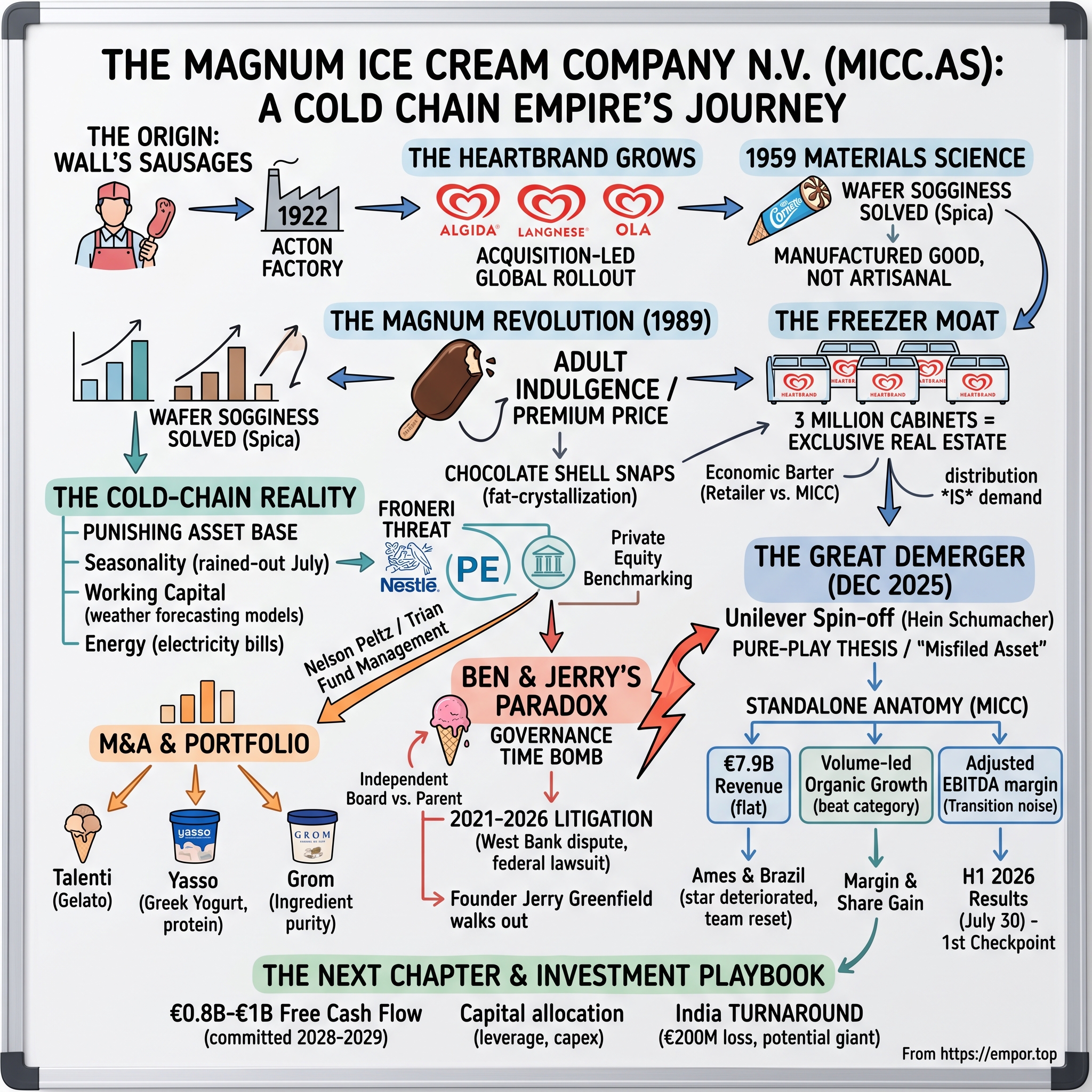
The Magnum Ice Cream Company N.V.: The Pure-Play Cold Chain Empire
I. Introduction & Episode Roadmap
On the morning of December 8, 2025, a bell rang on the Beursplein in Amsterdam and a new company began trading under the ticker MICC — simultaneously on Euronext Amsterdam, the London Stock Exchange and the New York Stock Exchange.2 It was, by any measure, an odd creature to arrive on public markets. Not a software platform, not a biotech, not a bank. A company that sells frozen sugar, milk fat and cocoa butter on sticks.
And yet the arithmetic was serious: roughly €7.9 billion of annual revenue, about 21% of global ice cream retail sales, four of the five largest ice cream brands in the world, thirty factories, 16,500 employees, and — the number that makes operators lean forward — three million company-owned freezer cabinets scattered across corner shops, petrol stations, beach kiosks and supermarket aisles on six continents.13 Investors handed it an opening market value of roughly $9.1 billion.4
The story of how it got there starts, improbably, in a London butcher's shop. In 1913, a sausage maker named Thomas Wall noticed that his business collapsed every summer — nobody wants a hot pork sausage in August — and reasoned that the cold rooms and delivery carts sitting idle in July could just as easily move something frozen. The First World War interrupted the idea. By the time it was revived in 1922, the business had been bought by Lever Brothers, and ice cream production started at a factory in Acton, west London.9 A century later, that hedge against seasonal sausage demand had become the largest ice cream company on earth.
The pure-play thesis, and the paradox underneath it
Here is the puzzle that makes this company genuinely interesting rather than merely large.
Ice cream is one of the highest gross-margin categories in packaged food. A Magnum bar takes cheap agricultural inputs and sells them at a multiple that would embarrass most confectionery. Emerging markets are still under-penetrated. The category has grown 3–4% a year for a decade.7 By the standard logic of consumer goods, this should be a crown jewel.
Unilever threw it overboard.
On March 19, 2024, CEO Hein Schumacher announced that Unilever would separate its ice cream division entirely, alongside a productivity programme targeting €800 million of savings and up to 7,500 office-based job cuts.56 The stated rationale was that ice cream is a fundamentally different business: a deep-freeze supply chain rather than an ambient one, a different capital intensity, a different route to market, a different seasonal rhythm.
That rationale is genuine but incomplete. The fuller version is that inside a conglomerate, ice cream was structurally disadvantaged. Every euro of capital it requested for refrigerated trucks and freezer cabinets competed against beauty brands earning far higher returns on far less physical asset. Ice cream also carried something no other Unilever division did — a brand with its own independent board and a mandate to make political statements, which turned into recurring headline risk for a FTSE 100 constituent.
So the demerger is best understood not as "we love this business, it deserves focus" but as "this asset was misfiled." Whether it was misfiled into a better home is precisely what public shareholders are now underwriting, and the early evidence is mixed. The company's first set of standalone results, published February 12, 2026, sent the shares down roughly 15% in a day: net profit fell 48.4% to €307 million, and free cash flow collapsed from €803 million to €38 million.81 Management had explanations, most of them technically valid. The market's reaction told you how much benefit of the doubt a newly listed carve-out gets: not much.
What this episode covers
The threads worth pulling: how Magnum invented an entire category — premium ice cream for adults — and in doing so discovered that the real constraint on ice cream economics is not the product but the freezer; how three million cabinets became the deepest moat in impulse food and simultaneously one of its heaviest capital burdens; how a private-equity-backed rival called Froneri spent a decade demonstrating that this industry could be run leaner, and in doing so effectively wrote Unilever's exit memo; how a governance clause signed in 2000 to protect a Vermont brand's soul metastasised into a federal lawsuit still unresolved in the summer of 2026; and what a chief executive who has spent thirty-eight years inside Unilever's ice cream machine can actually change now that the machine is his.
We should be honest about where we sit in the story. As of this writing, the company has published exactly one full-year result and one quarterly trading update as an independent business. Its H1 2026 results are due on July 30, 2026 — two days from now. Almost everything management has promised remains a promise. The interesting question is not whether the strategy sounds coherent; it does. The question is whether the specific mechanisms behind it — the €500 million productivity programme, the cabinet fleet's returns, the exit from Unilever's transitional services by end-2027 — survive contact with a cocoa cycle, a weather cycle and a very public fight over the second-largest brand in the portfolio.
To understand why the freezer matters more than the flavour, you have to go back to the butcher.
 Subscribe on LinkedIn
II. The Origin Story: From Wall's Sausages to the Heartbrand (1920s–1980s)
Picture the problem Thomas Wall faced. You run a meat business. Your factory, your cold rooms, your carts and your workforce are sized for winter demand. Then June arrives, sausage sales fall off a cliff, and you are paying to keep an idle plant alive until October. Wall's insight was that the constraint — refrigeration — was also the asset. Whatever else changed with the seasons, cold was cold.
The idea took nine years and a change of ownership to reach the street. By 1922 the business had been bought by Lever Brothers, and ice cream production began in Acton.9 Then came the piece of go-to-market engineering that defined the next hundred years: the tricycle. Wall's put freezer boxes on the front of bicycles, painted them with the slogan "Stop Me and Buy One," and pushed them into parks and seaside promenades across Britain.10 There were no supermarkets to speak of. There was no domestic freezer in the average home. If you wanted to sell ice cream, you had to physically bring the cold to the consumer at the exact moment they wanted it.
That is the founding lesson of this business, and it has never stopped being true. In ice cream, distribution is not a channel to demand. Distribution is demand. Nobody plans an impulse purchase; you buy the ice cream that is in front of you, cold, right now. Which means the company that controls the cold box at the point of sale controls the sale.
Building the Heartbrand by acquisition
Unilever's post-war expansion in ice cream was not a single global rollout. It was a patient, decades-long accumulation of local champions — Langnese in Germany, Frigo in Spain, Algida in Italy, Miko in France, Kibon in Brazil, Ola in the Netherlands, Good Humor in the United States, Frisko in Denmark, Wall's across Asia. Each came with its own factories, its own distributor network, its own century of local affection.
The strategic problem with a portfolio like that is obvious: no scale in branding. The solution — the red-and-white heart logo, rolled out as a unifying mark while local names were preserved — is one of the more elegant pieces of brand architecture in consumer goods. A German tourist in Turkey sees the heart on a kiosk and knows exactly what is inside, even though the sign says Algida rather than Langnese. Unilever got global recognition and local heritage in the same asset. Today the company still refers to this collection internally as the Heartbrand, spanning Wall's, Algida, Ola, Good Humor and sub-brands such as Solero, Calippo, Carte d'Or and Twister.7
What that patchwork also produced, less happily, was complexity: dozens of national portfolios, thousands of stock-keeping units, factories optimised for local tastes rather than global platforms. Four decades later, stripping that complexity out is the single largest line item in the standalone company's savings programme. Acquisition-led globalisation builds a moat and a mess at the same time, and the bill for the mess arrives long after the executives who signed the deals have retired.
Cornetto: a materials-science breakthrough disguised as a snack
The other foundational asset came from Naples. In 1959, an Italian ice cream maker called Spica solved a problem that had defeated the industry: how do you sell a pre-made ice cream cone without the wafer going soggy? Their answer was to line the inside of the cone with a barrier of oil, sugar and chocolate — a waterproof membrane between the wafer and the ice cream. They registered the name Cornetto, "little horn," in 1960.11
It is worth pausing on why this mattered, because it is easy to underrate as a piece of food engineering. Before Spica, an ice cream cone was a service product: someone had to assemble it in front of you, and it had to be eaten immediately. After Spica, a cone became a manufactured good — something you could freeze, box, ship, stack in a cabinet three months in advance and sell from an unattended kiosk. The chocolate lining did not just improve the eating experience; it converted an artisanal transaction into an industrial one.
Unilever bought Spica in 1976 and scaled Cornetto with a campaign built around Italian summer romance, turning a regional product into what remains one of the largest ice cream brands in the world.11 The template — take a format innovation, wrap it in a lifestyle, distribute it through a cold network you already own — became the company's core operating pattern.
That pattern needed one more ingredient: the realisation that adults would pay a great deal more than children.
III. The Magnum Revolution & Portfolio Aggregation (1989–2000s)
In the late 1980s, the consumer research on ice cream told a consistent and, in hindsight, spectacularly limiting story. Ice cream was for children — a treat handed out after a football match, an ice lolly at the beach — or it was a family dessert scooped from a tub after dinner. The impulse category was priced accordingly: cheap, small, disposable.
In Aarhus, Denmark, a team at Unilever's Frisko subsidiary asked a different question. What if the constraint was not the consumer but the product? What if nobody had ever made an ice cream bar that an adult would be seen holding?
The answer they built, launched in 1989, was Magnum: a vanilla ice cream bar roughly twice the size of a standard stick, coated in a thick shell of Belgian chocolate formulated specifically to stay glossy, snappy and flavourful at deep-freeze temperatures.1213 The name came from the Latin magnus — large.
Why the chocolate shell was the whole business model
The technical achievement here is genuinely underrated, and it is worth explaining in plain terms because it underpins the pricing power that still carries the company.
Chocolate behaves badly when cold. Cocoa butter crystallises into several different structures depending on how it is tempered and stored, and the wrong crystal form turns a chocolate shell dull, crumbly and waxy — it shatters into powder instead of cracking cleanly. Formulating a coating that could be applied to a frozen core, survive months at −25°C, and still deliver an audible snap and a smooth melt in the mouth is a fat-crystallisation problem, not a recipe problem. Get it right and you have created a sensory experience — the crack, then the cold cream — that no cheaper competitor can replicate with a standard compound coating.
That sensory gap is what allowed the price. Magnum entered at a multiple of a conventional impulse stick, and consumers paid it, because they were not comparing it to another ice cream. They were comparing it to a premium chocolate bar or a coffee-shop indulgence. The lesson generalises far beyond frozen food: if you can move a product across a category boundary in the consumer's mind, you inherit the price anchor of the category you moved into.
Rollout was deliberately simultaneous across Germany, the Netherlands, Belgium, Denmark, Switzerland and Sweden, then France and Britain. By 1994 it was selling in 35 countries.13 Magnum eventually joined Unilever's roster of billion-euro brands, an accolade the group made a point of announcing publicly.14 Today it anchors a portfolio in which Magnum, Ben & Jerry's, Cornetto and the Heartbrand together represent four of the five largest ice cream brands globally.3
Ben & Jerry's: the acquisition with a conscience clause
If Magnum was the margin engine, the deal Unilever struck in April 2000 was the one that would generate headlines for the next quarter-century.
Ben & Jerry's — founded in a converted Vermont petrol station, built on double-digit chunks of cookie dough and an unusually literal commitment to social activism — agreed to sell for $326 million. The founders' central fear was that a multinational would sand the politics off the brand and, in doing so, destroy the very thing that made it worth $326 million. So the merger agreement did something almost unheard of in large-cap M&A: it preserved an independent board of directors for the acquired subsidiary, with defined authority over the brand's social mission and brand integrity, separate from the parent's control of financial and operational matters.15
Read as a commercial document, it was clever. Unilever bought a brand whose entire equity was authenticity, and paid for a mechanism to guarantee that authenticity survived corporate ownership. For roughly two decades it broadly worked; Ben & Jerry's grew, expanded into Europe, and kept its voice.
Read as a governance document, it was a time bomb with a very long fuse. The agreement gave a subsidiary board the standing to publicly contradict its own parent — and, as events after 2021 demonstrated, the standing to sue. Structural autonomy granted to preserve brand value becomes, under sufficient political stress, a control problem the parent cannot resolve through normal corporate authority. We will return to how that detonated.
Alongside it, Unilever assembled the North American grocery shelf — Breyers, Klondike, Popsicle, Good Humor — a deliberate counterweight to the European impulse business. Where Europe generated high-margin single-serve sales through owned cabinets, America was a take-home, multi-pack, supermarket-freezer business with retailer power on the other side of the table. That structural difference between the two largest regions still shows up in the segment margins today, and it is the reason a company with 21% global share does not have uniform economics.
The freezer moat takes shape
Underneath the brand-building, the company was quietly compounding something harder to copy. Through the 1990s and 2000s, Unilever placed company-owned freezer cabinets — not shelves, not displays, but powered assets bearing the Heartbrand logo — into small retailers, kiosks and forecourts by the hundreds of thousands, eventually reaching the three million units the standalone company operates today.3
The economic logic is a barter. The retailer receives a freezer they did not have to buy, install or maintain, plus the electricity-hungry hardware needed to sell a category they could not otherwise stock. The manufacturer receives the exclusive right to fill it. A newcomer with a superior product faces a wall that has nothing to do with product quality: there is nowhere cold to put it.
This is the mechanism most investors underrate, and the one CEO Peter ter Kulve returned to explicitly on the company's first results call, comparing the cabinets to soft-drink chillers and calling them "sometimes overlooked or misunderstood."7 He is right that it is a moat. He is also, as we will see, describing an asset base that consumes capital every single year whether or not the summer cooperates.
Which brings us to the part of the story where the physics starts sending invoices.
IV. The Cold-Chain Reality: Economics, Operations, & The Froneri Threat (2010–2022)
Consider what has to happen for a Magnum to reach a consumer in Jakarta in an edible state.
It is manufactured in a plant with hardened freezing tunnels. It moves into a cold store held far below freezing. It travels in a refrigerated truck to a regional distributor's cold warehouse, then in another refrigerated vehicle to a small retailer, and finally sits in a company-owned cabinet drawing electricity twenty-four hours a day until someone buys it. At no point in that chain — factory to mouth — can the product be allowed to warm. Not once, not briefly.
This is the fundamental difference between ice cream and every other packaged good, and it is the reason it sat awkwardly inside Unilever. A bottle of shampoo can be dropped, stored in a hot warehouse, and left on a shelf for two years. An ice cream that thaws and refreezes develops ice crystals — the texture goes gritty and the product is commercially dead even though it is still frozen. The entire supply chain is a single point of failure, replicated ten thousand times.
The four costs nobody sees on the label
Capital. Refrigerated manufacturing, cold storage, refrigerated logistics and a three-million-unit cabinet fleet that must be continuously replaced. The standalone company ran capital expenditure at roughly 4.5% of sales in 2025 and has told investors it expects that to rise toward about 5% in the medium term before settling in a 4–5% range.73 For context, that is materially heavier than an asset-light personal care business, and it is the structural reason ice cream lost the internal competition for Unilever's capital.
Energy. Three million cabinets running continuously is a permanent electricity bill, borne partly by retailers and partly, through the economics of the arrangement, by the manufacturer.
Seasonality. The business earns its year in a handful of warm months. On the FY2025 call, management noted that the fourth quarter represents only around 15% of full-year sales, and that in the seasonal out-of-home markets the company actively uses Q4 to pull cabinets back in, recover stock from distributors and reset the fleet for the following season.7 Ter Kulve estimated — flagging it as an approximation — that somewhere between 500,000 and 700,000 cabinets come back every year across a network of about 2,000 distributors.7 There is no way to make up a rained-out July. The volume simply does not exist.
Working capital rhythm. Inventory and cabinets are built ahead of a season that may or may not arrive on schedule. The company now feeds advanced weather forecasting models into its planning systems — a genuinely sensible response to a risk you cannot hedge in the futures market.7
Put those together and you have a business with attractive gross margins and a punishing asset base. That combination is exactly what a diversified conglomerate handles badly, because the gross margin gets celebrated in the brand review and the asset base gets penalised in the capital allocation meeting.
Froneri: the competitor that became an argument
In 2016, Nestlé did something that, in retrospect, reframed the entire industry. Rather than continue running its European ice cream operations inside a food conglomerate with the same internal-competition problem Unilever had, it merged them into a 50:50 joint venture with R&R Ice Cream, owned by the private equity firm PAI Partners. The new entity was called Froneri, and it combined ice cream businesses across parts of Europe, the Americas, Southeast Asia and South Africa.16
Froneri's operating model was recognisably private equity: obsessive cost discipline, aggressive SKU rationalisation, a willingness to run private-label manufacturing alongside owned and licensed brands, and — crucially — a management team whose only job was ice cream. PAI describes the transformation as taking a predominantly European private-label producer and turning it into a brand-led global business with roughly €5.5 billion of revenue.17
For a decade, Froneri functioned as a live, permanently running control experiment. Two companies, the same category, the same weather, the same cocoa market — one run as a division of a consumer goods conglomerate, one run as a focused, leveraged, owner-operated business. Every time an analyst asked Unilever why ice cream margins lagged the group, Froneri was the implicit benchmark sitting on the other side of the question.
A caution worth stating plainly, because the comparison is often made sloppily: Froneri is privately held and does not publish audited segment margins on a basis comparable to a listed company's adjusted EBITDA. Widely circulated claims of a precise margin gap should be treated as estimates rather than facts. What is verifiable is the direction of travel and the cash: Froneri paid Nestlé approximately CHF 2 billion in dividends over two financial years, and in February 2026 Nestlé announced it would sell its remaining ice cream assets — roughly CHF 1 billion of revenue across the Americas and parts of Asia — to Froneri in a phased transaction through 2026 and 2027, while keeping its 50% stake in the joint venture.18
That last decision is the most eloquent competitive datapoint available. Nestlé looked at the same category and concluded, twice, that ice cream generates more value inside a focused vehicle than inside a food conglomerate. Unilever eventually reached the same conclusion by a different route. Between them, the two companies now account for roughly 32% of global ice cream retail sales — a duopoly at the top of a fragmented market.18
The difference in structure matters for how the two will compete from here. Froneri answers to a private equity sponsor and a strategic partner; it can absorb a bad summer without a share price reaction and can carry leverage a listed company would not choose. The Magnum Ice Cream Company answers to public shareholders every ninety days, with an investment-grade rating to defend. On the same weather, the same cocoa curve and the same shelf, the listed vehicle has less tolerance for a bad quarter — and it will be judged, fairly or not, against a competitor whose numbers nobody outside can see.
Before the demerger could happen, though, Unilever had to be pushed. And the pushing came from two very different directions at once.
V. M&A, Activism, & The Ben & Jerry's Paradox
By the mid-2010s, Unilever's ice cream division was doing what large consumer goods divisions do when growth gets harder: buying smaller companies that had figured out what consumers wanted next.
Talenti came first. On December 2, 2014, Unilever acquired the Minneapolis-based gelato maker, founded by Josh Hochschuler as a storefront gelateria in Dallas in 2003, and by then the best-selling packaged gelato in the United States with sales expected to approach $120 million.19 The strategic logic was that American consumers were trading up from ice cream to something denser, less aerated and more European-sounding — and that the clear plastic pint jar, which looked like something from a delicatessen rather than a factory, was doing a lot of the persuading.
Grom followed in 2015: a premium Italian gelato business founded in Turin in 2003, operating more than 60 shops in Italy and internationally, built on an ingredient-purity story.20 Grom brought credibility rather than scale — the ability to say, in Italy of all places, that the company owned an artisan gelato brand.
Yasso, acquired in 2023, was the most strategically interesting of the three: the US leader in frozen Greek yogurt bars, aimed squarely at consumers who wanted a portion-controlled, protein-forward treat rather than an indulgence.[^21] It has since become one of the clearer proof points in the portfolio — management reported Yasso grew over 30% in 2025 as it expanded into new formats.7
The honest read on this M&A programme: it was sensible, small, and mostly directionally right, but it did not change the shape of the company. Talenti and Grom addressed premiumisation; Yasso addressed the better-for-you shift that has since been amplified by GLP-1 weight-loss drugs. None of them altered the fundamental economics of a business defined by cold chains and cabinets. Bolt-ons that buy you optionality on a consumer trend are useful. They are not a substitute for fixing the cost base — and by the early 2020s, the cost base was what investors wanted fixed.
The activist arrives
In January 2022, it became public that Nelson Peltz's Trian Fund Management had built a stake in Unilever.[^23] Peltz's history at Procter & Gamble, Heinz and Mondelez gave the position an immediate meaning to the market: a campaign for portfolio simplification and cost discipline was coming. He joined Unilever's board later that year.
Trian's general diagnosis of sprawling consumer conglomerates — too many businesses, too much central overhead, capital spread across assets with incompatible return profiles — applied to Unilever's ice cream division with unusual precision. Ice cream was the group's most capital-hungry, most seasonal, most operationally distinct business. In a portfolio review looking for structural simplification, it was the obvious candidate.
It would be too neat to say Peltz caused the demerger; Unilever's own management had been under pressure on growth and margins for years, and the Growth Action Plan announced under Hein Schumacher was a broader programme. But the presence of an activist on the board changed the cost of not acting. Contemporary coverage of the March 2024 separation announcement explicitly framed it against the backdrop of Peltz's pressure on the company.41 Activists rarely invent the argument; they raise the price of ignoring it.
The Ben & Jerry's paradox detonates
While the financial case for separation was being built, the governance case was building itself.
In 2021, Ben & Jerry's independent board decided the brand would stop selling ice cream in the Israeli-occupied West Bank. The decision generated a political firestorm: several US state pension funds divested from Unilever under state anti-boycott statutes, and the parent company faced sustained pressure. When Unilever attempted to resolve the situation by selling its Israeli business to a local licensee, Ben & Jerry's independent board sued its own parent in July 2022 to block the transaction.21
That was the moment the 2000 merger agreement stopped being a piece of brand-protection cleverness and became a live corporate control problem. A subsidiary board was using contractual rights, in federal court, against the shareholder that owned it.
The conflict did not resolve — it escalated, and it followed the ice cream business into its new home. The disputed timeline, as reported by trade press covering the litigation: a fresh lawsuit filed in November 2024 alleging the parent had censored the brand's social advocacy; the removal of Ben & Jerry's CEO Dave Stever beginning in March 2025; an audit of the Ben & Jerry's Foundation in April 2025; an integrity investigation into independent board chair Anuradha Mittal spanning September to November 2025; and new bylaws introduced in December 2025, after the Magnum Ice Cream Company was created, that rendered multiple directors ineligible.23
In September 2025, three months before the listing, co-founder Jerry Greenfield resigned after nearly fifty years, saying that the independence which had been "the very basis of our sale to Unilever" was gone.22 For a brand whose entire commercial premise is authenticity, a founder publicly walking out and saying the soul has been removed is not a public relations problem. It is an attack on the asset itself.
Since the demerger, the dispute has become the new company's problem. Magnum removed nearly all of Ben & Jerry's independent directors; the remaining independent members sued, alleging the removals violated the original merger agreement. In March 2026 the Ben & Jerry's Foundation won a court ruling permitting it to join the litigation after Magnum stopped previously approved funding.25 In May 2026 a fourth amended complaint characterised the parent's conduct as a coordinated campaign to "censor, intimidate and purge" the independent board.24 Co-founder Ben Cohen, alongside a coalition of investment funds, challenged the company at its annual general meeting on May 7, 2026, pressing for a sale of the brand to a values-aligned buyer and raising the prospect of a consumer boycott extending to Breyers and Klondike.26 As of late July 2026 the case sits before Judge P. Kevin Castel in US federal court, awaiting a ruling that will determine whether it proceeds as a broad governance challenge or narrows to limited contractual claims.24
For investors, the material questions are narrower than the headlines. Ben & Jerry's is one of the company's four largest brands, and management has reported it gaining share in both the US and Europe across at-home and away-from-home channels.7 So the commercial performance has, so far, held up. But three risks are live and quantifiable only after the fact: an adverse ruling that constrains how the parent governs a major brand; sustained reputational damage that erodes the brand's price premium; and the possibility — raised by the activist shareholders rather than the company — of a forced or negotiated separation of the asset. The company's first annual report on Form 20-F, covering the year to December 31, 2025, discloses the dispute as a risk but does not attach a provision or an estimated financial exposure to it.34 That absence is itself worth noting; it is the kind of item a sceptical investor should track in each subsequent filing rather than assume away.
The lesson for the acquisition playbook is uncomfortable and durable. Structural governance concessions made to preserve a brand's authenticity do not expire when the deal closes, when management changes, or even when the parent company demerges. They travel with the asset.
VI. The Great Demerger: Why Unilever Cut Loose Its €8B Crown Jewel (2023–2025)
Hein Schumacher had been Unilever's chief executive for less than a year when he stood up in March 2024 and announced the largest structural change in the company's recent history.
The framing was operational rather than apologetic. Ice cream, Unilever argued, has a distinct operating model: a cold-chain supply network fundamentally different from ambient logistics, a different capital intensity, a different channel mix weighted toward out-of-home impulse, and a seasonality no other division shares. Separating it would let both companies pursue strategies suited to their own economics. Alongside the separation, Unilever launched a productivity programme targeting €800 million of savings over three years, with up to 7,500 predominantly office-based roles affected.56
Strip out the corporate language and the message to the market was: ice cream will never earn its cost of capital inside this building, and we have stopped pretending otherwise.
Building a company from a division
What followed was twenty-one months of unglamorous work that is easy to skip past and shouldn't be, because it is the direct cause of the financial results the company posted in its first year.
Carving out a division of this scale means recreating everything the parent used to provide invisibly: legal entities in dozens of countries, an IT stack, a treasury function, a payroll system, tax registrations, transfer pricing, an audit relationship, a board, and a sales organisation that had previously shared feet on the street with other Unilever categories. The company hired roughly 1,000 dedicated sales representatives in the process.7
None of this happens instantly, which is why the company entered what management calls an interim operating model. Under transitional service agreements, Unilever continues to provide certain functions — for a fee, with a tax mark-up — while the new company builds its own. Management has committed to exiting all TSAs by the end of 2027.7
The financial consequences of that arrangement are subtle and, on the evidence of the February 2026 share price reaction, poorly understood before they landed. CFO Abhijit Bhattacharya explained on the call that depreciation which Unilever had previously allocated to the ice cream business as a non-cash charge is now billed under the TSAs as a cash cost — which mechanically reduced reported adjusted EBITDA by 50 basis points in 2025 without any deterioration in the underlying business.7 Add "double running costs" — paying for fifty people at Unilever doing accounts payable while training fifty of your own to replace them — and you get a P&L in which genuine operational progress is buried under transition accounting.
Management's total guidance for separation costs, including building the new IT stack, was €800 million, with a further restructuring charge on top; adjusting items were guided to €425–450 million for 2026 alone.7 These are not small numbers against a company generating €1.255 billion of adjusted EBITDA.1
Financing, delay, and the December listing
In November 2025 the company came to the bond market for the first time, raising €3 billion across four €750 million tranches maturing in 2029, 2031, 2034 and 2037, at coupons ranging from 2.75% to 4%.2728 The book was oversubscribed roughly seven times, and the company secured investment-grade ratings of BBB from S&P and Baa2 from Moody's.28 Credit investors, in other words, were comfortable. That is a meaningful independent signal: the debt market was pricing a stable, cash-generative category leader even as equity investors would shortly prove more sceptical.
The listing itself slipped. Originally targeted for mid-November 2025, it was delayed by the US government shutdown, which stalled the required regulatory processes.29 The demerger became effective on December 6, 2025, and trading began on December 8.302
The mechanics: qualifying Unilever shareholders and ADS holders received one MICC share for every five Unilever shares or ADSs held, and Unilever retained a minority stake of less than 20%, to be sold down over time.30 That retained stake is a deliberate two-sided instrument. It gives Unilever flexibility to fund separation costs and signals alignment; it also creates a known future seller, which is a persistent, if manageable, technical overhang on the shares.
Three businesses did not transfer on day one. Indonesia moved across a day after listing for technical reasons. Portugal and — far more significantly — India were expected to be acquired in the first half of 2026, with India requiring a separate local listing first.7 India is the interesting one, and we will come back to why a roughly €200 million, loss-making business is the piece of this story management seems most excited about.
The strategic verdict on the demerger is not yet available, and anyone offering one is guessing. What can be said is that the rationale is coherent and consistent with what a competitor concluded independently. The execution, so far, has been expensive and roughly on the schedule management set. What remains untested is the core promise: that focus produces margins a conglomerate could not.
Which brings us to the numbers.
VII. Standalone Anatomy: Financial Breakdown, Segments, & Management
On February 12, 2026, the Magnum Ice Cream Company reported its first full year as a standalone business. The shares fell roughly 15%.8
It is worth understanding exactly what upset the market, because the headline and the underlying story diverge more than usual.
The 2025 scorecard
Turnover was €7.9 billion, essentially flat as reported. Underneath that, organic sales growth was 4.2% — comfortably ahead of a category management estimates grew 3–4% — split between 2.6 percentage points of price and, more importantly, 1.5% of volume and mix.17 Every region grew, and the company reported market share gains in most markets.
Then the profit lines. Adjusted EBITDA was €1,255 million, a margin of 15.9% versus 16.9% the prior year. Adjusted EBIT was €917 million, an 11.6% margin against 12.1%. Reported operating profit fell to €599 million from €764 million — the roughly €318 million gap to adjusted EBIT being separation, restructuring and other adjusting items. Net profit dropped 48.4% to €307 million from €595 million. Diluted EPS was €0.48; adjusted EPS €0.93. Free cash flow fell to €38 million from €803 million. Net debt stood at €2,967 million, or 2.4 times adjusted EBITDA.18
A 48% profit decline and near-zero free cash flow is an alarming pair of numbers to debut with, regardless of the explanation.
What the numbers actually say
Here is where the analysis has to be careful, because the reported figures overstate the deterioration and management's bridge, while self-serving, is substantially verifiable from the disclosures.
Of the 100 basis points of adjusted EBITDA margin decline, management attributed 50 basis points to currency translation and 50 basis points to the TSA depreciation reclassification described earlier.7 Neither reflects a worsening business. On that basis the underlying margin was roughly flat.
The gross margin story is the more revealing one. Commodity and supply chain cost inflation hit 380 basis points in 2025 — an extraordinary shock, driven principally by cocoa and dairy, which the CFO characterised as close to 9% commodity inflation.7 Against that, the company took 230 basis points of pricing and delivered 170 basis points of supply chain productivity savings. Net of a 50 basis point currency drag, gross margin was down 30 basis points as reported but up 20 basis points operationally.7
That is a genuinely creditable outcome, and it contains a strategic choice worth examining. Faced with 380 basis points of input inflation, management could have priced it all through and protected the margin. Instead it priced roughly 230 basis points and used its productivity savings to absorb the rest — deliberately buying volume and share rather than margin. Ter Kulve was explicit that this was debated internally: "shall we do more profit and have less volume growth and less share."7
Whether that was the right call is the central judgement on this management team's first year. The evidence in favour: volume grew 1.5% globally, share was gained in most markets, and in the US — the largest single market — volume grew 1.8% while value grew 1.7%, meaning essentially all US growth was real units rather than price.7 In a period when many US food companies were posting volume declines against heavy pricing, that is a differentiated outcome. The evidence against: it delivered a first-year profit print that cost shareholders 15% in a day, and it means the margin expansion story now has to be delivered from a lower base with less pricing cushion.
The cash flow line requires similar unpacking. Management presented a comparable free cash flow of €660 million for 2024 and €602 million for 2025 on a like-for-like basis, with the €58 million difference attributable to €31 million of higher capital expenditure (roughly a third of it additional cabinets) and €27 million of adverse currency translation. The reported figure fell to €38 million because of €564 million of demerger and interim operating model costs.7 The CFO also noted that working capital days were essentially unchanged year on year — receivables slightly worse, inventory two days better, payables flat.7
The honest reading: the cash flow collapse was transitional, not operational, but investors have no way to independently verify the "comparable" bridge, and management declined to guide free cash flow for 2026 or 2027 precisely because the interim operating model makes it hard to forecast.7 Two years of un-guided, hard-to-interpret cash flow from a newly listed company is a legitimate thing for a sceptic to dislike. The company has committed to €0.8–1.0 billion of free cash flow in both 2028 and 2029.3 Those years are the real test.
The three regions are three different businesses
Europe & ANZ generated €3.2 billion of revenue at a 13.1% adjusted EBITDA margin, with 3.3% organic growth and 37 basis points of share gain — a second consecutive year of share gains.17 The UK was described as outstanding, helped by favourable weather; Italy remains a work in progress with the route to market being rebuilt. This is the dense impulse market with the deepest cabinet footprint and the most mature consumption.
The Americas produced €2.8 billion at a 14.1% margin but only 0.8% organic growth.1 The US delivered 1.7% growth with share gains of 24 basis points for the second straight year. The regional drag was Brazil, where ter Kulve was unusually candid: the Kibon business "used to be a star 10 years ago" and had "deteriorated," losing share over a decade by getting "stuck in the middle" as the market bifurcated toward premium and affordable. Management replaced the entire local leadership team and is addressing high factory waste levels.7 That is a specific, checkable turnaround plan rather than a vague reference to macro conditions — and it is the kind of disclosure that makes a management team easier to hold accountable.
AMEA is the standout: €2.0 billion of revenue at a 22.9% adjusted EBITDA margin, with 10.9% organic growth and 4.5% volume growth.17 Turkey and Pakistan grew double digits; China and Indonesia delivered high single-digit growth with share gains after the company reset trade margins. Note what that margin implies — the fastest-growing region is also by some distance the most profitable, because out-of-home impulse through owned cabinets carries better economics than supermarket multi-packs. Against local competition including 伊利集团 Yili Group and 蒙牛乳业 Mengniu Dairy in China, holding a solid number two position and gaining share is a real operational result.
Asked where the remaining margin opportunity sits, ter Kulve was blunt: "Margin is for Europe and the U.S."7 Asia is for growth. That is a clear and falsifiable allocation of ambition.
The company does not disclose a precise revenue split between out-of-home impulse and in-home take-home channels in its results release. What it has said is that at-home grew mid-single digit on the back of a newly dedicated sales force winning better shelf positions, that away-from-home grew mid-single digit supported by cabinet expansion, and that digital commerce is the fastest-growing channel overall, already exceeding 20% of sales in China.7
The people running it
Peter ter Kulve is not a turnaround specialist parachuted in from outside. He joined Unilever's ice cream business in 1988 as a marketer — one year before Magnum launched — became CEO of Wall's China in 1999, ran the global ice cream category as an executive vice president from 2004 to 2009 where he oversaw Magnum's globalisation and Ben & Jerry's European rollout, served as President Commissioner of PT Unilever Indonesia from 2011 to 2014, and later held roles including Chief Digital and Growth Officer and Business Group President for Home Care. He left Unilever after 37 years to run the standalone company.32
The case for him is deep operational knowledge of exactly this business in exactly the markets that matter most; on the results call he drew on having worked in China in the 1990s to argue that India today resembles China then. The case against is the obvious one: an insider of nearly four decades is being asked to dismantle habits he helped build. Investors evaluating this should watch behaviour rather than biography — whether he cuts what a conglomerate lifer would protect.
Abhijit Bhattacharya, the CFO, brings the outside perspective: 38 years at Koninklijke Philips in senior finance and operations roles across Europe, Asia and the US, before becoming CFO of Unilever Ice Cream in 2024. Jean-François van Boxmeer — the former Heineken chief executive and Vodafone chair — chairs the board and its Nomination & Governance Committee.31 It is a board with genuine consumer and capital markets experience, which matters given the governance dispute it inherited.
On disclosure discipline, the early behaviour is encouraging: the company committed to publishing a company-compiled analyst consensus at half-year and full-year, and to publishing expected foreign exchange impacts based on actual rate movements ahead of each reporting period.7 Those are small, concrete steps that reduce the scope for expectation management, and they are the sort of thing a management team confident in its numbers does voluntarily.
2026 so far
The Q1 2026 trading update, published April 30, showed organic sales growth of 4.5% — 2.9% volume and 1.6% price — on turnover of €1.770 billion.33 Reported revenue actually fell 1.2% because currency translation cost 5.5 percentage points, with the Americas alone absorbing a 7.6% headwind from a weakening dollar.33 Every region grew: Europe & ANZ 4.0%, the Americas 2.6% (entirely price, with volume flat), and AMEA 7.9%, with Turkey and Pakistan again in double digits.33
Guidance was reaffirmed: 3–5% organic sales growth, 40–60 basis points of adjusted EBITDA margin improvement on a comparable perimeter, but only 0–20 basis points as reported — a reiteration that analysts read as a signal of confidence rather than an upgrade.3339 The bridge between those two figures is instructive and worth knowing: roughly 40 basis points of dilution from consolidating the loss-making India business, 20 basis points from the loss of the royalty India used to pay for using the group's brands, and 20 basis points from the TSA depreciation effect.7 Management also flagged that improvement would be weighted to the second half, as TSAs wind down and lower cocoa costs work through hedged positions.33
That second-half weighting is the thing to hold management to. A company that guides to back-half-loaded improvement in its first full year of independence is asking for patience it has not yet earned. The H1 2026 results on July 30 are the first genuine checkpoint.
VIII. Playbook: Business & Investing Lessons
Four transferable lessons emerge from a century of this business, and each has a sharp edge.
1. In impulse categories, physical point-of-sale real estate is the product
The most valuable asset this company owns is not a recipe. It is the right to be the only ice cream in three million freezers. Impulse consumption has no consideration phase — there is no research, no comparison, no basket planning. The purchase decision happens in the two seconds between seeing a cabinet and opening it. Whoever fills that cabinet wins by default.
This is a moat that digital disruption largely cannot cross. A direct-to-consumer ice cream startup faces a physics problem, not a marketing problem: shipping a frozen product to a home costs a multiple of the product's value. The cabinet network is the reason a challenger brand with a superior product can still fail to reach a consumer standing three feet away from it.
The edge to the lesson: cornered physical distribution and heavy fixed assets are the same thing viewed from two angles. The cabinet fleet consumes capital annually, depreciates, and now faces a regulatory retrofit cycle. A moat you have to re-buy every year is a real moat with a permanent toll.
2. Move a product across a category boundary and you inherit a new price anchor
Magnum's achievement was not a better ice cream. It was persuading adults that the relevant comparison was a premium chocolate bar rather than a children's lolly. The chocolate shell was the enabling technology; the positioning was the value creation.
The generalisable version: pricing power comes from the reference set the consumer uses, and the reference set can be engineered. This is why the company's current innovation agenda — protein propositions, real-fruit ices, hydration products, portion-controlled bites — is strategically coherent rather than faddish. Each is an attempt to move ice cream into a new comparison set where the anchor price is higher and the competitive field is different.
The test, of course, is whether consumers accept the move. Yasso growing over 30% suggests better-for-you works.7 Whether a "hydration ice cream" finds a real occasion is an open question, and most category-expanding innovations fail.
3. Conglomerates systematically under-invest in capital-intensive niches
This is the cleanest lesson in the whole story, and it has been independently confirmed by two of the world's largest food companies reaching the same conclusion about the same category.
Inside Unilever, ice cream's capital requests competed against businesses with far higher returns on far less invested capital. The internal hurdle rate is not set by the division's own opportunity set; it is set by the best alternative in the building. A perfectly good project earning attractive returns gets declined because a beauty brand's project earns more. Over enough years, the division becomes structurally under-invested — not because anyone decided to starve it, but because the allocation mechanism worked exactly as designed.
The corollary for investors is the useful part: capital-intensive divisions inside diversified groups are a recurring source of value when separated, provided the standalone entity actually redirects capital to the projects the parent declined. That is testable. Capital expenditure rising from roughly 4.5% toward 5% of sales, with cabinet capital expenditure up around 10% in 2025 and disproportionately directed toward high-return emerging market placements, is the company doing what the thesis requires.7 Whether those cabinets earn their cost of capital is knowable only in the returns, not the spending.
4. Governance concessions in M&A have half-lives measured in decades
The Ben & Jerry's clause was signed in 2000 by executives who are long gone, to protect a brand from a parent that no longer owns it, and it is still generating federal litigation in 2026 against a company that did not exist until December 2025.
The lesson is not "never grant autonomy." Unilever bought authenticity and correctly identified that authenticity requires independence. The lesson is that the mechanism chosen — a board with standing to act against the parent — created a permanent, unresolvable structure. Contractual autonomy over "social mission" cannot be bounded in advance, because the definition of social mission expands with the political environment.
A sharper version for acquirers: when buying a brand whose value is its values, the acquirer is purchasing an asset that can turn and litigate against them. Price that.
IX. Strategic Position, Hamilton Helmer's 7 Powers, & Bear vs. Bull Stress Test
Strip away the narrative and ask the only question that matters: does this company possess durable advantages that let it earn returns above its cost of capital, and what would break them?
Hamilton Helmer's 7 Powers
Cornered Resource — strong, but rented. The three million cabinets constitute the clearest cornered resource in packaged food: exclusive physical positions in retail locations that a competitor cannot buy at any reasonable price, because the space is finite and already occupied.3 The qualification is that this resource is maintained by continuous capital, exclusivity arrangements that are subject to competition law scrutiny in various jurisdictions, and a retailer relationship that could sour. It is a cornered resource with an annual rent.
Scale Economies — strong. Roughly 21% global retail share, thirty specialised factories and twelve R&D centres produce genuine purchasing scale in dairy, cocoa, sugar and packaging, and the ability to amortise innovation across dozens of markets.13 The company's example of a Chinese multi-layer stick concept becoming a global innovation platform is exactly what scale in R&D is supposed to produce.7 The counterpoint: Froneri at €5.5 billion of revenue has enough scale that the marginal advantage of being 40% larger is not decisive.17
Branding — strong, and the primary margin defender. Magnum maintained volumes through price increases taken to offset cocoa inflation — the cleanest available evidence of real pricing power.7 Ben & Jerry's commands a premium built on identity. The vulnerability is specific and current: brand power built on values is uniquely exposed to the reputational consequences of the governance fight described earlier.
Process Power — moderate, and the least proven. The company has real capability in frozen-product formulation: chocolate coatings engineered for deep-freeze conditions, texture stability across temperature fluctuation, multi-layer stick architecture. It also claims process advantage in demand forecasting using weather models. This is genuine know-how, but it is closer to accumulated craft than to a replicable system competitors cannot learn. Treat management's process claims as unverified until they show up as a sustained gross margin differential.
Switching Costs, Network Economies and Counter-Positioning — weak or absent. Consumers face zero switching costs. There are no network effects. And counter-positioning runs the wrong way: it is Froneri, with its leaner private-equity model, that has been counter-positioned against the conglomerate — which is precisely the gap this demerger exists to close.
Porter's Five Forces
Buyer power — high in the Americas, moderate elsewhere. Walmart, Kroger and Target hold real leverage in take-home grocery, with private label as a permanent alternative. This is visibly reflected in the numbers: the Americas at a 14.1% adjusted EBITDA margin with 0.8% growth versus AMEA at 22.9% with 10.9% growth.1 Where the company controls the cabinet, it captures the economics; where the retailer controls the freezer, it shares them.
Threat of substitutes — high and structurally rising. Impulse ice cream competes with every other treat: confectionery, soft drinks, savoury snacks, bakery. GLP-1 weight-loss drugs are the genuinely new variable. Management's argument — that when people eat less overall, they concentrate their remaining treat occasions in higher-quality, portion-controlled products, benefiting premium ice cream — is plausible and self-serving in equal measure. Ter Kulve told investors the company's thinking on GLP-1 had "evolved" since the September Capital Markets Day — the event at which the standalone strategy and medium-term targets were first laid out in full — toward this more optimistic reading.740 It is worth noting that this is a narrative shift toward a more favourable conclusion within a single quarter, on data the company has not published. Treat it as a hypothesis under test.
Threat of new entrants — very low. The cold chain is a genuine barrier. No credible startup can replicate national refrigerated distribution.
Supplier power — moderate but volatile. Cocoa and dairy are traded commodities where the company has scale but no control, as 2025 demonstrated emphatically.
Rivalry — intensifying at the top. Two players now command roughly 32% of global retail sales, with Nestlé consolidating its remaining assets into Froneri through 2027.18 Duopolies in categories with high fixed costs and seasonal capacity can be disciplined on price — or they can be brutal.
The activist stress test
What would a sceptical investor challenge if they built a position tomorrow?
Disclosure and comparability. The company reports adjusted EBITDA that excludes €425–450 million of adjusting items for 2026 alone, presents "comparable" free cash flow bridges investors cannot independently reconstruct, and has declined to guide cash flow for two years.7 Every one of those choices may be justified. Collectively they mean the reported numbers do not yet describe the underlying business, and they will not until the TSAs are gone at the end of 2027. That is a long runway of adjusted metrics.
Capital allocation. Leverage sits at 2.4 times adjusted EBITDA, at the top of the stated 2.0–2.5 times range, with no dividend until 2027 and a 40–60% payout policy thereafter.13 A company de-levering while raising capital expenditure toward 5% of sales, absorbing separation costs, and buying a loss-making Indian business has limited room for error. If free cash flow disappoints in 2026, something has to give.
The India acquisition. Consolidating roughly €200 million of revenue that is loss-making, and simultaneously losing the royalty stream that business previously paid, costs the group about 60 basis points of reported margin in 2026.7 Management's justification is a twenty-year one: ter Kulve argued India resembles China in the early 1990s, has the world's largest dairy market, and could eventually become the world's largest ice cream market. He also conceded the business "lost a lot of share" over the last twenty years and is in turnaround.7 A shareholder is being asked to accept a definite near-term margin cost for an indefinite long-term option. That is a defensible trade, but it should be named as what it is.
Governance. A major brand is the subject of unresolved federal litigation, a founder has publicly disavowed the company's stewardship, and organised shareholders challenged the board at the first AGM.222426 No estimated exposure has been disclosed.
Management accountability. The team has one full year of standalone results, and it missed on profit and cash while beating on organic growth. Its explanations were specific and largely traceable to disclosed items, which is a mark in its favour — the difference between "macro headwinds" and "here are the four technical items and their basis-point impacts" is the difference between a team that can be held to account and one that cannot. But 2026 is the first year in which promises meet outcomes.
The three KPIs that matter
Most metrics for this company are noise. Three are not.
1. Volume-led organic sales growth — specifically the volume component. Price growth in a food company tells you about inflation pass-through. Volume growth tells you whether people are actually buying more of your product. Management has explicitly chosen volume over price, delivering 1.5% in 2025 and 2.9% in Q1 2026, and has stated the expectation of 1.5–2% for the full year.733 If volume decelerates toward zero while price carries the growth, the strategic bet has failed and the share gains were rented, not earned.
2. Adjusted EBITDA margin progression on a comparable perimeter. The entire investment case is that focus unlocks margin a conglomerate could not. The company has committed to 40–60 basis points of annual improvement in the medium term, delivered off a €500 million productivity programme of which €250 million was already banked by end-2025.37 Watch the comparable-perimeter figure, not the reported one — and watch whether the promised second-half 2026 weighting materialises.
3. Free cash flow conversion from 2028. Cash flow is uninterpretable until the TSAs are gone. The company has committed to €0.8–1.0 billion in both 2028 and 2029.3 That target, against €1.255 billion of adjusted EBITDA today, is the single number that will determine whether this is a quality compounder or a capital-hungry brand collection. Everything before it is transition.
The risk radar
Cocoa, in both directions. Cocoa peaked near $12,000 a tonne in 2024, collapsed to roughly $3,500 by mid-February 2026, and traded around $5,300 in late July 2026 — down about 34% year on year.3536 The decline reflects improved West African harvest prospects and a projected global surplus.37 This is a large tailwind arriving, but with two caveats: the company is hedged at higher prices, so the benefit is delayed to the second half of 2026, and lower input costs invite competitive price reinvestment across the industry. Management guided to low-single-digit commodity inflation for 2026 versus nearly 9% in 2025.7 A cocoa tailwind that is competed away in promotions is not a margin tailwind.
Weather and seasonality. Unhedgeable and unrecoverable. A cool European summer removes profit that no amount of Q4 execution restores. The 2025 UK performance was flattered by favourable weather, which management acknowledged.7 The same honesty will be required when the weather goes the other way.
Currency. With costs and reporting in euros and roughly two-thirds of revenue elsewhere, translation cost 5.5 percentage points of reported revenue in Q1 2026 alone.33 This does not affect the business; it does affect reported earnings and the multiple investors apply.
Refrigerant regulation. EU Regulation 2024/573 prohibits placing commercial refrigerators and freezers containing fluorinated gases with a global warming potential of 150 or more on the market from 2025, as part of a phase-down targeting an 80% reduction in HFC consumption by 2030.38 For a company operating three million cabinets, this converts a routine replacement cycle into a mandated technology transition. The company has not separately quantified the incremental cost, which is a disclosure gap worth watching.
Private label and down-trading. Persistent consumer pressure favours retailer-brand tubs in take-home. Froneri, notably, has a substantial private-label manufacturing capability — meaning the number two player profits from the down-trading that hurts the number one.
US channel exposure. Management disclosed that roughly 6–8% of US turnover comes from purchases made with food assistance benefits, and that disruption to those programmes hurt Q4 2025.7 That is a specific, policy-dependent revenue exposure most investors would not have modelled.
The bull case
Focus works and the numbers follow. The €500 million productivity programme — half already delivered — continues to convert conglomerate slack into margin. TSA costs roll off by end-2027, removing both the cash drag and the accounting distortion, and reported figures converge toward adjusted. Cocoa deflation flows through hedges into the second half of 2026 and through 2027. AMEA compounds at high single digits with a 22.9% margin, mixing the group upward. India transitions from margin drag to the growth engine ter Kulve describes. Cabinet capital is redirected from saturated European markets to Indian and Pakistani placements where incremental returns are far higher. By 2028–29 the company generates €0.8–1.0 billion of free cash flow, pays a 40–60% dividend, and trades as what it structurally is: a category-leading, share-gaining, pricing-powered consumer staple that a conglomerate had been quietly under-managing for twenty years.
Supporting evidence is not merely rhetorical: two consecutive years of share gains in the US and Europe, volume growth in every region, gross margin up operationally against a 380 basis point cost shock, an oversubscribed investment-grade debut bond, and a share price that has recovered from a post-results low near €11 to around €16 by late July 2026.72842
The bear case
The demerger swapped a conglomerate discount for a standalone cost base. Separation and IT costs run past €800 million; the interim operating model proves stickier than planned and TSAs extend beyond 2027. The productivity programme's remaining savings prove harder than the first tranche — early savings usually are the easy ones. Cocoa relief arrives but is immediately competed away, in a duopoly where the private rival has both a private-label business that benefits from down-trading and a sponsor indifferent to quarterly optics. Two poor summers in Europe expose how much of this business is weather. India absorbs capital for years without the promised inflection. The Ben & Jerry's litigation produces an adverse ruling or a boycott that damages a top-four brand. Unilever's retained stake overhangs the shares. And the fundamental question resurfaces: a business needing 5% of sales in annual capital expenditure to defend a physical distribution network, in a category growing 3–4%, may simply be a moderate-return business that no amount of focus transforms.
The disciplined conclusion is that neither case is proven, and the evidence to settle it is arriving on a known schedule. The half-year results land on July 30, 2026. They will show whether the promised second-half margin inflection is beginning, whether volume growth held through the critical European season, and whether cash generation looks anything like a normal consumer staple once the transition noise starts to fade.
For a company whose entire history is about being in the right place at the moment the sun comes out, it is fitting that its first real test as an independent business arrives in the middle of summer.
References
-
2025 Full Year Results — The Magnum Ice Cream Company, 2026-02-12 ↩↩↩↩↩↩↩↩↩↩↩
-
The Magnum Ice Cream Company lists on Euronext — Euronext, 2025-12-08 ↩↩
-
TMICC's Strategic Plan & Financial Goals Ahead of Listing (Capital Markets Day 2025) — The Magnum Ice Cream Company, 2025-09-09 ↩↩↩↩↩↩↩↩↩↩
-
Ben & Jerry's maker Magnum Ice Cream debuts on Amsterdam stock market — CNBC, 2025-12-08 ↩
-
Unilever Announces Major Step Forward in Growth Action Plan via Separation of Ice Cream — Unilever, 2024-03-19 ↩↩
-
Unilever to Spin Off Ice Cream Unit and Cut 7,500 Jobs — Reuters, 2024-03-19 ↩↩
-
Full Year 2025 Results Webcast Transcript and Presentation — The Magnum Ice Cream Company Investor Relations, 2026-02-12 ↩↩↩↩↩↩↩↩↩↩↩↩↩↩↩↩↩↩↩↩↩↩↩↩↩↩↩↩↩↩↩↩↩↩↩↩↩↩↩↩↩↩↩↩
-
Ice Cream Maker Magnum's Shares Slump as Debut Results Underwhelm — Reuters via U.S. News & World Report, 2026-02-12 ↩↩↩
-
Behind the brand: Wall's ice cream serving happiness for 100 years — Unilever UK, 2022 ↩
-
A Short Guide to Italy's Most Iconic Industrial Ice Creams — ITALY Magazine ↩↩
-
Behind the brand: Magnum – indulgent ice creams designed for pleasure — Unilever UK, 2023 ↩
-
Magnum Ice Cream Company Unilever demerger complete: a history — FoodNavigator, 2025-12-08 ↩↩
-
How Ben & Jerry's Got Bought Out Without Selling Out — Knowledge at Wharton ↩
-
Nestlé makes strategic move to create global leader in ice cream — Nestlé, 2016 ↩
-
Nestlé to Sell Ice Cream Business as Froneri JV Gains Strength — DairyReporter, 2026-02-20 ↩↩↩
-
Unilever acquires Talenti Gelato & Sorbetto — Unilever, 2014-12-02 ↩
-
Unilever acquires Italian gelato group Grom — Just Food, 2015 ↩
-
Ben & Jerry's sues parent Unilever to block sale of Israeli business — Reuters, 2022-07-05 ↩
-
Ben & Jerry's Jerry Greenfield quits in independence row with Unilever — CNBC, 2025-09-17 ↩↩
-
Ben & Jerry's vs Magnum: Timeline of the Governance Dispute — DairyReporter, 2026-02-04 ↩
-
Ben & Jerry's vs Unilever: Lawsuit Reaches Crucial Stage — DairyReporter, 2026-07-01 ↩↩↩
-
Ben & Jerry's Foundation wins court ruling in lawsuit against Unilever/Magnum — Vermont Business Magazine, 2026-03-23 ↩
-
Ben & Jerry's boycott threat puts Magnum on the defensive — Rolling Out, 2026-05-09 ↩↩
-
The Magnum Ice Cream Company successfully completes €3 billion debut bond issuance — GlobeNewswire, 2025-11-26 ↩
-
Magnum Ice Cream raises $3.5 billion in bond issue, Unilever spinoff nears — Reuters via Investing.com, 2025-11-26 ↩↩↩
-
Unilever delays Magnum ice cream demerger amid US government shutdown — Food Ingredients First, 2025 ↩
-
The Magnum Ice Cream Company demerger — Unilever Investor Relations ↩↩
-
The Magnum Ice Cream Company announces full Board of Directors — Unilever, 2025 ↩
-
Magnum Ice Cream Company names CEO ahead of Unilever demerger — The Grocer ↩
-
Q1 2026 Trading Update — The Magnum Ice Cream Company, 2026-04-30 ↩↩↩↩↩↩↩
-
Form 20-F for the fiscal year ended December 31, 2025 — Magnum Ice Cream Co N.V. via SEC EDGAR, 2026 ↩
-
Cocoa prices collapse following record highs — ConfectioneryNews, 2026-02-13 ↩
-
Cocoa prices are easing. So why is chocolate still so expensive? — CNBC, 2026-07-26 ↩
-
Why are Cocoa Prices Falling? — J.P. Morgan Global Research ↩
-
Regulation (EU) 2024/573: Reviewing the New F-gas Regulation — Compliance & Risks, 2024 ↩
-
The Magnum Ice Cream Company (Q1 Update): guidance reiterated — Hargreaves Lansdown, 2026 ↩
-
The Magnum Ice Cream Company to present its strategic plan and financial goals at Capital Markets Day — Unilever, 2025 ↩
-
Unilever to separate ice cream unit, cut 7,500 jobs amid activist investor Nelson Peltz pressure — Fortune Europe, 2024-03-19 ↩
 LinkedIn
 WhatsApp
 Reddit
 Hacker News
 Email
Email Kindle
 RSS Feed
 Spotify
 Apple Podcasts
 Amazon Music
 Audible
 YouTube