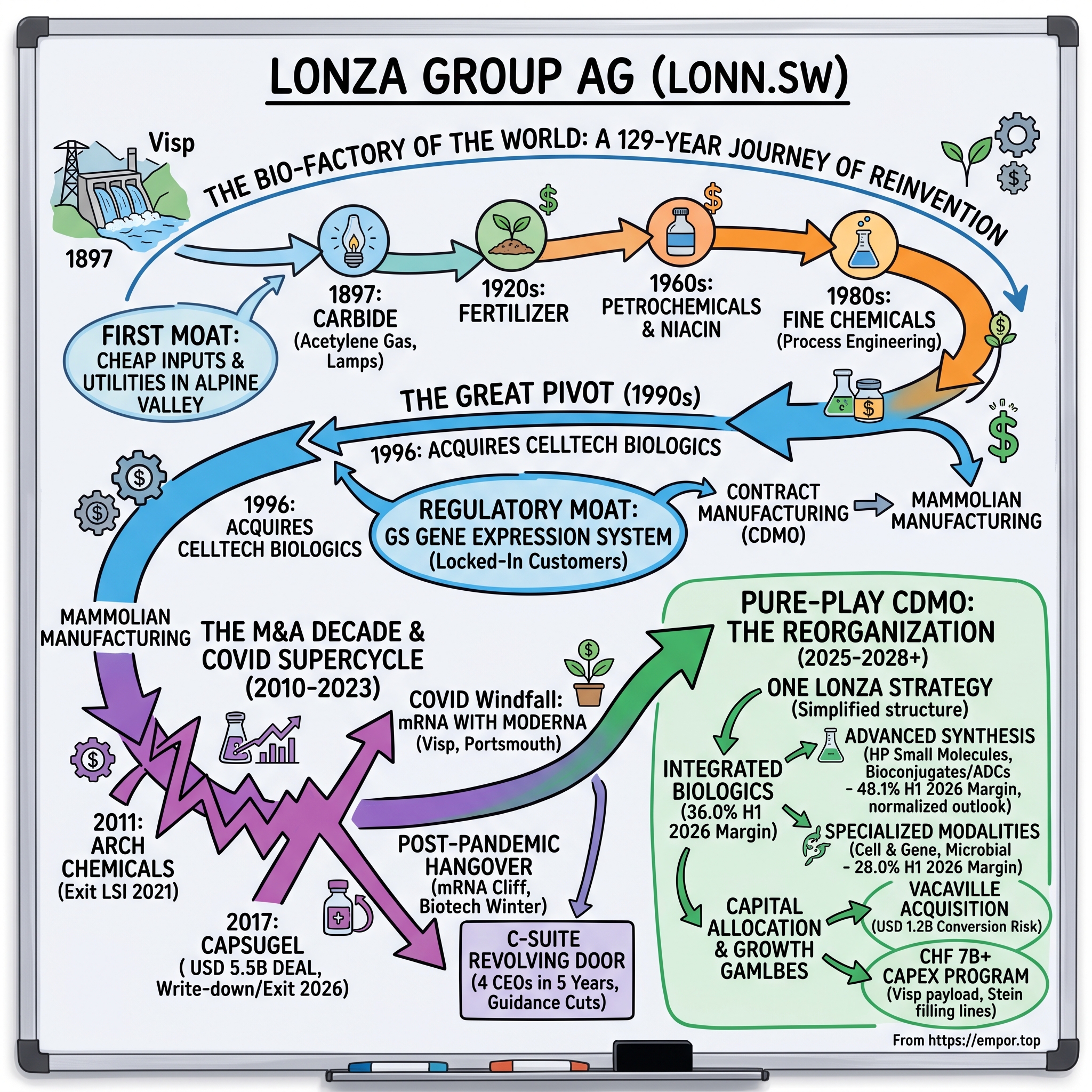
Lonza Group AG: The Bio-Factory of the World
I. Introduction & Episode Roadmap (00:00 – 00:12 | 12 min)
In 1897, a Basel banker named Alfons Ehinger looked at a river running out of the Lötschental glacier and saw not water but electricity. He built a power station on the banks of the Lonza, in the canton of Valais, and used the current to fuse coal and lime into calcium carbide — a gritty grey solid that, dropped into water, releases acetylene gas. The market was lamps. Carbide lit the headlamps of locomotives and the helmets of miners, and for a few years the little Swiss works had a growth business.1
Then electric headlights arrived, and the carbide market died.
That is the first thing worth knowing about Lonza Group AG (LONN.SW, SIX Swiss Exchange): its founding product was obsolete almost immediately, and the company survived anyway. Over the following 129 years it reinvented itself perhaps six times — carbide to fertilizer, fertilizer to petrochemicals, petrochemicals to fine chemicals, fine chemicals to contract manufacturing, contract manufacturing to biologics, and finally biologics-plus-everything-else to a self-declared pure-play CDMO. Very few industrial companies get to change their answer that many times. Lonza has done it while staying, physically, in the same alpine valley.
Today the company is the largest contract development and manufacturing organization in pharmaceuticals — the outsourced factory floor of the drug industry. It does not discover medicines and it does not sell them. It builds and runs the extraordinarily difficult infrastructure that turns a biotech's laboratory recipe into millions of vials of sterile, identical, regulator-approved product. In full-year 2025 that business generated sales of CHF 6.5 billion, up 21.7% at constant exchange rates, with CORE EBITDA of CHF 2.1 billion and a margin of 31.6%.2 In the first half of 2026, reported on 22 July, sales reached CHF 3.37 billion and the CORE EBITDA margin jumped to 34.8% — 4.4 percentage points better than the prior-year half.3
The core thesis is easy to state and harder to test: Lonza is protected less by technology than by paperwork. When a drug wins approval, the regulatory filing names the specific factory, the specific cell line, the specific process. Moving that production elsewhere means re-running comparability studies and re-opening a file with the FDA and EMA — years of work and real risk to a revenue stream worth billions. That is a switching cost written into law rather than into a contract, and it is the single most important thing about this business.
But a moat is not a guarantee of returns, and the last five years have been a live demonstration of that. Lonza has had four chief executives since 2019, two of them the same man serving as interim. It rode an mRNA windfall that vanished, cut guidance twice in one year, and watched its shares fall hard. It has since sold the capsule business it paid USD 5.5 billion for, sold the cell-therapy platform it built as its option on the future, and committed to spending more than CHF 7 billion on new plant through 2030.3 The story is not "quality compounder does quality compounding." It is a company with a genuinely rare asset base learning, expensively and publicly, how to run it.
Here is the route. First, the alpine origins — how a hydroelectric carbide works became a chemical engineering culture. Second, the pivot in the 1990s, when Lonza bought a British biologics business and, almost incidentally, acquired the expression technology that would embed it in the industry's regulatory files. Third, the M&A decade: the Arch Chemicals detour, the Capsugel megadeal, and the CHF 4.2 billion exit from specialty chemicals. Fourth, the COVID supercycle and the bullwhip that followed. Fifth, the governance crisis — four CEOs, two profit warnings, and a board on the defensive. Sixth, what the company actually looks like now, after a 2025 reorganization replaced nine business units with three platforms. Seventh, the industry structure and the BIOSECURE Act, which finally became law in December 2025 with far more caveats than the bull case assumed. Eighth, capital allocation: the Vacaville gamble and the enormous capex program riding on it. And last, the case for and against, and the small number of things actually worth tracking.
Start where the company started: in a valley, with a river, and a problem.
 Subscribe on LinkedIn
II. Alpine Origins: Electricity, Chemicals, and the Swiss Industrial Bedrock (1897–1980s) (00:12 – 00:27 | 15 min)
The Valais in 1897 was not an obvious place to build a chemical company. It was poor, mountainous, and far from customers. What it had was falling water — enormous quantities of it, dropping thousands of metres from glaciers to the Rhône valley floor.
That was the entire business case. Electrochemistry at the turn of the century was a brutal trade: you needed to hold a furnace at temperatures around 2,000°C to force carbon and lime to combine, and electricity was the only practical way to get there. Anywhere with expensive power, the economics failed. In the Valais, power was nearly free once the turbines were paid for. Lonza's founding insight was not chemistry at all. It was that a company should be built where the cheapest input is, and let the product find its way to market.
This is worth dwelling on, because the same logic runs through the company 129 years later. Visp — the town downstream where Lonza consolidated operations in the early 1900s — is still the heart of the business. Not because Visp is convenient. Because once you have spent a century installing utilities, effluent treatment, steam, containment, and a trained workforce in one valley, the marginal cost of the next plant there is dramatically lower than the cost of the first plant anywhere else. Lonza's oldest competitive asset is a piece of infrastructure, and the decision that created it was made when the product was lamp gas.1
The carbide business collapsed on schedule. Electric headlights replaced acetylene, and Lonza did the thing it would keep doing: it looked at its own capabilities — high-temperature reactions, gas handling, nitrogen chemistry — and asked what else they could make. The answer was fertilizer. Calcium cyanamide, made by reacting carbide with nitrogen, was a nitrogen source for European agriculture. Nitric acid production followed in 1920.1
Then came the long middle. Through the interwar years and after 1945, Lonza built out the standard portfolio of a European chemical company: industrial gases, solvents, plastics intermediates, agrochemical building blocks. In 1956 it started producing niacin — vitamin B3 — a molecule that turned out to matter more than anyone expected, because it dragged Lonza into the world of things humans ingest, with the quality standards that implies.1 In 1965 the company installed its first naphtha cracker, formally moving from carbide-derived chemistry to petrochemicals.1
Meanwhile, ninety minutes down the valley, Basel was becoming the most concentrated pharmaceutical cluster on earth. Ciba-Geigy, Sandoz, Roche and Hoffmann-La Roche were building the modern drug industry: discovery science, clinical trials, patents, global sales forces. Lonza was not that. Lonza was the company those firms called when they needed a difficult intermediate made at tonne scale without blowing anything up. The cultural divide is important. Basel sold molecules and marketing. Lonza sold process — the ability to take a reaction that worked in a flask and make it work, safely and repeatably, in a vessel the size of a house.
In 1974 Lonza was acquired by Alusuisse, the Swiss aluminium group, and became the chemicals arm of a metals conglomerate.1 The ownership brought capital, and Lonza spent it deepening its position in fine chemicals and pharmaceutical intermediates. In 1982 it took the step that defined everything after: it entered contract manufacturing as a declared business.1
That sounds small. It was not. Selling a chemical is a product business — you make a thing, you price it, the customer buys it or doesn't. Selling contract manufacturing is a service business with an entirely different shape. The customer brings the molecule. You bring the plant, the engineers, and the regulatory track record. You are paid for capability and reliability, not for the compound. Revenue becomes contractual rather than transactional; relationships run for a decade rather than a quarter; and — critically — the customer's regulatory filing starts to depend on you.
By the late 1980s the strategic problem was clear and unforgiving. Fine chemicals were cyclical, capital-hungry, and increasingly exposed to Asian producers who had the same reaction vessels and lower labour costs. Every year, the commodity end of Lonza's portfolio got harder. The company had two options: compete on cost against producers with structurally cheaper inputs, or find a customer base that would pay for something other than price.
The answer was staring at them from Basel. Human healthcare had the highest tolerance for cost and the lowest tolerance for failure of any industry on earth. If Lonza could make itself indispensable there, price competition would stop being the game.
The question was what, specifically, to sell them. The answer arrived from an unexpected direction: not chemistry at all, but biology.
III. The Great Pivot: From Fine Chemicals to the Birth of Biologics (1990s–2000s) (00:27 – 00:47 | 20 min)
To understand what Lonza saw in the early 1990s, you have to understand what was wrong with the way drugs had always been made.
A traditional pharmaceutical — aspirin, a statin, an antibiotic — is a small molecule. It has perhaps 20 to 50 atoms arranged in a specific shape, and you build it the way you build anything in a chemistry lab: mix reagents, apply heat, purify, repeat. It is complicated but it is deterministic. Follow the recipe and you get the compound.
A biologic is not like that. A monoclonal antibody has on the order of 20,000 atoms folded into a three-dimensional structure that no chemist can assemble by hand. The only practical way to make one is to persuade a living cell to make it for you. You insert the gene for your protein into a mammalian cell — almost always a Chinese Hamster Ovary cell, the industry's workhorse — grow billions of those cells in a nutrient broth inside a sterile steel tank, and let them secrete the drug. Then you spend weeks separating your product from everything else the cells produced.
The analogy that helps: small-molecule manufacturing is baking, and biologics manufacturing is brewing. In baking, the recipe is the product. In brewing, the yeast is the product, and the recipe is a set of conditions you maintain so the yeast does what you want. Which means the biology itself — which cell line, how it was engineered, how it behaves at scale — is not a detail. It is the asset.
Lonza figured this out earlier than most of its chemical peers. Through the mid-1980s and into the 1990s it invested in biotechnology while much of the specialty chemical industry treated it as an academic sideline. It acquired a fermentation facility in the Czech Republic in 1992.1 And then, in 1996, it bought Celltech Biologics — a British business manufacturing therapeutic proteins, with sites in Slough, England and Portsmouth, New Hampshire.1
Those two sites remain central to Lonza's mammalian manufacturing network three decades later.4 But the more consequential thing in the deal was not real estate. It was the GS gene expression system.
Here is what GS does, in plain terms. When you put a gene for a drug into a cell, most of the cells you treat don't take it up properly. You need a way to find the rare cells that did — a selection mechanism that kills everything else. The GS system uses glutamine synthetase, an enzyme cells need to make glutamine, an essential nutrient. Engineer the cells so that only those which successfully took up your drug gene can produce the enzyme, then starve them of glutamine. The cells that didn't take up the gene die. The survivors are, by construction, the ones you want — and by tuning the selection pressure you can push for the highest-producing clones. The result is a cell line that pumps out far more protein per litre than an unselected population, which means a smaller tank, a shorter run, and a lower cost per gram.5
Now the strategically interesting part. Lonza did not keep GS to itself. It licensed the system out — to Big Pharma, and especially to small biotechs at the earliest, most fragile stage of their existence. That looks like giving away the crown jewels. It was the opposite.
Consider what happens to a biotech that licenses GS. It develops its cell line on Lonza's platform. It runs its preclinical and early clinical material on that platform. When it files for approval, the process described in the application is built around that cell line. If the drug succeeds, the company faces a choice: manufacture with Lonza, or rebuild the process elsewhere and go back to the regulator to prove the new product is comparable to the one that was tested in patients. For a drug with a decade of patent life and a billion dollars of annual revenue at stake, that second option is close to unthinkable.
So Lonza was not selling a licence. It was buying an option on every biotech that used it — for free, at the moment those companies were too small to negotiate, and exercisable exactly when they became large. This is the mechanism at the heart of Lonza's position, and it explains why the company's advantage is durable in a way that a merely-good factory would not be. The lock-in was installed years before the customer had any reason to care.
Building the physical capacity to serve those customers was the harder half. Through the 2000s Lonza expanded stainless-steel mammalian bioreactor suites at Portsmouth and, later, in Singapore, alongside the Slough operations.4 These are not chemical plants with different labels. A bioreactor run is a live process lasting two weeks or more, in which the operator must keep temperature, dissolved oxygen, pH and nutrient feed within tight bands while billions of cells metabolize. Everything entering the vessel must be sterile. A single contamination event does not damage the batch — it destroys it, along with weeks of tank occupancy and, potentially, a customer's clinical supply. The economics of the business are therefore dominated by two variables: how much of your installed capacity is running, and how often batches fail. Every industrial habit Lonza had built over a century — process discipline, containment, engineering rigour — turned out to be exactly the right inheritance.
There is a further consequence of that cost structure that shapes the whole industry. Because a bioreactor suite costs roughly the same to run whether it is producing at capacity or standing idle, the difference between a highly profitable CDMO and a loss-making one is not price or efficiency in any conventional sense. It is booked capacity. A site running near full has its enormous fixed base spread thin and generates margins that look almost software-like. The same site at half utilization generates very little. This single fact explains most of what happens to Lonza's earnings over the next twenty-five years — the boom, the bust, and the recovery — and it is why the company's strategic decisions have consistently prioritized filling tanks over any other objective.
The corporate structure caught up in 1999. Alusuisse merged with Alcan and Pechiney, and Lonza was spun off as an independent company listed on the Swiss exchange.1 For the first time since 1974 it answered to its own shareholders.
What it did with that freedom over the following two decades was a genuine mess — a period in which the company demonstrated, repeatedly, that knowing which business is good is a different skill from staying in it.
IV. M&A Fever & Portfolio Clean-up: Arch, Capsugel, and LSI (2010–2021) (00:47 – 01:12 | 25 min)
In July 2011, Lonza agreed to buy Arch Chemicals, a US company that made biocides — the active ingredients in swimming pool treatments, wood preservatives, and industrial water systems — for roughly USD 1.4 billion.6 The CEO who did the deal was Stefan Borgas, and the logic he offered was that microbial control was a growth market adjacent to Lonza's existing chemistry.
The logic was not wrong about the chemistry. It was wrong about the economics.
Everything that made the biologics business attractive was absent from biocides. Nobody files a regulatory application naming the specific plant that made their pool chlorine. Nobody spends three years and tens of millions re-qualifying a wood preservative supplier. Customers switch on price, demand tracks construction and consumer spending, and margins compress whenever a competitor adds a line. Lonza had spent fifteen years acquiring the rarest thing in industrial manufacturing — a customer base that structurally cannot leave — and then deployed a billion and a half dollars into a business with the opposite property.
The consequences showed up in group returns rather than in any single headline. A large slug of capital now sat in assets earning cyclical industrial margins, dragging down blended return on invested capital and blurring what the company was for. Borgas departed, and Richard Ridinger became CEO in 2012.
Ridinger's contribution was less glamorous than a deal and more valuable. He imposed capital discipline, closed sub-scale chemical lines, and spent several years making the existing asset base earn its keep before attempting anything ambitious. It is the least-celebrated period in modern Lonza history and arguably the one that made the rest possible.
Then, in December 2016, he attempted something very ambitious indeed. Lonza agreed to buy Capsugel from KKR for USD 5.5 billion in cash, including refinancing roughly USD 2 billion of existing Capsugel debt. The transaction completed on 6 July 2017.78
Capsugel made capsules. Specifically, it was the global leader in hard capsules — the two-piece shells, made from gelatin or from plant-derived HPMC, that hold powdered drug or supplement. It is a business of astonishing volume and unglamorous physics: billions of units, tight tolerances, and customers ranging from Big Pharma to vitamin brands.
The bull case was coherent. Lonza's biologics business made drug substance — the active molecule. Capsugel gave it a position in oral dosage forms, the format in which most medicines actually reach patients, plus proprietary delivery technologies for poorly soluble compounds, plus a large consumer-health customer base that grew with the global supplement market. In principle it made Lonza a partner across the whole journey from molecule to swallowed pill.
The bear case was equally coherent and, in the end, closer to right. The multiple was rich for a manufacturer of physical shells. And the businesses shared very little: different customers, different sales cycles, different capital intensity, different cyclicality. A biologics contract runs for a decade and depends on regulatory filings. A capsule contract depends on what consumers spend on vitamins this quarter.
Hold that thought. It gets resolved in 2026, and not in Capsugel's favour.
The third move in the sequence was the cleanest. On 8 February 2021, Lonza agreed to sell its Specialty Ingredients division — the legacy industrial chemistry business, with the Arch biocides assets at its core — to Bain Capital and Cinven for an enterprise value of CHF 4.2 billion. The transaction closed on 2 July 2021, transferring 17 manufacturing sites and roughly 2,800 employees; the business was renamed Arxada.91011
Two observations, one flattering and one less so.
The flattering one: as capital recycling, this worked. Lonza took the least defensible part of its portfolio, sold it at a full price into a strong private equity market, and redirected the proceeds into mammalian biologics, bioconjugation and cell therapy capacity — businesses with the switching-cost characteristics the divested assets lacked. Selling a cyclical industrial business near a cycle peak to fund expansion in a structurally growing one is textbook good allocation, and Lonza executed it well.
The less flattering one: the round trip took a decade and cost real money. The 2021 sale was, in substantial part, the undoing of the 2011 purchase. Lonza bought Arch for USD 1.4 billion, spent ten years explaining why a healthcare company owned a pool chemicals business, and then sold it inside a larger package. It is possible to admire the exit and still note that the best version of this decade involved never making the entry — and that management's own subsequent conduct, in exiting Capsugel too, amounts to a verdict on the acquisition strategy of the preceding fifteen years.
For investors, the more useful lesson is about pattern recognition. Twice in fifteen years, Lonza deployed billions into businesses that were adjacent in manufacturing terms but alien in economic terms, and twice it eventually reversed course. That is a genuine data point on capital allocation judgement, and it deserves weight when assessing the CHF 7 billion-plus the company now plans to spend through 2030.3
By mid-2021, though, none of this was the story investors cared about. Lonza had just become a pure-play healthcare company at precisely the moment the entire planet needed one — and it was already deep into the strangest chapter in its history.
V. The COVID mRNA Supercycle & The Post-Pandemic Hangover (2020–2023) (01:12 – 01:32 | 20 min)
In the spring of 2020, Moderna had a vaccine candidate, a validated platform, and almost no manufacturing capacity. It needed to go from a company that had never commercialized a product to one supplying hundreds of millions of doses, and it needed to do so in months.
On 1 May 2020, Moderna and Lonza announced a ten-year strategic collaboration to manufacture mRNA drug substance, with production to be established at Visp and Portsmouth.12
What Lonza then did was, operationally, the most impressive thing in the company's modern history. Installing a new pharmaceutical production line normally takes two to three years: design, build, install, qualify equipment, validate the process, demonstrate consistency, host regulators. Lonza compressed that to a matter of months, repeatedly, across multiple lines — while global supply chains for single-use bags, filters, lipids and specialized instrumentation were seizing up, and while the regulatory scrutiny on every batch was the most intense the industry had ever seen.
It helped enormously that mRNA is, relatively speaking, a chemical process rather than a biological one. Making an antibody requires living cells and two weeks of cultivation. Making mRNA is enzymatic synthesis in a tank — you supply a DNA template and the building blocks, and the reaction runs in hours. That is why the world could scale vaccine production in 2020 at all, and why Lonza could stand up lines at a pace that would have been physically impossible for a monoclonal antibody. The constraint was never the biology. It was the engineering, the raw materials, and the willingness to commit capital before anyone knew whether the product would work.
That last point deserves emphasis, because it is the part that gets forgotten. In May 2020 nobody knew whether Moderna's vaccine was effective. Lonza committed capital and organizational bandwidth to building lines for a product that might have failed in Phase III. It was a genuine risk decision, taken quickly, and it happened to be right.
The financial effect was enormous. mRNA volumes lifted group revenue, and the cash generated funded a wave of internal expansion without stretching the balance sheet. But the more important effect was reputational. Before 2020, Lonza's pitch to a large pharmaceutical company was that it was a competent, reliable outsourcing partner. After 2020, the pitch was that when the hardest manufacturing problem on earth appeared with no schedule and no margin for error, Lonza solved it. That is a different kind of credential, and it is not one a competitor can buy.
There was a second-order cost to the triumph, though, and it showed up later. A company that has just proven it can do the impossible tends to be believed when it forecasts the merely difficult. Internally and externally, the COVID period reset expectations about what Lonza could deliver — on volumes, on margins, on the speed of new project ramp-ups. Those expectations were set during the most favourable demand conditions in the industry's history, and they were still in place when conditions changed.
Then the demand went away.
The unwind was faster and more brutal than almost anyone modelled. As populations acquired immunity and COVID moved from pandemic to endemic, vaccine demand collapsed. In 2023, Moderna moved to right-size its manufacturing footprint, ramping down mRNA drug substance production for its COVID-19 vaccine at Visp in the third quarter and planning to absorb the volume at its own Norwood, Massachusetts site and at new facilities in the UK, Canada and Australia.1314 The arrangement carried a termination fee, and the lost revenue landed on 2024.13
This is the structural lesson of the episode, and it is uncomfortable for the bull case. A CDMO's revenue is derivative — it depends entirely on demand for its customers' products, over which it has no influence whatsoever. Lonza executed flawlessly and still lost the business, because the drug's market disappeared. Switching costs protect you from the customer choosing someone else. They do not protect you from the customer needing less.
Worse, the loss came with stranded assets. Facilities built for one modality at one customer's specification are not instantly redeployable. Re-tooling dedicated mRNA suites for other work takes time and capital, and in the interim the fixed cost sits in the P&L earning nothing. High-fixed-cost manufacturing is a wonderful business at high utilization and a punishing one at low utilization, and the same operating leverage that produced the boom produced the bust.
The mRNA cliff was not the only thing going wrong. Two other problems arrived at the same time, which is what turned a bad year into a crisis.
The first was capsules. During the pandemic, consumer health and nutraceutical brands — worried about supply chains and riding a surge in vitamin buying — ordered capsules far in advance of what they needed. In 2023 they stopped ordering and worked through the inventory instead. Demand for nutraceutical capsules fell, and the Capsugel-derived business, which management had positioned as the group's steady cash generator, turned into a source of negative surprises.15
The second was the biotech funding winter. Central banks raised rates sharply through 2022 and 2023, and capital fled speculative early-stage biotech. Companies that would have started a development programme instead cut headcount and extended runway. That hit Lonza's early-stage development and testing services directly — the front end of the funnel, where tomorrow's commercial contracts are sourced.15
Three independent shocks — a customer's product cycle, a customer's inventory cycle, and the cost of capital — landed in the same twelve months. None was Lonza's fault in any simple sense. All three were foreseeable as risks. And what turned them from a rough patch into a credibility crisis was not the operating performance. It was what management had said before they happened.
VI. The C-Suite Revolving Door & Governance Stress Test (2019–2024) (01:32 – 01:47 | 15 min)
Count the chief executives.
Richard Ridinger ran Lonza from 2012 to 2019 and retired after the turnaround and the Capsugel deal. Marc Funk succeeded him and lasted under nine months. Chairman Albert Baehny stepped in as interim CEO. Pierre-Alain Ruffieux, recruited from Roche, took the role in November 2020 and departed in September 2023. Baehny stepped in as interim CEO again. Wolfgang Wienand started in July 2024.1617
That is five names across a five-year period, two of them the same man filling a gap. For a business whose entire proposition is multi-year reliability, it is difficult to overstate how damaging that looks. A pharmaceutical company signing a ten-year manufacturing agreement is making a bet on institutional continuity. When the counterparty cannot keep a CEO for two years, the bet gets harder to justify internally.
The immediate trigger for the 2023 rupture was guidance. In July 2023, alongside mixed half-year results, Lonza cut its outlook: sales growth from "high single-digit" to "mid-to-high single-digit," and the CORE EBITDA margin from a previously guided 30–31% to 28–29%. Management attributed the shortfall to weaker early-stage services as biotech funding tightened and to falling nutraceutical capsule demand.15
In September, Ruffieux left.17 Baehny took the operational reins for the second time.
Then, on 17 October 2023, at its Capital Markets Day, Lonza cut again — telling investors that the 2024 CORE EBITDA margin would be in the high twenties, against consensus expectations of roughly 30.7%. The shares fell to an eight-month low.[^18] For 2023 as a whole the company ultimately delivered 10.9% CER sales growth and a 29.8% CORE EBITDA margin — respectable numbers in isolation, and precisely the point.18 The operating business was not broken. The forecasting was.
Two guidance cuts in three months, bracketing a CEO departure, is the kind of sequence that changes how a stock is valued. It is not only that the numbers came down; it is what the pattern implies about the information reaching the board. Either management did not know what was happening in its own order book, or it knew and communicated it late. Neither reading is good, and investors were entitled to ask which it was.
The same Capital Markets Day set new mid-term guidance for 2024–2028: sales CAGR of 11–13% at constant exchange rates, a CORE EBITDA margin of 32–34%, and double-digit ROIC.19 It is worth being precise about the provenance of those targets, because they are frequently attributed to the current CEO. They were not his. They were set in October 2023, under an interim chief executive, in the middle of a credibility crisis — which makes the decision to publish five-year targets at that moment a defensible attempt to restore an anchor, or an odd time to make new promises, depending on your charity.
Which brings us to Albert Baehny, a figure who deserves more attention than he usually gets. Baehny is a career industrialist who chaired the board and twice took the operating job when the alternative was a vacuum. The generous reading is that he provided continuity and accountability at moments when the company badly needed both. The sceptical reading — and an activist would make it — is that a chairman serving as interim CEO twice in four years is a governance failure in itself. The chairman's central job is CEO succession. Doing that job twice, badly enough to need to backfill it personally, is not a demonstration of board strength. It is evidence of the opposite.
The eventual hire, announced on 2 April 2024, was Wolfgang Wienand.16 He started on 1 July 2024.20
Wienand's profile was a deliberate corrective. He studied chemistry at the University of Bonn and holds a doctorate in organic and bioorganic chemistry from the University of Cologne, plus an executive master's in international finance from HEC Paris. He held senior roles at Evonik Industries before joining Siegfried Holding — a Swiss mid-cap CDMO — in 2010 as Chief Scientific Officer, then Chief Strategy Officer, then CEO from January 2019 until March 2024.2122
The signal in that CV is specific. Wienand is a chemist who became a strategist who became a CEO, entirely inside the contract manufacturing industry. At Siegfried he built a reputation for the exact quality Lonza had lost: saying what the company would do and then doing it. Lonza did not hire a visionary. It hired someone whose distinguishing characteristic was that his guidance held.
Poaching him from a direct competitor also said something about urgency. Siegfried was left searching for a CEO.22
Wienand's first substantive act was not a deal. It was, in December 2024, to tell investors what Lonza was going to stop being.
VII. Business Architecture & Segment Economics: Where the Money Is Made (01:47 – 02:12 | 25 min)
On 12 December 2024, at an investor update in Basel, Wienand presented the conclusions of five months spent going through the business. The document that resulted is the most consequential strategic statement Lonza has made since the LSI sale.
Three things were announced. First, a strategy called "One Lonza," built on four initiatives: focus on the CDMO business, reshape the operating model, elevate execution in manufacturing and engineering, and take an impartial view on buying versus building. Second, a radical structural simplification — the CDMO business would move from three divisions containing nine underlying business units to three integrated business platforms, with the business unit layer removed entirely, effective from Q2 2025. Third, and most bluntly: Lonza would exit the Capsules & Health Ingredients business.23
Take the structure first, because it defines how the company is now understood.
Integrated Biologics combines Mammalian manufacturing and Drug Product Services.23 This is the core: large-scale cell culture producing antibodies and other proteins, plus the fill-finish operations that turn bulk drug substance into vials and syringes. In H1 2026 it generated CHF 1,870 million of sales, grew 10.0% at constant currency, and delivered a 36.0% CORE EBITDA margin.3 It is the largest platform, the most defensible, and the one where the regulatory switching cost is most absolute. Note, though, that it was the slowest-growing of the three in the half — a reminder that the crown jewel is also the most mature, and that Vacaville's phasing distorts the optics.
The commercial structure here is worth understanding, because it explains why the margin is what it is. Large-scale mammalian contracts typically reserve specific capacity for a customer over a multi-year term, with minimum volume commitments attached. The customer is buying certainty of supply for a product on which its entire franchise depends; Lonza is buying certainty of utilization on an asset that cost hundreds of millions. Both sides want the same thing — a full tank on a predictable schedule — which is why these relationships tend to renew and extend rather than go out to tender. Combining drug substance with drug product in one platform compounds it: a customer that fills as well as brews with Lonza has two sets of regulatory filings pointing at the same supplier.
The vertical integration argument is also the honest counter-argument. Fill-finish is a less differentiated activity than cell culture, with more capable providers, and bundling it raises revenue per customer more than it raises defensibility. Growth of 10% in the half, against 22–28% for the two smaller platforms, is consistent with a business that is very hard to displace and no longer easy to grow quickly.
Advanced Synthesis combines the former Small Molecules division with Bioconjugates.23 In H1 2026 it produced CHF 834 million of sales, grew 27.7%, and posted a 48.1% CORE EBITDA margin.3 That margin deserves a second look — it is extraordinary for contract manufacturing, and management flagged on the call that it was flattered by favourable product mix and phasing, with H2 expected to normalize.24 Investors should treat 48% as a high-water mark, not a run rate.
The businesses inside it are two of the highest-barrier niches in pharmaceutical production. Small Molecules here means highly potent active ingredients — cytotoxic compounds for oncology so toxic that manufacturing them requires containment systems designed to protect operators from microgram exposures. Very few facilities in the world are built for it, which is why the pricing holds.
Bioconjugates means antibody-drug conjugates, currently the most commercially exciting format in oncology. The concept is elegant: take a cytotoxic payload far too poisonous to give a patient systemically, and chemically tether it to an antibody that binds only to a marker on tumour cells. The antibody is the guidance system; the payload is the warhead; the linker is what holds them together and, critically, only releases the payload once inside the target cell. A guided missile rather than carpet bombing.
Making them is genuinely hard, because an ADC is a chemistry problem and a biology problem welded together. You need the antibody (biologics manufacturing), the payload (highly potent small-molecule chemistry), the conjugation step itself, and sterile fill-finish of a product that is toxic by design. Almost no organization has all four capabilities at commercial scale under one roof. Lonza does, which is why bioconjugation is its strongest genuinely differentiated position. It reinforced this on 1 June 2023 by acquiring Synaffix, a Dutch company with site-specific linker and payload technology, for €100 million in cash plus up to €60 million in performance-based consideration.2526
Specialized Modalities covers Cell & Gene Technologies, mRNA, Microbial and Bioscience.23 In H1 2026 it delivered CHF 553 million of sales, grew 22.6%, and earned a 28.0% CORE EBITDA margin.3 This is the emerging-technology bucket, and its economics are structurally the weakest — margins below group, and revenue that swings with the clinical fortunes of customers whose trials may simply fail.
Now the subtractions, which matter as much as the structure.
On 6 March 2026, Lonza agreed to sell Capsules & Health Ingredients to Lone Star Funds at an enterprise value of CHF 2.3 billion (about USD 3 billion). Lonza receives upfront proceeds of CHF 1.7 billion (about USD 2.2 billion) and retains a 40% stake with a preferential participation in a future exit; total undiscounted proceeds including full exit are expected at or above CHF 3 billion. The transaction was expected to close in the second half of 2026. Lonza also recognized a non-cash impairment, including CHI-related goodwill, of around CHF 1.3 billion in its FY2025 accounts, allocated to discontinued operations and excluded from CORE EBITDA of continuing operations.2728
Read those numbers against the 2017 purchase price of USD 5.5 billion and the CHF 1.3 billion write-down, and the conclusion is unavoidable: the Capsugel acquisition destroyed value. Wienand said as much, in franker terms than CEOs usually manage, telling that CHI had "distracted" the company from focusing on its true core.27 Analysts at William Blair reportedly did not view the deal terms favourably while remaining positive on the CDMO portfolio — a reasonable position, since the exit is right and the price is what it is.27
Two structural features of the deal deserve scrutiny. The 40% retained stake means Lonza has not fully exited; it keeps residual exposure to a business it just declared non-core, and the headline CHF 3 billion figure depends on a future exit that has not happened and is not guaranteed. The upfront cash — CHF 1.7 billion — is the number with certainty attached.
Lonza also divested its Personalized Medicines cell and gene therapy business, including the Cocoon cell therapy platform, to Octane Medical Group; sold the MODA manufacturing and quality software platform to StarLIMS; and disposed of the Monteggio micronization site. Terms were not disclosed.27
That last set matters more than its size suggests. Cocoon was Lonza's automated, closed-cassette system for making autologous cell therapies — treatments manufactured individually from each patient's own cells — and it had been presented for years as the company's option on a decentralized manufacturing future. Selling it is a clear statement: Lonza has decided it is in the business of large-scale, high-utilization industrial manufacturing, not in the business of distributed devices. Whether that turns out to be disciplined focus or a prematurely closed door is genuinely unresolved. It is a real bet, and it should be scored honestly in a few years.
The through-line is coherent. Wienand has taken a conglomerate assembled over three decades and reduced it to one question: does this asset produce complex molecules at scale for pharmaceutical customers under regulatory lock-in? Everything answering yes stayed. Everything answering no — capsules, cell therapy devices, software, a micronization site — went.
Which raises the obvious question. If the strategy is now to be the best large-scale CDMO in the world, how good is that business to be in?
VIII. Industry Structure, Moats, & The Geopolitical Windfall (02:12 – 02:32 | 20 min)
Run the industry through Porter, and the picture is unusually favourable — with one honest exception.
Threat of new entrants: very low. A commercial-scale biologics facility costs hundreds of millions to over a billion dollars and takes years to design, construct, commission, validate and get through regulatory inspection. Capital is the smaller barrier; the scarce inputs are time and people. You cannot buy a decade of batch records, and you cannot hire a workforce that has run a 20,000-litre bioreactor through a hundred campaigns if that workforce does not exist. Entry is possible for a sovereign fund or a conglomerate, and slow for everyone.
Threat of substitutes: negligible. There is no chemical shortcut to a folded protein. As long as medicine moves toward biologics, cell-based manufacturing is the only route.
Bargaining power of suppliers: moderate. The bioprocessing supply chain — single-use bags, chromatography resins, cell culture media, filters — is concentrated among a handful of firms including Sartorius, Merck KGaA, Danaher's Cytiva and Thermo Fisher. Lonza's purchasing scale helps, but 2021 demonstrated that when the industry needs the same consumables simultaneously, scale does not conjure supply. This is a real and under-discussed dependency.
Bargaining power of buyers: moderate, and asymmetric by customer. A large pharmaceutical company negotiating a new programme has genuine leverage: it can dual-source, run a competitive process, and walk. Once a product is approved on a named line, that leverage largely evaporates. Lonza's negotiating position is therefore weakest exactly when it is winning business and strongest once it has it — which is why the front end of the funnel matters so much and why the 2023 biotech winter hurt.
Competitive rivalry: high at the top. The credible large-scale competitive set is small: 삼성바이오로직스 Samsung Biologics, Boehringer Ingelheim, 药明生物 WuXi Biologics, Fujifilm Diosynth, and Thermo Fisher's Patheon. This is where the honest exception lives. Samsung Biologics has been building its fifth Incheon plant, adding over 600,000 litres and due to come online in the second half of 2026, and in December 2025 acquired a Maryland facility from GSK to build US capacity.29 Lonza is larger in total CDMO revenue, but it is not adding capacity into an empty market. A competitor with a lower cost of capital and a willingness to build ahead of demand is the most serious structural threat to the pricing environment — more serious, arguably, than anything on the demand side.
Now Helmer's 7 Powers, where two of the seven do real work.
Switching costs — specifically regulatory switching costs — are the dominant power, and the mechanism was described earlier: the filing names the plant, the process, the cell line. What is worth adding here is the shape of that protection. It applies to approved commercial products, not to development-stage work, and it protects against displacement, not against volume decline. Moderna's exit proved that distinction is not theoretical.
Scale economies are the second real power. Regulatory compliance, quality systems, analytical testing, global logistics and IT are largely fixed costs spread across a very large asset base. This is visible in the numbers: Lonza's margin expanded from 29.0% in 2024 to 31.6% in 2025 to 34.8% in H1 2026, with management attributing the improvement to maturing growth projects, operational execution and operating leverage.2330 Operating leverage cuts both ways, which is exactly what 2023 showed.
The third often-claimed power — process power, meaning accumulated know-how in yield optimization and batch reliability — is real but unverifiable from outside. Lonza does not disclose batch success rates or yields. Investors should treat it as plausible rather than proven.
Myth versus reality: the BIOSECURE Act
Here is where the consensus narrative most needs correcting.
For two years the bull case on Western CDMOs leaned on the US BIOSECURE Act — legislation aimed at Chinese biotechnology companies, and specifically at 药明康德 WuXi AppTec and 药明生物 WuXi Biologics — as an approaching windfall. The story was that American pharma would be forced out of Chinese suppliers and into Lonza's arms.
The Act did become law, on 18 December 2025, as part of the FY2026 National Defense Authorization Act.31 That is real, and it is a genuine change from the pending-legislation status the bull case had assumed for years.
But the enacted statute is considerably narrower than the version investors priced. The explicit named-entity list — which had identified WuXi AppTec, WuXi Biologics, BGI, MGI and Complete Genomics — was removed and replaced with two designation pathways: automatic inclusion for companies on the Department of Defense's Section 1260H list of Chinese military companies that also supply biotechnology equipment or services, and discretionary designation by the Office of Management and Budget.31
On 8 June 2026, the DoD added WuXi AppTec to its 1260H list, describing the company as indirectly owned and indirectly affiliated with Chinese state and military entities.31 So the designation machinery works, and it has fired.
Now the caveats, which the headline version omits. The Act's prohibitions do not take effect until 60 days after the Federal Acquisition Regulation is revised — a process that could run for close to three years. Contracts predating the restrictions receive a five-year grandfathering period. And the scope covers federal procurement, grants and loans subject to the FAR; Medicare and Medicaid agreements fall outside it.31
Put those together and the practical picture is this: a real, permanent shift in the direction of Western supply chain policy, delivered on a timeline measured in years rather than quarters, with existing arrangements protected for half a decade, and applying directly only to the federal contracting channel rather than to the commercial pharmaceutical market as a whole.
The commercial effect is likely to run through risk management rather than compliance. A pharmaceutical company planning a product launch in 2032 does not want its supply chain sitting on a designated entity, regardless of grandfathering. That reasoning moves new programmes westward. It does not move existing volume.
Lonza's own management has been notably careful here. On the H1 2026 call, Wienand did not present BIOSECURE as a windfall. He said he had seen no evidence of a fundamental shift in how customers view their strategic partnerships, noted that pharmaceutical companies have historically spent around 5% of sales on capital expenditure with that continuing through 2030, and framed the opportunity as an "increased regionalization of supply and demand" favouring Lonza's diversified global network, with geopolitical developments raising demand for US capacity specifically — reflected in contracting at Portsmouth and Vacaville.24
That is a more modest claim than the market's, and it is more likely to be right. Which makes the US asset base the thing to examine — and the largest piece of it was bought two years ago for USD 1.2 billion.
IX. Capital Allocation & The Next Act: The Vacaville Gamble & Wienand's Strategy (02:32 – 02:47 | 15 min)
Vacaville, California sits about an hour northeast of San Francisco, past the edge of the Bay Area's sprawl. Genentech built its large-scale manufacturing there, and for decades it was one of the most productive biologics sites in the world — making Roche's antibodies for its own patients, at a scale few facilities can match.
Then Roche got better at manufacturing. Improved cell-line productivity and process yields meant the company needed less physical capacity to make the same quantity of drug, and a site sized for an earlier generation of technology became surplus.32
On 20 March 2024, Lonza agreed to buy it for USD 1.2 billion in cash. The deal closed on 1 October 2024.333435
The asset is roughly 330,000 litres of bioreactor capacity, including 12,000- and 25,000-litre vessels, making it one of the largest biologics sites in the world by volume. Around 750 Genentech employees were offered employment with Lonza. Lonza expected to invest a further approximately USD 561 million to renew and upgrade the facility. And Roche committed to volumes equal to 30% of capacity in 2025, ramping down over the medium term.3235
The arithmetic on price is striking. USD 1.2 billion for 330,000 litres is roughly USD 3,600 per litre of installed capacity. Lonza has not published a formal replacement-cost benchmark, and greenfield comparisons vary widely with location and specification, so any "half the cost of building it" claim should be treated as an estimate rather than a disclosed figure. What is not in doubt is the time saving. Building an equivalent site would take roughly five years from decision to first commercial batch. Lonza acquired a running facility with a trained workforce, an established quality system, and an anchor customer already in the building.
The genuine risk was never the price. It was the conversion.
A captive plant and a CDMO are different organisms. A captive plant makes a known set of products for one owner, on a predictable schedule, with one quality system and one IT stack. A CDMO site runs many customers' processes simultaneously, under separate confidentiality regimes, with different specifications and audit requirements, and must switch between them without cross-contamination or schedule collapse. The equipment transfers. The operating model has to be rebuilt.
The evidence so far is mixed-to-good. In FY2025 Vacaville contributed approximately CHF 0.6 billion of sales, slightly above expectations, completed its first FDA audit under Lonza ownership, and signed additional commercial contracts.236 But management guided that Vacaville sales in FY2026 would be roughly flat at around CHF 0.6 billion, with a planned shutdown during the year for CDMO readiness work.24 In other words: the conversion is genuinely under way, it costs production time, and the site is not yet a growth contributor. That is honest disclosure and an unfinished project. Underlying organic growth excluding Vacaville ran in the low teens in 2025 at an improved margin — the number that shows what the rest of the business is doing.2
The capital commitment ahead is the real story. Lonza has laid out more than CHF 7 billion of organic capital expenditure through 2030, subject to a minimum 15% internal rate of return and a 30% peak ROIC hurdle per project.324 Named projects include a payload linker manufacturing expansion at Visp ramping in 2029, a second commercial aseptic ADC filling line at Stein for 2030 and beyond, and an enhanced Stein facility for high-value small molecules from 2028.24 Capex ran at CHF 1.3 billion in FY2025, or 19.6% of sales.36 In H1 2026 it was CHF 530 million, 15.7% of sales, down from 21.2% a year earlier, with 62% going to growth projects, and full-year guidance sits in the mid-to-high teens as a percentage of sales.3
The published hurdle rates are the most investor-relevant disclosure Lonza has made in years, precisely because they are falsifiable. A company that publishes a 15% IRR floor has given the market a stick to beat it with. Returns are showing early progress: ROIC reached 13.2% annualized in H1 2026, up 2.7 percentage points, with the CFO noting it now runs at roughly twice the weighted average cost of capital.324 That is a genuine improvement. It is also, at 13.2%, still below the 15% project hurdle at the group level — which is what you would expect mid-build, and which is exactly the gap the next four years must close.
The rest of the framework: a dividend policy committing to maintain or increase dividend per share year on year at a 35–45% payout ratio.23 Free cash flow in H1 2026 was CHF 426 million against CHF 116 million a year earlier — a large improvement, and one to watch, because a company spending CHF 7 billion needs its operating cash to do the heavy lifting.3
What "One Lonza" actually changed
The operating model deserves more attention than it usually gets, because it is the least visible and possibly the most important of Wienand's moves. Removing the business unit layer — collapsing nine units into three platforms with direct management of multiple technology platforms — is not an org-chart cosmetic.23 In a company where every site competes internally for capital, every unit forecasts its own demand, and every unit negotiates its own customer terms, the group ends up with nine partial views of the order book and no single one. That is a plausible mechanical explanation for how a management team could be surprised twice in one year by its own numbers.
Flattening the structure does two things. It shortens the distance between a site's actual utilization and the CEO's view of it, and it makes a unified go-to-market possible — one commercial conversation with a customer who might want antibody, conjugation, and fill-finish rather than three separate negotiations. Management explicitly described the redesign as intended to improve execution capability and unify the customer-facing approach.23
The evidence that it is working is indirect but real: margin expansion attributed to execution and operating leverage rather than price, capex intensity falling from 21.2% to 15.7% of sales year on year while growth continued, and — the sharpest signal — a management team that in July 2026 could explain second-half phasing at the level of individual site shutdowns and product mix.324 Companies that do not know their own order book cannot talk that way. It is not proof, but it is the opposite of what 2023 looked like.
The activist's case
What would a sceptical investor press on?
First, the acquisition record. Arch was reversed. Capsugel was written down and sold. Cocoon was sold. Three major capital decisions, three retreats. Against that history, a CHF 7 billion organic programme deserves scepticism until the returns show up — and the fact that it is organic rather than acquisitive is a point in its favour, since Lonza's building record is better than its buying record.
Second, the CHI structure. Retaining 40% of a business you have declared non-core, with the headline valuation depending on a future exit, is not a clean break. It leaves residual exposure and a valuation claim that cannot yet be verified.
Third, disclosure gaps. Lonza does not publish capacity utilization rates, batch success rates, or customer concentration in useful detail. For a business whose economics are dominated by utilization, that is a meaningful hole, and it forces investors to infer from margin what they should be able to read directly.
Fourth, guidance behaviour — where the criticism now runs in the opposite direction from 2023. Which brings us to the most interesting thing about the last reporting day.
X. The Investment Story Spine: Bull vs. Bear Case & 3 Critical KPIs (02:47 – 03:00 | 13 min)
On 22 July 2026, Lonza reported a first half that beat on essentially every line. Sales grew 16.0% at constant currency. CORE EBITDA rose 27.4%. The margin expanded 4.4 points to 34.8%. CORE earnings per share reached CHF 8.63, up 34.0%. Free cash flow nearly quadrupled. Management upgraded the full-year margin guidance to 33–34% from "above 32%."3
The reason is the most revealing detail in this entire story. Management raised the margin outlook but left the full-year sales growth guidance unchanged at 11–12% CER, and analysts pressed repeatedly on why. The answers were about phasing: tougher comparisons in the second half, the Vacaville shutdown, and normalization of Advanced Synthesis margins from an unusually strong first half. At one point management noted the business is "not a cookies factory" and that lumpiness between halves is normal.24
Read that against 2023 and something important becomes visible. This is a management team that has chosen to under-promise, absorb a bad share price day, and preserve the option of beating rather than missing. Whether you find that reassuring depends on whether you think the 2023 lesson needed learning. The evidence suggests it did, and that it was.
That is the strongest single piece of evidence in the bull case — not the margin, the behaviour. But it is two years old, in a rising market, and it has not yet been tested by a downturn. Guidance discipline is easy when demand is strong.
The bull case
Outsourcing is structurally growing, and the mix is moving toward Lonza's hardest capabilities. ADCs, bispecifics and complex biologics are exactly the modalities that pharma companies are least likely to build for themselves, because each requires a different specialist capability set. Lonza's Advanced Synthesis growth of 27.7% in H1 2026 is the cleanest evidence that this mix shift is real and monetizable, not a slide-deck argument.3
Operating leverage is delivering. A 5.8-point margin expansion from FY2024's 29.0% to H1 2026's 34.8% is a large move in a capital-intensive business, and it came from utilization and project maturation rather than from price alone.330
The structure is finally clean. After the CHI, Cocoon, MODA and Monteggio disposals, Lonza is what it says it is. Conglomerate discount arguments no longer apply, and management attention is not divided across businesses with nothing in common.
Geopolitics leans the right way over time. Even discounted for the BIOSECURE Act's delayed and narrow implementation, the direction of Western supply-chain policy favours a CDMO with large-scale capacity in Switzerland, the UK and the United States.
Management credibility is being rebuilt with observable behaviour, including published return hurdles that can be checked.
The bear case
Capacity is arriving industry-wide, not just at Lonza. Samsung Biologics' Incheon expansion alone adds more than 600,000 litres in the second half of 2026.29 Lonza's margin story depends on high utilization, and utilization depends on the industry not overbuilding. This is the single most underweighted risk in the bull case, because it attacks pricing rather than volume, and pricing is where the operating leverage lives.
Demand is derivative and can vanish without any execution failure. The Moderna experience is the template: the switching-cost moat protects share, not volume. Concentration risk is real and poorly disclosed.
The capital programme is enormous and front-loaded. More than CHF 7 billion through 2030, against a company generating roughly CHF 2 billion of CORE EBITDA annually, means years of capex running well above depreciation. If demand disappoints, the fixed cost arrives regardless — the exact mechanism that produced 2023.
Vacaville is unfinished. Flat sales guided for 2026 and a shutdown for readiness work are evidence of a conversion in progress, not complete.24 The multi-customer operating model has not yet been demonstrated at full scale.
The capital allocation history is genuinely poor. A CHF 1.3 billion impairment on CHI is a large, recent, documented error.28 It was corrected, but it was made.
Quality risk is chronic. Management characterized FDA 483 observations as "almost nowadays normal course of business" and stated none had affected operations or revenue, and separately that cell and gene production challenges were unrelated to FDA observations and had been resolved.24 That is a reasonable answer. It is also the kind of risk that is invisible until it is not: a serious regulatory finding at a major site would hit multiple customers simultaneously.
The KPIs that actually matter
Three, and only three.
1. Organic constant-currency sales growth, excluding acquisitions. This is the demand signal stripped of the two things that distort it — currency translation and the Vacaville contribution. Lonza's own organic growth model targets low teens over time.23 If organic growth holds in the low teens, the outsourcing thesis is intact. If it drifts toward mid-single digits while capex runs above 15% of sales, the thesis is breaking regardless of what the reported headline says.
2. CORE EBITDA margin. This is the utilization proxy. Lonza does not disclose capacity utilization rates — a real gap — so margin is the best available read on whether new assets are filling up. The relevant question each period is not whether margin rose, but why: mix and phasing effects, like the exceptional H1 2026 Advanced Synthesis result, are temporary, while sustained fixed-cost absorption is not. Management guided 33–34% for 2026 against a 32–34% mid-term frame.319
3. ROIC against the published hurdle. This is the accountability metric, and it is the one Lonza handed investors itself. The company has committed to a 15% minimum IRR and 30% peak ROIC on new projects while spending more than CHF 7 billion.24 Group ROIC reached 13.2% annualized in H1 2026.3 Track the trajectory. Rising ROIC through a heavy build phase means the assets are earning as promised. Flat or falling ROIC while capex stays elevated is the signature of a company building capacity the market does not need — and it would be the clearest possible signal that the pattern of the Arch and Capsugel decisions has repeated itself in organic form.
Everything else — quarterly sales phasing, individual contract wins, the precise timing of BIOSECURE enforcement — is noise against those three.
The company that emerges from all of this is genuinely unusual. It occupies a position almost nobody can attack, in an industry with real secular growth, protected by regulatory mechanics that competitors cannot replicate with capital alone. It also spent fifteen years proving it could misallocate money, lost a customer that generated an enormous share of its revenue through no fault of its own, and burned through four CEOs learning what business it was in.
Alfons Ehinger built a power station to make lamp gas, and the lamp market died within a decade. What survived was not the product but the position: a company sitting on cheap inputs in a valley, willing to keep asking what else it could make. Lonza has now answered that question for the seventh time. The answer — be the factory the drug industry cannot build for itself — is the best one it has ever given. Whether the CHF 7 billion it is spending to prove it earns the returns management has promised is the question the next four years will settle, and the three numbers above are how it will be settled.
References
-
Lonza Group Ltd. — Company Profile, Information, Business Description, History — International Directory of Company Histories ↩↩↩↩↩↩↩↩↩↩
-
Lonza Delivers Strong Profitable Growth in Full-Year 2025 and Successfully Advances Transformation — Lonza Group AG, 2026-01-28 ↩↩↩↩
-
Lonza H1 2026 slides: margin upgrade overshadowed by muted outlook — Investing.com, 2026-07-22 ↩↩↩↩↩↩↩↩↩↩↩↩↩↩↩↩↩↩
-
Lonza cGMP Manufacturing Facility, Slough — Pharmaceutical Technology ↩↩
-
Lonza To Buy Arch Chemicals — Chemical & Engineering News, 2011-07-18 ↩
-
Lonza Group AG to buy Capsugel from KKR & Co for $5.5bn — Financier Worldwide ↩
-
Lonza Completes Acquisition of Capsugel to Create Leading Integrated Solutions Provider — Lonza Group AG Press Release, 2017-07-06 ↩
-
Lonza Signs Agreement to Divest Specialty Ingredients Business to Bain Capital and Cinven — Lonza Group AG Press Release, 2021-02-08 ↩
-
Lonza Completes Divestment of Specialty Ingredients Business — Lonza Group AG Press Release, 2021-07-02 ↩
-
Bain Capital Private Equity and Cinven enter into definitive agreements to acquire Lonza Specialty Ingredients — Bain Capital, 2021-02-08 ↩
-
Moderna and Lonza Announce Strategic Global Manufacturing Agreement for mRNA Vaccine — Lonza Group AG Press Release, 2020-05-01 ↩
-
Moderna Ramps Down mRNA Drug Substance Production For Its Covid-19 Vaccine At Lonza — Moderna, Inc. ↩↩
-
Lonza to stop producing Moderna Covid-19 vaccine — SWI swissinfo.ch ↩
-
Lonza Group AG Q2 2023 Earnings Call Transcript — Seeking Alpha, 2023-07-21 ↩↩↩
-
Lonza Appoints Wolfgang Wienand as New Chief Executive Officer — Lonza Group AG Press Release, 2024-04-02 ↩↩
-
Lonza's CEO makes sharp exit — Chemical & Engineering News, 2023-09 ↩↩
-
Lonza Delivers Solid 2023 Performance with 10.9% CER Sales Growth and 29.8% CORE EBITDA Margin — Lonza Group AG, 2024-01-26 ↩
-
Capital Markets Day 2023: New Mid-Term Guidance 2024–2028 Supported by Ramp-Up of Growth Projects — Lonza Group AG, 2023-10-17 ↩↩
-
Lonza Welcomes New Group Chief Executive Officer Wolfgang Wienand — Lonza Group AG, 2024-07-01 ↩
-
Dr. Wolfgang Wienand — Board of Directors, Mettler-Toledo International Inc. ↩
-
Lonza poaches its new CEO from rival Siegfried — Chemical & Engineering News, 2024 ↩↩
-
Lonza Investor Update 2024 Outlines Strategy, New Organizational Structure and Guidance — Lonza Group AG, 2024-12-12 ↩↩↩↩↩↩↩↩
-
Earnings call transcript: Lonza H1 2026 profit gains fail to lift shares — Investing.com, 2026-07-22 ↩↩↩↩↩↩↩↩↩↩↩↩
-
Lonza to Acquire Synaffix and Strengthen Antibody-Drug Conjugates Offering — Lonza Group AG Press Release, 2023-06-01 ↩
-
Lonza lays out $100m+ for ADC firm Synaffix — BioProcess Insider, 2023-06 ↩
-
Lonza divests capsules and health ingredients business for $2.2B in upfront cash — Pharma Manufacturing, 2026-03 ↩↩↩↩
-
Lonza Completes its Transformation to a Pure-Play CDMO with Agreement to Divest Capsules & Health Ingredients — Lonza Group AG, 2026-03-06 ↩↩
-
Samsung Biologics climbs to global top 3 as US advances bioindustry limits on Chinese CDMOs — Korea Biomedical Review ↩↩
-
Lonza Delivers Solid 2024 Performance with CER Sales in Line with Prior Year and 29.0% CORE EBITDA Margin — Lonza Group AG, 2025-01-29 ↩↩
-
WuXi AppTec's 1260H Listing Brings the BIOSECURE Act Back to Center Stage — FDA Law Blog, 2026-06 ↩↩↩↩
-
Lonza snaps up 330kL Roche Vacaville site for $1.2 billion — BioProcess International, 2024-03 ↩↩
-
Lonza Signs Agreement to Acquire Large-Scale Biologics Site in Vacaville (US) from Roche — Lonza Group AG Press Release, 2024-03-20 ↩
-
Lonza Completes Acquisition of Vacaville Biologics Site — Lonza Group AG Press Release, 2024-10-01 ↩
-
Roche: Improved processes drove $1.2bn Vacaville sale — BioProcess International ↩↩
-
Lonza Reports CHF 6.5bn Sales in FY 2025, Raises 2026 Outlook — PharmaSource, 2026-01-28 ↩↩
 LinkedIn
 WhatsApp
 Reddit
 Hacker News
 Email
Email Kindle
 RSS Feed
 Spotify
 Apple Podcasts
 Amazon Music
 Audible
 YouTube