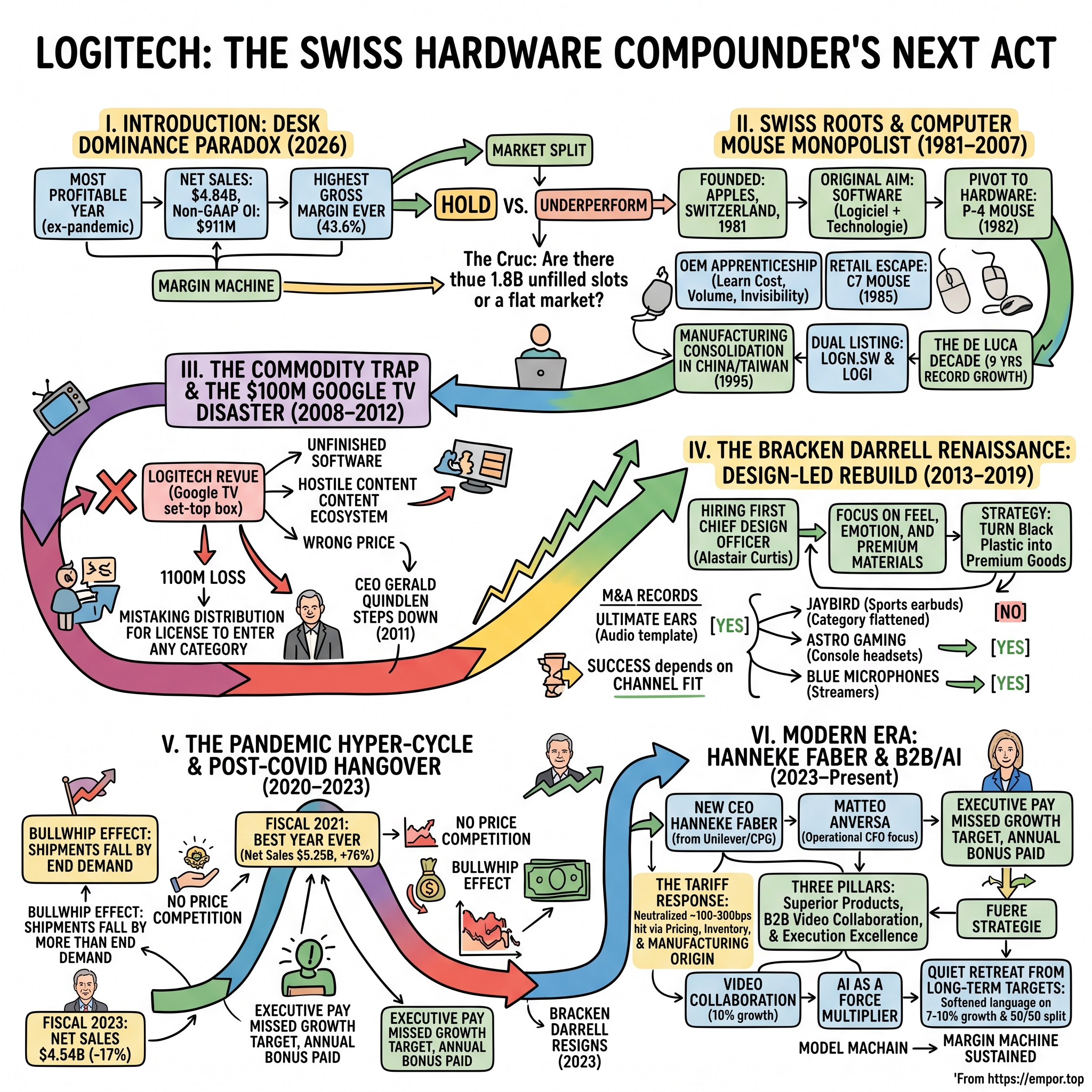
Logitech: The Swiss Hardware Compounder's Next Act
I. Introduction & The Desk Dominance Paradox
On May 5, 2026, a company that most investors still file under "PC accessories" reported the most profitable year in its history outside the pandemic. Net sales of $4.84 billion, up 6% in dollars and 4% in constant currency. Non-GAAP operating income of $911 million, up 18%. A non-GAAP gross margin of 43.6% and an operating margin of 18.8% — both described by management as the highest ever recorded outside the COVID years. Cash from operations of $1.04 billion, which is to say the business converted more than 100% of its operating income into cash.12
This is not what a commoditised hardware business looks like. Commoditised hardware businesses earn teens gross margins, live and die on component pricing, and hand their economics to whoever controls the channel. Logitech earned a gross margin closer to a branded consumer goods company than to a contract manufacturer, and it did so in a fiscal year that included a US tariff shock, a memory-chip squeeze, and a soft Western gaming market.
And yet, the market's verdict remains conspicuously split. As of late July 2026, the shares changed hands around $111 on Nasdaq against a 52-week range of roughly $83 to $130, with a consensus analyst rating of "Hold" and a twelve-month price target essentially level with the current price. Wedbush carried a $135 target. Bank of America had moved the other way entirely, downgrading to Underperform with an $86 target on demand concerns.3 Two competent research teams looking at the same company, roughly 55% apart on value. That gap is the story.
The peripherals fallacy
The bear framing has been remarkably stable for fifteen years: peripherals are attachments to a mature, cyclical PC market; the products are physically simple; anyone with a factory in Shenzhen can build a mouse; therefore margins must eventually compress toward the cost of plastic, copper, and a sensor. The framing has been wrong often enough to deserve scrutiny, but it has also been right at least twice — once catastrophically. Understanding when it is right is more useful than deciding it is permanently wrong.
The bull framing is equally simple: this is a design-and-brand business that happens to ship physical objects, sitting on a global distribution system that took forty years and several thousand retail and reseller relationships to assemble, with an installed base of desks that it can keep upgrading. On the January 2026 earnings call, CEO Hanneke Faber put a number on the opportunity that reframes the whole debate: of roughly 1.5 billion PCs in use worldwide, fewer than half have a mouse attached and under 30% have an external keyboard — over 1.8 billion unfilled slots, in her framing, and a far larger prize than the tens of millions of new PCs sold each quarter.14
That claim is the crux. If it holds, Logitech is not a PC-cycle derivative at all; it is a penetration story with decades of runway. If it does not — if the people without a mouse are people who genuinely do not want one — then the company is a share-gainer in a flat market, and the growth half of its financial model is aspirational.
What this story tests
The arc runs from a village in French-speaking Switzerland in 1981, through a near-death encounter with platform dependency that cost more than $100 million and two chief executives, through a decade-long design-led rebuild, through the most extreme demand distortion any consumer hardware company experienced in modern times, and into the present: a CEO from consumer packaged goods running a hardware company on cost discipline and market-share arithmetic, with roughly 40% of revenue now coming from business customers rather than consumers.
Along the way we will test the claims rather than repeat them. Where management says the moat is durable, we will look for the mechanism and the counter-evidence. Where the incentive structure is presented as aligned, we will check what actually paid out. And we will pay particular attention to the two places where the numbers and the narrative do not entirely agree: a long-term growth target that has quietly softened, and a company that consistently beats its margin model while missing its growth model.
It starts, as these stories often do, with two graduate students who thought they were starting a software company.
 Subscribe on LinkedIn
II. Swiss Roots & The Computer Mouse Monopolist (1981–2007)
Apples is a village in the canton of Vaud, above Lake Geneva, with a population that even today would struggle to fill a mid-sized office building. In 1981 it acquired an unlikely tenant: a startup founded by Daniel Borel, a Swiss engineer, and Pierluigi Zappacosta, an Italian one, who had met at Stanford and returned to Europe with an idea about software.4 The name they chose — Logitech, from the French logiciel, meaning software, plus technologie — records the original ambition. They were not planning to build hardware.
The pivot came from a practical observation. Graphical interfaces were arriving, and a graphical interface is useless without a pointer. Someone had to build the pointer, and the engineering was harder than it looked: an opto-mechanical mouse of the era had to translate the messy analogue motion of a human hand into clean digital coordinates, reliably, thousands of times per second, for years, at a price a computer buyer would tolerate. Logitech's first mouse, the P-4, arrived in 1982.4
The OEM apprenticeship
What followed was the most valuable and least glamorous phase of the company's life: roughly a decade as a supplier to other people's brands. Selling mice to computer manufacturers taught Logitech three things that shaped everything after. It learned to hit a cost target set by someone else, which is a different discipline from designing to a spec. It learned volume manufacturing, because OEM contracts arrive in units of hundreds of thousands. And it learned that being invisible is profitable but fragile — the customer can switch suppliers at the next design cycle, and the end user never knows your name.
The escape route was retail. In 1985 the company launched the C7, a three-button mouse sold under its own brand, and stepped into the consumer channel while continuing to supply manufacturers.4 Running both models simultaneously is harder than it sounds — the OEM customer is also, in effect, a competitor's supplier — but it gave Logitech a rare combination for the era: manufacturing scale from the OEM business, and pricing power and brand recognition from retail.
The manufacturing footprint followed the economics with unsentimental speed. Taiwan opened in 1986. Cork, Ireland, in 1988. Suzhou, China, in 1994. And in 1995, the company closed its US and Irish plants and consolidated production into China and Taiwan.4 Read that sequence again with 2026 eyes: three decades before "China+1" became a boardroom phrase, Logitech had already run the full arc from Western manufacturing to Asian consolidation, and it had learned that moving a factory is an operational decision, not an identity crisis. That institutional muscle memory turns out to matter enormously later in this story.
The scale that followed was extraordinary in a quiet way. The hundred-millionth mouse shipped in 1996. The two-hundred-millionth in December 1998. The five-hundred-millionth in September 2003.4 Compounding at that rate, in a product category most people never think about, is precisely the kind of thing public markets systematically under-notice.
Capital markets and the De Luca decade
Logitech went public on the Zurich exchange in 1988, the year it formally became Logitech International S.A. and passed roughly $40 million in revenue.4 The Nasdaq listing followed in 1997 with four million American Depositary Shares — a dual-listing structure the company still carries today, trading as LOGN in Switzerland and LOGI in the United States.4 For a Swiss company selling mostly into the American and Asian technology markets, the dual listing was less vanity than necessity: it put the shares where the technology investors were.
In 1998 Guerrino De Luca arrived as chief executive, with Borel moving to chairman.4 De Luca had come from Apple, and he brought a marketer's instinct to what had been an engineer's company. His decade in the job was the most straightforwardly successful stretch in Logitech's history: revenue grew from roughly $400 million to more than $2.1 billion, operating income from about $16 million to more than $230 million, and the company posted nine consecutive years of record sales and profits before he handed the CEO role to Gerald Quindlen effective January 1, 2008.4
The strategy in those years was category expansion off a fixed distribution asset. Once you own shelf space and a brand in mice, the marginal cost of also selling keyboards, trackballs, webcams, and desktop speakers through the same channel is low. The QuickCam webcam business, bought from Connectix in September 1998 for $26.2 million, is the template: a modest price for a product line that plugged straight into an existing sales machine.4 Labtec followed in 2001 for $73 million and Intrigue Technologies in 2004 for $29 million.4
The pattern worth extracting is this: Logitech's original moat was never the mouse. It was the combination of low-cost Asian manufacturing and privileged access to the world's retail shelves, which let it turn commodity-ish electronics into branded goods at scale. That advantage is real and it is durable — but it has a specific failure mode. A company built to push volume through a channel will, sooner or later, be tempted to push the wrong thing through it. In 2010, Logitech did exactly that.
III. The Commodity Trap & The $100M Google TV Disaster (2008–2012)
Picture the autumn of 2010. Apple had launched the iPad in April; smartphones were eating the general-purpose computing market; and every technology analyst in the world had a slide showing PC shipments flattening. For a company whose products attach to PCs, the implication was existential, and management knew it. The obvious response was to find the next screen. Television was the largest screen in the house, and Google was building software for it.
The Logitech Revue was a set-top box that put Google TV on a television, launched into the 2010 holiday season at $299.99, with an optional camera accessory at $149.99.5 The logic was seductive. Logitech had the manufacturing, the retail relationships, and a genuine claim to expertise in remote controls through its Harmony line. Google had the software. All that was missing was a market.
How it actually failed
The failure was not a single mistake but a cascade of them, and each one is a lesson.
The software was not finished. De Luca later called Google TV "a beta product" that "cost us dearly."5 Logitech had committed manufacturing capacity, retail shelf space, and marketing dollars to a platform whose owner was still figuring out what it was.
The content ecosystem turned hostile almost immediately. Major broadcasters blocked the service from accessing their web streams, which meant the box's core promise — the web on your television — degraded within weeks of launch. Logitech had no control over this and no ability to fix it; the leverage sat entirely with parties who had never agreed to help.
And the price was wrong for what the device actually did. Three hundred dollars for a partially working experience, in a category where consumers already had cable boxes and were about to have $99 streaming sticks, was not a value proposition. Logitech eventually cut the Revue to $99, which converted a demand problem into a margin problem without solving either.5
The financial damage was severe. By July 2011 the company had acknowledged a $34 million loss on the effort, and at an investor gathering on November 11, 2011, De Luca — who had returned to run the company after Quindlen's departure that July — described the Revue launch as "a mistake of implementation of a gigantic nature," and put the combined cost of the Google TV bet and missteps in Europe at more than $100 million of operating profit.5 He also offered one of the more honest lines any executive has delivered about a failed product: the team "thought we had invented [sliced] bread."5
The deeper diagnosis
It is tempting to file Revue as a product failure. It was something more structural: a distribution company mistaking its distribution for a licence to enter any category.
Logitech's genuine advantage was the ability to move a well-designed accessory through global retail at low cost. That advantage transfers beautifully to adjacent accessories — a keyboard, a webcam, a speaker — because the customer, the shelf, and the purchase decision are the same. It transfers badly to a platform device, because the value of a set-top box is determined almost entirely by software and content rights, neither of which Logitech owned or influenced. The company had committed hardware capital to an outcome it could not control.
The second structural failure was inventory. Consumer hardware is a promise made months in advance: components ordered, factories booked, containers shipped, shelves filled. When demand does not appear, the loss is not merely foregone profit but the cost of unwinding a physical supply chain. Software companies can kill a product with a blog post; hardware companies pay for their mistakes twice.
The governance consequences were real. Quindlen stepped down in July 2011, and De Luca — by then chairman — took the executive reins himself until a permanent successor could be found, holding the role through December 2012 before handing over to Bracken Darrell in January 2013.4 The board's willingness to put its chairman back in operational control was, depending on your view, either admirable urgency or an admission that succession planning had failed.
By 2012 the market had comprehensively repriced the company. The narrative was that a mature peripherals business had proven it could not innovate outside its core and could not defend its core against tablets. What arrived next was a chief executive with no hardware background at all — which turned out to be the point.
IV. The Bracken Darrell Renaissance: Design, Premiumization, & M&A (2013–2019)
The board's choice was, on paper, strange. Bracken Darrell had spent his career in consumer packaged goods and appliances — Procter & Gamble, then Whirlpool — industries where the product is functionally similar to the competitor's product and the entire game is brand, design, price architecture, and shelf discipline. He had never run a technology company. He took over at the start of 2013 and stayed for roughly a decade, a tenure the company itself later described as transforming Logitech into an award-winning design company.6
The insight Darrell imported was that mice and keyboards had more in common with kitchen appliances than with semiconductors. Nobody buys a stand mixer on specifications. They buy it because it looks like something they want on the counter, feels solid in the hand, and signals something about the owner. Applied to a desk, that reframing changes what you optimise: not the sensor's DPI number, but how the product feels under a palm for eight hours.
Hiring design as a function, not a department
The first structural move was hiring Alastair Curtis as chief design officer in 2013 — the first person to hold that title at Logitech. Curtis had run design at Nokia as chief designer, senior vice president and head of the design department, and held a master's in industrial design engineering from London's Royal College of Art.7
Curtis's stated philosophy is worth quoting for what it says about the business model rather than the aesthetics. He pushed the company away from what he called cost-optimised black plastic toward unexpected materials — textiles, silicones — chosen to create an emotional connection, and he insisted on integrating marketing and sales into the design process from the earliest sketches through launch.7
Read commercially, that is a margin strategy dressed as a design philosophy. Textile and soft-touch surfaces cost more to manufacture than injection-moulded ABS. You only choose them if you believe the customer will pay a premium that exceeds the added cost — and if you have the channel power to hold that price at retail. Design became the mechanism through which a $20 category could support $100 products.
The flagship expression was the MX Master line of productivity mice, which repositioned the mouse from a bundled afterthought to a considered purchase at multiples of the commodity price. The evidence that the franchise still works is recent and specific: the MX Master 4, launched at the end of September 2025, sold more units in its first month than any personal workspace mouse in the company's history, and generated close to $100 million in net sales within its first six months.1415 A single mouse model producing that kind of revenue in half a year is the clearest available proof that premiumisation is not a slogan.
The M&A record, judged honestly
Darrell also ran an active acquisition programme, and the record is genuinely mixed — which makes it more useful than a clean one.
Ultimate Ears, acquired in August 2008 for $34 million in cash under Quindlen, predates Darrell but became a template under him: a specialist audio brand bought cheaply, then scaled through Logitech's distribution into portable Bluetooth speakers.8
Jaybird, acquired in April 2016 for $50 million in cash plus a $45 million earnout, is the clearest failure.9 Jaybird made wireless sports earbuds, sold to fitness consumers, in a category about to be flattened by Apple's AirPods and a wave of true-wireless entrants. Logitech's retail distribution did not confer an advantage where the winning product was bundled into a phone ecosystem. The brand was wound down in 2022, reportedly following a sharp decline in the audio and wearables category; Logitech never made a formal public announcement of the discontinuation.10
ASTRO Gaming, announced in July 2017 at $85 million in cash, worked.11 ASTRO owned premium console gaming headsets, a category adjacent to Logitech G's PC gaming strength but reaching a different buyer through the same stores. Console esports athletes were already using the product; Logitech supplied global distribution and manufacturing leverage.
Blue Microphones, bought in August 2018 for $117 million in cash, worked for similar reasons.12 The Blue Yeti had become the default microphone for streamers and podcasters, and Darrell described it at the time as an adjacent opportunity with synergies across gaming, webcams, and audio.12 The purchase captured the creator-economy hardware wave without requiring Logitech to build a brand from scratch.
Streamlabs, acquired in September 2019 for $89 million in cash plus $29 million in stock contingent on revenue growth, was the odd one out — software, not hardware, aimed at binding creators to Logitech's ecosystem through broadcasting tools.13 It remains inside the Gaming category's reported revenue, which makes its standalone contribution difficult for outside investors to assess.2
The pattern that separates the winners from the loser
Strip out the brand names and one variable explains most of the outcome: whether the acquired product was sold to the same buyer, in the same place, at the same moment as Logitech's existing products. ASTRO and Blue were bought by people already standing in the gaming or creator aisle. Jaybird was bought by a runner in a sporting-goods context, where Logitech's shelf presence and brand meant nothing and where the eventual winner competed on smartphone integration rather than distribution.
That is a testable rule, and it is the right lens to apply to any future deal the company announces. Distribution-adjacent tuck-ins have produced durable revenue; distribution-distant brand purchases have produced write-downs.
By the end of the decade, Logitech had rebuilt itself into a design-led, multi-category consumer hardware company with a serious gaming franchise and a nascent enterprise video business. Then the world locked its office doors, and every assumption about demand went out the window at once.
V. The Pandemic Hyper-Cycle & Post-COVID Hangover (2020–2023)
There has probably never been a cleaner natural experiment in demand elasticity than what happened to Logitech's product line in March 2020. Overnight, several hundred million people were told to work from home on equipment designed for casual use. Every one of them needed a webcam that did not look like a security camera, a headset that did not leak the call to the room, a keyboard that would not destroy their wrists, and — as the lockdown wore on — something to play with in the evening.
Fiscal 2021, the year ended March 2021, captured the full force of it. Net sales reached $5.25 billion, up 76% in dollars and 74% in constant currency. GAAP operating income rose 315% to $1.15 billion; on a non-GAAP basis, operating income grew 229% to $1.27 billion. Gross margin reached 44.5% on a GAAP basis and 44.8% non-GAAP.16 Darrell called it, accurately, the best year ever.16
The margin detail is the analytically important part. Revenue nearly doubling is a demand story; gross margin expanding while revenue nearly doubles is a pricing and mix story. With demand exceeding supply, promotional discounting effectively disappeared, factories ran at full utilisation, and customers bought whatever was in stock rather than whatever was cheapest. For roughly eighteen months, Logitech operated in an environment with no price competition. That is worth remembering when evaluating today's margins: the pandemic peak was not a normal-state achievement, and management has been careful to describe subsequent records as bests "outside pandemic peaks."1
The bullwhip
What goes up on a demand shock comes down on the mirror image of it, and the mechanism has a name: the bullwhip effect. Retailers and distributors, having been unable to get stock for a year, over-order. Consumers, having bought a webcam in 2020, do not need another one in 2022. Corporate IT departments, having equipped everyone for home working, freeze budgets. The result is that the manufacturer's shipments fall by more than end demand falls, because the channel is simultaneously working down inventory.
The numbers trace it precisely. Fiscal 2022 held at $5.48 billion, up 4% in constant currency. Fiscal 2023 fell to $4.54 billion — down 13% in constant currency and 17% in dollars, as a strengthening dollar compounded the volume decline. Fiscal 2024 fell again to $4.30 billion, down 6% in constant currency.2 Peak to trough, roughly a fifth of revenue disappeared in two years.
Two things about that drawdown deserve emphasis. First, the trough was still substantially above the pre-pandemic base — the company did not give back everything it gained, which suggests some of the demand pull-forward was genuine category expansion rather than pure timing. Second, and more importantly for judging management quality, the company did not permanently inflate its cost base during the boom. Operating expenses were allowed to rise with the surge and then compressed again, rather than being institutionalised as headcount and fixed commitments. A great many companies failed that test in 2022 and 2023. Logitech mostly passed it.
The consequences did show up somewhere, though, and it is worth noting where: in executive pay. The performance share units covering fiscal 2023 through fiscal 2025 vested at zero, because three-year weighted average revenue growth in constant currency came in at negative 3.5% against a 6% target, and cumulative non-GAAP operating income of $2,069 million fell just short of the $2,100 million gate that would have allowed any payout. Relative total shareholder return was actually strong — the 72nd percentile against the Russell 3000 — but the modifier only applies to an amount earned on the primary metric, and the primary metric earned nothing.18 For all the cynicism directed at executive compensation design, that is a plan working exactly as advertised.
Darrell's exit
On June 13, 2023, in the middle of the hangover, Logitech announced that Darrell had resigned as president, CEO and board member, effective immediately, remaining about a month to hand over. Board member Guy Gecht, a director since 2019 who had chaired the technology and innovation committee, stepped in as interim CEO while a global search began. Darrell framed the timing as a natural handover point after nearly a decade of growth and market leadership; chairperson Wendy Becker thanked him for leading "an exciting era of transformation."6
Immediate-effect CEO departures rarely feel routine, and this one did not — it came without a successor identified, during a demand downturn, at a company whose strategy had been closely identified with the departing executive. The board's task was now to find someone who could run a mature portfolio for profit and share, rather than reinvent it. It went looking outside the technology industry again.
VI. Modern Era: Hanneke Faber, B2B Video Collaboration, & AI (2023–Present)
The appointment was announced on October 30, 2023, effective December 1. Hanneke Faber arrived from Unilever, where she had been group president of the $14 billion Nutrition business spanning more than 150 countries. Before that she had been chief commercial officer at Ahold Delhaize, where she built its e-commerce operation into a global top-50 player, and had spent years at Procter & Gamble running major brands. Becker described her as "an exceptional business executive with proven leadership experience at a global scale"; Faber, for her part, talked about Logitech as "a well-loved global brand that stands for user-focused design, engineering and innovation."17
Twice now, Logitech's board has responded to a difficult moment by hiring a consumer-goods operator rather than a technologist. That is a deliberate statement about what the company believes it is. The scarce skill at Logitech is not inventing a sensor; it is managing a portfolio of brands and price points across a hundred markets while defending gross margin against retailers, competitors, and input costs.
The management team, and what its pay actually rewards
Faber's finance partner arrived after a period of genuine instability in the role. Charles Boynton resigned as CFO effective May 17, 2024; Meeta Sunderwala served as interim CFO; and Matteo Anversa took the permanent job during fiscal 2025.18 Anversa's public persona on earnings calls is that of a classic operational CFO — cost reduction, working capital, cash conversion — and the numbers under his tenure reflect that emphasis, with the cash conversion cycle improving 18% year over year to 27 days by the December 2025 quarter.14
Wendy Becker chairs the board, and the compensation architecture she oversees is more interesting than the standard description of it. Long-term incentives for named executives are now delivered as 100% performance share units. The metrics across recent grant years include weighted average constant-currency revenue growth, average revenue growth, non-GAAP operating income, cash flow from operations, inventory turns, and total shareholder return versus the Russell 3000, with awards converting between 0% and 200% of target.18 The design for the fiscal 2023–2025 cycle used revenue growth as the primary metric, operating income as a gate, and relative TSR only as a modifier.18
Here is where a skeptical investor should pause. In fiscal 2025, while the long-term awards paid nothing, the annual bonus paid out at 190% of target, driven by revenue in constant currency, non-GAAP operating income, and an ESG scorecard.18 Both outcomes were mechanically correct — the annual plan measured a good year, the three-year plan measured a bad period — but the combination means executives were paid well above target in cash for a year in which the multi-year value creation metric failed. That is not scandalous; it is the normal consequence of mixing one-year and three-year horizons. It is, however, the sort of thing worth watching if annual bonuses keep printing at 190% while the long-term growth metric keeps missing.
The strategy, stated and tested
Faber's public strategy has three pillars, repeated with unusual consistency across calls: superior products and innovation, doubling down on business customers, and excellence in execution around the world. She layered on three operating principles for fiscal 2026 — play offense, cost discipline, agility — and those phrases have recurred verbatim from the July 2025 call through the May 2026 letter, which at least makes the narrative easy to audit.212
The formal financial model came at the Analyst and Investor Day on March 5, 2025: net sales growth of 7% to 10%, non-GAAP gross margin of 40% and above, non-GAAP operating margin of 15% to 18%. Capital allocation priorities were organic reinvestment, the annual dividend, M&A, and buybacks, and the board approved a $600 million increase to the repurchase programme, targeting $2 billion over three years. Faber's framing was that Logitech is "a growing and highly profitable company in an attractive, growing market," with "AI as a force multiplier."19
Then, five weeks later, on April 10, 2025, the company withdrew its fiscal 2026 outlook entirely, citing "the continuing uncertainty of the tariff environment," while reaffirming the fiscal 2025 guidance it was about to deliver.20 Withdrawing guidance is a meaningful act. Read charitably, it was honesty about genuine unknowability; read skeptically, it removed accountability at precisely the moment accountability would have been informative. What can be said factually is that the company has since guided only one quarter at a time, and management explicitly declined longer-term guidance on the May 2026 call, citing geopolitical visibility.15
The tariff response, which is the real test
What followed was the most impressive operational sequence of Faber's tenure so far, and it is worth walking through because it demonstrates a capability that no strategy deck can prove.
Facing new US tariffs, management did three things simultaneously. It raised prices in North America — roughly 10%, applied across both consumer and business products — completing implementation over four to eight weeks of customer negotiations that temporarily dented in-stock levels and Americas net sales.21 It accelerated inventory purchases ahead of tariff deadlines, using the balance sheet as a buffer. And it moved manufacturing: the share of US-bound product made in China fell from 40% in April 2025 to under 10% by the end of December 2025, exactly as committed.2114
The result was that a tariff hit of roughly 100 basis points to gross margin in the June 2025 quarter, rising to a guided 200–300 basis points in the September quarter, was progressively neutralised. Gross margin was 42.1% in the first quarter, recovered to 43.5% by the third, and reached 44.8% in the fourth — the company's own explanation being pricing, product cost reduction, manufacturing diversification, and favourable currency, offsetting tariffs and heavier promotional spending.21142
For investors, this is the single most informative episode in the file. A company that can relocate the manufacturing origin of a product line by 30 percentage points in eight months, while pushing a double-digit price increase through American retailers without losing share, is demonstrating supply-chain optionality and brand pull that cannot be inferred from a margin percentage alone. It also tells you something about where the pricing power actually sits: management noted the expected short-term share softness after a price rise, and reported that US share stabilised a couple of quarters later.2114
B2B, AI, and the quiet retreat from a target
The business-to-business push is the growth engine management is asking investors to underwrite. Video Collaboration — room systems, conferencing cameras, and the appliances that turn a meeting room into a Zoom or Teams room — reached $689 million of revenue in fiscal 2026, growing 10% in dollars and 8% in constant currency.2 Faber has said B2B demand outpaced consumer demand throughout the year, supported by a partner programme now spanning 135 countries and double-digit growth in the education vertical.212
But the framing of the destination has changed. The long-standing aspiration was a roughly even split between business and consumer revenue. In May 2026, Faber said B2B was about 40% of revenue and growing faster than consumer, but that she does not manage the business to a strict 50% target — the mix will move closer if B2B keeps outgrowing.22 That is a softer formulation than a goal, and investors should record it as such: a directional preference, not a commitment against which management can be measured.
A similar softening appears in the growth model itself. The March 2025 investor day set 7% to 10% net sales growth; the May 2026 shareholder letter describes the long-term model as "mid-to-high single-digit topline organic growth."192 Actual constant-currency growth in fiscal 2026 was 4%.1 The company is therefore delivering above the high end of its margin model while running below its growth model, and has adjusted the language describing the growth model downward. Management has not framed it as a change. It is one.
On AI, the company has moved from promise to shipment, which is progress worth crediting. Fiscal 2026 products included the Rally Board 65 and Sight conferencing cameras, Zone 2 wireless headsets, and the Spot sensor; the Rally AI Camera and Rally AI Camera Pro, with a one-inch sensor and AI-driven framing for large rooms, were announced in January 2026 and set to ship in summer 2026.142 Internally, Faber has said Logitech's own AI platform is used daily by 80% of employees and has produced roughly 2,000 productivity agents over eighteen months, and that AI compressed the PRO X2 SUPERSTRIKE gaming mouse from prototype to launch in under a year.222 When Bank of America's Didier Scemama pressed on AI spending payback on the May 2026 call, Faber's answer was that the costs sit inside the existing R&D budget and would fit comfortably even if token usage doubled or tripled.15 That is a cost answer, not yet a revenue answer — and the revenue answer is what will eventually matter.
What the shareholder gets
Capital returns have been substantial and mechanical. Fiscal 2026 returned $768 million — $233 million in dividends and $535 million in buybacks — against $1.04 billion of operating cash flow.2 The 2023 repurchase programme was completed having bought back 17,305,662 shares, about 10% of the initial share capital, and a new three-year, $1.4 billion programme took effect on May 8, 2026, which with the earlier $600 million authorisation constitutes the $2 billion plan.23 On May 19, 2026, the board proposed raising the dividend to CHF 1.36 per share from CHF 1.26, subject to shareholder approval at the annual general meeting.24
Retiring roughly a tenth of the share count while raising the dividend, funded entirely from operating cash flow with $1.7 billion of cash still on the balance sheet and no meaningful leverage, is a defensible use of capital for a business with limited reinvestment intensity.1 It is also, as we will come to, exactly what an activist would attack if growth disappoints — because buybacks are what a company does when it cannot find better uses for money, and Logitech is simultaneously arguing that it has enormous untapped growth ahead.
To judge that argument, you have to understand where the money actually comes from.
VII. Segment Economics, Unit Level Dynamics, & Value Drivers
Logitech reports revenue by product category rather than by segment, which is unhelpful for modelling but revealing if you rearrange it. For fiscal 2026: Gaming at $1,414 million, Keyboards & Combos at $938 million, Pointing Devices at $859 million, Video Collaboration at $689 million, Tablet Accessories at $336 million, Webcams at $326 million, Headsets at $180 million, and Other — mostly mobile and PC speakers — at $99 million.2
Group those the way management does internally and the shape emerges. Personal Workspace — keyboards, mice, webcams, tablet accessories, headsets — is roughly $2.6 billion, or about 55% of the company. Gaming is roughly 29%. Video Collaboration is about 14%. Everything else is a rounding error being managed for cash. The Other category's 22% constant-currency decline is not a problem; it is a deliberate exit from businesses that no longer earn their shelf space.2
Where the growth actually came from
The fiscal 2026 detail rewards close reading. Pointing Devices grew 6% in constant currency and Tablet Accessories 10% — the two fastest-growing hardware lines outside video.2 Gaming grew 4%, but the composition was uncomfortable: double-digit growth in Asia Pacific offsetting declines in the Americas and EMEA, where management acknowledged the gaming market itself was contracting.14 Headsets declined slightly, which the company attributed to a portfolio transition toward AI-enabled models.2
That mix tells you something the headline growth rate does not. The company's strongest categories in fiscal 2026 were its oldest ones — mice and keyboards — plus a tablet-accessory business riding education and back-to-school demand. The much-discussed growth engines, gaming and video, delivered acceptable but not spectacular constant-currency numbers. If the thesis is that Logitech is transitioning to a higher-growth enterprise and gaming company, fiscal 2026 did not much support it; it supported the more prosaic thesis that the core desk business still has room to run.
The margin machine, explained plainly
How does a company selling plastic-and-silicon desk objects sustain a gross margin in the mid-40s? Four mechanisms, none of them mysterious.
The first is manufacturing structure. Logitech operates across six countries with a hybrid model: its own plant in Suzhou, which accounts for roughly 35% of production by value, plus contract manufacturers principally across Asia and in Mexico.25 Owning a large plant provides cost control, intellectual-property protection, and a benchmark against which to negotiate with outsourced partners; using contractors for the rest provides flexibility. That structure is precisely what made the eight-month China-to-elsewhere shift possible.
The second is relentless product cost reduction. Anversa has described a continuous annual programme of value engineering and supplier negotiation — redesigning a part to use less material, consolidating components, renegotiating with vendors — which he named as one of three foundations of the gross margin, alongside brand-driven pricing power and innovation.14 In a business where the same product family sells for years, shaving a dollar of bill-of-materials cost recurs across every unit sold thereafter.
The third is mix. Video Collaboration is accretive to the company average, so B2B growth mechanically lifts blended margin, and premium products carry higher margins than entry-level ones.21 The fourth is that Logitech deliberately competes at both ends: the China-designed G316 gaming keyboard at the entry level, the PRO and simulation lines at the top, so that consumers trading down within a category still trade down into a Logitech product.14
What is not disclosed is per-product profitability. Logitech does not publish gross margin by SKU or by category, so any claim that a specific flagship mouse earns a specific margin is inference, not fact. What can be said with evidence is that a single premium mouse generated nearly $100 million in six months, and that the company's overall margin rose while its promotional spending increased — which is consistent with a mix shift toward higher-priced goods.152
The installed base, and the argument it has to win
The strategic claim underneath everything is the attach-rate opportunity. Fewer than half of the world's 1.5 billion PCs have a mouse; under 30% have an external keyboard; attach rates on newly sold PCs run only 9% to 14% depending on product.14 Management's supporting evidence is that over a ten-year period excluding the COVID years, peripheral sales grew 300 to 500 basis points faster than PC unit sales — and that the majority of growth historically came from raising attachment on the installed base rather than riding new PC shipments.14
If true, this decouples Logitech from the PC cycle in a way most investors do not price. It also explains the company's confidence during a period of soft PC demand and rising memory costs — on the January 2026 call, Faber argued that most of the portfolio does not use the memory chips currently in short supply, with only part of the video conferencing line affected, and that supply was secured through at least the first half of the next fiscal year.14
The counter-argument is straightforward and unresolved: Morgan Stanley's Erik Woodring put it directly on that call, asking whether the PCs without peripherals lack them for a reason.14 A laptop user in a café is not an unfilled slot; they are a person who has chosen a trackpad. Logitech's answer is product superiority and demonstrated benefit, which is a marketing answer to a structural question. The honest position is that the outperformance-versus-PC-units record is real and measurable, while the size of the remaining runway is an assertion.
Research and development spending suggests the company is at least funding the attempt: $316.2 million in fiscal 2026, or 6.5% of sales, up from $309.0 million and $287.2 million in the two prior years.25 That is a meaningful but not extravagant commitment — enough for continuous product refresh, not enough to fund a platform-scale bet. Which, given the Revue, may be deliberate.
The economics, then, rest on a manufacturing structure, a design capability, and a distribution position. Only one of those is genuinely hard to replicate.
VIII. Strategic Moats: Hamilton Helmer's 7 Powers & Porter's 5 Forces
Every hardware company claims a moat. The useful exercise is to name the specific mechanism, then ask what evidence would falsify it. Run through Hamilton Helmer's framework, and Logitech has two powers that hold up under scrutiny, one that is genuinely interesting, and one that is mostly asserted.
Scale economies and distribution: the real one
The durable advantage is the distribution system. Logitech sells through mass retail, e-commerce, specialist gaming stores, and enterprise resellers in over a hundred countries, and it does so at a logistics cost per unit that reflects four decades of volume. A competitor can match the product; matching simultaneous shelf presence in American big-box retail, European electronics chains, Asian e-commerce platforms, and enterprise IT resellers requires capital and time that no startup possesses.
The evidence is visible in the customer concentration disclosed in the fiscal 2026 annual report: Amazon accounted for 18% of gross sales, Ingram Micro 14%, and TD Synnex 12%, with no other customer above 10%.25 That is the machine working — and, simultaneously, the machine's principal vulnerability, which we return to below.
The B2B partner programme extension to 135 countries is the enterprise analogue of the retail footprint, and it is the slow, boring work that determines whether the video collaboration business scales.21
Counter-positioning in video collaboration: the interesting one
The most genuinely Helmer-esque power in the portfolio is what Logitech has done to meeting rooms. Historically, outfitting a conference room for video meant an integrator, a rack of equipment, custom cabling, a control system, and a services contract — a project, with a project's cost and timeline. Logitech's approach has been to compress that into an appliance: a bar containing camera, microphones, and speakers, running certified Zoom or Teams software, that an IT generalist can mount and configure.
Why is this counter-positioning rather than ordinary competition? Because the incumbent's business model actively resists the response. An audiovisual integrator whose revenue depends on installation labour and service contracts cannot enthusiastically sell a self-installed appliance, and a vendor whose enterprise sales force is compensated on large-system deals will not lead with the cheap product. Logitech attacks with a model that incumbents find economically painful to copy.
The evidence that it worked is the market position itself — the company's claim to have disrupted the incumbents and become a market leader in video collaboration in under five years, with share gains reported in the category across fiscal 2026.2 The limits are equally clear: this is now a crowded market, the sales cycle is lumpy quarter to quarter, as Anversa has repeatedly flagged, and the segment depends on enterprise IT budgets that freeze in downturns.14
Switching costs and brand: the asserted ones
Logitech's configuration software — the Options+ productivity suite and the G HUB gaming layer — creates some friction. Once a user has assigned custom buttons, DPI profiles, and application-specific shortcuts, moving to a competitor means rebuilding that setup. But Logitech does not disclose active software users, engagement, or retention. Without that data, the switching-cost argument is a mechanism without a magnitude, and investors should treat it as an unquantified soft advantage rather than a proven moat.
The brand and engineering assets are more tangible. The PRO X2 SUPERSTRIKE, for instance, introduced a haptic induction trigger system that combines optical-mechanical precision with real-time haptic feedback — proprietary engineering in a product category outsiders assume is undifferentiated.2 Whether such features constitute a cornered resource or simply a two-year lead is the open question, and the honest answer is that in peripherals, features get copied. What is harder to copy is the ability to keep producing them on an annual cadence.
Porter's five forces, with the awkward parts included
Threat of new entrants is low at scale, high at the niche. Anyone can list a mouse on Amazon; almost nobody can supply a global enterprise procurement contract with security compliance, firmware update infrastructure, and multi-year availability. The niche threat is real, though: enthusiast mechanical keyboard brands and direct-from-Asia gaming peripheral sellers have built genuine followings by targeting exactly the customers who care most about specifications.
Buyer power is the force Logitech's own filings implicitly rank highest. With Amazon at 18% of gross sales and the two largest distributors at another 26% combined, the top three customers represent roughly 44% of gross sales.25 The offsetting factor is consumer pull — a retailer that drops Logitech's flagships loses traffic — but the negotiation is not symmetric, and trade spend is a permanent tax on the P&L. The 2025 US price increase is the best available evidence on this question, and it is genuinely two-sided: Logitech pushed a roughly 10% increase through, but it took four to eight weeks of negotiation and caused a visible dip in shelf availability and Americas revenue while it happened.21
Supplier power is not as low as the standard analysis claims. The memory shortage that ran through late 2025 and 2026 demonstrated that when a component market tightens, even a company with Logitech's purchasing scale becomes a price-taker: management confirmed a modest cost impact on video conferencing products and announced offsetting price increases across the VC line effective May 1, 2026.1415 Commodity and component costs rising was explicitly flagged by Anversa as a fiscal 2027 factor to be worked through.14
Substitutes remain weak in the medium term. Voice interfaces and touchscreens have coexisted with keyboards for over a decade without displacing them, because typing and precise pointing remain the fastest ways to do detailed work. The genuine long-term question is whether AI agents reduce the quantity of manual computer interaction — if a knowledge worker delegates more work to software, they touch fewer keys. That is a slow risk, not a cliff, but it is the one substitution vector that would matter.
Rivalry is intense and asymmetric by category. In gaming, Logitech competes head-on with Razer, Corsair, and a long tail of specialists in a market where enthusiasts switch brands readily. In video collaboration, the field includes Poly under HP, Yealink, Neat, and Cisco. The fiscal 2026 annual report names Apple, Dell, HP, Razer and Cisco among competitors with greater resources or brand recognition in particular areas.25 In core workspace peripherals, rivalry is the mildest — which is precisely why that category produces the cash.
The composite picture: a company with one exceptionally strong structural advantage (distribution and scale), one clever strategic position under active attack (video appliances), and a set of softer advantages that are real but unquantified. That is a good business. It is not an unassailable one, which is why the risk analysis matters more here than it would for a monopoly.
IX. Risk Radar, Activist Stress Test, & Bull vs. Bear Case
Start with the risks that have already produced measurable financial effects, rather than the theoretical ones.
The live risks
Tariffs and geopolitics have moved from tail risk to operating variable. The company withdrew a full-year outlook over it, absorbed a triple-digit basis-point margin hit, restructured its US-bound supply chain, and raised prices — all within one fiscal year.2021 It managed the shock well, but the underlying exposure has not vanished; it has been relocated. Manufacturing across six countries with a large Suzhou plant is more resilient than a single-country footprint, but it remains an Asia-centric footprint in a period of Asian geopolitical risk.25 Management also flagged a roughly 150 basis point headwind to the June 2026 quarter tied to Middle East conflict, a reminder that geographic diversification creates exposure as well as reducing it.15
Input costs are the newer pressure. Memory pricing has already forced targeted price increases in video collaboration, and Anversa has been explicit that commodity and component costs are rising into fiscal 2027.1415 The mitigation playbook — cost reduction, pricing — is proven, but each round of it consumes some of the customer goodwill that pricing power depends on.
Demand composition is the quiet worry. Gaming, the category with the best growth narrative, contracted in the Americas and EMEA during fiscal 2026, and Faber's explanation combined a "K-shaped economy" with a thin release calendar, with gamers waiting for major titles.14 Both explanations may be correct; both are also outside management's control. A category that depends on someone else's release schedule is a category with an exogenous demand driver.
AI as a substitution risk belongs on the radar but not at the top. The nearer-term AI question is whether Logitech's AI-enabled products command a premium — and the evidence so far is products shipping and share gains in video collaboration, not a demonstrated price uplift.
Concentration and channel risk deserves more attention than it usually receives, given the top three customers' share of gross sales.25
The activist stress test
Suppose a skeptical fund built a position and wrote a letter. What would it actually say?
It would start with the growth model. The company set a 7% to 10% growth target at an investor day in March 2025, delivered 4% in constant currency in fiscal 2026, and by May 2026 was describing the model as "mid-to-high single-digit."1912 An activist would demand that management either reaffirm the original number with a bridge to it, or formally reset it and explain what changed. Quietly re-describing a target is the kind of thing that erodes the credibility a company needs when it eventually asks investors to fund a large investment cycle — which is exactly what fiscal 2027 is.
It would attack the disclosure cadence. Guiding one quarter forward, having withdrawn annual guidance in 2025 and declined to reinstate it in 2026 on grounds of geopolitical visibility, gives management wide latitude.15 Peers with comparable exposure do provide annual frameworks. A skeptic would note that limited guidance is convenient during an investment year when margins may compress.
It would question the buyback-versus-investment balance. Returning $768 million in a year while committing $2 billion over three years, at a company arguing it has 1.8 billion unattached PCs to address, invites an obvious question: if the growth opportunity is that large, why is the marginal dollar going to share count reduction rather than to sales capacity, marketing, and R&D?223 Management's fiscal 2027 answer is that it will now spend more on all three — R&D, B2B sales capability, and marketing, where Faber has acknowledged historically low spending levels and strong measured returns.22 The activist's follow-up would be: if the returns on marketing were strong, why was the company under-spending for years?
It would probe the abandoned 50/50 target. Dropping a headline aspiration without a formal reset, replaced by "we don't manage to that," is either sensible flexibility or the removal of a scoreboard.22
And it would look hard at pay symmetry — the 190% annual bonus in a year the long-term plan paid zero.18 The counter is that the design worked, and a fair-minded activist would concede it; the FY23–25 zero payout is genuine evidence of accountability that many companies cannot show.
Where the activist case is weakest is the balance sheet and the cash conversion. It is difficult to argue mismanagement at a company generating operating cash flow above 100% of operating income with $1.7 billion of cash and no leverage problem.12 This is not a broken company; it is a good company with an unresolved growth question.
The bull case
The bull case rests on four legs, in descending order of evidentiary strength.
First, the margin structure has been stress-tested and held. Tariffs, promotions, and component inflation all hit within eighteen months, and gross margin still finished fiscal 2026 slightly ahead of the prior year at 43.6%, with Anversa characterising Logitech as structurally a 43–44% gross margin company at current currency levels.215 That is the strongest fact in the bull file, because it was earned under adverse conditions rather than favourable ones.
Second, cash generation is exceptional for a hardware company and funds returns without leverage. Third, B2B and video collaboration provide a genuinely differentiated growth vector with margin accretion, and the fiscal 2026 evidence — B2B demand outpacing consumer, video growing at 8% in constant currency with share gains — is directionally supportive.2 Fourth, the installed-base penetration argument, if it holds, extends the runway well beyond PC unit growth.
The bear case
The bear case is not that Logitech is a bad business. It is that the market is being asked to pay a growth multiple for a share-gaining, cash-generative, low-growth franchise.
The specific concerns are these. Constant-currency growth of 4% in fiscal 2026 was flattered at the headline level by currency, which turned it into 6% in dollars — and currency reverses.1 The gaming market declined in the two largest Western regions in a year when management called gaming a strategic priority.14 The video collaboration business, while growing, is now competing against well-funded incumbents in a category where hardware could plausibly be absorbed into the smart displays and conferencing platforms that Microsoft, Zoom, Google and hardware partners control. The peripheral replacement cycle is long, and a customer who bought an MX Master in 2021 has no functional need to replace it in 2026. And niche competitors continue to erode the enthusiast segment where margins are richest.
The falsification tests are clean, which is what makes this a tractable investment question. The bull case breaks if gross margin drifts below the low 40s while growth stays mid-single-digit — that would indicate pricing power weakening exactly when it is needed. The bear case breaks if constant-currency growth accelerates toward the upper single digits with video collaboration compounding at a double-digit rate, because that would demonstrate the installed-base and B2B theses simultaneously.
Everything else — the AI narrative, the brand architecture, the design awards — is commentary on those two lines.
X. Playbook: Durable Business & Investing Lessons
Four decades of Logitech's history compress into a small number of transferable lessons, each earned expensively.
Lesson one: design is a margin instrument, not a cost centre. The Darrell-Curtis rebuild worked because it changed what the customer was buying — from a functional necessity chosen on price to a considered object chosen on feel and appearance. The mechanism is specific: premium materials and ergonomics raise the bill of materials by some amount, and raise the acceptable retail price by a much larger amount, provided the brand and channel can hold the price. The generalisable test for any company claiming a design advantage is whether gross margin actually expanded after the design investment, and whether it held through a downturn. Logitech's did both.
Lesson two: never let someone else's software determine your inventory risk. The Revue is the cautionary tale, and its lesson is more precise than "don't fail." Logitech committed physical capital — components, factory slots, retail shelf space — to a product whose value depended entirely on software and content rights controlled by third parties who had no obligation to make it work. When those parties acted in their own interests, the hardware became unsellable at any economic price. Any hardware business entering a platform-dependent category should ask a single question first: if the platform owner changes course tomorrow, who eats the inventory?
Lesson three: acquisitions succeed or fail on channel fit, not on brand quality. Jaybird was a good product bought at a modest price and it still failed, because the buyer, the aisle, and the competitive dynamic were foreign to Logitech's machine. ASTRO and Blue succeeded because they slotted into shelves and customer relationships the company already owned. The diagnostic is not "is this a good brand?" but "does this product reach the customer through infrastructure we already control?"
Lesson four: a demand spike is a test of cost discipline, not of demand forecasting. Nobody could have forecast the pandemic surge, and the credit due to management for the boom years is limited. The credit due is for what happened afterward: the cost base was allowed to expand with the surge and then compress again, so that when revenue fell roughly a fifth, the company remained solidly profitable and emerged with a structurally better margin than it entered with. The failure mode in a boom is treating windfall revenue as a permanent base and hiring against it.
The KPIs that actually matter
For a business like this, three measures carry most of the signal, and they should be tracked as reported rather than reconstructed.
Non-GAAP gross margin. This is the single most informative number Logitech publishes, because it aggregates pricing power, mix, manufacturing efficiency, promotional intensity, tariffs, and component costs into one line. Management has framed the company as structurally a 43–44% gross margin business at current currency levels, against a stated long-term floor of 40% and above.1519 Sustained readings materially below that range would indicate the premiumisation thesis is failing; readings at or above it during periods of heavy promotion indicate it is intact.
Constant-currency net sales growth, decomposed between Video Collaboration and the consumer categories. The dollar growth rate is contaminated by currency; the constant-currency rate is the honest measure of underlying demand and share. The decomposition matters because the entire bull thesis rests on B2B growing faster than consumer for a sustained period. Fiscal 2026 provides the baseline against which to judge it: 4% overall, 8% for video collaboration.12
Operating cash flow conversion relative to operating income, and what share of it is returned. Logitech's fiscal 2026 conversion exceeded 100% of operating income, and management has cautioned against modelling that continuing indefinitely given inventory building for video conferencing.215 Conversion falling well below operating income would signal working capital deterioration — the earliest reliable warning sign in a hardware business, because it means product is not selling through as fast as it is being built.
Three numbers, all published quarterly, all requiring no reconstruction. That is the whole dashboard.
XI. Epilogue & What to Watch
As this is written, on July 28, 2026, Logitech is scheduled to report its first-quarter fiscal 2027 results after the US market close. Management guided the quarter to net sales of $1,190 million to $1,215 million — 2% to 4% growth in constant currency — with non-GAAP operating income of $195 million to $215 million, a range that spans a 3% decline to 6% growth in dollars against the prior year.12 That guidance range is itself informative: it is the first quarter of a declared investment year, and management has effectively told investors that profit growth may pause while spending rises.
Three questions will determine how this story reads in three years.
The first is whether the investment year produces growth. Fiscal 2027 is the year Logitech chose to spend more on R&D, enterprise sales capability, and marketing while promising to hold operating margin at the high end of a 15–18% range.2 Those two commitments are in tension, and the tension is the point: if the spending works, growth accelerates toward the model and the margin holds because volume leverage pays for it. If it does not, investors will have paid for an investment cycle and received a slower-growing business with a lower margin. The evidence to watch is not the spending itself but the constant-currency growth rate two to four quarters after it.
The second is whether business customers become genuinely half the company. Faber's retreat from a hard 50/50 target was pragmatic, but it also removed the clearest available scoreboard.22 Video collaboration growing at a persistent double-digit constant-currency rate, with the education, government and healthcare verticals contributing visibly, would validate the transition. A video business growing at mid-single digits in line with the rest of the company would mean Logitech is simply a peripherals company with an enterprise product line — still a fine business, but a different one from the one being marketed.
The third is what AI does to the desk. Both directions remain live. In the constructive case, AI-enabled hardware — cameras that frame a room intelligently, headsets that filter a noisy office, devices with dedicated keys into AI workflows — becomes a genuine upgrade cycle across an installed base of over a billion desks, which is the single largest addressable event available to this company. In the adverse case, software agents gradually reduce the amount of manual interaction knowledge workers have with their machines, and the peripheral becomes a slightly less important object each year. Neither outcome will announce itself; both will show up first in attach rates and average selling prices.
What is not in doubt is the character of the underlying business. Logitech has now survived the death of the desktop PC, a self-inflicted platform disaster, the largest demand distortion in consumer electronics history, an abrupt CEO transition, and a tariff regime change — and it has emerged from each with its gross margin structure intact and its balance sheet unlevered. That is a genuine record of resilience, and resilience is worth something.
The open question is whether resilience is the same thing as compounding. A company that keeps its margins through every storm but grows at 4% is a cash machine. A company that converts an installed base of a billion desks into a durable mid-to-high single-digit growth franchise with an enterprise engine attached is something considerably more valuable. Fiscal 2027 is the year Logitech has volunteered to prove which one it is.
References
-
Logitech Announces Q4 and Full Fiscal Year 2026 Results — Logitech International, 2026-05-05 ↩↩↩↩↩↩↩↩↩
-
Logitech Q4 FY2026 Shareholder Letter — Logitech International, 2026-05-05 ↩↩↩↩↩↩↩↩↩↩↩↩↩↩↩↩↩↩↩↩↩↩↩↩↩↩↩
-
Logitech International (LOGI) Stock Price & Overview — StockAnalysis, 2026-07-28 ↩
-
Logitech CEO: Google TV a 'gigantic mistake' — The Register, 2011-11-11 ↩↩↩↩↩
-
Logitech Announces CEO Departure — Logitech International, 2023-06-13 ↩↩
-
Interview with Alastair Curtis, Chief Design Officer, Logitech — K-MAG / K-online ↩↩
-
Logitech to Acquire Ultimate Ears — Logitech International, 2008-08-14 ↩
-
Logitech snaps up wireless earbuds maker JayBird for $50M — TechCrunch, 2016-04-12 ↩
-
Logitech to Acquire ASTRO Gaming — Logitech International, 2017-07-11 ↩
-
Logitech announces purchase of Blue Microphones for US$117 million — Notebookcheck, 2018-08-01 ↩↩
-
Logitech Agrees To Acquire Streamlabs — Logitech International, 2019-09-26 ↩
-
Transcript — Q3 FY26 Earnings Call — Logitech International, 2026-01-27 ↩↩↩↩↩↩↩↩↩↩↩↩↩↩↩↩↩↩↩↩
-
Earnings call transcript: Logitech Q4 2026 beats expectations — Investing.com, 2026-05-05 ↩↩↩↩↩↩↩↩↩↩↩
-
Logitech Grows 76% for Fiscal Year 2021, Q4 Revenue Doubles — Logitech International, 2021-04-28 ↩↩
-
Logitech Appoints Hanneke Faber as Chief Executive Officer — Logitech International, 2023-10-30 ↩
-
Logitech 2025 Annual General Meeting Invitation and Proxy Statement — Logitech International, 2025 ↩↩↩↩↩↩
-
Logitech Shares Plans to Accelerate Profitable Growth at Analyst & Investor Day — Logitech International, 2025-03-05 ↩↩↩↩
-
Logitech Reaffirms FY 2025 Financial Outlook; Withdraws FY 2026 Financial Outlook Due to Tariff Environment — Logitech International, 2025-04-10 ↩↩
-
Transcript — Q1 FY26 Earnings Call — Logitech International, 2025-07-29 ↩↩↩↩↩↩↩↩↩↩
-
Logitech International CEO Eyes AI, B2B Growth as Next Investment Push Begins — Yahoo Finance, 2026-05-27 ↩↩↩↩↩
-
Logitech launches $1.4 billion share buyback program — Investing.com, 2026-05-07 ↩↩
-
Logitech board proposes dividend increase to CHF 1.36 per share — Investing.com, 2026-05-19 ↩
-
Logitech details FY 2026 business and risks — Logitech Annual Report (Form 10-K) summary, StockTitan, 2026 ↩↩↩↩↩↩↩
 LinkedIn
 WhatsApp
 Reddit
 Hacker News
 Email
Email Kindle
 RSS Feed
 Spotify
 Apple Podcasts
 Amazon Music
 Audible
 YouTube