Chocoladefabriken Lindt & Sprüngli AG: The Story of Industrial Luxury & The Ultimate Chocolate Monopoly
I. Introduction & Episode Roadmap
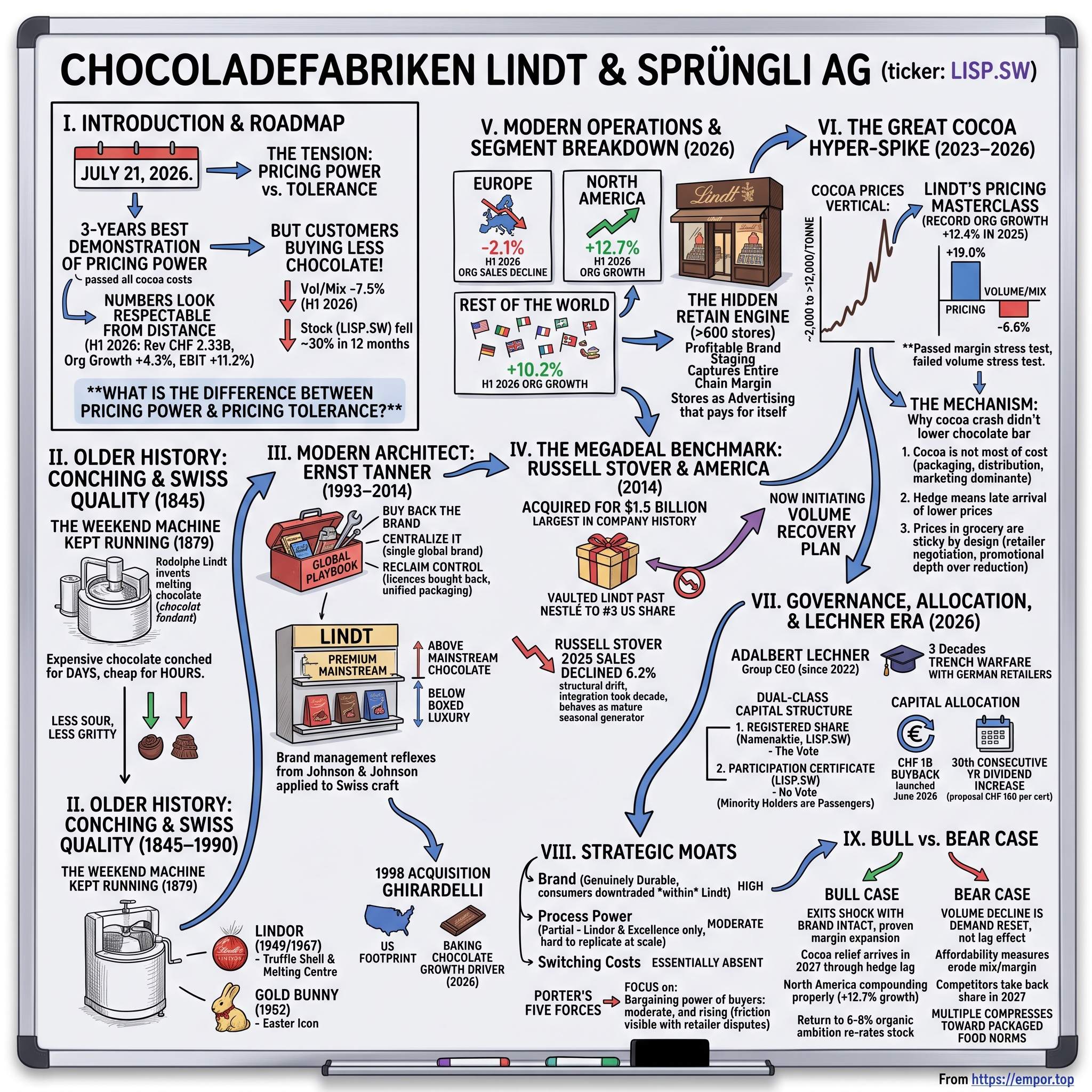
On the morning of July 21, 2026, a company that had spent three years being described as the single best demonstration of pricing power in global consumer goods stood in front of investors and admitted that its customers were buying less chocolate. Not slightly less. Volume and mix fell 7.5% in the first half of the year — the second consecutive period of high-single-digit volume erosion — and the only reason revenue moved at all was that Lindt & Sprüngli had raised prices 11.8% on top of a 19.0% increase the year before.12
The numbers still looked respectable from a distance. Sales of CHF 2.33 billion, organic growth of 4.3%, operating profit of CHF 260.2 million at an 11.2% margin — twenty basis points better than the prior year and comfortably ahead of what analysts had modelled.1 But the market was not looking at the distance. The participation certificate that trades on SIX under the ticker LISP.SW had fallen from roughly CHF 13,550 in July 2025 to about CHF 9,545 twelve months later, a decline of close to 30%.3 The voting registered share, one of the most expensive listed instruments in the world, changed hands around CHF 97,600 on results day, having spent most of the prior decade climbing.4 By the end of June 2026 the stock had logged its worst quarter since 2009.5
This is the tension that makes Lindt & Sprüngli one of the most interesting businesses in Europe right now. For thirty years it was the answer to the question what does a truly great consumer compounder look like? — a Swiss chocolatier that grew organically at high-single digits, expanded margins almost every year, never diluted shareholders, and generated the kind of brand equity that lets a company charge double what the shelf next to it charges for functionally similar cocoa, sugar, and milk. Then came the largest agricultural price shock in the history of the cocoa market, and Lindt did exactly what the textbook says a company with pricing power should do: it passed the cost through. All of it. Fast.
And the textbook turned out to be incomplete.
The core question
The central question of this story is not whether Lindt has pricing power. It plainly does — a company that can push cumulative price increases north of 30% across two years and still grow revenue has demonstrated something most food companies cannot. The real question is subtler and more useful for a long-term investor: what is the difference between pricing power and pricing tolerance, and where is the line?
Pricing power, in the way it is usually sold to investors, means a business can raise prices without losing customers. What Lindt demonstrated in 2024 and 2025 is something slightly different — it could raise prices and protect the income statement, because the revenue gained on each remaining unit more than covered the units it lost. Group-wide, that arithmetic held: 19.0% price against a 6.6% volume-and-mix decline produced 12.4% organic growth in 2025, the strongest in the company's modern history, and EBIT still rose 9.8% to CHF 971.0 million.2 But an income statement protected by shrinking volume is a different animal from a business that is growing. One compounds. The other borrows from the future.
Management knows this. On the half-year call, Group CEO Adalbert Lechner opened not with a defence of the pricing strategy but with a plan to undo part of it: "The foundation of our volume recovery plan is not pricing. It is the strength of the Lindt brand."6 That sentence is the whole 2026 story in a nutshell — a company that spent two years leaning on price now trying to prove that the brand, not the price list, is what actually holds the franchise together.
What this story covers
The road to that moment runs through a remarkably long history, and we will treat the deep past briskly and the recent past slowly, because that is where the money is decided. We start in Bern in 1879, where a pharmacist's son who apprenticed as a chocolate maker stumbled onto the process that turned chocolate from something you chew into something that melts.7 We move quickly to 1993, when Ernst Tanner inherited a sleepy federation of regional licensees and turned it into a single global brand machine. We benchmark the two acquisitions that built North America — Ghirardelli in 1998 and Russell Stover in 2014, the latter the largest deal in company history at roughly $1.5 billion.8
Then we spend real time on the present: the segment structure, the own-retail network that quietly grew past 600 stores, the mechanics of cocoa hedging, the March 2026 guidance cut that broke the stock, the dual-class capital structure that makes minority holders passengers rather than voters, and the American courtroom where Lindt's own lawyers argued that the word "excellence" on its packaging was legally meaningless.9
Along the way we will test the bull case rather than recite it — because the most valuable thing to establish about a company this admired is not why it has been good, but under what conditions it stops being good. And the first place to look for that answer is in the machine Rodolphe Lindt left running over a weekend.
 Subscribe on LinkedIn
II. Older History Made Succinct: Conching & The Birth of Swiss Quality (1845–1990)
Rodolphe Lindt was supposed to be a pharmacist. His father was one; his brother was one. At twenty-four he walked away from the family trade, apprenticed himself to a chocolate maker, and set up a small workshop in Bern to run experiments — which is a polite way of saying he spent his twenties failing at something nobody had solved.7
The problem he was failing at is worth understanding, because it explains the entire premium chocolate category that exists today. In the 1870s, chocolate was not a pleasure food in the modern sense. It was hard, brittle, gritty, and slightly sour. Cocoa beans, once roasted and ground, produce a paste full of microscopic sugar and cocoa particles and residual acetic acid from fermentation. Eat that and your tongue registers sand and vinegar. Every chocolate maker in Europe knew this. Nobody had a fix.
The weekend the machine kept running
The legend — and Lindt & Sprüngli has never been shy about the legend — is that an employee forgot to switch off a mixing machine on a Friday night. Lindt returned on Monday to find it still turning, expected to find a ruined batch, and instead found chocolate with an extraordinary consistency and aroma.7 The honest historical position is that the actual sequence of events is unknown, and the "accident" framing may be as much marketing as history. What is not in dispute is the mechanism.
Think of it like kneading dough, except the goal is not gluten but time. Prolonged mixing does three things at once: it grinds the particles far below the threshold where the human tongue can detect grit, it generates frictional heat that drives off volatile acids so the sourness evaporates, and it coats every particle in cocoa butter so the whole mass behaves like a liquid at body temperature.7 The machine that does this became known as the conche, and the product Lindt made with it was called chocolat fondant — melting chocolate. Cheap chocolate is conched for hours. Expensive chocolate is conched for days. That single variable — time in the conche — remains one of the clearest lines between a premium bar and a commodity one, and it is a line drawn in electricity, capital equipment, and working capital rather than in ingredients.
The 1.5 million franc secret
Meanwhile in Zurich, a different lineage was building the retail side. David Sprüngli-Schwarzenbach and his son Rudolf had opened a confectionery in 1845 and begun producing solid chocolate — the origin of both the Confiserie Sprüngli that still trades on Paradeplatz today and the industrial company that would become Lindt & Sprüngli.10
In 1899, Johann Rudolf Sprüngli-Schifferli bought Rodolphe Lindt's factory, his recipe, his brand, and — crucially — the conching secret itself, for 1.5 million gold francs.10 It is worth pausing on that number. In 1899 this was an enormous sum for a small Bernese workshop, and it was not a purchase of production capacity. It was a purchase of process knowledge and a name. More than a century later, the same instinct shows up in how the company describes its own competitive position: not as a recipe holder but as a process holder.
Building the icons
The twentieth century added the product platforms that still carry the business. Lindor arrived first as a solid bar in 1949 and was reformulated in 1967 into the round truffle with the shell that snaps and the centre that collapses — a texture contrast that is genuinely difficult to reproduce at scale because it requires two chocolates with different melting behaviours to coexist in one product without either migrating into the other.10 The Gold Bunny, introduced in 1952, turned Easter into an annual revenue event with a product that is bought as much for the foil and the bell as for the chocolate inside. And Excellence, launched in 1989, effectively invented the modern high-cocoa dark chocolate tasting category in mainstream retail — the 70%, 85%, and 90% bars that trained a generation of Western consumers to read cocoa percentages the way wine drinkers read vintages.10
The quiet century in between
Between the world wars and the 1980s, Lindt & Sprüngli did what most European family-adjacent manufacturers did: it grew slowly, licensed its name into neighbouring markets, and built a set of national businesses that were profitable enough to survive and too small to matter globally. It acquired the Italian confectioner Caffarel — a Turin house with its own claim on chocolate history as the originator of gianduja, the hazelnut-cocoa paste — and it built manufacturing in Germany, France, and Austria. But it was not, in any modern sense, a single company. It was a name attached to a set of regional operations.
This is the part of the corporate history that most annual-report retrospectives skip, and it is the part that matters most for understanding what came next. The Lindt of 1990 owned a legendary process, three iconic products, and a Swiss provenance that money cannot buy — and was earning ordinary returns on all of it. The gap between the quality of the assets and the quality of the economics was the entire opportunity.
Why the old history still matters
Three inheritances from this period remain live in the financials.
First, Lindt is one of the few large chocolate manufacturers that runs the full bean-to-bar chain in-house — selecting, roasting, grinding, and conching its own beans rather than buying finished chocolate mass from an industrial supplier like Barry Callebaut.11 This is expensive in capital and inflexible in downturns, but it means the company owns its taste profile rather than renting it, and it means cocoa cost enters the P&L as a raw commodity rather than as a converter's invoice.
Second, the product platforms are few and enormous. Lindor, Excellence, and the seasonal figures do the heavy lifting, which permits extreme automation — the same line running the same shell for dozens of markets, with local variation confined largely to flavour and packaging.
Third, and least appreciated: the conching heritage gave the company permission to charge more. Every premium consumer brand needs a defensible reason for its price, and "we invented the process that makes chocolate melt" is an unusually durable one.
That inheritance sat underexploited for most of the twentieth century. The company that owned the best story in chocolate was, by the early 1990s, a middling European manufacturer with inconsistent margins and no coherent global identity. Fixing that took an outsider.
III. The Modern Architect: Ernst Tanner & The Global Playbook (1993–2014)
Ernst Tanner did not come from chocolate. He came from Johnson & Johnson, where he had spent two decades learning the discipline of consumer marketing in a company that measured everything — and when he arrived at Lindt & Sprüngli in 1993 he found a business that measured very little.12
What he inherited was less a company than a confederation. Lindt chocolate was made and sold across Europe by a patchwork of licensees and semi-autonomous national operations, each with its own packaging conventions, its own pricing, its own view of what the brand meant. A Lindt bar in Italy did not necessarily taste, look, or cost like a Lindt bar in Germany. Margins were thin because nobody had scale, and brand equity leaked at every border.
Tanner's background matters because it explains his instincts. Johnson & Johnson in the 1970s and 1980s was one of the great training grounds in brand management — a decentralised company that nonetheless imposed rigorous discipline on how a brand was defined, positioned, priced, and defended. Executives who came up through that system tend to share a set of reflexes: the brand is the asset, the price point is a strategic statement rather than a tactical lever, distribution is won market by market, and consistency across geographies is worth paying for. Tanner arrived at a Swiss chocolate company with those reflexes fully formed and applied them to an industry that had largely been run by manufacturers rather than marketers.
He also arrived without sentimentality about Swiss chocolate heritage, which turned out to be an advantage. A custodian would have protected the traditions. Tanner treated the heritage as an input to a commercial system.
Buy back the brand, then centralise it
Tanner's first move was structural and unglamorous: reclaim control. Licences were bought back, national operations were pulled into a single group structure, and product specifications, packaging, and above all pricing architecture were centralised.12 This is the kind of work that produces no headlines for five years and then produces a decade of margin expansion, because it converts a set of regional brands with regional economics into one global brand with global economics.
The second move was positional, and it is the single most important strategic decision in the company's modern history. Tanner refused to compete with Mars, Hershey, or Mondelez on the mass shelf, and refused to retreat into the tiny, unscalable world of hand-made luxury confectionery. He parked Lindt in the gap between them — priced clearly above mainstream chocolate, clearly below the boxed-luxury houses, and available everywhere mainstream chocolate is sold. In investor language this is "premium mainstream." In consumer language it is an accessible treat that feels like a gift.
That position has one enormous economic property: the absolute price point stays small. A pouch of Lindor or a bar of Excellence is a few francs, dollars, or euros. When the absolute outlay is small, consumers are far less likely to run the mental arithmetic that kills a purchase — which is precisely why the 2024–2026 price shock is so analytically interesting, and we will return to it.
The third move was communications. The white-hatted Maître Chocolatier — the Master Chocolatier who appears in Lindt advertising across every market — is a piece of brand engineering that does a specific job: it converts an industrial product made on automated lines running around the clock into a craft product made by a named human being. It is not a lie, exactly; the company does employ chocolatiers. But it is a deliberate framing, and its effectiveness explains why the company later fought so hard in court over the words on its packaging.
Myth vs reality: the "Swiss craft" question
The most persistent consensus narrative about Lindt is that it is a craft chocolatier that happens to be large. The reality is closer to the inverse: Lindt is a highly automated industrial manufacturer that has been unusually disciplined about protecting a craft perception — and its investors should understand that the industrial half is where the money comes from, not in spite of the craft half but through it.
Consider what actually has to be true for the model to work. A Lindor truffle must be produced by the hundreds of millions per year, survive transport across continents and climates, sit on a shelf for months without blooming, and deliver an identical melt experience in Munich and Melbourne. That is a manufacturing engineering achievement, not a kitchen one. The advertising imagery of a chocolatier folding truffles by hand is not fraudulent — such people exist inside the company — but the economics of Lindt live in line speed, yield, energy cost, and shelf-space allocation.
This distinction is not a criticism. It is the source of the moat. A genuinely artisanal producer cannot scale, cannot fund global advertising, and cannot negotiate with Walmart. What Tanner built was a business that captures the pricing of craft and the cost structure of industry, and the entire premium-mainstream position rests on keeping those two facts from colliding in the consumer's mind. When they did collide — in an American courtroom, over the word "excellence" — the result was one of the more damaging brand moments in the company's history, which we come to later.
Ghirardelli: the test case for buying a brand and leaving it alone
In 1998, Lindt bought Ghirardelli, the San Francisco chocolate company founded during the Gold Rush.13 The purchase price was never disclosed by the company.
Strategically it did three things at once. It gave Lindt an American manufacturing and distribution footprint without the multi-year slog of building one. It gave the group a second premium brand with a genuinely different consumer position — Ghirardelli's squares and its baking chocolate live in different aisles and different occasions than Lindor truffles, which meant the two brands could expand shelf space rather than cannibalise each other. And it established the acquisition template Lindt has used ever since: keep the acquired brand's identity and heritage entirely intact, and extract value through procurement, manufacturing, and distribution behind the scenes.
The Ghirardelli deal is widely regarded as one of the better consumer acquisitions of its era, and the evidence supports that view rather than merely asserting it — nearly three decades later the brand is still a distinct growth driver, with Ghirardelli baking products singled out by management in 2026 as one of the products carrying North American growth.6 An acquisition that is still contributing incremental growth twenty-eight years later has, by any reasonable standard, earned its price.
What this era proves, and what it does not
By the time Tanner handed over the CEO role in 2016 — while retaining the Executive Chairman seat he still holds[^14] — Lindt had compounded from a fragmented European manufacturer into a global premium brand with the financial signature investors love: consistent organic growth, steady margin accretion, and negligible leverage.
The honest caveat is that this was achieved during an extraordinarily benign period for premium consumer goods. Cocoa was cheap and stable, developed-market consumers were trading up, and modern retail was expanding shelf space for premium impulse products. Tanner's playbook was excellent, and it also ran with the wind behind it for twenty years. The interesting question — the one 2026 is answering — is how much of the outperformance was the playbook and how much was the weather.
Before that question could be asked, though, Tanner made one more bet, and it was the biggest of his career.
IV. The Megadeal Benchmark: Acquiring Russell Stover & Conquering America (2014–2022)
In July 2014, Ernst Tanner flew to Kansas City to close a deal with two brothers whose family had owned an American institution for fifty-four years.
Louis Ward had bought Russell Stover in 1960 for $7.5 million. By 2014 his sons Thomas and Scott were co-presidents of a business generating roughly $600 million in annual sales, running four US chocolate factories, employing about 2,700 people, and operating some thirty-five outlet stores.8 Forbes estimated the family's combined net worth at $1.8 billion before the sale.8 Lindt paid approximately $1.5 billion — the largest acquisition in its history, and a deal the company announced on July 14, 2014.814
Tanner did not undersell it. He called it "the biggest and most important strategic acquisition to date," describing "a unique opportunity to expand our North American chocolate business."8 The market agreed on the day: Lindt shares rose nearly 3%.8
What Lindt was actually buying
The strategic logic was positional rather than operational. Russell Stover was not a premium brand and was never going to become one. What it was, and remains, is the leader in American boxed chocolate — the heart-shaped Valentine's Day box, the Mother's Day assortment, the Christmas gift tin. Combined with Lindt USA and Ghirardelli, it vaulted the group past Nestlé into third place in the overall US chocolate market with roughly 10% share, behind only Hershey and Mars.8
That is the part of the deal that worked as designed. Lindt bought a distribution and seasonal-occasion position that would have been effectively impossible to build organically, because those shelf allocations are decided years in advance by a handful of American retail buyers.
Did Lindt overpay? The uncomfortable middle answer
On entry, Russell Stover was a business in structural drift. Boxed chocolate in American supermarkets had been in slow secular decline for years; packaging looked like it belonged to an earlier decade; and manufacturing efficiency lagged what Lindt was used to in Europe. The company was, in effect, buying a distressed franchise at a full price on the theory that its own operating discipline was the missing ingredient.
The integration took materially longer and cost materially more than initial guidance implied. Between roughly 2015 and 2018, North American organic growth stalled while Lindt pruned unprofitable SKUs, rebuilt manufacturing, and repositioned parts of the range — including a push into sugar-free chocolate sweetened with steviol glycosides. Investors who bought the deal on the 2014 thesis waited most of a decade for it to show up in the numbers.
And the honest verdict, twelve years on, is mixed rather than triumphant. In the record year of 2025 — when the group posted its strongest organic growth ever — Russell Stover sales declined 6.2%.15 North America as a whole grew 8.9% organically and delivered a 13.7% EBIT margin that beat consensus,15 but the growth came from Lindt-branded product, Excellence, and Ghirardelli. Russell Stover behaved the way a mature seasonal cash generator behaves: it funded things, it did not drive them.
For a long-term investor this is the most useful lesson in the whole Lindt story about capital allocation. The deal was not a disaster — it bought a durable #3 position in the world's largest chocolate market and a portfolio of seasonal occasions that competitors cannot easily attack. But it also demonstrates that even a disciplined acquirer paying roughly 2x sales for a declining business buys itself a decade of work, and that "we will fix it with our operating model" is a claim that should be discounted heavily at the time it is made and judged only much later. Lindt has, to its credit, never repeated the experiment at that scale.
The succession that wasn't quite a succession
Governance changed alongside the portfolio. In 2016 Dieter Weisskopf, the long-serving CFO, took the CEO role while Tanner moved up to Executive Chairman — a transition that kept strategic control firmly with Tanner.[^14] In October 2022 Weisskopf handed over to Dr. Adalbert Lechner, and here the choice was revealing.
Lechner is not a chocolate romantic. He took a doctorate in law, then held marketing and sales management roles at L'Oréal and Johnson & Johnson before joining Lindt in 1993 as head of the Austrian subsidiary — the same year Tanner arrived at group level.16 In 1997 he took over Germany and built it into the group's largest single market, which in practice meant three decades of trench warfare with the most brutally price-disciplined grocery retailers in Europe: Edeka, Rewe, Aldi, Lidl.16 He joined Group Management in 2017 and became Group CEO in October 2022.16
Appointing the executive who had spent a career winning German retail price negotiations, right at the moment cocoa began its historic run, looks in hindsight like the single most consequential personnel decision the board has made. Whether it was foresight or luck, the skill set turned out to be exactly the one the next four years demanded.
Because within a year of Lechner taking the job, the price of the company's principal raw material began to do something it had never done in recorded history.
V. Modern Operations & Segment Breakdown: Europe, North America, & The Hidden Retail Engine
To understand what Lindt actually is as a business in 2026, it helps to walk into one of its stores.
There are more than 600 of them now — Lindt boutiques, Ghirardelli chocolate shops, Russell Stover outlets — spread across airports, high streets, and outlet malls, with 53 opened in 2025 alone.10 In the first half of 2026 the company opened flagships in Lucerne, Oslo, and Munich, and entered India, Saudi Arabia, and Malaysia.17 Inside a Lindt boutique the product is not on a shelf in a plastic pouch; it is in a wall of open bins, sold by weight, in a room that smells engineered. Management describes the format bluntly as "profitable brand staging."17
That phrase is worth taking seriously, because own retail is the most misunderstood part of this company.
The three segments, and what each one really does
Europe remains the anchor. In 2025 the region generated CHF 2.96 billion of sales and grew 15.3% organically — extraordinary for a mature market, and almost entirely a pricing outcome.182 Germany is the largest single market, with the UK, France, Switzerland, and Italy (where the group also owns Caffarel) behind it. Europe is where brand penetration is highest, where the seasonal franchises — Gold Bunny at Easter, Santa at Christmas — are most entrenched, and where the margin structure is best.
It is also where the model cracked first. In the first half of 2026, European organic sales fell 2.1%, against consensus expecting roughly 1.9% growth.4 Segment operating profit dropped to CHF 186 million from CHF 200.9 million, with margin narrowing to 15.7% from 16.1%.4 Management attributed the decline to a weaker Easter, softer consumer sentiment, reduced tourist flows, and a punishing comparison against the prior-year half when Europe had grown 17.7% organically.16 All of those are true. They are also, taken together, the profile of a market where two consecutive years of aggressive pricing finally exhausted the consumer's patience.
North America is now the growth engine and, in 2026, the margin story. First-half sales reached CHF 819 million, up 12.7% organically — roughly 35% of the group.17 More striking than the growth was the profitability swing: segment EBIT margin rose to 7.7% from 3.2% a year earlier.4 Management described the growth as broad-based, with Excellence dark chocolate up strong double digits, Ghirardelli baking performing, Lindor holding, and a "Dubai Style" filled chocolate launch riding the viral pistachio-and-kadayif trend that swept global confectionery.6
The American divergence deserves an explanation rather than a celebration. Two things appear to be happening. American consumers absorbed price increases later and from a lower base than European ones, so the elasticity pain arrived on a lag. And Lindt's US premium position sits above a mass market — Hershey, Mars — that raised prices sharply too, which compressed the relative premium a shopper pays for Lindt even as the absolute price rose. Lechner made exactly this argument when an analyst pressed him on affordability, noting that category-wide inflation had narrowed Lindt's price gap versus competitors and private label.6 It is a genuinely good argument. It is also an argument that works in reverse the moment competitors start cutting.
Rest of the World — Japan, Brazil, Australia, China, plus travel retail — is the smallest segment at CHF 326 million in the first half, up 10.2% organically.17 It grew, but profitably it disappointed badly: first-half segment operating profit fell to CHF 11.5 million from CHF 32.7 million,4 and the full-year 2025 margin of 10.0% came in far below the roughly 14.9% consensus expected.15 This is the segment where the company is simultaneously paying for store openings, market entries, and travel-retail exposure to volatile tourism flows — genuine long-term optionality being funded with near-term profit, which is a defensible choice but not a free one. In Japan, Lindt competes against deeply entrenched domestic players like 明治 Meiji as well as global premium brands, and the boutique-led model is the company's answer to the problem of building brand awareness where it has no seasonal heritage.
The seasonal machine nobody models properly
There is a structural feature of this business that does not appear in any segment table and materially affects how the numbers should be read: Lindt's year is not four even quarters. It is a series of spikes.
Easter and Christmas are not merely strong periods; they are periods in which specific products — the Gold Bunny, the Santa figure, the boxed assortment — are manufactured months ahead, shipped into retail on negotiated allocations, and sold within a narrow window. Inventory is built against a forecast. Shelf space is committed a year in advance. If the season underperforms, the correction is immediate and there is no second chance until the following year.
This is why the first half of 2026 was more informative than a single half-year usually is. Management attributed part of Europe's organic decline specifically to weaker Easter trading.16 A weak Easter is not a slow month; it is roughly a fifth of a region's annual seasonal volume decided in a few weeks by consumers looking at a shelf price that had risen twice in two years. It also explains why the company reports only twice a year rather than quarterly: with a business this seasonally lumpy, quarterly reporting would generate more noise than signal — though it also means investors wait six months between data points on the metric that currently matters most.
Why own retail matters more than its revenue share
Own retail contributes roughly a tenth of group revenue,10 which makes it look like a rounding error next to wholesale. It is not, for three reasons.
The first is margin capture. Selling a Lindor truffle through a supermarket means sharing economics with the retailer. Selling the same truffle by weight in a Lindt boutique captures the entire chain. The second is control. In a boutique, Lindt sets the price, the assortment, the display, and the experience — no buyer negotiation, no promotional calendar imposed by someone else. The third, and most strategically important, is that stores are advertising that pays for itself. The Lindt Home of Chocolate in Kilchberg — opened in September 2020, housing a nine-metre free-standing chocolate fountain and the company's largest shop — functions as a brand pilgrimage site, and it is funded by visitors rather than by a marketing budget.10
There is a cost to this model that showed up in 2026. Own retail carries fixed occupancy and staffing costs, so when footfall drops — as it did across Europe with tourism weakness — same-store sales go negative and the operating leverage runs backwards. Management acknowledged negative European like-for-like retail growth on the half-year call while arguing that personnel cost savings came from genuine efficiency rather than headcount cuts and would not reverse when volumes recover.6 That is a specific, testable claim, and investors should hold them to it in the 2027 numbers.
Which brings us to the event that reshaped every one of these segments at once.
VI. The Great Cocoa Hyper-Spike: Lindt's Pricing Masterclass & Inflation Stress Test (2023–2026)
Cocoa is grown by roughly two million smallholder farmers, most of them working a few hectares, more than 60% of global supply concentrated in Côte d'Ivoire and Ghana. Those farms are old — many trees planted decades ago, well past peak yield — and the economics of replanting have never worked for growers paid a government-fixed farmgate price. It is one of the most structurally fragile supply chains underneath any major consumer category.
Between 2023 and 2024 that fragility became a crisis. Swollen shoot virus spread through West African plantations. Weather turned hostile — heavy rains, then harmattan winds. Decades of underinvestment in replanting meant there was no yield buffer. And the futures market did what futures markets do when a physically tight commodity has no substitute: it went vertical.
Cocoa, which had traded for years in a band roughly around $2,000–$3,000 per tonne, broke above $12,000 per tonne by the end of 2024 — a move of a magnitude no living chocolate executive had planned for.19
The hedge, and what a hedge actually does
Lindt's first line of defence is a forward purchasing and hedging programme that covers cocoa requirements roughly twelve to eighteen months ahead.3 It is worth being precise about what this achieves, because "we hedge" is one of the most over-credited phrases in consumer investing.
Hedging does not make a company immune to input costs. It delays and smooths them. If you buy your cocoa a year forward, a price spike today hits your P&L a year from now — which buys you time to reprice your products, renegotiate with retailers, and reformulate packs. What it cannot do is prevent the cost from arriving. And it cuts both ways: the same programme that shielded Lindt on the way up delays the benefit on the way down.
Both halves of that trade are now visible. Material costs, including inventory changes, rose to 35.5% of first-half 2026 sales from 33.3% a year earlier — a 220 basis point headwind arriving from hedges struck when cocoa was near its highs.174 Meanwhile the spot market had already retreated substantially: by mid-2025 cocoa had fallen below $8,000 per tonne as demand destruction bit, with industrial cocoa grindings down 7.2% year-on-year in Europe and 16% in Asia in the second quarter of that year, and J.P. Morgan Global Research carrying a medium-term forecast of $6,000 per tonne.19 On the July 2026 call, CFO Martin Hug guided to full-year material costs roughly in line with 2025 as cocoa eased through the second half, and said plainly of the following year: "For 2027, we will have a positive impact from lower cocoa prices."6
So the sequence is: cost shock arrives late, prices go up to meet it, cost relief also arrives late — and in the gap between those two lags sits a consumer who has already changed behaviour.
The pricing engine, and the bill it generated
What Lindt did operationally was aggressive and, on its own terms, effective. Group-wide prices rose 19.0% in 2025 and a further 11.8% in the first half of 2026.21 In some German markets, price increases reportedly reached as much as 100% on specific lines.20 Higher cocoa costs were offset through a combination of those increases, efficiency gains, and cost discipline, and the result in 2025 was record organic growth of 12.4%, record sales of CHF 5.92 billion, EBIT up 9.8% to CHF 971.0 million, a margin of 16.4% versus 16.2%, and net income of CHF 726.7 million.2
By the standards of the packaged food industry, that is an exceptional demonstration of price realisation. Most companies in the category could not have moved price that far that fast without losing distribution.
But look at what it cost. Volume and mix fell 6.6% in 2025 and 7.5% in the first half of 2026.21 Free cash flow, which should be the great virtue of an asset-moderate branded business, fell about 30% in 2025 to CHF 446.3 million as expensive cocoa inventory absorbed working capital.215 And in March 2026 the company cut its 2026 organic growth guidance to 4–6%, abandoning for the year the 6–8% range that had been the company's medium-term signature for most of a generation.15 The shares fell 6% on the day, and Barclays — maintaining an underweight rating — asked the exact right question publicly: was the cut about geopolitical risk, or about structural pressure created by the company's own 19% price increase?15
The mechanism nobody explains: why the cocoa crash did not lower your chocolate bar
For a lay reader, the most confusing thing about 2026 is that cocoa prices collapsed and chocolate stayed expensive. The explanation has three parts, and it is worth walking through slowly because it is the key to reading the next two years of results.
First, cocoa is not most of what you pay for. A premium chocolate bar's retail price is dominated by manufacturing, packaging, distribution, advertising, and retailer margin. Cocoa is a critical input, but a fall in the bean price moves the finished product's cost structure far less than one instinctively assumes.
Second, the hedge means Lindt is not buying cocoa at today's price. It is consuming cocoa it contracted for a year or more ago — which in the first half of 2026 meant beans bought near the top of the market. That is the entire explanation for material costs rising 220 basis points while headlines described a cocoa crash.17
Third, prices in grocery are sticky by design. Retail price points are negotiated with retailers, printed on packaging, and anchored in consumer memory. Taking a price down is operationally expensive and strategically dangerous, because it invites the retailer to demand the lower price permanently. This is precisely why Lechner's 2027 language was so carefully hedged — no further increases, but "some price adjustments where needed, and where possible," alongside promotions and smaller formats rather than list price cuts.6 Companies restore affordability through pack architecture and promotional depth, not through reducing the shelf price, because the former is reversible and the latter is not.
The investable consequence: if cocoa stays at reduced levels and the hedge rolls, 2027 should see input costs fall against a price list that does not, which is mechanically favourable for gross margin. The risk is that competitors reach that same position and choose to compete on price rather than bank the margin.
The honest reading of the stress test
The consensus framing of Lindt in 2023–2025 was that affordable luxury made it inelastic — that a five-franc indulgence is the last thing a consumer cuts. The 2026 evidence says something more nuanced. Consumers did not abandon the brand; they downshifted within it, buying smaller packs, buying less often, and waiting for promotions rather than switching to a cheaper brand.3 That is meaningfully better than share loss. It is still a volume decline, and volume declines eventually erode the manufacturing scale economies that underpin the margin.
Morningstar's Svetlana Menshchikova put the reality check crisply: premium positioning "doesn't shield the business when prices rise 19% in a single year."5 Jefferies' Feng Zhang framed it as a reckoning for mid-term growth expectations, and Bank of America's Antoine Prevot flagged European consumers as the most price-resistant of all.5
The fair conclusion is that Lindt passed the margin stress test and failed the volume stress test — and that these are different tests measuring different things. The margin outcome proves the brand has genuine pricing latitude. The volume outcome proves that latitude has a ceiling, that Lindt found it, and that the company is now spending 2026 and 2027 trying to walk back from it. Management's own remedy list — shrinking the German Lindor pouch from 137g to 100g to restore an entry price point, making Excellence promotions "more attractive," and explicitly ruling out further increases in 2027 — is not the behaviour of a company that believes its consumer is inelastic.6
The question of who decides how that recovery is funded, and who gets a vote on it, brings us to one of the more unusual governance structures in European large-cap equity.
VII. Governance, Capital Allocation, & Current Leadership: Adalbert Lechner's Era
There is a peculiar thing about buying shares in Lindt & Sprüngli: most people who do it are not buying shares at all.
The company has two listed instruments. The registered share — the Namenaktie — carries a par value of CHF 100 and carries the vote. As of mid-June 2026 there were 133,437 of them outstanding.3 The participation certificate — the Partizipationsschein, ticker LISP.SW — carries a par value of CHF 10, has identical rights to dividends, capital repayments, and liquidation proceeds in proportion to that par value, and carries no vote whatsoever. There were 965,188 outstanding.3
In economic terms the two are equivalent: ten certificates equal one share. In governance terms they are not remotely equivalent, and that asymmetry is the structural feature a prospective investor should understand before anything else.
Who actually controls the company
Voting power is concentrated and deliberately defended. A substantial block sits with foundations connected to the company — most notably the Fonds für Pensionskassen der Chocoladefabriken Lindt & Sprüngli AG — an arrangement that makes a hostile takeover of a Swiss chocolate icon effectively impossible.3
There is a genuine two-sided argument here, and it deserves to be made honestly rather than dismissed.
The case for the structure is that it has demonstrably produced long-horizon behaviour. A management team insulated from takeover pressure could afford to spend a decade fixing Russell Stover, could build a museum in Kilchberg, and could invest in a cocoa traceability programme with no near-term payback. Much of what makes Lindt admirable as a compounder is downstream of not having to defend a quarterly share price.
The case against is that insulation cuts both ways, and 2026 is the test case. Participation certificate holders — who own the overwhelming majority of the economic equity — had no vote on the pricing strategy that cost them roughly 30% of their capital value over twelve months, no vote on board composition, and no mechanism to force a strategic review. When the strategy is right, that does not matter. When it is wrong, the only available response is to sell. A skeptical investor is entitled to note that the board, chaired in an executive capacity by the same person who has effectively set strategy since 1993 and which numbered eight members as of April 2026,[^14] is not structurally exposed to challenge from the people whose money is at risk.
The Tanner-Lechner arrangement is itself part of this. An Executive Chairman with three decades of accumulated authority alongside a Group CEO in his fourth year is a configuration that works beautifully when the two agree and offers no visible resolution mechanism when they do not. Nothing in the public record suggests a conflict. But investors should recognise that continuity here is a design choice, not an accident, and that the 2026 volume problem will be the first genuine test of whether this board can force a course correction on a strategy its own chairman's playbook produced.
Capital allocation: the strongest part of the record
If governance is the weakest part of the equity story, capital allocation is the strongest, and it is where management's credibility is best evidenced by behaviour rather than rhetoric.
Buybacks are continuous and — critically — the repurchased instruments are cancelled rather than parked. The effect is visible in the numbers above: both the registered share count and the certificate count have shrunk measurably from earlier in the decade. A CHF 500 million programme launched in 2024 had executed CHF 467.5 million by the end of 2025, and the board approved a new programme of up to CHF 1 billion running from June 1, 2026 for up to three years.1015
That timing is analytically interesting. Launching the largest buyback in company history into a 30% share price decline, funded from internal cash flow, is either good counter-cyclical capital allocation or an expensive attempt to support a falling stock — and which of those it turns out to be depends entirely on whether the volume recovery plan works. Investors should watch the pace of execution, not just the authorisation.
The dividend record is the more straightforward evidence. For 2025 the board proposed CHF 1,800 per registered share and CHF 180 per participation certificate — above the roughly CHF 1,600 consensus expected — marking the thirtieth consecutive year of dividend increase.1510 Maintaining that streak through the worst input cost shock in the industry's history, in a year when free cash flow fell 30%, is a real signal about how the board thinks about its commitments.
Capex has stayed in the mid-single digits as a percentage of sales, directed at factory automation and capacity, and financed out of operating cash flow. Net debt has remained minimal and the equity ratio stood at 54.5% at the end of 2025.2 For a business now navigating simultaneous commodity volatility, volume decline, and a major buyback, that balance sheet is the reason none of this is existential.
The question is whether the moat those balance sheet resources are defending is as wide as three decades of narrative suggest.
VIII. Strategic Moats & Frameworks: Helmer's 7 Powers & Porter's 5 Forces
Strip the romance away and ask the war-game question: if a well-capitalised competitor wanted to take Lindt's business, where would it attack?
Helmer's 7 Powers, scored honestly
Brand — the dominant power, and genuinely durable. Lindt's brand allows it to charge a substantial premium per gram over mass chocolate, and management pointed to an external brand valuation of roughly $11.7 billion, up 24% year-on-year, as evidence the asset strengthened even during the pricing shock.6 Treat any brand-valuation figure with appropriate skepticism — these are modelled numbers, not transactions. But the underlying behaviour supports the direction: during two years of aggressive price increases, consumers downtraded within Lindt rather than away from it.3 That is the cleanest available evidence of real brand power, because it is revealed preference under stress rather than survey response.
Process Power — real but narrower than the marketing implies. The conching parameters, the bean blending ratios, and above all the two-phase shell-and-filling architecture of a Lindor truffle are genuinely hard to replicate at scale. Making one great truffle is a craft problem. Making billions of identical truffles where the shell snaps and the centre yields at exactly the same temperature, across factories on two continents, is an industrial problem — and industrial problems of that kind take competitors years and considerable capital to solve. The limitation: process power protects Lindor and Excellence specifically, not the whole portfolio. Russell Stover has no process moat at all, which is precisely why it grows slowly and why its 2025 sales declined.15
Scale Economies — real, and currently under pressure. Global cocoa procurement, dedicated high-speed lines, and shelf-space dominance in impulse displays are all genuine scale advantages. But note the mechanism carefully: scale economies in manufacturing are volume-dependent. Two consecutive years of high-single-digit volume decline mean less throughput over the same fixed asset base. The margin has held so far because pricing and cost discipline offset it — personnel costs fell 100 basis points to 22.5% of sales in the first half of 2026 and other operating expenses fell 130 basis points to 25.6%.4 That offset is real, but cost savings are a finite resource in a way that volume growth is not. This is the power most exposed if volumes do not recover.
Cornered Resource — partial, and mostly a risk mitigant rather than an advantage. The Lindt & Sprüngli Farming Program, run since 2008, gives the company direct relationships with cocoa farmers, and in 2025 the group reported sourcing 100% of its cocoa products — beans, butter, powder, and mass — through the programme or equivalent responsible sourcing standards, with full first-mile traceability.[^22] In a shortage this improves security of supply and, increasingly, regulatory compliance. But it does not give Lindt cocoa at a better price than the market, and it should not be sold as a cost advantage. It is insurance, and insurance costs money.
Switching Costs and Network Economies — essentially absent. Nobody is locked into a chocolate brand. This matters: it means every one of Lindt's advantages must be re-earned at each purchase, which is exactly why the volume data is the most important thing in the reporting pack.
Porter's Five Forces, applied to 2026 conditions
Threat of new entrants: low. Building a global premium chocolate brand requires manufacturing capital, temperature-controlled distribution, decades of brand investment, and — the hardest part — shelf allocation from a small number of retail buyers who decide seasonal space years ahead. Craft entrants can build lovely regional businesses; they cannot get a Gold Bunny into 40,000 stores at Easter.
Bargaining power of buyers: moderate, and rising. Supermarket groups push back hard on price, and in 2026 that friction became visible — management referenced resolved retailer disputes in France and Switzerland as a factor in expected second-half improvement.6 A "resolved dispute" in grocery usually means a period during which product was delisted or de-promoted. Lindt's counter-leverage is brand velocity: retailers lose traffic if they do not carry Lindor and the seasonal figures. But that leverage weakens with every year of volume decline, because a slower-selling premium SKU is easier to cut.
Bargaining power of suppliers: high in the commodity, moderated at the farm. Cocoa's terms are set by weather and West African policy, not by negotiation. Hedging and direct sourcing smooth the experience without changing the underlying price.
Threat of substitutes: low to moderate. Chocolate occupies emotional and gifting occasions that other confectionery does not fully replace. The realistic substitute is not another sweet — it is not buying, or buying a smaller pack. Which is precisely the substitution the last two years produced.
Competitive rivalry: moderate, with a changing shape. On the mass side sit Mars/Wrigley, Hershey, and Mondelez with Milka and Toblerone; on the premium side Ferrero, Neuhaus, Leonidas, and ethically positioned disruptors like Tony's Chocolonely. The important 2026 development is that everyone was hit by cocoa — Hershey's shares fell 14% in the same quarter Lindt logged its worst in seventeen years, and Barry Callebaut, the industrial chocolate supplier whose fortunes had earlier diverged from Lindt's, forecast a volume rebound over roughly eighteen months.5 The competitive risk on the way down is asymmetric: whichever player is hedged at the lowest cost base first can price aggressively into a recovering market and take share from those still carrying expensive inventory.
The net assessment is that Lindt's moat is real, brand-led, and narrower than its reputation. It protects premium positioning and margin. It does not protect volume, and it does not protect the multiple.
IX. Skeptical Investor Stress Test, Legal Risks, & Bull vs. Bear Case
By the summer of 2026, the sell side had stopped agreeing with itself. Coverage split almost evenly — five buy ratings against six sells — and short interest in the stock had more than doubled since March.5 Jefferies carried an underperform rating with a target well below the prevailing registered share price, writing after the half-year that the results were "helpful" but that "reliance on cost savings & miss in Europe LFL will worry" investors.4 For a company that spent thirty years as a consensus quality holding, an open bear case is itself news.
What an activist would actually attack
The narrative shift. The most legitimate criticism is not that Lindt raised prices — it is how the company characterised the consequences over time. Through 2024 and 2025 the framing was pricing power and premium resilience. In March 2026 the medium-term 6–8% growth range was set aside for the year in favour of 4–6%.15 By July 2026 the CEO was describing a "volume recovery plan" and ruling out further increases.6 Nothing in that sequence is dishonest, and to management's credit the volume declines were disclosed clearly and quantified in every release. But the shift from "our consumer absorbs price" to "we need affordability measures" happened faster than the guidance did, and an activist would argue the guidance lagged the operating reality by at least two quarters.
Whether the answers on the calls are concrete. On the July 2026 call, Bernstein's Callum Elliott pressed management on a genuinely difficult point: why should chocolate volumes recover faster than other staples categories that had gone through comparable pricing cycles? The answer was notable for what it conceded. Management did not claim the category would recover faster — it argued instead that Lindt would outperform the category through specific actions on price points, promotional depth, and brand investment.6 That is a more honest and more falsifiable answer than the alternative, and it is the kind of response that should raise rather than lower an investor's assessment of management credibility. When a separate question challenged whether the products were still affordable after two years of inflation, Lechner's response — that category-wide pricing had compressed Lindt's relative premium, and that smaller formats restore accessibility without repositioning the brand — was equally specific.6 The pattern across the call was concrete answers rather than deflection, which is a genuine mark in management's favour even for investors who think the underlying strategy was too aggressive.
Governance and accountability. The dual-class structure, the executive chairmanship held since the early 1990s, and the absence of any minority-holder mechanism to force change constitute the most concrete activist target — while also being, by design, the one least susceptible to activist pressure.
The valuation overhang. Lindt has historically traded at a substantial premium to packaged food peers on the strength of its growth consistency. Multiple compression is not a business risk; it is a rating risk. But it is the mechanism through which even a stable operating performance can produce poor shareholder returns, and it is the primary risk a long-duration holder faces from here.
Capital allocation timing. Launching a CHF 1 billion buyback into a declining stock while free cash flow fell 30% and working capital absorbed cocoa inventory is defensible — but it is a choice that leaves less flexibility if 2027 disappoints.
Second-layer signals. A few things a diligent investor should check rather than assume. Working capital was the weak link in 2025 — cocoa inventory absorbed cash and free cash flow fell about 30% even as reported profit rose,215 which is exactly the pattern that precedes a covenant conversation at a leveraged company and is merely an inconvenience at one with a 54.5% equity ratio.2 The recovery in first-half 2026 free cash flow to CHF 61.1 million from negative CHF 79.7 million a year earlier suggests that unwind has begun.1 There has been no reported auditor change, restatement, or accounting controversy. And with the buyback authorisation running to 2029, the annual disclosure of how much has actually been executed is a cleaner read on management's confidence than any statement made on a call.
The material legal and regulatory radar
The heavy metals litigation. In February 2023, following a 2022 Consumer Reports study finding lead and cadmium in dark chocolate, plaintiffs filed a class action in the U.S. District Court for the Eastern District of New York covering consumers in Alabama, California, Florida, Illinois, Nevada, and New York, targeting Lindt's high-cocoa Excellence bars.921
Lindt's defence produced one of the more self-inflicted brand moments in recent consumer goods history. Its lawyers argued that phrases on the packaging — "excellence," "expertly crafted with the finest ingredients" — were legally unactionable "puffery," meaning exaggerated boasting on which no reasonable buyer would rely.21 The court rejected the argument, defining puffery in exactly those terms and holding that a reasonable consumer paying a premium could be deceived by such claims, and denied the motion to dismiss.21
The financial exposure is manageable for a company generating CHF 971 million of EBIT. The reputational mechanism is the part that matters. A company whose entire economic model rests on consumers believing the quality claims on the wrapper had its own counsel argue in open court that those claims mean nothing. Media coverage seized on it. No recall has been issued and no settlement has been reported. Note also the underlying scientific reality: cadmium in cocoa is largely taken up from soil and concentrates in high-cocoa products, which means the exposure is structurally worst in exactly the dark chocolate range that has been driving Lindt's North American growth.6
Supply chain and ESG. West African cocoa carries persistent scrutiny over child labour and deforestation. The EU Deforestation Regulation imposes traceability obligations across the cocoa chain, and Lindt's 100% first-mile traceability achievement in 2025 positions it comparatively well.[^22] The cost of maintaining that verification, however, is permanent and rising.
Elasticity risk. The open question is whether the volume declines of 2025 and 2026 represent a one-time reset to a higher price level — after which consumption stabilises — or the beginning of a slow habit change in which premium chocolate becomes an occasional purchase rather than a routine one. There is currently no evidence that settles this, and any investor claiming certainty either way is guessing.
Bull case
Lindt exits the shock with its brand intact, having proven it can pass through a historic cost spike and expand margin — from 16.2% to 16.4% in 2025 and a further 20 basis points in the first half of 2026.21 Cocoa relief arrives in 2027 through the hedging lag, at which point a company that has already taken its pricing and cut its cost base sees gross margin expand against a price list it does not intend to reduce. North America's 12.7% growth and margin swing from 3.2% to 7.7% show the American franchise is finally compounding properly.174 Own retail, emerging market entries, and product innovation — Dubai Style, and the Choco Wafer platform slated for 2027 — provide volume levers that do not require price cuts.6 Add a CHF 1 billion buyback shrinking the count, a thirty-year dividend record, and a fortress balance sheet, and a return to the medium-term 6–8% ambition would likely re-rate the stock.
Bear case
Volume decline is not a lag effect but a demand reset, and the affordability measures — smaller packs, more promotion — restore units at the cost of the mix that produced the margin. Europe, half the business, is already shrinking organically. Competitors hedged at lower cocoa prices reach the shelf with better relative pricing in 2027 and take share back. Scale economies erode as throughput falls. The litigation drags on, keeping "lead in dark chocolate" attached to the brand's most premium range. And the multiple — the thing that made this a great stock rather than merely a great company — compresses toward packaged food norms as growth converges on the sector rather than exceeding it. In that scenario, the operating business remains perfectly healthy while the equity delivers years of nothing.
Which of these is right will be visible in a very small number of disclosed metrics.
X. Playbook, Essential KPIs, & Epilogue
What this business teaches
Affordable luxury is a position, not a shield. The whole thesis of the premium-mainstream slot is that a small absolute price point makes the consumer insensitive. Lindt proved that this holds beautifully for moderate inflation and breaks somewhere between a 19% single-year increase and the consumer's memory of what the product used to cost.2 The lesson is not that the position is bad — it is that inelasticity is a range, not a property, and the range has a boundary that is invisible until you cross it.
Platform concentration is an underrated industrial asset. By standardising on Lindor, Excellence, and the seasonal figures, Lindt gets factory automation economics from a portfolio that presents to consumers as artisanal. The trade-off is that the group's fortunes are unusually tied to a handful of products — which is why the 2027 Choco Wafer launch matters more than a single line extension normally would.6
Fixing an acquisition takes longer than the acquirer says and longer than the market believes. Russell Stover took the better part of a decade to stabilise and was still shrinking in the group's best year.15 The structural prize — the #3 US position — was worth having. The integration timeline should be the default assumption for any consumer deal of that shape.
Hedging buys time, not immunity, and time runs in both directions. The programme that protected Lindt's margin through the spike is the same programme now delaying its relief.6
The three metrics that actually matter
1. The split between price and volume/mix inside organic growth. This is the single most important disclosure in the company's reporting, and Lindt publishes it explicitly every half-year — 19.0% price against −6.6% volume/mix in 2025, 11.8% against −7.5% in the first half of 2026.21 Management has committed to flat volumes in the second half of 2026 and a return to volume growth in 2027.6 That is a specific, falsifiable promise. Volume/mix is now the number that decides the thesis; the headline organic growth rate has become almost decorative by comparison.
2. EBIT margin, and the composition underneath it. The company guides to 20–40 basis points of annual expansion and has delivered against that in both of the last two reporting periods.12 The composition matters as much as the level: margin expansion driven by cost lines — personnel and operating expenses fell sharply in the first half of 20264 — is finite, while expansion driven by gross margin and volume leverage is repeatable. Watch which one is doing the work.
3. Material costs as a percentage of sales. At 35.5% in the first half of 2026 against 33.3% a year earlier,17 this line is the direct readout of the cocoa hedging position flowing into the P&L. It is where the promised 2027 relief will appear first, and if it does not appear roughly when management said it would, the hedging narrative deserves re-examination.
Everything else — store count, brand valuations, regional commentary — is context. These three are the scoreboard. Note that Lindt reports twice yearly, with net sales for 2026 due on January 19, 2027,1 so patience is structurally required.
Epilogue
There is a version of this story that ends in 2023, and in that version it is a triumph: a Bernese experimenter's runaway machine becomes a Swiss industrial fortune, a marketing executive from Johnson & Johnson turns a fragmented licensee network into a global brand, and the whole thing compounds for thirty years while paying a rising dividend.
The version that includes 2026 is more useful. It shows what happens when a genuinely excellent consumer franchise meets a cost shock large enough to force it to choose between margin and volume — and chooses margin. The choice was rational and it was disclosed. It also revealed the boundary of an advantage that had never been tested, and it left the company spending the following two years buying back the volume it priced away, with smaller pouches, better promotions, and an explicit pledge not to raise prices again in 2027.6
Rodolphe Lindt's contribution was to discover that if you keep working chocolate long enough, its harshness evaporates and what remains is smooth. That is roughly the position Lindt & Sprüngli finds itself in now — grinding through an unusually rough period, betting that the brand underneath survives the friction. Whether it does will be decided not by a story, but by a single line in a half-year report showing whether people bought more chocolate than they did the year before.
References
-
Lindt & Sprüngli reports solid half-year results and confirms full-year guidance — EQS/TradingView, 2026-07-21 ↩↩↩↩↩↩↩↩↩↩↩
-
Lindt & Sprüngli achieves double-digit organic growth and higher profitability — EQS/TradingView, 2026-03-10 ↩↩↩↩↩↩↩↩↩↩↩↩↩↩
-
Lindt share price under pressure as cocoa costs test investor confidence — FoodNavigator, 2026-07-20 ↩↩↩↩↩↩↩
-
Lindt H1 profit rises as North America offsets weaker Europe — Investing.com, 2026-07-21 ↩↩↩↩↩↩↩↩↩↩
-
Lindt Heads for Worst Quarter in 17 Years on Price-Hike Fallout — SWI swissinfo.ch, 2026 ↩↩↩↩↩
-
Earnings call transcript: Lindt posts solid H1 2026 growth as volumes fall — Investing.com, 2026-07-21 ↩↩↩↩↩↩↩↩↩↩↩↩↩↩↩↩↩↩↩↩↩
-
Rodolphe Lindt — The Engines of Our Ingenuity, University of Houston ↩↩↩↩
-
Russell Stover Sale To Lindt A Sweet Deal For Billionaire Family Owner — Forbes, 2014-07-14 ↩↩↩↩↩↩↩
-
Lindt facing US class action over heavy metals in dark chocolate — Reuters, 2023-01-12 ↩↩
-
Lindt & Sprüngli Financial Reporting & Annual Reports — Lindt & Sprüngli ↩↩↩↩↩↩↩↩↩
-
Lindt & Sprüngli Investor Relations Hub — Lindt & Sprüngli ↩
-
Lindt & Sprüngli Media Center & Ad-Hoc Press Releases — Lindt & Sprüngli ↩↩
-
Chocoladefabriken Lindt & Spruengli AG company coverage — Reuters ↩
-
Lindt & Sprüngli Completes Acquisition of Russell Stover Candies — Lindt & Sprüngli, 2014-07-14 ↩
-
Lindt shares down 6% on 2025 results day as 2026 guidance disappoints — Investing.com, 2026-03-10 ↩↩↩↩↩↩↩↩↩↩↩↩
-
Lindt H1 2026 slides: margins hold as volumes fall 7.5% — Investing.com, 2026-07-21 ↩↩↩↩↩↩↩↩
-
Lindt & Sprüngli Half-Year 2025 Financial Results — Lindt & Sprüngli, 2025-07-22 ↩
-
Why are cocoa prices falling? — J.P. Morgan Global Research, 2025 ↩↩
-
Lindt growth slows as cocoa costs continue to weigh on volumes — ConfectioneryNews, 2026-07-21 ↩
-
Sued over metals in chocolate, Lindt says 'excellence' and 'expertly crafted' just exaggeration — Fortune Europe, 2024-11-12 ↩↩↩
 LinkedIn
 WhatsApp
 Reddit
 Hacker News
 Email
Email Kindle
 RSS Feed
 Spotify
 Apple Podcasts
 Amazon Music
 Audible
 YouTube